The Teen Brain Solving the Mystery of Adolescence Sarah Pahl, MSW Drug Prevention Resources, Inc. Drug Prevention Resources, Inc.
Overview Leading Research Developmental Timeline Effects of Harmful Substances Implications for Teen Drivers Keeping Teens Safe – Action Steps Drug Prevention Resources, Inc.
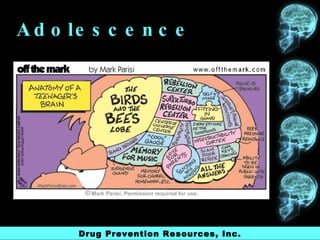
Adolescence Drug Prevention Resources, Inc.
 
Video Dr. Jay Giedd, National Institute of Mental Health “ Inside the Teenage Brain” PBS Frontline  http://www.pbs.org/wgbh/pages/frontline/shows/teenbrain/view/ Drug Prevention Resources, Inc.
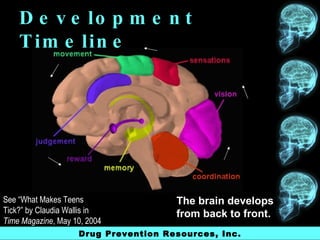
Development Timeline The brain develops from back to front. See “What Makes Teens Tick?” by Claudia Wallis in  Time Magazine , May 10, 2004 Drug Prevention Resources, Inc.
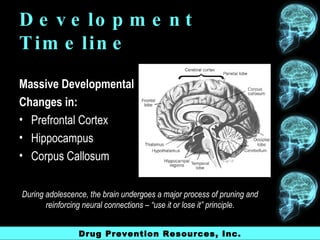
Development Timeline Massive Developmental Changes in: Prefrontal Cortex Hippocampus Corpus Callosum During adolescence, the brain undergoes a major process of pruning and reinforcing neural connections – “use it or lose it” principle. Drug Prevention Resources, Inc.
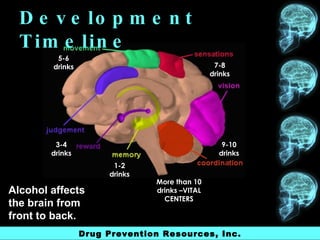
Development Timeline Alcohol affects the brain from front to back. 1-2 drinks 3-4 drinks 5-6 drinks 7-8 drinks 9-10 drinks More than 10 drinks –VITAL CENTERS Drug Prevention Resources, Inc.
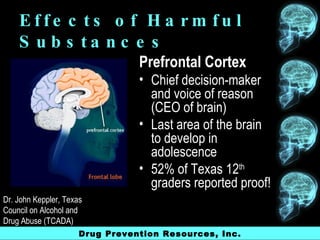
Effects of Harmful Substances Prefrontal Cortex Chief decision-maker and voice of reason (CEO of brain) Last area of the brain to develop in adolescence 52% of Texas 12 th  graders reported proof! Dr. John Keppler, Texas Council on Alcohol and Drug Abuse (TCADA) Drug Prevention Resources, Inc.
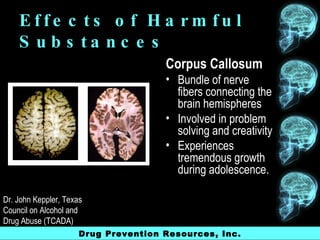
Effects of Harmful Substances Corpus Callosum Bundle of nerve fibers connecting the brain hemispheres Involved in problem solving and creativity Experiences tremendous growth during adolescence. Dr. John Keppler, Texas Council on Alcohol and Drug Abuse (TCADA) Drug Prevention Resources, Inc.
Effects of Harmful Substances Hippocampus Responsible for learning and memory Most sensitive during adolescence Shutdown results in blackouts Smaller in alcohol-abusing teens See “Getting Stupid” by Bernice Wuethrich in  Discover Magazine , March 2001 Drug Prevention Resources, Inc.
Effects of Harmful Substances Hippocampus In the lab, drinking teens aged 15 to 16 had a harder time than non-drinking teens in both verbal and non-verbal tests of memory recall. Teens could not remember words such as apple and football that they had learned just 20 minutes before. See “Getting Stupid” by Bernice Wuethrich in  Discover Magazine , March 2001 Drug Prevention Resources, Inc.
Implications for Teen Drivers Teens are more prone to engage in risky behavior due to brain development not reaching completion until age 25. Good judgment is inhibited, especially when faced with distractions or when teens are in groups. Teens are four times as likely as older drivers to be involved in a crash a three times as likely to die in one. (Insurance Institute for Highway Safety) Drug Prevention Resources, Inc.
Implications for Teen Drivers Group Danger The chances of a crash by a 16- or 17-year-old driver are doubled with two peers in the vehicle and quadrupled with three or more. (IIHS) Teens start to take even more risks in the presence of their friends. (Laurence Steinberg, Temple University) Drug Prevention Resources, Inc.
Keeping Teens Safe –  Action Steps Successful Prevention Strategy Prevention Education Effective Policy Social Norms Approach Drug Prevention Resources, Inc.
Keeping Teens Safe –  Action Steps Prevention Education Review current programs and evaluate effectiveness Effective Policy Restricting teen driving – raise driving age,  limit number of passengers, ban cell phone use (talking, texting, etc.) Drug Prevention Resources, Inc.
He that gives good advice builds with one hand; he that gives good counsel and example builds with both. -Francis Bacon Drug Prevention Resources, Inc.
Sarah Pahl, MSW Drug Prevention Resources, Inc. 972-812-6312 [email_address] www.impactcommunities.com Contact Info Drug Prevention Resources, Inc.

The Teen Brain

  • 1.
    The Teen BrainSolving the Mystery of Adolescence Sarah Pahl, MSW Drug Prevention Resources, Inc. Drug Prevention Resources, Inc.
  • 2.
    Overview Leading ResearchDevelopmental Timeline Effects of Harmful Substances Implications for Teen Drivers Keeping Teens Safe – Action Steps Drug Prevention Resources, Inc.
  • 3.
  • 4.
  • 5.
    Video Dr. JayGiedd, National Institute of Mental Health “ Inside the Teenage Brain” PBS Frontline http://www.pbs.org/wgbh/pages/frontline/shows/teenbrain/view/ Drug Prevention Resources, Inc.
  • 6.
    Development Timeline Thebrain develops from back to front. See “What Makes Teens Tick?” by Claudia Wallis in Time Magazine , May 10, 2004 Drug Prevention Resources, Inc.
  • 7.
    Development Timeline MassiveDevelopmental Changes in: Prefrontal Cortex Hippocampus Corpus Callosum During adolescence, the brain undergoes a major process of pruning and reinforcing neural connections – “use it or lose it” principle. Drug Prevention Resources, Inc.
  • 8.
    Development Timeline Alcoholaffects the brain from front to back. 1-2 drinks 3-4 drinks 5-6 drinks 7-8 drinks 9-10 drinks More than 10 drinks –VITAL CENTERS Drug Prevention Resources, Inc.
  • 9.
    Effects of HarmfulSubstances Prefrontal Cortex Chief decision-maker and voice of reason (CEO of brain) Last area of the brain to develop in adolescence 52% of Texas 12 th graders reported proof! Dr. John Keppler, Texas Council on Alcohol and Drug Abuse (TCADA) Drug Prevention Resources, Inc.
  • 10.
    Effects of HarmfulSubstances Corpus Callosum Bundle of nerve fibers connecting the brain hemispheres Involved in problem solving and creativity Experiences tremendous growth during adolescence. Dr. John Keppler, Texas Council on Alcohol and Drug Abuse (TCADA) Drug Prevention Resources, Inc.
  • 11.
    Effects of HarmfulSubstances Hippocampus Responsible for learning and memory Most sensitive during adolescence Shutdown results in blackouts Smaller in alcohol-abusing teens See “Getting Stupid” by Bernice Wuethrich in Discover Magazine , March 2001 Drug Prevention Resources, Inc.
  • 12.
    Effects of HarmfulSubstances Hippocampus In the lab, drinking teens aged 15 to 16 had a harder time than non-drinking teens in both verbal and non-verbal tests of memory recall. Teens could not remember words such as apple and football that they had learned just 20 minutes before. See “Getting Stupid” by Bernice Wuethrich in Discover Magazine , March 2001 Drug Prevention Resources, Inc.
  • 13.
    Implications for TeenDrivers Teens are more prone to engage in risky behavior due to brain development not reaching completion until age 25. Good judgment is inhibited, especially when faced with distractions or when teens are in groups. Teens are four times as likely as older drivers to be involved in a crash a three times as likely to die in one. (Insurance Institute for Highway Safety) Drug Prevention Resources, Inc.
  • 14.
    Implications for TeenDrivers Group Danger The chances of a crash by a 16- or 17-year-old driver are doubled with two peers in the vehicle and quadrupled with three or more. (IIHS) Teens start to take even more risks in the presence of their friends. (Laurence Steinberg, Temple University) Drug Prevention Resources, Inc.
  • 15.
    Keeping Teens Safe– Action Steps Successful Prevention Strategy Prevention Education Effective Policy Social Norms Approach Drug Prevention Resources, Inc.
  • 16.
    Keeping Teens Safe– Action Steps Prevention Education Review current programs and evaluate effectiveness Effective Policy Restricting teen driving – raise driving age, limit number of passengers, ban cell phone use (talking, texting, etc.) Drug Prevention Resources, Inc.
  • 17.
    He that givesgood advice builds with one hand; he that gives good counsel and example builds with both. -Francis Bacon Drug Prevention Resources, Inc.
  • 18.
    Sarah Pahl, MSWDrug Prevention Resources, Inc. 972-812-6312 [email_address] www.impactcommunities.com Contact Info Drug Prevention Resources, Inc.

Editor's Notes

  • #2 Introduce self, DPRI, and IMPACT Communities.