Dr. Gay E. Phillips
barton.phillips & associates, inc.
                Tulsa, Oklahoma
GLBTTIQQ

 What is this
alphabet soup?
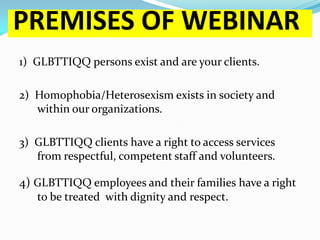
PREMISES OF WEBINAR
1) GLBTTIQQ persons exist and are your clients.

2) Homophobia/Heterosexism exists in society and
   within our organizations.

3) GLBTTIQQ clients have a right to access services
   from respectful, competent staff and volunteers.

4) GLBTTIQQ employees and their families have a right
   to be treated with dignity and respect.
Cultural Competency Definition
Gaining cultural competence is a long term process of
 expanding horizons, thinking critically about issues of
 power and oppression, and acting appropriately.


Culturally competent individuals have a mixture of
 beliefs, attitudes, knowledge, and skills that help them
 establish trust and communicate with others.
                         University of Oklahoma, National Resource Center for Youth Services, Tulsa, OK
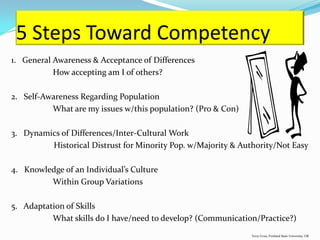
5 Steps Toward Competency
1. General Awareness & Acceptance of Differences
           How accepting am I of others?

2. Self-Awareness Regarding Population
          What are my issues w/this population? (Pro & Con)

3. Dynamics of Differences/Inter-Cultural Work
         Historical Distrust for Minority Pop. w/Majority & Authority/Not Easy

4. Knowledge of an Individual’s Culture
         Within Group Variations

5. Adaptation of Skills
          What skills do I have/need to develop? (Communication/Practice?)
                                                               Terry Cross, Portland State University, OR
Four Areas of Competency-Based
Services to GLBTTIQQ
1. Creating Intentional Invitations
    Conversation, attitude, and environment.
2. Triage, Assessments, Counseling
     Best practices.
3. Advocacy
     Giving voice & support!
4. Referrals
     When I’m not the one to help, who is?
Agency Readiness
 Leadership
 Policies & Procedures
 Human Resources
 Knowledge & Development
 Climate & Environment
 Practices
 Community Relations
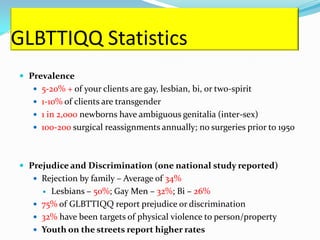
GLBTTIQQ Statistics
 Prevalence
    5-20% + of your clients are gay, lesbian, bi, or two-spirit
    1-10% of clients are transgender
    1 in 2,000 newborns have ambiguous genitalia (inter-sex)
    100-200 surgical reassignments annually; no surgeries prior to 1950


 Prejudice and Discrimination (one national study reported)
    Rejection by family – Average of 34%
      Lesbians – 50%; Gay Men – 32%; Bi – 26%
    75% of GLBTTIQQ report prejudice or discrimination
    32% have been targets of physical violence to person/property
    Youth on the streets report higher rates
Challenges
 Physical/Psychological Threats &/or Harm (Bullying)


 Isolation/Ostrasized


 Rejection by Family, Friends, School, Religious Affil.


 Name-calling


 Self-Hatred
Challenges, Cont.
 These issues can put these youth at higher risk for:
    Homelessness


   Self-Harm, including suicide


   Substance Abuse


   Promiscuity, including human trafficking


   Etc.
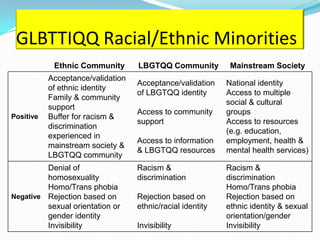
GLBTTIQQ Racial/Ethnic Minorities
            Ethnic Community       LBGTQQ Community          Mainstream Society
           Acceptance/validation
                                   Acceptance/validation    National identity
           of ethnic identity
                                   of LBGTQQ identity       Access to multiple
           Family & community
                                                            social & cultural
           support
                                   Access to community      groups
Positive   Buffer for racism &
                                   support                  Access to resources
           discrimination
                                                            (e.g. education,
           experienced in
                                   Access to information    employment, health &
           mainstream society &
                                   & LBGTQQ resources       mental health services)
           LBGTQQ community
         Denial of                 Racism &                 Racism &
         homosexuality             discrimination           discrimination
         Homo/Trans phobia                                  Homo/Trans phobia
Negative Rejection based on        Rejection based on       Rejection based on
         sexual orientation or     ethnic/racial identity   ethnic identity & sexual
         gender identity                                    orientation/gender
         Invisibility              Invisibility             Invisibility
Religious/Faith Issues
 Explore own issues
 Expect faith issues
 Find out/explore concerns
 Acknowledge this isn’t your expertise (if isn’t)
 Provide alternative views within their own faith
 Ask families & friends to
   resist “reacting”
   discuss consequences of any actions
 Be an alternative voice

GLBTTIQQ PEOPLE OF FAITH HAVE NOT ABANDONED THEIR FAITH
Resources for Dealing with Religious
Issues

Is the Homosexual My Neighbor
             by Scanzoni & Mollenkott


 PFLAG (Parents, Family, and Friends of Lesbians and
 Gays) – religious materials: www.pflag.org
Language
 Words/Labels are powerful (Positive & Negative).


 Some youth self-identify, use their words.


 Language changes often, go with the flow/Get comfortable
 with the words.

 Ask when you don’t know what something means.


 ALWAYS CONFRONT NAME-CALLING/BULLYING!!!
Attitude/Willingness is Everything

 Heterosexist Assumption
 Historical Distrust/Impact of “Ism’s”
 Know your Values & Biases
 Readiness/Timing on their part
 Be Comfortable w/being Uncomfortable!
 Transference/Counter Transference – ours/theirs
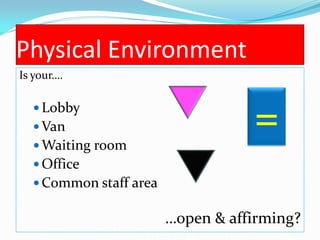
Physical Environment
Is your….

   Lobby
   Van
   Waiting room
                                   =
   Office
   Common staff area

                        …open & affirming?
Sexual Orientation and/or
Gender Identity may/may not
  complicate current issues,
  trauma, or mental health
         concerns
Triage/Assessment

    Assess for Safety & Risk Behaviors

    Assess Support Network

    Stabilize & Support
Coming Out Process/Identity:
CASS Model
 Confusion
 Comparison
 Tolerance
 Acceptance
 Pride
 Synthesis
Protecting Confidentiality

  Avoid pathologizing/DSMR…


  Strategize with Client (or your co-worker)


  Understand Insurance Impact


  HIPPA/Privacy vs. Inclusion/Documenting
Adjustment Counseling
 Validate the “Coming Out” Process
 Developmental Delays
 Dealing with Stigma/Rejection
 Internalized Homo/Trans Phobia
 Risky Behaviors/Healthy Decision-Making
 Redefining/Adjusting Expectations
 Issues in Relationships with Family, Partner,
 Friends, Employer
No data demonstrates that reparative or
conversion therapies are effective and in
 fact, they may be harmful. NASW and
most other professional associations do
       not support these programs.
“Reparative” Programs/Therapy
 If a client decides to try one of these programs, stay in
  contact and monitor their feelings, behaviors – overall
  mental health. Most individuals fail in these programs
  and can become more at risk of self-harm. A few
  people use these programs to improve their overall
  functioning, but do not claim that their “gayness” ---
  sexual orientation is changed, it’s just not lived out.

                *Be ready to step back in to assess and/or
                 provide services.
Trauma Issues
 Abuse Victimology: Child, Sex, Substance


 Dysfunctional Families


 Domestic Violence


 Impact of Risk Behaviors


 Dealing with a History of Rejection
Coming Out/Counseling
with Families
 34% of GLBTTIQQ persons are rejected by their
  families
 Explore each members individual/personal issues:
  grief, “loss of dreams,” fears, etc.
 Help them adjust/redefine their expectations &
  use coping skills to deal w/anxieties, fears, beliefs,
  “hiding”
 Explore consequences of any actions
 Work for acceptance/Find common ground
 Your goal is to keep family talking/connected.
Transgender Issues – FTM/MTF
 Sexual Orientation Vs. Gender Identity
 Housing
 Developmental Delays
 Transphobia & Internalized Transphobia
 Relationship Issues – who will love me?
 Personnel Practices/Harry Benjamin Standards
 Stages of Transition
 Life After Surgery
Inter-sexed Issues
 We are beginning to see/become aware of youth
 dealing with issues of gender identity, sexual
 orientation, sexuality, etc. who were born with non-
 descript or multiple genitilia. Perhaps they were
 surgically changed at birth, perhaps not.

 And there is a growing network of these individuals
 who are advocating for non-surgical approaches until
 the child can make their own decisions.
INTERSEXED ISSUES
 Identity at Birth


 Surgery at Birth


 Prepare for Possible Stigmatization


 Later in Life Identity/Surgery?


 Work with this group in the same ways: assess, triage,
  counsel, support, advocate, network, etc.
Effective Advocacy

 Arm Yourself – Policies/Procedures w/in
  Agency/Professional Org., & Laws
 Be Willing to Advocate/Speak Up
 Look for “Blind Spots”/In Competencies
 Educate Those Around You
 Advocate for your GLBTIQQ Colleagues
Advocacy- What can you do?
Agency/Company Readiness Checklist
       How ready is our agency/state Professional organizations?

Educate colleagues, friends and family.
        How often do Professional Asso. host trainings on these topics?
        Does our local Association have training?

Check your local library
        Donate books related to GLBTIQ issues.
        Does our college campus library have any books or
           journals on GLBTIQ issues?

“52 things you can do for transgender equality.”
Advocate for local, state and national legislation for equality.
Timely & Appropriate Referrals:
Who, When, Where
 Build Your Professional Network


 Contact GLBTTIQ Community Centers


 If you don’t know, don’t refer. Check out a therapist or
  program yourself first.

 Asso. policies state that as a licensed therapist it is
  unethical to refer clients to therapists who participate
  in “reparative therapies or conversion programs.”
Additional Resources
 Kaiser Permanente – Health Protocols
 PFLAG (national and local chapters)
 Child Welfare League of America
 National Association of Social Workers
 Gay and Lesbian Student Alliance Network (safe zone
  stickers)
 COLLAGE (for youth whose parents are GLB)
Thank You For
Participating!!

   )))))))
Questions?
Comments?
TRANSGENDER PROTOCOLS
                Sample Policies
          Hayworth House Emergency Shelter
                  Boston

 1. Allows individuals to self-identify and staff strive
 to not make assumptions based on appearances.

 2. If staff members are unsure of what pronoun
 (he, she) to use with a resident they will ask that
 person how they identify.
Hayworth House model policy

3. Trans residents will not have any additional
clothing requirements imposed upon them
different than other residents (e.g. wearing
makeup or particular clothing.)
4. If a person does not have identification,
staff will not refuse the person.
5. If the person uses a different name than on
their identification, both names will be noted,
and the preferred name will be used.
Hayworth House model policy
 6. If the person identifies as particular sex or
 gender and presents or lives as that sex or
 gender, they will have access to the dorms of
 that sex/gender, or the dorm the individual feels
 most safe in.

 7. If there are concerns about the safety of a
 resident (such as a transgender person) those
 who are threatening the safety of the resident
 (through intimidation, threats, violence, or other
 forms of unacceptable behavior) will be
 approached.
Hayworth House model policy
 8. Hayworth House addresses behavior issues,
 not identification issues. If someone breaks the
 rules of the shelter that behavior will be
 addressed.

 9. Residents who harass, abuse, assault, or
 discriminate against other residents will be dealt
 with based upon the suspicion of guideline
 violation. Heyworth House recognizes that
 harassment based upon sex or gender identity is
 discriminatory behavior and will be treated as
 such.
Hayworth House model policy
  Training:

  All staff working at Heyworth House are
  required to go through training regarding trans
  issues within 6 months of commencing work at
  the shelter.

  There will be regular training for residents
  regarding trans issues (at least three times a
  year.)

Natl safe place glbtq webinar pp

  • 1.
    Dr. Gay E.Phillips barton.phillips & associates, inc. Tulsa, Oklahoma
  • 2.
    GLBTTIQQ What isthis alphabet soup?
  • 3.
    PREMISES OF WEBINAR 1)GLBTTIQQ persons exist and are your clients. 2) Homophobia/Heterosexism exists in society and within our organizations. 3) GLBTTIQQ clients have a right to access services from respectful, competent staff and volunteers. 4) GLBTTIQQ employees and their families have a right to be treated with dignity and respect.
  • 4.
    Cultural Competency Definition Gainingcultural competence is a long term process of expanding horizons, thinking critically about issues of power and oppression, and acting appropriately. Culturally competent individuals have a mixture of beliefs, attitudes, knowledge, and skills that help them establish trust and communicate with others. University of Oklahoma, National Resource Center for Youth Services, Tulsa, OK
  • 5.
    5 Steps TowardCompetency 1. General Awareness & Acceptance of Differences How accepting am I of others? 2. Self-Awareness Regarding Population What are my issues w/this population? (Pro & Con) 3. Dynamics of Differences/Inter-Cultural Work Historical Distrust for Minority Pop. w/Majority & Authority/Not Easy 4. Knowledge of an Individual’s Culture Within Group Variations 5. Adaptation of Skills What skills do I have/need to develop? (Communication/Practice?) Terry Cross, Portland State University, OR
  • 6.
    Four Areas ofCompetency-Based Services to GLBTTIQQ 1. Creating Intentional Invitations Conversation, attitude, and environment. 2. Triage, Assessments, Counseling Best practices. 3. Advocacy Giving voice & support! 4. Referrals When I’m not the one to help, who is?
  • 7.
    Agency Readiness  Leadership Policies & Procedures  Human Resources  Knowledge & Development  Climate & Environment  Practices  Community Relations
  • 8.
    GLBTTIQQ Statistics  Prevalence  5-20% + of your clients are gay, lesbian, bi, or two-spirit  1-10% of clients are transgender  1 in 2,000 newborns have ambiguous genitalia (inter-sex)  100-200 surgical reassignments annually; no surgeries prior to 1950  Prejudice and Discrimination (one national study reported)  Rejection by family – Average of 34%  Lesbians – 50%; Gay Men – 32%; Bi – 26%  75% of GLBTTIQQ report prejudice or discrimination  32% have been targets of physical violence to person/property  Youth on the streets report higher rates
  • 9.
    Challenges  Physical/Psychological Threats&/or Harm (Bullying)  Isolation/Ostrasized  Rejection by Family, Friends, School, Religious Affil.  Name-calling  Self-Hatred
  • 10.
    Challenges, Cont.  Theseissues can put these youth at higher risk for:  Homelessness  Self-Harm, including suicide  Substance Abuse  Promiscuity, including human trafficking  Etc.
  • 11.
    GLBTTIQQ Racial/Ethnic Minorities Ethnic Community LBGTQQ Community Mainstream Society Acceptance/validation Acceptance/validation National identity of ethnic identity of LBGTQQ identity Access to multiple Family & community social & cultural support Access to community groups Positive Buffer for racism & support Access to resources discrimination (e.g. education, experienced in Access to information employment, health & mainstream society & & LBGTQQ resources mental health services) LBGTQQ community Denial of Racism & Racism & homosexuality discrimination discrimination Homo/Trans phobia Homo/Trans phobia Negative Rejection based on Rejection based on Rejection based on sexual orientation or ethnic/racial identity ethnic identity & sexual gender identity orientation/gender Invisibility Invisibility Invisibility
  • 12.
    Religious/Faith Issues  Exploreown issues  Expect faith issues  Find out/explore concerns  Acknowledge this isn’t your expertise (if isn’t)  Provide alternative views within their own faith  Ask families & friends to  resist “reacting”  discuss consequences of any actions  Be an alternative voice GLBTTIQQ PEOPLE OF FAITH HAVE NOT ABANDONED THEIR FAITH
  • 13.
    Resources for Dealingwith Religious Issues Is the Homosexual My Neighbor by Scanzoni & Mollenkott PFLAG (Parents, Family, and Friends of Lesbians and Gays) – religious materials: www.pflag.org
  • 15.
    Language  Words/Labels arepowerful (Positive & Negative).  Some youth self-identify, use their words.  Language changes often, go with the flow/Get comfortable with the words.  Ask when you don’t know what something means.  ALWAYS CONFRONT NAME-CALLING/BULLYING!!!
  • 16.
    Attitude/Willingness is Everything Heterosexist Assumption  Historical Distrust/Impact of “Ism’s”  Know your Values & Biases  Readiness/Timing on their part  Be Comfortable w/being Uncomfortable!  Transference/Counter Transference – ours/theirs
  • 17.
    Physical Environment Is your….  Lobby  Van  Waiting room =  Office  Common staff area …open & affirming?
  • 19.
    Sexual Orientation and/or GenderIdentity may/may not complicate current issues, trauma, or mental health concerns
  • 20.
    Triage/Assessment Assess for Safety & Risk Behaviors Assess Support Network Stabilize & Support
  • 21.
    Coming Out Process/Identity: CASSModel Confusion Comparison Tolerance Acceptance Pride Synthesis
  • 22.
    Protecting Confidentiality Avoid pathologizing/DSMR…  Strategize with Client (or your co-worker)  Understand Insurance Impact  HIPPA/Privacy vs. Inclusion/Documenting
  • 23.
    Adjustment Counseling  Validatethe “Coming Out” Process  Developmental Delays  Dealing with Stigma/Rejection  Internalized Homo/Trans Phobia  Risky Behaviors/Healthy Decision-Making  Redefining/Adjusting Expectations  Issues in Relationships with Family, Partner, Friends, Employer
  • 24.
    No data demonstratesthat reparative or conversion therapies are effective and in fact, they may be harmful. NASW and most other professional associations do not support these programs.
  • 25.
    “Reparative” Programs/Therapy  Ifa client decides to try one of these programs, stay in contact and monitor their feelings, behaviors – overall mental health. Most individuals fail in these programs and can become more at risk of self-harm. A few people use these programs to improve their overall functioning, but do not claim that their “gayness” --- sexual orientation is changed, it’s just not lived out. *Be ready to step back in to assess and/or provide services.
  • 26.
    Trauma Issues  AbuseVictimology: Child, Sex, Substance  Dysfunctional Families  Domestic Violence  Impact of Risk Behaviors  Dealing with a History of Rejection
  • 27.
    Coming Out/Counseling with Families 34% of GLBTTIQQ persons are rejected by their families  Explore each members individual/personal issues: grief, “loss of dreams,” fears, etc.  Help them adjust/redefine their expectations & use coping skills to deal w/anxieties, fears, beliefs, “hiding”  Explore consequences of any actions  Work for acceptance/Find common ground  Your goal is to keep family talking/connected.
  • 28.
    Transgender Issues –FTM/MTF  Sexual Orientation Vs. Gender Identity  Housing  Developmental Delays  Transphobia & Internalized Transphobia  Relationship Issues – who will love me?  Personnel Practices/Harry Benjamin Standards  Stages of Transition  Life After Surgery
  • 29.
    Inter-sexed Issues  Weare beginning to see/become aware of youth dealing with issues of gender identity, sexual orientation, sexuality, etc. who were born with non- descript or multiple genitilia. Perhaps they were surgically changed at birth, perhaps not.  And there is a growing network of these individuals who are advocating for non-surgical approaches until the child can make their own decisions.
  • 30.
    INTERSEXED ISSUES  Identityat Birth  Surgery at Birth  Prepare for Possible Stigmatization  Later in Life Identity/Surgery?  Work with this group in the same ways: assess, triage, counsel, support, advocate, network, etc.
  • 32.
    Effective Advocacy  ArmYourself – Policies/Procedures w/in Agency/Professional Org., & Laws  Be Willing to Advocate/Speak Up  Look for “Blind Spots”/In Competencies  Educate Those Around You  Advocate for your GLBTIQQ Colleagues
  • 33.
    Advocacy- What canyou do? Agency/Company Readiness Checklist How ready is our agency/state Professional organizations? Educate colleagues, friends and family. How often do Professional Asso. host trainings on these topics? Does our local Association have training? Check your local library Donate books related to GLBTIQ issues. Does our college campus library have any books or journals on GLBTIQ issues? “52 things you can do for transgender equality.” Advocate for local, state and national legislation for equality.
  • 35.
    Timely & AppropriateReferrals: Who, When, Where  Build Your Professional Network  Contact GLBTTIQ Community Centers  If you don’t know, don’t refer. Check out a therapist or program yourself first.  Asso. policies state that as a licensed therapist it is unethical to refer clients to therapists who participate in “reparative therapies or conversion programs.”
  • 36.
    Additional Resources  KaiserPermanente – Health Protocols  PFLAG (national and local chapters)  Child Welfare League of America  National Association of Social Workers  Gay and Lesbian Student Alliance Network (safe zone stickers)  COLLAGE (for youth whose parents are GLB)

  • 37.
  • 38.
  • 39.
    TRANSGENDER PROTOCOLS Sample Policies Hayworth House Emergency Shelter Boston 1. Allows individuals to self-identify and staff strive to not make assumptions based on appearances. 2. If staff members are unsure of what pronoun (he, she) to use with a resident they will ask that person how they identify.
  • 40.
    Hayworth House modelpolicy 3. Trans residents will not have any additional clothing requirements imposed upon them different than other residents (e.g. wearing makeup or particular clothing.) 4. If a person does not have identification, staff will not refuse the person. 5. If the person uses a different name than on their identification, both names will be noted, and the preferred name will be used.
  • 41.
    Hayworth House modelpolicy 6. If the person identifies as particular sex or gender and presents or lives as that sex or gender, they will have access to the dorms of that sex/gender, or the dorm the individual feels most safe in. 7. If there are concerns about the safety of a resident (such as a transgender person) those who are threatening the safety of the resident (through intimidation, threats, violence, or other forms of unacceptable behavior) will be approached.
  • 42.
    Hayworth House modelpolicy 8. Hayworth House addresses behavior issues, not identification issues. If someone breaks the rules of the shelter that behavior will be addressed. 9. Residents who harass, abuse, assault, or discriminate against other residents will be dealt with based upon the suspicion of guideline violation. Heyworth House recognizes that harassment based upon sex or gender identity is discriminatory behavior and will be treated as such.
  • 43.
    Hayworth House modelpolicy Training: All staff working at Heyworth House are required to go through training regarding trans issues within 6 months of commencing work at the shelter. There will be regular training for residents regarding trans issues (at least three times a year.)