Bullying: Lifelong Pain
 Prelude to Violence

      SuEllen Fried
      BullySafeUSA
Definition of Bullying:
 Bullying occurs when one or more
individuals inflict physical, verbal,
  emotional, psychological and/or
sexual abuse on another or others.
Is it really a problem?
   In 2/3 of the 37 school shootings since 1974, the attackers
    felt persecuted, bullied, threatened, attacked or injured.

   There has been an alarming increase in youth suicide in the last
    decade and more and more students are experiencing
    depression. Between 1980-1997, the rate of suicide increased
    109% for 10-14 year old students.

   74% of 8-11 year old students say that teasing and bullying
    occur at their school.

    Recent study indicates that in the United States,
    5,736,417 students are involved in bullying- as a bully, a target
     or both.
Journal of American Medical
          Association Research Article on
                      Bullying
● The study measured the prevalence of bullying behaviors among youth and
   attempted to determine an association of bullying and being bullied with
   indicators of social adjustment: problem behavior, school adjustment,
   social/emotional adjustment, and parenting.

● The sample included 15686 students grades 6-10 throughout the US. Students
   filled out a survey that measured their involvement in bullying- either as a bully
   or as a target.

● They found that 29.9% reported being involved as a bully (13.0%), a target
   (10.6%) or both (6.3%).

● They concluded that the prevalence of bullying among US youth is substantial,
   and that given the behavioral and emotional difficulties associated with
   bullying, as well as the long term negative outcomes for the youth involved, the
   issue of bullying merits serious attention- both for future research and
   PREVENTATIVE INTERVENTION.
Four Major Concerns
   Targets

       Bullies

           Witnesses

               Teachers
Targets
   Over 160,000 students stay home from school
    each day because of fears of what might happen
    to them on the bus, the playground, the
    bathroom, the cafeteria, the hallways, the locker
    room, the classroom, or walking home from school.
   Anxiety increases for students being bullied and
    decreases concentration- lowering students
    ability to retain and learn materials covered in
    the classroom.
   Today’s target can become tomorrow’s bully- most
    of the students involved in classmate shootings
    had suffered rejection at the hands of their
    peers.
Bullies
In a research study done by Dr. Leonard
   Eron, he found:
 One out of four bullies nominated by their
   classmates in the third grade, had a
   criminal record by the age of 28
 Male bullies were at greater risk to have
   become abusive husbands
 Female bullies were more likely to have
   become abusive mothers
More Bully Research
In another research study conducted in Norway by Dan
Olweus, 60% of children identified a s bullies between
grades six and ten were cited for criminal behavior as
adults, and 40% had three or more convictions.


A study published in Learning 94 concluded that bullies
whose behavior is allowed to continue are five times more
likely to be involved with the juvenile justice system, to be
convicted if crimes and to have children with aggression
problems.
Witnesses
   The “Silent Victim”
   Develop a range of responses
       They may become angry at the target for failing
        to eliminate the situation
       They build a wall around their feelings to
        diminish the discomfort
       They conceal the situation for fear of reprisal
       They encourage and support the bully to gain
        favor with the perpetrator
       They become an accomplice
Teachers
On a daily basis:
 6,250 Teachers are threatened with
  bodily harm (National Education
  Association, NEA)
 260 Teachers are physically
  assaulted (NEA)
 Teachers are also witnesses, often
  experiencing the same responses
Teasing VS. Bullying
   What is the difference between
    teasing and bullying?
   Teasing occurs when there is a “give
    and take” - No one gets hurt
   Bullying occurs when one person does
    all the giving and the other person
    does all the taking- Someone gets
    hurt
5 Types of Bullying
   Physical

       Verbal

         Emotional


             Sexual

                  Cyber
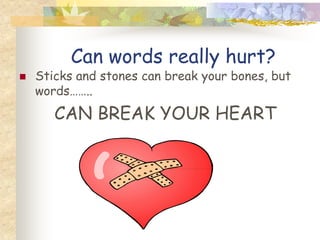
Can words really hurt?
   Sticks and stones can break your bones, but
    words……..
       CAN BREAK YOUR HEART
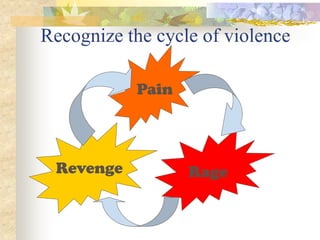
Recognize the cycle of violence

           Pain


 Revenge          Rage
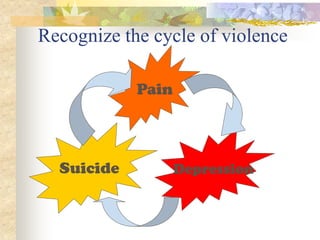
Recognize the cycle of violence

            Pain


  Suicide          Depression
Three Kinds of Bullies
            The Proactive Bully

• Bullies for the pleasure of it
• Has no apparent motive
• Has antisocial traits
• Does not form attachments
• Can be cold and calculating
The Reactive Bully
   Bullies in response to a
    perceived threat
   Is hyper-vigilant to signs of
    provocation
   Does not believe that he/she
    initiates bullying behavior
   May be or have been a target
The Elitist Bully

   Bullies because of perceived position

   Has been corrupted by the power
    he/she acquires because of
    attractiveness, wealth, athletic ability,
    or parents’ status
Apathy/Sympathy/Empathy
     Discussion with students
   Apathy- lack of feeling
   Sympathy- feeling sorry for someone
   Empathy- caring about and trying to
    understand how someone else feels
         “Walk a mile in my shoes”
Strategies for schools
   Develop a school-wide policy on bullying prevention and
    intervention.

• Define unacceptable behaviors and the consequences for
  those behaviors and consistently impose them.
• Use consistent terminology to hold students accountable for
  various forms of bullying.
• Saturate the school atmosphere with anti-bullying messages
  and incentives.
• Determine high-risk locations for bullying and actively
  monitor these areas.

• Involve everyone to make it a whole-school team approach.
• Involve parents- SAC, PTO, Parent Handout
Strategies for Teachers
   Emphasize the importance of respect and dignity
    for EVERYONE in the classroom.
    Emphasize a respect for differences of all kinds.
   Model appropriate behavior- apologies and
    appreciations. The ways in which you handle your
    own anger, stress, frustration and mistakes
    provide valuable lessons for students.
   Discuss difference between tattling and
    reporting
   Role play situations with students- develop
    strategies with them to handle bullying situations
•   Teach about ethics and ethical behavior
• Assure students of confidentiality when reporting
  bullying. THIS IS CRUCIAL!


• Never dismiss a report. Be responsive to students’
  communications.


• Speak with targets and bullies separately.


• Bring the bully and victim together only if the target
  consents, but do not leave the target exposed and
  vulnerable.
Interventions with Bullies
   Confront bullies in private- avoid giving them
    public status and power
   Determine source of bullying behavior- i.e.
    low self esteem, past target, difficulties at
    home, anger etc.
   Give opportunity to make amends
   Offer incentives for positive behavior
   Give opportunity to teach Kindness and Bully
    Prevention strategies to younger students
Interventions with Bullies
Proactive Bullies need to experience the consequences
   of their choices. Set the boundaries, establish the
   limits and enforce the penalties.


Reactive Bullies need to develop relationship skills. Refer
  for anger management, empathy training, mediation and
  social skills training and problem solving approaches.

Elitist Bullies need to become less self-centered.
   Assign them service learning experiences,
   community volunteer opportunities and
   opportunities for creative leadership.
Interventions with Targets
٠Targets need to hear that no child deserves to be
     bullied and that you will do all you can to help
     them.
• Teach and role play assertiveness. Give them
     language ideas, scripts and role-playing
     opportunities.
• Discuss body language and facial expressions.
• Help them recognize and break any annoying habits
      that irritate peers and attract bullies.
• Support and emphasize the strengths of the
      target.
Teach students that bullies “shop around” for
     targets and look for students who will:

 Cry

       Comply

             Deny

                    Fly off the handle


       Don’t Get Hooked By A Bully
Interventions with Witnesses
   Establish a respectful atmosphere in the
    classroom
   Remind students of responsibility to report
    bullying incidents to an adult
   Make a commitment to keep reports confidential
   Role play strategies to support targets
   Encourage them to support the target in
    whatever manner they are comfortable.
   Discuss a sense of fairness, justice, and a moral
    code that reflects the ethics of students.
Students are in need of S.O.S. from teachers
              Skills - Observation - Support

    Skills for targets, bullies and witnesses have been discussed
     earlier.
• Observation
    Monitor your class and the hallways. Instead of talking to
    another teacher, watch what is happening between classes.
    Occasionally walk into student restrooms.
    Discern bullying behaviors. Become more attuned to the
    slights, derisive laughter and ostracizing that takes place.
    Supervise thoughtfully. Students are concerned when the
    teacher leaves the classroom physically or mentally. Leave
    specific instructions for substitute teachers.
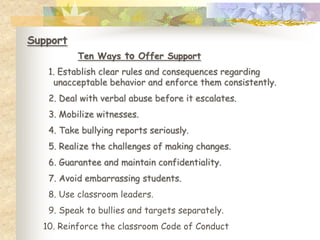
Support
          Ten Ways to Offer Support
   1. Establish clear rules and consequences regarding
    unacceptable behavior and enforce them consistently.
   2. Deal with verbal abuse before it escalates.
   3. Mobilize witnesses.
   4. Take bullying reports seriously.
   5. Realize the challenges of making changes.
   6. Guarantee and maintain confidentiality.
   7. Avoid embarrassing students.
   8. Use classroom leaders.
   9. Speak to bullies and targets separately.
  10. Reinforce the classroom Code of Conduct
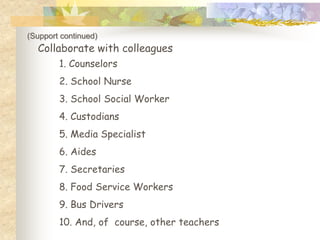
(Support continued)
  Collaborate with colleagues
        1. Counselors
        2. School Nurse
        3. School Social Worker
        4. Custodians
        5. Media Specialist
        6. Aides
        7. Secretaries
        8. Food Service Workers
        9. Bus Drivers
        10. And, of course, other teachers

Bullying prevention

  • 1.
    Bullying: Lifelong Pain Prelude to Violence SuEllen Fried BullySafeUSA
  • 2.
    Definition of Bullying: Bullying occurs when one or more individuals inflict physical, verbal, emotional, psychological and/or sexual abuse on another or others.
  • 3.
    Is it reallya problem?  In 2/3 of the 37 school shootings since 1974, the attackers felt persecuted, bullied, threatened, attacked or injured.  There has been an alarming increase in youth suicide in the last decade and more and more students are experiencing depression. Between 1980-1997, the rate of suicide increased 109% for 10-14 year old students.  74% of 8-11 year old students say that teasing and bullying occur at their school.  Recent study indicates that in the United States, 5,736,417 students are involved in bullying- as a bully, a target or both.
  • 4.
    Journal of AmericanMedical Association Research Article on Bullying ● The study measured the prevalence of bullying behaviors among youth and attempted to determine an association of bullying and being bullied with indicators of social adjustment: problem behavior, school adjustment, social/emotional adjustment, and parenting. ● The sample included 15686 students grades 6-10 throughout the US. Students filled out a survey that measured their involvement in bullying- either as a bully or as a target. ● They found that 29.9% reported being involved as a bully (13.0%), a target (10.6%) or both (6.3%). ● They concluded that the prevalence of bullying among US youth is substantial, and that given the behavioral and emotional difficulties associated with bullying, as well as the long term negative outcomes for the youth involved, the issue of bullying merits serious attention- both for future research and PREVENTATIVE INTERVENTION.
  • 5.
    Four Major Concerns  Targets  Bullies  Witnesses  Teachers
  • 6.
    Targets  Over 160,000 students stay home from school each day because of fears of what might happen to them on the bus, the playground, the bathroom, the cafeteria, the hallways, the locker room, the classroom, or walking home from school.  Anxiety increases for students being bullied and decreases concentration- lowering students ability to retain and learn materials covered in the classroom.  Today’s target can become tomorrow’s bully- most of the students involved in classmate shootings had suffered rejection at the hands of their peers.
  • 7.
    Bullies In a researchstudy done by Dr. Leonard Eron, he found:  One out of four bullies nominated by their classmates in the third grade, had a criminal record by the age of 28  Male bullies were at greater risk to have become abusive husbands  Female bullies were more likely to have become abusive mothers
  • 8.
    More Bully Research Inanother research study conducted in Norway by Dan Olweus, 60% of children identified a s bullies between grades six and ten were cited for criminal behavior as adults, and 40% had three or more convictions. A study published in Learning 94 concluded that bullies whose behavior is allowed to continue are five times more likely to be involved with the juvenile justice system, to be convicted if crimes and to have children with aggression problems.
  • 9.
    Witnesses  The “Silent Victim”  Develop a range of responses  They may become angry at the target for failing to eliminate the situation  They build a wall around their feelings to diminish the discomfort  They conceal the situation for fear of reprisal  They encourage and support the bully to gain favor with the perpetrator  They become an accomplice
  • 10.
    Teachers On a dailybasis:  6,250 Teachers are threatened with bodily harm (National Education Association, NEA)  260 Teachers are physically assaulted (NEA)  Teachers are also witnesses, often experiencing the same responses
  • 11.
    Teasing VS. Bullying  What is the difference between teasing and bullying?  Teasing occurs when there is a “give and take” - No one gets hurt  Bullying occurs when one person does all the giving and the other person does all the taking- Someone gets hurt
  • 12.
    5 Types ofBullying  Physical  Verbal  Emotional  Sexual  Cyber
  • 13.
    Can words reallyhurt?  Sticks and stones can break your bones, but words…….. CAN BREAK YOUR HEART
  • 14.
    Recognize the cycleof violence Pain Revenge Rage
  • 15.
    Recognize the cycleof violence Pain Suicide Depression
  • 16.
    Three Kinds ofBullies The Proactive Bully • Bullies for the pleasure of it • Has no apparent motive • Has antisocial traits • Does not form attachments • Can be cold and calculating
  • 17.
    The Reactive Bully  Bullies in response to a perceived threat  Is hyper-vigilant to signs of provocation  Does not believe that he/she initiates bullying behavior  May be or have been a target
  • 18.
    The Elitist Bully  Bullies because of perceived position  Has been corrupted by the power he/she acquires because of attractiveness, wealth, athletic ability, or parents’ status
  • 19.
    Apathy/Sympathy/Empathy Discussion with students  Apathy- lack of feeling  Sympathy- feeling sorry for someone  Empathy- caring about and trying to understand how someone else feels “Walk a mile in my shoes”
  • 20.
    Strategies for schools  Develop a school-wide policy on bullying prevention and intervention. • Define unacceptable behaviors and the consequences for those behaviors and consistently impose them. • Use consistent terminology to hold students accountable for various forms of bullying. • Saturate the school atmosphere with anti-bullying messages and incentives. • Determine high-risk locations for bullying and actively monitor these areas. • Involve everyone to make it a whole-school team approach. • Involve parents- SAC, PTO, Parent Handout
  • 21.
    Strategies for Teachers  Emphasize the importance of respect and dignity for EVERYONE in the classroom.  Emphasize a respect for differences of all kinds.  Model appropriate behavior- apologies and appreciations. The ways in which you handle your own anger, stress, frustration and mistakes provide valuable lessons for students.  Discuss difference between tattling and reporting  Role play situations with students- develop strategies with them to handle bullying situations • Teach about ethics and ethical behavior
  • 22.
    • Assure studentsof confidentiality when reporting bullying. THIS IS CRUCIAL! • Never dismiss a report. Be responsive to students’ communications. • Speak with targets and bullies separately. • Bring the bully and victim together only if the target consents, but do not leave the target exposed and vulnerable.
  • 23.
    Interventions with Bullies  Confront bullies in private- avoid giving them public status and power  Determine source of bullying behavior- i.e. low self esteem, past target, difficulties at home, anger etc.  Give opportunity to make amends  Offer incentives for positive behavior  Give opportunity to teach Kindness and Bully Prevention strategies to younger students
  • 24.
    Interventions with Bullies ProactiveBullies need to experience the consequences of their choices. Set the boundaries, establish the limits and enforce the penalties. Reactive Bullies need to develop relationship skills. Refer for anger management, empathy training, mediation and social skills training and problem solving approaches. Elitist Bullies need to become less self-centered. Assign them service learning experiences, community volunteer opportunities and opportunities for creative leadership.
  • 25.
    Interventions with Targets ٠Targetsneed to hear that no child deserves to be bullied and that you will do all you can to help them. • Teach and role play assertiveness. Give them language ideas, scripts and role-playing opportunities. • Discuss body language and facial expressions. • Help them recognize and break any annoying habits that irritate peers and attract bullies. • Support and emphasize the strengths of the target.
  • 26.
    Teach students thatbullies “shop around” for targets and look for students who will: Cry Comply Deny Fly off the handle Don’t Get Hooked By A Bully
  • 27.
    Interventions with Witnesses  Establish a respectful atmosphere in the classroom  Remind students of responsibility to report bullying incidents to an adult  Make a commitment to keep reports confidential  Role play strategies to support targets  Encourage them to support the target in whatever manner they are comfortable.  Discuss a sense of fairness, justice, and a moral code that reflects the ethics of students.
  • 28.
    Students are inneed of S.O.S. from teachers Skills - Observation - Support  Skills for targets, bullies and witnesses have been discussed earlier. • Observation Monitor your class and the hallways. Instead of talking to another teacher, watch what is happening between classes. Occasionally walk into student restrooms. Discern bullying behaviors. Become more attuned to the slights, derisive laughter and ostracizing that takes place. Supervise thoughtfully. Students are concerned when the teacher leaves the classroom physically or mentally. Leave specific instructions for substitute teachers.
  • 29.
    Support Ten Ways to Offer Support 1. Establish clear rules and consequences regarding unacceptable behavior and enforce them consistently. 2. Deal with verbal abuse before it escalates. 3. Mobilize witnesses. 4. Take bullying reports seriously. 5. Realize the challenges of making changes. 6. Guarantee and maintain confidentiality. 7. Avoid embarrassing students. 8. Use classroom leaders. 9. Speak to bullies and targets separately. 10. Reinforce the classroom Code of Conduct
  • 30.
    (Support continued) Collaborate with colleagues 1. Counselors 2. School Nurse 3. School Social Worker 4. Custodians 5. Media Specialist 6. Aides 7. Secretaries 8. Food Service Workers 9. Bus Drivers 10. And, of course, other teachers