GENETICS
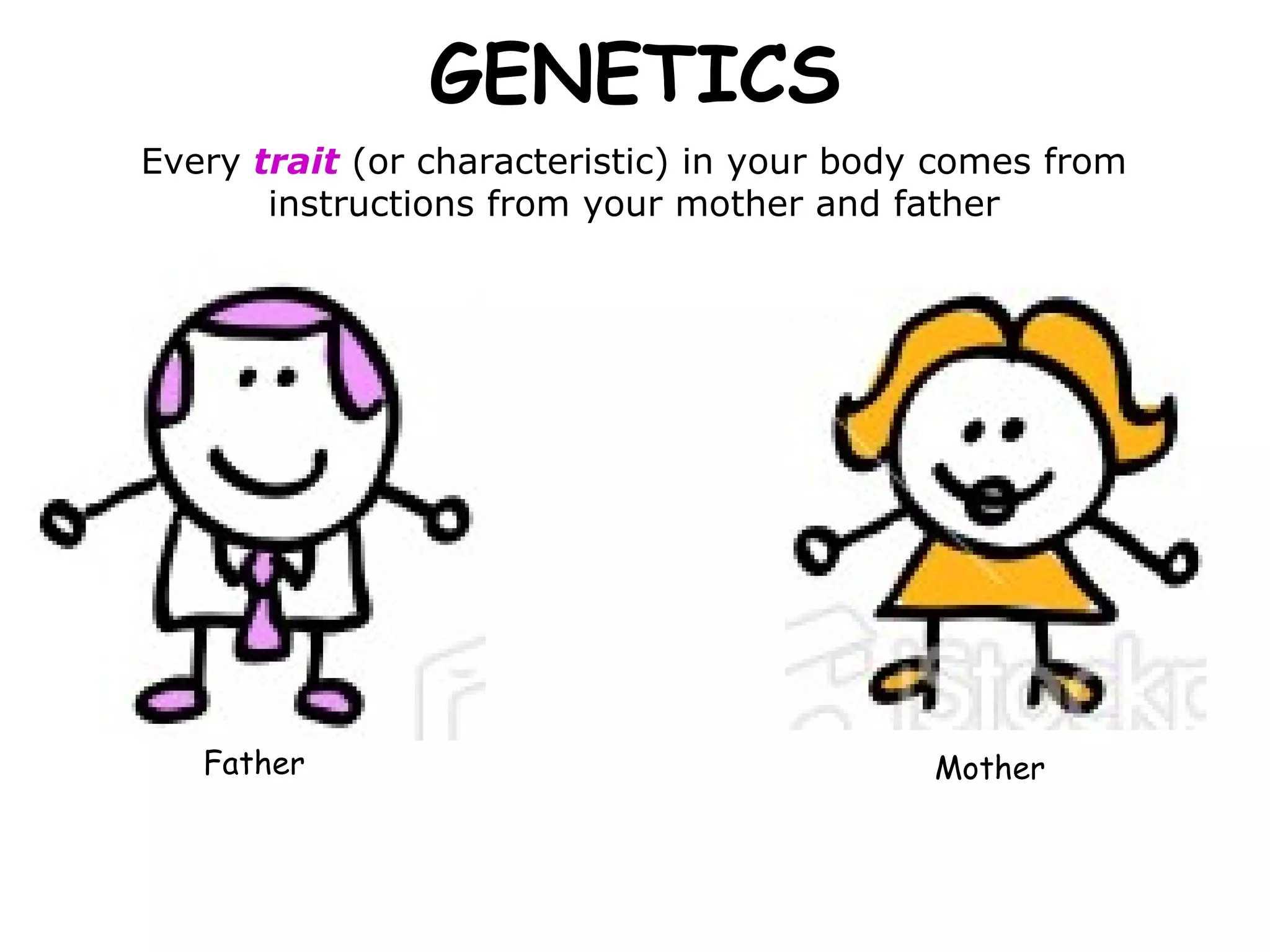
Every  trait  (or characteristic) in your body comes from instructions from your mother and father GENETICS Father Mother
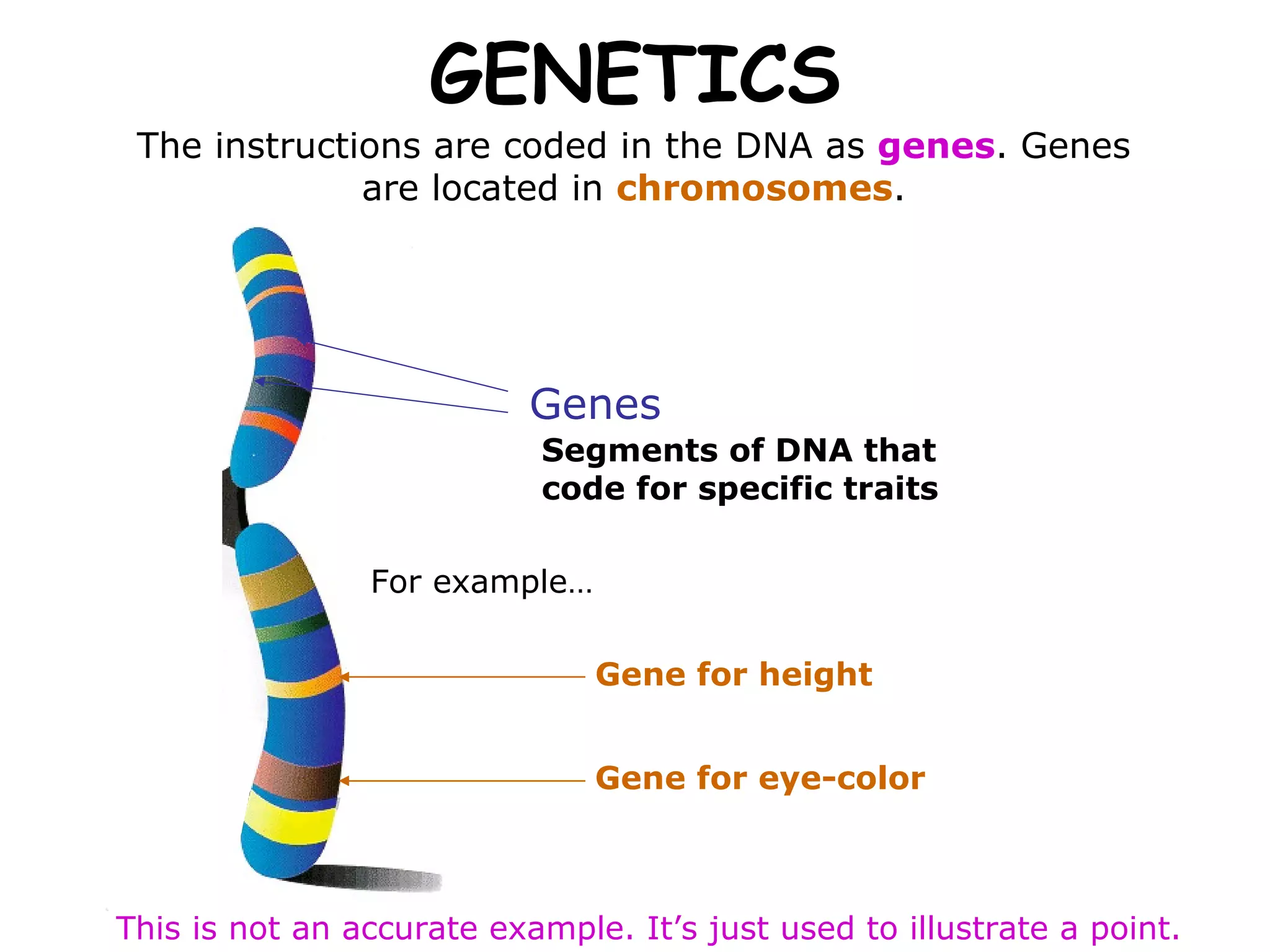
GENETICS Segments of DNA that code for specific traits The instructions are coded in the DNA as  genes . Genes are located in  chromosomes . For example… This is not an accurate example. It’s just used to illustrate a point. Genes Gene for height Gene for eye-color
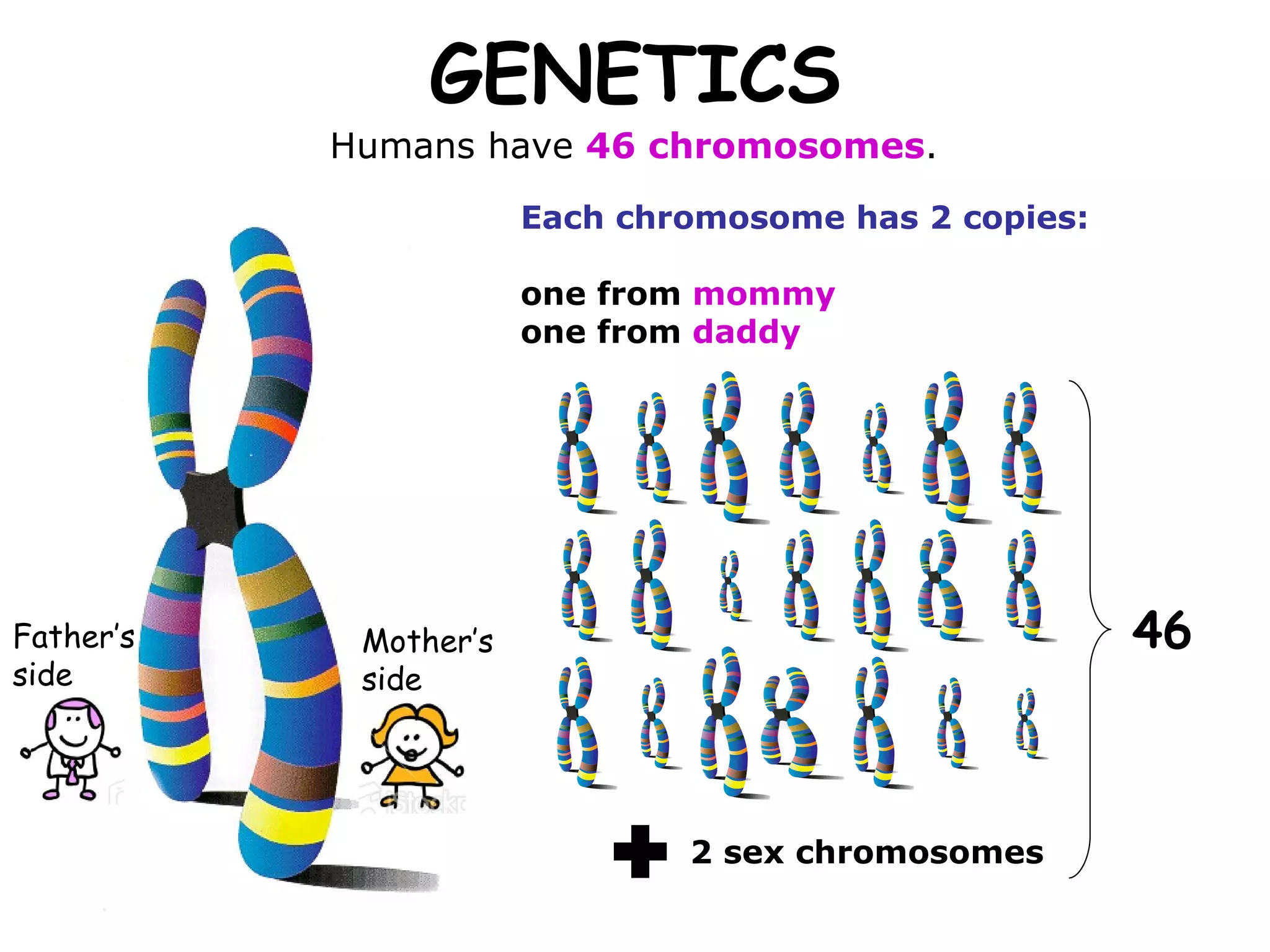
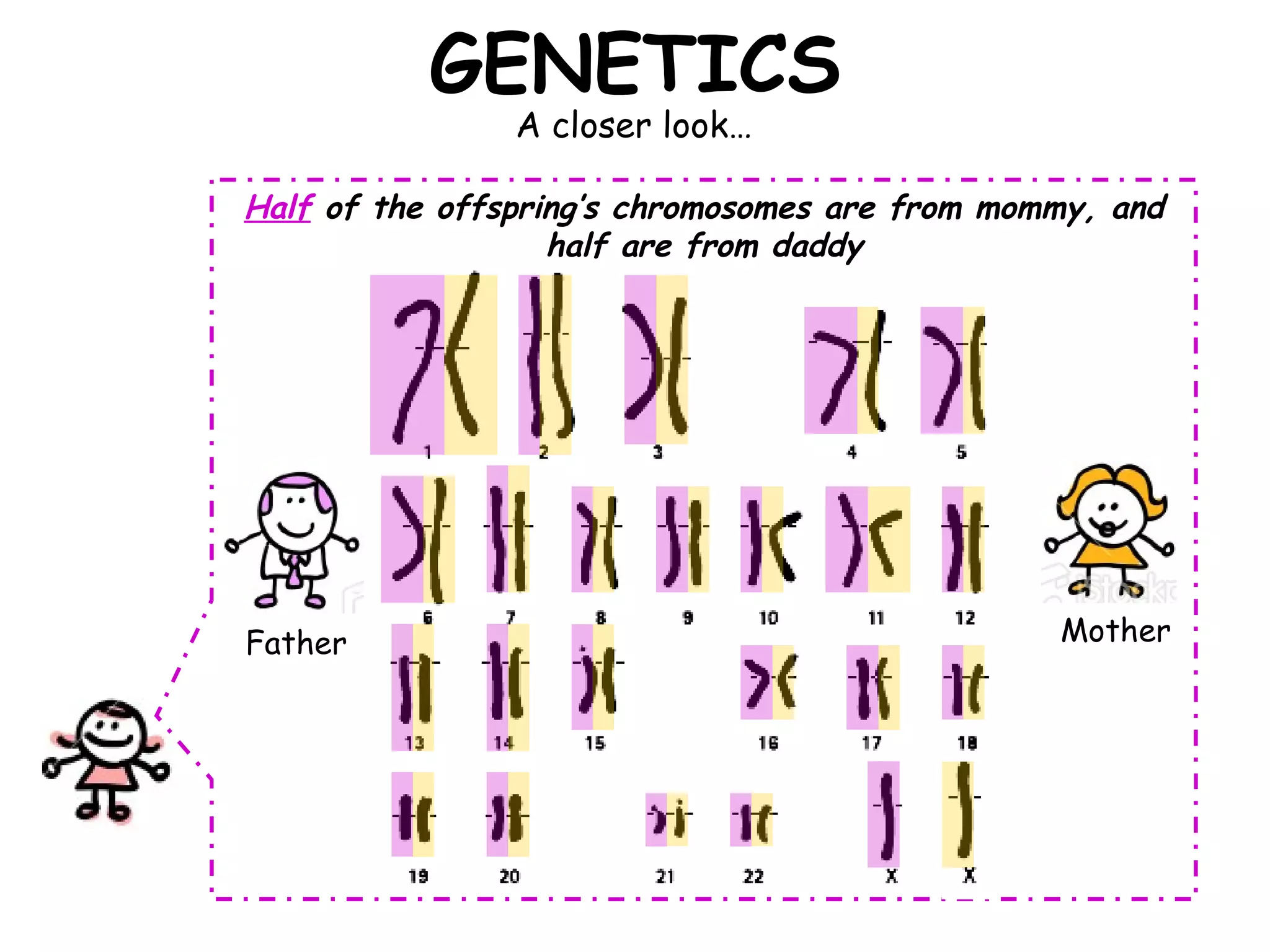
GENETICS Humans have  46 chromosomes . Father’s side Mother’s side Each chromosome has 2 copies: one from  mommy one from  daddy 2 sex chromosomes 46
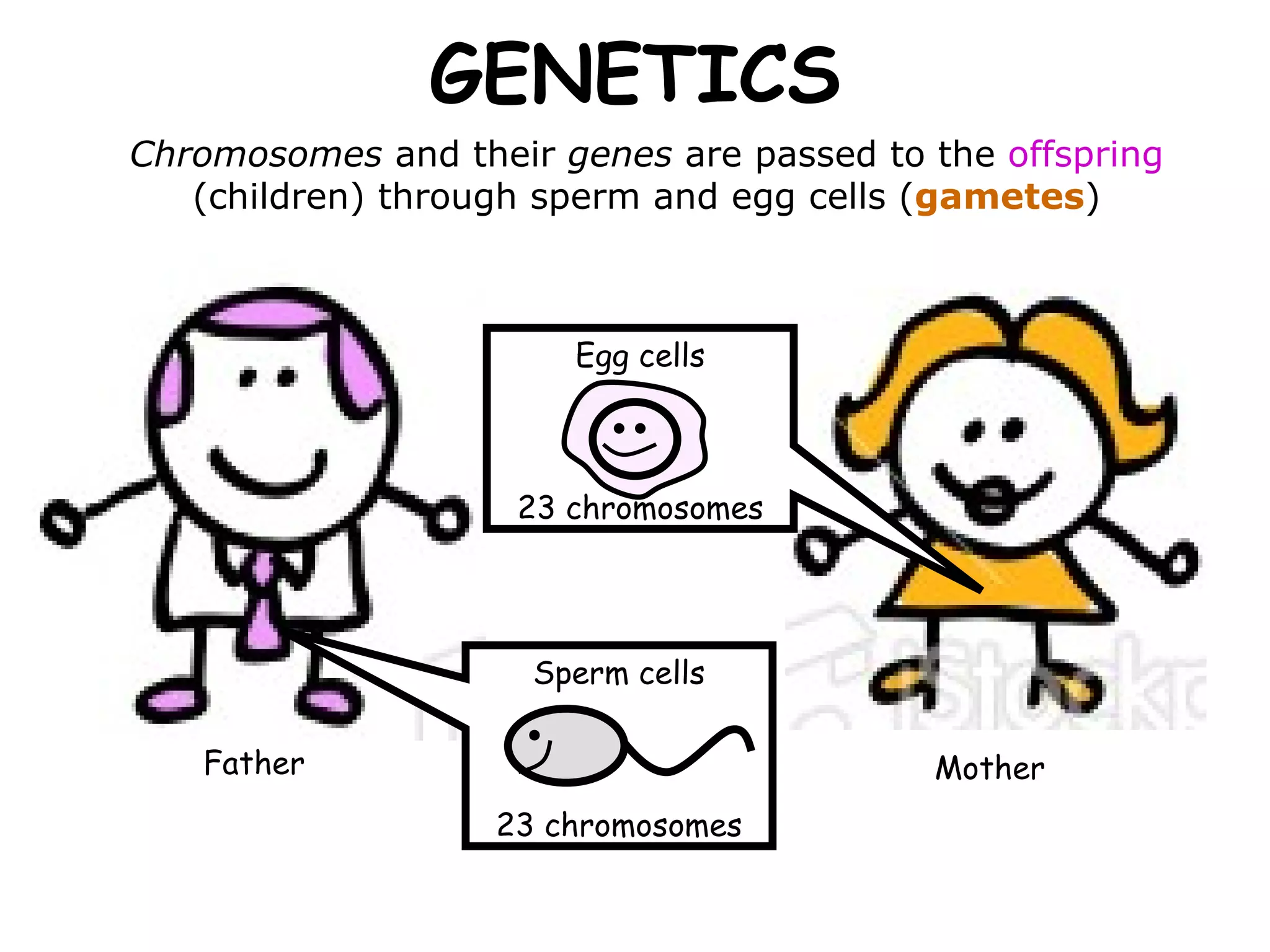
GENETICS Chromosomes  and their  genes  are passed to the  offspring  (children) through sperm and egg cells ( gametes ) Father Mother Sperm cells 23 chromosomes Egg cells 23 chromosomes
GENETICS Chromosomes  and their  genes  are passed to the  offspring  (children) through sperm and egg cells ( gametes ) Father Mother
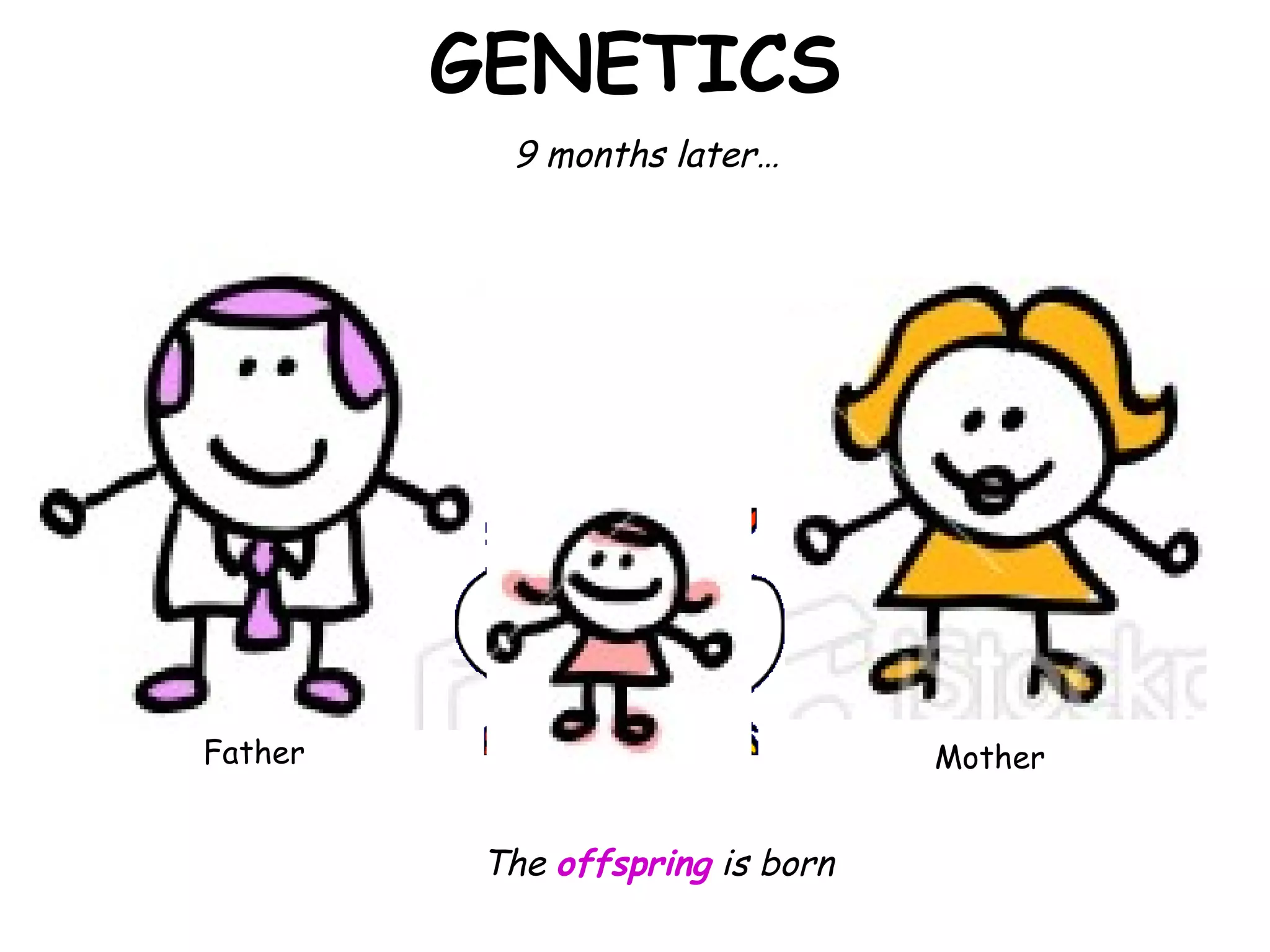
GENETICS 9 months later… The  offspring  is born Father Mother
GENETICS A closer look… Half  of the offspring’s chromosomes are from mommy, and half are from daddy Father Mother
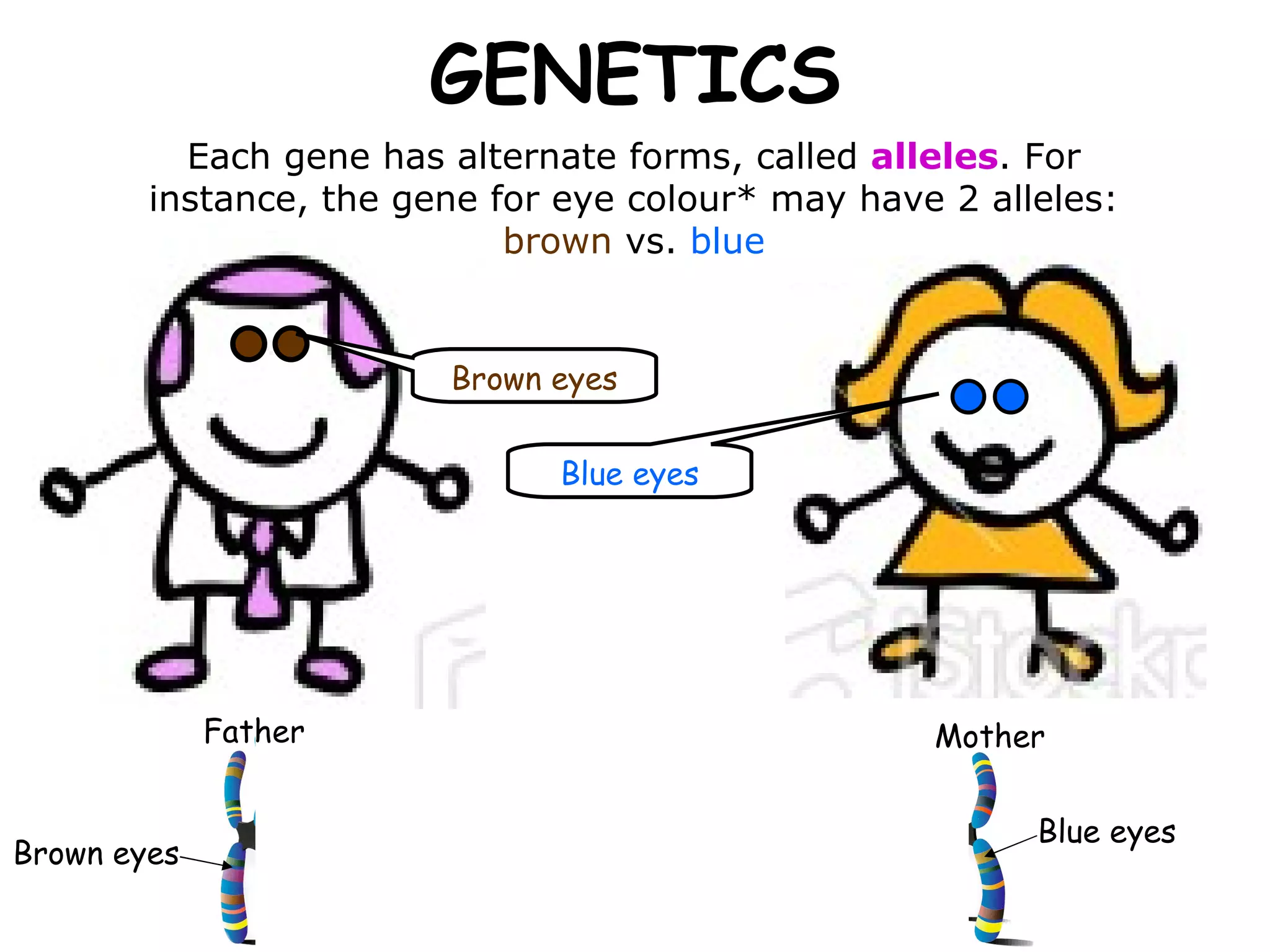
GENETICS Blue eyes Brown eyes Each gene has alternate forms, called  alleles . For instance, the gene for eye colour* may have 2 alleles: brown  vs.  blue Brown eyes Blue eyes Father Mother
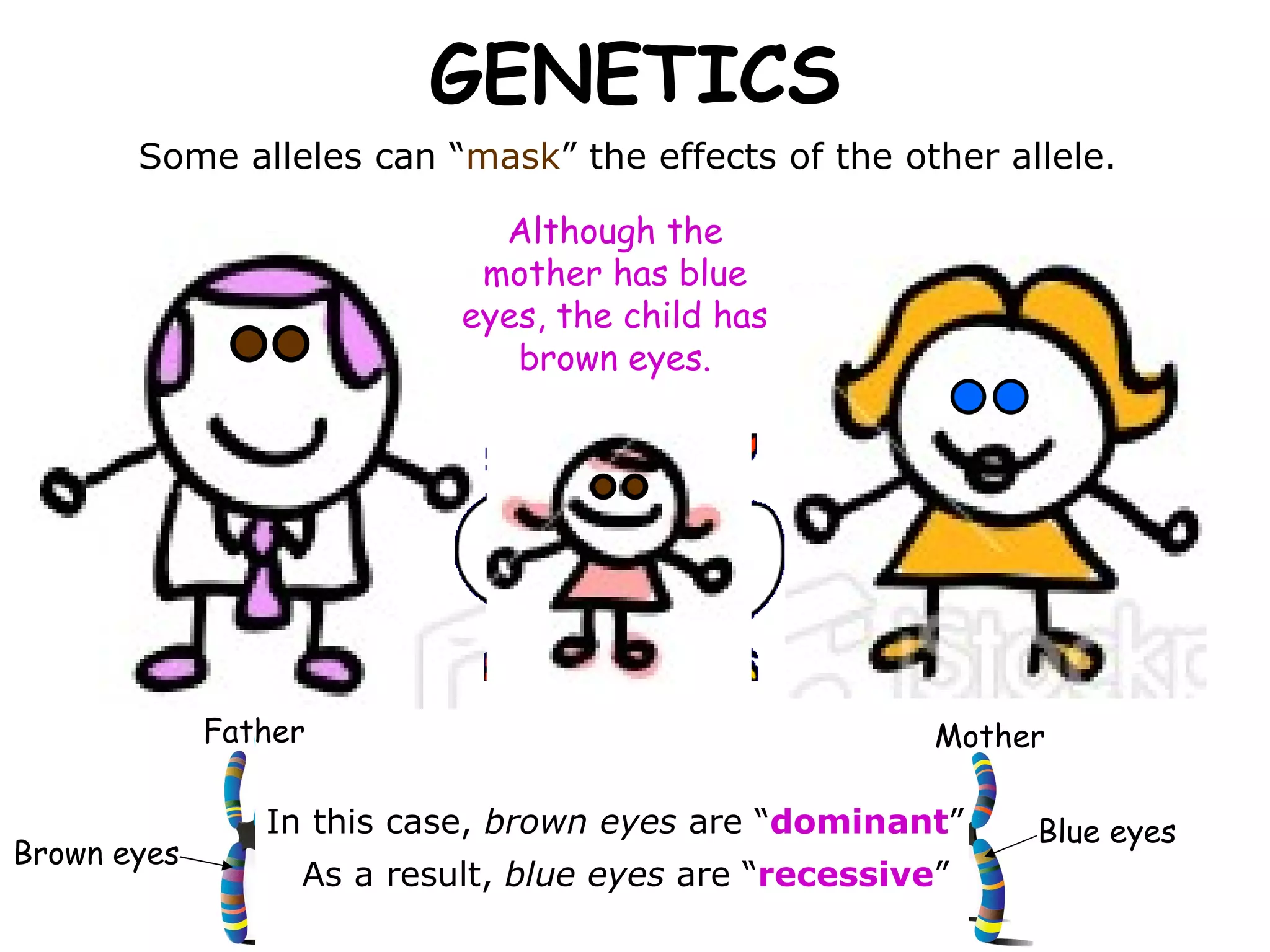
GENETICS Some alleles can “ mask ” the effects of the other allele.  Although the mother has blue eyes, the child has brown eyes. In this case,  brown eyes  are “ dominant ” As a result,  blue eyes  are “ recessive ” Brown eyes Blue eyes Father Mother
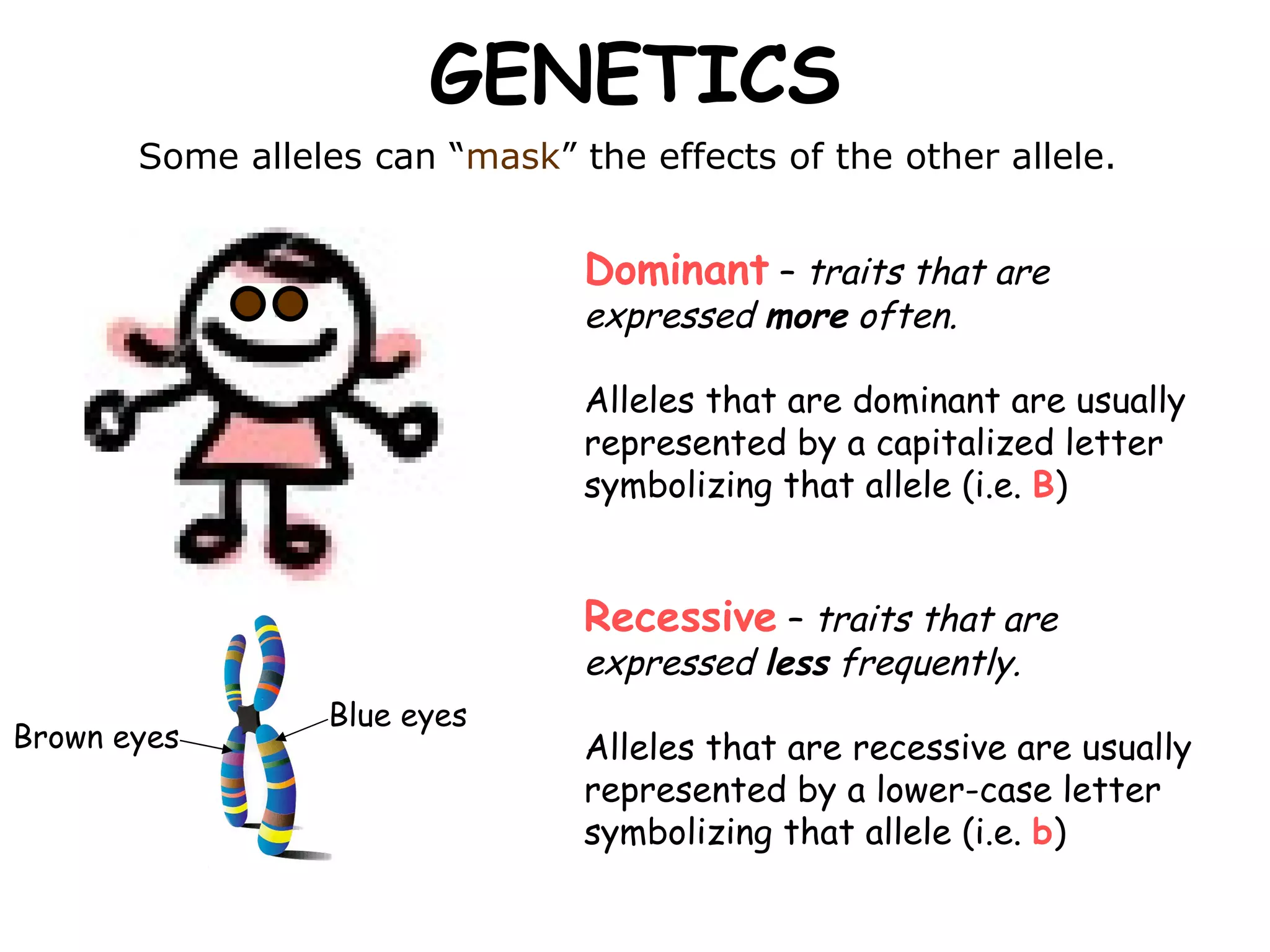
GENETICS Some alleles can “ mask ” the effects of the other allele.  Dominant   –  traits that are expressed  more  often.  Alleles that are dominant are usually represented by a capitalized letter symbolizing that allele (i.e.  B ) Recessive  –  traits that are expressed  less  frequently. Alleles that are recessive are usually represented by a lower-case letter symbolizing that allele (i.e.  b ) Brown eyes Blue eyes
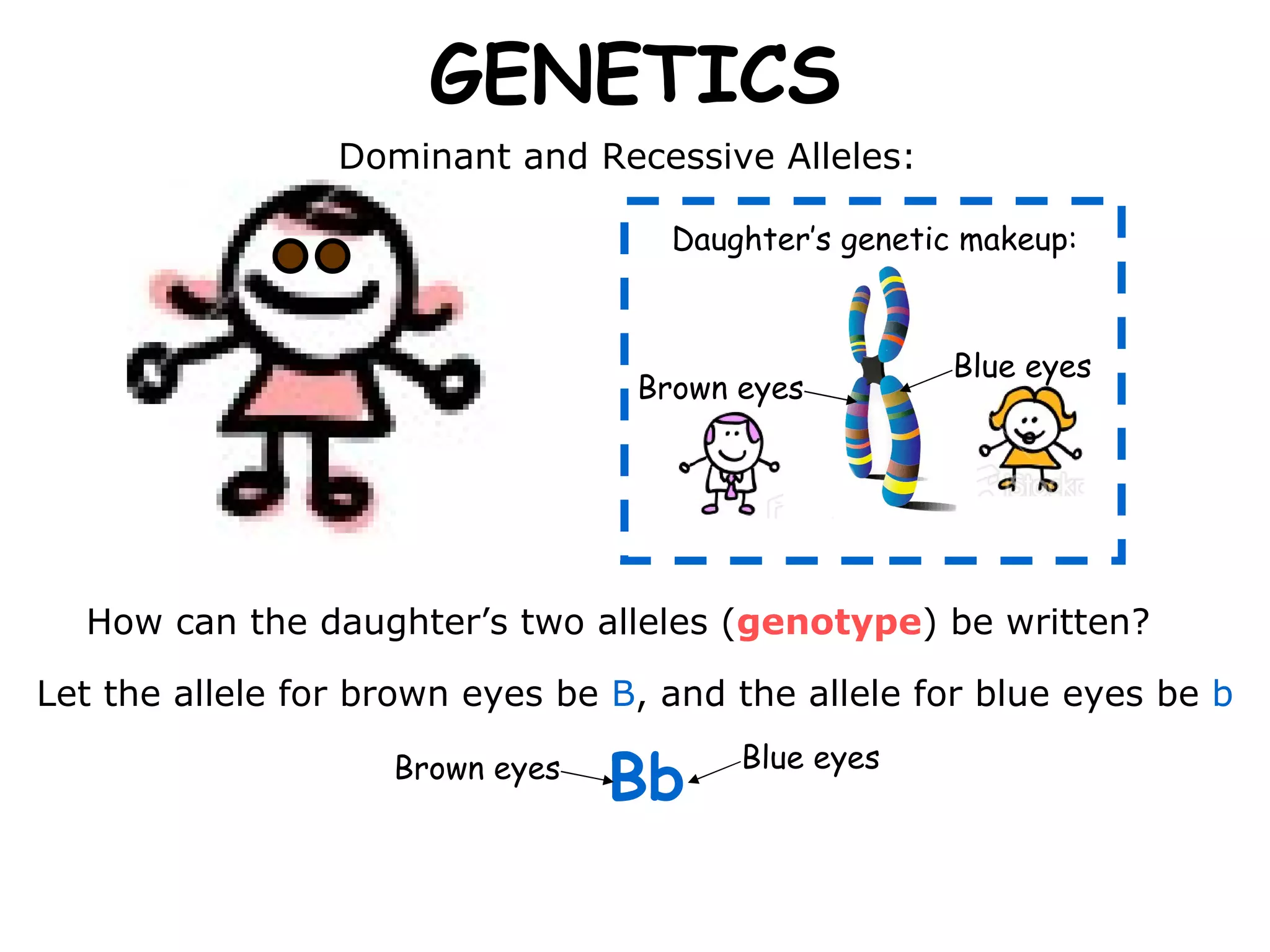
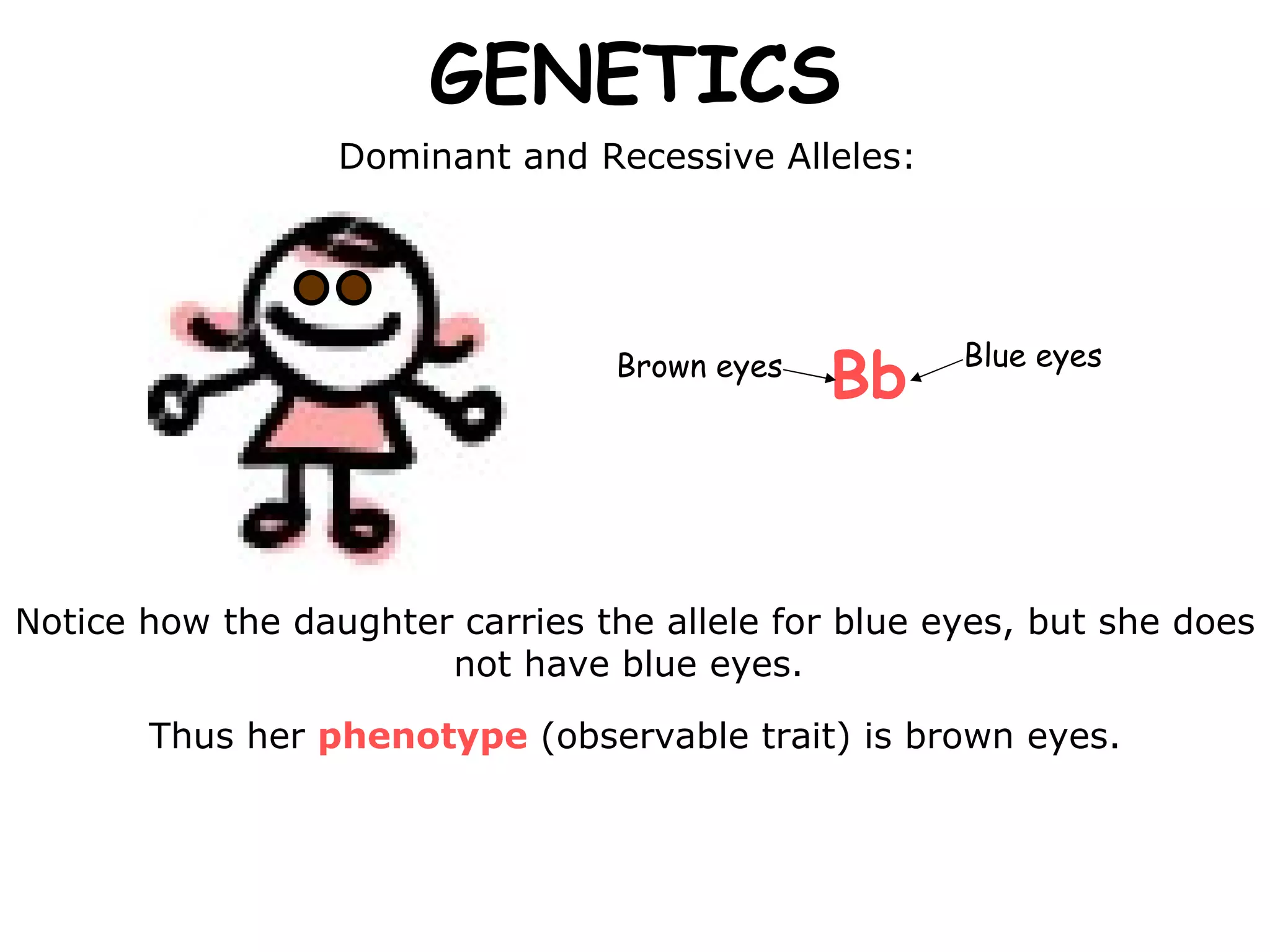
GENETICS Dominant and Recessive Alleles:  How can the daughter’s two alleles ( genotype ) be written?  Bb   Let the allele for brown eyes be  B , and the allele for blue eyes be  b Brown eyes Blue eyes Daughter’s genetic makeup: Brown eyes Blue eyes
GENETICS Dominant and Recessive Alleles:  Bb   Notice how the daughter carries the allele for blue eyes, but she does not have blue eyes.  Thus her  phenotype  (observable trait) is brown eyes. Brown eyes Blue eyes
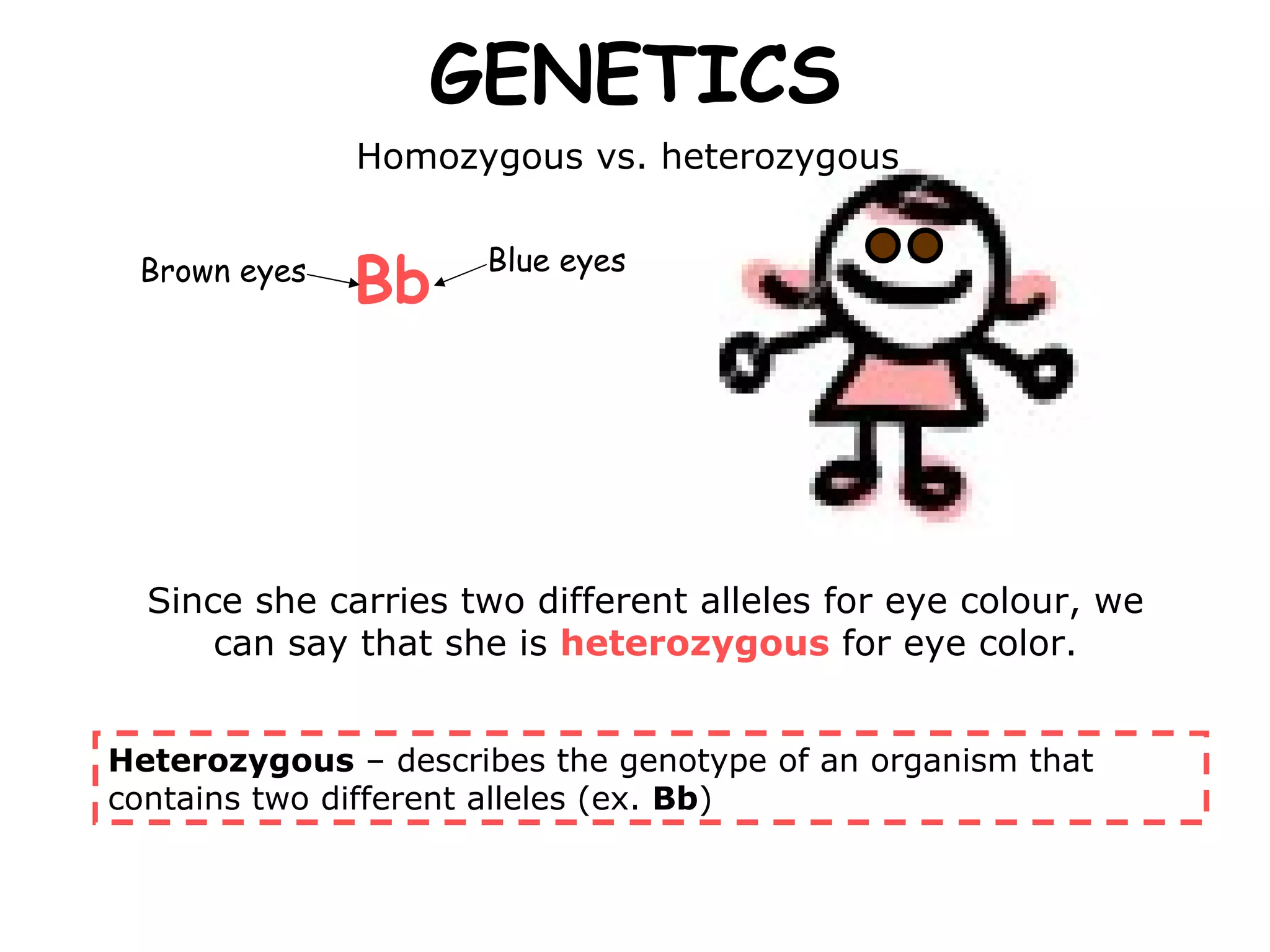
GENETICS Since she carries two different alleles for eye colour, we can say that she is  heterozygous  for eye color. Heterozygous  – describes the genotype of an organism that contains two different alleles (ex.  Bb ) Homozygous vs. heterozygous  Bb   Brown eyes Blue eyes
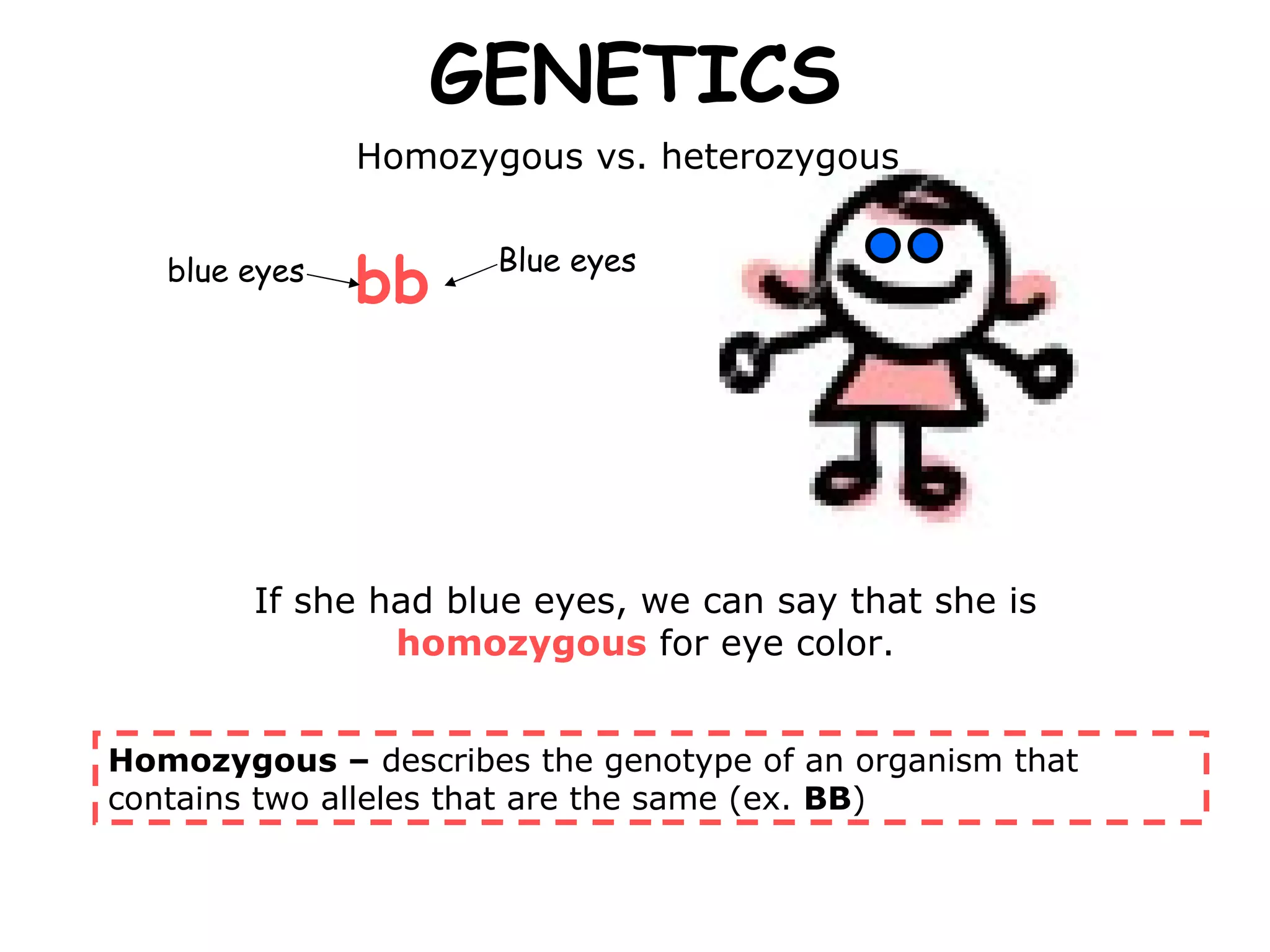
GENETICS If she had blue eyes, we can say that she is  homozygous  for eye color. Homozygous –  describes the genotype of an organism that contains two alleles that are the same (ex.  BB ) Homozygous vs. heterozygous  bb   blue eyes Blue eyes
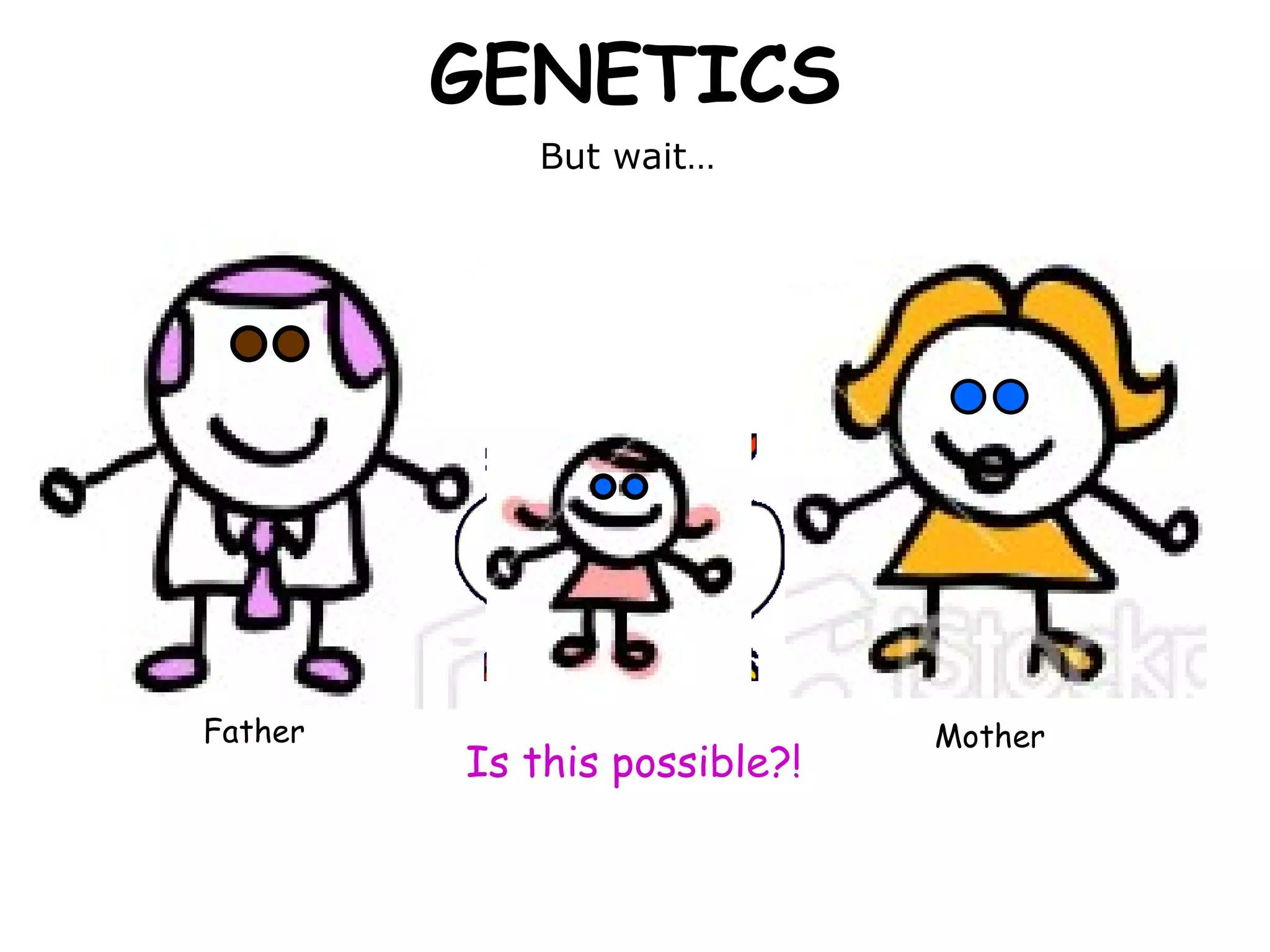
GENETICS But wait…  Is this possible?! Father Mother
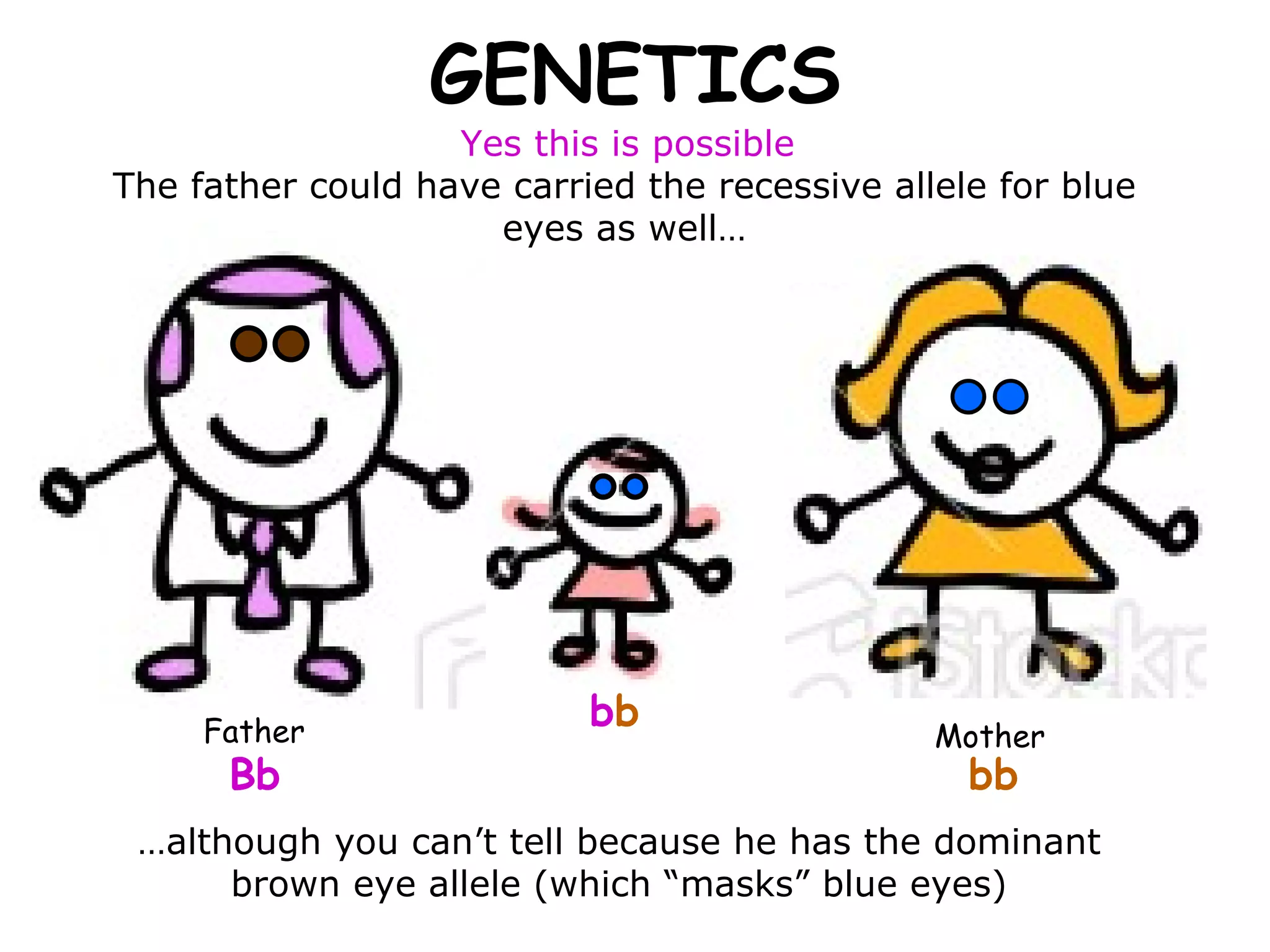
GENETICS Yes this is possible  Bb bb The father could have carried the recessive allele for blue eyes as well… … although you can’t tell because he has the dominant brown eye allele (which “masks” blue eyes) b b Father Mother
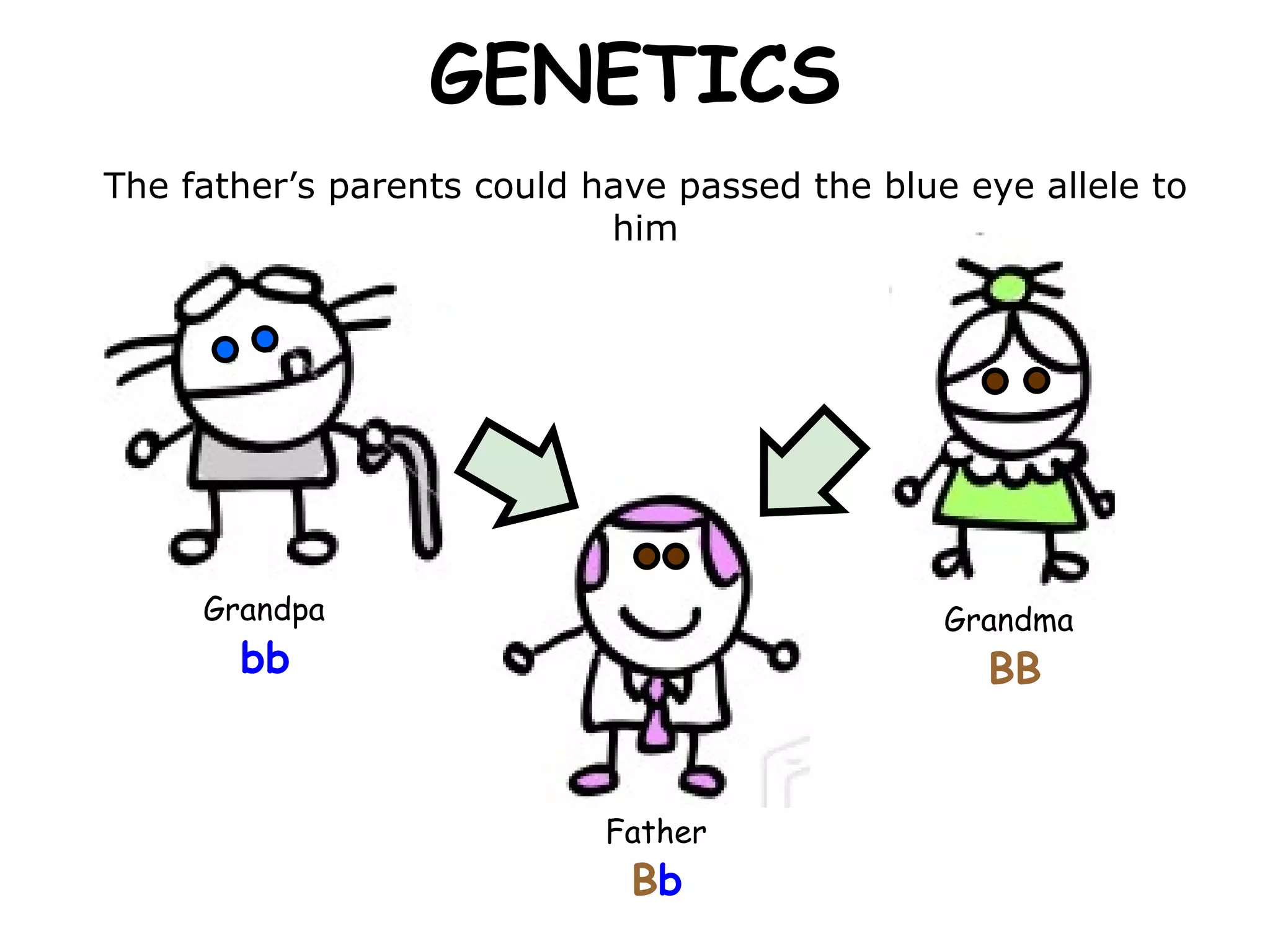
GENETICS Father B b The father’s parents could have passed the blue eye allele to him bb BB Grandpa Grandma
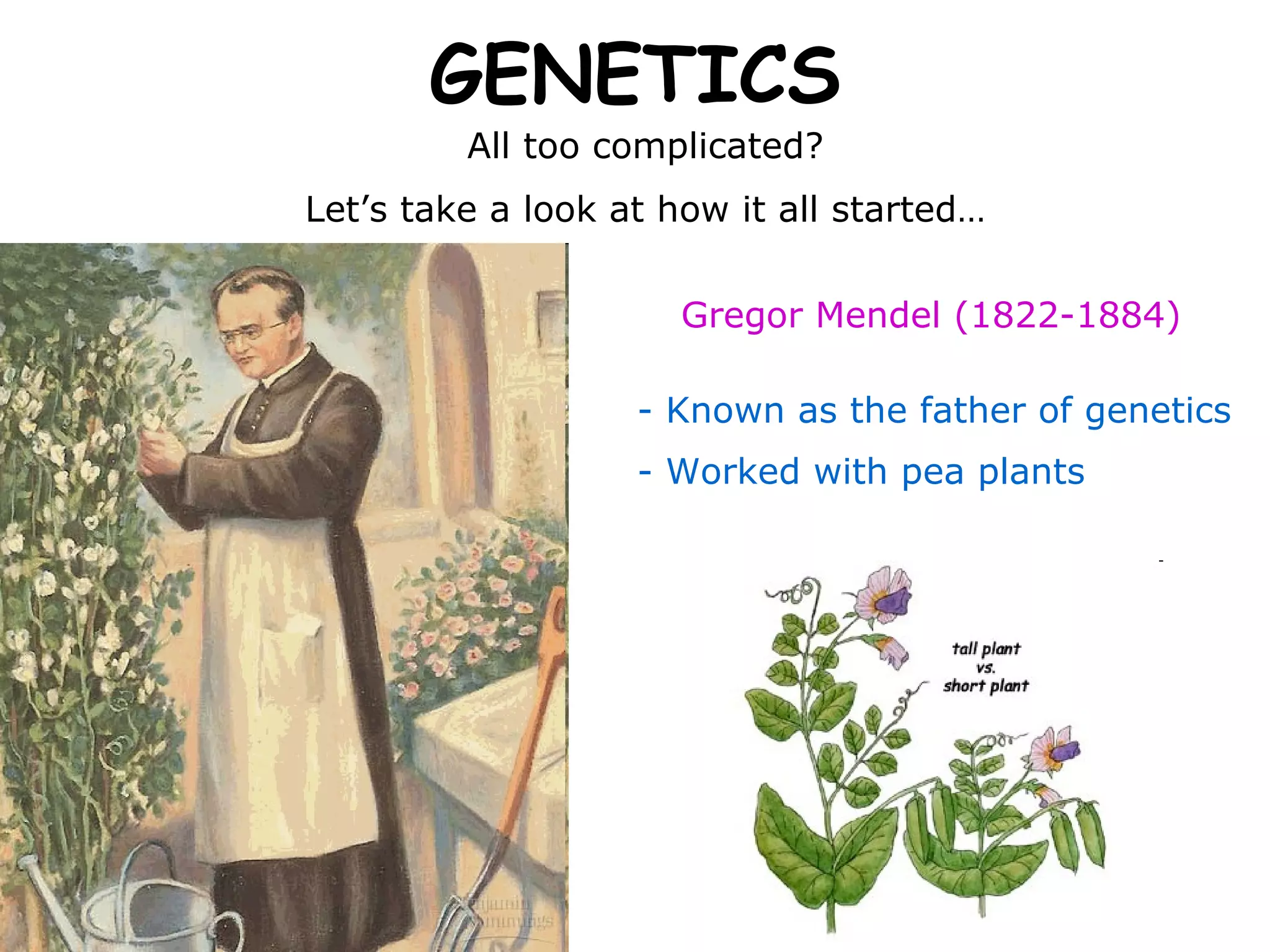
GENETICS All too complicated? Let’s take a look at how it all started… Gregor Mendel (1822-1884) - Known as the father of genetics - Worked with pea plants
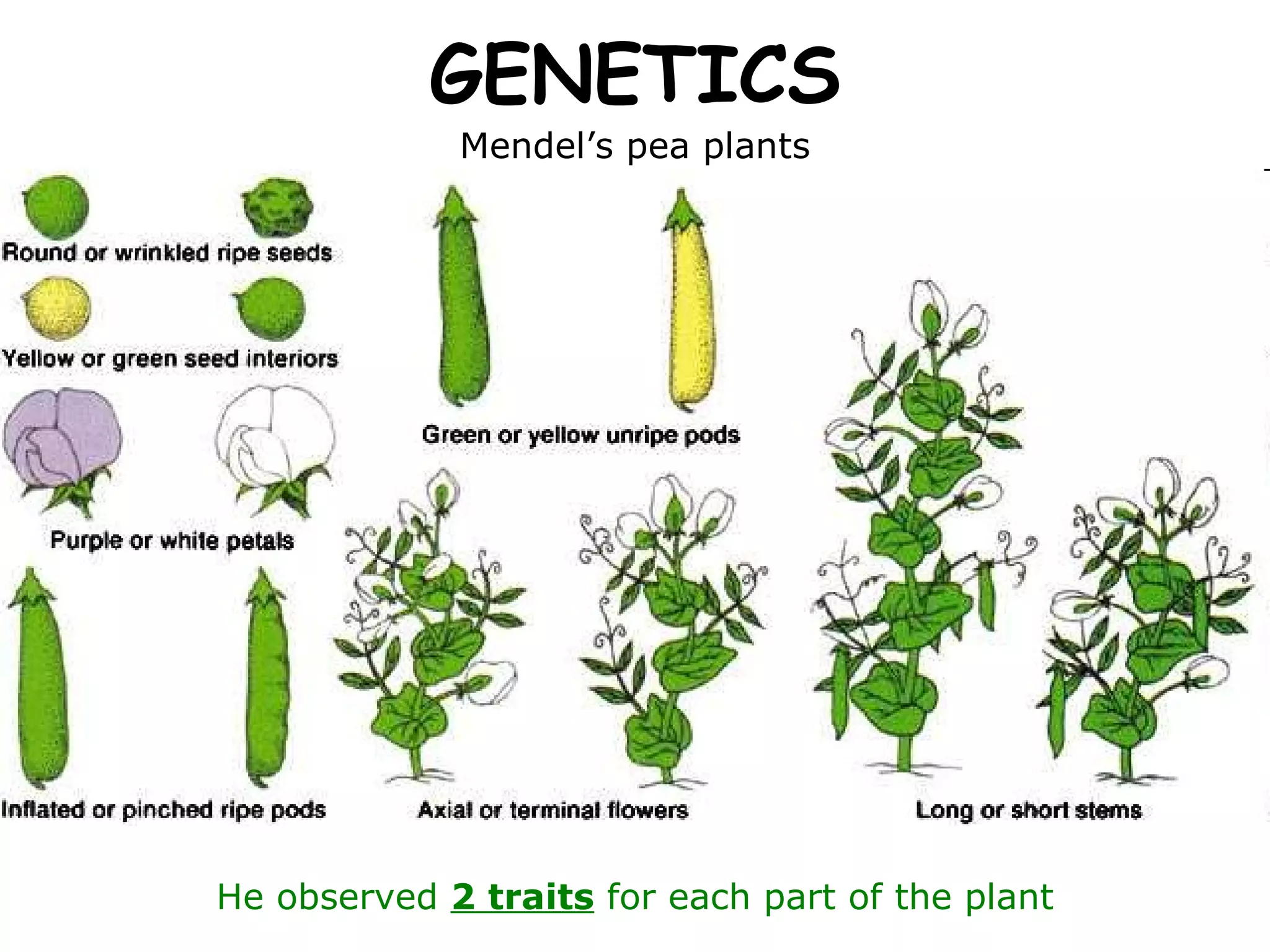
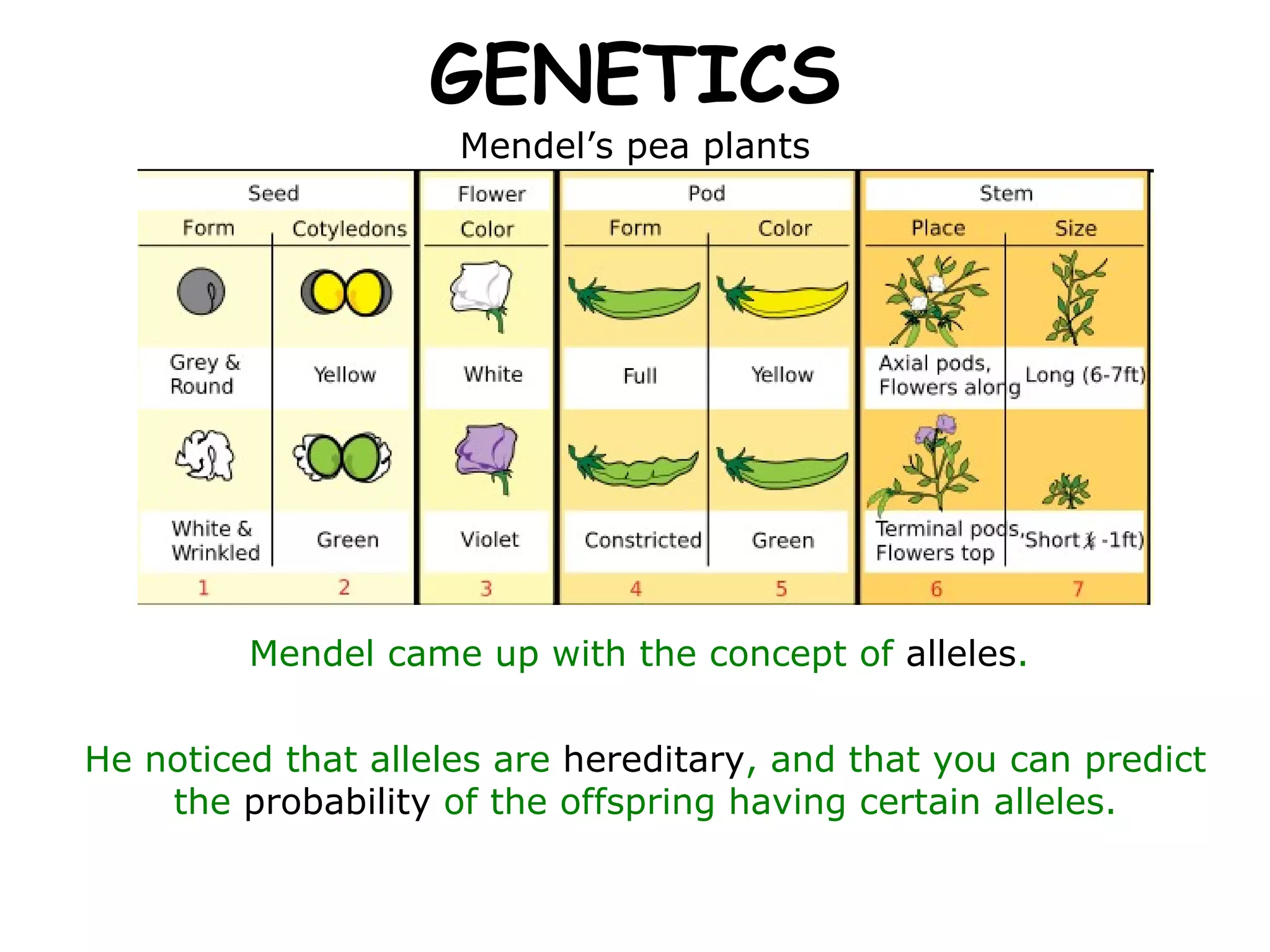
GENETICS Mendel’s pea plants He observed  2 traits  for each part of the plant
GENETICS Mendel’s pea plants Mendel came up with the concept of  alleles .  He noticed that alleles are  hereditary , and that you can predict the  probability  of the offspring having certain alleles.
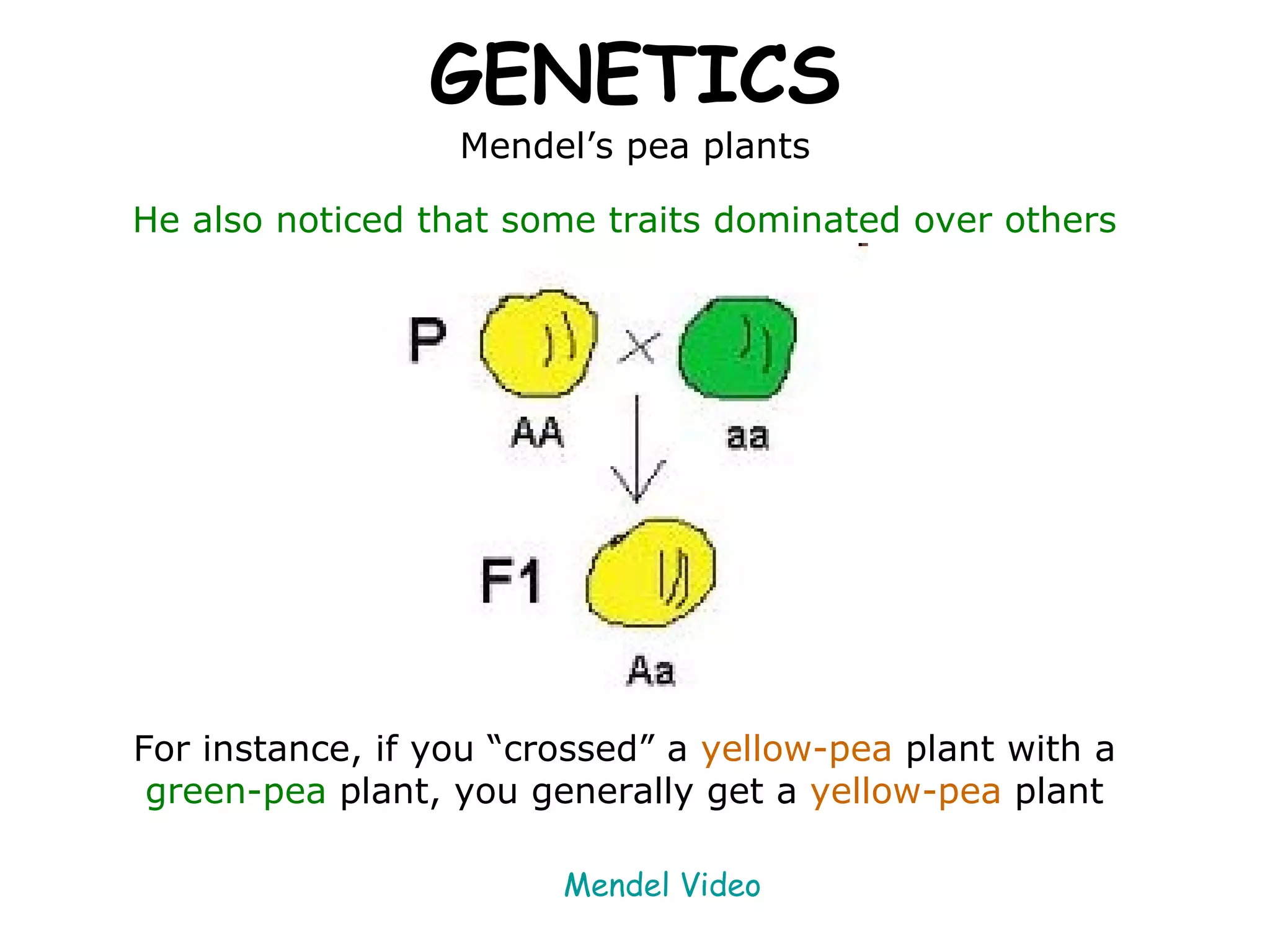
GENETICS Mendel’s pea plants He also noticed that some traits dominated over others For instance, if you “crossed” a   yellow-pea   plant with a  green-pea  plant, you generally get a   yellow-pea   plant Mendel Video
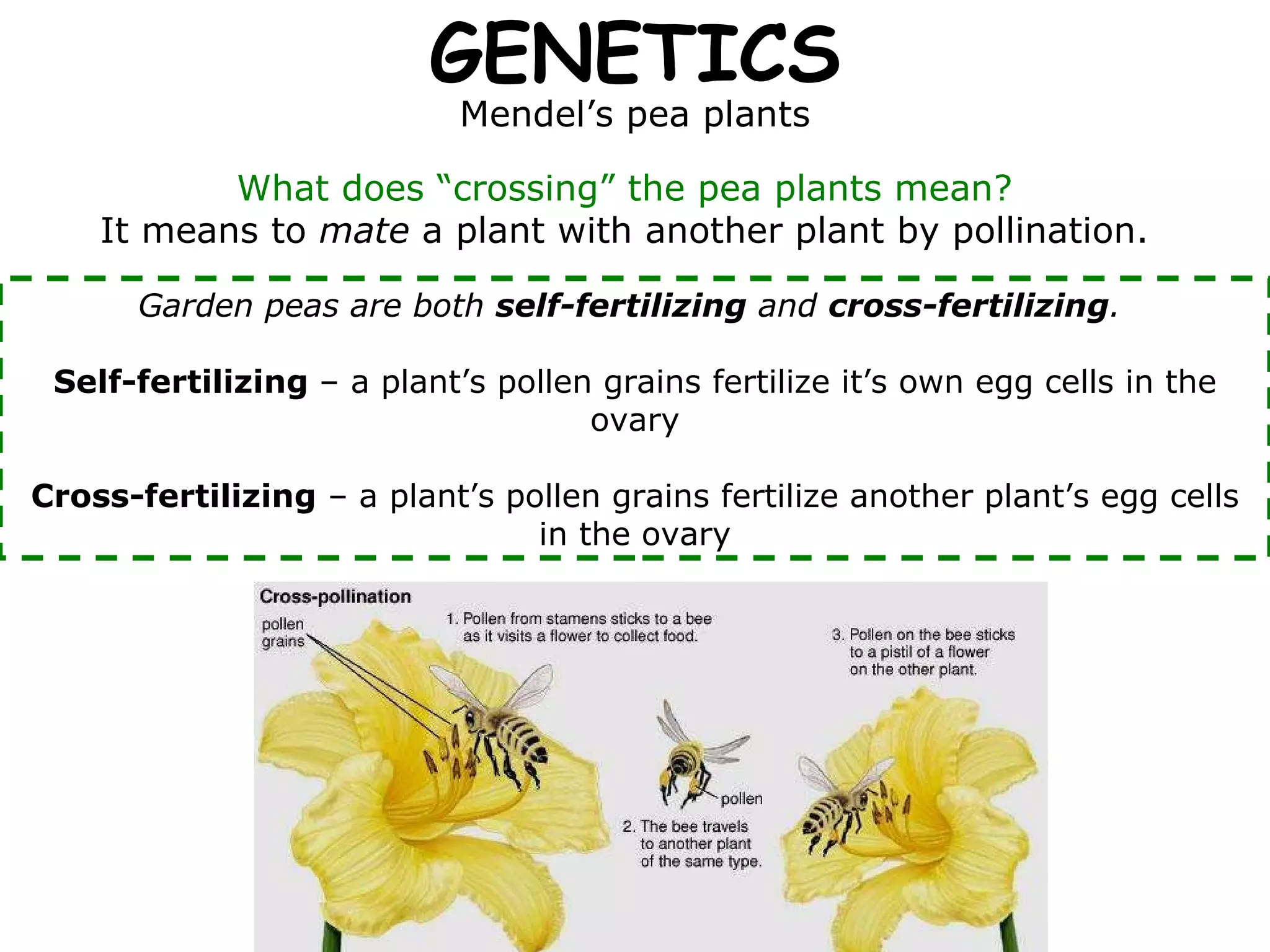
GENETICS Mendel’s pea plants What does “crossing” the pea plants mean? Garden peas are both  self-fertilizing  and  cross-fertilizing .  Self-fertilizing  – a plant’s pollen grains fertilize it’s own egg cells in the ovary Cross-fertilizing  – a plant’s pollen grains fertilize another plant’s egg cells in the ovary It means to  mate  a plant with another plant by pollination.
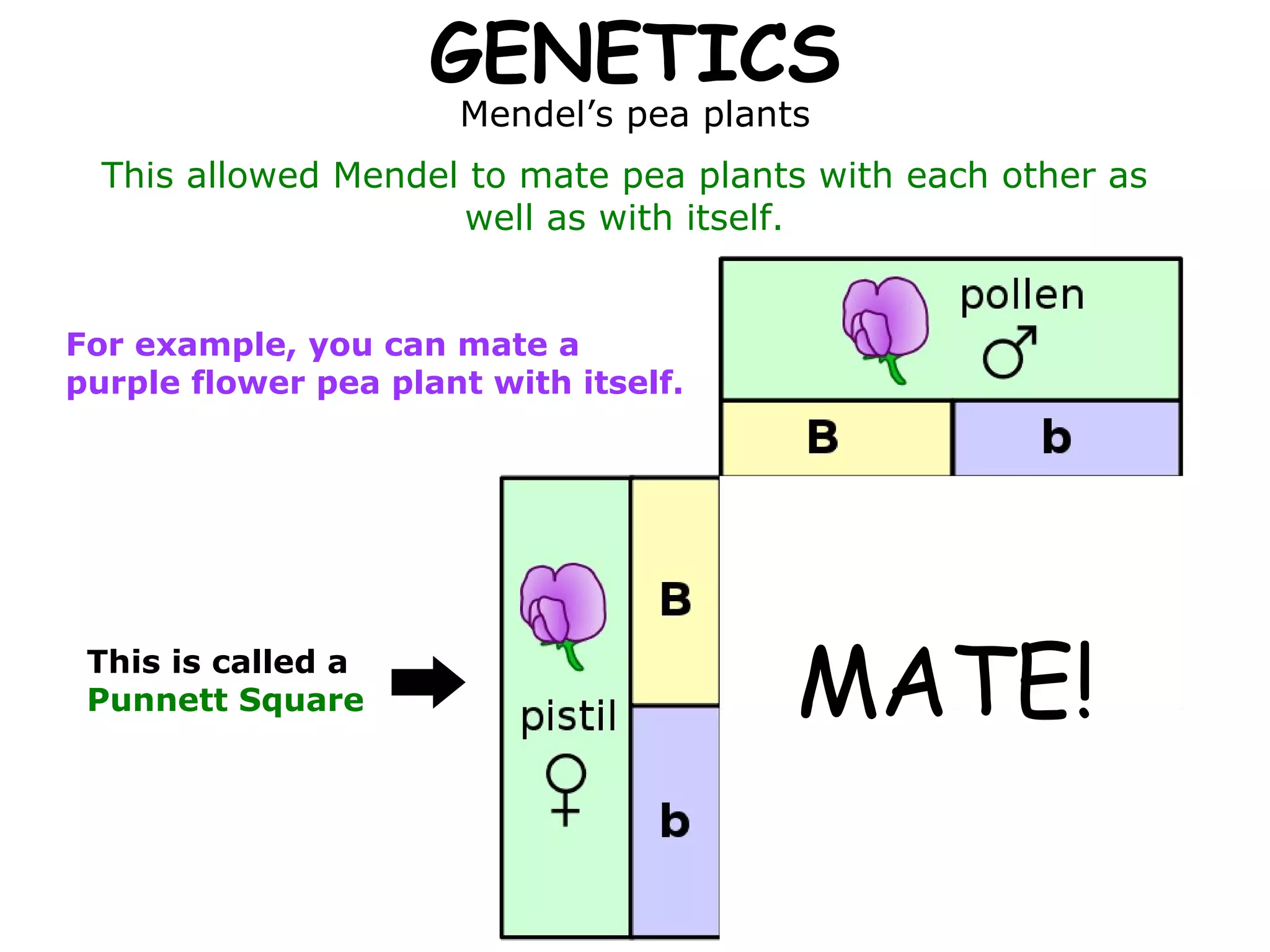
GENETICS Mendel’s pea plants This allowed Mendel to mate pea plants with each other as well as with itself. For example, you can mate a purple flower pea plant with itself. MATE! This is called a  Punnett Square
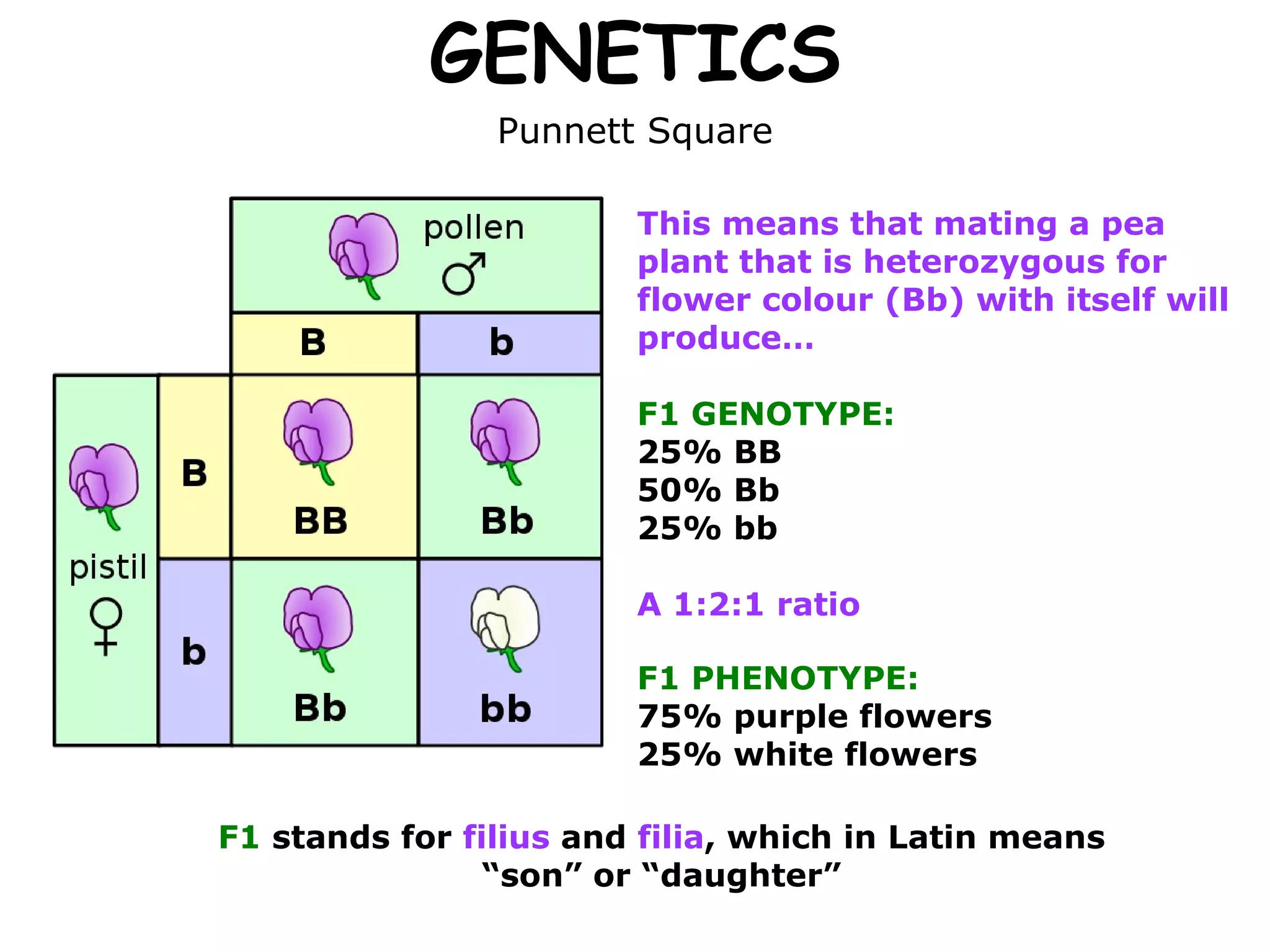
GENETICS Punnett Square This means that mating a pea plant that is heterozygous for flower colour (Bb) with itself will produce… F1 GENOTYPE: 25% BB 50% Bb 25% bb A 1:2:1 ratio F1 PHENOTYPE: 75% purple flowers 25% white flowers F1  stands for  filius  and  filia , which in Latin means “son” or “daughter”
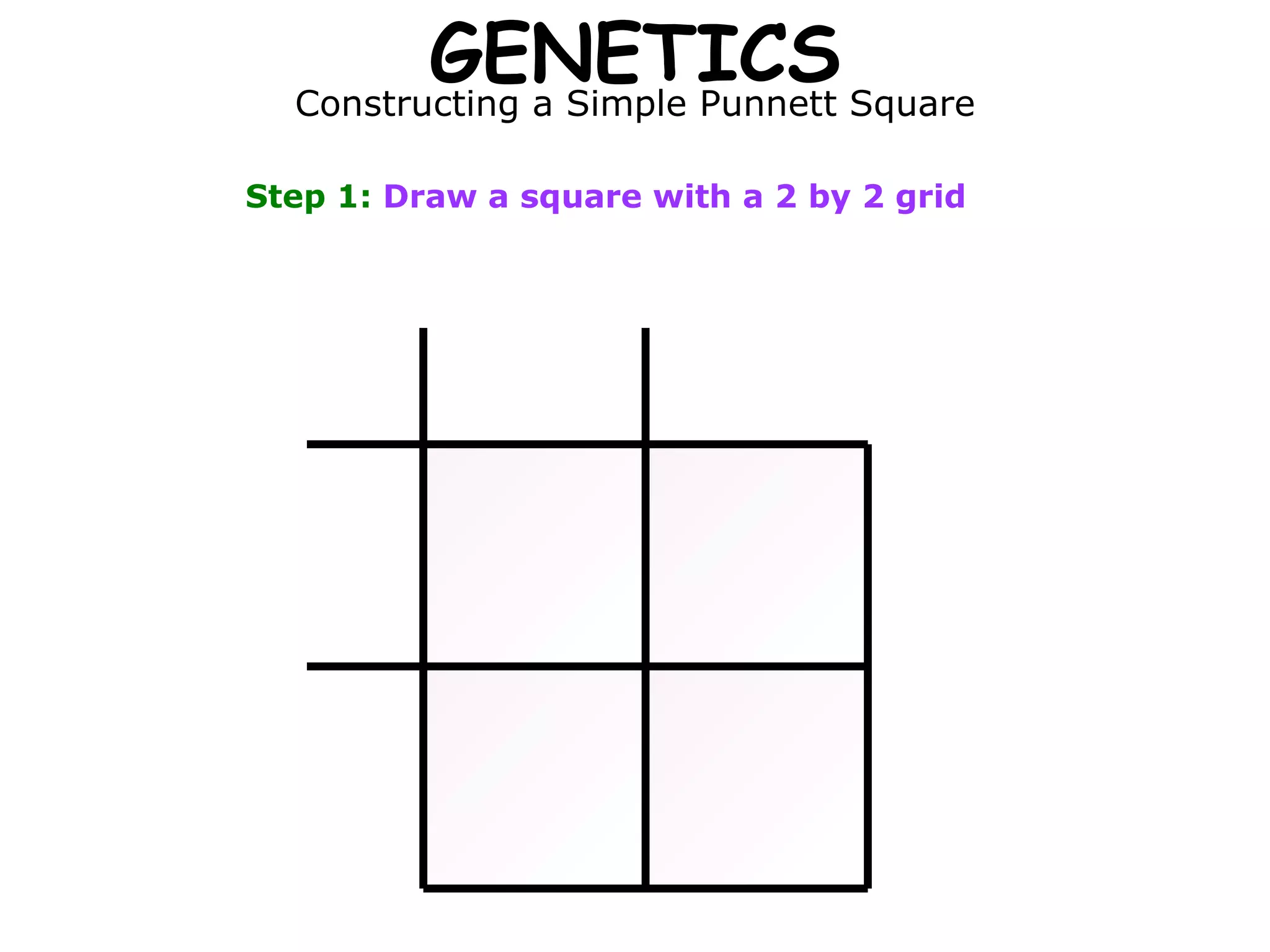
GENETICS Constructing a Simple Punnett Square Step 1:  Draw a square with a 2 by 2 grid
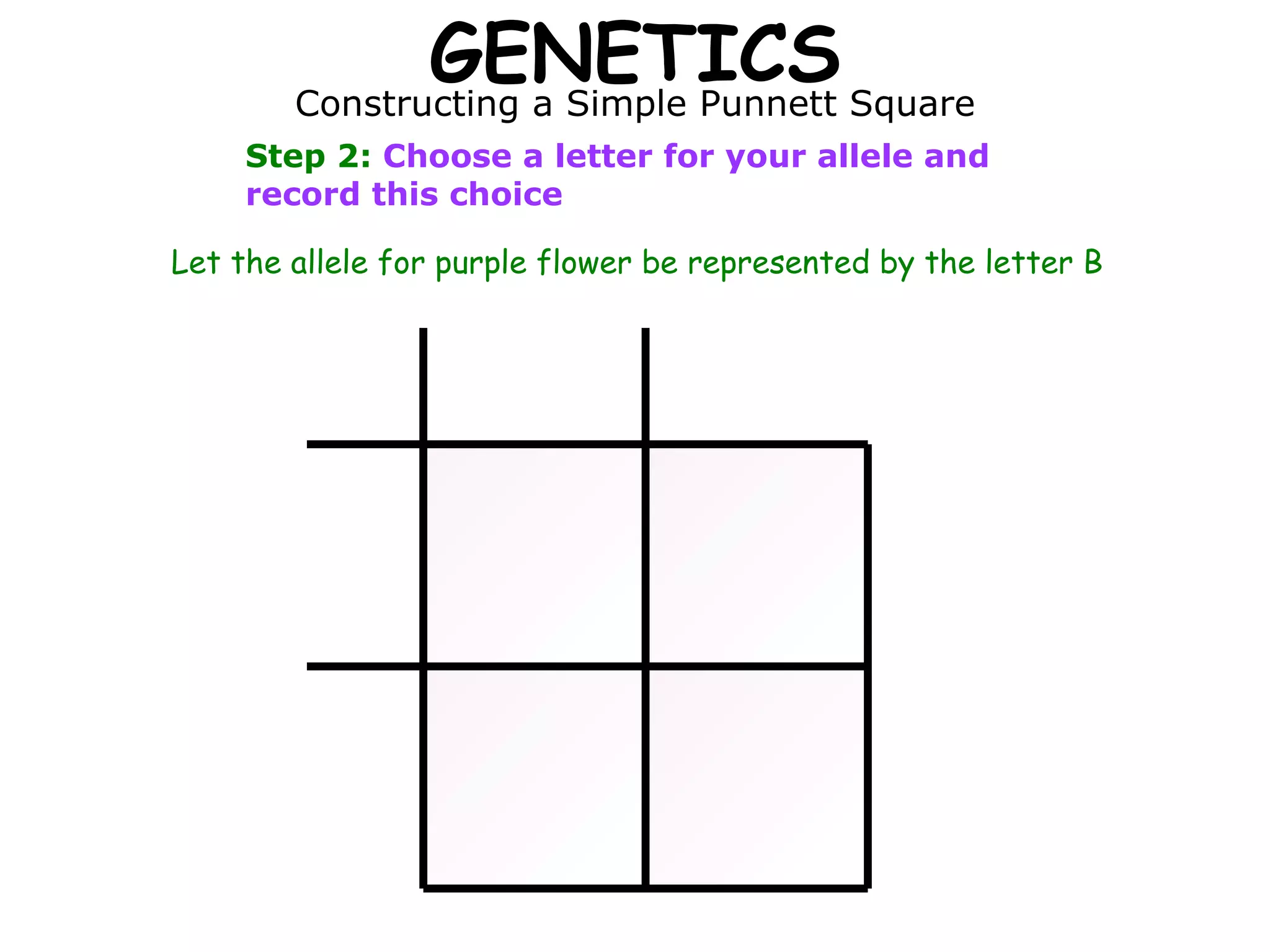
GENETICS Constructing a Simple Punnett Square Step 2:  Choose a letter for your allele and record this choice Let the allele for purple flower be represented by the letter B
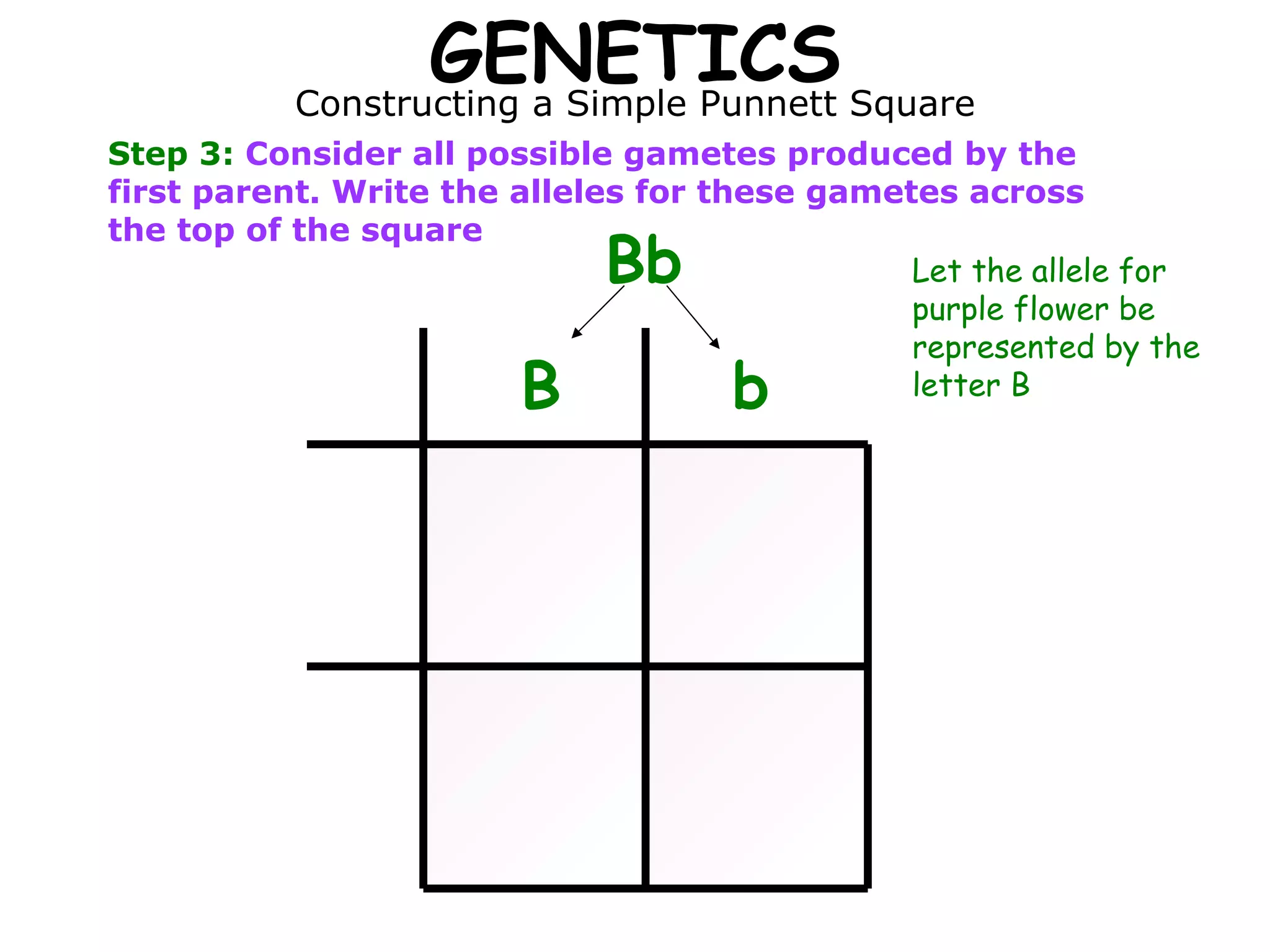
GENETICS Constructing a Simple Punnett Square Step 3:  Consider all possible gametes produced by the first parent. Write the alleles for these gametes across the top of the square Bb B b Let the allele for purple flower be represented by the letter B
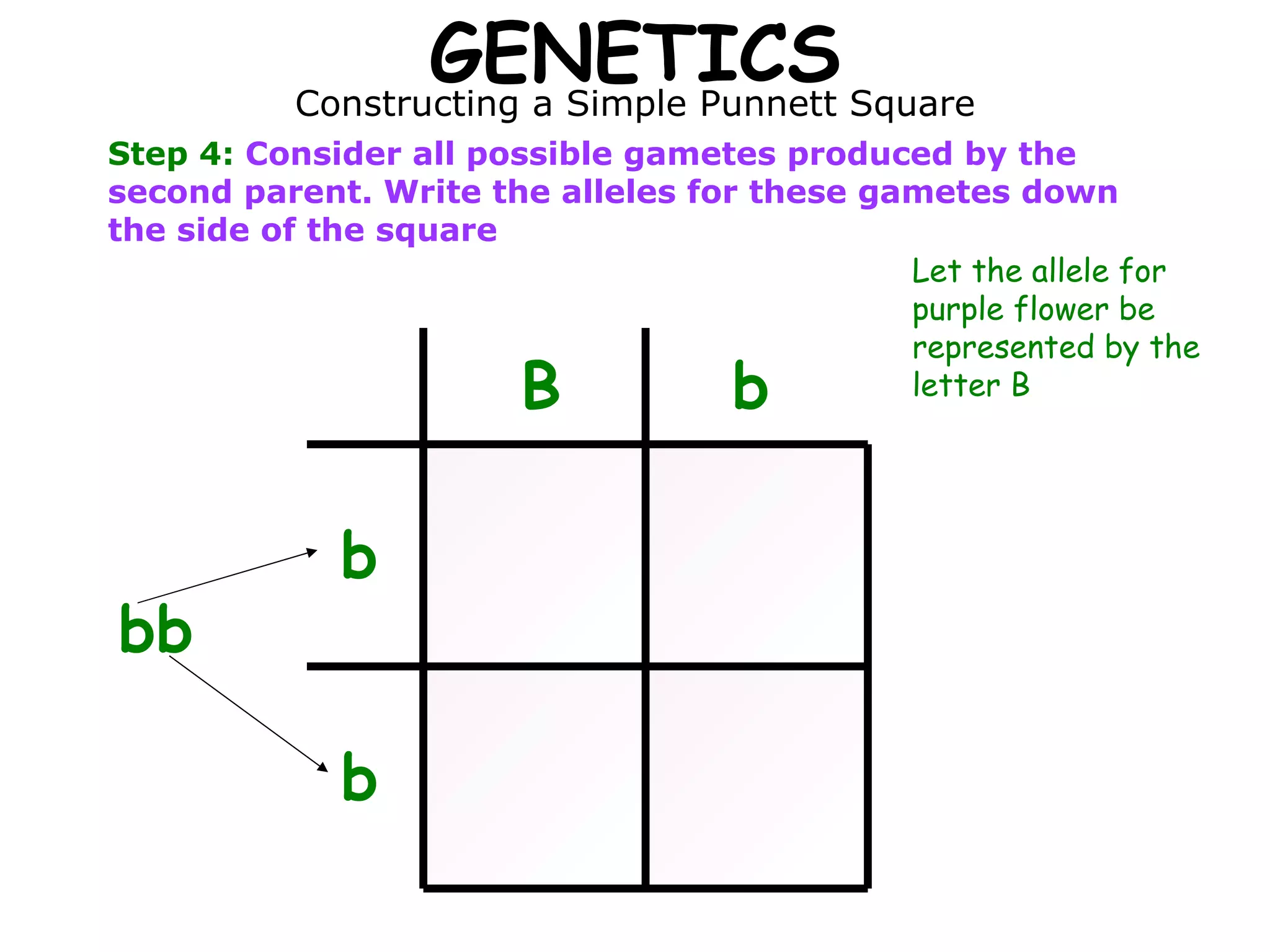
GENETICS Constructing a Simple Punnett Square Step 4:  Consider all possible gametes produced by the second parent. Write the alleles for these gametes down the side of the square B b bb b b Let the allele for purple flower be represented by the letter B
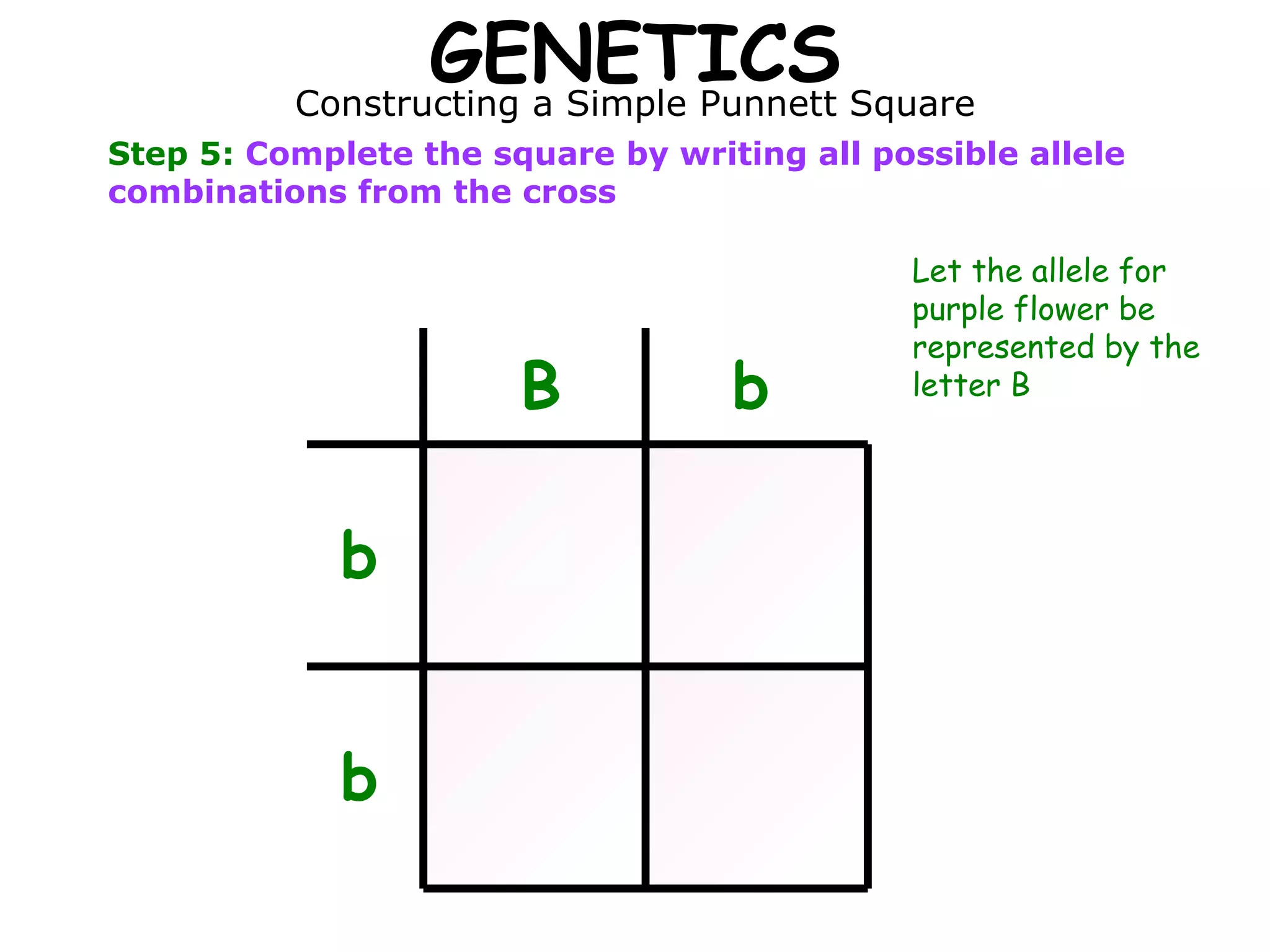
GENETICS Constructing a Simple Punnett Square Step 5:  Complete the square by writing all possible allele combinations from the cross B b b b B b b b b B b b Let the allele for purple flower be represented by the letter B
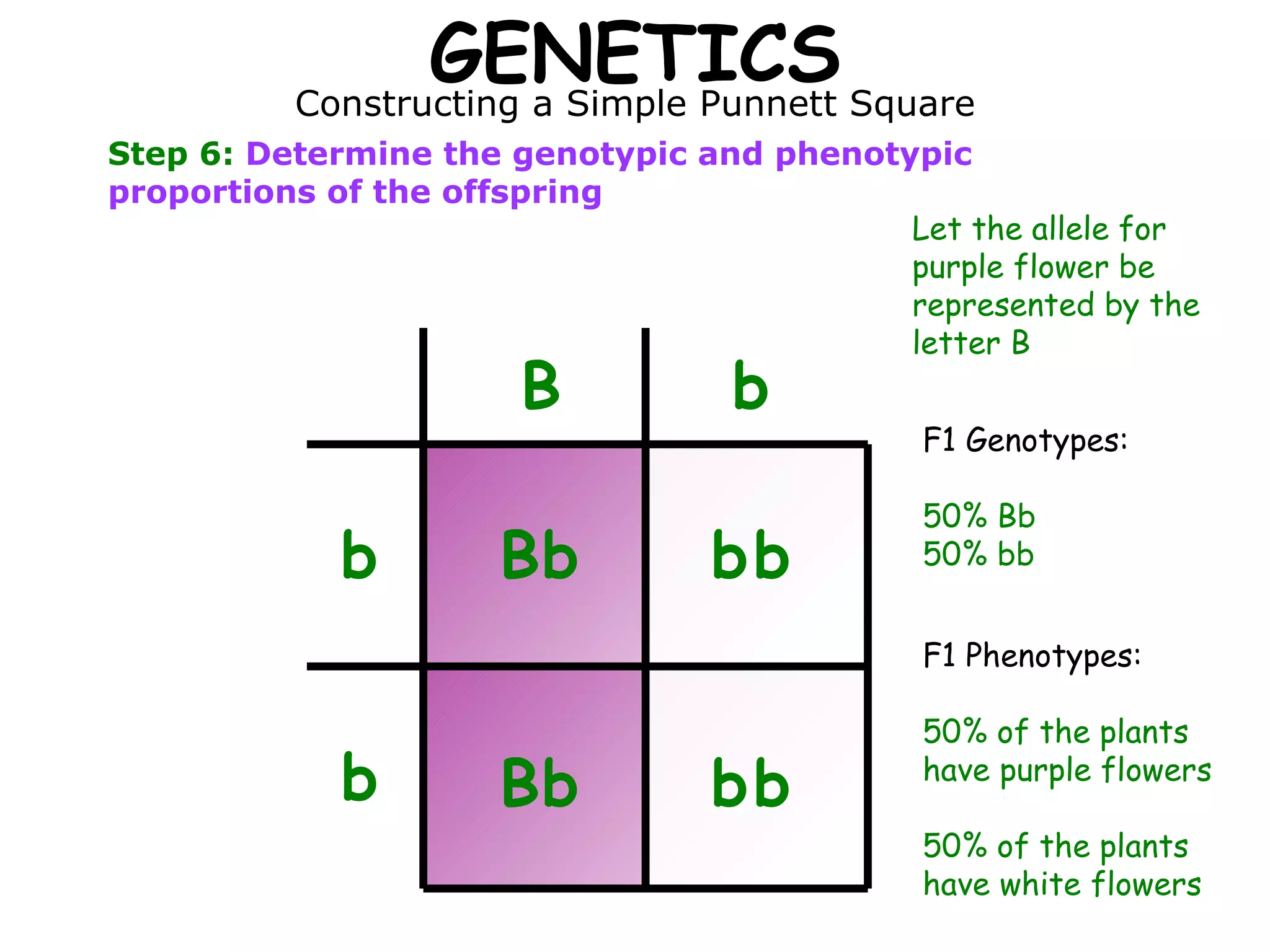
GENETICS Constructing a Simple Punnett Square Step 6:  Determine the genotypic and phenotypic proportions of the offspring B b b b B b b b b B b b b Let the allele for purple flower be represented by the letter B F1 Genotypes: 50% Bb 50% bb F1 Phenotypes: 50% of the plants have purple flowers 50% of the plants have white flowers
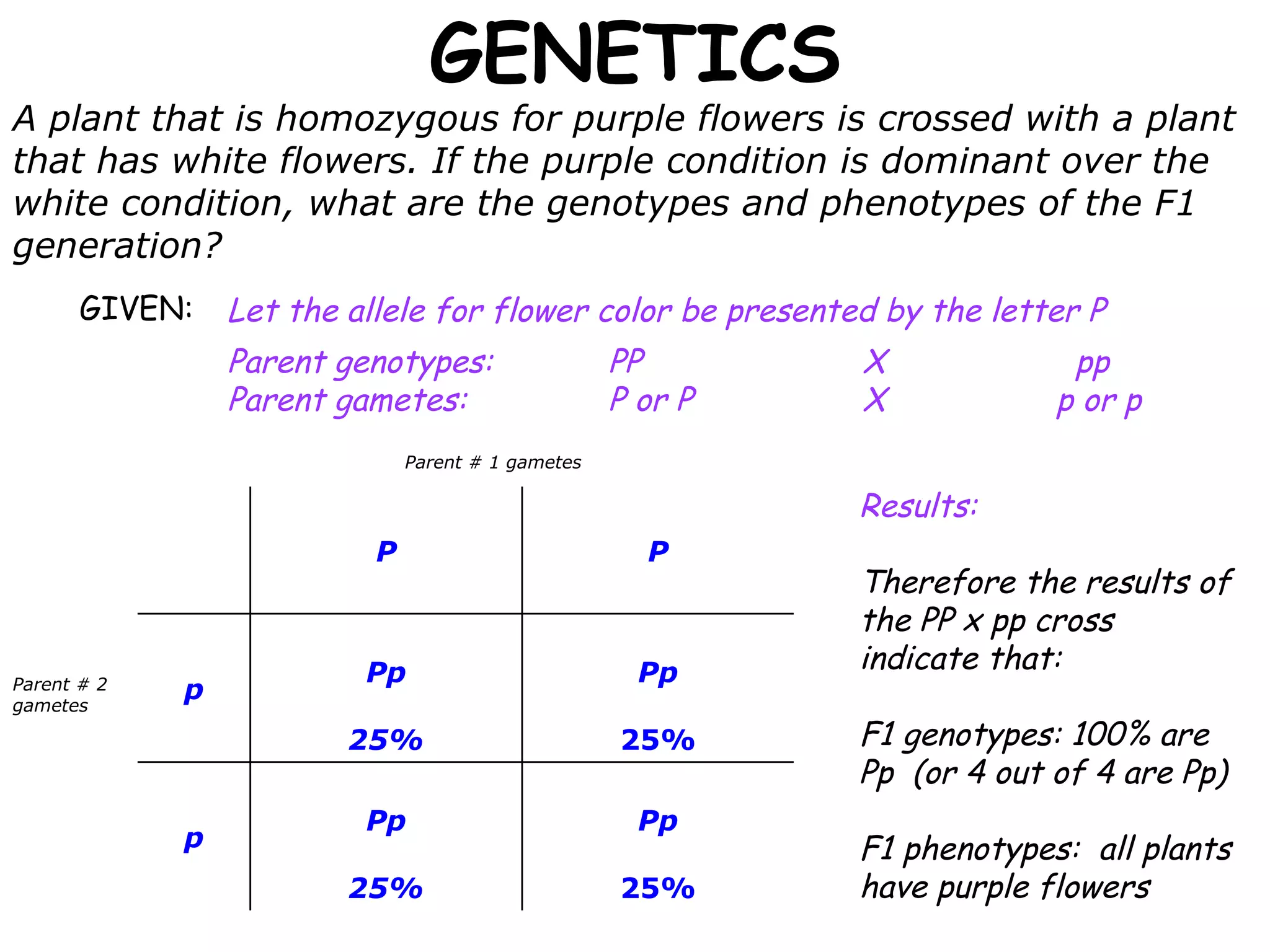
GENETICS A plant that is homozygous for purple flowers is crossed with a plant that has white flowers. If the purple condition is dominant over the white condition, what are the genotypes and phenotypes of the F1 generation? GIVEN:  Let the allele for flower color be presented by the letter P Parent genotypes:  PP X   pp Parent gametes:   P or P X   p or p Parent # 2 gametes Parent # 1 gametes Results: Therefore the results of the PP x pp cross indicate that: F1 genotypes: 100% are Pp  (or 4 out of 4 are Pp) F1 phenotypes:  all plants have purple flowers Pp 25% Pp 25% p Pp 25% Pp 25% p P P
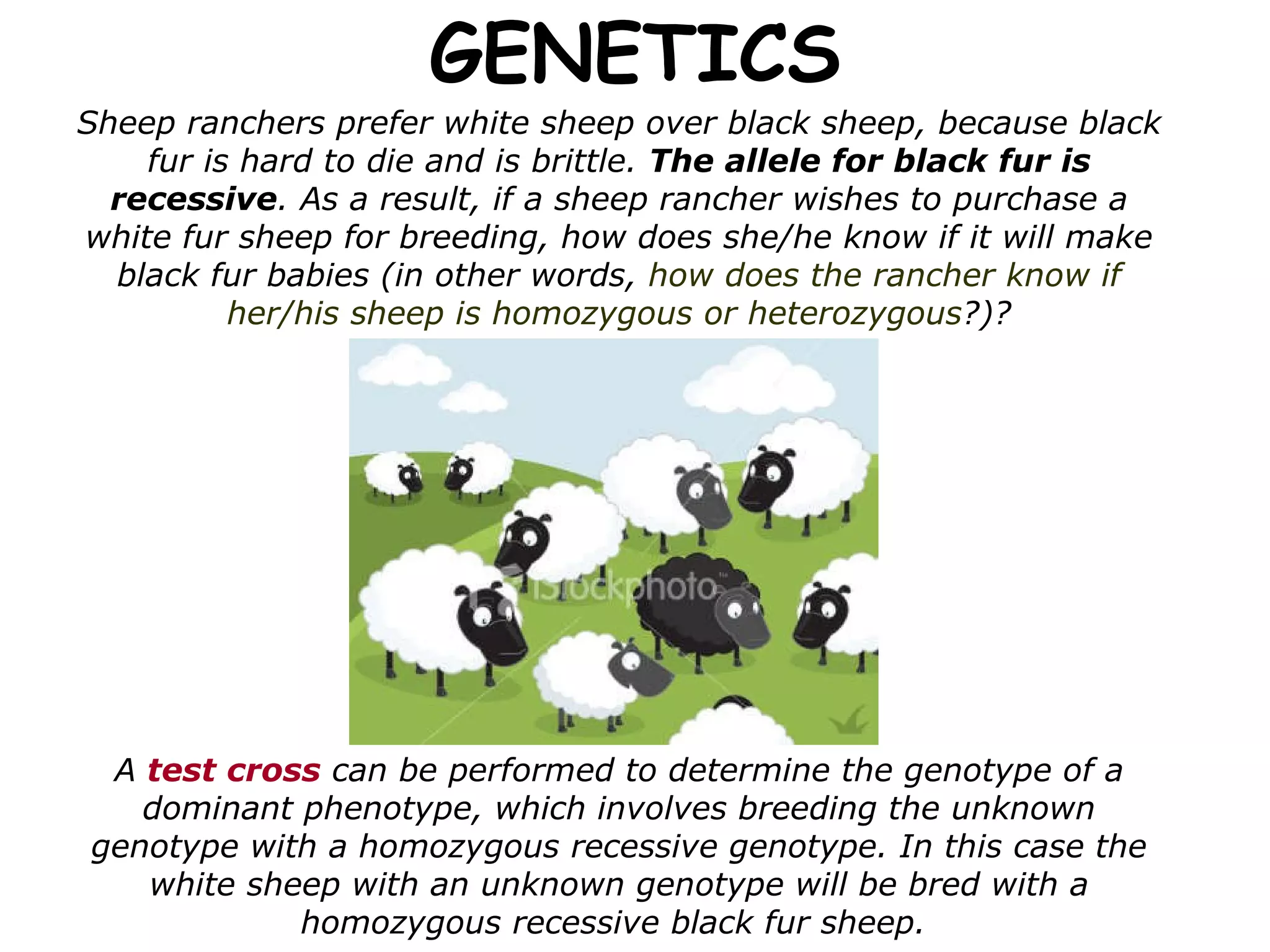
GENETICS Sheep ranchers prefer white sheep over black sheep, because black fur is hard to die and is brittle.  The allele for black fur is recessive . As a result, if a sheep rancher wishes to purchase a white fur sheep for breeding, how does she/he know if it will make black fur babies (in other words,  how does the rancher know if her/his sheep is homozygous or heterozygous ?)? A  test cross  can be performed to determine the genotype of a dominant phenotype, which involves breeding the unknown genotype with a homozygous recessive genotype. In this case the white sheep with an unknown genotype will be bred with a homozygous recessive black fur sheep.
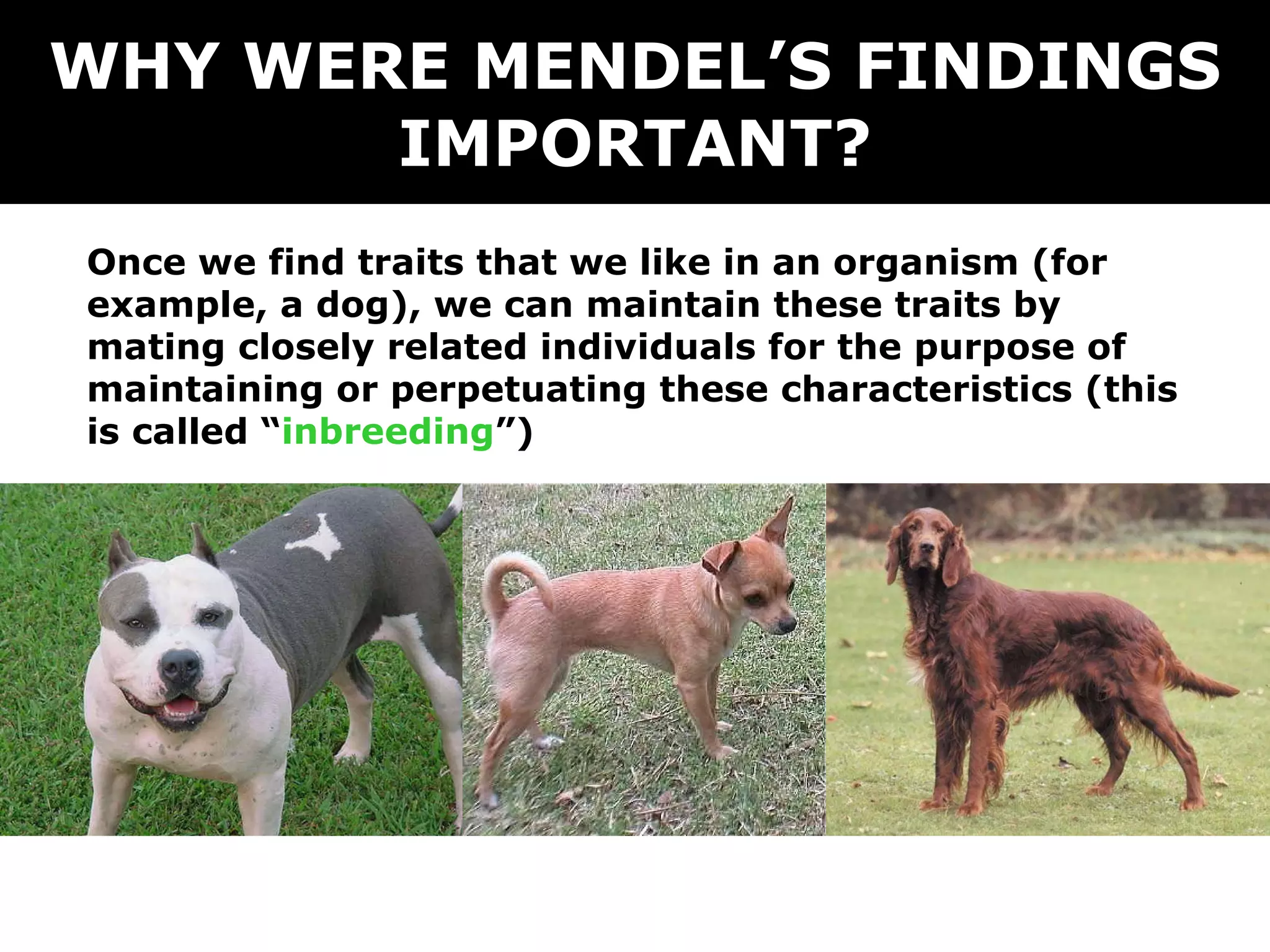
WHY WERE MENDEL’S FINDINGS IMPORTANT? Once we find traits that we like in an organism (for example, a dog), we can maintain these traits by mating closely related individuals for the purpose of maintaining or perpetuating these characteristics (this is called “ inbreeding ”)
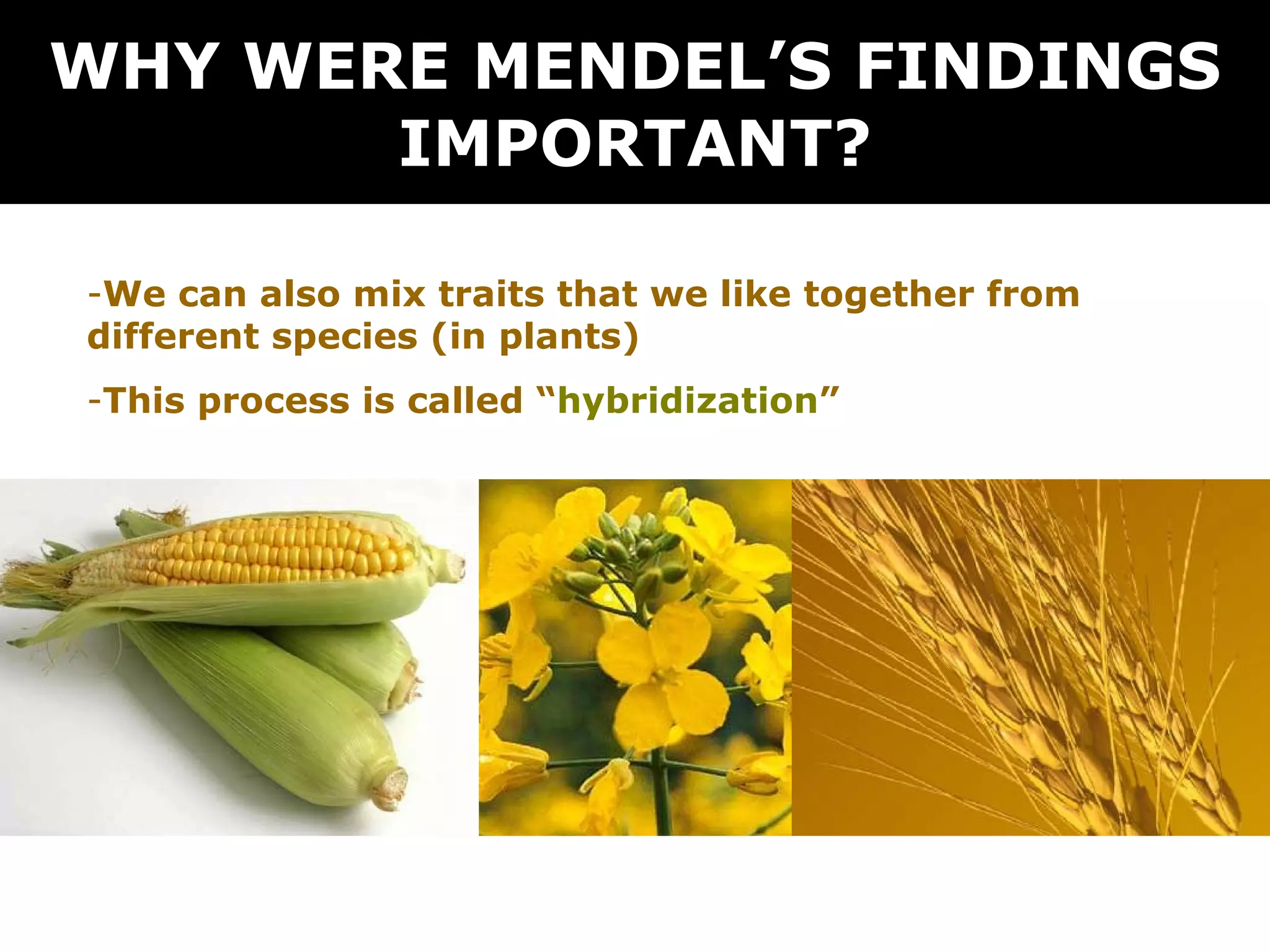
WHY WERE MENDEL’S FINDINGS IMPORTANT? We can also mix traits that we like together from different species (in plants) This process is called “ hybridization ”
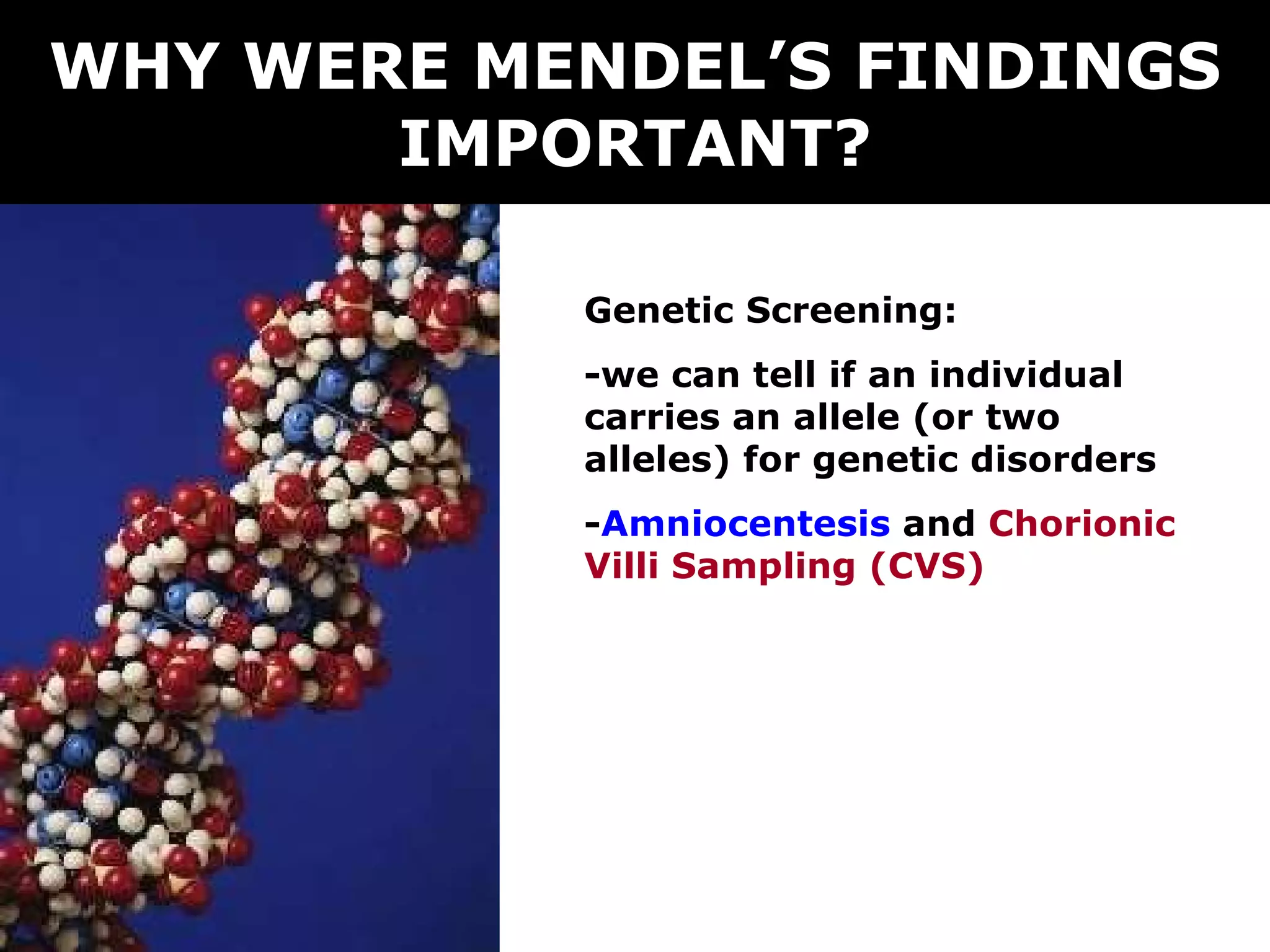
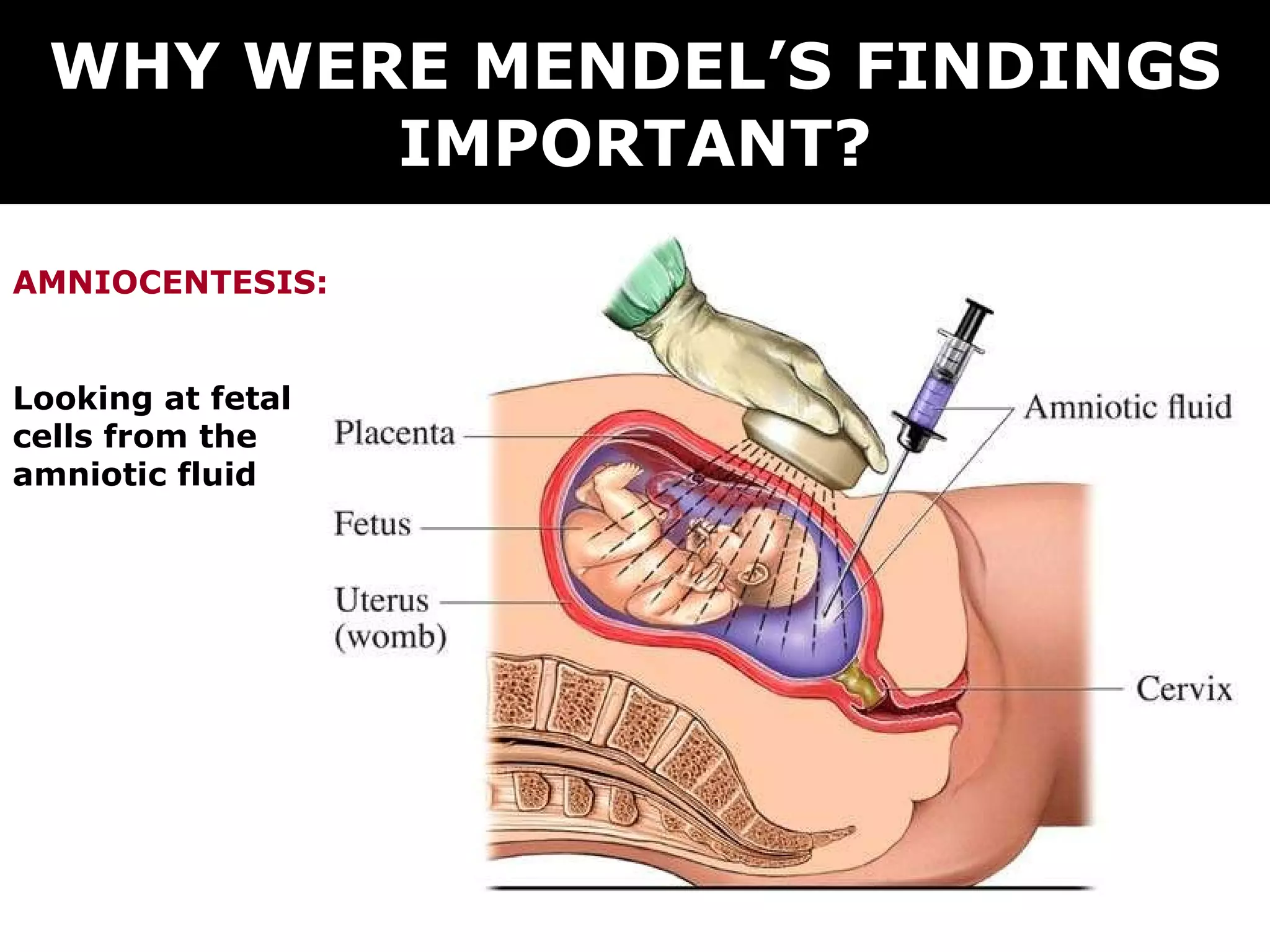
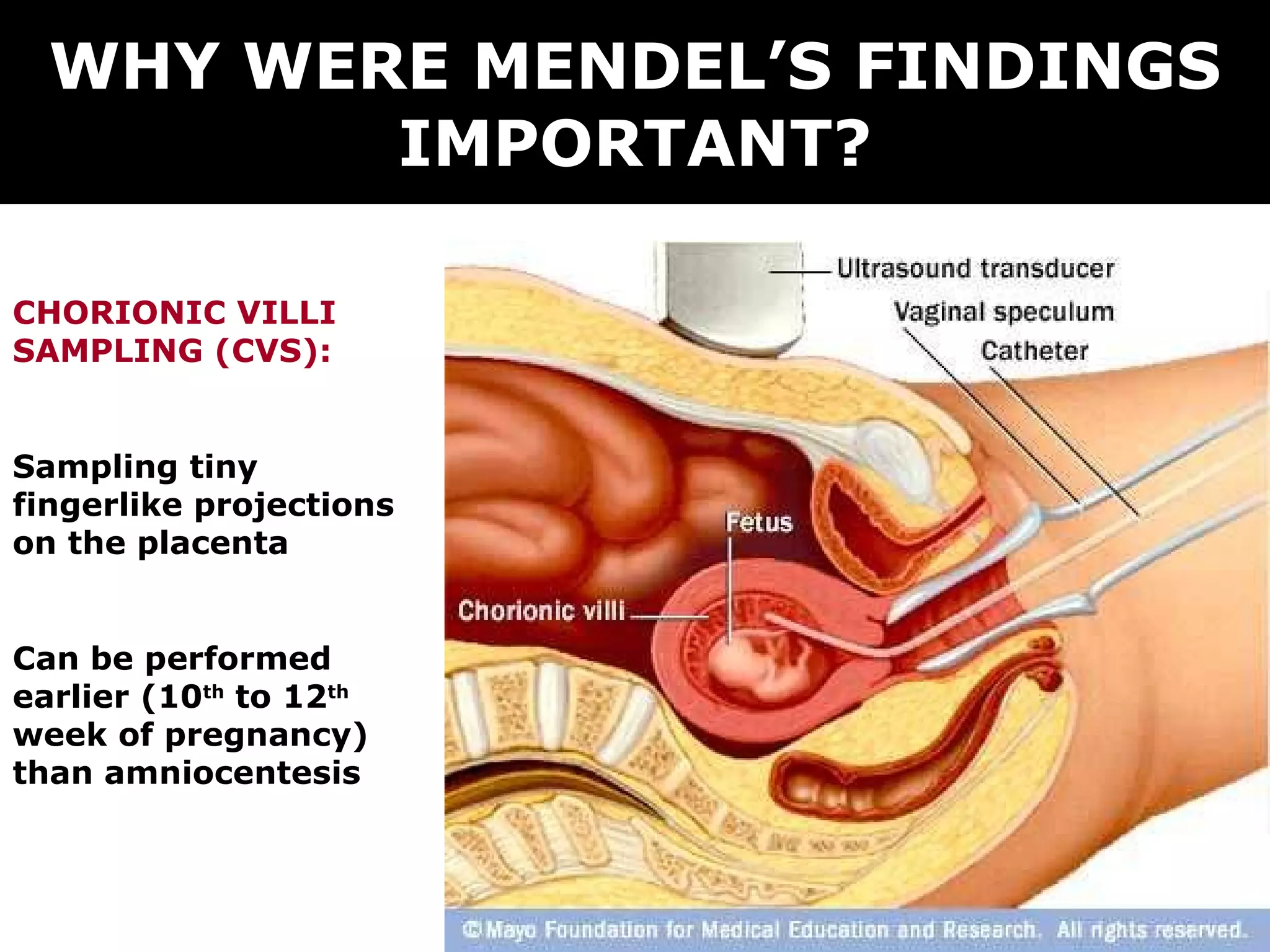
WHY WERE MENDEL’S FINDINGS IMPORTANT? Genetic Screening: -we can tell if an individual carries an allele (or two alleles) for genetic disorders - Amniocentesis  and  Chorionic Villi Sampling (CVS)
WHY WERE MENDEL’S FINDINGS IMPORTANT? AMNIOCENTESIS: Looking at fetal cells from the amniotic fluid
WHY WERE MENDEL’S FINDINGS IMPORTANT? CHORIONIC VILLI SAMPLING (CVS): Sampling tiny fingerlike projections on the placenta Can be performed earlier (10 th  to 12 th  week of pregnancy)   than amniocentesis
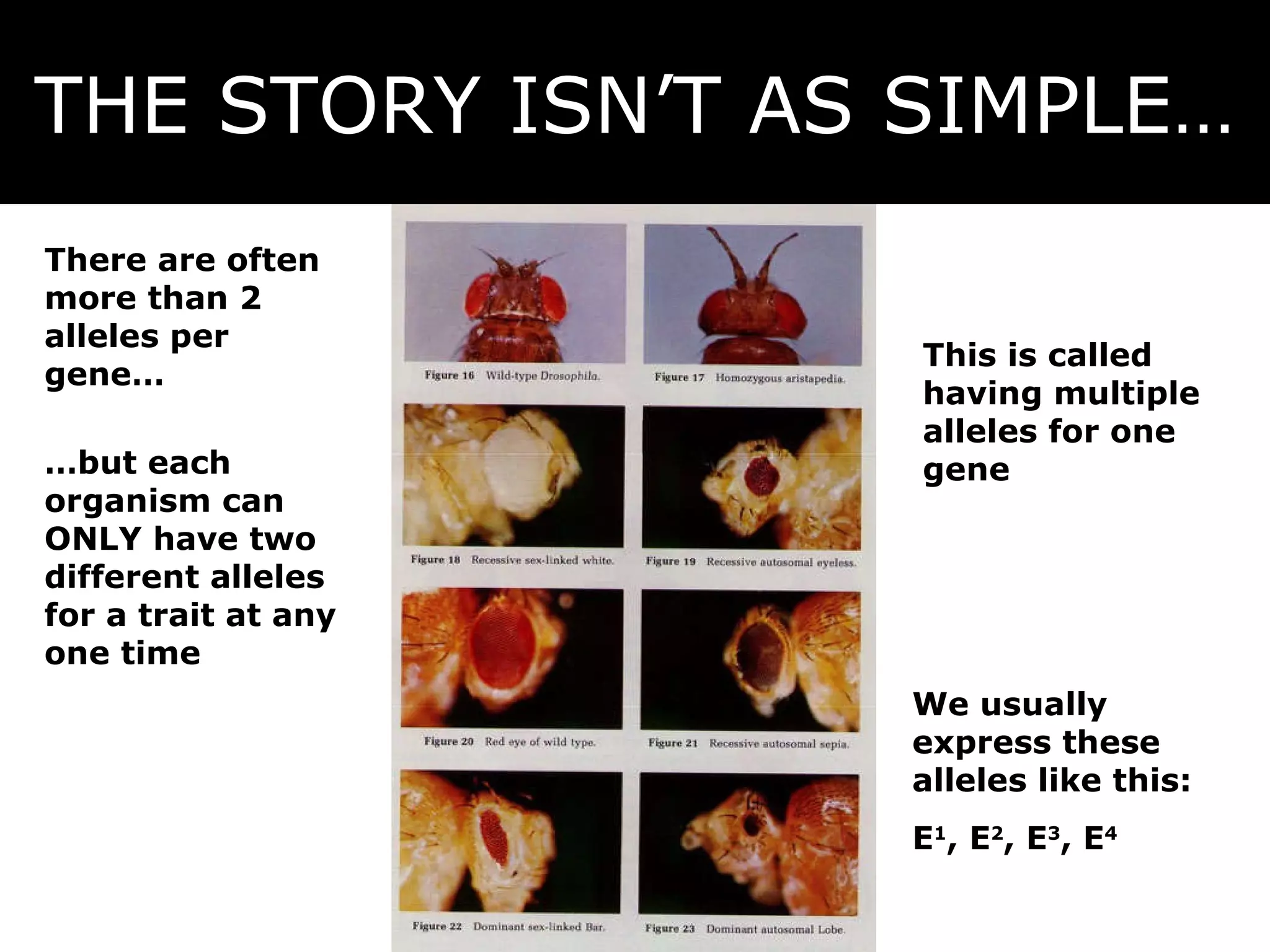
THE STORY ISN’T AS SIMPLE… There are often more than 2 alleles per gene… … but each organism can ONLY have two different alleles for a trait at any one time We usually express these alleles like this: E 1 , E 2 , E 3 , E 4 This is called having multiple alleles for one gene
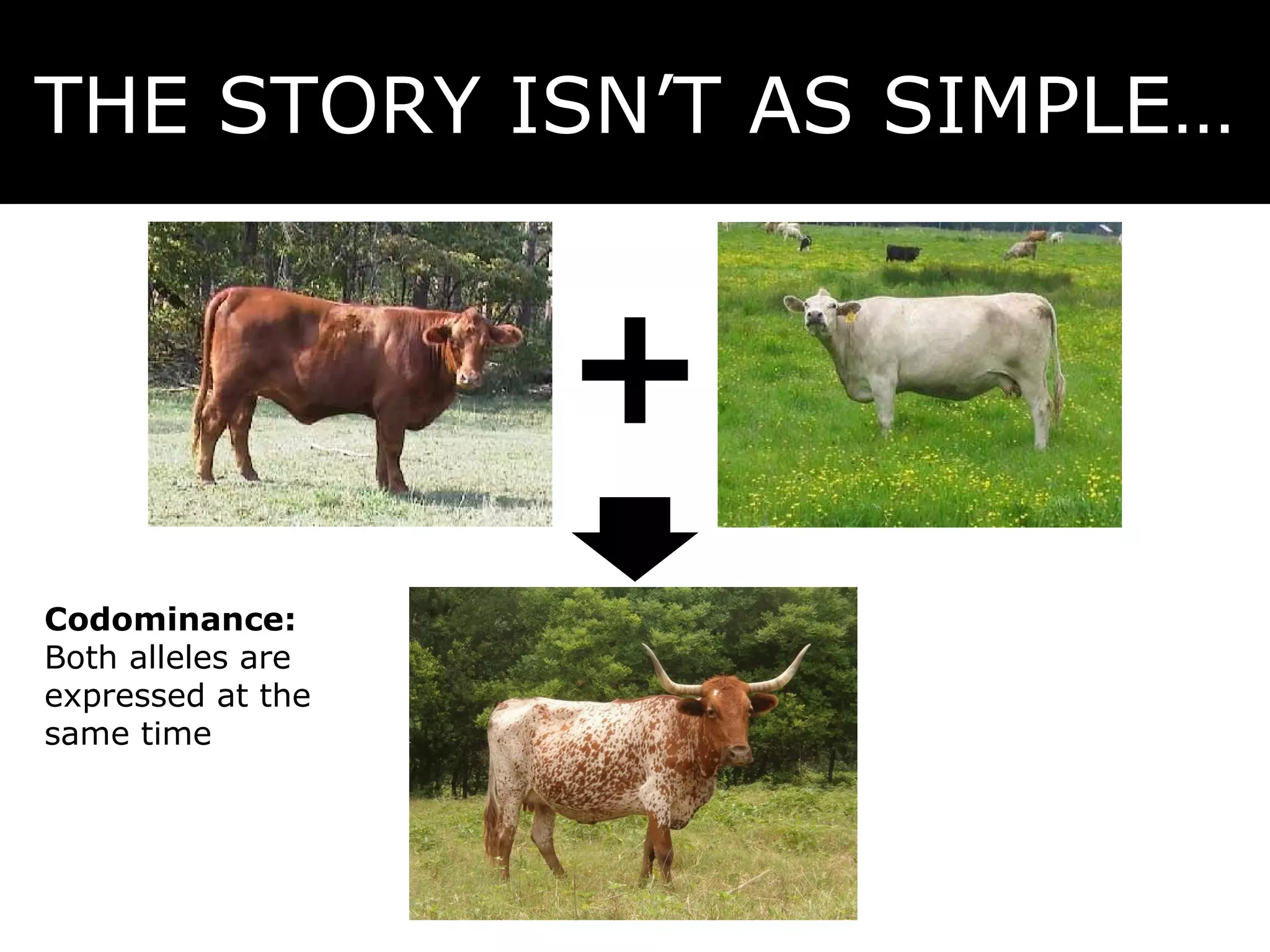
THE STORY ISN’T AS SIMPLE… Codominance:  Both alleles are expressed at the same time
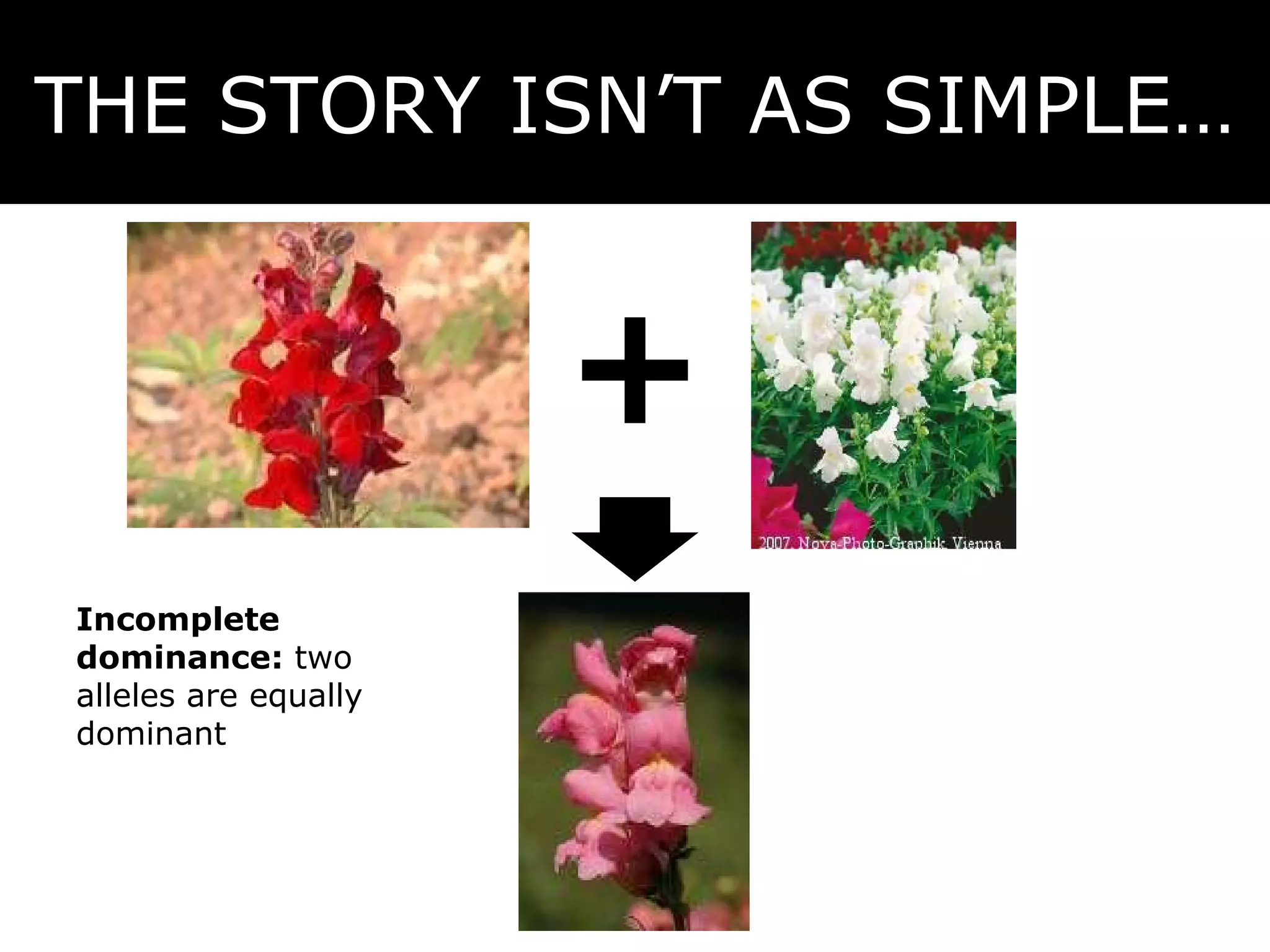
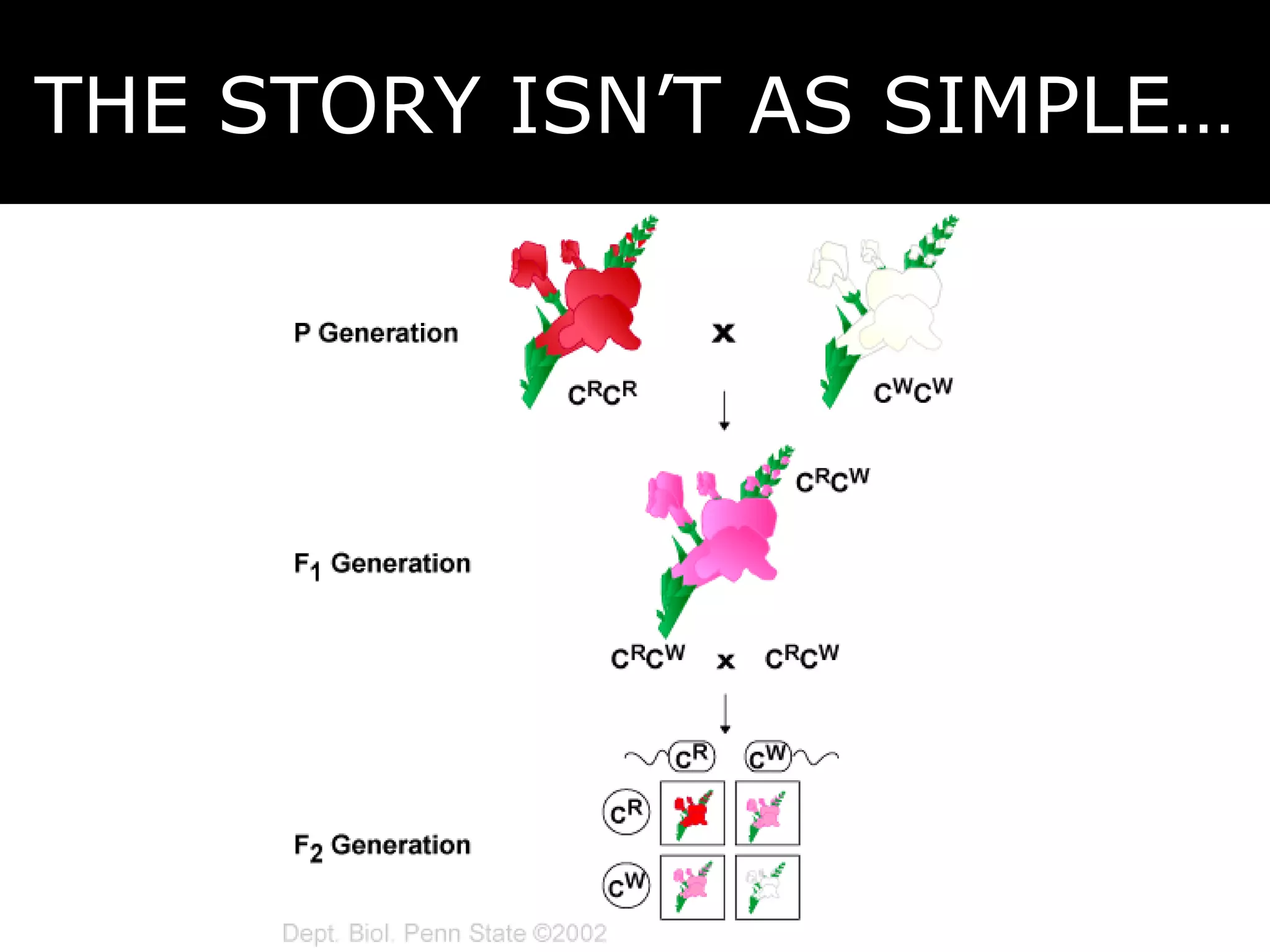
THE STORY ISN’T AS SIMPLE… Incomplete dominance:  two alleles are equally dominant
THE STORY ISN’T AS SIMPLE…
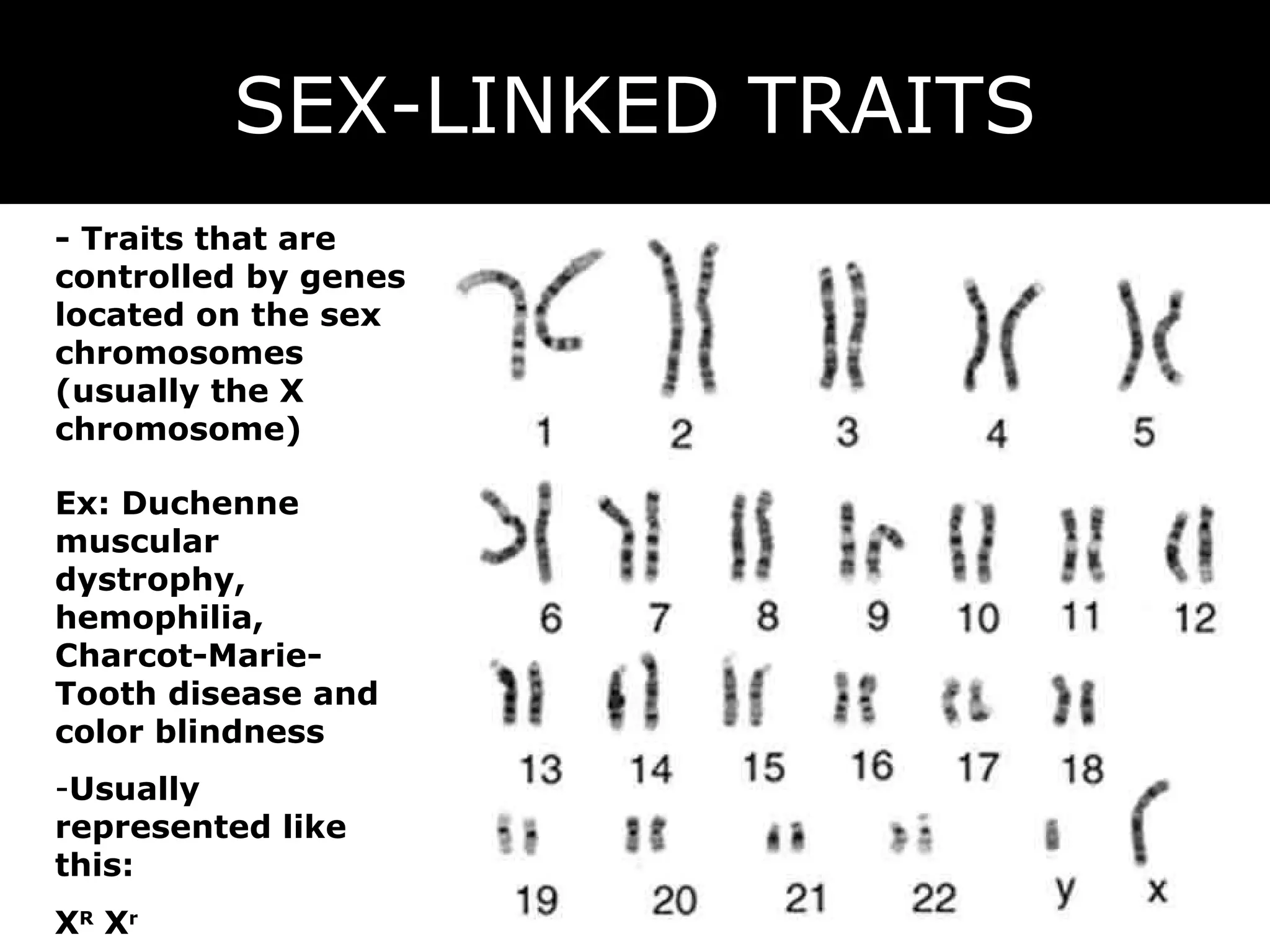
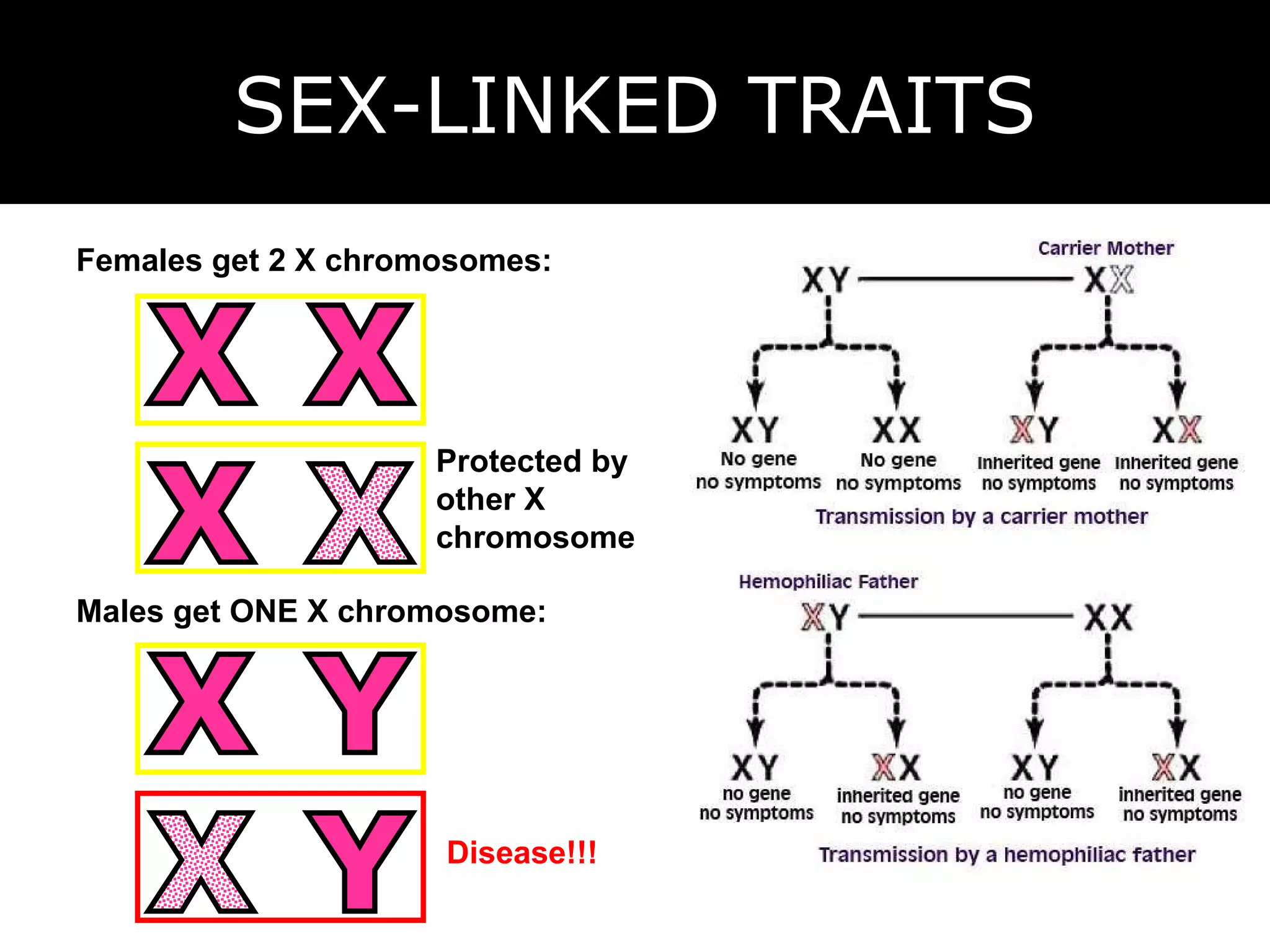
SEX-LINKED TRAITS - Traits that are controlled by genes located on the sex chromosomes (usually the X chromosome) Usually represented like this: X R  X r Ex: Duchenne muscular dystrophy, hemophilia, Charcot-Marie-Tooth disease and color blindness
SEX-LINKED TRAITS Females get 2 X chromosomes: Males get ONE X chromosome: Disease!!! Protected by other X chromosome X X X X Y X Y X
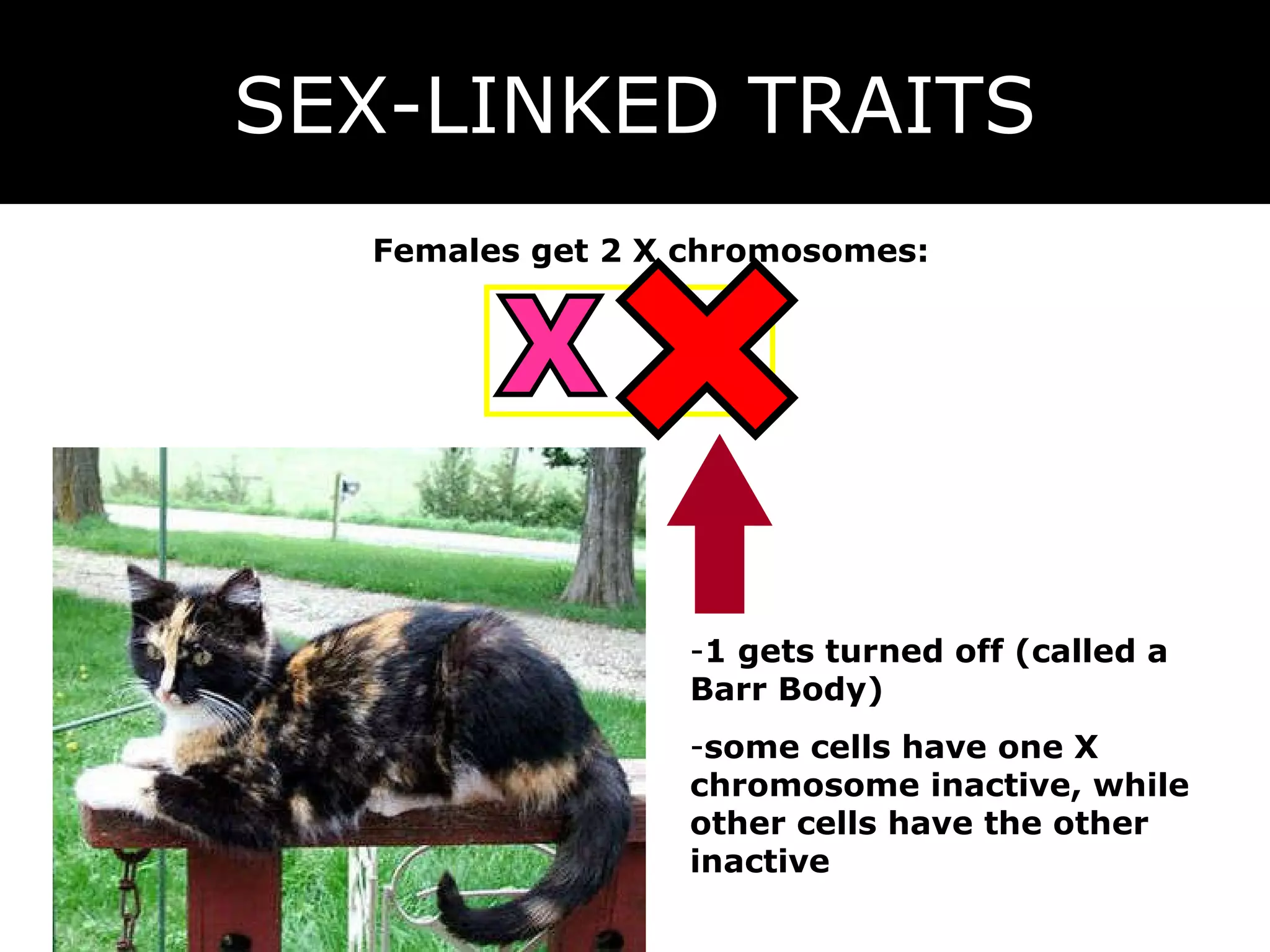
SEX-LINKED TRAITS X X Females get 2 X chromosomes: 1 gets turned off (called a Barr Body) some cells have one X chromosome inactive, while other cells have the other inactive
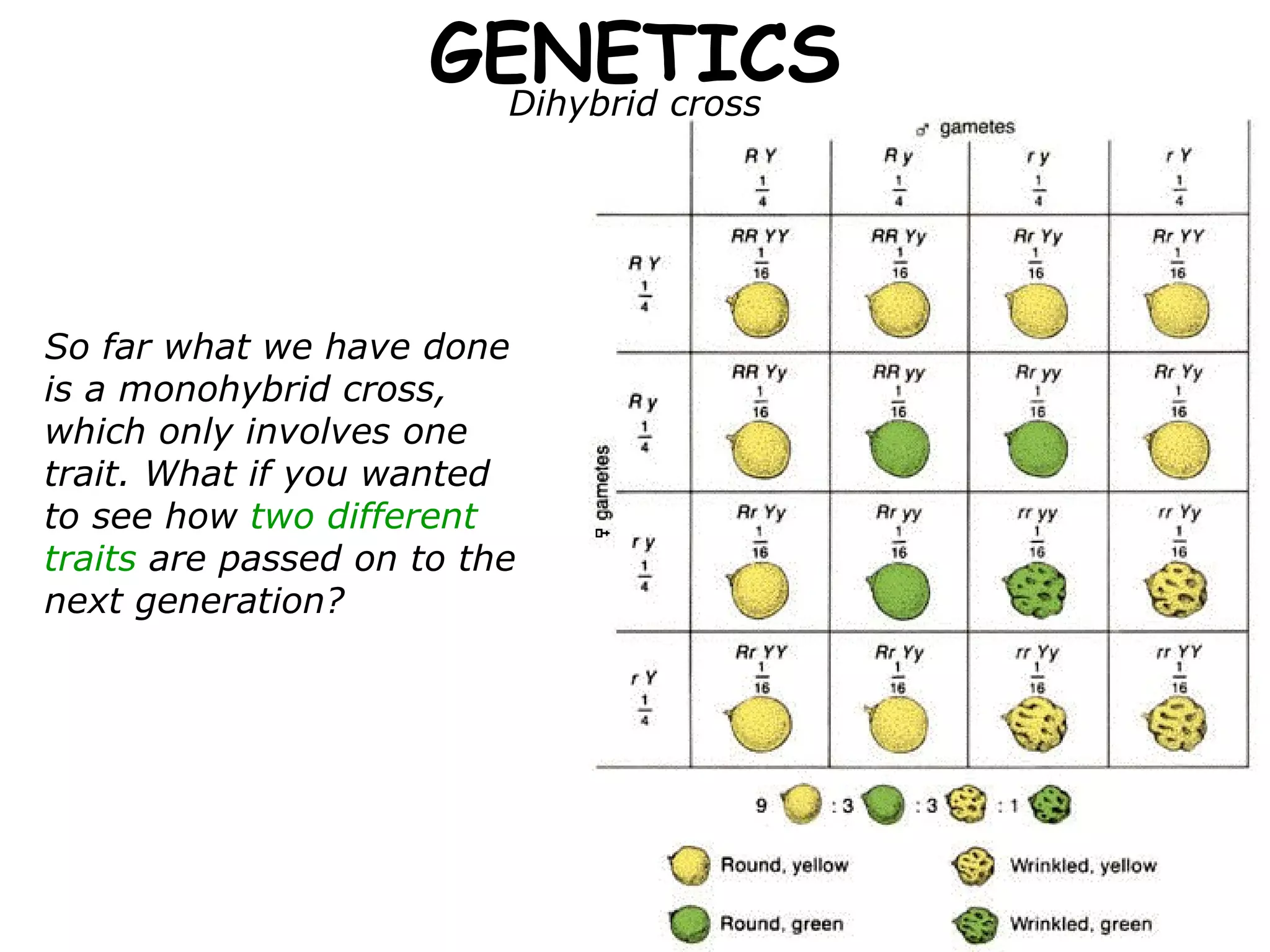
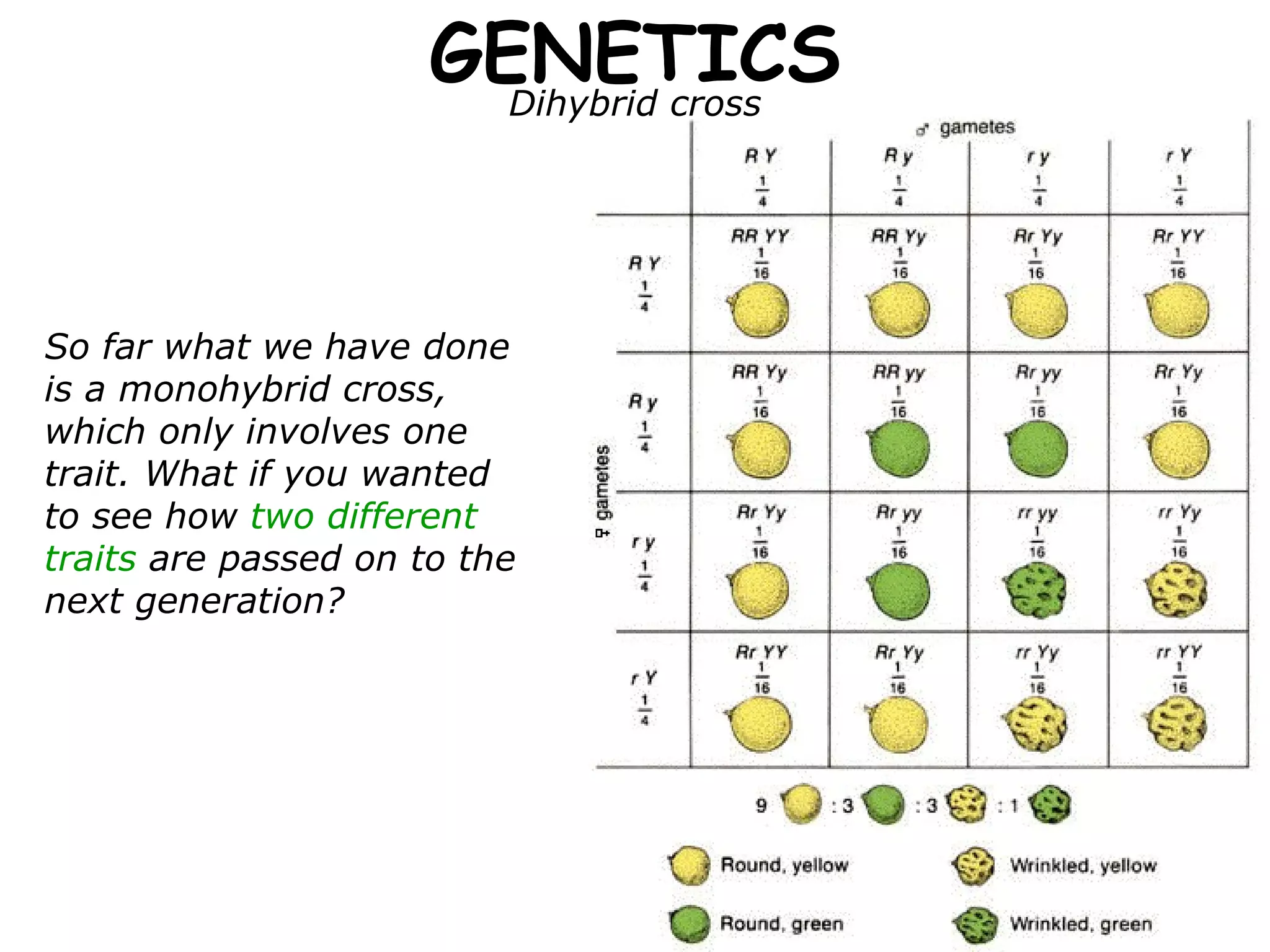
GENETICS Dihybrid cross So far what we have done is a monohybrid cross, which only involves one trait. What if you wanted to see how  two different traits  are passed on to the next generation?

01 genetics version 2

  • 1.
  • 2.
    Every trait (or characteristic) in your body comes from instructions from your mother and father GENETICS Father Mother
  • 3.
    GENETICS Segments ofDNA that code for specific traits The instructions are coded in the DNA as genes . Genes are located in chromosomes . For example… This is not an accurate example. It’s just used to illustrate a point. Genes Gene for height Gene for eye-color
  • 4.
    GENETICS Humans have 46 chromosomes . Father’s side Mother’s side Each chromosome has 2 copies: one from mommy one from daddy 2 sex chromosomes 46
  • 5.
    GENETICS Chromosomes and their genes are passed to the offspring (children) through sperm and egg cells ( gametes ) Father Mother Sperm cells 23 chromosomes Egg cells 23 chromosomes
  • 6.
    GENETICS Chromosomes and their genes are passed to the offspring (children) through sperm and egg cells ( gametes ) Father Mother
  • 7.
    GENETICS 9 monthslater… The offspring is born Father Mother
  • 8.
    GENETICS A closerlook… Half of the offspring’s chromosomes are from mommy, and half are from daddy Father Mother
  • 9.
    GENETICS Blue eyesBrown eyes Each gene has alternate forms, called alleles . For instance, the gene for eye colour* may have 2 alleles: brown vs. blue Brown eyes Blue eyes Father Mother
  • 10.
    GENETICS Some allelescan “ mask ” the effects of the other allele. Although the mother has blue eyes, the child has brown eyes. In this case, brown eyes are “ dominant ” As a result, blue eyes are “ recessive ” Brown eyes Blue eyes Father Mother
  • 11.
    GENETICS Some allelescan “ mask ” the effects of the other allele. Dominant – traits that are expressed more often. Alleles that are dominant are usually represented by a capitalized letter symbolizing that allele (i.e. B ) Recessive – traits that are expressed less frequently. Alleles that are recessive are usually represented by a lower-case letter symbolizing that allele (i.e. b ) Brown eyes Blue eyes
  • 12.
    GENETICS Dominant andRecessive Alleles: How can the daughter’s two alleles ( genotype ) be written? Bb Let the allele for brown eyes be B , and the allele for blue eyes be b Brown eyes Blue eyes Daughter’s genetic makeup: Brown eyes Blue eyes
  • 13.
    GENETICS Dominant andRecessive Alleles: Bb Notice how the daughter carries the allele for blue eyes, but she does not have blue eyes. Thus her phenotype (observable trait) is brown eyes. Brown eyes Blue eyes
  • 14.
    GENETICS Since shecarries two different alleles for eye colour, we can say that she is heterozygous for eye color. Heterozygous – describes the genotype of an organism that contains two different alleles (ex. Bb ) Homozygous vs. heterozygous Bb Brown eyes Blue eyes
  • 15.
    GENETICS If shehad blue eyes, we can say that she is homozygous for eye color. Homozygous – describes the genotype of an organism that contains two alleles that are the same (ex. BB ) Homozygous vs. heterozygous bb blue eyes Blue eyes
  • 16.
    GENETICS But wait… Is this possible?! Father Mother
  • 17.
    GENETICS Yes thisis possible Bb bb The father could have carried the recessive allele for blue eyes as well… … although you can’t tell because he has the dominant brown eye allele (which “masks” blue eyes) b b Father Mother
  • 18.
    GENETICS Father Bb The father’s parents could have passed the blue eye allele to him bb BB Grandpa Grandma
  • 19.
    GENETICS All toocomplicated? Let’s take a look at how it all started… Gregor Mendel (1822-1884) - Known as the father of genetics - Worked with pea plants
  • 20.
    GENETICS Mendel’s peaplants He observed 2 traits for each part of the plant
  • 21.
    GENETICS Mendel’s peaplants Mendel came up with the concept of alleles . He noticed that alleles are hereditary , and that you can predict the probability of the offspring having certain alleles.
  • 22.
    GENETICS Mendel’s peaplants He also noticed that some traits dominated over others For instance, if you “crossed” a yellow-pea plant with a green-pea plant, you generally get a yellow-pea plant Mendel Video
  • 23.
    GENETICS Mendel’s peaplants What does “crossing” the pea plants mean? Garden peas are both self-fertilizing and cross-fertilizing . Self-fertilizing – a plant’s pollen grains fertilize it’s own egg cells in the ovary Cross-fertilizing – a plant’s pollen grains fertilize another plant’s egg cells in the ovary It means to mate a plant with another plant by pollination.
  • 24.
    GENETICS Mendel’s peaplants This allowed Mendel to mate pea plants with each other as well as with itself. For example, you can mate a purple flower pea plant with itself. MATE! This is called a Punnett Square
  • 25.
    GENETICS Punnett SquareThis means that mating a pea plant that is heterozygous for flower colour (Bb) with itself will produce… F1 GENOTYPE: 25% BB 50% Bb 25% bb A 1:2:1 ratio F1 PHENOTYPE: 75% purple flowers 25% white flowers F1 stands for filius and filia , which in Latin means “son” or “daughter”
  • 26.
    GENETICS Constructing aSimple Punnett Square Step 1: Draw a square with a 2 by 2 grid
  • 27.
    GENETICS Constructing aSimple Punnett Square Step 2: Choose a letter for your allele and record this choice Let the allele for purple flower be represented by the letter B
  • 28.
    GENETICS Constructing aSimple Punnett Square Step 3: Consider all possible gametes produced by the first parent. Write the alleles for these gametes across the top of the square Bb B b Let the allele for purple flower be represented by the letter B
  • 29.
    GENETICS Constructing aSimple Punnett Square Step 4: Consider all possible gametes produced by the second parent. Write the alleles for these gametes down the side of the square B b bb b b Let the allele for purple flower be represented by the letter B
  • 30.
    GENETICS Constructing aSimple Punnett Square Step 5: Complete the square by writing all possible allele combinations from the cross B b b b B b b b b B b b Let the allele for purple flower be represented by the letter B
  • 31.
    GENETICS Constructing aSimple Punnett Square Step 6: Determine the genotypic and phenotypic proportions of the offspring B b b b B b b b b B b b b Let the allele for purple flower be represented by the letter B F1 Genotypes: 50% Bb 50% bb F1 Phenotypes: 50% of the plants have purple flowers 50% of the plants have white flowers
  • 32.
    GENETICS A plantthat is homozygous for purple flowers is crossed with a plant that has white flowers. If the purple condition is dominant over the white condition, what are the genotypes and phenotypes of the F1 generation? GIVEN: Let the allele for flower color be presented by the letter P Parent genotypes: PP X pp Parent gametes: P or P X p or p Parent # 2 gametes Parent # 1 gametes Results: Therefore the results of the PP x pp cross indicate that: F1 genotypes: 100% are Pp (or 4 out of 4 are Pp) F1 phenotypes: all plants have purple flowers Pp 25% Pp 25% p Pp 25% Pp 25% p P P
  • 33.
    GENETICS Sheep ranchersprefer white sheep over black sheep, because black fur is hard to die and is brittle. The allele for black fur is recessive . As a result, if a sheep rancher wishes to purchase a white fur sheep for breeding, how does she/he know if it will make black fur babies (in other words, how does the rancher know if her/his sheep is homozygous or heterozygous ?)? A test cross can be performed to determine the genotype of a dominant phenotype, which involves breeding the unknown genotype with a homozygous recessive genotype. In this case the white sheep with an unknown genotype will be bred with a homozygous recessive black fur sheep.
  • 34.
    WHY WERE MENDEL’SFINDINGS IMPORTANT? Once we find traits that we like in an organism (for example, a dog), we can maintain these traits by mating closely related individuals for the purpose of maintaining or perpetuating these characteristics (this is called “ inbreeding ”)
  • 35.
    WHY WERE MENDEL’SFINDINGS IMPORTANT? We can also mix traits that we like together from different species (in plants) This process is called “ hybridization ”
  • 36.
    WHY WERE MENDEL’SFINDINGS IMPORTANT? Genetic Screening: -we can tell if an individual carries an allele (or two alleles) for genetic disorders - Amniocentesis and Chorionic Villi Sampling (CVS)
  • 37.
    WHY WERE MENDEL’SFINDINGS IMPORTANT? AMNIOCENTESIS: Looking at fetal cells from the amniotic fluid
  • 38.
    WHY WERE MENDEL’SFINDINGS IMPORTANT? CHORIONIC VILLI SAMPLING (CVS): Sampling tiny fingerlike projections on the placenta Can be performed earlier (10 th to 12 th week of pregnancy) than amniocentesis
  • 39.
    THE STORY ISN’TAS SIMPLE… There are often more than 2 alleles per gene… … but each organism can ONLY have two different alleles for a trait at any one time We usually express these alleles like this: E 1 , E 2 , E 3 , E 4 This is called having multiple alleles for one gene
  • 40.
    THE STORY ISN’TAS SIMPLE… Codominance: Both alleles are expressed at the same time
  • 41.
    THE STORY ISN’TAS SIMPLE… Incomplete dominance: two alleles are equally dominant
  • 42.
    THE STORY ISN’TAS SIMPLE…
  • 43.
    SEX-LINKED TRAITS -Traits that are controlled by genes located on the sex chromosomes (usually the X chromosome) Usually represented like this: X R X r Ex: Duchenne muscular dystrophy, hemophilia, Charcot-Marie-Tooth disease and color blindness
  • 44.
    SEX-LINKED TRAITS Femalesget 2 X chromosomes: Males get ONE X chromosome: Disease!!! Protected by other X chromosome X X X X Y X Y X
  • 45.
    SEX-LINKED TRAITS XX Females get 2 X chromosomes: 1 gets turned off (called a Barr Body) some cells have one X chromosome inactive, while other cells have the other inactive
  • 46.
    GENETICS Dihybrid crossSo far what we have done is a monohybrid cross, which only involves one trait. What if you wanted to see how two different traits are passed on to the next generation?
  • 47.
    GENETICS Dihybrid crossSo far what we have done is a monohybrid cross, which only involves one trait. What if you wanted to see how two different traits are passed on to the next generation?