UNIT 4:
GENETICS AND
INHERITANCE
Campbell & Reece:
Chapters 14 and 15
1. WHAT IS GENETICS
• Genetics: The study of heredity.
• Heredity is the relations between
successive generations.
• Why do children look a little bit like their
parents but also different?
• What is responsible for these
similarities and differences?
2. MENDEL’S GENETICS
• Gregory Mendel is the father of
Genetics.
• Mendel discovered the basic principles
of heredity by breeding garden peas in
carefully planned experiments.
• Advantages of pea plants for genetic
study: Cross-pollination (fertilization
between different plants) can be achieved by
dusting one plant with pollen from another.
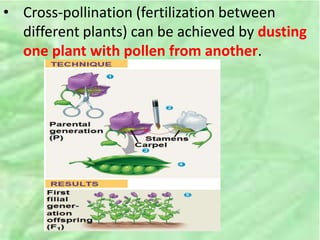
• Cross-pollination (fertilization between
different plants) can be achieved by dusting
one plant with pollen from another.
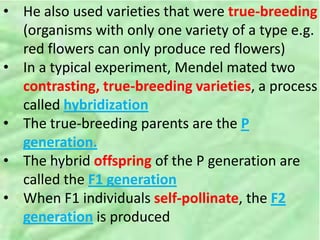
• He also used varieties that were true-breeding
(organisms with only one variety of a type e.g.
red flowers can only produce red flowers)
• In a typical experiment, Mendel mated two
contrasting, true-breeding varieties, a process
called hybridization
• The true-breeding parents are the P
generation.
• The hybrid offspring of the P generation are
called the F1 generation
• When F1 individuals self-pollinate, the F2
generation is produced
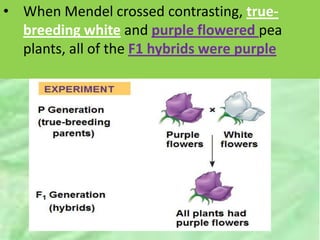
• When Mendel crossed contrasting, true-
breeding white and purple flowered pea
plants, all of the F1 hybrids were purple
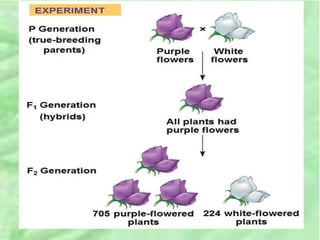
• When Mendel crossed the F1 hybrids,
many of the F2 plants had purple flowers,
but some had white
• Mendel discovered a ratio of about three
to one, purple to white flowers, in the F2
generation.
• Mendel reasoned that only the purple flower
factor was affecting flower color in the F1
hybrids.
• Mendel called the purple flower color a
dominant trait and the white flower color a
recessive trait
• What Mendel called a “heritable factor” is
what we now call a gene
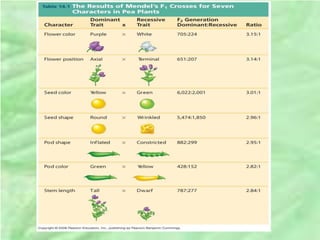
• He did 7 other crosses using different traits
and found the same phenomenon.
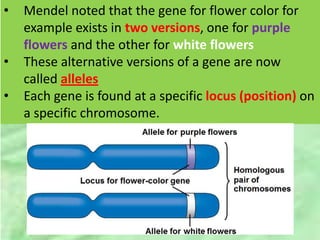
• Mendel noted that the gene for flower color for
example exists in two versions, one for purple
flowers and the other for white flowers
• These alternative versions of a gene are now
called alleles
• Each gene is found at a specific locus (position) on
a specific chromosome.
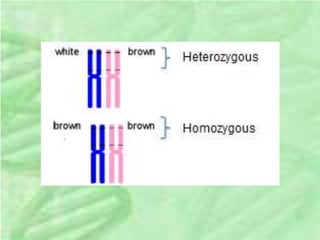
• The two alleles at a locus on a homologous
chromosome pair may be identical, as in the
true-breeding plants – they are then said to
be homozygous for that trait/gene.
• Alternatively, the two alleles at a locus may
differ – they are said to be heterozygous for
that gene/trait.
• If the two alleles at a locus differ, then one
(the dominant allele) determines the
organism’s appearance (we refer to it as its
phenotype), and the other (the recessive
allele) has no noticeable effect on
• Mendel then formulated the law of
segregation, states that the two alleles for a
heritable character separate (segregate)
during gamete formation and end up in
different gametes
• Thus, an egg or a sperm gets only one of the
two alleles that are present in the somatic
cells of an organism.
• An organism traits are indicated via its
genotype and phenotype.
 Genotype: The genetic composition of
the gene, indicated by letters e.g. GG,
Gg, gg. (A capital letter represents a
dominant allele, and a lowercase letter
represents a recessive allele)
 Phenotype: The external appearance of
the gene e.g. Brown hair, white hair.
3. GENETIC CROSSES
• HOW CAN WE NOW MORE OF LESS
DETERMINE WHAT WILL BE THE
OUTCOME IF 2 ORGANISMS HAVE A
BABY?
TWO TYPES OF
GENETIC CROSSES
• MONOHYBRID CROSSES: A cross
between 2 organisms where we only
look an one pair of contrasting traits.
• DIHYBRID CROSS: A cross between 2
organisms where we look at two pairs
of contrasting traits at the same time.
MONOHYBRID CROSS -EXAMPLE
• Determine the outcome/ F1 generation
of a cross between a homozygous tall
plant and a homozygous short plant.
Tall plants are dominant over short
plants.
STEPS TO SOLVE A CROSS PROBLEM
1. What trait are we looking at?
2. Choose a letter to represent the trait.
3. See if you can identify which trait is dominant –
allocate the capital letter to that trait.
4. Identify the recessive trait and allocate a lower case
letter to that trait.
5. Determine the genotypes of the parents. –
Homozygous dominant – Two capital letters e.g. GG
Homozygous recessive – Two lower case letter. E.g.
gg
Heterozygous – One capital letter and one lower
case letter e.g. Gg
1. Start with cross
SOLUTION
1. Trait – Size of plant.
2. Letter chosen to represent size of plant = T/t
3. Tall plants are dominant. (Given in problem) –
Given the – “T” (capital T)
4. Short plants are recessive – given the “t”
(lower case t)
5. One parent is homozygous tall – TT
other parent is homozygous short - tt
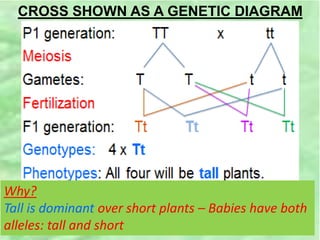
CROSS SHOWN AS A GENETIC DIAGRAM
Why?
Tall is dominant over short plants – Babies have both
alleles: tall and short
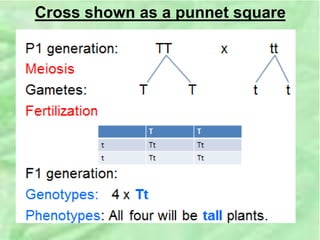
Cross shown as a punnet square
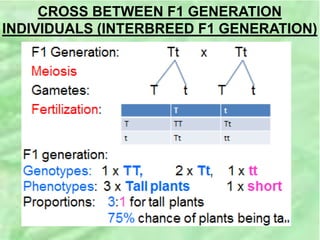
CROSS BETWEEN F1 GENERATION
INDIVIDUALS (INTERBREED F1 GENERATION)
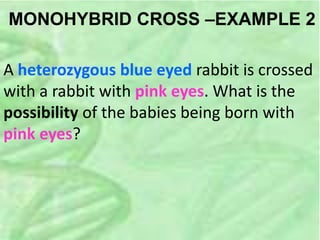
MONOHYBRID CROSS –EXAMPLE 2
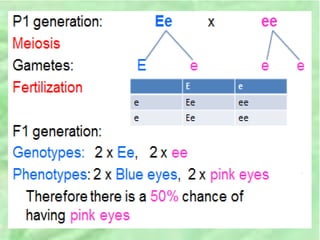
A heterozygous blue eyed rabbit is crossed
with a rabbit with pink eyes. What is the
possibility of the babies being born with
pink eyes?
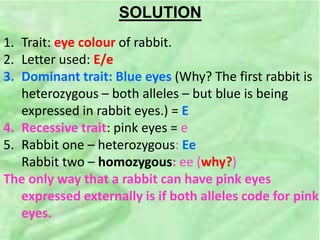
SOLUTION
1. Trait: eye colour of rabbit.
2. Letter used: E/e
3. Dominant trait: Blue eyes (Why? The first rabbit is
heterozygous – both alleles – but blue is being
expressed in rabbit eyes.) = E
4. Recessive trait: pink eyes = e
5. Rabbit one – heterozygous: Ee
Rabbit two – homozygous: ee (why?)
The only way that a rabbit can have pink eyes
expressed externally is if both alleles code for pink
eyes.
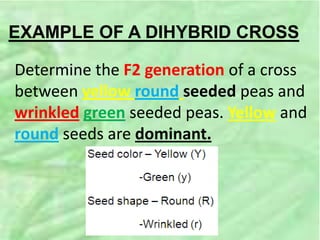
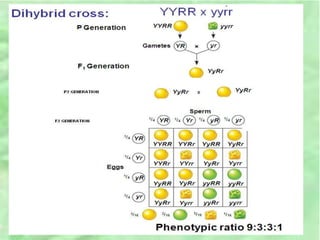
EXAMPLE OF A DIHYBRID CROSS
Determine the F2 generation of a cross
between yellow round seeded peas and
wrinkled green seeded peas. Yellow and
round seeds are dominant.
• Using a dihybrid cross, Mendel developed
the law of independent assortment
• The law of independent assortment states
that each pair of alleles segregates
independently of each other pair of alleles
during gamete formation.
• Strictly speaking, this law applies only to
genes on different, nonhomologous
chromosomes
• Genes located near each other on the
same chromosome tend to be inherited
together.
4. DEGREES OF DOMINANCE
•Complete dominance One allele
suppresses the expression of the other
allele.
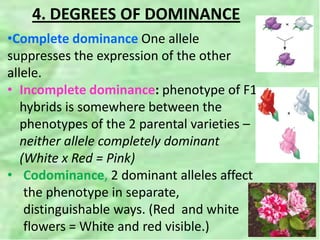
• Incomplete dominance: phenotype of F1
hybrids is somewhere between the
phenotypes of the 2 parental varieties –
neither allele completely dominant
(White x Red = Pink)
• Codominance, 2 dominant alleles affect
the phenotype in separate,
distinguishable ways. (Red and white
flowers = White and red visible.)
5. MULTIPLE ALLELES
 Most genes exist in populations in more than two
allelic forms.
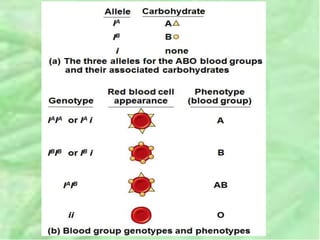
 For example, the four phenotypes of the ABO
blood group in humans are determined by three
alleles for the enzyme (I) that attaches A or B
carbohydrates to red blood cells: IA, IB, and i.
 The enzyme encoded by the IA allele adds the A
carbohydrate, whereas the enzyme encoded by
the IB allele adds the B carbohydrate; the
enzyme encoded by the i allele adds neither.
6. PLEIOTROPY
 Most genes have multiple phenotypic effects, a
property called pleiotropy
 For example, pleiotropic alleles are responsible
for the multiple symptoms of certain hereditary
diseases, such as cystic fibrosis and sickle-cell
disease
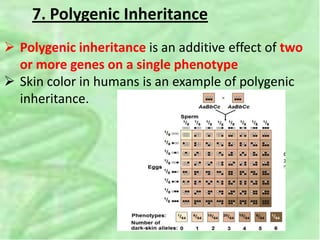
7. Polygenic Inheritance
 Polygenic inheritance is an additive effect of two
or more genes on a single phenotype
 Skin color in humans is an example of polygenic
inheritance.
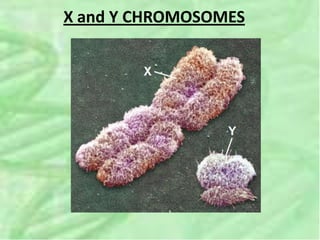
8. DETERMINING THE SEX OF A BABY
 In humans and other mammals, there are
two varieties of sex chromosomes: a larger
X chromosome and a smaller Y
chromosome
 Only the ends of the Y chromosome have
regions that are homologous with the X
chromosome
 The SRY gene on the Y chromosome codes
for the development of testes.
X and Y CHROMOSOMES
 Females are XX, and males are XY
 Each ovum contains an X
chromosome, while a sperm may
contain either an X or a Y
chromosome.
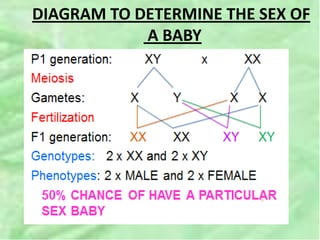
DIAGRAM TO DETERMINE THE SEX OF
A BABY
9. Inheritance of Sex-Linked Genes
 The sex chromosomes have genes for many
characters unrelated to sex
 A gene located on either sex chromosome is
called a sex-linked gene
 In humans, sex-linked refers to a gene on the
larger X chromosome.
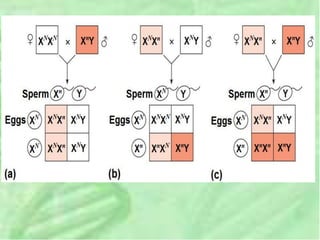
 For a recessive sex-linked trait to be expressed
 A female needs two copies of the allele
 A male needs only one copy of the allele.
 Sex-linked recessive disorders are much more
common in males than in females.
Some disorders caused by recessive alleles on
the X chromosome in humans:
• Color blindness
• Duchenne muscular dystrophy
• Hemophilia

Genetics and inheritance

  • 1.
    UNIT 4: GENETICS AND INHERITANCE Campbell& Reece: Chapters 14 and 15
  • 2.
    1. WHAT ISGENETICS • Genetics: The study of heredity. • Heredity is the relations between successive generations. • Why do children look a little bit like their parents but also different? • What is responsible for these similarities and differences?
  • 3.
    2. MENDEL’S GENETICS •Gregory Mendel is the father of Genetics. • Mendel discovered the basic principles of heredity by breeding garden peas in carefully planned experiments. • Advantages of pea plants for genetic study: Cross-pollination (fertilization between different plants) can be achieved by dusting one plant with pollen from another.
  • 4.
    • Cross-pollination (fertilizationbetween different plants) can be achieved by dusting one plant with pollen from another.
  • 5.
    • He alsoused varieties that were true-breeding (organisms with only one variety of a type e.g. red flowers can only produce red flowers) • In a typical experiment, Mendel mated two contrasting, true-breeding varieties, a process called hybridization • The true-breeding parents are the P generation. • The hybrid offspring of the P generation are called the F1 generation • When F1 individuals self-pollinate, the F2 generation is produced
  • 6.
    • When Mendelcrossed contrasting, true- breeding white and purple flowered pea plants, all of the F1 hybrids were purple
  • 7.
    • When Mendelcrossed the F1 hybrids, many of the F2 plants had purple flowers, but some had white • Mendel discovered a ratio of about three to one, purple to white flowers, in the F2 generation.
  • 9.
    • Mendel reasonedthat only the purple flower factor was affecting flower color in the F1 hybrids. • Mendel called the purple flower color a dominant trait and the white flower color a recessive trait • What Mendel called a “heritable factor” is what we now call a gene • He did 7 other crosses using different traits and found the same phenomenon.
  • 11.
    • Mendel notedthat the gene for flower color for example exists in two versions, one for purple flowers and the other for white flowers • These alternative versions of a gene are now called alleles • Each gene is found at a specific locus (position) on a specific chromosome.
  • 12.
    • The twoalleles at a locus on a homologous chromosome pair may be identical, as in the true-breeding plants – they are then said to be homozygous for that trait/gene. • Alternatively, the two alleles at a locus may differ – they are said to be heterozygous for that gene/trait. • If the two alleles at a locus differ, then one (the dominant allele) determines the organism’s appearance (we refer to it as its phenotype), and the other (the recessive allele) has no noticeable effect on
  • 14.
    • Mendel thenformulated the law of segregation, states that the two alleles for a heritable character separate (segregate) during gamete formation and end up in different gametes • Thus, an egg or a sperm gets only one of the two alleles that are present in the somatic cells of an organism.
  • 15.
    • An organismtraits are indicated via its genotype and phenotype.  Genotype: The genetic composition of the gene, indicated by letters e.g. GG, Gg, gg. (A capital letter represents a dominant allele, and a lowercase letter represents a recessive allele)  Phenotype: The external appearance of the gene e.g. Brown hair, white hair.
  • 16.
    3. GENETIC CROSSES •HOW CAN WE NOW MORE OF LESS DETERMINE WHAT WILL BE THE OUTCOME IF 2 ORGANISMS HAVE A BABY?
  • 17.
    TWO TYPES OF GENETICCROSSES • MONOHYBRID CROSSES: A cross between 2 organisms where we only look an one pair of contrasting traits. • DIHYBRID CROSS: A cross between 2 organisms where we look at two pairs of contrasting traits at the same time.
  • 18.
    MONOHYBRID CROSS -EXAMPLE •Determine the outcome/ F1 generation of a cross between a homozygous tall plant and a homozygous short plant. Tall plants are dominant over short plants.
  • 19.
    STEPS TO SOLVEA CROSS PROBLEM 1. What trait are we looking at? 2. Choose a letter to represent the trait. 3. See if you can identify which trait is dominant – allocate the capital letter to that trait. 4. Identify the recessive trait and allocate a lower case letter to that trait. 5. Determine the genotypes of the parents. – Homozygous dominant – Two capital letters e.g. GG Homozygous recessive – Two lower case letter. E.g. gg Heterozygous – One capital letter and one lower case letter e.g. Gg 1. Start with cross
  • 20.
    SOLUTION 1. Trait –Size of plant. 2. Letter chosen to represent size of plant = T/t 3. Tall plants are dominant. (Given in problem) – Given the – “T” (capital T) 4. Short plants are recessive – given the “t” (lower case t) 5. One parent is homozygous tall – TT other parent is homozygous short - tt
  • 21.
    CROSS SHOWN ASA GENETIC DIAGRAM Why? Tall is dominant over short plants – Babies have both alleles: tall and short
  • 22.
    Cross shown asa punnet square
  • 23.
    CROSS BETWEEN F1GENERATION INDIVIDUALS (INTERBREED F1 GENERATION)
  • 24.
    MONOHYBRID CROSS –EXAMPLE2 A heterozygous blue eyed rabbit is crossed with a rabbit with pink eyes. What is the possibility of the babies being born with pink eyes?
  • 25.
    SOLUTION 1. Trait: eyecolour of rabbit. 2. Letter used: E/e 3. Dominant trait: Blue eyes (Why? The first rabbit is heterozygous – both alleles – but blue is being expressed in rabbit eyes.) = E 4. Recessive trait: pink eyes = e 5. Rabbit one – heterozygous: Ee Rabbit two – homozygous: ee (why?) The only way that a rabbit can have pink eyes expressed externally is if both alleles code for pink eyes.
  • 27.
    EXAMPLE OF ADIHYBRID CROSS Determine the F2 generation of a cross between yellow round seeded peas and wrinkled green seeded peas. Yellow and round seeds are dominant.
  • 29.
    • Using adihybrid cross, Mendel developed the law of independent assortment • The law of independent assortment states that each pair of alleles segregates independently of each other pair of alleles during gamete formation. • Strictly speaking, this law applies only to genes on different, nonhomologous chromosomes • Genes located near each other on the same chromosome tend to be inherited together.
  • 30.
    4. DEGREES OFDOMINANCE •Complete dominance One allele suppresses the expression of the other allele. • Incomplete dominance: phenotype of F1 hybrids is somewhere between the phenotypes of the 2 parental varieties – neither allele completely dominant (White x Red = Pink) • Codominance, 2 dominant alleles affect the phenotype in separate, distinguishable ways. (Red and white flowers = White and red visible.)
  • 31.
    5. MULTIPLE ALLELES Most genes exist in populations in more than two allelic forms.  For example, the four phenotypes of the ABO blood group in humans are determined by three alleles for the enzyme (I) that attaches A or B carbohydrates to red blood cells: IA, IB, and i.  The enzyme encoded by the IA allele adds the A carbohydrate, whereas the enzyme encoded by the IB allele adds the B carbohydrate; the enzyme encoded by the i allele adds neither.
  • 33.
    6. PLEIOTROPY  Mostgenes have multiple phenotypic effects, a property called pleiotropy  For example, pleiotropic alleles are responsible for the multiple symptoms of certain hereditary diseases, such as cystic fibrosis and sickle-cell disease
  • 34.
    7. Polygenic Inheritance Polygenic inheritance is an additive effect of two or more genes on a single phenotype  Skin color in humans is an example of polygenic inheritance.
  • 35.
    8. DETERMINING THESEX OF A BABY  In humans and other mammals, there are two varieties of sex chromosomes: a larger X chromosome and a smaller Y chromosome  Only the ends of the Y chromosome have regions that are homologous with the X chromosome  The SRY gene on the Y chromosome codes for the development of testes.
  • 36.
    X and YCHROMOSOMES
  • 37.
     Females areXX, and males are XY  Each ovum contains an X chromosome, while a sperm may contain either an X or a Y chromosome.
  • 38.
    DIAGRAM TO DETERMINETHE SEX OF A BABY
  • 39.
    9. Inheritance ofSex-Linked Genes  The sex chromosomes have genes for many characters unrelated to sex  A gene located on either sex chromosome is called a sex-linked gene  In humans, sex-linked refers to a gene on the larger X chromosome.  For a recessive sex-linked trait to be expressed  A female needs two copies of the allele  A male needs only one copy of the allele.  Sex-linked recessive disorders are much more common in males than in females.
  • 41.
    Some disorders causedby recessive alleles on the X chromosome in humans: • Color blindness • Duchenne muscular dystrophy • Hemophilia