Solving Linear Inequalities

1.4 Sets, Inequalities, and Interval Notation
1.5 Intersections, Unions, and Compound Inequalities

1.6 Absolute-Value Equations and Inequalities
1.4

Sets, Inequalities, and Interval
Notation
OBJECTIVES

a Determine whether a given number is a solution of an
inequality.
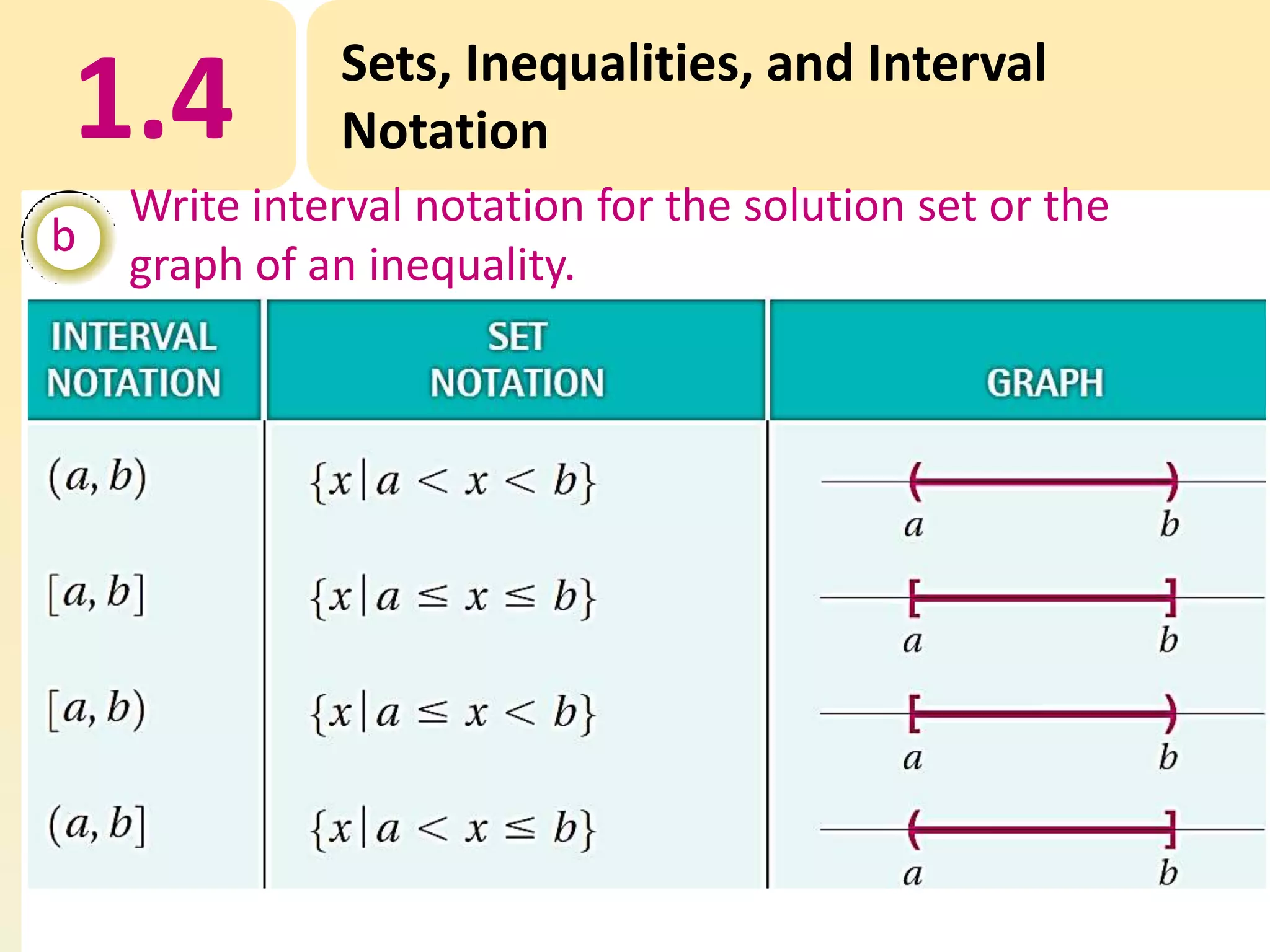
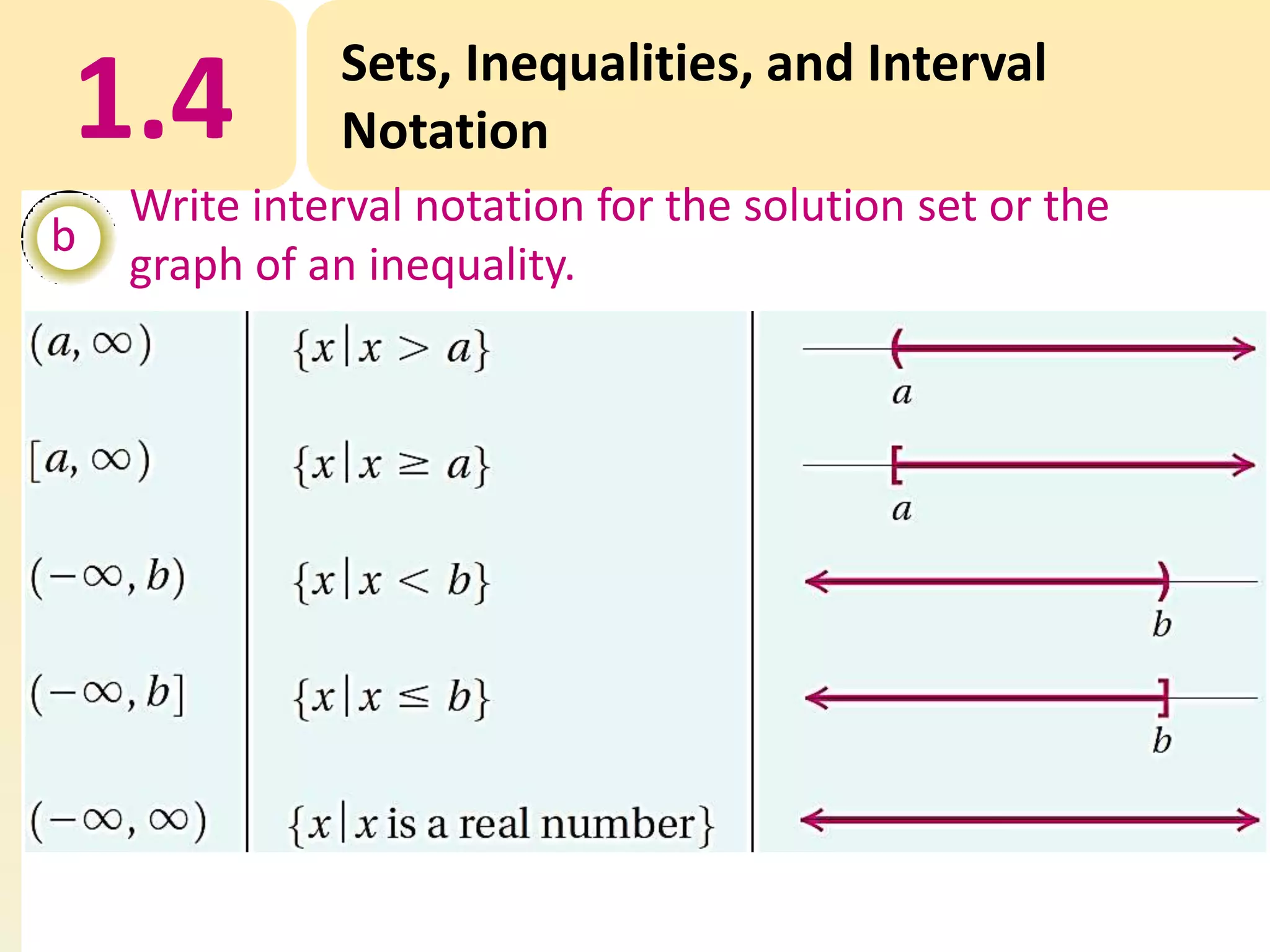
b Write interval notation for the solution set or the graph
of an inequality.
c Solve an inequality using the addition principle and the
multiplication principle and then graph the inequality.
d Solve applied problems by translating to inequalities.
1.4

Sets, Inequalities, and Interval
Notation

Inequality
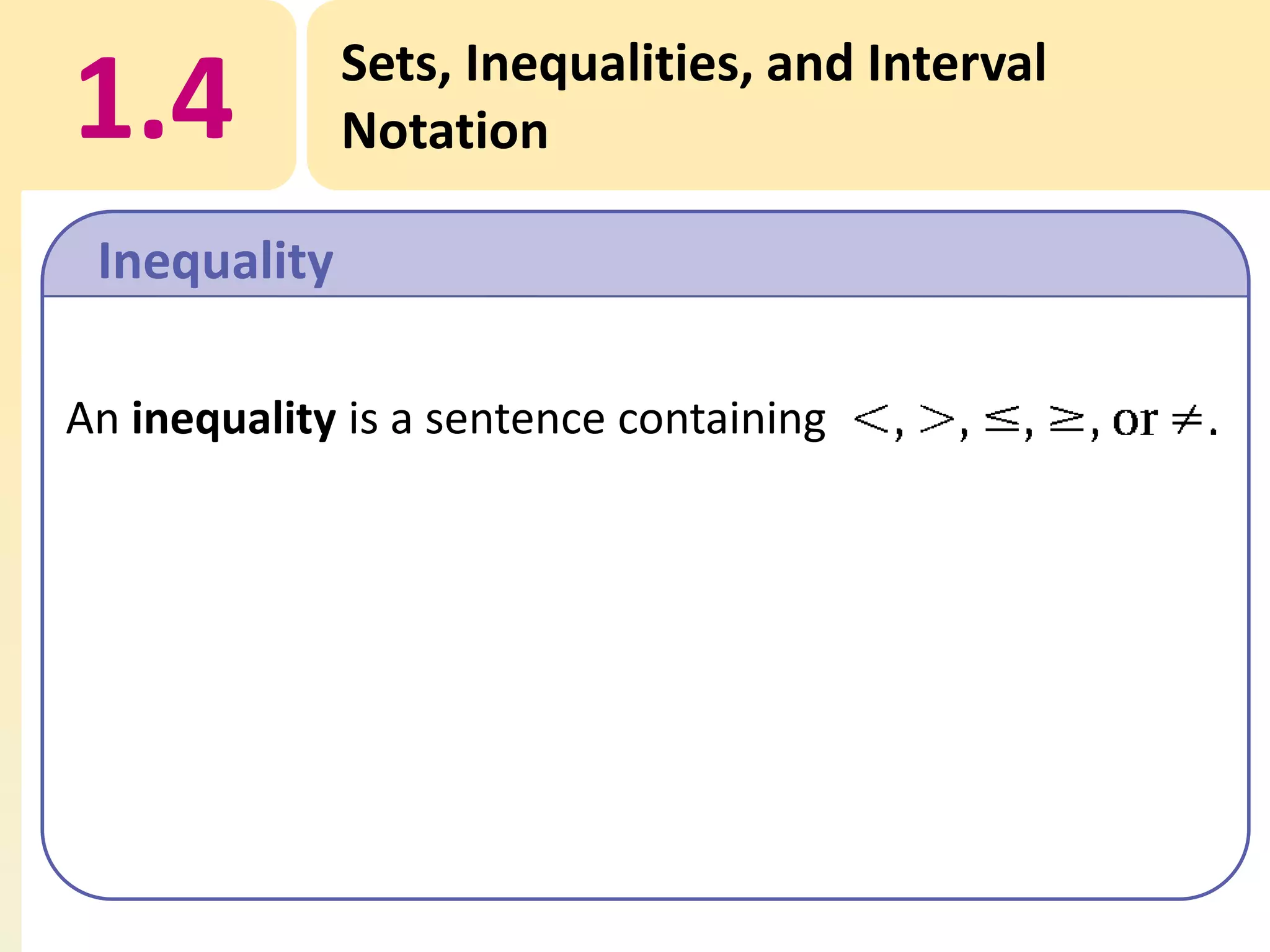
An inequality is a sentence containing
1.4

Sets, Inequalities, and Interval
Notation

Solution of an Inequality
Any replacement or value for the variable that makes
an inequality true is called a solution of the inequality.
The set of all solutions is called the solution set. When
all the solutions of an inequality have been found, we
say that we have solved the inequality.
1.4

Sets, Inequalities, and Interval
Notation

Determine whether a given number is a solution of an
a
inequality.
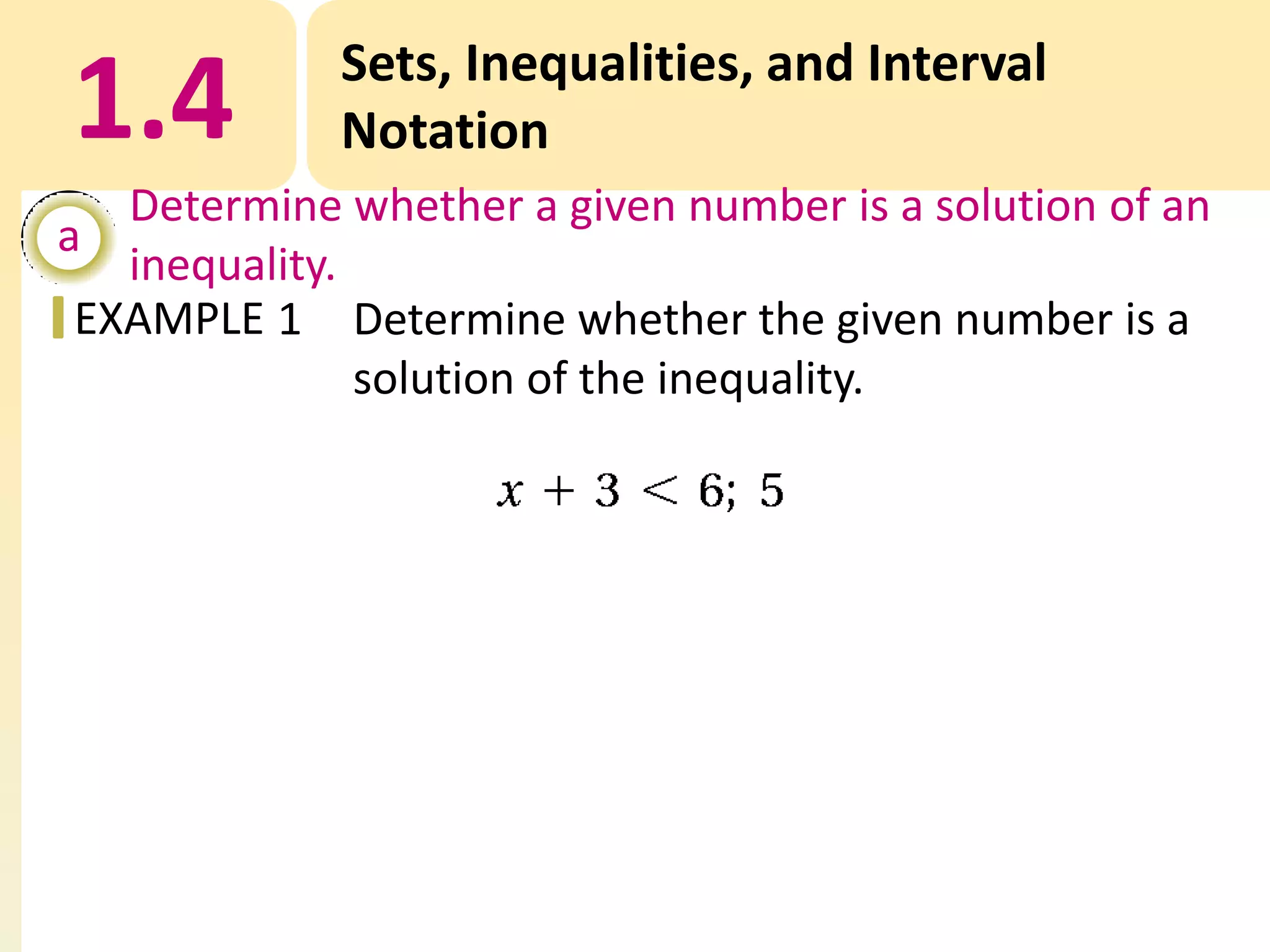
EXAMPLE 1 Determine whether the given number is a
solution of the inequality.
1.4

Sets, Inequalities, and Interval
Notation

Determine whether a given number is a solution of an
a
inequality.
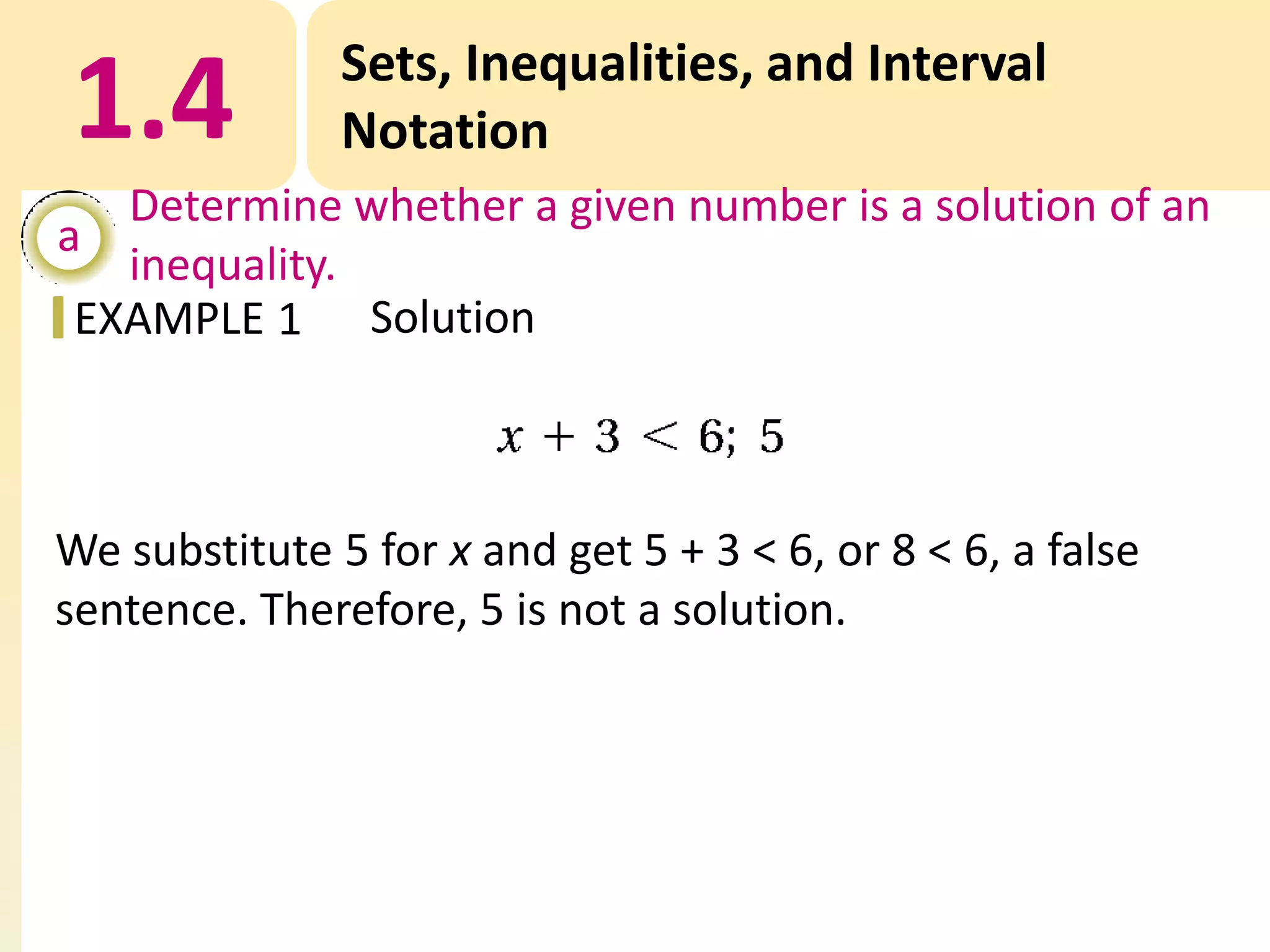
EXAMPLE 1 Solution

We substitute 5 for x and get 5 + 3 < 6, or 8 < 6, a false
sentence. Therefore, 5 is not a solution.
1.4

Sets, Inequalities, and Interval
Notation

Determine whether a given number is a solution of an
a
inequality.
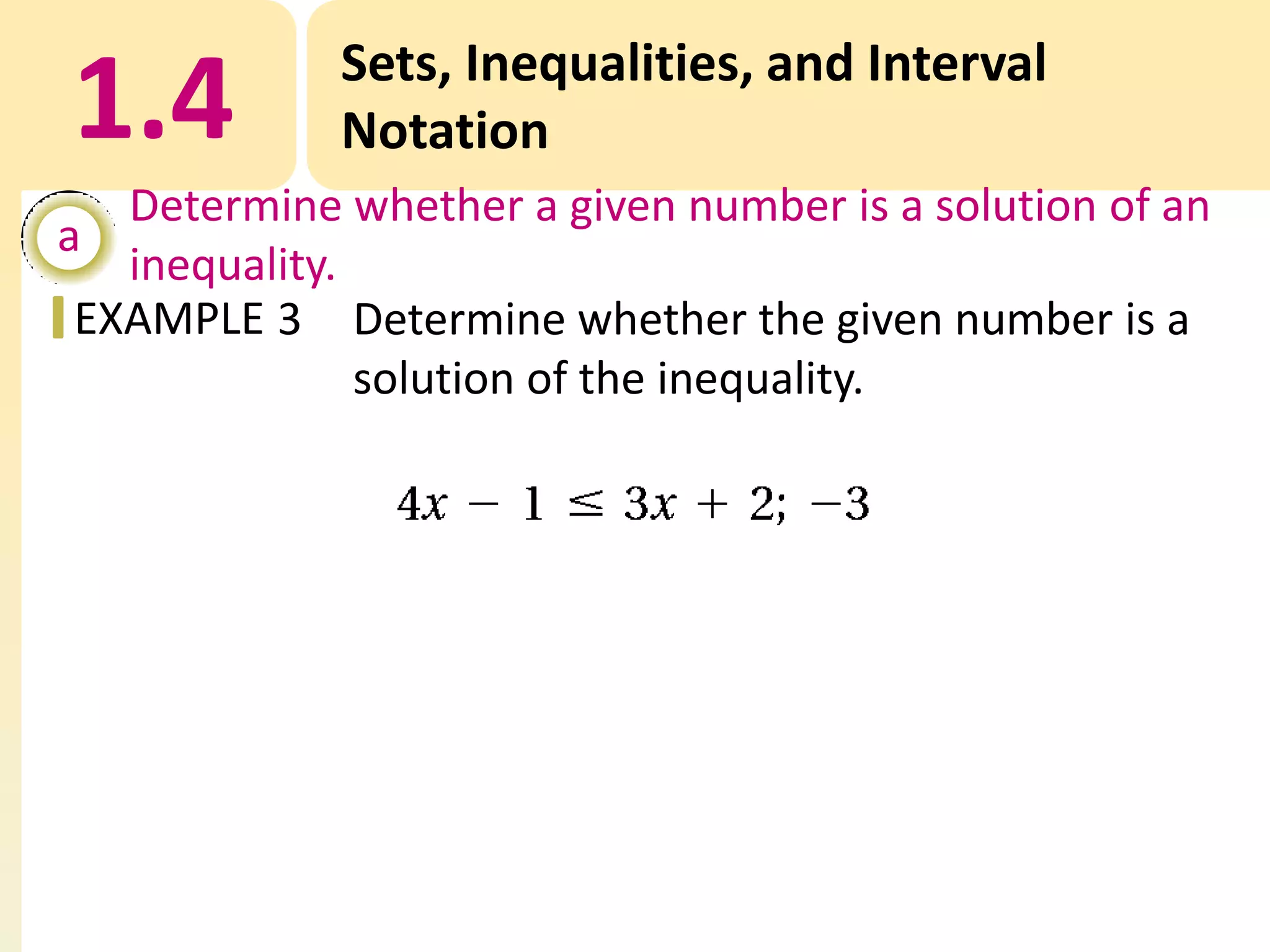
EXAMPLE 3 Determine whether the given number is a
solution of the inequality.
1.4

Sets, Inequalities, and Interval
Notation

Determine whether a given number is a solution of an
a
inequality.
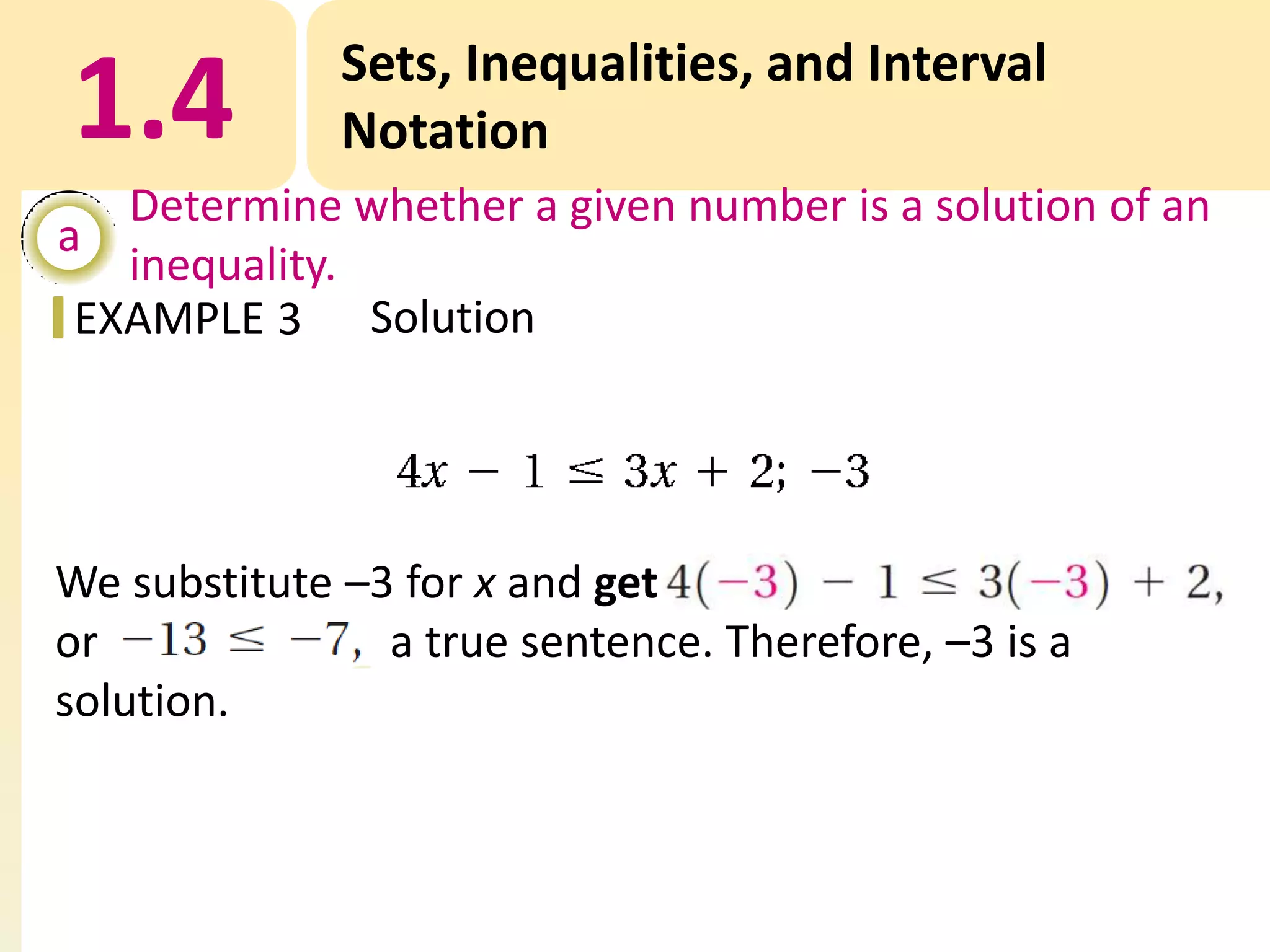
EXAMPLE 3 Solution

We substitute –3 for x and get
or
a true sentence. Therefore, –3 is a
solution.
1.4
b

Sets, Inequalities, and Interval
Notation

Write interval notation for the solution set or the
graph of an inequality.

The graph of an inequality is a drawing that represents its
solutions.
1.4

Sets, Inequalities, and Interval
Notation

Write interval notation for the solution set or the
b
graph of an inequality.
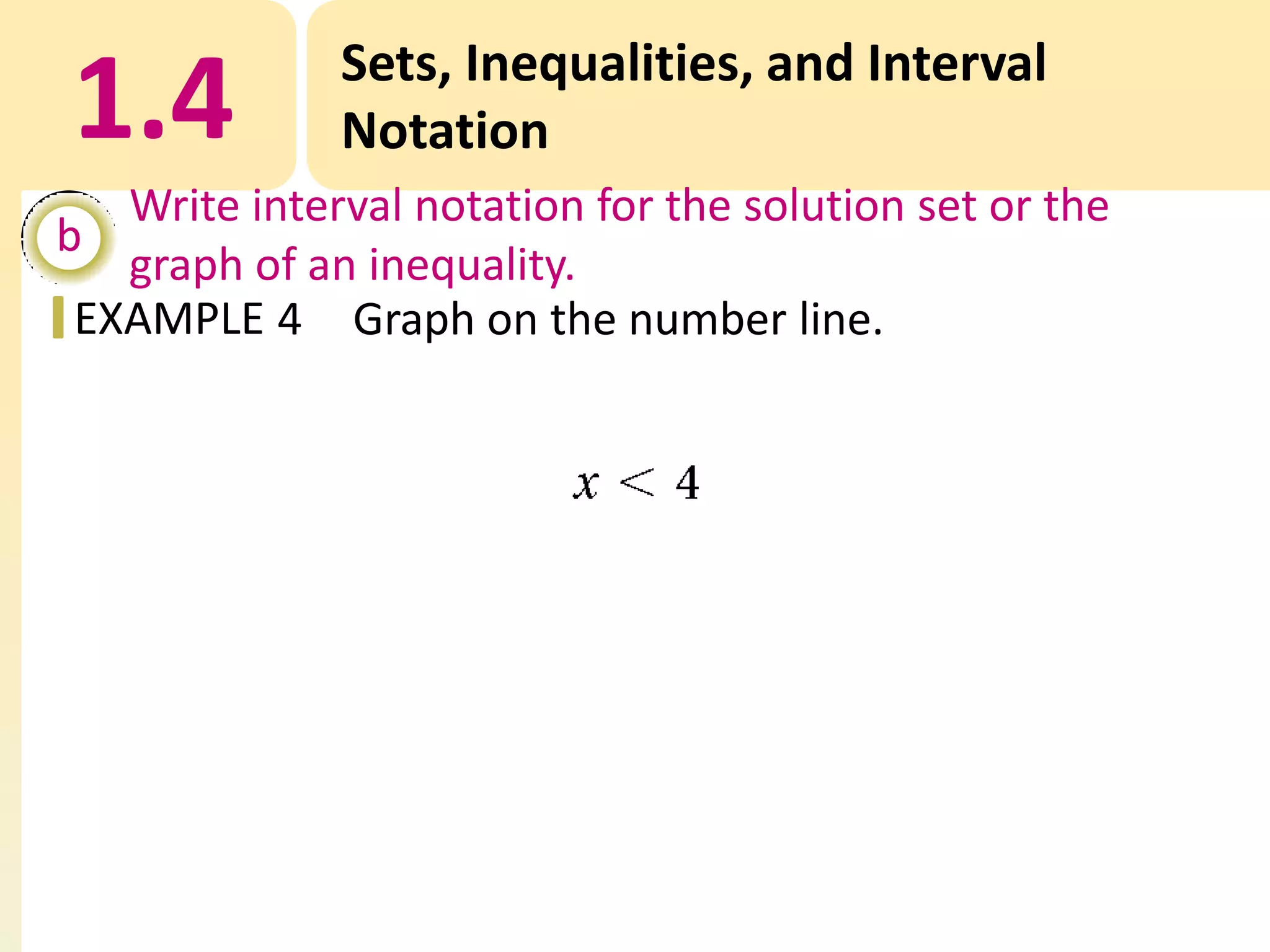
EXAMPLE 4 Graph on the number line.
1.4

Sets, Inequalities, and Interval
Notation

Write interval notation for the solution set or the
b
graph of an inequality.
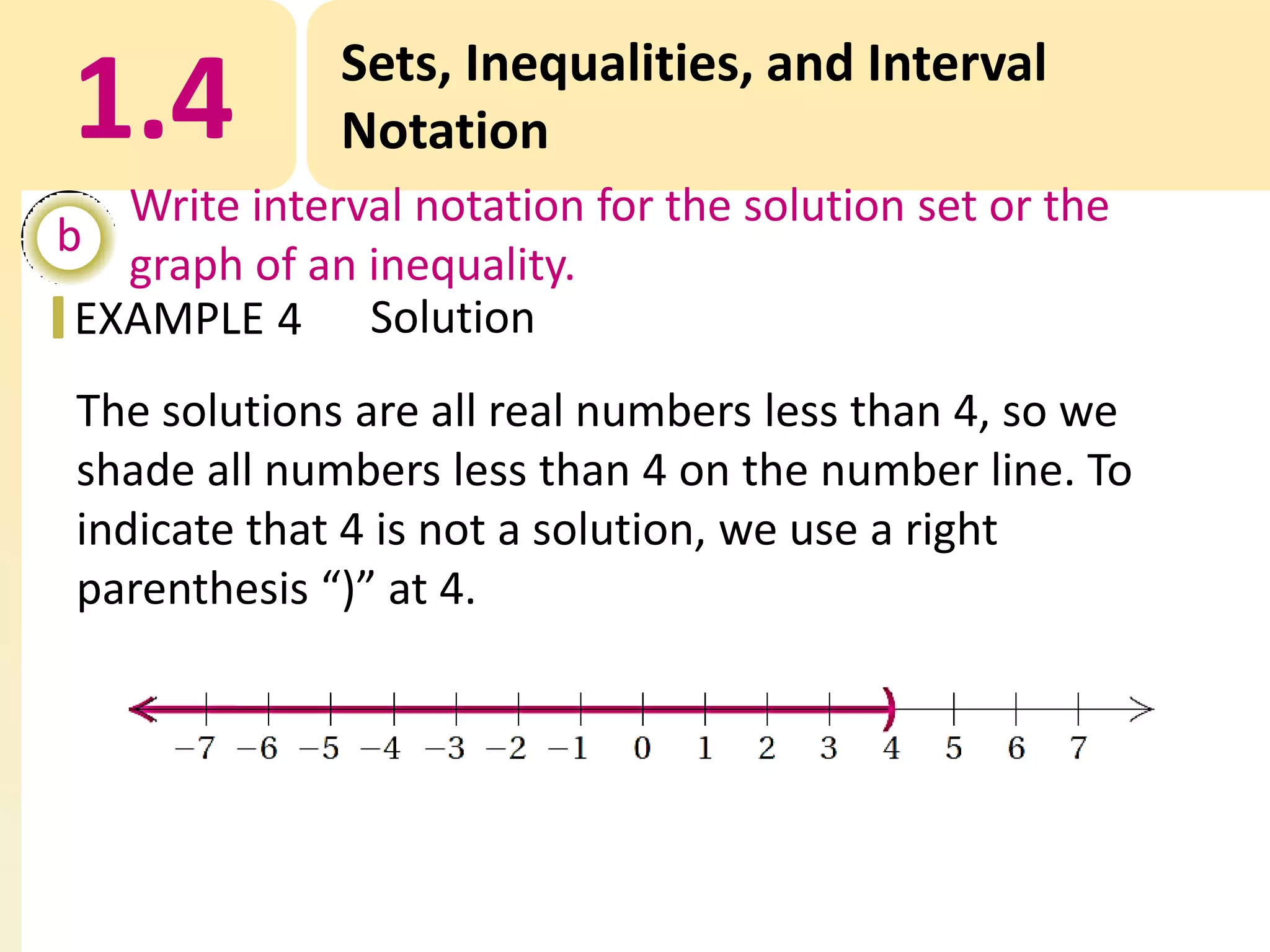
EXAMPLE 4 Solution

The solutions are all real numbers less than 4, so we
shade all numbers less than 4 on the number line. To
indicate that 4 is not a solution, we use a right
parenthesis “)” at 4.
1.4
b

Sets, Inequalities, and Interval
Notation

Write interval notation for the solution set or the
graph of an inequality.
1.4
b

Sets, Inequalities, and Interval
Notation

Write interval notation for the solution set or the
graph of an inequality.
1.4

Sets, Inequalities, and Interval
Notation

Write interval notation for the solution set or the
b
graph of an inequality.
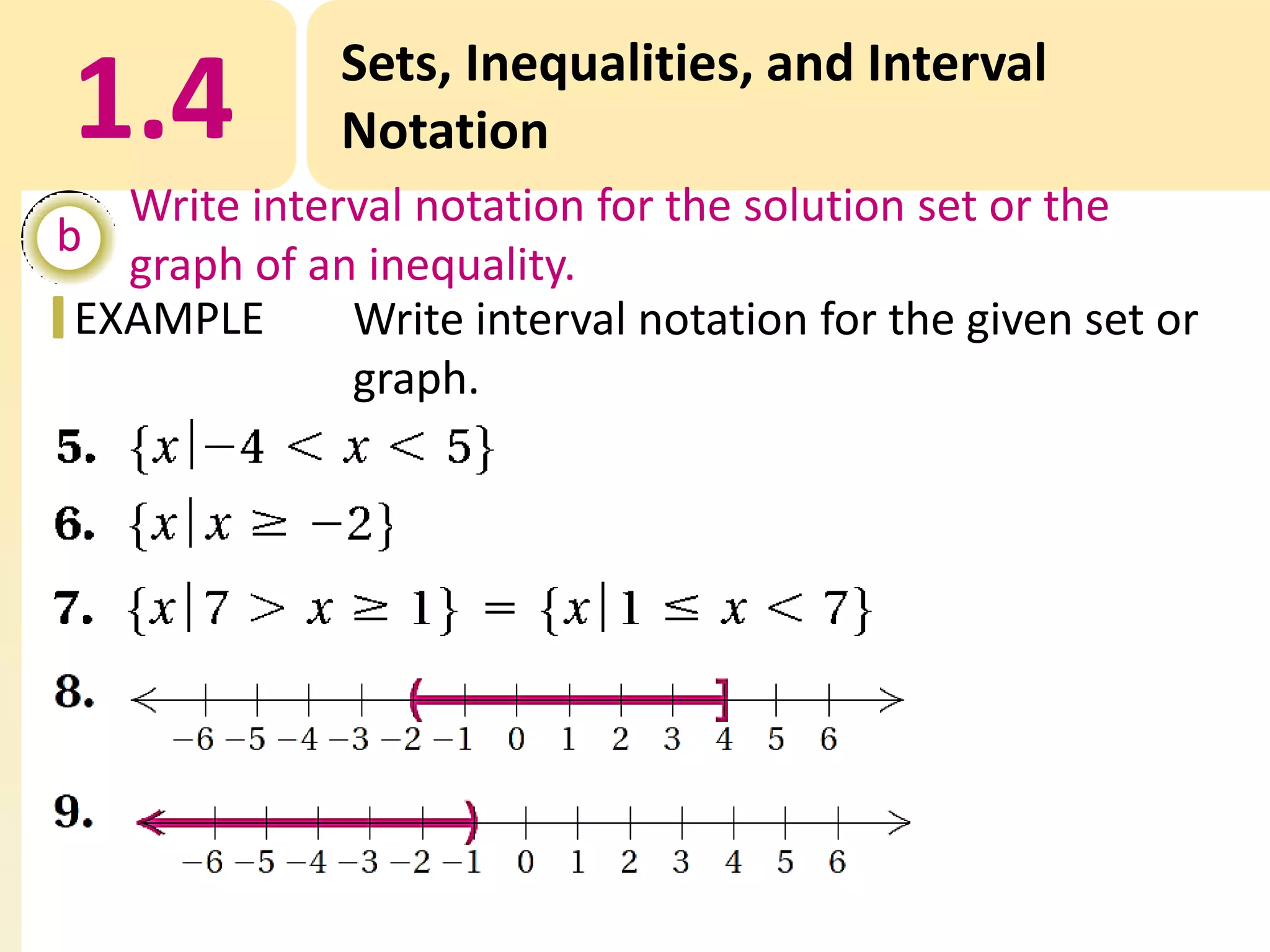
EXAMPLE
Write interval notation for the given set or
graph.
1.4

Sets, Inequalities, and Interval
Notation

Write interval notation for the solution set or the
b
graph of an inequality.
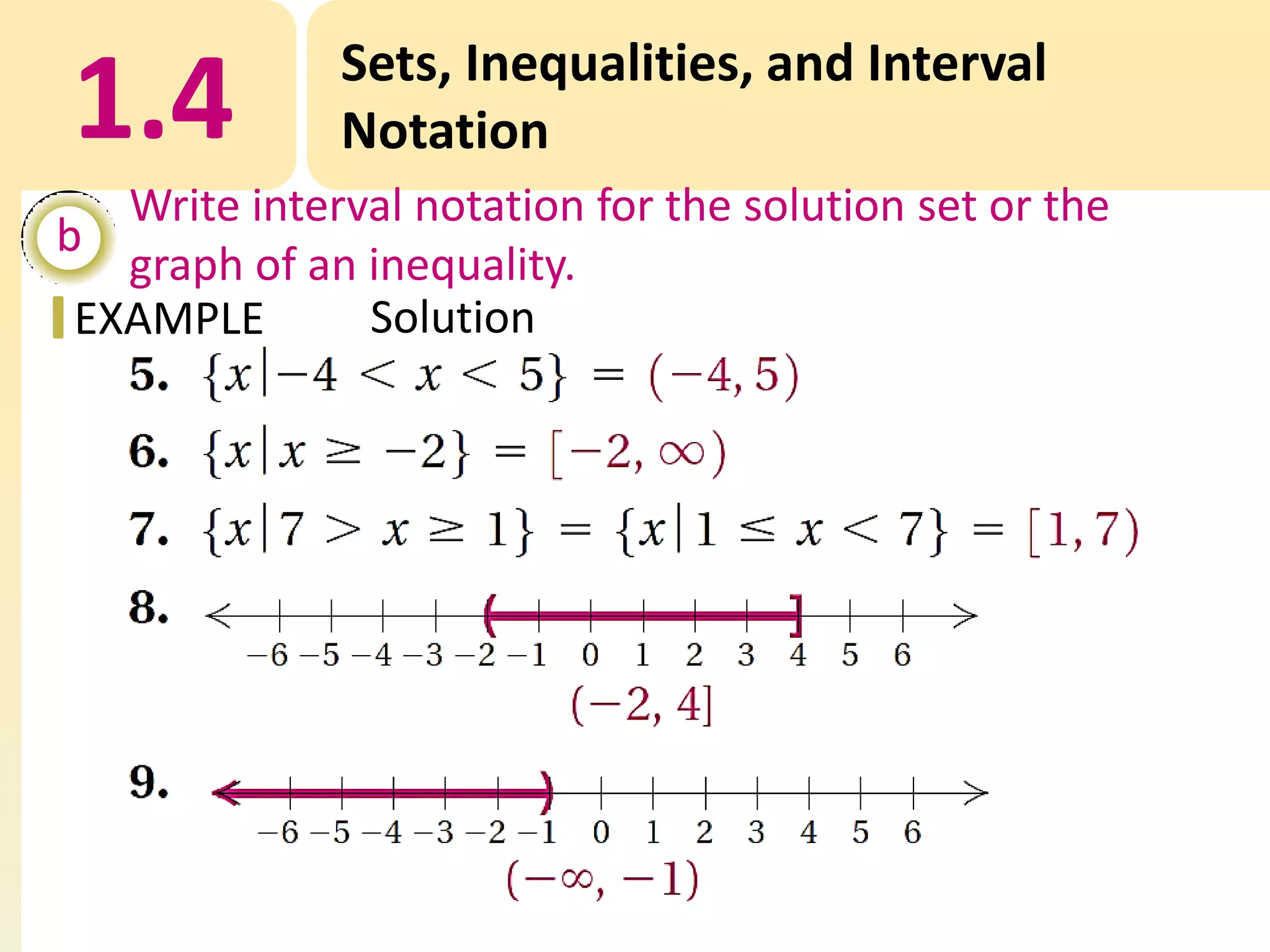
Solution
EXAMPLE
1.4
c

Sets, Inequalities, and Interval
Notation

Solve an inequality using the addition principle and the
multiplication principle and then graph the inequality.

Two inequalities are equivalent if they have the same
solution set.
1.4

Sets, Inequalities, and Interval
Notation

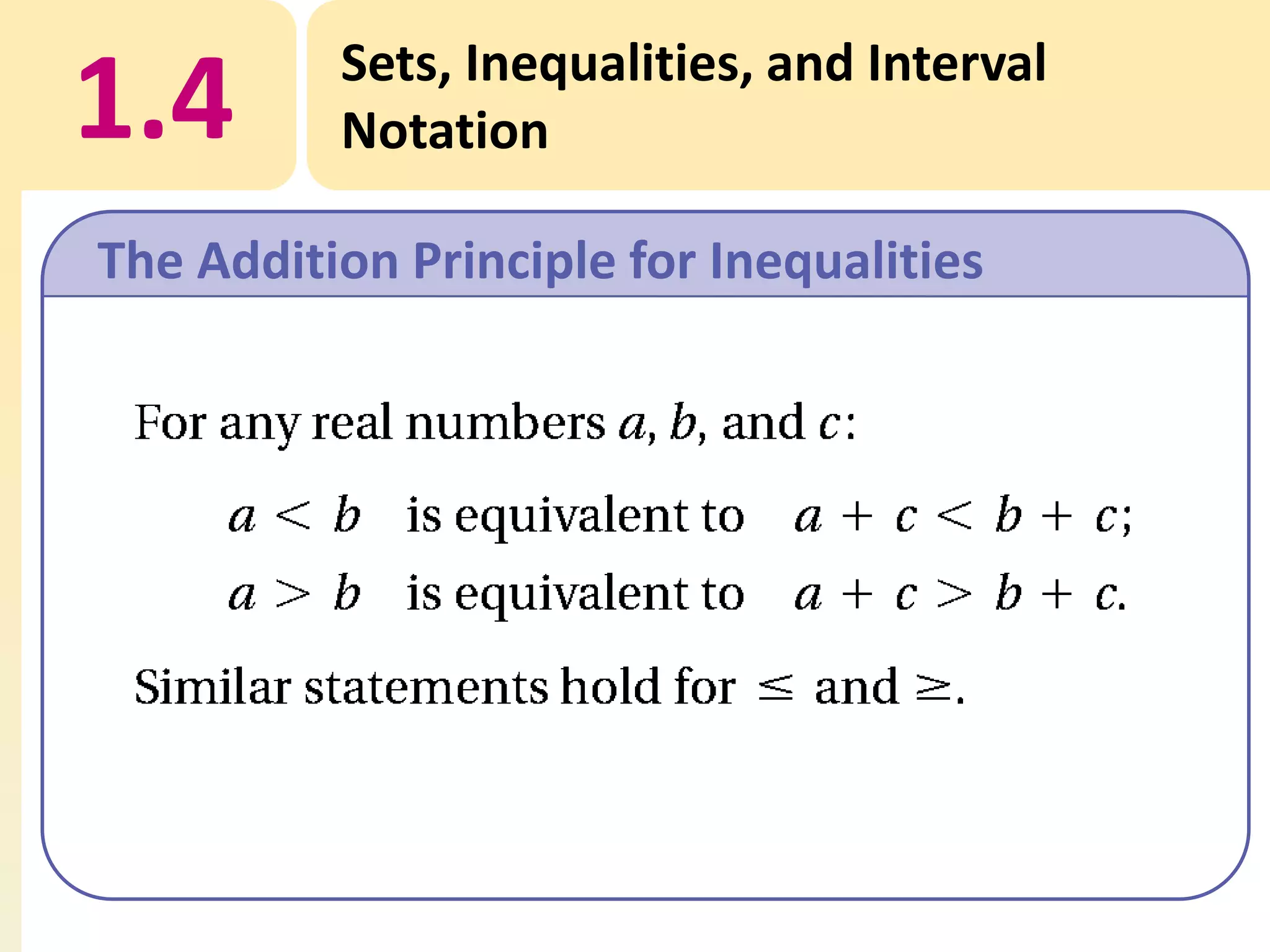
The Addition Principle for Inequalities
1.4

Sets, Inequalities, and Interval
Notation

Solve an inequality using the addition principle and the
c
multiplication principle and then graph the inequality.
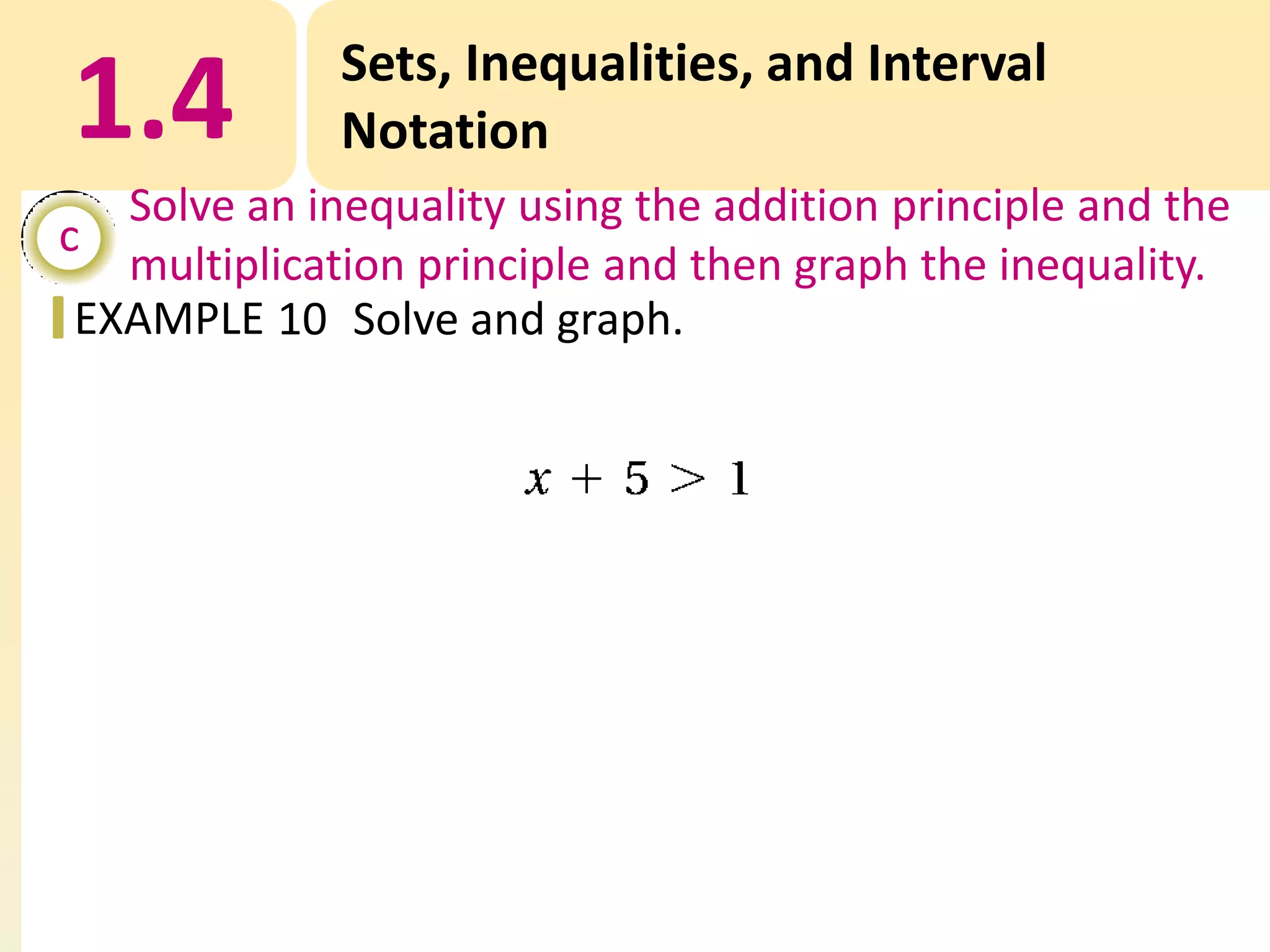
EXAMPLE 10 Solve and graph.
1.4

Sets, Inequalities, and Interval
Notation

Solve an inequality using the addition principle and the
c
multiplication principle and then graph the inequality.
EXAMPLE 10 Solution

We used the addition principle to show that the
inequalities x + 5 > 1 and x > –4 are equivalent. The
solution set is
and consists of an infinite
number of solutions. We cannot possibly check them all.
1.4

Sets, Inequalities, and Interval
Notation

Solve an inequality using the addition principle and the
c
multiplication principle and then graph the inequality.
EXAMPLE 10 Solution
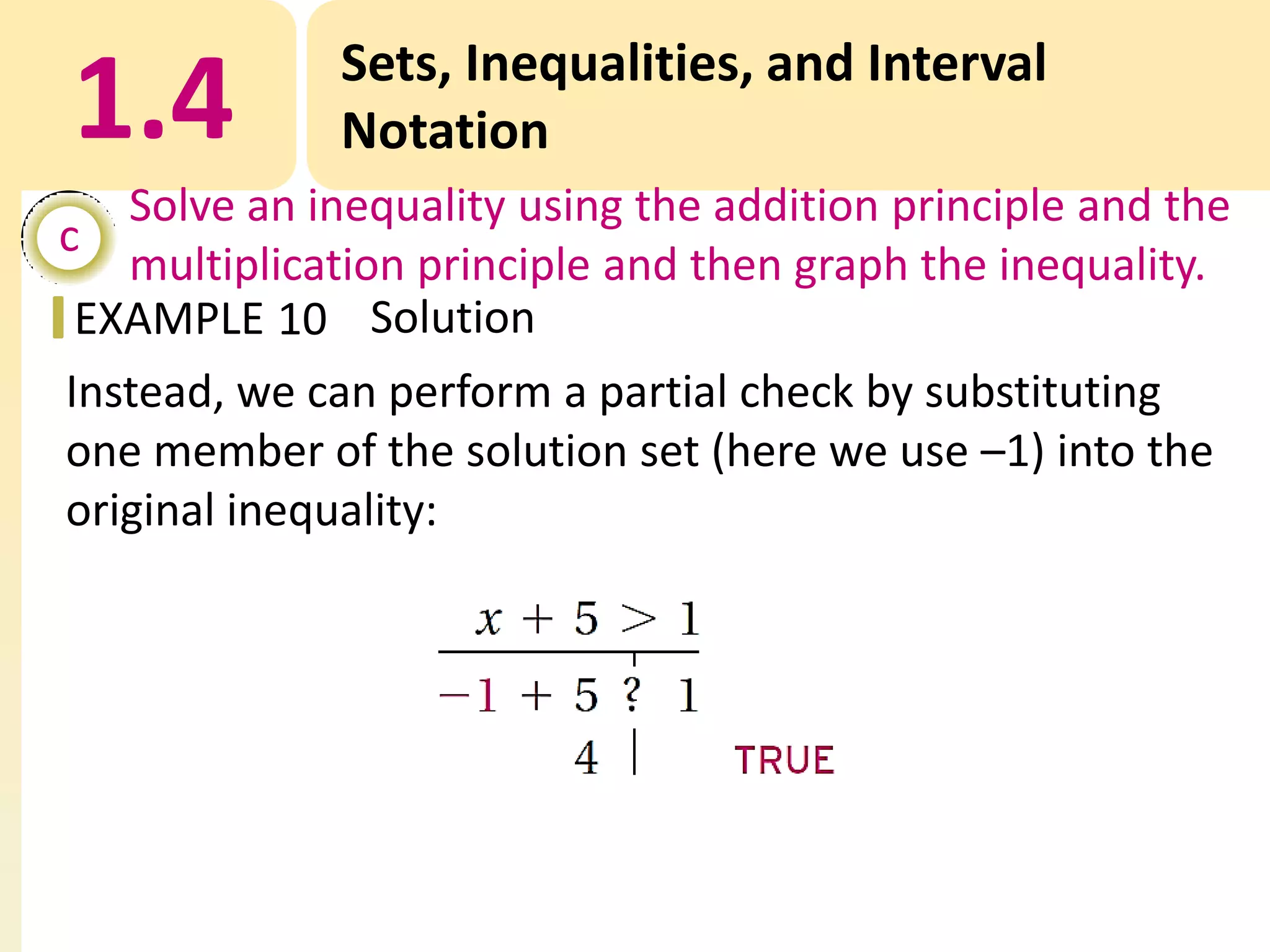
Instead, we can perform a partial check by substituting
one member of the solution set (here we use –1) into the
original inequality:
1.4

Sets, Inequalities, and Interval
Notation

Solve an inequality using the addition principle and the
c
multiplication principle and then graph the inequality.
EXAMPLE 10 Solution

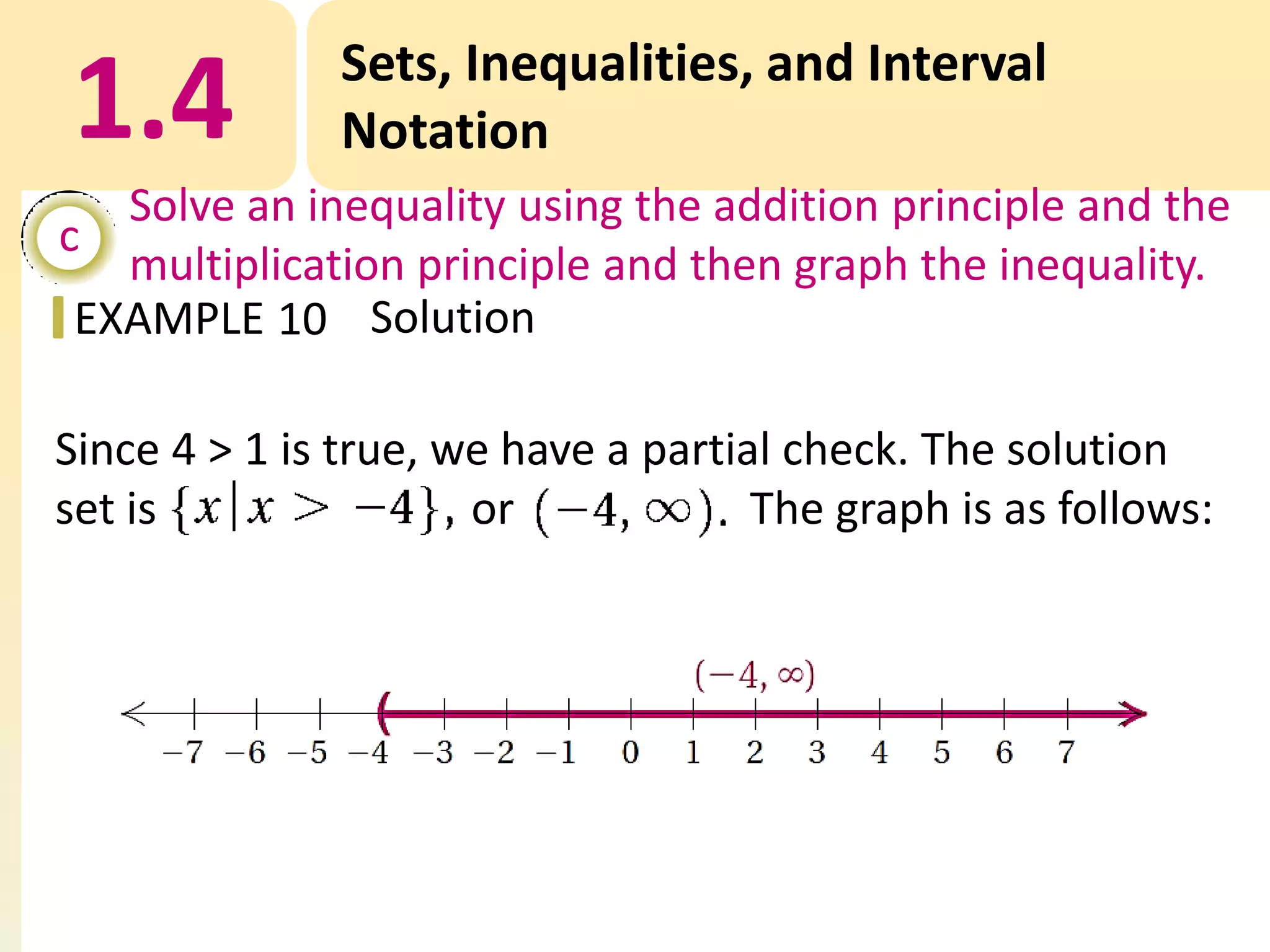
Since 4 > 1 is true, we have a partial check. The solution
set is
or
The graph is as follows:
1.4

Sets, Inequalities, and Interval
Notation

Solve an inequality using the addition principle and the
c
multiplication principle and then graph the inequality.
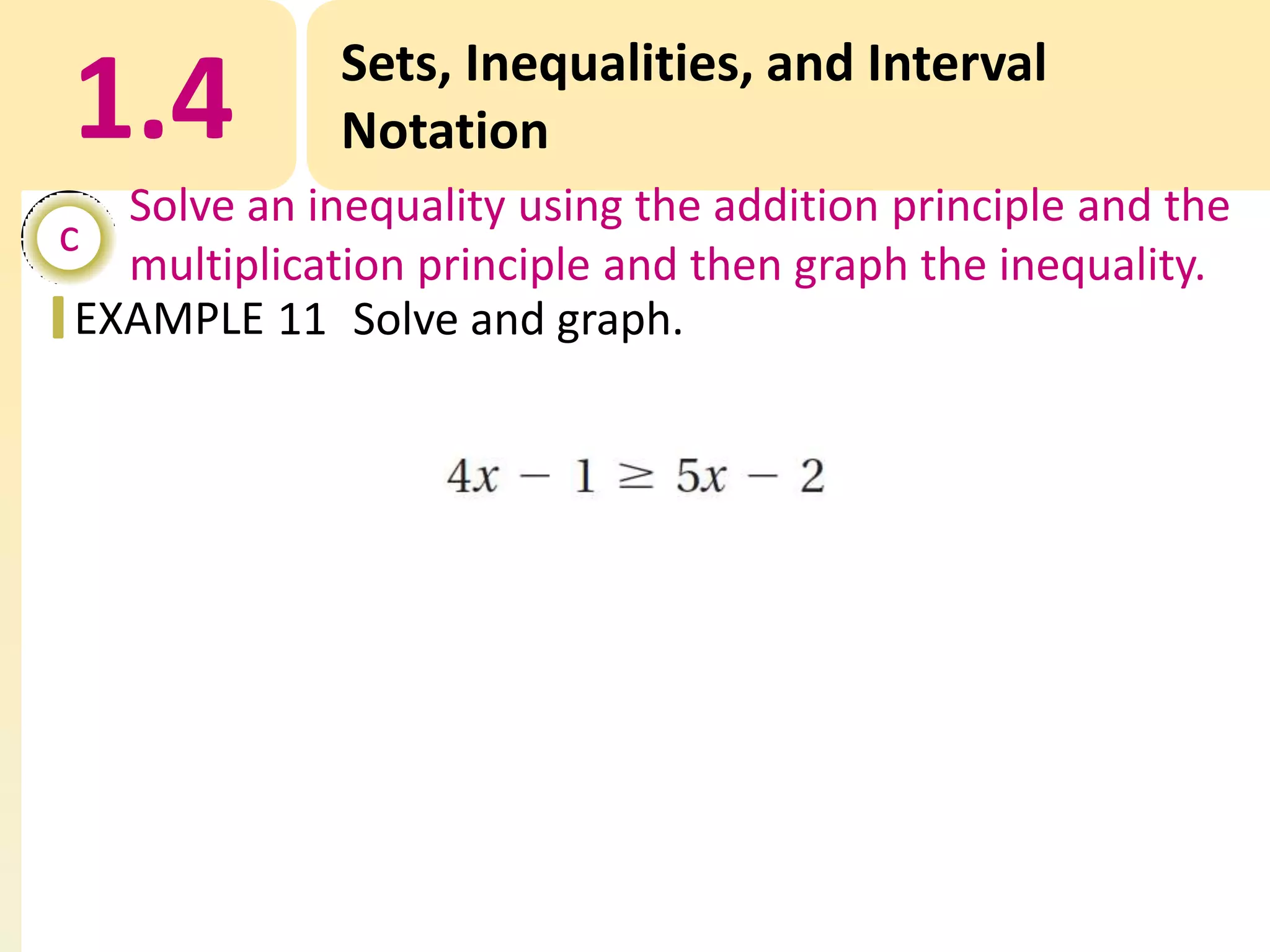
EXAMPLE 11 Solve and graph.
1.4

Sets, Inequalities, and Interval
Notation

Solve an inequality using the addition principle and the
c
multiplication principle and then graph the inequality.
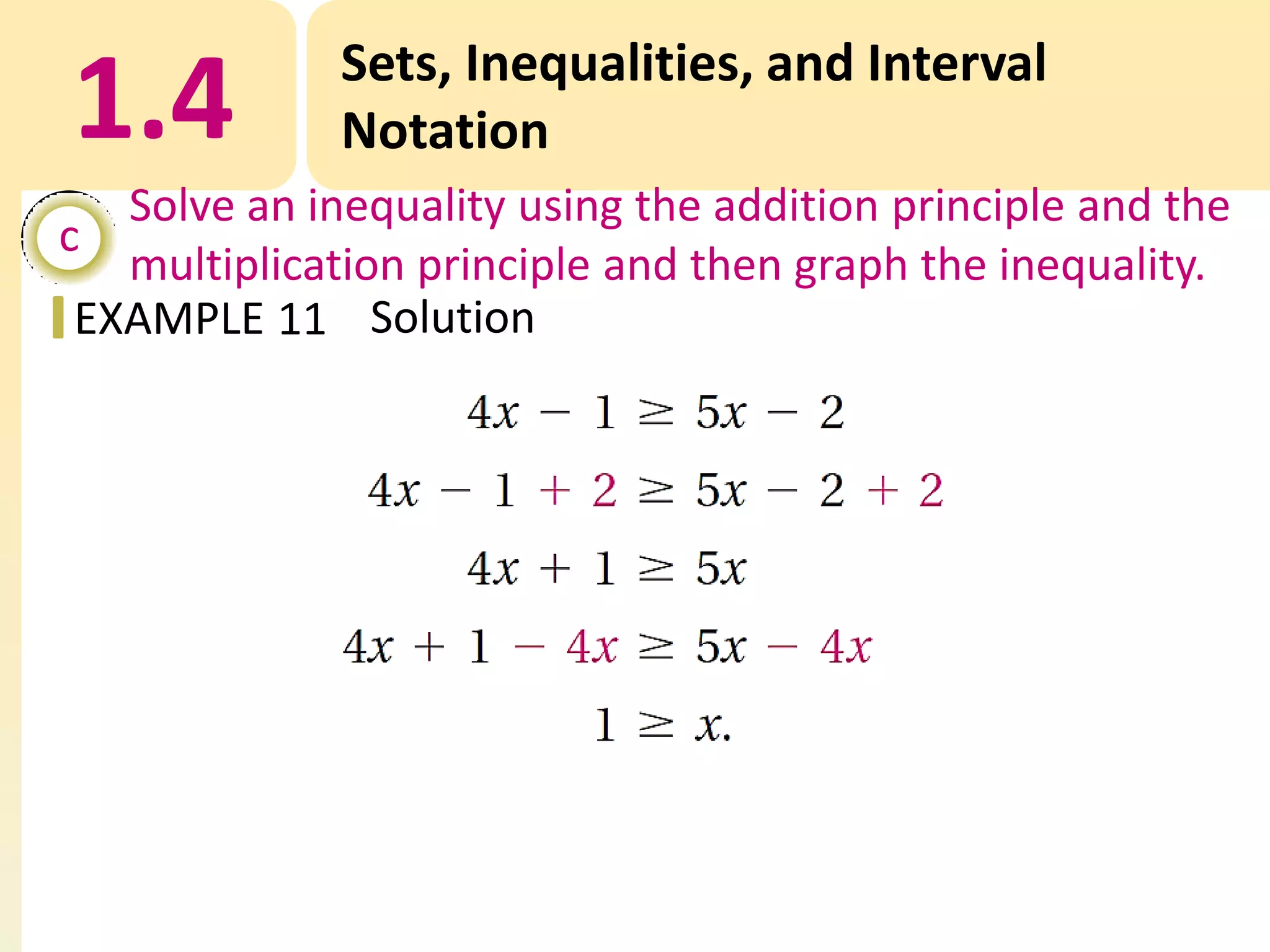
EXAMPLE 11 Solution
1.4

Sets, Inequalities, and Interval
Notation

Solve an inequality using the addition principle and the
c
multiplication principle and then graph the inequality.
EXAMPLE 11 Solution
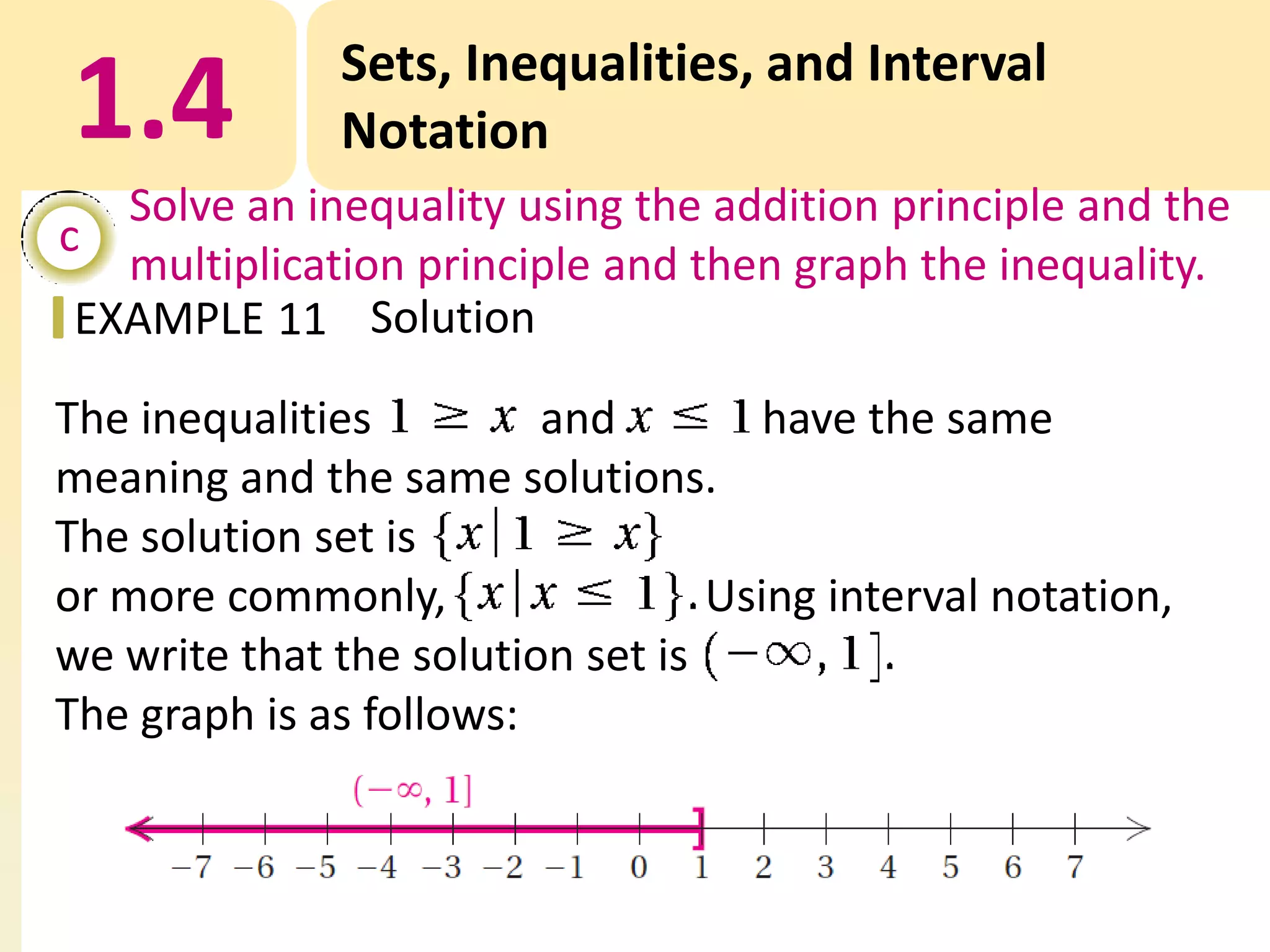
The inequalities
and
have the same
meaning and the same solutions.
The solution set is
or more commonly,
Using interval notation,
we write that the solution set is
The graph is as follows:
1.4

Sets, Inequalities, and Interval
Notation

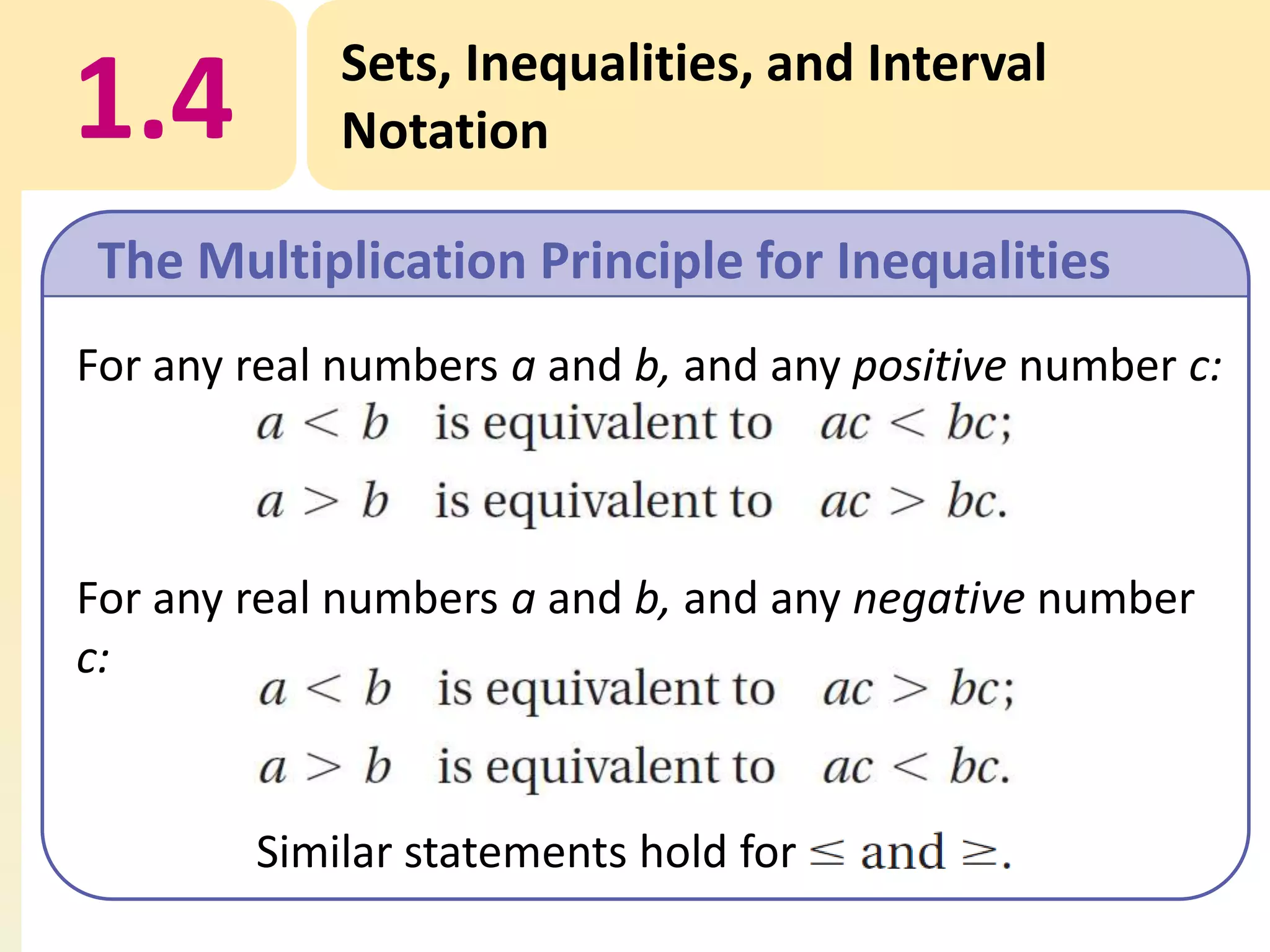
The Multiplication Principle for Inequalities
For any real numbers a and b, and any positive number c:

For any real numbers a and b, and any negative number
c:

Similar statements hold for
1.4

Sets, Inequalities, and Interval
Notation

The multiplication principle tells us that when we
multiply or divide on both sides of an inequality by a
negative number, we must reverse the inequality symbol
to obtain an equivalent inequality.
1.4

Sets, Inequalities, and Interval
Notation

Solve an inequality using the addition principle and the
c
multiplication principle and then graph the inequality.
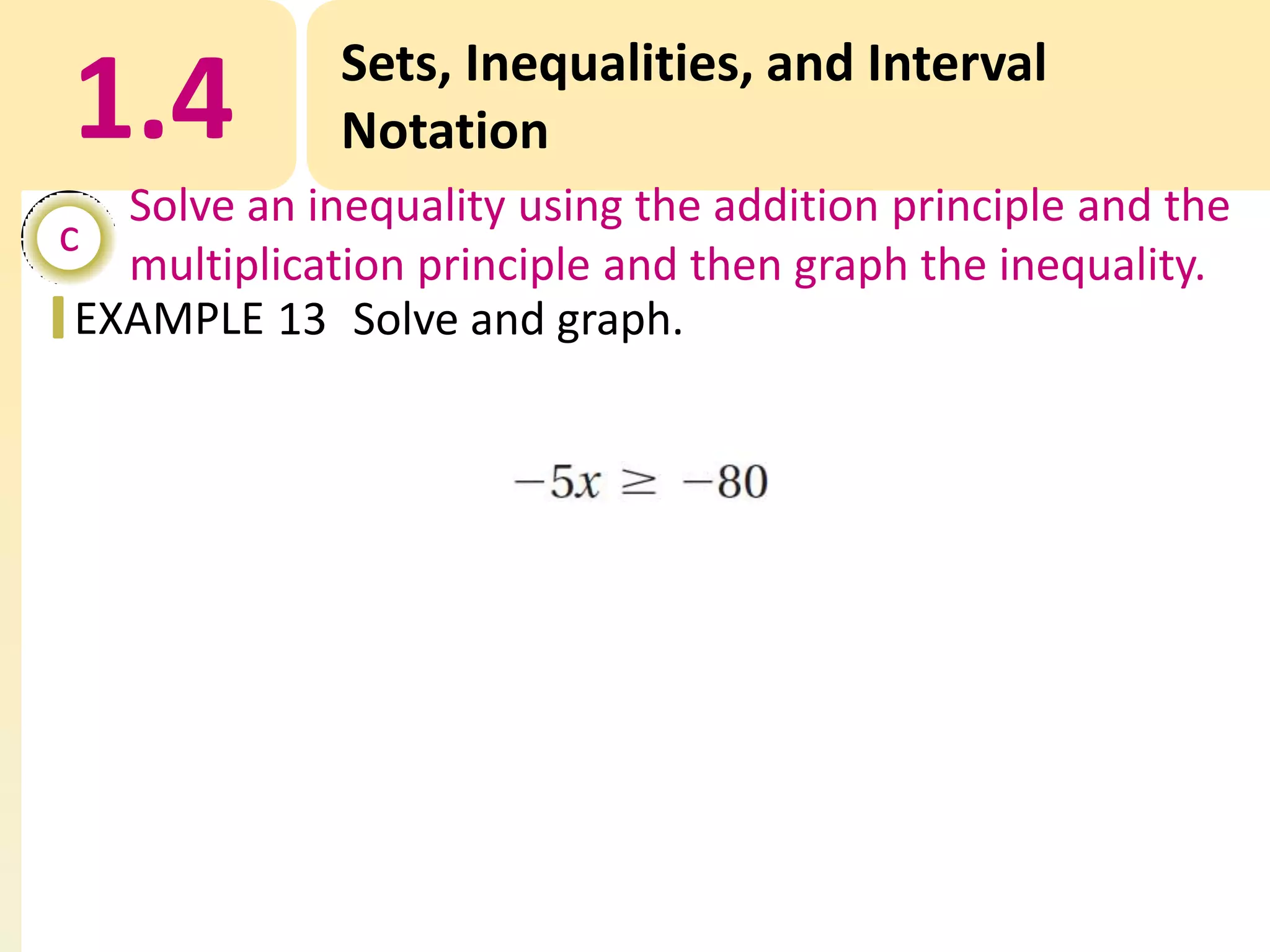
EXAMPLE 13 Solve and graph.
1.4

Sets, Inequalities, and Interval
Notation

Solve an inequality using the addition principle and the
c
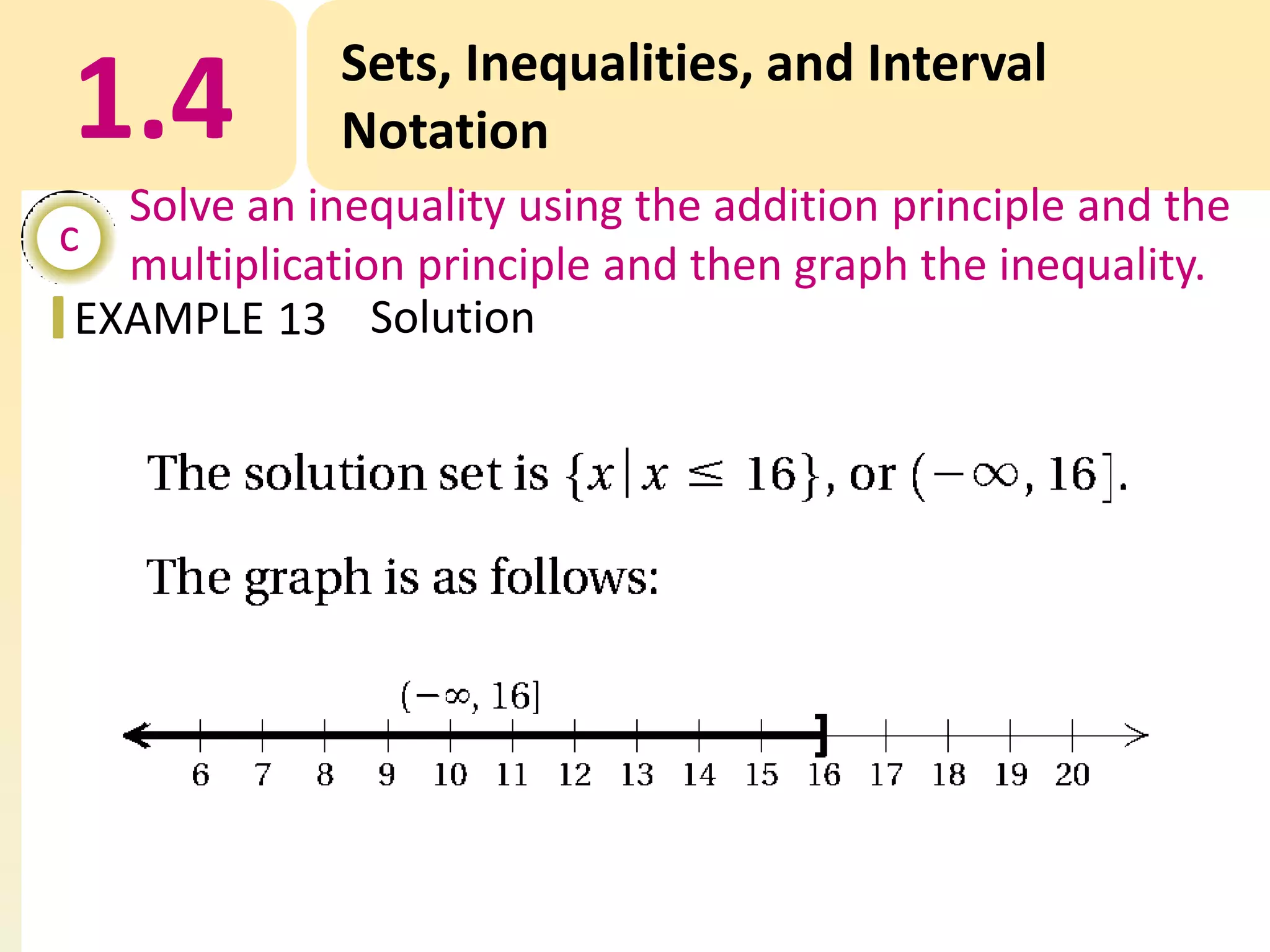
multiplication principle and then graph the inequality.
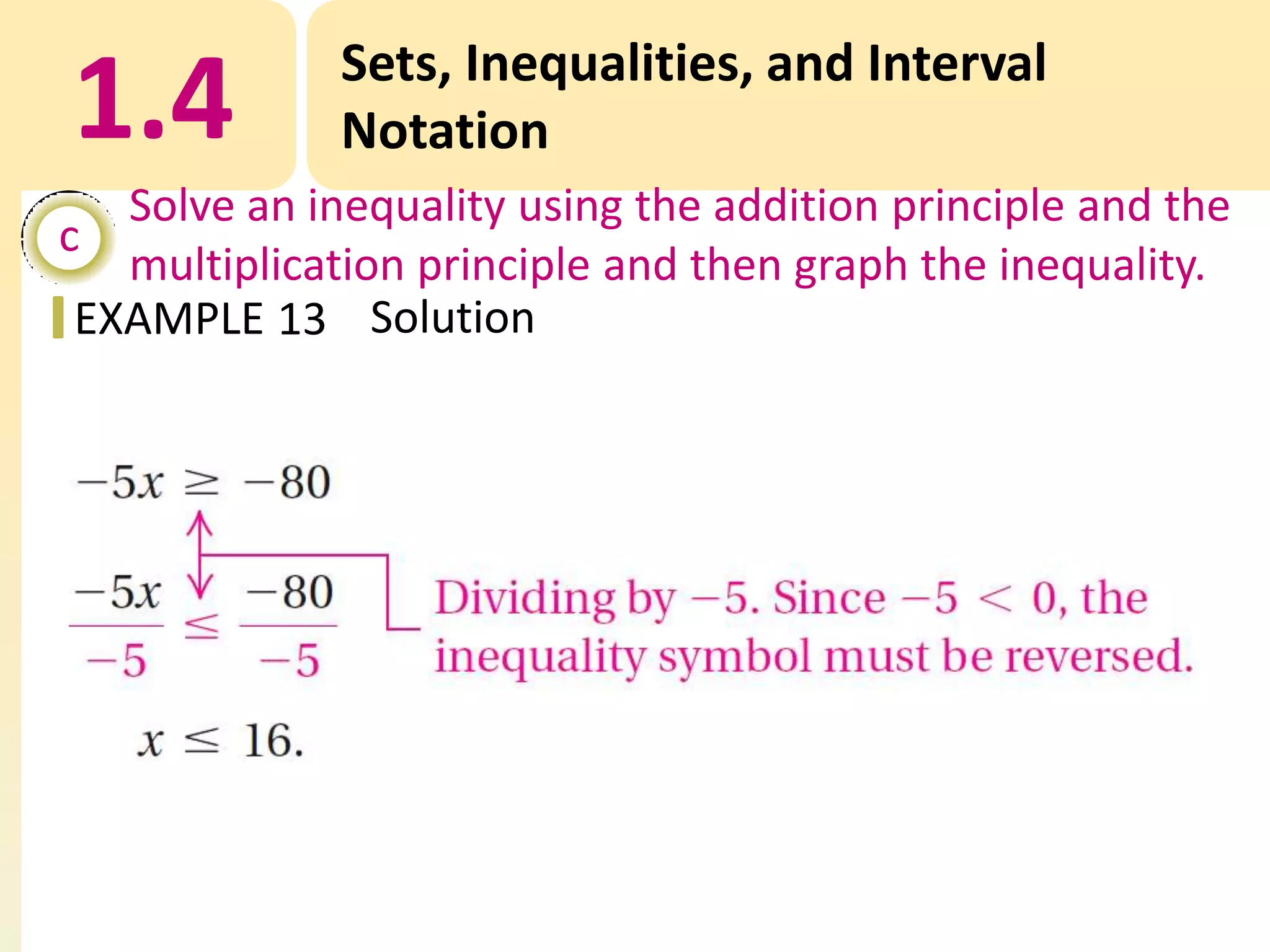
EXAMPLE 13 Solution
1.4

Sets, Inequalities, and Interval
Notation

Solve an inequality using the addition principle and the
c
multiplication principle and then graph the inequality.
EXAMPLE 13 Solution
1.4

Sets, Inequalities, and Interval
Notation

Solve an inequality using the addition principle and the
c
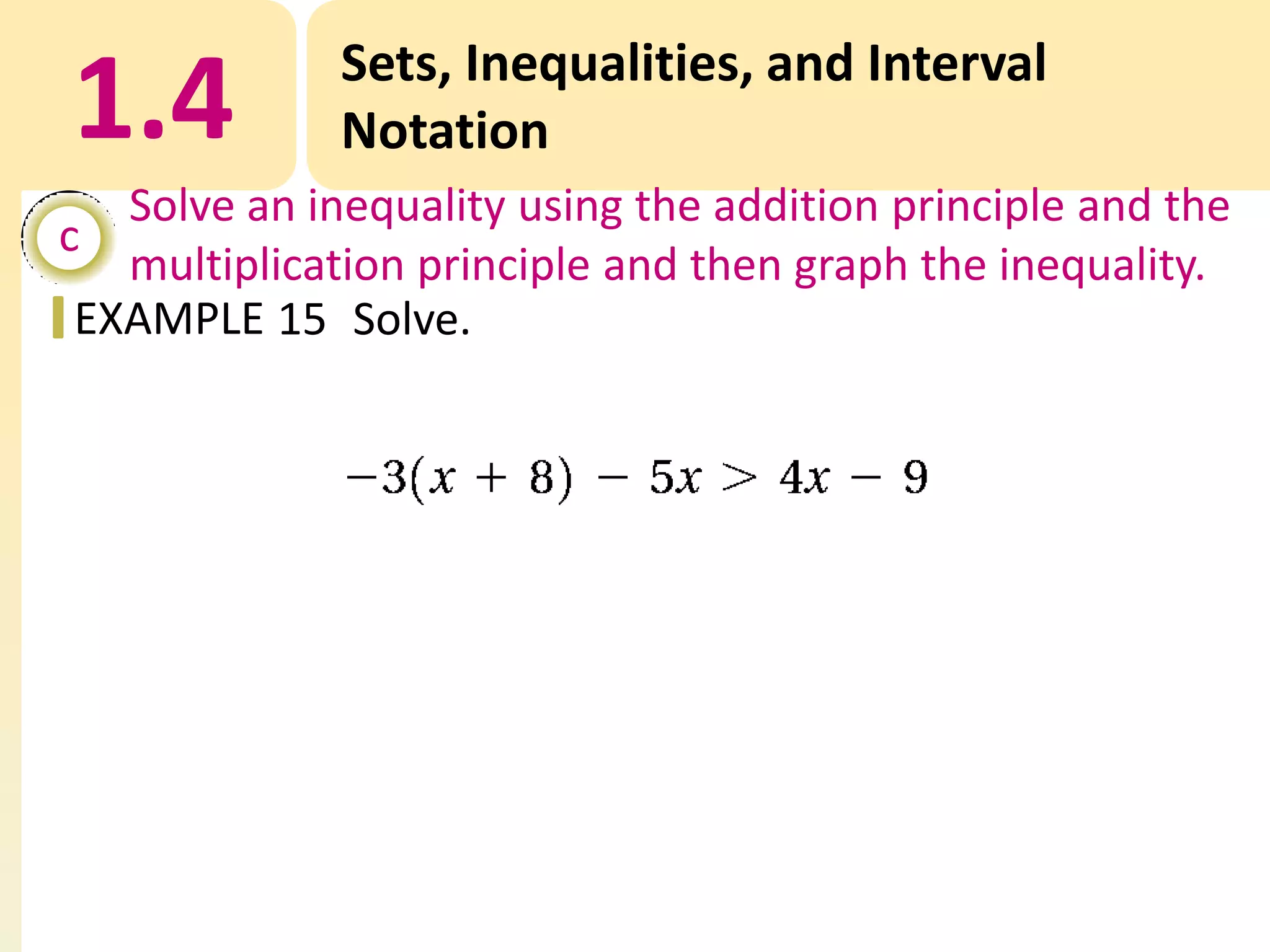
multiplication principle and then graph the inequality.
EXAMPLE 15 Solve.
1.4

Sets, Inequalities, and Interval
Notation

Solve an inequality using the addition principle and the
c
multiplication principle and then graph the inequality.
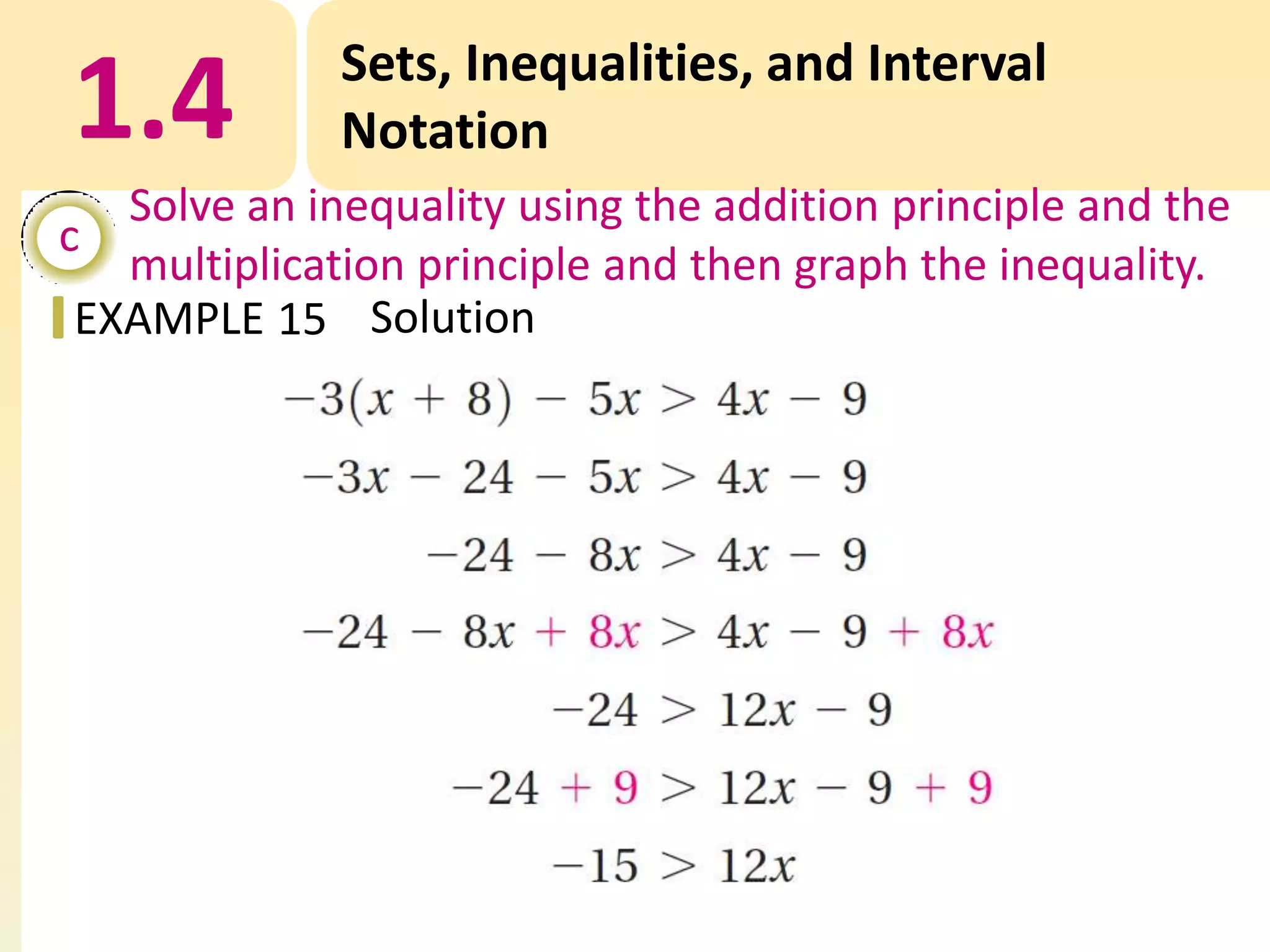
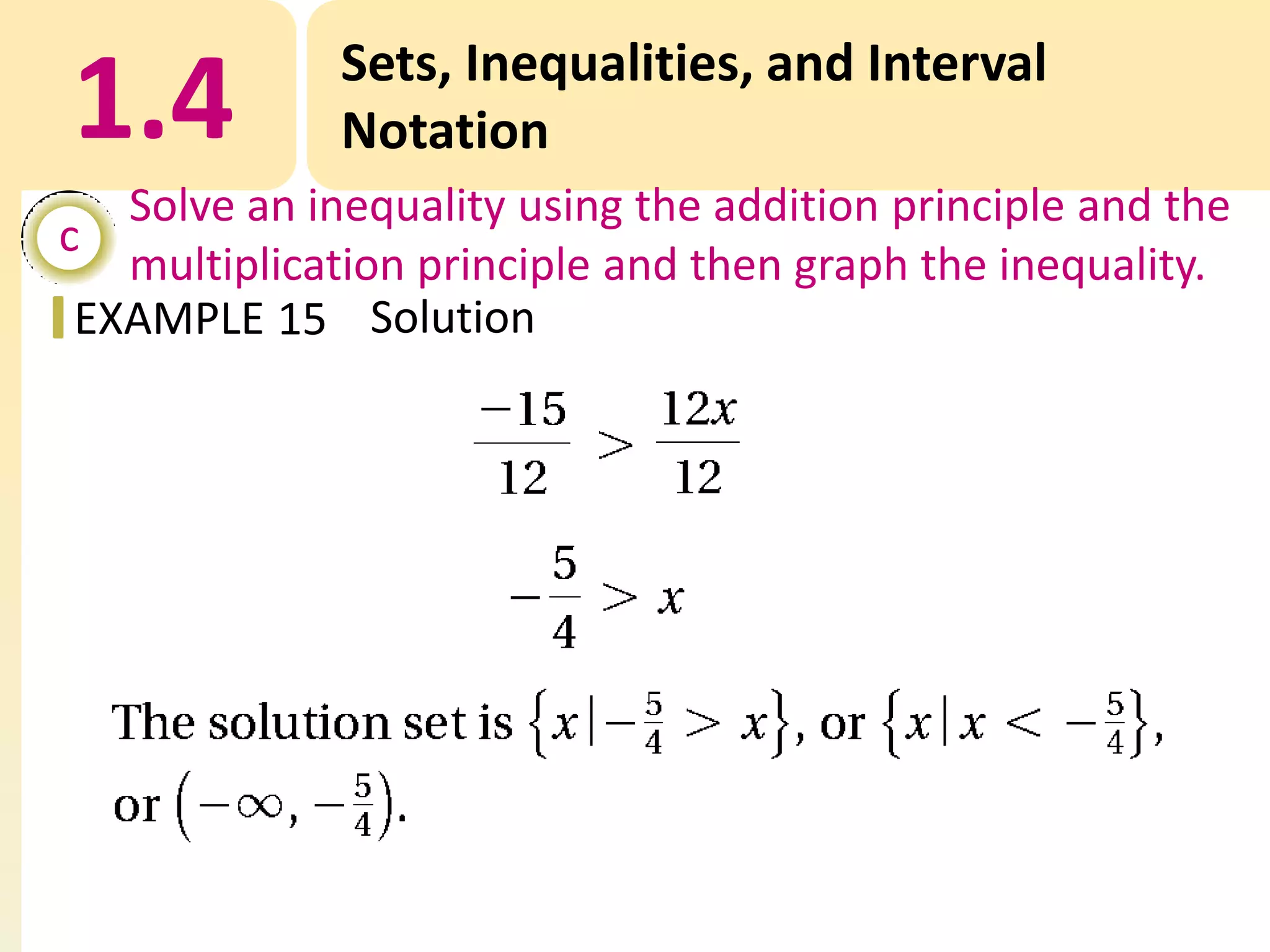
EXAMPLE 15 Solution
1.4

Sets, Inequalities, and Interval
Notation

Solve an inequality using the addition principle and the
c
multiplication principle and then graph the inequality.
EXAMPLE 15 Solution
1.4
d

Sets, Inequalities, and Interval
Notation

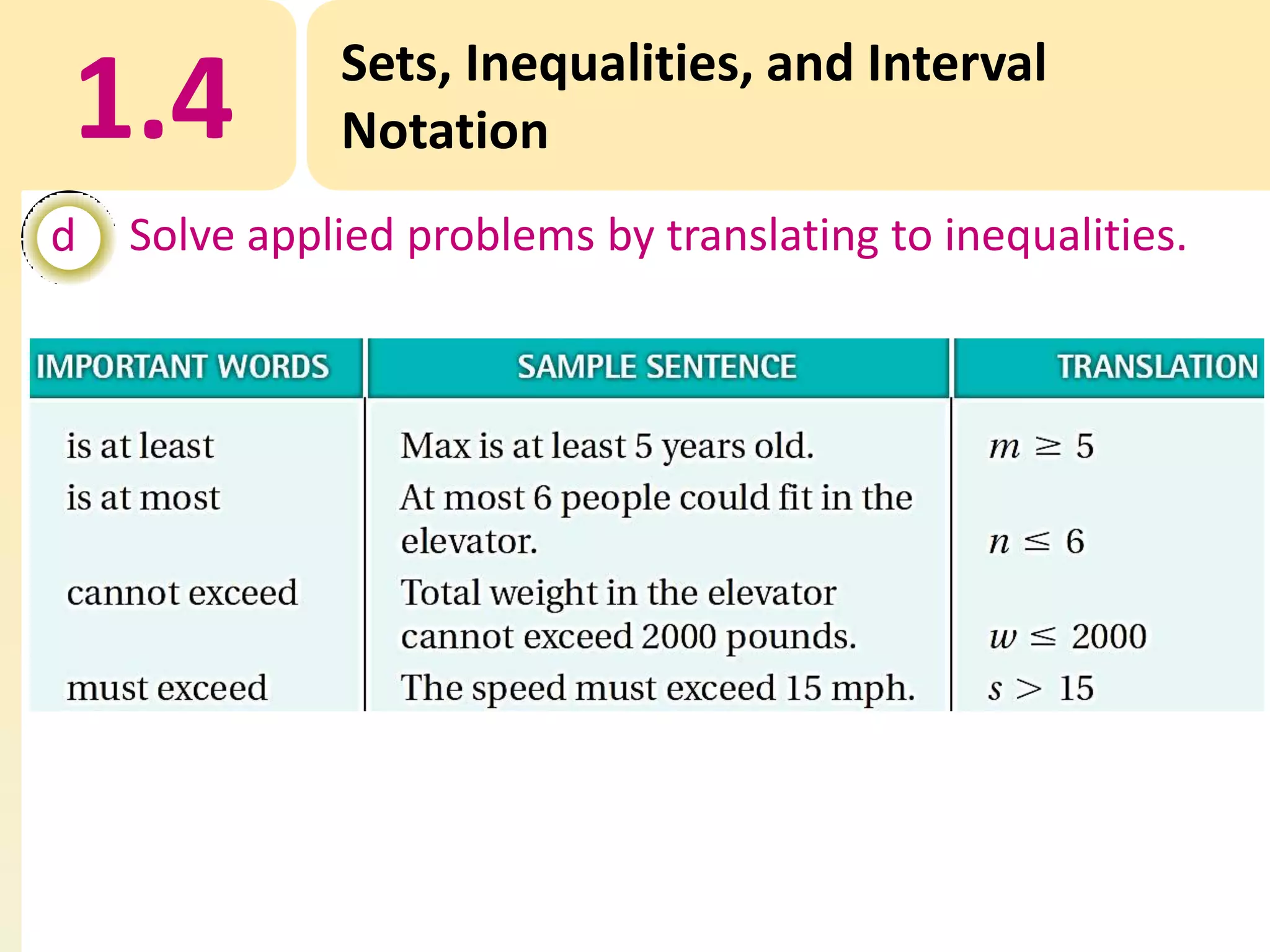
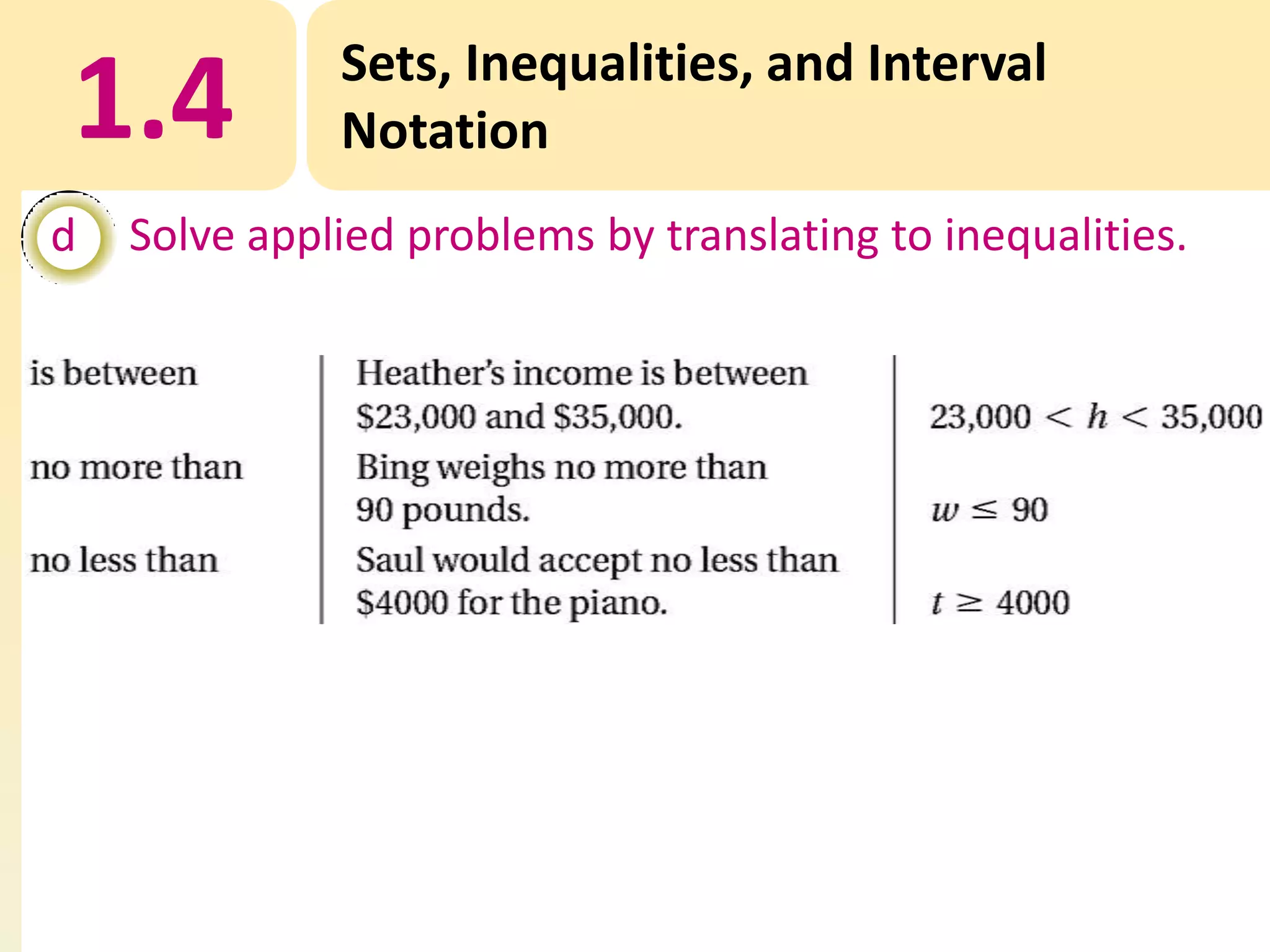
Solve applied problems by translating to inequalities.
1.4
d

Sets, Inequalities, and Interval
Notation

Solve applied problems by translating to inequalities.
1.4

Sets, Inequalities, and Interval
Notation

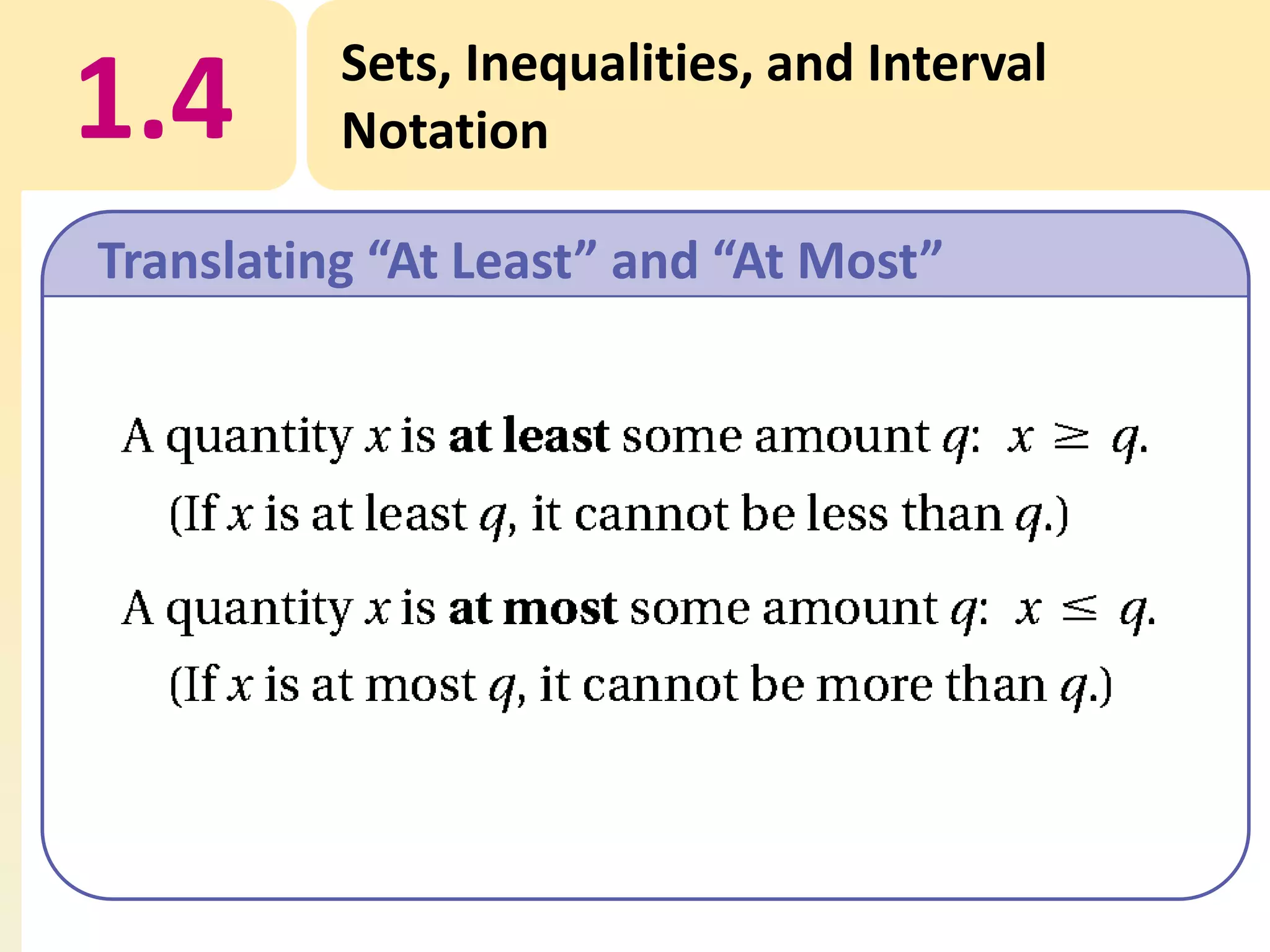
Translating “At Least” and “At Most”
1.4

Sets, Inequalities, and Interval
Notation

d Solve applied problems by translating to inequalities.
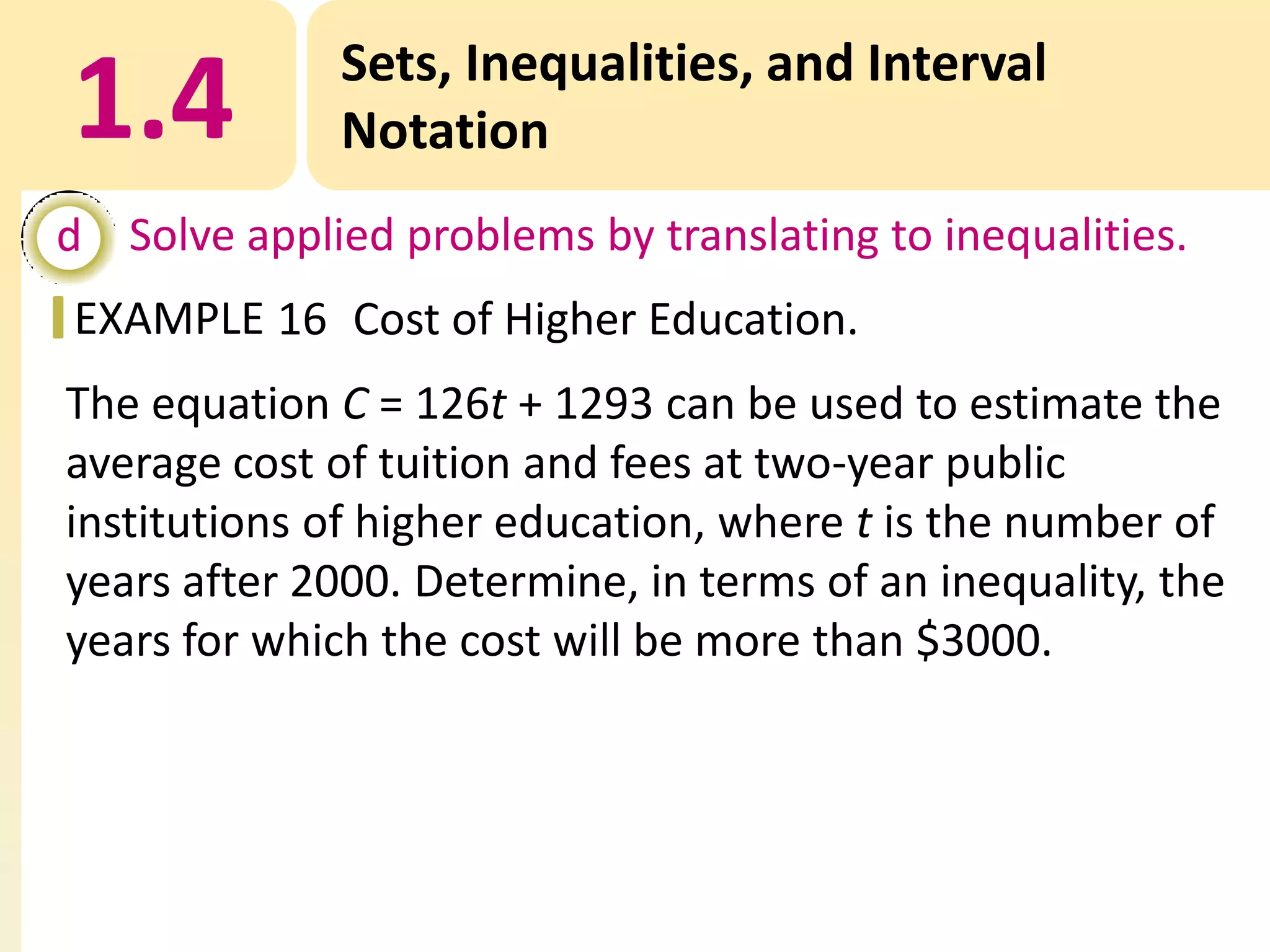
EXAMPLE 16 Cost of Higher Education.
The equation C = 126t + 1293 can be used to estimate the
average cost of tuition and fees at two-year public
institutions of higher education, where t is the number of
years after 2000. Determine, in terms of an inequality, the
years for which the cost will be more than $3000.
1.4

Sets, Inequalities, and Interval
Notation

d Solve applied problems by translating to inequalities.
EXAMPLE 16 Solution

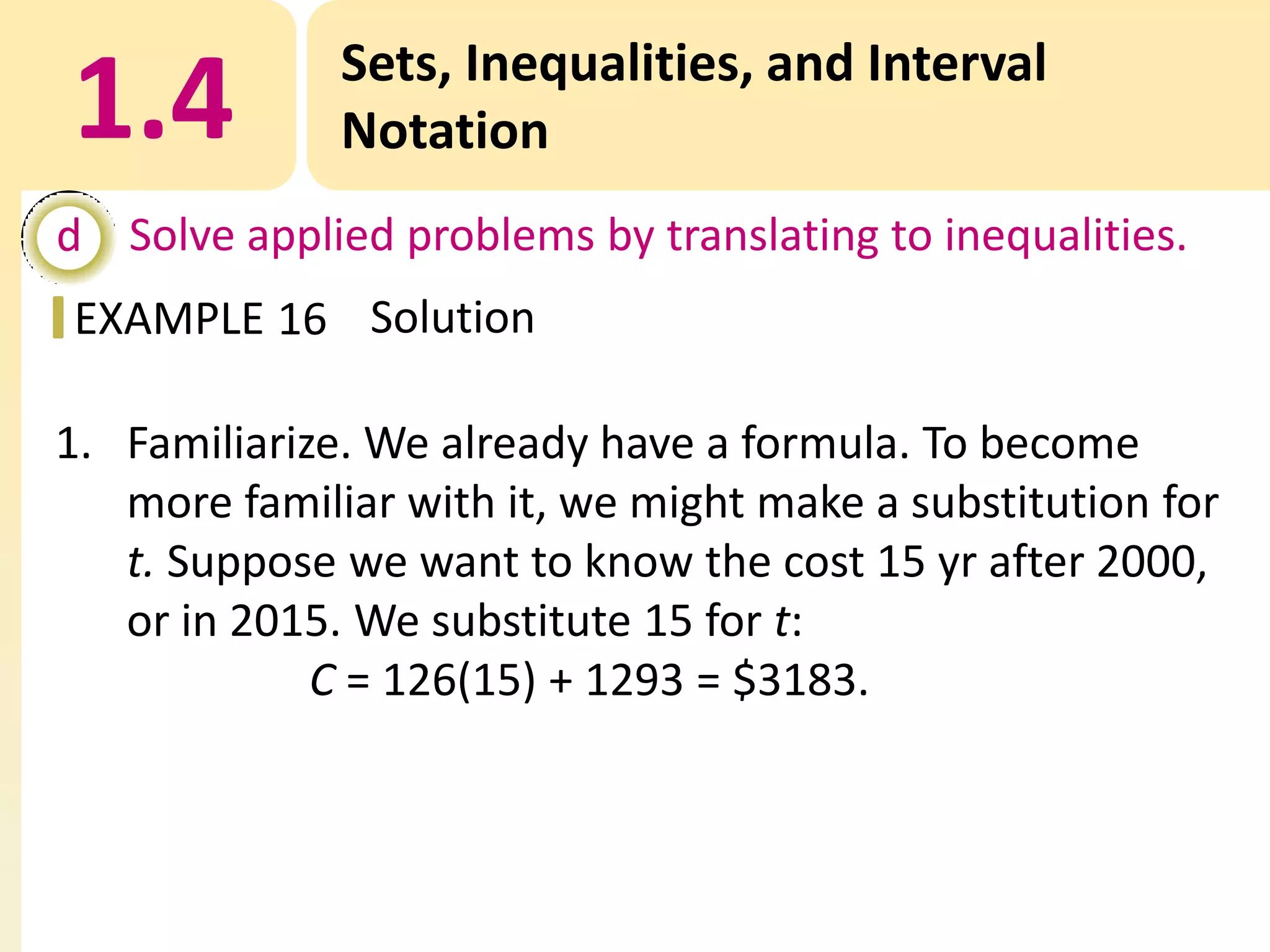
1. Familiarize. We already have a formula. To become
more familiar with it, we might make a substitution for
t. Suppose we want to know the cost 15 yr after 2000,
or in 2015. We substitute 15 for t:
C = 126(15) + 1293 = $3183.
1.4

Sets, Inequalities, and Interval
Notation

d Solve applied problems by translating to inequalities.
EXAMPLE 16 Solution
We see that in 2015, the cost of tuition and fees at twoyear public institutions will be more than $3000. To find
all the years in which the cost exceeds $3000, we could
make other guesses less than 15, but it is more efficient to
proceed to the next step.
1.4

Sets, Inequalities, and Interval
Notation

d Solve applied problems by translating to inequalities.
EXAMPLE 16 Solution

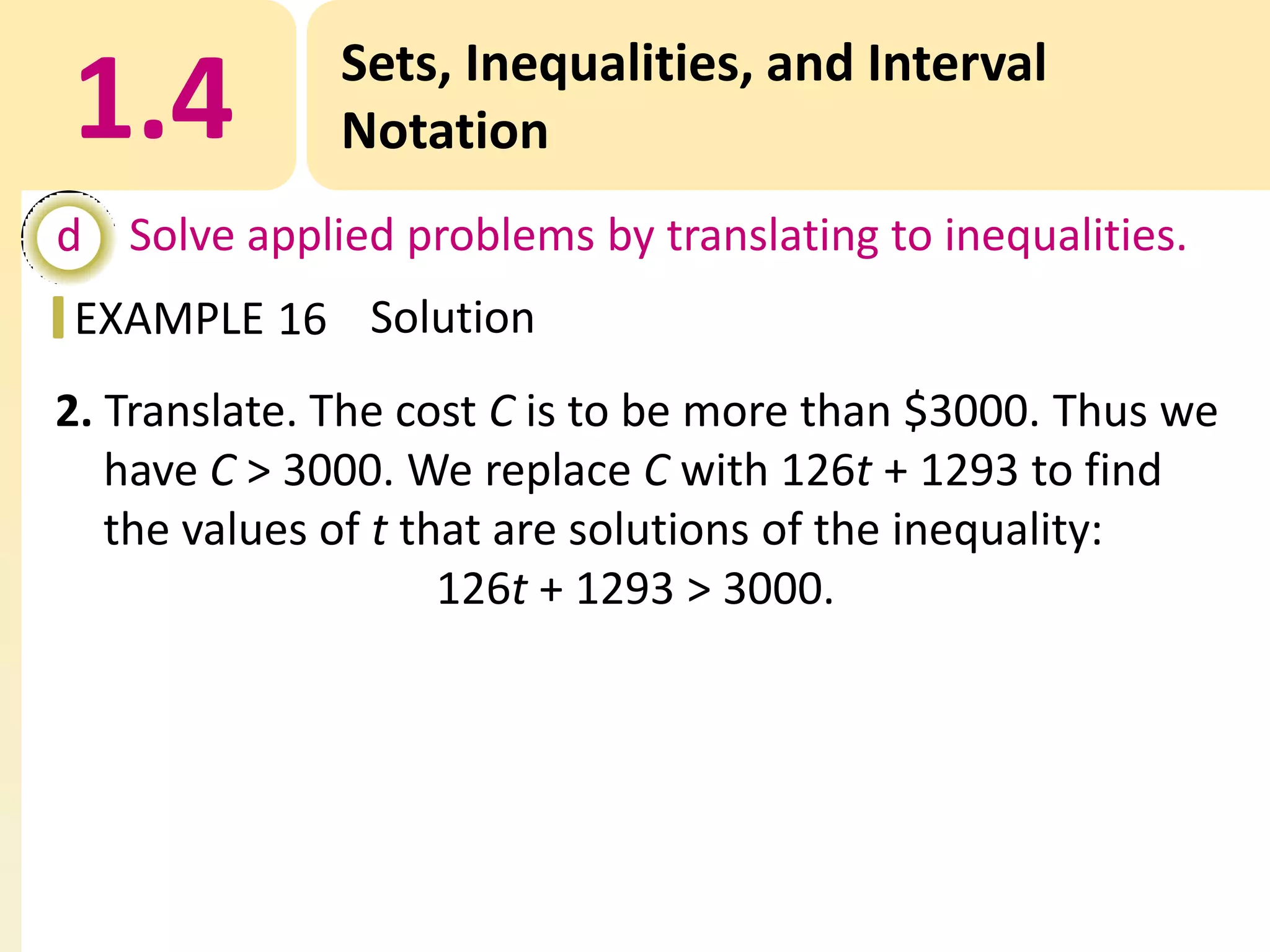
2. Translate. The cost C is to be more than $3000. Thus we
have C > 3000. We replace C with 126t + 1293 to find
the values of t that are solutions of the inequality:
126t + 1293 > 3000.
1.4

Sets, Inequalities, and Interval
Notation

d Solve applied problems by translating to inequalities.
EXAMPLE 16 Solution
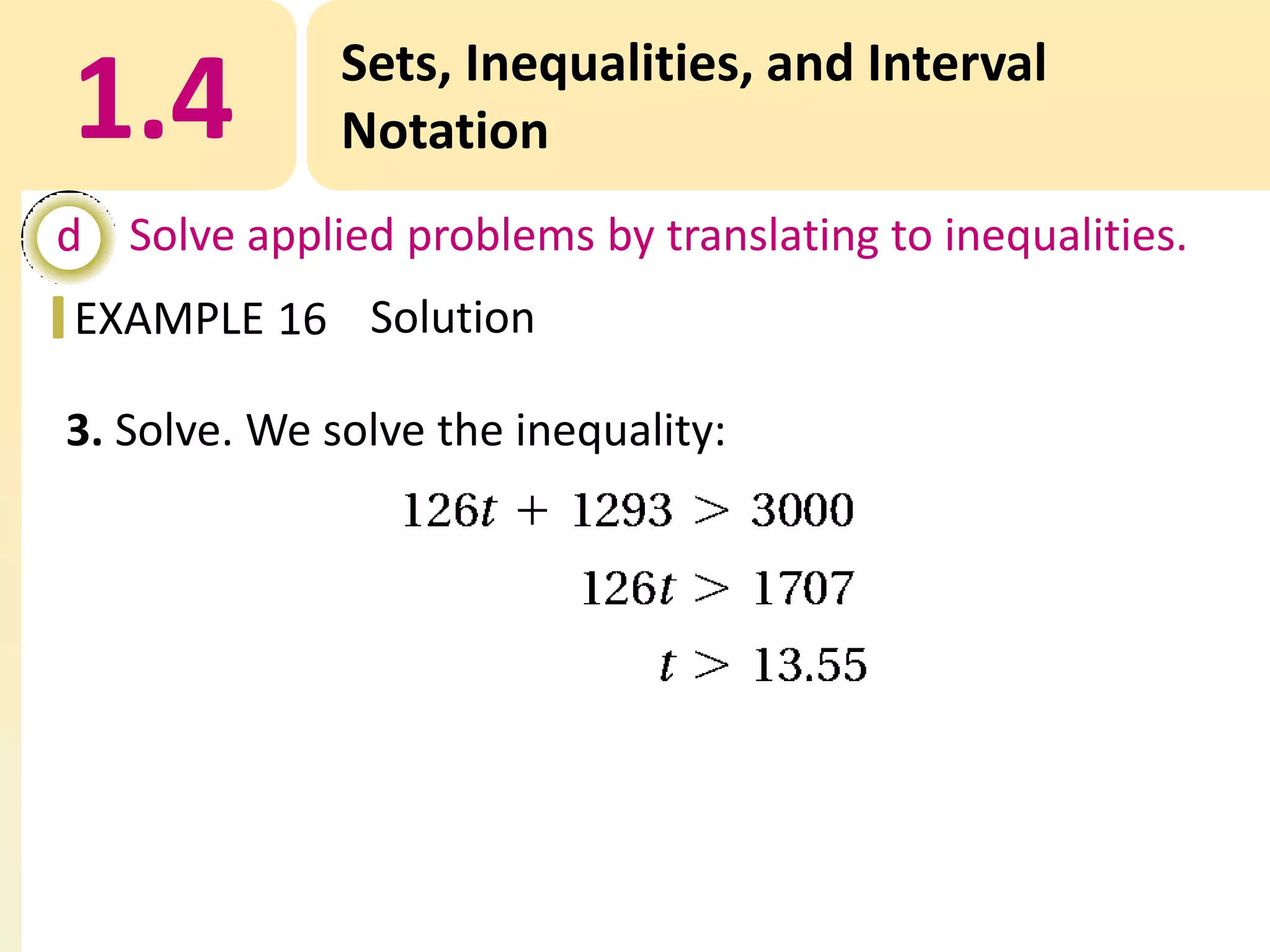
3. Solve. We solve the inequality:
1.4

Sets, Inequalities, and Interval
Notation

d Solve applied problems by translating to inequalities.
EXAMPLE 16 Solution
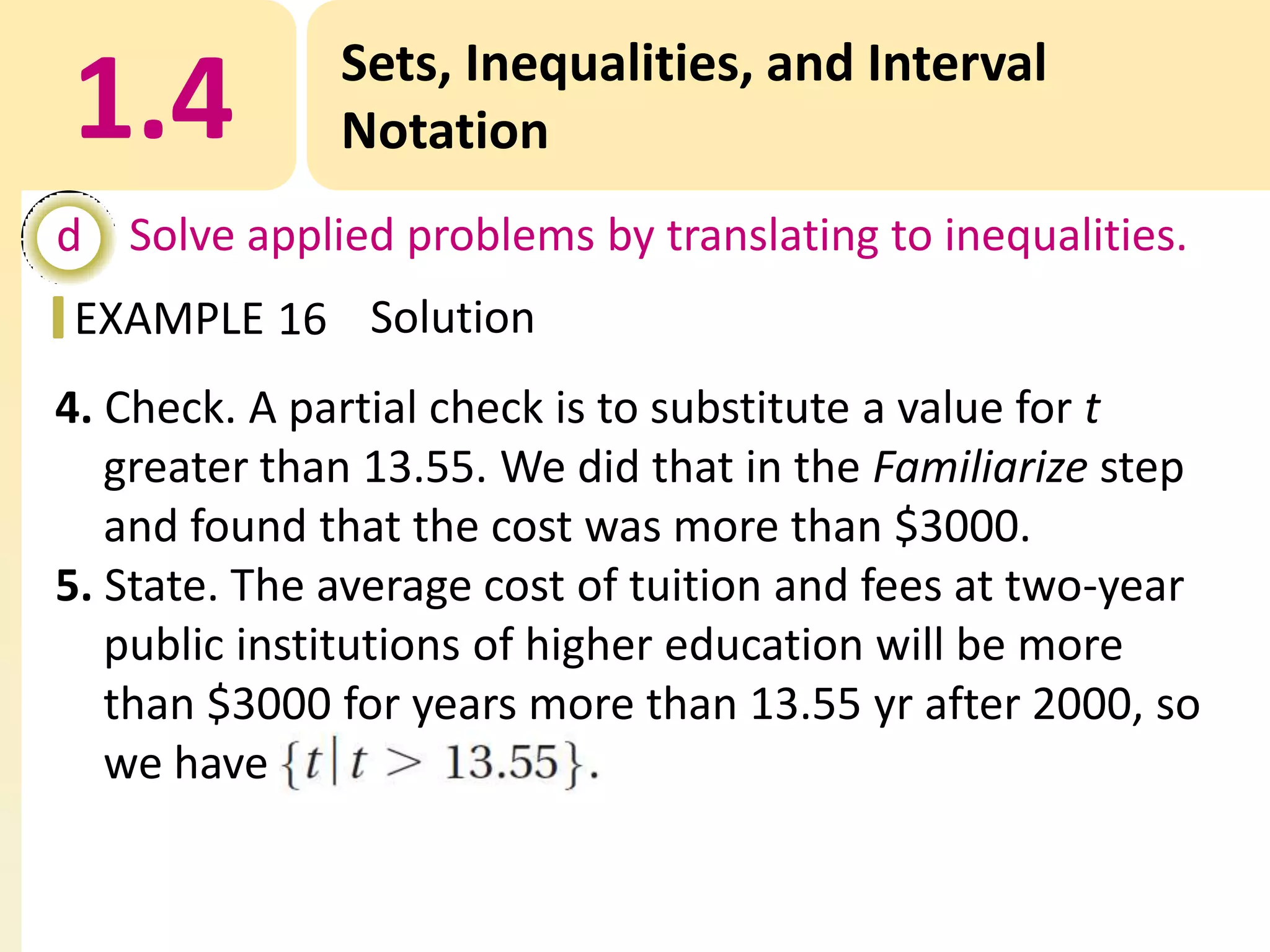
4. Check. A partial check is to substitute a value for t
greater than 13.55. We did that in the Familiarize step
and found that the cost was more than $3000.
5. State. The average cost of tuition and fees at two-year
public institutions of higher education will be more
than $3000 for years more than 13.55 yr after 2000, so
we have

Ultimate guide to linear inequalities

  • 2.
    Solving Linear Inequalities 1.4Sets, Inequalities, and Interval Notation 1.5 Intersections, Unions, and Compound Inequalities 1.6 Absolute-Value Equations and Inequalities
  • 3.
    1.4 Sets, Inequalities, andInterval Notation OBJECTIVES a Determine whether a given number is a solution of an inequality. b Write interval notation for the solution set or the graph of an inequality. c Solve an inequality using the addition principle and the multiplication principle and then graph the inequality. d Solve applied problems by translating to inequalities.
  • 4.
    1.4 Sets, Inequalities, andInterval Notation Inequality An inequality is a sentence containing
  • 5.
    1.4 Sets, Inequalities, andInterval Notation Solution of an Inequality Any replacement or value for the variable that makes an inequality true is called a solution of the inequality. The set of all solutions is called the solution set. When all the solutions of an inequality have been found, we say that we have solved the inequality.
  • 6.
    1.4 Sets, Inequalities, andInterval Notation Determine whether a given number is a solution of an a inequality. EXAMPLE 1 Determine whether the given number is a solution of the inequality.
  • 7.
    1.4 Sets, Inequalities, andInterval Notation Determine whether a given number is a solution of an a inequality. EXAMPLE 1 Solution We substitute 5 for x and get 5 + 3 < 6, or 8 < 6, a false sentence. Therefore, 5 is not a solution.
  • 8.
    1.4 Sets, Inequalities, andInterval Notation Determine whether a given number is a solution of an a inequality. EXAMPLE 3 Determine whether the given number is a solution of the inequality.
  • 9.
    1.4 Sets, Inequalities, andInterval Notation Determine whether a given number is a solution of an a inequality. EXAMPLE 3 Solution We substitute –3 for x and get or a true sentence. Therefore, –3 is a solution.
  • 10.
    1.4 b Sets, Inequalities, andInterval Notation Write interval notation for the solution set or the graph of an inequality. The graph of an inequality is a drawing that represents its solutions.
  • 11.
    1.4 Sets, Inequalities, andInterval Notation Write interval notation for the solution set or the b graph of an inequality. EXAMPLE 4 Graph on the number line.
  • 12.
    1.4 Sets, Inequalities, andInterval Notation Write interval notation for the solution set or the b graph of an inequality. EXAMPLE 4 Solution The solutions are all real numbers less than 4, so we shade all numbers less than 4 on the number line. To indicate that 4 is not a solution, we use a right parenthesis “)” at 4.
  • 13.
    1.4 b Sets, Inequalities, andInterval Notation Write interval notation for the solution set or the graph of an inequality.
  • 14.
    1.4 b Sets, Inequalities, andInterval Notation Write interval notation for the solution set or the graph of an inequality.
  • 15.
    1.4 Sets, Inequalities, andInterval Notation Write interval notation for the solution set or the b graph of an inequality. EXAMPLE Write interval notation for the given set or graph.
  • 16.
    1.4 Sets, Inequalities, andInterval Notation Write interval notation for the solution set or the b graph of an inequality. Solution EXAMPLE
  • 17.
    1.4 c Sets, Inequalities, andInterval Notation Solve an inequality using the addition principle and the multiplication principle and then graph the inequality. Two inequalities are equivalent if they have the same solution set.
  • 18.
    1.4 Sets, Inequalities, andInterval Notation The Addition Principle for Inequalities
  • 19.
    1.4 Sets, Inequalities, andInterval Notation Solve an inequality using the addition principle and the c multiplication principle and then graph the inequality. EXAMPLE 10 Solve and graph.
  • 20.
    1.4 Sets, Inequalities, andInterval Notation Solve an inequality using the addition principle and the c multiplication principle and then graph the inequality. EXAMPLE 10 Solution We used the addition principle to show that the inequalities x + 5 > 1 and x > –4 are equivalent. The solution set is and consists of an infinite number of solutions. We cannot possibly check them all.
  • 21.
    1.4 Sets, Inequalities, andInterval Notation Solve an inequality using the addition principle and the c multiplication principle and then graph the inequality. EXAMPLE 10 Solution Instead, we can perform a partial check by substituting one member of the solution set (here we use –1) into the original inequality:
  • 22.
    1.4 Sets, Inequalities, andInterval Notation Solve an inequality using the addition principle and the c multiplication principle and then graph the inequality. EXAMPLE 10 Solution Since 4 > 1 is true, we have a partial check. The solution set is or The graph is as follows:
  • 23.
    1.4 Sets, Inequalities, andInterval Notation Solve an inequality using the addition principle and the c multiplication principle and then graph the inequality. EXAMPLE 11 Solve and graph.
  • 24.
    1.4 Sets, Inequalities, andInterval Notation Solve an inequality using the addition principle and the c multiplication principle and then graph the inequality. EXAMPLE 11 Solution
  • 25.
    1.4 Sets, Inequalities, andInterval Notation Solve an inequality using the addition principle and the c multiplication principle and then graph the inequality. EXAMPLE 11 Solution The inequalities and have the same meaning and the same solutions. The solution set is or more commonly, Using interval notation, we write that the solution set is The graph is as follows:
  • 26.
    1.4 Sets, Inequalities, andInterval Notation The Multiplication Principle for Inequalities For any real numbers a and b, and any positive number c: For any real numbers a and b, and any negative number c: Similar statements hold for
  • 27.
    1.4 Sets, Inequalities, andInterval Notation The multiplication principle tells us that when we multiply or divide on both sides of an inequality by a negative number, we must reverse the inequality symbol to obtain an equivalent inequality.
  • 28.
    1.4 Sets, Inequalities, andInterval Notation Solve an inequality using the addition principle and the c multiplication principle and then graph the inequality. EXAMPLE 13 Solve and graph.
  • 29.
    1.4 Sets, Inequalities, andInterval Notation Solve an inequality using the addition principle and the c multiplication principle and then graph the inequality. EXAMPLE 13 Solution
  • 30.
    1.4 Sets, Inequalities, andInterval Notation Solve an inequality using the addition principle and the c multiplication principle and then graph the inequality. EXAMPLE 13 Solution
  • 31.
    1.4 Sets, Inequalities, andInterval Notation Solve an inequality using the addition principle and the c multiplication principle and then graph the inequality. EXAMPLE 15 Solve.
  • 32.
    1.4 Sets, Inequalities, andInterval Notation Solve an inequality using the addition principle and the c multiplication principle and then graph the inequality. EXAMPLE 15 Solution
  • 33.
    1.4 Sets, Inequalities, andInterval Notation Solve an inequality using the addition principle and the c multiplication principle and then graph the inequality. EXAMPLE 15 Solution
  • 34.
    1.4 d Sets, Inequalities, andInterval Notation Solve applied problems by translating to inequalities.
  • 35.
    1.4 d Sets, Inequalities, andInterval Notation Solve applied problems by translating to inequalities.
  • 36.
    1.4 Sets, Inequalities, andInterval Notation Translating “At Least” and “At Most”
  • 37.
    1.4 Sets, Inequalities, andInterval Notation d Solve applied problems by translating to inequalities. EXAMPLE 16 Cost of Higher Education. The equation C = 126t + 1293 can be used to estimate the average cost of tuition and fees at two-year public institutions of higher education, where t is the number of years after 2000. Determine, in terms of an inequality, the years for which the cost will be more than $3000.
  • 38.
    1.4 Sets, Inequalities, andInterval Notation d Solve applied problems by translating to inequalities. EXAMPLE 16 Solution 1. Familiarize. We already have a formula. To become more familiar with it, we might make a substitution for t. Suppose we want to know the cost 15 yr after 2000, or in 2015. We substitute 15 for t: C = 126(15) + 1293 = $3183.
  • 39.
    1.4 Sets, Inequalities, andInterval Notation d Solve applied problems by translating to inequalities. EXAMPLE 16 Solution We see that in 2015, the cost of tuition and fees at twoyear public institutions will be more than $3000. To find all the years in which the cost exceeds $3000, we could make other guesses less than 15, but it is more efficient to proceed to the next step.
  • 40.
    1.4 Sets, Inequalities, andInterval Notation d Solve applied problems by translating to inequalities. EXAMPLE 16 Solution 2. Translate. The cost C is to be more than $3000. Thus we have C > 3000. We replace C with 126t + 1293 to find the values of t that are solutions of the inequality: 126t + 1293 > 3000.
  • 41.
    1.4 Sets, Inequalities, andInterval Notation d Solve applied problems by translating to inequalities. EXAMPLE 16 Solution 3. Solve. We solve the inequality:
  • 42.
    1.4 Sets, Inequalities, andInterval Notation d Solve applied problems by translating to inequalities. EXAMPLE 16 Solution 4. Check. A partial check is to substitute a value for t greater than 13.55. We did that in the Familiarize step and found that the cost was more than $3000. 5. State. The average cost of tuition and fees at two-year public institutions of higher education will be more than $3000 for years more than 13.55 yr after 2000, so we have