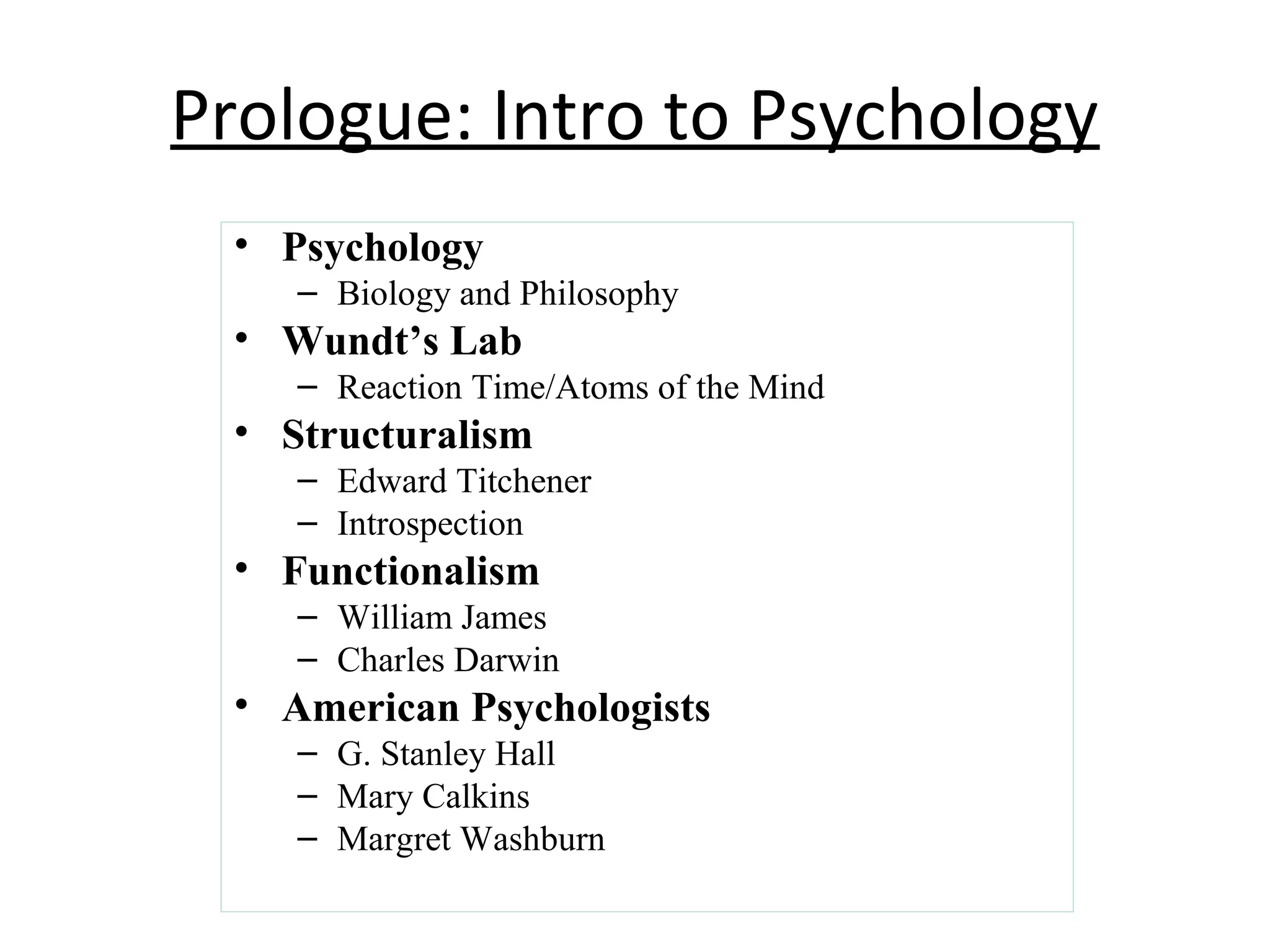
Prologue: Intro to Psychology
• Psychology
– Biology and Philosophy
• Wundt’s Lab
– Reaction Time/Atoms of the Mind
• Structuralism
– Edward Titchener
– Introspection
• Functionalism
– William James
– Charles Darwin
• American Psychologists
– G. Stanley Hall
– Mary Calkins
– Margret Washburn
Psychology’s Basic Perspectives
• Biological
– How hormones, drugs, neurotransmitters and brain structures influence the
body and behavior
• Evolutionary (Darwin, James)
– How the natural selection of traits promotes the perpetuation of one's genes
(survival of the fittest)
• Psychodynamic (Freud, Jung)
– How behavior springs from unconscious drives and conflicts
• Humanistic (Rogers, Maslow)
– Self Actualization and humans reaching full potential
• Behavioral (Watson, Pavlov, Skinner)
– How we learn through observable responses and consequences; states that
learning is automatic and thoughtless
• Cognitive (Beck, Ellis)
– Behavior is influenced by how a person thinks and remembers
• Social-Cultural
– How behavior and thinking vary across situations and cultures
Unit 1: Research Methods
• Op. Definitions of Variables
– Replicate research
• Descriptive Research Methods
– Case Study (Unique People)
– Naturalistic Observation
– Surveys
• Wording Effects
• Volunteer Bias
• Random Sample
• Correlations (Prediction)
– Correlation does not prove
causation Third variables
– Scatterplot, Pearson’s r
– Illusory Correlation
• Experiments (Cause/effect)
– Independent Variable
– Dependent Variable
– Random Assignment
– Single v. Double Blind
• Types of Studies
– Longitudinal Studies
– Cross Sectional Studies
• Ethical Considerations
– Protect from harm
– Informed Consent
– Confidentiality
– Debriefing
• Descriptive Statistics
– Measures of Central tendency
• Mean, Median, Mode
– Measures of Variation
• Range
• Standard Deviation
• Inferential Statistics
– Pearson’s r (-1 to +1)
– Statistical significance (T-Test)
• P-value (p < .05)
Random Sample vs. Random Assignment
Used to generalize to a
population
Used to equalize (make even)
two groups (control & exp)
Positive Correlation:
Muscle size and exercise
Negative Correlation:
Smoking and health
No Correlation:
Weight and GPA
Unit 2: Biological Basis of Behavior
• Neurons
– Dendrite, Cell Body, Axon, Synaptic
Vesicles, Synapse
– Action Potential (All or none)
– Types of neurons (Efferent, Afferent,
Inter)
• Neurotransmitters
– Dopamine
– Endorphins
– Acetylcholine (ACh)
– Serotonin
– GABA
– Epinephrine
– Agonist vs. Antagonist
– Reuptake
• Nervous Systems
– Spinal Reflexes (reflex arc)
– Central
– Peripheral
• Sympathetic
• Parasympathetic
• Endocrine System
– Hormones
– Glands
• Observing the Brain
– CT Scan
– PET Scan
– EEG Waves
– fMRI
• The Brain Structures
– Medulla, Pons, Cerebellum, Reticular
Formation
– Limbic System
– Association Areas
– Cerebral Cortex & Hemispheres
• Frontal, Parietal, Temporal and Occipital
• Hypothalamus, Hippocampus, Amygdala,
Thalamus
– Plasticity, Phineas Gage
• Language and the Brain (Aphasia)
– Broca, Wernicke and Angular Gyrus
• Split Brain Studies
– Sperry& Gazzaniga
– Corpus Callosum
Unit 3: Development
• In the Womb
– Zygote, Embryo, Fetus
– Teratogens
• Newborns
– Reflexes (Rooting, Moro)
– Habituation
• Cognitive Development
– Jean Piaget
• Sensorimotor
• Preoperational
• Concrete operations
• Formal Operations
– Lev Vygotsky
• Zone of Proximal Development
• Attachment
– Lorenz Critical Period
• Imprinting
– Harlow’s Monkeys
– Ainsworth
• Strange Situation Test
– Parenting Styles
• Authoritative
• Authoritarian
• Permissive
• Adolescence
– Identity Development
• Erik Erikson’s Stages
– Identify v. Role Confusion
– Moral Development
• Kohlberg’s Heinz Dilemma
– Pre, Post Conventional
• Carol Gilligan’s debate of
Kohlberg’s research
• Adulthood
– Alzheimer's Disease
– Senile Dementia
– Crystallized v. Fluid Intelligence
• Death & Dying
– Kuebler-Ross
• D, A, B, D, A

Q1 benchmarkreview

  • 1.
    Prologue: Intro toPsychology • Psychology – Biology and Philosophy • Wundt’s Lab – Reaction Time/Atoms of the Mind • Structuralism – Edward Titchener – Introspection • Functionalism – William James – Charles Darwin • American Psychologists – G. Stanley Hall – Mary Calkins – Margret Washburn
  • 2.
    Psychology’s Basic Perspectives •Biological – How hormones, drugs, neurotransmitters and brain structures influence the body and behavior • Evolutionary (Darwin, James) – How the natural selection of traits promotes the perpetuation of one's genes (survival of the fittest) • Psychodynamic (Freud, Jung) – How behavior springs from unconscious drives and conflicts • Humanistic (Rogers, Maslow) – Self Actualization and humans reaching full potential • Behavioral (Watson, Pavlov, Skinner) – How we learn through observable responses and consequences; states that learning is automatic and thoughtless • Cognitive (Beck, Ellis) – Behavior is influenced by how a person thinks and remembers • Social-Cultural – How behavior and thinking vary across situations and cultures
  • 3.
    Unit 1: ResearchMethods • Op. Definitions of Variables – Replicate research • Descriptive Research Methods – Case Study (Unique People) – Naturalistic Observation – Surveys • Wording Effects • Volunteer Bias • Random Sample • Correlations (Prediction) – Correlation does not prove causation Third variables – Scatterplot, Pearson’s r – Illusory Correlation • Experiments (Cause/effect) – Independent Variable – Dependent Variable – Random Assignment – Single v. Double Blind • Types of Studies – Longitudinal Studies – Cross Sectional Studies • Ethical Considerations – Protect from harm – Informed Consent – Confidentiality – Debriefing • Descriptive Statistics – Measures of Central tendency • Mean, Median, Mode – Measures of Variation • Range • Standard Deviation • Inferential Statistics – Pearson’s r (-1 to +1) – Statistical significance (T-Test) • P-value (p < .05)
  • 4.
    Random Sample vs.Random Assignment Used to generalize to a population Used to equalize (make even) two groups (control & exp)
  • 5.
    Positive Correlation: Muscle sizeand exercise Negative Correlation: Smoking and health No Correlation: Weight and GPA
  • 6.
    Unit 2: BiologicalBasis of Behavior • Neurons – Dendrite, Cell Body, Axon, Synaptic Vesicles, Synapse – Action Potential (All or none) – Types of neurons (Efferent, Afferent, Inter) • Neurotransmitters – Dopamine – Endorphins – Acetylcholine (ACh) – Serotonin – GABA – Epinephrine – Agonist vs. Antagonist – Reuptake • Nervous Systems – Spinal Reflexes (reflex arc) – Central – Peripheral • Sympathetic • Parasympathetic • Endocrine System – Hormones – Glands • Observing the Brain – CT Scan – PET Scan – EEG Waves – fMRI • The Brain Structures – Medulla, Pons, Cerebellum, Reticular Formation – Limbic System – Association Areas – Cerebral Cortex & Hemispheres • Frontal, Parietal, Temporal and Occipital • Hypothalamus, Hippocampus, Amygdala, Thalamus – Plasticity, Phineas Gage • Language and the Brain (Aphasia) – Broca, Wernicke and Angular Gyrus • Split Brain Studies – Sperry& Gazzaniga – Corpus Callosum
  • 8.
    Unit 3: Development •In the Womb – Zygote, Embryo, Fetus – Teratogens • Newborns – Reflexes (Rooting, Moro) – Habituation • Cognitive Development – Jean Piaget • Sensorimotor • Preoperational • Concrete operations • Formal Operations – Lev Vygotsky • Zone of Proximal Development • Attachment – Lorenz Critical Period • Imprinting – Harlow’s Monkeys – Ainsworth • Strange Situation Test – Parenting Styles • Authoritative • Authoritarian • Permissive • Adolescence – Identity Development • Erik Erikson’s Stages – Identify v. Role Confusion – Moral Development • Kohlberg’s Heinz Dilemma – Pre, Post Conventional • Carol Gilligan’s debate of Kohlberg’s research • Adulthood – Alzheimer's Disease – Senile Dementia – Crystallized v. Fluid Intelligence • Death & Dying – Kuebler-Ross • D, A, B, D, A

Editor's Notes

  • #2 Wundt “Father of Psychology”; introspection Structure of our mind Wertheimer Gestalt psychology Titchner Structuralism James Functionalism-mental life and behavior in terms of active adaptation to the person&amp;apos;s environment Watson Behaviorism; “Little Albert Study”; aversion therapy Freud Psychoanalytic; dream analysis; free association; structure of personality; stages of development; defense mechanisms Hall-1st President Calkins-1st female Washburn- 1st female president
  • #4 An operational definition describes exactly what the variables are and how they are measured within the context of your study. The Experiment: 1. Two variables are studied for cause and effect Independent variable – manipulated Dependent variable – the response; measured Confounding variable – other variables that may influence results Experiment group – exposed to manipulation of independent variable Control group – an unaffected comparison group Subject bias – a subject’s behavior changes due to believed expectations of experiment (Demand characteristics) Researcher bias – expectations influence what is recorded Double-blind technique – control for bias by keeping placement of subject secret Placebo – inactive substance unknowingly given in place of drug Null hypothesis – negatively expressed hypothesis; X will not change Y
  • #6 A correlation measures the relationship between two variables. As explained earlier, correlations can be either positive or negative. If two things are positively correlated, the presence of one thing predicts the presence of the other. In contrast, a negative correlation means that the presence of one thing predicts the absence of the other. When no relationship exists between two things, no correlation exists. As an example, one would suspect that a positive correlation exists between studying and earning good grades. Conversely, one would suspect that a negative correlation might occur between cutting classes and earning good grades. Finally, it is likely that there is no correlation between the number of stuffed animals one owns and earning good grades.
  • #7 Myelin Sheath – a fatty covering around the axon of some neurons that speeds the neural impulse Axon – wire-like structure ending in the terminal that extends from the cell body Neurons – a nerve cell; the basic building block of the nervous system Sensory Neurons (afferent) – neurons that carry incoming information from the sense receptors (nose, ears, hands) to the central nervous systemInterneuron – central nervous system neurons that internally communicate and intervene between the sensory inputs and the motor outputsMotor Neurons (efferent) – neurons that carry incoming information from the central nervous system to the muscles and glands Dopa- movement, earning, attention, emotion. Excess-Schizo, too little-Parkinson Edorphine-pain blocking Ach-muscle movement, learning, and memory. Alzhemiers-breakdown of ACH producing neurons Sertonin-mood, hunger, arousal, sleep. Under supply= depression Epinephrine-adrenaline, arousal GABA-inhbits neurotransmission Limbic System – associated with emotions like aggression and fear and drives such as hunger and thirst and sex (Hippocampus, Hypothalamus, and Amygdala)
  • #8 Acetylcholine – activates motor neurons and skeletal muscles, too little = Alzheimer’s Dopamine – contributes to voluntary movements and pleasurable emotions, lack of it causes Parkinson’s as too much causes schizophrenia Endorphins – natural pain killers created by brain, promotes pain relief, like morphine Serotonin – involved in mood, regulation of sleep, appetite, and body temperature, to little leads to depression as too much contributes to OCD and mania Norepinephrine – affects memory, learning, and contributes to changes in mood, undersupply leads to depression
  • #9 Rooting Reflex – when touched on the cheek, a baby will turn its head and seek a nipple Moro Reflex – when startled, baby flings limbs out and slowly retract themBabinski Reflex – when a baby’s foot is stroked, he/she will spread their toesSucking Reflex – when an object is placed into baby’s mouth, the infant will suck on it Grasping Reflex – if an object is placed into baby’s balm, the baby will try to grasp it