Unit 1

What is Psychology?
• Psychology: the scientific study of
  behavior and mental processes
  – Behavior: any action that others can observe
    or measure.
     • This includes almost everything that a person
       could do. (walk, talk, sleep, eat, blink, etc.)
     • Some things can‟t be seen. [Brain activity is
       measured with an electroencephalograph (EEG)]
  – Cognitive activities: private mental processes
    known only to the individual. (Ex:
    dreams, thoughts, memories)
  – Psychological Constructs: What researchers
    use to talk about cognitive activities. (how
    they affect your behavior)
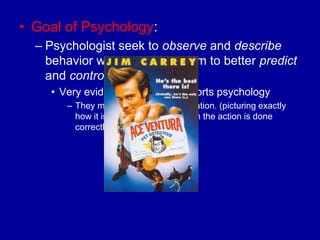
• Goal of Psychology:
  – Psychologist seek to observe and describe
    behavior which enables them to better predict
    and control one‟s behavior.
    • Very evident in the field of sports psychology
       – They may use positive visualization. (picturing exactly
         how it is supposed to look when the action is done
         correctly)
• Psychology is a social science with some
  foundations in the natural sciences.
  – There are other social sciences: History,
    Anthropology, Economics, Political Science,
    Sociology
  – All these other social sciences deal with individuals
    and their behavior, which is the basis of Psychology.
• Psychology also has some base in the natural
  sciences
  – The Natural sciences include: Biology, Chemistry,
    Physics.
  – Psychologist study the functions of the brain which is
    closely linked to Biology and Anatomy
• Psychologist will test their ideas through
  research. There are two main research
  methods: Survey and Experimentation.
   – Some psychologist use animal experimentation to
     explain human behavior. Other research can only be
     conducted on humans.
• Psychologist organize their thoughts or ideas
  into theories.
   – Theory: a statement that attempts to explain why
     things are the way they are or happen the way they
     do.
   – Principle: a basic truth or law that most Psychologist
     will agree on.
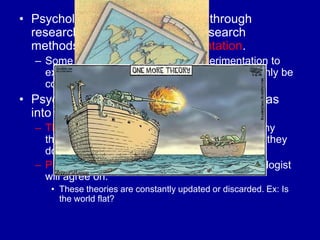
      • These theories are constantly updated or discarded. Ex: Is
        the world flat?
Different types of Psychologist:
• Clinical Psychologist
  – Makes up 48% of all Psychologist
  – Help people with psychological problems like
    anxiety, depression or more severe problems like
    schizophrenia
  – Do a large amount of research
  – Found in hospitals, prisons, universities
  – Not to be confused with a Psychiatrist, who is a
    medical doctor that specializes in psychological
    problems and can prescribe medication for their
    patients
• Counseling Psychologist
   – They use interviews and test to identify their clients
     problems
   – Mainly deal with people who have adjustment
     problems rather then serious disorders
   – This is the group that most employer and family
     counselors fall into

• School Psychologist
   – Work in schools to help students with any problems
     that may interfere with learning (family problems, peer
     problems, learning disorders)
   – They administer IQ and other achievement test
   – They may be in charge of student placement into
     special programs
• Educational Psychologist
   – Similar to school psychologist but they are concerned with
     course planning and instructional methods for an entire district
   – Their research includes the way learning is affected by
     psychological factors, cultural factors, economic factors, and
     instructional factors
   – They write most standardized test (ACT,SAT) then test the
     results

• Developmental Psychologist
   – They study the changes that occur throughout a life span. These
     are:
       • physical, (height, weight, maturity)
       • emotional, (self concept, self esteem),
       • cognitive, (changes in the thought processes from infant to adult)
         and
       • social (the formations of bonds between people and peer pressure)
   – They deal with the nature vs. nurture debate
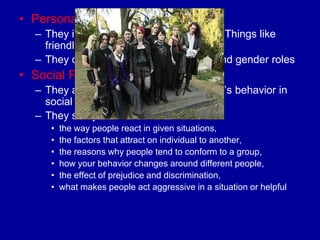
• Personality Psychologist
  – They identify characteristics or traits. (Things like
    friendliness or shyness)
  – They deal with aggression, anxiety, and gender roles
• Social Psychologist
  – They are concerned with an individual‟s behavior in
    social situations
  – They study:
     •   the way people react in given situations,
     •   the factors that attract on individual to another,
     •   the reasons why people tend to conform to a group,
     •   how your behavior changes around different people,
     •   the effect of prejudice and discrimination,
     •   what makes people act aggressive in a situation or helpful
• Experimental Psychologist
  – They usually conduct research in the basic processes
    such as functions of the nervous system.
  – They are closely linked to the natural sciences
  – They perform Basic research: research that is done
    for no immediate application but rather for its own
    sake
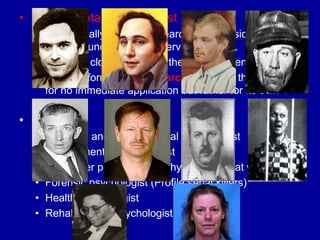
• Others:
  •   Industrial and organizational psychologist
  •   Environmental psychologist
  •   Consumer psychologist (why we buy what we buy)
  •   Forensic psychologist (Profile serial killers)
  •   Health Psychologist
  •   Rehabilitation Psychologist
History of Psychology
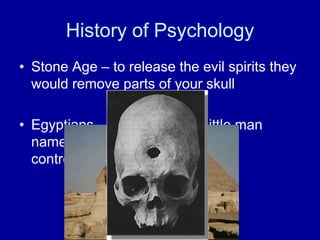
• Stone Age – to release the evil spirits they
  would remove parts of your skull

• Egyptians – believed that a little man
  named Ka lived in your head and
  controlled what you do
• Ancient Greece
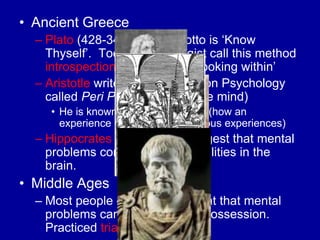
  – Plato (428-348 BC) his motto is „Know
    Thyself‟. Today Psychologist call this method
    introspection which means „looking within‟
  – Aristotle writes the first book on Psychology
    called Peri Psyches (about the mind)
     • He is known for associationism (how an
       experience reminds us of previous experiences)
  – Hippocrates is the first to suggest that mental
    problems come from abnormalities in the
    brain.
• Middle Ages
  – Most people of the day thought that mental
    problems came from demon possession.
    Practiced trial by ordeal.
• 16th, 17th, 18th centuries
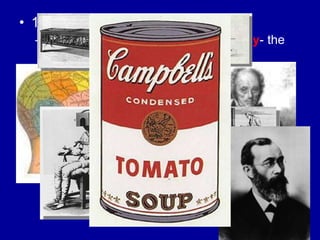
  – the start of the science of Phrenology- the
   reading of the bumps on your head
• 1879 William Wundt
  – Starts the field (or school) of psychology
    called Structuralism
  – It‟s basis is that your conscious is broken into
    two basic elements
     • Objective sensations
     • Subjective feelings
  – The mind functions by combining the these
    two basic elements
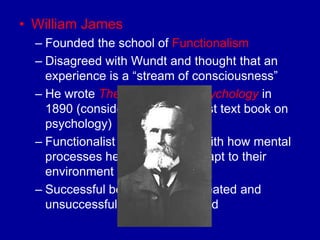
• William James
  – Founded the school of Functionalism
  – Disagreed with Wundt and thought that an
    experience is a “stream of consciousness”
  – He wrote The Principles of Psychology in
    1890 (considered to be the first text book on
    psychology)
  – Functionalist are concerned with how mental
    processes help organisms adapt to their
    environment
  – Successful behaviors are repeated and
    unsuccessful ones are dropped
• The difference between Functionalism and
  Structuralism:
  – Structuralism asks: what are the elements (or
    structures) of the psychological process?
  – Functionalism ask: What are the purposes (or
    functions) of these behaviors and mental
    processes?
  – In other words “one asks what are the parts?
    The other asks what do the parts do?”
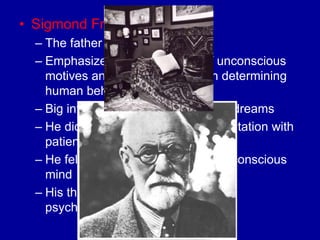
• Sigmond Freud
  – The father of Psychoanalysis
  – Emphasized the importance of unconscious
    motives and internal conflicts in determining
    human behavior
  – Big into interpretation of slips and dreams
  – He did his research through consultation with
    patients (not in a lab)
  – He felt you are driven by your subconscious
    mind
  – His theories are sometimes called
    psychodynamic thinking
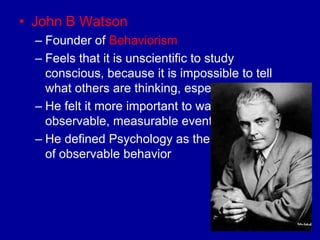
• John B Watson
  – Founder of Behaviorism
  – Feels that it is unscientific to study
    conscious, because it is impossible to tell
    what others are thinking, especially animals
  – He felt it more important to watch
    observable, measurable events
  – He defined Psychology as the scientific study
    of observable behavior
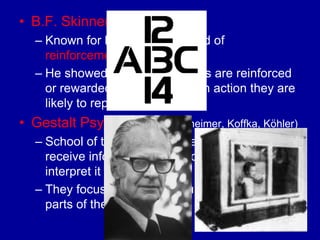
• B.F. Skinner
  – Known for his work in the field of
    reinforcement.
  – He showed that when animals are reinforced
    or rewarded for performing an action they are
    likely to repeat it.
• Gestalt Psychology (Werthheimer, Koffka, Köhler)
  – School of thought concerned with how people
    receive information influences how they
    interpret it
  – They focus on the big picture rather then the
    parts of the picture
• Contemporary Perspectives
  – The old schools and theorist have been
    modified to form more modern perspectives
• Biological Perspective:
  – emphasizes the influence of biology on
    behavior
  – They look at how the different parts of your
    brain control your behavior
• Evolutionary Perspective:
  – They feel that behaviors, like other
    evolutionary characteristics are passed down
    to offspring
• Cognitive Perspective:
  – Emphasizes the role played by thoughts in
    determining behavior
  – They study how the mind develops over time
    and how it processes information


• Humanistic Perspective:
  – Stresses the human capacity for self-
    fulfillment.
  – They believe you are in charge of your own
    behavior
• Psychoanalytic Perspective:
  – Stresses the influences of unconscious forces
    on human behavior
  – You live out pent-up frustrations in other ways
• Learning Perspective:
  – This emphasizes the effects of experience on
    behavior.
  – They feel that you do things because of past
    learned experiences
    • The social learning theory suggest that you can
      learn almost anything from watching others
      experience it.
• Socio-cultural Prospective:
  – Addresses issues such as
    ethnicity, gender, culture, and socioeconomic
    status on behavior
  – Are some groups smarter than others?
  – Are women smarter than men?

Unit 1 fluff

  • 1.
    Unit 1 What isPsychology?
  • 2.
    • Psychology: thescientific study of behavior and mental processes – Behavior: any action that others can observe or measure. • This includes almost everything that a person could do. (walk, talk, sleep, eat, blink, etc.) • Some things can‟t be seen. [Brain activity is measured with an electroencephalograph (EEG)] – Cognitive activities: private mental processes known only to the individual. (Ex: dreams, thoughts, memories) – Psychological Constructs: What researchers use to talk about cognitive activities. (how they affect your behavior)
  • 3.
    • Goal ofPsychology: – Psychologist seek to observe and describe behavior which enables them to better predict and control one‟s behavior. • Very evident in the field of sports psychology – They may use positive visualization. (picturing exactly how it is supposed to look when the action is done correctly)
  • 4.
    • Psychology isa social science with some foundations in the natural sciences. – There are other social sciences: History, Anthropology, Economics, Political Science, Sociology – All these other social sciences deal with individuals and their behavior, which is the basis of Psychology. • Psychology also has some base in the natural sciences – The Natural sciences include: Biology, Chemistry, Physics. – Psychologist study the functions of the brain which is closely linked to Biology and Anatomy
  • 5.
    • Psychologist willtest their ideas through research. There are two main research methods: Survey and Experimentation. – Some psychologist use animal experimentation to explain human behavior. Other research can only be conducted on humans. • Psychologist organize their thoughts or ideas into theories. – Theory: a statement that attempts to explain why things are the way they are or happen the way they do. – Principle: a basic truth or law that most Psychologist will agree on. • These theories are constantly updated or discarded. Ex: Is the world flat?
  • 6.
    Different types ofPsychologist: • Clinical Psychologist – Makes up 48% of all Psychologist – Help people with psychological problems like anxiety, depression or more severe problems like schizophrenia – Do a large amount of research – Found in hospitals, prisons, universities – Not to be confused with a Psychiatrist, who is a medical doctor that specializes in psychological problems and can prescribe medication for their patients
  • 7.
    • Counseling Psychologist – They use interviews and test to identify their clients problems – Mainly deal with people who have adjustment problems rather then serious disorders – This is the group that most employer and family counselors fall into • School Psychologist – Work in schools to help students with any problems that may interfere with learning (family problems, peer problems, learning disorders) – They administer IQ and other achievement test – They may be in charge of student placement into special programs
  • 8.
    • Educational Psychologist – Similar to school psychologist but they are concerned with course planning and instructional methods for an entire district – Their research includes the way learning is affected by psychological factors, cultural factors, economic factors, and instructional factors – They write most standardized test (ACT,SAT) then test the results • Developmental Psychologist – They study the changes that occur throughout a life span. These are: • physical, (height, weight, maturity) • emotional, (self concept, self esteem), • cognitive, (changes in the thought processes from infant to adult) and • social (the formations of bonds between people and peer pressure) – They deal with the nature vs. nurture debate
  • 9.
    • Personality Psychologist – They identify characteristics or traits. (Things like friendliness or shyness) – They deal with aggression, anxiety, and gender roles • Social Psychologist – They are concerned with an individual‟s behavior in social situations – They study: • the way people react in given situations, • the factors that attract on individual to another, • the reasons why people tend to conform to a group, • how your behavior changes around different people, • the effect of prejudice and discrimination, • what makes people act aggressive in a situation or helpful
  • 10.
    • Experimental Psychologist – They usually conduct research in the basic processes such as functions of the nervous system. – They are closely linked to the natural sciences – They perform Basic research: research that is done for no immediate application but rather for its own sake • Others: • Industrial and organizational psychologist • Environmental psychologist • Consumer psychologist (why we buy what we buy) • Forensic psychologist (Profile serial killers) • Health Psychologist • Rehabilitation Psychologist
  • 11.
    History of Psychology •Stone Age – to release the evil spirits they would remove parts of your skull • Egyptians – believed that a little man named Ka lived in your head and controlled what you do
  • 12.
    • Ancient Greece – Plato (428-348 BC) his motto is „Know Thyself‟. Today Psychologist call this method introspection which means „looking within‟ – Aristotle writes the first book on Psychology called Peri Psyches (about the mind) • He is known for associationism (how an experience reminds us of previous experiences) – Hippocrates is the first to suggest that mental problems come from abnormalities in the brain. • Middle Ages – Most people of the day thought that mental problems came from demon possession. Practiced trial by ordeal.
  • 13.
    • 16th, 17th,18th centuries – the start of the science of Phrenology- the reading of the bumps on your head • 1879 William Wundt – Starts the field (or school) of psychology called Structuralism – It‟s basis is that your conscious is broken into two basic elements • Objective sensations • Subjective feelings – The mind functions by combining the these two basic elements
  • 14.
    • William James – Founded the school of Functionalism – Disagreed with Wundt and thought that an experience is a “stream of consciousness” – He wrote The Principles of Psychology in 1890 (considered to be the first text book on psychology) – Functionalist are concerned with how mental processes help organisms adapt to their environment – Successful behaviors are repeated and unsuccessful ones are dropped
  • 15.
    • The differencebetween Functionalism and Structuralism: – Structuralism asks: what are the elements (or structures) of the psychological process? – Functionalism ask: What are the purposes (or functions) of these behaviors and mental processes? – In other words “one asks what are the parts? The other asks what do the parts do?”
  • 16.
    • Sigmond Freud – The father of Psychoanalysis – Emphasized the importance of unconscious motives and internal conflicts in determining human behavior – Big into interpretation of slips and dreams – He did his research through consultation with patients (not in a lab) – He felt you are driven by your subconscious mind – His theories are sometimes called psychodynamic thinking
  • 17.
    • John BWatson – Founder of Behaviorism – Feels that it is unscientific to study conscious, because it is impossible to tell what others are thinking, especially animals – He felt it more important to watch observable, measurable events – He defined Psychology as the scientific study of observable behavior
  • 18.
    • B.F. Skinner – Known for his work in the field of reinforcement. – He showed that when animals are reinforced or rewarded for performing an action they are likely to repeat it. • Gestalt Psychology (Werthheimer, Koffka, Köhler) – School of thought concerned with how people receive information influences how they interpret it – They focus on the big picture rather then the parts of the picture
  • 19.
    • Contemporary Perspectives – The old schools and theorist have been modified to form more modern perspectives • Biological Perspective: – emphasizes the influence of biology on behavior – They look at how the different parts of your brain control your behavior • Evolutionary Perspective: – They feel that behaviors, like other evolutionary characteristics are passed down to offspring
  • 20.
    • Cognitive Perspective: – Emphasizes the role played by thoughts in determining behavior – They study how the mind develops over time and how it processes information • Humanistic Perspective: – Stresses the human capacity for self- fulfillment. – They believe you are in charge of your own behavior
  • 21.
    • Psychoanalytic Perspective: – Stresses the influences of unconscious forces on human behavior – You live out pent-up frustrations in other ways • Learning Perspective: – This emphasizes the effects of experience on behavior. – They feel that you do things because of past learned experiences • The social learning theory suggest that you can learn almost anything from watching others experience it.
  • 22.
    • Socio-cultural Prospective: – Addresses issues such as ethnicity, gender, culture, and socioeconomic status on behavior – Are some groups smarter than others? – Are women smarter than men?