Perspectives and Sub-Fields
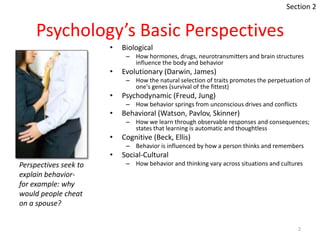
Psychology’s Basic Perspectives
2
• Biological
– How hormones, drugs, neurotransmitters and brain structures
influence the body and behavior
• Evolutionary (Darwin, James)
– How the natural selection of traits promotes the perpetuation of
one's genes (survival of the fittest)
• Psychodynamic (Freud, Jung)
– How behavior springs from unconscious drives and conflicts
• Behavioral (Watson, Pavlov, Skinner)
– How we learn through observable responses and consequences;
states that learning is automatic and thoughtless
• Cognitive (Beck, Ellis)
– Behavior is influenced by how a person thinks and remembers
• Social-Cultural
– How behavior and thinking vary across situations and culturesPerspectives seek to
explain behavior-
for example: why
would people cheat
on a spouse?
Section 2
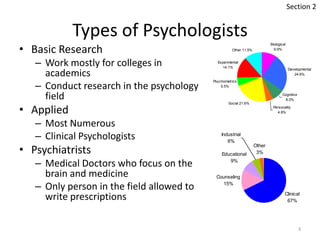
Types of Psychologists
3
• Basic Research
– Work mostly for colleges in
academics
– Conduct research in the psychology
field
• Applied
– Most Numerous
– Clinical Psychologists
• Psychiatrists
– Medical Doctors who focus on the
brain and medicine
– Only person in the field allowed to
write prescriptions
Biological
9.9%
Developmental
24.6%
Cognitive
8.0%
Personality
4.8%
Social 21.6%
Psychometrics
5.5%
Experimental
14.1%
Other 11.5%
Clinical
67%
Counseling
15%
Educational
9%
Other
3%
Industrial
6%
Section 2
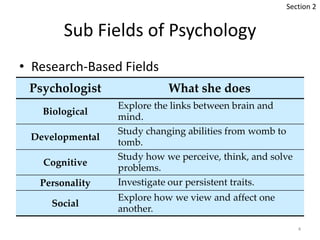
Sub Fields of Psychology
4
• Research-Based Fields
Psychologist What she does
Biological
Explore the links between brain and
mind.
Developmental
Study changing abilities from womb to
tomb.
Cognitive
Study how we perceive, think, and solve
problems.
Personality Investigate our persistent traits.
Social
Explore how we view and affect one
another.
Section 2
Sub Fields of Psychology
5
• Applied Fields
Psychologist What she does
Clinical
Studies, assesses, and treats people
with psychological disorders
Counseling
Helps people cope with academic,
vocational, and marital challenges.
Educational
Studies and helps individuals in
school and educational settings
Industrial/
Organizational
Studies and advises on behavior in
the workplace.
Section 2

Perspectives & subfields ss

  • 1.
  • 2.
    Psychology’s Basic Perspectives 2 •Biological – How hormones, drugs, neurotransmitters and brain structures influence the body and behavior • Evolutionary (Darwin, James) – How the natural selection of traits promotes the perpetuation of one's genes (survival of the fittest) • Psychodynamic (Freud, Jung) – How behavior springs from unconscious drives and conflicts • Behavioral (Watson, Pavlov, Skinner) – How we learn through observable responses and consequences; states that learning is automatic and thoughtless • Cognitive (Beck, Ellis) – Behavior is influenced by how a person thinks and remembers • Social-Cultural – How behavior and thinking vary across situations and culturesPerspectives seek to explain behavior- for example: why would people cheat on a spouse? Section 2
  • 3.
    Types of Psychologists 3 •Basic Research – Work mostly for colleges in academics – Conduct research in the psychology field • Applied – Most Numerous – Clinical Psychologists • Psychiatrists – Medical Doctors who focus on the brain and medicine – Only person in the field allowed to write prescriptions Biological 9.9% Developmental 24.6% Cognitive 8.0% Personality 4.8% Social 21.6% Psychometrics 5.5% Experimental 14.1% Other 11.5% Clinical 67% Counseling 15% Educational 9% Other 3% Industrial 6% Section 2
  • 4.
    Sub Fields ofPsychology 4 • Research-Based Fields Psychologist What she does Biological Explore the links between brain and mind. Developmental Study changing abilities from womb to tomb. Cognitive Study how we perceive, think, and solve problems. Personality Investigate our persistent traits. Social Explore how we view and affect one another. Section 2
  • 5.
    Sub Fields ofPsychology 5 • Applied Fields Psychologist What she does Clinical Studies, assesses, and treats people with psychological disorders Counseling Helps people cope with academic, vocational, and marital challenges. Educational Studies and helps individuals in school and educational settings Industrial/ Organizational Studies and advises on behavior in the workplace. Section 2