Speech and the
Communication Process
CMIbarreta
What is Communication?
• Communication is the exchange of thoughts,
messages, or information, as by speech,
signals, writing, or behavior.
• It is defined as a process by which we assign
and convey meaning in an attempt to create
shared understanding
• It was derived from the Latin word "communis",
meaning commonness.
• Communication occurs when there’s an
existence of message to be shared, person or
persons to share it, and a medium they can use
to make the sharing possible.
Is Communication IMPORTANT?
Communication is the means for expression
Communication defines survival
Communication ties communicators
Communication helps preserve a democratic way of living
Communication civilizes communicators
Communication is a vehicle toward the future
Communication raises aspirations
Communication helps meet people’s ambitions
Communication helps develop an individual, organisation,
society, nation, and country
Communications helps in arriving quick decision and
implementation
Basic Elements of Communication
Sender
First and foremost is the person who sends a message.
Known as sender in the jargons of communication, he or
she is the chief initiator of any communication. In fact a
communication may not take place if there is no sender.
The sender may be singular and plural as well. It all
depends on the nature of communication. If a teacher is
delivering lecture, it constitute a case of sender as one
individual. Sender comprising many is the case when a
group of people shout together, or more than one person
sing a song as chorus.
Basic Elements of Communication
Message
When sender – the source of communication,
decides to communicate he/she encodes the
root of the feeling in words/gestures or any
other form commonly understood. This encoded
form is called message. It may be a simple word
or a very complex and technical integration of
feelings by the source on a given subject.
Basic Elements of Communication
Channel
No sooner a message is created by a sender, it
enters in the channel. The channel is part of the
communication process which helps carry the
message to its desired destination. In case of
printed words paper is the channel, in the matter
of voice air may serve as a channel. In
telephonic conversation the wire and the sets
make the channel. Sometimes the channel itself
becomes part of message and sometime
message is sent in a manner that a part of it
serves as a channel.
Basic Elements of Communication
Receiver
The process of communication may not be
complete if the message does not reach a
person, or persons, it is designed for. Receiver
in this process is the element which is target of
the message and actually receives it. The
dimension of receiver is very wide – it may vary
from an individual to an army of people, or a
nation or all nations. Again, it depends what the
message is.
Basic Elements of Communication
Feedback
Sending and receiving of message is a simultaneous
process in which the receiver continuously sends
back its approval or disapproval after having interpreted
the message. This helps the sender to modify or
discipline its message. This element in the
communication process is referred as feedback. For
instance a person is delivering speech, the voices,
gestures and facial expressions – all part of feedback,
would help the speaker to check its loudness, smiles,
rhetoric, contents or time to speak. If there is no
feedback, the original message may never shape
accordingly which may distort the whole communication
exercise.
Basic Elements of Communication
Context
Every message is delivered and received in a
given context. Change in the background
factors denoted as context, may change the
meanings altogether. Context itself comprises
multiple factors each one of them becomes
essential when it comes to interpretation of the
original message.
FORMS OF COMMUNICATION
Human Communication
Non-Human Communication
Human Communication includes...
Nonverbal Communication
- the process of conveying meaning in the form
of non-word messages.
Verbal/ Oral Communication
- use sounds or voice expressions to convey
message.
Written Communication
This form of communication uses symbols to
convey message.
Non-Human Communication
are...
• Animal Communication through
behaviour
• Plant Communication through cellular
interaction
• Fungi Communication through growth
• Bacteria Communication (Quorum
Sensing) through changes in density
Barriers vs Noise to Communication
1. Physical Barrier VS Physical Noise
2. Physiological Barrier VS Physiological
Noise
3. Attitudinal / Psychological Barrier VS
Psychological Noise
4. Ambiguity of Words VS Semantic and
Syntactical Noise
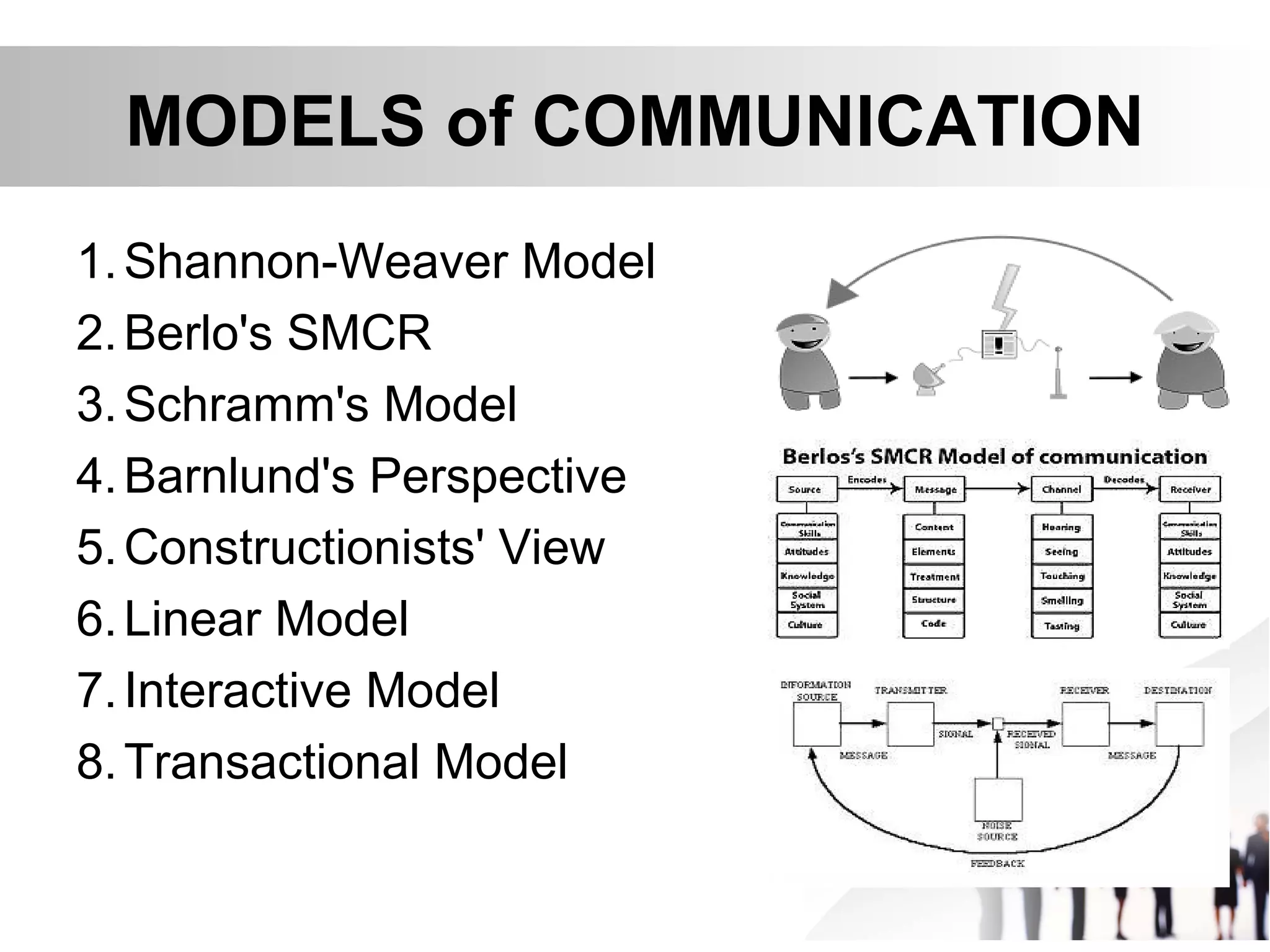
MODELS of COMMUNICATION
1.Shannon-Weaver Model
2.Berlo's SMCR
3.Schramm's Model
4.Barnlund's Perspective
5.Constructionists' View
6.Linear Model
7.Interactive Model
8.Transactional Model
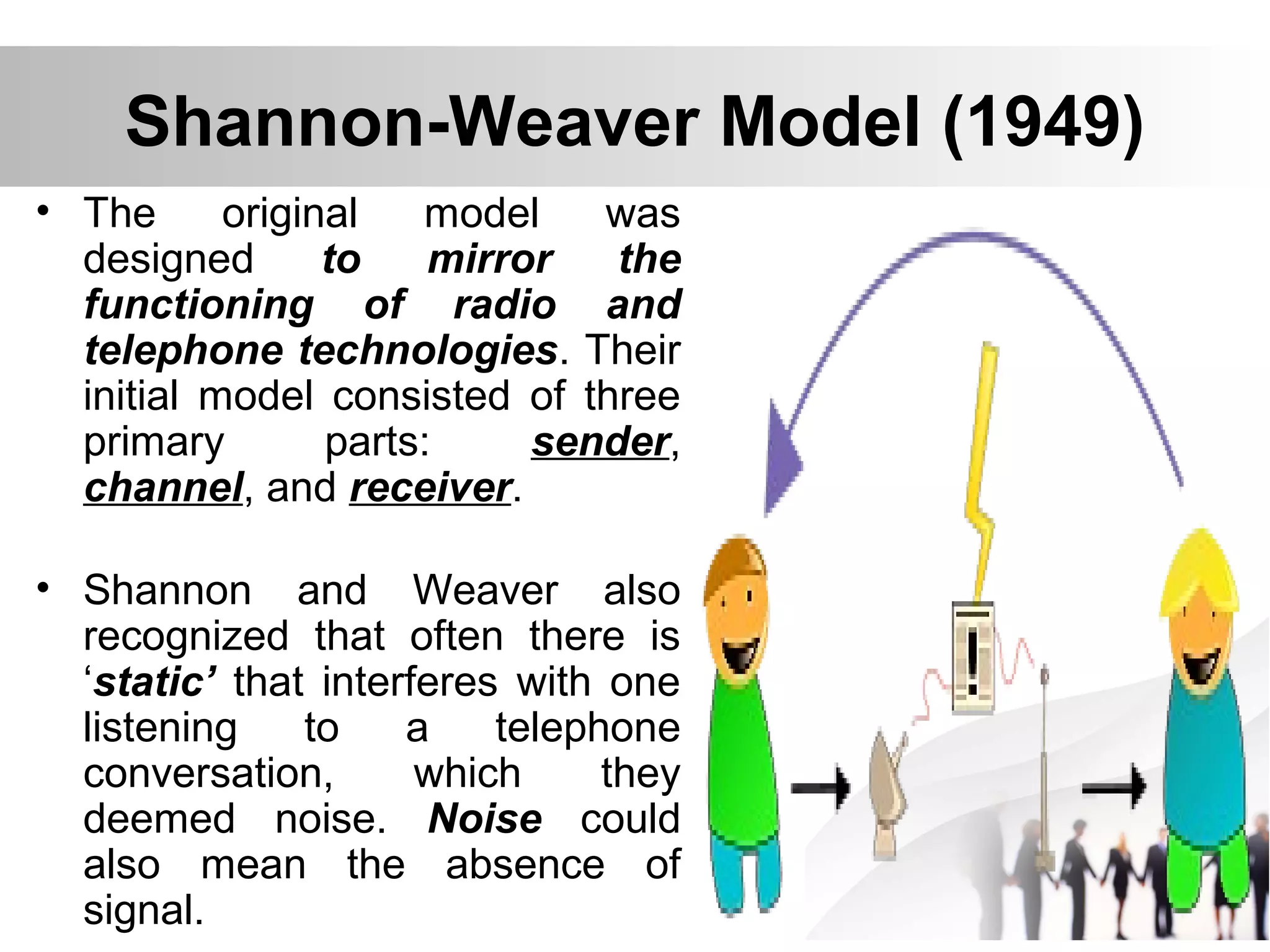
Shannon-Weaver Model (1949)
• The original model was
designed to mirror the
functioning of radio and
telephone technologies. Their
initial model consisted of three
primary parts: sender,
channel, and receiver.
• Shannon and Weaver also
recognized that often there is
‘static’ that interferes with one
listening to a telephone
conversation, which they
deemed noise. Noise could
also mean the absence of
signal.
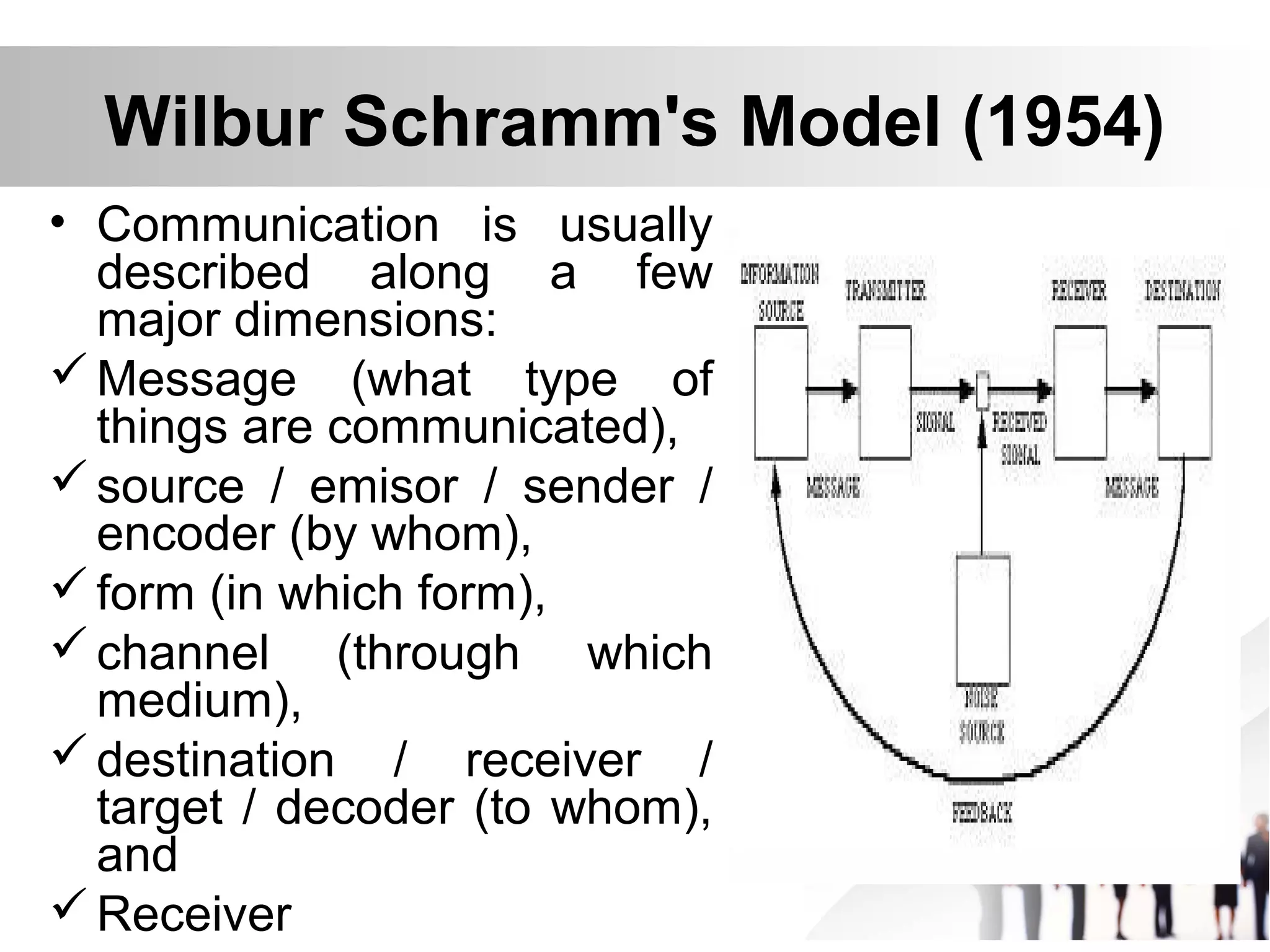
Wilbur Schramm's Model (1954)
• Communication is usually
described along a few
major dimensions:
Message (what type of
things are communicated),
source / emisor / sender /
encoder (by whom),
form (in which form),
channel (through which
medium),
destination / receiver /
target / decoder (to whom),
and
Receiver
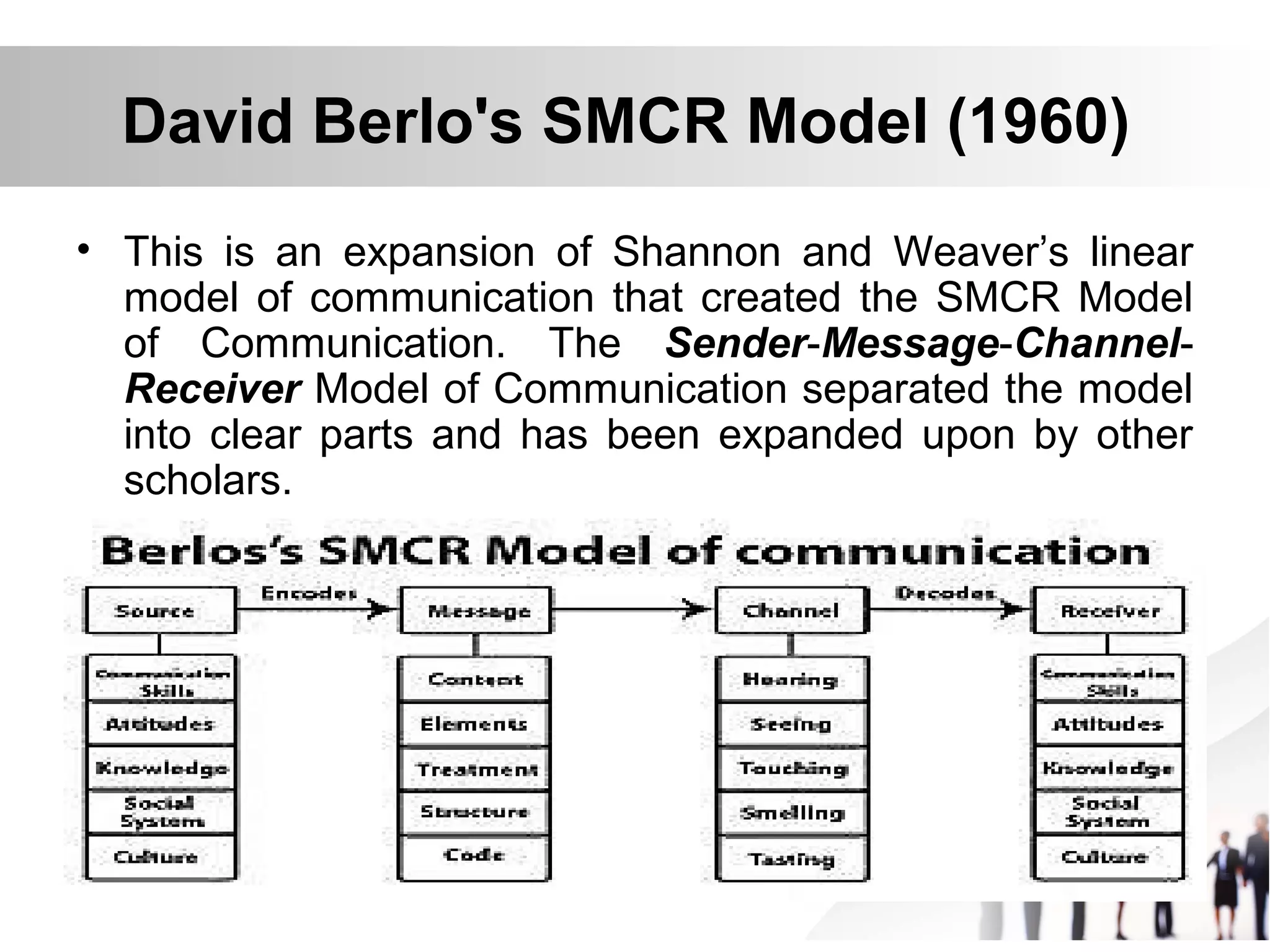
David Berlo's SMCR Model (1960)
• This is an expansion of Shannon and Weaver’s linear
model of communication that created the SMCR Model
of Communication. The Sender-Message-Channel-
Receiver Model of Communication separated the model
into clear parts and has been expanded upon by other
scholars.
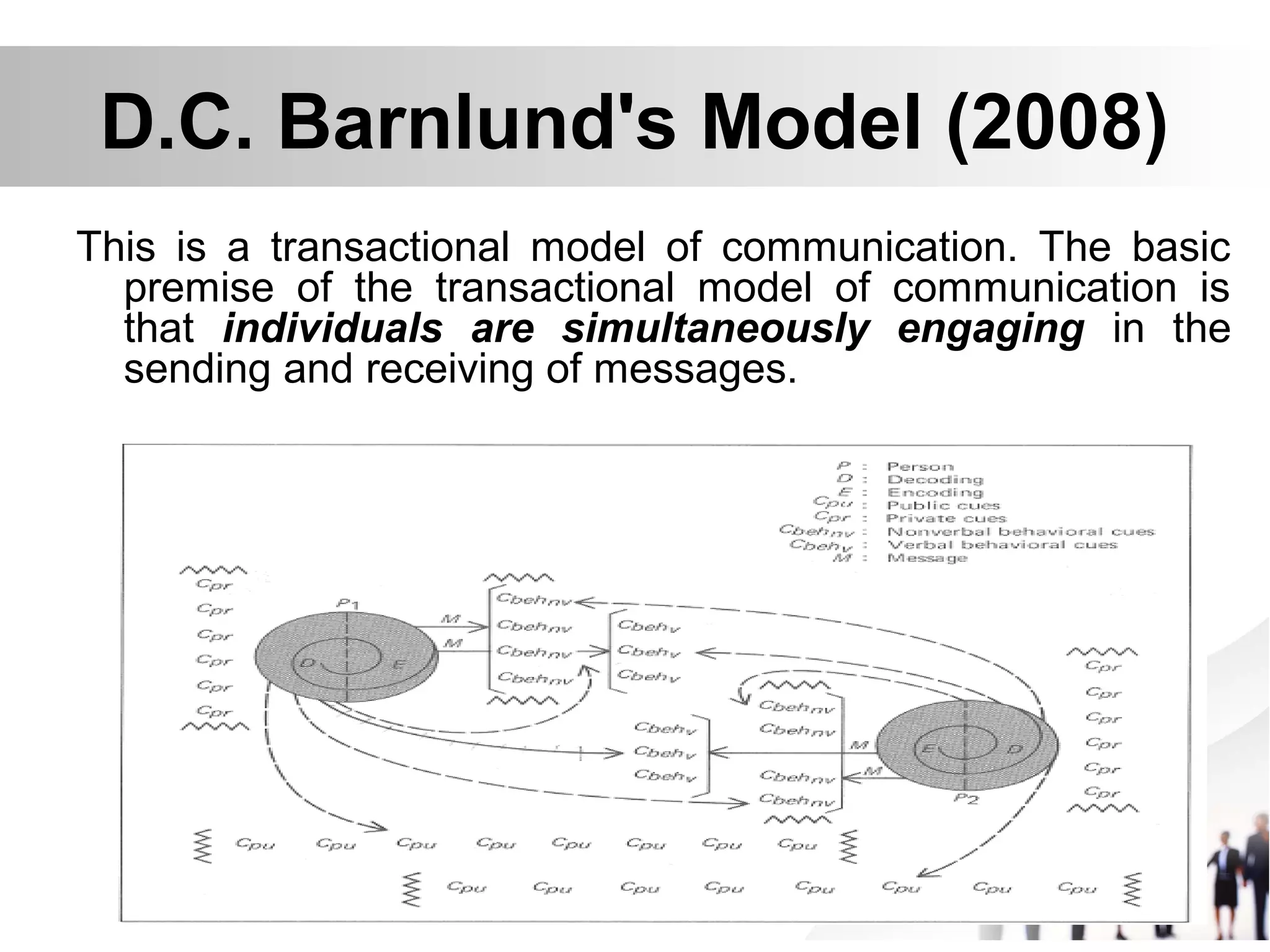
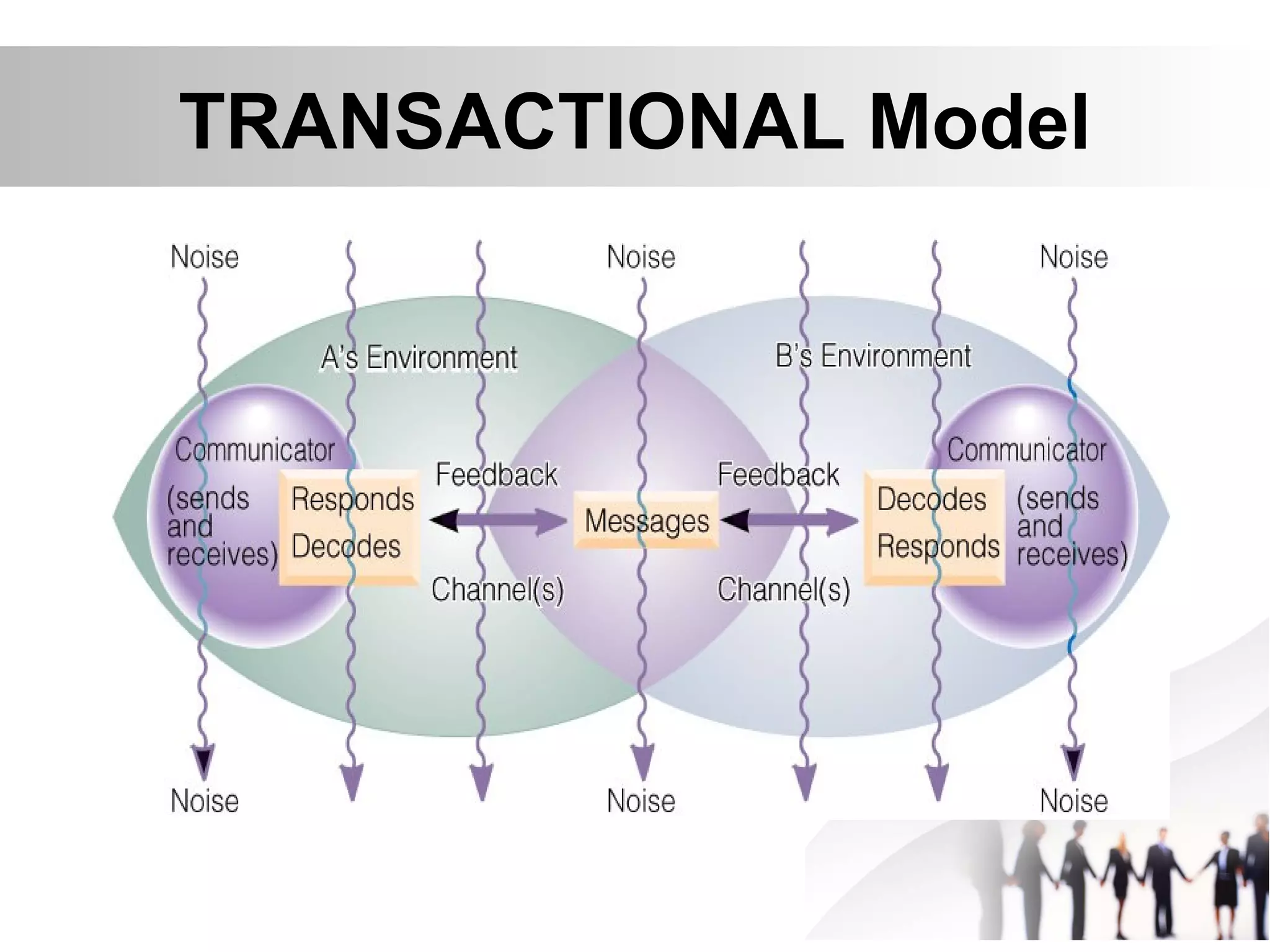
D.C. Barnlund's Model (2008)
This is a transactional model of communication. The basic
premise of the transactional model of communication is
that individuals are simultaneously engaging in the
sending and receiving of messages.
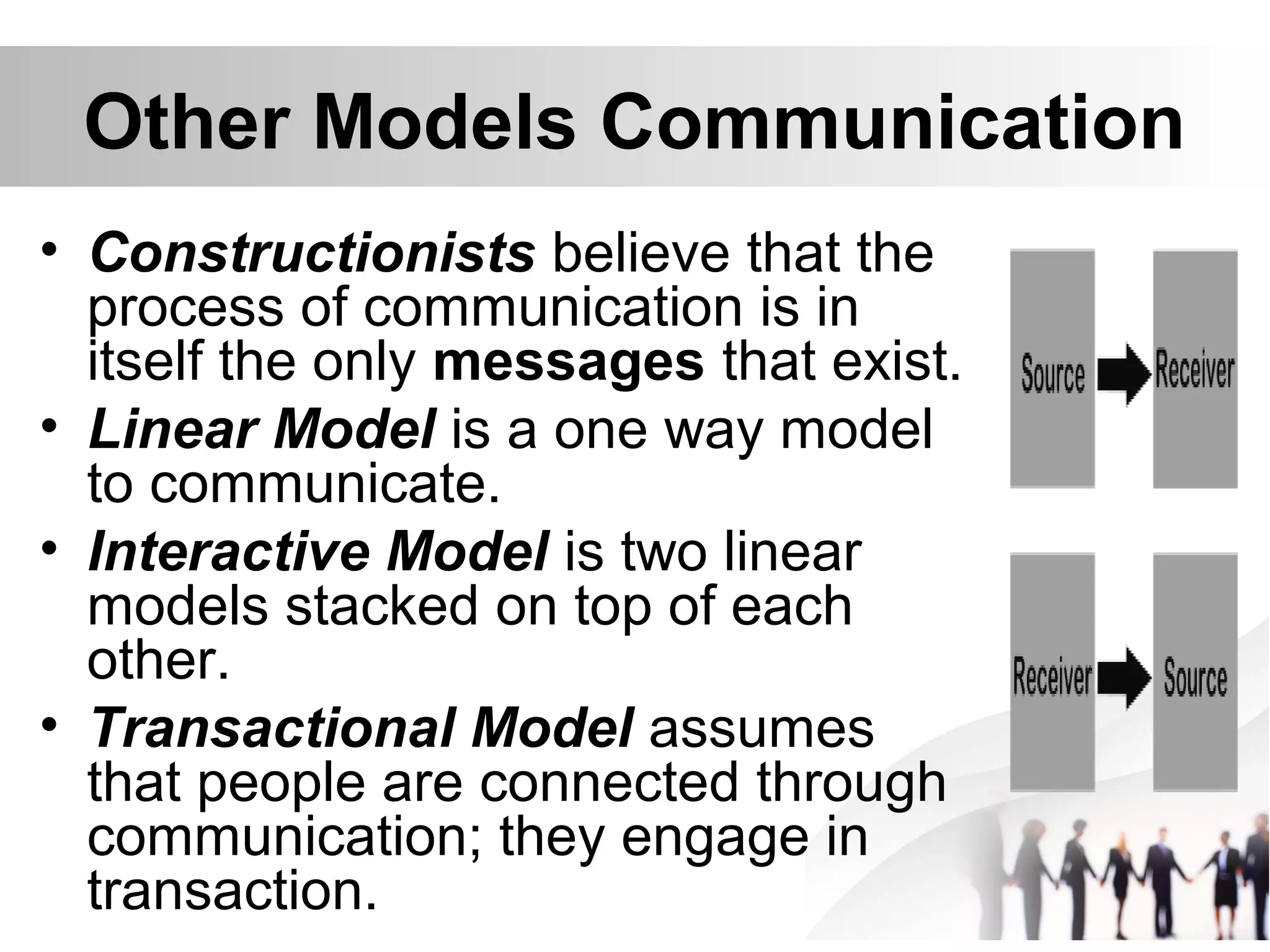
Other Models Communication
• Constructionists believe that the
process of communication is in
itself the only messages that exist.
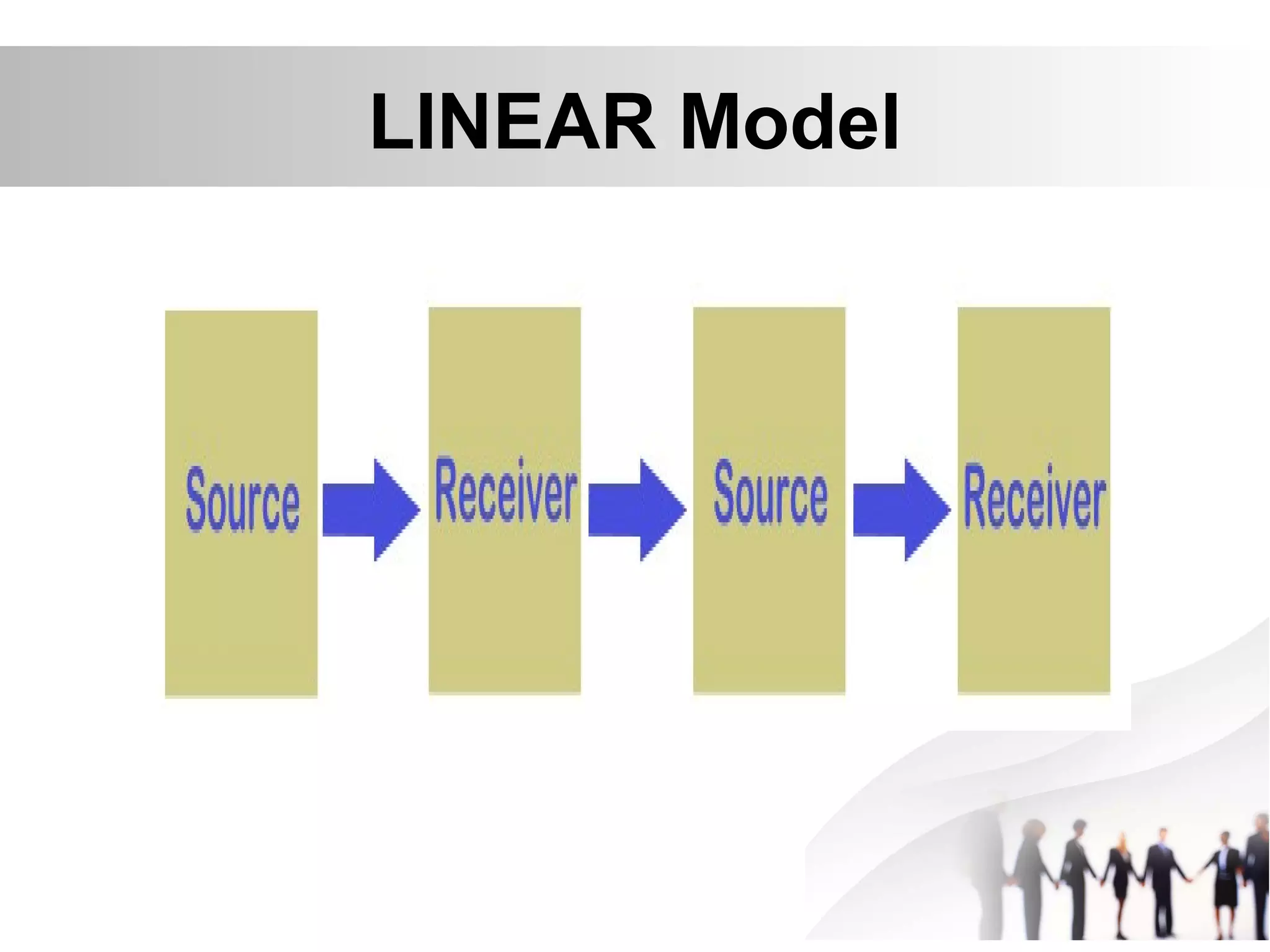
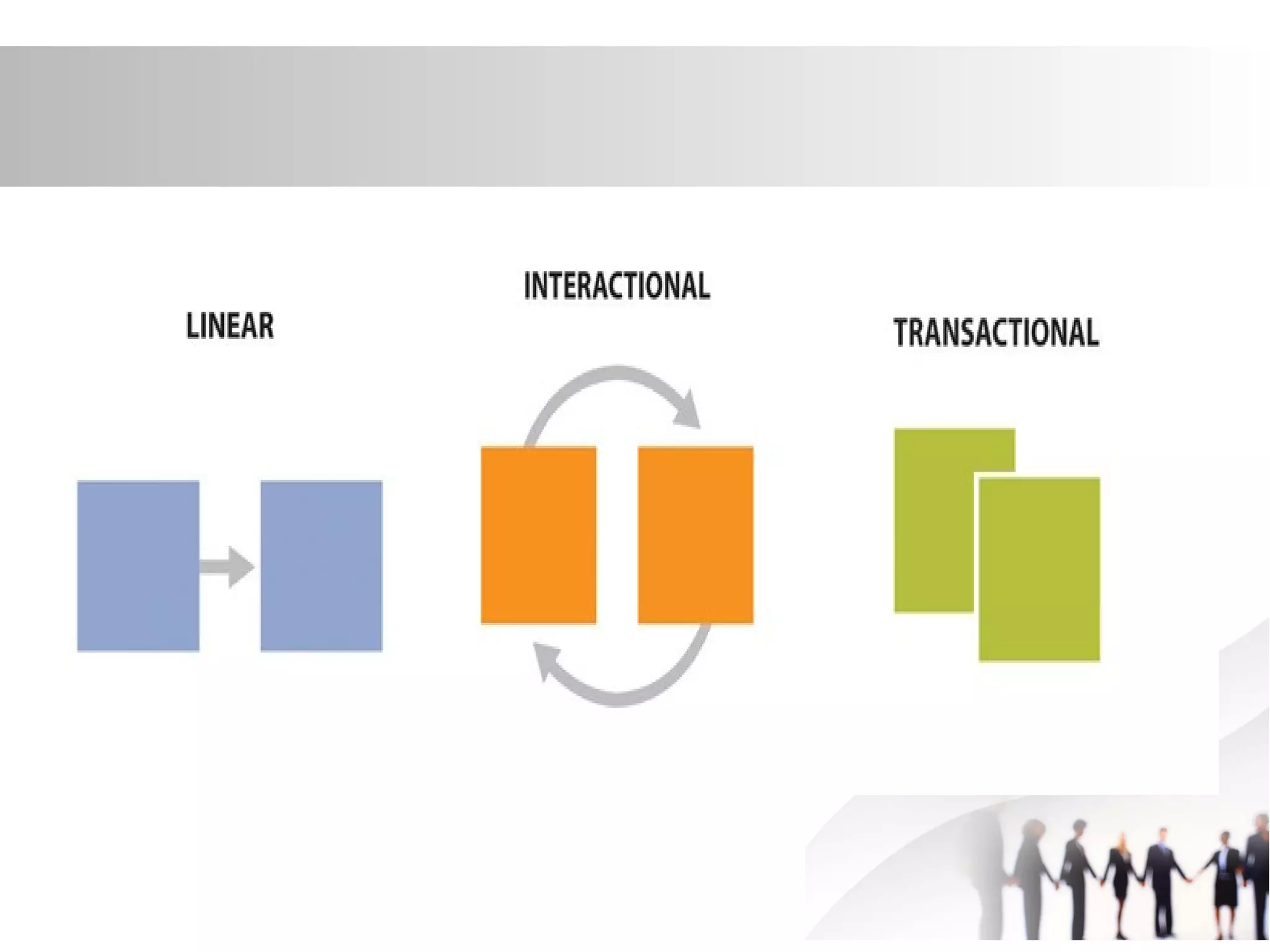
• Linear Model is a one way model
to communicate.
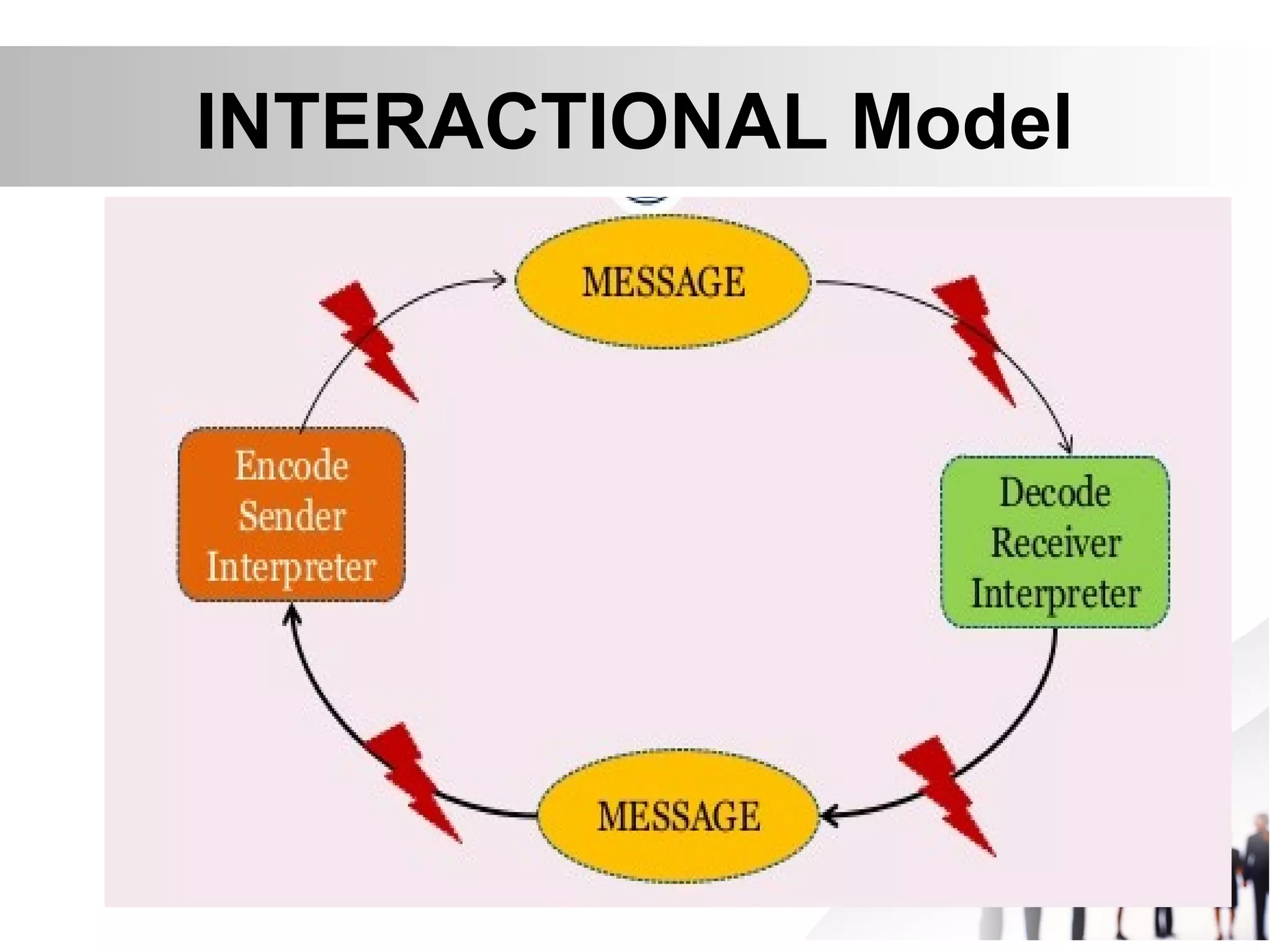
• Interactive Model is two linear
models stacked on top of each
other.
• Transactional Model assumes
that people are connected through
communication; they engage in
transaction.
LINEAR Model
INTERACTIONAL Model
TRANSACTIONAL Model
The COMMUNICATION PROCESS
1.Stimulus/stimuli- triggering event of the communication
process
2.Ideation- an idea or several ideas are formulated and
organized to answer a need to communicate
3.Encoding- the ideas, which have been organized in the
ideation stage, are put into code to make transmission
possible. To represent these ideas, symbols in the form
of sounds or words are made use of.
4.Transmission- the encoded message is sent through a
chosen appropriate channel or medium
5.Reception- the message reaches the receiver
Comm. Process cont...
6.Decoding- the codes or symbols used to
transmit messages are converted into ideas or
mental images to be interpreted by the receiver
7.Understanding- the message, which has been
transformed into thought or mental images,
having been interpreted now becomes clear to
the receiver. If he/she does not understand,
miscommunication sets in.
8. Action- the receiver responds to the message
received by sending feedback
PRINCIPLES OF COMMUNICATION
• Communication has purpose
• Communication is continuous
• Communication messages vary in conscious thought
• Communication is relational
– Once cannot be attractive without others who are attracted?
– One cannot be a leader unless others are willing to follow?
– Quality of interaction between parent and child is a two-way
street (Dainton, Stafford, 1993).
• Communication is guided by culture
• Communication has ethical implications
• Communication is learned
– After 30 minutes of instruction, participants became significantly
more effective in detecting lies (DeTurch, Miller, 1990)
Communication Competence
• Effective
when it achieves it’s goals
• Appropriate
when it conforms to the situation
What Makes a Communicator Effective?
• Speaking and expressing your thoughts and feelings in a
clear and non-defensive manner.
• Being an active listener by using both verbal (un huh)
and nonverbal skills (leaning forward)
• Being aware of your body language and what it
communicates to others.
• Learning to code-switch in different professional versus
social settings.
– Example from using African American English to Standard
American English when appropriate.
Characteristics of Competent
Communicators
• A wide range of behaviors
• Ability to choose the most appropriate
behavior
• Skill at performing behaviors
• Perspective taking
• Cognitive Complexity
• Self-Monitoring
• Commitment to the Relationship
Activity 1: Elements of Communication
1. Message
2. Sender
3. Receiver
4. Channel
5. Feedback
6. Context
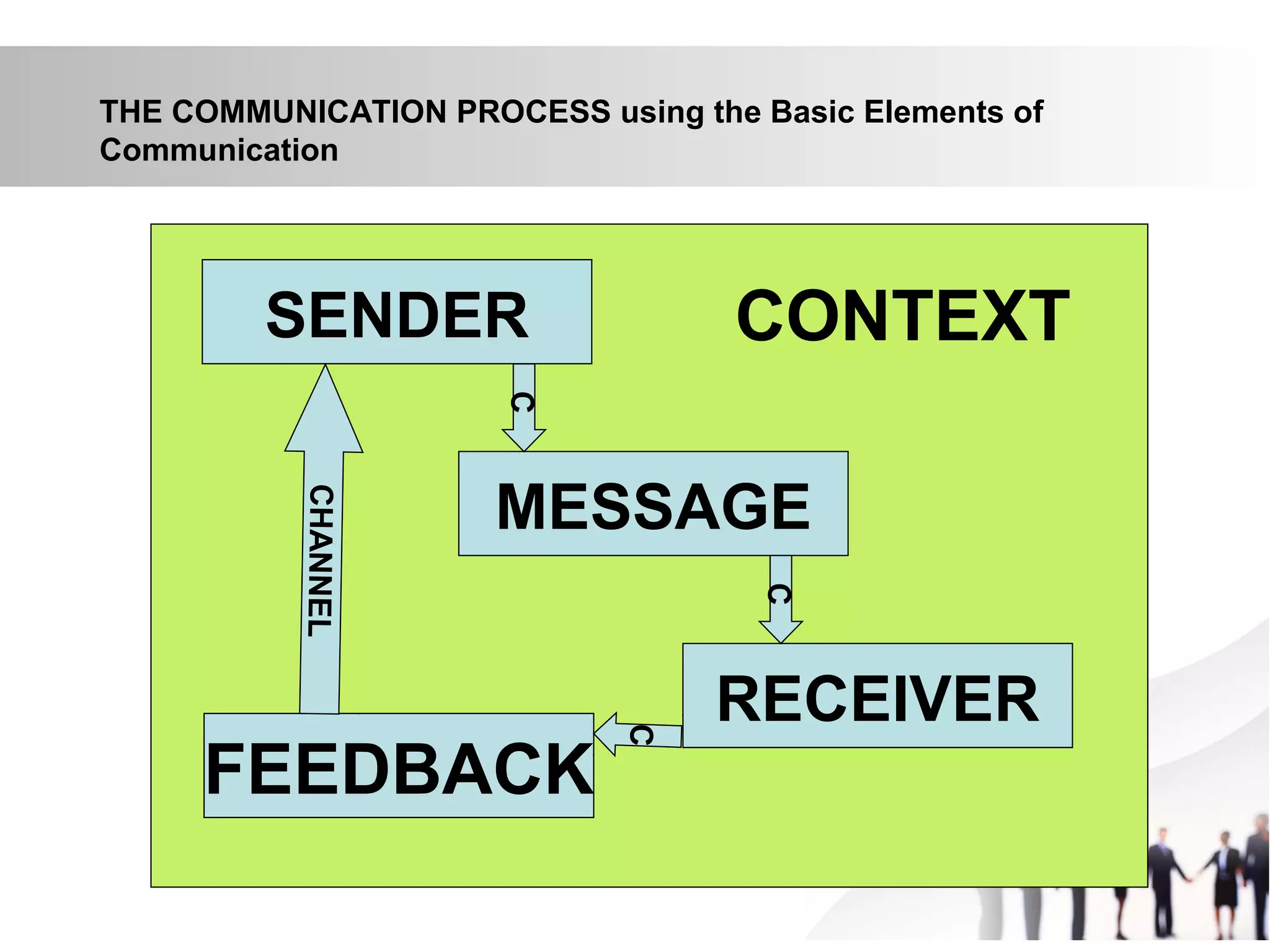
SENDER
MESSAGE
RECEIVER
FEEDBACK
C
C
C
CHANNEL
CONTEXT
THE COMMUNICATION PROCESS using the Basic Elements of
Communication

Introduction to Speech Communication

  • 1.
    Speech and the CommunicationProcess CMIbarreta
  • 2.
    What is Communication? •Communication is the exchange of thoughts, messages, or information, as by speech, signals, writing, or behavior. • It is defined as a process by which we assign and convey meaning in an attempt to create shared understanding • It was derived from the Latin word "communis", meaning commonness. • Communication occurs when there’s an existence of message to be shared, person or persons to share it, and a medium they can use to make the sharing possible.
  • 3.
    Is Communication IMPORTANT? Communicationis the means for expression Communication defines survival Communication ties communicators Communication helps preserve a democratic way of living Communication civilizes communicators Communication is a vehicle toward the future Communication raises aspirations Communication helps meet people’s ambitions Communication helps develop an individual, organisation, society, nation, and country Communications helps in arriving quick decision and implementation
  • 4.
    Basic Elements ofCommunication Sender First and foremost is the person who sends a message. Known as sender in the jargons of communication, he or she is the chief initiator of any communication. In fact a communication may not take place if there is no sender. The sender may be singular and plural as well. It all depends on the nature of communication. If a teacher is delivering lecture, it constitute a case of sender as one individual. Sender comprising many is the case when a group of people shout together, or more than one person sing a song as chorus.
  • 5.
    Basic Elements ofCommunication Message When sender – the source of communication, decides to communicate he/she encodes the root of the feeling in words/gestures or any other form commonly understood. This encoded form is called message. It may be a simple word or a very complex and technical integration of feelings by the source on a given subject.
  • 6.
    Basic Elements ofCommunication Channel No sooner a message is created by a sender, it enters in the channel. The channel is part of the communication process which helps carry the message to its desired destination. In case of printed words paper is the channel, in the matter of voice air may serve as a channel. In telephonic conversation the wire and the sets make the channel. Sometimes the channel itself becomes part of message and sometime message is sent in a manner that a part of it serves as a channel.
  • 7.
    Basic Elements ofCommunication Receiver The process of communication may not be complete if the message does not reach a person, or persons, it is designed for. Receiver in this process is the element which is target of the message and actually receives it. The dimension of receiver is very wide – it may vary from an individual to an army of people, or a nation or all nations. Again, it depends what the message is.
  • 8.
    Basic Elements ofCommunication Feedback Sending and receiving of message is a simultaneous process in which the receiver continuously sends back its approval or disapproval after having interpreted the message. This helps the sender to modify or discipline its message. This element in the communication process is referred as feedback. For instance a person is delivering speech, the voices, gestures and facial expressions – all part of feedback, would help the speaker to check its loudness, smiles, rhetoric, contents or time to speak. If there is no feedback, the original message may never shape accordingly which may distort the whole communication exercise.
  • 9.
    Basic Elements ofCommunication Context Every message is delivered and received in a given context. Change in the background factors denoted as context, may change the meanings altogether. Context itself comprises multiple factors each one of them becomes essential when it comes to interpretation of the original message.
  • 10.
    FORMS OF COMMUNICATION HumanCommunication Non-Human Communication
  • 11.
    Human Communication includes... NonverbalCommunication - the process of conveying meaning in the form of non-word messages. Verbal/ Oral Communication - use sounds or voice expressions to convey message. Written Communication This form of communication uses symbols to convey message.
  • 12.
    Non-Human Communication are... • AnimalCommunication through behaviour • Plant Communication through cellular interaction • Fungi Communication through growth • Bacteria Communication (Quorum Sensing) through changes in density
  • 13.
    Barriers vs Noiseto Communication 1. Physical Barrier VS Physical Noise 2. Physiological Barrier VS Physiological Noise 3. Attitudinal / Psychological Barrier VS Psychological Noise 4. Ambiguity of Words VS Semantic and Syntactical Noise
  • 14.
    MODELS of COMMUNICATION 1.Shannon-WeaverModel 2.Berlo's SMCR 3.Schramm's Model 4.Barnlund's Perspective 5.Constructionists' View 6.Linear Model 7.Interactive Model 8.Transactional Model
  • 15.
    Shannon-Weaver Model (1949) •The original model was designed to mirror the functioning of radio and telephone technologies. Their initial model consisted of three primary parts: sender, channel, and receiver. • Shannon and Weaver also recognized that often there is ‘static’ that interferes with one listening to a telephone conversation, which they deemed noise. Noise could also mean the absence of signal.
  • 16.
    Wilbur Schramm's Model(1954) • Communication is usually described along a few major dimensions: Message (what type of things are communicated), source / emisor / sender / encoder (by whom), form (in which form), channel (through which medium), destination / receiver / target / decoder (to whom), and Receiver
  • 17.
    David Berlo's SMCRModel (1960) • This is an expansion of Shannon and Weaver’s linear model of communication that created the SMCR Model of Communication. The Sender-Message-Channel- Receiver Model of Communication separated the model into clear parts and has been expanded upon by other scholars.
  • 18.
    D.C. Barnlund's Model(2008) This is a transactional model of communication. The basic premise of the transactional model of communication is that individuals are simultaneously engaging in the sending and receiving of messages.
  • 19.
    Other Models Communication •Constructionists believe that the process of communication is in itself the only messages that exist. • Linear Model is a one way model to communicate. • Interactive Model is two linear models stacked on top of each other. • Transactional Model assumes that people are connected through communication; they engage in transaction.
  • 20.
  • 21.
  • 22.
  • 24.
    The COMMUNICATION PROCESS 1.Stimulus/stimuli-triggering event of the communication process 2.Ideation- an idea or several ideas are formulated and organized to answer a need to communicate 3.Encoding- the ideas, which have been organized in the ideation stage, are put into code to make transmission possible. To represent these ideas, symbols in the form of sounds or words are made use of. 4.Transmission- the encoded message is sent through a chosen appropriate channel or medium 5.Reception- the message reaches the receiver
  • 25.
    Comm. Process cont... 6.Decoding-the codes or symbols used to transmit messages are converted into ideas or mental images to be interpreted by the receiver 7.Understanding- the message, which has been transformed into thought or mental images, having been interpreted now becomes clear to the receiver. If he/she does not understand, miscommunication sets in. 8. Action- the receiver responds to the message received by sending feedback
  • 26.
    PRINCIPLES OF COMMUNICATION •Communication has purpose • Communication is continuous • Communication messages vary in conscious thought • Communication is relational – Once cannot be attractive without others who are attracted? – One cannot be a leader unless others are willing to follow? – Quality of interaction between parent and child is a two-way street (Dainton, Stafford, 1993). • Communication is guided by culture • Communication has ethical implications • Communication is learned – After 30 minutes of instruction, participants became significantly more effective in detecting lies (DeTurch, Miller, 1990)
  • 27.
    Communication Competence • Effective whenit achieves it’s goals • Appropriate when it conforms to the situation
  • 28.
    What Makes aCommunicator Effective? • Speaking and expressing your thoughts and feelings in a clear and non-defensive manner. • Being an active listener by using both verbal (un huh) and nonverbal skills (leaning forward) • Being aware of your body language and what it communicates to others. • Learning to code-switch in different professional versus social settings. – Example from using African American English to Standard American English when appropriate.
  • 29.
    Characteristics of Competent Communicators •A wide range of behaviors • Ability to choose the most appropriate behavior • Skill at performing behaviors • Perspective taking • Cognitive Complexity • Self-Monitoring • Commitment to the Relationship
  • 30.
    Activity 1: Elementsof Communication 1. Message 2. Sender 3. Receiver 4. Channel 5. Feedback 6. Context
  • 31.