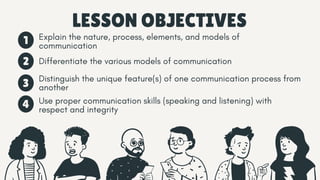
LESSON OBJECTIVES
Explain thenature, process, elements, and models of
communication
Differentiate the various models of communication
1
2
3 Distinguish the unique feature(s) of one communication process from
another
4 Use proper communication skills (speaking and listening) with
respect and integrity
3.
LET'S SHARE!
What isthe one thing you
like about communicating
with other people?
– the term“language” can be used to refer
to a variety of concepts such as the “particular
form of words and speech used by the people
of a country, area, or social group” or “the
method of human communication using
spoken or written words.”
LANGUAGE
6.
Language is oftenviewed as a vehicle of
thought, a system of expression that mediates
the transfer of thought from one person to
another.
Language is often defined as an arbitrary
vocal system used by humans to communicate
with one another. But it should be noted that
language is more than communication.
LANGUAGE
7.
• Most effectivemedium of communication.
• Transmits messages between and among
people.
• Exists as a tool used in expressing ideas and
feelings to achieve understanding.
LANGUAGE
exchange of thoughts,ideas, concepts,
emotions between and among humans
COMMUNICATION
COMMUN
ICATION
something in common
understanding
(Chase & Shamo, 2013)
10.
pertains to achievingcommon understanding
of something
COMMUNICATION
the process of sending and receiving
messages through verbal or nonverbal means,
including oral communication; writing and
graphical representations; signs, signals, or
behavior
(Nordquist, 2018)
11.
COMMUNICATION
• The transmissionof ideas and emotions
between or among persons with the use of
verbal and non- verbal cues.
• Broad term for the two-way dynamic process
of message transmission.
• Embraces both the verbal and the non-verbal
aspects.
12.
TYPES OF COMMUNICATION
VERBALCOMMUNICATION NON-VERBAL COMMUNICATION
Makes use of words in the
process of sending and
receiving messages.
Written and Oral
Commmunication.
Sending and receiving
messages without the use of
words.
Facial expressions and body
movements.
Communication is anyprocess in which people, through the use of symbols,
verbally and/or nonverbally, consciously or not consciously, intentionally or
unintentionally, generate meanings (information, ideas, feelings, and
perceptions) within and across various contexts, Cultures, channels, and media.
(Hybels & Weaver II, 2009).
Communication is a systematic process in which people interact with and
through symbols to create and interpret meanings. (Wood, 2009).
Communication is a process by which verbal and nonverbal symbols are sent,
received, and give meaning. (Seiler, 1988).
Communication is “the act or process of using words, sounds, signs, or behaviors
to express or exchange information or for expressing your ideas, thoughts,
feelings, etc., to someone else.” It is “the exchange of thoughts, messages, or
information, as by speech, signals, writing, or behavior.” (Merriam Webster, 1898)
COMMUNICATION
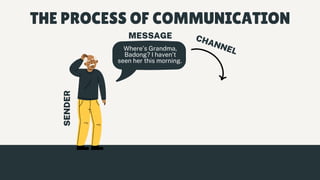
SENDER
is the speakeror the
communicator who has
his/her own purpose,
knowledge, interests,
attitudes, skills, and credibility.
Also called the (encoder,
source, or speaker)
17.
MESSAGE
is the ideabeing transmitted
by the sender to the listener. It
includes the three (3) aspects
of content, structure, and
style.
18.
CHANNEL
is the mediumor vehicle
through which the message is
sent. It may be verbal or
visual. The latter is often
supplemented with the
pictorial and aural channels.
19.
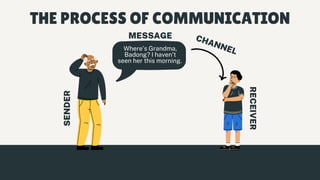
RECEIVER
is the targetof the
communication. S/He is the
destination of the message, the
listener, with his/her own purposes,
knowledge and interest levels,
attitudes, and listening skills.
(decoder, destination, or
listener)
20.
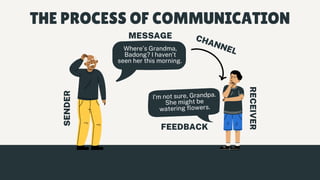
FEEDBACK
is the reactiongiven by the
listener to the sender of the
message. It is what completes
the communication process.
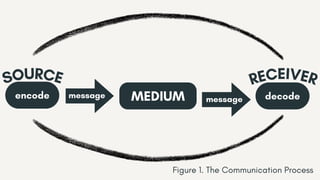
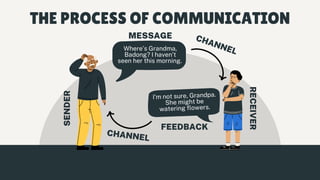
THE COMMUNICATION PROCESS
Accordingto Menoy (2010), communication is a
process, and, as such, it comes in stages. It starts with
the encoding and ends with the decoding. The
encoder is more popularly known as the sender of the
message. They transmit the message (for example, an
idea) to the receiver, a more popular term for the
decoder of the message.
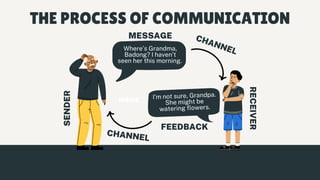
23.
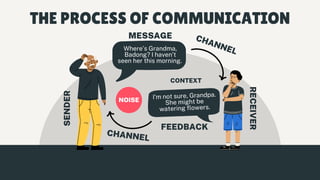
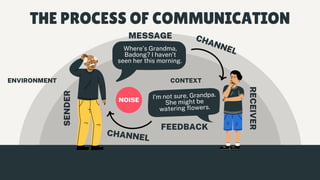
THE COMMUNICATION PROCESS
Therecipient tries to understand the message, and if
they do, communication takes place. They may then
give their feedback. If there is a continuous exchange
of messages between the sender and the receiver,
particularly in an oral discourse, communication takes
the form of a cycle. (See Figure 1.)
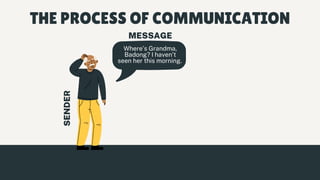
Where’s Grandma,
Badong? Ihaven’t
seen her this morning.
SENDER
MESSAGE CHANNEL
THE PROCESS OF COMMUNICATION
28.
Where’s Grandma,
Badong? Ihaven’t
seen her this morning.
SENDER
MESSAGE CHANNEL
RECEIVER
THE PROCESS OF COMMUNICATION
29.
Where’s Grandma,
Badong? Ihaven’t
seen her this morning.
I’m not sure, Grandpa.
She might be
watering flowers.
SENDER
MESSAGE CHANNEL
RECEIVER
FEEDBACK
THE PROCESS OF COMMUNICATION
30.
Where’s Grandma,
Badong? Ihaven’t
seen her this morning.
I’m not sure, Grandpa.
She might be
watering flowers.
SENDER
MESSAGE CHANNEL
RECEIVER
FEEDBACK
CHANNEL
NOISE
THE PROCESS OF COMMUNICATION
31.
Where’s Grandma,
Badong? Ihaven’t
seen her this morning.
I’m not sure, Grandpa.
She might be
watering flowers.
SENDER
MESSAGE CHANNEL
RECEIVER
FEEDBACK
CHANNEL
THE PROCESS OF COMMUNICATION
32.
Where’s Grandma,
Badong? Ihaven’t
seen her this morning.
I’m not sure, Grandpa.
She might be
watering flowers.
SENDER
MESSAGE CHANNEL
RECEIVER
FEEDBACK
CHANNEL
NOISE
CONTEXT
THE PROCESS OF COMMUNICATION
33.
Where’s Grandma,
Badong? Ihaven’t
seen her this morning.
I’m not sure, Grandpa.
She might be
watering flowers.
SENDER
MESSAGE CHANNEL
RECEIVER
FEEDBACK
CHANNEL
NOISE
CONTEXT
ENVIRONMENT
THE PROCESS OF COMMUNICATION
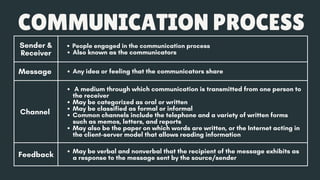
34.
Sender &
Receiver
People engagedin the communication process
Also known as the communicators
Message Any idea or feeling that the communicators share
Channel
A medium through which communication is transmitted from one person to
the receiver
May be categorized as oral or written
May be classified as formal or informal
Common channels include the telephone and a variety of written forms
such as memos, letters, and reports
May also be the paper on which words are written, or the Internet acting in
the client–server model that allows reading information
Feedback May be verbal and nonverbal that the recipient of the message exhibits as
a response to the message sent by the source/sender
COMMUNICATION PROCESS
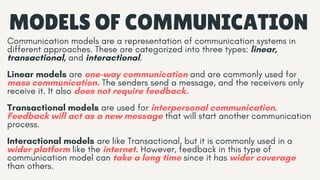
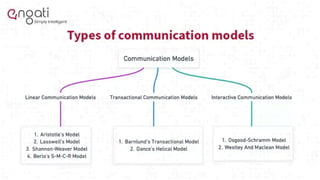
Communication models area representation of communication systems in
different approaches. These are categorized into three types: linear,
transactional, and interactional.
Linear models are one-way communication and are commonly used for
mass communication. The senders send a message, and the receivers only
receive it. It also does not require feedback.
Transactional models are used for interpersonal communication.
Feedback will act as a new message that will start another communication
process.
Interactional models are like Transactional, but it is commonly used in a
wider platform like the internet. However, feedback in this type of
communication model can take a long time since it has wider coverage
than others.
MODELS OF COMMUNICATION
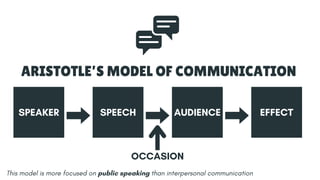
OCCASION
SPEAKER SPEECH AUDIENCEEFFECT
ARISTOTLE’S MODEL OF COMMUNICATION
This model is more focused on public speaking than interpersonal communication
40.
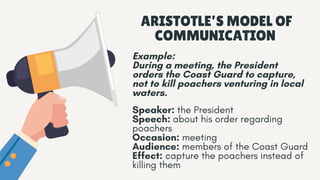
ARISTOTLE’S MODEL OF
COMMUNICATION
Example:
Duringa meeting, the President
orders the Coast Guard to capture,
not to kill poachers venturing in local
waters.
Speaker: the President
Speech: about his order regarding
poachers
Occasion: meeting
Audience: members of the Coast Guard
Effect: capture the poachers instead of
killing them
41.
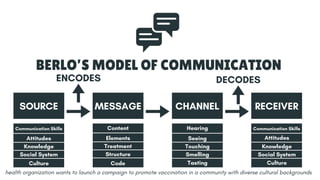
ENCODES DECODES
SOURCE MESSAGECHANNEL RECEIVER
BERLO’S MODEL OF COMMUNICATION
Communication Skills
Attitudes
Knowledge
Social System
Culture
Content
Elements
Treatment
Structure
Code
Hearing
Seeing
Touching
Smelling
Tasting
Communication Skills
Attitudes
Knowledge
Social System
Culture
health organization wants to launch a campaign to promote vaccination in a community with diverse cultural backgrounds
42.
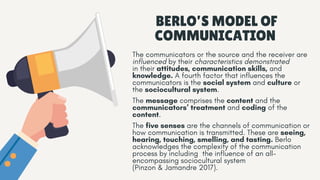
BERLO’S MODEL OF
COMMUNICATION
Thecommunicators or the source and the receiver are
influenced by their characteristics demonstrated
in their attitudes, communication skills, and
knowledge. A fourth factor that influences the
communicators is the social system and culture or
the sociocultural system.
The message comprises the content and the
communicators’ treatment and coding of the
content.
The five senses are the channels of communication or
how communication is transmitted. These are seeing,
hearing, touching, smelling, and tasting. Berlo
acknowledges the complexity of the communication
process by including the influence of an all-
encompassing sociocultural system
(Pinzon & Jamandre 2017).
43.
BERLO’S MODEL OF
COMMUNICATION
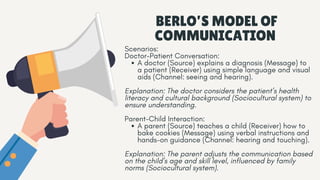
Scenarios:
Doctor-PatientConversation:
A doctor (Source) explains a diagnosis (Message) to
a patient (Receiver) using simple language and visual
aids (Channel: seeing and hearing).
Explanation: The doctor considers the patient’s health
literacy and cultural background (Sociocultural system) to
ensure understanding.
Parent-Child Interaction:
A parent (Source) teaches a child (Receiver) how to
bake cookies (Message) using verbal instructions and
hands-on guidance (Channel: hearing and touching).
Explanation: The parent adjusts the communication based
on the child’s age and skill level, influenced by family
norms (Sociocultural system).
44.
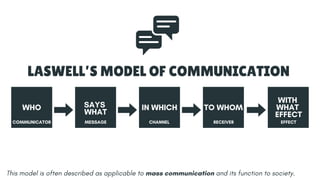
WHO SAYS
WHAT
IN WHICHTO WHOM
LASWELL’S MODEL OF COMMUNICATION
WITH
WHAT
EFFECT
COMMUNICATOR MESSAGE CHANNEL RECEIVER EFFECT
This model is often described as applicable to mass communication and its function to society.
45.
LASWELL’S MODEL OF
COMMUNICATION
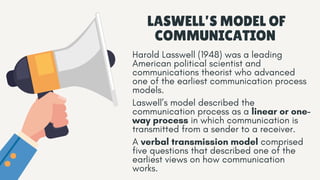
HaroldLasswell (1948) was a leading
American political scientist and
communications theorist who advanced
one of the earliest communication process
models.
Laswell’s model described the
communication process as a linear or one-
way process in which communication is
transmitted from a sender to a receiver.
A verbal transmission model comprised
five questions that described one of the
earliest views on how communication
works.
46.
LASWELL’S MODEL OF
COMMUNICATION
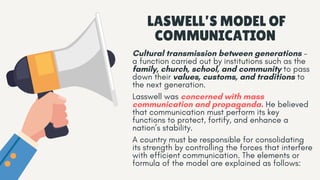
Culturaltransmission between generations –
a function carried out by institutions such as the
family, church, school, and community to pass
down their values, customs, and traditions to
the next generation.
Lasswell was concerned with mass
communication and propaganda. He believed
that communication must perform its key
functions to protect, fortify, and enhance a
nation’s stability.
A country must be responsible for consolidating
its strength by controlling the forces that interfere
with efficient communication. The elements or
formula of the model are explained as follows:
47.
LASWELL’S MODEL OF
COMMUNICATION
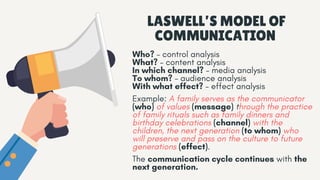
Who?– control analysis
What? – content analysis
In which channel? – media analysis
To whom? – audience analysis
With what effect? – effect analysis
Example: A family serves as the communicator
(who) of values (message) through the practice
of family rituals such as family dinners and
birthday celebrations (channel) with the
children, the next generation (to whom) who
will preserve and pass on the culture to future
generations (effect).
The communication cycle continues with the
next generation.
48.
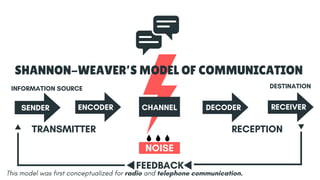
SENDER ENCODER CHANNELDECODER
SHANNON-WEAVER’S MODEL OF COMMUNICATION
RECEIVER
TRANSMITTER RECEPTION
FEEDBACK
NOISE
INFORMATION SOURCE DESTINATION
This model was first conceptualized for radio and telephone communication.
49.
SHANNON-WEAVER’S MODEL
OF COMMUNICATION
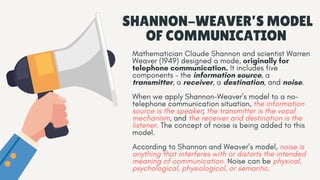
MathematicianClaude Shannon and scientist Warren
Weaver (1949) designed a mode, originally for
telephone communication. It includes five
components – the information source, a
transmitter, a receiver, a destination, and noise.
When we apply Shannon-Weaver’s model to a no-
telephone communication situation, the information
source is the speaker; the transmitter is the vocal
mechanism, and the receiver and destination is the
listener. The concept of noise is being added to this
model.
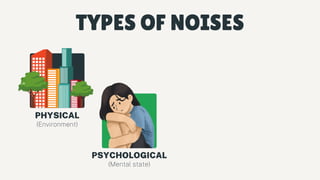
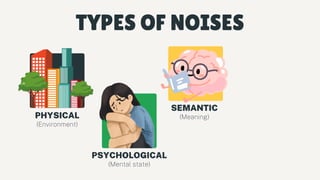
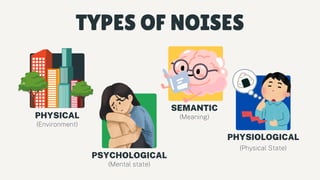
According to Shannon and Weaver’s model, noise is
anything that interferes with or distorts the intended
meaning of communication. Noise can be physical,
psychological, physiological, or semantic.
ENCODER
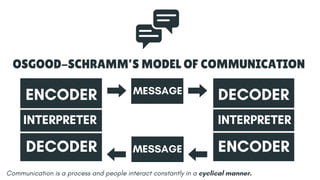
OSGOOD-SCHRAMM’S MODEL OFCOMMUNICATION
MESSAGE
MESSAGE
INTERPRETER
DECODER
DECODER
INTERPRETER
ENCODER
Communication is a process and people interact constantly in a cyclical manner.
56.
OSGOOD-SCHRAMM’S
MODEL OF COMMUNICATION
WilburSchramm was a scholar and authority on the
mass communication model, which was the
interactive model which shows the concept of
process and interaction in communication. The source
is the speaker who encodes the message. The
destination is the receiver, which decodes the
message.
Schramm’s first model highlights the importance of
overlap in the communicators’ field of experience
so that communication may occur.
The common field of experience illustrates
communicators' shared meanings, without which
communication is impossible. Conversely, the
common field of experience size determines the
breadth and depth of communication between
communicators.
57.
OSGOOD-SCHRAMM’S
MODEL OF COMMUNICATION
Schramm’ssecond model depicts the
dual roles of communicators where they
can be both senders or encoders and
receivers or decoders.
They are also interpreters in the process
as they assign meaning to the message.
The model also illustrates the circular
sequential process in which one person
interacts with another, sending
feedback to the first person.
58.
OSGOOD-SCHRAMM’S
MODEL OF COMMUNICATION
Scenarios:
Twofriends text about meeting up. One
suggests a time, and the other replies with a
confirmation.
A teacher asks a student a question, and the
student answers. The teacher then provides
feedback.
A customer asks about a product return, and the
representative provides the return instructions.
Team members discuss project ideas, with each
person responding to and building on others’
suggestions.
Siblings text about dinner plans, one suggests
pizza, and the other prefers sushi. They settle on
a choice together.
QUALITIES OF ANEFFECTIVE
COMMUNICATOR
Credible
Comprehensive
Consistent
Correct
61.
REFERENCES:
Menoy, J. Z.(2010). Oral communication and public speaking. Mandaluyong City, Manila.
Books Atbp. Publishing Corp.
Businesstopia. 2022. Models of Communication - Businesstopia. [online] Available at:
<https://www.businesstopia.net/communication> [Accessed 15 February 2022].
Effective communication. (n.d.). In HelpGuide.org.
http://www.helpguide.org/articles/relationships/effective communication.htm last
February 20, 2015
Kobiruzzaman, A. M. M. (2022, February 11). Models of communication, 3 types of
communication models linear. Models of Communication, 3 Types of Communication
Models Linear. Retrieved February 18, 2022, from https://newsmoor.com/3-types-of-
communication-models-linear-interactive-transactional/
Pinzon, M. J. L. (2017). Nature and Elements of Communication. In N. K. F. Jamandre (Ed.),
Power Speak: Oral Communication in Context (pp. 9–10). essay, ABIVA Publishing House,
INC.
![REFERENCES:
Menoy, J. Z. (2010). Oral communication and public speaking. Mandaluyong City, Manila.
Books Atbp. Publishing Corp.
Businesstopia. 2022. Models of Communication - Businesstopia. [online] Available at:
<https://www.businesstopia.net/communication> [Accessed 15 February 2022].
Effective communication. (n.d.). In HelpGuide.org.
http://www.helpguide.org/articles/relationships/effective communication.htm last
February 20, 2015
Kobiruzzaman, A. M. M. (2022, February 11). Models of communication, 3 types of
communication models linear. Models of Communication, 3 Types of Communication
Models Linear. Retrieved February 18, 2022, from https://newsmoor.com/3-types-of-
communication-models-linear-interactive-transactional/
Pinzon, M. J. L. (2017). Nature and Elements of Communication. In N. K. F. Jamandre (Ed.),
Power Speak: Oral Communication in Context (pp. 9–10). essay, ABIVA Publishing House,
INC.](https://image.slidesharecdn.com/ppt1-theprocessandelementsofcommunication-250914142231-c8368699/85/PPT1-The-Process-and-Elements-of-Communication-61-320.jpg)