The Speech Communication
         Process
  The Critical Components
The Objective

   To demonstrate the process of
   speech communication by
   studying its critical components.
“Communicating is universal.”
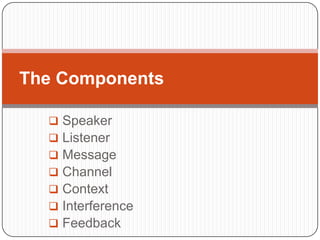
The Components

   Speaker
   Listener
   Message
   Channel
   Context
   Interference
   Feedback
The Speaker

    The speaker is simply the
   person who is delivering, or
   presenting the speech.
The Listener

    The listener is the person
   or persons who have
   assembled to hear the oral
   message.
The Message

   The message is what the
  speaker is discussing or
  the ideas that s/he is
  presenting to you as s/he
  covers a particular topic.
The Context

    The background of
   speech communication. It
   depends on the physical
   location or the occasion of
   the presentation.
The Channel

    The channel is simply the
   means by which the
   message is sent or
   transmitted.
The Interference

    The obstacle that gets in
   the way of the message and
   interferes with the listener’s
   ability to hear what’s being
   said.
    It could be mental,
   physical, or physiological.
The Feedback

   The state wherein the
  audience are sending a
  message of their own.
   It could be verbal or non-
  verbal.
Question

    What the process would
   look like if we used a
   diagram to illustrate it? Is it
   a straight line or circular?

Speech communication process

  • 1.
    The Speech Communication Process The Critical Components
  • 2.
    The Objective To demonstrate the process of speech communication by studying its critical components.
  • 3.
  • 4.
    The Components  Speaker  Listener  Message  Channel  Context  Interference  Feedback
  • 5.
    The Speaker  The speaker is simply the person who is delivering, or presenting the speech.
  • 6.
    The Listener  The listener is the person or persons who have assembled to hear the oral message.
  • 7.
    The Message  The message is what the speaker is discussing or the ideas that s/he is presenting to you as s/he covers a particular topic.
  • 8.
    The Context  The background of speech communication. It depends on the physical location or the occasion of the presentation.
  • 9.
    The Channel  The channel is simply the means by which the message is sent or transmitted.
  • 10.
    The Interference  The obstacle that gets in the way of the message and interferes with the listener’s ability to hear what’s being said.  It could be mental, physical, or physiological.
  • 11.
    The Feedback  The state wherein the audience are sending a message of their own.  It could be verbal or non- verbal.
  • 12.
    Question  What the process would look like if we used a diagram to illustrate it? Is it a straight line or circular?