Accelerating Random Forests in Scikit-Learn 
Gilles Louppe 
Universite de Liege, Belgium 
August 29, 2014 
1 / 26
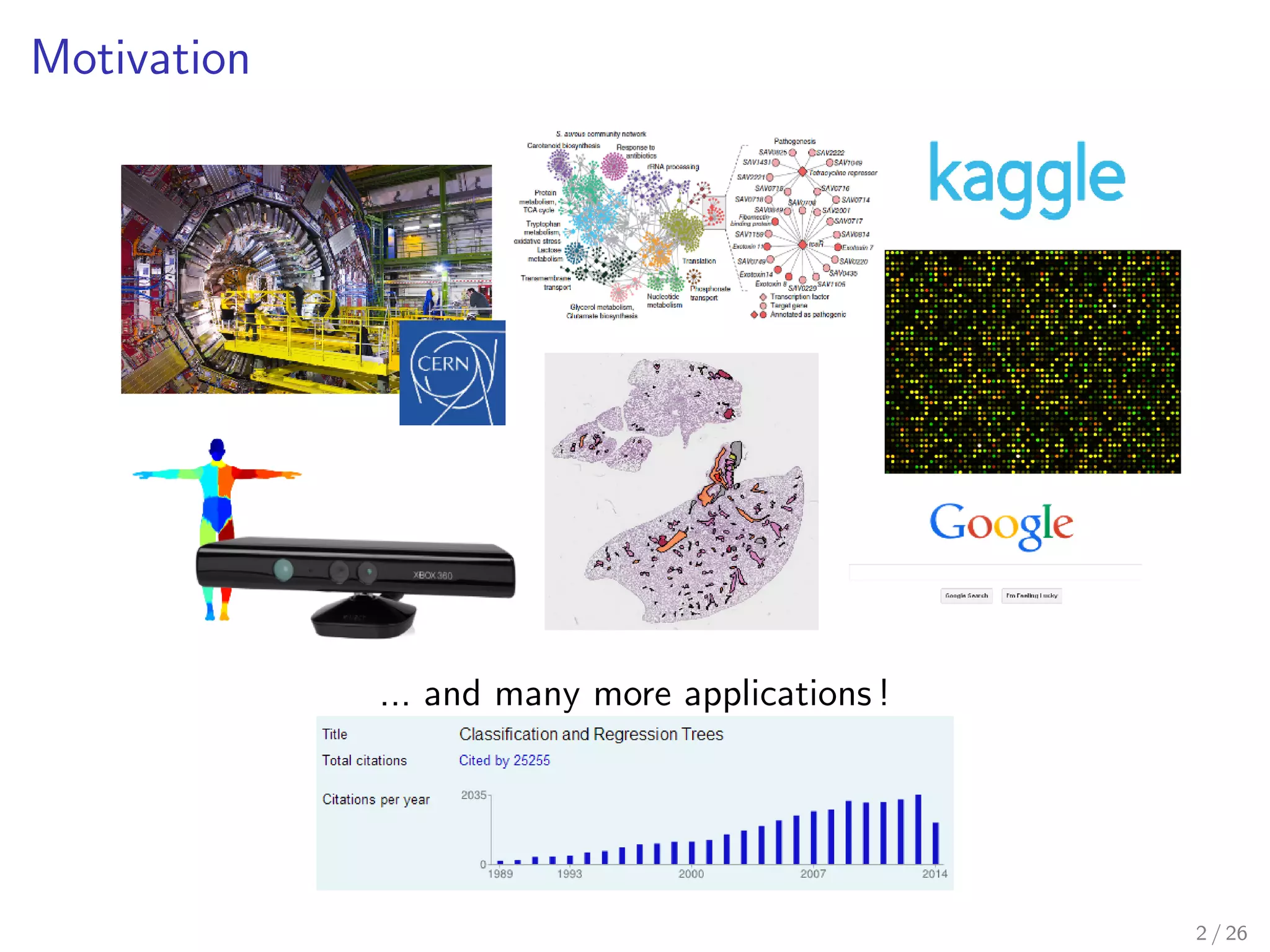
Motivation 
... and many more applications ! 
2 / 26
About 
Scikit-Learn 
 Machine learning library for Python 
 Classical and well-established 
algorithms 
 Emphasis on code quality and usability 
Myself 
 @glouppe 
 PhD student (Liege, Belgium) 
 Core developer on Scikit-Learn since 2011 
Chief tree hugger 
scikit 
3 / 26
Outline 
1 Basics 
2 Scikit-Learn implementation 
3 Python improvements 
4 / 26
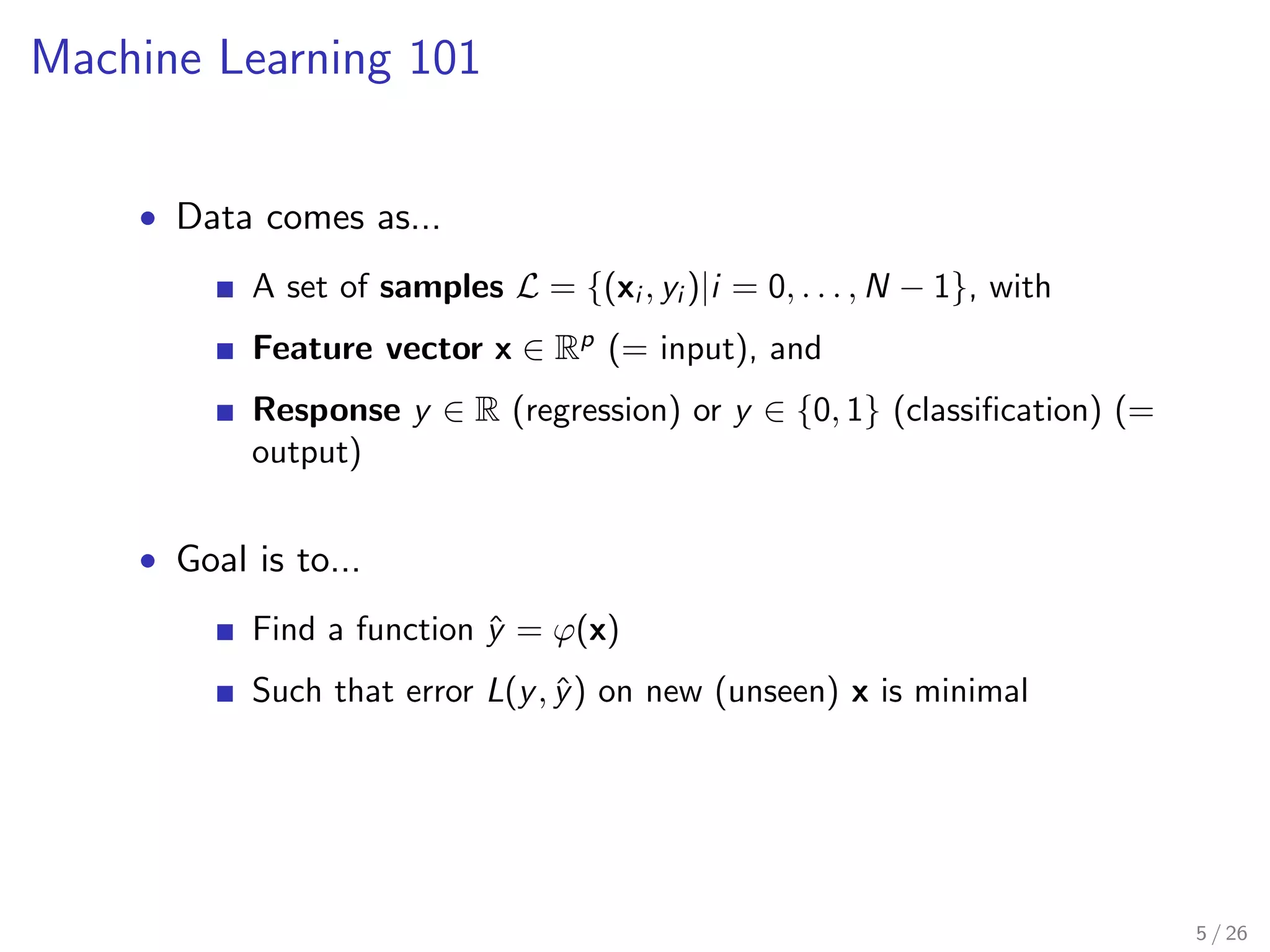
Machine Learning 101 
 Data comes as... 
A set of samples L = f(xi ; yi )ji = 0; : : : ;N  1g, with 
Feature vector x 2 Rp (= input), and 
Response y 2 R (regression) or y 2 f0; 1g (classi
cation) (= 
output) 
 Goal is to... 
Find a function ^y = '(x) 
Such that error L(y; ^y) on new (unseen) x is minimal 
5 / 26
Decision Trees 
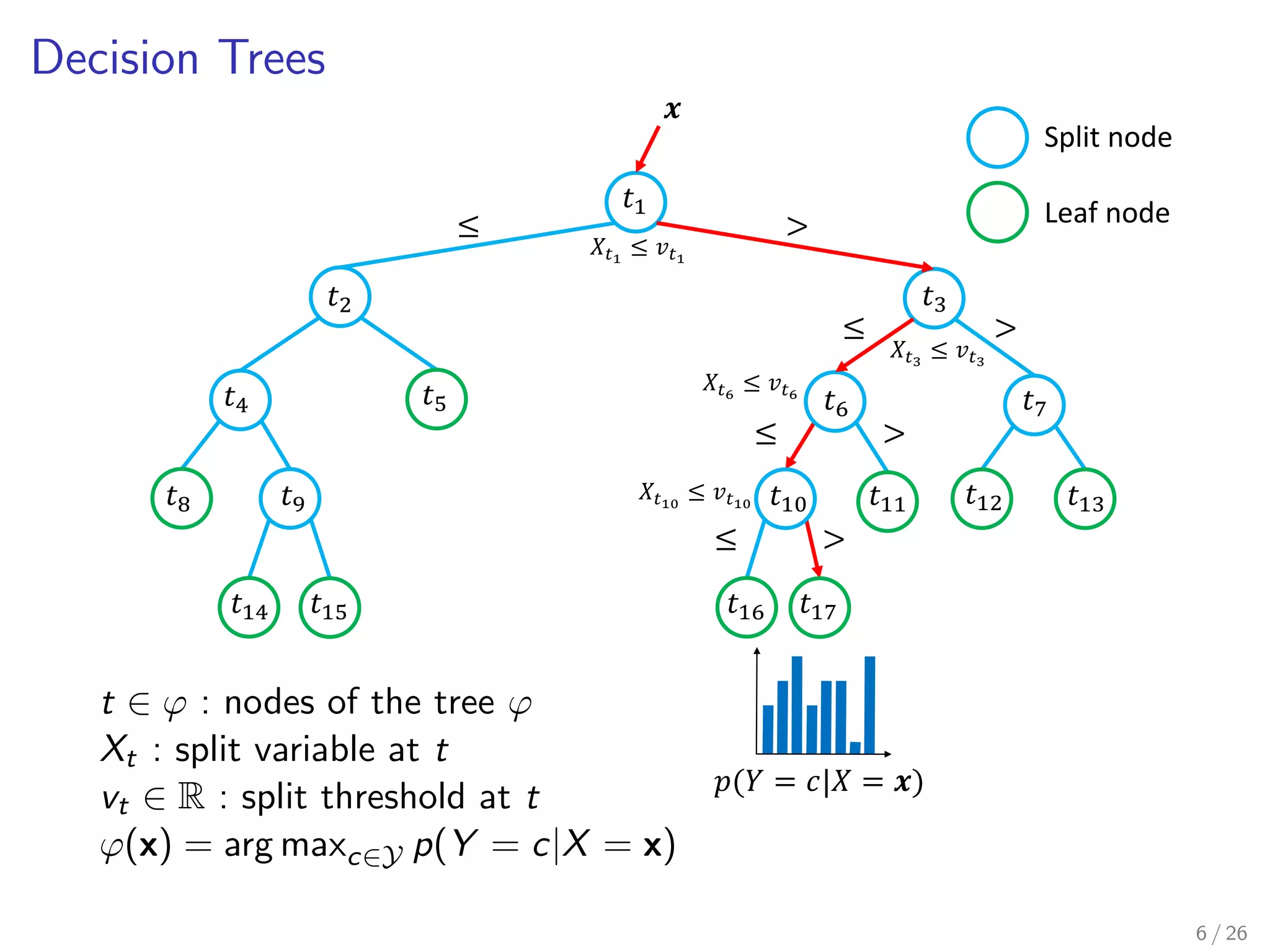
푡2 
푡1 
풙 
푋푡1 ≤ 푣푡1 
푡10 
푡3 
≤ 
푡4 푡5 푡6 푡7 
푡8 푡9 푡11 푡12 푡13 
푡14 푡15 푡16 푡17 
푋푡3 ≤ 푣푡3 
푋푡6 ≤ 푣푡6 
푋푡10 ≤ 푣푡10 
푝(푌 = 푐|푋 = 풙) 
Split node 
≤  Leaf node 


≤ 
≤ 
t 2 ' : nodes of the tree ' 
Xt : split variable at t 
vt 2 R : split threshold at t 
'(x) = arg maxc2Y p(Y = cjX = x) 
6 / 26
Random Forests 
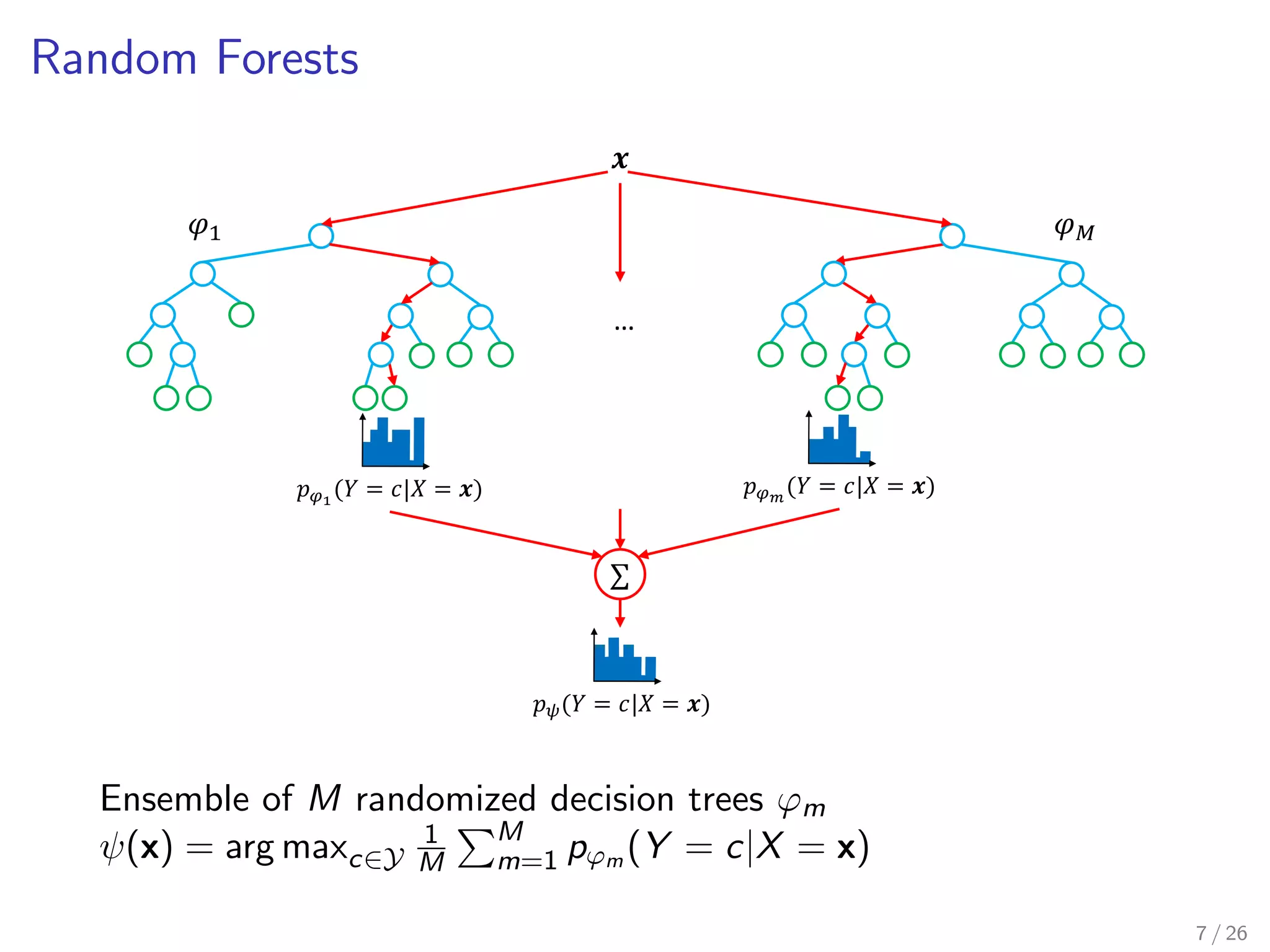
풙 
휑1 휑푀 
푝휑1 (푌 = 푐|푋 = 풙) 
… 
푝휑푚 (푌 = 푐|푋 = 풙) 
Σ 
푝휓(푌 = 푐|푋 = 풙) 
Ensemble of M randomized decision trees 'm 
 (x) = arg maxc2Y 
1M 
PM 
m=1 p'm(Y = cjX = x) 
7 / 26
Learning from data 
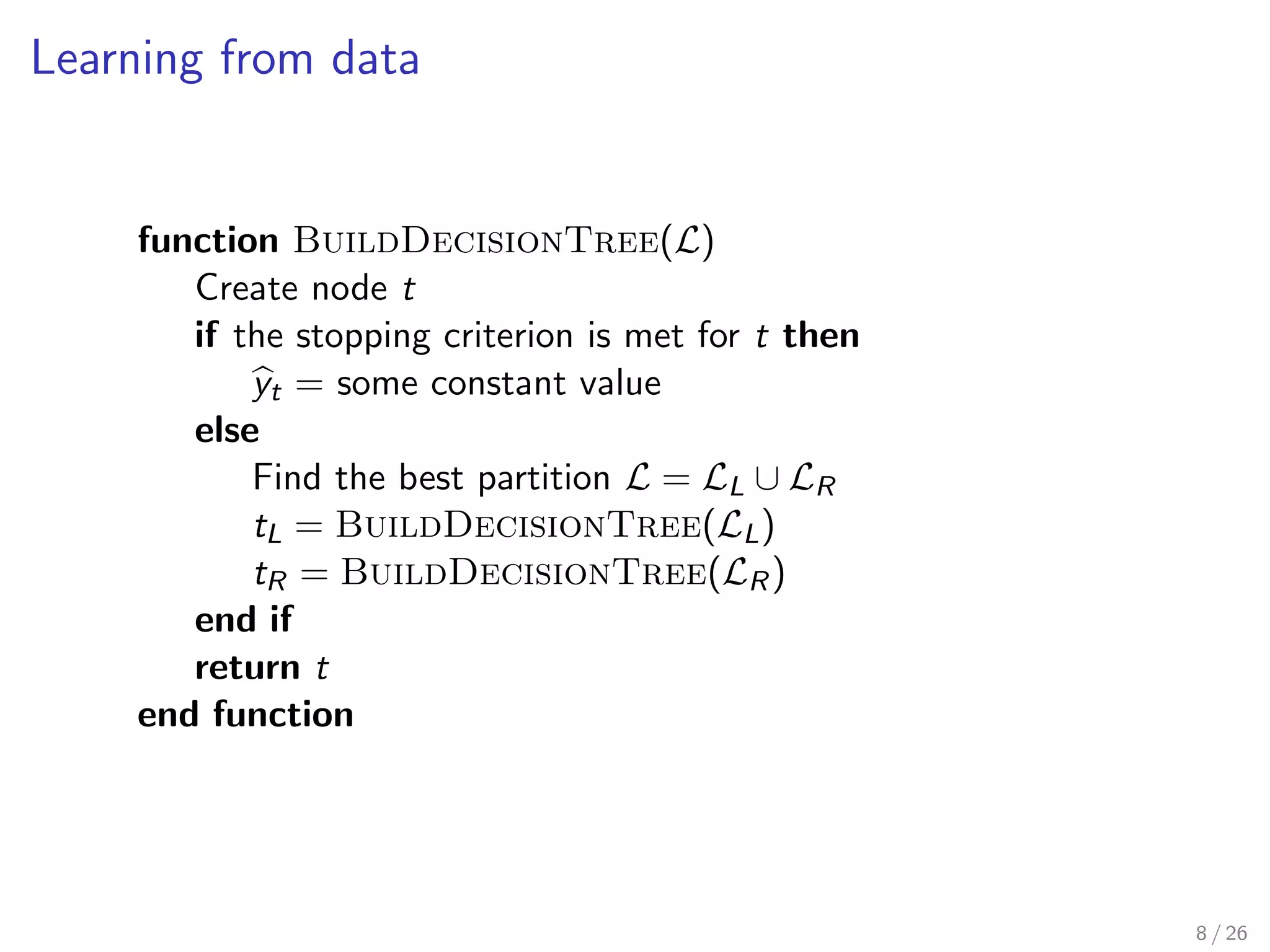
function BuildDecisionTree(L) 
Create node t 
if the stopping criterion is met for t then 
byt = some constant value 
else 
Find the best partition L = LL [ LR 
tL = BuildDecisionTree(LL) 
tR = BuildDecisionTree(LR) 
end if 
return t 
end function 
8 / 26
Outline 
1 Basics 
2 Scikit-Learn implementation 
3 Python improvements 
9 / 26
History 
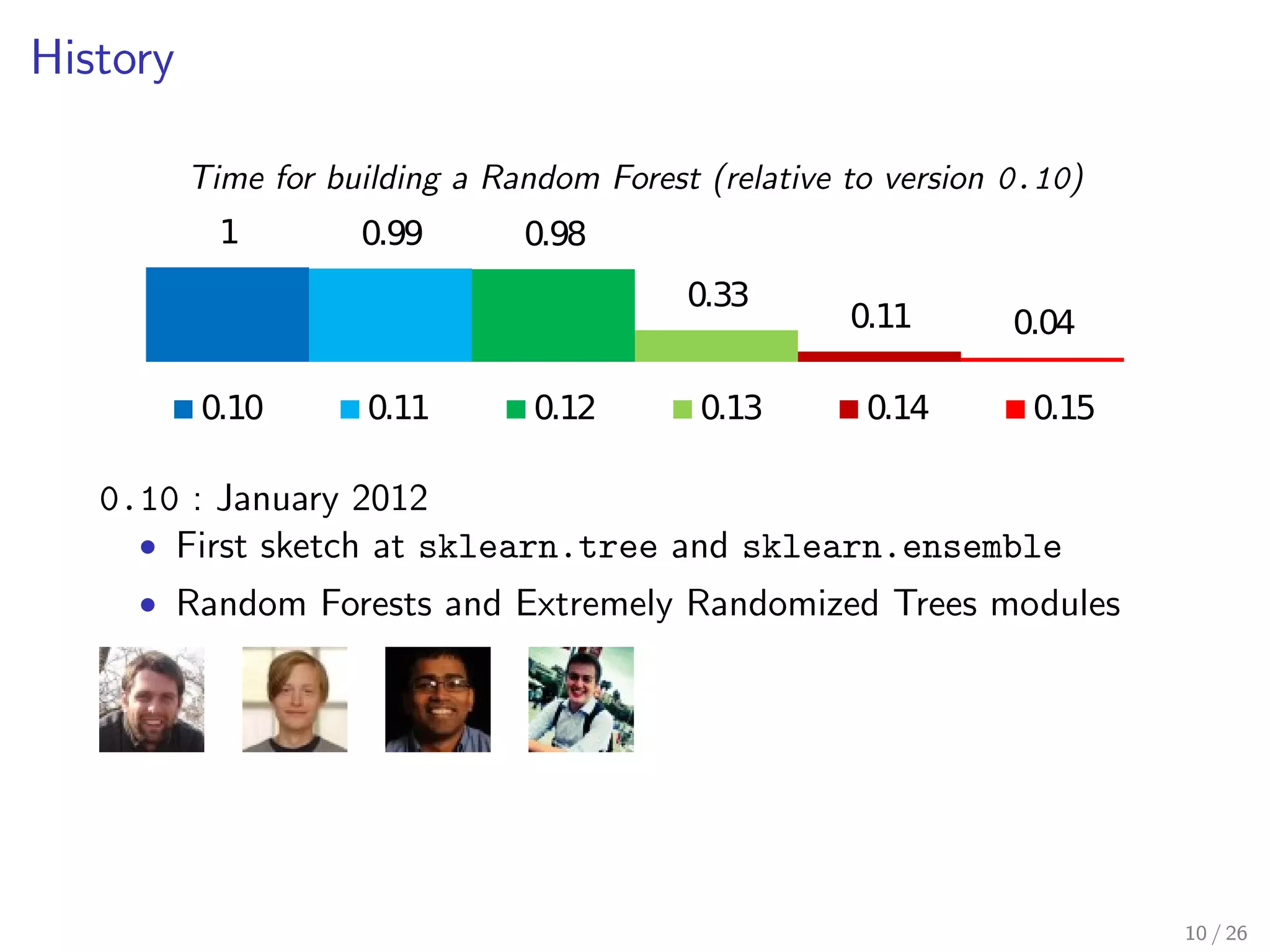
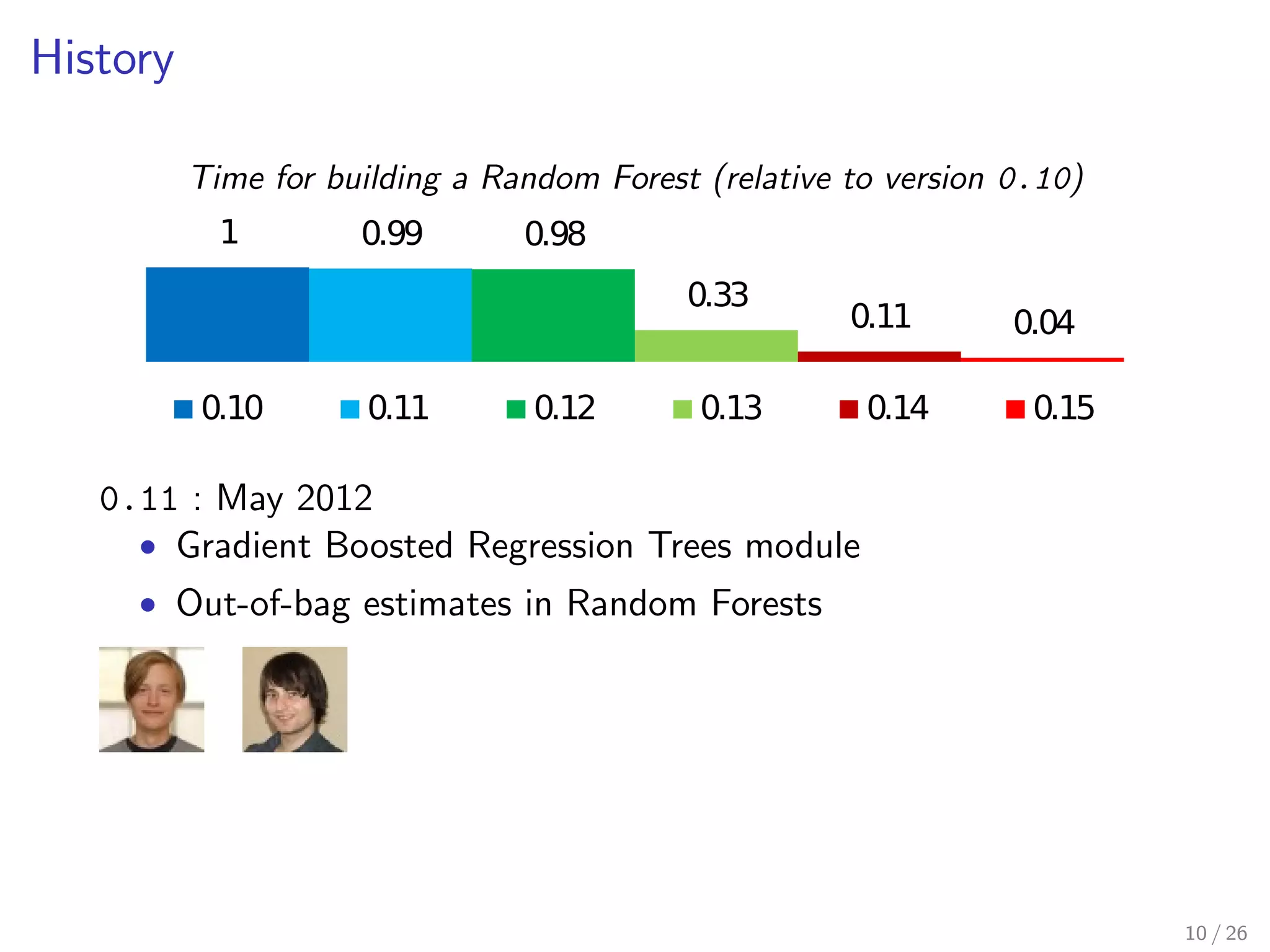
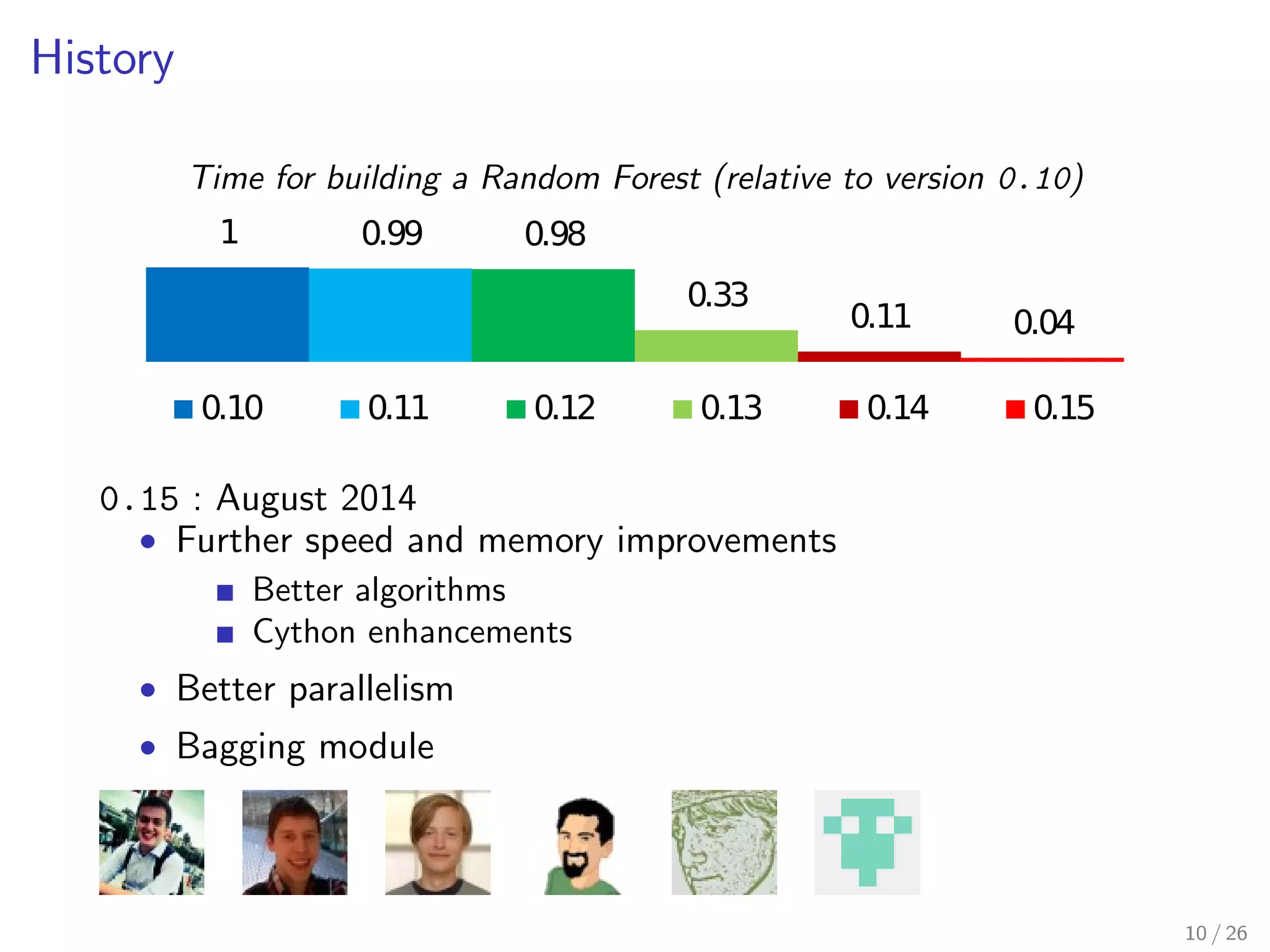
Time for building a Random Forest (relative to version 0.10) 
1 0.99 0.98 
0.33 0.11 0.04 
0.10 0.11 0.12 0.13 0.14 0.15 
0.10 : January 2012 
 First sketch at sklearn.tree and sklearn.ensemble 
 Random Forests and Extremely Randomized Trees modules 
10 / 26
History 
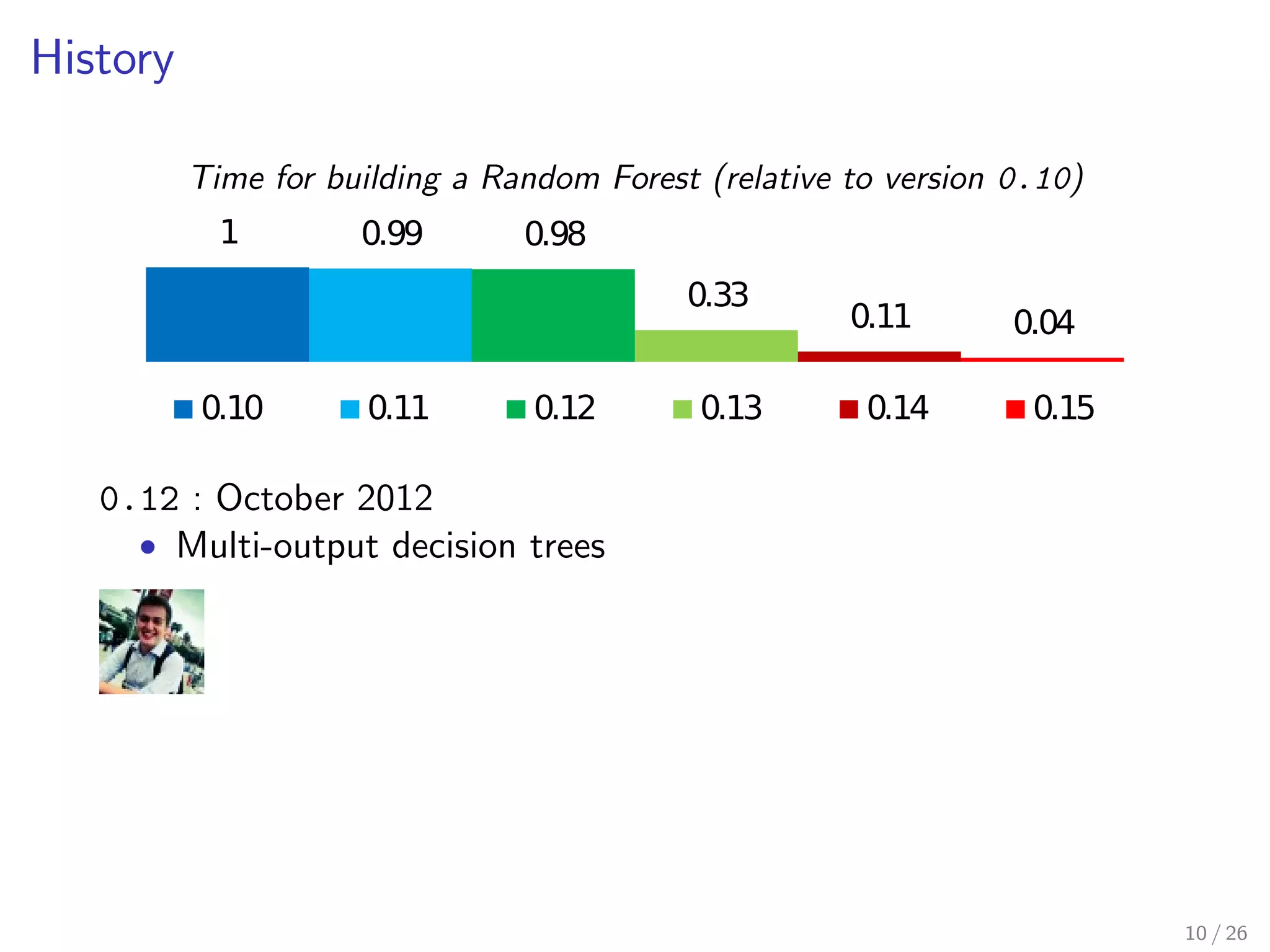
Time for building a Random Forest (relative to version 0.10) 
1 0.99 0.98 
0.33 0.11 0.04 
0.10 0.11 0.12 0.13 0.14 0.15 
0.11 : May 2012 
 Gradient Boosted Regression Trees module 
 Out-of-bag estimates in Random Forests 
10 / 26
History 
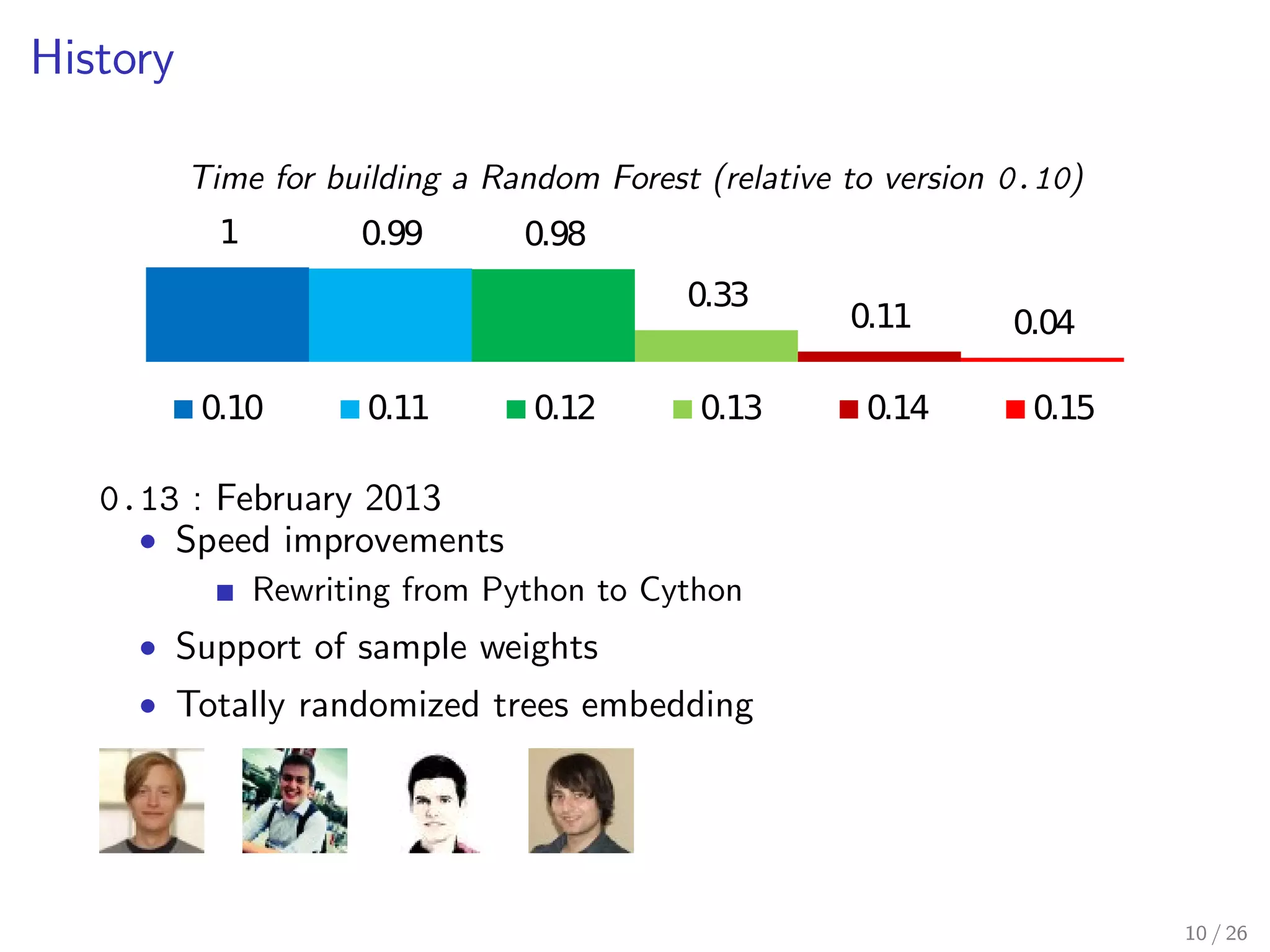
Time for building a Random Forest (relative to version 0.10) 
1 0.99 0.98 
0.33 0.11 0.04 
0.10 0.11 0.12 0.13 0.14 0.15 
0.12 : October 2012 
 Multi-output decision trees 
10 / 26
History 
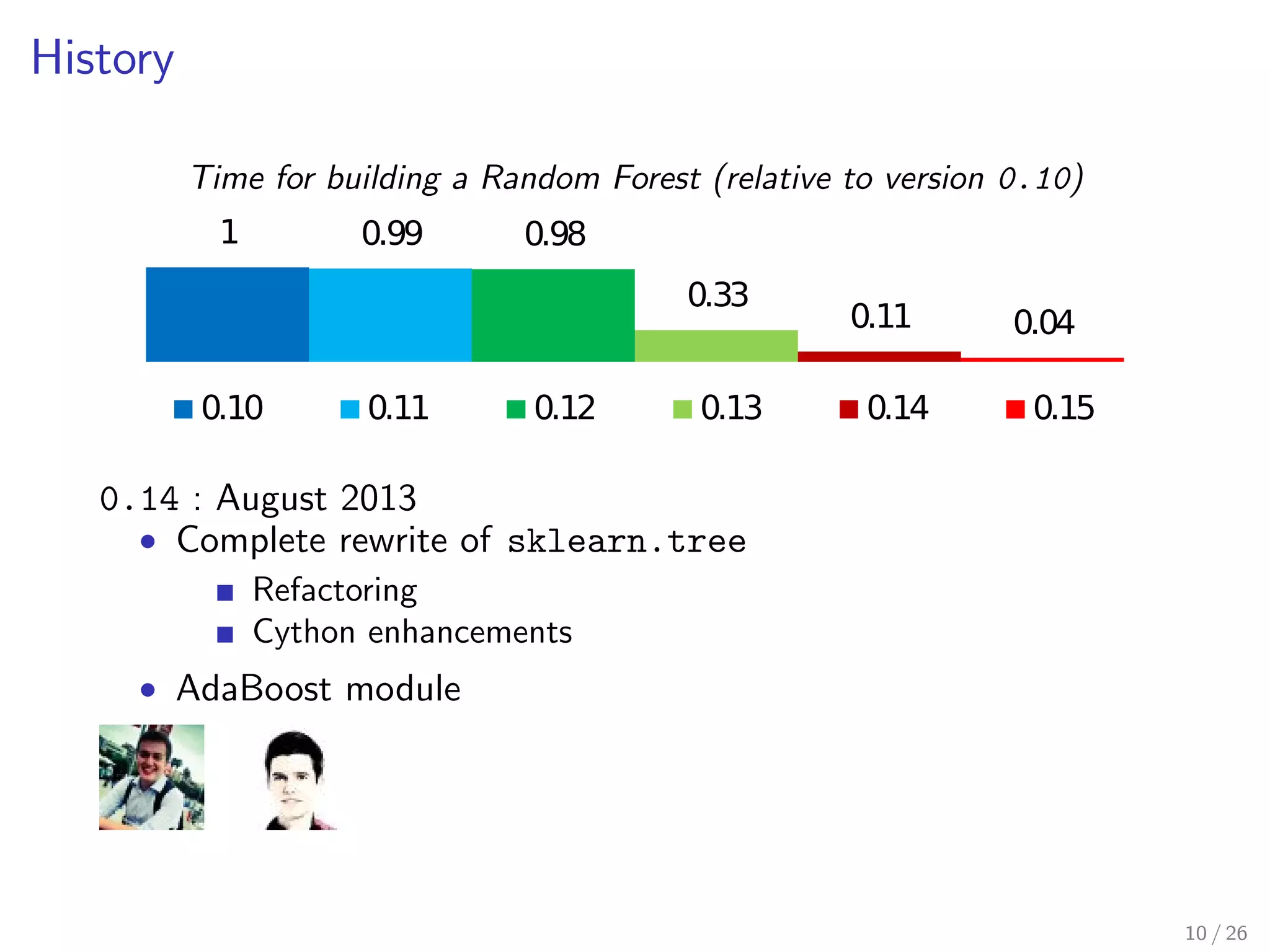
Time for building a Random Forest (relative to version 0.10) 
1 0.99 0.98 
0.33 0.11 0.04 
0.10 0.11 0.12 0.13 0.14 0.15 
0.13 : February 2013 
 Speed improvements 
Rewriting from Python to Cython 
 Support of sample weights 
 Totally randomized trees embedding 
10 / 26
History 
Time for building a Random Forest (relative to version 0.10) 
1 0.99 0.98 
0.33 0.11 0.04 
0.10 0.11 0.12 0.13 0.14 0.15 
0.14 : August 2013 
 Complete rewrite of sklearn.tree 
Refactoring 
Cython enhancements 
 AdaBoost module 
10 / 26
History 
Time for building a Random Forest (relative to version 0.10) 
1 0.99 0.98 
0.33 0.11 0.04 
0.10 0.11 0.12 0.13 0.14 0.15 
0.15 : August 2014 
 Further speed and memory improvements 
Better algorithms 
Cython enhancements 
 Better parallelism 
 Bagging module 
10 / 26
Implementation overview 
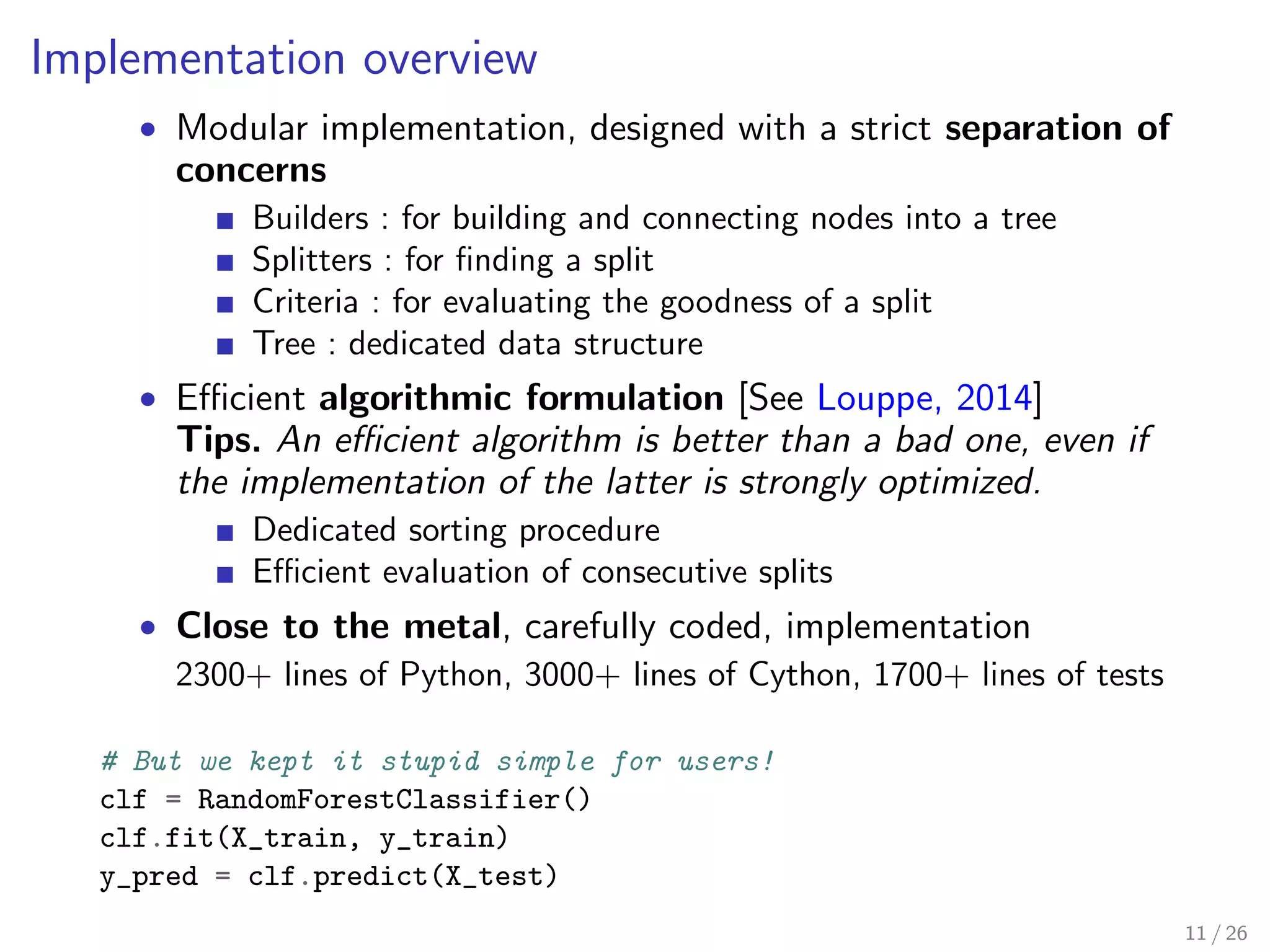
 Modular implementation, designed with a strict separation of 
concerns 
Builders : for building and connecting nodes into a tree 
Splitters : for
nding a split 
Criteria : for evaluating the goodness of a split 
Tree : dedicated data structure 
 Ecient algorithmic formulation [See Louppe, 2014] 
Tips. An ecient algorithm is better than a bad one, even if 
the implementation of the latter is strongly optimized. 
Dedicated sorting procedure 
Ecient evaluation of consecutive splits 
 Close to the metal, carefully coded, implementation 
2300+ lines of Python, 3000+ lines of Cython, 1700+ lines of tests 
# But we kept it stupid simple for users! 
clf = RandomForestClassifier() 
clf.fit(X_train, y_train) 
y_pred = clf.predict(X_test) 
11 / 26
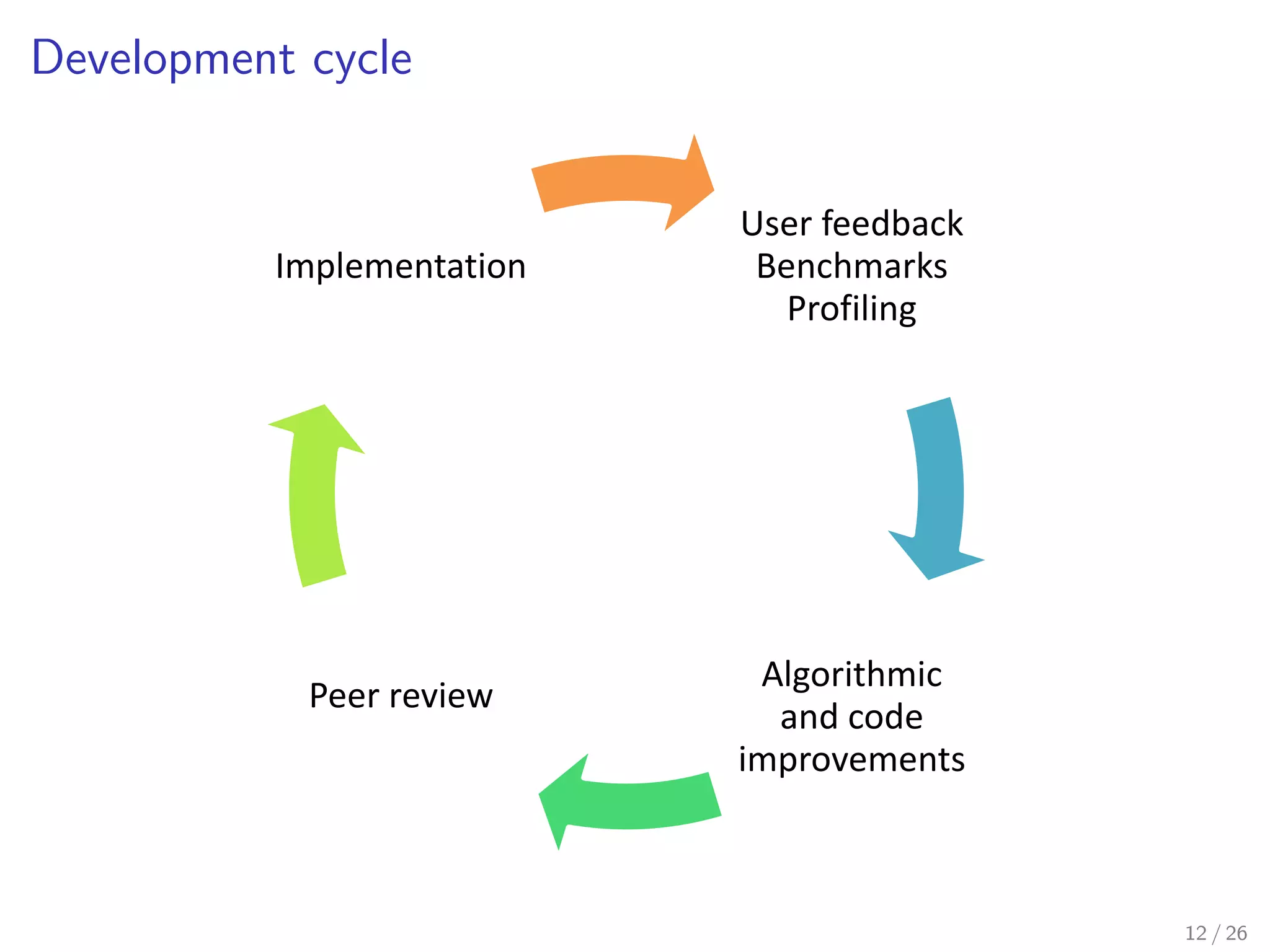
Development cycle 
User feedback 
Benchmarks 
Profiling 
Algorithmic 
and code 
improvements 
Implementation 
Peer review 
12 / 26
Continuous benchmarks 
 During code review, changes in the tree codebase are 
monitored with benchmarks. 
 Ensure performance and code quality. 
 Avoid code complexi
cation if it is not worth it. 
13 / 26
Outline 
1 Basics 
2 Scikit-Learn implementation 
3 Python improvements 
14 / 26
Disclaimer. Early optimization is the root of all evil. 
(This took us several years to get it right.) 
15 / 26
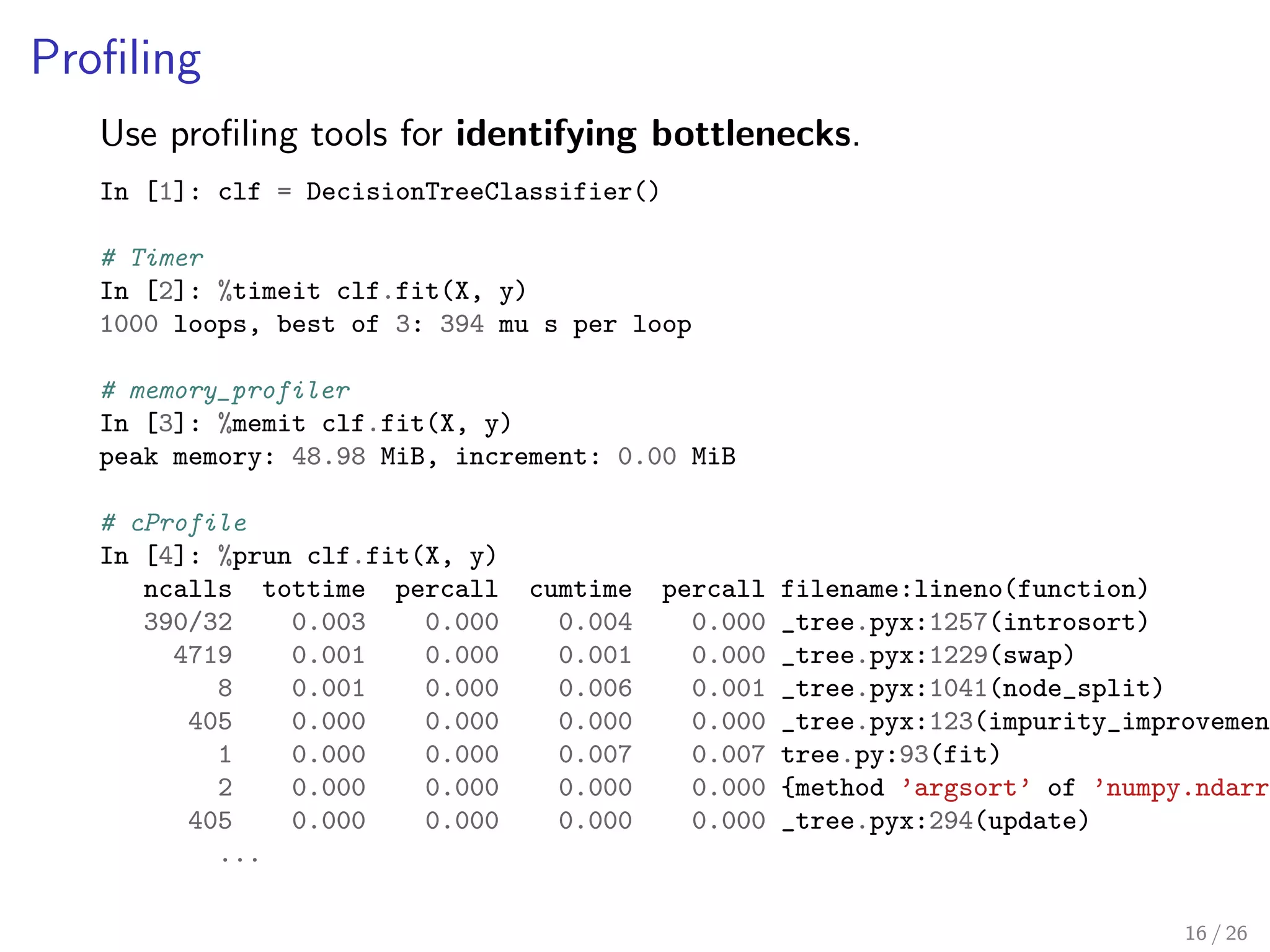
Pro
ling 
Use pro
ling tools for identifying bottlenecks. 
In [1]: clf = DecisionTreeClassifier() 
# Timer 
In [2]: %timeit clf.fit(X, y) 
1000 loops, best of 3: 394 mu s per loop 
# memory_profiler 
In [3]: %memit clf.fit(X, y) 
peak memory: 48.98 MiB, increment: 0.00 MiB 
# cProfile 
In [4]: %prun clf.fit(X, y) 
ncalls tottime percall cumtime percall filename:lineno(function) 
390/32 0.003 0.000 0.004 0.000 _tree.pyx:1257(introsort) 
4719 0.001 0.000 0.001 0.000 _tree.pyx:1229(swap) 
8 0.001 0.000 0.006 0.001 _tree.pyx:1041(node_split) 
405 0.000 0.000 0.000 0.000 _tree.pyx:123(impurity_improvement) 
1 0.000 0.000 0.007 0.007 tree.py:93(fit) 
2 0.000 0.000 0.000 0.000 {method 'argsort' of 'numpy.ndarray' 405 0.000 0.000 0.000 0.000 _tree.pyx:294(update) 
... 
16 / 26
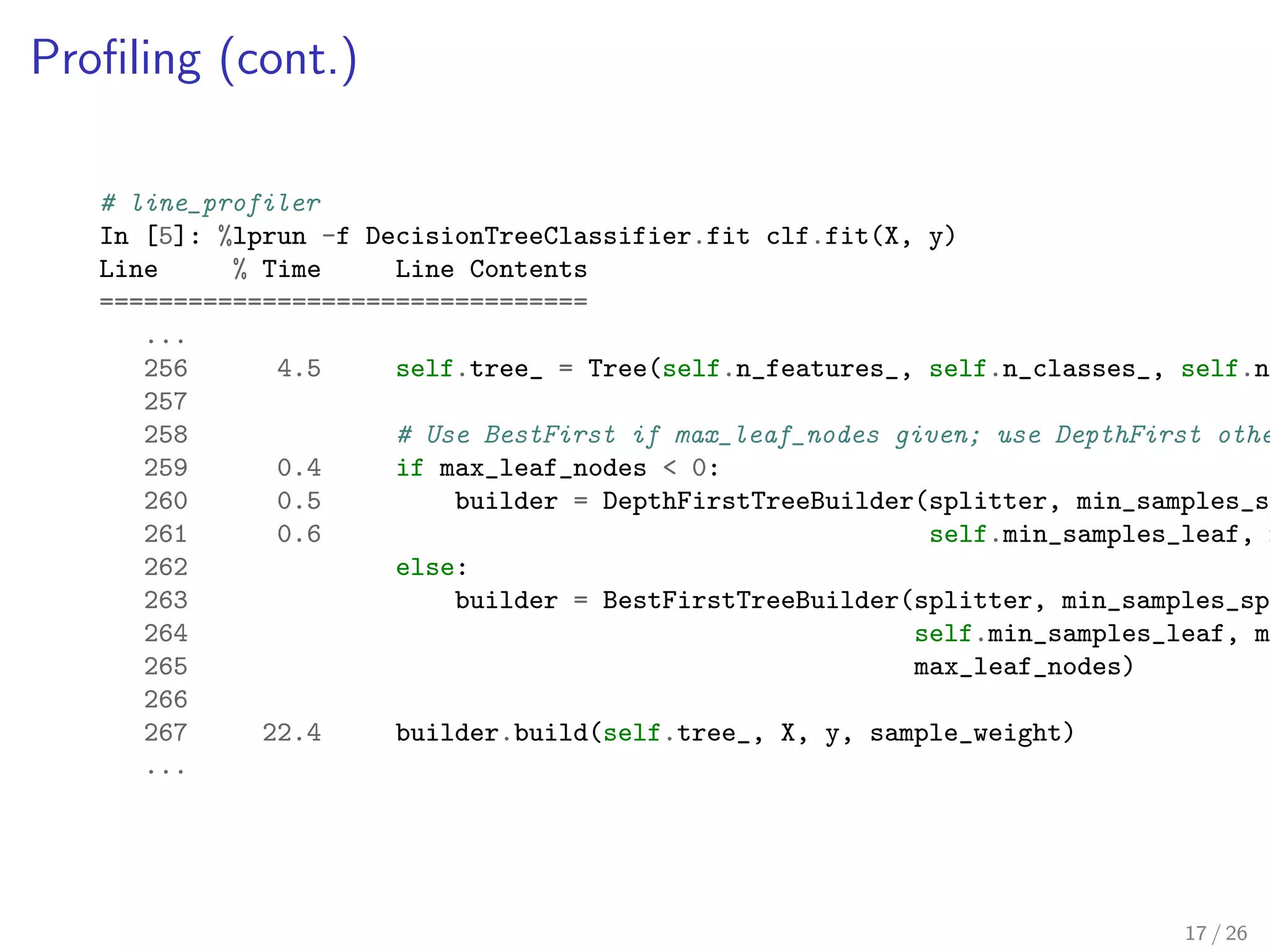
Pro
ling (cont.) 
# line_profiler 
In [5]: %lprun -f DecisionTreeClassifier.fit clf.fit(X, y) 
Line % Time Line Contents 
================================= 
... 
256 4.5 self.tree_ = Tree(self.n_features_, self.n_classes_, self.n_outputs_) 
257 
258 # Use BestFirst if max_leaf_nodes given; use DepthFirst otherwise 
259 0.4 if max_leaf_nodes  0: 
260 0.5 builder = DepthFirstTreeBuilder(splitter, min_samples_split, 
261 0.6 self.min_samples_leaf, 262 else: 
263 builder = BestFirstTreeBuilder(splitter, min_samples_split, 
264 self.min_samples_leaf, max_depth, 
265 max_leaf_nodes) 
266 
267 22.4 builder.build(self.tree_, X, y, sample_weight) 
... 
17 / 26
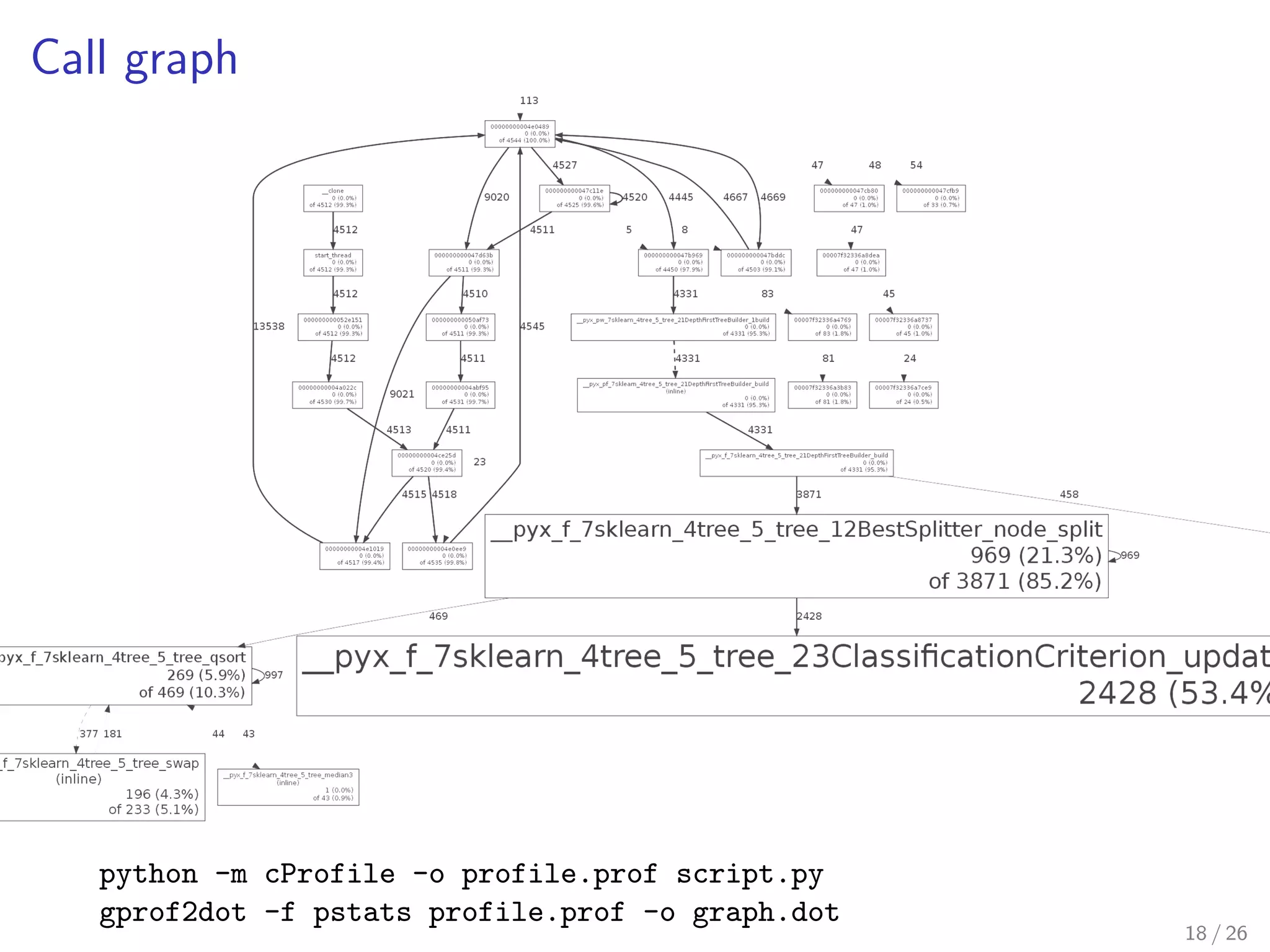
Call graph 
python -m cProfile -o profile.prof script.py 
gprof2dot -f pstats profile.prof -o graph.dot 
18 / 26
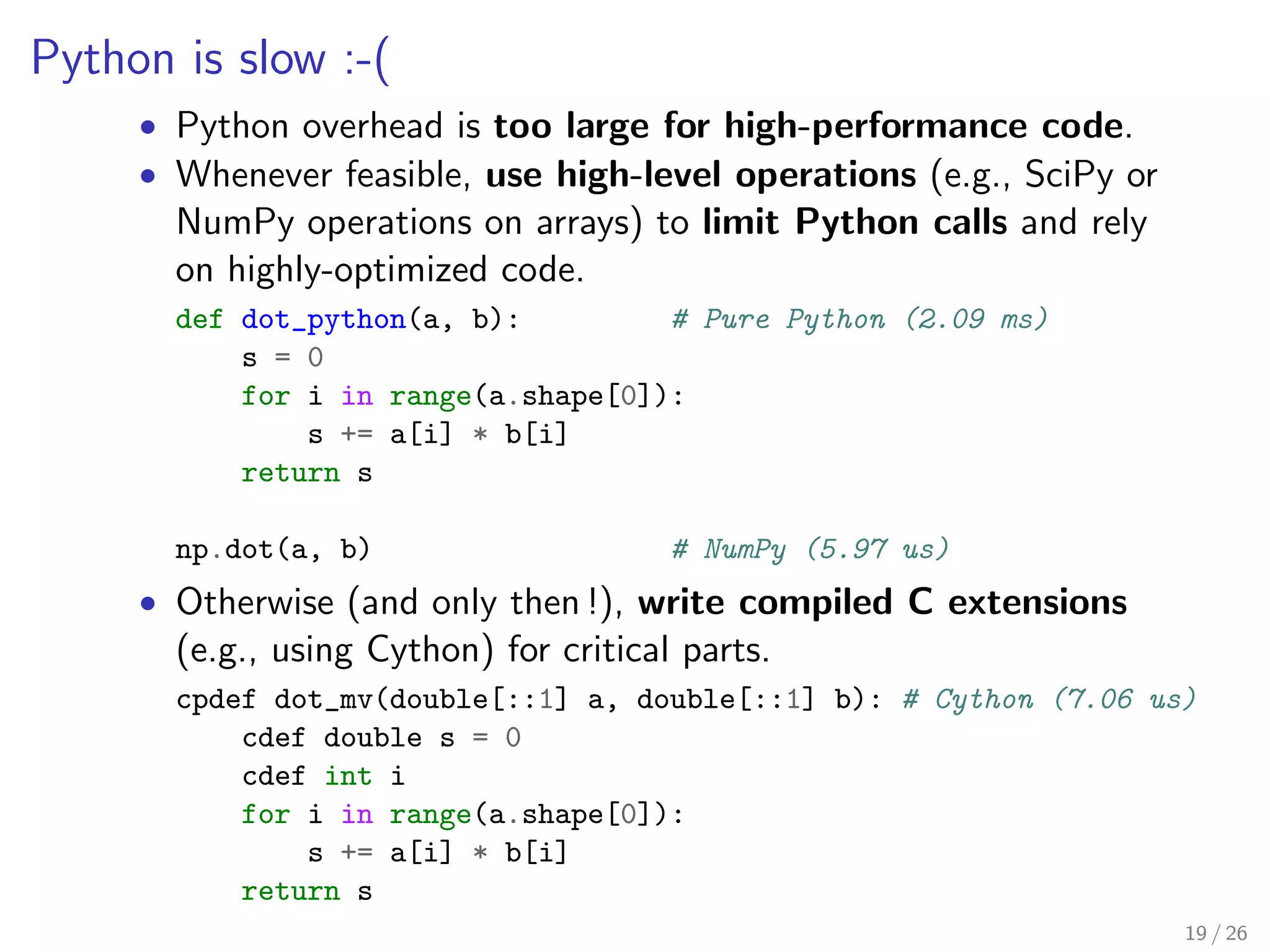
Python is slow :-( 
 Python overhead is too large for high-performance code. 
 Whenever feasible, use high-level operations (e.g., SciPy or 
NumPy operations on arrays) to limit Python calls and rely 
on highly-optimized code. 
def dot_python(a, b): # Pure Python (2.09 ms) 
s = 0 
for i in range(a.shape[0]): 
s += a[i] * b[i] 
return s 
np.dot(a, b) # NumPy (5.97 us) 
 Otherwise (and only then !), write compiled C extensions 
(e.g., using Cython) for critical parts. 
cpdef dot_mv(double[::1] a, double[::1] b): # Cython (7.06 us) 
cdef double s = 0 
cdef int i 
for i in range(a.shape[0]): 
s += a[i] * b[i] 
return s 
19 / 26
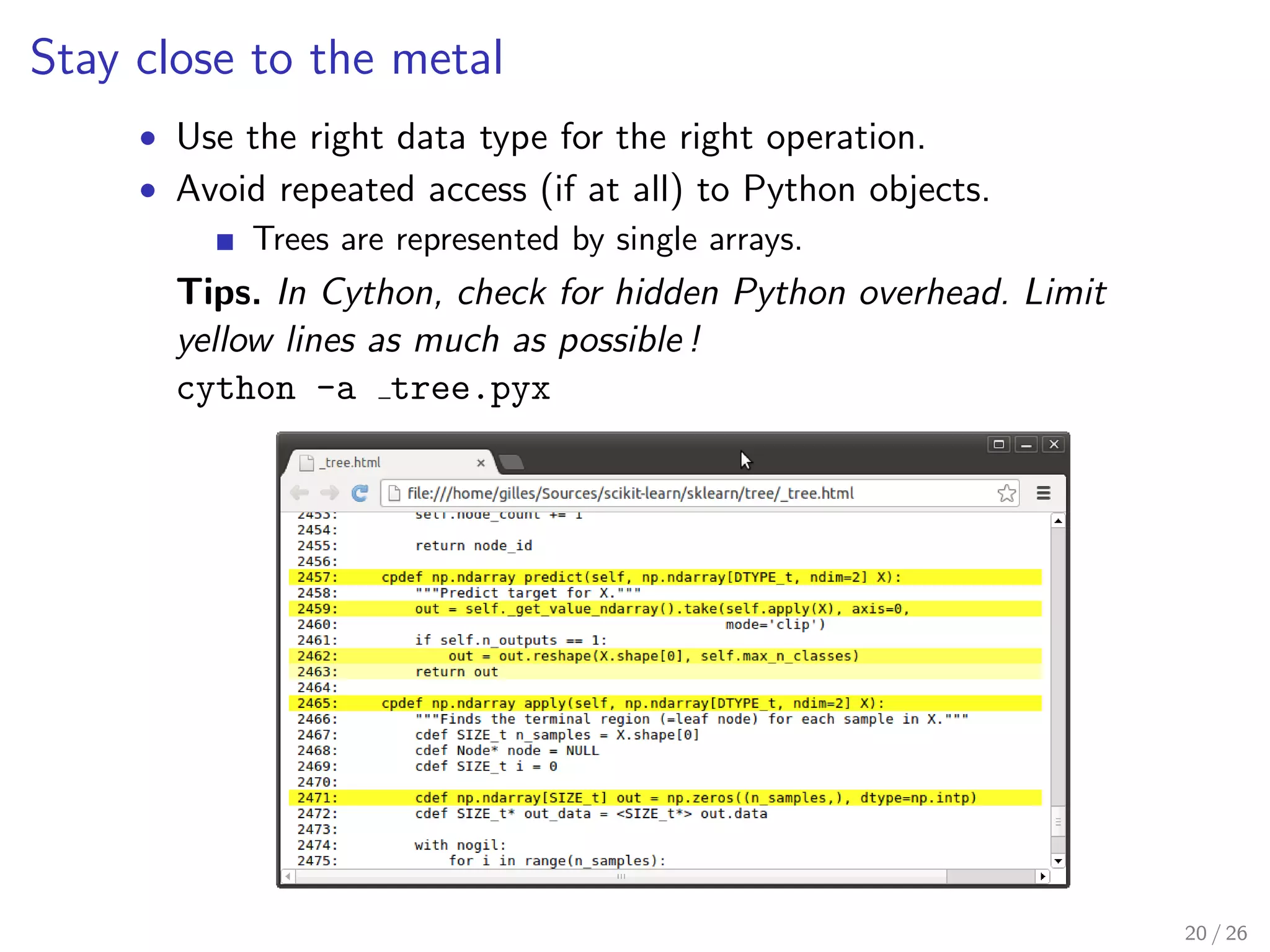
Stay close to the metal 
 Use the right data type for the right operation. 
 Avoid repeated access (if at all) to Python objects. 
Trees are represented by single arrays. 
Tips. In Cython, check for hidden Python overhead. Limit 
yellow lines as much as possible ! 
cython -a tree.pyx 
20 / 26

Accelerating Random Forests in Scikit-Learn

  • 1.
    Accelerating Random Forestsin Scikit-Learn Gilles Louppe Universite de Liege, Belgium August 29, 2014 1 / 26
  • 2.
    Motivation ... andmany more applications ! 2 / 26
  • 3.
    About Scikit-Learn Machine learning library for Python Classical and well-established algorithms Emphasis on code quality and usability Myself @glouppe PhD student (Liege, Belgium) Core developer on Scikit-Learn since 2011 Chief tree hugger scikit 3 / 26
  • 4.
    Outline 1 Basics 2 Scikit-Learn implementation 3 Python improvements 4 / 26
  • 5.
    Machine Learning 101 Data comes as... A set of samples L = f(xi ; yi )ji = 0; : : : ;N 1g, with Feature vector x 2 Rp (= input), and Response y 2 R (regression) or y 2 f0; 1g (classi
  • 6.
    cation) (= output) Goal is to... Find a function ^y = '(x) Such that error L(y; ^y) on new (unseen) x is minimal 5 / 26
  • 7.
    Decision Trees 푡2 푡1 풙 푋푡1 ≤ 푣푡1 푡10 푡3 ≤ 푡4 푡5 푡6 푡7 푡8 푡9 푡11 푡12 푡13 푡14 푡15 푡16 푡17 푋푡3 ≤ 푣푡3 푋푡6 ≤ 푣푡6 푋푡10 ≤ 푣푡10 푝(푌 = 푐|푋 = 풙) Split node ≤ Leaf node ≤ ≤ t 2 ' : nodes of the tree ' Xt : split variable at t vt 2 R : split threshold at t '(x) = arg maxc2Y p(Y = cjX = x) 6 / 26
  • 8.
    Random Forests 풙 휑1 휑푀 푝휑1 (푌 = 푐|푋 = 풙) … 푝휑푚 (푌 = 푐|푋 = 풙) Σ 푝휓(푌 = 푐|푋 = 풙) Ensemble of M randomized decision trees 'm (x) = arg maxc2Y 1M PM m=1 p'm(Y = cjX = x) 7 / 26
  • 9.
    Learning from data function BuildDecisionTree(L) Create node t if the stopping criterion is met for t then byt = some constant value else Find the best partition L = LL [ LR tL = BuildDecisionTree(LL) tR = BuildDecisionTree(LR) end if return t end function 8 / 26
  • 10.
    Outline 1 Basics 2 Scikit-Learn implementation 3 Python improvements 9 / 26
  • 11.
    History Time forbuilding a Random Forest (relative to version 0.10) 1 0.99 0.98 0.33 0.11 0.04 0.10 0.11 0.12 0.13 0.14 0.15 0.10 : January 2012 First sketch at sklearn.tree and sklearn.ensemble Random Forests and Extremely Randomized Trees modules 10 / 26
  • 12.
    History Time forbuilding a Random Forest (relative to version 0.10) 1 0.99 0.98 0.33 0.11 0.04 0.10 0.11 0.12 0.13 0.14 0.15 0.11 : May 2012 Gradient Boosted Regression Trees module Out-of-bag estimates in Random Forests 10 / 26
  • 13.
    History Time forbuilding a Random Forest (relative to version 0.10) 1 0.99 0.98 0.33 0.11 0.04 0.10 0.11 0.12 0.13 0.14 0.15 0.12 : October 2012 Multi-output decision trees 10 / 26
  • 14.
    History Time forbuilding a Random Forest (relative to version 0.10) 1 0.99 0.98 0.33 0.11 0.04 0.10 0.11 0.12 0.13 0.14 0.15 0.13 : February 2013 Speed improvements Rewriting from Python to Cython Support of sample weights Totally randomized trees embedding 10 / 26
  • 15.
    History Time forbuilding a Random Forest (relative to version 0.10) 1 0.99 0.98 0.33 0.11 0.04 0.10 0.11 0.12 0.13 0.14 0.15 0.14 : August 2013 Complete rewrite of sklearn.tree Refactoring Cython enhancements AdaBoost module 10 / 26
  • 16.
    History Time forbuilding a Random Forest (relative to version 0.10) 1 0.99 0.98 0.33 0.11 0.04 0.10 0.11 0.12 0.13 0.14 0.15 0.15 : August 2014 Further speed and memory improvements Better algorithms Cython enhancements Better parallelism Bagging module 10 / 26
  • 17.
    Implementation overview Modular implementation, designed with a strict separation of concerns Builders : for building and connecting nodes into a tree Splitters : for
  • 18.
    nding a split Criteria : for evaluating the goodness of a split Tree : dedicated data structure Ecient algorithmic formulation [See Louppe, 2014] Tips. An ecient algorithm is better than a bad one, even if the implementation of the latter is strongly optimized. Dedicated sorting procedure Ecient evaluation of consecutive splits Close to the metal, carefully coded, implementation 2300+ lines of Python, 3000+ lines of Cython, 1700+ lines of tests # But we kept it stupid simple for users! clf = RandomForestClassifier() clf.fit(X_train, y_train) y_pred = clf.predict(X_test) 11 / 26
  • 19.
    Development cycle Userfeedback Benchmarks Profiling Algorithmic and code improvements Implementation Peer review 12 / 26
  • 20.
    Continuous benchmarks During code review, changes in the tree codebase are monitored with benchmarks. Ensure performance and code quality. Avoid code complexi
  • 21.
    cation if itis not worth it. 13 / 26
  • 22.
    Outline 1 Basics 2 Scikit-Learn implementation 3 Python improvements 14 / 26
  • 23.
    Disclaimer. Early optimizationis the root of all evil. (This took us several years to get it right.) 15 / 26
  • 24.
  • 25.
  • 26.
    ling tools foridentifying bottlenecks. In [1]: clf = DecisionTreeClassifier() # Timer In [2]: %timeit clf.fit(X, y) 1000 loops, best of 3: 394 mu s per loop # memory_profiler In [3]: %memit clf.fit(X, y) peak memory: 48.98 MiB, increment: 0.00 MiB # cProfile In [4]: %prun clf.fit(X, y) ncalls tottime percall cumtime percall filename:lineno(function) 390/32 0.003 0.000 0.004 0.000 _tree.pyx:1257(introsort) 4719 0.001 0.000 0.001 0.000 _tree.pyx:1229(swap) 8 0.001 0.000 0.006 0.001 _tree.pyx:1041(node_split) 405 0.000 0.000 0.000 0.000 _tree.pyx:123(impurity_improvement) 1 0.000 0.000 0.007 0.007 tree.py:93(fit) 2 0.000 0.000 0.000 0.000 {method 'argsort' of 'numpy.ndarray' 405 0.000 0.000 0.000 0.000 _tree.pyx:294(update) ... 16 / 26
  • 27.
  • 28.
    ling (cont.) #line_profiler In [5]: %lprun -f DecisionTreeClassifier.fit clf.fit(X, y) Line % Time Line Contents ================================= ... 256 4.5 self.tree_ = Tree(self.n_features_, self.n_classes_, self.n_outputs_) 257 258 # Use BestFirst if max_leaf_nodes given; use DepthFirst otherwise 259 0.4 if max_leaf_nodes 0: 260 0.5 builder = DepthFirstTreeBuilder(splitter, min_samples_split, 261 0.6 self.min_samples_leaf, 262 else: 263 builder = BestFirstTreeBuilder(splitter, min_samples_split, 264 self.min_samples_leaf, max_depth, 265 max_leaf_nodes) 266 267 22.4 builder.build(self.tree_, X, y, sample_weight) ... 17 / 26
  • 29.
    Call graph python-m cProfile -o profile.prof script.py gprof2dot -f pstats profile.prof -o graph.dot 18 / 26
  • 30.
    Python is slow:-( Python overhead is too large for high-performance code. Whenever feasible, use high-level operations (e.g., SciPy or NumPy operations on arrays) to limit Python calls and rely on highly-optimized code. def dot_python(a, b): # Pure Python (2.09 ms) s = 0 for i in range(a.shape[0]): s += a[i] * b[i] return s np.dot(a, b) # NumPy (5.97 us) Otherwise (and only then !), write compiled C extensions (e.g., using Cython) for critical parts. cpdef dot_mv(double[::1] a, double[::1] b): # Cython (7.06 us) cdef double s = 0 cdef int i for i in range(a.shape[0]): s += a[i] * b[i] return s 19 / 26
  • 31.
    Stay close tothe metal Use the right data type for the right operation. Avoid repeated access (if at all) to Python objects. Trees are represented by single arrays. Tips. In Cython, check for hidden Python overhead. Limit yellow lines as much as possible ! cython -a tree.pyx 20 / 26
  • 32.
    Stay close tothe metal (cont.) Take care of data locality and contiguity. Make data contiguous to leverage CPU prefetching and cache mechanisms. Access data in the same way it is stored in memory. Tips. If accessing values row-wise (resp. column-wise), make sure the array is C-ordered (resp. Fortran-ordered). cdef int[::1, :] X = np.asfortranarray(X, dtype=np.int) cdef int i, j = 42 cdef s = 0 for i in range(...): s += X[i, j] # Fast s += X[j, i] # Slow If not feasible, use pre-buering. 21 / 26
  • 33.
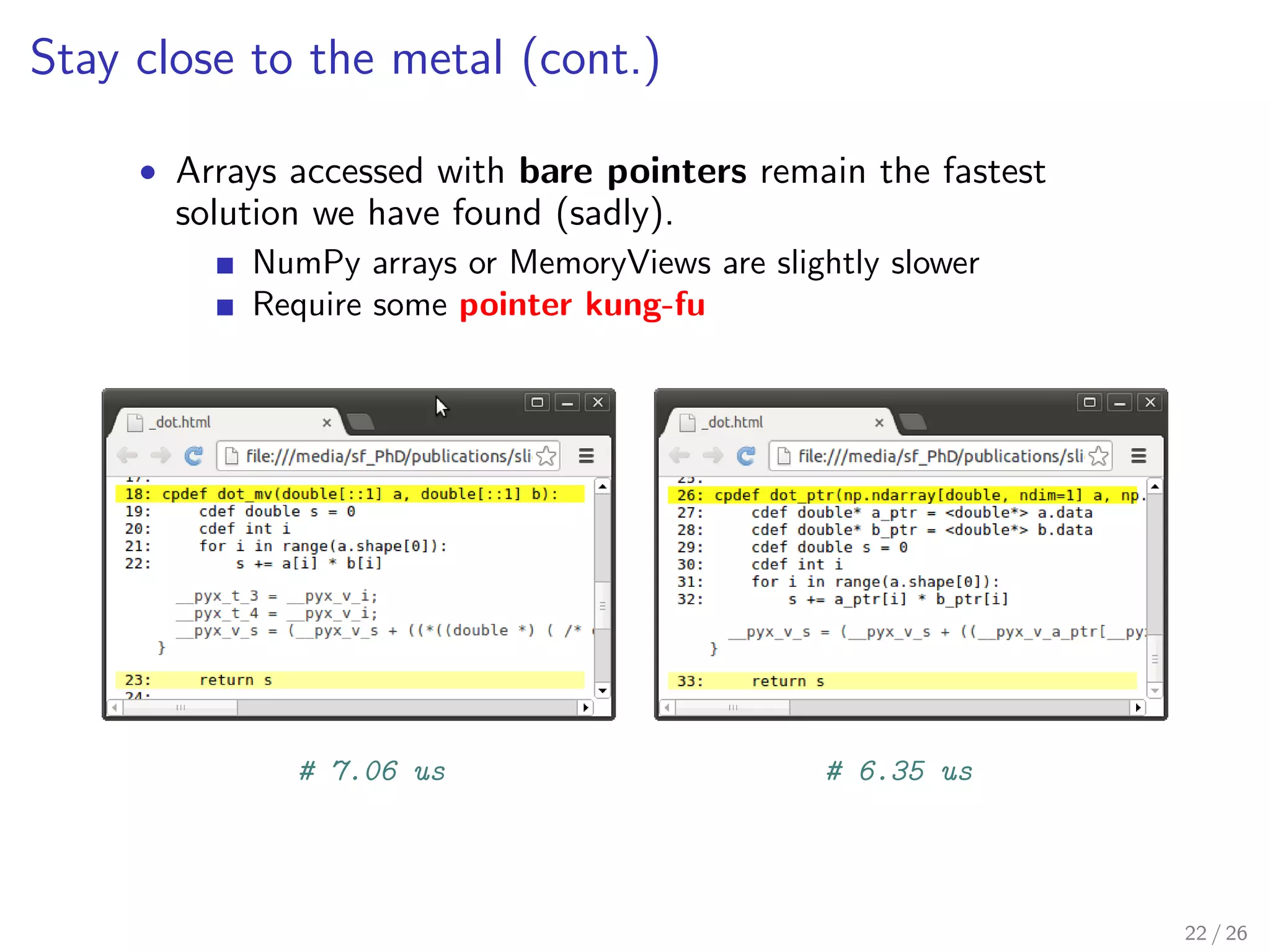
    Stay close tothe metal (cont.) Arrays accessed with bare pointers remain the fastest solution we have found (sadly). NumPy arrays or MemoryViews are slightly slower Require some pointer kung-fu # 7.06 us # 6.35 us 22 / 26
  • 34.
    Ecient parallelism inPython is possible ! 23 / 26
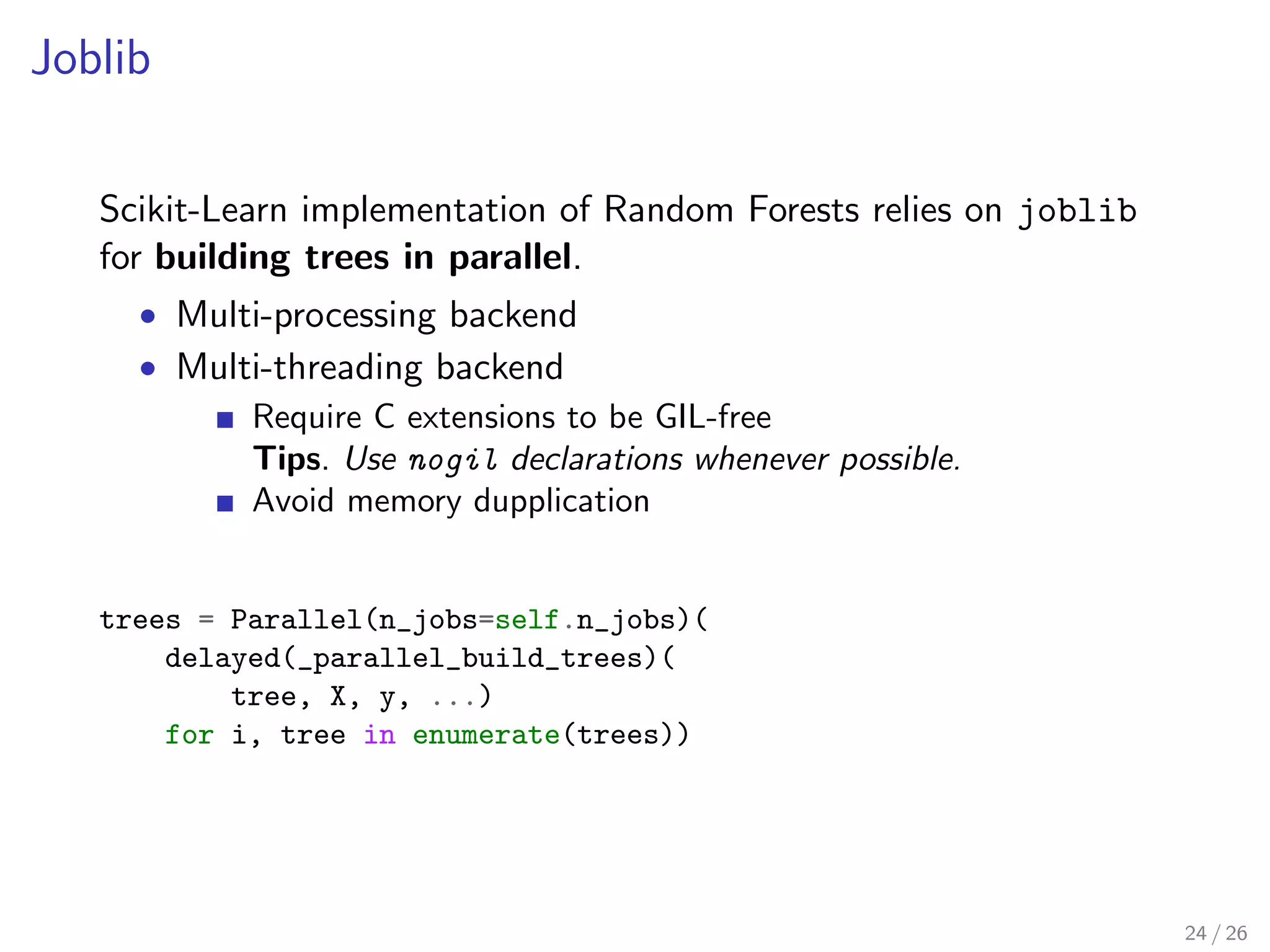
  • 35.
    Joblib Scikit-Learn implementationof Random Forests relies on joblib for building trees in parallel. Multi-processing backend Multi-threading backend Require C extensions to be GIL-free Tips. Use nogil declarations whenever possible. Avoid memory dupplication trees = Parallel(n_jobs=self.n_jobs)( delayed(_parallel_build_trees)( tree, X, y, ...) for i, tree in enumerate(trees)) 24 / 26
  • 36.
    A winning strategy Scikit-Learn implementation proves to be one of the fastest among all libraries and programming languages. 14000 12000 10000 8000 6000 4000 2000 0 Fit time (s ) 203.01 211.53 4464.65 3342.83 randomForest 1518.14 1711.94 R, Fortran 1027.91 13427.06 10941.72 Scikit-Learn-RF Scikit-Learn-ETs OpenCV-RF OpenCV-ETs OK3-RF OK3-ETs Weka-RF R-RF Orange-RF Scikit-Learn Python, Cython OpenCV C++ OK3 C Weka Java Orange Python 25 / 26
  • 37.
    Summary Theopen source development cycle really empowered the Scikit-Learn implementation of Random Forests. Combine algorithmic improvements with code optimization. Make use of pro
  • 38.
    ling tools toidentify bottlenecks. Optimize only critical code ! 26 / 26