CudaTree
Training Random Forests on the GPU
Alex Rubinsteyn (NYU, Mount Sinai)
@ GTC on March 25th, 2014
What’s a Random Forest?
trees = []
for i in 1 .. T:
Xi, Yi = random_sample(X, Y)
t = RandomizedDecisionTree()
t.fit(Xi,Yi)
trees.append(t)
A bagged ensemble of randomized decision
trees. Learning by uncorrelated memorization.
Few free parameters, popular for “data science”
Random Forest trees are trained like normal
decision trees (CART), but use random subset
of features at each split.
bestScore = bestThresh = None
for i in RandomSubset(nFeatures):
Xi, Yi = sort(X[:, i], Y)
for nLess, thresh in enumerate(Xi):
score = Impurity(nLess, Yi)
if score < bestScore:
bestScore = score
bestThresh = thresh
Decision Tree Training
1;
Random Forests:
Easy to Parallelize?
• Each tree gets trained independently!
• Simple parallelization strategy:“each
processor trains a tree”
• Works great for multi-core
implementations (wiseRF, scikit-learn, &c)
• Terrible for GPU
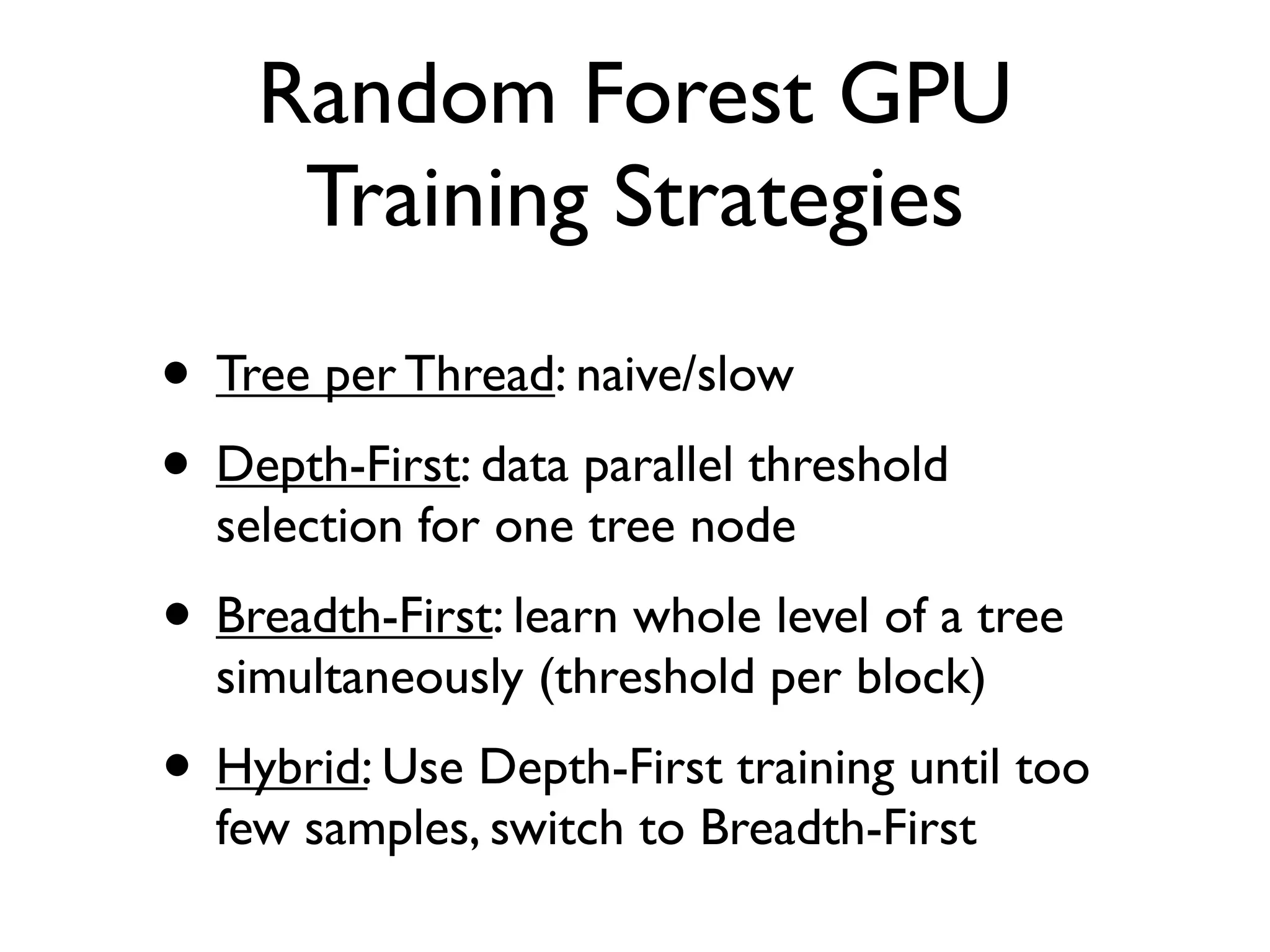
Random Forest GPU
Training Strategies
• Tree per Thread: naive/slow
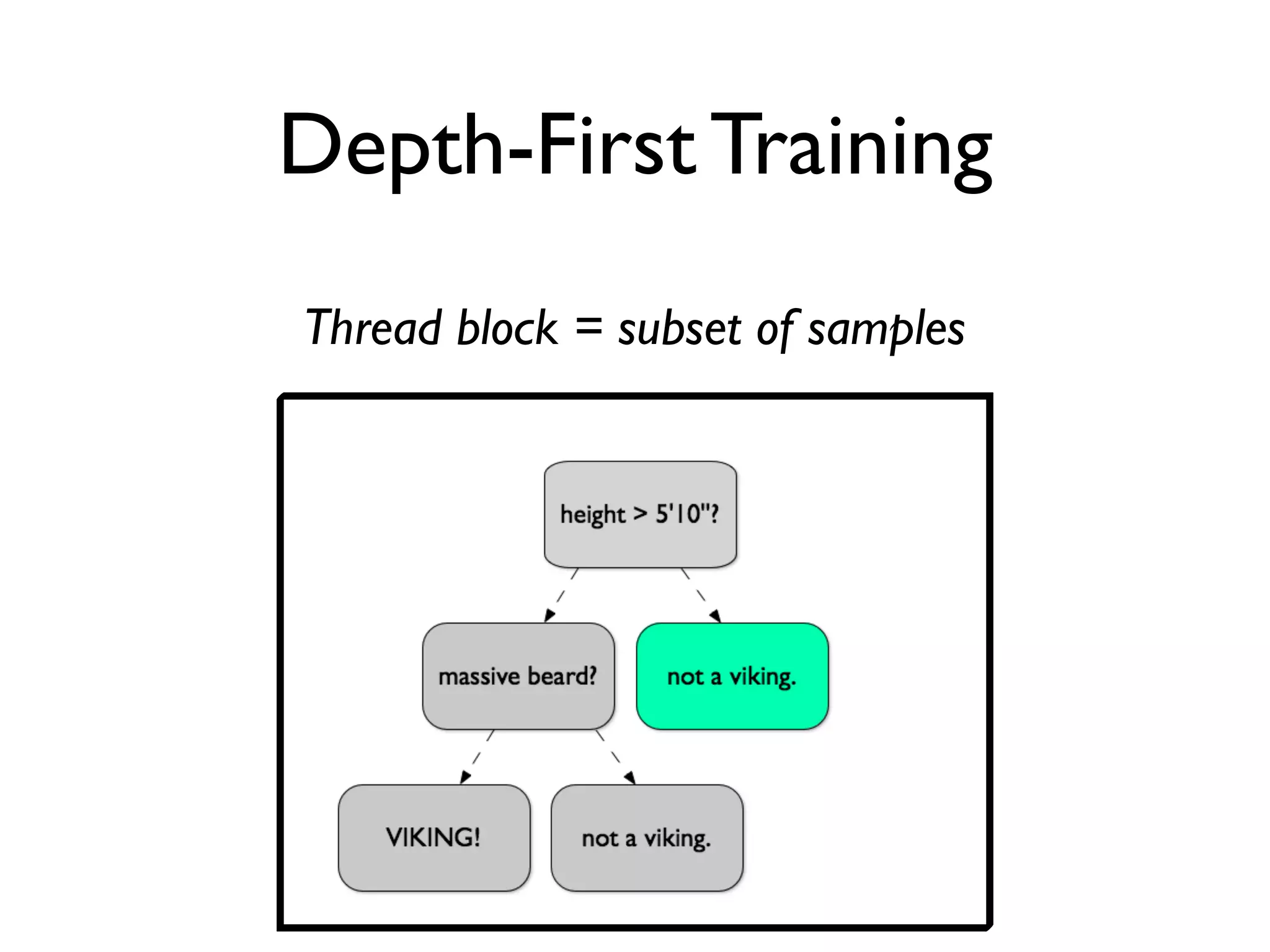
• Depth-First: data parallel threshold
selection for one tree node
• Breadth-First: learn whole level of a tree
simultaneously (threshold per block)
• Hybrid: Use Depth-First training until too
few samples, switch to Breadth-First
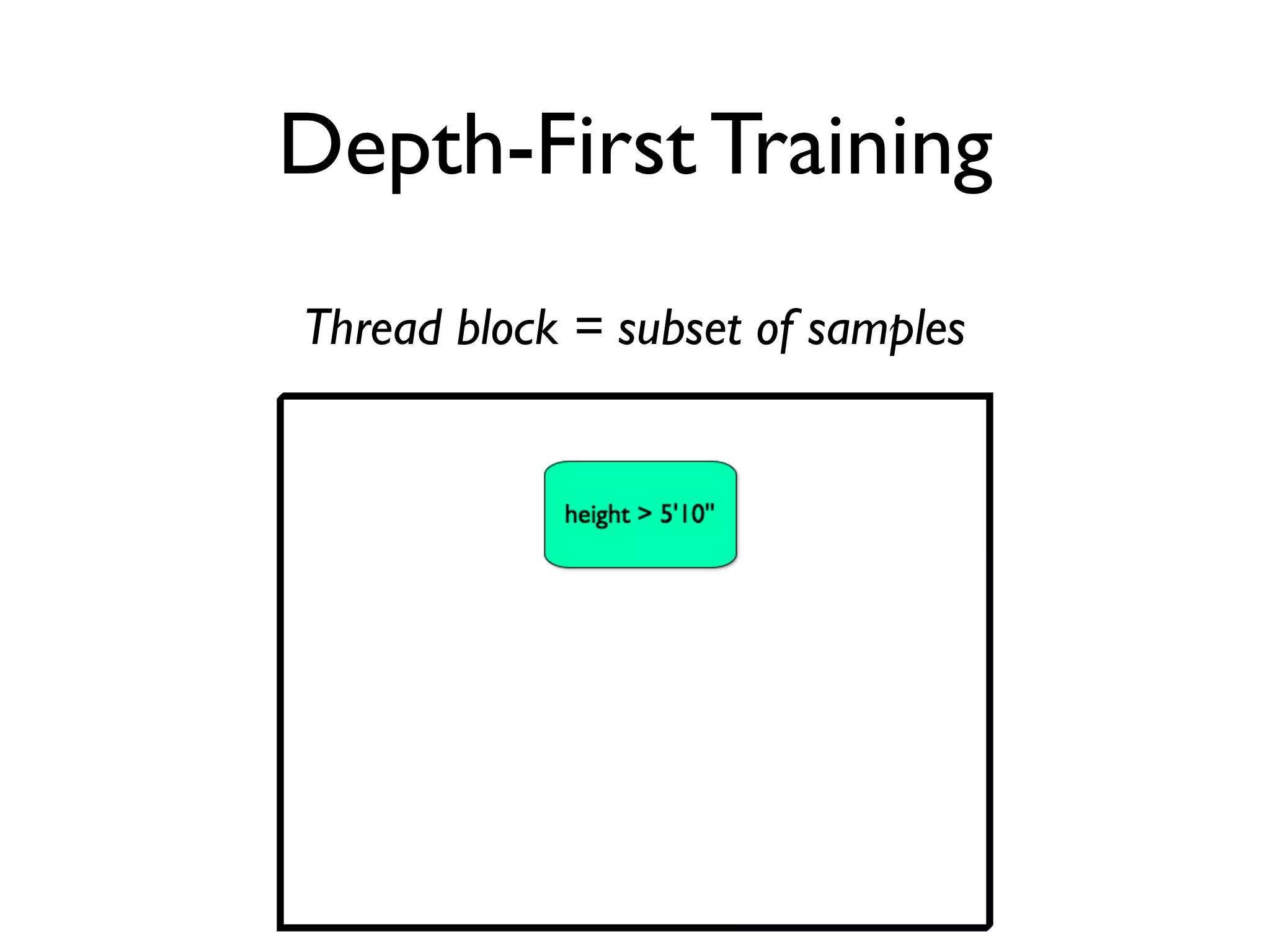
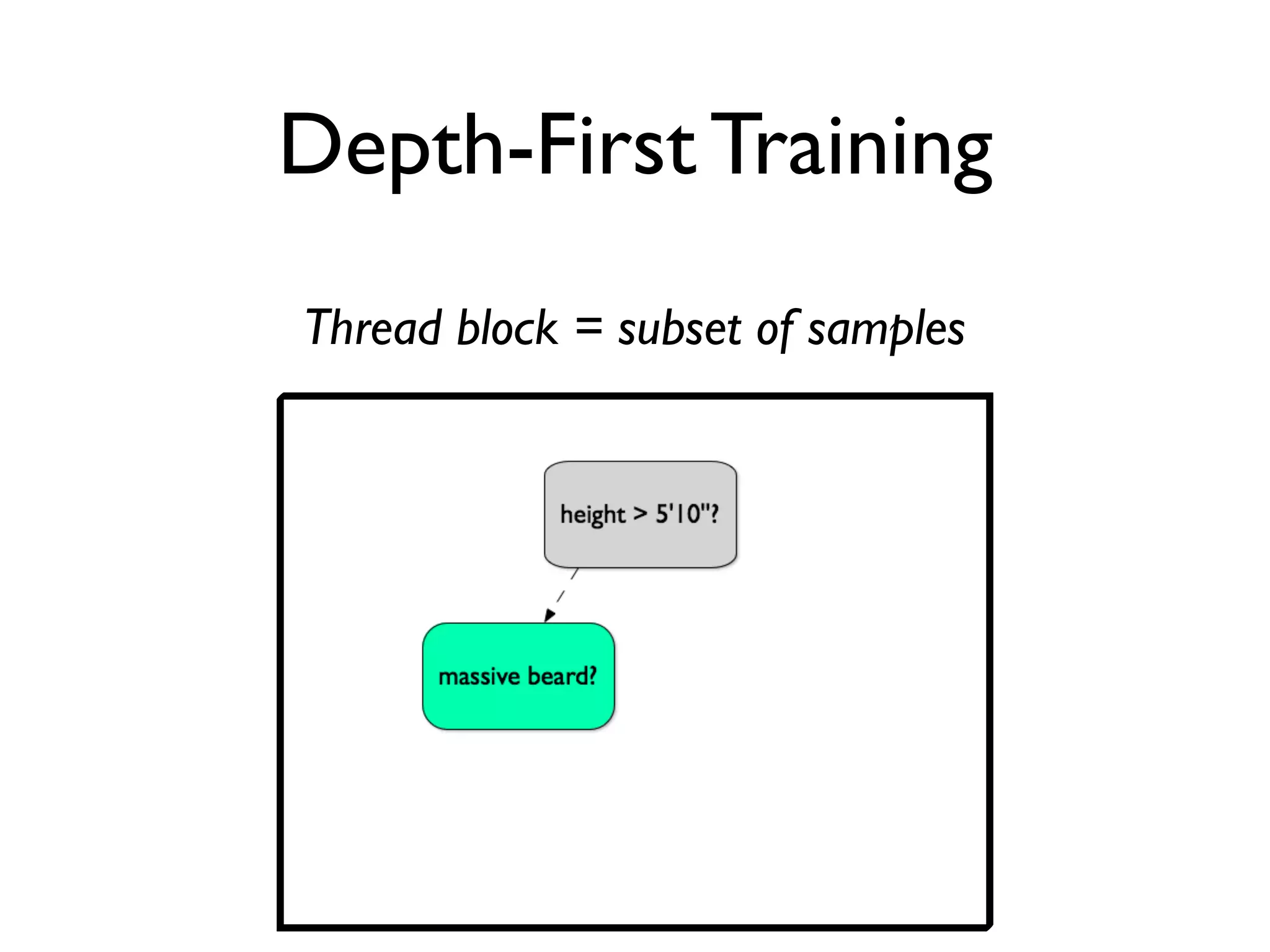
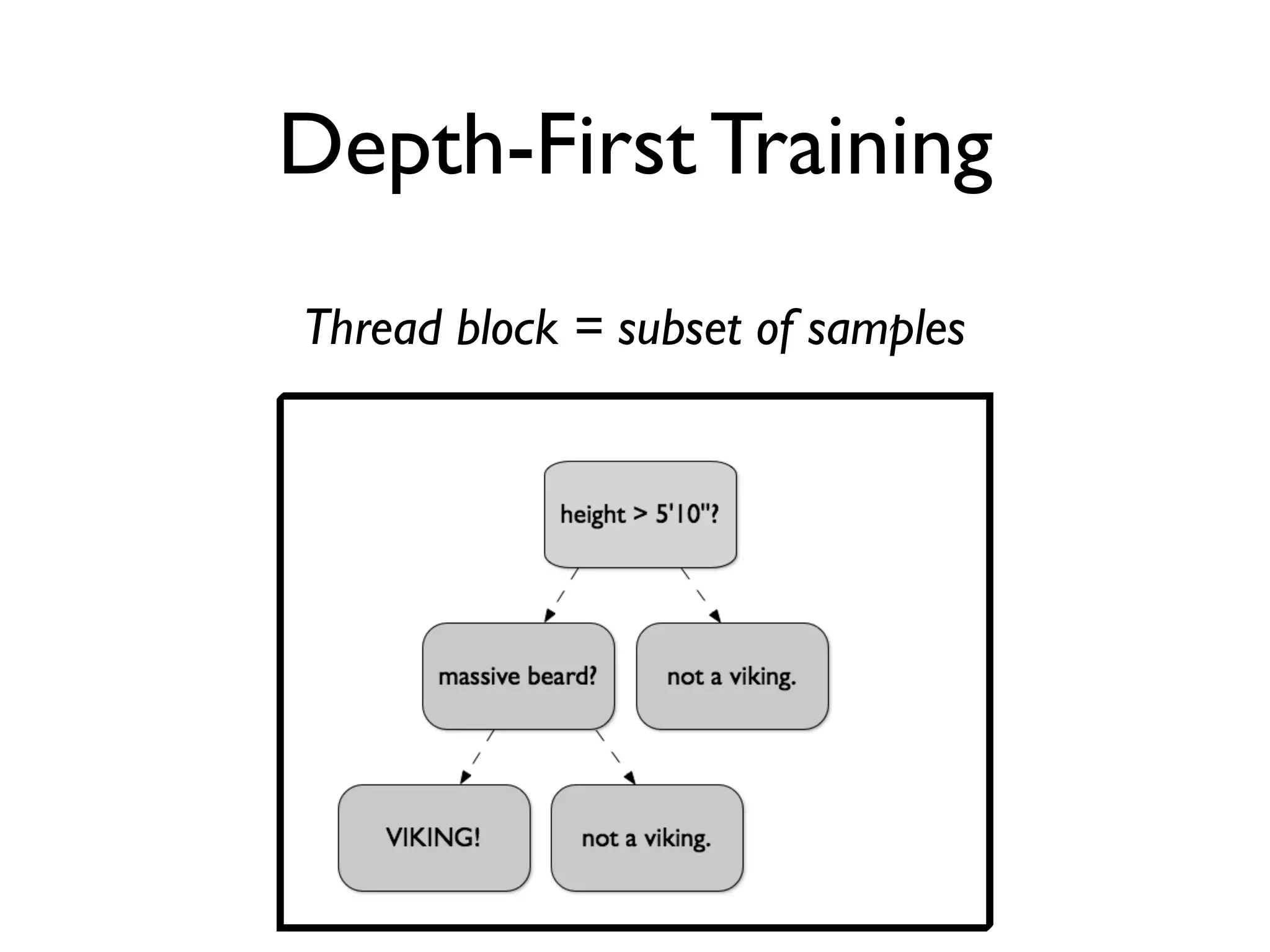
Depth-First Training
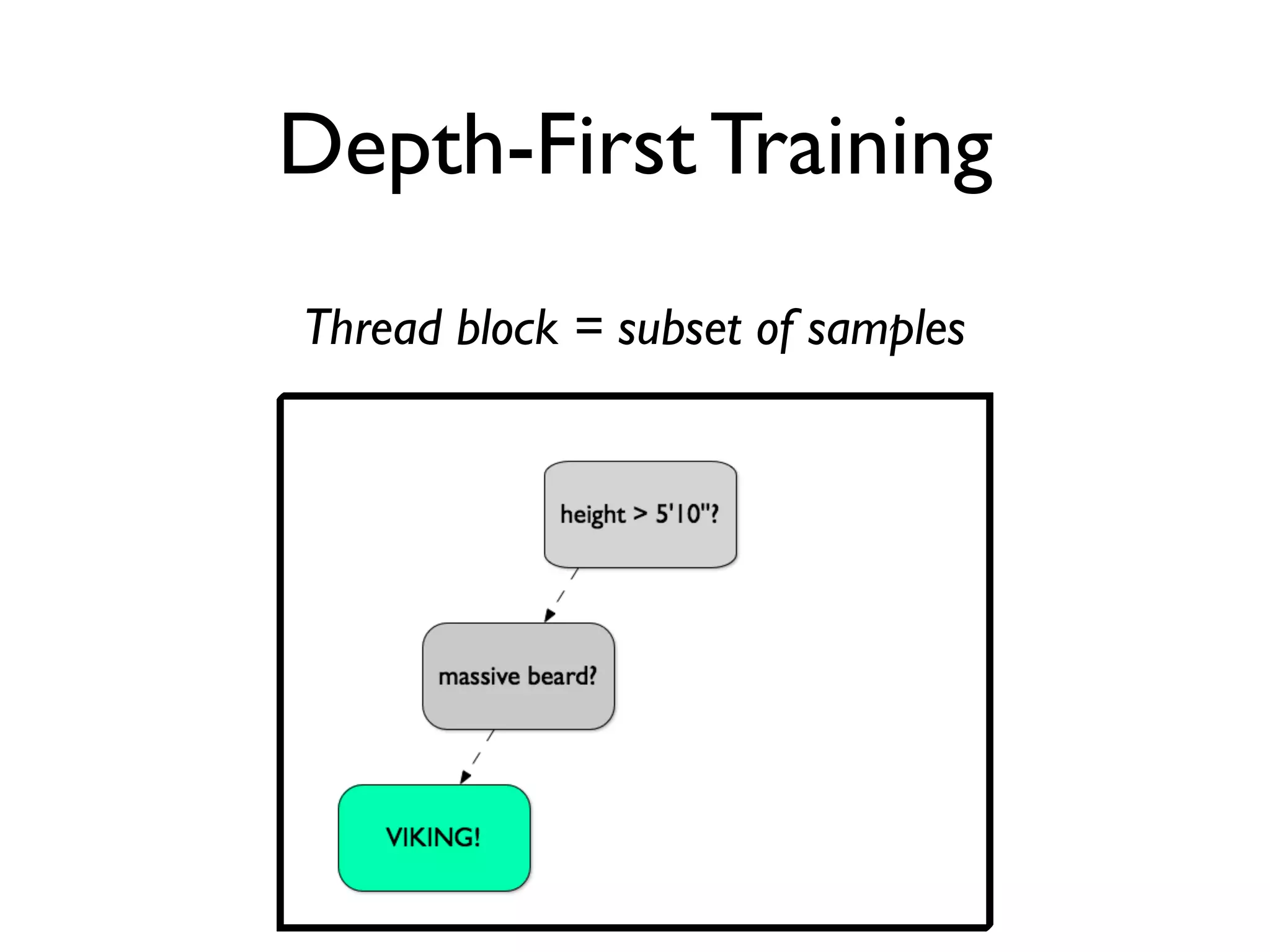
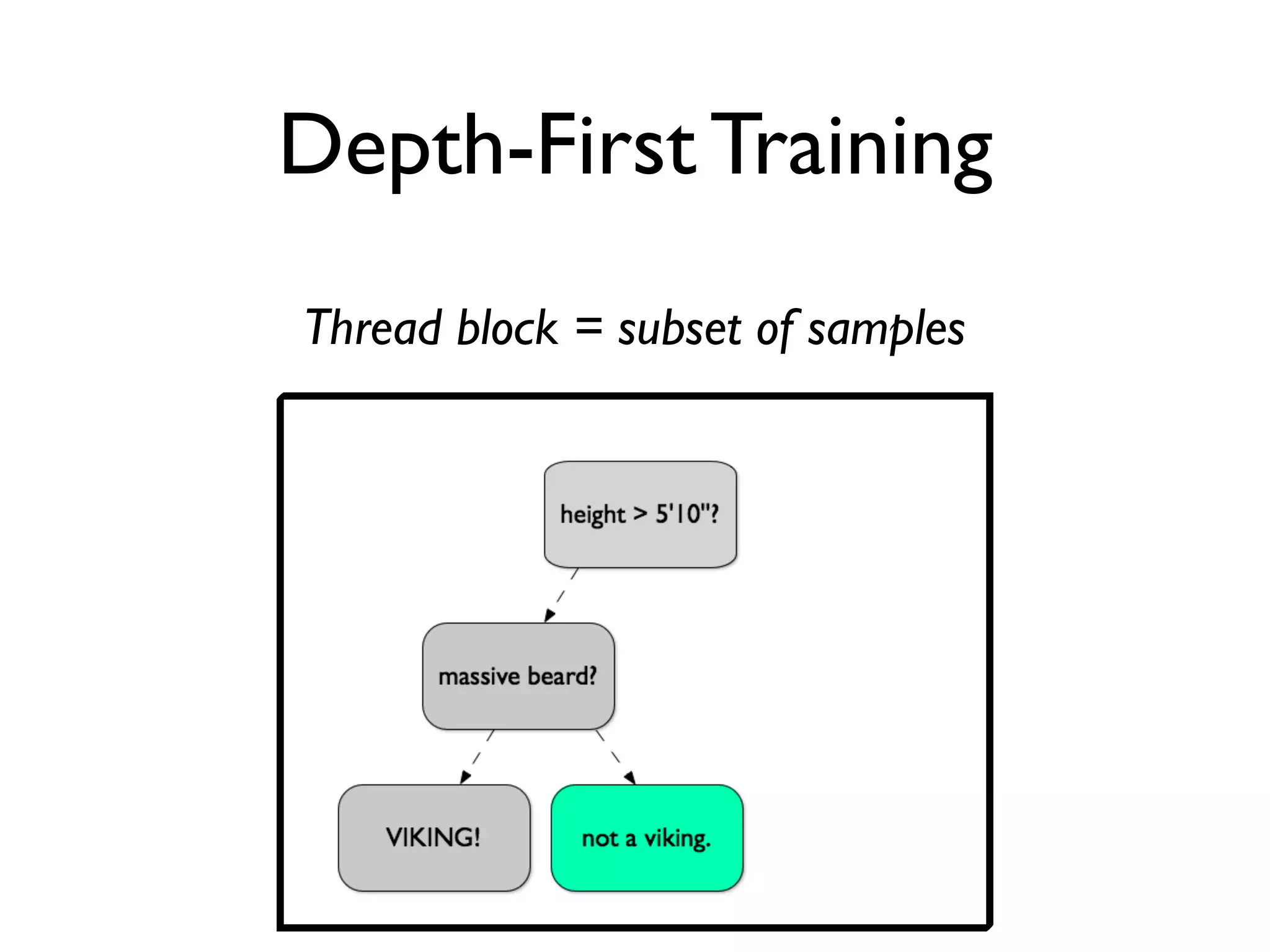
Thread block = subset of samples
Depth-First Training
Thread block = subset of samples
Depth-First Training
Thread block = subset of samples
Depth-First Training
Thread block = subset of samples
Depth-First Training
Thread block = subset of samples
Depth-First Training
Thread block = subset of samples
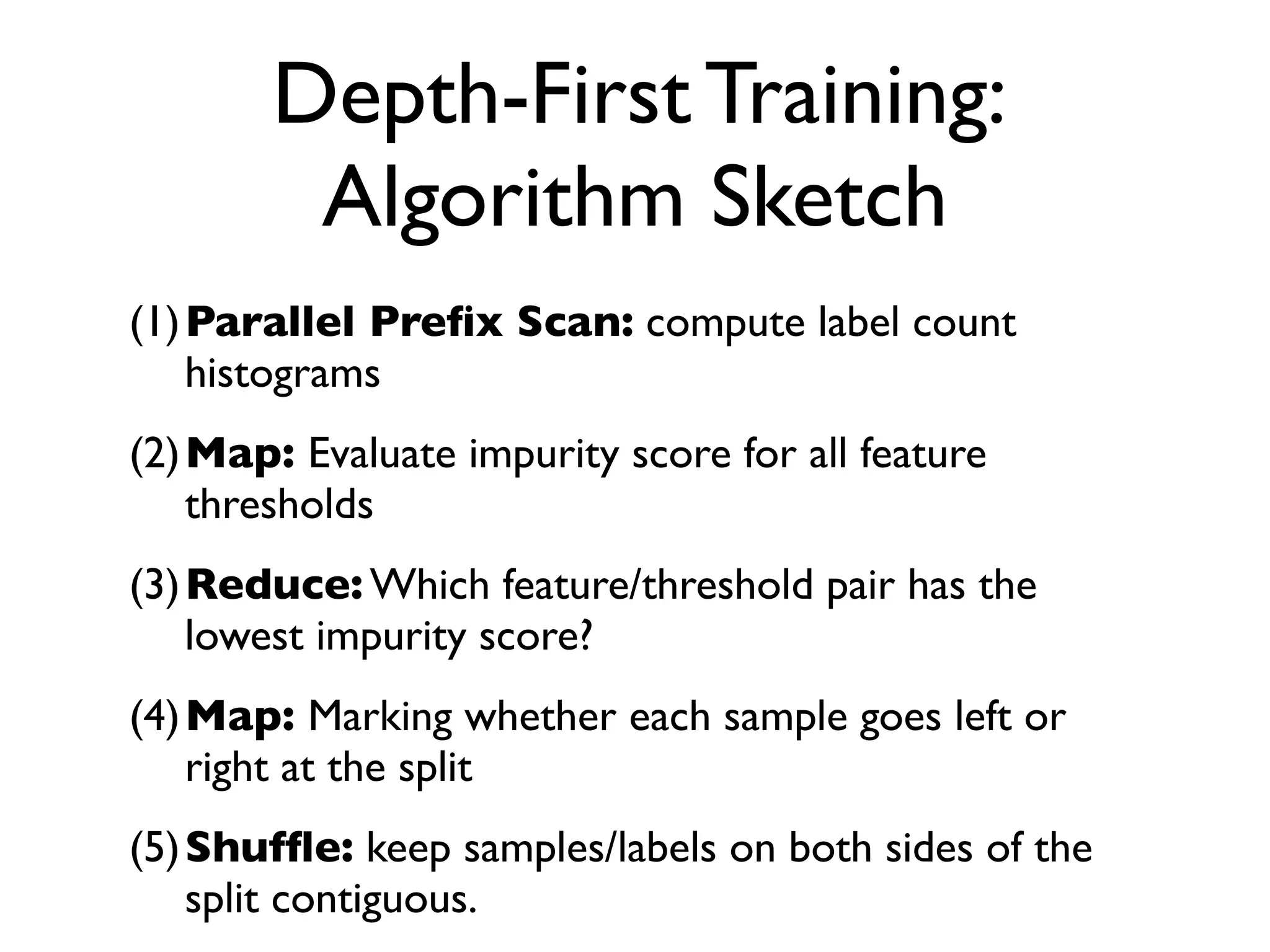
Depth-First Training:
Algorithm Sketch
(1)Parallel Prefix Scan: compute label count
histograms
(2)Map: Evaluate impurity score for all feature
thresholds
(3)Reduce: Which feature/threshold pair has the
lowest impurity score?
(4)Map: Marking whether each sample goes left or
right at the split
(5)Shuffle: keep samples/labels on both sides of the
split contiguous.
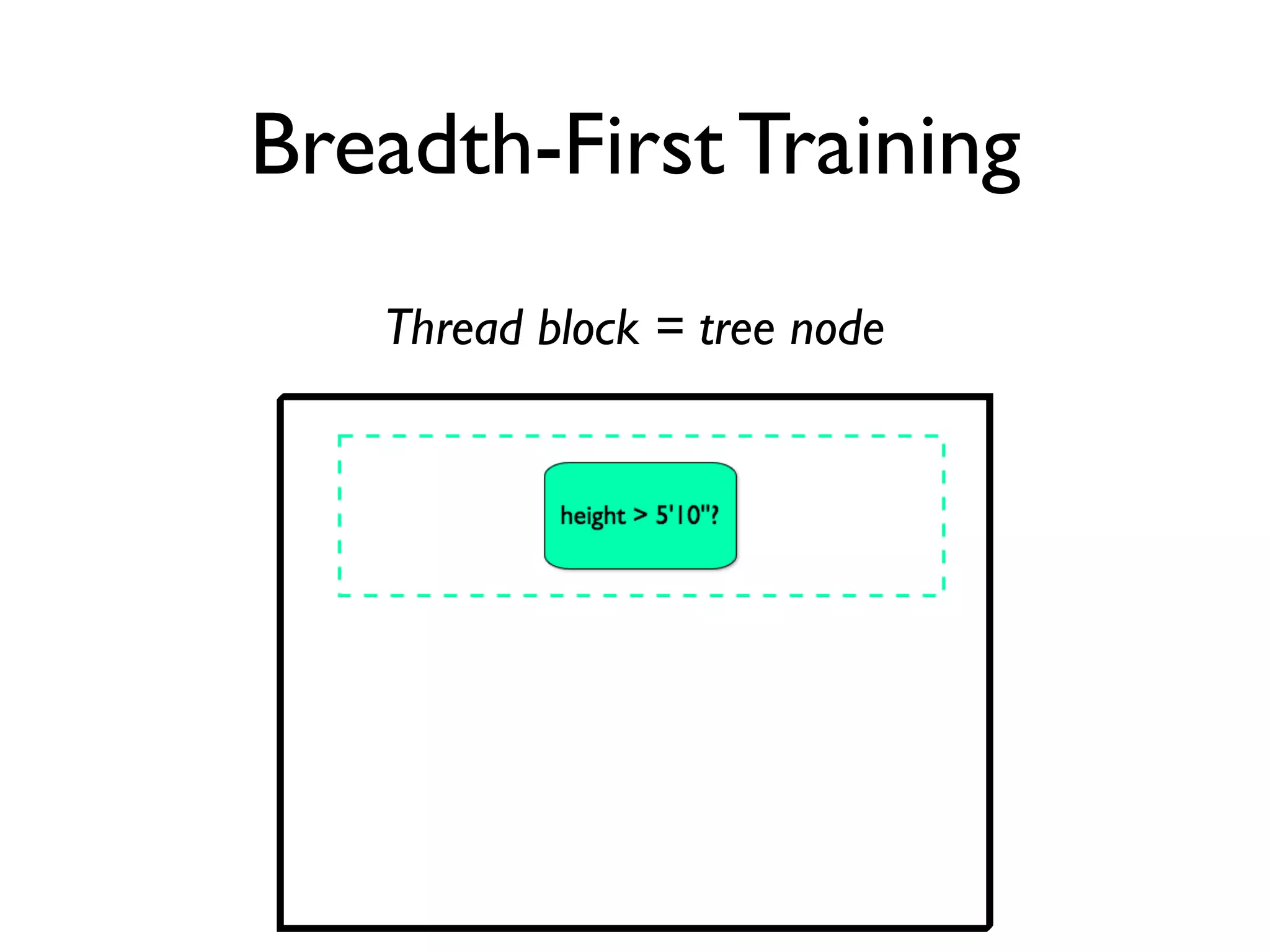
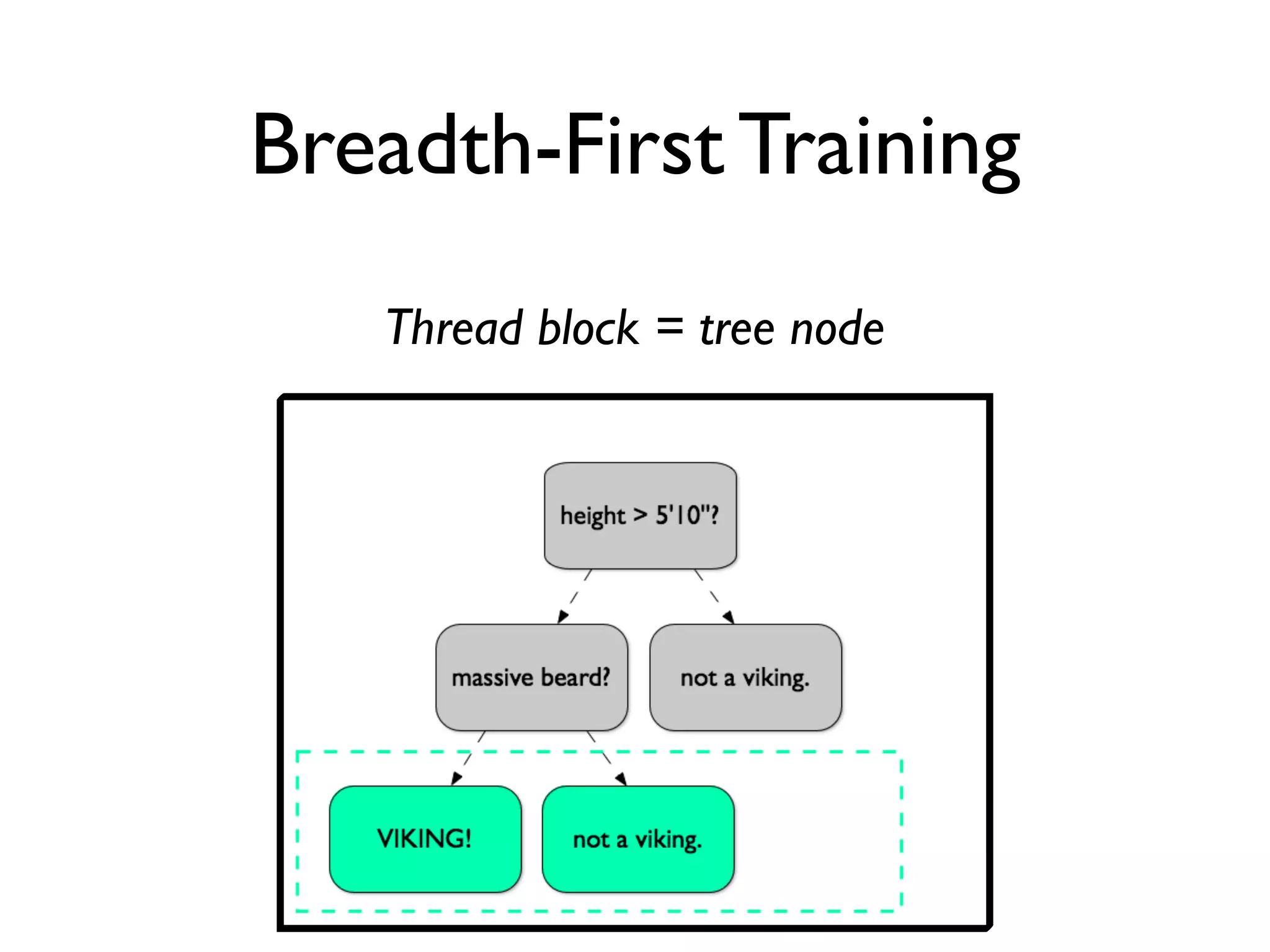
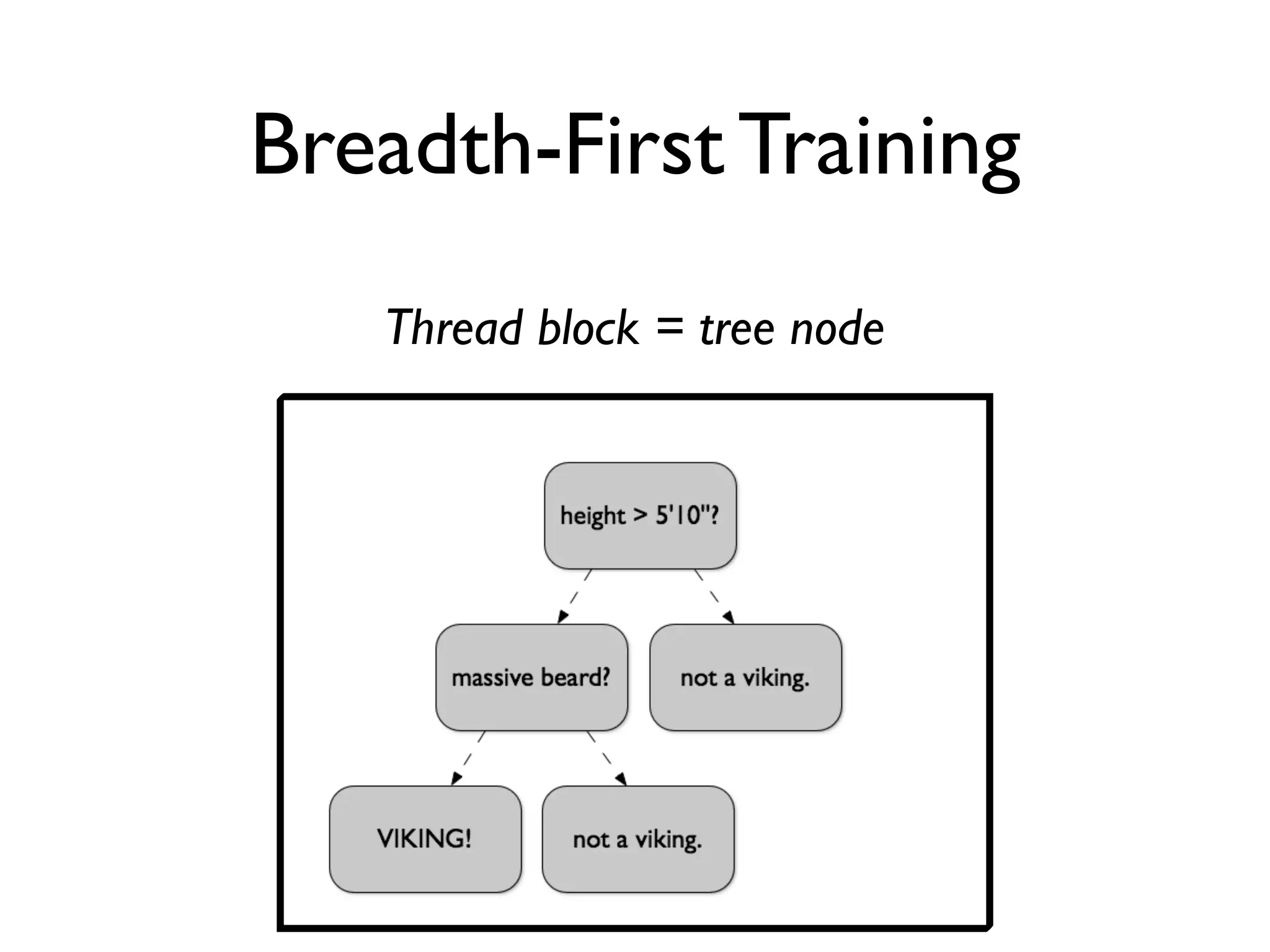
Breadth-First Training
Thread block = tree node
Breadth-First Training
Thread block = tree node
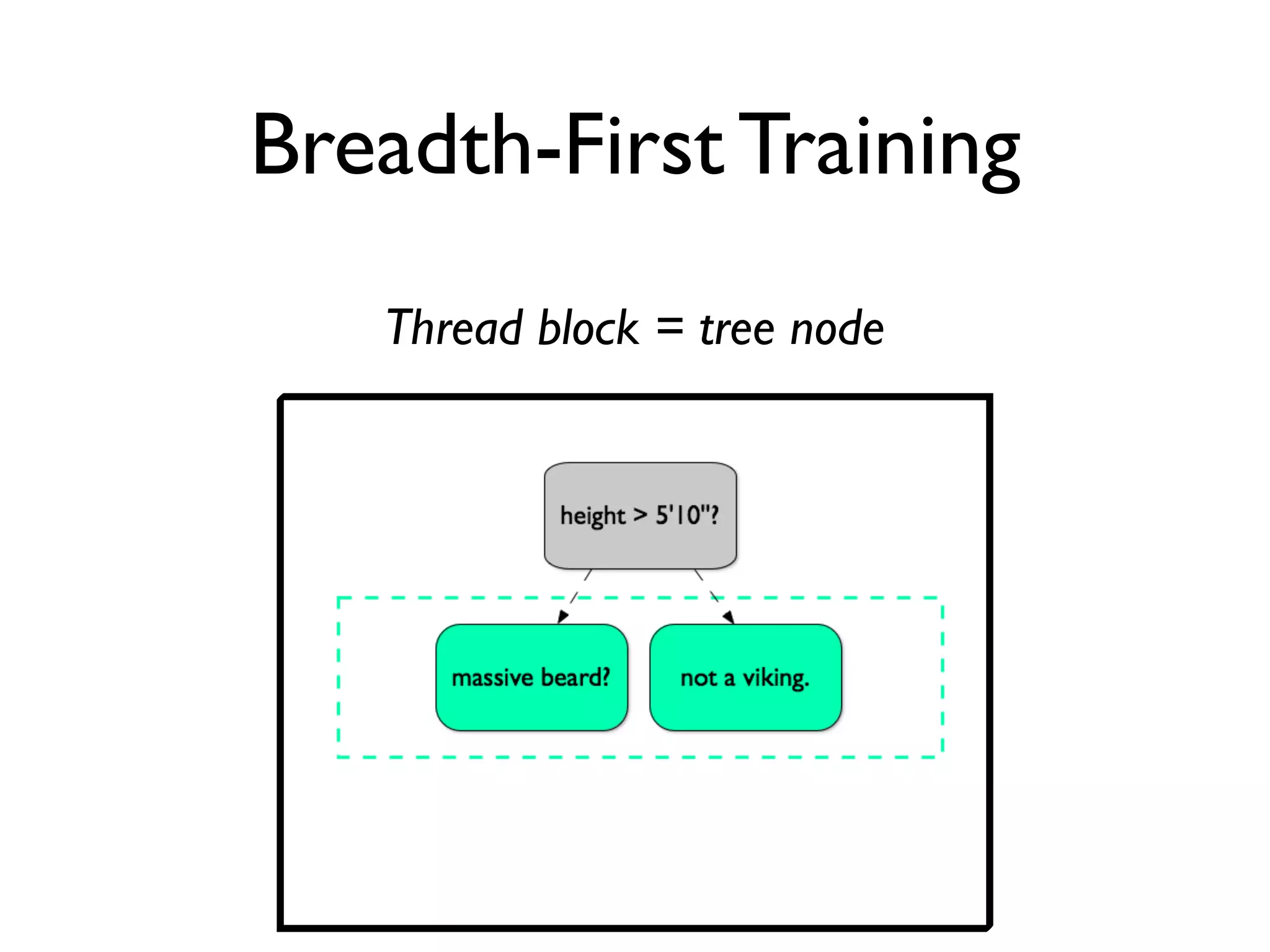
Breadth-First Training
Thread block = tree node
Breadth-First Training
Thread block = tree node
Breadth-First Training:
Algorithm Sketch
Uses the same sequence of data parallel operations
(Scan label counts, Map impurity evaluation, &c) as
Depth-First training but within each thread block
Fast at the bottom of the tree (lots of small tree
nodes), insufficient parallelism at the top.
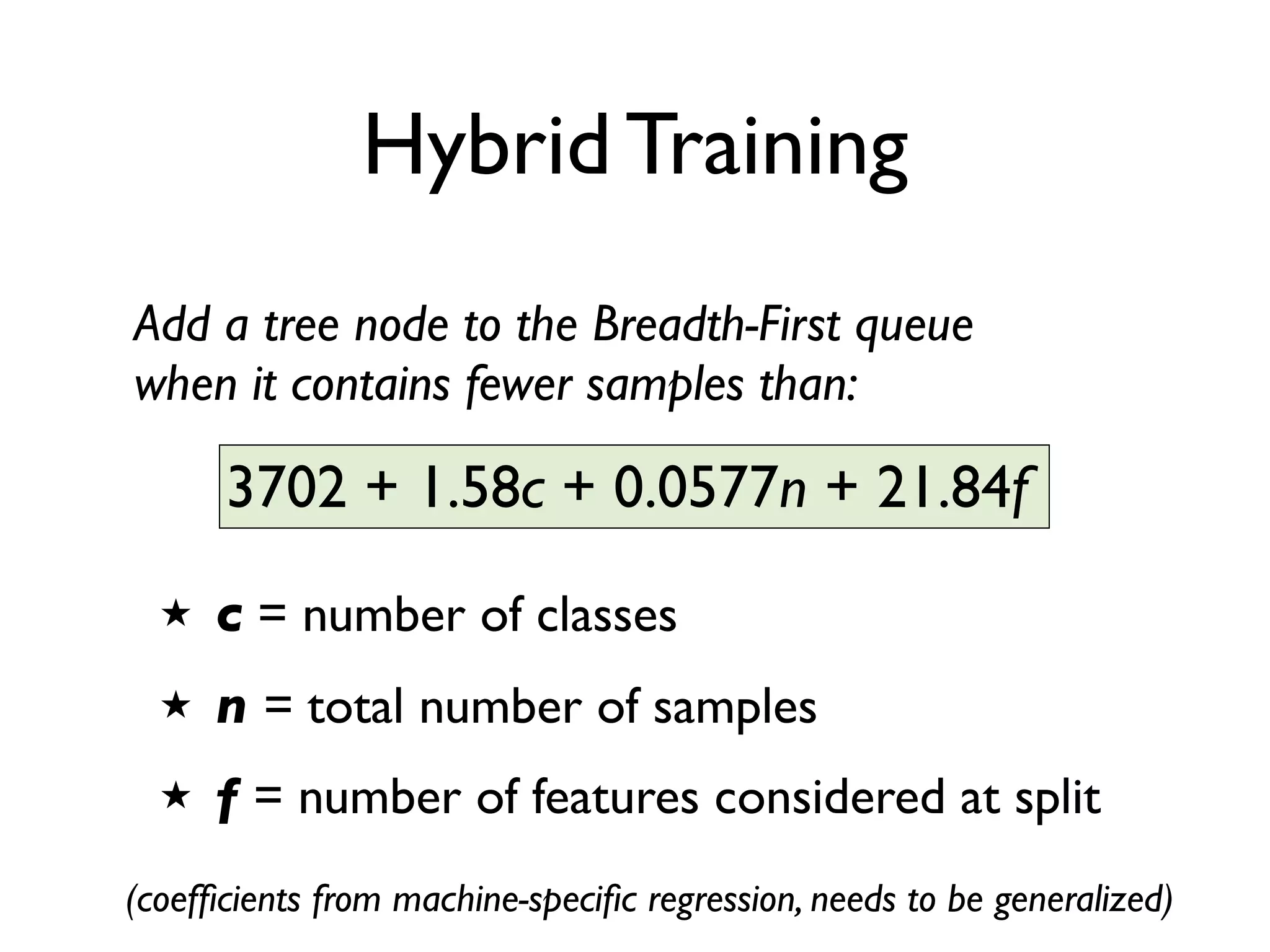
Hybrid Training
★ c = number of classes
★ n = total number of samples
★ f = number of features considered at split
3702 + 1.58c + 0.0577n + 21.84f
Add a tree node to the Breadth-First queue
when it contains fewer samples than:
(coefficients from machine-specific regression, needs to be generalized)
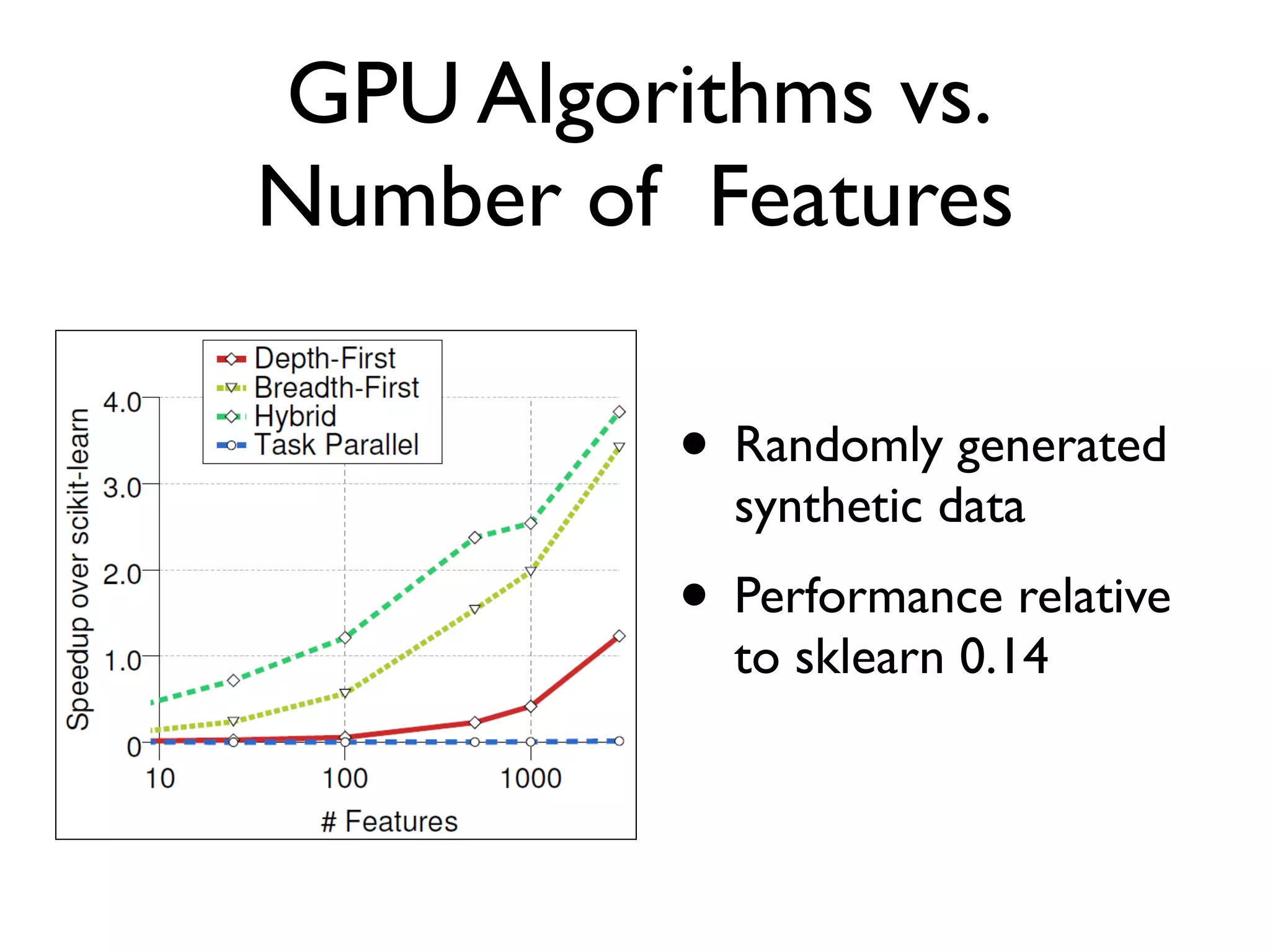
GPU Algorithms vs.
Number of Features
• Randomly generated
synthetic data
• Performance relative
to sklearn 0.14
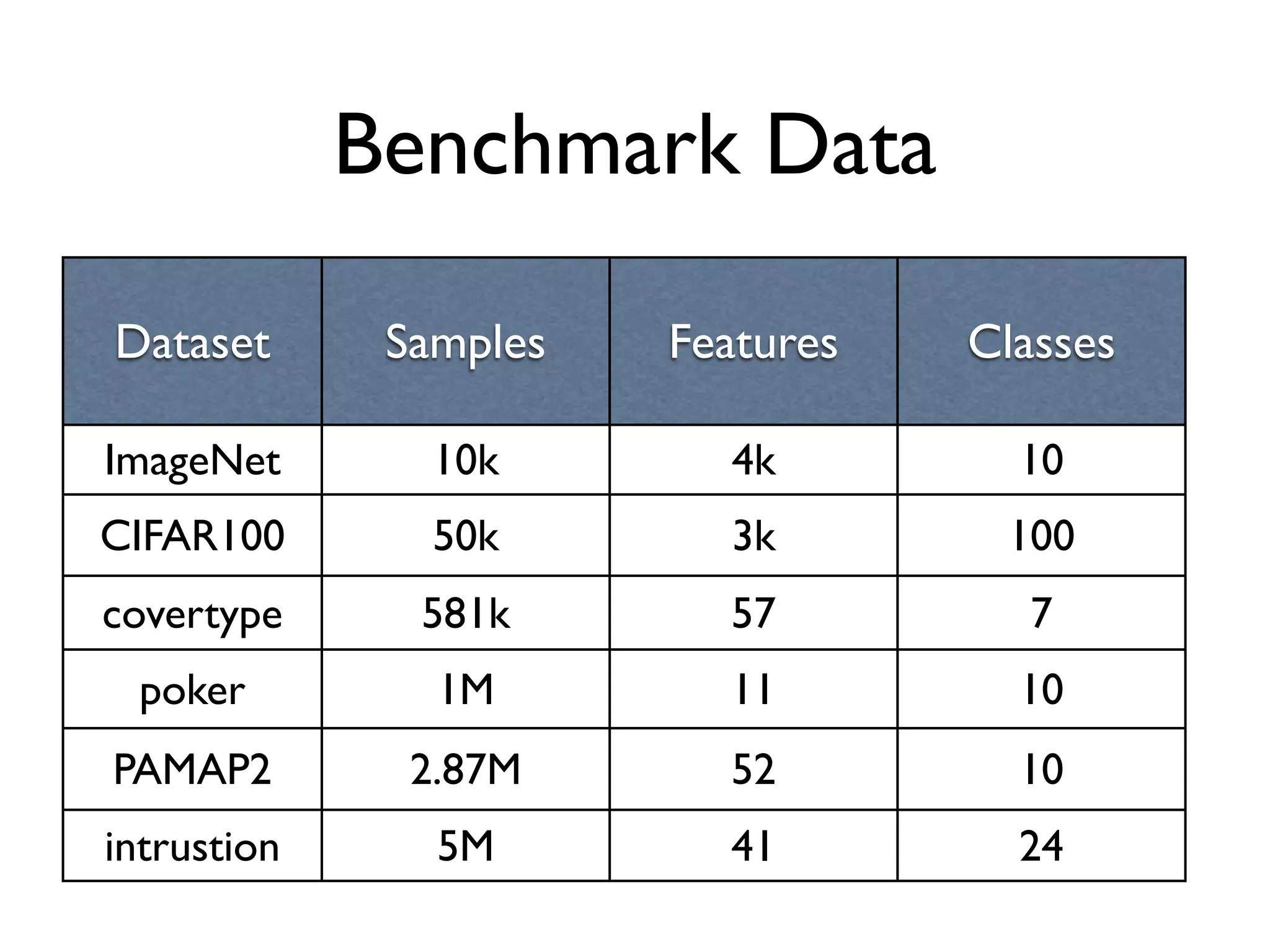
Benchmark Data
Dataset Samples Features Classes
ImageNet 10k 4k 10
CIFAR100 50k 3k 100
covertype 581k 57 7
poker 1M 11 10
PAMAP2 2.87M 52 10
intrustion 5M 41 24
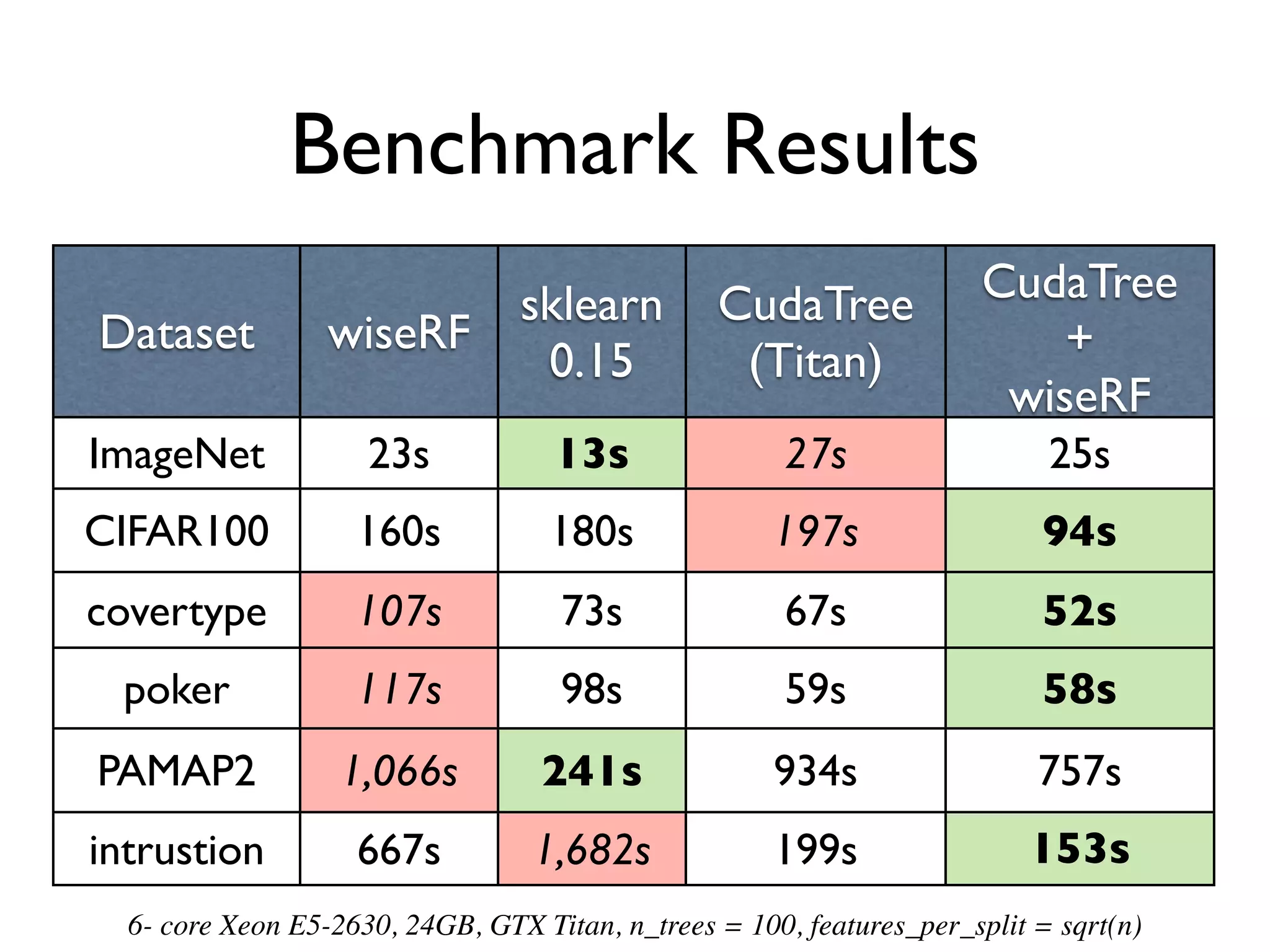
Benchmark Results
Dataset wiseRF
sklearn
0.15
CudaTree
(Titan)
CudaTree
+
wiseRF
ImageNet 23s 13s 27s 25s
CIFAR100 160s 180s 197s 94s
covertype 107s 73s 67s 52s
poker 117s 98s 59s 58s
PAMAP2 1,066s 241s 934s 757s
intrustion 667s 1,682s 199s 153s
6- core Xeon E5-2630, 24GB, GTX Titan, n_trees = 100, features_per_split = sqrt(n)
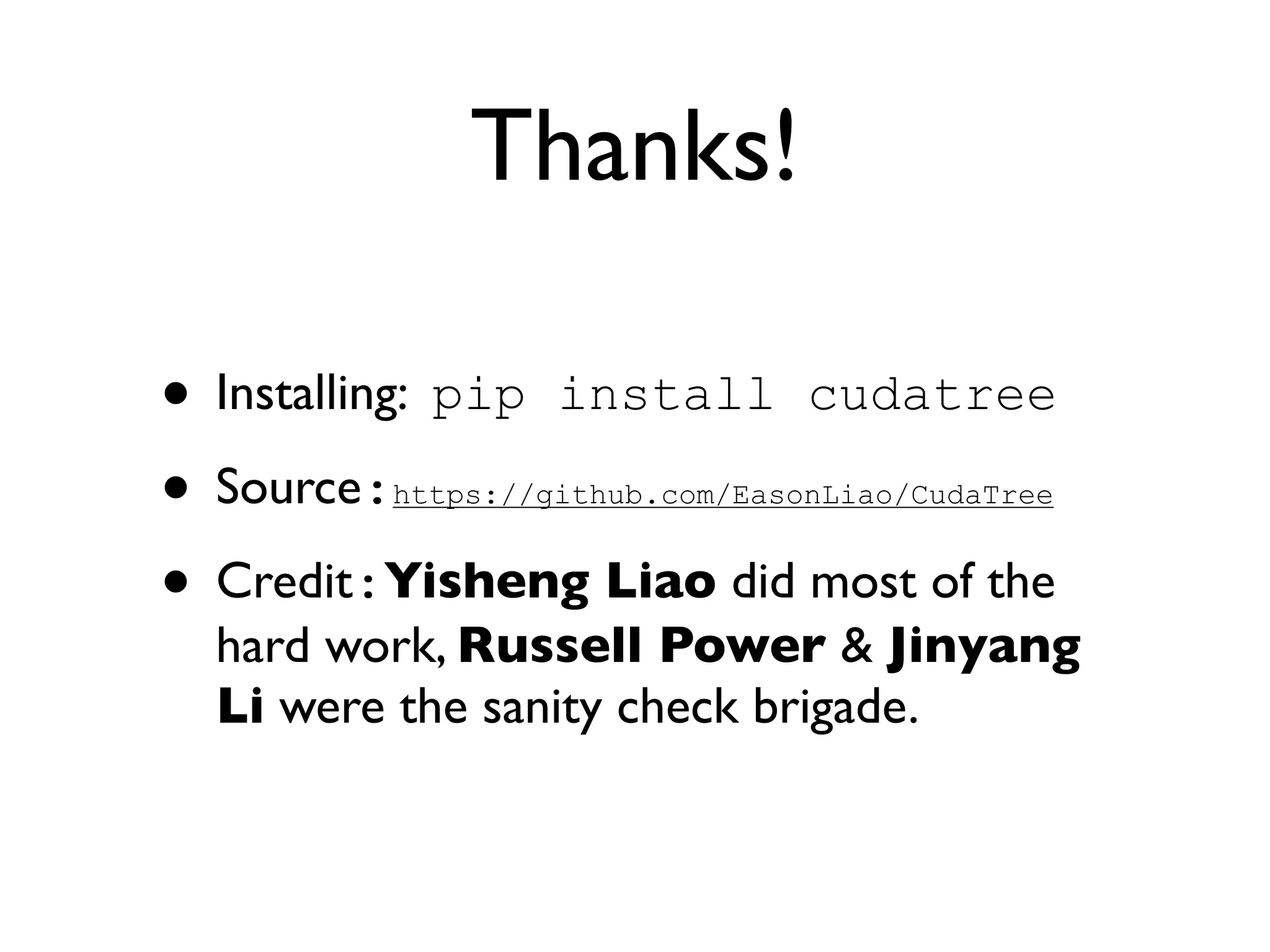
Thanks!
• Installing: pip install cudatree
• Source:https://github.com/EasonLiao/CudaTree
• Credit:Yisheng Liao did most of the
hard work, Russell Power & Jinyang
Li were the sanity check brigade.

CudaTree (GTC 2014)