Random forests are an ensemble learning method that constructs multiple decision trees during training and outputs the class that is the mode of the classes of the individual trees. The document discusses random forest concepts and implementations in scikit-learn, including extreme random forests, balancing random forests to address class imbalance, using grid search to tune hyperparameters, measuring feature importance, and balancing training data through resampling techniques.
![3
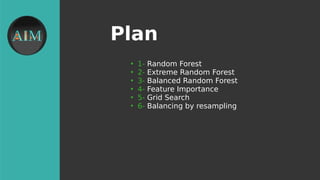
1-RandomForest
[By Amina Delali]
ConceptConcept
●
A random forest is :
Bagging or pasting. + Decision Trees:
with random
split
==
Bagging with Decision Trees as classifier. The trees use a random
subset of features at each split
An ensemble learning method composed only of Decision Trees.
They are trained on different random subsets of training data (with or
without replacement) . To split a node, the trees select the best
features from a random subset of features .
==](https://image.slidesharecdn.com/aaa-ped-15-190413161110/85/Aaa-ped-15-Ensemble-Learning-Random-Forests-3-320.jpg)
![4
1-RandomForest
[By Amina Delali]
Random forest in sklearn: method 1Random forest in sklearn: method 1
●
Using a Bagging Classifer: since a random forest is a special case,
of a bagging method. We can use a Bagging Classifer with
decision trees as estimator.
By specifying the splitter= “random”, at each split,
the chosen feature will be the “best random
feature”: the best feature from a random subset
of features.](https://image.slidesharecdn.com/aaa-ped-15-190413161110/85/Aaa-ped-15-Ensemble-Learning-Random-Forests-4-320.jpg)
![5
1-RandomForest
[By Amina Delali]
Random forest in sklearn: method 2Random forest in sklearn: method 2
●
Using the random forest classifer class: in sklearn, the size of the
samples used in the trees is the same as the original data size.
There is no “splitter” parameter. Almost all other default
parameters are the same. The only one that differs is :
max_features which is here set by default to “auto”. The
only parameter we had to specify is (to be adequate with
the tree of the previous example) is : max_depth
max_features =“auto” means that:
max_features = sqrt(numb_features)
Same parameters
used in the bagging
classifier for the
previous example.](https://image.slidesharecdn.com/aaa-ped-15-190413161110/85/Aaa-ped-15-Ensemble-Learning-Random-Forests-5-320.jpg)
![6
2-Extreme
RandomForest
[By Amina Delali]
ConceptConcept
●
In Extreme random forests, the thresholds used in the
decision trees are selected randomly, instead of choosing the
best one.
●
They are also called “Extremely randomized Trees” or “Extra
Trees”.
●
In sklearn, they are: “ExtraTreesClassifer” and
“ExtraTreesRegeressor”
●
“ExtraTreesClassifer” are random forests, but there is in sklearn
“ExtraTreeClassifer” which is a decision tree and not a forest.](https://image.slidesharecdn.com/aaa-ped-15-190413161110/85/Aaa-ped-15-Ensemble-Learning-Random-Forests-6-320.jpg)
![7
2-Extreme
RandomForest
[By Amina Delali]
ExampleExample
●](https://image.slidesharecdn.com/aaa-ped-15-190413161110/85/Aaa-ped-15-Ensemble-Learning-Random-Forests-7-320.jpg)
![8
2-Extreme
RandomForest
[By Amina Delali]
Out of bag scoresOut of bag scores
●
The bag refers to the training samples selected and used by a
predictor in a bagging method.
●
The out of bag, are the remaining samples.
●
For each predictor, it is possible to compute its score using its out
of bag samples.
●
At the end of the training, the average of all these scores will
represent the “out of bag score” of the learning method.
●
In sklearn, you have to specify: “oob_score =True” as parameter of
the bagging method.](https://image.slidesharecdn.com/aaa-ped-15-190413161110/85/Aaa-ped-15-Ensemble-Learning-Random-Forests-8-320.jpg)
![9
3-Balanced
RandomForest
[By Amina Delali]
ConceptConcept
●
Sometimes, in classifcation, the representation of your classes in
the training data is “unbalanced”. For example, in a binary
classifcation, you can have a big number of samples belonging to
the frst class. And, only few samples related to the other one.
●
In this case, the learning method will not be able to classify
correctly.
●
To avoid this situation, scikit-learn allow us to defne a parameter
called: class_weight, with a special value: “balanced” ==> it will
attribute bigger weights for less present classes.
●
The formula is as follow: n_samples / (n_classes * np.bincount(y))
Count number of
occurrences of each value in
y](https://image.slidesharecdn.com/aaa-ped-15-190413161110/85/Aaa-ped-15-Ensemble-Learning-Random-Forests-9-320.jpg)
![10
3-Balanced
RandomForest
[By Amina Delali]
Example without balancingExample without balancing
●
Loading the
data, and
extracting x
and y values
We will use yellowbrick library to visualize
our classification boundaries.](https://image.slidesharecdn.com/aaa-ped-15-190413161110/85/Aaa-ped-15-Ensemble-Learning-Random-Forests-10-320.jpg)
![11
3-Balanced
RandomForest
[By Amina Delali]
Example without balancing (suite)Example without balancing (suite)
●
The classes are
not balanced
We see that some
samples belonging to
class 0 are predicted
to be in class 1 and
vice versa.](https://image.slidesharecdn.com/aaa-ped-15-190413161110/85/Aaa-ped-15-Ensemble-Learning-Random-Forests-11-320.jpg)
![12
3-Balanced
RandomForest
[By Amina Delali]
Same example with balancingSame example with balancing
●
Balanced classes
●
We see clearly that the
decision boundaries
changed: the area of
class 0 is bigger now
●
But, we have more
classes 1 predicted as
belonging to class 0.](https://image.slidesharecdn.com/aaa-ped-15-190413161110/85/Aaa-ped-15-Ensemble-Learning-Random-Forests-12-320.jpg)
![13
4-GridSearch
[By Amina Delali]
ConceptConcept
●
GridSearch is a tool used to test a learning model with a list of
dictionaries containing diferent parameters.
●
We will use it to fnd the best parameters for a Random Forest
method. We will apply it on the already used iris data.
First the first
dictionary we
have: 9
combinations of
parameters. For
the second one
we have: 12
combinations.](https://image.slidesharecdn.com/aaa-ped-15-190413161110/85/Aaa-ped-15-Ensemble-Learning-Random-Forests-13-320.jpg)
![14
4-GridSearch
[By Amina Delali]
Example resultsExample results
●
• We can see that
augmenting the number
of estimators doesn’t
necessary enhance the
results.
●
Same observation about
max_depth value](https://image.slidesharecdn.com/aaa-ped-15-190413161110/85/Aaa-ped-15-Ensemble-Learning-Random-Forests-14-320.jpg)
![15
4-GridSearch
[By Amina Delali]
Best result visualizationBest result visualization
●
●
We will display the confusion matrix using yellowbrick.
The confusion
matrix is
printed as a
“heat-map”:
the best
values are the
darkest, and
vice-versa.](https://image.slidesharecdn.com/aaa-ped-15-190413161110/85/Aaa-ped-15-Ensemble-Learning-Random-Forests-15-320.jpg)
![16
5-FeatureImportance
[By Amina Delali]
ConceptConcept
●
The features in a data set have not the same importance.
●
In a decision tree, this importance can be deduced from the
distance between the appearance of a feature in a decision
node and the root.
●
In a random forest, the average of the distances corresponding
to each tree will represent the feature’s importance.
●
Scikit-learn implements this method.
We can see clearly
that the most
important features
are: “petal length”
and “petal width”](https://image.slidesharecdn.com/aaa-ped-15-190413161110/85/Aaa-ped-15-Ensemble-Learning-Random-Forests-16-320.jpg)
![17
5-FeatureImportance
[By Amina Delali]
Visualization of the features importanceVisualization of the features importance
●
Again, we will use yellowbrick.
Most important
features](https://image.slidesharecdn.com/aaa-ped-15-190413161110/85/Aaa-ped-15-Ensemble-Learning-Random-Forests-17-320.jpg)
![18
5-FeatureImportance
[By Amina Delali]
Comparison of resultsComparison of results
●
Using only 2 most
important features
(same result as using
all the features)
Using only 2 least
important features
(same result as using
all the features)](https://image.slidesharecdn.com/aaa-ped-15-190413161110/85/Aaa-ped-15-Ensemble-Learning-Random-Forests-18-320.jpg)
![19
6-Balancing
byresampling
[By Amina Delali]
ConceptConcept
●
An other way to obtain a balanced training set, is to remove
samples from the majority class. Which is called: under-
sampling. Or, to add new samples belonging to the less
represented class. Which is called: over-sampling.
●
There is a variety of resampling techniques. The library
imbalanced-learn library implements some of them.
●
For a RandomForest classifer, it applies: random under-
sampling technique with diferent strategies.
●
The default one is to : resample all classes but the minority class;](https://image.slidesharecdn.com/aaa-ped-15-190413161110/85/Aaa-ped-15-Ensemble-Learning-Random-Forests-19-320.jpg)
![20
6-Balancing
byresampling
[By Amina Delali]
ExampleExample
●
In this example, we combine the 2 libraries: yellowbrick and
imbalanced-learn](https://image.slidesharecdn.com/aaa-ped-15-190413161110/85/Aaa-ped-15-Ensemble-Learning-Random-Forests-20-320.jpg)
![21
6-Balancing
byresampling
[By Amina Delali]
Example (suite)Example (suite)
●
We can see that the class 0 region
obtained is different than the one
obtained using sckit-learn weighting
technique](https://image.slidesharecdn.com/aaa-ped-15-190413161110/85/Aaa-ped-15-Ensemble-Learning-Random-Forests-21-320.jpg)




![Polymer [ बहुलक ] Chemistry Notes PDF - Irfanullah Mehar - JJ Sir Chemistry.pdf](https://cdn.slidesharecdn.com/ss_thumbnails/polymerchemistrynotespdf-irfanullahmehar-jjsirchemistry-260210172118-3f9b37f7-thumbnail.jpg?width=640&height=640&fit=bounds)


