TensorFlow usage
Babii Andrii
Ph.D. student, Kharkiv National University of Radioelectronics
andrii.babii@nure.ua
2
Motivation
1. Data and model parallelism
2. TensorBoard for visualization
3. Computational graph abstraction
4. Python + Numpy
5. Great documentation and examples
6. More than deep learning framework
+ Now conception of ‘Python front-end’ for hard backend is trending
TinyFlow
http://dmlc.ml/2016/09/30/build-your-own-tensorflow-with-nnvm-and-torch.html
Syntax (‘Frontend’) like TensorFlow but interpretation is … Torch!
NNVM inspired by LLVM…
It provides ways to construct, represent and transform computation graphs
invariant of how it is executed.
3
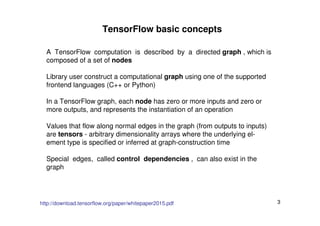
TensorFlow basic concepts
A TensorFlow computation is described by a directed graph , which is
composed of a set of nodes
Library user construct a computational graph using one of the supported
frontend languages (C++ or Python)
In a TensorFlow graph, each node has zero or more inputs and zero or
more outputs, and represents the instantiation of an operation
Values that flow along normal edges in the graph (from outputs to inputs)
are tensors - arbitrary dimensionality arrays where the underlying el-
ement type is specified or inferred at graph-construction time
Special edges, called control dependencies , can also exist in the
graph
http://download.tensorflow.org/paper/whitepaper2015.pdf
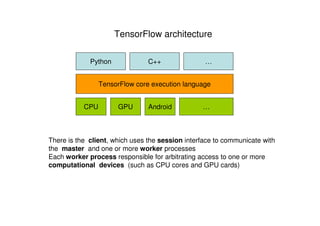
TensorFlow architecture
Python C++ …
TensorFlow core execution language
CPU GPU Android …
There is the client, which uses the session interface to communicate with
the master and one or more worker processes
Each worker process responsible for arbitrating access to one or more
computational devices (such as CPU cores and GPU cards)
TensorFlow Computation graph
https://www.tensorflow.org/
TensorFlow basic concepts. Tensor
A Tensor is a typed multi-dimensional array. For example, a 4-D array of
floating point numbers representing a mini-batch of images with dimensions
[batch, height, width, channel].
In a launched graph: Type of the data that flow between nodes.
In the Python API: class used to represent the output and inputs of ops added
to the graph tf.Tensor. Instances of this class do not hold data.
In the C++ API: class used to represent tensors returned from a Session::Run()
call tensorflow::Tensor. Instances of this class hold data.
https://www.tensorflow.org/versions/r0.9/resources/glossary.html#glossary
TensorFlow basic concepts. Operations
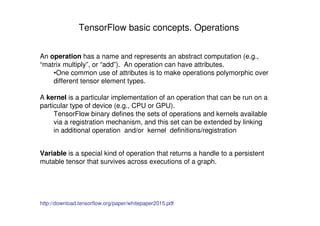
An operation has a name and represents an abstract computation (e.g.,
“matrix multiply”, or “add”). An operation can have attributes.
•One common use of attributes is to make operations polymorphic over
different tensor element types.
A kernel is a particular implementation of an operation that can be run on a
particular type of device (e.g., CPU or GPU).
TensorFlow binary defines the sets of operations and kernels available
via a registration mechanism, and this set can be extended by linking
in additional operation and/or kernel definitions/registration
http://download.tensorflow.org/paper/whitepaper2015.pdf
Variable is a special kind of operation that returns a handle to a persistent
mutable tensor that survives across executions of a graph.
TensoFlow built-in operations
http://download.tensorflow.org/paper/whitepaper2015.pdf
9
TensorFlow. Execution of computation graph
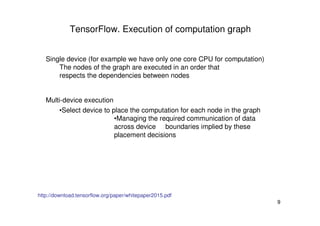
Single device (for example we have only one core CPU for computation)
The nodes of the graph are executed in an order that
respects the dependencies between nodes
Multi-device execution
•Select device to place the computation for each node in the graph
•Managing the required communication of data
across device boundaries implied by these
placement decisions
http://download.tensorflow.org/paper/whitepaper2015.pdf
10
TensorFlow node placement
http://download.tensorflow.org/paper/whitepaper2015.pdf
11
Cross-device communications
http://download.tensorflow.org/paper/whitepaper2015.pdf
12
TensorFlow. Extensions
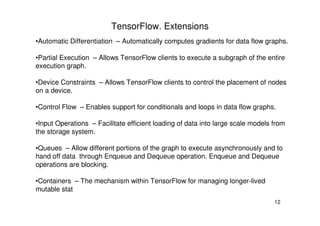
•Automatic Differentiation – Automatically computes gradients for data flow graphs.
•Partial Execution – Allows TensorFlow clients to execute a subgraph of the entire
execution graph.
•Device Constraints – Allows TensorFlow clients to control the placement of nodes
on a device.
•Control Flow – Enables support for conditionals and loops in data flow graphs.
•Input Operations – Facilitate efficient loading of data into large scale models from
the storage system.
•Queues – Allow different portions of the graph to execute asynchronously and to
hand off data through Enqueue and Dequeue operation. Enqueue and Dequeue
operations are blocking.
•Containers – The mechanism within TensorFlow for managing longer-lived
mutable stat
13
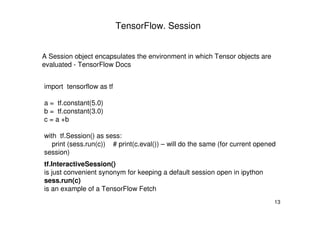
TensorFlow. Session
A Session object encapsulates the environment in which Tensor objects are
evaluated - TensorFlow Docs
import tensorflow as tf
a = tf.constant(5.0)
b = tf.constant(3.0)
c = a +b
with tf.Session() as sess:
print (sess.run(c)) # print(c.eval()) – will do the same (for current opened
session)
tf.InteractiveSession()
is just convenient synonym for keeping a default session open in ipython
sess.run(c)
is an example of a TensorFlow Fetch
14
TensorFlow. Variable
Variables are in-memory buffers
containing tensors.
They must be explicitly initialized and can
be saved to disk during and after training
TensorFlow Docs
import tensorflow as tf
weights = tf.Variable(tf.random_normal([100, 150], stddev=0.5), name="weights")
biases = tf.Variable(tf.zeros([150]), name="biases")
#https://www.tensorflow.org/versions/r0.11/api_docs/python/constant_op.html#random_normal
# Pin a variable to GPU.
with tf.device("/gpu:0"):
v = tf.Variable(...)
# Pin a variable to a particular parameter server task.
with tf.device("/job:ps/task:7"):
v = tf.Variable(...)
variable
assign
zeros, random_normal…
15
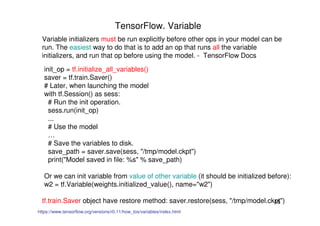
TensorFlow. Variable
Variable initializers must be run explicitly before other ops in your model can be
run. The easiest way to do that is to add an op that runs all the variable
initializers, and run that op before using the model. - TensorFlow Docs
init_op = tf.initialize_all_variables()
saver = tf.train.Saver()
# Later, when launching the model
with tf.Session() as sess:
# Run the init operation.
sess.run(init_op)
...
# Use the model
…
# Save the variables to disk.
save_path = saver.save(sess, "/tmp/model.ckpt")
print("Model saved in file: %s" % save_path)
Or we can init variable from value of other variable (it should be initialized before):
w2 = tf.Variable(weights.initialized_value(), name="w2")
tf.train.Saver object have restore method: saver.restore(sess, "/tmp/model.ckpt")
https://www.tensorflow.org/versions/r0.11/how_tos/variables/index.html
16
TensorFlow. Common syntax examples
Fill array with zeros and ones: a = tf.zeros((3,3)), b = tf.ones((3,3))
Sum of array, axis = 1: tf.reduce_sum(a,reduction_indices=[1])
Shape of array: a.get_shape()
Re-shape: array: tf.reshape(a,(1,4))
Basic arithmetic: a*3+ 2
Multiplication: tf.matmul(c, d)
Element accessing: a[0,0], a[:,0], a[0,:]
17
TensorFlow data input
How can we input external data into TensorFlow?
Simple solution: Import from Numpy:
a = np.zeros((3,3))
ta = tf.convert_to_tensor(a)
Simple, but does not scale
18
TensorFlow data input
Use tf.placeholder variables (dummy nodes that provide entry points for data
to computational graph).
A feed_dict is a python dictionary mapping from
tf.placeholder vars (or their names) to data (numpy arrays, lists, etc.)
Example:
input1 = tf.placeholder(tf.float32)
input2 = tf.placeholder(tf.float32)
output = tf.mul(input1, input2)
with tf.Session()as sess:
print(sess.run([output], feed_dict={input1:[6.], input2:[3.]}))
19
TensorFlow data input
Evaluation:
feed_dict={input1:[6.], input2:[3.]}
input1 = tf.placeholder(tf.float32) input2 = tf.placeholder(tf.float32)
result
20
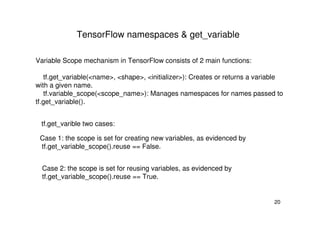
TensorFlow namespaces & get_variable
Variable Scope mechanism in TensorFlow consists of 2 main functions:
tf.get_variable(<name>, <shape>, <initializer>): Creates or returns a variable
with a given name.
tf.variable_scope(<scope_name>): Manages namespaces for names passed to
tf.get_variable().
Case 1: the scope is set for creating new variables, as evidenced by
tf.get_variable_scope().reuse == False.
tf.get_varible two cases:
Case 2: the scope is set for reusing variables, as evidenced by
tf.get_variable_scope().reuse == True.
21
Example
Problem: Linear regression min)ˆ( 22
→−= ∑∑ yye
x
x
x
x
x
Predicted value
Real value
Error = Y_predicted – Y_real
Y = X*k + b
22
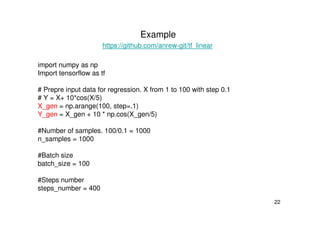
Example
import numpy as np
Import tensorflow as tf
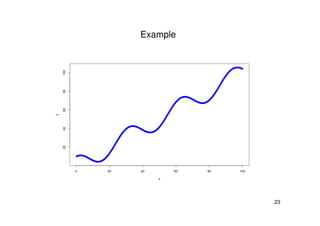
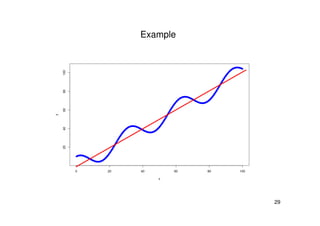
# Prepre input data for regression. X from 1 to 100 with step 0.1
# Y = X+ 10*cos(X/5)
X_gen = np.arange(100, step=.1)
Y_gen = X_gen + 10 * np.cos(X_gen/5)
#Number of samples. 100/0.1 = 1000
n_samples = 1000
#Batch size
batch_size = 100
#Steps number
steps_number = 400
https://github.com/anrew-git/tf_linear
23
Example
24
Example
# Tensorflow is sensitive to shapes, so reshaping without data change
# It were (n_samples,), now should be (n_samples, 1)
X_gen = np.reshape(X_gen, (n_samples,1))
Y_gen = np.reshape(Y_gen, (n_samples,1))
# Preparing placeholders
X = tf.placeholder(tf.float32, shape=(batch_size, 1))
Y = tf.placeholder(tf.float32, shape=(batch_size, 1))
25
Example
# Define variables to be learned
with tf.variable_scope("linear-regression"):
k = tf.get_variable("weights", (1, 1),
initializer=tf.random_normal_initializer())
b = tf.get_variable("bias", (1,),
initializer=tf.constant_initializer(0.0))
y_predicted = tf.matmul(X, k) + b
loss = tf.reduce_sum((Y - y_predicted)**2)
26
Example
# Sample code to solve this problem
# Define optimizer properties – optimization type – minimization, variable
opt_operation = tf.train.AdamOptimizer().minimize(loss)
with tf.Session() as sess:
# Initialize Variables in graph
sess.run(tf.initialize_all_variables())
# Optimization loop for steps_number steps
for i in range(steps_number):
# Select random minibatch
indices = np.random.choice(n_samples, batch_size)
X_batch, y_batch = X_gen[indices], Y_gen[indices]
# Do optimization step
sess.run([opt_operation, loss],
feed_dict={X: X_batch, Y: y_batch})
27
Example
# Gradient descent loop for steps_number steps
for i in range(steps_number):
# Select random minibatch
batch_indices = np.random.choice(n_samples, batch_size)
X_batch, y_batch = X_gen[batch_indices], Y_gen[batch_indices]
# Do optimization step
sess.run([opt_operation, loss],
feed_dict={X: X_batch, Y: y_batch})
Preparing mini-batches
Inside sess.run – feed data to TensorFlow
28
Example
feed_dict={X: X_batch, Y: y_batch})
y_predicted = tf.matmul(X, k) + b
loss = tf.reduce_sum((Y - y_predicted)**2)
k = tf.get_variable("weights", (1, 1),
initializer=tf.random_normal_initializer())
b = tf.get_variable("bias", (1,),
initializer=tf.constant_initializer(0.0))
29
Example
30
TensorFlow auto-differentiation and gradient
Automatic differentiation computes gradients without user input
TensorFlow nodes in computation graph have attached gradient operations.
Use backpropagation (using node-specific gradient ops) to compute required
gradients for all variables in graph
31
TensorFlow
1. TensorFlow has good computational graph visualization.
2. Support from such a huge company as Google is a plus for TensorFlow.
3. TensorFlow has C++ and Python interfaces.
4. TensorFlow has benefits on large computation problems and distributed
heterogeneus computation enviroment
5. TensorFlow not so good on 1-GPU / single host hardware as Theano/Torch
6. TensorFlow base can be extended to the wide range of new hardware
32
References
1. http://download.tensorflow.org/paper/whitepaper2015.pdf
2. https://www.tensorflow.org/
3. Getting Started with TensorFlow by Giancarlo Zaccone
4. TensorFlow Machine Learning Cookbook Paperback by Nick McClure
5. https://github.com/aymericdamien/TensorFlow-Examples
6. https://www.tensorflow.org/versions/r0.10/tutorials/index.html
7. http://bcomposes.com/2015/11/26/simple-end-to-end-tensorflow-examples/
8. https://github.com/anrew-git/tf_linear
9. Основные концепции нейронных сетей. Р. Каллан
33
Questions?

TensorFlow example for AI Ukraine2016

  • 1.
    TensorFlow usage Babii Andrii Ph.D.student, Kharkiv National University of Radioelectronics andrii.babii@nure.ua
  • 2.
    2 Motivation 1. Data andmodel parallelism 2. TensorBoard for visualization 3. Computational graph abstraction 4. Python + Numpy 5. Great documentation and examples 6. More than deep learning framework + Now conception of ‘Python front-end’ for hard backend is trending TinyFlow http://dmlc.ml/2016/09/30/build-your-own-tensorflow-with-nnvm-and-torch.html Syntax (‘Frontend’) like TensorFlow but interpretation is … Torch! NNVM inspired by LLVM… It provides ways to construct, represent and transform computation graphs invariant of how it is executed.
  • 3.
    3 TensorFlow basic concepts ATensorFlow computation is described by a directed graph , which is composed of a set of nodes Library user construct a computational graph using one of the supported frontend languages (C++ or Python) In a TensorFlow graph, each node has zero or more inputs and zero or more outputs, and represents the instantiation of an operation Values that flow along normal edges in the graph (from outputs to inputs) are tensors - arbitrary dimensionality arrays where the underlying el- ement type is specified or inferred at graph-construction time Special edges, called control dependencies , can also exist in the graph http://download.tensorflow.org/paper/whitepaper2015.pdf
  • 4.
    TensorFlow architecture Python C++… TensorFlow core execution language CPU GPU Android … There is the client, which uses the session interface to communicate with the master and one or more worker processes Each worker process responsible for arbitrating access to one or more computational devices (such as CPU cores and GPU cards)
  • 5.
  • 6.
    TensorFlow basic concepts.Tensor A Tensor is a typed multi-dimensional array. For example, a 4-D array of floating point numbers representing a mini-batch of images with dimensions [batch, height, width, channel]. In a launched graph: Type of the data that flow between nodes. In the Python API: class used to represent the output and inputs of ops added to the graph tf.Tensor. Instances of this class do not hold data. In the C++ API: class used to represent tensors returned from a Session::Run() call tensorflow::Tensor. Instances of this class hold data. https://www.tensorflow.org/versions/r0.9/resources/glossary.html#glossary
  • 7.
    TensorFlow basic concepts.Operations An operation has a name and represents an abstract computation (e.g., “matrix multiply”, or “add”). An operation can have attributes. •One common use of attributes is to make operations polymorphic over different tensor element types. A kernel is a particular implementation of an operation that can be run on a particular type of device (e.g., CPU or GPU). TensorFlow binary defines the sets of operations and kernels available via a registration mechanism, and this set can be extended by linking in additional operation and/or kernel definitions/registration http://download.tensorflow.org/paper/whitepaper2015.pdf Variable is a special kind of operation that returns a handle to a persistent mutable tensor that survives across executions of a graph.
  • 8.
  • 9.
    9 TensorFlow. Execution ofcomputation graph Single device (for example we have only one core CPU for computation) The nodes of the graph are executed in an order that respects the dependencies between nodes Multi-device execution •Select device to place the computation for each node in the graph •Managing the required communication of data across device boundaries implied by these placement decisions http://download.tensorflow.org/paper/whitepaper2015.pdf
  • 10.
  • 11.
  • 12.
    12 TensorFlow. Extensions •Automatic Differentiation– Automatically computes gradients for data flow graphs. •Partial Execution – Allows TensorFlow clients to execute a subgraph of the entire execution graph. •Device Constraints – Allows TensorFlow clients to control the placement of nodes on a device. •Control Flow – Enables support for conditionals and loops in data flow graphs. •Input Operations – Facilitate efficient loading of data into large scale models from the storage system. •Queues – Allow different portions of the graph to execute asynchronously and to hand off data through Enqueue and Dequeue operation. Enqueue and Dequeue operations are blocking. •Containers – The mechanism within TensorFlow for managing longer-lived mutable stat
  • 13.
    13 TensorFlow. Session A Sessionobject encapsulates the environment in which Tensor objects are evaluated - TensorFlow Docs import tensorflow as tf a = tf.constant(5.0) b = tf.constant(3.0) c = a +b with tf.Session() as sess: print (sess.run(c)) # print(c.eval()) – will do the same (for current opened session) tf.InteractiveSession() is just convenient synonym for keeping a default session open in ipython sess.run(c) is an example of a TensorFlow Fetch
  • 14.
    14 TensorFlow. Variable Variables arein-memory buffers containing tensors. They must be explicitly initialized and can be saved to disk during and after training TensorFlow Docs import tensorflow as tf weights = tf.Variable(tf.random_normal([100, 150], stddev=0.5), name="weights") biases = tf.Variable(tf.zeros([150]), name="biases") #https://www.tensorflow.org/versions/r0.11/api_docs/python/constant_op.html#random_normal # Pin a variable to GPU. with tf.device("/gpu:0"): v = tf.Variable(...) # Pin a variable to a particular parameter server task. with tf.device("/job:ps/task:7"): v = tf.Variable(...) variable assign zeros, random_normal…
  • 15.
    15 TensorFlow. Variable Variable initializersmust be run explicitly before other ops in your model can be run. The easiest way to do that is to add an op that runs all the variable initializers, and run that op before using the model. - TensorFlow Docs init_op = tf.initialize_all_variables() saver = tf.train.Saver() # Later, when launching the model with tf.Session() as sess: # Run the init operation. sess.run(init_op) ... # Use the model … # Save the variables to disk. save_path = saver.save(sess, "/tmp/model.ckpt") print("Model saved in file: %s" % save_path) Or we can init variable from value of other variable (it should be initialized before): w2 = tf.Variable(weights.initialized_value(), name="w2") tf.train.Saver object have restore method: saver.restore(sess, "/tmp/model.ckpt") https://www.tensorflow.org/versions/r0.11/how_tos/variables/index.html
  • 16.
    16 TensorFlow. Common syntaxexamples Fill array with zeros and ones: a = tf.zeros((3,3)), b = tf.ones((3,3)) Sum of array, axis = 1: tf.reduce_sum(a,reduction_indices=[1]) Shape of array: a.get_shape() Re-shape: array: tf.reshape(a,(1,4)) Basic arithmetic: a*3+ 2 Multiplication: tf.matmul(c, d) Element accessing: a[0,0], a[:,0], a[0,:]
  • 17.
    17 TensorFlow data input Howcan we input external data into TensorFlow? Simple solution: Import from Numpy: a = np.zeros((3,3)) ta = tf.convert_to_tensor(a) Simple, but does not scale
  • 18.
    18 TensorFlow data input Usetf.placeholder variables (dummy nodes that provide entry points for data to computational graph). A feed_dict is a python dictionary mapping from tf.placeholder vars (or their names) to data (numpy arrays, lists, etc.) Example: input1 = tf.placeholder(tf.float32) input2 = tf.placeholder(tf.float32) output = tf.mul(input1, input2) with tf.Session()as sess: print(sess.run([output], feed_dict={input1:[6.], input2:[3.]}))
  • 19.
    19 TensorFlow data input Evaluation: feed_dict={input1:[6.],input2:[3.]} input1 = tf.placeholder(tf.float32) input2 = tf.placeholder(tf.float32) result
  • 20.
    20 TensorFlow namespaces &get_variable Variable Scope mechanism in TensorFlow consists of 2 main functions: tf.get_variable(<name>, <shape>, <initializer>): Creates or returns a variable with a given name. tf.variable_scope(<scope_name>): Manages namespaces for names passed to tf.get_variable(). Case 1: the scope is set for creating new variables, as evidenced by tf.get_variable_scope().reuse == False. tf.get_varible two cases: Case 2: the scope is set for reusing variables, as evidenced by tf.get_variable_scope().reuse == True.
  • 21.
    21 Example Problem: Linear regressionmin)ˆ( 22 →−= ∑∑ yye x x x x x Predicted value Real value Error = Y_predicted – Y_real Y = X*k + b
  • 22.
    22 Example import numpy asnp Import tensorflow as tf # Prepre input data for regression. X from 1 to 100 with step 0.1 # Y = X+ 10*cos(X/5) X_gen = np.arange(100, step=.1) Y_gen = X_gen + 10 * np.cos(X_gen/5) #Number of samples. 100/0.1 = 1000 n_samples = 1000 #Batch size batch_size = 100 #Steps number steps_number = 400 https://github.com/anrew-git/tf_linear
  • 23.
  • 24.
    24 Example # Tensorflow issensitive to shapes, so reshaping without data change # It were (n_samples,), now should be (n_samples, 1) X_gen = np.reshape(X_gen, (n_samples,1)) Y_gen = np.reshape(Y_gen, (n_samples,1)) # Preparing placeholders X = tf.placeholder(tf.float32, shape=(batch_size, 1)) Y = tf.placeholder(tf.float32, shape=(batch_size, 1))
  • 25.
    25 Example # Define variablesto be learned with tf.variable_scope("linear-regression"): k = tf.get_variable("weights", (1, 1), initializer=tf.random_normal_initializer()) b = tf.get_variable("bias", (1,), initializer=tf.constant_initializer(0.0)) y_predicted = tf.matmul(X, k) + b loss = tf.reduce_sum((Y - y_predicted)**2)
  • 26.
    26 Example # Sample codeto solve this problem # Define optimizer properties – optimization type – minimization, variable opt_operation = tf.train.AdamOptimizer().minimize(loss) with tf.Session() as sess: # Initialize Variables in graph sess.run(tf.initialize_all_variables()) # Optimization loop for steps_number steps for i in range(steps_number): # Select random minibatch indices = np.random.choice(n_samples, batch_size) X_batch, y_batch = X_gen[indices], Y_gen[indices] # Do optimization step sess.run([opt_operation, loss], feed_dict={X: X_batch, Y: y_batch})
  • 27.
    27 Example # Gradient descentloop for steps_number steps for i in range(steps_number): # Select random minibatch batch_indices = np.random.choice(n_samples, batch_size) X_batch, y_batch = X_gen[batch_indices], Y_gen[batch_indices] # Do optimization step sess.run([opt_operation, loss], feed_dict={X: X_batch, Y: y_batch}) Preparing mini-batches Inside sess.run – feed data to TensorFlow
  • 28.
    28 Example feed_dict={X: X_batch, Y:y_batch}) y_predicted = tf.matmul(X, k) + b loss = tf.reduce_sum((Y - y_predicted)**2) k = tf.get_variable("weights", (1, 1), initializer=tf.random_normal_initializer()) b = tf.get_variable("bias", (1,), initializer=tf.constant_initializer(0.0))
  • 29.
  • 30.
    30 TensorFlow auto-differentiation andgradient Automatic differentiation computes gradients without user input TensorFlow nodes in computation graph have attached gradient operations. Use backpropagation (using node-specific gradient ops) to compute required gradients for all variables in graph
  • 31.
    31 TensorFlow 1. TensorFlow hasgood computational graph visualization. 2. Support from such a huge company as Google is a plus for TensorFlow. 3. TensorFlow has C++ and Python interfaces. 4. TensorFlow has benefits on large computation problems and distributed heterogeneus computation enviroment 5. TensorFlow not so good on 1-GPU / single host hardware as Theano/Torch 6. TensorFlow base can be extended to the wide range of new hardware
  • 32.
    32 References 1. http://download.tensorflow.org/paper/whitepaper2015.pdf 2. https://www.tensorflow.org/ 3.Getting Started with TensorFlow by Giancarlo Zaccone 4. TensorFlow Machine Learning Cookbook Paperback by Nick McClure 5. https://github.com/aymericdamien/TensorFlow-Examples 6. https://www.tensorflow.org/versions/r0.10/tutorials/index.html 7. http://bcomposes.com/2015/11/26/simple-end-to-end-tensorflow-examples/ 8. https://github.com/anrew-git/tf_linear 9. Основные концепции нейронных сетей. Р. Каллан
  • 33.