Machine Learning in
Python with scikit-learn
Microsoft Tech Days
February 2015
Outline
• Machine Learning refresher
• scikit-learn
• How the project is structured
• Some improvements released in 0.15
• Demo: interactive predictive modeling on Census
Data with IPython notebook / pandas / scikit-learn
Predictive modeling
~= machine learning
• Make predictions of outcome on new data
• Extract the structure of historical data
• Statistical tools to summarize the training data into
a executable predictive model
• Alternative to hard-coded rules written by experts
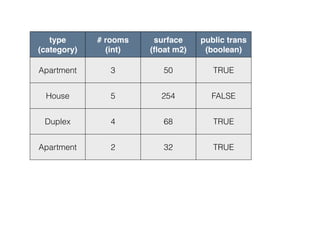
type
(category)
# rooms
(int)
surface
(float m2)
public trans
(boolean)
Apartment 3 50 TRUE
House 5 254 FALSE
Duplex 4 68 TRUE
Apartment 2 32 TRUE
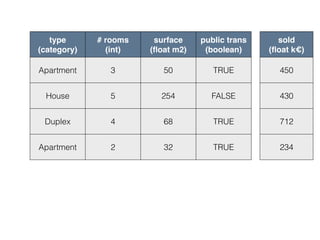
type
(category)
# rooms
(int)
surface
(float m2)
public trans
(boolean)
Apartment 3 50 TRUE
House 5 254 FALSE
Duplex 4 68 TRUE
Apartment 2 32 TRUE
sold
(float k€)
450
430
712
234
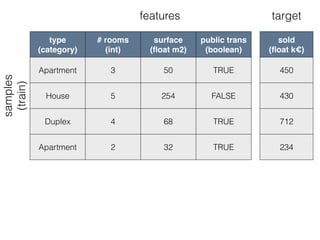
type
(category)
# rooms
(int)
surface
(float m2)
public trans
(boolean)
Apartment 3 50 TRUE
House 5 254 FALSE
Duplex 4 68 TRUE
Apartment 2 32 TRUE
sold
(float k€)
450
430
712
234
features target
samples
(train)
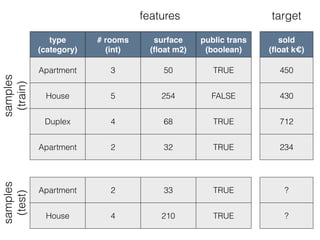
type
(category)
# rooms
(int)
surface
(float m2)
public trans
(boolean)
Apartment 3 50 TRUE
House 5 254 FALSE
Duplex 4 68 TRUE
Apartment 2 32 TRUE
sold
(float k€)
450
430
712
234
features target
samples
(train)
Apartment 2 33 TRUE
House 4 210 TRUE
samples
(test)
?
?
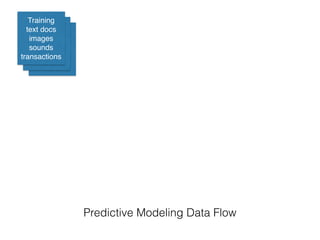
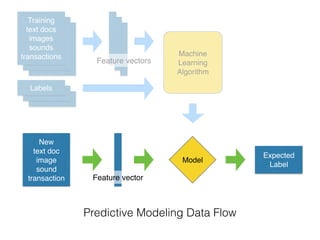
Training
text docs
images
sounds
transactions
Predictive Modeling Data Flow
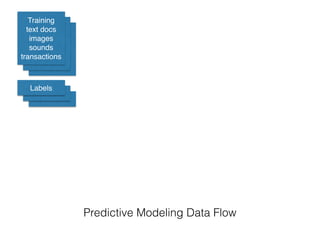
Training
text docs
images
sounds
transactions
Labels
Predictive Modeling Data Flow
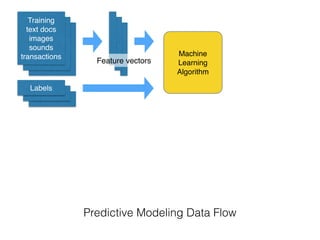
Training
text docs
images
sounds
transactions
Labels
Machine
Learning
Algorithm
Predictive Modeling Data Flow
Feature vectors
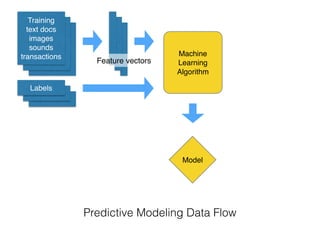
Training
text docs
images
sounds
transactions
Labels
Machine
Learning
Algorithm
Model
Predictive Modeling Data Flow
Feature vectors
New
text doc
image
sound
transaction
Model
Expected
Label
Predictive Modeling Data Flow
Feature vector
Training
text docs
images
sounds
transactions
Labels
Machine
Learning
Algorithm
Feature vectors
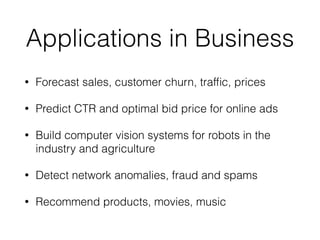
Applications in Business
• Forecast sales, customer churn, traffic, prices
• Predict CTR and optimal bid price for online ads
• Build computer vision systems for robots in the
industry and agriculture
• Detect network anomalies, fraud and spams
• Recommend products, movies, music
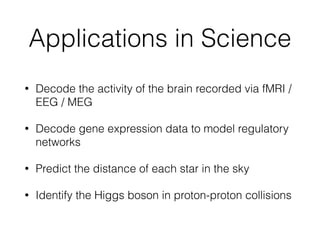
Applications in Science
• Decode the activity of the brain recorded via fMRI /
EEG / MEG
• Decode gene expression data to model regulatory
networks
• Predict the distance of each star in the sky
• Identify the Higgs boson in proton-proton collisions
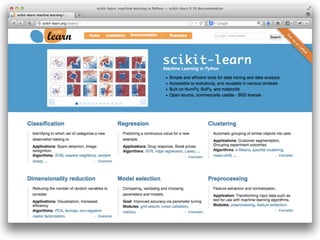
• Library of Machine Learning algorithms
• Focus on established methods (e.g. ESL-II)
• Open Source (BSD)
• Simple fit / predict / transform API
• Python / NumPy / SciPy / Cython
• Model Assessment, Selection & Ensembles
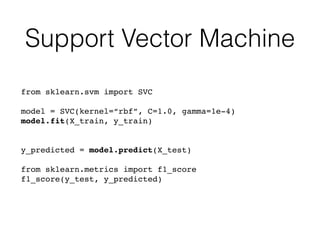
Support Vector Machine
from sklearn.svm import SVC
model = SVC(kernel=“rbf”, C=1.0, gamma=1e-4)
model.fit(X_train, y_train)
y_predicted = model.predict(X_test)
from sklearn.metrics import f1_score
f1_score(y_test, y_predicted)
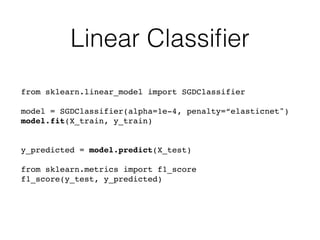
Linear Classifier
from sklearn.linear_model import SGDClassifier
model = SGDClassifier(alpha=1e-4, penalty=“elasticnet")
model.fit(X_train, y_train)
y_predicted = model.predict(X_test)
from sklearn.metrics import f1_score
f1_score(y_test, y_predicted)
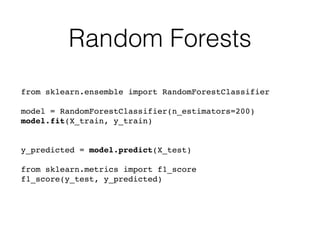
Random Forests
from sklearn.ensemble import RandomForestClassifier
model = RandomForestClassifier(n_estimators=200)
model.fit(X_train, y_train)
y_predicted = model.predict(X_test)
from sklearn.metrics import f1_score
f1_score(y_test, y_predicted)
scikit-learn contributors
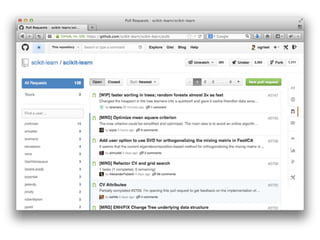
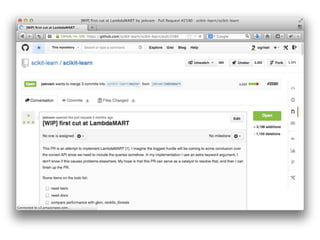
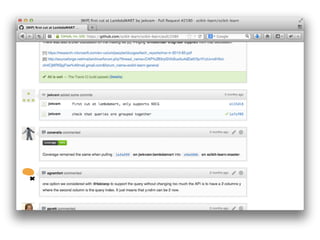
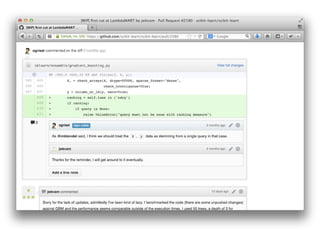
• GitHub-centric contribution workflow
• each pull request needs 2 x [+1] reviews
• code + tests + doc + example
• ~95% test coverage / Continuous Integration
• 2-3 major releases per years + bug-fix
• 150+ contributors for release 0.15
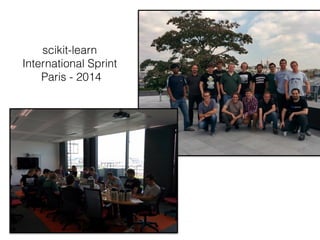
scikit-learn
International Sprint
Paris - 2014
scikit-learn users
• We support users on & ML
• 1500+ questions tagged with [scikit-learn]
• Many competitors + benchmarks
• Many data-driven startups use sklearn
• 500+ answers on 0.13 release user survey
• 60% academics / 40% from industry
New in 0.15
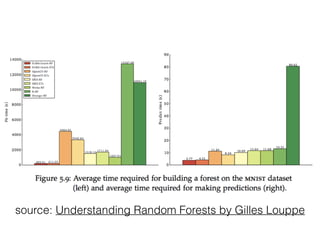
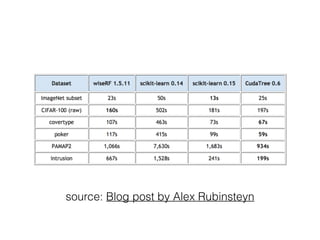
Fit time improvements in
Ensembles of Trees
• Large refactoring of the Cython code base
• Better internal data structures to optimize CPU cache
usage
• Leverage constant features detection
• Optimized MSE loss (for GBRT and regression forests)
• Cached features for Extra Trees
• Custom pure Cython PRNG and sort routines
source: Understanding Random Forests by Gilles Louppe
source: Blog post by Alex Rubinsteyn
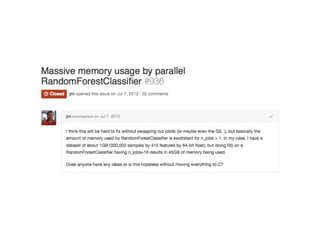
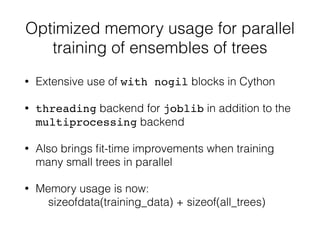
Optimized memory usage for parallel
training of ensembles of trees
• Extensive use of with nogil blocks in Cython
• threading backend for joblib in addition to the
multiprocessing backend
• Also brings fit-time improvements when training
many small trees in parallel
• Memory usage is now:

sizeofdata(training_data) + sizeof(all_trees)
Other memory usage
improvements
• Chunked euclidean distances computation in
KMeans and Neighbors estimators
• Support of numpy.memmap input data for shared
memory (e.g. with GridSearchCV w/ n_jobs=16)
• GIL-free threading backend for multi-class
SGDClassifier.
• Much more: scikit-learn.org/stable/whats_new.html
Cool new tools
to better understand your models
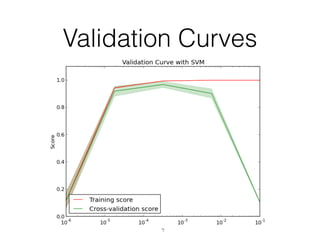
Validation Curves
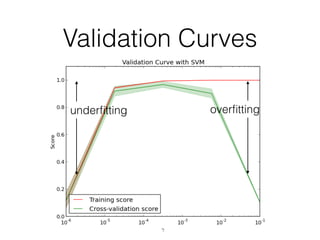
Validation Curves
overfittingunderfitting
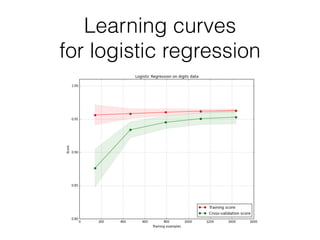
Learning curves
for logistic regression
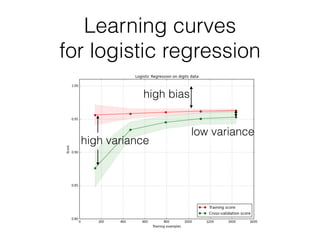
Learning curves
for logistic regression
high bias
high variance
low variance
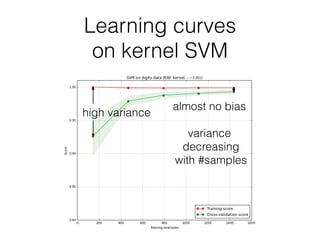
Learning curves
on kernel SVM
high variance
almost no bias
variance
decreasing
with #samples
Demo time!
http://nbviewer.ipython.org/github/ogrisel/notebooks/blob/
master/sklearn_demos/Income%20classification.ipynb
https://github.com/ogrisel/notebooks
Thank you!
• http://scikit-learn.org
• https://github.com/scikit-learn/scikit-learn
@ogrisel
Backup slides
Ongoing work in the
master branch
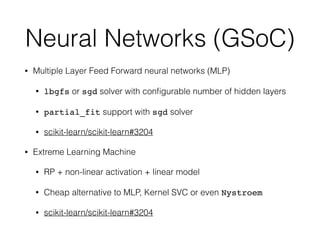
Neural Networks (GSoC)
• Multiple Layer Feed Forward neural networks (MLP)
• lbgfs or sgd solver with configurable number of hidden layers
• partial_fit support with sgd solver
• scikit-learn/scikit-learn#3204
• Extreme Learning Machine
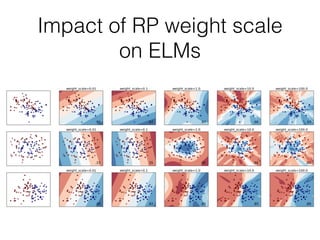
• RP + non-linear activation + linear model
• Cheap alternative to MLP, Kernel SVC or even Nystroem
• scikit-learn/scikit-learn#3204
Impact of RP weight scale
on ELMs
Incremental PCA
• PCA class with a partial_fit method
• Constant memory usage, supports for out-of-core
learning e.g. from the disk in one pass.
• To be extended to leverage the randomized_svd
trick to speed up when:

n_components << n_features
• PR scikit-learn/scikit-learn#3285
Better pandas support
• CV-related tools now leverage .iloc based
indexing without array conversion
• Estimators now leverage NumPy’s __array__
protocol implemented by DataFrame and Series
• Homogeneous feature extraction still required, e.g.
using sklearn_pandas transformers in a Pipeline
Much much more
• Better sparse feature support, in particular for
ensembles of trees (GSoC)
• Fast Approximate Nearest neighbors search with
LSH Forests (GSoC)
• Many linear model improvements, e.g.
LogisticRegressionCV to fit on a regularization
path with warm restarts (GSoC)
• https://github.com/scikit-learn/scikit-learn/pulls
Personal plans
for future work
Refactored joblib
concurrency model
• Use pre-spawned workers without multiprocessing fork (to
avoid issues with 3rd party threaded libraries)
• Make workers scheduler-aware to support nested
parallelism: e.g. cross-validation of GridSearchCV
• Automatically batch short-running tasks to hide dispatch
overhead, see joblib/joblib#157
• Make it possible to delegate queueing scheduling to 3rd
party cluster runtime:
• SGE, IPython.parallel, Kubernetes, PySpark

Scikit-Learn: Machine Learning in Python