How to do CPR
          (Cardiopulmonary Resuscitation)
                          .
                   2010 Guidelines


          American Heart Association
                         m


First Response Training, LLC
Disclaimer
 This presentation is not a substitute from
  taking a class in person.
 Please use this presentation as a refresher.
 Please sign up for a class to get to practice
  the “hands on skills”

                        Conor Devery, EMT-P………..
                        First Response Training, LLC
Adult CPR
   Make sure scene is safe
 Check for responsiveness
 If no response, call 911 and get the AED
 Check for breathing
 Check for movement
 Begin chest compressions
 Continue 30 compressions and 2 breaths until the
  AED arrives, EMS takes over, or the victim
  moves
 If uncomfortable doing mouth to mouth – just do
  compressions
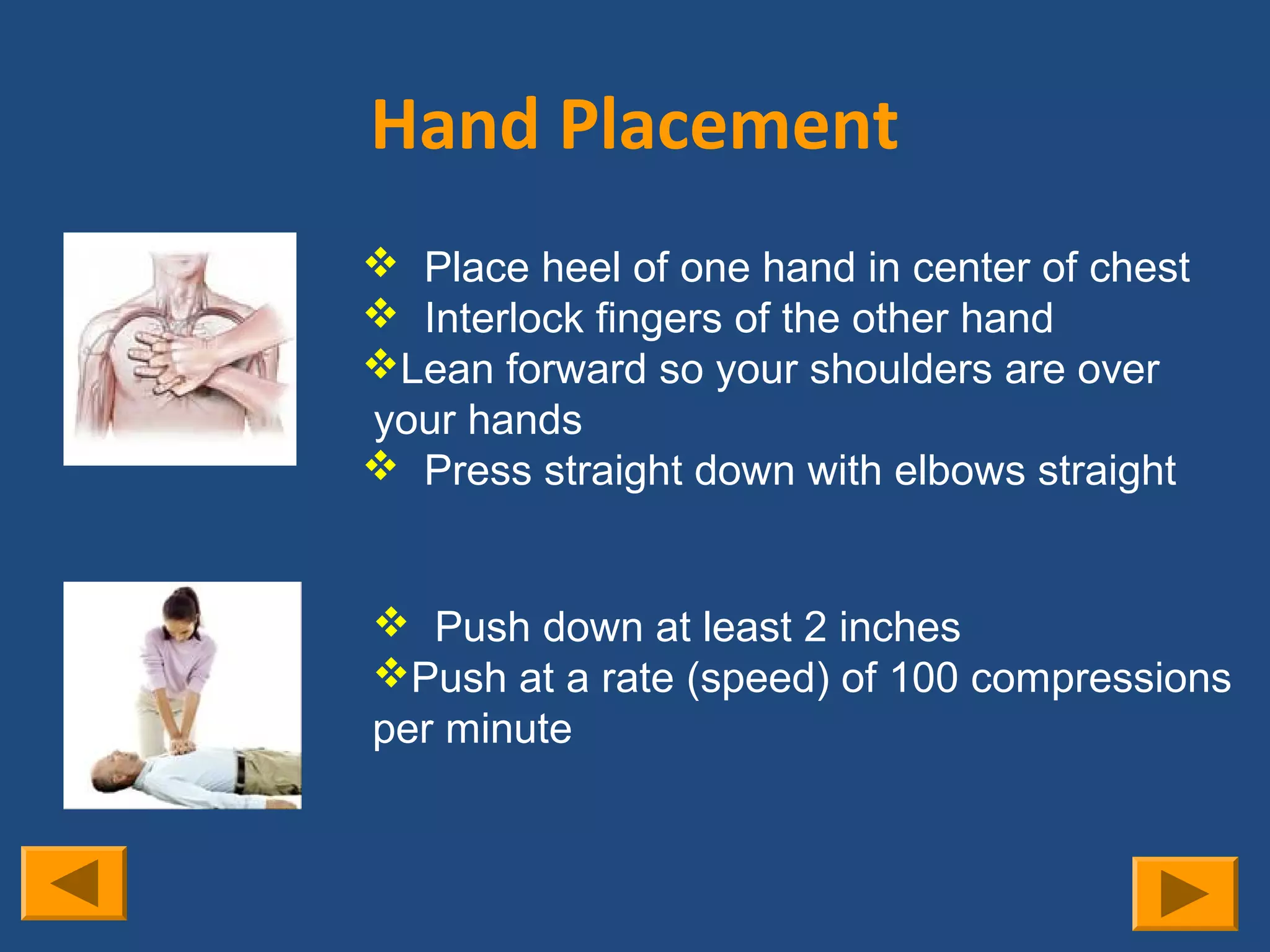
Hand Placement
 Place heel of one hand in center of chest
 Interlock fingers of the other hand
Lean forward so your shoulders are over
your hands
 Press straight down with elbows straight


 Push down at least 2 inches
Push at a rate (speed) of 100 compressions
per minute
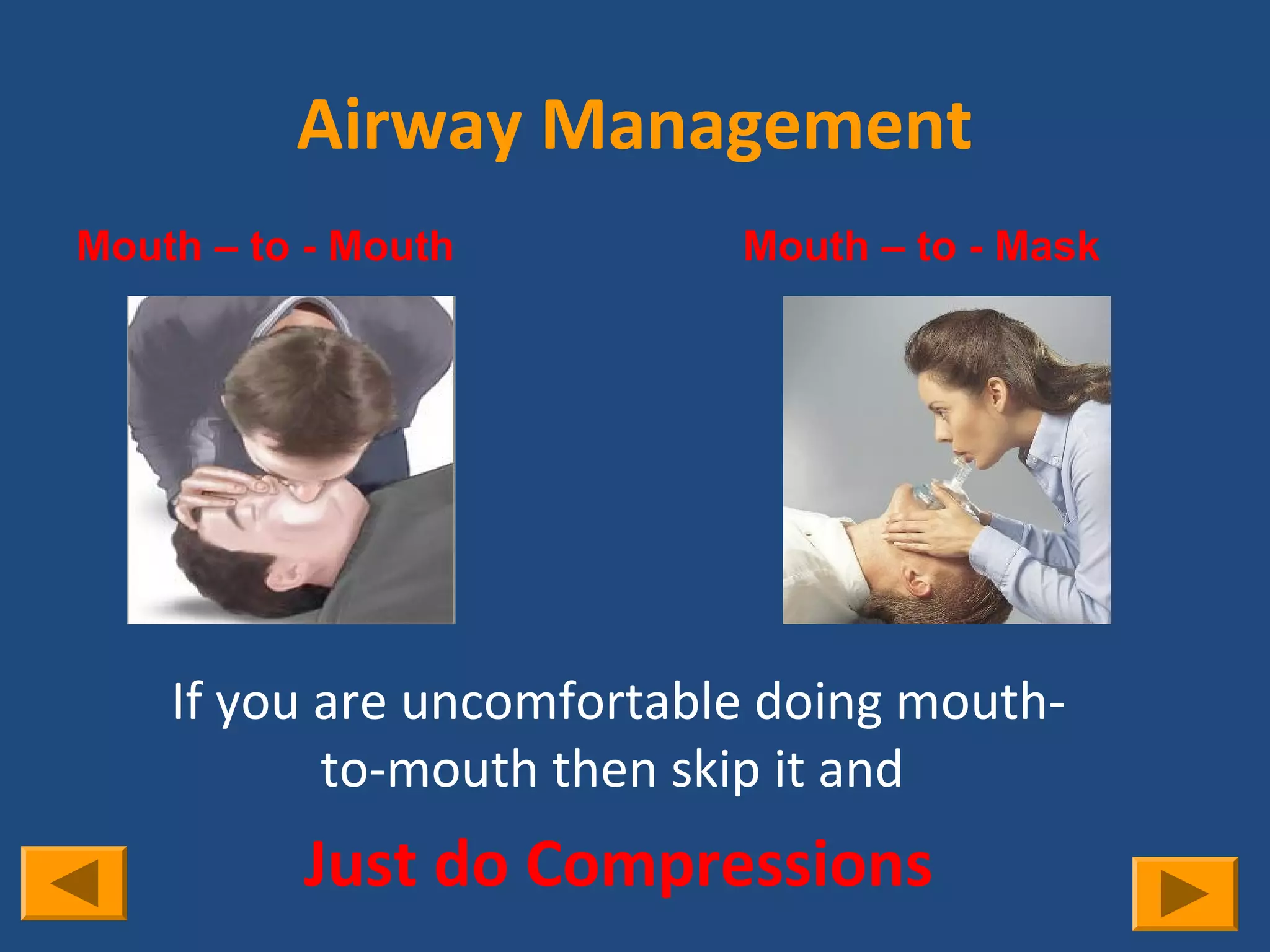
Airway Management
Mouth – to - Mouth         Mouth – to - Mask


    If you are uncomfortable doing mouth-
           to-mouth then skip it and
          Just do Compressions
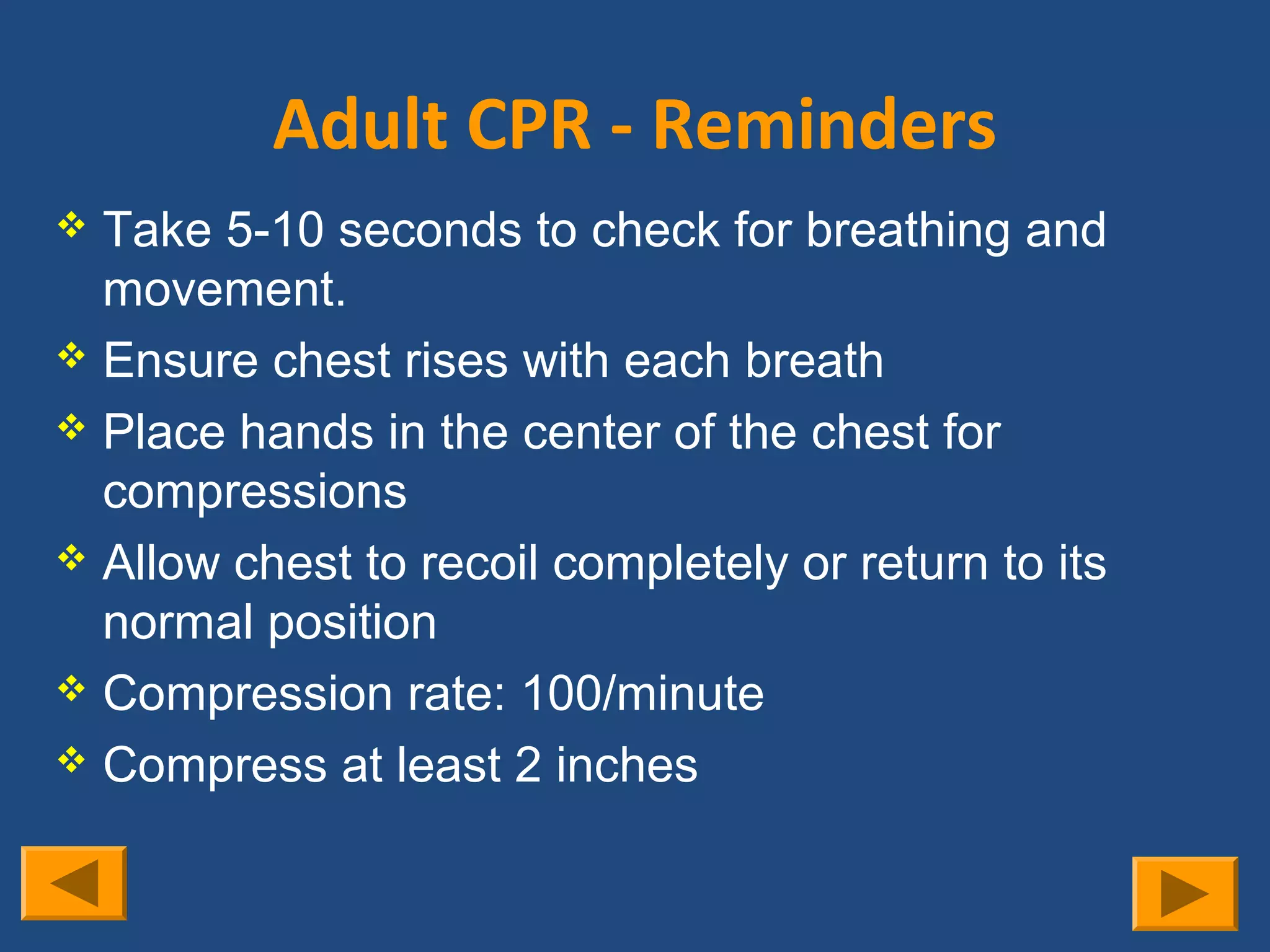
Adult CPR - Reminders
 Take 5-10 seconds to check for breathing and
  movement.
 Ensure chest rises with each breath
 Place hands in the center of the chest for
  compressions
 Allow chest to recoil completely or return to its
  normal position
 Compression rate: 100/minute
 Compress at least 2 inches
Child CPR
      Check for responsiveness
      Yell for help but don't leave the victim
      Check for breathing
                                    Max. of 10 seconds
      Check for movement
      Begin chest compressions
      After 30 compressions give 2 breaths
   Continue 30 compressions and 2 breaths for 5 cycles
    or 2 minutes
      If still no response, activate 911 and get the AED
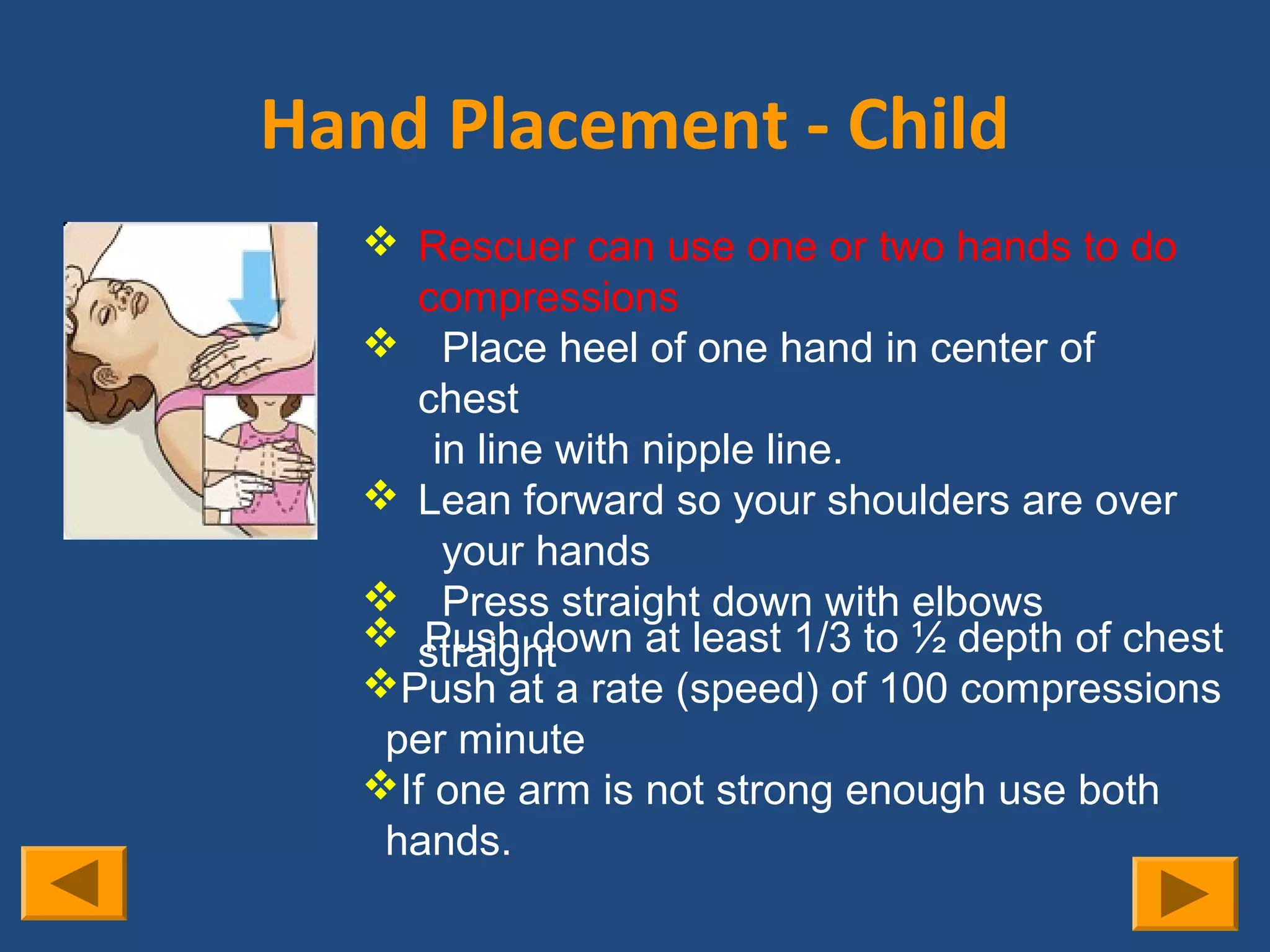
Hand Placement - Child
    Rescuer can use one or two hands to do
     compressions
    Place heel of one hand in center of
     chest
       in line with nipple line.
    Lean forward so your shoulders are over
        your hands
    Press straight down with elbows
      Push down at least 1/3 to ½ depth of chest
    straight
   Push at a rate (speed) of 100 compressions
    per minute
   If one arm is not strong enough use both
    hands.
Child CPR - Reminders
 Take 5-10 seconds to check for breathing and
  movement
 Ensure chest rises with each breath
 Place hands in the center of the chest for
  compressions
 Use 1 or 2 hands for compressions
 Allow chest to recoil completely
 Compression rate: 100/minute
 Compress 1/3 to 1/2 the depth of the chest
 Phone 911 after 5 cycles of CPR if you are alone
Infant CPR
   Check for responsiveness
   Yell for help but don't leave the victim
   Check for breathing
                                  Max. of 10 seconds
   Check for movement
   Begin chest compressions
   After 30 compressions give 2 breaths
   Continue 30 compressions and 2 breaths for 5 cycles or
     2 minutes
   If still no response, activate 911 and get the AED
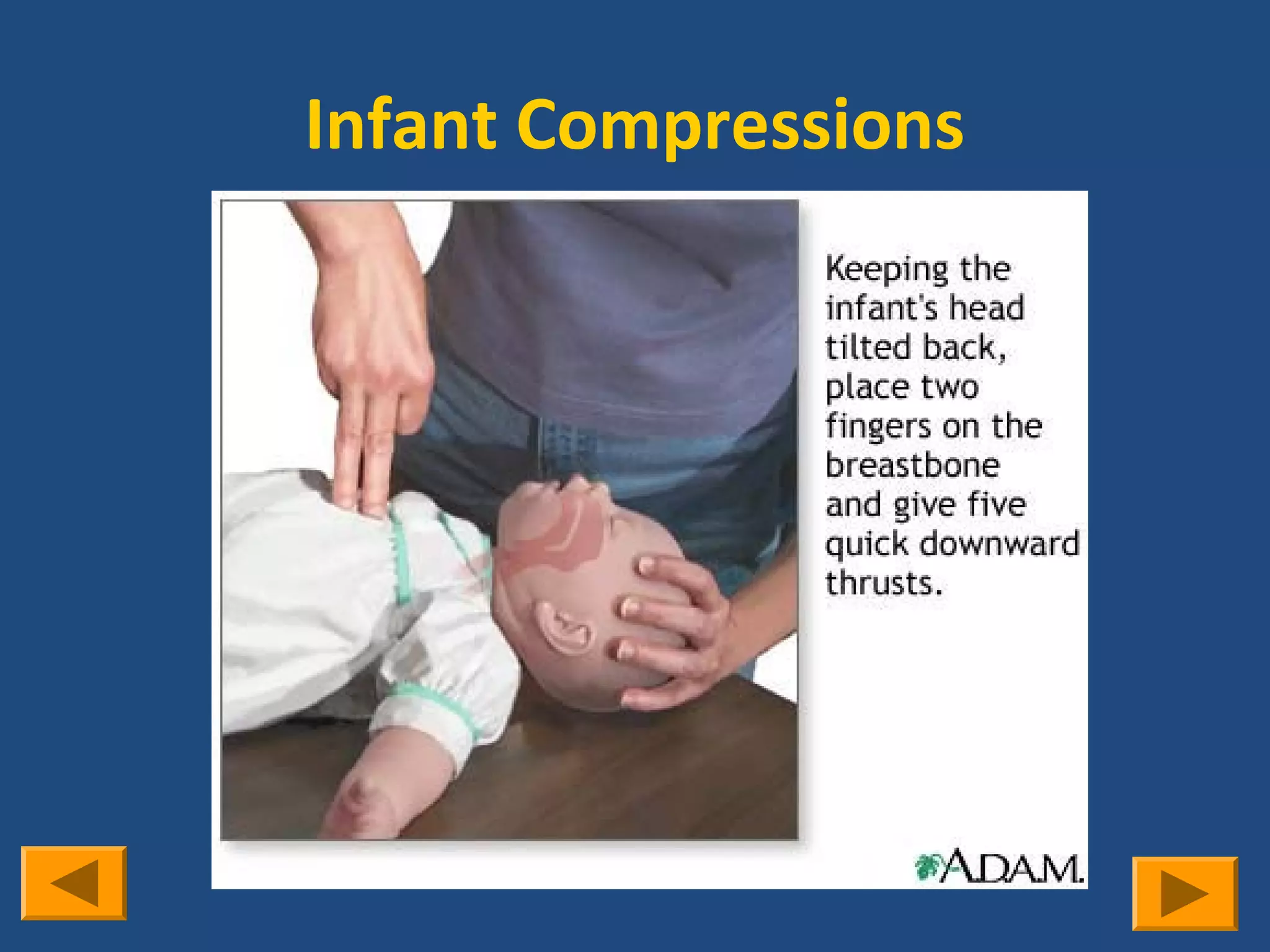
Infant Compressions
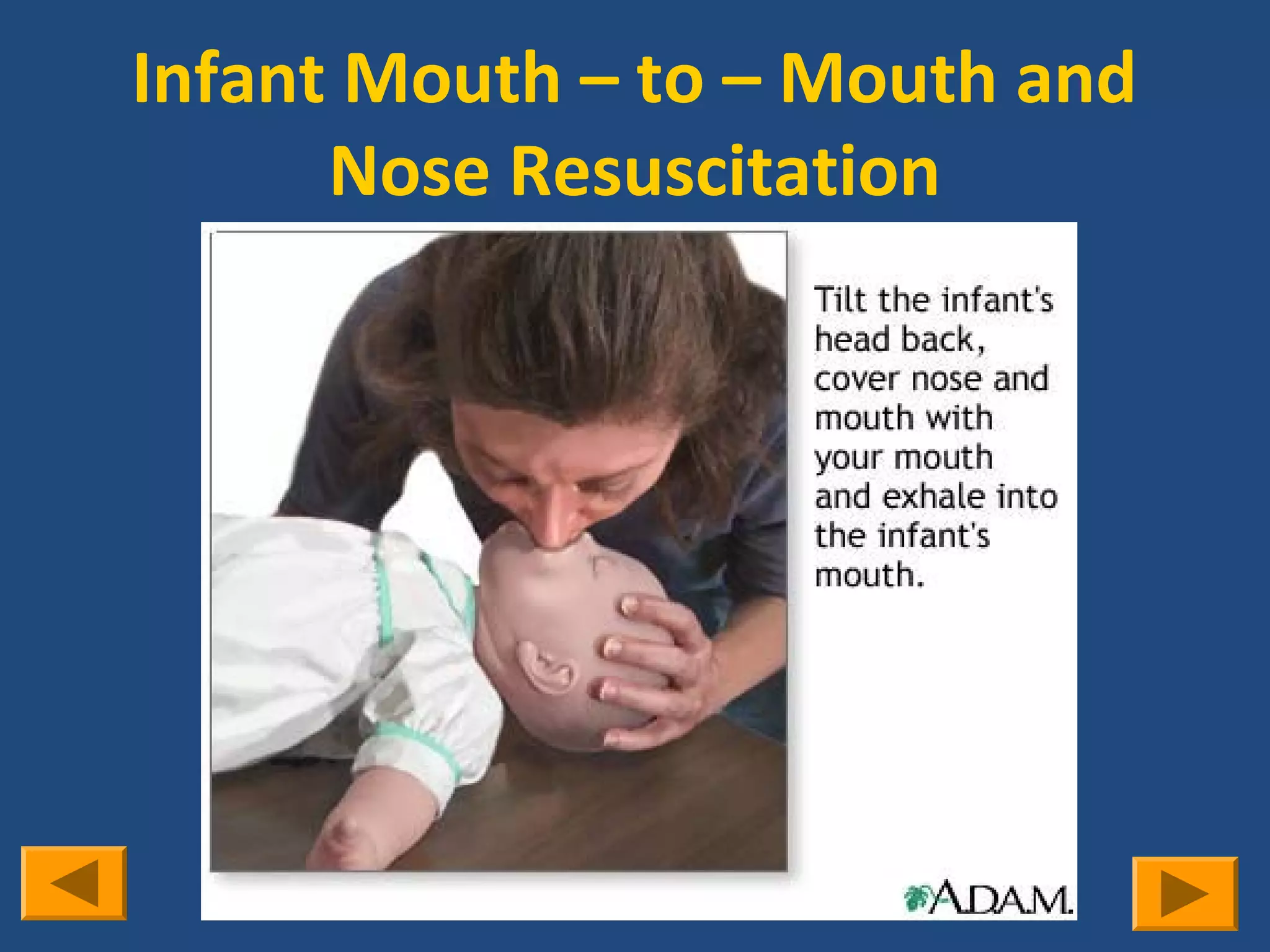
Infant Mouth – to – Mouth and
      Nose Resuscitation
Infant CPR - Reminders
 Take 5-10 seconds to check for breathing and
  movement
 Ensure chest rises with each breath
 Perform compressions using 2 fingers placed 1 finger
  width below the nipple line
 Allow chest to recoil completely
 Compression rate: 100/minute
 Compress 1/3 the depth of the chest
 Phone 911 after 5 cycles of CPR if you are alone
 AED can now be used for infants
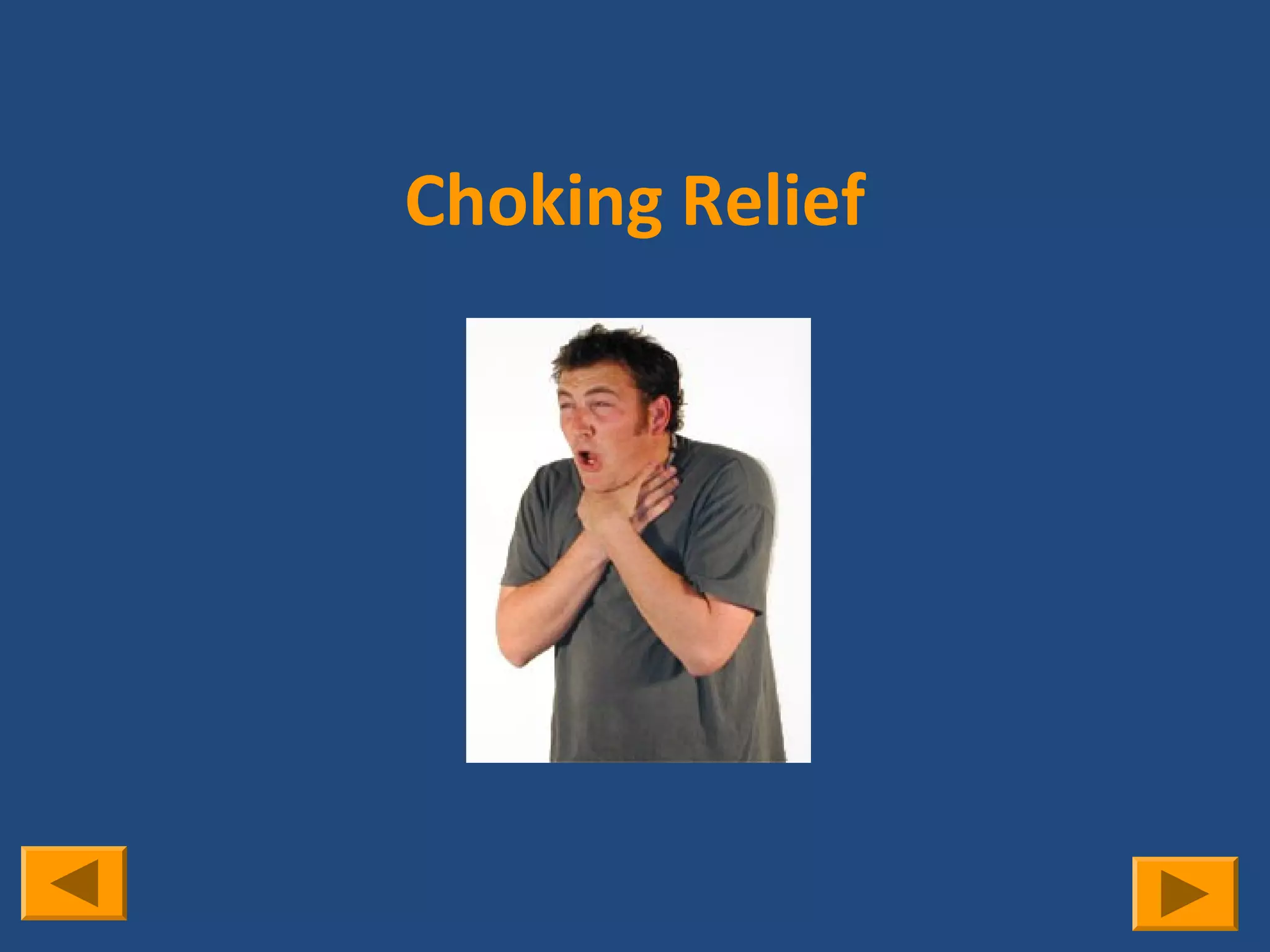
Choking Relief
When NOT to do Choking Relief
 If a person appears to be choking
 Ask the patient “Are you choking.”
If they can talk, or cough, they are not fully
choking
 Encourage them to keep coughing
 Call 911
Do NOT do abdominal thrusts if they can talk
or cough
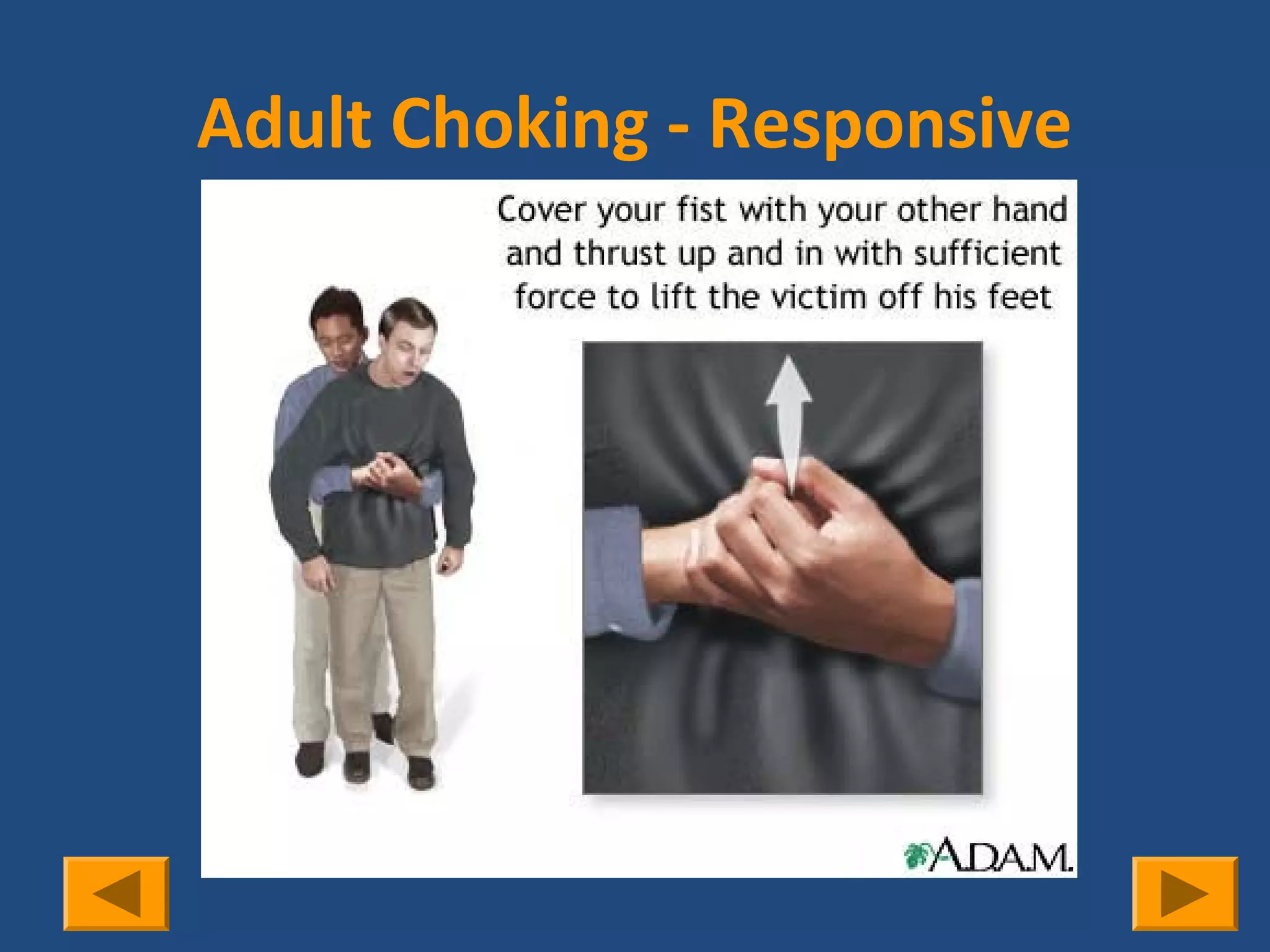
Adult Choking - Responsive
• Stand behind the person and wrap your arms around the
  person’s waist.
• Make a fist with one hand. Place the thumb side of your fist
  just above the person’s navel, well below the breastbone.
..
• Grasp the fist with your hand.
• Make quick, upward and inward thrusts with your fists.
• Continue thrusts until the object is dislodged or the person
  loses consciousness.
• If the person becomes unconscious, lower person to the floor,
  call 911, and begin CPR. If you see the object blocking the airway,
     try to remove it.
Adult Choking - Responsive


               1/2 way
            between navel
             and xyphoid
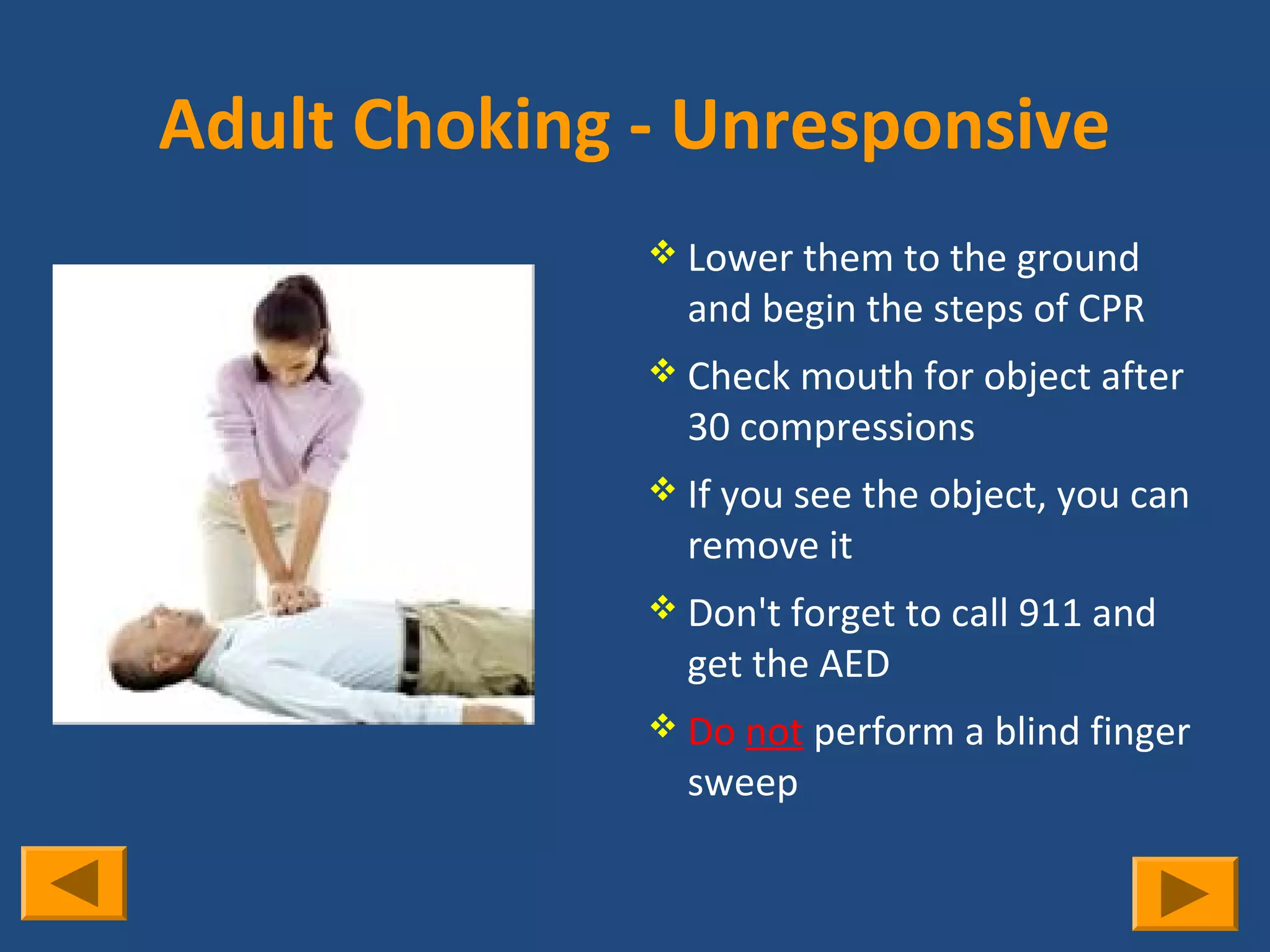
Adult Choking - Unresponsive
               Lower them to the ground
                and begin the steps of CPR
               Check mouth for object after
                30 compressions
               If you see the object, you can
                remove it
               Don't forget to call 911 and
                get the AED
               Do not perform a blind finger
                sweep
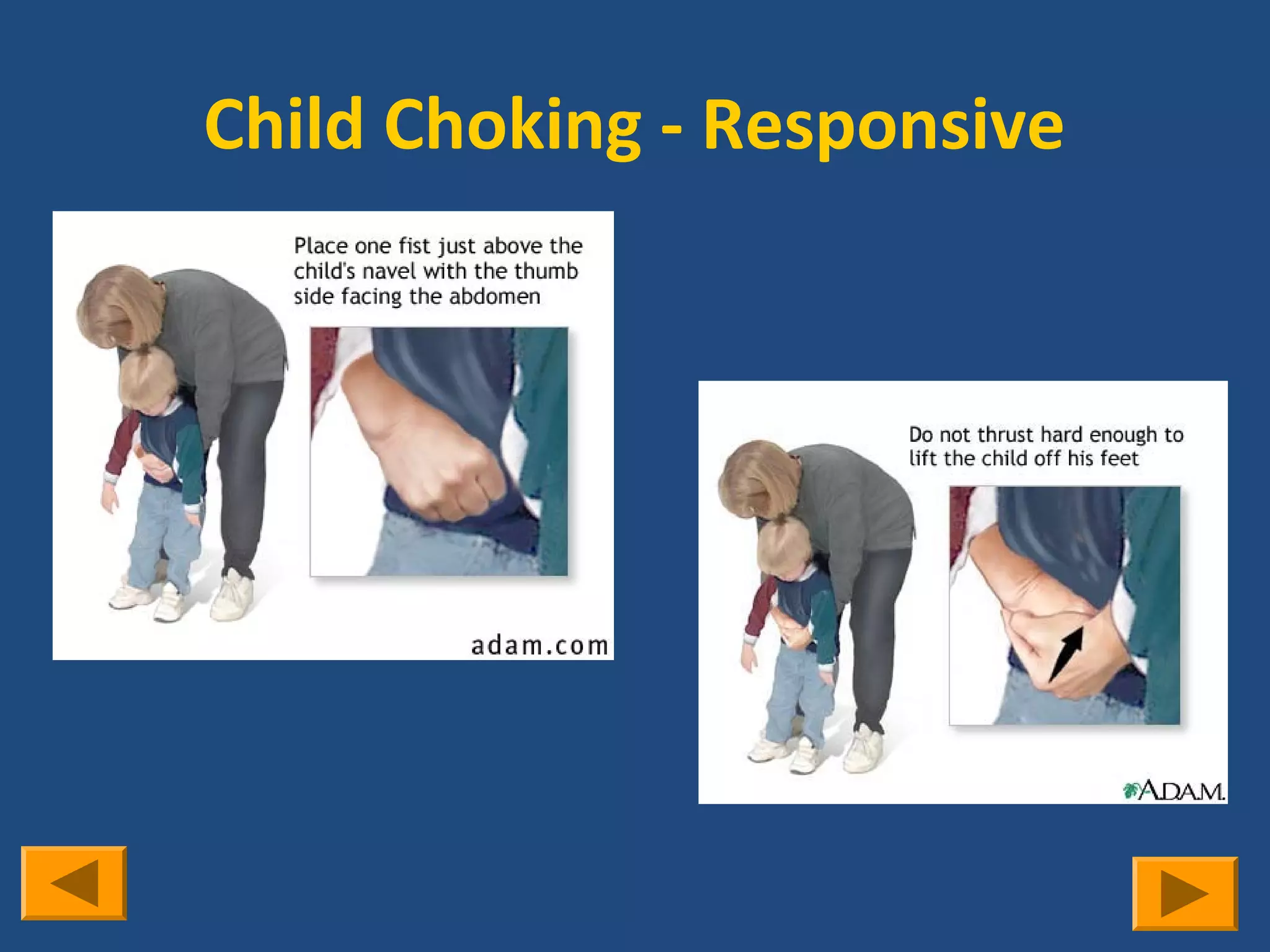
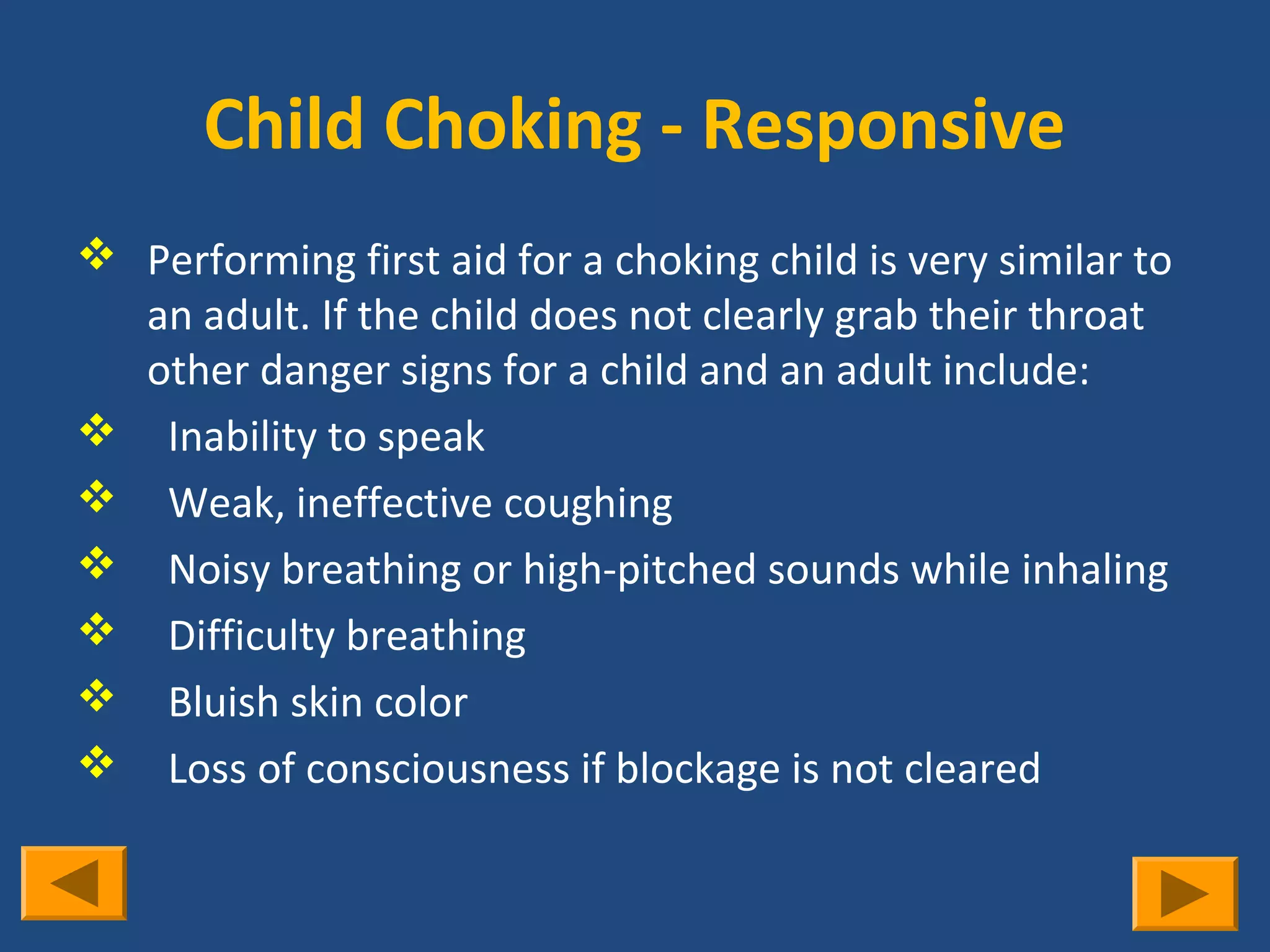
Child Choking - Responsive
 Performing first aid for a choking child is very similar to
  an adult. If the child does not clearly grab their throat
  other danger signs for a child and an adult include:
 Inability to speak
 Weak, ineffective coughing
 Noisy breathing or high-pitched sounds while inhaling
 Difficulty breathing
 Bluish skin color
 Loss of consciousness if blockage is not cleared
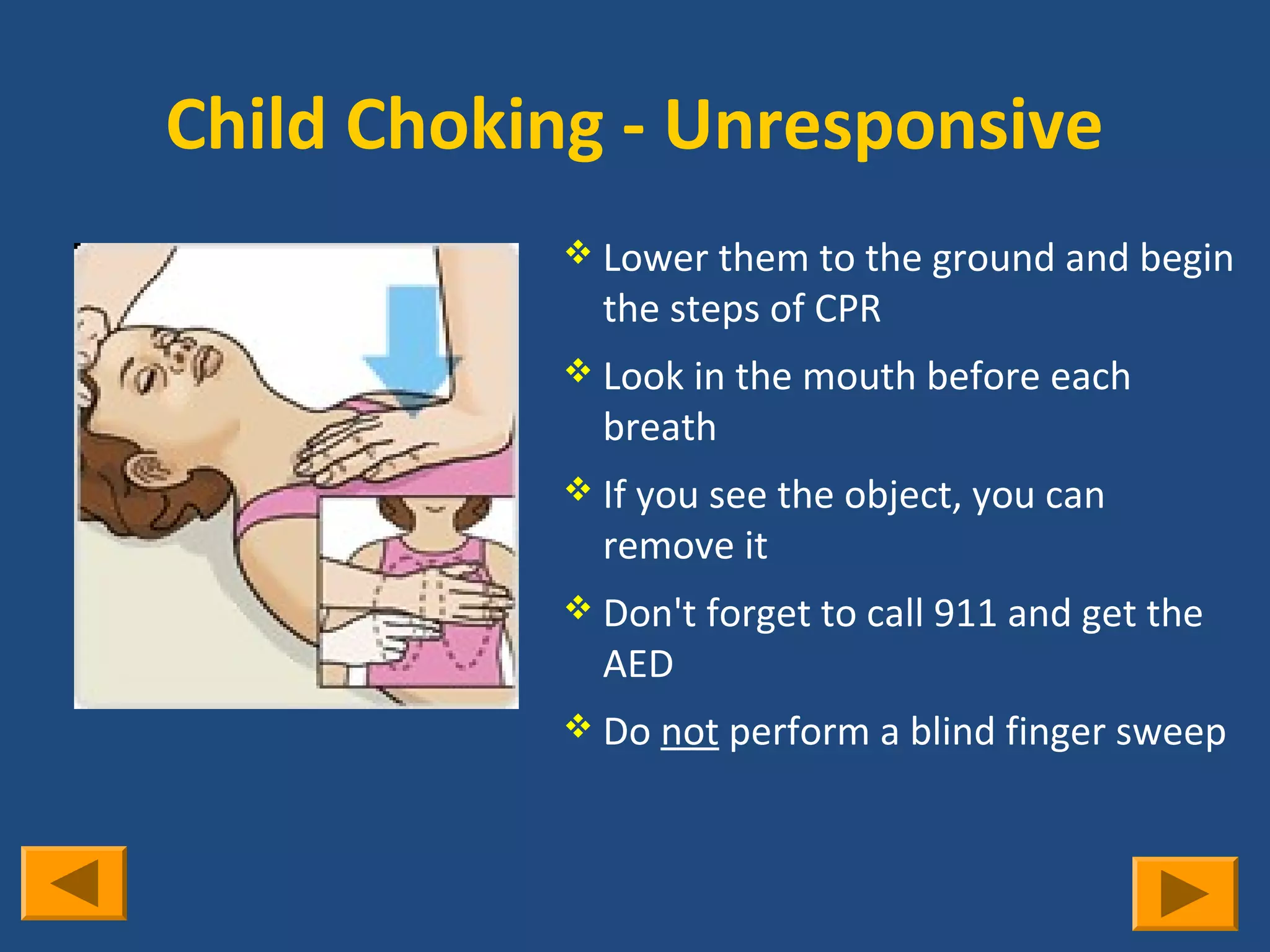
Child Choking - Unresponsive
            Lower them to the ground and begin
             the steps of CPR
            Look in the mouth before each
             breath
            If you see the object, you can
             remove it
            Don't forget to call 911 and get the
             AED
            Do not perform a blind finger sweep
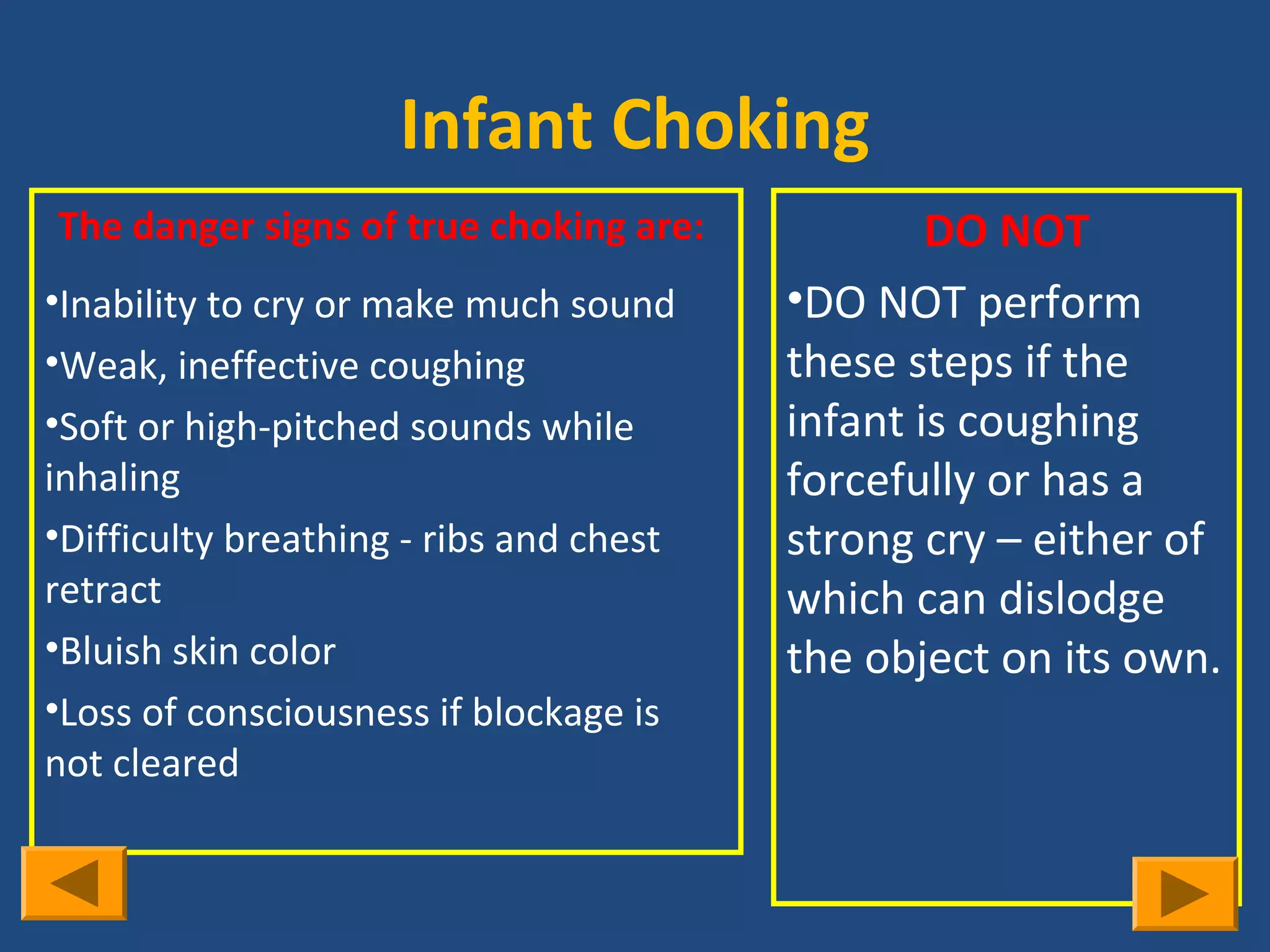
Infant Choking
The danger signs of true choking are:            DO NOT
•Inability to cry or make much sound     •DO NOT perform
•Weak, ineffective coughing              these steps if the
•Soft or high-pitched sounds while       infant is coughing
inhaling                                 forcefully or has a
•Difficulty breathing - ribs and chest   strong cry – either of
retract                                  which can dislodge
•Bluish skin color                       the object on its own.
•Loss of consciousness if blockage is
not cleared
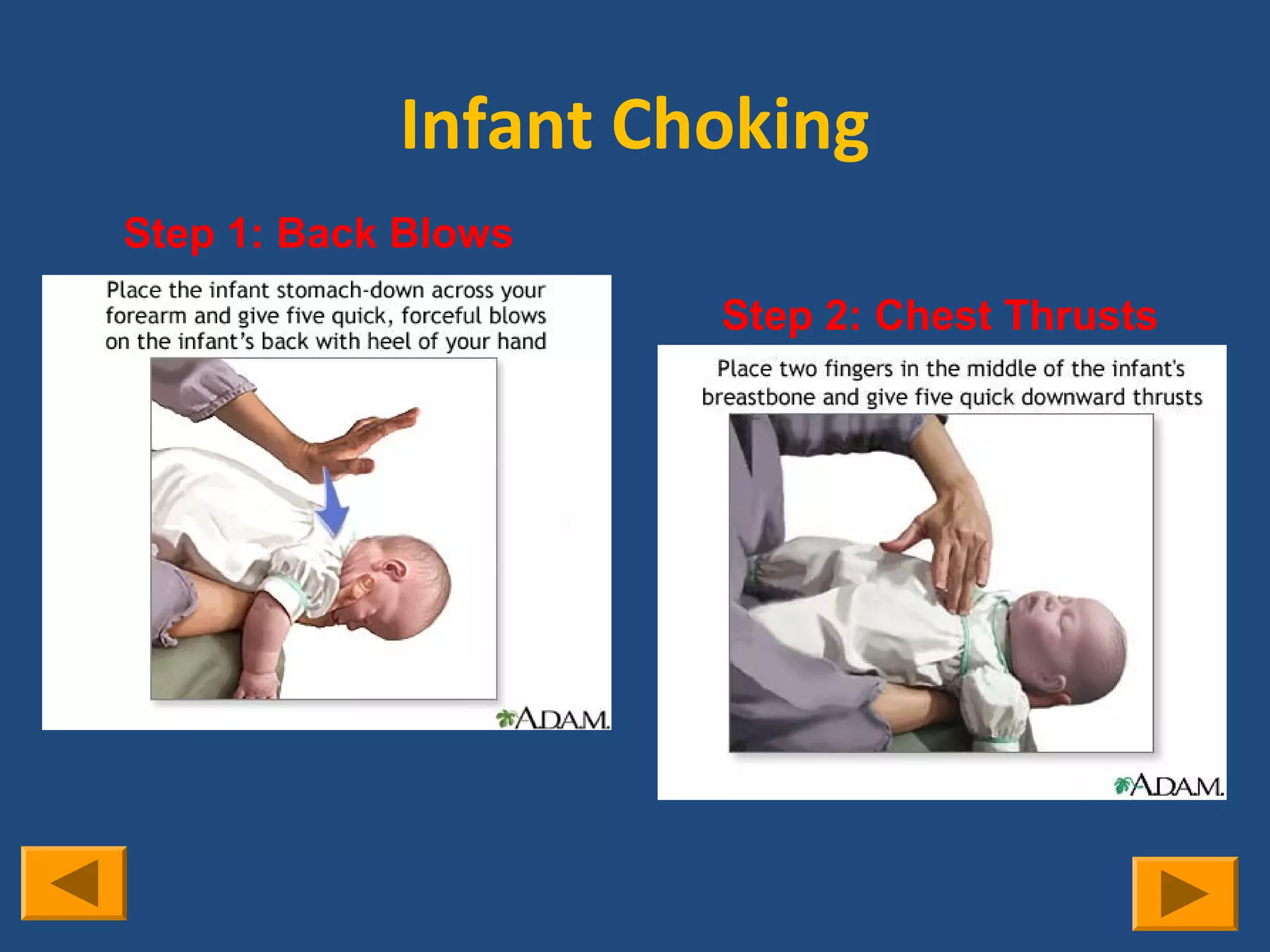
Infant Choking
Step 1: Back Blows
                     Step 2: Chest Thrusts
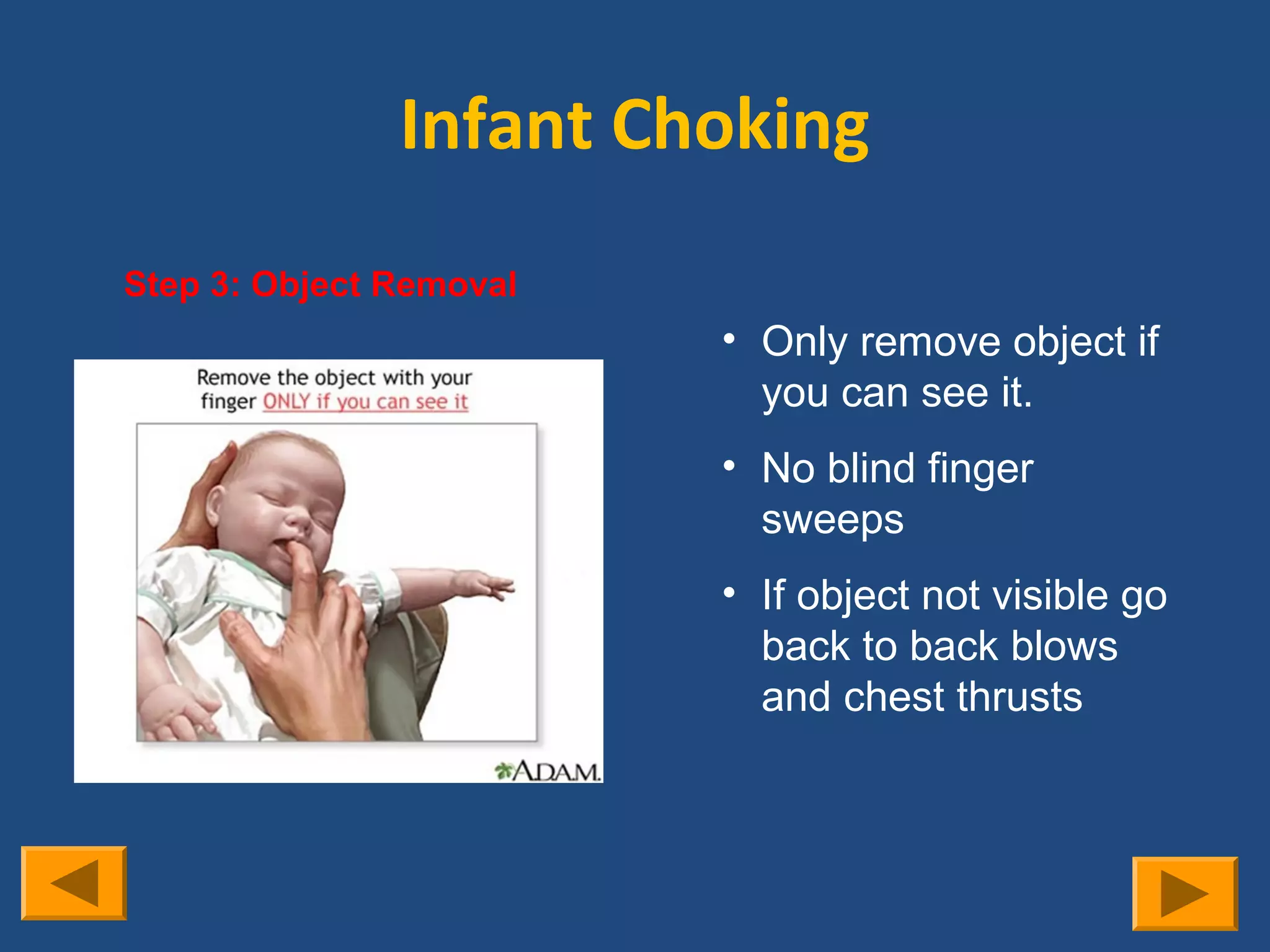
Infant Choking
Step 3: Object Removal
                         • Only remove object if
                           you can see it.
                         • No blind finger
                           sweeps
                         • If object not visible go
                           back to back blows
                           and chest thrusts
Choking Infant - Unresponsive
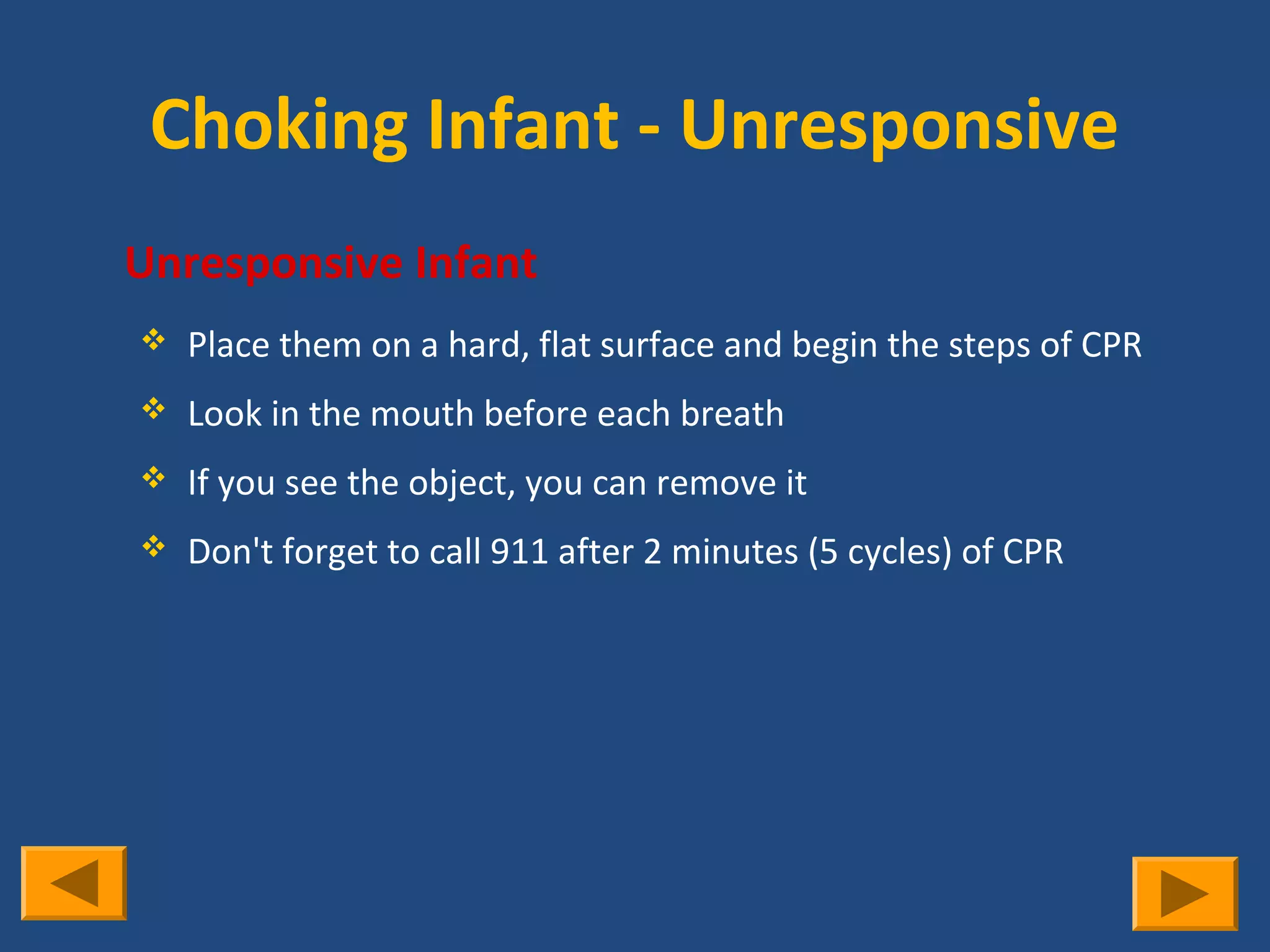
   Unresponsive Infant
       Place them on a hard, flat surface and begin the steps of CPR
       Look in the mouth before each breath
       If you see the object, you can remove it
       Don't forget to call 911 after 2 minutes (5 cycles) of CPR
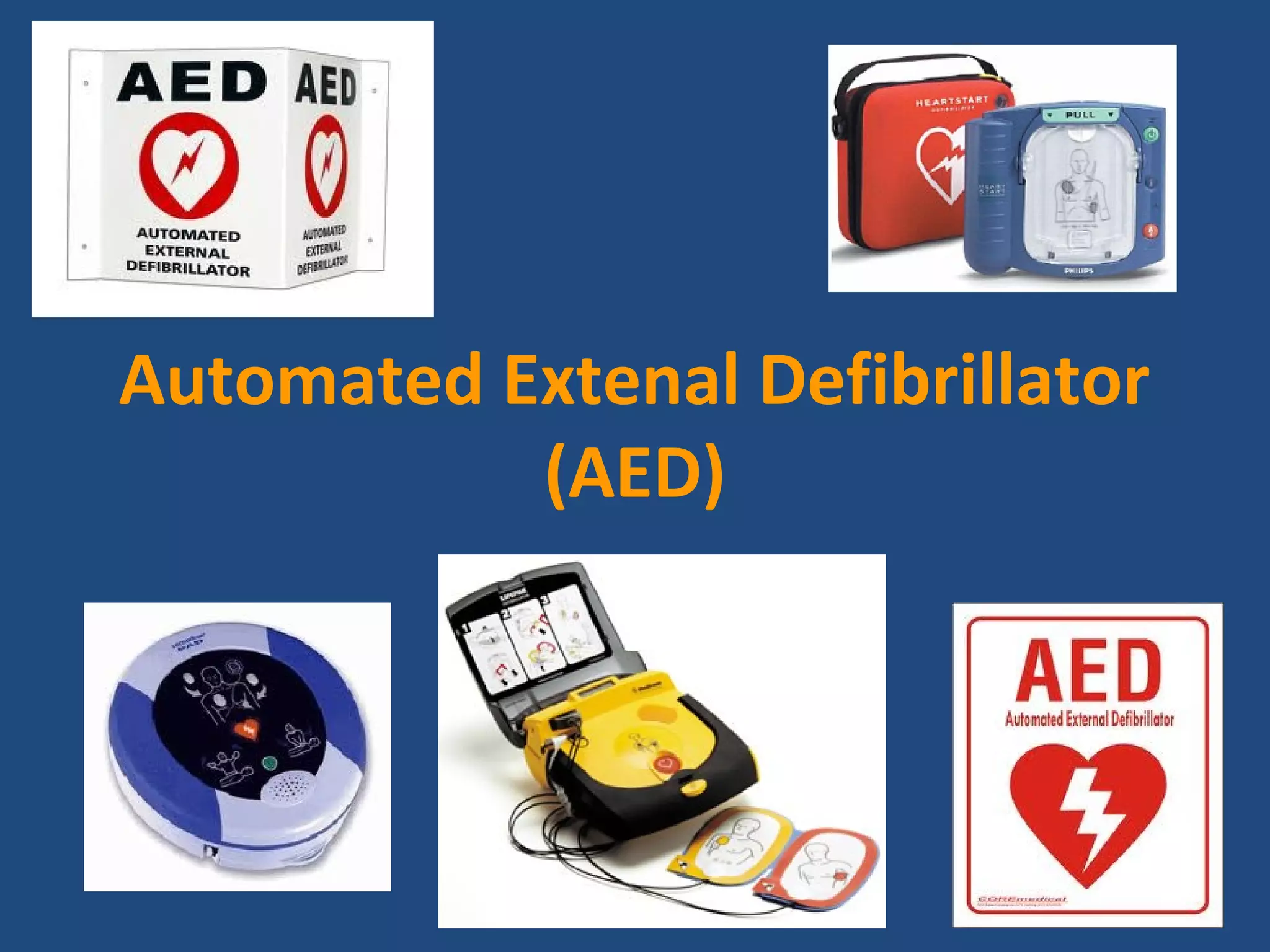
Automated Extenal Defibrillator
           (AED)
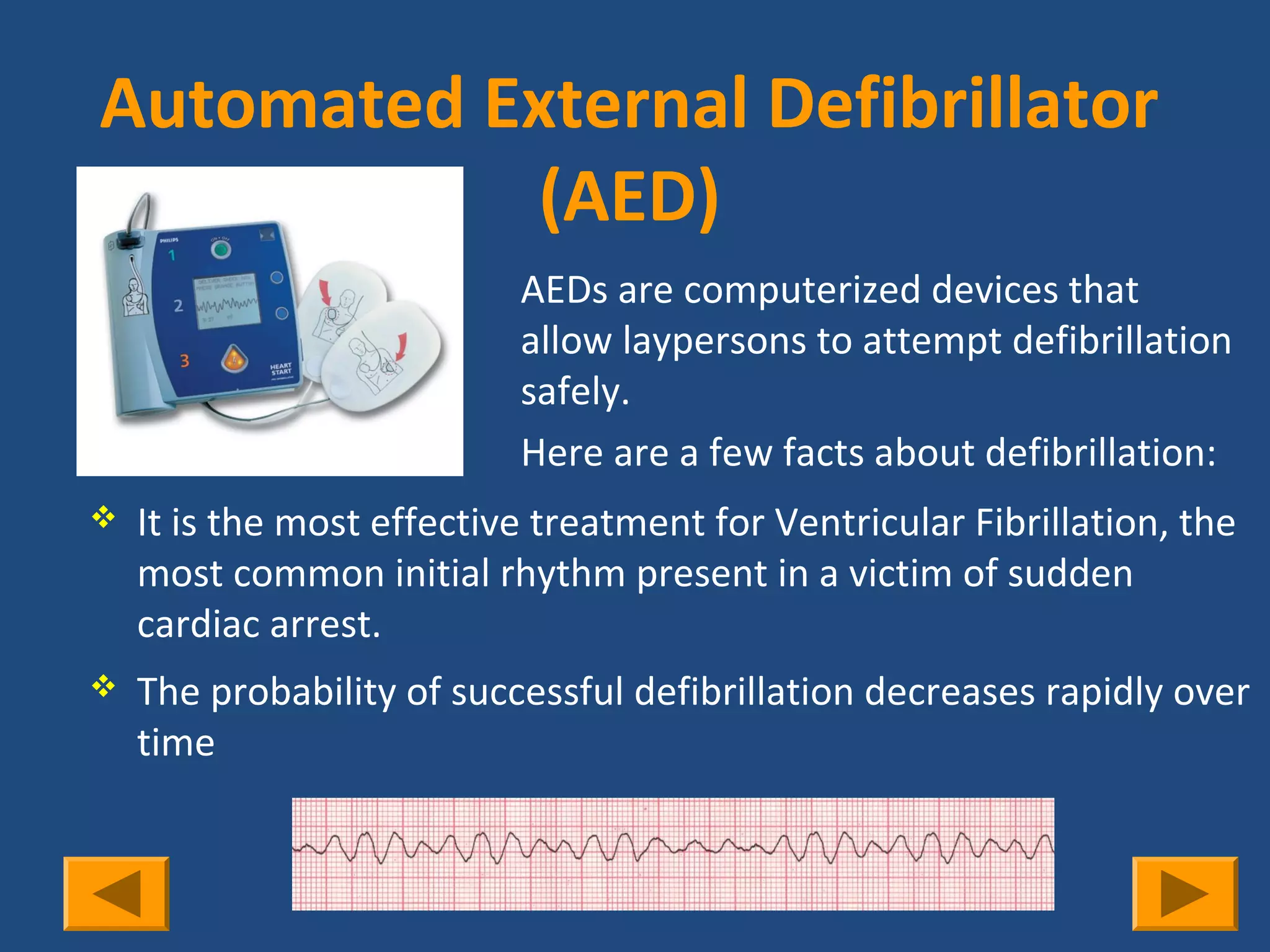
Automated External Defibrillator
           (AED)
                           AEDs are computerized devices that
                           allow laypersons to attempt defibrillation
                           safely.
                           Here are a few facts about defibrillation:
   It is the most effective treatment for Ventricular Fibrillation, the
    most common initial rhythm present in a victim of sudden
    cardiac arrest.
   The probability of successful defibrillation decreases rapidly over
    time
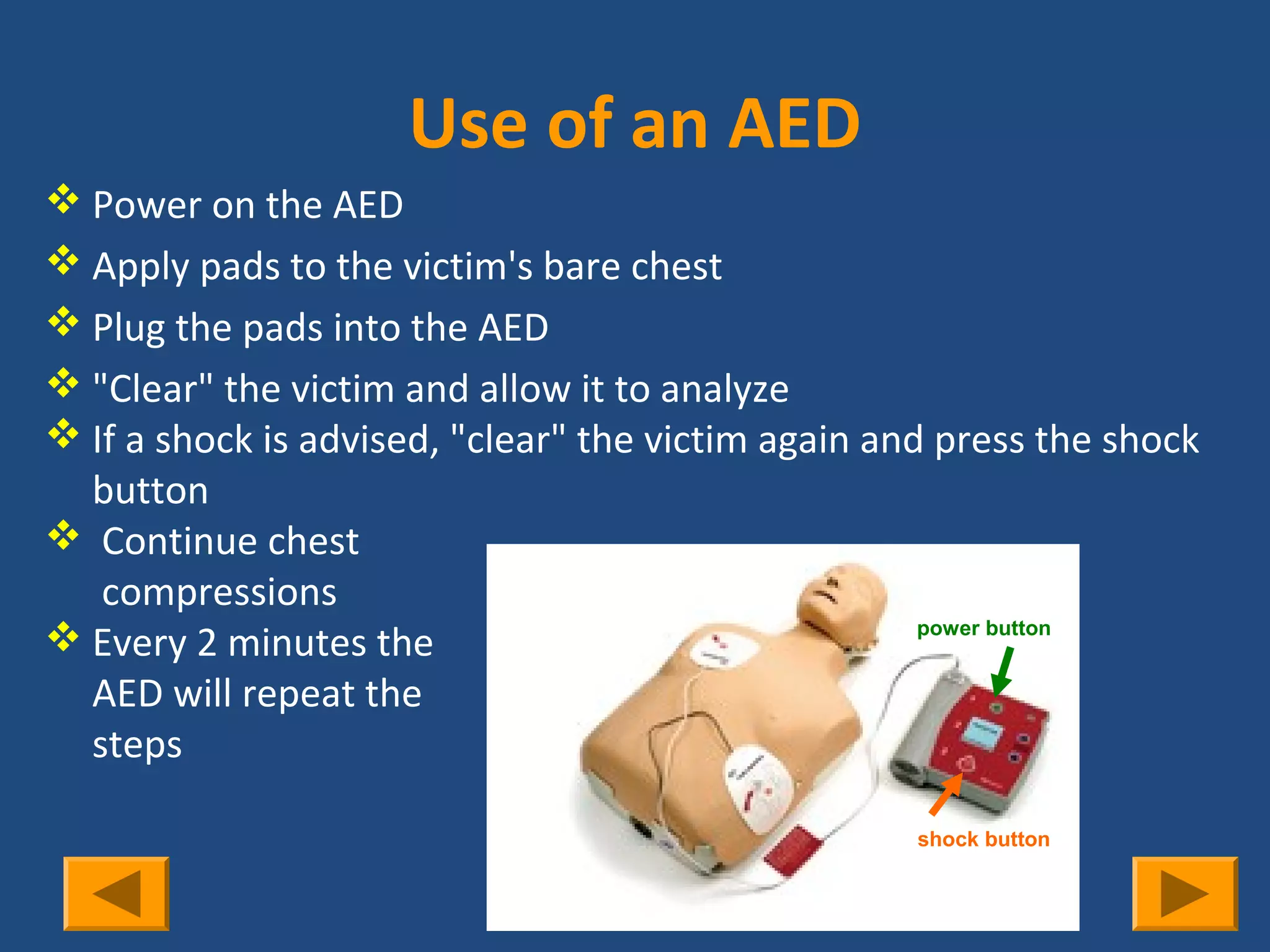
Use of an AED
 Power on the AED
 Apply pads to the victim's bare chest
 Plug the pads into the AED
 "Clear" the victim and allow it to analyze
 If a shock is advised, "clear" the victim again and press the shock
  button
 Continue chest
   compressions
 Every 2 minutes the                                power button


  AED will repeat the
  steps

                                                    shock button
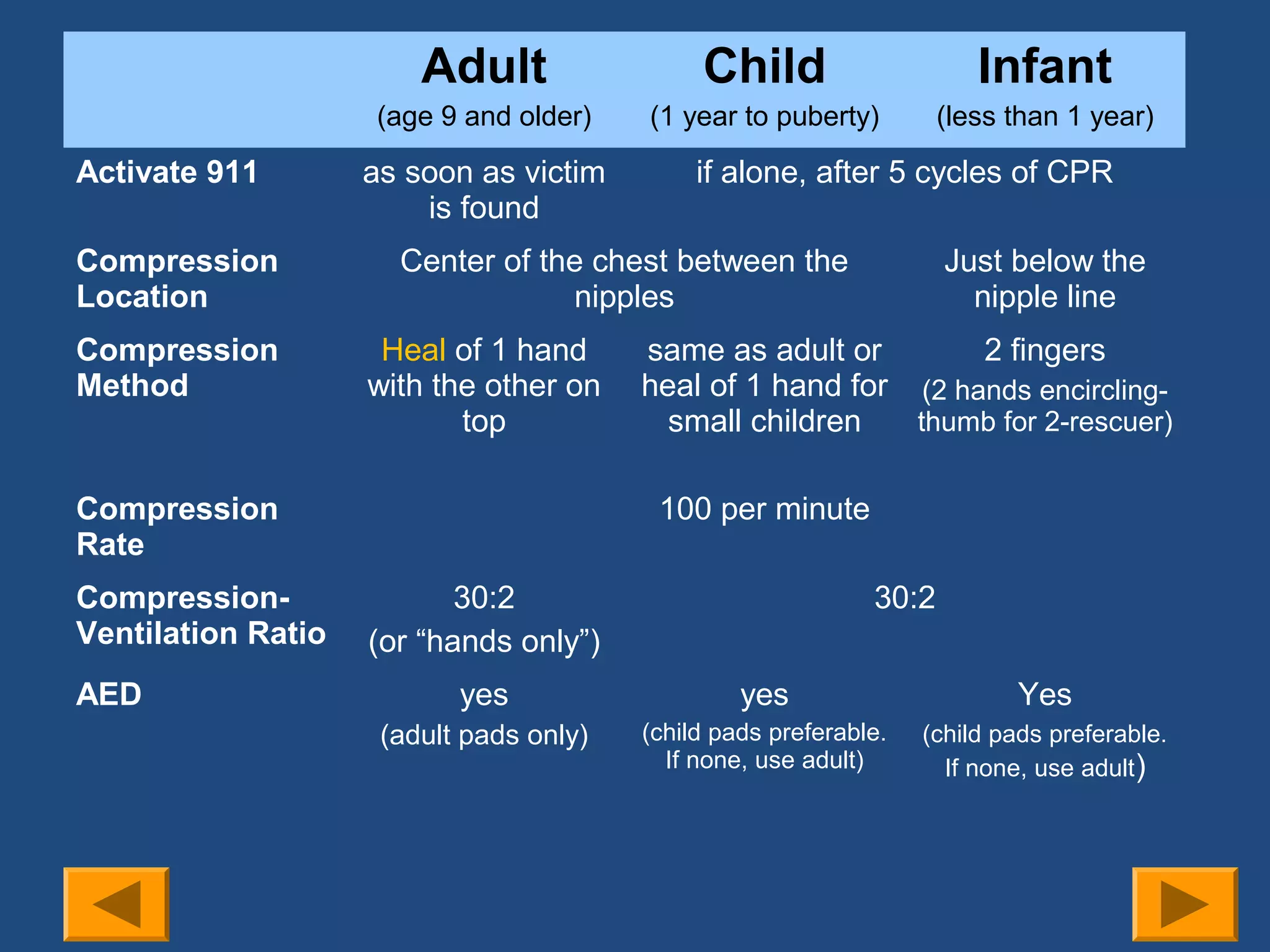
Adult                 Child                     Infant
                    (age 9 and older)    (1 year to puberty)         (less than 1 year)

Activate 911        as soon as victim         if alone, after 5 cycles of CPR
                        is found
Compression           Center of the chest between the                Just below the
Location                          nipples                              nipple line
Compression          Heal of 1 hand      same as adult or        2 fingers
Method              with the other on    heal of 1 hand for (2 hands encircling-
                           top             small children   thumb for 2-rescuer)


Compression                               100 per minute
Rate
Compression-               30:2                               30:2
Ventilation Ratio   (or “hands only”)
AED                        yes                    yes                      Yes
                     (adult pads only)   (child pads preferable.   (child pads preferable.
                                           If none, use adult)       If none, use adult)
Liked It ?


Share on LinkedIn   Tweet this presentation   Share this on Facebook


                     First Response Training, LLC
                     (561) 459-0221
Share on Google+     www.gotcpr.us
                     firstresponsetraining@gmail.com

How to do CPR

  • 1.
    How to doCPR (Cardiopulmonary Resuscitation) . 2010 Guidelines American Heart Association m First Response Training, LLC
  • 2.
    Disclaimer  This presentationis not a substitute from taking a class in person.  Please use this presentation as a refresher.  Please sign up for a class to get to practice the “hands on skills” Conor Devery, EMT-P……….. First Response Training, LLC
  • 3.
    Adult CPR  Make sure scene is safe  Check for responsiveness  If no response, call 911 and get the AED  Check for breathing  Check for movement  Begin chest compressions  Continue 30 compressions and 2 breaths until the AED arrives, EMS takes over, or the victim moves  If uncomfortable doing mouth to mouth – just do compressions
  • 4.
    Hand Placement  Placeheel of one hand in center of chest  Interlock fingers of the other hand Lean forward so your shoulders are over your hands  Press straight down with elbows straight  Push down at least 2 inches Push at a rate (speed) of 100 compressions per minute
  • 5.
    Airway Management Mouth –to - Mouth Mouth – to - Mask If you are uncomfortable doing mouth- to-mouth then skip it and Just do Compressions
  • 6.
    Adult CPR -Reminders  Take 5-10 seconds to check for breathing and movement.  Ensure chest rises with each breath  Place hands in the center of the chest for compressions  Allow chest to recoil completely or return to its normal position  Compression rate: 100/minute  Compress at least 2 inches
  • 7.
    Child CPR  Check for responsiveness  Yell for help but don't leave the victim  Check for breathing Max. of 10 seconds  Check for movement  Begin chest compressions  After 30 compressions give 2 breaths  Continue 30 compressions and 2 breaths for 5 cycles or 2 minutes  If still no response, activate 911 and get the AED
  • 8.
    Hand Placement -Child  Rescuer can use one or two hands to do compressions  Place heel of one hand in center of chest in line with nipple line.  Lean forward so your shoulders are over your hands  Press straight down with elbows Push down at least 1/3 to ½ depth of chest  straight Push at a rate (speed) of 100 compressions per minute If one arm is not strong enough use both hands.
  • 9.
    Child CPR -Reminders  Take 5-10 seconds to check for breathing and movement  Ensure chest rises with each breath  Place hands in the center of the chest for compressions  Use 1 or 2 hands for compressions  Allow chest to recoil completely  Compression rate: 100/minute  Compress 1/3 to 1/2 the depth of the chest  Phone 911 after 5 cycles of CPR if you are alone
  • 10.
    Infant CPR  Check for responsiveness  Yell for help but don't leave the victim  Check for breathing Max. of 10 seconds  Check for movement  Begin chest compressions  After 30 compressions give 2 breaths  Continue 30 compressions and 2 breaths for 5 cycles or 2 minutes  If still no response, activate 911 and get the AED
  • 11.
  • 12.
    Infant Mouth –to – Mouth and Nose Resuscitation
  • 13.
    Infant CPR -Reminders  Take 5-10 seconds to check for breathing and movement  Ensure chest rises with each breath  Perform compressions using 2 fingers placed 1 finger width below the nipple line  Allow chest to recoil completely  Compression rate: 100/minute  Compress 1/3 the depth of the chest  Phone 911 after 5 cycles of CPR if you are alone  AED can now be used for infants
  • 14.
  • 15.
    When NOT todo Choking Relief If a person appears to be choking  Ask the patient “Are you choking.” If they can talk, or cough, they are not fully choking  Encourage them to keep coughing  Call 911 Do NOT do abdominal thrusts if they can talk or cough
  • 16.
    Adult Choking -Responsive • Stand behind the person and wrap your arms around the person’s waist. • Make a fist with one hand. Place the thumb side of your fist just above the person’s navel, well below the breastbone. .. • Grasp the fist with your hand. • Make quick, upward and inward thrusts with your fists. • Continue thrusts until the object is dislodged or the person loses consciousness. • If the person becomes unconscious, lower person to the floor, call 911, and begin CPR. If you see the object blocking the airway, try to remove it.
  • 17.
    Adult Choking -Responsive 1/2 way between navel and xyphoid
  • 18.
    Adult Choking -Unresponsive  Lower them to the ground and begin the steps of CPR  Check mouth for object after 30 compressions  If you see the object, you can remove it  Don't forget to call 911 and get the AED  Do not perform a blind finger sweep
  • 19.
    Child Choking -Responsive
  • 20.
    Child Choking -Responsive  Performing first aid for a choking child is very similar to an adult. If the child does not clearly grab their throat other danger signs for a child and an adult include:  Inability to speak  Weak, ineffective coughing  Noisy breathing or high-pitched sounds while inhaling  Difficulty breathing  Bluish skin color  Loss of consciousness if blockage is not cleared
  • 21.
    Child Choking -Unresponsive  Lower them to the ground and begin the steps of CPR  Look in the mouth before each breath  If you see the object, you can remove it  Don't forget to call 911 and get the AED  Do not perform a blind finger sweep
  • 22.
    Infant Choking The dangersigns of true choking are: DO NOT •Inability to cry or make much sound •DO NOT perform •Weak, ineffective coughing these steps if the •Soft or high-pitched sounds while infant is coughing inhaling forcefully or has a •Difficulty breathing - ribs and chest strong cry – either of retract which can dislodge •Bluish skin color the object on its own. •Loss of consciousness if blockage is not cleared
  • 23.
    Infant Choking Step 1:Back Blows Step 2: Chest Thrusts
  • 24.
    Infant Choking Step 3:Object Removal • Only remove object if you can see it. • No blind finger sweeps • If object not visible go back to back blows and chest thrusts
  • 25.
    Choking Infant -Unresponsive  Unresponsive Infant  Place them on a hard, flat surface and begin the steps of CPR  Look in the mouth before each breath  If you see the object, you can remove it  Don't forget to call 911 after 2 minutes (5 cycles) of CPR
  • 26.
  • 27.
    Automated External Defibrillator (AED) AEDs are computerized devices that allow laypersons to attempt defibrillation safely. Here are a few facts about defibrillation:  It is the most effective treatment for Ventricular Fibrillation, the most common initial rhythm present in a victim of sudden cardiac arrest.  The probability of successful defibrillation decreases rapidly over time
  • 28.
    Use of anAED  Power on the AED  Apply pads to the victim's bare chest  Plug the pads into the AED  "Clear" the victim and allow it to analyze  If a shock is advised, "clear" the victim again and press the shock button  Continue chest compressions  Every 2 minutes the power button AED will repeat the steps shock button
  • 29.
    Adult Child Infant (age 9 and older) (1 year to puberty) (less than 1 year) Activate 911 as soon as victim if alone, after 5 cycles of CPR is found Compression Center of the chest between the Just below the Location nipples nipple line Compression Heal of 1 hand same as adult or 2 fingers Method with the other on heal of 1 hand for (2 hands encircling- top small children thumb for 2-rescuer) Compression 100 per minute Rate Compression- 30:2 30:2 Ventilation Ratio (or “hands only”) AED yes yes Yes (adult pads only) (child pads preferable. (child pads preferable. If none, use adult) If none, use adult)
  • 30.
    Liked It ? Shareon LinkedIn Tweet this presentation Share this on Facebook First Response Training, LLC (561) 459-0221 Share on Google+ www.gotcpr.us firstresponsetraining@gmail.com