Cardio Pulmonary
Resuscitation
CardioPulmonary Resuscitation
What are the functions of CPR
?
A. As basic life support – to maintain a viable
(living) victim for advanced life support. (EMS)
◦
EMS stands for Emergency Medical Service
B. To minimize the occurrence of panic during
times of emergency
.
C. For early diagnosis and detection of the
symptoms of heart attack
.
-
Be able to recognize the signs of a heart attack
.
◦
-
The greatest risk of death from heart attack is in
the initial two hours after the onset of the
symptoms
-
60%
of all victims die before they reach the
hospital. (paramedics now stabilize the victim at
the site before transporting.)

C = Cardio (heart)

P = Pulmonary (lungs)

R = Resuscitation (recover)


Oxygen is the basic requirement for breathing and every
Living cell in the body

The function of the epiglottis is to guard the entrance to

trachea
What does CPR stand for
?
What types of situations might cause a victim to
need CPR
?
-
Heart attack

-
Electrocution

-
Drug overdose

-
Accidents

-
Stroke

-
Diabetes

-
Choking

-
Poisoning

-
Smoke -Inhalation

-
Epilepsy

-
Suffocation

-
Drowning
What are the real symptoms of a heart attack
?

-
Uncomfortable pressure and squeezing, usually located in
the center of the chest

-
Pain may spread to shoulders, arms, neck, and back
(usually on the left side)

-
The pain is not always severe and may come and go
(sharp, stabbing twinges of pain usually are not signals of
heart attack)

-
Sweating, nausea, shortness of breath, feeling of
weakness
◦
-
May occur in either sex, even young adults, and not
necessarily during physical or emotional stress
.
How to help a heart attack victim that is
conscious

-
Help the victim into a comfortable position
◦
Sitting if he or she is short of breath
◦
Lying down if he or she is light headed

-
Loosen clothing around neck and waist
.

-
Call an ambulance. Call 997
!

•
Definitions

Coronary Heart Disease – the blood supply to a
part of the heart is blocked; that part of the heart
not receiving oxygen begins to die
.

Respiratory Arrest – breathing stops

Cardiac Arrest – the heart has stopped

Stroke – the blood supply to a part of the brain is
blocked; those brain cells not receiving oxygen
begin to die
.

Heart attack – A sudden severe instance of
abnormal heart function
.
Brain Death – Occurs 4-6 minutes after clinical death
when the cells of the brain begin to die
.
Biological death- all systems cease to function. Organ
systems have shut down and are no longer working
Clinical Death – means the heart and breathing have
stopped
.

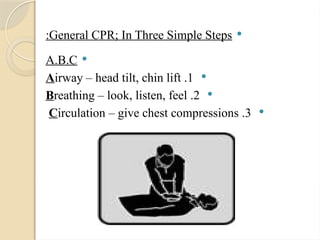
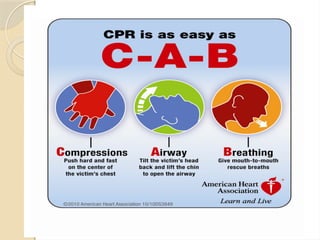
General CPR; In Three Simple Steps
:

A.B.C

1
.
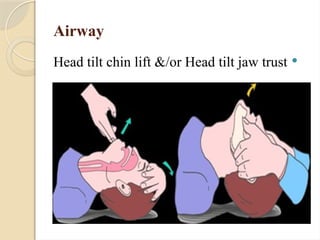
Airway – head tilt, chin lift

2
.
Breathing – look, listen, feel

3
.
Circulation – give chest compressions
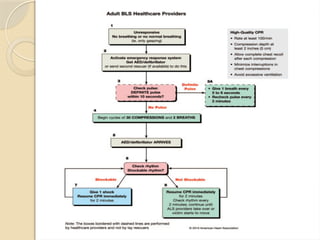
Adult; over 12 years old; CPR
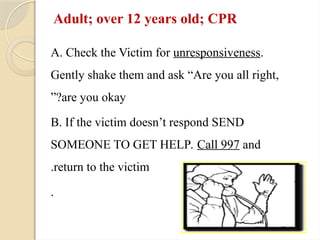
A. Check the Victim for unresponsiveness.
Gently shake them and ask “Are you all right,
are you okay
”?
B. If the victim doesn’t respond SEND
SOMEONE TO GET HELP. Call 997 and
return to the victim
.
.
Compressions: Restore blood circulation
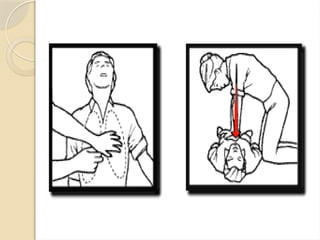
-Put the person on his or her back on a firm surface.
-Kneel next to the person's neck and shoulders.
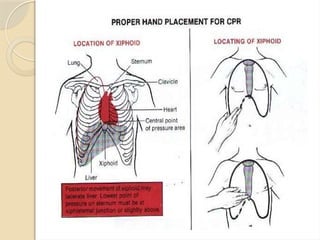
-Place the heel of one hand over the center of the
person's chest, between the nipples. Place your
other hand on top of the first hand. Keep your
elbows straight and position your shoulders
directly above your hands.
-Use your upper body weight (not just your arms) as
you push straight down on (compress) the chest at
least 2 inches (approximately 5 centimeters). Push
hard at a rate of about 100 compressions a minute.
-If you haven't been trained in CPR, continue chest
compressions until there are signs of movement or
until emergency medical personnel take over. If
you have been trained in CPR, go on to checking
the airway and rescue breathing.
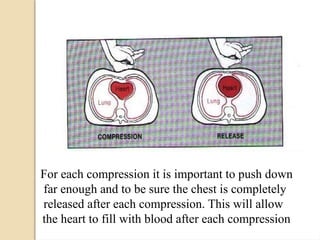
For each compression it is important to push down
far enough and to be sure the chest is completely
released after each compression. This will allow
the heart to fill with blood after each compression
.
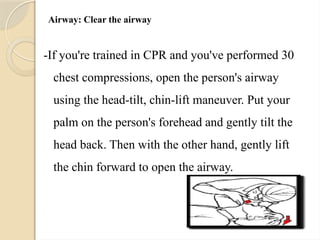
Airway: Clear the airway
-If you're trained in CPR and you've performed 30
chest compressions, open the person's airway
using the head-tilt, chin-lift maneuver. Put your
palm on the person's forehead and gently tilt the
head back. Then with the other hand, gently lift
the chin forward to open the airway.

-
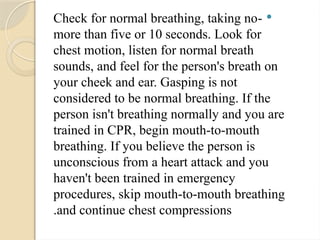
Check for normal breathing, taking no
more than five or 10 seconds. Look for
chest motion, listen for normal breath
sounds, and feel for the person's breath on
your cheek and ear. Gasping is not
considered to be normal breathing. If the
person isn't breathing normally and you are
trained in CPR, begin mouth-to-mouth
breathing. If you believe the person is
unconscious from a heart attack and you
haven't been trained in emergency
procedures, skip mouth-to-mouth breathing
and continue chest compressions
.
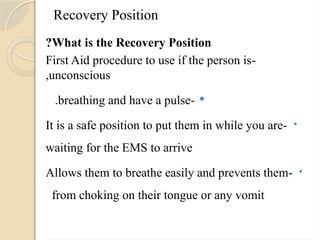
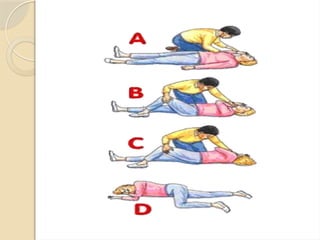
Recovery Position
What is the Recovery Position
?
-
First Aid procedure to use if the person is
unconscious
,

-
breathing and have a pulse
.
•
-
It is a safe position to put them in while you are
waiting for the EMS to arrive
•
-
Allows them to breathe easily and prevents them
from choking on their tongue or any vomit
.
Breathing: Breathe for the person

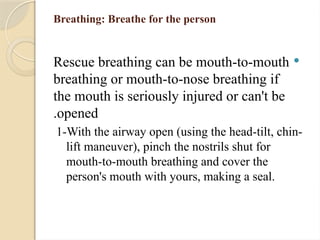
Rescue breathing can be mouth-to-mouth
breathing or mouth-to-nose breathing if
the mouth is seriously injured or can't be
opened
.
1-With the airway open (using the head-tilt, chin-
lift maneuver), pinch the nostrils shut for
mouth-to-mouth breathing and cover the
person's mouth with yours, making a seal.
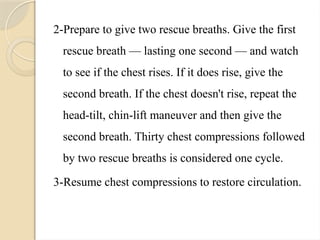
2-Prepare to give two rescue breaths. Give the first
rescue breath — lasting one second — and watch
to see if the chest rises. If it does rise, give the
second breath. If the chest doesn't rise, repeat the
head-tilt, chin-lift maneuver and then give the
second breath. Thirty chest compressions followed
by two rescue breaths is considered one cycle.
3-Resume chest compressions to restore circulation.
4-If the person has not begun moving after five
cycles (about two minutes) and an automated
external defibrillator (AED) is available, apply it
and follow the prompts. Administer one shock,
then resume CPR — starting with chest
compressions — for two more minutes before
administering a second shock. If you're not
trained to use an AED, a 997 or other emergency
medical operator may be able to guide you in its
use. If an AED isn't available, go to step 5
below.
5-Continue CPR until there are signs of movement
or emergency medical personnel take over.
To perform CPR on a child

The procedure for giving CPR to a child age 1
through 8 is essentially the same as that for an
adult. The differences are as follows
:
1-If you're alone, perform five cycles of compressions and
breaths on the child — this should take about two minutes
— before calling 997 or your local emergency number or
using an AED.
2-Use only one hand to perform chest compressions.
3-Breathe more gently.
4-Use the same compression-breath rate as is used
for adults: 30 compressions followed by two
breaths. This is one cycle. Following the two
breaths, immediately begin the next cycle of
compressions and breaths.
5-After five cycles (about two minutes) of CPR, if
there is no response and an AED is available,
apply it and follow the prompts. Use pediatric
pads if available, for children ages 1 through 8.
If pediatric pads aren't available, use adult pads.
Do not use an AED for children younger than
age 1. Administer one shock, then resume CPR
— starting with chest compressions — for two
more minutes before administering a second
shock. If you're not trained to use an AED, a 997
or other emergency medical operator may be
able to guide you in its use.

6
-
Continue until the child moves or help arrives
.
To perform CPR on a baby

Most cardiac arrests in babies occur from lack of
oxygen, such as from drowning or choking. If
you know the baby has an airway obstruction,
perform first aid for choking. If you don't know
why the baby isn't breathing, perform CPR
.

To begin, examine the situation. Stroke the baby
and watch for a response, such as movement,
but don't shake the baby
.

If there's no response, follow the CAB
procedures below and time the call for help as
follows
:
 If you're the only rescuer and CPR is needed, do
CPR for two minutes — about five cycles —
before calling 997 or your local emergency
number.
 If another person is available, have that person
call for help immediately while you attend to the
baby.
Compressions: Restore blood circulation
1-Place the baby on his or her back on a firm, flat
surface, such as a table. The floor or ground also
will do.
2-Imagine a horizontal line drawn between the
baby's nipples. Place two fingers of one hand just
below this line, in the center of the chest.
3-Gently compress the chest about 1.5 inches (about
4 centimeters).
4-Count aloud as you pump in a fairly rapid rhythm.
You should pump at a rate of 100 compressions a
minute.
Airway: Clear the airway
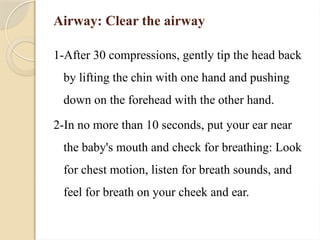
1-After 30 compressions, gently tip the head back
by lifting the chin with one hand and pushing
down on the forehead with the other hand.
2-In no more than 10 seconds, put your ear near
the baby's mouth and check for breathing: Look
for chest motion, listen for breath sounds, and
feel for breath on your cheek and ear.
Breathing: Breathe for the baby
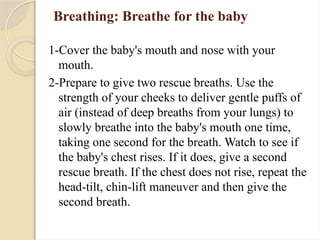
1-Cover the baby's mouth and nose with your
mouth.
2-Prepare to give two rescue breaths. Use the
strength of your cheeks to deliver gentle puffs of
air (instead of deep breaths from your lungs) to
slowly breathe into the baby's mouth one time,
taking one second for the breath. Watch to see if
the baby's chest rises. If it does, give a second
rescue breath. If the chest does not rise, repeat the
head-tilt, chin-lift maneuver and then give the
second breath.
3-If the baby's chest still doesn't rise, examine the
mouth to make sure no foreign material is
inside. If an object is seen, sweep it out with
your finger. If the airway seems blocked,
perform first aid for a choking baby.
4-Give two breaths after every 30 chest
compressions.
5-Perform CPR for about two minutes before
calling for help unless someone else can make
the call while you attend to the baby.
6-Continue CPR until you see signs of life or until
medical personnel arrive.
CPR: Infant; 0 to 1 year check for
unresponsiveness; call for help
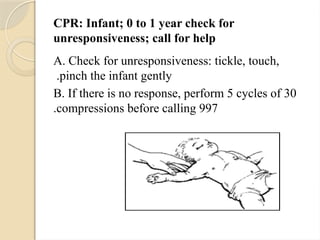
A. Check for unresponsiveness: tickle, touch,
pinch the infant gently
.
B. If there is no response, perform 5 cycles of 30
compressions before calling 997
.
Check circulation
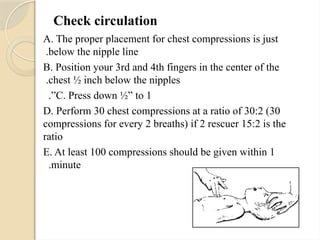
A. The proper placement for chest compressions is just
below the nipple line
.
B. Position your 3rd and 4th fingers in the center of the
chest ½ inch below the nipples
.
C. Press down ½” to 1
.”
D. Perform 30 chest compressions at a ratio of 30:2 (30
compressions for every 2 breaths) if 2 rescuer 15:2 is the
ratio
E. At least 100 compressions should be given within 1
minute
.
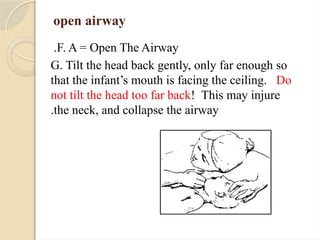
open airway
F. A = Open The Airway
.
G. Tilt the head back gently, only far enough so
that the infant’s mouth is facing the ceiling. Do
not tilt the head too far back! This may injure
the neck, and collapse the airway
.
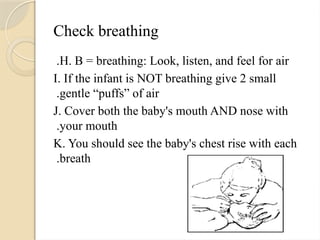
Check breathing
H. B = breathing: Look, listen, and feel for air
.
I. If the infant is NOT breathing give 2 small
gentle “puffs” of air
.
J. Cover both the baby's mouth AND nose with
your mouth
.
K. You should see the baby's chest rise with each
breath
.

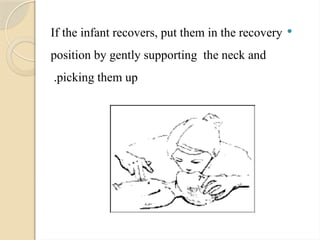
If the infant recovers, put them in the recovery
position by gently supporting the neck and
picking them up
.
-
In a two person rescue situation, rescuers should
rotate between compressions and breathing
every 2 minutes to avoid fatigue
.
-
Ideally, the rescuers should switch positions
within 5 seconds so the victim is not left
unattended for too long
.
Chest Compressions

-
To provide effective chest compressions, push
hard and push fast
.

-
Compress the adult chest at a rate of at least
100 compressions per minute with a
compression depth of at least 2 inches/5 cm
.

-
Allow complete chest recoil after each
compression
.

-
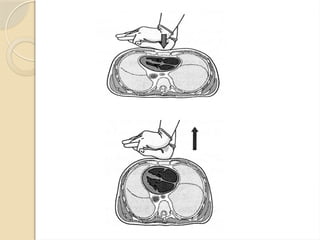
The rescuer should place the heel of one hand
on the center (middle) of the victim’s chest
(which is the lower half of the sternum) and the
heel of the other hand on top of the first so
that the hands are overlapped and parallel
.

Chest compression & chest recoil/relaxation
times approximately equal
.
Airway

Head tilt chin lift &/or Head tilt jaw trust
Cardio pulmonary rescuitation pricedure explained practically

Cardio pulmonary rescuitation pricedure explained practically

  • 1.
  • 2.
  • 3.
    What are thefunctions of CPR ? A. As basic life support – to maintain a viable (living) victim for advanced life support. (EMS) ◦ EMS stands for Emergency Medical Service B. To minimize the occurrence of panic during times of emergency . C. For early diagnosis and detection of the symptoms of heart attack .
  • 4.
    - Be able torecognize the signs of a heart attack . ◦ - The greatest risk of death from heart attack is in the initial two hours after the onset of the symptoms - 60% of all victims die before they reach the hospital. (paramedics now stabilize the victim at the site before transporting.)
  • 5.
     C = Cardio(heart)  P = Pulmonary (lungs)  R = Resuscitation (recover)   Oxygen is the basic requirement for breathing and every Living cell in the body  The function of the epiglottis is to guard the entrance to  trachea What does CPR stand for ?
  • 6.
    What types ofsituations might cause a victim to need CPR ? - Heart attack  - Electrocution  - Drug overdose  - Accidents  - Stroke  - Diabetes  - Choking  - Poisoning  - Smoke -Inhalation  - Epilepsy  - Suffocation  - Drowning
  • 7.
    What are thereal symptoms of a heart attack ?  - Uncomfortable pressure and squeezing, usually located in the center of the chest  - Pain may spread to shoulders, arms, neck, and back (usually on the left side)  - The pain is not always severe and may come and go (sharp, stabbing twinges of pain usually are not signals of heart attack)  - Sweating, nausea, shortness of breath, feeling of weakness ◦ - May occur in either sex, even young adults, and not necessarily during physical or emotional stress .
  • 8.
    How to helpa heart attack victim that is conscious  - Help the victim into a comfortable position ◦ Sitting if he or she is short of breath ◦ Lying down if he or she is light headed  - Loosen clothing around neck and waist .  - Call an ambulance. Call 997 !
  • 9.
     • Definitions  Coronary Heart Disease– the blood supply to a part of the heart is blocked; that part of the heart not receiving oxygen begins to die .  Respiratory Arrest – breathing stops  Cardiac Arrest – the heart has stopped  Stroke – the blood supply to a part of the brain is blocked; those brain cells not receiving oxygen begin to die .
  • 10.
     Heart attack –A sudden severe instance of abnormal heart function . Brain Death – Occurs 4-6 minutes after clinical death when the cells of the brain begin to die . Biological death- all systems cease to function. Organ systems have shut down and are no longer working Clinical Death – means the heart and breathing have stopped .
  • 11.
     General CPR; InThree Simple Steps :  A.B.C  1 . Airway – head tilt, chin lift  2 . Breathing – look, listen, feel  3 . Circulation – give chest compressions
  • 13.
    Adult; over 12years old; CPR A. Check the Victim for unresponsiveness. Gently shake them and ask “Are you all right, are you okay ”? B. If the victim doesn’t respond SEND SOMEONE TO GET HELP. Call 997 and return to the victim . .
  • 14.
    Compressions: Restore bloodcirculation -Put the person on his or her back on a firm surface. -Kneel next to the person's neck and shoulders. -Place the heel of one hand over the center of the person's chest, between the nipples. Place your other hand on top of the first hand. Keep your elbows straight and position your shoulders directly above your hands.
  • 15.
    -Use your upperbody weight (not just your arms) as you push straight down on (compress) the chest at least 2 inches (approximately 5 centimeters). Push hard at a rate of about 100 compressions a minute. -If you haven't been trained in CPR, continue chest compressions until there are signs of movement or until emergency medical personnel take over. If you have been trained in CPR, go on to checking the airway and rescue breathing.
  • 18.
    For each compressionit is important to push down far enough and to be sure the chest is completely released after each compression. This will allow the heart to fill with blood after each compression .
  • 19.
    Airway: Clear theairway -If you're trained in CPR and you've performed 30 chest compressions, open the person's airway using the head-tilt, chin-lift maneuver. Put your palm on the person's forehead and gently tilt the head back. Then with the other hand, gently lift the chin forward to open the airway.
  • 20.
     - Check for normalbreathing, taking no more than five or 10 seconds. Look for chest motion, listen for normal breath sounds, and feel for the person's breath on your cheek and ear. Gasping is not considered to be normal breathing. If the person isn't breathing normally and you are trained in CPR, begin mouth-to-mouth breathing. If you believe the person is unconscious from a heart attack and you haven't been trained in emergency procedures, skip mouth-to-mouth breathing and continue chest compressions .
  • 21.
    Recovery Position What isthe Recovery Position ? - First Aid procedure to use if the person is unconscious ,  - breathing and have a pulse . • - It is a safe position to put them in while you are waiting for the EMS to arrive • - Allows them to breathe easily and prevents them from choking on their tongue or any vomit .
  • 23.
    Breathing: Breathe forthe person  Rescue breathing can be mouth-to-mouth breathing or mouth-to-nose breathing if the mouth is seriously injured or can't be opened . 1-With the airway open (using the head-tilt, chin- lift maneuver), pinch the nostrils shut for mouth-to-mouth breathing and cover the person's mouth with yours, making a seal.
  • 24.
    2-Prepare to givetwo rescue breaths. Give the first rescue breath — lasting one second — and watch to see if the chest rises. If it does rise, give the second breath. If the chest doesn't rise, repeat the head-tilt, chin-lift maneuver and then give the second breath. Thirty chest compressions followed by two rescue breaths is considered one cycle. 3-Resume chest compressions to restore circulation.
  • 25.
    4-If the personhas not begun moving after five cycles (about two minutes) and an automated external defibrillator (AED) is available, apply it and follow the prompts. Administer one shock, then resume CPR — starting with chest compressions — for two more minutes before administering a second shock. If you're not trained to use an AED, a 997 or other emergency medical operator may be able to guide you in its use. If an AED isn't available, go to step 5 below. 5-Continue CPR until there are signs of movement or emergency medical personnel take over.
  • 26.
    To perform CPRon a child  The procedure for giving CPR to a child age 1 through 8 is essentially the same as that for an adult. The differences are as follows : 1-If you're alone, perform five cycles of compressions and breaths on the child — this should take about two minutes — before calling 997 or your local emergency number or using an AED. 2-Use only one hand to perform chest compressions.
  • 27.
    3-Breathe more gently. 4-Usethe same compression-breath rate as is used for adults: 30 compressions followed by two breaths. This is one cycle. Following the two breaths, immediately begin the next cycle of compressions and breaths.
  • 28.
    5-After five cycles(about two minutes) of CPR, if there is no response and an AED is available, apply it and follow the prompts. Use pediatric pads if available, for children ages 1 through 8. If pediatric pads aren't available, use adult pads. Do not use an AED for children younger than age 1. Administer one shock, then resume CPR — starting with chest compressions — for two more minutes before administering a second shock. If you're not trained to use an AED, a 997 or other emergency medical operator may be able to guide you in its use.  6 - Continue until the child moves or help arrives .
  • 29.
    To perform CPRon a baby  Most cardiac arrests in babies occur from lack of oxygen, such as from drowning or choking. If you know the baby has an airway obstruction, perform first aid for choking. If you don't know why the baby isn't breathing, perform CPR .
  • 30.
     To begin, examinethe situation. Stroke the baby and watch for a response, such as movement, but don't shake the baby .  If there's no response, follow the CAB procedures below and time the call for help as follows :
  • 31.
     If you'rethe only rescuer and CPR is needed, do CPR for two minutes — about five cycles — before calling 997 or your local emergency number.  If another person is available, have that person call for help immediately while you attend to the baby.
  • 32.
    Compressions: Restore bloodcirculation 1-Place the baby on his or her back on a firm, flat surface, such as a table. The floor or ground also will do. 2-Imagine a horizontal line drawn between the baby's nipples. Place two fingers of one hand just below this line, in the center of the chest. 3-Gently compress the chest about 1.5 inches (about 4 centimeters). 4-Count aloud as you pump in a fairly rapid rhythm. You should pump at a rate of 100 compressions a minute.
  • 33.
    Airway: Clear theairway 1-After 30 compressions, gently tip the head back by lifting the chin with one hand and pushing down on the forehead with the other hand. 2-In no more than 10 seconds, put your ear near the baby's mouth and check for breathing: Look for chest motion, listen for breath sounds, and feel for breath on your cheek and ear.
  • 34.
    Breathing: Breathe forthe baby 1-Cover the baby's mouth and nose with your mouth. 2-Prepare to give two rescue breaths. Use the strength of your cheeks to deliver gentle puffs of air (instead of deep breaths from your lungs) to slowly breathe into the baby's mouth one time, taking one second for the breath. Watch to see if the baby's chest rises. If it does, give a second rescue breath. If the chest does not rise, repeat the head-tilt, chin-lift maneuver and then give the second breath.
  • 35.
    3-If the baby'schest still doesn't rise, examine the mouth to make sure no foreign material is inside. If an object is seen, sweep it out with your finger. If the airway seems blocked, perform first aid for a choking baby. 4-Give two breaths after every 30 chest compressions.
  • 36.
    5-Perform CPR forabout two minutes before calling for help unless someone else can make the call while you attend to the baby. 6-Continue CPR until you see signs of life or until medical personnel arrive.
  • 37.
    CPR: Infant; 0to 1 year check for unresponsiveness; call for help A. Check for unresponsiveness: tickle, touch, pinch the infant gently . B. If there is no response, perform 5 cycles of 30 compressions before calling 997 .
  • 38.
    Check circulation A. Theproper placement for chest compressions is just below the nipple line . B. Position your 3rd and 4th fingers in the center of the chest ½ inch below the nipples . C. Press down ½” to 1 .” D. Perform 30 chest compressions at a ratio of 30:2 (30 compressions for every 2 breaths) if 2 rescuer 15:2 is the ratio E. At least 100 compressions should be given within 1 minute .
  • 39.
    open airway F. A= Open The Airway . G. Tilt the head back gently, only far enough so that the infant’s mouth is facing the ceiling. Do not tilt the head too far back! This may injure the neck, and collapse the airway .
  • 40.
    Check breathing H. B= breathing: Look, listen, and feel for air . I. If the infant is NOT breathing give 2 small gentle “puffs” of air . J. Cover both the baby's mouth AND nose with your mouth . K. You should see the baby's chest rise with each breath .
  • 41.
     If the infantrecovers, put them in the recovery position by gently supporting the neck and picking them up .
  • 42.
    - In a twoperson rescue situation, rescuers should rotate between compressions and breathing every 2 minutes to avoid fatigue . - Ideally, the rescuers should switch positions within 5 seconds so the victim is not left unattended for too long .
  • 44.
    Chest Compressions  - To provideeffective chest compressions, push hard and push fast .  - Compress the adult chest at a rate of at least 100 compressions per minute with a compression depth of at least 2 inches/5 cm .  - Allow complete chest recoil after each compression .
  • 45.
     - The rescuer shouldplace the heel of one hand on the center (middle) of the victim’s chest (which is the lower half of the sternum) and the heel of the other hand on top of the first so that the hands are overlapped and parallel .  Chest compression & chest recoil/relaxation times approximately equal .
  • 47.
    Airway  Head tilt chinlift &/or Head tilt jaw trust