Making	
  It	
  Happen:	
  
Enhancing	
  Educa@on	
  through	
  Games	
  &	
  Storytelling	


  Game-­‐Based	
  Learning:	
  A	
  workshop	
  to	
  
     inform	
  educators	
  and	
  engage	
  
          contemporary	
  learners	
  	
  
                              Eric	
  B.	
  Bauman,	
  PhD	
  
                                 RN,	
  Paramedic	


              . 	
  . 	
  . 	
  . 	
  . 	
  . 	
  . 	
  . 	
  . 	
  . 	
  .	


                                                                                              ©Bauman	
  2012	
  Rights	
  Reserved	
  
Professional	
  Affilia@ons	
  	
  
                              Disclosures/Conflict	
  of	
  Interest	


DeVry	
  Inc.,	
  Healthcare	
  Group	
  
             •  Associate	
  Director	
  For	
  Simula@on	
  –	
  Center	
  for	
  Simula@on	
  Excellence	
  	
  
Managing	
  Member	
  –	
  Clinical	
  Playground,	
  LLC	
  
Managing	
  Member	
  –	
  Forensic	
  Analy@cs,	
  LLC	
  
Games+Learning+Society	
  
             •  Affiliate	
  
Society	
  for	
  Simula@on	
  in	
  Healthcare	
  (SSH)	
  
             •  Chair	
  –	
  Website	
  Commi[ee	
  
             •  Co-­‐Chair	
  	
  –	
  Serious	
  Games	
  and	
  Virtual	
  Environments	
  Special	
  Interest	
  Group	
  	
  
Springer	
  –	
  contract	
  for	
  forthcoming	
  book	
  on	
  Game-­‐Based	
  learning	
  and	
  Clinical	
  Educa@on	
  
Adjunct	
  Faculty	
  –	
  CAE	
  Healthcare	
  
Relevant	
  Stock	
  –	
  CAE,	
  Zynga,	
  Pfizer,	
  GE	


                                . 	
  . 	
  . 	
  . 	
  . 	
  . 	
  . 	
  . 	
  . 	
  . 	
  .	


                                                                                                                      ©Bauman	
  2012	
  Rights	
  Reserved	
  
Objec@ves	
  
Par@cipants	
  will	
  recognize	
  the	
  poten@al	
  for	
  student	
  engagement	
  by	
  integra@ng	
  game-­‐
   based	
  learning	
  into	
  today’s	
  digital	
  and	
  media	
  rich	
  educa@onal	
  environments.	
  

Par@cipants	
  will	
  iden@fy	
  the	
  importance	
  of	
  objec@ve	
  iden@fica@on	
  and	
  “fit”	
  when	
  
   using	
  digital	
  and	
  game-­‐based	
  learning	
  pedagogy.	
  

Par@cipants	
  will	
  examine	
  contemporary	
  theory	
  for	
  game-­‐based	
  and	
  virtual	
  learning	
  
   environments.	
  

Par@cipants	
  will	
  be	
  able	
  to	
  include	
  game-­‐based	
  learning	
  in	
  their	
  own	
  professional	
  
   environments.	
  

Par@cipants	
  will	
  experience	
  Game-­‐Based	
  Learning.	


                              . 	
  . 	
  . 	
  . 	
  . 	
  . 	
  . 	
  . 	
  . 	
  . 	
  .	


                                                                                                              ©Bauman	
  2012	
  Rights	
  Reserved	
  
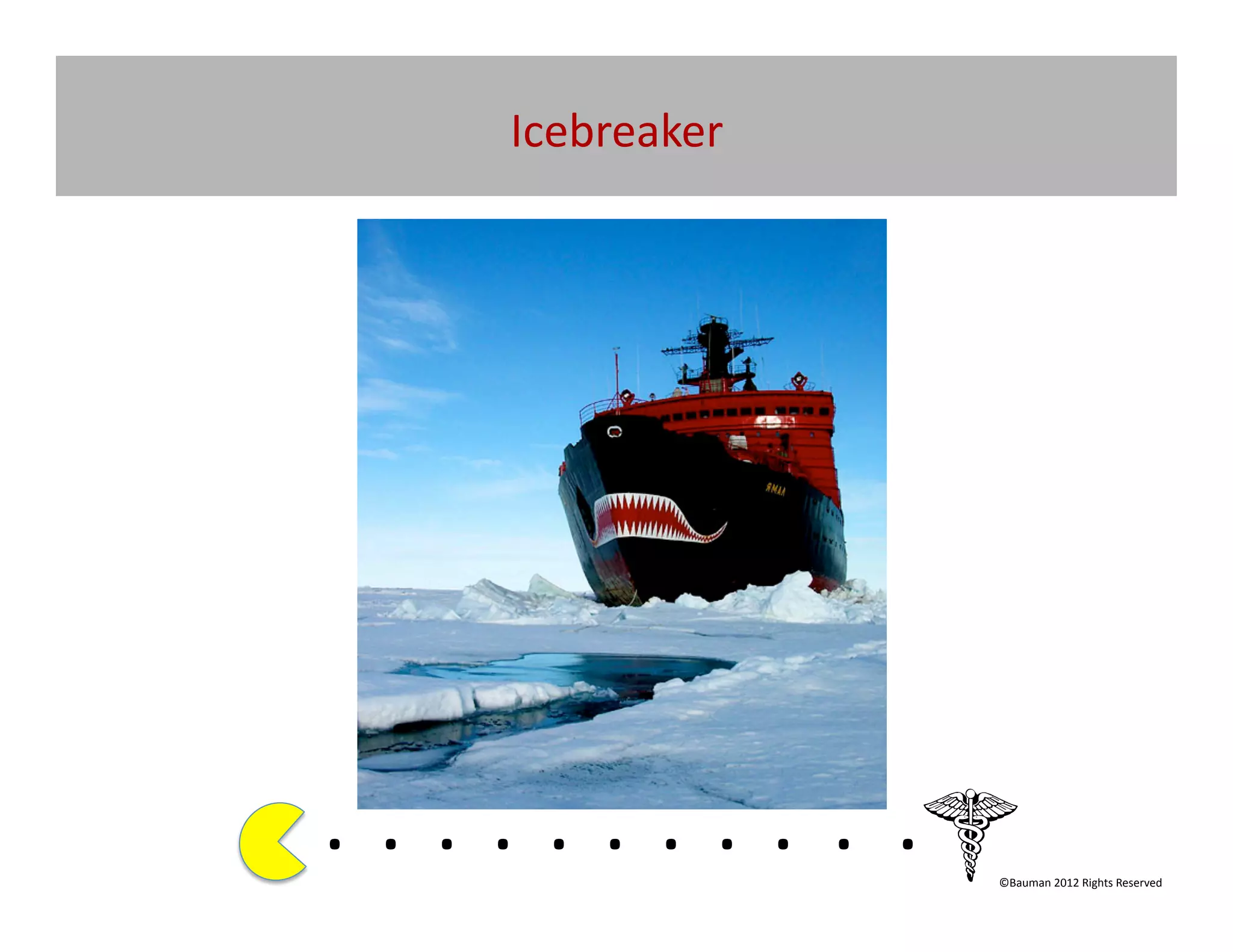
Icebreaker	


. 	
  . 	
  . 	
  . 	
  . 	
  . 	
  . 	
  . 	
  . 	
  . 	
  .	


                                                                                ©Bauman	
  2012	
  Rights	
  Reserved	
  
What	
  are	
  we	
  going	
  to	
  Explore	
  &	
  Talk	
  about	
  

Components	
  of	
  Game-­‐Based	
  Learning	
  

Developing	
  a	
  game	
  versus	
  repurposing	
  

High	
  Tech	
  versus	
  Low	
  Tech	
  –	
  Spectrum	
  of	
  possibili@es	


Integra@ng	
  Game-­‐Based	
  Learning	
  –	
  Return	
  on	
  Investment	
  (ROI)	


                               . 	
  . 	
  . 	
  . 	
  . 	
  . 	
  . 	
  . 	
  . 	
  . 	
  .	


                                                                                                               ©Bauman	
  2012	
  Rights	
  Reserved	
  
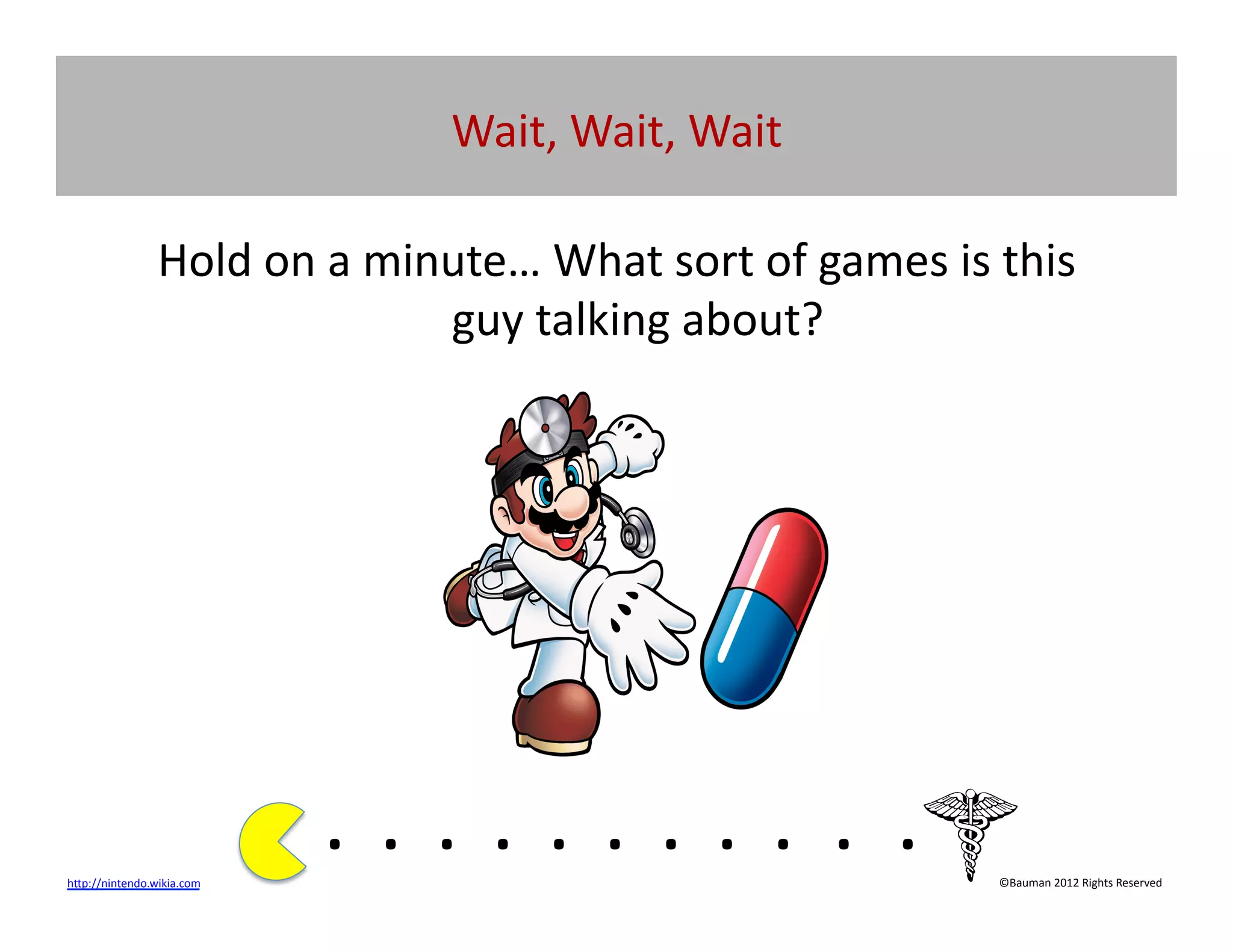
Wait,	
  Wait,	
  Wait	
  

                    Hold	
  on	
  a	
  minute…	
  What	
  sort	
  of	
  games	
  is	
  this	
  
                                          guy	
  talking	
  about?	


h[p://nintendo.wikia.com	
  	
  
                                   . 	
  . 	
  . 	
  . 	
  . 	
  . 	
  . 	
  . 	
  . 	
  . 	
  .	


                                                                                                                   ©Bauman	
  2012	
  Rights	
  Reserved	
  
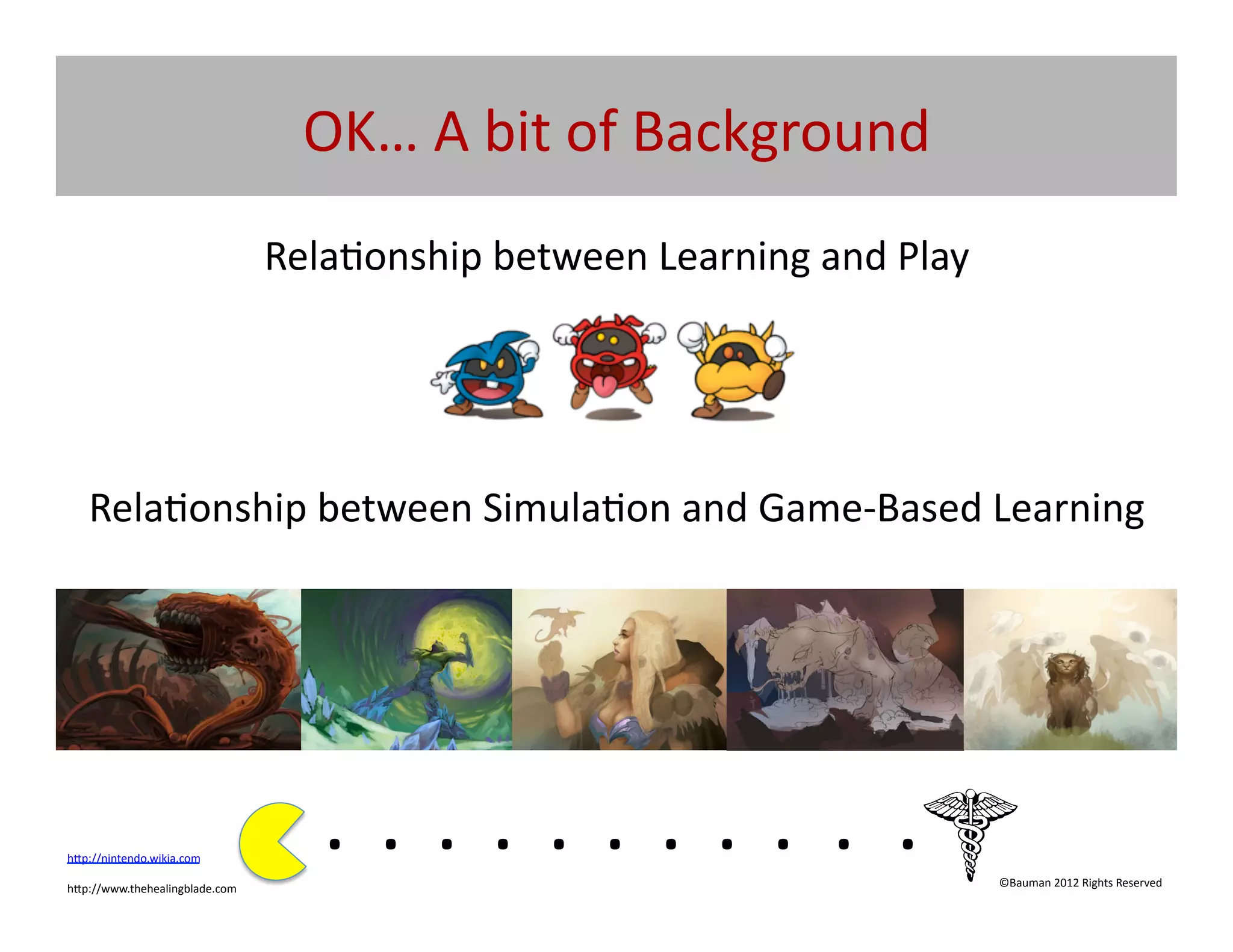
OK…	
  A	
  bit	
  of	
  Background	
  
                                        Rela@onship	
  between	
  Learning	
  and	
  Play	


    Rela@onship	
  between	
  Simula@on	
  and	
  Game-­‐Based	
  Learning	


h[p://nintendo.wikia.com	


h[p://www.thehealingblade.com	
  	
  
                                            . 	
  . 	
  . 	
  . 	
  . 	
  . 	
  . 	
  . 	
  . 	
  . 	
  .	


                                                                                                                            ©Bauman	
  2012	
  Rights	
  Reserved	
  
Instruc@onal	
  or	
  Serious	
  Games,	
  and	
  Simula@on	
  

  •  Tradi@onal	
  Perspec@ve	
  on	
  Games	
  
     –  Goal	
  Oriented	
  
     –  Rule	
  Based	
  
     –  Sense	
  of	
  Consequence	
  	
  
         •  Rewards	
  or	
  otherwise	
  
  •  Tradi@onal	
  Perspec@ve	
  on	
  Simula@on	
  
     –  Imita@on	
  of	
  something	
  real	
  
     –  Representa@on	
  of	
  key	
  design	
  elements	
  or	
  
        variables	
  of	
  a	
  system	
  or	
  process	
  

                . 	
  . 	
  . 	
  . 	
  . 	
  . 	
  . 	
  . 	
  . 	
  . 	
  .	


                                                                                                ©Bauman	
  2012	
  Rights	
  Reserved	
  
Review	
  of	
  historical	
  pedagogy	
  suppor@ng	
  simula@on-­‐
 &	
  now	
  game-­‐based	
  learning	
  for	
  clinical	
  educa@on	
  	
  
            Note	
  the	
  term	
  clinical	
  educa5on	
  is	
  being	
  used	
  very	
  broadly	
  here	
  

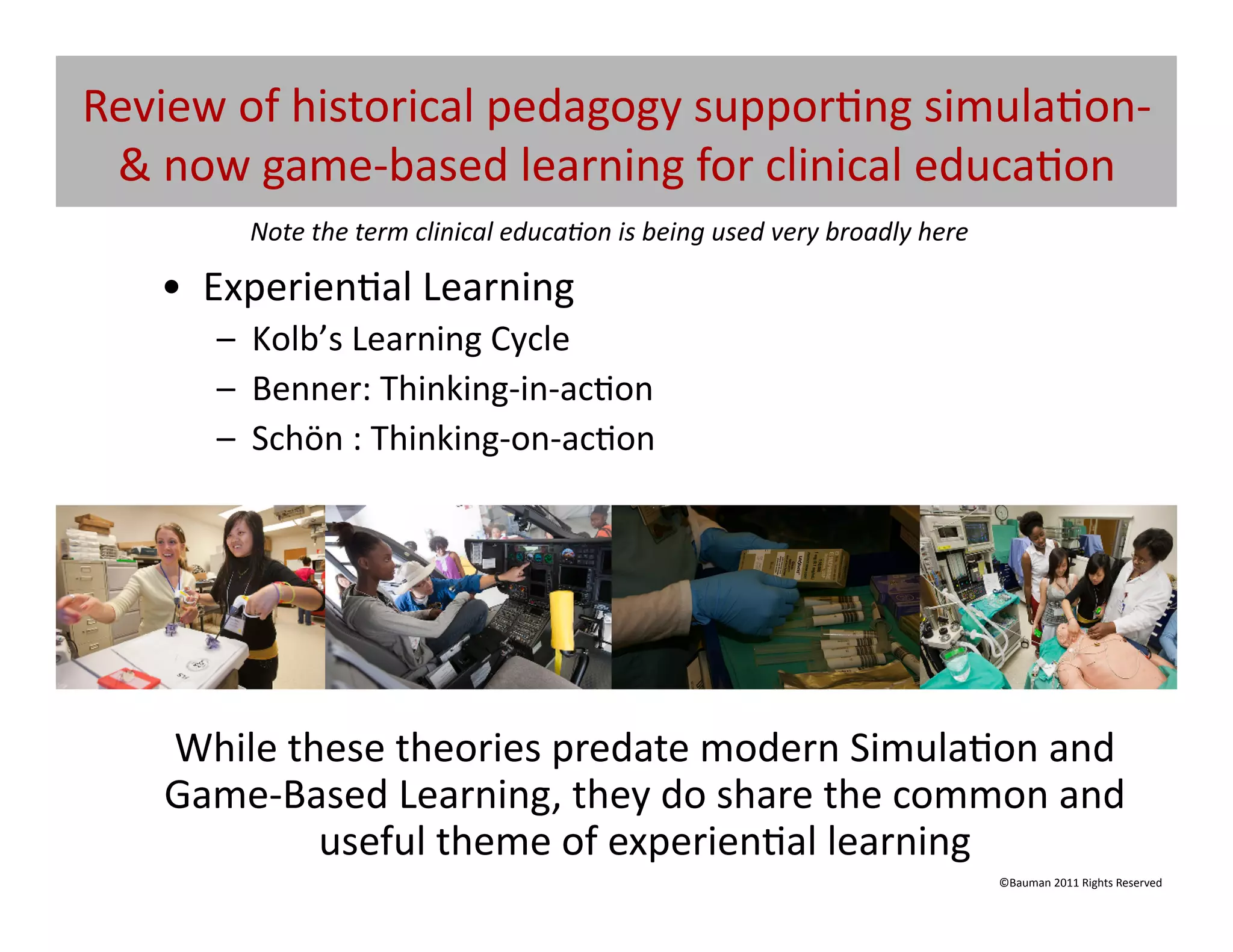
     •  Experien@al	
  Learning	
  
         –  Kolb’s	
  Learning	
  Cycle	
  
         –  Benner:	
  Thinking-­‐in-­‐ac@on	
  
         –  Schön	
  :	
  Thinking-­‐on-­‐ac@on	


     While	
  these	
  theories	
  predate	
  modern	
  Simula@on	
  and	
  
     Game-­‐Based	
  Learning,	
  they	
  do	
  share	
  the	
  common	
  and	
  
                useful	
  theme	
  of	
  experien@al	
  learning	
  
                                                                                                                ©Bauman	
  2011	
  Rights	
  Reserved	
  
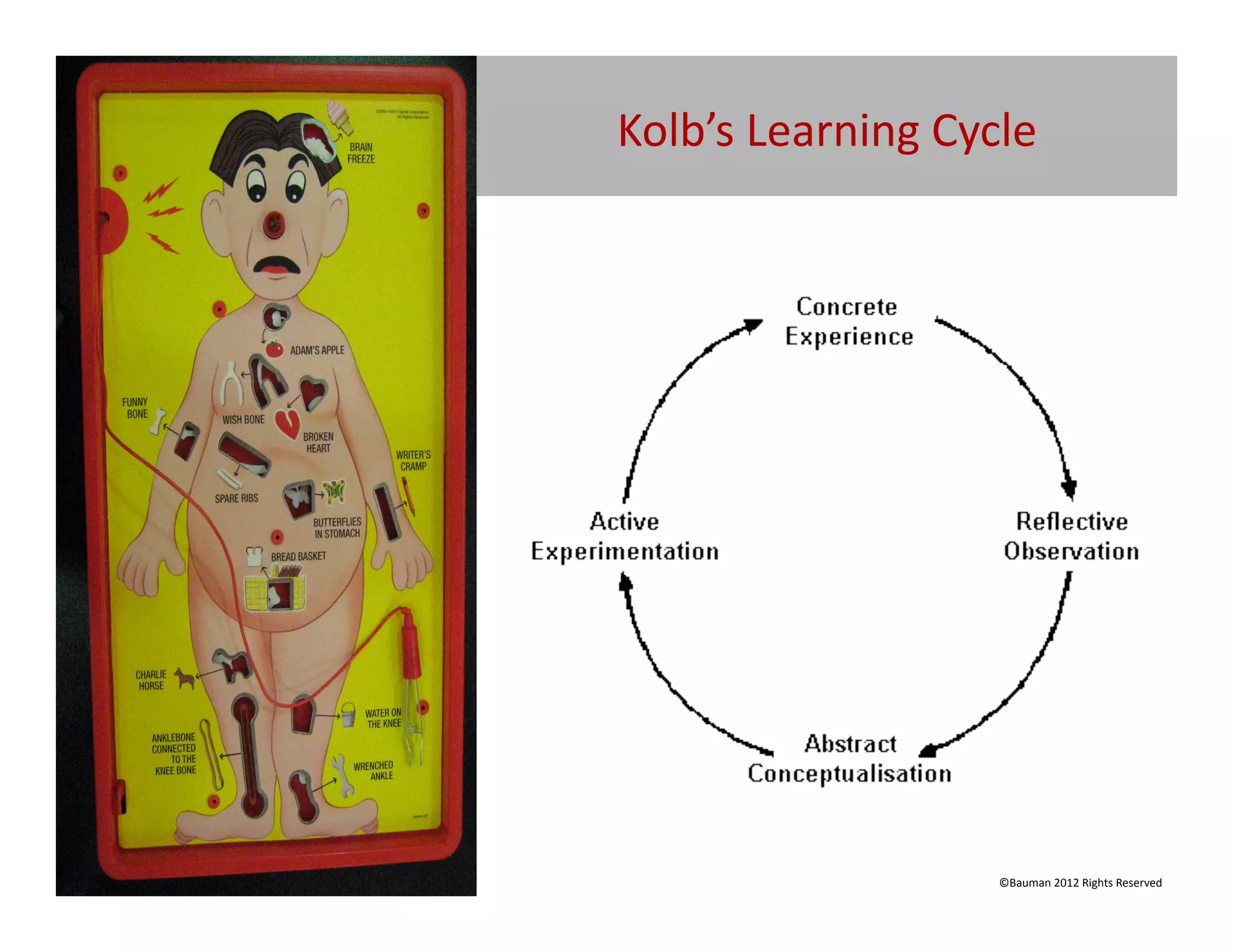
Kolb’s	
  Learning	
  Cycle	


                           ©Bauman	
  2012	
  Rights	
  Reserved	
  
Schön: Thinking-on/in-action
                                                                                       ©Bauman	
  2012	
  Rights	
  Reserved	


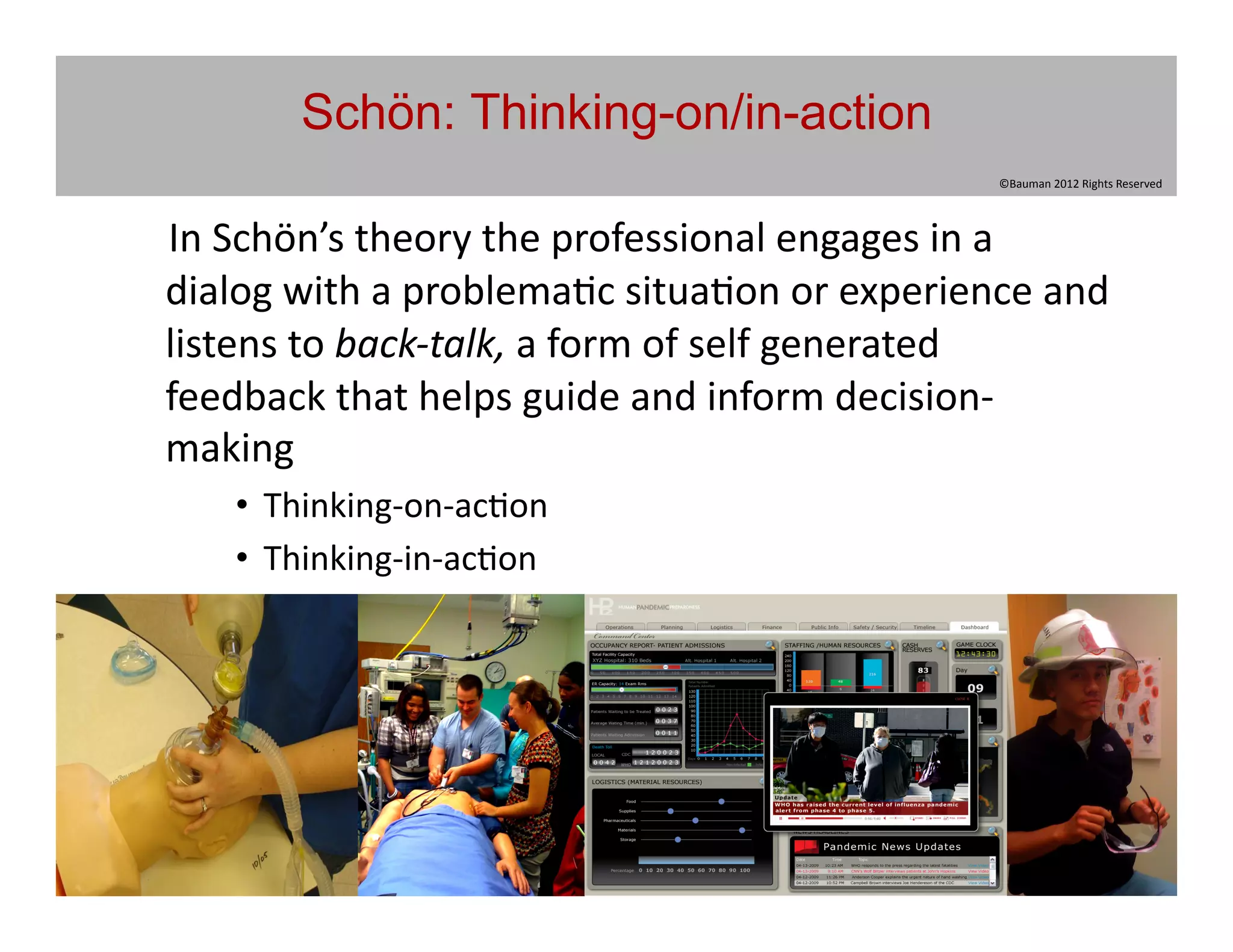
  In	
  Schön’s	
  theory	
  the	
  professional	
  engages	
  in	
  a	
  
    dialog	
  with	
  a	
  problema@c	
  situa@on	
  or	
  experience	
  and	
  
    listens	
  to	
  back-­‐talk,	
  a	
  form	
  of	
  self	
  generated	
  
    feedback	
  that	
  helps	
  guide	
  and	
  inform	
  decision-­‐
    making	
  	
  
           •  Thinking-­‐on-­‐ac@on	
  	
  
           •  Thinking-­‐in-­‐ac@on	
  
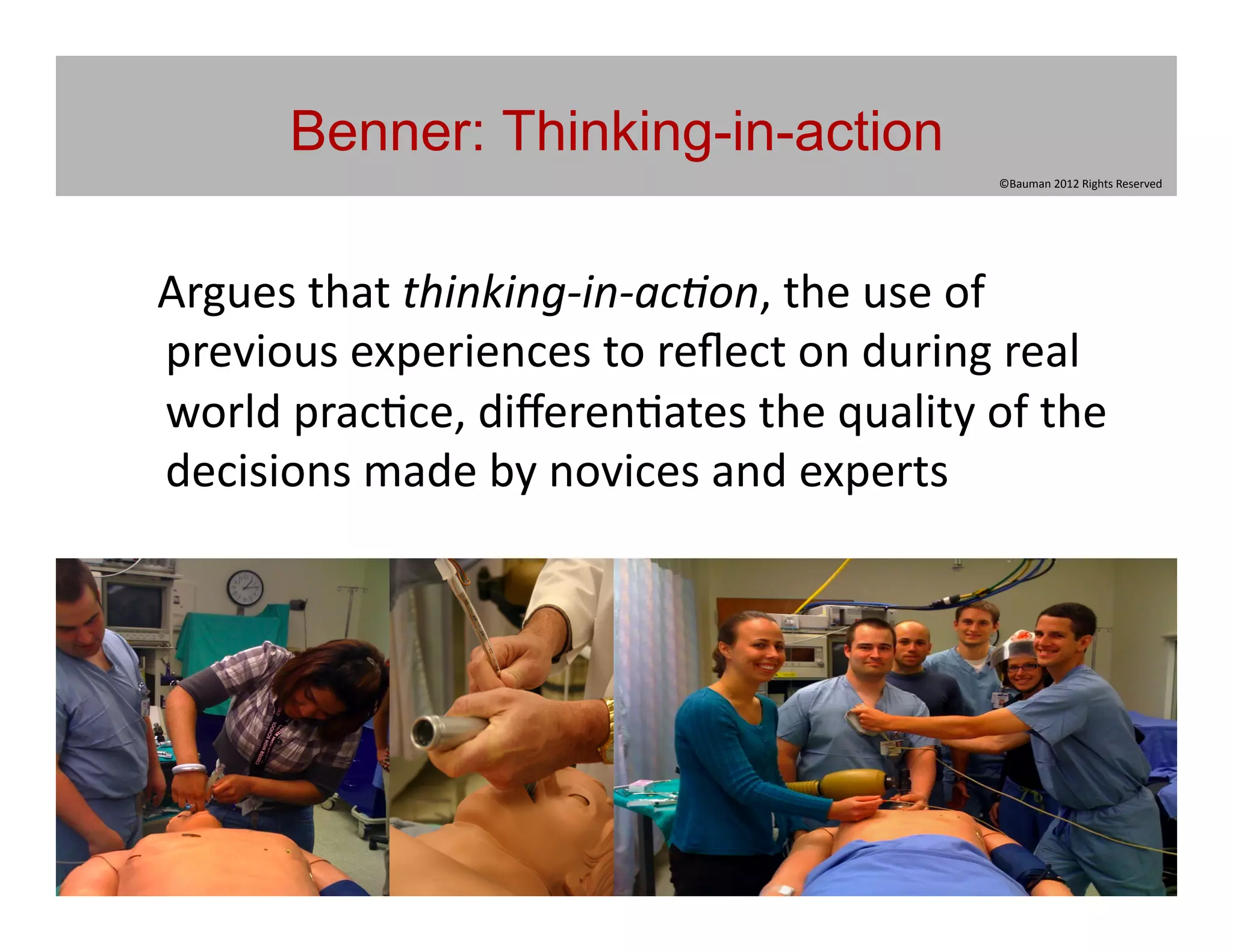
Benner: Thinking-in-action
                                                                      ©Bauman	
  2012	
  Rights	
  Reserved	


  Argues	
  that	
  thinking-­‐in-­‐ac5on,	
  the	
  use	
  of	
  
            previous	
  experiences	
  to	
  reflect	
  on	
  during	
  real	
  
            world	
  prac@ce,	
  differen@ates	
  the	
  quality	
  of	
  the	
  
            decisions	
  made	
  by	
  novices	
  and	
  experts	
  
Contemporary	
  Perspec@ve	
  on	
  Games	
  and	
  Simula@on	
  

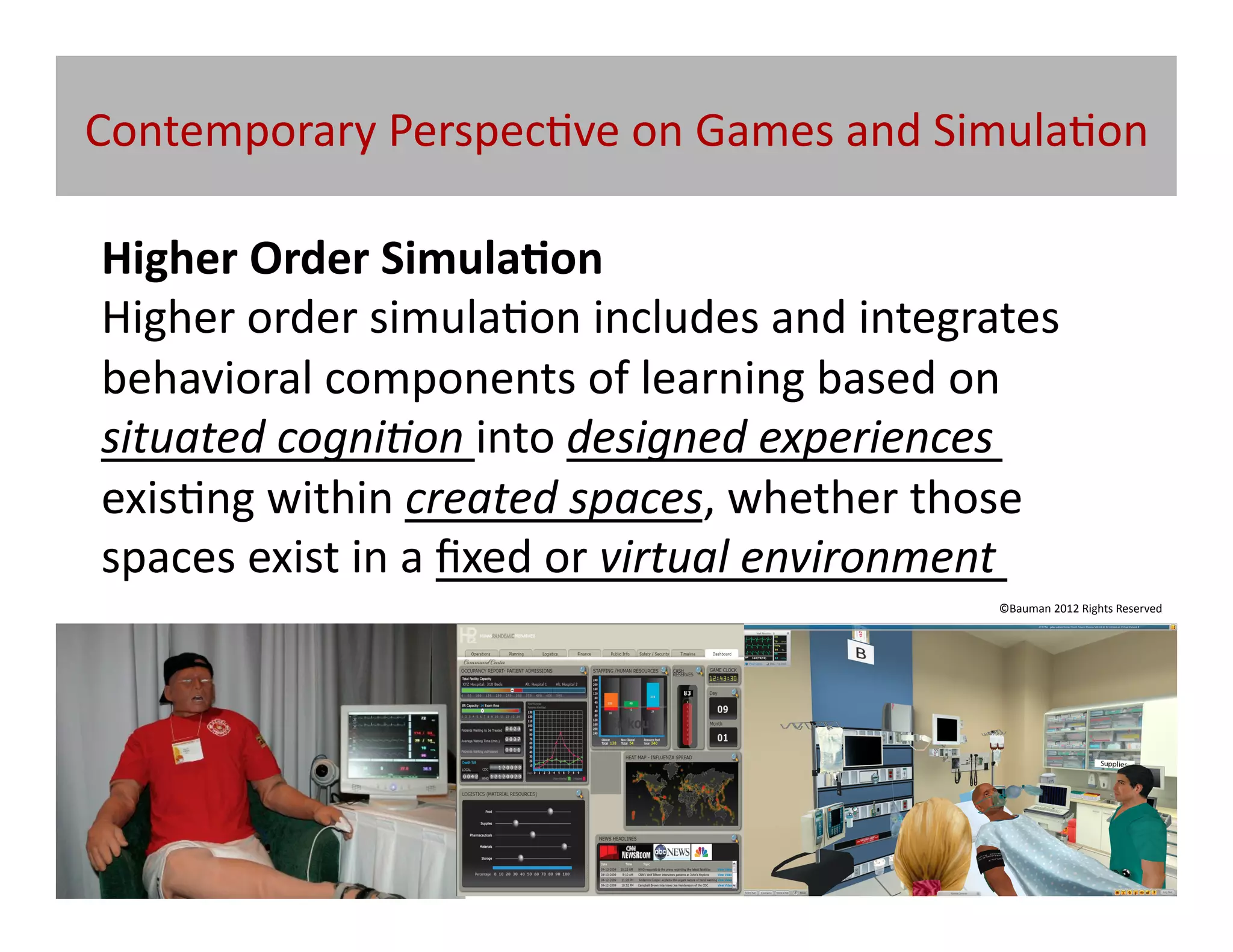
Higher	
  Order	
  Simula/on	
  
Higher	
  order	
  simula@on	
  includes	
  and	
  integrates	
  
behavioral	
  components	
  of	
  learning	
  based	
  on	
  
situated	
  cogni5on	
  into	
  designed	
  experiences	
  
exis@ng	
  within	
  created	
  spaces,	
  whether	
  those	
  
spaces	
  exist	
  in	
  a	
  fixed	
  or	
  virtual	
  environment	
  	
  
                                                                    ©Bauman	
  2012	
  Rights	
  Reserved	
  
Contemporary	
  Perspec@ve	
  on	
  Games	
  and	
  Simula@on	
  
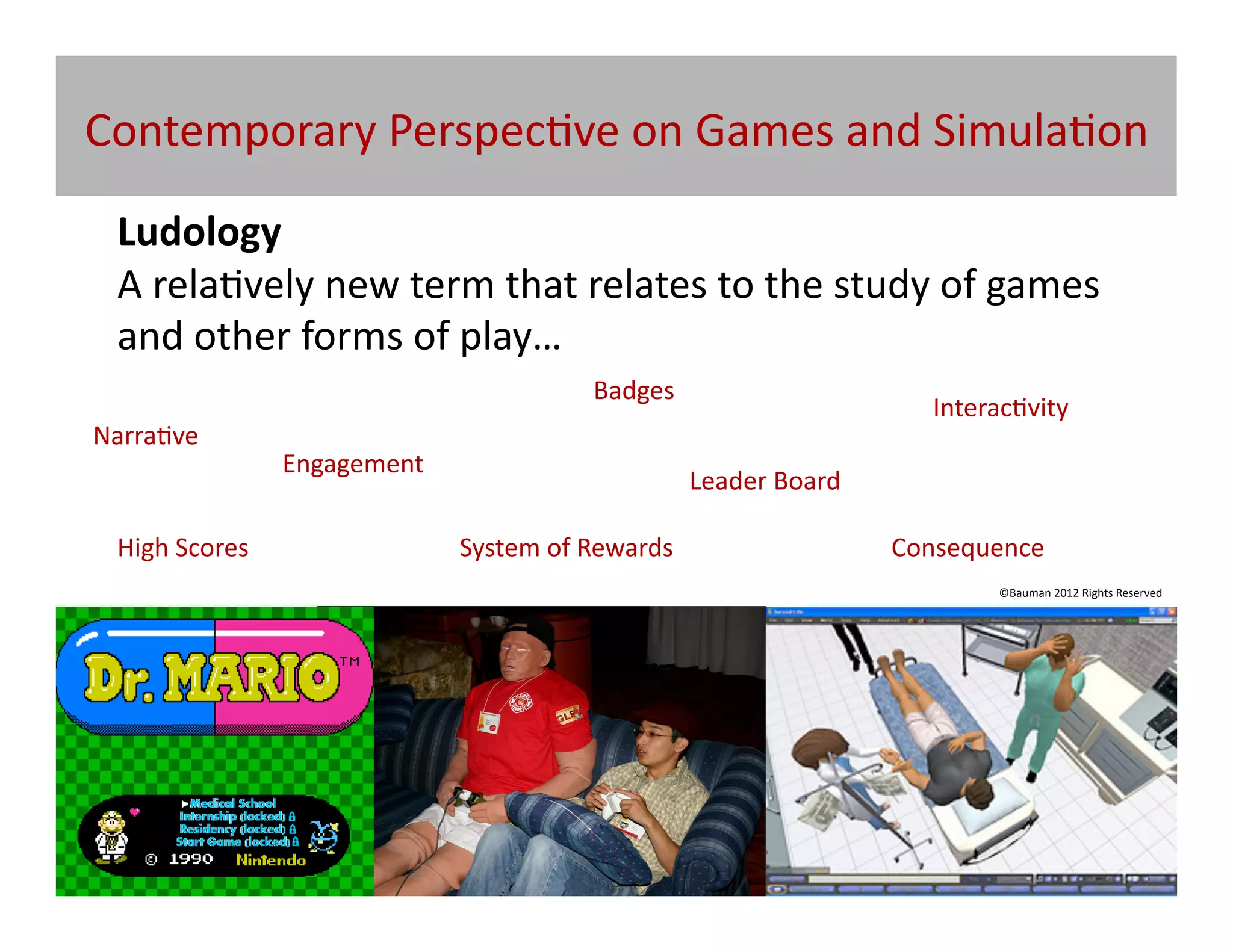
  Ludology	
  
  A	
  rela@vely	
  new	
  term	
  that	
  relates	
  to	
  the	
  study	
  of	
  games	
  
  and	
  other	
  forms	
  of	
  play…	
  
                                                            Badges	
  
                                                                                                   Interac@vity	
  
Narra@ve	
  
                           Engagement	
  
                                                                          Leader	
  Board	
  

  High	
  Scores	
  	
                      System	
  of	
  Rewards	
                           Consequence	
  
                                                                                                          ©Bauman	
  2012	
  Rights	
  Reserved	


                              Does	
  higher	
  order	
  simula@on	
  cons@tute	
  
                                                  Ludology?	
  
Games	
  +	
  Simula@on	
  

•    Goal	
  Oriented	
  	
  
•    Rule	
  Based	
  
•    Sense	
  of	
  Consequence	
  
•    Imita@on	
  of	
  something	
  real	
  (Authen@city)	
  
•    Accurate	
  representa@on	
  of	
  system(s)	
  and	
  
     related	
  processes	


               . 	
  . 	
  . 	
  . 	
  . 	
  . 	
  . 	
  . 	
  . 	
  . 	
  .	


                                                                                               ©Bauman	
  2011	
  Rights	
  Reserved	
  
Ludology	
  
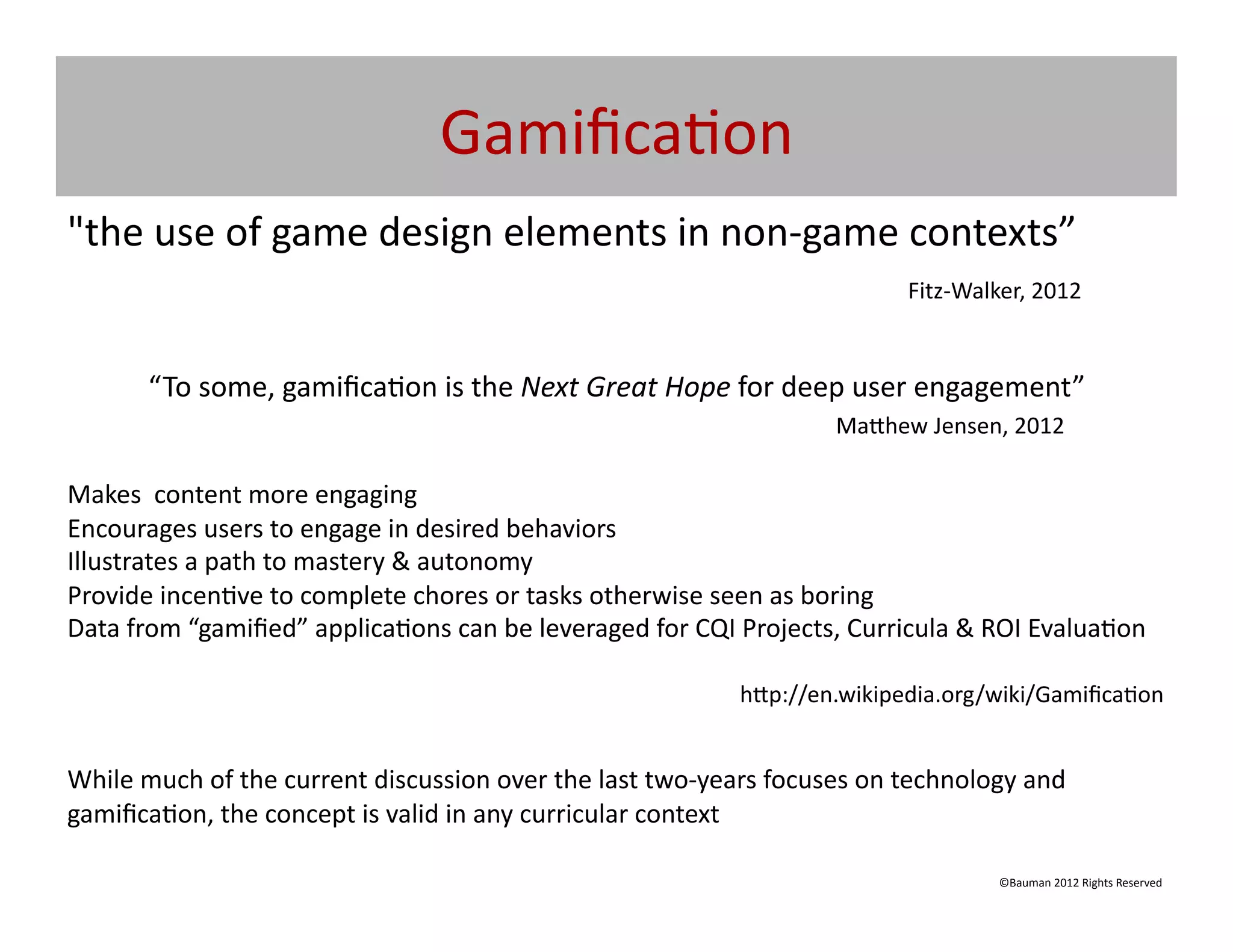
              “We	
  are	
  entering	
  the	
  Ludic	
  Century…	
  
…	
  we	
  will	
  use	
  games	
  to	
  shape	
  the	
  future	
  of	
  educa@on”	


                            Eric	
  Zimmerman,	
  NYU	
  Games	
  Center	
  
                                        6/15/2011	
  at	
  GLS7	
  
                                    www.ericzimmerman.com/	
  
                         h[p://gamecenter.nyu.edu/tag/eric-­‐zimmerman	
       ©Bauman	
  2012	
  Rights	
  Reserved	
  
Gamifica@on	
  
"the	
  use	
  of	
  game	
  design	
  elements	
  in	
  non-­‐game	
  contexts”	


  Fitz-­‐Walker,	
  2012


               “To	
  some,	
  gamifica@on	
  is	
  the	
  Next	
  Great	
  Hope	
  for	
  deep	
  user	
  engagement”	


  Ma[hew	
  Jensen,	
  2012	
  

Makes	
  	
  content	
  more	
  engaging	
  
Encourages	
  users	
  to	
  engage	
  in	
  desired	
  behaviors	
  
Illustrates	
  a	
  path	
  to	
  mastery	
  &	
  autonomy	
  
Provide	
  incen@ve	
  to	
  complete	
  chores	
  or	
  tasks	
  otherwise	
  seen	
  as	
  boring	
  
Data	
  from	
  “gamified”	
  applica@ons	
  can	
  be	
  leveraged	
  for	
  CQI	
  Projects,	
  Curricula	
  &	
  ROI	
  Evalua@on	


  h[p://en.wikipedia.org/wiki/Gamifica@on	


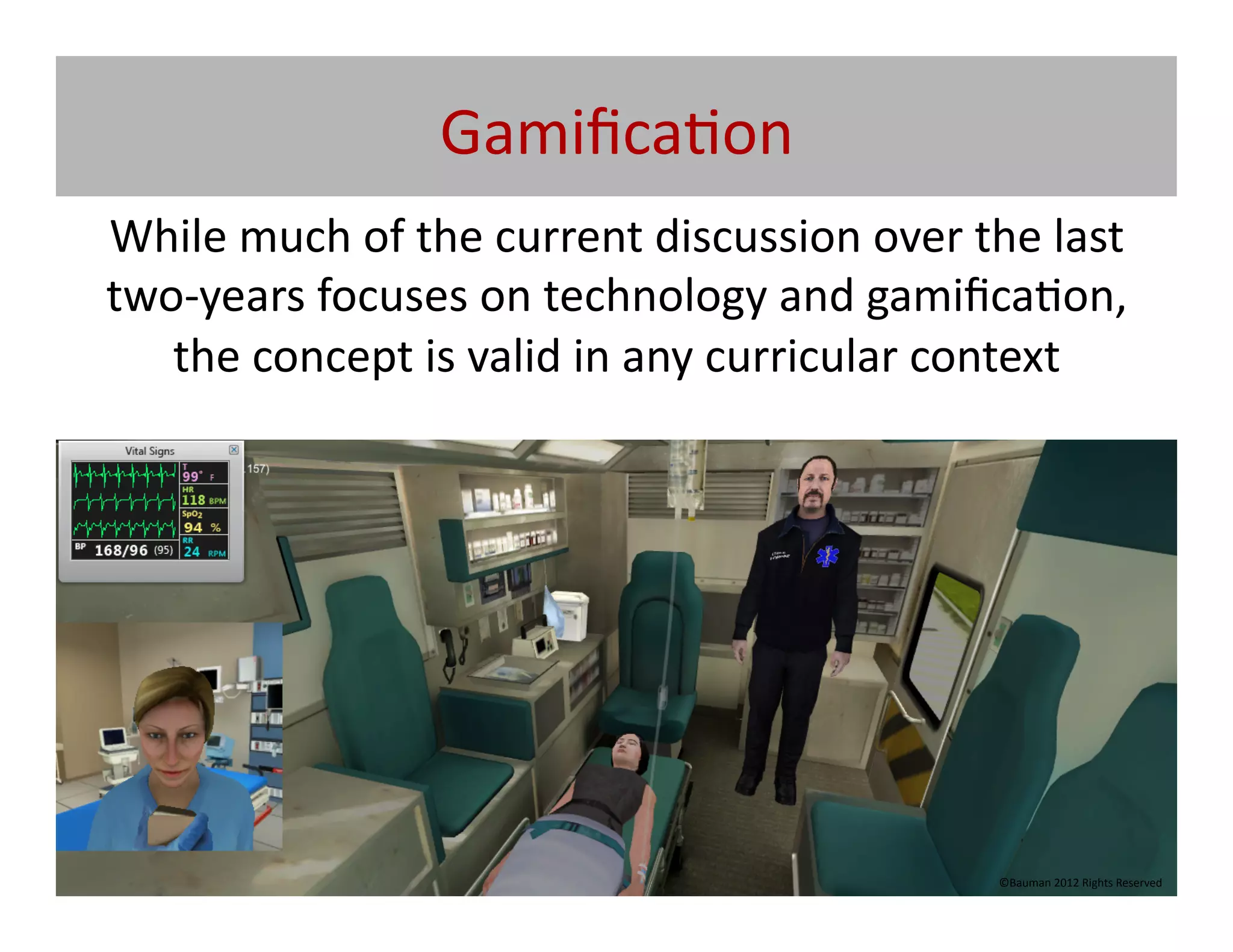
While	
  much	
  of	
  the	
  current	
  discussion	
  over	
  the	
  last	
  two-­‐years	
  focuses	
  on	
  technology	
  and	
  
gamifica@on,	
  the	
  concept	
  is	
  valid	
  in	
  any	
  curricular	
  context	
  

                                                                                                                                                                                                       ©Bauman	
  2012	
  Rights	
  Reserved	
  
Gamifica@on	
  
While	
  much	
  of	
  the	
  current	
  discussion	
  over	
  the	
  last	
  
two-­‐years	
  focuses	
  on	
  technology	
  and	
  gamifica@on,	
  
   the	
  concept	
  is	
  valid	
  in	
  any	
  curricular	
  context	


                                                                   ©Bauman	
  2012	
  Rights	
  Reserved	
  
Gamifica@on	
  
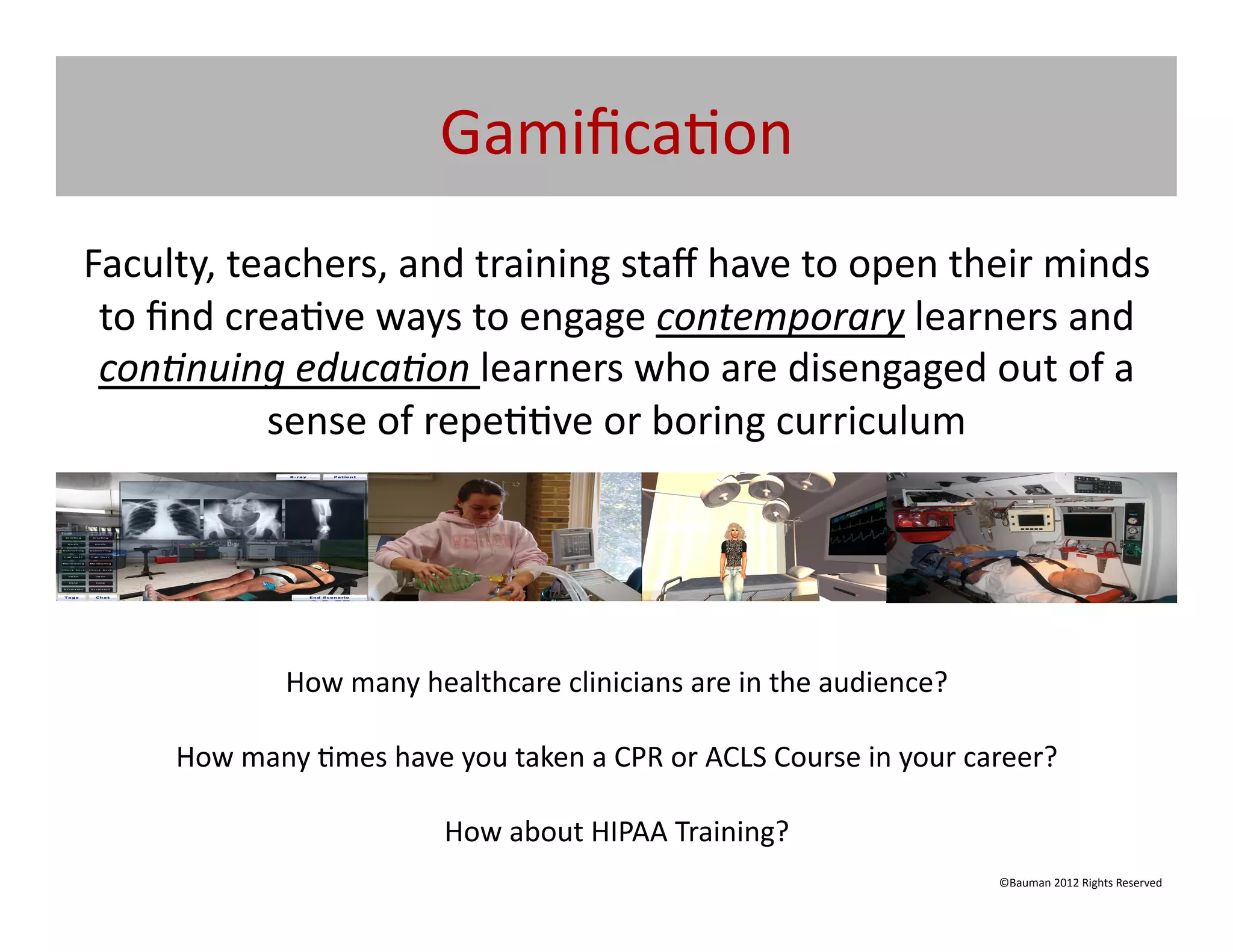
Faculty,	
  teachers,	
  and	
  training	
  staff	
  have	
  to	
  open	
  their	
  minds	
  
 to	
  find	
  crea@ve	
  ways	
  to	
  engage	
  contemporary	
  learners	
  and	
  
 con5nuing	
  educa5on	
  learners	
  who	
  are	
  disengaged	
  out	
  of	
  a	
  
                sense	
  of	
  repe@@ve	
  or	
  boring	
  curriculum	


                    How	
  many	
  healthcare	
  clinicians	
  are	
  in	
  the	
  audience?	
  

       How	
  many	
  @mes	
  have	
  you	
  taken	
  a	
  CPR	
  or	
  ACLS	
  Course	
  in	
  your	
  career?	
  

                                       How	
  about	
  HIPAA	
  Training?	


                                                                                                           ©Bauman	
  2012	
  Rights	
  Reserved	
  
Metagaming	
  
It	
  is	
  the	
  use	
  of	
  out-­‐of-­‐game	
  [out	
  of	
  curriculum]	
  informa@on	
  or	
  
resources	
  to	
  affect	
  one's	
  in-­‐game	
  [prac@ce]	
  decisions…	


Transcends	
  a	
  prescribed	
  rule	
  set	
  …uses	
  external	
  factors	
  to	
  
affect	
  the	
  game	
  [prac@ce],	
  or	
  goes	
  beyond	
  the	
  supposed	
  
limits	
  of	
  the	
  game	
  [prac@ce]	
  environment	
  

h[p://en.wikipedia.org/wiki/Metagaming	
  

                                                                                    ©Bauman	
  2012	
  Rights	
  Reserved	
  
Ludic	
  Pedagogy	
  
       The	
  manner	
  through	
  which	
  games	
  teach	
  [learners]	
  
                         players	
  to	
  play	
  [Learn]…	
  
h[p://etd.lsu.edu/docs/available/etd-­‐11092011-­‐154402/unrestricted/jbroussard_disserta@on.pdf	


  The	
  ac@vity	
  of	
  play,	
  par@cularly	
  when	
  engaging	
  a	
  new	
  
           game	
  always	
  represents	
  a	
  learning	
  process	
  
                                                                                                       ©Bauman	
  2012	
  Rights	
  Reserved	
  
Food	
  for	
  Thought?	
  
                                                                                  ©Bauman	
  2012	
  Rights	
  Reserved	


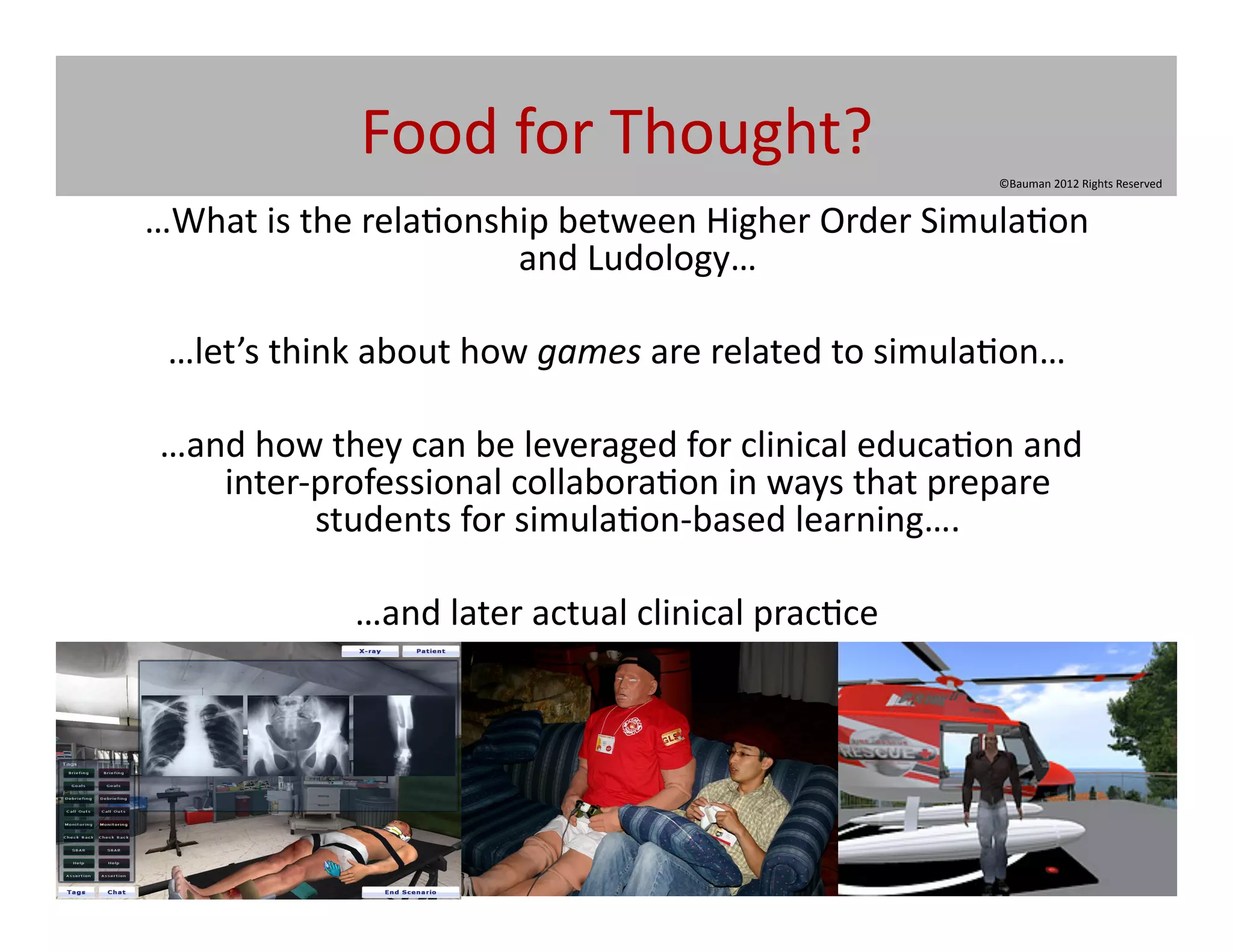
…What	
  is	
  the	
  rela@onship	
  between	
  Higher	
  Order	
  Simula@on	
  
                               and	
  Ludology…	
  

 …let’s	
  think	
  about	
  how	
  games	
  are	
  related	
  to	
  simula@on…	


  …and	
  how	
  they	
  can	
  be	
  leveraged	
  for	
  clinical	
  educa@on	
  and	
  
       inter-­‐professional	
  collabora@on	
  in	
  ways	
  that	
  prepare	
  
               students	
  for	
  simula@on-­‐based	
  learning….	
  

                   …and	
  later	
  actual	
  clinical	
  prac@ce	
  
Contemporary	
  Perspec@ve	
  on	
  Games	
  and	
  Simula@on	
  

  •    Created	
  Environment	
  
  •    Designed	
  Experience	
  
  •    Socially	
  Situated	
  Cogni/on	
  
  •    Ecology	
  of	
  Culturally	
  Competent	
  Design	
  
Contemporary	
  Perspec@ve	
  on	
  Games	
  and	
  Simula@on	
  
                                                                                               ©Bauman	
  2012	
  Rights	
  Reserved	


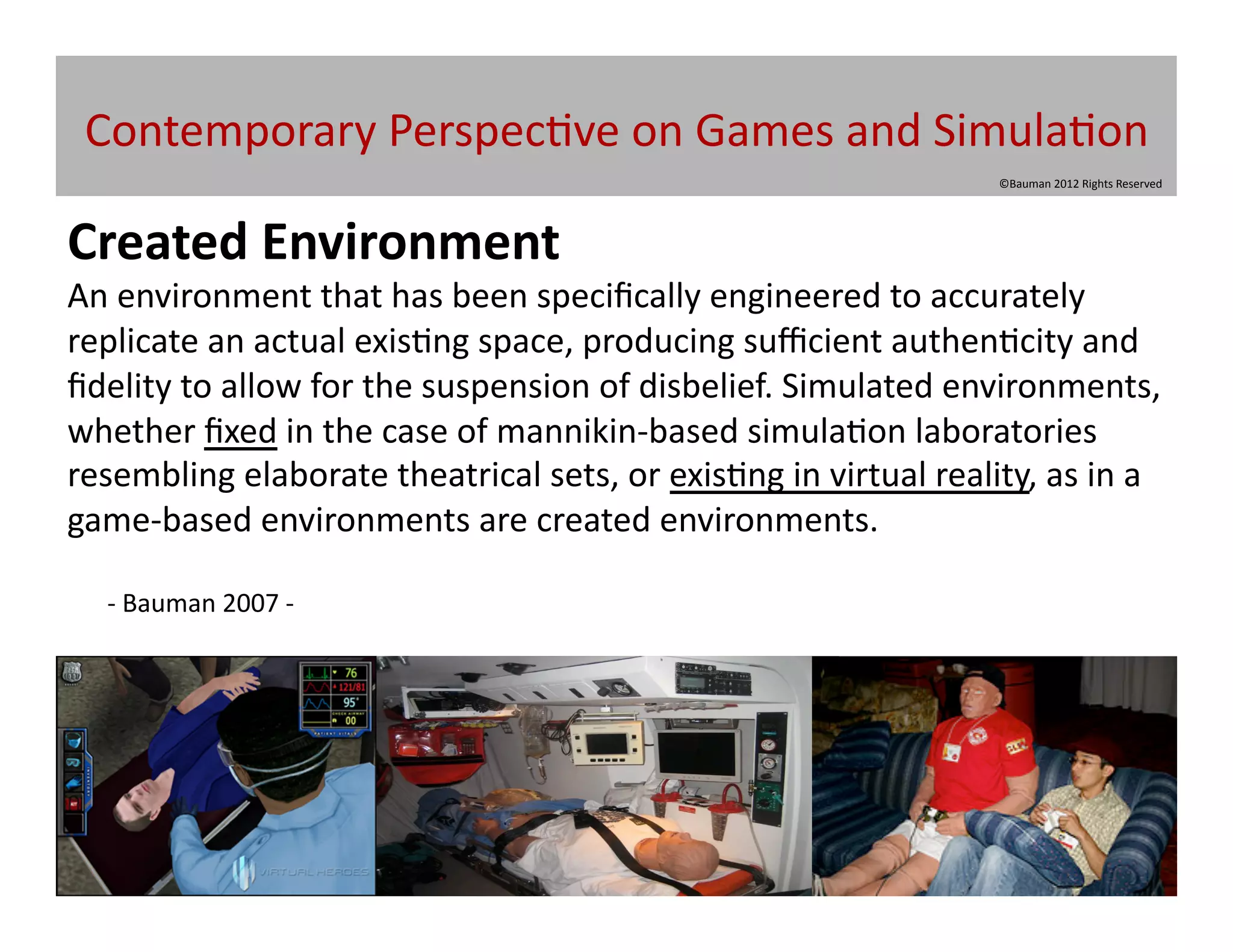
Created	
  Environment	
  
An	
  environment	
  that	
  has	
  been	
  specifically	
  engineered	
  to	
  accurately	
  
replicate	
  an	
  actual	
  exis@ng	
  space,	
  producing	
  sufficient	
  authen@city	
  and	
  
fidelity	
  to	
  allow	
  for	
  the	
  suspension	
  of	
  disbelief.	
  Simulated	
  environments,	
  
whether	
  fixed	
  in	
  the	
  case	
  of	
  mannikin-­‐based	
  simula@on	
  laboratories	
  
resembling	
  elaborate	
  theatrical	
  sets,	
  or	
  exis@ng	
  in	
  virtual	
  reality,	
  as	
  in	
  a	
  
game-­‐based	
  environments	
  are	
  created	
  environments.	
  

    -­‐	
  Bauman	
  2007	
  -­‐	
  	
  
Contemporary	
  Perspec@ve	
  on	
  Games	
  and	
  Simula@on	
  
                                                                                          ©Bauman	
  2012	
  Rights	
  Reserved	


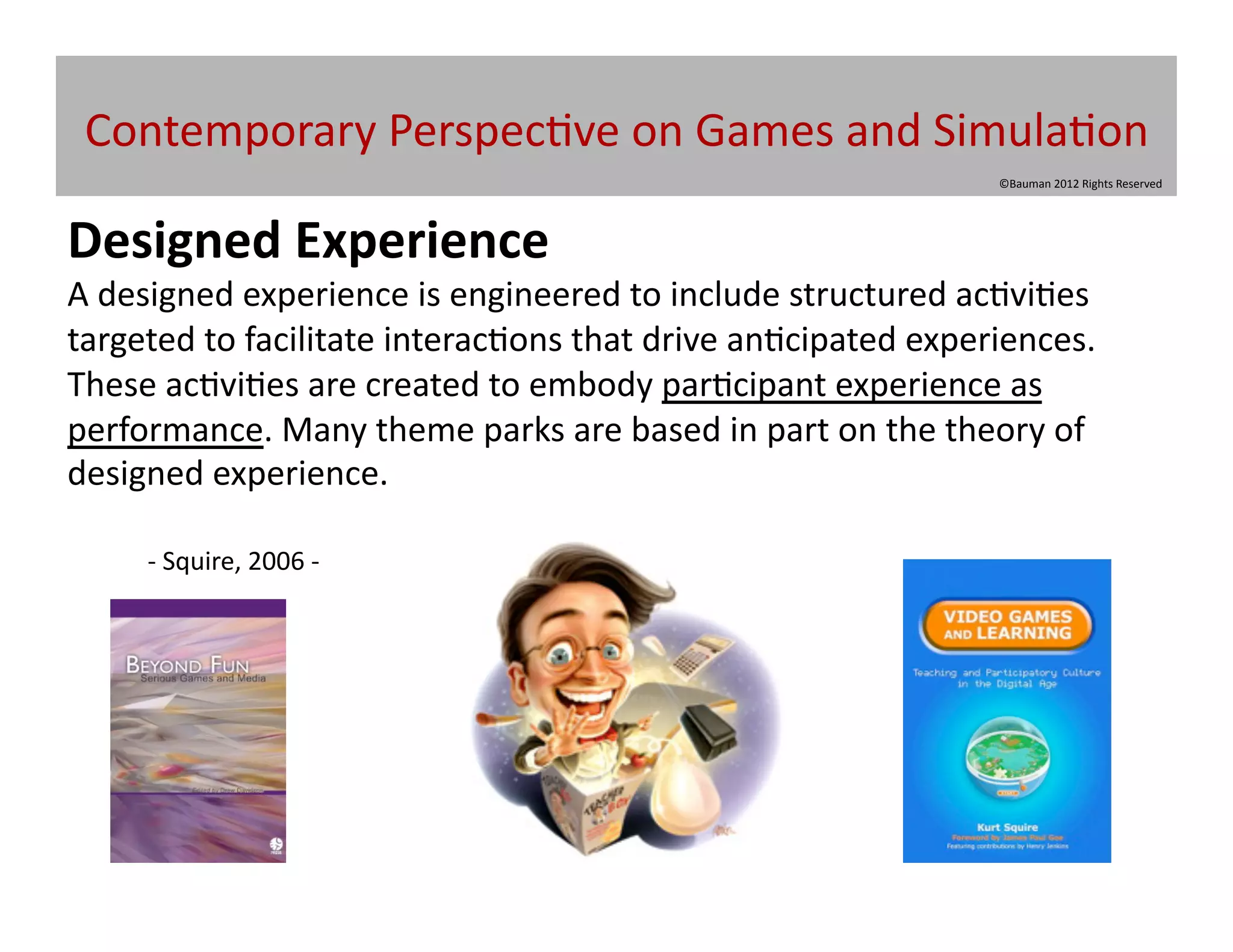
Designed	
  Experience	
  
A	
  designed	
  experience	
  is	
  engineered	
  to	
  include	
  structured	
  ac@vi@es	
  
targeted	
  to	
  facilitate	
  interac@ons	
  that	
  drive	
  an@cipated	
  experiences.	
  	
  
These	
  ac@vi@es	
  are	
  created	
  to	
  embody	
  par@cipant	
  experience	
  as	
  
performance.	
  Many	
  theme	
  parks	
  are	
  based	
  in	
  part	
  on	
  the	
  theory	
  of	
  
designed	
  experience.	


  -­‐	
  Squire,	
  2006	
  -­‐	
  	
  
Contemporary	
  Perspec@ve	
  on	
  Games	
  and	
  Simula@on	
  
                                                                                  ©Bauman	
  2012	
  Rights	
  Reserved	


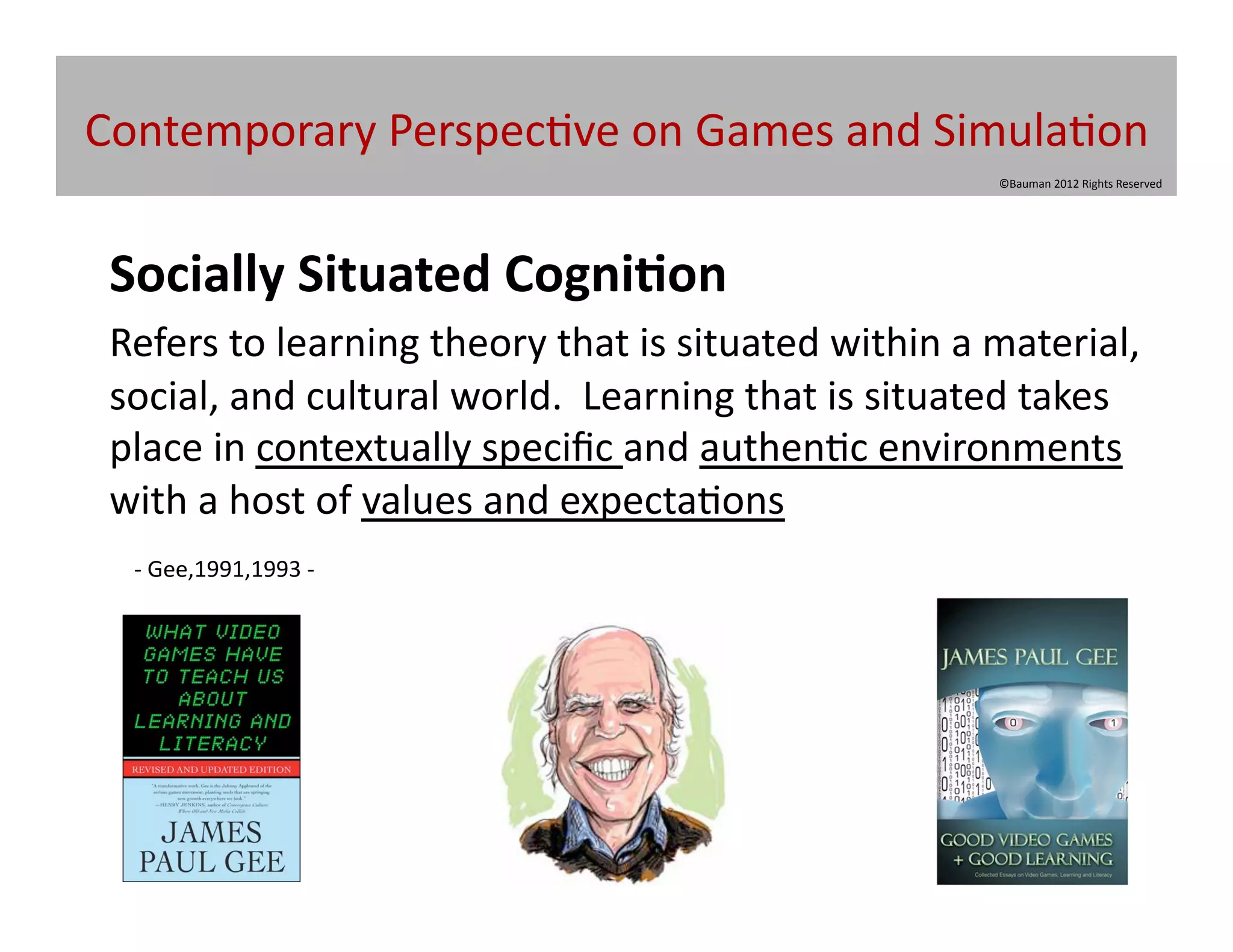
  Socially	
  Situated	
  Cogni/on	
  
	
  Refers	
  to	
  learning	
  theory	
  that	
  is	
  situated	
  within	
  a	
  material,	
  
    social,	
  and	
  cultural	
  world.	
  	
  Learning	
  that	
  is	
  situated	
  takes	
  
    place	
  in	
  contextually	
  specific	
  and	
  authen@c	
  environments	
  
    with	
  a	
  host	
  of	
  values	
  and	
  expecta@ons	
  	
  
   -­‐	
  Gee,1991,1993	
  -­‐	
  	
  
Contemporary	
  Perspec@ve	
  on	
  Games	
  and	
  Simula@on	
  
                                                                                           ©Bauman	
  2012	
  Rights	
  Reserved	


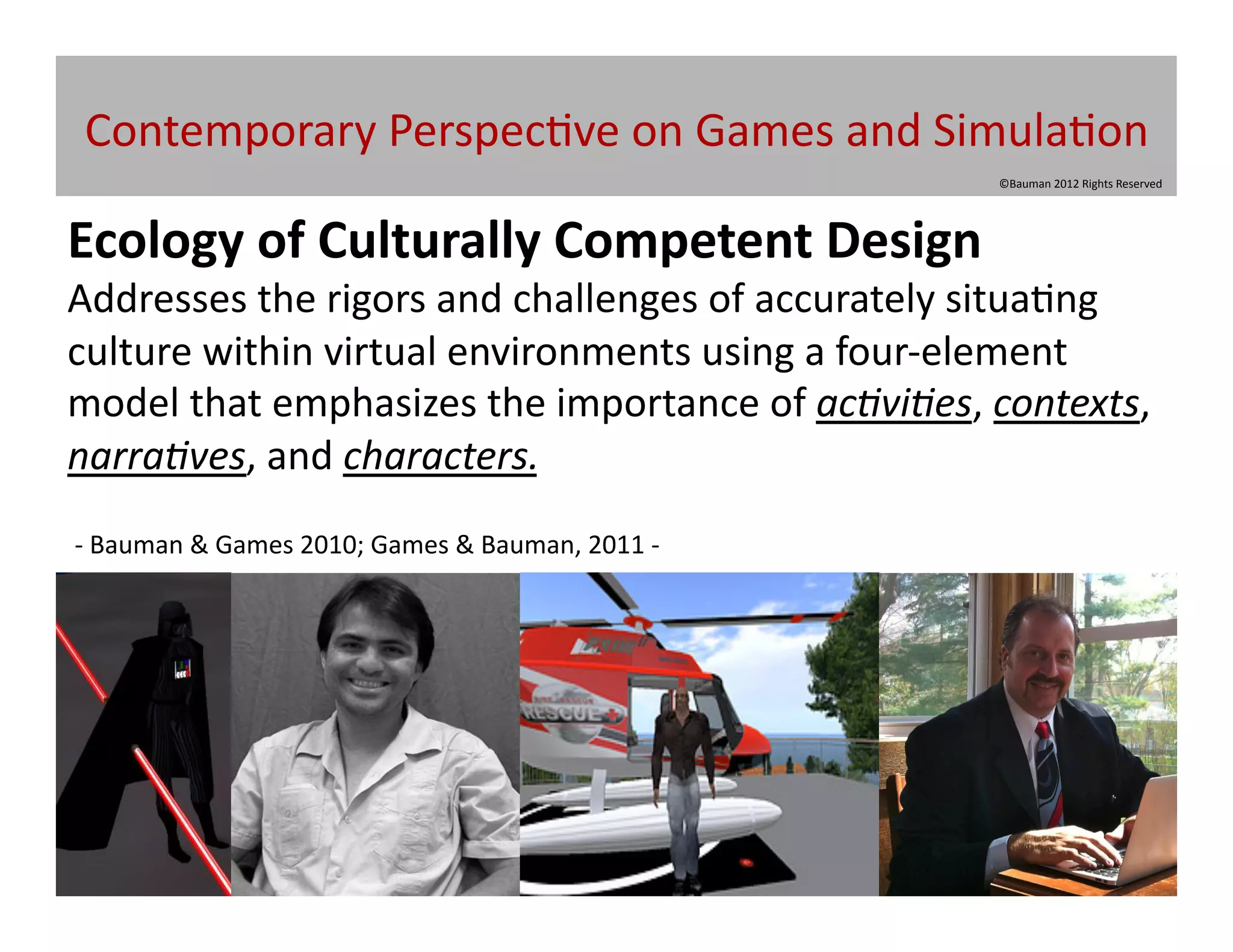
Ecology	
  of	
  Culturally	
  Competent	
  Design	
  
Addresses	
  the	
  rigors	
  and	
  challenges	
  of	
  accurately	
  situa@ng	
  
culture	
  within	
  virtual	
  environments	
  using	
  a	
  four-­‐element	
  
model	
  that	
  emphasizes	
  the	
  importance	
  of	
  ac5vi5es,	
  contexts,	
  
narra5ves,	
  and	
  characters.
-­‐	
  Bauman	
  &	
  Games	
  2010;	
  Games	
  &	
  Bauman,	
  2011	
  -­‐	


Who	
  Cares…	
  and	
  why	
  does	
  any	
  of	
  this	
  ma[er?	
  
                                                                                       ©Bauman	
  2012	
  Rights	
  Reserved	


Because	
  the	
  best	
  and	
  brightest	
  learners	
  become:	
  
    Our	
  next	
  genera@on	
  of	
  scholars	
  

    Well	
  trained	
  and	
  excep@onally	
  educated	
  people	
  [clinicians,	
  teachers,	
  	
  
    administrator,	
  etc..]	
  are	
  a	
  major	
  part	
  of	
  the	
  solu@on	
  to	
  the	
  
    healthcare	
  &	
  	
  educa@on	
  crises	
  that	
  we	
  face	
  locally,	
  na@onally,	
  and	
  
    interna@onally	
  
Engagement…	


Why	
  is	
  Game-­‐Based	
  Learning	
  Important	
  
                                             ©Bauman	
  2012	
  Rights	
  Reserved	
  
M.	
  Presky,	
  2001	
  
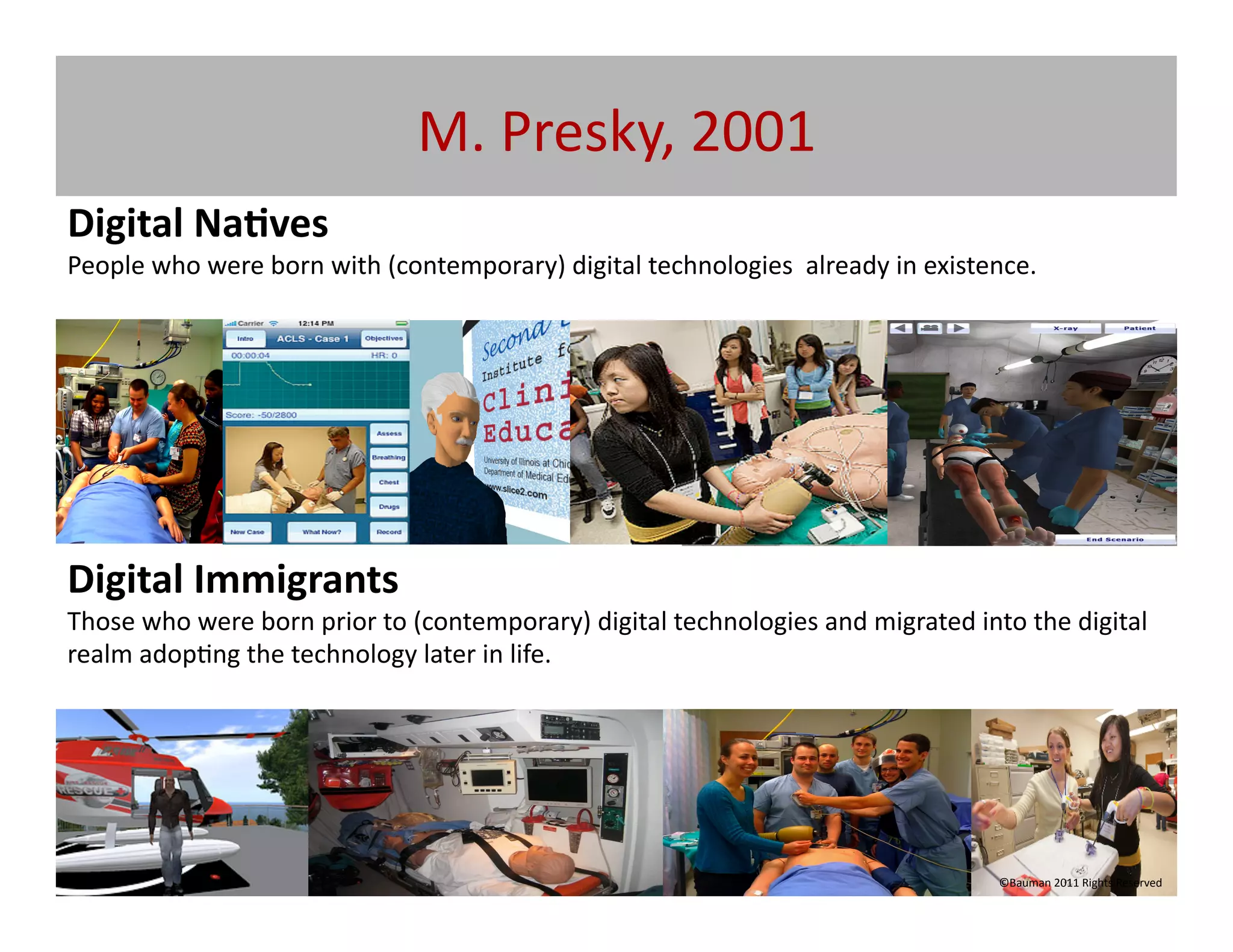
Digital	
  Na/ves	
  
People	
  who	
  were	
  born	
  with	
  (contemporary)	
  digital	
  technologies	
  	
  already	
  in	
  existence.	


Digital	
  Immigrants	
  
Those	
  who	
  were	
  born	
  prior	
  to	
  (contemporary)	
  digital	
  technologies	
  and	
  migrated	
  into	
  the	
  digital	
  
realm	
  adop@ng	
  the	
  technology	
  later	
  in	
  life.	


                                                                                                                     ©Bauman	
  2011	
  Rights	
  Reserved	
  
Advantages	
  to	
  Game-­‐Based	
  Learning	
  

•  Different	
  way	
  engaging	
  learners	
  
•  A[ends	
  to	
  challenges	
  of	
  @me	
  and	
  distance	
  
   inherent	
  to	
  distribu@ve	
  educa@on	
  
•  A[ends	
  to	
  aspects	
  of	
  accultura@on	
  not	
  always	
  
   available	
  in	
  the	
  tradi@onal	
  learning	
  
   environment	
  
•  There	
  is	
  evidence	
  to	
  support	
  videogame	
  
   playing	
  and	
  some	
  types	
  of	
  procedural	
  training	
  
              . 	
  . 	
  . 	
  . 	
  . 	
  . 	
  . 	
  . 	
  . 	
  . 	
  .	


                                                                                              ©Bauman	
  2012	
  Rights	
  Reserved	
  
About	
  Today’s	
  Students	


•  Today’s	
  students/learners	
  have	
  a	
  degree	
  of	
  
   technical	
  and	
  digital	
  literacy	
  that	
  generally	
  far	
  
   exceed	
  that	
  of	
  their	
  instructors	
  
•  They	
  have	
  a	
  host	
  of	
  expecta@ons	
  in	
  how	
  
   informa@on	
  dissemina@on,	
  presenta@on,	
  and	
  
   transfer	
  will	
  take	
  place	
  
•  Those	
  ins@tu@ons	
  that	
  fail	
  to	
  address	
  these	
  
   expecta@ons	
  will	
  fail	
  to	
  a[ract	
  and	
  retain	
  the	
  best	
  
   and	
  brightest	
  students	
  

              . 	
  . 	
  . 	
  . 	
  . 	
  . 	
  . 	
  . 	
  . 	
  . 	
  .	


                                                                                              ©Bauman	
  2011	
  Rights	
  Reserved	
  
Transla@onal	
  Effect	


  Serious	
  Games	
  [ludic	
  pedagogy]	
  leverage	
  created	
  
       environments	
  so	
  that	
  learning	
  takes	
  place	
  as	
  
         performance	
  though	
  carefully	
  designed	
  
    experiences	
  that	
  o|en	
  use	
  a	
  contextually	
  situated	
  
       narra5ve	
  to	
  promote	
  curriculum	
  objec@ves	
  
                                                                ©Bauman	
  2012	
  Rights	
  Reserved	
  
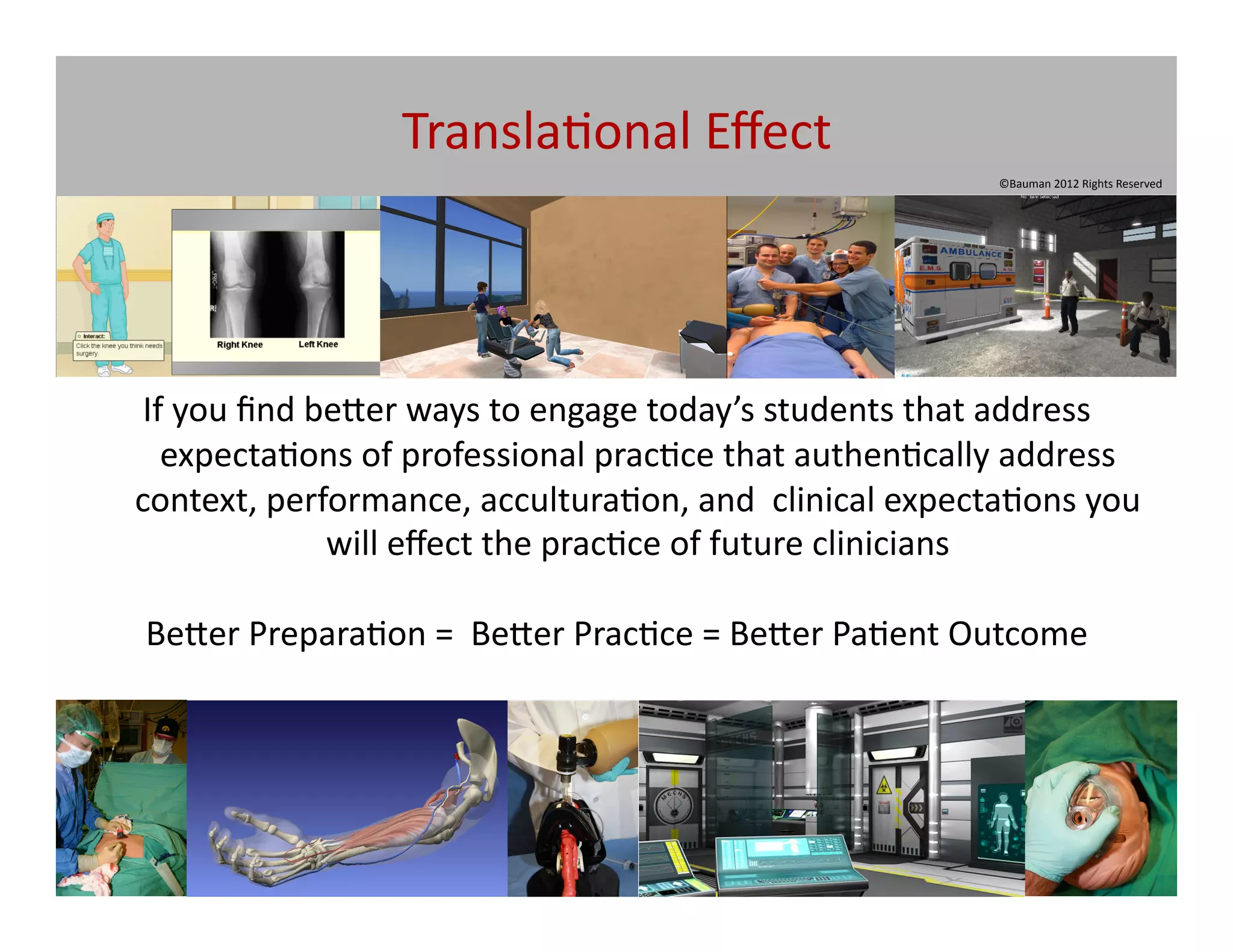
Transla@onal	
  Effect	
  
                                                                                 ©Bauman	
  2012	
  Rights	
  Reserved	


 If	
  you	
  find	
  be[er	
  ways	
  to	
  engage	
  today’s	
  students	
  that	
  address	
  
   expecta@ons	
  of	
  professional	
  prac@ce	
  that	
  authen@cally	
  address	
  
context,	
  performance,	
  accultura@on,	
  and	
  	
  clinical	
  expecta@ons	
  you	
  
                      will	
  effect	
  the	
  prac@ce	
  of	
  future	
  clinicians	
  

 Be[er	
  Prepara@on	
  =	
  	
  Be[er	
  Prac@ce	
  =	
  Be[er	
  Pa@ent	
  Outcome	
  
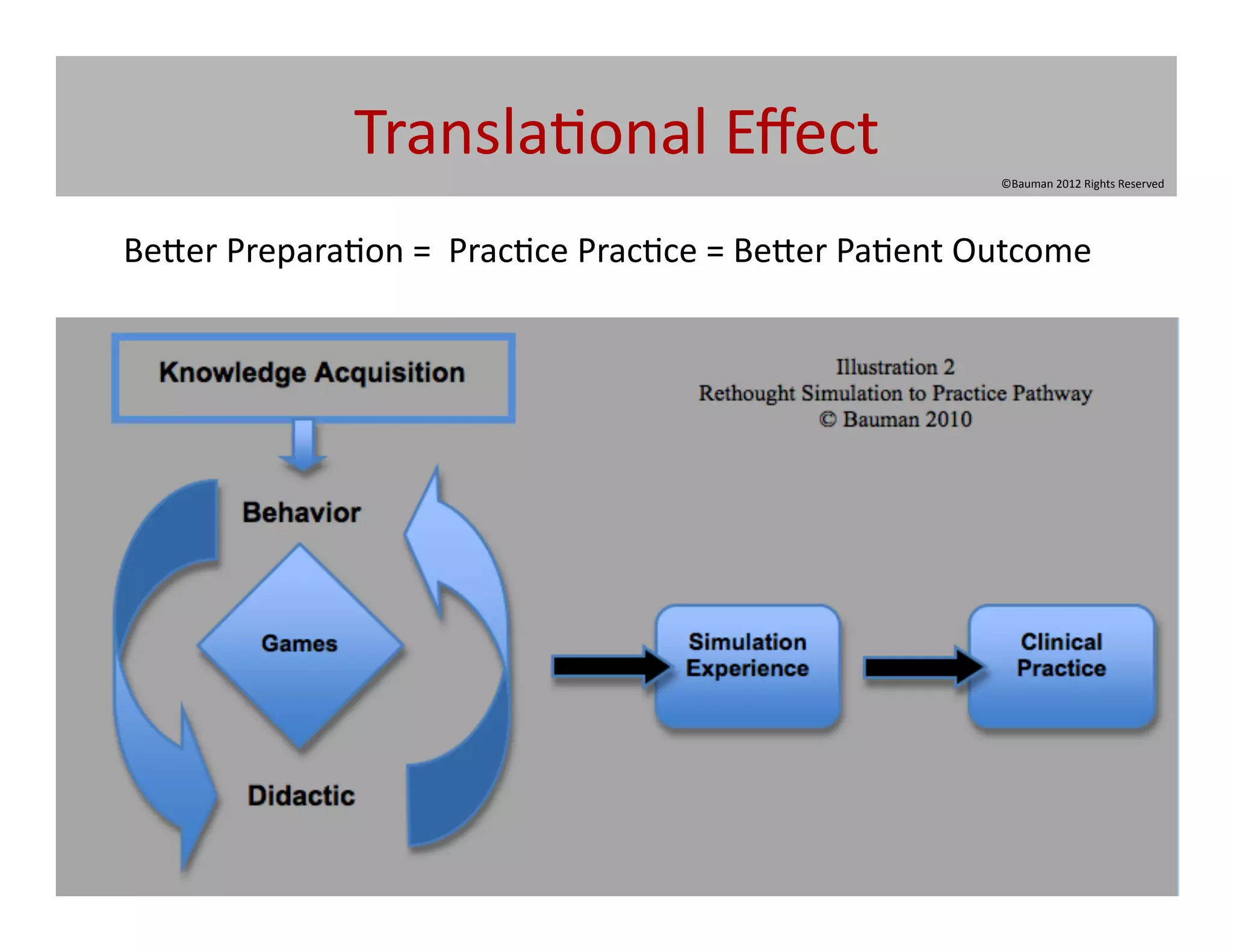
Transla@onal	
  Effect	
  
                                                                               ©Bauman	
  2012	
  Rights	
  Reserved	


Be[er	
  Prepara@on	
  =	
  	
  Prac@ce	
  Prac@ce	
  =	
  Be[er	
  Pa@ent	
  Outcome	
  
Good	
  Fit	
  
                                                                                            ©Bauman	
  2012	
  Rights	
  Reserved	


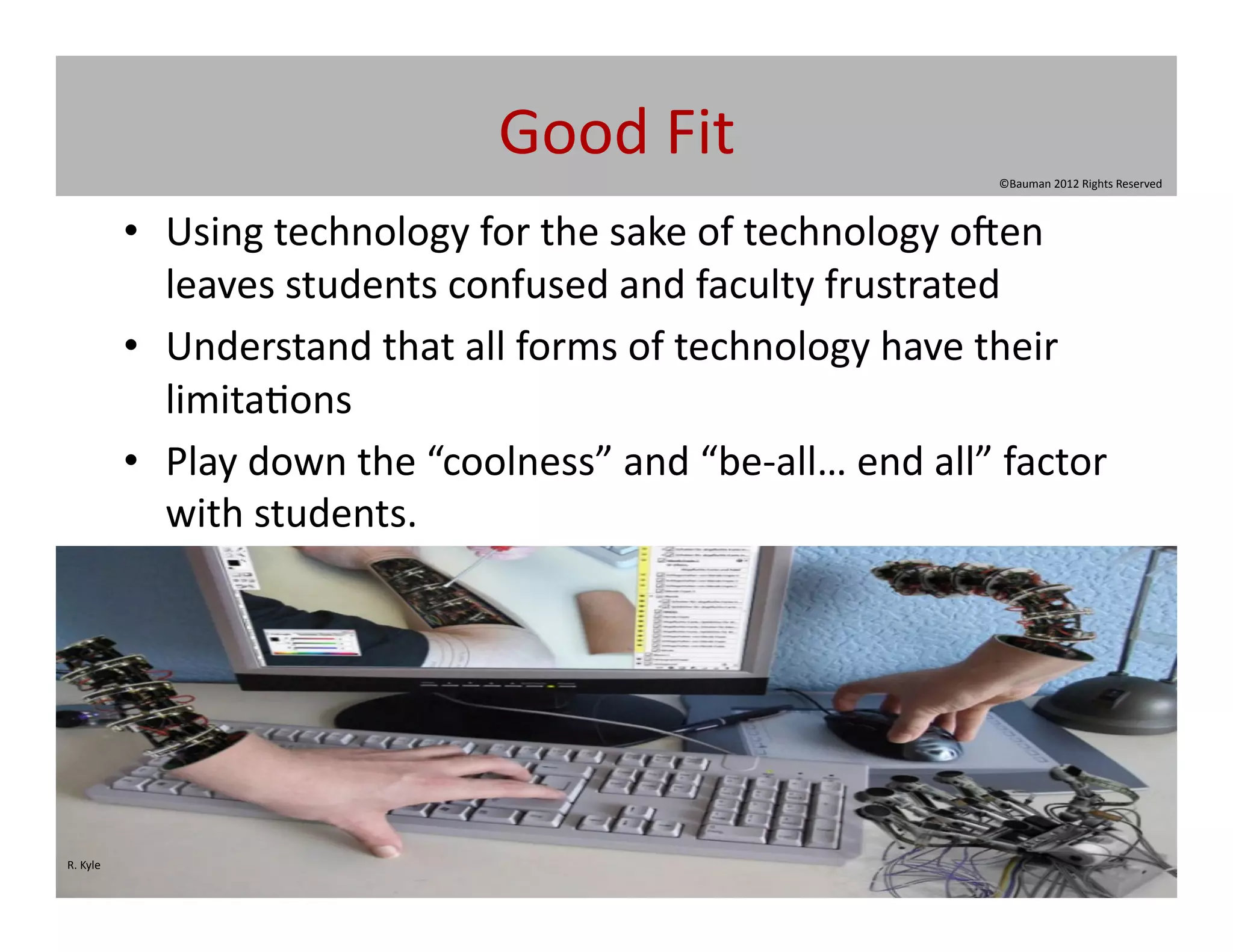
                 •  Using	
  technology	
  for	
  the	
  sake	
  of	
  technology	
  o|en	
  
                    leaves	
  students	
  confused	
  and	
  faculty	
  frustrated	
  	
  
                 •  Understand	
  that	
  all	
  forms	
  of	
  technology	
  have	
  their	
  
                    limita@ons	
  
                 •  Play	
  down	
  the	
  “coolness”	
  and	
  “be-­‐all…	
  end	
  all”	
  factor	
  
                    with	
  students.	


R.	
  Kyle	
  
Fit	
  and	
  the	
  role	
  of	
  Orienta@on	
  
                                                                           ©Bauman	
  2012	
  Rights	
  Reserved	


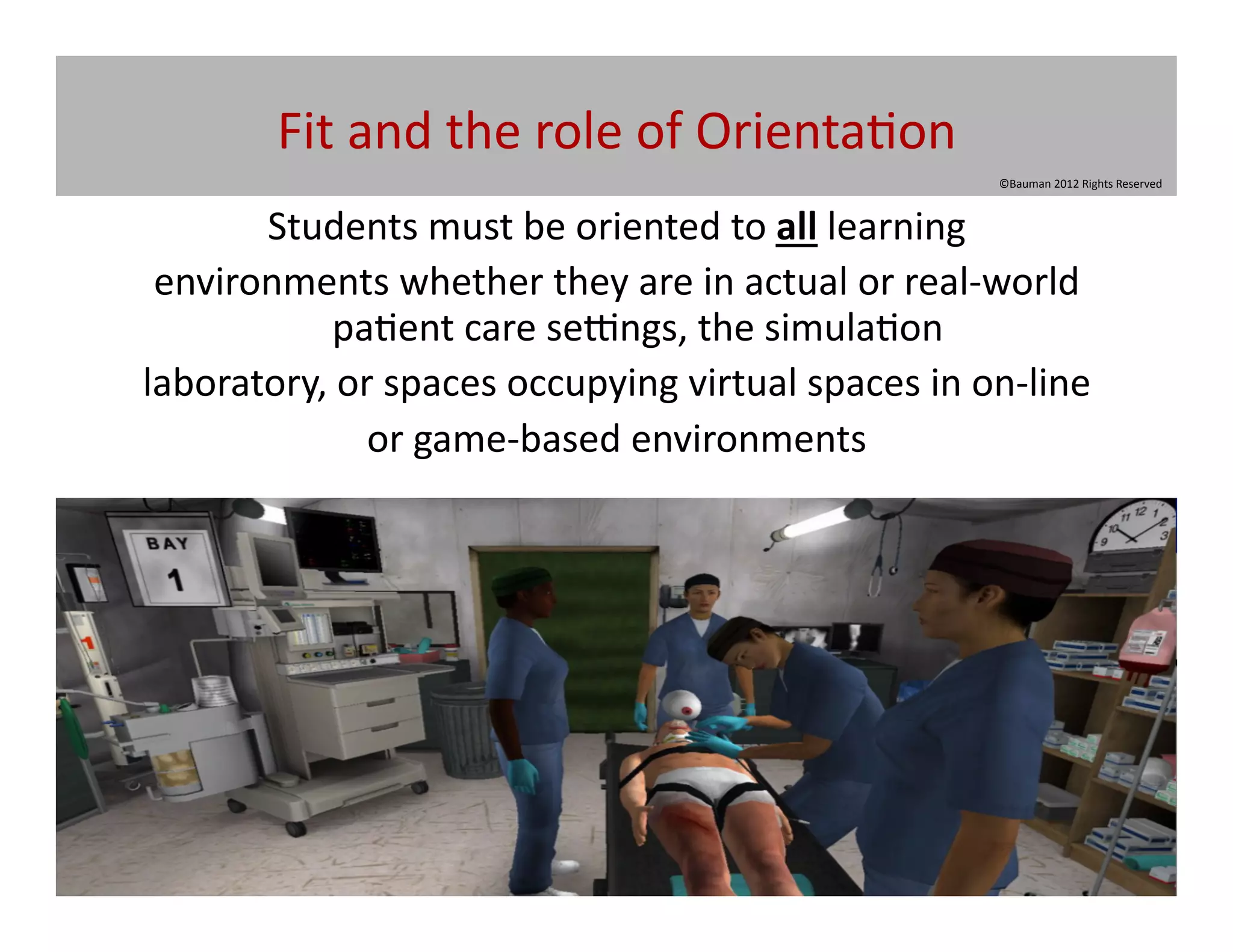
       Students	
  must	
  be	
  oriented	
  to	
  all	
  learning	
  	
  
 environments	
  whether	
  they	
  are	
  in	
  actual	
  or	
  real-­‐world	
  
             pa@ent	
  care	
  se~ngs,	
  the	
  simula@on	
  
laboratory,	
  or	
  spaces	
  occupying	
  virtual	
  spaces	
  in	
  on-­‐line	
  
                 or	
  game-­‐based	
  environments	
  	
  
More	
  On	
  Good	
  Fit…	
  

•  O|en	
  using	
  virtual	
  environments	
  whether	
  online	
  	
  
   or	
  found	
  in	
  fixed	
  gaming	
  environments	
  are	
  best	
  
   leveraged	
  for	
  lessons	
  that	
  center	
  on	
  behavioral	
  or	
  
   decision	
  aspects	
  of	
  prac@ce	
  and	
  some	
  forms	
  of	
  
   targeted	
  psychomotor	
  training…	
  
    –  Accultura@on	
  
    –  Decision	
  Making	
  
    –  Team	
  Training	
  	
  
    –  Workload/Time	
  Management	
  
    –  Procedural	
  Demonstra@on	
  
               . 	
  . 	
  . 	
  . 	
  . 	
  . 	
  . 	
  . 	
  . 	
  . 	
  .	


                                                                                               ©Bauman	
  2012	
  Rights	
  Reserved	
  
Rela@onship	
  between	
  Objec@ves	
  &	
  Fit	
  

                 Remember	
  Objec/ves	
  First	
  
         ….	
  Everything	
  else	
  follows,	
  including:	
  

                                     Technology	
  

In	
  other	
  words	
  how	
  can	
  technology	
  help	
  you	
  meet	
  
                your	
  curriculum	
  objec/ves!!!!!!!	
  

                . 	
  . 	
  . 	
  . 	
  . 	
  . 	
  . 	
  . 	
  . 	
  . 	
  .	


                                                                                                ©Bauman	
  2012	
  Rights	
  Reserved	
  
Rela@onship	
  between	
  Objec@ves	
  &	
  Fit	
  

                 Remember	
  Objec/ves	
  First	
  
         ….	
  Everything	
  else	
  follows,	
  including:	
  

                                     Technology	
  

In	
  other	
  words	
  how	
  can	
  technology	
  help	
  you	
  meet	
  
                your	
  curriculum	
  objec/ves!!!!!!!	
  

                . 	
  . 	
  . 	
  . 	
  . 	
  . 	
  . 	
  . 	
  . 	
  . 	
  .	


                                                                                                ©Bauman	
  2012	
  Rights	
  Reserved	
  
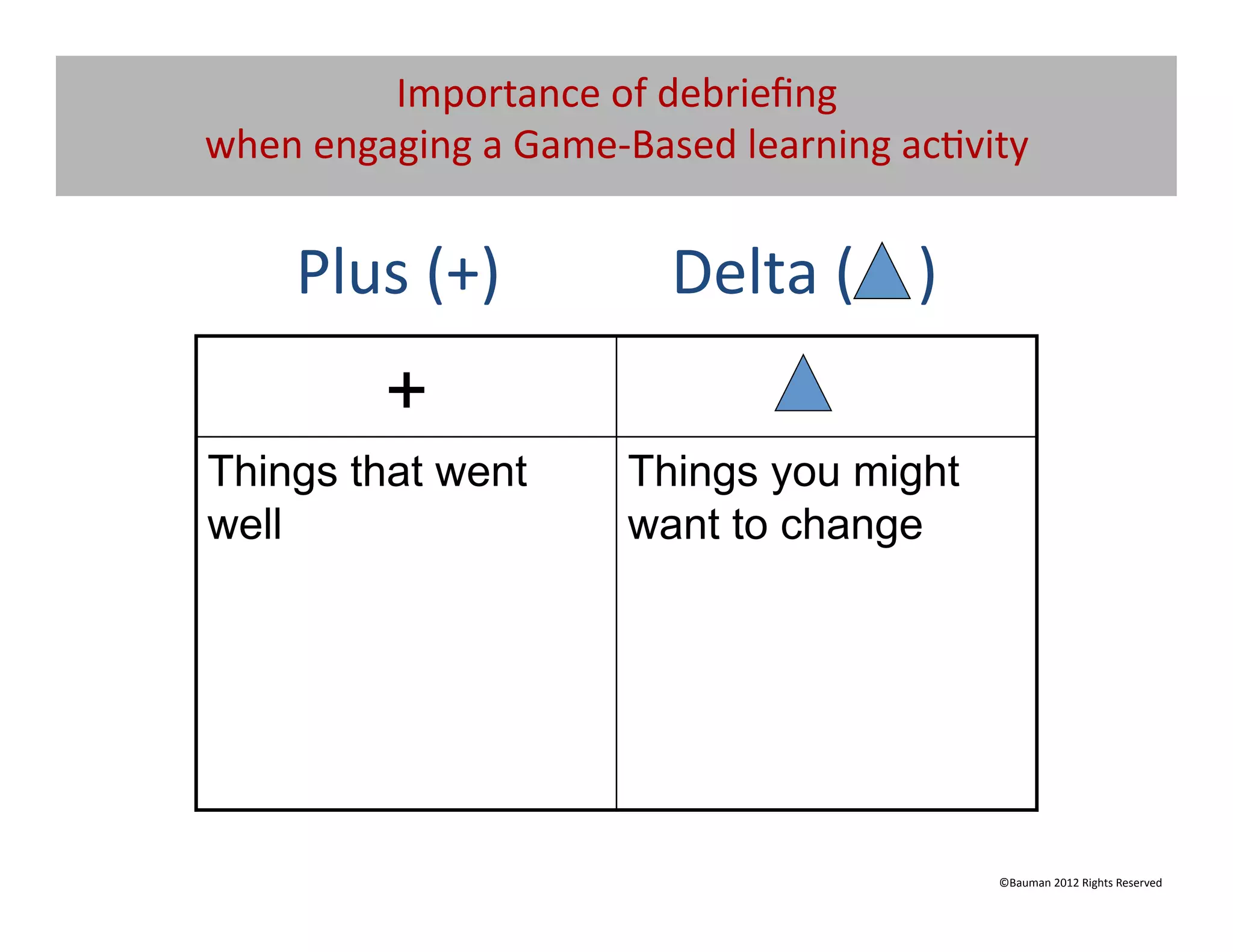
Importance	
  of	
  debriefing	
  	
  
when	
  engaging	
  a	
  Game-­‐Based	
  learning	
  ac@vity	


      Plus	
  (+)	


  Delta	
  (	


  )	
  
                 +
Things that went                                 Things you might
well                                             want to change


                                                                                               ©Bauman	
  2012	
  Rights	
  Reserved	
  
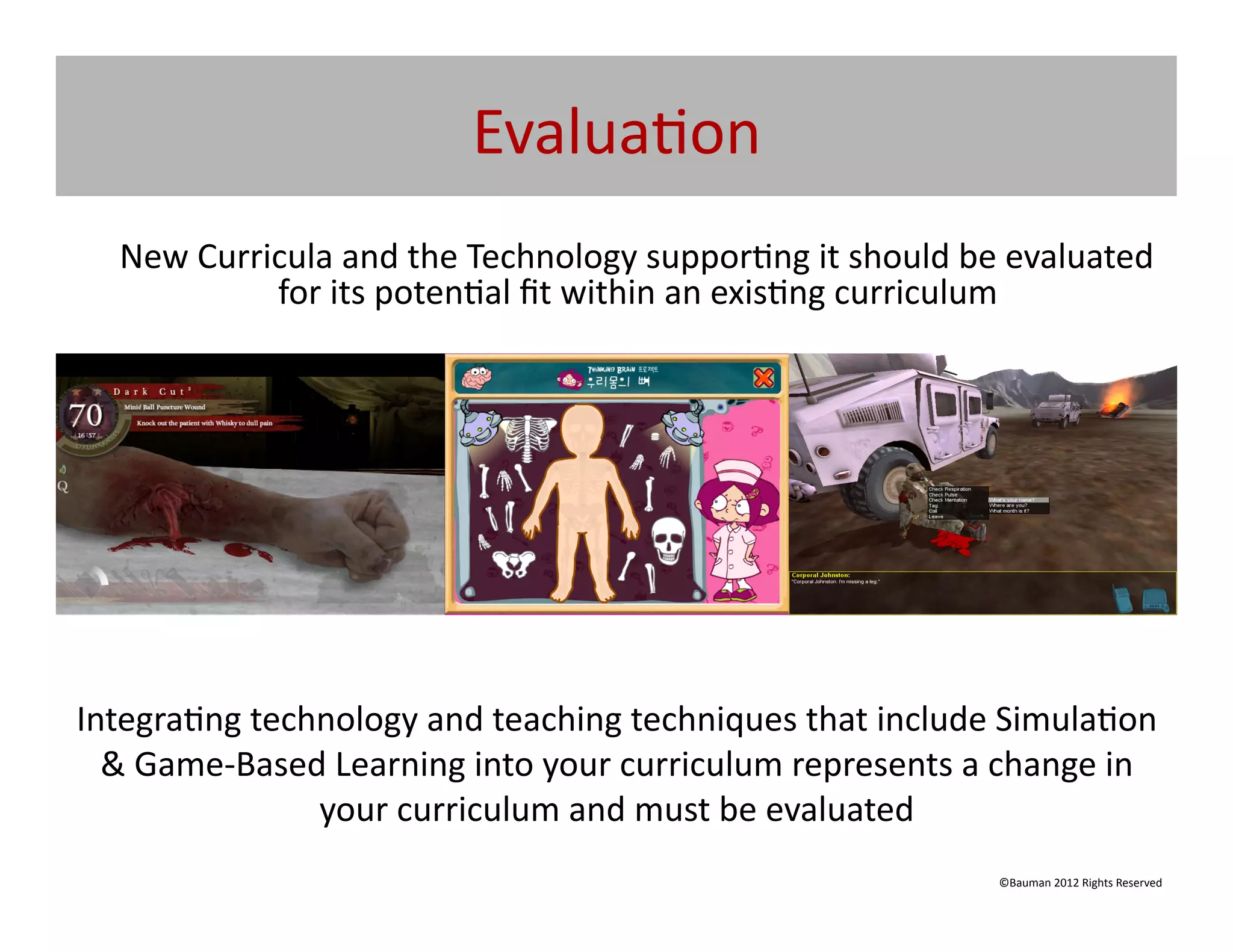
Evalua@on	
  
   	
  New	
  Curricula	
  and	
  the	
  Technology	
  suppor@ng	
  it	
  should	
  be	
  evaluated	
  
                   for	
  its	
  poten@al	
  fit	
  within	
  an	
  exis@ng	
  curriculum	


Integra@ng	
  technology	
  and	
  teaching	
  techniques	
  that	
  include	
  Simula@on	
  
  &	
  Game-­‐Based	
  Learning	
  into	
  your	
  curriculum	
  represents	
  a	
  change	
  in	
  
                   your	
  curriculum	
  and	
  must	
  be	
  evaluated	
  
                                                                                       ©Bauman	
  2012	
  Rights	
  Reserved	
  
Research:	
  Suppor@ng	
  Educa@on…	
  
                                                                            ©Bauman	
  2012	
  Rights	
  Reserved	


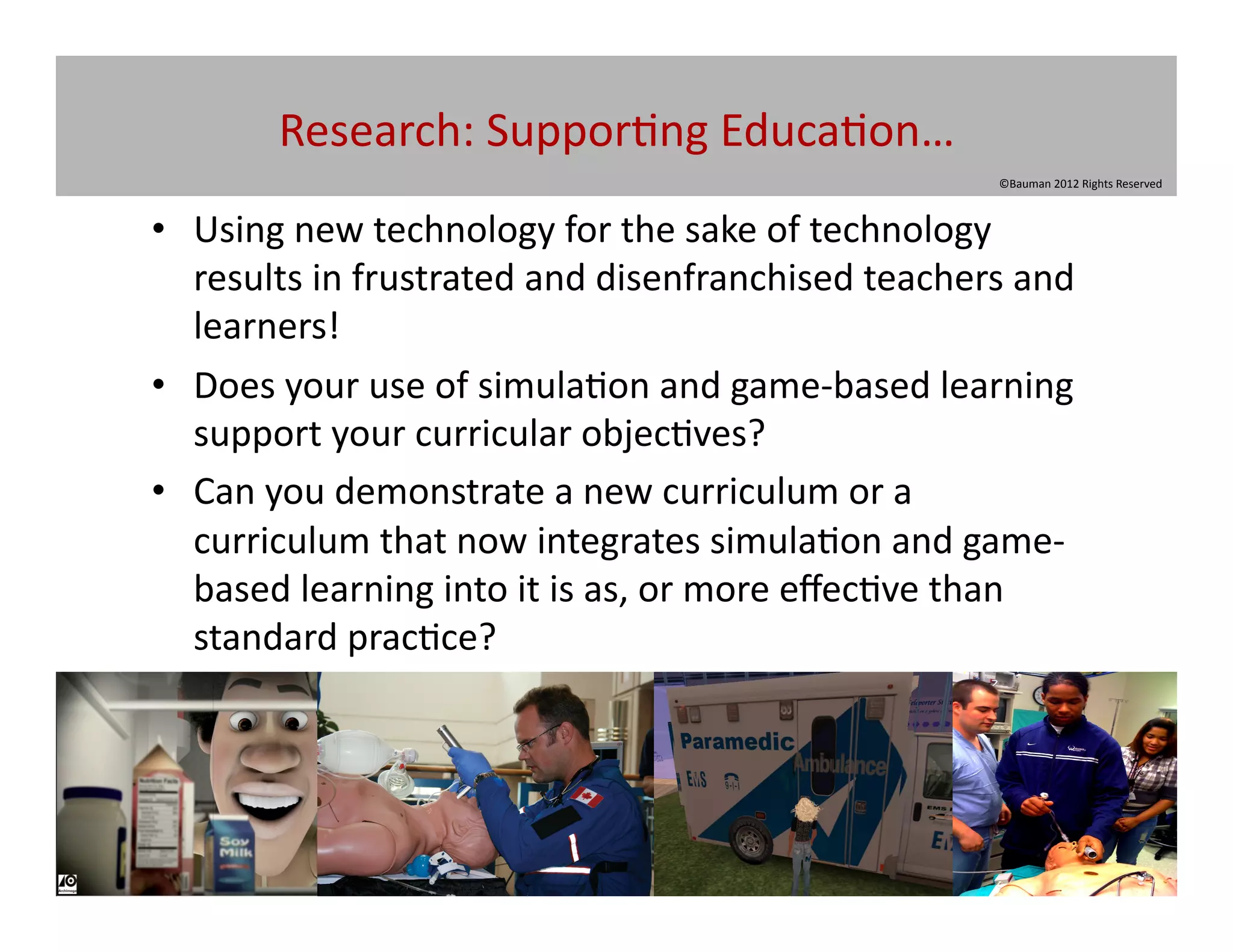
•  Using	
  new	
  technology	
  for	
  the	
  sake	
  of	
  technology	
  
   results	
  in	
  frustrated	
  and	
  disenfranchised	
  teachers	
  and	
  
   learners!	
  
•  Does	
  your	
  use	
  of	
  simula@on	
  and	
  game-­‐based	
  learning	
  
   support	
  your	
  curricular	
  objec@ves?	
  
•  Can	
  you	
  demonstrate	
  a	
  new	
  curriculum	
  or	
  a	
  
   curriculum	
  that	
  now	
  integrates	
  simula@on	
  and	
  game-­‐
   based	
  learning	
  into	
  it	
  is	
  as,	
  or	
  more	
  effec@ve	
  than	
  
   standard	
  prac@ce?	
  
Research:	
  Best	
  Prac@ces	
  &	
  Contribu@on…	
  
                                                                                 ©Bauman	
  2012	
  Rights	
  Reserved	


•  The	
  concept	
  of	
  Best	
  Prac@ce	
  applies	
  to	
  
   educa@onal	
  processes	
  as	
  well	
  as	
  pa@ent	
  
   interven@ons	
  and	
  outcomes!	
  
•  Inves@ga@on	
  defines	
  Best	
  Prac@ce?	
  
•  Defining	
  Best	
  Prac@ce	
  is	
  fluid?	
  
    –  Best	
  Prac@ce	
  is	
  defined	
  by	
  current	
  knowledge.	
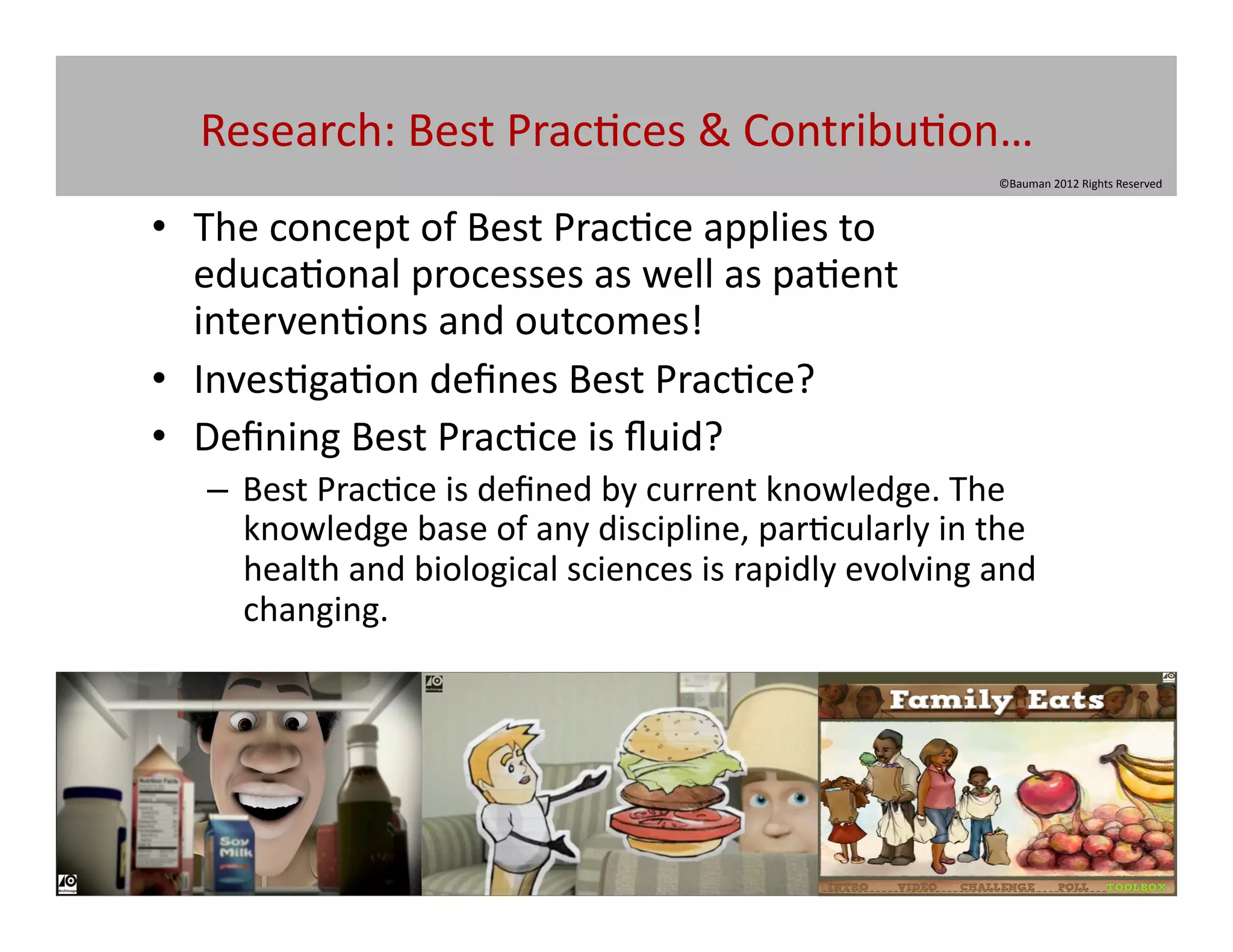
  The	
  
       knowledge	
  base	
  of	
  any	
  discipline,	
  par@cularly	
  in	
  the	
  
       health	
  and	
  biological	
  sciences	
  is	
  rapidly	
  evolving	
  and	
  
       changing.	
  
OK	
  I’m	
  Sold…	
  How	
  do	
  I	
  get	
  started?	
  
     Students	
  and	
  Faculty	
  need	
  to	
  be	
  prepared	
  for	
  game-­‐based	
  learning	
  
•    Pick	
  your	
  objec@ves	
  first…	
  then	
  look	
  for	
  a	
  game	
  that	
  is	
  going	
  to	
  support	
  those	
  objec@ves	
  
      –  Introducing	
  the	
  students	
  to	
  each	
  other	
  (Icebreakers)	
  –	
  Geography	
  Game	
  
      –  Teamwork	
  –	
  Helium	
  S@ck	
  
      –  Informa@on	
  	
  Processing	
  and	
  Discrimina@on	
  –	
  The	
  Nail	
  Game	
  
      –  Informa@on	
  Processing	
  and	
  Team	
  Work	
  –	
  The	
  Monkey	
  and	
  the	
  Mar@ni	
  
      –  Magic	
  Numbers	
  –	
  Problem	
  Solving	


•    Just	
  like	
  Simula@on	
  –	
  Debriefing	
  is	
  essen@al	
  to	
  maximize	
  the	
  poten@al	
  for	
  experien@al	
  learning.	
  
      –  Kolb’s	
  Learning	
  Cycle	
  
      –  Benner:	
  Thinking-­‐in-­‐ac@on	
  
      –  Schön	
  :	
  Thinking-­‐on-­‐ac@on	
  

•    While	
  games	
  are	
  fun…	
  with	
  learners,	
  par@cularly	
  adult	
  learners	
  incorpora@ng	
  games	
  into	
  your	
  
     curriculum	
  should	
  make	
  sense	
  
      –  They	
  should	
  be	
  situated	
  
      –  They	
  should	
  not	
  be	
  senseless	
  filler	
  
      –  They	
  should	
  be	
  well	
  rehearsed	
  	
  
                                                                                                                                            ©Bauman	
  2012	
  Rights	
  Reserved	
  
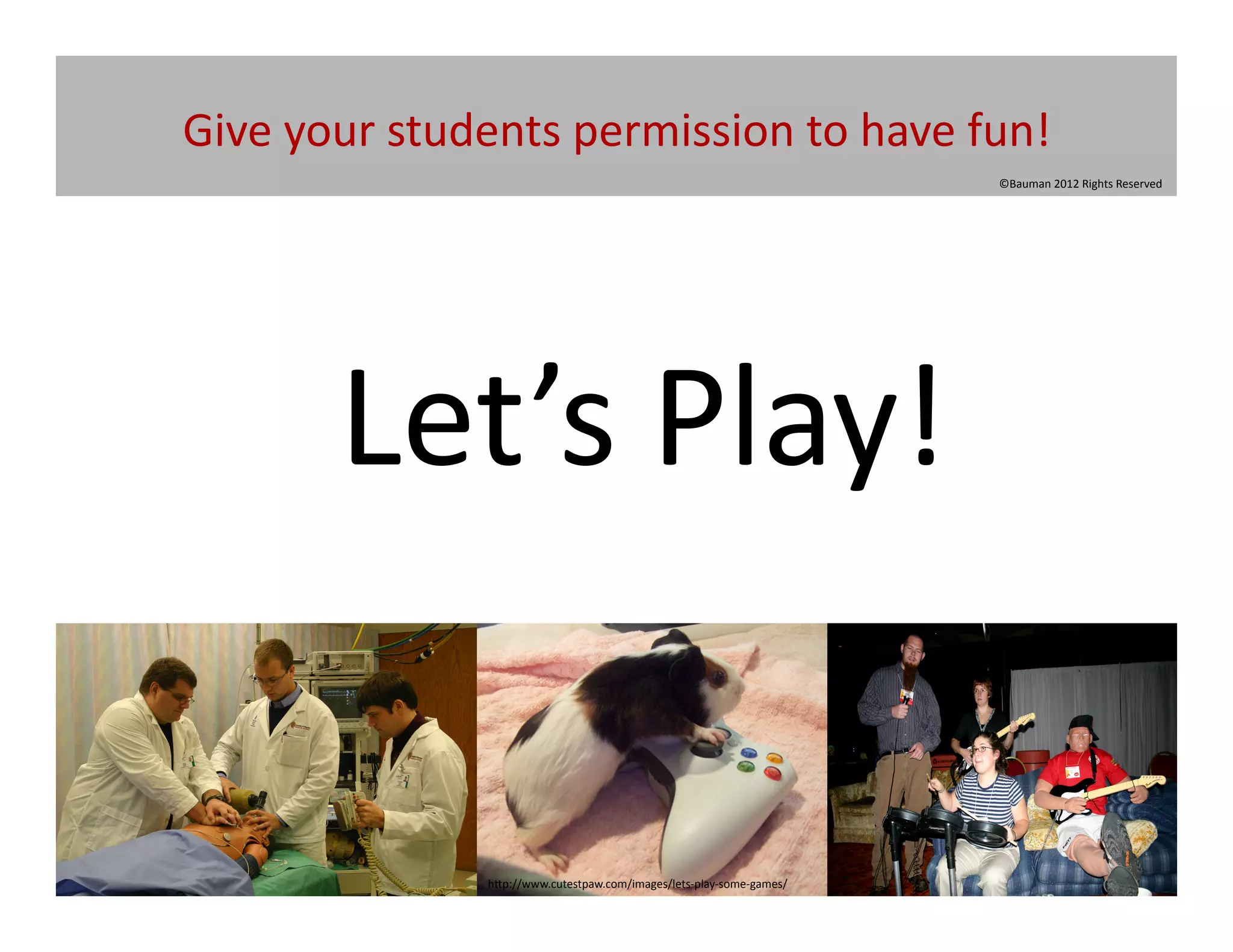
Give	
  your	
  students	
  permission	
  to	
  have	
  fun!	
  
                                                                                       ©Bauman	
  2012	
  Rights	
  Reserved	


           Let’s	
  Play!	
  

                      h[p://www.cutestpaw.com/images/lets-­‐play-­‐some-­‐games/	
  
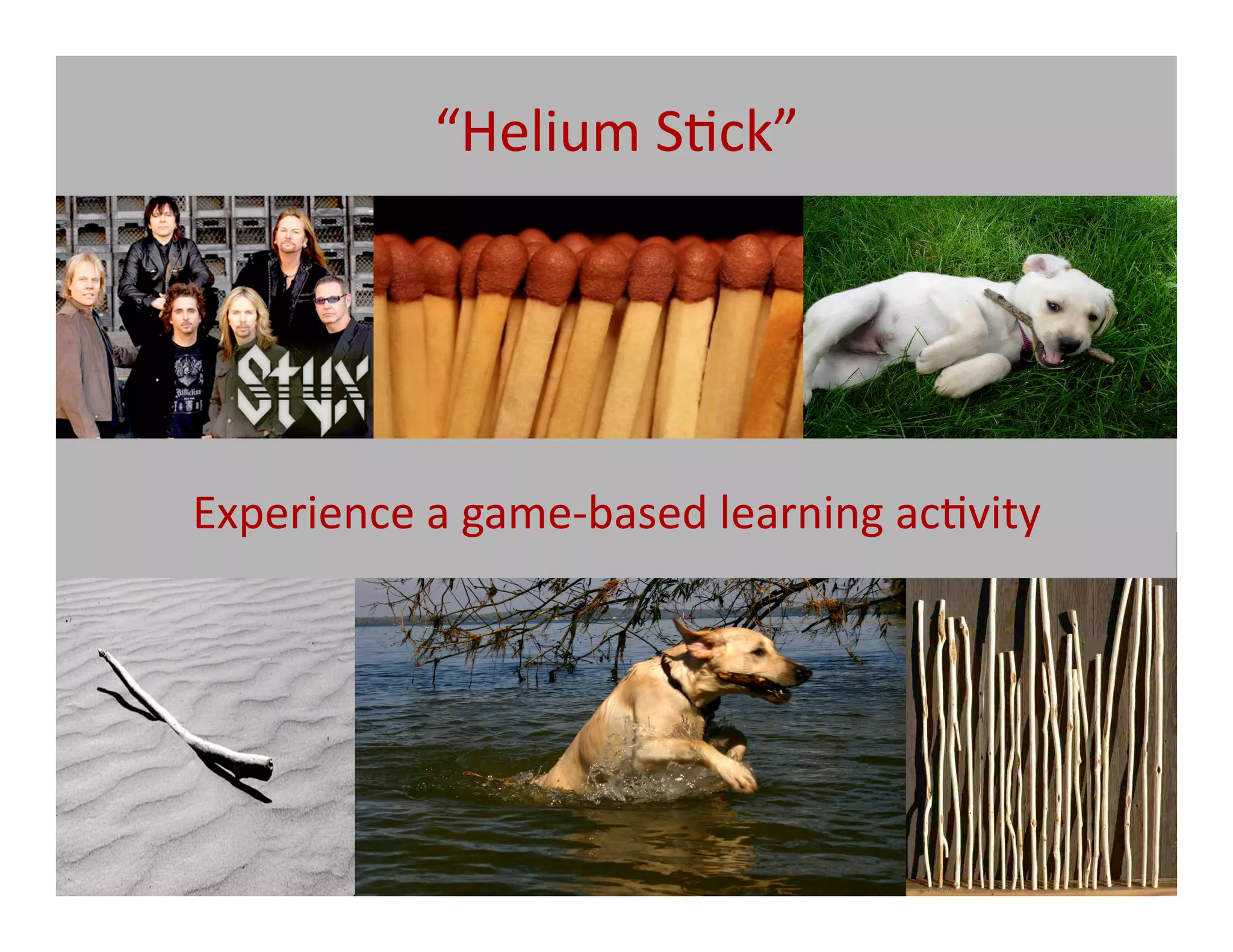
“Helium	
  S@ck”	


Experience	
  a	
  game-­‐based	
  learning	
  ac@vity	
  	
  
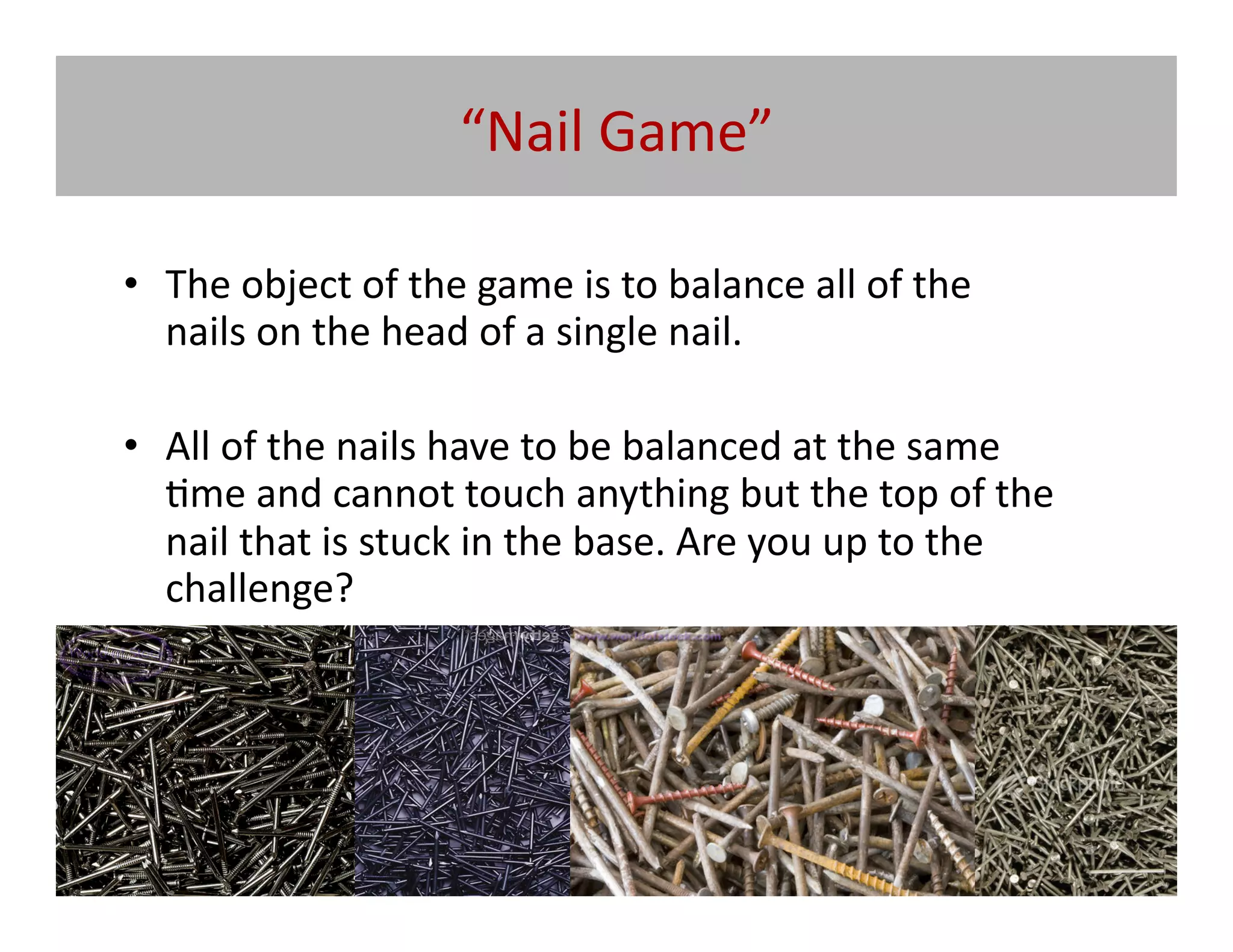
“Nail	
  Game”	
  

•  The	
  object	
  of	
  the	
  game	
  is	
  to	
  balance	
  all	
  of	
  the	
  
   nails	
  on	
  the	
  head	
  of	
  a	
  single	
  nail.	


•  All	
  of	
  the	
  nails	
  have	
  to	
  be	
  balanced	
  at	
  the	
  same	
  
   @me	
  and	
  cannot	
  touch	
  anything	
  but	
  the	
  top	
  of	
  the	
  
   nail	
  that	
  is	
  stuck	
  in	
  the	
  base.	
  Are	
  you	
  up	
  to	
  the	
  
   challenge?	
  
Let’s	
  add	
  a	
  new	
  word	
  to	
  the	
  mix…	
  
                                                                                  ©Bauman	
  2012	
  Rights	
  Reserved	


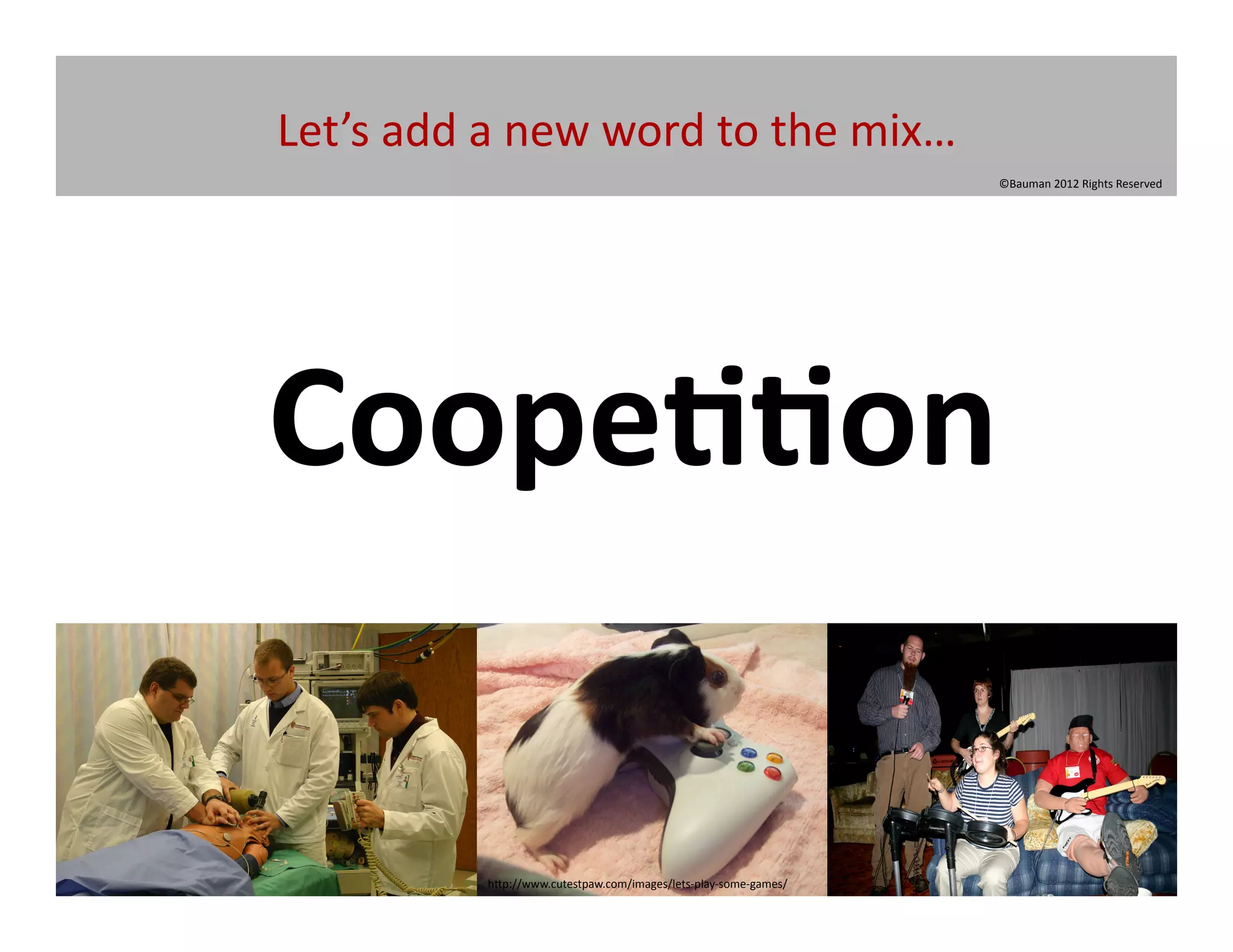
Coope//on	
  

                 h[p://www.cutestpaw.com/images/lets-­‐play-­‐some-­‐games/	
  
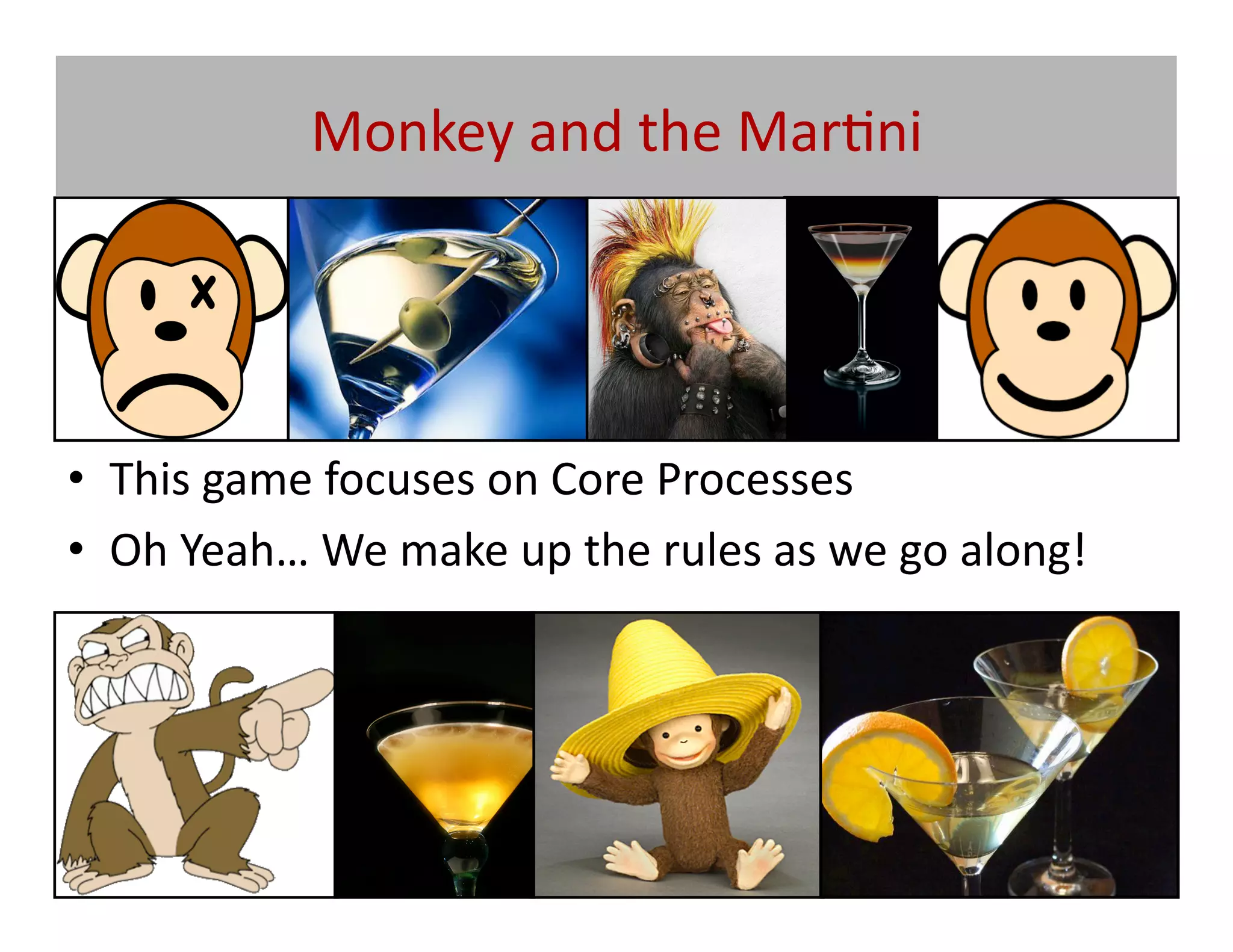
Monkey	
  and	
  the	
  Mar@ni	


•  This	
  game	
  focuses	
  on	
  Core	
  Processes	
  	
  
•  Oh	
  Yeah…	
  We	
  make	
  up	
  the	
  rules	
  as	
  we	
  go	
  along!	
  
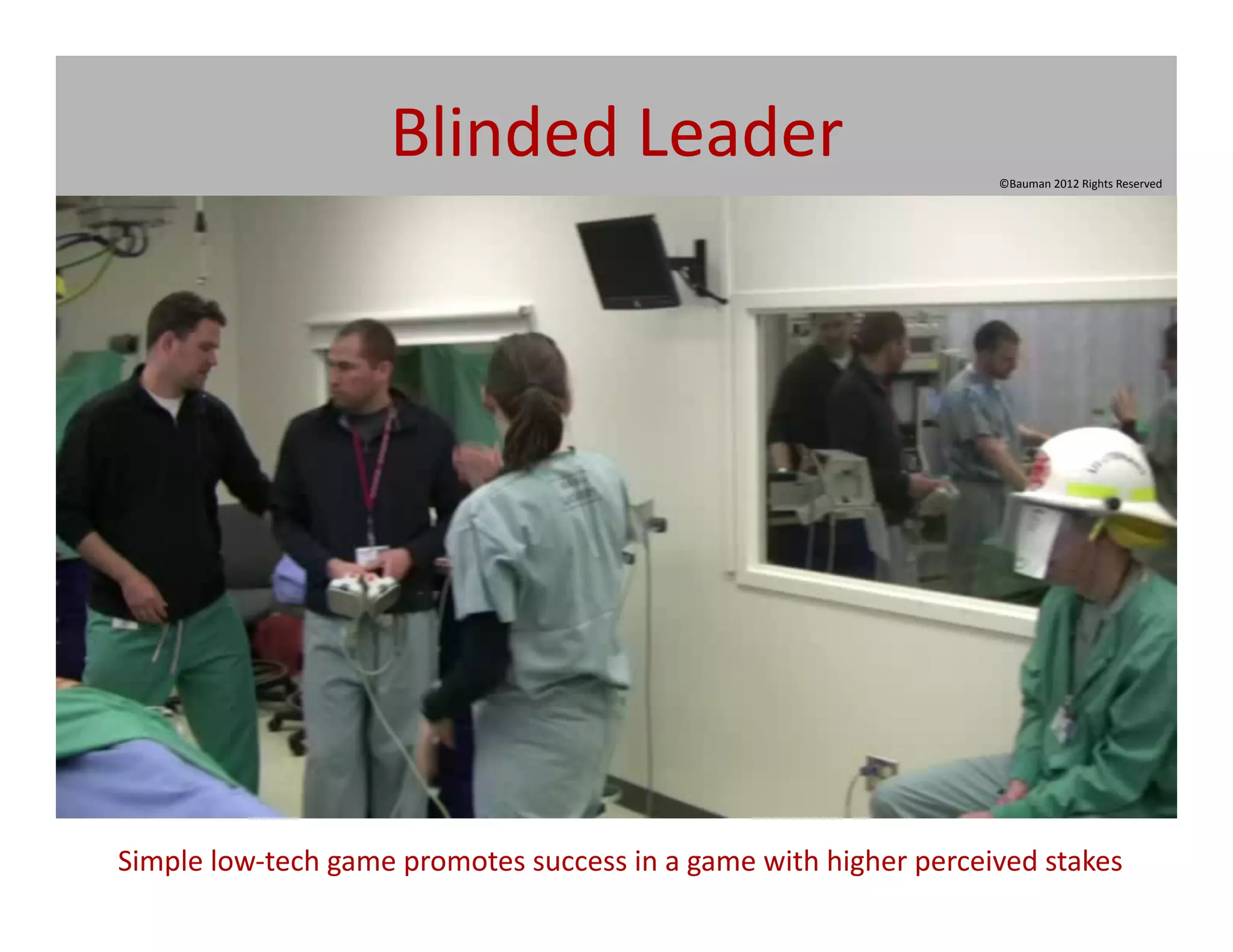
Blinded	
  Leader	
                                                    ©Bauman	
  2012	
  Rights	
  Reserved	


  Simple	
  low-­‐tech	
  game	
  promotes	
  success	
  in	
  a	
  game	
  with	
  higher	
  perceived	
  stakes	
  
What	
  sorts	
  of	
  Games	
  &	
  Environments	
  are	
  out	
  there…	
  
                                                                                                        ©Bauman	
  2012	
  Rights	
  Reserved	


MMOG’s	
  –	
  Massively	
  Mul@-­‐player	
  online	
  Games	
  [Repurposing	
  Commercial	
  Games	
  and	
  
exis@ng	
  mul@-­‐media]	
  
    	
  Starcra|	
  II	
  	
  –	
  4.5	
  Million	
  Copies,	
  14	
  Languages,	
  5	
  Con@nents	
  
    	
  World	
  of	
  WarCra|	
  
    	
  Quest	
  Atlan@s	
  (K12	
  Audience)	
  	
  	
  50K	
  Children,	
  6	
  Con@nents	


  Second	
  Life	
  (+/-­‐)	
  

These	
  environments	
  provide	
  online	
  virtual	
  worlds	
  that	
  can	
  promote	
  many	
  of	
  the	
  
objec@ves	
  we	
  find	
  valuable	
  to	
  clinical	
  disciplines	
  
    	
  Teamwork	
  
    	
  Cri@cal	
  Thinking	
  
    	
  Problem	
  Solving	
  
    	
  Pa[ern	
  Recogni@on	
  
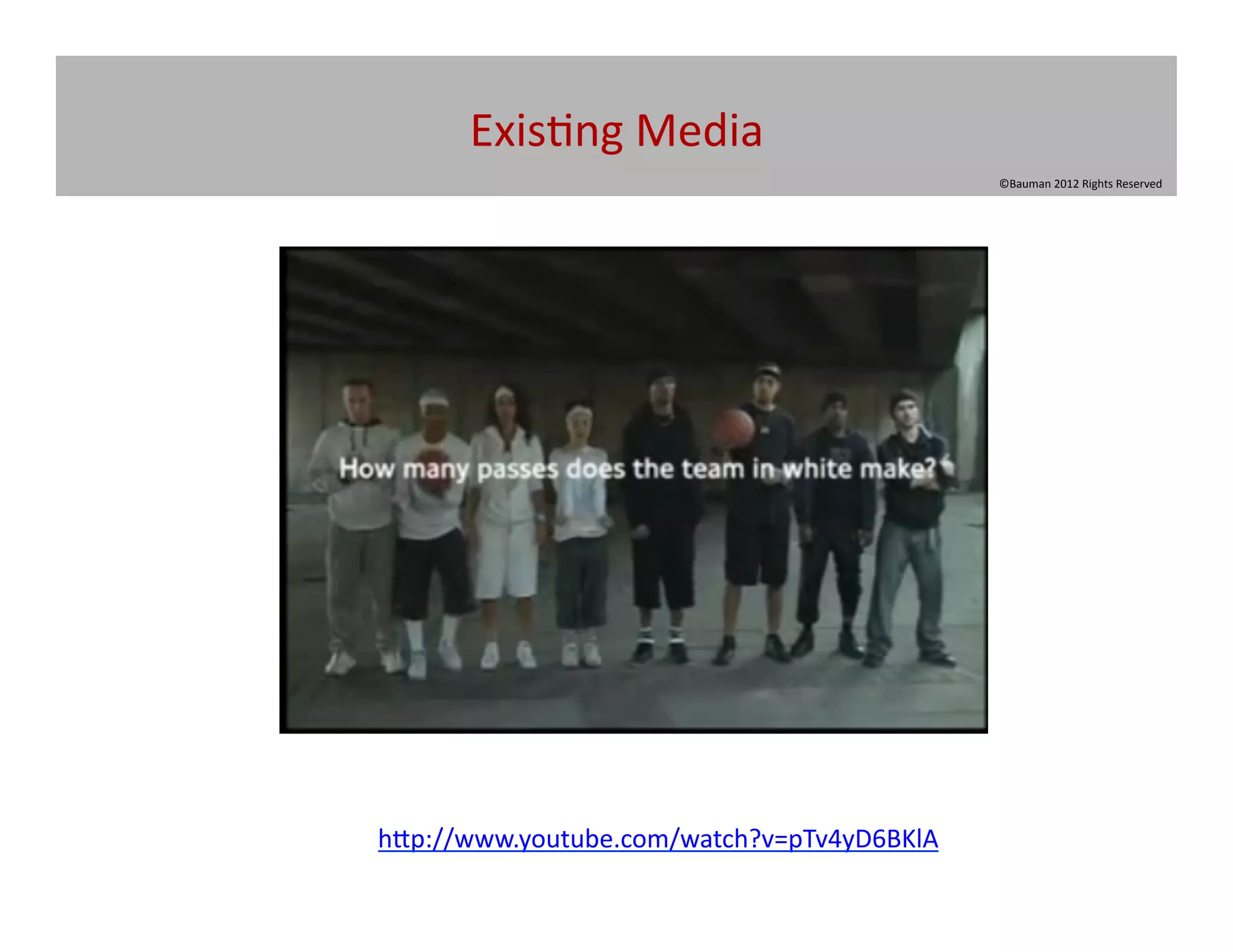
Exis@ng	
  Media	
  
                                                ©Bauman	
  2012	
  Rights	
  Reserved	


h[p://www.youtube.com/watch?v=pTv4yD6BKlA	
  
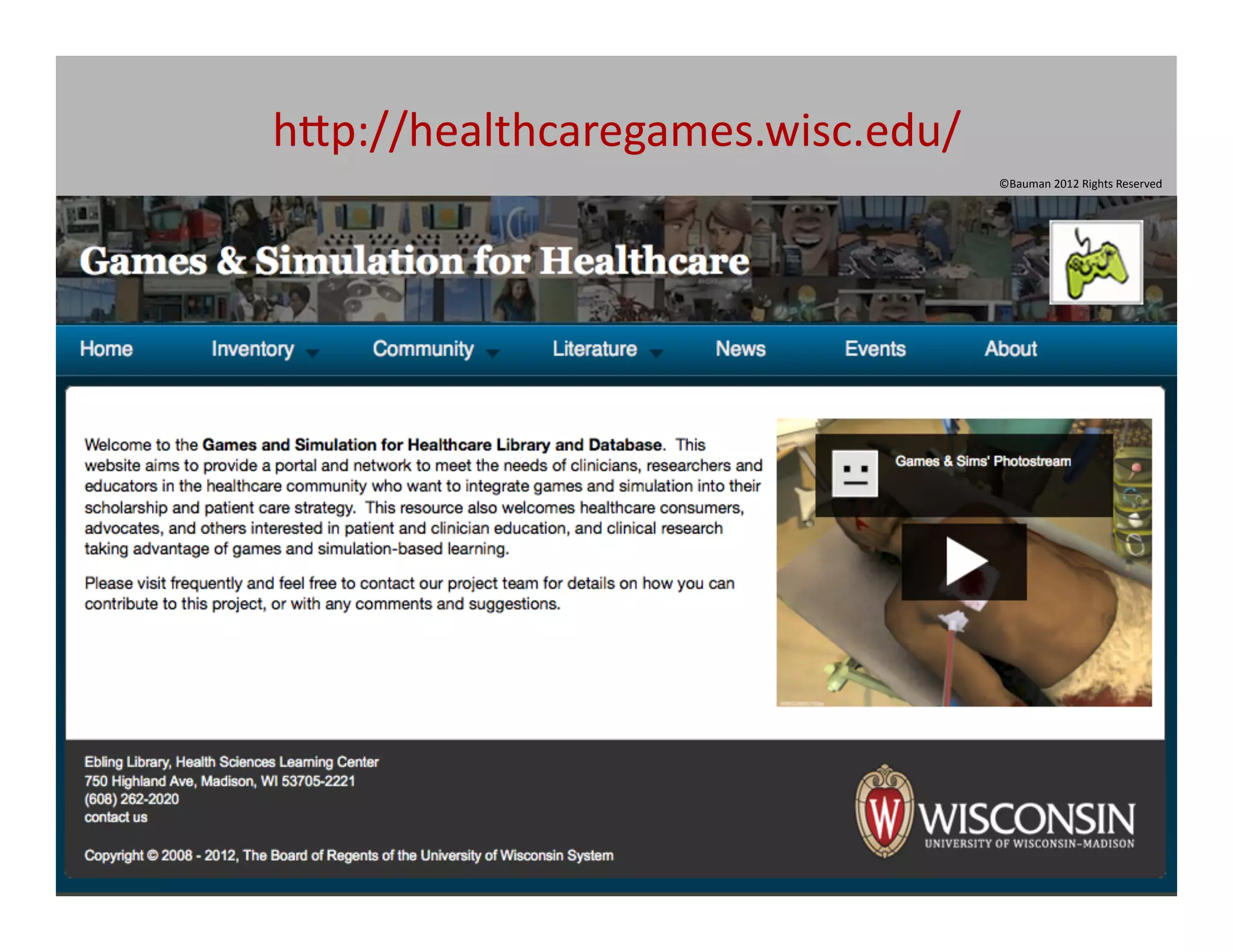
h[p://healthcaregames.wisc.edu/	
  
                                      ©Bauman	
  2012	
  Rights	
  Reserved	
  
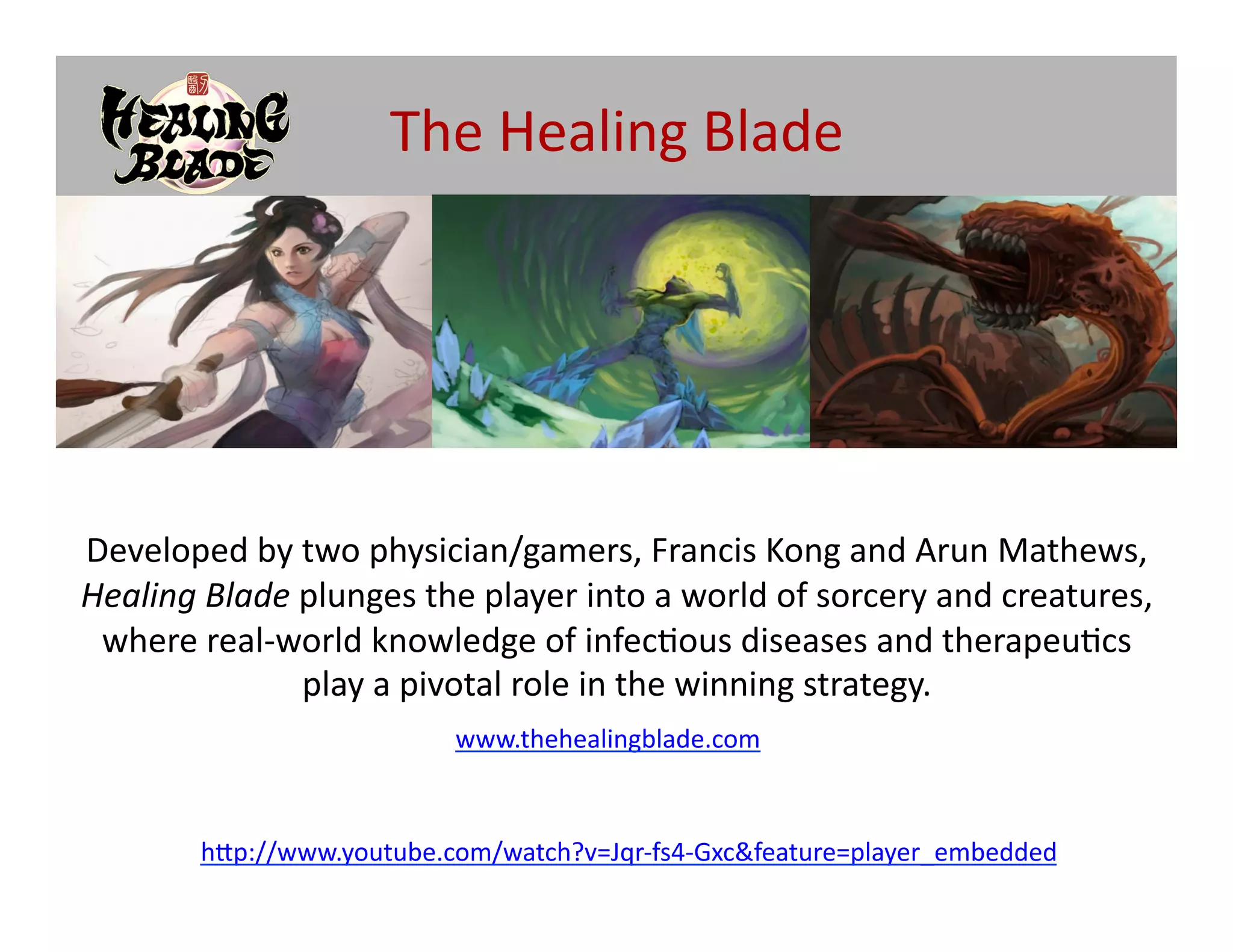
The	
  Healing	
  Blade	


Developed	
  by	
  two	
  physician/gamers,	
  Francis	
  Kong	
  and	
  Arun	
  Mathews,	
  
Healing	
  Blade	
  plunges	
  the	
  player	
  into	
  a	
  world	
  of	
  sorcery	
  and	
  creatures,	
  
 where	
  real-­‐world	
  knowledge	
  of	
  infec@ous	
  diseases	
  and	
  therapeu@cs	
  
                    play	
  a	
  pivotal	
  role	
  in	
  the	
  winning	
  strategy.	
  
                                     www.thehealingblade.com	


           h[p://www.youtube.com/watch?v=Jqr-­‐fs4-­‐Gxc&feature=player_embedded	
  
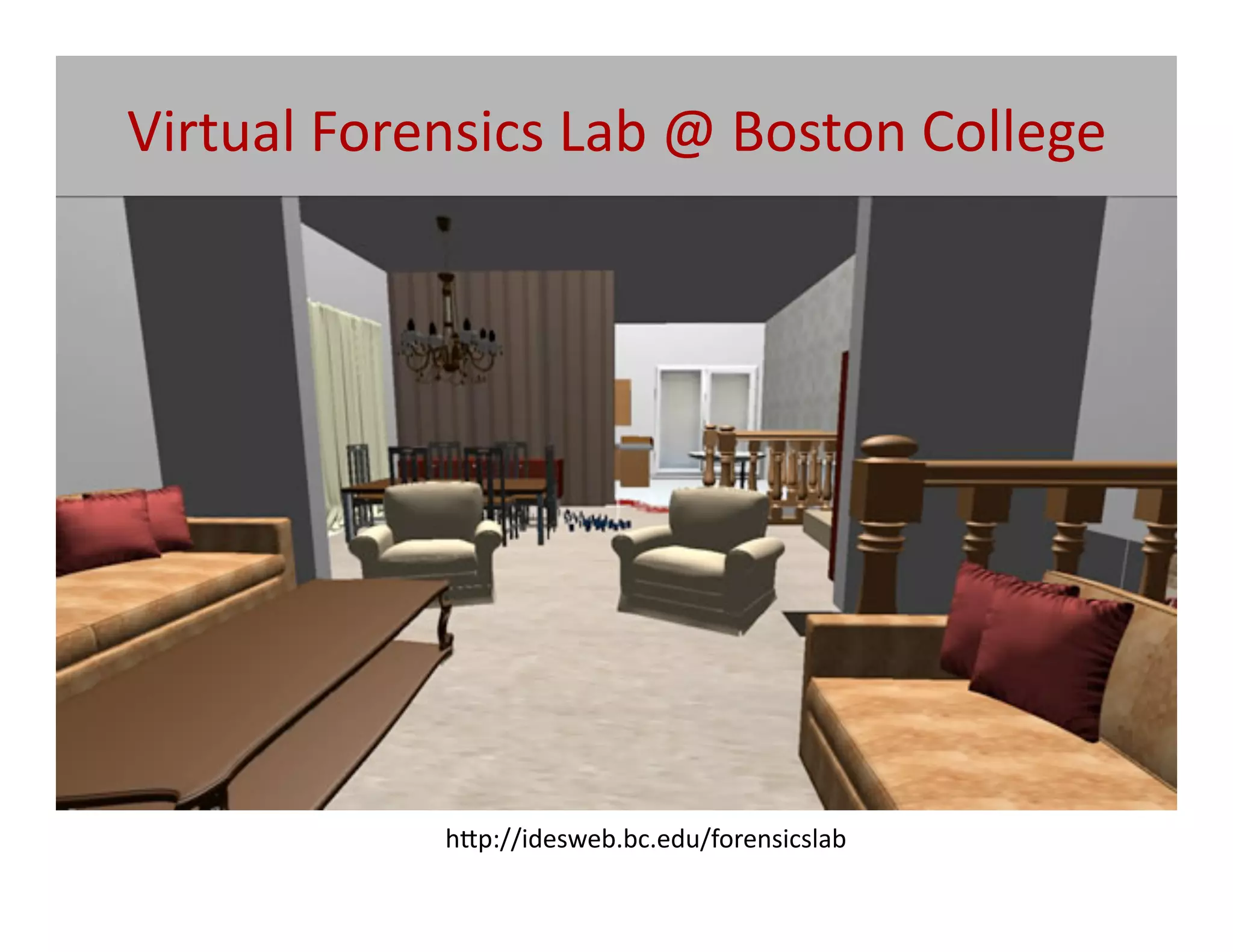
Virtual	
  Forensics	
  Lab	
  @	
  Boston	
  College	


                  h[p://idesweb.bc.edu/forensicslab/	
  
CliniSpace	


h[p://www.youtube.com/watch?v=WlX_Gyo1QKg	
      h[p://clinispace.com/	
  
h[p://vimeo.com/17279986	
  
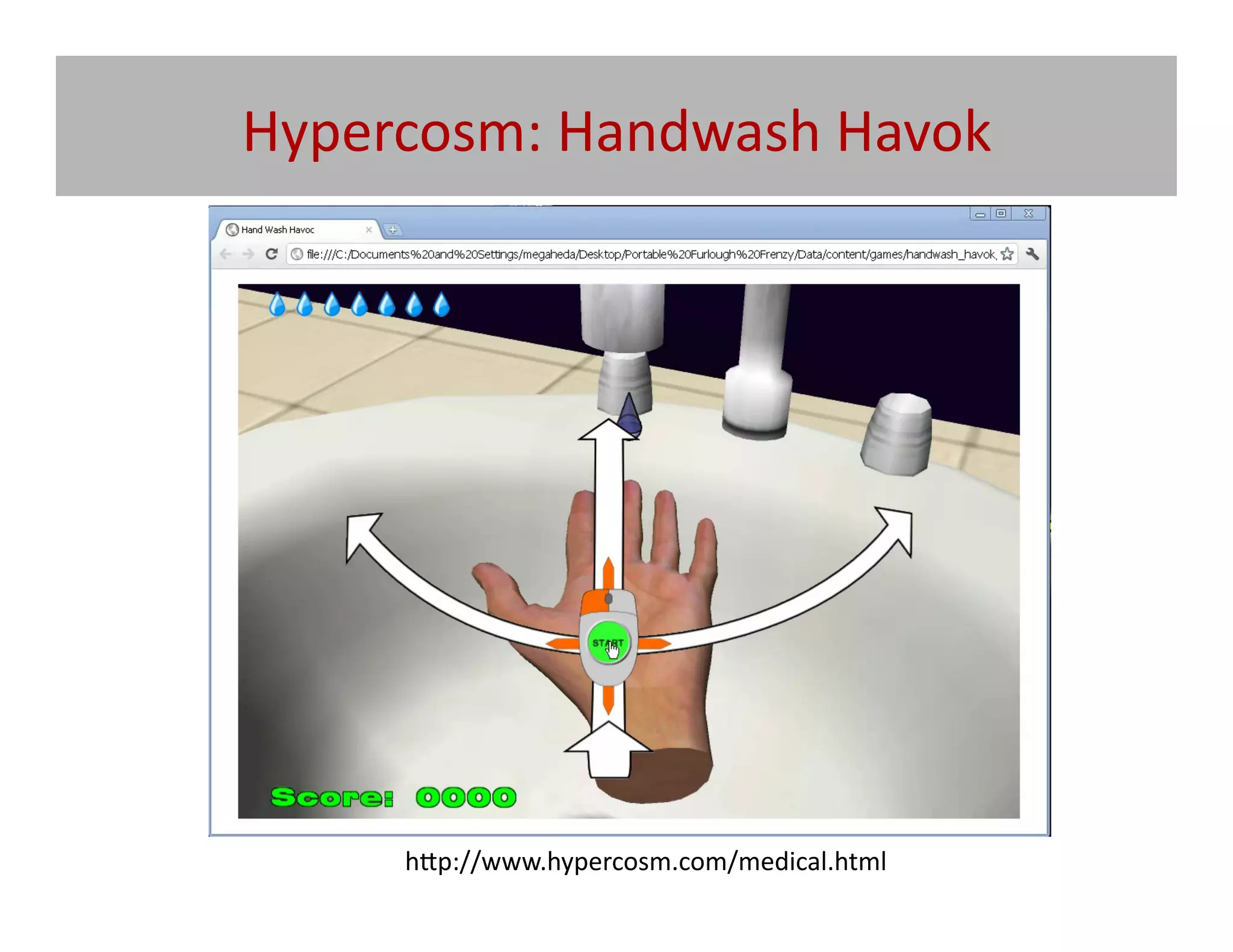
Hypercosm:	
  Handwash	
  Havok	


       h[p://www.hypercosm.com/medical.html/	
  
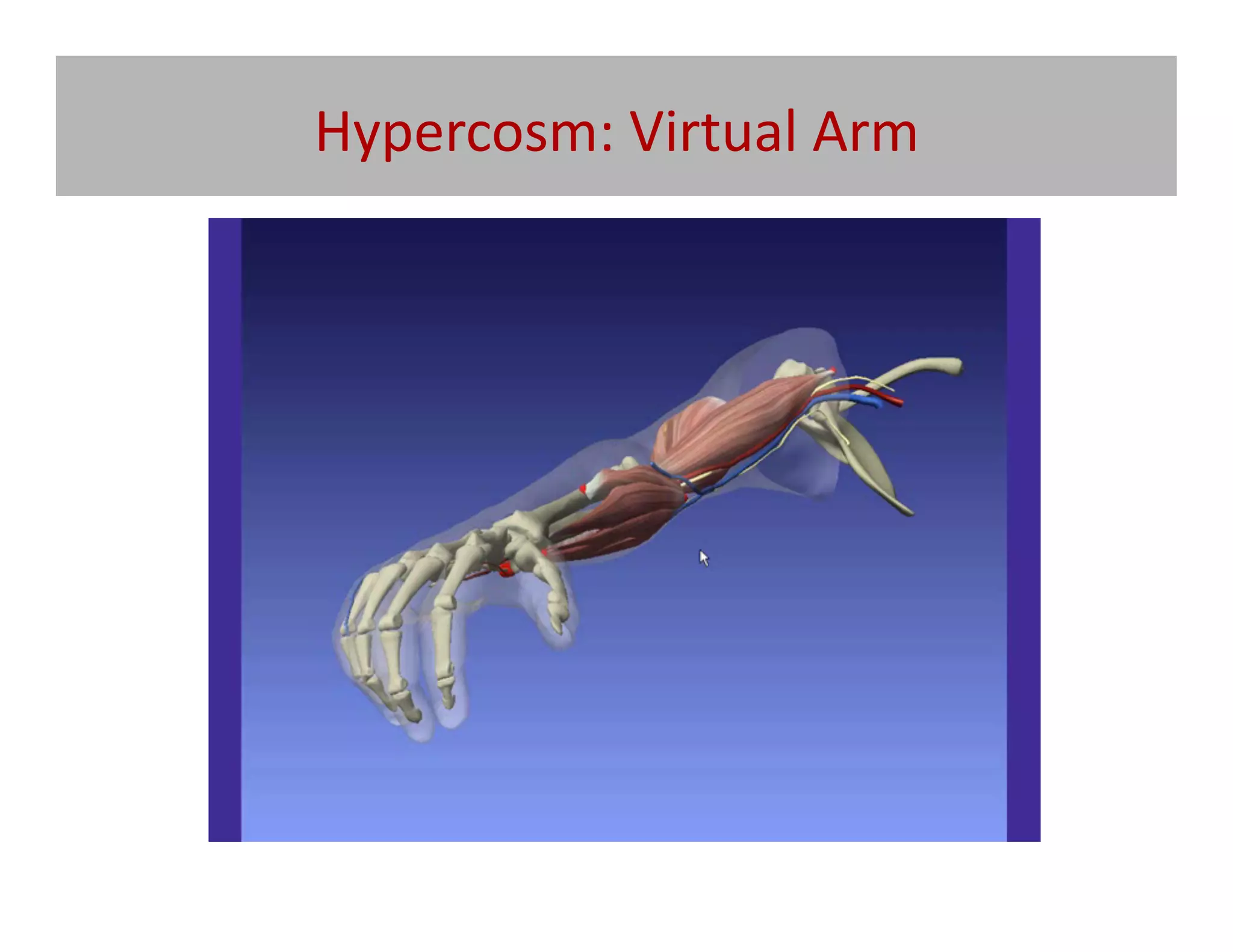
Hypercosm:	
  Virtual	
  Arm	
  
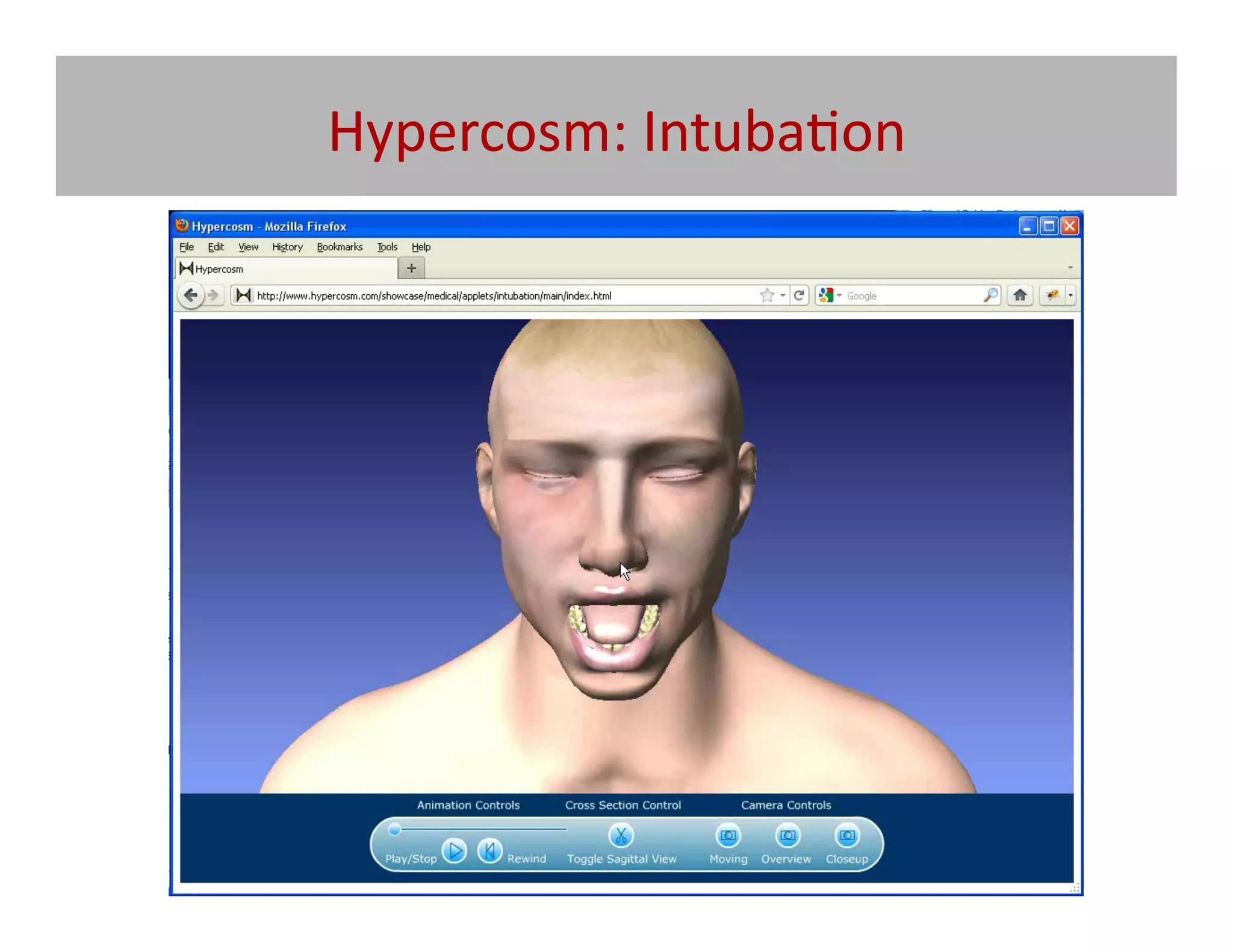
Hypercosm:	
  Intuba@on	
  
Exercise	
  
At	
  your	
  table	
  brain	
  storm	
  how	
  you	
  might	
  use	
  
       Game-­‐based	
  learning	
  meet	
  a	
  training	
  or	
  
                    curriculum	
  objec@ve	
  

 – How	
  do	
  you	
  envision	
  your	
  idea	
  engaging	
  
   learners	
  
 – Why	
  would	
  it	
  be	
  transla@onal…	
  change	
  or	
  
   improve	
  prac@ce	


            . 	
  . 	
  . 	
  . 	
  . 	
  . 	
  . 	
  . 	
  . 	
  . 	
  .	


                                                                                            ©Bauman	
  2012	
  Rights	
  Reserved	
  
Recap	
  
•  Explored	
  the	
  poten@al	
  for	
  learner	
  engagement	
  when	
  using	
  
   game-­‐based	
  learning	
  methods	
  and	
  strategies	


•  We	
  discussed	
  the	
  importance	
  of	
  addressing	
  “Fit”	
  when	
  using	
  
   digital	
  and	
  game-­‐based	
  pedagogy	
  

•  Contemporary	
  theory	
  for	
  game-­‐based	
  and	
  virtual	
  learning	
  
   environments	
  were	
  introduced	
  and	
  discussed	
  

•  Strategies	
  for	
  introducing	
  game-­‐based	
  learning	
  into	
  
   professional	
  and	
  educa@onal	
  environments	
  was	
  explored	
  

•  Game-­‐Based	
  learning	
  was	
  discussed,	
  demonstrated,	
  and	
  
   experienced	
  

                  . 	
  . 	
  . 	
  . 	
  . 	
  . 	
  . 	
  . 	
  . 	
  . 	
  .	


                                                                                                  ©Bauman	
  2011	
  Rights	
  Reserved	
  
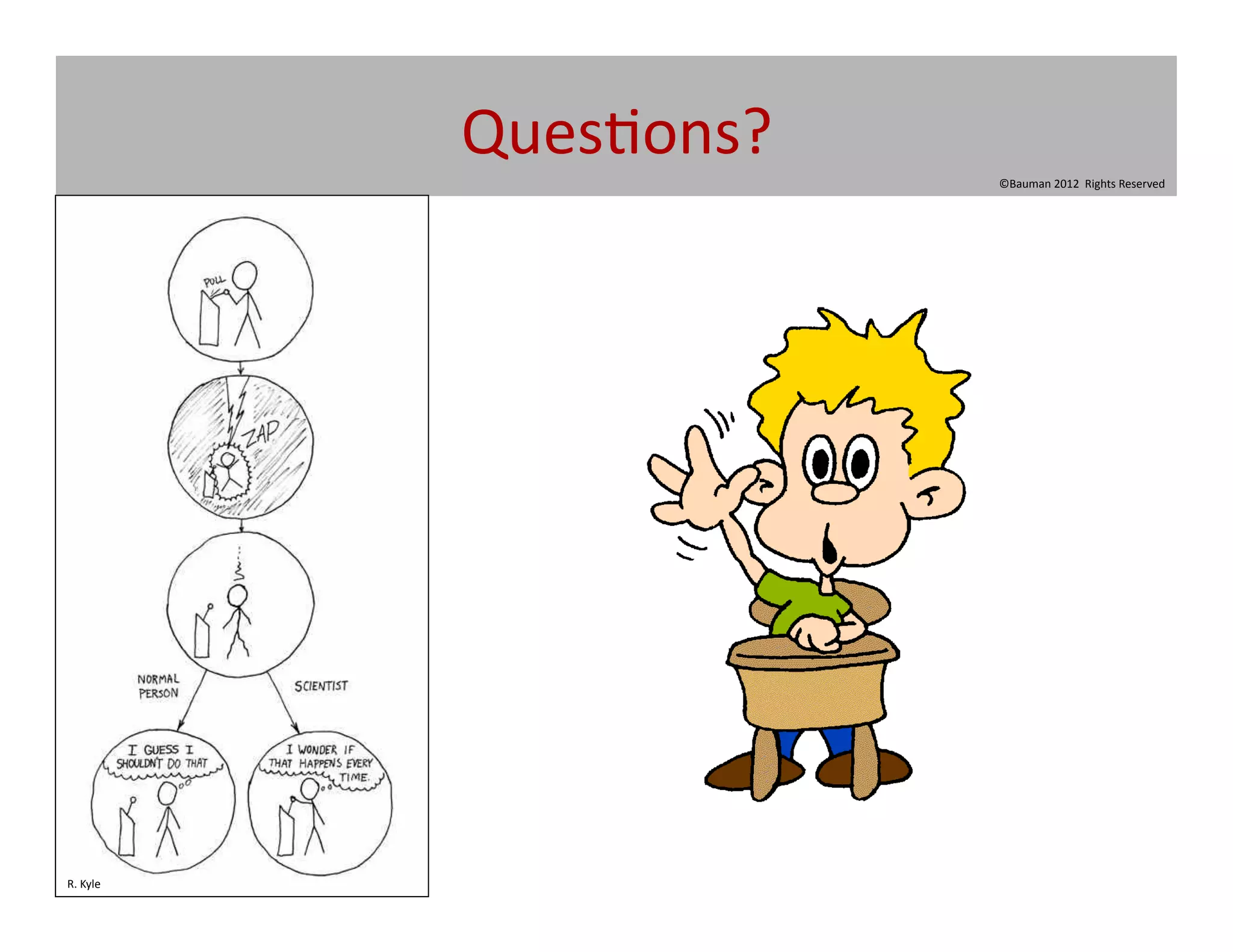
Ques@ons?	
  
                                 ©Bauman	
  2012	
  	
  Rights	
  Reserved	


R.	
  Kyle	
  
Contact	
  Informa@on	


                                             Eric	
  B.	
  Bauman,	
  PhD	
  
                                       ebauman@clinicalplayground.com	
  
                                          www.clinicalplayground.com	
  
                                    h[p://www.linkedin.com/in/ericbbauman	
  
                                      h[p://www.slideshare.net/ebauman	


Clinical	
  Playground	
  LLC	
                                                 @bauman1967	
  
Selected	
  References	
  
                                                                                                                                                                                                                                                                                                                   ©Bauman	
  2012	
  Rights	
  Reserved	


Bauman,	
  E.	
  (2007).	
  High	
  fidelity	
  simula@on	
  in	
  healthcare.	
  Ph.D.	
  disserta@on,	
  The	
  University	
  of	
  Wisconsin-­‐Madison,	
  United	
  States.	
  Disserta@ons	
  &	
  Thesis	
  @	
  CIC	
  Ins@tu@ons	
  database.	
  (Publica@on	
  no.	
  AAT	
  3294196)	


Bauman,	
  E.	
  (2010).	
  Virtual	
  reality	
  and	
  game-­‐based	
  clinical	
  educa@on.	
  In	
  Gaberson,	
  K.B.,	
  &	
  Oermann,	
  M.H.	
  (Eds)	
  Clinical	
  teaching	
  strategies	
  in	
  nursing	
  educa5on	
  (3rd	
  ed).New	
  York,	
  Springer	
  Publishing	
  Company.	
  

Bauman,	
  E.B.	
  and	
  Games,	
  I.A.	
  (2011).	
  Contemporary	
  theory	
  for	
  immersive	
  worlds:	
  Addressing	
  engagement,	
  culture,	
  and	
  diversity.	
  In	
  Cheney,	
  A.	
  and	
  Sanders,	
  R.	
  (Eds)	
  Teaching	
  and	
  Learning	
  in	
  3D	
  Immersive	
  Worlds:	
  Pedagogical	
  models	
  and	
  
           construc5vist	
  approaches.	
  IGI	
  Global.	


Bauman,	
  E.	
  B.	
  (2012).	
  Game-­‐based	
  Teaching	
  and	
  Simula5on	
  in	
  Nursing	
  &	
  Healthcare.	
  New	
  York,	
  NY:	
  Springer	
  Publishing	
  Company.	
  	
  
Benner,	
  P.	
  (1984).	
  From	
  novice	
  to	
  expert:	
  Excellence	
  and	
  power	
  in	
  clinical	
  nursing	
  prac5ce.	
  Menlo	
  Park,	
  CA:	
  Addison-­‐Wesley.	
  

Benner,	
  P.,	
  Tanner,	
  C.,	
  &	
  Chesla,	
  C.	
  (2009).	
  Exper5se	
  in	
  nursing:	
  Caring,	
  clinical	
  judgment,	
  and	
  ethics.	
  New	
  York:	
  Springer	
  Publishing	
  Company	


Broussard.,	
  J	
  (2012).	
  Making	
  the	
  MMOst	
  of	
  Your	
  Online	
  Class.	
  Teaching	
  and	
  Curriculum	
  Dialog.	
  

Culhane-­‐Pera,	
  K.A.,	
  Reif,	
  C.,	
  Egli,	
  E.,	
  Baker,	
  N.J.,	
  and	
  Kassekert	
  (1997).	
  A	
  curriculum	
  for	
  mul@cultural	
  educa@on	
  in	
  family	
  medicine.	
  Family	
  Medicine,	
  29(10),	
  719-­‐723.	
  

Fitz-­‐Walter,	
  Z.	
  (2012).	
  h[p://gamasutra.com/blogs/ZacharyFitzWalter/20120426/169287/Gamifica@on_Thoughts_on_defini@on_and_design.php	
  

Games,	
  I.	
  and	
  Bauman,	
  E.	
  (2011)	
  Virtual	
  worlds:	
  An	
  environment	
  for	
  cultural	
  sensi@vity	
  educa@on	
  in	
  the	
  health	
  sciences.	
  	
  Interna5onal	
  Journal	
  of	
  Web	
  Based	
  Communi5es	
  7(2).	


Gee,	
  J.P.	
  (2003)	
  What	
  Videogames	
  Have	
  to	
  Teach	
  Us	
  About	
  Learning	
  and	
  Literacy.	
  New	
  York,	
  NY:	
  Palgrave-­‐McMillan.	
  

Jenson,	
  M.	
  (2012).	
  Engaging	
  the	
  learner:	
  Gamifica@on	
  strives	
  to	
  keep	
  the	
  user’s	
  interest.	
  T	
  &D,	
  	
  January,	
  2012,	
  41-­‐44.	
  

Kolb,	
  D.	
  (1984).	
  Experien@al	
  learning:	
  Experience	
  as	
  the	
  source	
  of	
  learning	
  and	
  development.	
  	
  Upper	
  Saddle	
  River,	
  NJ:	
  Pren@ce	
  Hall.	
  

Larew,	
  C.,	
  Lessans,	
  S.,	
  Spunt,	
  D.,	
  Foster,	
  D.,	
  &	
  Covington,	
  B.	
  (2006).	
  Innova@ons	
  in	
  clinical	
  simula@on:	
  Applica@on	
  of	
  Benner's	
  theory	
  in	
  an	
  interac@ve	
  pa@ents	
  care	
  simula@on.	
  Nursing	
  Educa5on	
  Perspec5ves,	
  27(1),	
  16-­‐21.	


Prensky,	
  M.	
  (2001).	
  Digital	
  na@ves,	
  digital	
  immegrants,	
  part	
  1.	
  On	
  the	
  Horizon	
  9(5).	
  

Popkewitz,	
  T.	
  (2007).	
  Cosmopoli@anism	
  and	
  the	
  age	
  of	
  school	
  reform:	
  science,	
  educa@on	
  and	
  making	
  a	
  society	
  by	
  making	
  the	
  child.	
  Routledge.	
  

Taekman	
  J.M.,	
  Segall	
  N.,	
  Hobbs	
  G.,	
  and	
  Wright,	
  M.C.	
  (2007).	
  3DiTeams:	
  Healthcare	
  team	
  training	
  in	
  a	
  virtual	
  environment.	
  Anesthesiology.	
  2007:	
  107:	
  A2145.	
  

Schön,	
  D.	
  A.	
  (1983).	
  The	
  reflec5ve	
  prac55oner:	
  How	
  professionals	
  think	
  in	
  ac5on.	
  New	
  York:	
  	
  Basic	
  Books.	
  

Skiba,	
  D.	
  J.	
  (2009).	
  Nursing	
  educa@on	
  2.0:	
  A	
  second	
  look	
  at	
  Second	
  Life.	
  Nursing	
  Educa5on	
  Perspec5ves,	
  30,	
  129-­‐131.	
  

Squire,	
  K.	
  (2006).	
  	
  From	
  content	
  to	
  context:	
  Videogames	
  as	
  designed	
  experience.	
  	
  Educa@onal	
  Researcher.	
  	
  35(8),	
  19-­‐29.	


Squire,	
  K.,	
  Giovane[o,	
  L.,	
  DeVane,	
  B,.	
  &	
  Durga,	
  S.	
  (2005).	
  From	
  users	
  to	
  designers:	
  Building	
  a	
  self-­‐organizing	
  game-­‐based	
  learning	
  environment.	
  Technology	
  Trends,	
  49(5),	
  34-­‐42.	
  

Taekman	
  J.M.,	
  Segall	
  N.,	
  Hobbs	
  G.,	
  and	
  Wright,	
  M.C.	
  (2007).	
  3DiTeams:	
  Healthcare	
  team	
  training	
  in	
  a	
  virtual	
  environment.	
  Anesthesiology.	
  2007:	
  107:	
  A2145.	
  

Tervalon,	
  M.	
  and	
  Murray-­‐Garcia,	
  J.	
  (1998).	
  Cultural	
  humility	
  versus	
  cultural	
  competence:	
  A	
  cri@cal	
  dis@nc@on	
  in	
  defining	
  physician	
  training	
  outcomes	
  in	
  mul@cultural	
  educa@on.	
  Journal	
  of	
  Health	
  Care	
  for	
  the	
  Poor	
  and	
  
        Underserved,	
  9(2),	
  117-­‐125.	


Turkle,	
  S.	
  (1995)	
  Life	
  on	
  the	
  screen.	
  Iden5ty	
  in	
  the	
  age	
  of	
  the	
  Internet.	
  New	
  York:	
  Touchstone.	
  

Game-Based Learning: A workshop to inform educators and engage contemporary learners

  • 1.
    Making  It  Happen:   Enhancing  Educa@on  through  Games  &  Storytelling   Game-­‐Based  Learning:  A  workshop  to   inform  educators  and  engage   contemporary  learners     Eric  B.  Bauman,  PhD   RN,  Paramedic   .  .  .  .  .  .  .  .  .  .  .               ©Bauman  2012  Rights  Reserved  
  • 2.
    Professional  Affilia@ons     Disclosures/Conflict  of  Interest     DeVry  Inc.,  Healthcare  Group   •  Associate  Director  For  Simula@on  –  Center  for  Simula@on  Excellence     Managing  Member  –  Clinical  Playground,  LLC   Managing  Member  –  Forensic  Analy@cs,  LLC   Games+Learning+Society   •  Affiliate   Society  for  Simula@on  in  Healthcare  (SSH)   •  Chair  –  Website  Commi[ee   •  Co-­‐Chair    –  Serious  Games  and  Virtual  Environments  Special  Interest  Group     Springer  –  contract  for  forthcoming  book  on  Game-­‐Based  learning  and  Clinical  Educa@on   Adjunct  Faculty  –  CAE  Healthcare   Relevant  Stock  –  CAE,  Zynga,  Pfizer,  GE   .  .  .  .  .  .  .  .  .  .  .               ©Bauman  2012  Rights  Reserved  
  • 3.
    Objec@ves   Par@cipants  will  recognize  the  poten@al  for  student  engagement  by  integra@ng  game-­‐ based  learning  into  today’s  digital  and  media  rich  educa@onal  environments.   Par@cipants  will  iden@fy  the  importance  of  objec@ve  iden@fica@on  and  “fit”  when   using  digital  and  game-­‐based  learning  pedagogy.   Par@cipants  will  examine  contemporary  theory  for  game-­‐based  and  virtual  learning   environments.   Par@cipants  will  be  able  to  include  game-­‐based  learning  in  their  own  professional   environments.   Par@cipants  will  experience  Game-­‐Based  Learning.         .  .  .  .  .  .  .  .  .  .  .               ©Bauman  2012  Rights  Reserved  
  • 4.
    Icebreaker   .  .  .  .  .  .  .  .  .  .  .               ©Bauman  2012  Rights  Reserved  
  • 5.
    What  are  we  going  to  Explore  &  Talk  about   Components  of  Game-­‐Based  Learning   Developing  a  game  versus  repurposing   High  Tech  versus  Low  Tech  –  Spectrum  of  possibili@es     Integra@ng  Game-­‐Based  Learning  –  Return  on  Investment  (ROI)   .  .  .  .  .  .  .  .  .  .  .               ©Bauman  2012  Rights  Reserved  
  • 6.
    Wait,  Wait,  Wait   Hold  on  a  minute…  What  sort  of  games  is  this   guy  talking  about?   h[p://nintendo.wikia.com     .  .  .  .  .  .  .  .  .  .  .               ©Bauman  2012  Rights  Reserved  
  • 7.
    OK…  A  bit  of  Background   Rela@onship  between  Learning  and  Play   Rela@onship  between  Simula@on  and  Game-­‐Based  Learning   h[p://nintendo.wikia.com     h[p://www.thehealingblade.com     .  .  .  .  .  .  .  .  .  .  .               ©Bauman  2012  Rights  Reserved  
  • 8.
    Instruc@onal  or  Serious  Games,  and  Simula@on   •  Tradi@onal  Perspec@ve  on  Games   –  Goal  Oriented   –  Rule  Based   –  Sense  of  Consequence     •  Rewards  or  otherwise   •  Tradi@onal  Perspec@ve  on  Simula@on   –  Imita@on  of  something  real   –  Representa@on  of  key  design  elements  or   variables  of  a  system  or  process   .  .  .  .  .  .  .  .  .  .  .               ©Bauman  2012  Rights  Reserved  
  • 9.
    Review  of  historical  pedagogy  suppor@ng  simula@on-­‐ &  now  game-­‐based  learning  for  clinical  educa@on     Note  the  term  clinical  educa5on  is  being  used  very  broadly  here   •  Experien@al  Learning   –  Kolb’s  Learning  Cycle   –  Benner:  Thinking-­‐in-­‐ac@on   –  Schön  :  Thinking-­‐on-­‐ac@on   While  these  theories  predate  modern  Simula@on  and   Game-­‐Based  Learning,  they  do  share  the  common  and   useful  theme  of  experien@al  learning   ©Bauman  2011  Rights  Reserved  
  • 10.
    Kolb’s  Learning  Cycle   ©Bauman  2012  Rights  Reserved  
  • 11.
    Schön: Thinking-on/in-action ©Bauman  2012  Rights  Reserved          In  Schön’s  theory  the  professional  engages  in  a   dialog  with  a  problema@c  situa@on  or  experience  and   listens  to  back-­‐talk,  a  form  of  self  generated   feedback  that  helps  guide  and  inform  decision-­‐ making     •  Thinking-­‐on-­‐ac@on     •  Thinking-­‐in-­‐ac@on  
  • 12.
    Benner: Thinking-in-action ©Bauman  2012  Rights  Reserved        Argues  that  thinking-­‐in-­‐ac5on,  the  use  of   previous  experiences  to  reflect  on  during  real   world  prac@ce,  differen@ates  the  quality  of  the   decisions  made  by  novices  and  experts  
  • 13.
    Contemporary  Perspec@ve  on  Games  and  Simula@on   Higher  Order  Simula/on   Higher  order  simula@on  includes  and  integrates   behavioral  components  of  learning  based  on   situated  cogni5on  into  designed  experiences   exis@ng  within  created  spaces,  whether  those   spaces  exist  in  a  fixed  or  virtual  environment     ©Bauman  2012  Rights  Reserved  
  • 14.
    Contemporary  Perspec@ve  on  Games  and  Simula@on   Ludology   A  rela@vely  new  term  that  relates  to  the  study  of  games   and  other  forms  of  play…   Badges   Interac@vity   Narra@ve   Engagement   Leader  Board   High  Scores     System  of  Rewards   Consequence   ©Bauman  2012  Rights  Reserved   Does  higher  order  simula@on  cons@tute   Ludology?  
  • 15.
    Games  +  Simula@on   •  Goal  Oriented     •  Rule  Based   •  Sense  of  Consequence   •  Imita@on  of  something  real  (Authen@city)   •  Accurate  representa@on  of  system(s)  and   related  processes   .  .  .  .  .  .  .  .  .  .  .               ©Bauman  2011  Rights  Reserved  
  • 16.
    Ludology   “We  are  entering  the  Ludic  Century…   …  we  will  use  games  to  shape  the  future  of  educa@on”     Eric  Zimmerman,  NYU  Games  Center   6/15/2011  at  GLS7   www.ericzimmerman.com/   h[p://gamecenter.nyu.edu/tag/eric-­‐zimmerman   ©Bauman  2012  Rights  Reserved  
  • 17.
    Gamifica@on   "the  use  of  game  design  elements  in  non-­‐game  contexts”                                Fitz-­‐Walker,  2012             “To  some,  gamifica@on  is  the  Next  Great  Hope  for  deep  user  engagement”                            Ma[hew  Jensen,  2012   Makes    content  more  engaging   Encourages  users  to  engage  in  desired  behaviors   Illustrates  a  path  to  mastery  &  autonomy   Provide  incen@ve  to  complete  chores  or  tasks  otherwise  seen  as  boring   Data  from  “gamified”  applica@ons  can  be  leveraged  for  CQI  Projects,  Curricula  &  ROI  Evalua@on                                                  h[p://en.wikipedia.org/wiki/Gamifica@on   While  much  of  the  current  discussion  over  the  last  two-­‐years  focuses  on  technology  and   gamifica@on,  the  concept  is  valid  in  any  curricular  context   ©Bauman  2012  Rights  Reserved  
  • 18.
    Gamifica@on   While  much  of  the  current  discussion  over  the  last   two-­‐years  focuses  on  technology  and  gamifica@on,   the  concept  is  valid  in  any  curricular  context   ©Bauman  2012  Rights  Reserved  
  • 19.
    Gamifica@on   Faculty,  teachers,  and  training  staff  have  to  open  their  minds   to  find  crea@ve  ways  to  engage  contemporary  learners  and   con5nuing  educa5on  learners  who  are  disengaged  out  of  a   sense  of  repe@@ve  or  boring  curriculum   How  many  healthcare  clinicians  are  in  the  audience?   How  many  @mes  have  you  taken  a  CPR  or  ACLS  Course  in  your  career?   How  about  HIPAA  Training?       ©Bauman  2012  Rights  Reserved  
  • 20.
    Metagaming   It  is  the  use  of  out-­‐of-­‐game  [out  of  curriculum]  informa@on  or   resources  to  affect  one's  in-­‐game  [prac@ce]  decisions…   Transcends  a  prescribed  rule  set  …uses  external  factors  to   affect  the  game  [prac@ce],  or  goes  beyond  the  supposed   limits  of  the  game  [prac@ce]  environment   h[p://en.wikipedia.org/wiki/Metagaming   ©Bauman  2012  Rights  Reserved  
  • 21.
    Ludic  Pedagogy   The  manner  through  which  games  teach  [learners]   players  to  play  [Learn]…   h[p://etd.lsu.edu/docs/available/etd-­‐11092011-­‐154402/unrestricted/jbroussard_disserta@on.pdf   The  ac@vity  of  play,  par@cularly  when  engaging  a  new   game  always  represents  a  learning  process   ©Bauman  2012  Rights  Reserved  
  • 22.
    Food  for  Thought?   ©Bauman  2012  Rights  Reserved   …What  is  the  rela@onship  between  Higher  Order  Simula@on   and  Ludology…   …let’s  think  about  how  games  are  related  to  simula@on…    …and  how  they  can  be  leveraged  for  clinical  educa@on  and   inter-­‐professional  collabora@on  in  ways  that  prepare   students  for  simula@on-­‐based  learning….   …and  later  actual  clinical  prac@ce  
  • 23.
    Contemporary  Perspec@ve  on  Games  and  Simula@on   •  Created  Environment   •  Designed  Experience   •  Socially  Situated  Cogni/on   •  Ecology  of  Culturally  Competent  Design  
  • 24.
    Contemporary  Perspec@ve  on  Games  and  Simula@on   ©Bauman  2012  Rights  Reserved   Created  Environment   An  environment  that  has  been  specifically  engineered  to  accurately   replicate  an  actual  exis@ng  space,  producing  sufficient  authen@city  and   fidelity  to  allow  for  the  suspension  of  disbelief.  Simulated  environments,   whether  fixed  in  the  case  of  mannikin-­‐based  simula@on  laboratories   resembling  elaborate  theatrical  sets,  or  exis@ng  in  virtual  reality,  as  in  a   game-­‐based  environments  are  created  environments.   -­‐  Bauman  2007  -­‐    
  • 25.
    Contemporary  Perspec@ve  on  Games  and  Simula@on   ©Bauman  2012  Rights  Reserved   Designed  Experience   A  designed  experience  is  engineered  to  include  structured  ac@vi@es   targeted  to  facilitate  interac@ons  that  drive  an@cipated  experiences.     These  ac@vi@es  are  created  to  embody  par@cipant  experience  as   performance.  Many  theme  parks  are  based  in  part  on  the  theory  of   designed  experience.    -­‐  Squire,  2006  -­‐    
  • 26.
    Contemporary  Perspec@ve  on  Games  and  Simula@on   ©Bauman  2012  Rights  Reserved    Socially  Situated  Cogni/on    Refers  to  learning  theory  that  is  situated  within  a  material,   social,  and  cultural  world.    Learning  that  is  situated  takes   place  in  contextually  specific  and  authen@c  environments   with  a  host  of  values  and  expecta@ons     -­‐  Gee,1991,1993  -­‐    
  • 27.
    Contemporary  Perspec@ve  on  Games  and  Simula@on   ©Bauman  2012  Rights  Reserved   Ecology  of  Culturally  Competent  Design   Addresses  the  rigors  and  challenges  of  accurately  situa@ng   culture  within  virtual  environments  using  a  four-­‐element   model  that  emphasizes  the  importance  of  ac5vi5es,  contexts,   narra5ves,  and  characters. -­‐  Bauman  &  Games  2010;  Games  &  Bauman,  2011  -­‐      
  • 28.
    Who  Cares…  and  why  does  any  of  this  ma[er?   ©Bauman  2012  Rights  Reserved   Because  the  best  and  brightest  learners  become:   Our  next  genera@on  of  scholars   Well  trained  and  excep@onally  educated  people  [clinicians,  teachers,     administrator,  etc..]  are  a  major  part  of  the  solu@on  to  the   healthcare  &    educa@on  crises  that  we  face  locally,  na@onally,  and   interna@onally  
  • 29.
    Engagement…     Why  is  Game-­‐Based  Learning  Important   ©Bauman  2012  Rights  Reserved  
  • 30.
    M.  Presky,  2001   Digital  Na/ves   People  who  were  born  with  (contemporary)  digital  technologies    already  in  existence.   Digital  Immigrants   Those  who  were  born  prior  to  (contemporary)  digital  technologies  and  migrated  into  the  digital   realm  adop@ng  the  technology  later  in  life.   ©Bauman  2011  Rights  Reserved  
  • 31.
    Advantages  to  Game-­‐Based  Learning   •  Different  way  engaging  learners   •  A[ends  to  challenges  of  @me  and  distance   inherent  to  distribu@ve  educa@on   •  A[ends  to  aspects  of  accultura@on  not  always   available  in  the  tradi@onal  learning   environment   •  There  is  evidence  to  support  videogame   playing  and  some  types  of  procedural  training   .  .  .  .  .  .  .  .  .  .  .               ©Bauman  2012  Rights  Reserved  
  • 32.
    About  Today’s  Students     •  Today’s  students/learners  have  a  degree  of   technical  and  digital  literacy  that  generally  far   exceed  that  of  their  instructors   •  They  have  a  host  of  expecta@ons  in  how   informa@on  dissemina@on,  presenta@on,  and   transfer  will  take  place   •  Those  ins@tu@ons  that  fail  to  address  these   expecta@ons  will  fail  to  a[ract  and  retain  the  best   and  brightest  students   .  .  .  .  .  .  .  .  .  .  .               ©Bauman  2011  Rights  Reserved  
  • 33.
    Transla@onal  Effect    Serious  Games  [ludic  pedagogy]  leverage  created   environments  so  that  learning  takes  place  as   performance  though  carefully  designed   experiences  that  o|en  use  a  contextually  situated   narra5ve  to  promote  curriculum  objec@ves   ©Bauman  2012  Rights  Reserved  
  • 34.
    Transla@onal  Effect   ©Bauman  2012  Rights  Reserved   If  you  find  be[er  ways  to  engage  today’s  students  that  address   expecta@ons  of  professional  prac@ce  that  authen@cally  address   context,  performance,  accultura@on,  and    clinical  expecta@ons  you   will  effect  the  prac@ce  of  future  clinicians   Be[er  Prepara@on  =    Be[er  Prac@ce  =  Be[er  Pa@ent  Outcome  
  • 35.
    Transla@onal  Effect   ©Bauman  2012  Rights  Reserved   Be[er  Prepara@on  =    Prac@ce  Prac@ce  =  Be[er  Pa@ent  Outcome  
  • 36.
    Good  Fit   ©Bauman  2012  Rights  Reserved   •  Using  technology  for  the  sake  of  technology  o|en   leaves  students  confused  and  faculty  frustrated     •  Understand  that  all  forms  of  technology  have  their   limita@ons   •  Play  down  the  “coolness”  and  “be-­‐all…  end  all”  factor   with  students.     R.  Kyle  
  • 37.
    Fit  and  the  role  of  Orienta@on   ©Bauman  2012  Rights  Reserved   Students  must  be  oriented  to  all  learning     environments  whether  they  are  in  actual  or  real-­‐world   pa@ent  care  se~ngs,  the  simula@on   laboratory,  or  spaces  occupying  virtual  spaces  in  on-­‐line   or  game-­‐based  environments    
  • 38.
    More  On  Good  Fit…   •  O|en  using  virtual  environments  whether  online     or  found  in  fixed  gaming  environments  are  best   leveraged  for  lessons  that  center  on  behavioral  or   decision  aspects  of  prac@ce  and  some  forms  of   targeted  psychomotor  training…   –  Accultura@on   –  Decision  Making   –  Team  Training     –  Workload/Time  Management   –  Procedural  Demonstra@on   .  .  .  .  .  .  .  .  .  .  .               ©Bauman  2012  Rights  Reserved  
  • 39.
    Rela@onship  between  Objec@ves  &  Fit   Remember  Objec/ves  First   ….  Everything  else  follows,  including:   Technology   In  other  words  how  can  technology  help  you  meet   your  curriculum  objec/ves!!!!!!!   .  .  .  .  .  .  .  .  .  .  .               ©Bauman  2012  Rights  Reserved  
  • 40.
    Rela@onship  between  Objec@ves  &  Fit   Remember  Objec/ves  First   ….  Everything  else  follows,  including:   Technology   In  other  words  how  can  technology  help  you  meet   your  curriculum  objec/ves!!!!!!!   .  .  .  .  .  .  .  .  .  .  .               ©Bauman  2012  Rights  Reserved  
  • 41.
    Importance  of  debriefing     when  engaging  a  Game-­‐Based  learning  ac@vity   Plus  (+)                      Delta  (        )   + Things that went Things you might well want to change ©Bauman  2012  Rights  Reserved  
  • 42.
    Evalua@on    New  Curricula  and  the  Technology  suppor@ng  it  should  be  evaluated   for  its  poten@al  fit  within  an  exis@ng  curriculum     Integra@ng  technology  and  teaching  techniques  that  include  Simula@on   &  Game-­‐Based  Learning  into  your  curriculum  represents  a  change  in   your  curriculum  and  must  be  evaluated   ©Bauman  2012  Rights  Reserved  
  • 43.
    Research:  Suppor@ng  Educa@on…   ©Bauman  2012  Rights  Reserved   •  Using  new  technology  for  the  sake  of  technology   results  in  frustrated  and  disenfranchised  teachers  and   learners!   •  Does  your  use  of  simula@on  and  game-­‐based  learning   support  your  curricular  objec@ves?   •  Can  you  demonstrate  a  new  curriculum  or  a   curriculum  that  now  integrates  simula@on  and  game-­‐ based  learning  into  it  is  as,  or  more  effec@ve  than   standard  prac@ce?  
  • 44.
    Research:  Best  Prac@ces  &  Contribu@on…   ©Bauman  2012  Rights  Reserved   •  The  concept  of  Best  Prac@ce  applies  to   educa@onal  processes  as  well  as  pa@ent   interven@ons  and  outcomes!   •  Inves@ga@on  defines  Best  Prac@ce?   •  Defining  Best  Prac@ce  is  fluid?   –  Best  Prac@ce  is  defined  by  current  knowledge.  The   knowledge  base  of  any  discipline,  par@cularly  in  the   health  and  biological  sciences  is  rapidly  evolving  and   changing.  
  • 45.
    OK  I’m  Sold…  How  do  I  get  started?   Students  and  Faculty  need  to  be  prepared  for  game-­‐based  learning   •  Pick  your  objec@ves  first…  then  look  for  a  game  that  is  going  to  support  those  objec@ves   –  Introducing  the  students  to  each  other  (Icebreakers)  –  Geography  Game   –  Teamwork  –  Helium  S@ck   –  Informa@on    Processing  and  Discrimina@on  –  The  Nail  Game   –  Informa@on  Processing  and  Team  Work  –  The  Monkey  and  the  Mar@ni   –  Magic  Numbers  –  Problem  Solving     •  Just  like  Simula@on  –  Debriefing  is  essen@al  to  maximize  the  poten@al  for  experien@al  learning.   –  Kolb’s  Learning  Cycle   –  Benner:  Thinking-­‐in-­‐ac@on   –  Schön  :  Thinking-­‐on-­‐ac@on   •  While  games  are  fun…  with  learners,  par@cularly  adult  learners  incorpora@ng  games  into  your   curriculum  should  make  sense   –  They  should  be  situated   –  They  should  not  be  senseless  filler   –  They  should  be  well  rehearsed     ©Bauman  2012  Rights  Reserved  
  • 46.
    Give  your  students  permission  to  have  fun!   ©Bauman  2012  Rights  Reserved   Let’s  Play!   h[p://www.cutestpaw.com/images/lets-­‐play-­‐some-­‐games/  
  • 47.
    “Helium  S@ck”   Experience  a  game-­‐based  learning  ac@vity    
  • 48.
    “Nail  Game”   • The  object  of  the  game  is  to  balance  all  of  the   nails  on  the  head  of  a  single  nail.     •  All  of  the  nails  have  to  be  balanced  at  the  same   @me  and  cannot  touch  anything  but  the  top  of  the   nail  that  is  stuck  in  the  base.  Are  you  up  to  the   challenge?  
  • 49.
    Let’s  add  a  new  word  to  the  mix…   ©Bauman  2012  Rights  Reserved   Coope//on   h[p://www.cutestpaw.com/images/lets-­‐play-­‐some-­‐games/  
  • 50.
    Monkey  and  the  Mar@ni   •  This  game  focuses  on  Core  Processes     •  Oh  Yeah…  We  make  up  the  rules  as  we  go  along!  
  • 51.
    Blinded  Leader   ©Bauman  2012  Rights  Reserved    Simple  low-­‐tech  game  promotes  success  in  a  game  with  higher  perceived  stakes  
  • 52.
    What  sorts  of  Games  &  Environments  are  out  there…   ©Bauman  2012  Rights  Reserved   MMOG’s  –  Massively  Mul@-­‐player  online  Games  [Repurposing  Commercial  Games  and   exis@ng  mul@-­‐media]    Starcra|  II    –  4.5  Million  Copies,  14  Languages,  5  Con@nents    World  of  WarCra|    Quest  Atlan@s  (K12  Audience)      50K  Children,  6  Con@nents          Second  Life  (+/-­‐)   These  environments  provide  online  virtual  worlds  that  can  promote  many  of  the   objec@ves  we  find  valuable  to  clinical  disciplines    Teamwork    Cri@cal  Thinking    Problem  Solving    Pa[ern  Recogni@on  
  • 53.
    Exis@ng  Media   ©Bauman  2012  Rights  Reserved   h[p://www.youtube.com/watch?v=pTv4yD6BKlA  
  • 54.
    h[p://healthcaregames.wisc.edu/   ©Bauman  2012  Rights  Reserved  
  • 55.
    The  Healing  Blade   Developed  by  two  physician/gamers,  Francis  Kong  and  Arun  Mathews,   Healing  Blade  plunges  the  player  into  a  world  of  sorcery  and  creatures,   where  real-­‐world  knowledge  of  infec@ous  diseases  and  therapeu@cs   play  a  pivotal  role  in  the  winning  strategy.   www.thehealingblade.com   h[p://www.youtube.com/watch?v=Jqr-­‐fs4-­‐Gxc&feature=player_embedded  
  • 56.
    Virtual  Forensics  Lab  @  Boston  College   h[p://idesweb.bc.edu/forensicslab/  
  • 57.
    CliniSpace   h[p://www.youtube.com/watch?v=WlX_Gyo1QKg   h[p://clinispace.com/   h[p://vimeo.com/17279986  
  • 58.
    Hypercosm:  Handwash  Havok   h[p://www.hypercosm.com/medical.html/  
  • 59.
  • 60.
  • 61.
    Exercise   At  your  table  brain  storm  how  you  might  use   Game-­‐based  learning  meet  a  training  or   curriculum  objec@ve   – How  do  you  envision  your  idea  engaging   learners   – Why  would  it  be  transla@onal…  change  or   improve  prac@ce   .  .  .  .  .  .  .  .  .  .  .               ©Bauman  2012  Rights  Reserved  
  • 62.
    Recap   •  Explored  the  poten@al  for  learner  engagement  when  using   game-­‐based  learning  methods  and  strategies     •  We  discussed  the  importance  of  addressing  “Fit”  when  using   digital  and  game-­‐based  pedagogy   •  Contemporary  theory  for  game-­‐based  and  virtual  learning   environments  were  introduced  and  discussed   •  Strategies  for  introducing  game-­‐based  learning  into   professional  and  educa@onal  environments  was  explored   •  Game-­‐Based  learning  was  discussed,  demonstrated,  and   experienced   .  .  .  .  .  .  .  .  .  .  .               ©Bauman  2011  Rights  Reserved  
  • 63.
    Ques@ons?   ©Bauman  2012    Rights  Reserved   R.  Kyle  
  • 64.
    Contact  Informa@on   Eric  B.  Bauman,  PhD   ebauman@clinicalplayground.com   www.clinicalplayground.com   h[p://www.linkedin.com/in/ericbbauman   h[p://www.slideshare.net/ebauman   Clinical  Playground  LLC   @bauman1967  
  • 65.
    Selected  References   ©Bauman  2012  Rights  Reserved   Bauman,  E.  (2007).  High  fidelity  simula@on  in  healthcare.  Ph.D.  disserta@on,  The  University  of  Wisconsin-­‐Madison,  United  States.  Disserta@ons  &  Thesis  @  CIC  Ins@tu@ons  database.  (Publica@on  no.  AAT  3294196)     Bauman,  E.  (2010).  Virtual  reality  and  game-­‐based  clinical  educa@on.  In  Gaberson,  K.B.,  &  Oermann,  M.H.  (Eds)  Clinical  teaching  strategies  in  nursing  educa5on  (3rd  ed).New  York,  Springer  Publishing  Company.   Bauman,  E.B.  and  Games,  I.A.  (2011).  Contemporary  theory  for  immersive  worlds:  Addressing  engagement,  culture,  and  diversity.  In  Cheney,  A.  and  Sanders,  R.  (Eds)  Teaching  and  Learning  in  3D  Immersive  Worlds:  Pedagogical  models  and   construc5vist  approaches.  IGI  Global.     Bauman,  E.  B.  (2012).  Game-­‐based  Teaching  and  Simula5on  in  Nursing  &  Healthcare.  New  York,  NY:  Springer  Publishing  Company.     Benner,  P.  (1984).  From  novice  to  expert:  Excellence  and  power  in  clinical  nursing  prac5ce.  Menlo  Park,  CA:  Addison-­‐Wesley.   Benner,  P.,  Tanner,  C.,  &  Chesla,  C.  (2009).  Exper5se  in  nursing:  Caring,  clinical  judgment,  and  ethics.  New  York:  Springer  Publishing  Company     Broussard.,  J  (2012).  Making  the  MMOst  of  Your  Online  Class.  Teaching  and  Curriculum  Dialog.   Culhane-­‐Pera,  K.A.,  Reif,  C.,  Egli,  E.,  Baker,  N.J.,  and  Kassekert  (1997).  A  curriculum  for  mul@cultural  educa@on  in  family  medicine.  Family  Medicine,  29(10),  719-­‐723.   Fitz-­‐Walter,  Z.  (2012).  h[p://gamasutra.com/blogs/ZacharyFitzWalter/20120426/169287/Gamifica@on_Thoughts_on_defini@on_and_design.php   Games,  I.  and  Bauman,  E.  (2011)  Virtual  worlds:  An  environment  for  cultural  sensi@vity  educa@on  in  the  health  sciences.    Interna5onal  Journal  of  Web  Based  Communi5es  7(2).     Gee,  J.P.  (2003)  What  Videogames  Have  to  Teach  Us  About  Learning  and  Literacy.  New  York,  NY:  Palgrave-­‐McMillan.   Jenson,  M.  (2012).  Engaging  the  learner:  Gamifica@on  strives  to  keep  the  user’s  interest.  T  &D,    January,  2012,  41-­‐44.   Kolb,  D.  (1984).  Experien@al  learning:  Experience  as  the  source  of  learning  and  development.    Upper  Saddle  River,  NJ:  Pren@ce  Hall.   Larew,  C.,  Lessans,  S.,  Spunt,  D.,  Foster,  D.,  &  Covington,  B.  (2006).  Innova@ons  in  clinical  simula@on:  Applica@on  of  Benner's  theory  in  an  interac@ve  pa@ents  care  simula@on.  Nursing  Educa5on  Perspec5ves,  27(1),  16-­‐21.     Prensky,  M.  (2001).  Digital  na@ves,  digital  immegrants,  part  1.  On  the  Horizon  9(5).   Popkewitz,  T.  (2007).  Cosmopoli@anism  and  the  age  of  school  reform:  science,  educa@on  and  making  a  society  by  making  the  child.  Routledge.   Taekman  J.M.,  Segall  N.,  Hobbs  G.,  and  Wright,  M.C.  (2007).  3DiTeams:  Healthcare  team  training  in  a  virtual  environment.  Anesthesiology.  2007:  107:  A2145.   Schön,  D.  A.  (1983).  The  reflec5ve  prac55oner:  How  professionals  think  in  ac5on.  New  York:    Basic  Books.   Skiba,  D.  J.  (2009).  Nursing  educa@on  2.0:  A  second  look  at  Second  Life.  Nursing  Educa5on  Perspec5ves,  30,  129-­‐131.   Squire,  K.  (2006).    From  content  to  context:  Videogames  as  designed  experience.    Educa@onal  Researcher.    35(8),  19-­‐29.     Squire,  K.,  Giovane[o,  L.,  DeVane,  B,.  &  Durga,  S.  (2005).  From  users  to  designers:  Building  a  self-­‐organizing  game-­‐based  learning  environment.  Technology  Trends,  49(5),  34-­‐42.   Taekman  J.M.,  Segall  N.,  Hobbs  G.,  and  Wright,  M.C.  (2007).  3DiTeams:  Healthcare  team  training  in  a  virtual  environment.  Anesthesiology.  2007:  107:  A2145.   Tervalon,  M.  and  Murray-­‐Garcia,  J.  (1998).  Cultural  humility  versus  cultural  competence:  A  cri@cal  dis@nc@on  in  defining  physician  training  outcomes  in  mul@cultural  educa@on.  Journal  of  Health  Care  for  the  Poor  and   Underserved,  9(2),  117-­‐125.     Turkle,  S.  (1995)  Life  on  the  screen.  Iden5ty  in  the  age  of  the  Internet.  New  York:  Touchstone.