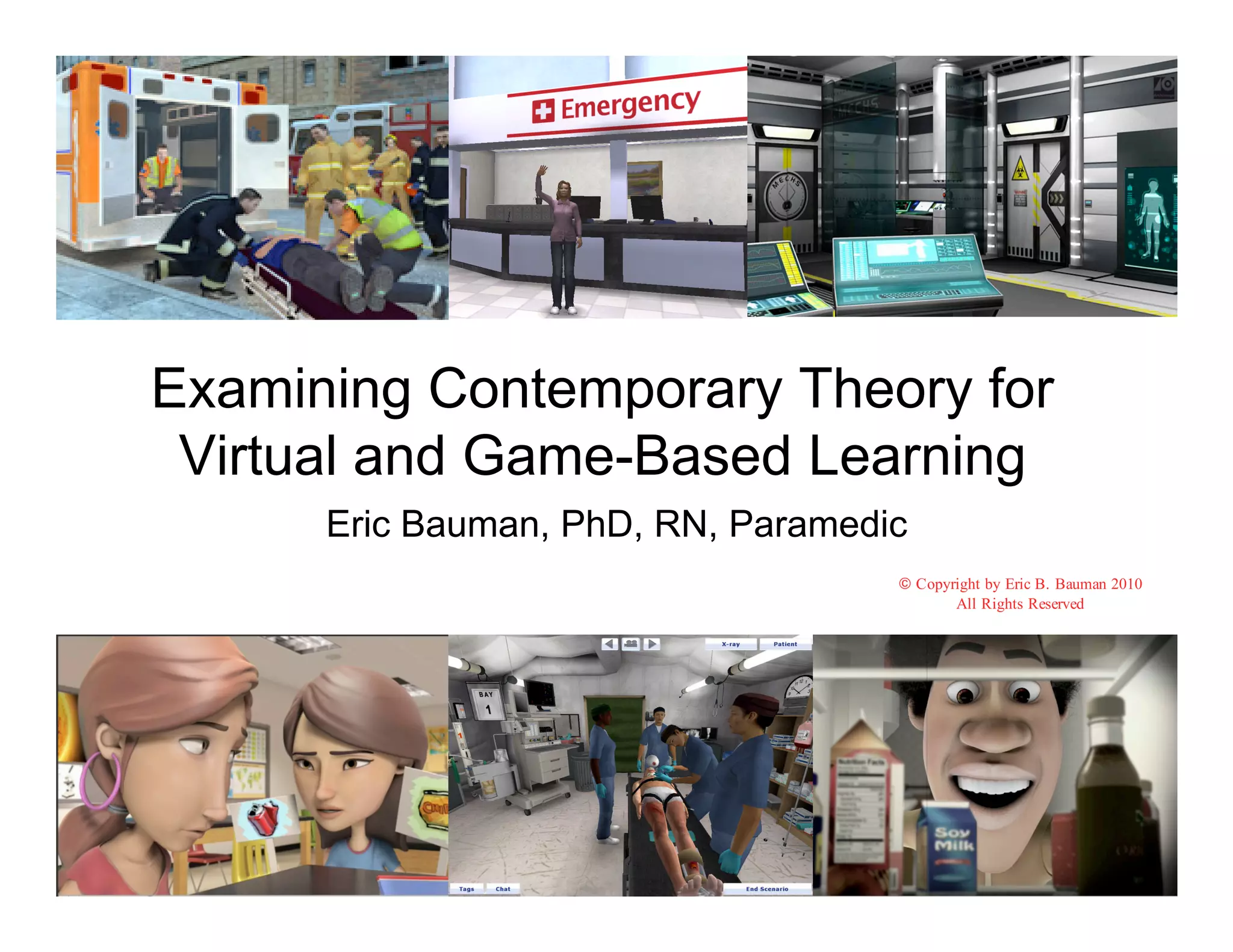
Examining Contemporary Theory for
 Virtual and Game-Based Learning
      Eric Bauman, PhD, RN, Paramedic
                                    © Copyright by Eric B. Bauman 2010
                                           All Rights Reserved
Author Information and COI Statement
              Eric Bauman, PhD, RN
                 Faculty Associate
   University of Wisconsin School of Medicine &
                   Public Health
           Department of Anesthesiology

    COI: Consultant -Vernon M emorial Healthcare and TM FD
                 Investments: Pfizer, SHSAX
What’s Wrong with Traditional Theory
          Nothing & Everything
• Traditional theory provides historical prospective and
  in some cases a starting point for contemporary
  theories.
• Traditional learning theories predate modern
  technology including virtual and game-based
  immersive environments.
• The learner can no longer be seen as an empty
  vessel waiting around for a fill-up of expertise
• Traditional learning theories often does not
  adequately address behavioral aspects of
  professional practice such as Culture & Diversity
Students are Students, Right?
      What worked for me is good enough for today’s students
•   Most of today’s students grew up in the age of the Internet - they
    embrace digital culture. They are likely to have a high degree of media
    literacy and adaptability

•   Students are well positioned to take advantage of virtual and game-
    based learning environments and opportunities

•   Digital media is no longer seen as a facet of culture limited to
    entertainment and communication.

•   The modern learner is accustomed to multi-media environments and is
    comfortable using these environments for academic, personal, and
    professional gain. Students today don’t expect good engaging
    technology - they DEMAND IT!

•   Institutions that do not embrace a sense of media literacy find it
    increasingly difficult to compete for today’s best and brightest students
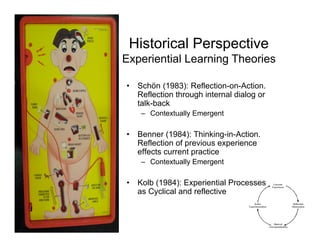
Historical Perspective
Experiential Learning Theories

•   Schön (1983): Reflection-on-Action.
    Reflection through internal dialog or
    talk-back
     – Contextually Emergent

•   Benner (1984): Thinking-in-Action.
    Reflection of previous experience
    effects current practice
     – Contextually Emergent

•   Kolb (1984): Experiential Processes
    as Cyclical and reflective
Contemporary Theories
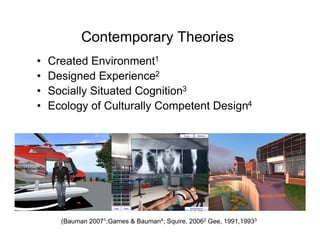
•   Created Environment1
•   Designed Experience2
•   Socially Situated Cognition3
•   Ecology of Culturally Competent Design4


      (Bauman 20071;Games & Bauman4; Squire, 20062 Gee, 1991,19933
Created Environment
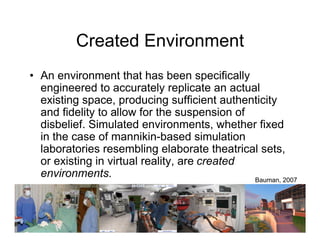
• An environment that has been specifically
  engineered to accurately replicate an actual
  existing space, producing sufficient authenticity
  and fidelity to allow for the suspension of
  disbelief. Simulated environments, whether fixed
  in the case of mannikin-based simulation
  laboratories resembling elaborate theatrical sets,
  or existing in virtual reality, are created
  environments.                               Bauman, 2007
Designed Experiences
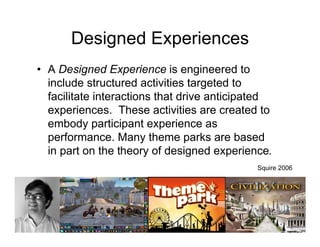
• A Designed Experience is engineered to
  include structured activities targeted to
  facilitate interactions that drive anticipated
  experiences. These activities are created to
  embody participant experience as
  performance. Many theme parks are based
  in part on the theory of designed experience.
                                             Squire 2006
Socially Situated Cognition
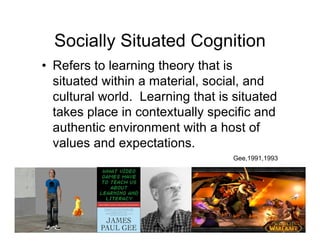
• Refers to learning theory that is
  situated within a material, social, and
  cultural world. Learning that is situated
  takes place in contextually specific and
  authentic environment with a host of
  values and expectations.
                                  Gee,1991,1993
Ecology of Culturally
        Competent Design
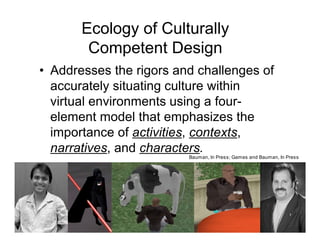
• Addresses the rigors and challenges of
  accurately situating culture within
  virtual environments using a four-
  element model that emphasizes the
  importance of activities, contexts,
  narratives, and characters.
                         Bauman, In Press; Games and Bauman, In Press
Activity
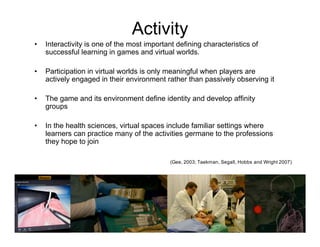
•   Interactivity is one of the most important defining characteristics of
    successful learning in games and virtual worlds.

•   Participation in virtual worlds is only meaningful when players are
    actively engaged in their environment rather than passively observing it

•   The game and its environment define identity and develop affinity
    groups

•   In the health sciences, virtual spaces include familiar settings where
    learners can practice many of the activities germane to the professions
    they hope to join

                                             (Gee, 2003; Taekman, Segall, Hobbs and Wright 2007)
Context
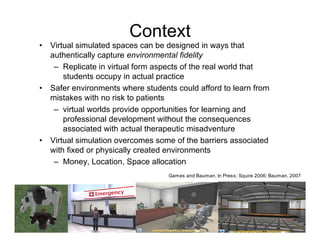
•   Virtual simulated spaces can be designed in ways that
    authentically capture environmental fidelity
     – Replicate in virtual form aspects of the real world that
        students occupy in actual practice
•   Safer environments where students could afford to learn from
    mistakes with no risk to patients
     – virtual worlds provide opportunities for learning and
        professional development without the consequences
        associated with actual therapeutic misadventure
•   Virtual simulation overcomes some of the barriers associated
    with fixed or physically created environments
     – Money, Location, Space allocation
                                    Games and Bauman, In Press; Squire 2006; Bauman, 2007
Narrative
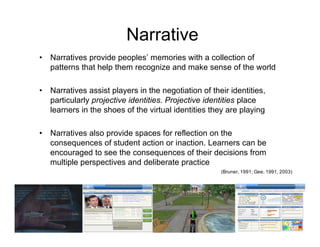
•   Narratives provide peoples’ memories with a collection of
    patterns that help them recognize and make sense of the world

•   Narratives assist players in the negotiation of their identities,
    particularly projective identities. Projective identities place
    learners in the shoes of the virtual identities they are playing

•   Narratives also provide spaces for reflection on the
    consequences of student action or inaction. Learners can be
    encouraged to see the consequences of their decisions from
    multiple perspectives and deliberate practice
                                                       (Bruner, 1991; Gee, 1991, 2003)
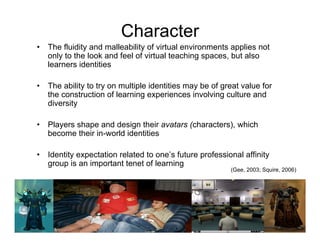
Character
•   The fluidity and malleability of virtual environments applies not
    only to the look and feel of virtual teaching spaces, but also
    learners identities

•   The ability to try on multiple identities may be of great value for
    the construction of learning experiences involving culture and
    diversity

•   Players shape and design their avatars (characters), which
    become their in-world identities

•   Identity expectation related to one’s future professional affinity
    group is an important tenet of learning
                                                          (Gee, 2003; Squire, 2006)
So why should we
                            turn to these new
                            fangled theories?
Cracked.com & capt_weasle


  Why turn to theories
  that stem from the
  modern videogame
  movement and the
    entertainment
       industry?
                                     Cracked.com & darrenjames140
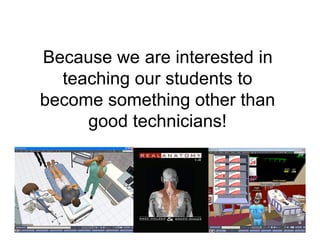
Because we are interested in
  teaching our students to
become something other than
     good technicians!
What we are really
                         interested in…
Cracked.com


      • Identity and Consequence
      • Acculturation and Indoctrination of a
        professional into practice
      • Cultural Competence
      • Learning as Behavioral Change
                                      Popkewitz, 2007
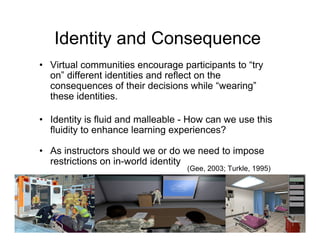
Identity and Consequence
• Virtual communities encourage participants to “try
  on” different identities and reflect on the
  consequences of their decisions while “wearing”
  these identities.

• Identity is fluid and malleable - How can we use this
  fluidity to enhance learning experiences?

• As instructors should we or do we need to impose
  restrictions on in-world identity
                                  (Gee, 2003; Turkle, 1995)
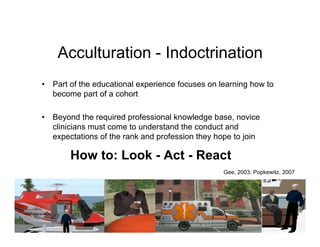
Acculturation - Indoctrination
•   Part of the educational experience focuses on learning how to
    become part of a cohort

•   Beyond the required professional knowledge base, novice
    clinicians must come to understand the conduct and
    expectations of the rank and profession they hope to join

        How to: Look - Act - React
                                                   Gee, 2003; Popkewitz, 2007
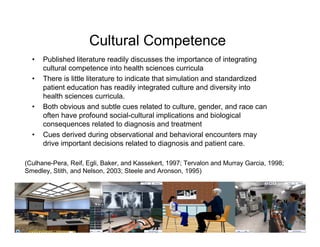
Cultural Competence
  •   Published literature readily discusses the importance of integrating
      cultural competence into health sciences curricula
  •   There is little literature to indicate that simulation and standardized
      patient education has readily integrated culture and diversity into
      health sciences curricula.
  •   Both obvious and subtle cues related to culture, gender, and race can
      often have profound social-cultural implications and biological
      consequences related to diagnosis and treatment
  •   Cues derived during observational and behavioral encounters may
      drive important decisions related to diagnosis and patient care.

(Culhane-Pera, Reif, Egli, Baker, and Kassekert, 1997; Tervalon and Murray Garcia, 1998;
Smedley, Stith, and Nelson, 2003; Steele and Aronson, 1995)
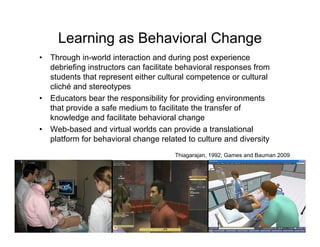
Learning as Behavioral Change
•   Through in-world interaction and during post experience
    debriefing instructors can facilitate behavioral responses from
    students that represent either cultural competence or cultural
    cliché and stereotypes
•   Educators bear the responsibility for providing environments
    that provide a safe medium to facilitate the transfer of
    knowledge and facilitate behavioral change
•   Web-based and virtual worlds can provide a translational
    platform for behavioral change related to culture and diversity
                                       Thiagarajan, 1992; Games and Bauman 2009
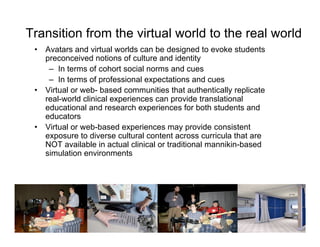
Transition from the virtual world to the real world
 •   Avatars and virtual worlds can be designed to evoke students
     preconceived notions of culture and identity
      – In terms of cohort social norms and cues
      – In terms of professional expectations and cues
 •   Virtual or web- based communities that authentically replicate
     real-world clinical experiences can provide translational
     educational and research experiences for both students and
     educators
 •   Virtual or web-based experiences may provide consistent
     exposure to diverse cultural content across curricula that are
     NOT available in actual clinical or traditional mannikin-based
     simulation environments
References
Bauman, E. (2007). High fidelity simulation in healthcare. Ph.D. dissertation, The University of Wisconsin-
     Madison, United States. Dissertations & Thesis @ CIC Institutions database. (Publication no. AAT
     3294196)
Bauman, E, (In Press). Virtual reality and game-based clinical education. In Gaberson, K.B., & Oermann, M.H.
     (Eds) Clinical teaching strategies in nursing education (3rd ed).New York, Springer Publishing Company.
Benner, P. (1984). From novice to expert: Excellence and power in clinical nursing practice. Menlo Park, CA:
     Addison-Wesley.
Bruner, J. (1991). The narrative construction of reality. Critical Inquiry 18 (Autumn), 1-20.
Culhane-Pera, K.A., Reif, C., Egli, E., Baker, N.J., and Kassekert (1997). A curriculum for multicultural education
     in family medicine. Family Medicine, 29(10), 719-723.
Games, I. and Bauman, E. (In Press). Virtual worlds: An environment for cultural sensitivity education in the
     health sciences. International Journal of Web Based Communities.
Gee, J. P. (1991). Memory and myth: A perspective on narrative. In A. McCabe & C. Peterson (Eds.), Developing
     narrative structure (pp. 1 - 26). Mahwah, NJ: Erlbaum.
Gee, J.P. (2003) What Videogames Have to Teach Us Ab out Learning and Literacy. New York, NY: Palgrave-
     McMillan.
Popkewitz, T. (2007). Cosmopolitianism and the age of school reform: science, education and making a society
     by making the child. Routledge.
Smedley, B. D, Stith, A. Y, and Nelson, A. R. (Eds.). (2003) Unequal treatment: Confronting racial and ethnic
     disparities in health care. Washington, D.C.: National Academies Press.
Steele, C.M. & Aronson, J. (1995) Stereotype Threat and the Intellectual Test Performance of African Americans.
     Journal of Personality and Social Psychology. 69(5), 797-811.
Squire, K. (2006). From content to context: Videogames as designed experience. Educational Researcher.
     35(8), 19-29.
Taekman J.M., Segall N., Hobbs G., and Wright, M.C. (2007). 3DiTeams: Healthcare team training in a virtual
     environment. Anesthesiology. 2007: 107: A2145.
Tervalon, M. and Murray-Garcia, J. (1998). Cultural humility versus cultural competence: A critical distinction in
     defining physician training outcomes in multicultural education. Journal of Health Care for the Poor and
     Underserved, 9(2), 117-125.
Turkle, S. (1995) Life on the screen. Identity in the age of the Internet. New York: Touchstone.
Special Thanks
• Eric Graves: American Research Institute
• Gerald Stapleton: University of Illinois at Chicago
  College of Medicine
• Jerry Heneghan: Virtual Heroes
• Melanie Lazarus: ARCHIMAGE
• Jeff Taekman: Duke University - Human Simulation
  and Patient Safety Center
• Bob Waddington: SimQuest
• Allan Barclay: University of Wisconsin - Madison,
  Ebling Library
Contact Information
Eric Bauman, PhD, RN
B6/319 CSC
Department of Anesthesiology
600 Highland Avenue
Madison, WI 53792-3272

Email: ebauman@wisc.edu
Office: 608-263-5911
Linkedin: http://www.linkedin.com/in/ericbbauman

Contemporary Theory Bauman Imsh 2010

  • 1.
    Examining Contemporary Theoryfor Virtual and Game-Based Learning Eric Bauman, PhD, RN, Paramedic © Copyright by Eric B. Bauman 2010 All Rights Reserved
  • 2.
    Author Information andCOI Statement Eric Bauman, PhD, RN Faculty Associate University of Wisconsin School of Medicine & Public Health Department of Anesthesiology COI: Consultant -Vernon M emorial Healthcare and TM FD Investments: Pfizer, SHSAX
  • 3.
    What’s Wrong withTraditional Theory Nothing & Everything • Traditional theory provides historical prospective and in some cases a starting point for contemporary theories. • Traditional learning theories predate modern technology including virtual and game-based immersive environments. • The learner can no longer be seen as an empty vessel waiting around for a fill-up of expertise • Traditional learning theories often does not adequately address behavioral aspects of professional practice such as Culture & Diversity
  • 4.
    Students are Students,Right? What worked for me is good enough for today’s students • Most of today’s students grew up in the age of the Internet - they embrace digital culture. They are likely to have a high degree of media literacy and adaptability • Students are well positioned to take advantage of virtual and game- based learning environments and opportunities • Digital media is no longer seen as a facet of culture limited to entertainment and communication. • The modern learner is accustomed to multi-media environments and is comfortable using these environments for academic, personal, and professional gain. Students today don’t expect good engaging technology - they DEMAND IT! • Institutions that do not embrace a sense of media literacy find it increasingly difficult to compete for today’s best and brightest students
  • 5.
    Historical Perspective Experiential LearningTheories • Schön (1983): Reflection-on-Action. Reflection through internal dialog or talk-back – Contextually Emergent • Benner (1984): Thinking-in-Action. Reflection of previous experience effects current practice – Contextually Emergent • Kolb (1984): Experiential Processes as Cyclical and reflective
  • 6.
    Contemporary Theories • Created Environment1 • Designed Experience2 • Socially Situated Cognition3 • Ecology of Culturally Competent Design4 (Bauman 20071;Games & Bauman4; Squire, 20062 Gee, 1991,19933
  • 7.
    Created Environment • Anenvironment that has been specifically engineered to accurately replicate an actual existing space, producing sufficient authenticity and fidelity to allow for the suspension of disbelief. Simulated environments, whether fixed in the case of mannikin-based simulation laboratories resembling elaborate theatrical sets, or existing in virtual reality, are created environments. Bauman, 2007
  • 8.
    Designed Experiences • ADesigned Experience is engineered to include structured activities targeted to facilitate interactions that drive anticipated experiences. These activities are created to embody participant experience as performance. Many theme parks are based in part on the theory of designed experience. Squire 2006
  • 9.
    Socially Situated Cognition •Refers to learning theory that is situated within a material, social, and cultural world. Learning that is situated takes place in contextually specific and authentic environment with a host of values and expectations. Gee,1991,1993
  • 10.
    Ecology of Culturally Competent Design • Addresses the rigors and challenges of accurately situating culture within virtual environments using a four- element model that emphasizes the importance of activities, contexts, narratives, and characters. Bauman, In Press; Games and Bauman, In Press
  • 11.
    Activity • Interactivity is one of the most important defining characteristics of successful learning in games and virtual worlds. • Participation in virtual worlds is only meaningful when players are actively engaged in their environment rather than passively observing it • The game and its environment define identity and develop affinity groups • In the health sciences, virtual spaces include familiar settings where learners can practice many of the activities germane to the professions they hope to join (Gee, 2003; Taekman, Segall, Hobbs and Wright 2007)
  • 12.
    Context • Virtual simulated spaces can be designed in ways that authentically capture environmental fidelity – Replicate in virtual form aspects of the real world that students occupy in actual practice • Safer environments where students could afford to learn from mistakes with no risk to patients – virtual worlds provide opportunities for learning and professional development without the consequences associated with actual therapeutic misadventure • Virtual simulation overcomes some of the barriers associated with fixed or physically created environments – Money, Location, Space allocation Games and Bauman, In Press; Squire 2006; Bauman, 2007
  • 13.
    Narrative • Narratives provide peoples’ memories with a collection of patterns that help them recognize and make sense of the world • Narratives assist players in the negotiation of their identities, particularly projective identities. Projective identities place learners in the shoes of the virtual identities they are playing • Narratives also provide spaces for reflection on the consequences of student action or inaction. Learners can be encouraged to see the consequences of their decisions from multiple perspectives and deliberate practice (Bruner, 1991; Gee, 1991, 2003)
  • 14.
    Character • The fluidity and malleability of virtual environments applies not only to the look and feel of virtual teaching spaces, but also learners identities • The ability to try on multiple identities may be of great value for the construction of learning experiences involving culture and diversity • Players shape and design their avatars (characters), which become their in-world identities • Identity expectation related to one’s future professional affinity group is an important tenet of learning (Gee, 2003; Squire, 2006)
  • 15.
    So why shouldwe turn to these new fangled theories? Cracked.com & capt_weasle Why turn to theories that stem from the modern videogame movement and the entertainment industry? Cracked.com & darrenjames140
  • 16.
    Because we areinterested in teaching our students to become something other than good technicians!
  • 17.
    What we arereally interested in… Cracked.com • Identity and Consequence • Acculturation and Indoctrination of a professional into practice • Cultural Competence • Learning as Behavioral Change Popkewitz, 2007
  • 18.
    Identity and Consequence •Virtual communities encourage participants to “try on” different identities and reflect on the consequences of their decisions while “wearing” these identities. • Identity is fluid and malleable - How can we use this fluidity to enhance learning experiences? • As instructors should we or do we need to impose restrictions on in-world identity (Gee, 2003; Turkle, 1995)
  • 19.
    Acculturation - Indoctrination • Part of the educational experience focuses on learning how to become part of a cohort • Beyond the required professional knowledge base, novice clinicians must come to understand the conduct and expectations of the rank and profession they hope to join How to: Look - Act - React Gee, 2003; Popkewitz, 2007
  • 20.
    Cultural Competence • Published literature readily discusses the importance of integrating cultural competence into health sciences curricula • There is little literature to indicate that simulation and standardized patient education has readily integrated culture and diversity into health sciences curricula. • Both obvious and subtle cues related to culture, gender, and race can often have profound social-cultural implications and biological consequences related to diagnosis and treatment • Cues derived during observational and behavioral encounters may drive important decisions related to diagnosis and patient care. (Culhane-Pera, Reif, Egli, Baker, and Kassekert, 1997; Tervalon and Murray Garcia, 1998; Smedley, Stith, and Nelson, 2003; Steele and Aronson, 1995)
  • 21.
    Learning as BehavioralChange • Through in-world interaction and during post experience debriefing instructors can facilitate behavioral responses from students that represent either cultural competence or cultural cliché and stereotypes • Educators bear the responsibility for providing environments that provide a safe medium to facilitate the transfer of knowledge and facilitate behavioral change • Web-based and virtual worlds can provide a translational platform for behavioral change related to culture and diversity Thiagarajan, 1992; Games and Bauman 2009
  • 22.
    Transition from thevirtual world to the real world • Avatars and virtual worlds can be designed to evoke students preconceived notions of culture and identity – In terms of cohort social norms and cues – In terms of professional expectations and cues • Virtual or web- based communities that authentically replicate real-world clinical experiences can provide translational educational and research experiences for both students and educators • Virtual or web-based experiences may provide consistent exposure to diverse cultural content across curricula that are NOT available in actual clinical or traditional mannikin-based simulation environments
  • 23.
    References Bauman, E. (2007).High fidelity simulation in healthcare. Ph.D. dissertation, The University of Wisconsin- Madison, United States. Dissertations & Thesis @ CIC Institutions database. (Publication no. AAT 3294196) Bauman, E, (In Press). Virtual reality and game-based clinical education. In Gaberson, K.B., & Oermann, M.H. (Eds) Clinical teaching strategies in nursing education (3rd ed).New York, Springer Publishing Company. Benner, P. (1984). From novice to expert: Excellence and power in clinical nursing practice. Menlo Park, CA: Addison-Wesley. Bruner, J. (1991). The narrative construction of reality. Critical Inquiry 18 (Autumn), 1-20. Culhane-Pera, K.A., Reif, C., Egli, E., Baker, N.J., and Kassekert (1997). A curriculum for multicultural education in family medicine. Family Medicine, 29(10), 719-723. Games, I. and Bauman, E. (In Press). Virtual worlds: An environment for cultural sensitivity education in the health sciences. International Journal of Web Based Communities. Gee, J. P. (1991). Memory and myth: A perspective on narrative. In A. McCabe & C. Peterson (Eds.), Developing narrative structure (pp. 1 - 26). Mahwah, NJ: Erlbaum. Gee, J.P. (2003) What Videogames Have to Teach Us Ab out Learning and Literacy. New York, NY: Palgrave- McMillan. Popkewitz, T. (2007). Cosmopolitianism and the age of school reform: science, education and making a society by making the child. Routledge. Smedley, B. D, Stith, A. Y, and Nelson, A. R. (Eds.). (2003) Unequal treatment: Confronting racial and ethnic disparities in health care. Washington, D.C.: National Academies Press. Steele, C.M. & Aronson, J. (1995) Stereotype Threat and the Intellectual Test Performance of African Americans. Journal of Personality and Social Psychology. 69(5), 797-811. Squire, K. (2006). From content to context: Videogames as designed experience. Educational Researcher. 35(8), 19-29. Taekman J.M., Segall N., Hobbs G., and Wright, M.C. (2007). 3DiTeams: Healthcare team training in a virtual environment. Anesthesiology. 2007: 107: A2145. Tervalon, M. and Murray-Garcia, J. (1998). Cultural humility versus cultural competence: A critical distinction in defining physician training outcomes in multicultural education. Journal of Health Care for the Poor and Underserved, 9(2), 117-125. Turkle, S. (1995) Life on the screen. Identity in the age of the Internet. New York: Touchstone.
  • 24.
    Special Thanks • EricGraves: American Research Institute • Gerald Stapleton: University of Illinois at Chicago College of Medicine • Jerry Heneghan: Virtual Heroes • Melanie Lazarus: ARCHIMAGE • Jeff Taekman: Duke University - Human Simulation and Patient Safety Center • Bob Waddington: SimQuest • Allan Barclay: University of Wisconsin - Madison, Ebling Library
  • 25.
    Contact Information Eric Bauman,PhD, RN B6/319 CSC Department of Anesthesiology 600 Highland Avenue Madison, WI 53792-3272 Email: ebauman@wisc.edu Office: 608-263-5911 Linkedin: http://www.linkedin.com/in/ericbbauman