SAMPLING TECHNIQUES
DR.BHARAT PAUL
CONTENTS
 Introduction
 Need for sampling
 Sampling Process
 Essentials of Sampling
 Methods of Sampling
 Non Probability Sampling
 Probability Sampling
 Errors in Sampling
 References
INTRODUCTION
 Population/Universe: in statistics denotes the
aggregate from which sample (items) is to be taken.
 A population can be defined as including all people
or items with the characteristic one wishes to
understand.
 Because there is very rarely enough time or money
to gather information from everyone or everything
in a population, the goal becomes finding a
representative sample (or subset) of that population.
INTRODUCTION
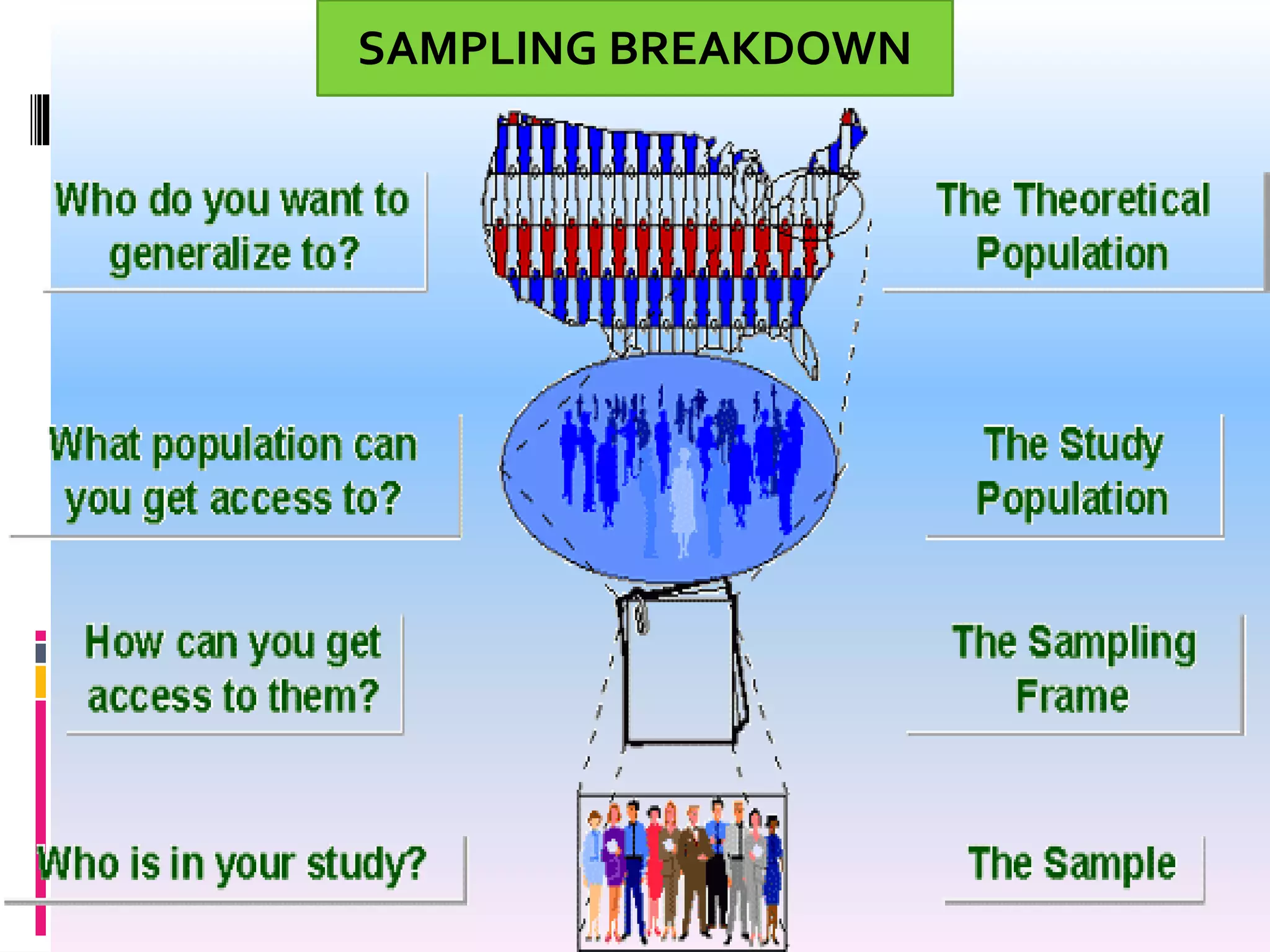
 Sampling frame is the list from which the
potential respondents are drawn .
 A sample is “a smaller (but hopefully
representative) collection of units from a
population used to determine truths about that
population” (Field, 2005)
SAMPLING BREAKDOWN
SAMPLING
 Sampling: the process of learning about
population on the basis of sample drawn from it.
 Three elements in process of sampling:
 Selecting the sample
 Collecting the information
 Making inference about population
 Statistics: values obtained from study of a
sample.
 Parameters: such values from study of
population.
NEED FOR SAMPLING
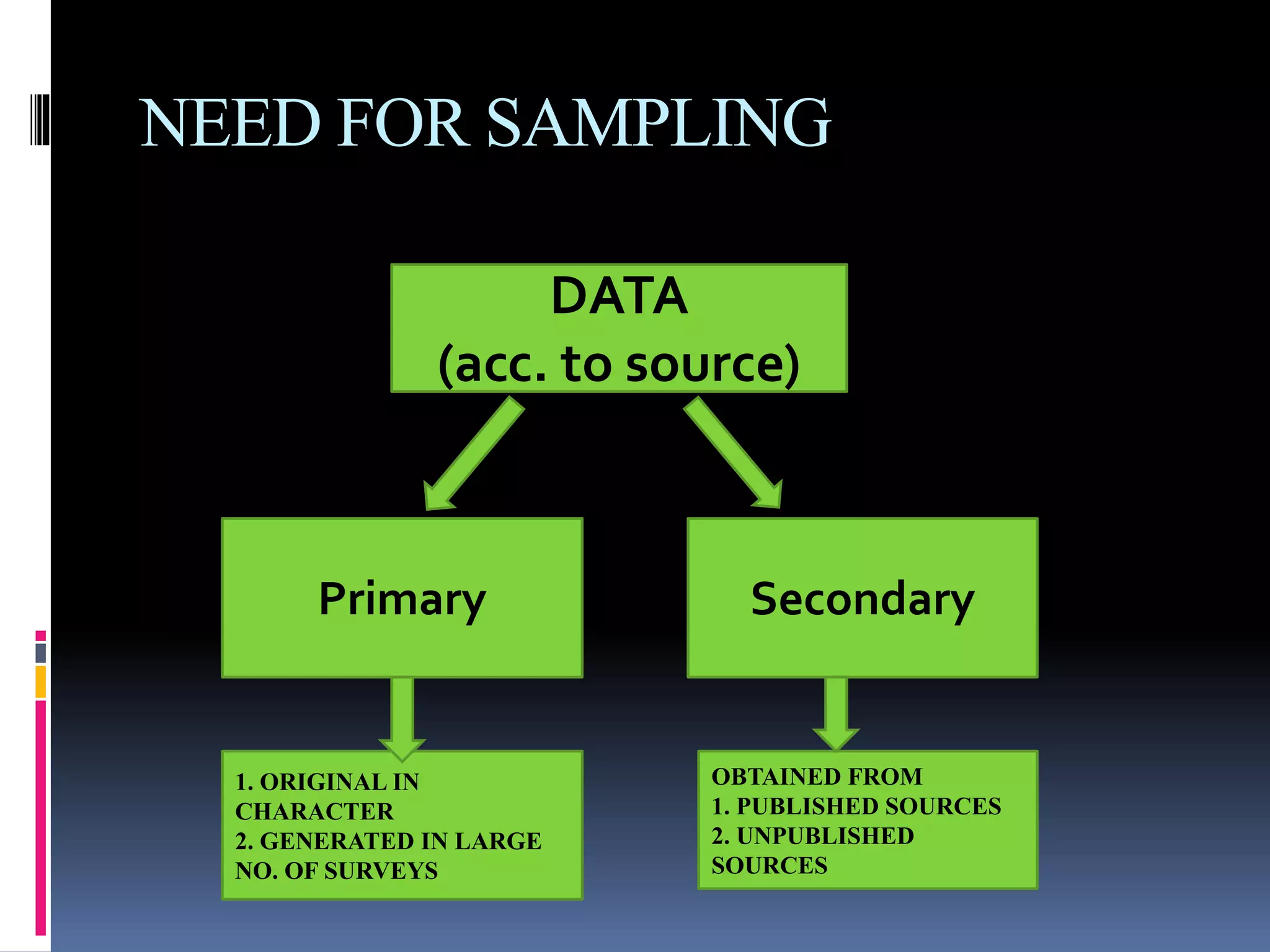
DATA
(acc. to source)
Primary Secondary
1. ORIGINAL IN
CHARACTER
2. GENERATED IN LARGE
NO. OF SURVEYS
OBTAINED FROM
1. PUBLISHED SOURCES
2. UNPUBLISHED
SOURCES
NEED FOR SAMPLING
 When secondary data are not available for the
problem under study , primary data is
collected.
 Two methods –
 Census method or complete enumeration method
 Sample method
CENSUS (Complete Enumeration
Survey)
 Merits
 Data obtained from each and every unit of
population.
 Results: more representative, accurate, reliable.
 Basis of various surveys.
 Demerits
 More effort ,money , time.
 Big problem in underdeveloped countries.
ADVANTAGES OF SAMPLING
 Less resources (time, money)
 Less workload.
 Gives results with known accuracy that can be
calculated mathematically.
THEORETICAL BASIS OF
SAMPLING
 On the basis of sample study we can predict
and generalize the behavior of mass
phenomena.
 There is no statistical population whose
elements would vary from each other without
limit.
THEORETICAL BASIS OF
SAMPLING
 Law of Statistical Regularity-
 Sample is taken at random from a population, it is
likely to possess same characteristics as that of
population.
 Law of inertia of large numbers-
 Larger the size of sample, more accurate the results
are likely to be.
SAMPLING PROCESS
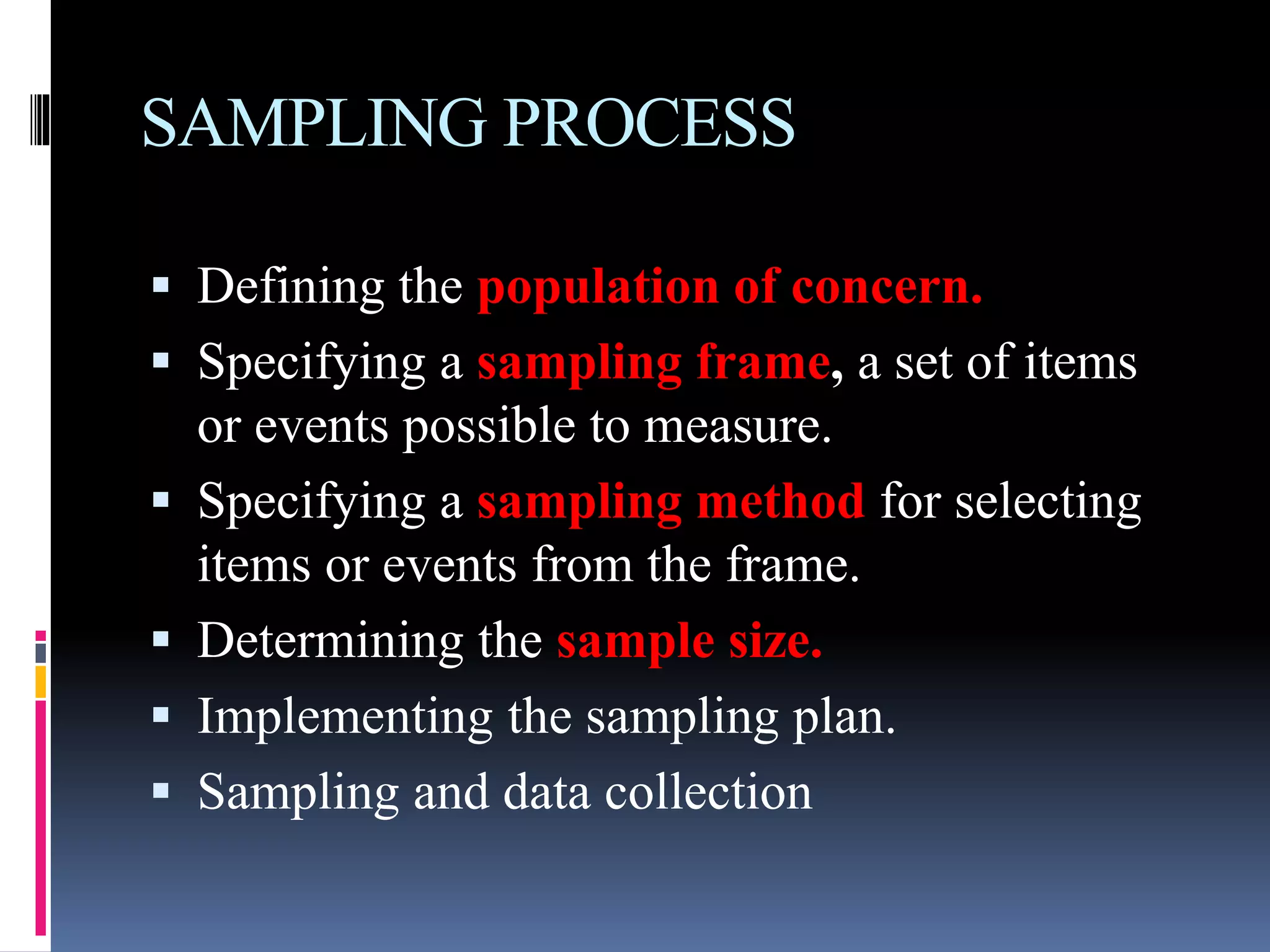
 Defining the population of concern.
 Specifying a sampling frame, a set of items
or events possible to measure.
 Specifying a sampling method for selecting
items or events from the frame.
 Determining the sample size.
 Implementing the sampling plan.
 Sampling and data collection
ESSENTIALS OF SAMPLING
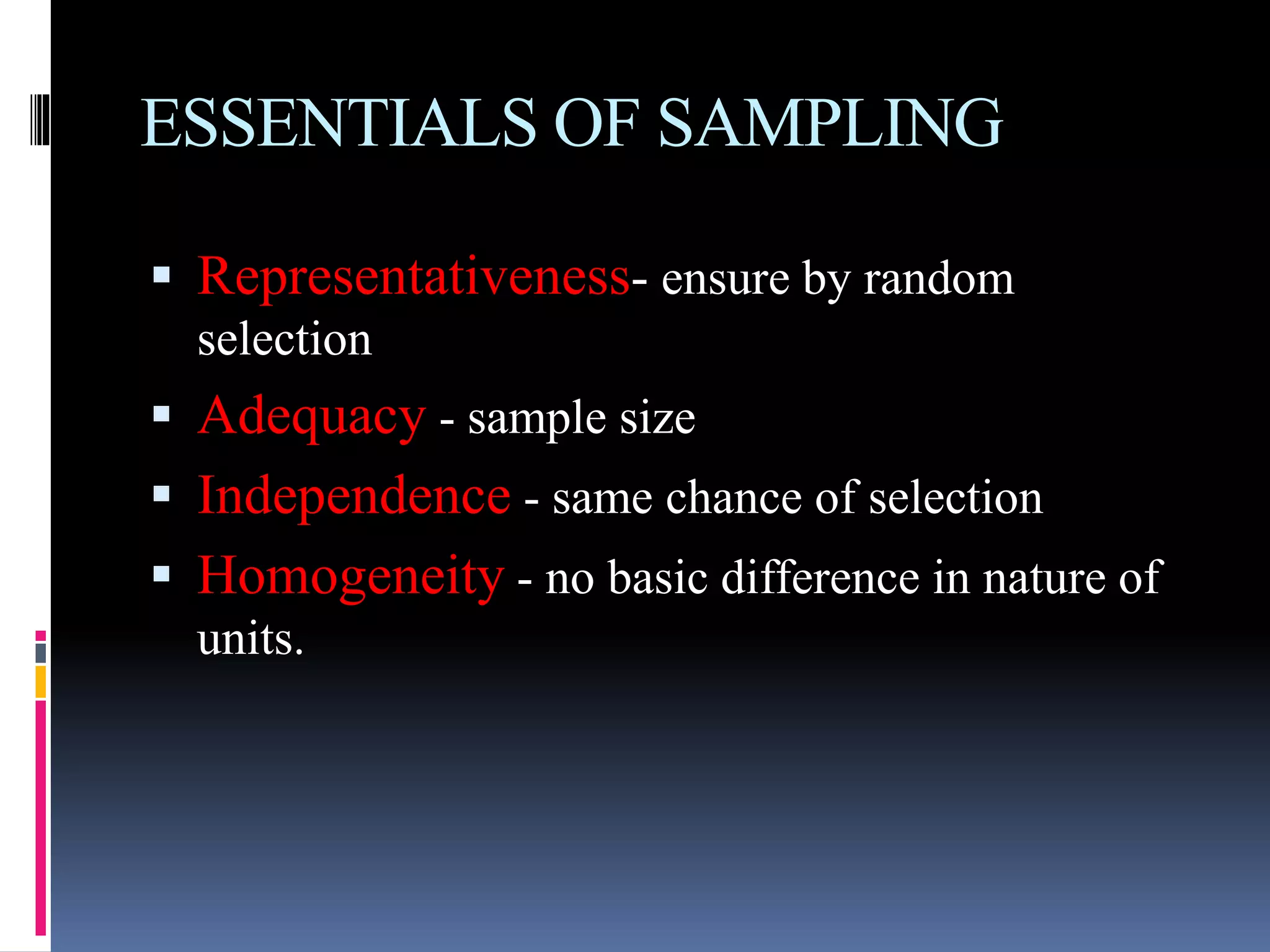
 Representativeness- ensure by random
selection
 Adequacy - sample size
 Independence - same chance of selection
 Homogeneity - no basic difference in nature of
units.
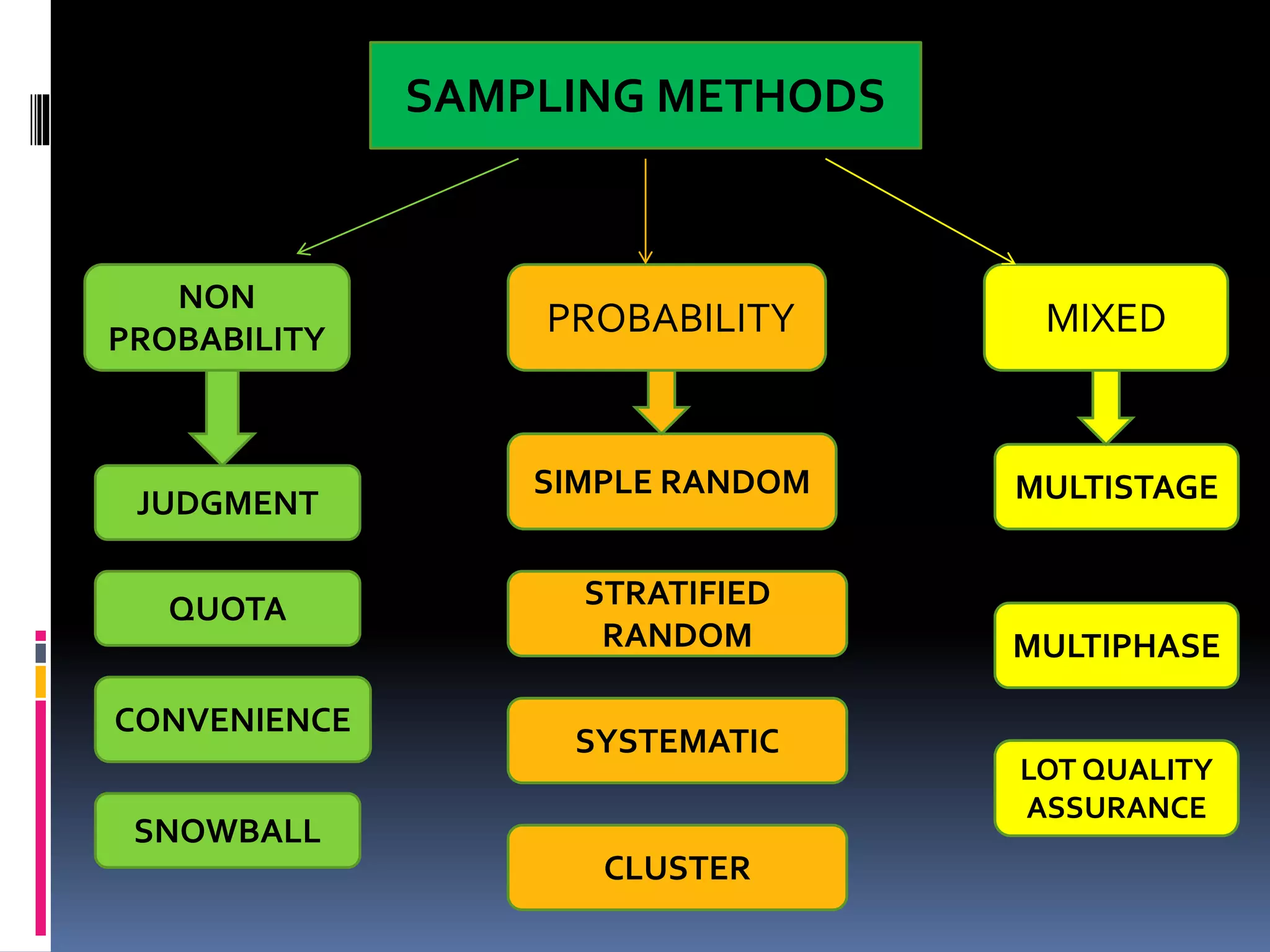
SAMPLING METHODS
NON
PROBABILITY
PROBABILITY MIXED
JUDGMENT
QUOTA
CONVENIENCE
SNOWBALL
SIMPLE RANDOM
STRATIFIED
RANDOM
SYSTEMATIC
CLUSTER
MULTISTAGE
MULTIPHASE
LOT QUALITY
ASSURANCE
NON PROBABILITY
SAMPLING
JUDGMENT SAMPLING
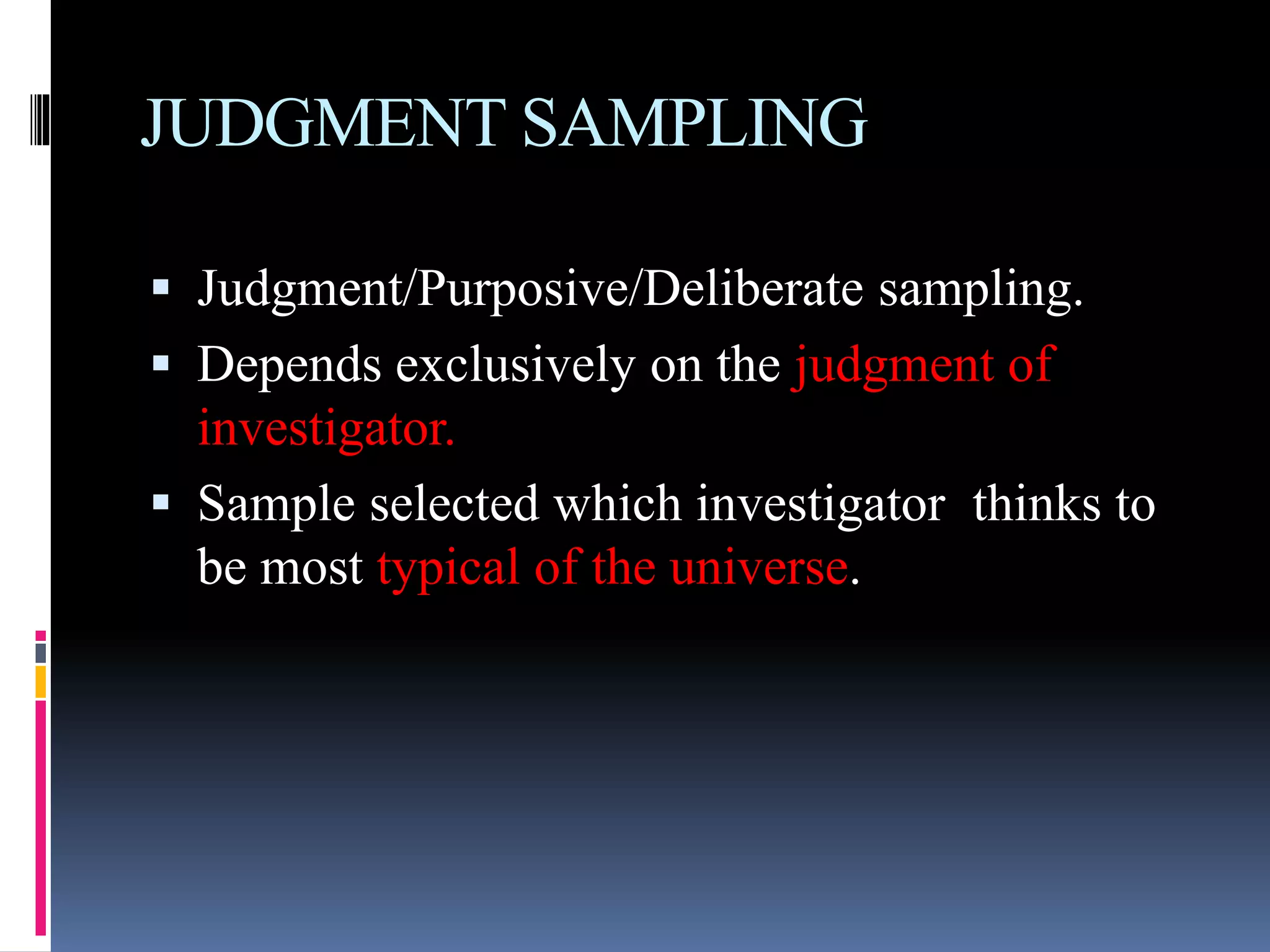
 Judgment/Purposive/Deliberate sampling.
 Depends exclusively on the judgment of
investigator.
 Sample selected which investigator thinks to
be most typical of the universe.
JUDGMENT SAMPLING
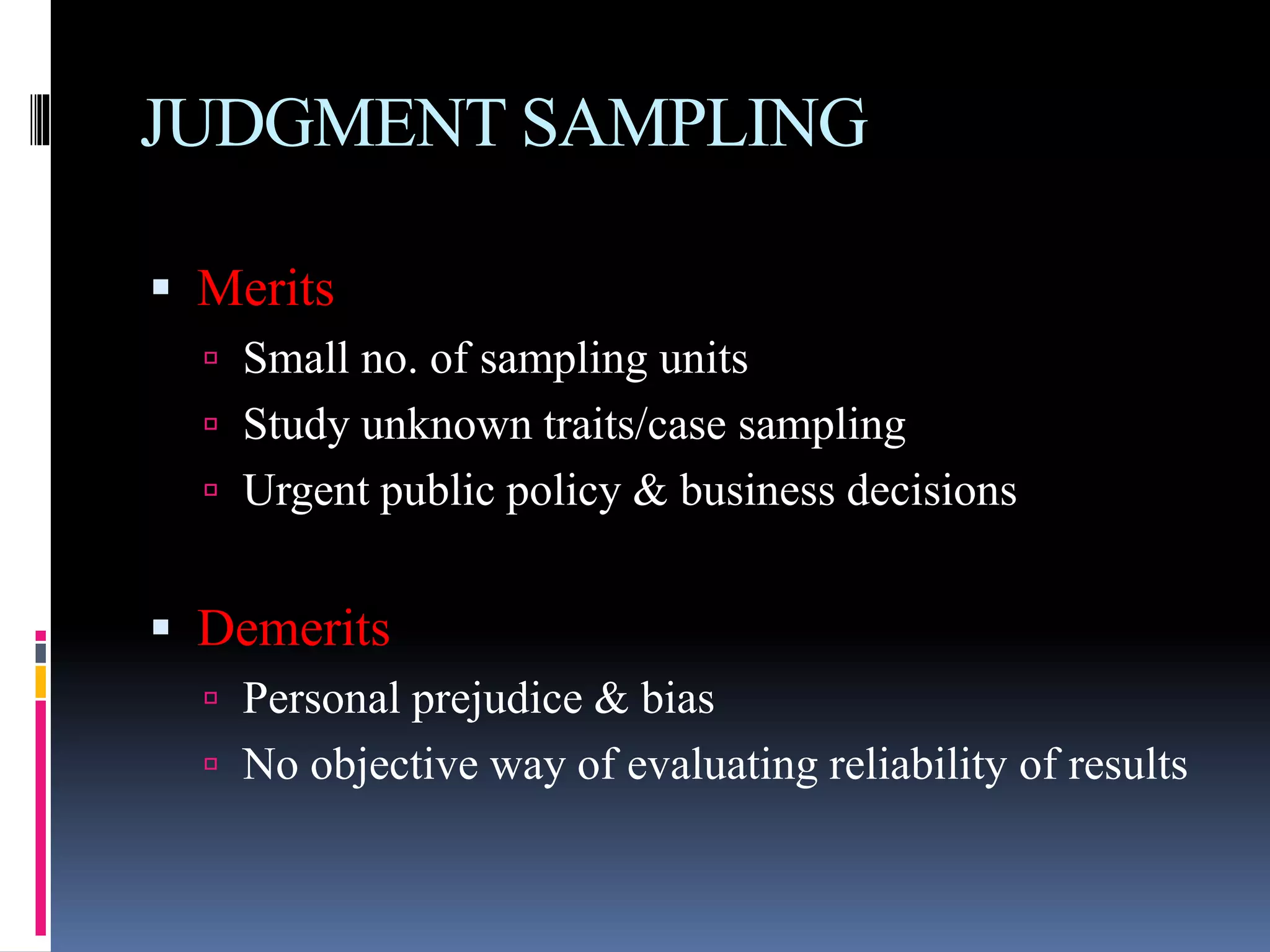
 Merits
 Small no. of sampling units
 Study unknown traits/case sampling
 Urgent public policy & business decisions
 Demerits
 Personal prejudice & bias
 No objective way of evaluating reliability of results
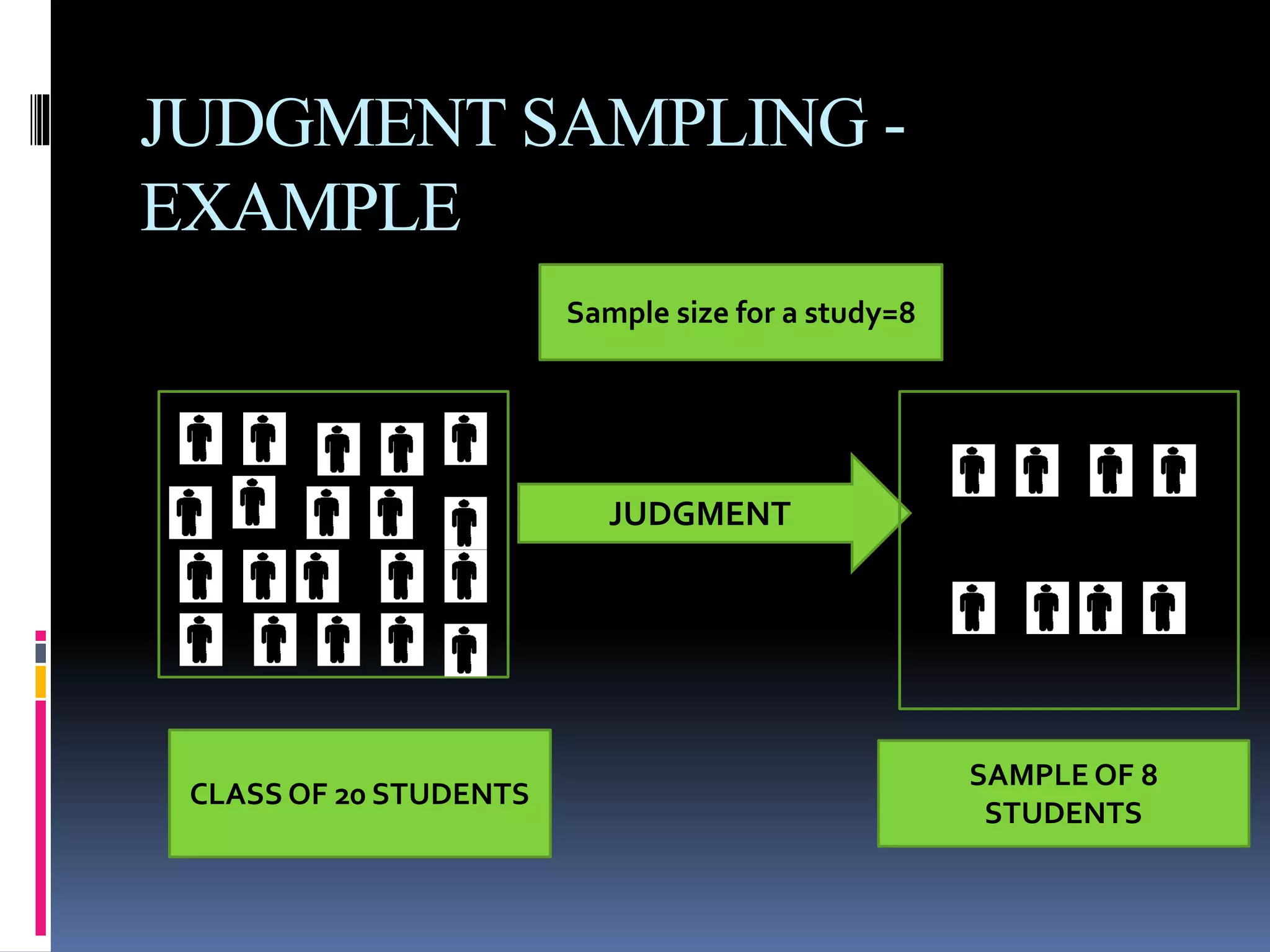
JUDGMENT SAMPLING -
EXAMPLE
CLASS OF 20 STUDENTS
Sample size for a study=8
JUDGMENT
SAMPLE OF 8
STUDENTS
CONVENIENCE SAMPLING
 Convenient sample units selected.
 Selected neither by probability nor by
judgment.
 Merit – useful in pilot studies.
 Demerit – results usually biased and
unsatisfactory.
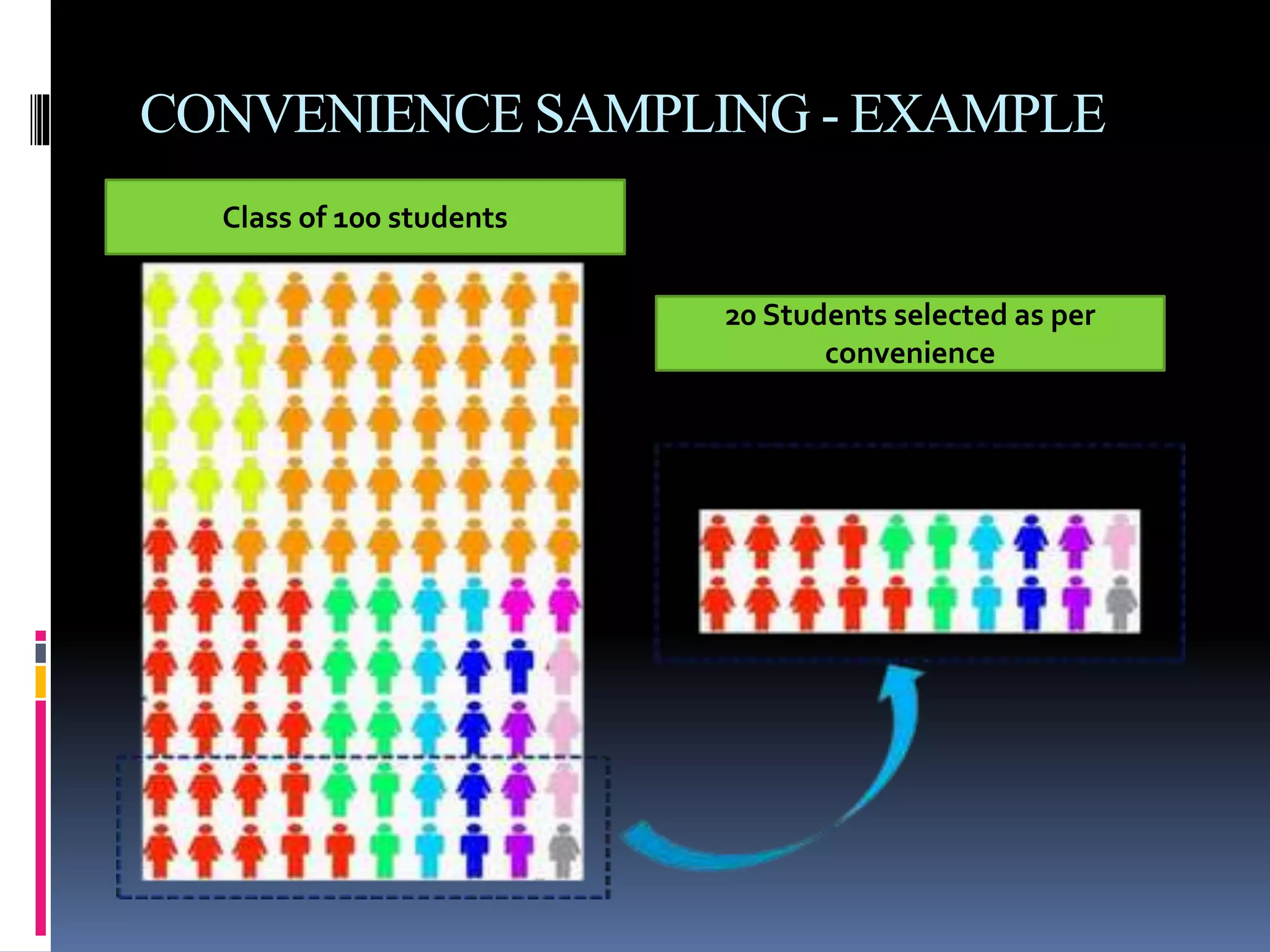
CONVENIENCE SAMPLING - EXAMPLE
Class of 100 students
20 Students selected as per
convenience
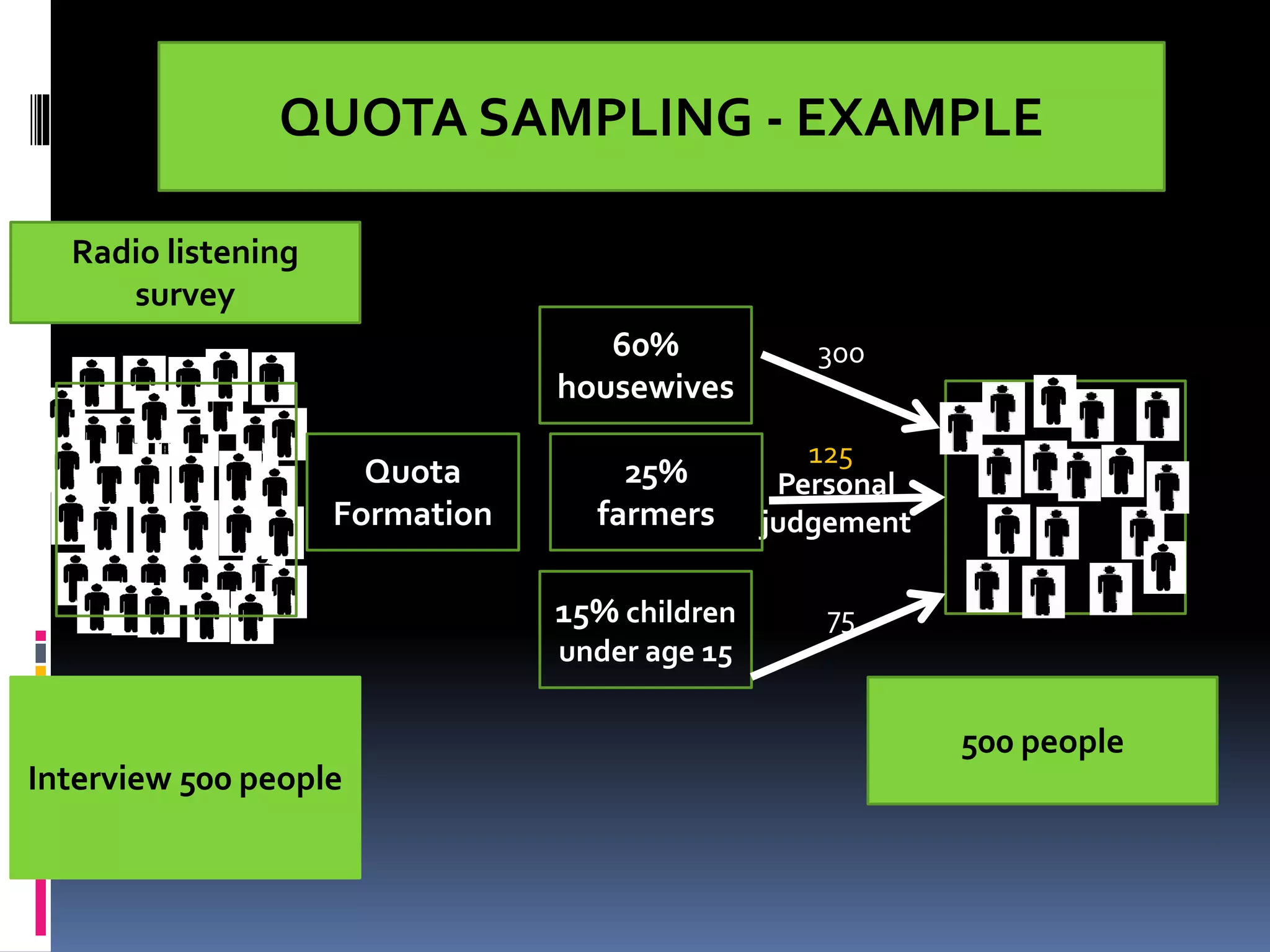
QUOTASAMPLING
 Most commonly used in non probability
sampling.
 Quotas set up according to some specified
characteristic.
 Within the quota , selection depends on
personal judgment.
 Merit- Used in public opinion studies
 Demerit – personal prejudice and bias
Quota
Formation
Interview 500 people
Personal
judgement
Radio listening
survey
60%
housewives
25%
farmers
15% children
under age 15
300
125
75
500 people
QUOTA SAMPLING - EXAMPLE
SNOWBALL SAMPLING
 A special non probability method used when
the desired sample characteristic is rare.
 It may be extremely difficult or cost
prohibitive to locate respondents in these
situations.
 Snowball sampling relies on referrals from
initial subjects to generate additional subjects.
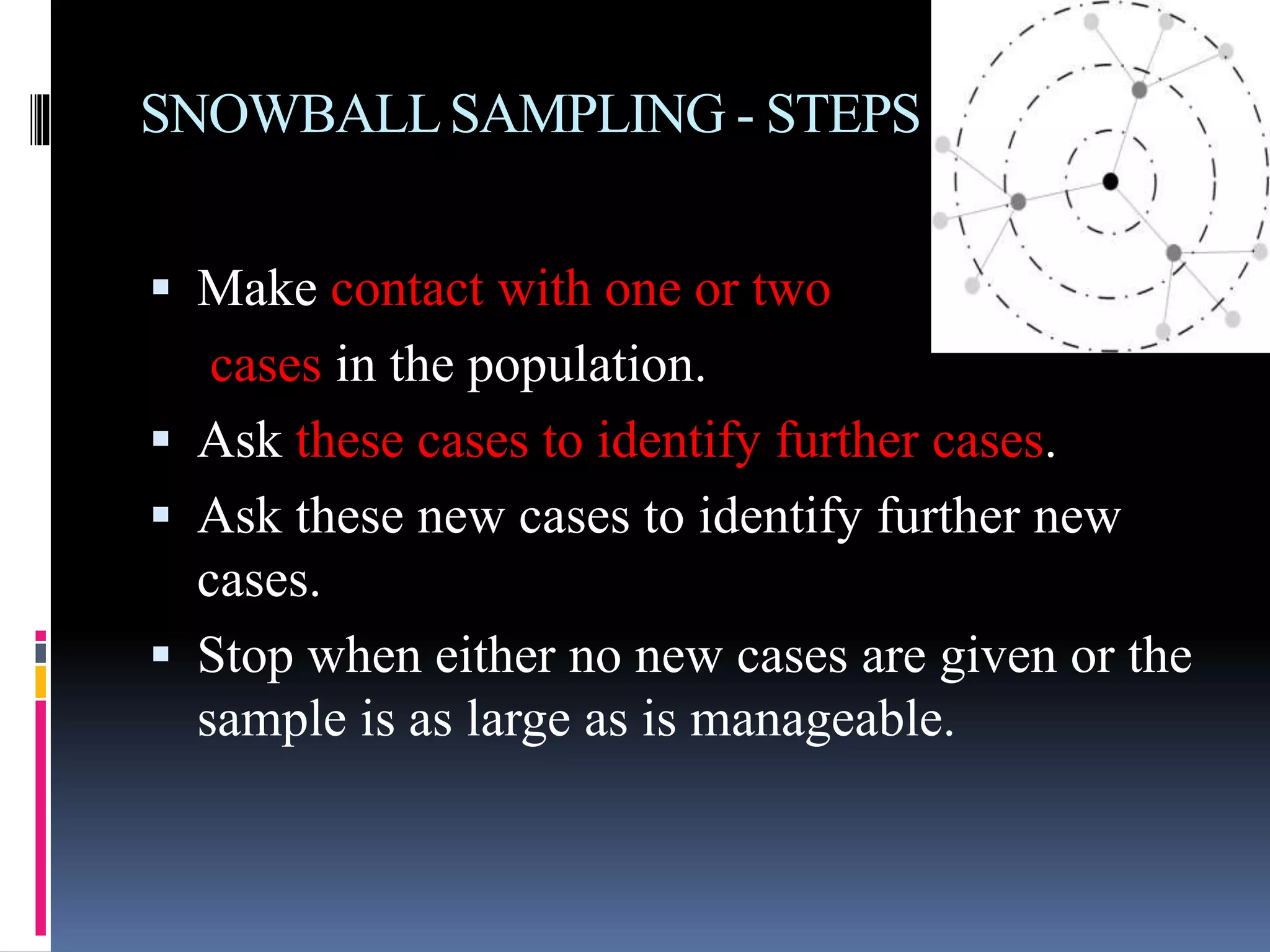
SNOWBALLSAMPLING - STEPS
 Make contact with one or two
cases in the population.
 Ask these cases to identify further cases.
 Ask these new cases to identify further new
cases.
 Stop when either no new cases are given or the
sample is as large as is manageable.
SNOWBALL SAMPLING
 Merit
 access to difficult to reach populations (other
methods may not yield any results).
 Demerit
 not representative of the population and will result
in a biased sample as it is self-selecting.
PROBABILITY SAMPLING
SIMPLE RANDOM SAMPLING
 Each unit has an equal opportunity of being
selected.
 Chance determines which items shall be
included.
SIMPLE RANDOM SAMPLING
 The sample is a simple random sample if any
of the following is true (Chou) –
 All items selected independently.
 At each selection , all remaining items have same
chance of being selected.
 All the possible samples of a given size are equally
likely to be selected.
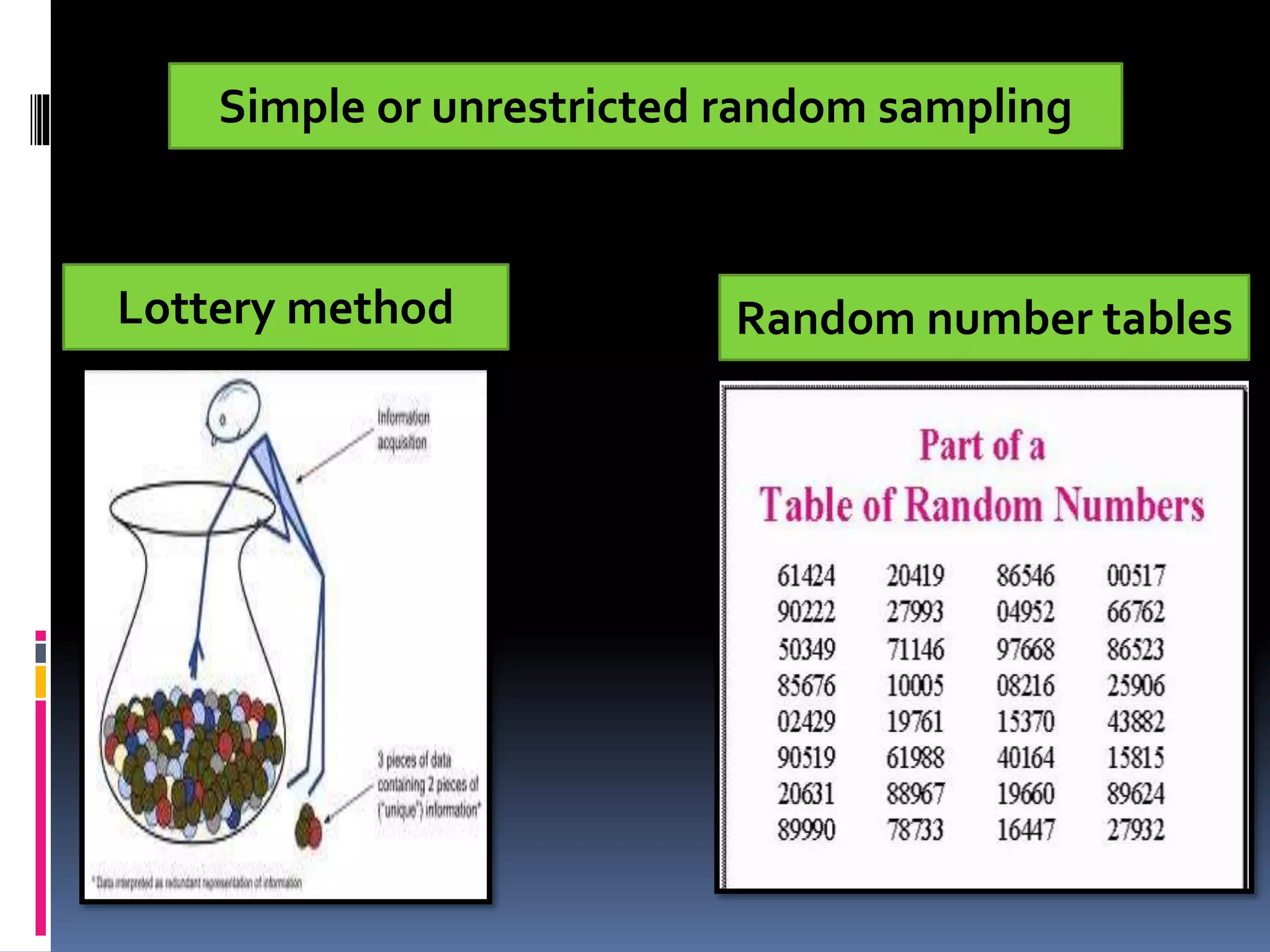
Simple or unrestricted random sampling
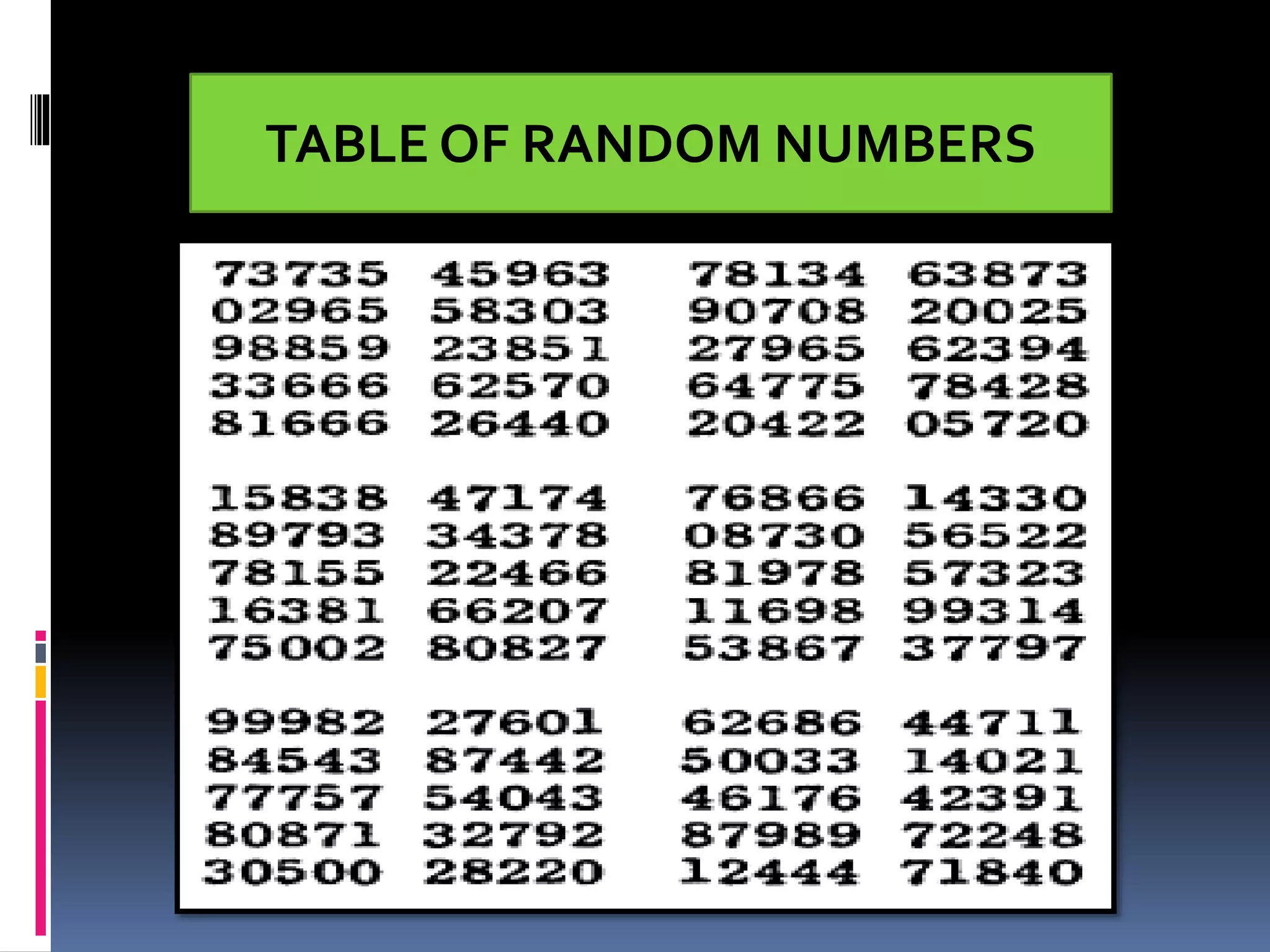
Lottery method Random number tables
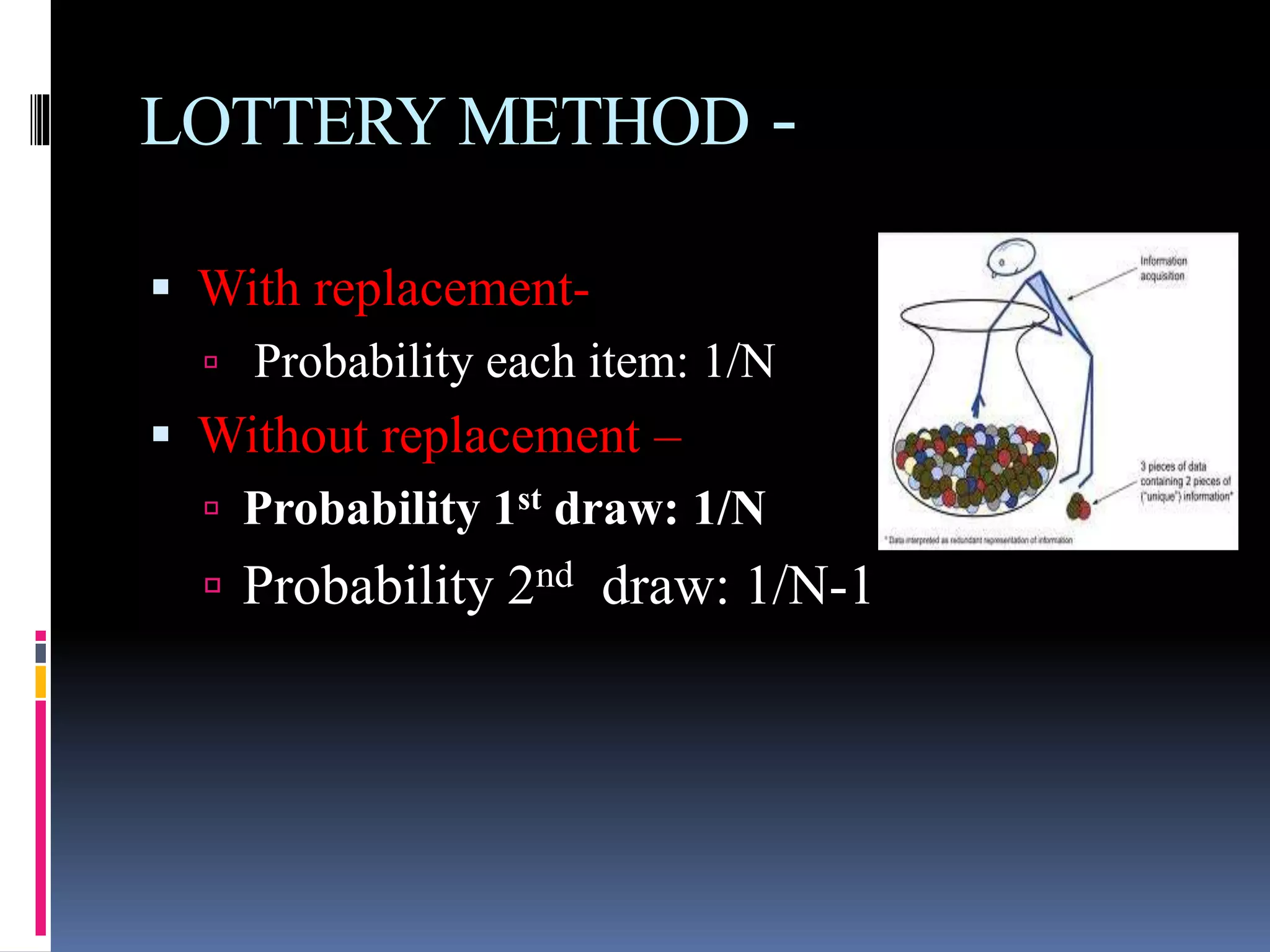
LOTTERY METHOD -
 With replacement-
 Probability each item: 1/N
 Without replacement –
 Probability 1st draw: 1/N
 Probability 2nd draw: 1/N-1
TABLE OF RANDOM NUMBERS
SIMPLE RANDOM SAMPLING
 Merits
 No personal bias.
 Sample more representative of population.
 Accuracy can be assessed as sampling errors follow
principals of chance.
 Demerits
 Requires completely catalogued universe.
 Cases too widely dispersed - more time and cost.
STRATIFIED RANDOM
SAMPLING
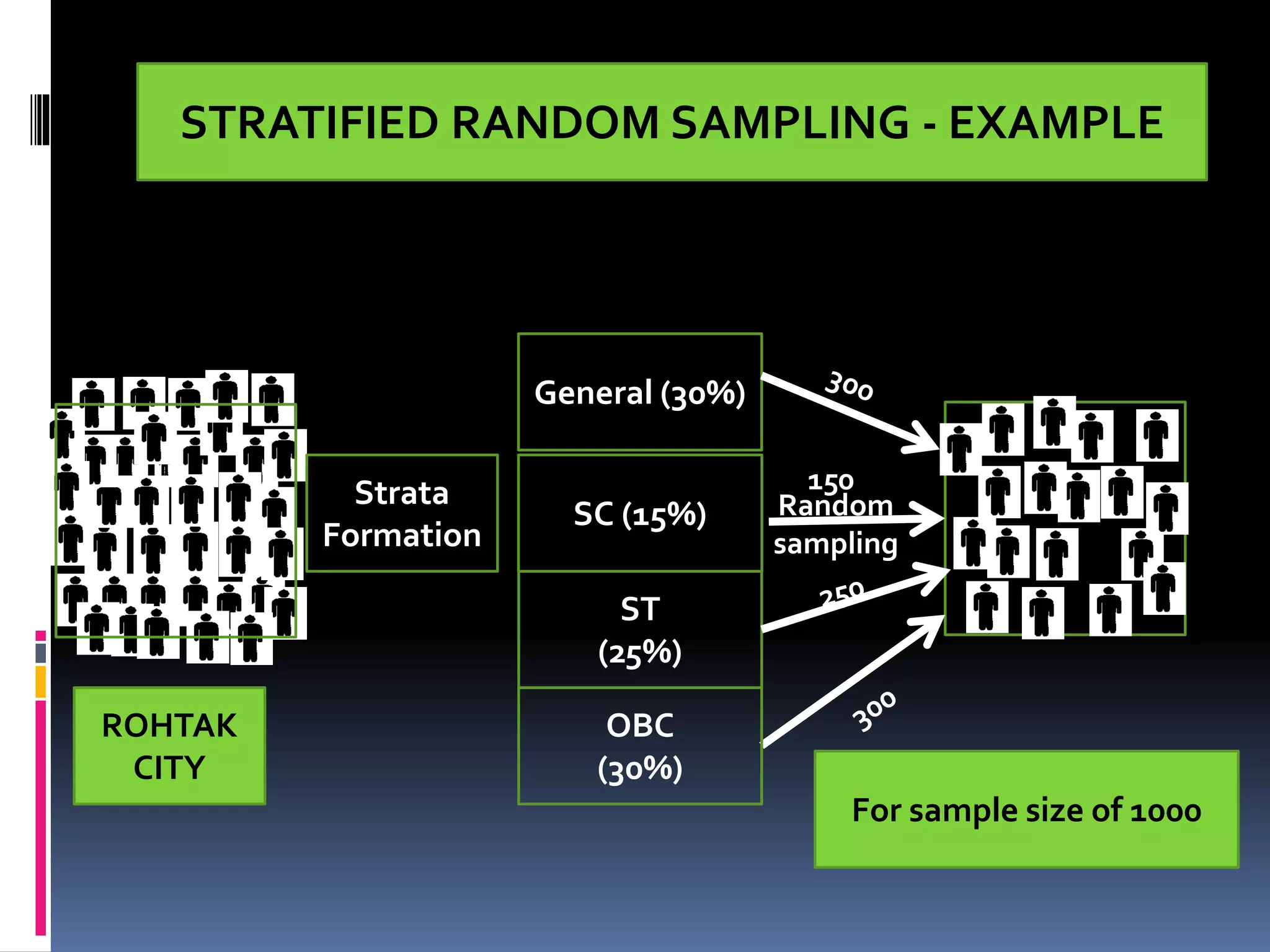
 Universe is sub divided into mutually
exclusive groups.
 A simple random sample is then chosen
independently from each group.
STRATIFIED RANDOM
SAMPLING
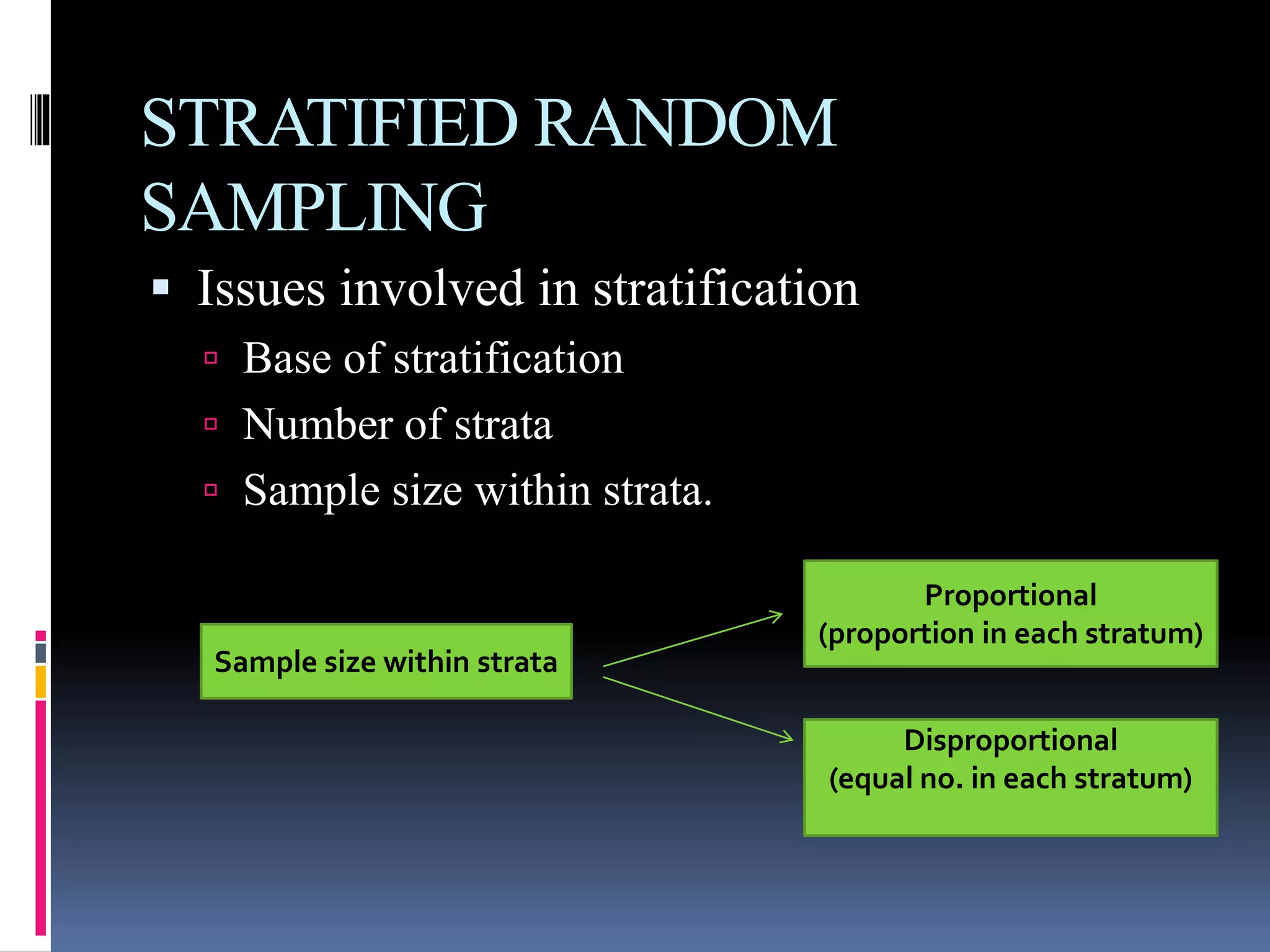
 Issues involved in stratification
 Base of stratification
 Number of strata
 Sample size within strata.
Sample size within strata
Proportional
(proportion in each stratum)
Disproportional
(equal no. in each stratum)
Strata
Formation
Random
sampling
General (30%)
SC (15%)
ST
(25%)
OBC
(30%)
ROHTAK
CITY
150
For sample size of 1000
STRATIFIED RANDOM SAMPLING - EXAMPLE
STRATIFIED RANDOM
SAMPLING
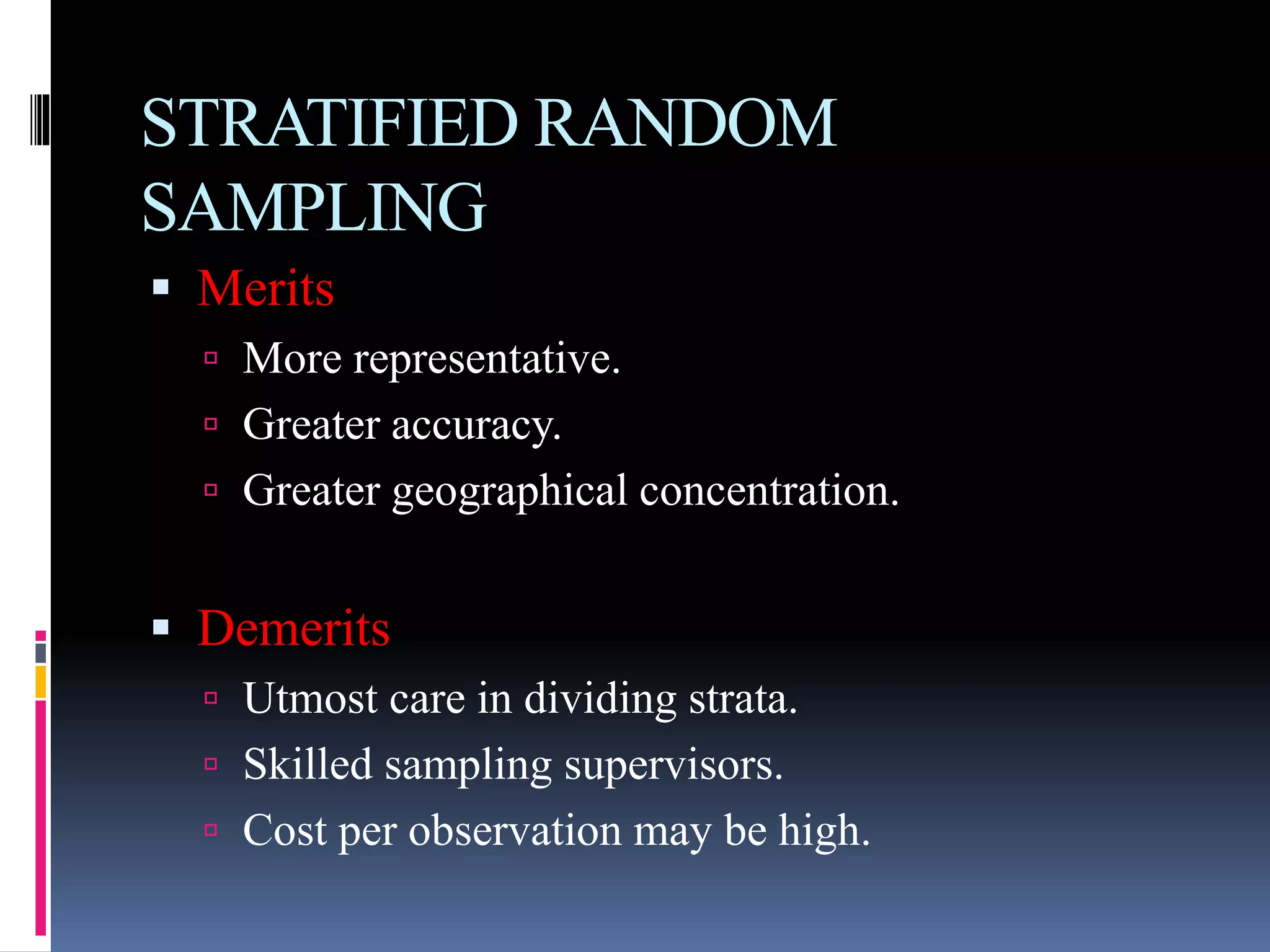
 Merits
 More representative.
 Greater accuracy.
 Greater geographical concentration.
 Demerits
 Utmost care in dividing strata.
 Skilled sampling supervisors.
 Cost per observation may be high.
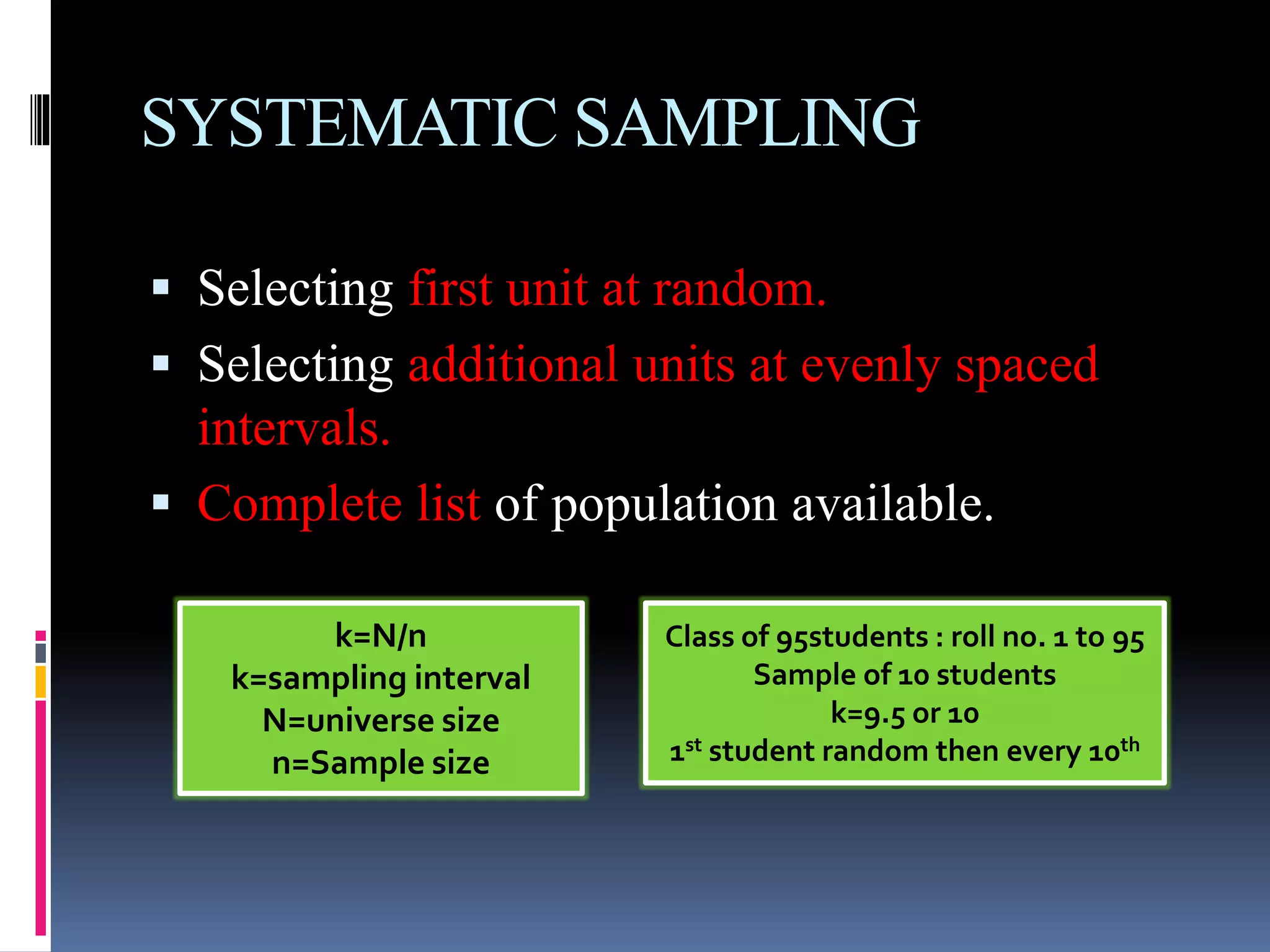
SYSTEMATIC SAMPLING
 Selecting first unit at random.
 Selecting additional units at evenly spaced
intervals.
 Complete list of population available.
k=N/n
k=sampling interval
N=universe size
n=Sample size
Class of 95students : roll no. 1 to 95
Sample of 10 students
k=9.5 or 10
1st student random then every 10th
SYSTEMATIC SAMPLING
 Merits
 Simple and convenient.
 Less time consuming.
 Demerits
 Population with hidden periodicities.
CLUSTER SAMPLING
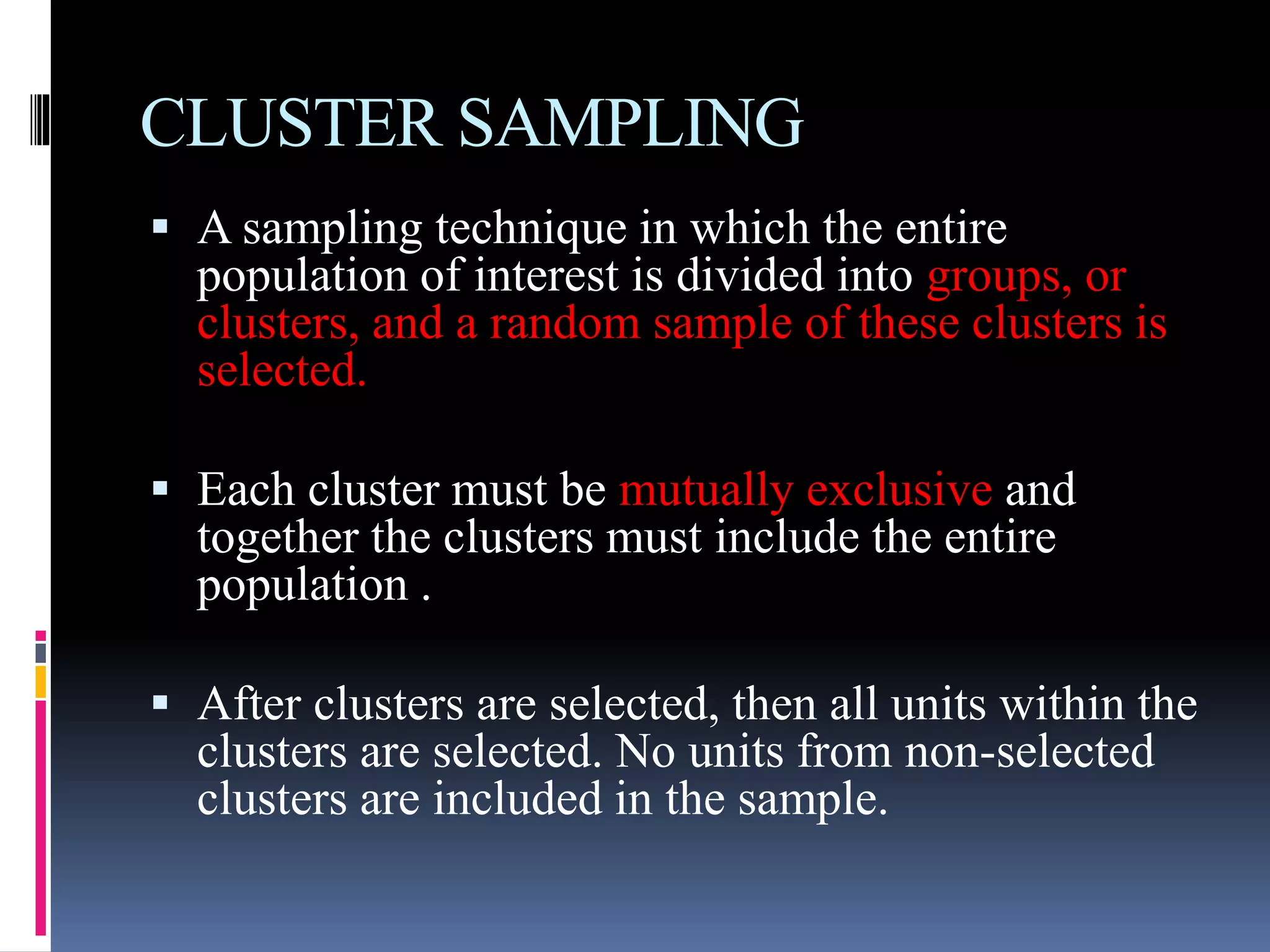
 A sampling technique in which the entire
population of interest is divided into groups, or
clusters, and a random sample of these clusters is
selected.
 Each cluster must be mutually exclusive and
together the clusters must include the entire
population .
 After clusters are selected, then all units within the
clusters are selected. No units from non-selected
clusters are included in the sample.
CLUSTER SAMPLING
 In cluster sampling, the clusters are the
primary sampling unit (PSU’s) and the units
within the clusters are the secondary sampling
units (SSU’s)
STRATIFICATION V/S
CLUSTERING
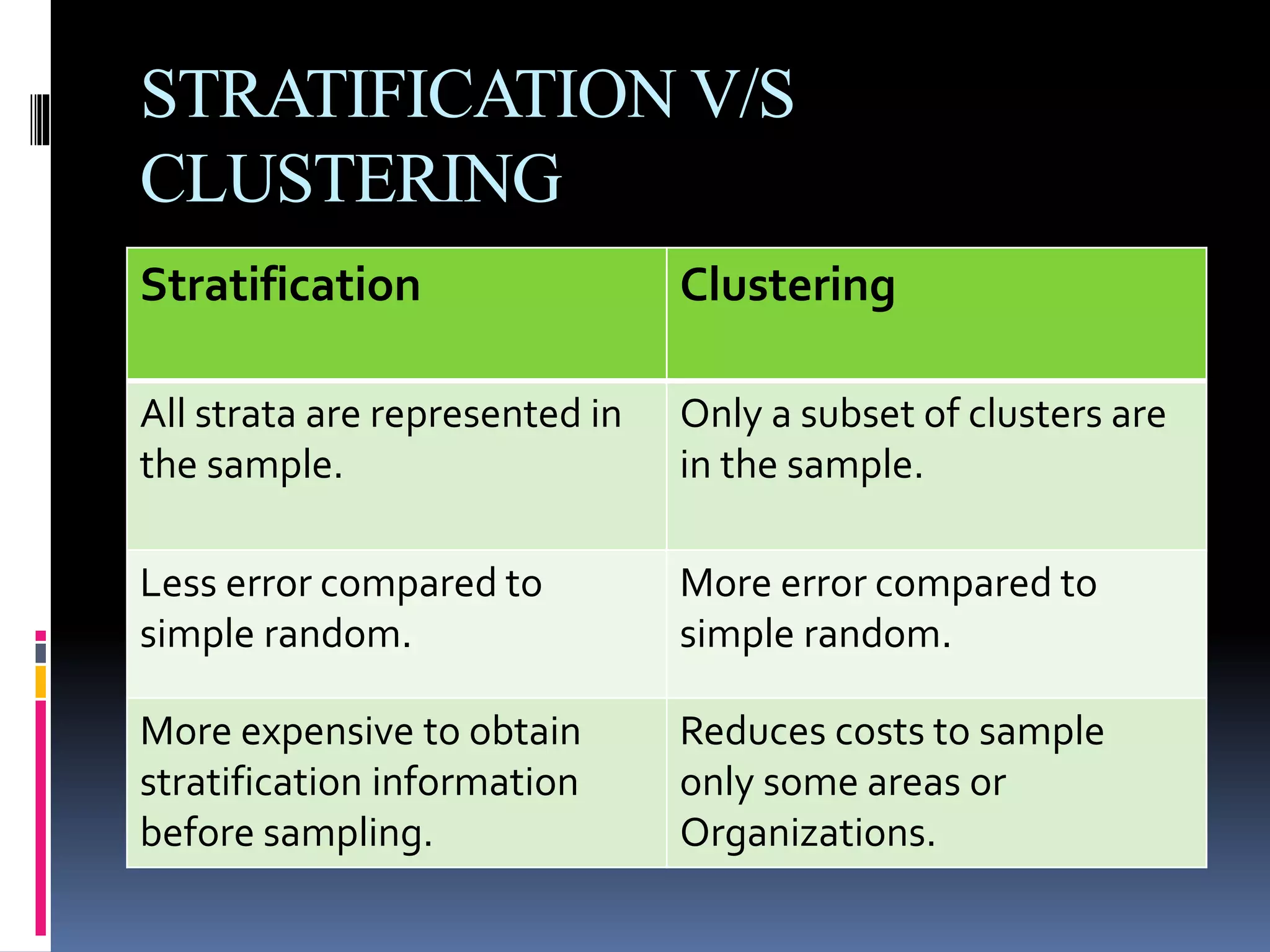
Stratification Clustering
All strata are represented in
the sample.
Only a subset of clusters are
in the sample.
Less error compared to
simple random.
More error compared to
simple random.
More expensive to obtain
stratification information
before sampling.
Reduces costs to sample
only some areas or
Organizations.
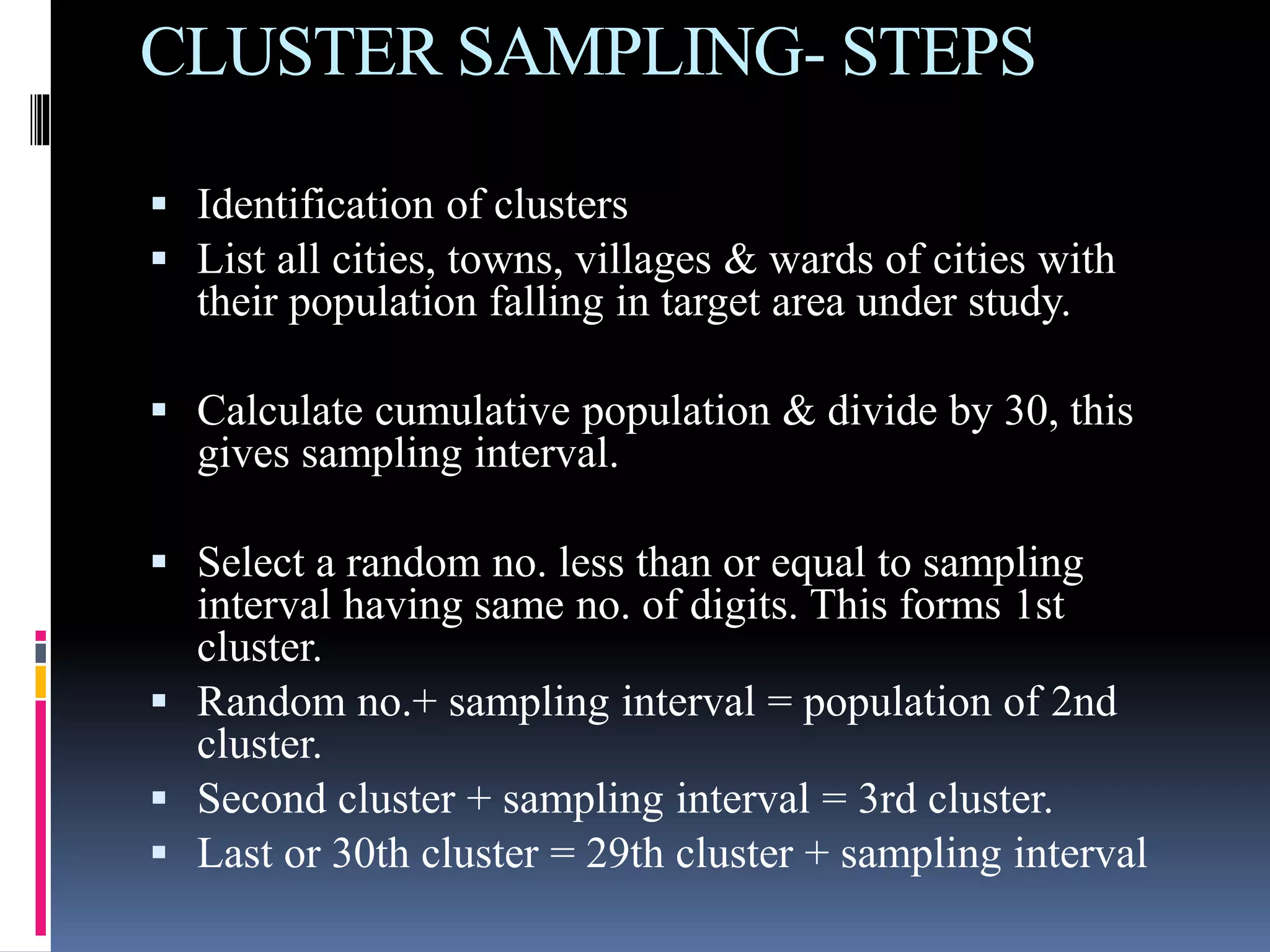
CLUSTER SAMPLING- STEPS
 Identification of clusters
 List all cities, towns, villages & wards of cities with
their population falling in target area under study.
 Calculate cumulative population & divide by 30, this
gives sampling interval.
 Select a random no. less than or equal to sampling
interval having same no. of digits. This forms 1st
cluster.
 Random no.+ sampling interval = population of 2nd
cluster.
 Second cluster + sampling interval = 3rd cluster.
 Last or 30th cluster = 29th cluster + sampling interval
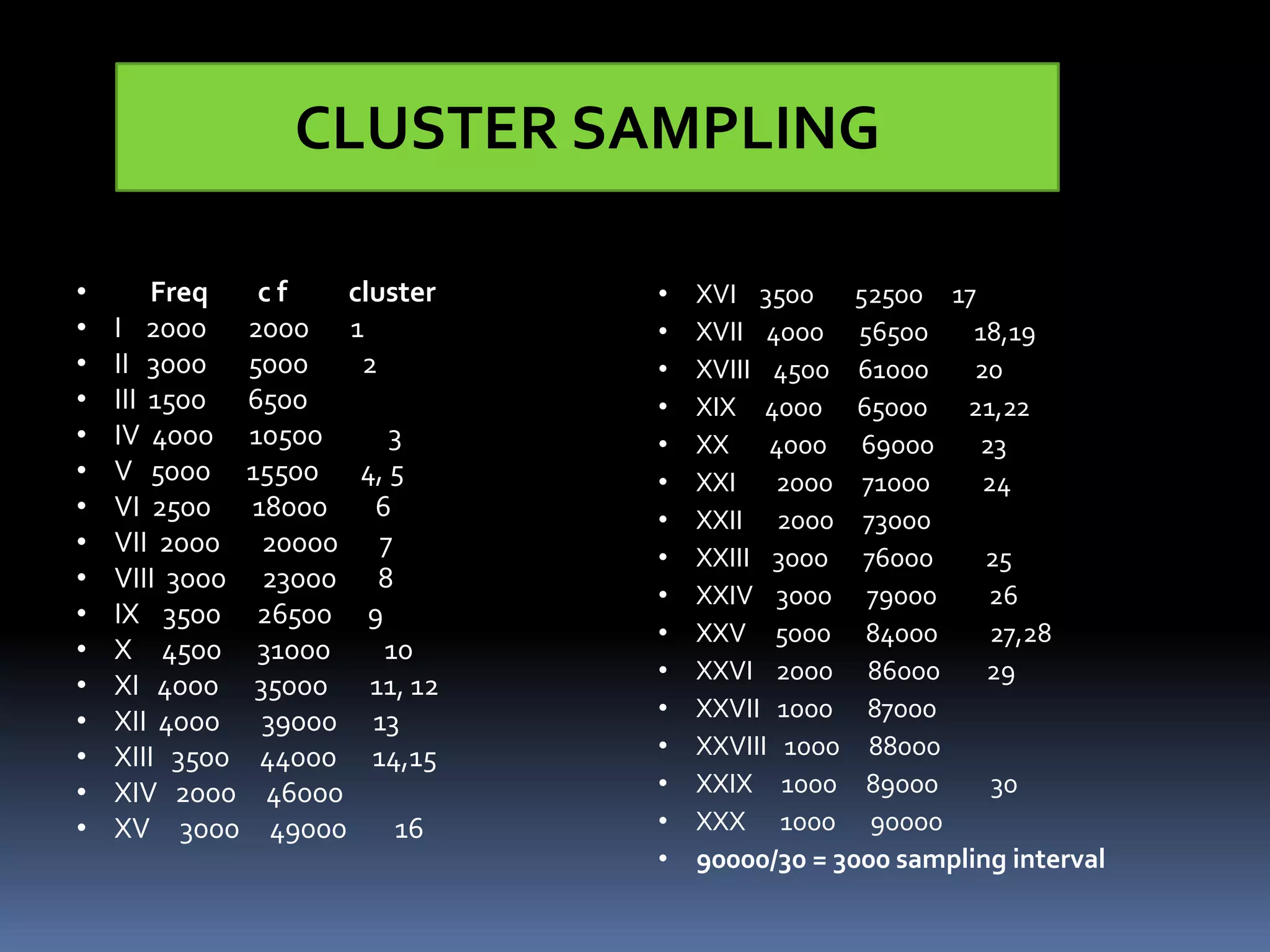
• Freq c f cluster
• I 2000 2000 1
• II 3000 5000 2
• III 1500 6500
• IV 4000 10500 3
• V 5000 15500 4, 5
• VI 2500 18000 6
• VII 2000 20000 7
• VIII 3000 23000 8
• IX 3500 26500 9
• X 4500 31000 10
• XI 4000 35000 11, 12
• XII 4000 39000 13
• XIII 3500 44000 14,15
• XIV 2000 46000
• XV 3000 49000 16
• XVI 3500 52500 17
• XVII 4000 56500 18,19
• XVIII 4500 61000 20
• XIX 4000 65000 21,22
• XX 4000 69000 23
• XXI 2000 71000 24
• XXII 2000 73000
• XXIII 3000 76000 25
• XXIV 3000 79000 26
• XXV 5000 84000 27,28
• XXVI 2000 86000 29
• XXVII 1000 87000
• XXVIII 1000 88000
• XXIX 1000 89000 30
• XXX 1000 90000
• 90000/30 = 3000 sampling interval
CLUSTER SAMPLING
CLUSTER SAMPLING
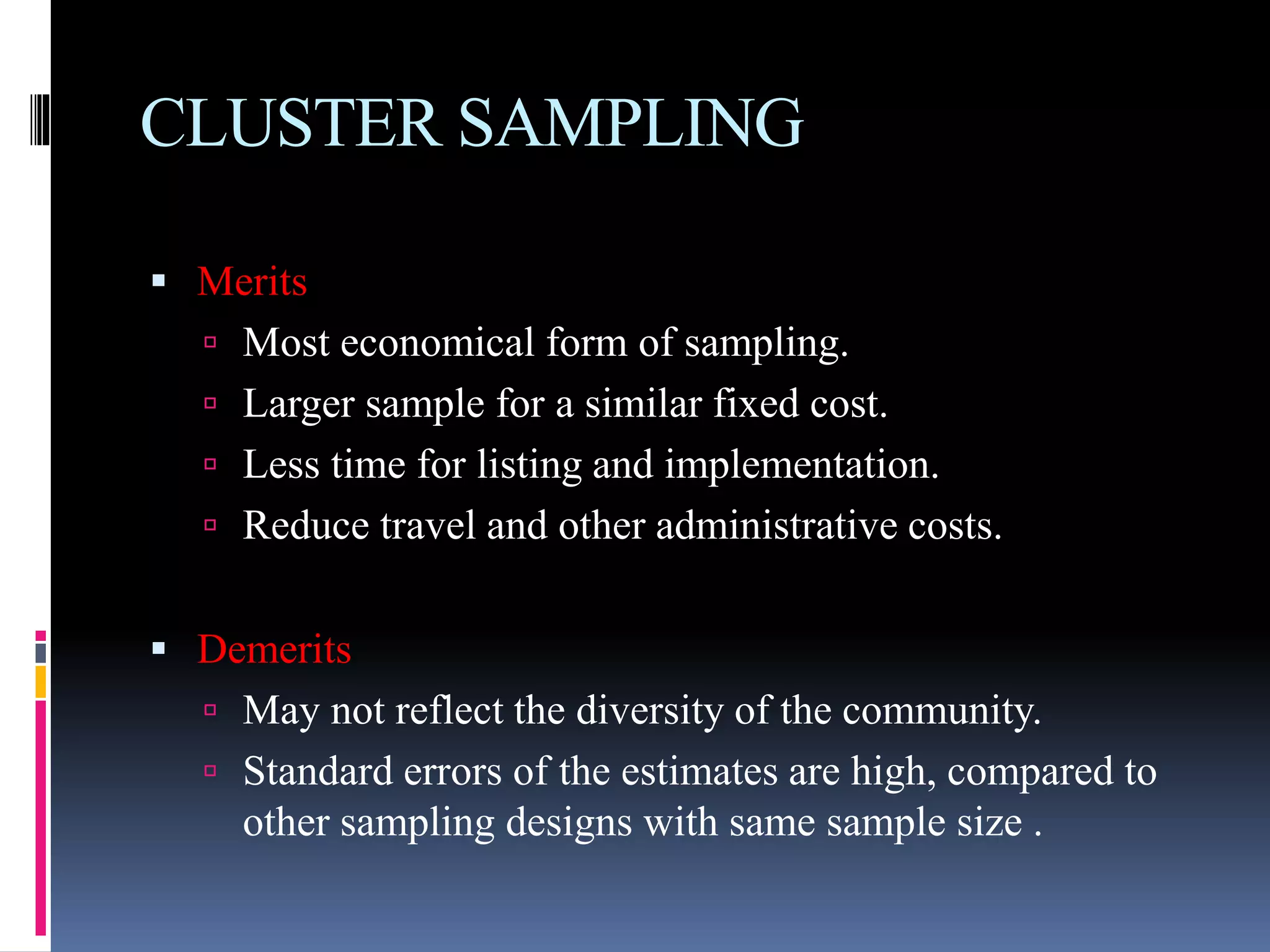
 Merits
 Most economical form of sampling.
 Larger sample for a similar fixed cost.
 Less time for listing and implementation.
 Reduce travel and other administrative costs.
 Demerits
 May not reflect the diversity of the community.
 Standard errors of the estimates are high, compared to
other sampling designs with same sample size .
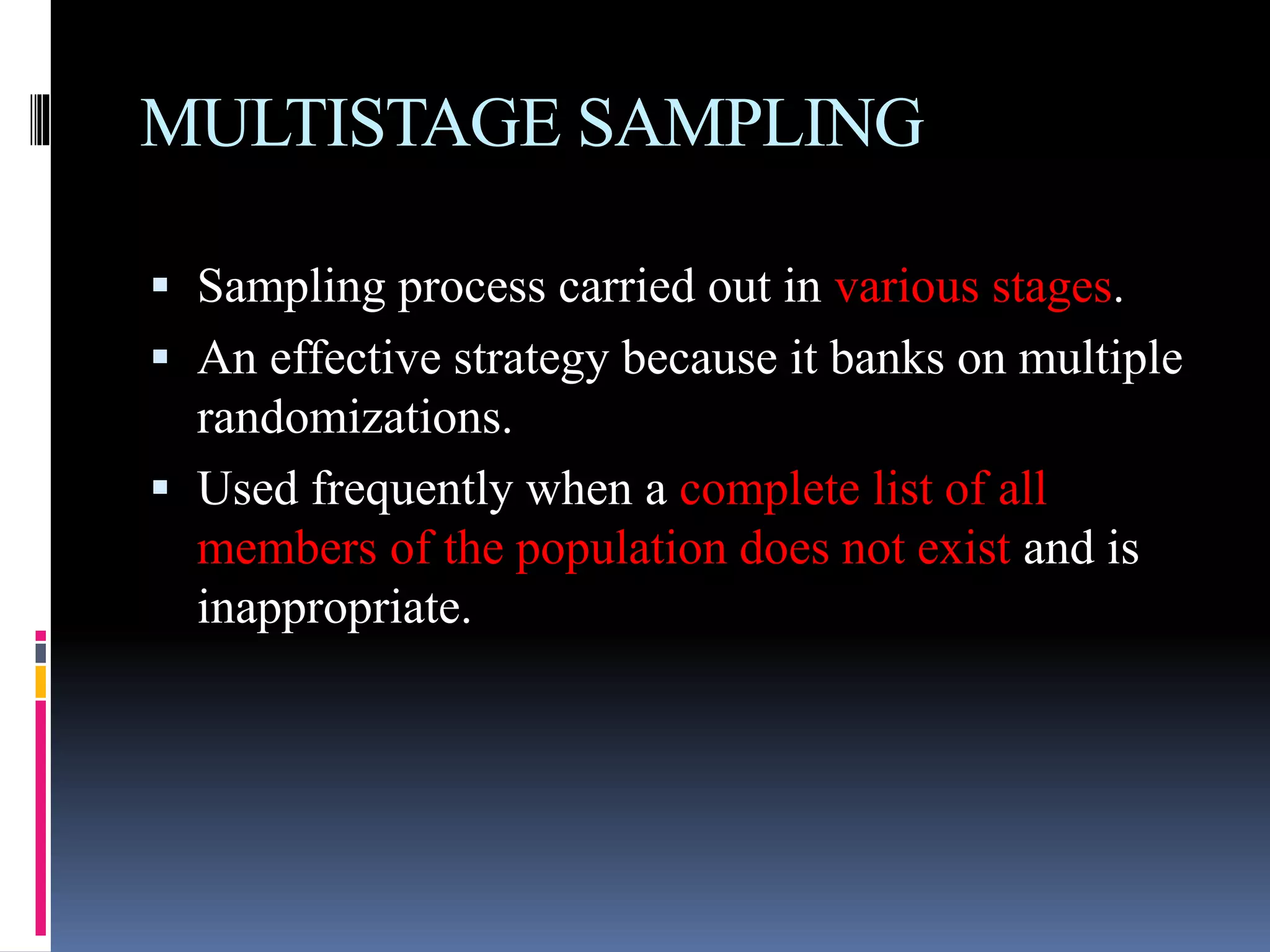
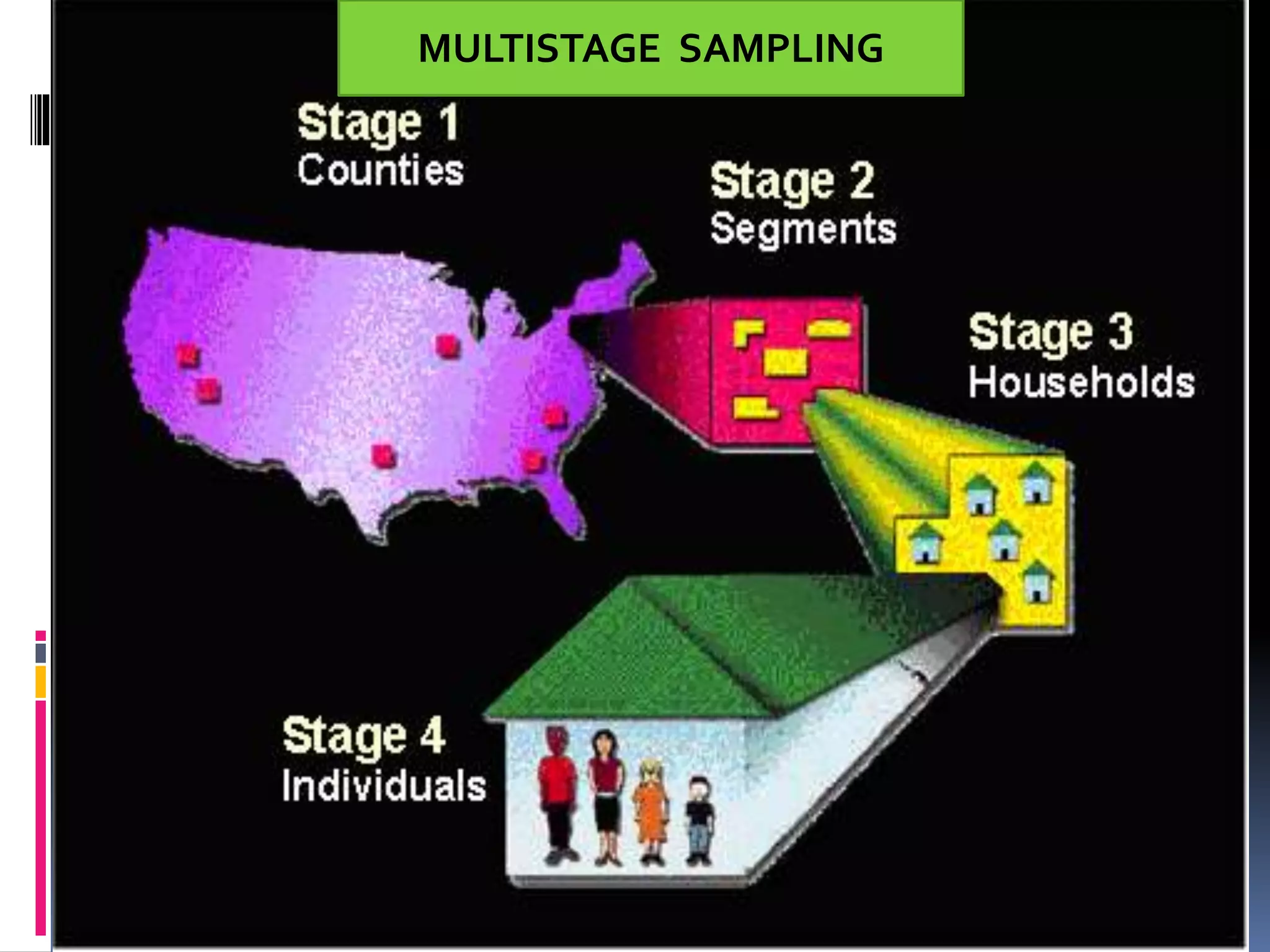
MULTISTAGE SAMPLING
 Sampling process carried out in various stages.
 An effective strategy because it banks on multiple
randomizations.
 Used frequently when a complete list of all
members of the population does not exist and is
inappropriate.
MULTISTAGE SAMPLING
MULTISTAGE SAMPLING
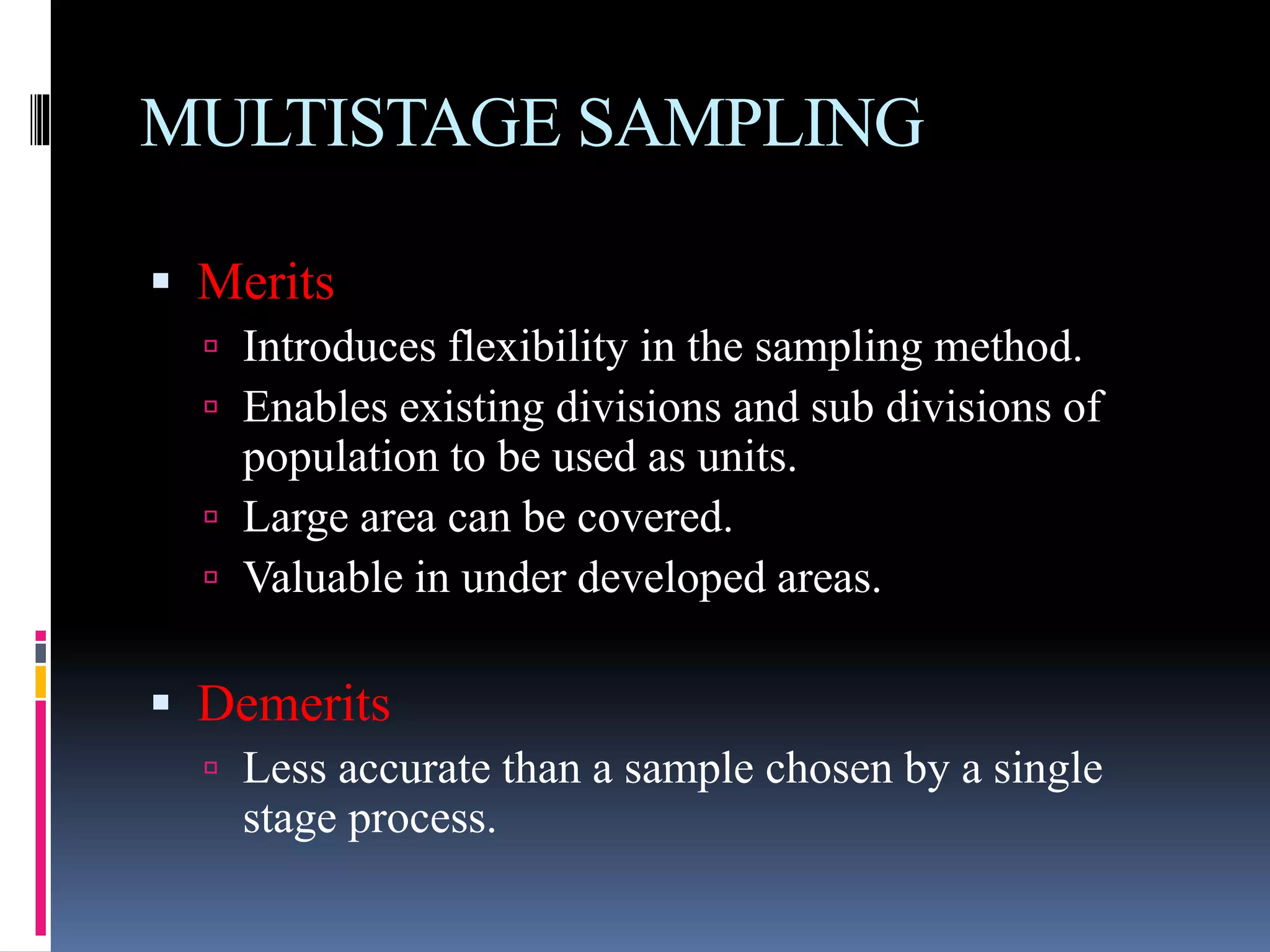
 Merits
 Introduces flexibility in the sampling method.
 Enables existing divisions and sub divisions of
population to be used as units.
 Large area can be covered.
 Valuable in under developed areas.
 Demerits
 Less accurate than a sample chosen by a single
stage process.
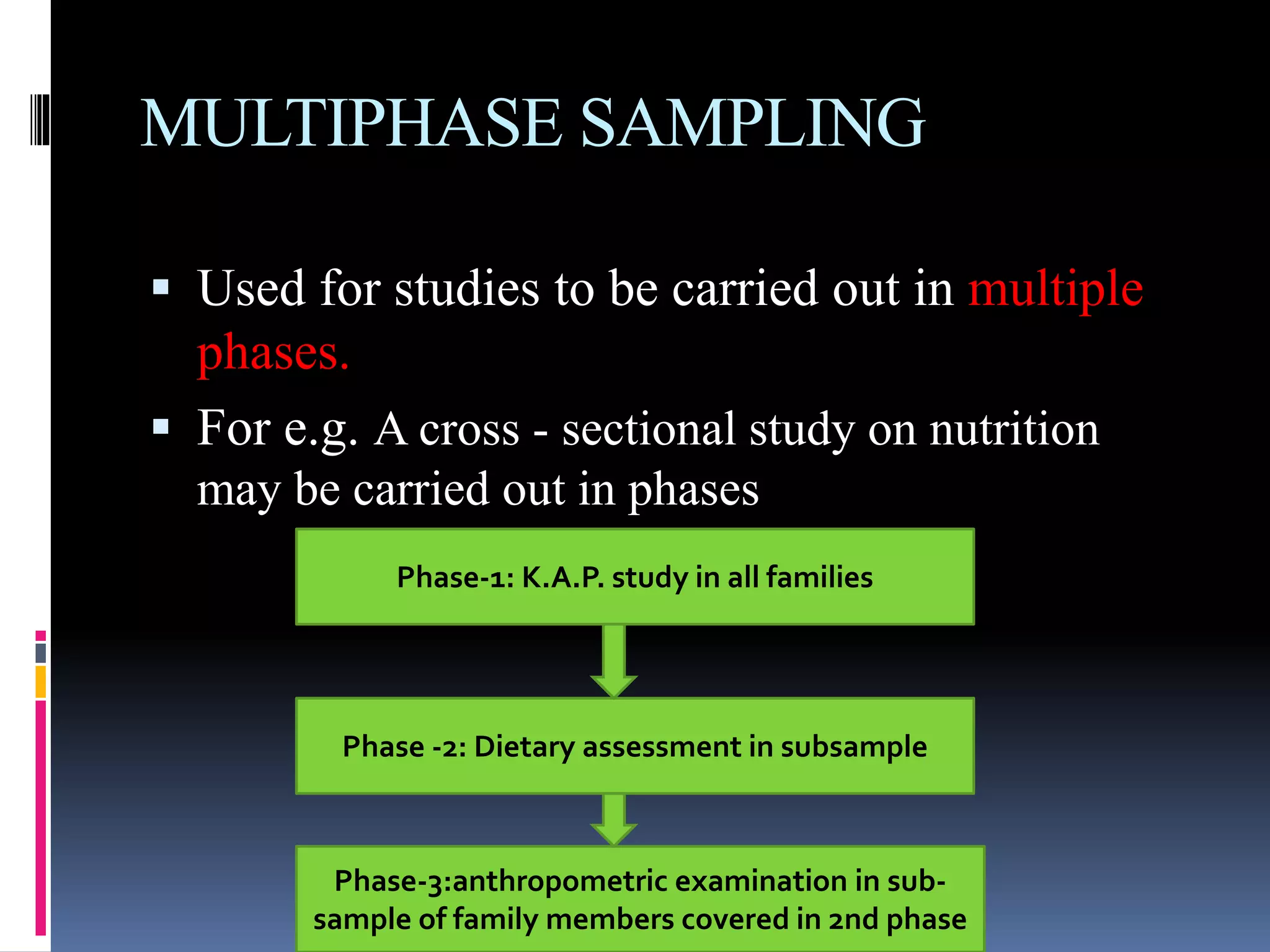
MULTIPHASE SAMPLING
 Used for studies to be carried out in multiple
phases.
 For e.g. A cross - sectional study on nutrition
may be carried out in phases
Phase-1: K.A.P. study in all families
Phase -2: Dietary assessment in subsample
Phase-3:anthropometric examination in sub-
sample of family members covered in 2nd phase
LOT QUALITYASSURANCE
SAMPLING
 Originated in the manufacturing industry for
quality control purposes.
 Manufacturers were interested in determining
whether a batch, or lot, of goods met the
desired specifications.
 The only outcome in this type of sampling is
“acceptable” or “not acceptable”
LOT QUALITYASSURANCE
SAMPLING
 The sample size is the number of units that are
selected from each lot.
 The decision value is the number of “defective”
items that need to found before the lot is deemed
unacceptable.
 There are two types of risks
 the risk of accepting a “bad” lot, referred to as
Type I error
 the risk of not accepting a “good” lot, referred to as
Type II error.
LOT QUALITYASSURANCE
SAMPLING
 Information from lots can be combined to
obtain the overall proportion of defects.
 The population is first divided into a complete
set of non-overlapping lots.
 Samples are then taken from every lot, and the
proportion of defective items in each lot is
calculated.
 The LQAS method is an example of stratified
sampling, where the lots play the role of the
strata.
LOT QUALITYASSURANCE
SAMPLING
 The advantage of the LQAS method over a
traditional stratified sampling design is that
the response for each lot is binary (acceptable
or not), and therefore smaller sample sizes can
be used.
LOT QUALITYASSURANCE
SAMPLING
 Can be used for evaluating a number of health
programmes e.g. immnunisation coverage ,
knowledge of ORS, etc
 Despite successful trials of LQAS in health
surveys , its routine use has not been
established yet.
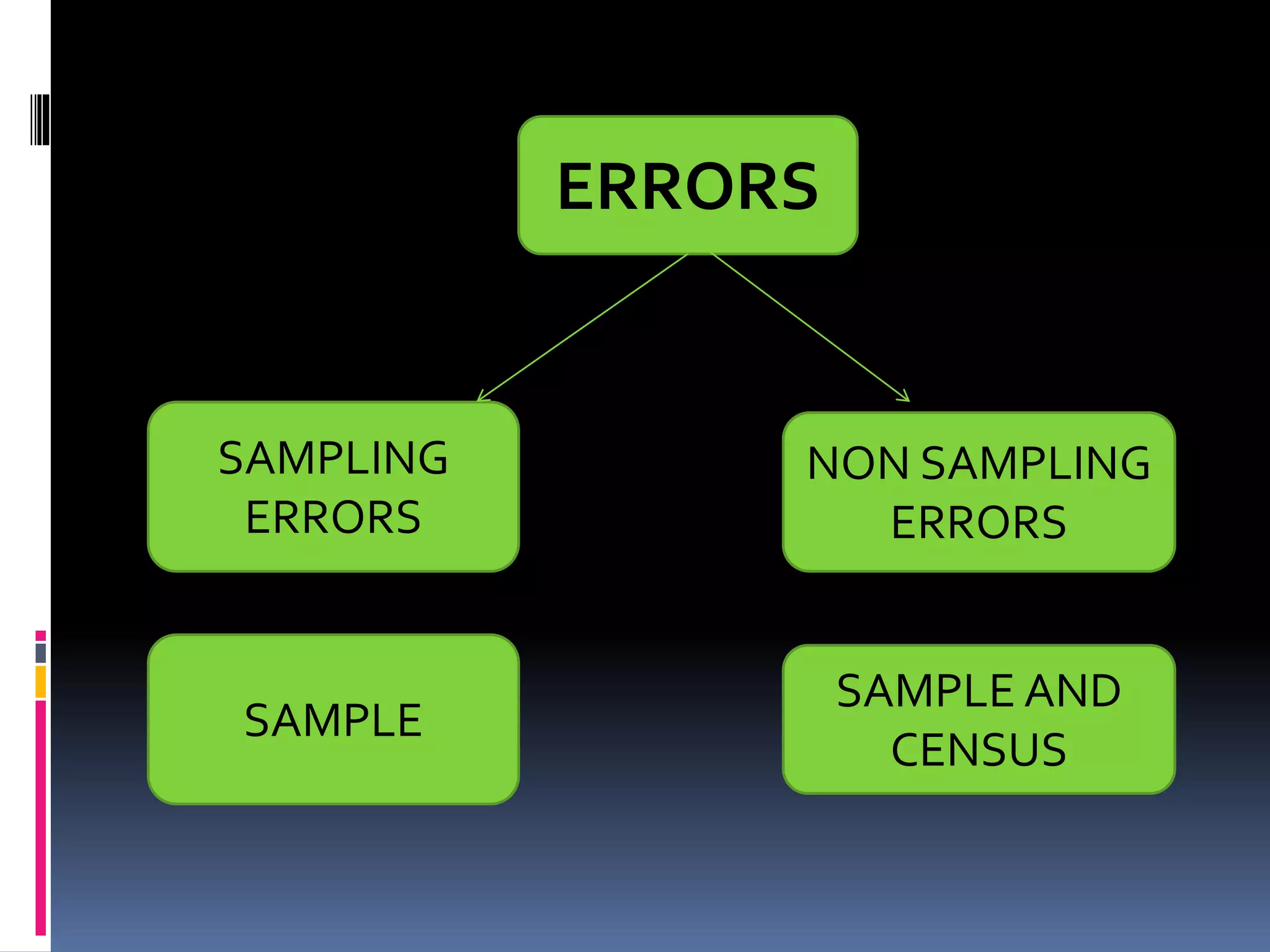
ERRORS
SAMPLING
ERRORS
NON SAMPLING
ERRORS
SAMPLE
SAMPLE AND
CENSUS
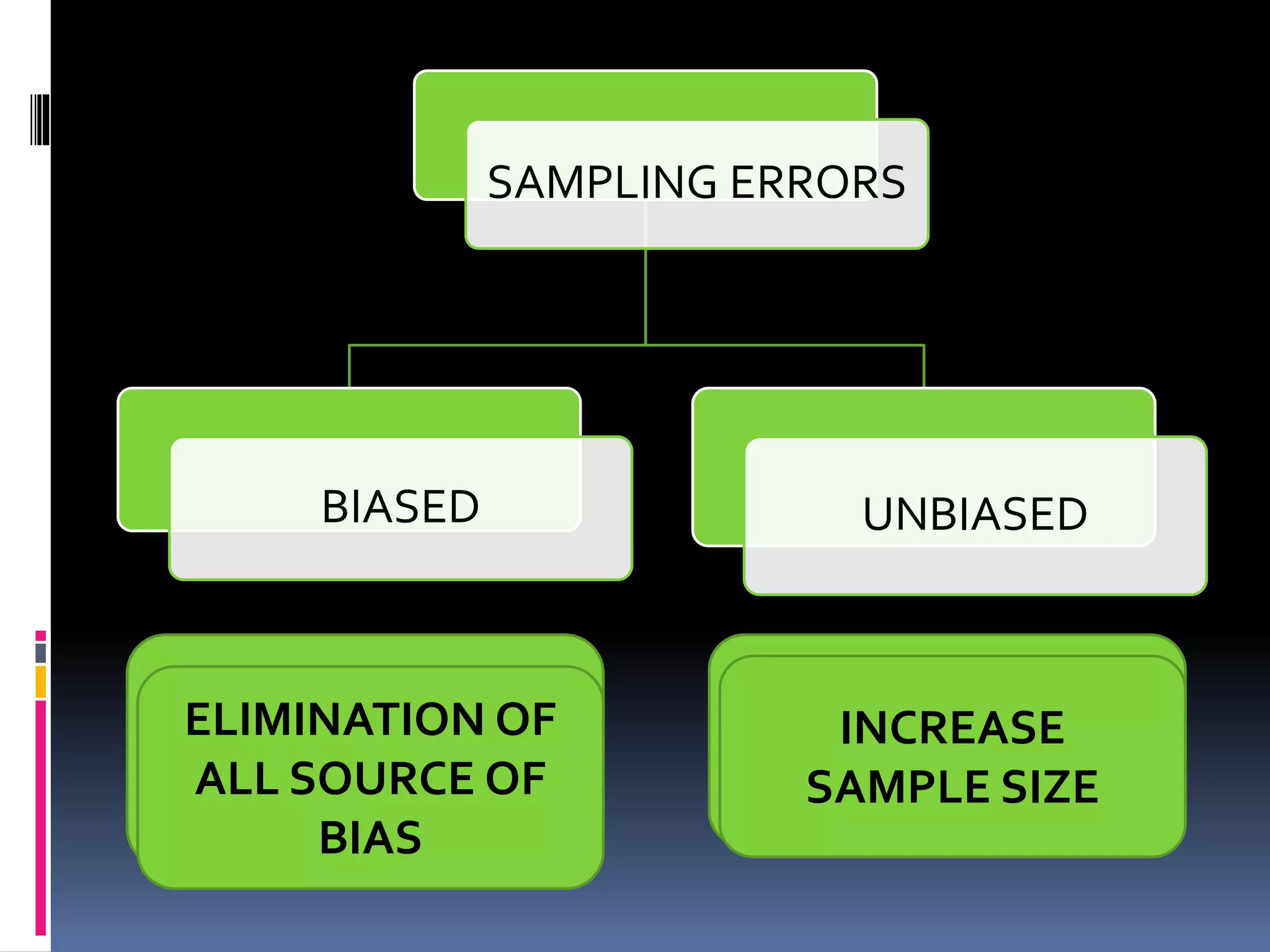
SAMPLING ERRORS
BIASED UNBIASED
DELIBERATE SELECTION
SUBSTITUTION
NON-RESPONSE
APPEALTOVANITY (PRIDE)
DIFFERENCES BETWEEN
VALUE OF SAMPLE AND
THAT OF POPULATION
ELIMINATION OF
ALL SOURCE OF
BIAS
INCREASE
SAMPLE SIZE
NON SAMPLING ERRORS
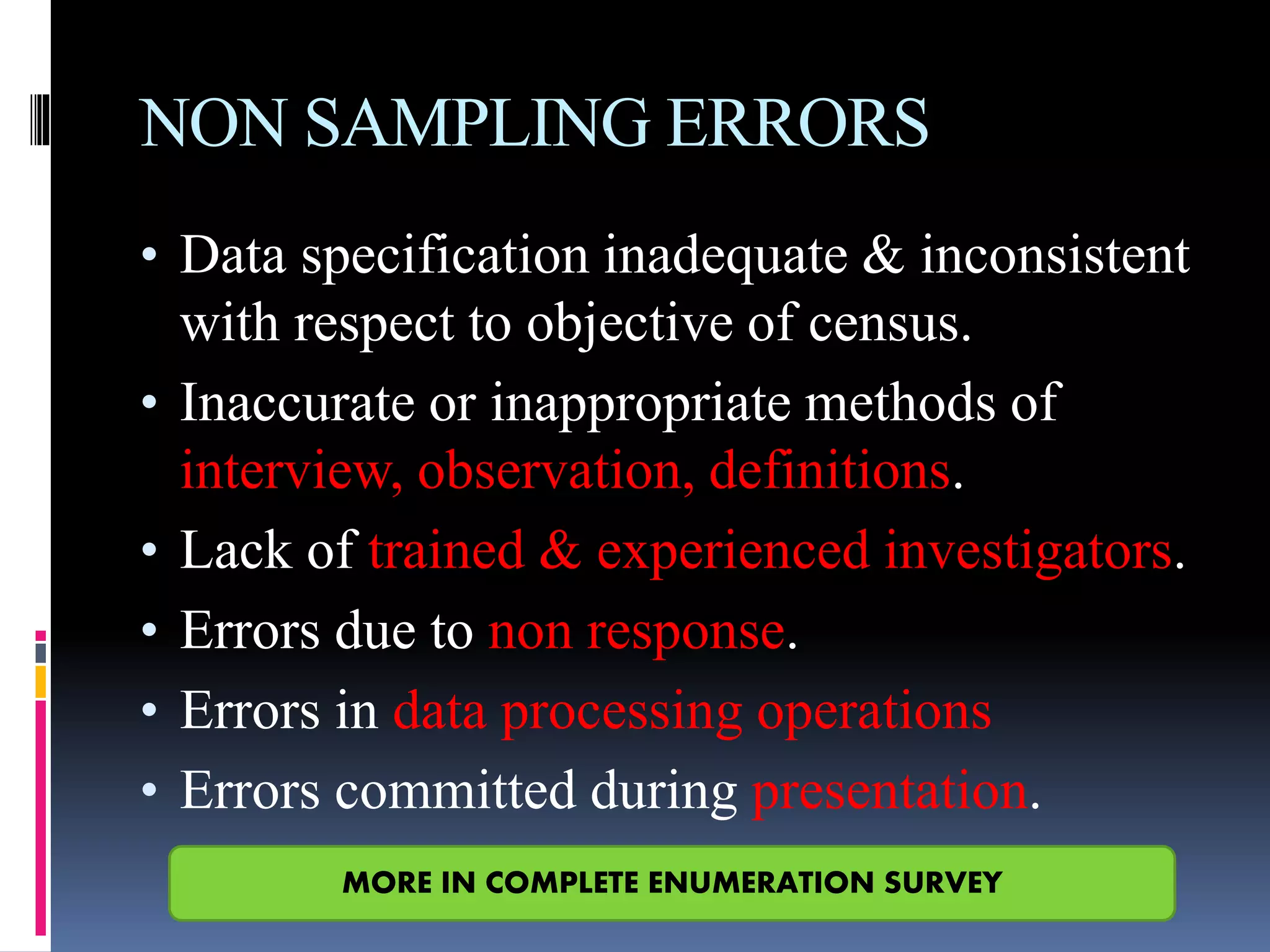
• Data specification inadequate & inconsistent
with respect to objective of census.
• Inaccurate or inappropriate methods of
interview, observation, definitions.
• Lack of trained & experienced investigators.
• Errors due to non response.
• Errors in data processing operations
• Errors committed during presentation.
MORE IN COMPLETE ENUMERATION SURVEY
REFERENCES
 Methods in Biostatistics by BK Mahajan
 Statistical Methods by SP Gupta
 Basic & Clinical Biostatistics by Dawson and
Beth.
Sampling techniques

Sampling techniques

  • 1.
  • 2.
    CONTENTS  Introduction  Needfor sampling  Sampling Process  Essentials of Sampling  Methods of Sampling  Non Probability Sampling  Probability Sampling  Errors in Sampling  References
  • 3.
    INTRODUCTION  Population/Universe: instatistics denotes the aggregate from which sample (items) is to be taken.  A population can be defined as including all people or items with the characteristic one wishes to understand.  Because there is very rarely enough time or money to gather information from everyone or everything in a population, the goal becomes finding a representative sample (or subset) of that population.
  • 4.
    INTRODUCTION  Sampling frameis the list from which the potential respondents are drawn .  A sample is “a smaller (but hopefully representative) collection of units from a population used to determine truths about that population” (Field, 2005)
  • 5.
  • 6.
    SAMPLING  Sampling: theprocess of learning about population on the basis of sample drawn from it.  Three elements in process of sampling:  Selecting the sample  Collecting the information  Making inference about population  Statistics: values obtained from study of a sample.  Parameters: such values from study of population.
  • 7.
    NEED FOR SAMPLING DATA (acc.to source) Primary Secondary 1. ORIGINAL IN CHARACTER 2. GENERATED IN LARGE NO. OF SURVEYS OBTAINED FROM 1. PUBLISHED SOURCES 2. UNPUBLISHED SOURCES
  • 8.
    NEED FOR SAMPLING When secondary data are not available for the problem under study , primary data is collected.  Two methods –  Census method or complete enumeration method  Sample method
  • 9.
    CENSUS (Complete Enumeration Survey) Merits  Data obtained from each and every unit of population.  Results: more representative, accurate, reliable.  Basis of various surveys.  Demerits  More effort ,money , time.  Big problem in underdeveloped countries.
  • 10.
    ADVANTAGES OF SAMPLING Less resources (time, money)  Less workload.  Gives results with known accuracy that can be calculated mathematically.
  • 11.
    THEORETICAL BASIS OF SAMPLING On the basis of sample study we can predict and generalize the behavior of mass phenomena.  There is no statistical population whose elements would vary from each other without limit.
  • 12.
    THEORETICAL BASIS OF SAMPLING Law of Statistical Regularity-  Sample is taken at random from a population, it is likely to possess same characteristics as that of population.  Law of inertia of large numbers-  Larger the size of sample, more accurate the results are likely to be.
  • 13.
    SAMPLING PROCESS  Definingthe population of concern.  Specifying a sampling frame, a set of items or events possible to measure.  Specifying a sampling method for selecting items or events from the frame.  Determining the sample size.  Implementing the sampling plan.  Sampling and data collection
  • 14.
    ESSENTIALS OF SAMPLING Representativeness- ensure by random selection  Adequacy - sample size  Independence - same chance of selection  Homogeneity - no basic difference in nature of units.
  • 15.
    SAMPLING METHODS NON PROBABILITY PROBABILITY MIXED JUDGMENT QUOTA CONVENIENCE SNOWBALL SIMPLERANDOM STRATIFIED RANDOM SYSTEMATIC CLUSTER MULTISTAGE MULTIPHASE LOT QUALITY ASSURANCE
  • 16.
  • 17.
    JUDGMENT SAMPLING  Judgment/Purposive/Deliberatesampling.  Depends exclusively on the judgment of investigator.  Sample selected which investigator thinks to be most typical of the universe.
  • 18.
    JUDGMENT SAMPLING  Merits Small no. of sampling units  Study unknown traits/case sampling  Urgent public policy & business decisions  Demerits  Personal prejudice & bias  No objective way of evaluating reliability of results
  • 19.
    JUDGMENT SAMPLING - EXAMPLE CLASSOF 20 STUDENTS Sample size for a study=8 JUDGMENT SAMPLE OF 8 STUDENTS
  • 20.
    CONVENIENCE SAMPLING  Convenientsample units selected.  Selected neither by probability nor by judgment.  Merit – useful in pilot studies.  Demerit – results usually biased and unsatisfactory.
  • 21.
    CONVENIENCE SAMPLING -EXAMPLE Class of 100 students 20 Students selected as per convenience
  • 22.
    QUOTASAMPLING  Most commonlyused in non probability sampling.  Quotas set up according to some specified characteristic.  Within the quota , selection depends on personal judgment.  Merit- Used in public opinion studies  Demerit – personal prejudice and bias
  • 23.
    Quota Formation Interview 500 people Personal judgement Radiolistening survey 60% housewives 25% farmers 15% children under age 15 300 125 75 500 people QUOTA SAMPLING - EXAMPLE
  • 24.
    SNOWBALL SAMPLING  Aspecial non probability method used when the desired sample characteristic is rare.  It may be extremely difficult or cost prohibitive to locate respondents in these situations.  Snowball sampling relies on referrals from initial subjects to generate additional subjects.
  • 25.
    SNOWBALLSAMPLING - STEPS Make contact with one or two cases in the population.  Ask these cases to identify further cases.  Ask these new cases to identify further new cases.  Stop when either no new cases are given or the sample is as large as is manageable.
  • 26.
    SNOWBALL SAMPLING  Merit access to difficult to reach populations (other methods may not yield any results).  Demerit  not representative of the population and will result in a biased sample as it is self-selecting.
  • 27.
  • 28.
    SIMPLE RANDOM SAMPLING Each unit has an equal opportunity of being selected.  Chance determines which items shall be included.
  • 29.
    SIMPLE RANDOM SAMPLING The sample is a simple random sample if any of the following is true (Chou) –  All items selected independently.  At each selection , all remaining items have same chance of being selected.  All the possible samples of a given size are equally likely to be selected.
  • 30.
    Simple or unrestrictedrandom sampling Lottery method Random number tables
  • 31.
    LOTTERY METHOD - With replacement-  Probability each item: 1/N  Without replacement –  Probability 1st draw: 1/N  Probability 2nd draw: 1/N-1
  • 32.
  • 33.
    SIMPLE RANDOM SAMPLING Merits  No personal bias.  Sample more representative of population.  Accuracy can be assessed as sampling errors follow principals of chance.  Demerits  Requires completely catalogued universe.  Cases too widely dispersed - more time and cost.
  • 34.
    STRATIFIED RANDOM SAMPLING  Universeis sub divided into mutually exclusive groups.  A simple random sample is then chosen independently from each group.
  • 35.
    STRATIFIED RANDOM SAMPLING  Issuesinvolved in stratification  Base of stratification  Number of strata  Sample size within strata. Sample size within strata Proportional (proportion in each stratum) Disproportional (equal no. in each stratum)
  • 36.
  • 37.
    STRATIFIED RANDOM SAMPLING  Merits More representative.  Greater accuracy.  Greater geographical concentration.  Demerits  Utmost care in dividing strata.  Skilled sampling supervisors.  Cost per observation may be high.
  • 38.
    SYSTEMATIC SAMPLING  Selectingfirst unit at random.  Selecting additional units at evenly spaced intervals.  Complete list of population available. k=N/n k=sampling interval N=universe size n=Sample size Class of 95students : roll no. 1 to 95 Sample of 10 students k=9.5 or 10 1st student random then every 10th
  • 39.
    SYSTEMATIC SAMPLING  Merits Simple and convenient.  Less time consuming.  Demerits  Population with hidden periodicities.
  • 40.
    CLUSTER SAMPLING  Asampling technique in which the entire population of interest is divided into groups, or clusters, and a random sample of these clusters is selected.  Each cluster must be mutually exclusive and together the clusters must include the entire population .  After clusters are selected, then all units within the clusters are selected. No units from non-selected clusters are included in the sample.
  • 41.
    CLUSTER SAMPLING  Incluster sampling, the clusters are the primary sampling unit (PSU’s) and the units within the clusters are the secondary sampling units (SSU’s)
  • 42.
    STRATIFICATION V/S CLUSTERING Stratification Clustering Allstrata are represented in the sample. Only a subset of clusters are in the sample. Less error compared to simple random. More error compared to simple random. More expensive to obtain stratification information before sampling. Reduces costs to sample only some areas or Organizations.
  • 43.
    CLUSTER SAMPLING- STEPS Identification of clusters  List all cities, towns, villages & wards of cities with their population falling in target area under study.  Calculate cumulative population & divide by 30, this gives sampling interval.  Select a random no. less than or equal to sampling interval having same no. of digits. This forms 1st cluster.  Random no.+ sampling interval = population of 2nd cluster.  Second cluster + sampling interval = 3rd cluster.  Last or 30th cluster = 29th cluster + sampling interval
  • 44.
    • Freq cf cluster • I 2000 2000 1 • II 3000 5000 2 • III 1500 6500 • IV 4000 10500 3 • V 5000 15500 4, 5 • VI 2500 18000 6 • VII 2000 20000 7 • VIII 3000 23000 8 • IX 3500 26500 9 • X 4500 31000 10 • XI 4000 35000 11, 12 • XII 4000 39000 13 • XIII 3500 44000 14,15 • XIV 2000 46000 • XV 3000 49000 16 • XVI 3500 52500 17 • XVII 4000 56500 18,19 • XVIII 4500 61000 20 • XIX 4000 65000 21,22 • XX 4000 69000 23 • XXI 2000 71000 24 • XXII 2000 73000 • XXIII 3000 76000 25 • XXIV 3000 79000 26 • XXV 5000 84000 27,28 • XXVI 2000 86000 29 • XXVII 1000 87000 • XXVIII 1000 88000 • XXIX 1000 89000 30 • XXX 1000 90000 • 90000/30 = 3000 sampling interval CLUSTER SAMPLING
  • 45.
    CLUSTER SAMPLING  Merits Most economical form of sampling.  Larger sample for a similar fixed cost.  Less time for listing and implementation.  Reduce travel and other administrative costs.  Demerits  May not reflect the diversity of the community.  Standard errors of the estimates are high, compared to other sampling designs with same sample size .
  • 46.
    MULTISTAGE SAMPLING  Samplingprocess carried out in various stages.  An effective strategy because it banks on multiple randomizations.  Used frequently when a complete list of all members of the population does not exist and is inappropriate.
  • 47.
  • 48.
    MULTISTAGE SAMPLING  Merits Introduces flexibility in the sampling method.  Enables existing divisions and sub divisions of population to be used as units.  Large area can be covered.  Valuable in under developed areas.  Demerits  Less accurate than a sample chosen by a single stage process.
  • 49.
    MULTIPHASE SAMPLING  Usedfor studies to be carried out in multiple phases.  For e.g. A cross - sectional study on nutrition may be carried out in phases Phase-1: K.A.P. study in all families Phase -2: Dietary assessment in subsample Phase-3:anthropometric examination in sub- sample of family members covered in 2nd phase
  • 50.
    LOT QUALITYASSURANCE SAMPLING  Originatedin the manufacturing industry for quality control purposes.  Manufacturers were interested in determining whether a batch, or lot, of goods met the desired specifications.  The only outcome in this type of sampling is “acceptable” or “not acceptable”
  • 51.
    LOT QUALITYASSURANCE SAMPLING  Thesample size is the number of units that are selected from each lot.  The decision value is the number of “defective” items that need to found before the lot is deemed unacceptable.  There are two types of risks  the risk of accepting a “bad” lot, referred to as Type I error  the risk of not accepting a “good” lot, referred to as Type II error.
  • 52.
    LOT QUALITYASSURANCE SAMPLING  Informationfrom lots can be combined to obtain the overall proportion of defects.  The population is first divided into a complete set of non-overlapping lots.  Samples are then taken from every lot, and the proportion of defective items in each lot is calculated.  The LQAS method is an example of stratified sampling, where the lots play the role of the strata.
  • 53.
    LOT QUALITYASSURANCE SAMPLING  Theadvantage of the LQAS method over a traditional stratified sampling design is that the response for each lot is binary (acceptable or not), and therefore smaller sample sizes can be used.
  • 54.
    LOT QUALITYASSURANCE SAMPLING  Canbe used for evaluating a number of health programmes e.g. immnunisation coverage , knowledge of ORS, etc  Despite successful trials of LQAS in health surveys , its routine use has not been established yet.
  • 55.
  • 56.
    SAMPLING ERRORS BIASED UNBIASED DELIBERATESELECTION SUBSTITUTION NON-RESPONSE APPEALTOVANITY (PRIDE) DIFFERENCES BETWEEN VALUE OF SAMPLE AND THAT OF POPULATION ELIMINATION OF ALL SOURCE OF BIAS INCREASE SAMPLE SIZE
  • 57.
    NON SAMPLING ERRORS •Data specification inadequate & inconsistent with respect to objective of census. • Inaccurate or inappropriate methods of interview, observation, definitions. • Lack of trained & experienced investigators. • Errors due to non response. • Errors in data processing operations • Errors committed during presentation. MORE IN COMPLETE ENUMERATION SURVEY
  • 58.
    REFERENCES  Methods inBiostatistics by BK Mahajan  Statistical Methods by SP Gupta  Basic & Clinical Biostatistics by Dawson and Beth.