Group slide part
•    Mae slide 1 – 17
•    Mark G. Slide 18 – 26
•    Coleen slide 27 - 34
•    Irene 35 - 41
•    Gretchen 42 - 44

    Irene and gretchen kau na po bahala if dadagdagan nyo po ung slides. Iksi
    lang ng naisama q sa slides nyo refer na lang po kau sa softcopy na pinasa
    q dn para maintindhan nyo at para maexplain nyo futher and if gusto nyo
    pa pong dagdagan ung slides. Tanxs.
ORDER PROCESSING AND
   PROCUREMENT
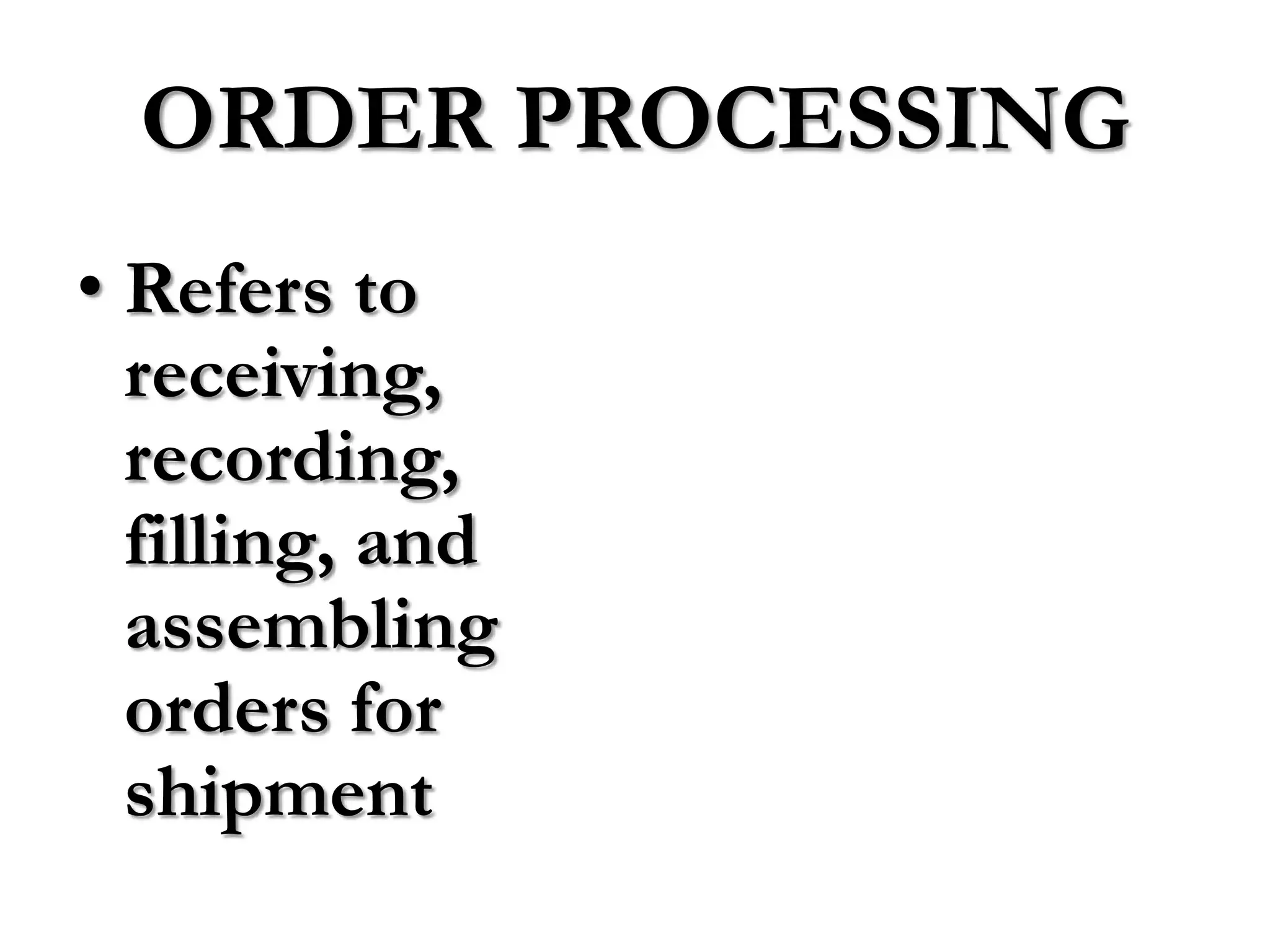
ORDER PROCESSING
• Refers to
  receiving,
  recording,
  filling, and
  assembling
  orders for
  shipment
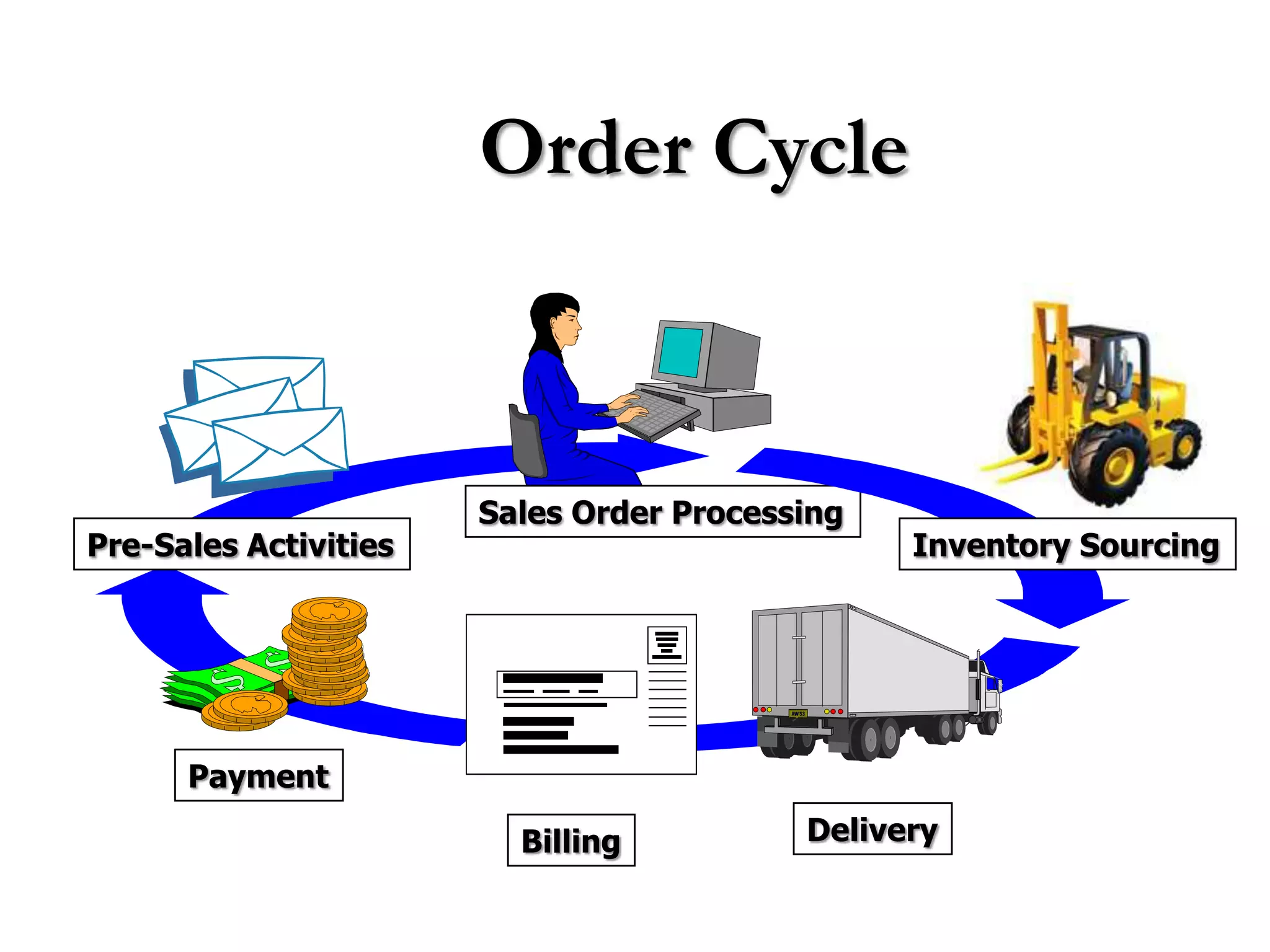
Order Cycle


                       Sales Order Processing
Pre-Sales Activities                            Inventory Sourcing


      Payment

                         Billing          Delivery
Pre-Sales Activities
• It contains the following functionality:
   – Creating and tracking customer contacts and communications (sales
     activity)
       •   Phone call records
       •   On-site meeting
       •   Letters
       •   Campaign communication
   – Implementing and tracking direct mailing, internet, and trade fair
     campaigns based on customer attributes
• Pre-sales documents need to be managed within the presales activities:
  Inquiries and Quotations. These documents help identify possible sales
  related activity and determine sales probability.
Inquiry
• An inquiry is a customer’s request to a
  company for information or quotation in
  respect to their products or services without
  obligation to purchase.
       – How much will it cost
       – Material/Service availability
       – May contain specific quantities and dates
• The inquiry is maintained in the system and a
  quotation is created to address questions for
  the potential customer.

January 2007 (v1.0)       The Rushmore Group, LLC    6
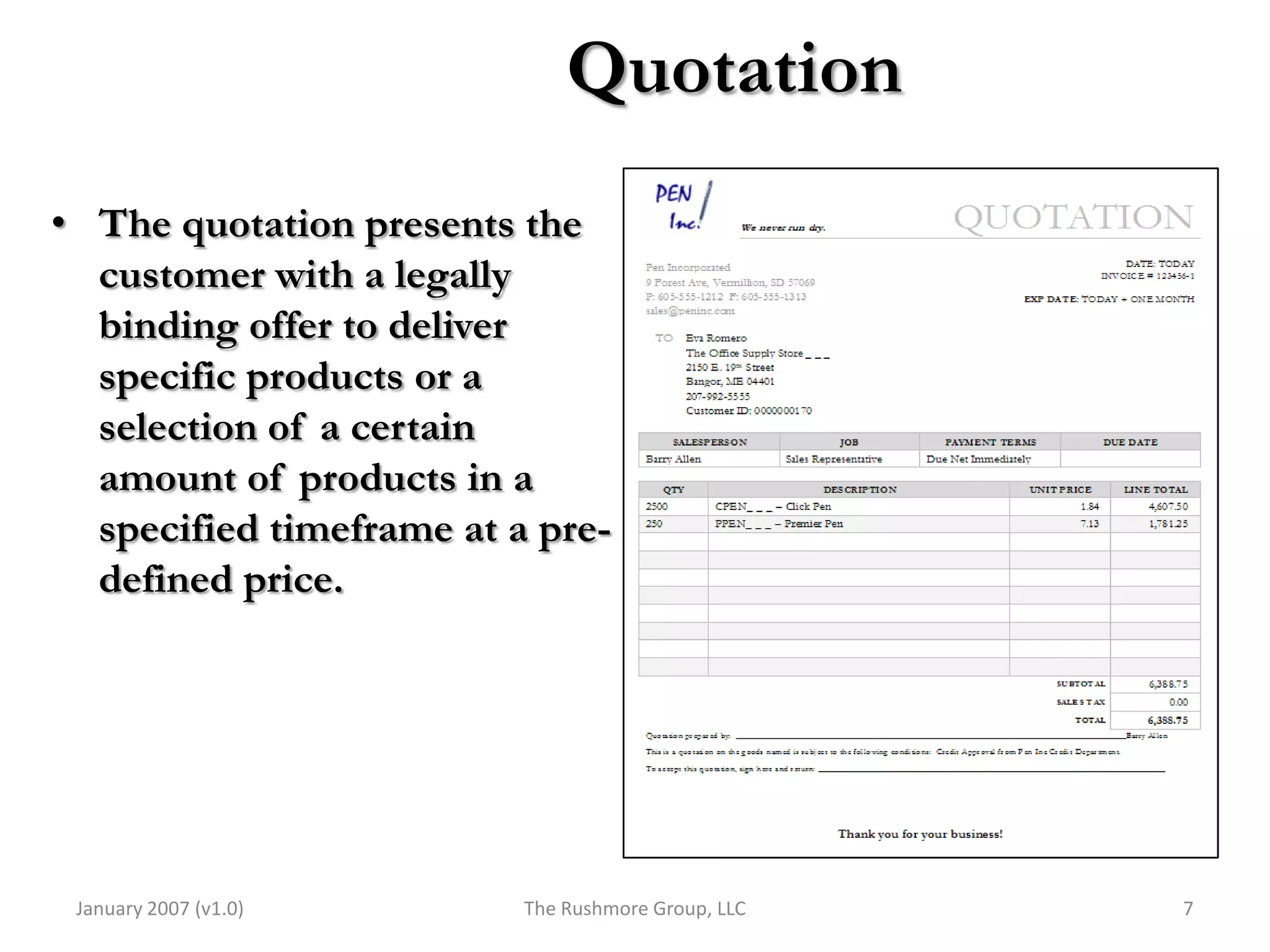
Quotation
• The quotation presents the
  customer with a legally
  binding offer to deliver
  specific products or a
  selection of a certain
  amount of products in a
  specified timeframe at a pre-
  defined price.


 January 2007 (v1.0)      The Rushmore Group, LLC   7
Sales Order Processing
• Customers place orders with a customer service
  representative who create a document* with information
  on:
   – Customer
   – Material Ordered - material and quantity
   – Pricing conditions for each item
   – Schedule lines - delivery dates and quantities
   – Delivery Information
   – Billing information
• Information is pulled from master data on customers
  and materials to minimize data entry errors.
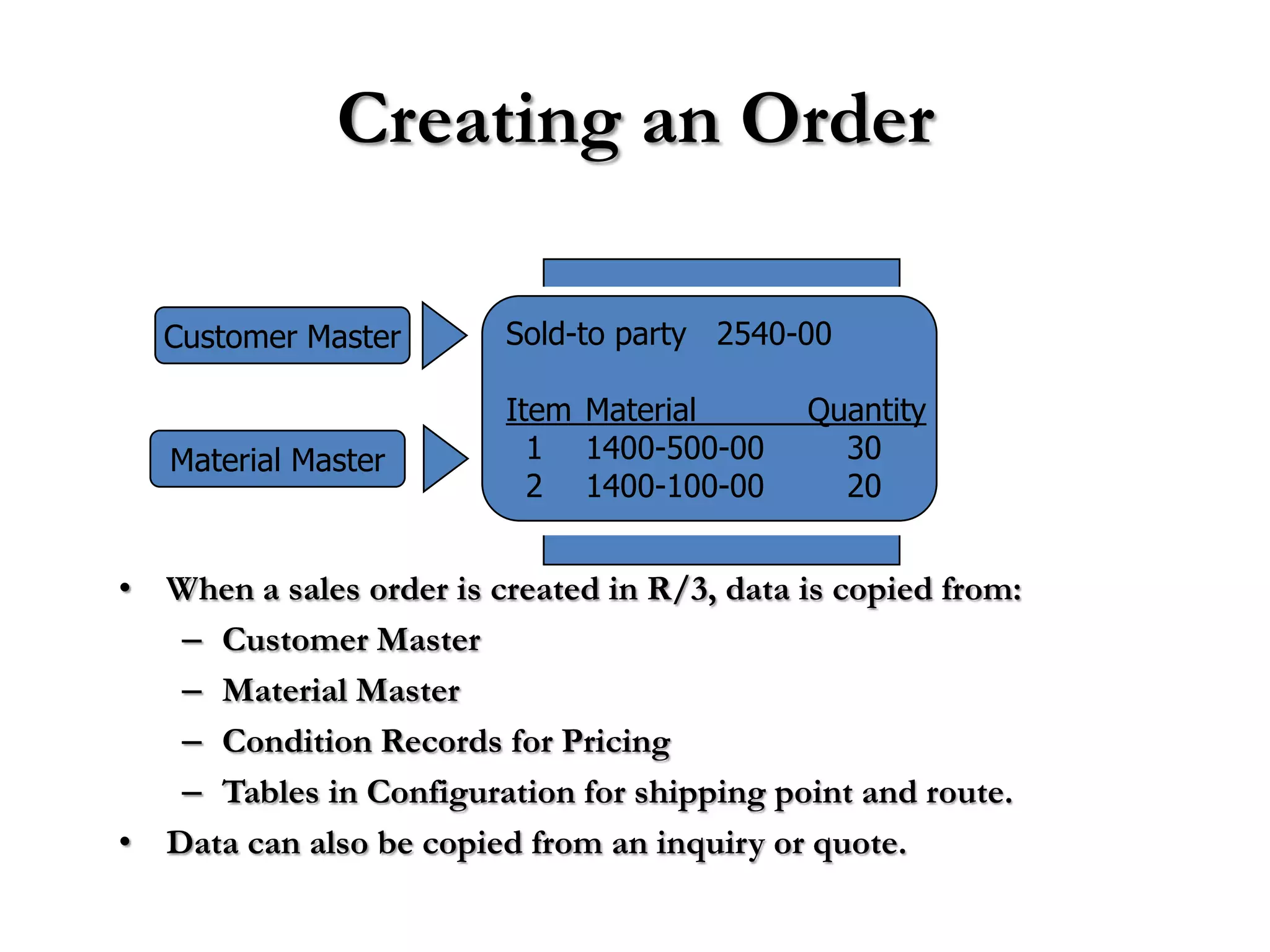
Creating an Order

   Customer Master       Sold-to party 2540-00

                         Item Material       Quantity
   Material Master         1 1400-500-00       30
                           2 1400-100-00       20


• When a sales order is created in R/3, data is copied from:
   – Customer Master
   – Material Master
   – Condition Records for Pricing
   – Tables in Configuration for shipping point and route.
• Data can also be copied from an inquiry or quote.
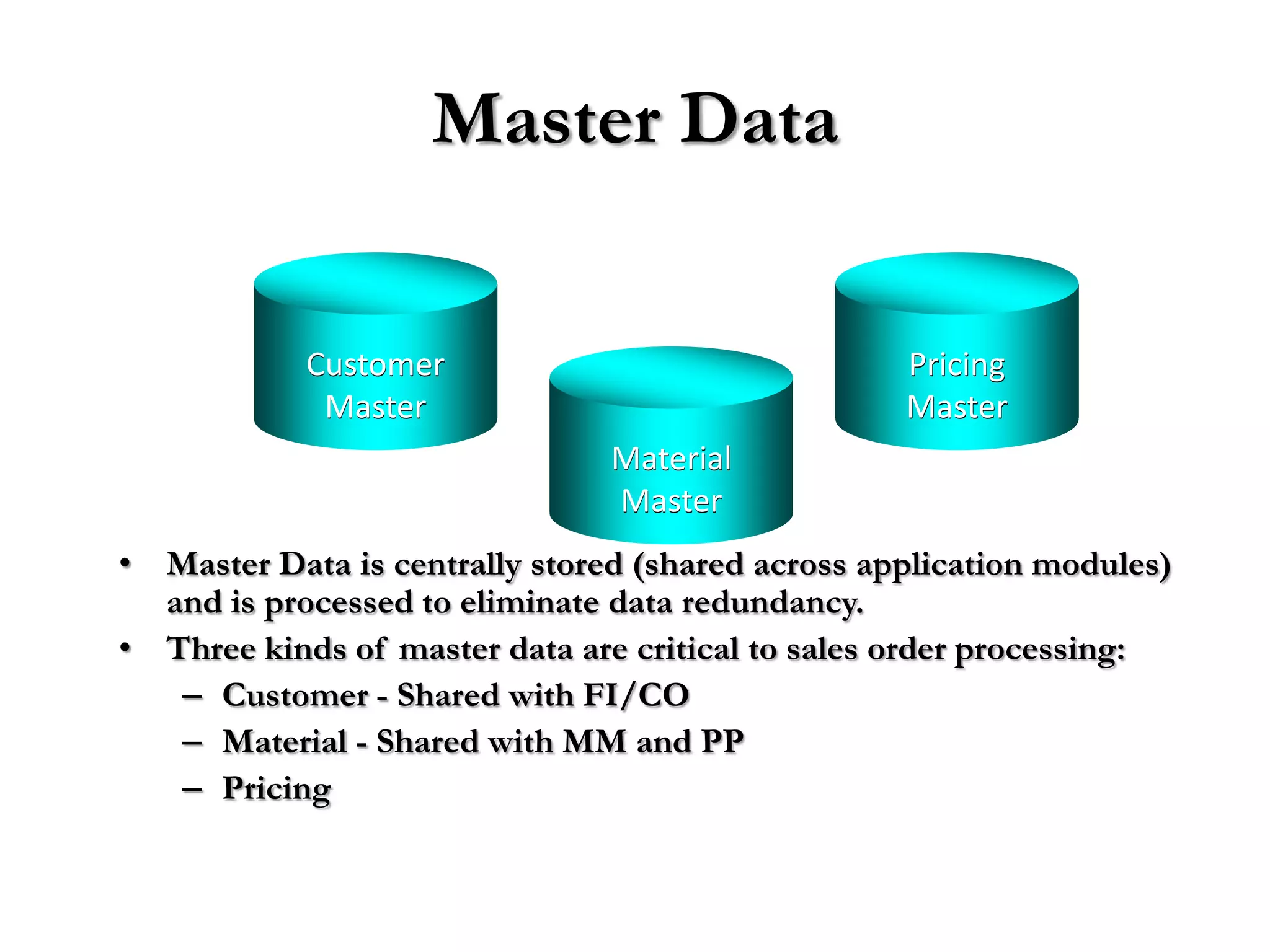
Master Data

            Customer                               Pricing
             Master                                Master
                                Material
                                Master
• Master Data is centrally stored (shared across application modules)
  and is processed to eliminate data redundancy.
• Three kinds of master data are critical to sales order processing:
   – Customer - Shared with FI/CO
   – Material - Shared with MM and PP
   – Pricing
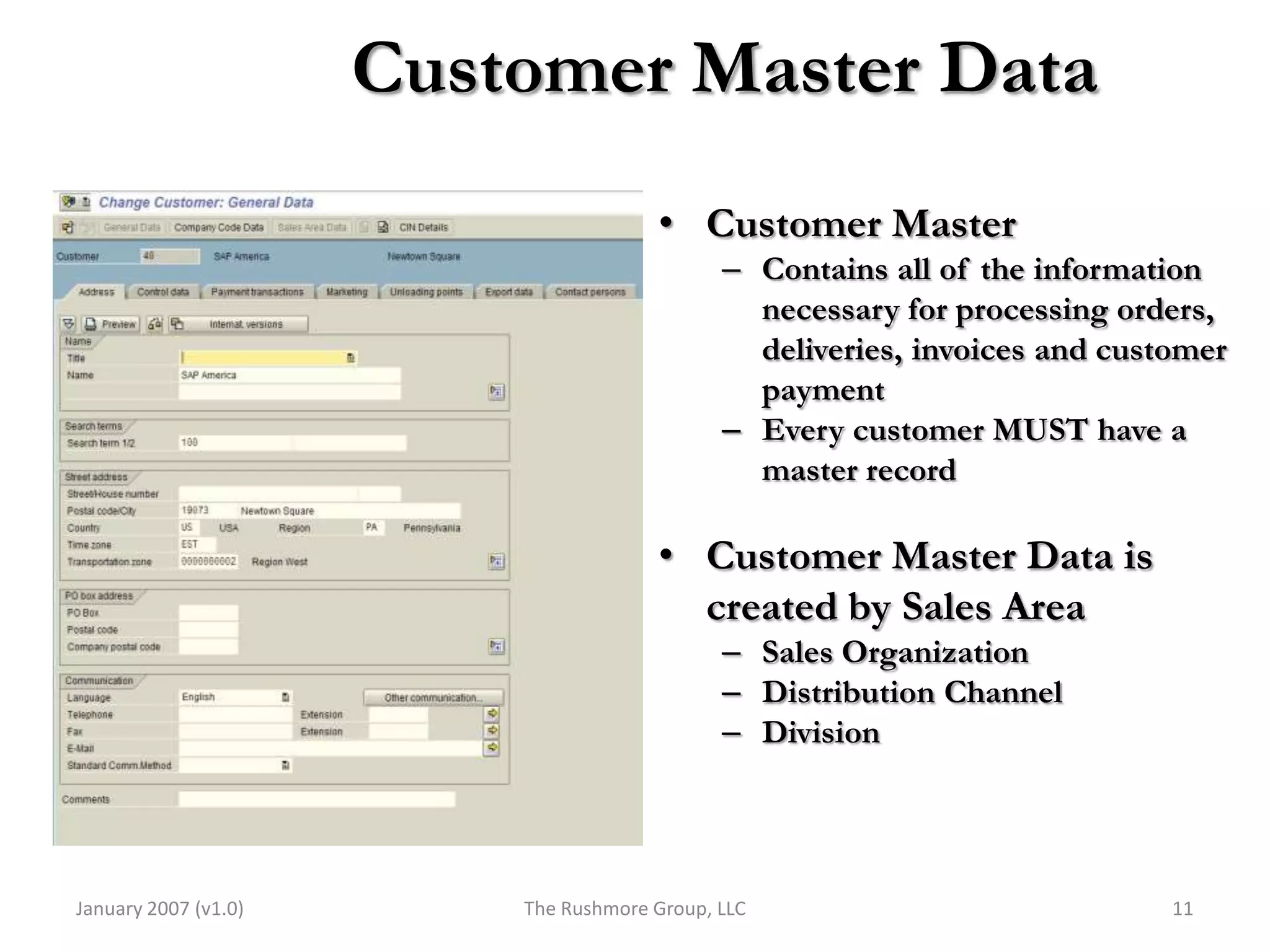
Customer Master Data
                                       • Customer Master
                                              – Contains all of the information
                                                necessary for processing orders,
                                                deliveries, invoices and customer
                                                payment
                                              – Every customer MUST have a
                                                master record

                                       • Customer Master Data is
                                         created by Sales Area
                                              – Sales Organization
                                              – Distribution Channel
                                              – Division


January 2007 (v1.0)       The Rushmore Group, LLC                            11
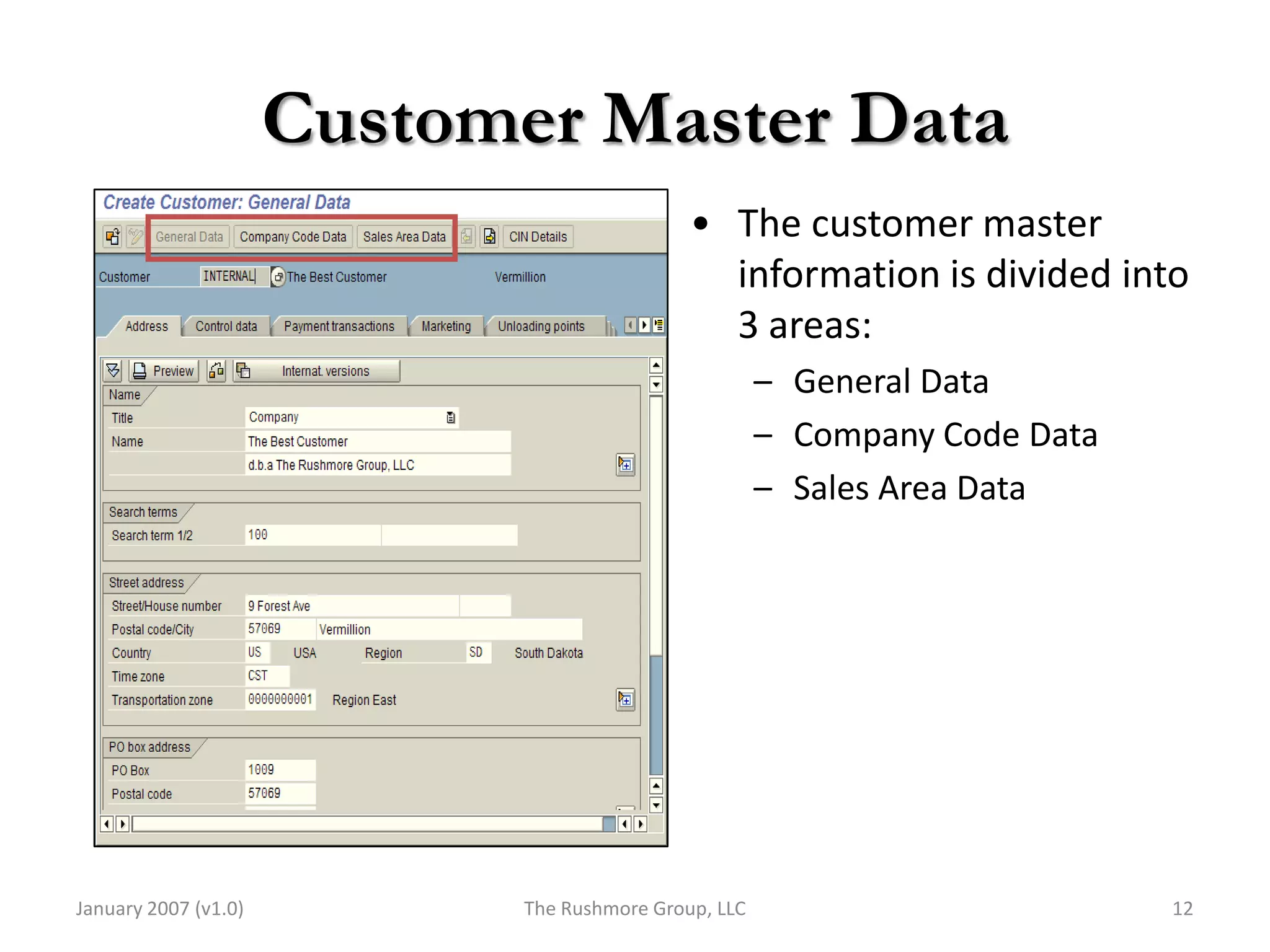
Customer Master Data
                                              • The customer master
                                                information is divided into
                                                3 areas:
                                                       – General Data
                                                       – Company Code Data
                                                       – Sales Area Data


January 2007 (v1.0)          The Rushmore Group, LLC                         12
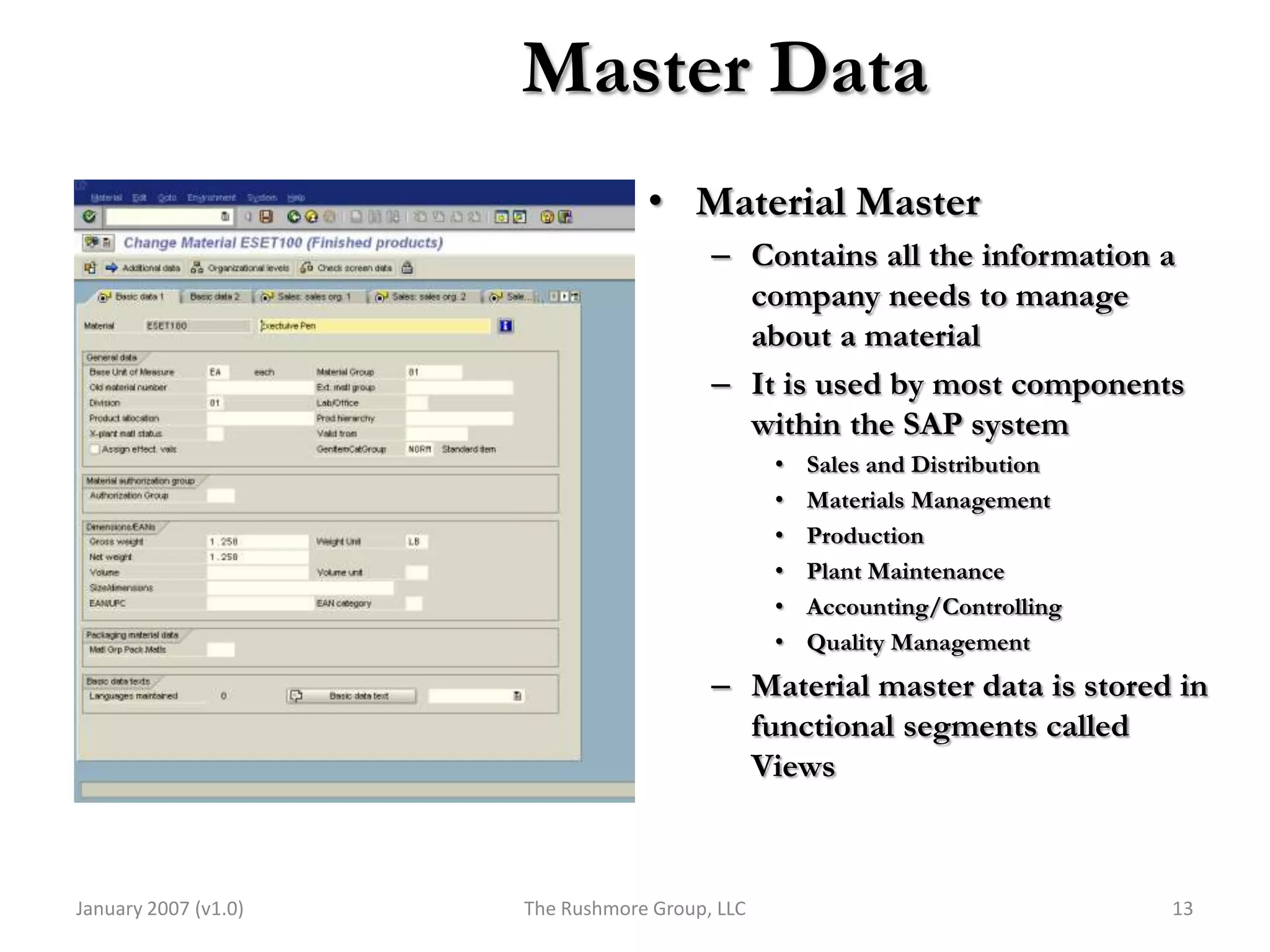
Master Data
                                  • Material Master
                                         – Contains all the information a
                                           company needs to manage
                                           about a material
                                         – It is used by most components
                                           within the SAP system
                                                •   Sales and Distribution
                                                •   Materials Management
                                                •   Production
                                                •   Plant Maintenance
                                                •   Accounting/Controlling
                                                •   Quality Management
                                         – Material master data is stored in
                                           functional segments called
                                           Views


January 2007 (v1.0)   The Rushmore Group, LLC                                13
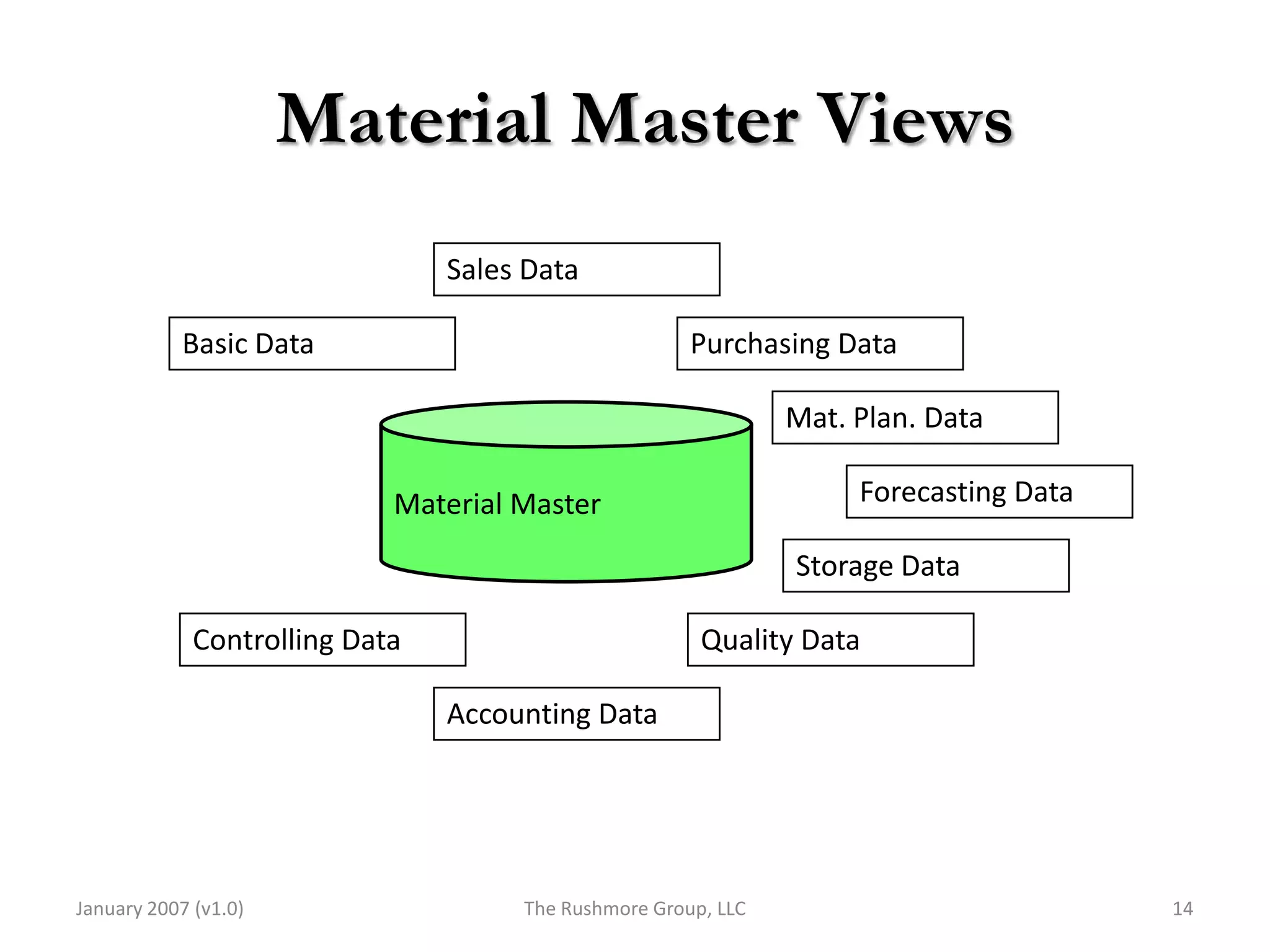
Material Master Views
                                Sales Data

           Basic Data                                 Purchasing Data

                                                               Mat. Plan. Data

                            Material Master                         Forecasting Data

                                                               Storage Data

             Controlling Data                          Quality Data

                                Accounting Data


January 2007 (v1.0)                  The Rushmore Group, LLC                           14
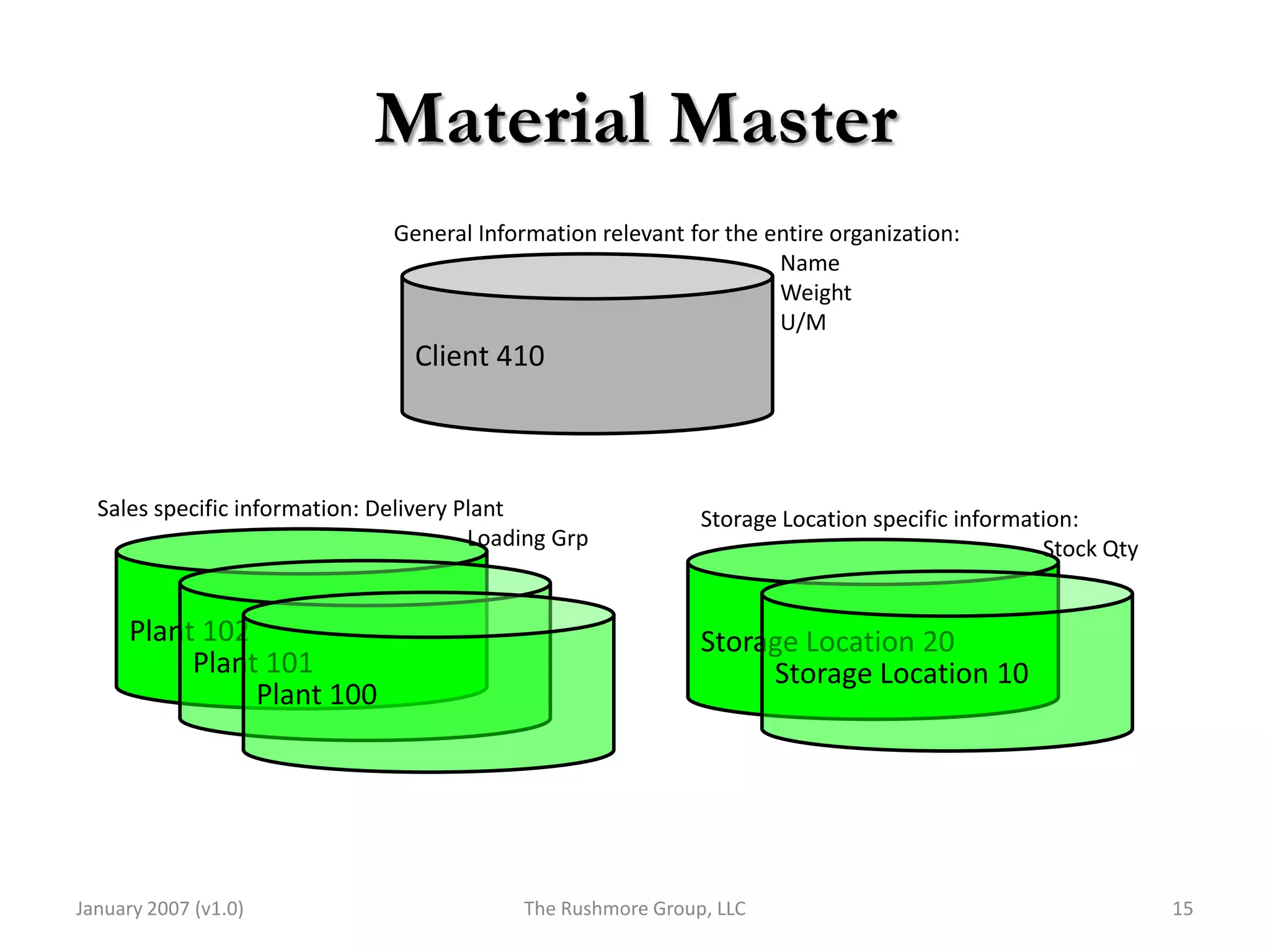
Material Master
                               General Information relevant for the entire organization:
                                                                     Name
                                                                     Weight
                                                                     U/M
                                 Client 410


  Sales specific information: Delivery Plant                  Storage Location specific information:
                                        Loading Grp                                             Stock Qty


     Plant 102                                                Storage Location 20
          Plant 101                                                Storage Location 10
               Plant 100


January 2007 (v1.0)                         The Rushmore Group, LLC                                         15
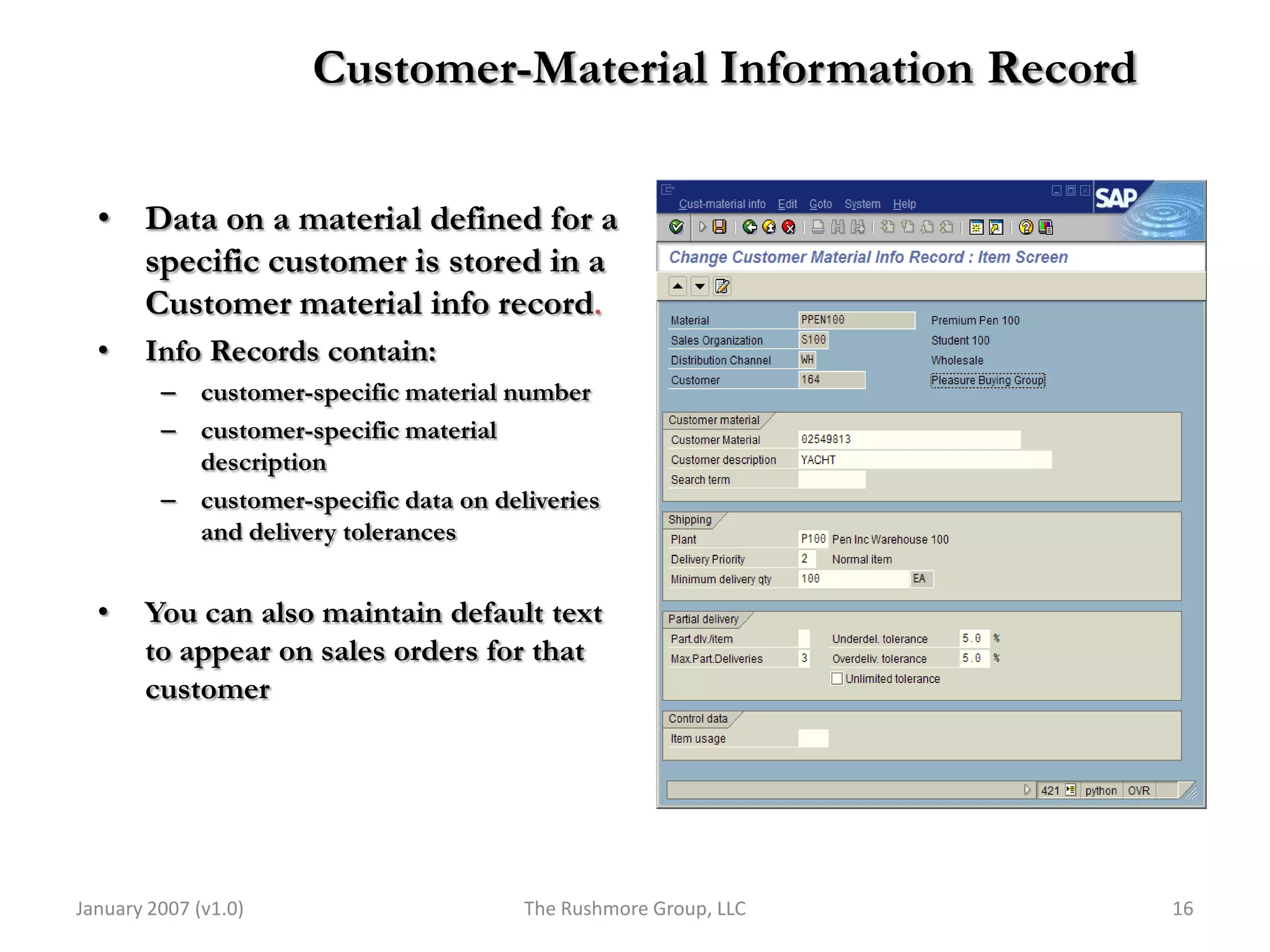
Customer-Material Information Record

  • Data on a material defined for a
    specific customer is stored in a
    Customer material info record.
  •    Info Records contain:
         – customer-specific material number
         – customer-specific material
           description
         – customer-specific data on deliveries
           and delivery tolerances


  •    You can also maintain default text
       to appear on sales orders for that
       customer


January 2007 (v1.0)                     The Rushmore Group, LLC   16
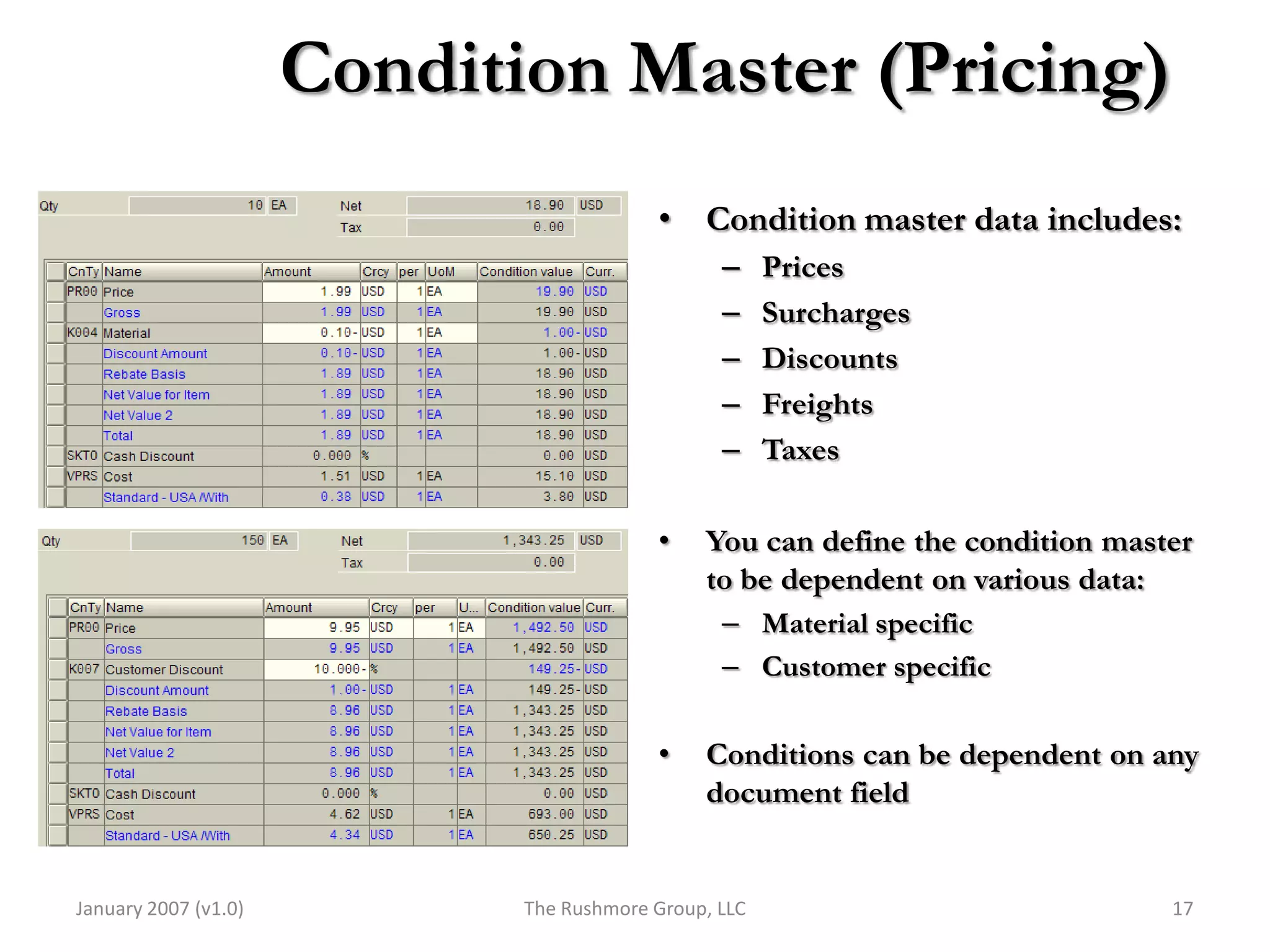
Condition Master (Pricing)
                                          • Condition master data includes:
                                                 –     Prices
                                                 –     Surcharges
                                                 –     Discounts
                                                 –     Freights
                                                 –     Taxes

                                          •    You can define the condition master
                                               to be dependent on various data:
                                                 – Material specific
                                                 – Customer specific

                                          •    Conditions can be dependent on any
                                               document field


January 2007 (v1.0)          The Rushmore Group, LLC                            17
Inventory Sourcing

• Inventory Sourcing determines:
   – If a product is available (availability check).
   – How the product will be supplied:
       • From stock on hand.
       • From production or purchase orders that should
         be available.
       • From make-to-order production.
       • Shipped from an external supplier.
       • Shipped from another plant or warehouse.
Inventory Sourcing

• Inventory sourcing occurs when:
  – An order is created.
  – An order is changed.
  – When the delivery document is created.
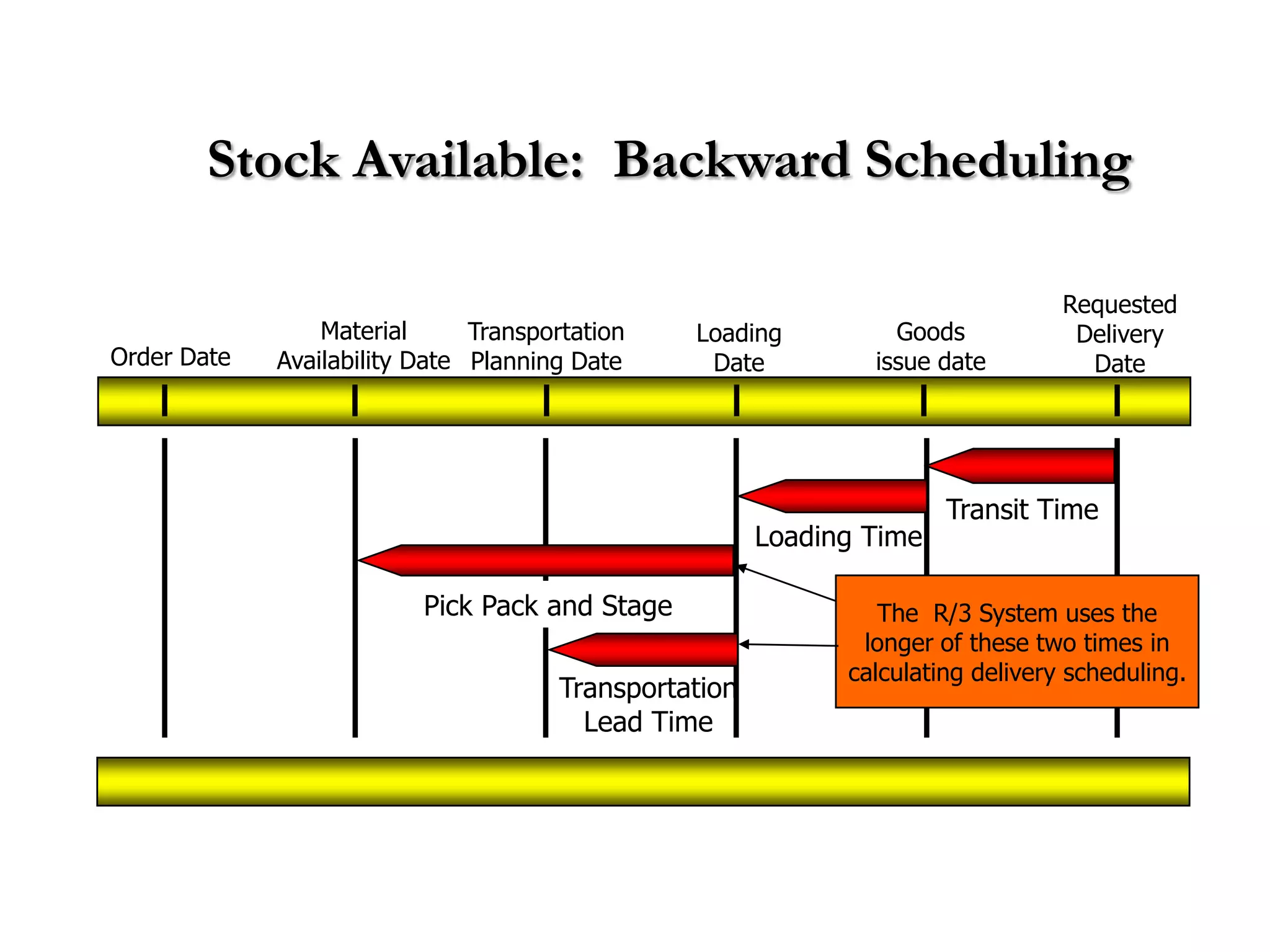
Stock Available: Backward Scheduling

                                                                                 Requested
                 Material      Transportation   Loading          Goods            Delivery
Order Date   Availability Date Planning Date     Date          issue date          Date


                                                                      Transit Time
                                                       Loading Time

                          Pick Pack and Stage                   The R/3 System uses the
                                                              longer of these two times in
                                                             calculating delivery scheduling.
                                      Transportation
                                        Lead Time
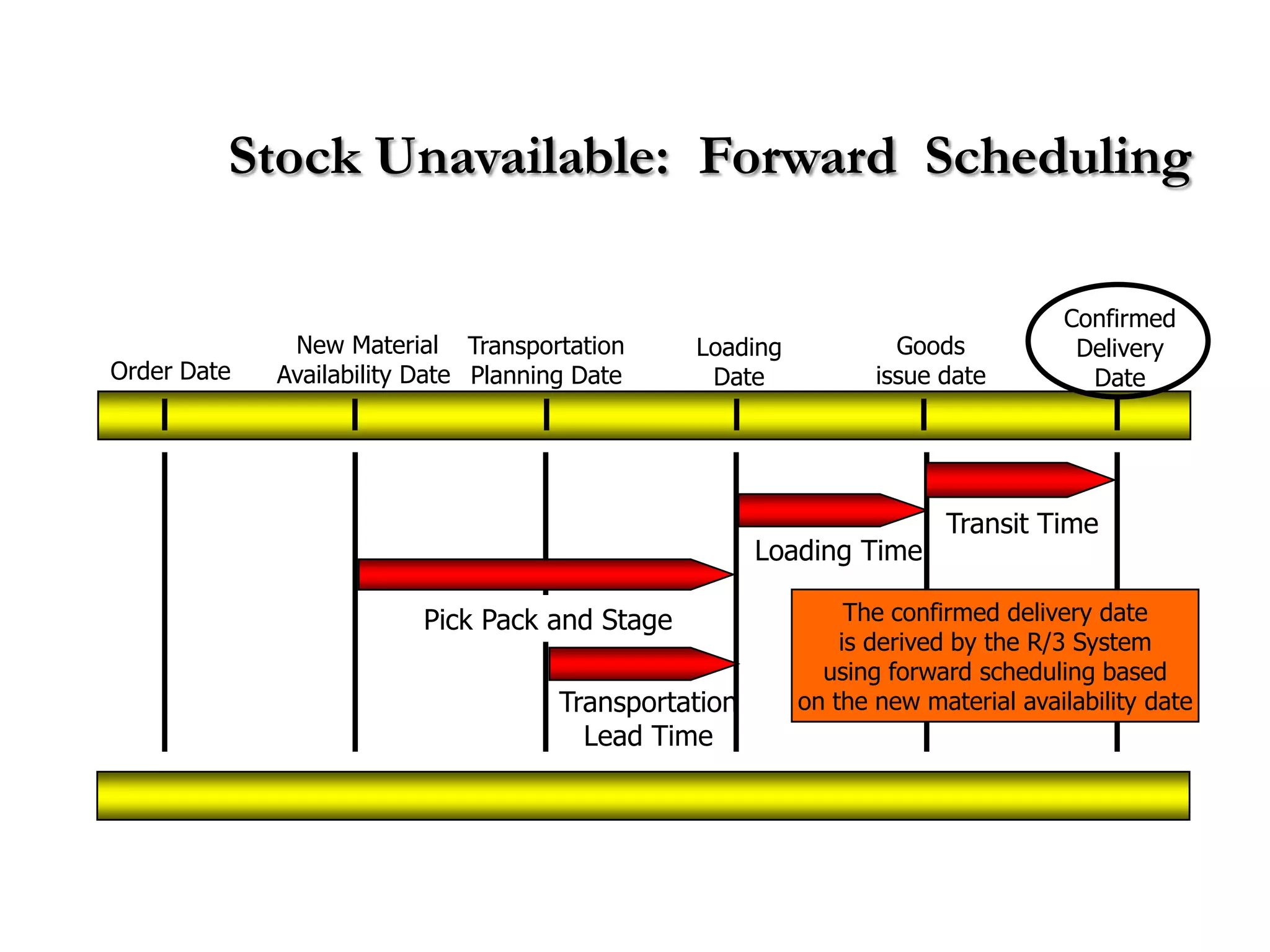
Stock Unavailable: Forward Scheduling

                                                                                  Confirmed
              New Material Transportation       Loading            Goods           Delivery
Order Date   Availability Date Planning Date     Date            issue date         Date


                                                                       Transit Time
                                                       Loading Time

                          Pick Pack and Stage                  The confirmed delivery date
                                                              is derived by the R/3 System
                                                            using forward scheduling based
                                      Transportation      on the new material availability date
                                        Lead Time
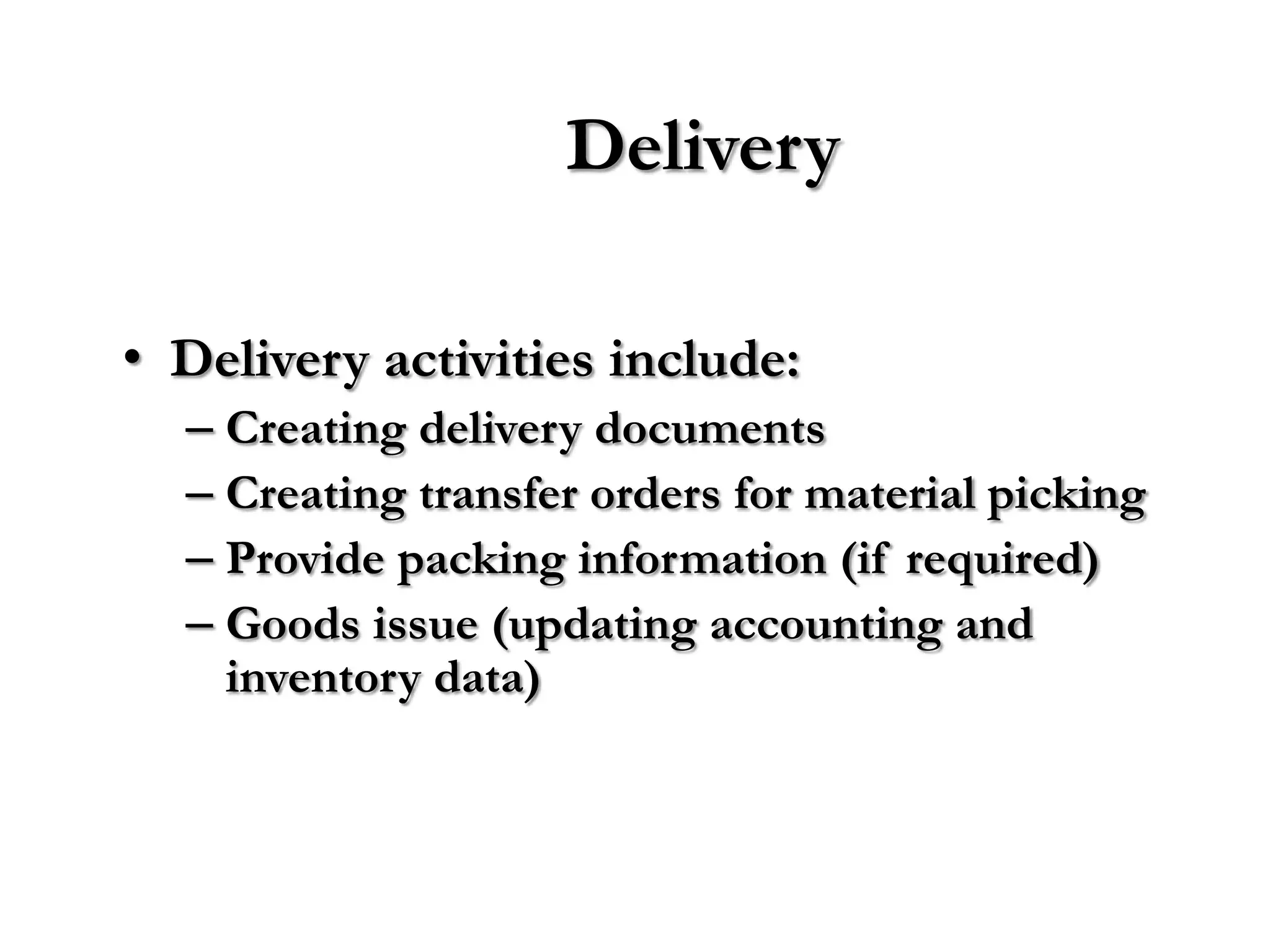
Delivery

• Delivery activities include:
  – Creating delivery documents
  – Creating transfer orders for material picking
  – Provide packing information (if required)
  – Goods issue (updating accounting and
    inventory data)
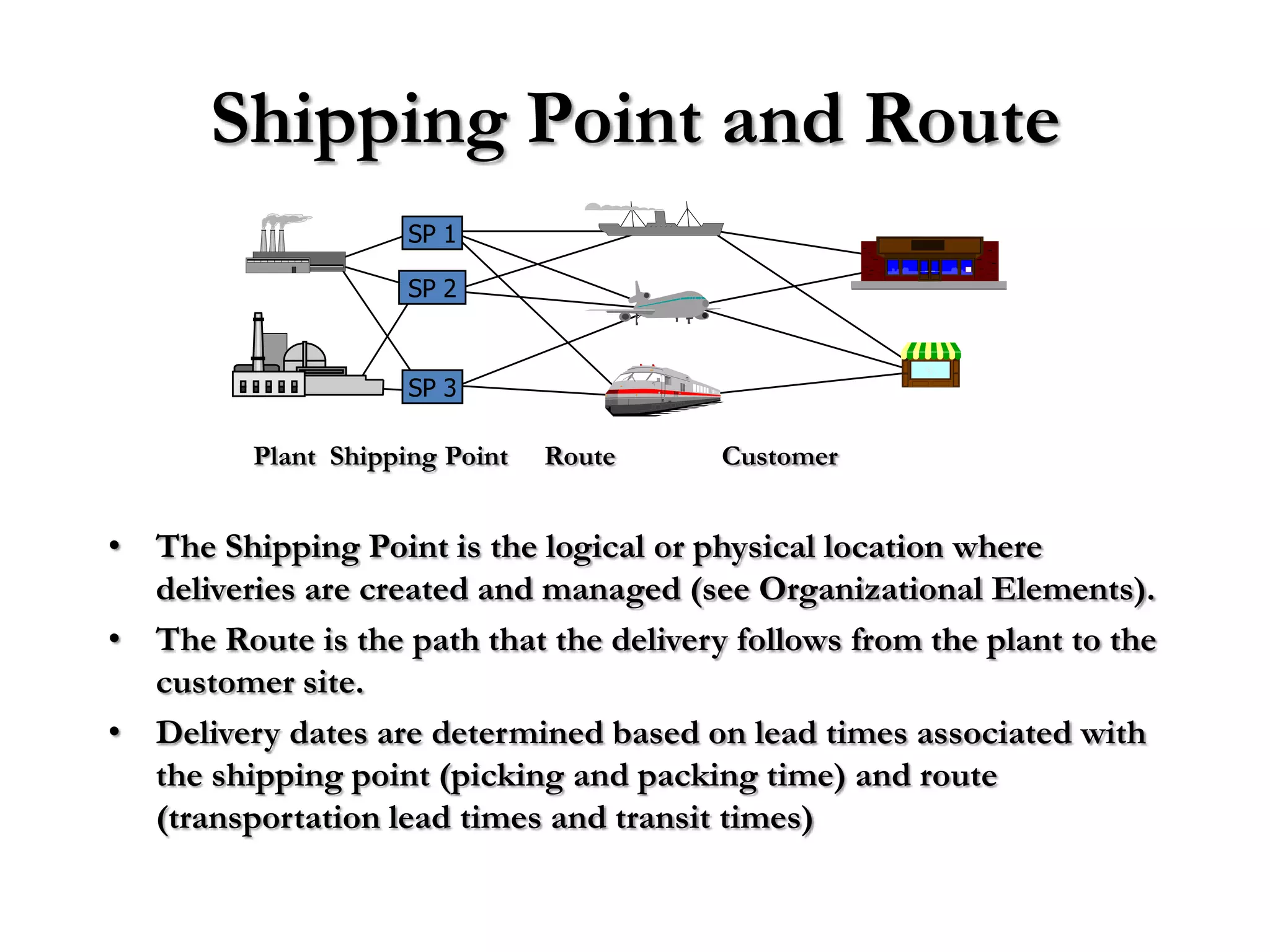
Shipping Point and Route
                     SP 1

                     SP 2


                     SP 3

         Plant Shipping Point   Route    Customer


• The Shipping Point is the logical or physical location where
  deliveries are created and managed (see Organizational Elements).
• The Route is the path that the delivery follows from the plant to the
  customer site.
• Delivery dates are determined based on lead times associated with
  the shipping point (picking and packing time) and route
  (transportation lead times and transit times)
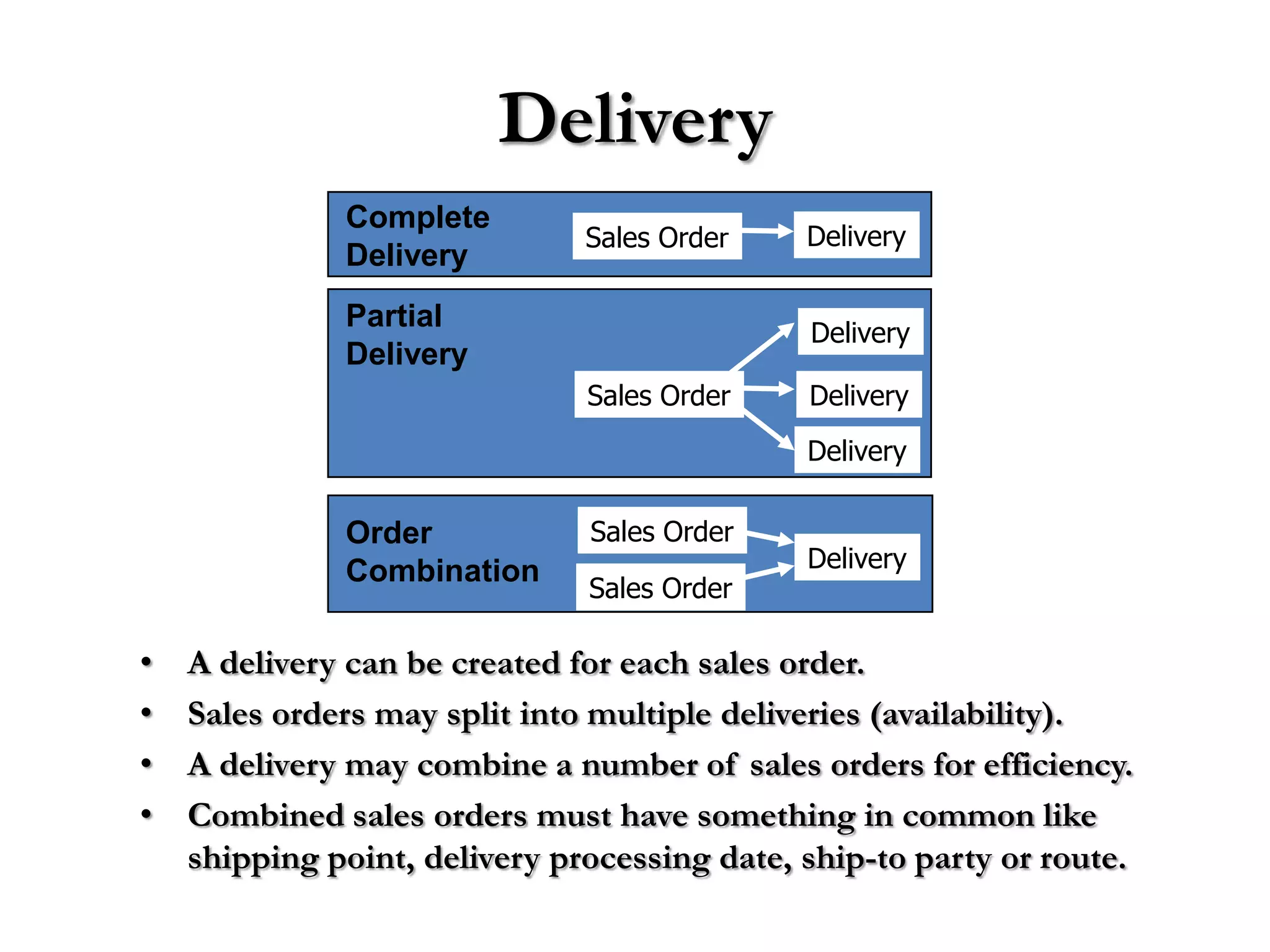
Delivery
              Complete
                               Sales Order    Delivery
              Delivery
              Partial
                                              Delivery
              Delivery
                               Sales Order    Delivery
                                              Delivery

              Order            Sales Order
              Combination                     Delivery
                               Sales Order

•   A delivery can be created for each sales order.
•   Sales orders may split into multiple deliveries (availability).
•   A delivery may combine a number of sales orders for efficiency.
•   Combined sales orders must have something in common like
    shipping point, delivery processing date, ship-to party or route.
Billing

• A Billing Document is created by copying information
  for the sales order and delivery document into the
  billing document which is used to create the invoice.
• Creating a Billing Document will automatically debit
  the customer’s accounts receivable account and credits
  the revenue account. Postings may also be made to
  other accounts.
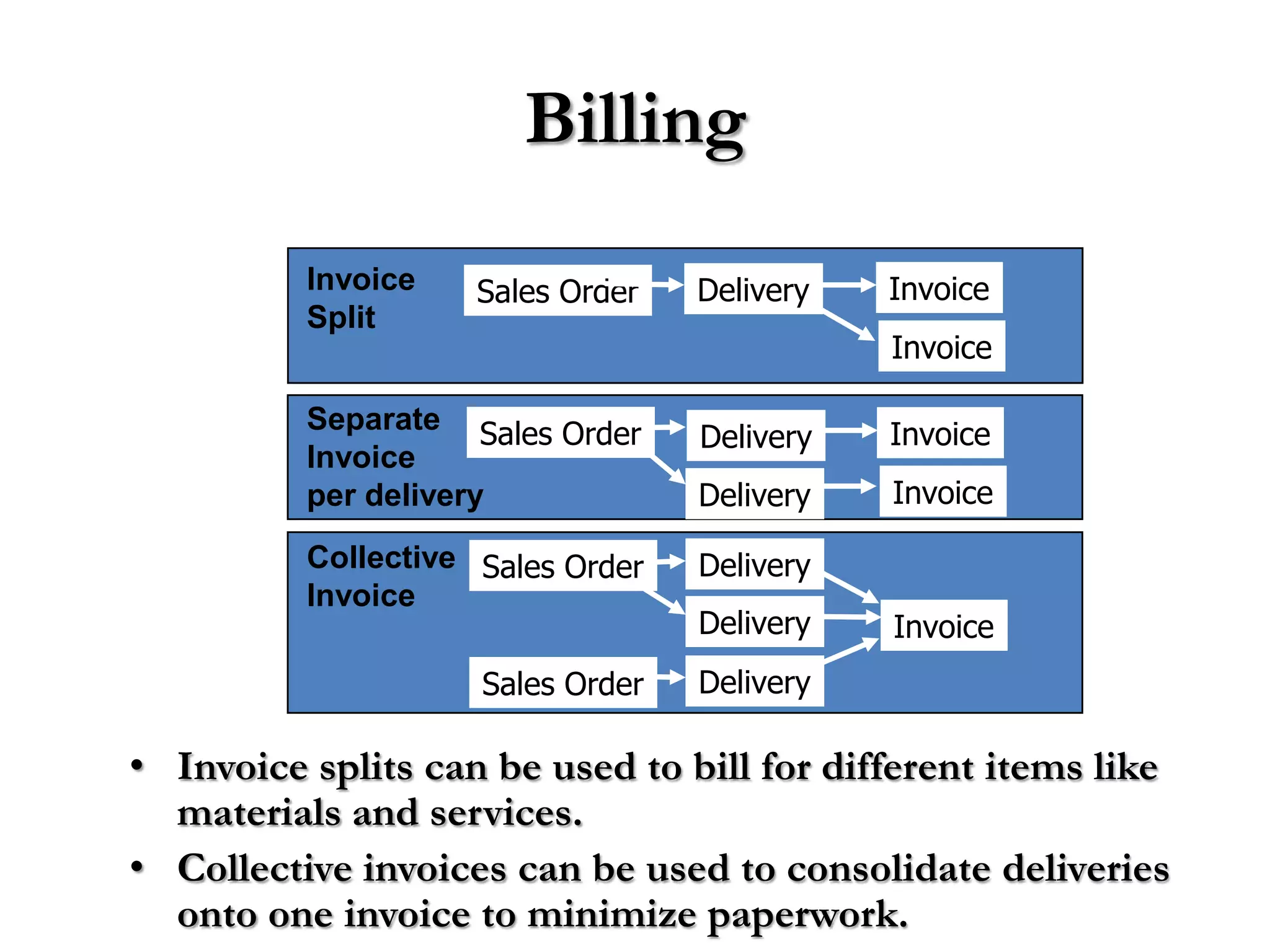
Billing
          Invoice    Sales Order   Delivery   Invoice
          Split
                                              Invoice

          Separate Sales Order                Invoice
                                   Delivery
          Invoice
          per delivery             Delivery   Invoice

          Collective Sales Order   Delivery
          Invoice
                                   Delivery   Invoice
                     Sales Order   Delivery

• Invoice splits can be used to bill for different items like
  materials and services.
• Collective invoices can be used to consolidate deliveries
  onto one invoice to minimize paperwork.
Payment

• Payment is the final step in the customer order
  management cycle.
• Final payment includes:
   – Posting payments against invoices.
   – Reconciling differences, if necessary.

• The Cycle may not always go as planned (material not
  in stock, defective material returned for credit, etc.).
  SAP has procedures to deal with these possibilities.
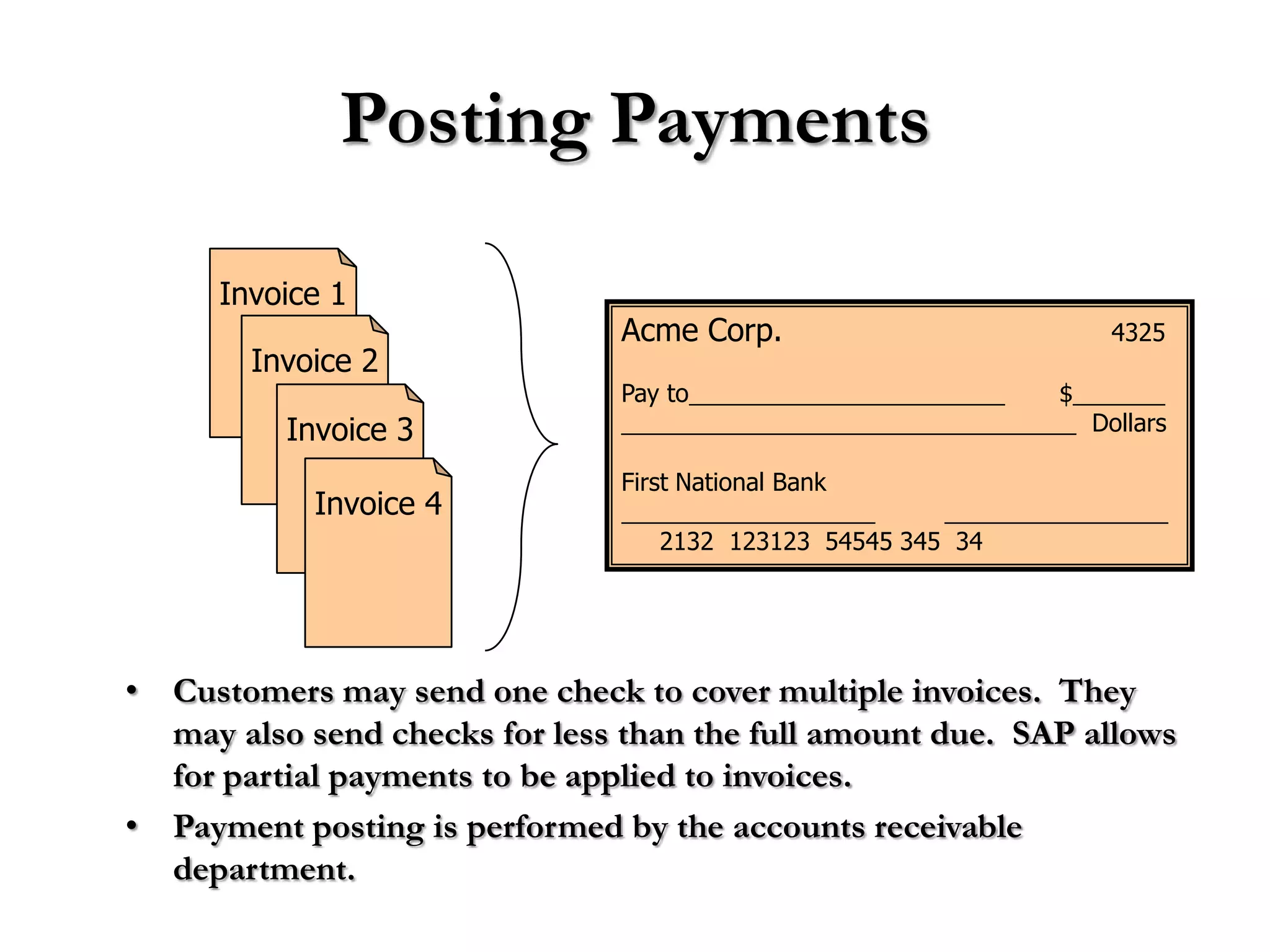
Posting Payments

      Invoice 1
                                Acme Corp.                         4325
        Invoice 2
                                Pay to                        $
          Invoice 3                                               Dollars

                                First National Bank
            Invoice 4
                                   2132 123123 54545 345 34


• Customers may send one check to cover multiple invoices. They
  may also send checks for less than the full amount due. SAP allows
  for partial payments to be applied to invoices.
• Payment posting is performed by the accounts receivable
  department.
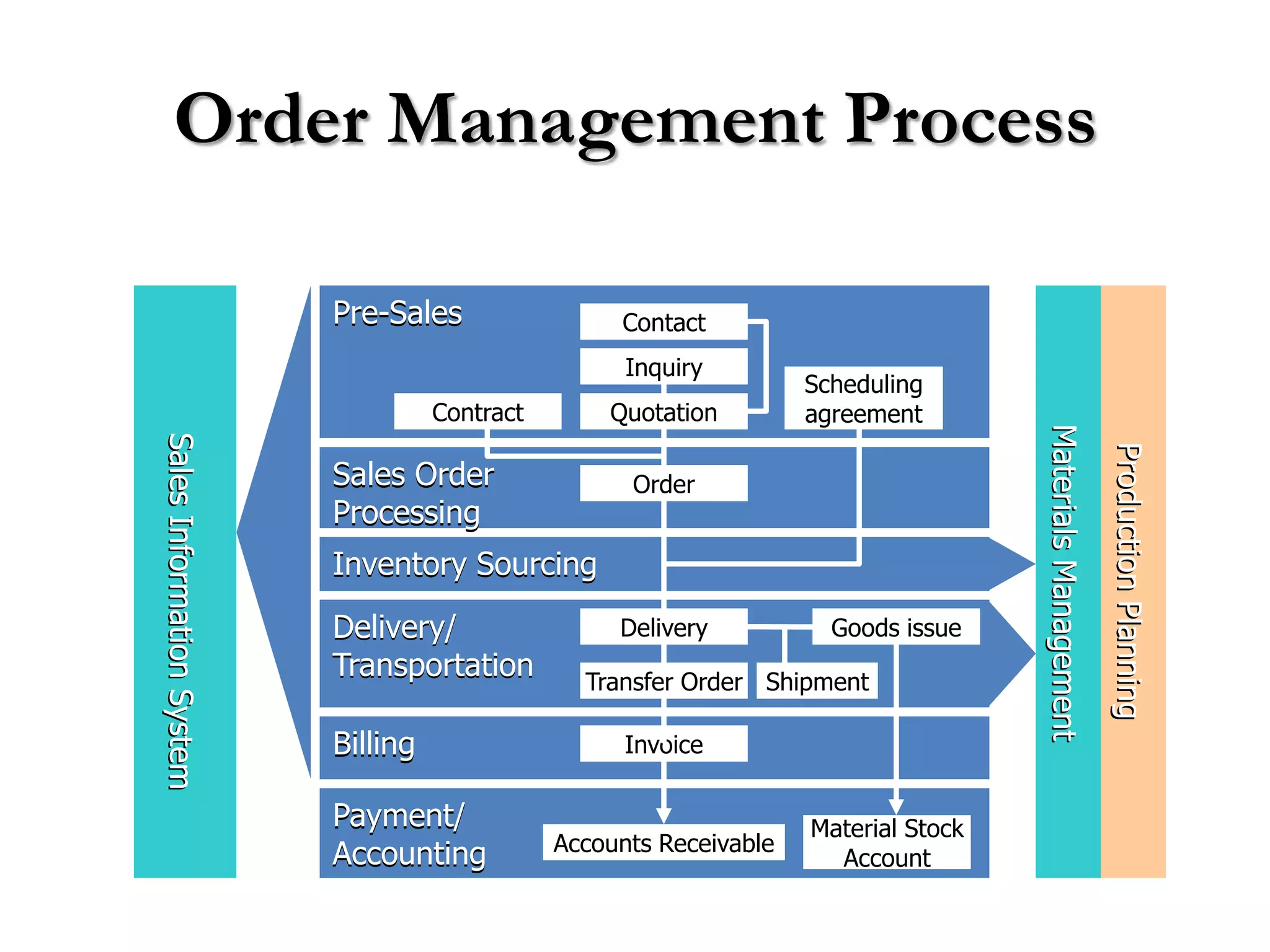
Order Management Process

                           Pre-Sales                 Contact
                                                      Inquiry
                                                                      Scheduling
                                     Contract       Quotation         agreement


                                                                                       Materials Management
                                                                                       Materials Management
Sales Information System


                                                                                                              Production Planning
                                                                                                              Production Planning
                           Sales Order                Order
                           Processing
                           Inventory Sourcing
                           Delivery/                 Delivery           Goods issue
                           Transportation         Transfer Order Shipment

                           Billing                    Invoice


                           Payment/                                   Material Stock
                                                Accounts Receivable
                           Accounting                                   Account
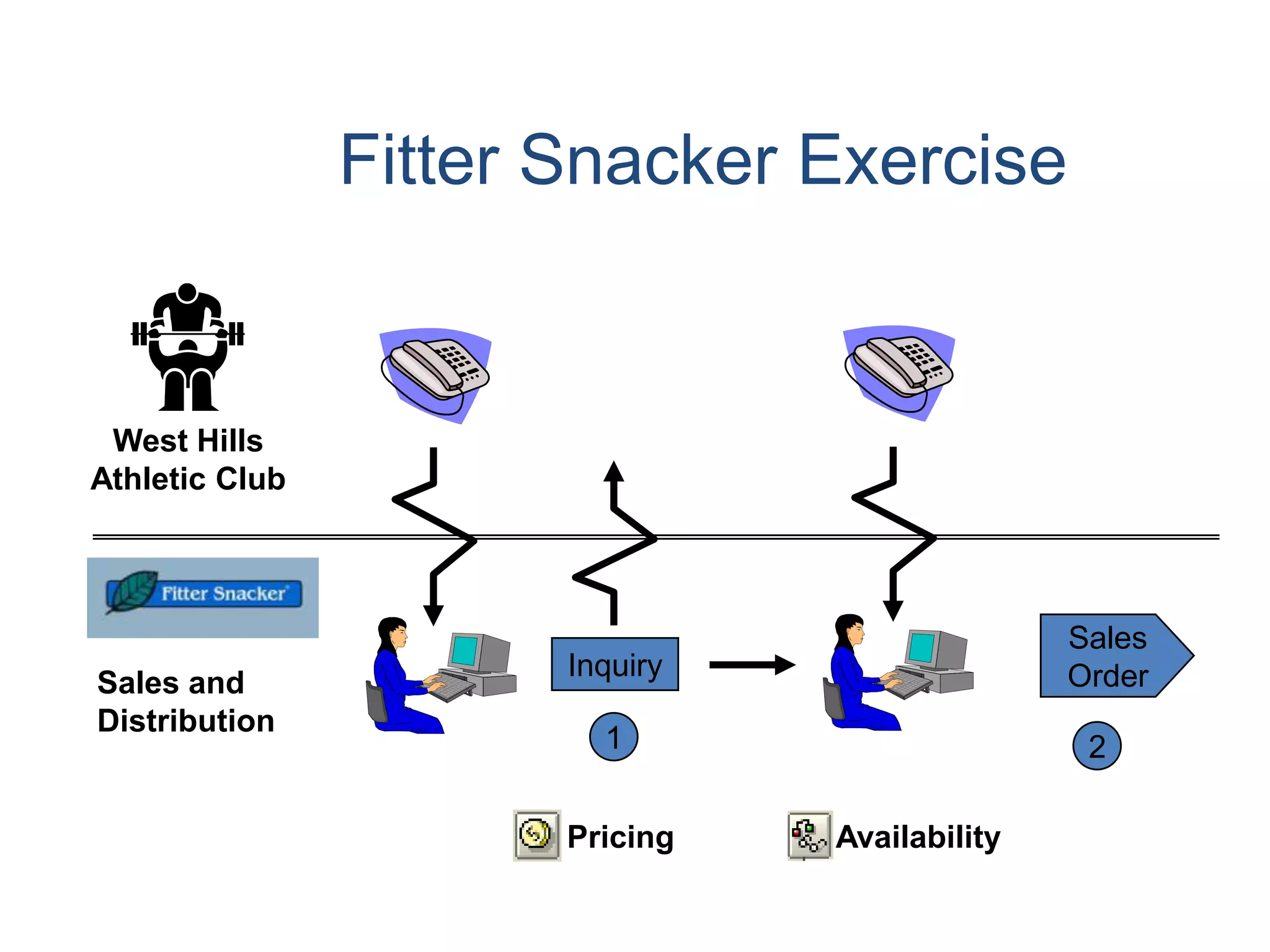
Fitter Snacker Exercise


 West Hills
Athletic Club


                                                Sales
                       Inquiry                  Order
Sales and
Distribution
                         1                       2

                       Pricing   Availability
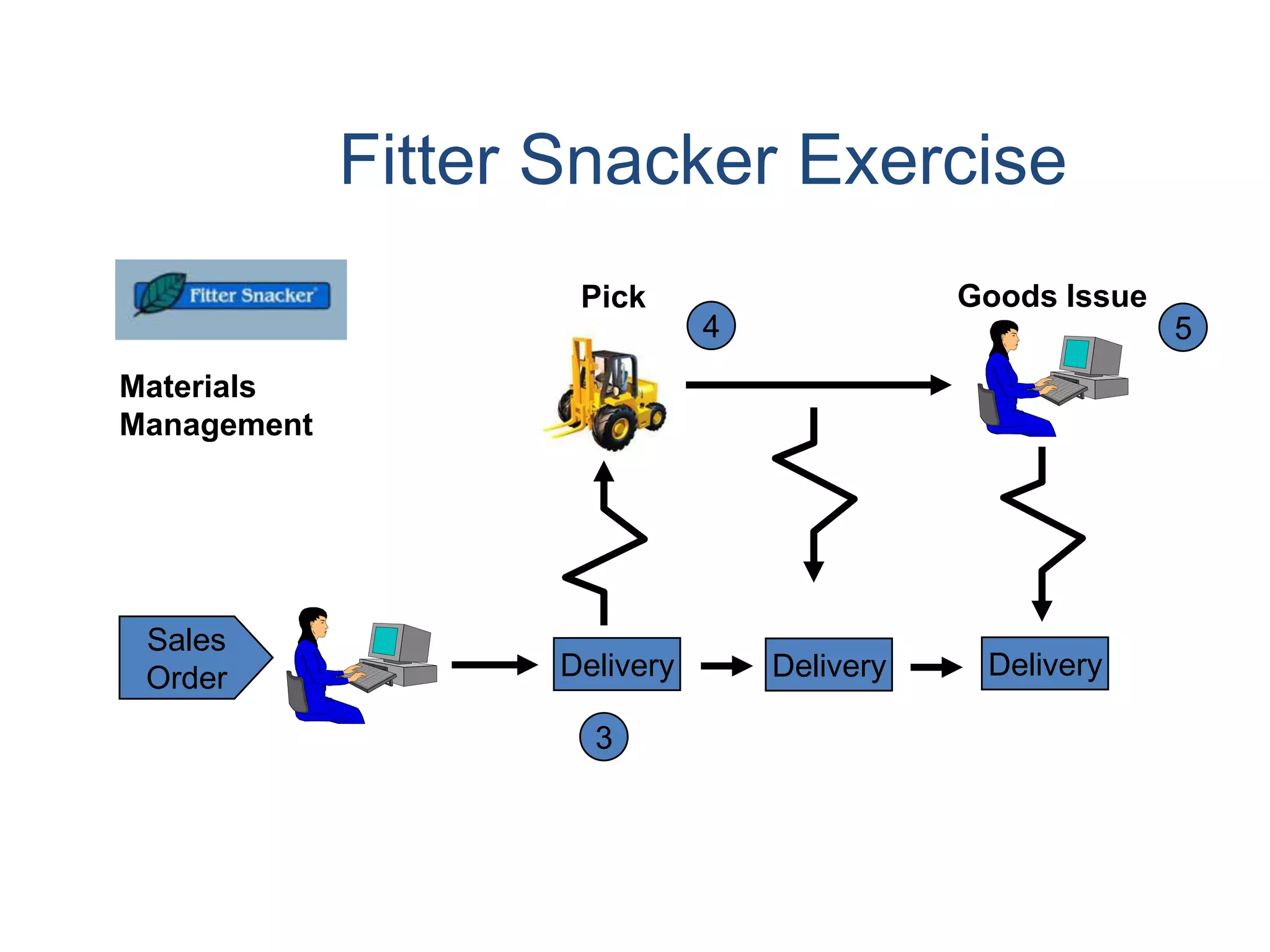
Fitter Snacker Exercise
                    Pick                     Goods Issue
                              4                            5
Materials
Management


 Sales
 Order             Delivery       Delivery    Delivery

                     3
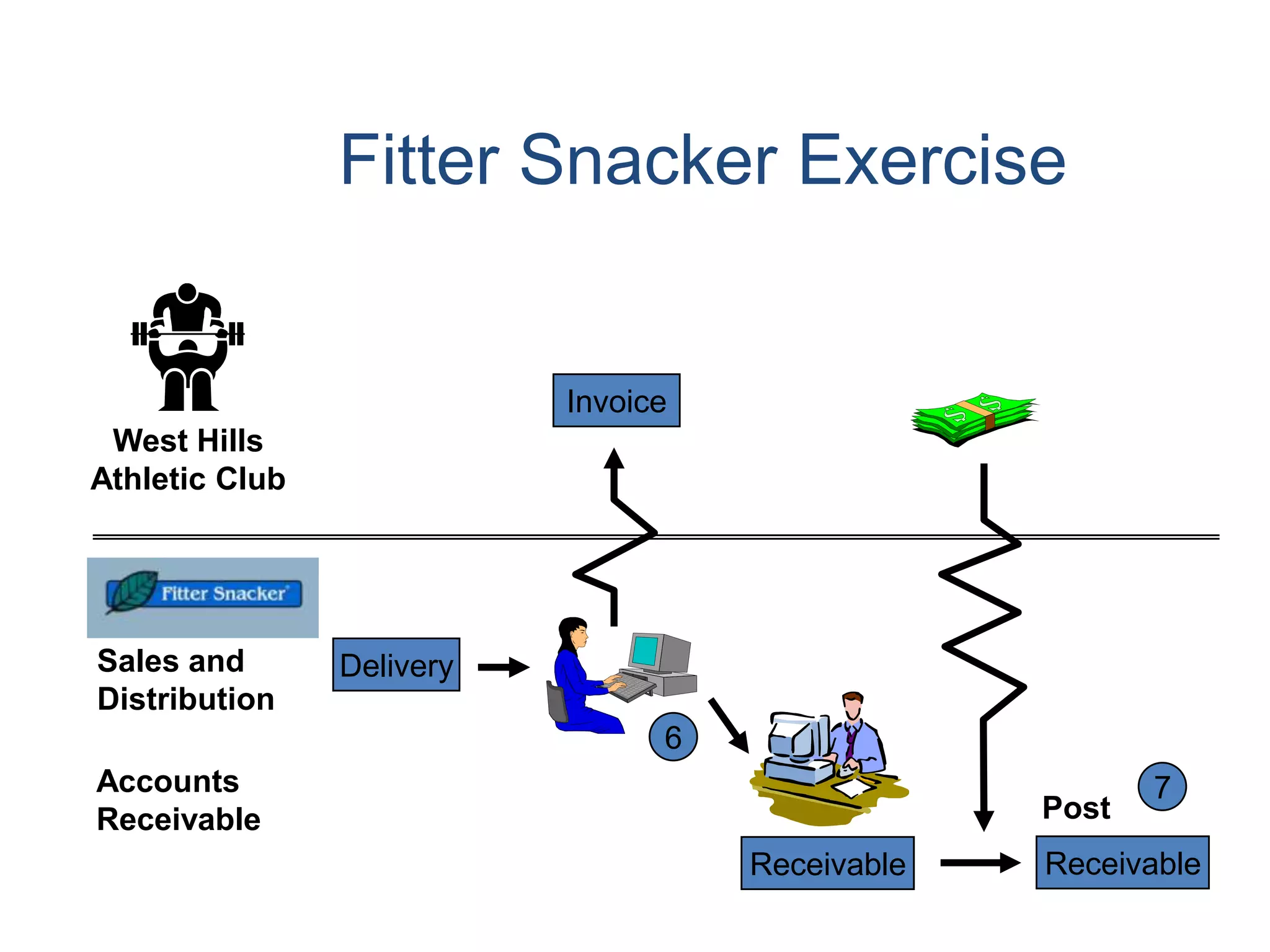
Fitter Snacker Exercise


                           Invoice
 West Hills
Athletic Club


Sales and       Delivery
Distribution
                                 6
Accounts                                                 7
Receivable                                        Post
                                     Receivable   Receivable
PROCUREMENT
• Procurement/Purchasing Procurement is
  the process of buying goods and services for
  the user department based on order
  specifications given by that department.
  Procurement begins with sending the
  purchase order to the supplier. Procurement
  function involves-
three company purchasing
             orientations
• Buying orientation. The purchaser’s focus is
  short – term and tactical.
• Procurement         Orientation:      buyers
  simultaneously seek quality improvements
  and cost reductions.
• Supply Chain Management Orientation: The
  purchasing role is further broadened to
  become a more strategic, value – adding
  operation.
Types of Purchasing Processes
• Routine products - These products have low
  value and cost to the customer and involve
  little risk.
• Leverage products: These products have
  high value and cost to the customer but
  involve little risk of supply because many
  companies make them.
Types of Purchasing Processes
• Strategic products: These products have
  high value and cost to the customer and also
  involve high risk

• Bottleneck products: These products have
  low value and cost to the customer but they
  involve some risk
Stages in the Purchasing Process

• Palagay na lng nong table na nasa hard copy..
  Tanxs.
Problem Recognition
• The purchase process begins when someone
  in the company recognize a problem or need
  that can be met by acquiring a good or
  service. The recognition can be triggered by
  internal or external stimuli.
General Need Description and
       Product Specification
• the buyer determines the needed item’s
  general characteristics and required
  quantity.
• The buying organization now develops the
  item’s technical specifications. Often, the
  company will assign a product – value –
  analysis (PVA) engineering team to the
  project.
Supplier Search
• The buyer now tries to identify the most
  appropriate suppliers. The buyer can
  examine trade directories, contact other
  companies for recommendation, watch trade
  advertisements, and attend trade shows
e – procurement in three other ways:

• Direct extranet links to major suppliers.
• Buying alliances.
• Company buying sites.
Proposal Solicitation
• The buyer invites qualified suppliers to
  submit proposals, If the item is complex or
  expensive, the buyer will require a detail
  written proposal from each qualified
  supplier, after evaluating the proposals, the
  buyer will invite a few suppliers to make
  formal presentations.
Supplier Selection
• Before selecting a supplier , the buying
  center will specify desired supplier attributes
  and indicate their relative importance, it will
  then rate suppliers on these attributes and
  identify the most attractive suppliers.
Order routine specification
• After selecting suppliers, the buyer
  negotiates the final order, listing the
  technical specification, the quantity needed,
  the expected time of delivery, return
  policies, warranties, and so on.
Performance review
• The buyer periodically review the performance
  of the chosen supplier(s). There methods are
  commonly used. The buyer may contact the
  end users and ask for their evaluations: or rate
  the supplier on several criteria using a weighted
  score method; or aggregate the cost of poor
  supplier performance to come up with adjusted
  costs of purchase, including price, the
  performance review may lead the buyer to
  continue, modify, or end the relationship with
  the supplier.

Order processing and procurement report

  • 1.
    Group slide part • Mae slide 1 – 17 • Mark G. Slide 18 – 26 • Coleen slide 27 - 34 • Irene 35 - 41 • Gretchen 42 - 44 Irene and gretchen kau na po bahala if dadagdagan nyo po ung slides. Iksi lang ng naisama q sa slides nyo refer na lang po kau sa softcopy na pinasa q dn para maintindhan nyo at para maexplain nyo futher and if gusto nyo pa pong dagdagan ung slides. Tanxs.
  • 2.
  • 3.
    ORDER PROCESSING • Refersto receiving, recording, filling, and assembling orders for shipment
  • 4.
    Order Cycle Sales Order Processing Pre-Sales Activities Inventory Sourcing Payment Billing Delivery
  • 5.
    Pre-Sales Activities • Itcontains the following functionality: – Creating and tracking customer contacts and communications (sales activity) • Phone call records • On-site meeting • Letters • Campaign communication – Implementing and tracking direct mailing, internet, and trade fair campaigns based on customer attributes • Pre-sales documents need to be managed within the presales activities: Inquiries and Quotations. These documents help identify possible sales related activity and determine sales probability.
  • 6.
    Inquiry • An inquiryis a customer’s request to a company for information or quotation in respect to their products or services without obligation to purchase. – How much will it cost – Material/Service availability – May contain specific quantities and dates • The inquiry is maintained in the system and a quotation is created to address questions for the potential customer. January 2007 (v1.0) The Rushmore Group, LLC 6
  • 7.
    Quotation • The quotationpresents the customer with a legally binding offer to deliver specific products or a selection of a certain amount of products in a specified timeframe at a pre- defined price. January 2007 (v1.0) The Rushmore Group, LLC 7
  • 8.
    Sales Order Processing •Customers place orders with a customer service representative who create a document* with information on: – Customer – Material Ordered - material and quantity – Pricing conditions for each item – Schedule lines - delivery dates and quantities – Delivery Information – Billing information • Information is pulled from master data on customers and materials to minimize data entry errors.
  • 9.
    Creating an Order Customer Master Sold-to party 2540-00 Item Material Quantity Material Master 1 1400-500-00 30 2 1400-100-00 20 • When a sales order is created in R/3, data is copied from: – Customer Master – Material Master – Condition Records for Pricing – Tables in Configuration for shipping point and route. • Data can also be copied from an inquiry or quote.
  • 10.
    Master Data Customer Pricing Master Master Material Master • Master Data is centrally stored (shared across application modules) and is processed to eliminate data redundancy. • Three kinds of master data are critical to sales order processing: – Customer - Shared with FI/CO – Material - Shared with MM and PP – Pricing
  • 11.
    Customer Master Data • Customer Master – Contains all of the information necessary for processing orders, deliveries, invoices and customer payment – Every customer MUST have a master record • Customer Master Data is created by Sales Area – Sales Organization – Distribution Channel – Division January 2007 (v1.0) The Rushmore Group, LLC 11
  • 12.
    Customer Master Data • The customer master information is divided into 3 areas: – General Data – Company Code Data – Sales Area Data January 2007 (v1.0) The Rushmore Group, LLC 12
  • 13.
    Master Data • Material Master – Contains all the information a company needs to manage about a material – It is used by most components within the SAP system • Sales and Distribution • Materials Management • Production • Plant Maintenance • Accounting/Controlling • Quality Management – Material master data is stored in functional segments called Views January 2007 (v1.0) The Rushmore Group, LLC 13
  • 14.
    Material Master Views Sales Data Basic Data Purchasing Data Mat. Plan. Data Material Master Forecasting Data Storage Data Controlling Data Quality Data Accounting Data January 2007 (v1.0) The Rushmore Group, LLC 14
  • 15.
    Material Master General Information relevant for the entire organization: Name Weight U/M Client 410 Sales specific information: Delivery Plant Storage Location specific information: Loading Grp Stock Qty Plant 102 Storage Location 20 Plant 101 Storage Location 10 Plant 100 January 2007 (v1.0) The Rushmore Group, LLC 15
  • 16.
    Customer-Material Information Record • Data on a material defined for a specific customer is stored in a Customer material info record. • Info Records contain: – customer-specific material number – customer-specific material description – customer-specific data on deliveries and delivery tolerances • You can also maintain default text to appear on sales orders for that customer January 2007 (v1.0) The Rushmore Group, LLC 16
  • 17.
    Condition Master (Pricing) • Condition master data includes: – Prices – Surcharges – Discounts – Freights – Taxes • You can define the condition master to be dependent on various data: – Material specific – Customer specific • Conditions can be dependent on any document field January 2007 (v1.0) The Rushmore Group, LLC 17
  • 18.
    Inventory Sourcing • InventorySourcing determines: – If a product is available (availability check). – How the product will be supplied: • From stock on hand. • From production or purchase orders that should be available. • From make-to-order production. • Shipped from an external supplier. • Shipped from another plant or warehouse.
  • 19.
    Inventory Sourcing • Inventorysourcing occurs when: – An order is created. – An order is changed. – When the delivery document is created.
  • 20.
    Stock Available: BackwardScheduling Requested Material Transportation Loading Goods Delivery Order Date Availability Date Planning Date Date issue date Date Transit Time Loading Time Pick Pack and Stage The R/3 System uses the longer of these two times in calculating delivery scheduling. Transportation Lead Time
  • 21.
    Stock Unavailable: ForwardScheduling Confirmed New Material Transportation Loading Goods Delivery Order Date Availability Date Planning Date Date issue date Date Transit Time Loading Time Pick Pack and Stage The confirmed delivery date is derived by the R/3 System using forward scheduling based Transportation on the new material availability date Lead Time
  • 22.
    Delivery • Delivery activitiesinclude: – Creating delivery documents – Creating transfer orders for material picking – Provide packing information (if required) – Goods issue (updating accounting and inventory data)
  • 23.
    Shipping Point andRoute SP 1 SP 2 SP 3 Plant Shipping Point Route Customer • The Shipping Point is the logical or physical location where deliveries are created and managed (see Organizational Elements). • The Route is the path that the delivery follows from the plant to the customer site. • Delivery dates are determined based on lead times associated with the shipping point (picking and packing time) and route (transportation lead times and transit times)
  • 24.
    Delivery Complete Sales Order Delivery Delivery Partial Delivery Delivery Sales Order Delivery Delivery Order Sales Order Combination Delivery Sales Order • A delivery can be created for each sales order. • Sales orders may split into multiple deliveries (availability). • A delivery may combine a number of sales orders for efficiency. • Combined sales orders must have something in common like shipping point, delivery processing date, ship-to party or route.
  • 25.
    Billing • A BillingDocument is created by copying information for the sales order and delivery document into the billing document which is used to create the invoice. • Creating a Billing Document will automatically debit the customer’s accounts receivable account and credits the revenue account. Postings may also be made to other accounts.
  • 26.
    Billing Invoice Sales Order Delivery Invoice Split Invoice Separate Sales Order Invoice Delivery Invoice per delivery Delivery Invoice Collective Sales Order Delivery Invoice Delivery Invoice Sales Order Delivery • Invoice splits can be used to bill for different items like materials and services. • Collective invoices can be used to consolidate deliveries onto one invoice to minimize paperwork.
  • 27.
    Payment • Payment isthe final step in the customer order management cycle. • Final payment includes: – Posting payments against invoices. – Reconciling differences, if necessary. • The Cycle may not always go as planned (material not in stock, defective material returned for credit, etc.). SAP has procedures to deal with these possibilities.
  • 28.
    Posting Payments Invoice 1 Acme Corp. 4325 Invoice 2 Pay to $ Invoice 3 Dollars First National Bank Invoice 4 2132 123123 54545 345 34 • Customers may send one check to cover multiple invoices. They may also send checks for less than the full amount due. SAP allows for partial payments to be applied to invoices. • Payment posting is performed by the accounts receivable department.
  • 29.
    Order Management Process Pre-Sales Contact Inquiry Scheduling Contract Quotation agreement Materials Management Materials Management Sales Information System Sales Information System Production Planning Production Planning Sales Order Order Processing Inventory Sourcing Delivery/ Delivery Goods issue Transportation Transfer Order Shipment Billing Invoice Payment/ Material Stock Accounts Receivable Accounting Account
  • 30.
    Fitter Snacker Exercise West Hills Athletic Club Sales Inquiry Order Sales and Distribution 1 2 Pricing Availability
  • 31.
    Fitter Snacker Exercise Pick Goods Issue 4 5 Materials Management Sales Order Delivery Delivery Delivery 3
  • 32.
    Fitter Snacker Exercise Invoice West Hills Athletic Club Sales and Delivery Distribution 6 Accounts 7 Receivable Post Receivable Receivable
  • 33.
    PROCUREMENT • Procurement/Purchasing Procurementis the process of buying goods and services for the user department based on order specifications given by that department. Procurement begins with sending the purchase order to the supplier. Procurement function involves-
  • 34.
    three company purchasing orientations • Buying orientation. The purchaser’s focus is short – term and tactical. • Procurement Orientation: buyers simultaneously seek quality improvements and cost reductions. • Supply Chain Management Orientation: The purchasing role is further broadened to become a more strategic, value – adding operation.
  • 35.
    Types of PurchasingProcesses • Routine products - These products have low value and cost to the customer and involve little risk. • Leverage products: These products have high value and cost to the customer but involve little risk of supply because many companies make them.
  • 36.
    Types of PurchasingProcesses • Strategic products: These products have high value and cost to the customer and also involve high risk • Bottleneck products: These products have low value and cost to the customer but they involve some risk
  • 37.
    Stages in thePurchasing Process • Palagay na lng nong table na nasa hard copy.. Tanxs.
  • 38.
    Problem Recognition • Thepurchase process begins when someone in the company recognize a problem or need that can be met by acquiring a good or service. The recognition can be triggered by internal or external stimuli.
  • 39.
    General Need Descriptionand Product Specification • the buyer determines the needed item’s general characteristics and required quantity. • The buying organization now develops the item’s technical specifications. Often, the company will assign a product – value – analysis (PVA) engineering team to the project.
  • 40.
    Supplier Search • Thebuyer now tries to identify the most appropriate suppliers. The buyer can examine trade directories, contact other companies for recommendation, watch trade advertisements, and attend trade shows
  • 41.
    e – procurementin three other ways: • Direct extranet links to major suppliers. • Buying alliances. • Company buying sites.
  • 42.
    Proposal Solicitation • Thebuyer invites qualified suppliers to submit proposals, If the item is complex or expensive, the buyer will require a detail written proposal from each qualified supplier, after evaluating the proposals, the buyer will invite a few suppliers to make formal presentations.
  • 43.
    Supplier Selection • Beforeselecting a supplier , the buying center will specify desired supplier attributes and indicate their relative importance, it will then rate suppliers on these attributes and identify the most attractive suppliers.
  • 44.
    Order routine specification •After selecting suppliers, the buyer negotiates the final order, listing the technical specification, the quantity needed, the expected time of delivery, return policies, warranties, and so on.
  • 45.
    Performance review • Thebuyer periodically review the performance of the chosen supplier(s). There methods are commonly used. The buyer may contact the end users and ask for their evaluations: or rate the supplier on several criteria using a weighted score method; or aggregate the cost of poor supplier performance to come up with adjusted costs of purchase, including price, the performance review may lead the buyer to continue, modify, or end the relationship with the supplier.