Company
LOGO
Master Data
Sales & Distribution
Topics
1. Introduction
2. Customer Master
3. Material Master
4. Condition records
Customer Master
 Master data in SD
 Customer Master
 Material Master
 Condition Records
 Customer Master – It is created in coordination with
Finance function.
 Material Master – It is created in coordination with
Materials Management function.
 Condition Records – They are mainly created for Pricing.
Others include output records.
Customer Master
 Customer account group is necessary to create
customers as per classification.
 Main Account groups
 Sold-to party
 Ship-to party
 Bill-to party
 Customer Account group controls
 Customer number range
 Display / restrict data in the customer master screens
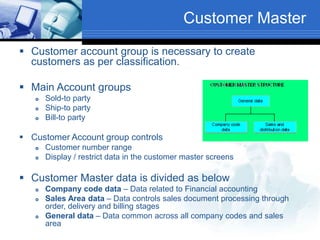
 Customer Master data is divided as below
 Company code data – Data related to Financial accounting
 Sales Area data – Data controls sales document processing through
order, delivery and billing stages
 General data – Data common across all company codes and sales
area
Customer Master
 Company code data – It is maintained by Finance
department and key data for payment processing in FI
accounting is captured. Key data is
 Terms of payment
 Reconciliation account
 Sales area data – It is maintained for Sales area. It is
divided among sales, shipping and billing data
 Sales data – Key data is as below
 Currency in which customer should be billed
 Pricing related data
Customer Master
 Shipping data – Key data is as below
 Shipping condition (Needed in the determination of Shipping
point)
 Delivering plant (To default in the sales order)
 Partial delivery agreement
 Billing data – Key data is as below
 Incoterms
 Account assignment group
 Tax data
 Partner function, Text data can be maintained for
customer master
Material Master
 Material master maintains key sales data to process material in the
sales order processing. Sales data is maintained for a sales
organization and distribution channel.
 Key data is as below
 Delivering plant
 Tax data
 Quantity specifications
 Item category group
 Availability checking rule
 Shipping data like transportation and loading group
 Material can be restricted for a distribution channel or all distribution
channel for a specific period. Reason could be material is under
development or the sale of the material is not allowed through a particular
distribution channel.
Material Master
 Division can be maintained in material master and
thereby restricting usage of material for other sales
areas. This is controlled via customizing.
 Among other important data maintained in sales view of
material master, Product Hierarchy can also be
maintained. This is used to group materials by combining
various features. This is a powerful feature for analysis
of materials in groups.
Condition records
 Condition records allow to store data in system and use
it in sales documents.
 Condition records are maintained for Pricing and Outputs
among others.
 For Pricing, pricing elements in business like discounts,
prices, freight & surcharges data is stored in condition
records.
 For Outputs, the condition records are maintained to
trigger automatically various outputs like Order
Acknowledgement, Shipping notification, Invoice output.

Master_data.ppt

  • 1.
  • 2.
    Topics 1. Introduction 2. CustomerMaster 3. Material Master 4. Condition records
  • 3.
    Customer Master  Masterdata in SD  Customer Master  Material Master  Condition Records  Customer Master – It is created in coordination with Finance function.  Material Master – It is created in coordination with Materials Management function.  Condition Records – They are mainly created for Pricing. Others include output records.
  • 4.
    Customer Master  Customeraccount group is necessary to create customers as per classification.  Main Account groups  Sold-to party  Ship-to party  Bill-to party  Customer Account group controls  Customer number range  Display / restrict data in the customer master screens  Customer Master data is divided as below  Company code data – Data related to Financial accounting  Sales Area data – Data controls sales document processing through order, delivery and billing stages  General data – Data common across all company codes and sales area
  • 5.
    Customer Master  Companycode data – It is maintained by Finance department and key data for payment processing in FI accounting is captured. Key data is  Terms of payment  Reconciliation account  Sales area data – It is maintained for Sales area. It is divided among sales, shipping and billing data  Sales data – Key data is as below  Currency in which customer should be billed  Pricing related data
  • 6.
    Customer Master  Shippingdata – Key data is as below  Shipping condition (Needed in the determination of Shipping point)  Delivering plant (To default in the sales order)  Partial delivery agreement  Billing data – Key data is as below  Incoterms  Account assignment group  Tax data  Partner function, Text data can be maintained for customer master
  • 7.
    Material Master  Materialmaster maintains key sales data to process material in the sales order processing. Sales data is maintained for a sales organization and distribution channel.  Key data is as below  Delivering plant  Tax data  Quantity specifications  Item category group  Availability checking rule  Shipping data like transportation and loading group  Material can be restricted for a distribution channel or all distribution channel for a specific period. Reason could be material is under development or the sale of the material is not allowed through a particular distribution channel.
  • 8.
    Material Master  Divisioncan be maintained in material master and thereby restricting usage of material for other sales areas. This is controlled via customizing.  Among other important data maintained in sales view of material master, Product Hierarchy can also be maintained. This is used to group materials by combining various features. This is a powerful feature for analysis of materials in groups.
  • 9.
    Condition records  Conditionrecords allow to store data in system and use it in sales documents.  Condition records are maintained for Pricing and Outputs among others.  For Pricing, pricing elements in business like discounts, prices, freight & surcharges data is stored in condition records.  For Outputs, the condition records are maintained to trigger automatically various outputs like Order Acknowledgement, Shipping notification, Invoice output.