ContinuitySection 2.3
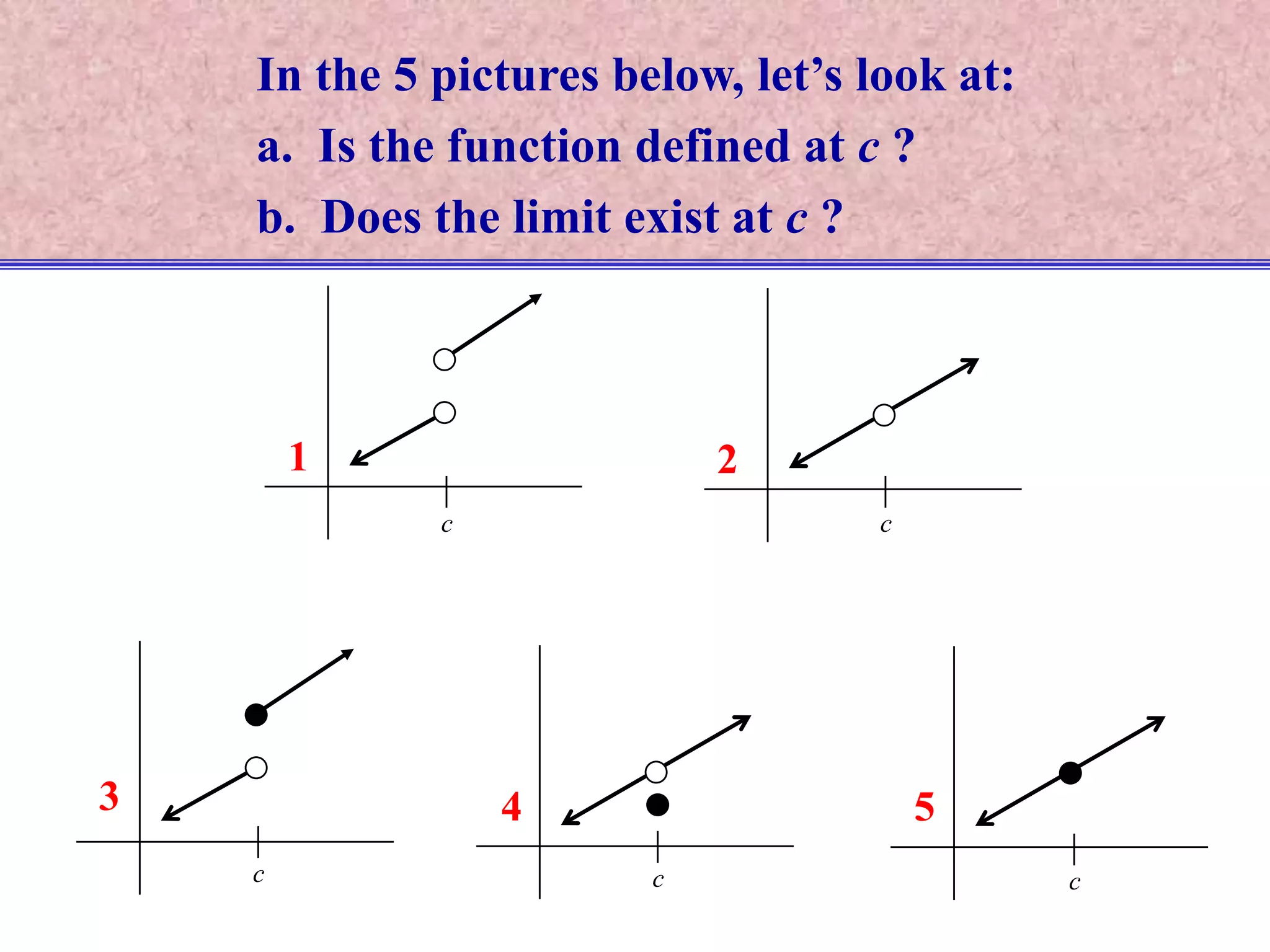
21ccccc345In the 5 pictures below, let’s look at:a.  Is the function defined at c ?b.  Does the limit exist at c ?
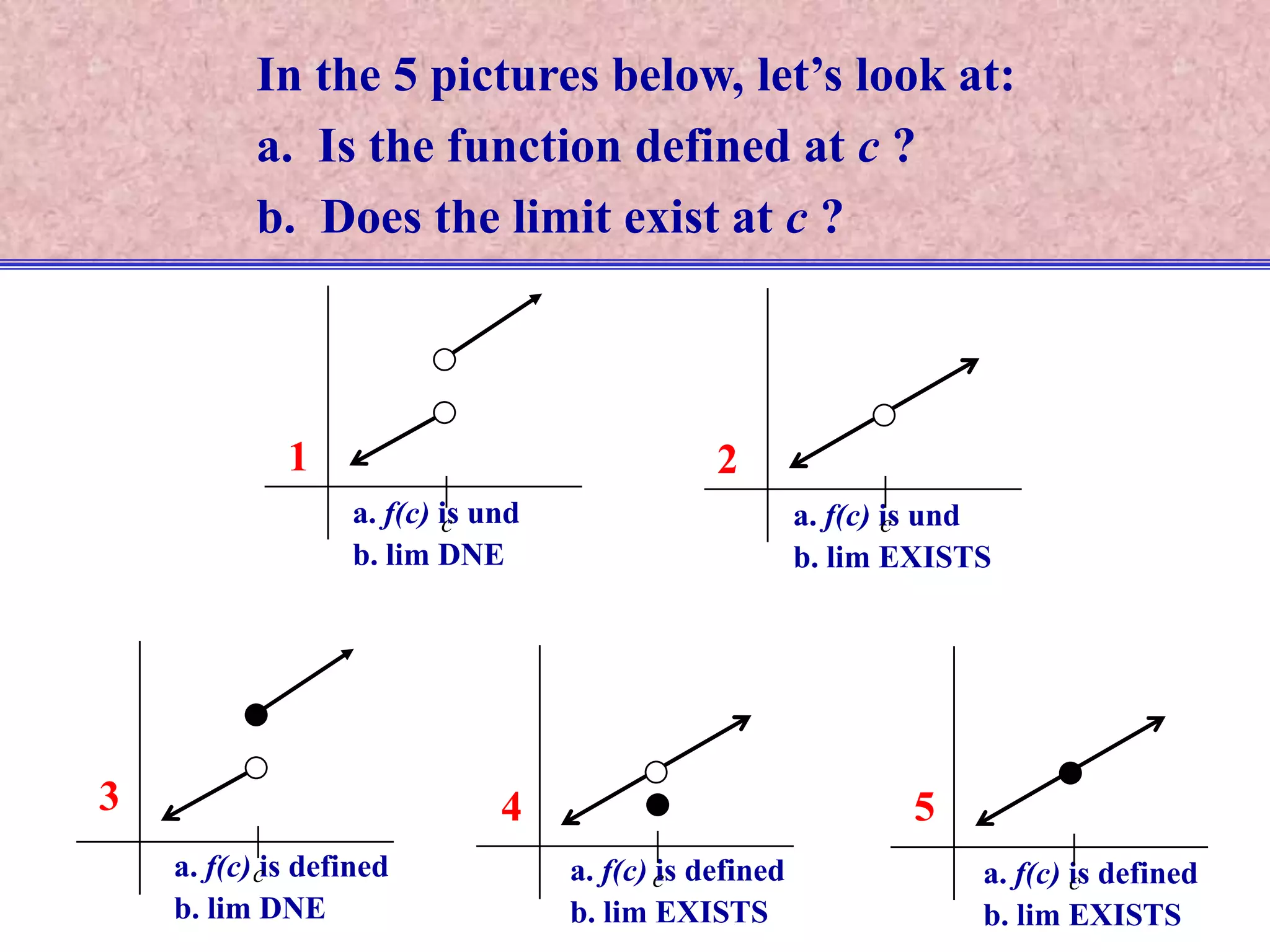
21a. f(c) is undb. lim DNEccccca. f(c) is undb. lim EXISTS345a. f(c) is definedb. lim DNEa. f(c) is definedb. lim EXISTSa. f(c) is definedb. lim EXISTSIn the 5 pictures below, let’s look at:a.  Is the function defined at c ?b.  Does the limit exist at c ?
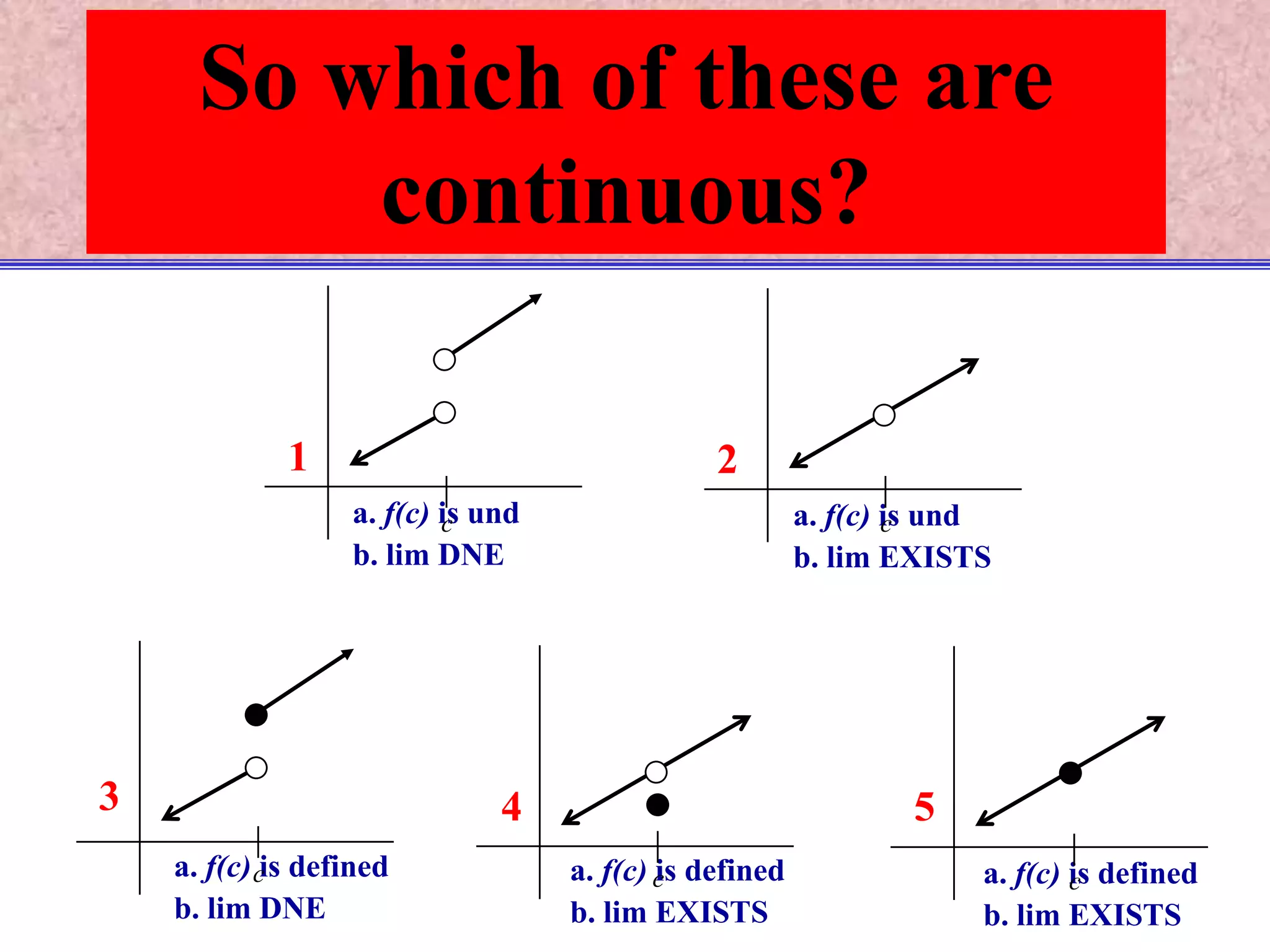
21a. f(c) is undb. lim DNEccccca. f(c) is undb. lim EXISTS345a. f(c) is definedb. lim DNEa. f(c) is definedb. lim EXISTSa. f(c) is definedb. lim EXISTSSo which of these are continuous?In the 5 pictures below, let’s look at:a.  Is the function defined at c ?b.  Does the limit exist at c ?
A function is continuous at c if…1. The function is defined at c.2. The limit exists at c.3.The value of function at c equals the value of limit at c.* All three of these must occur.
Another way of saying this is that a function is continuous at every point in the interval if you can draw it without lifting your pencil.
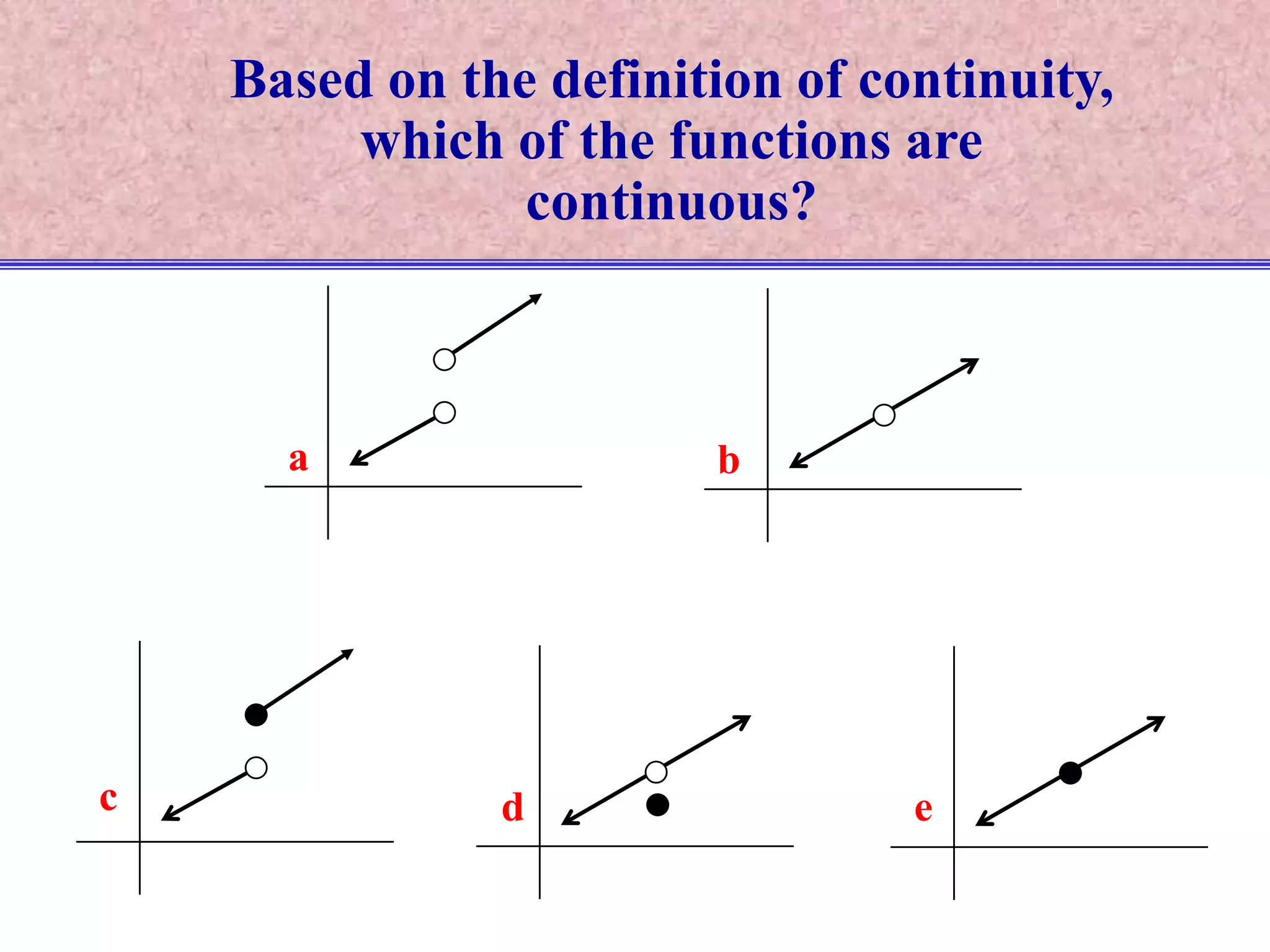
bacdeBased on the definition of continuity, which of the functions are continuous?
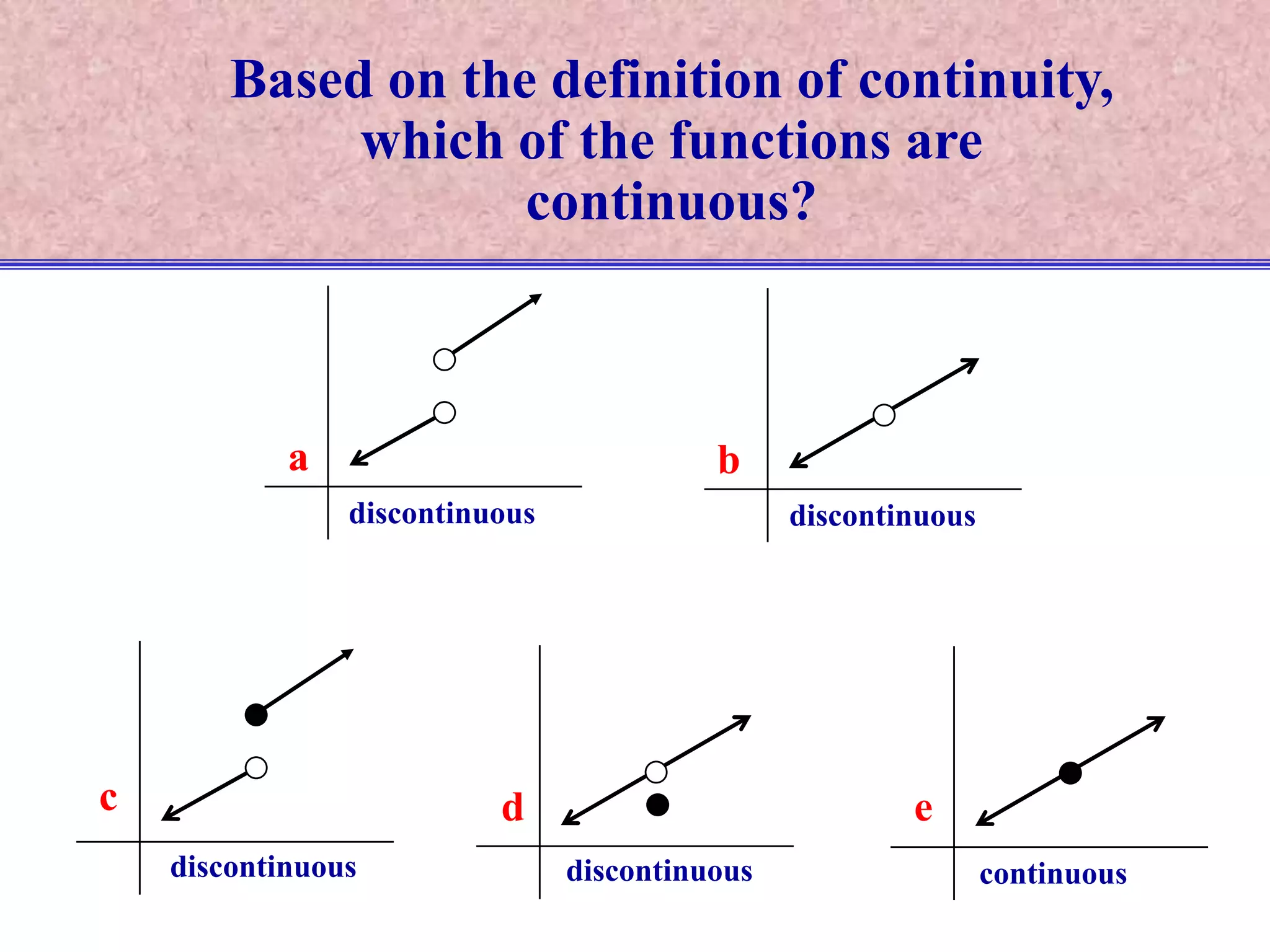
badiscontinuousdiscontinuouscdediscontinuousdiscontinuouscontinuousBased on the definition of continuity, which of the functions are continuous?
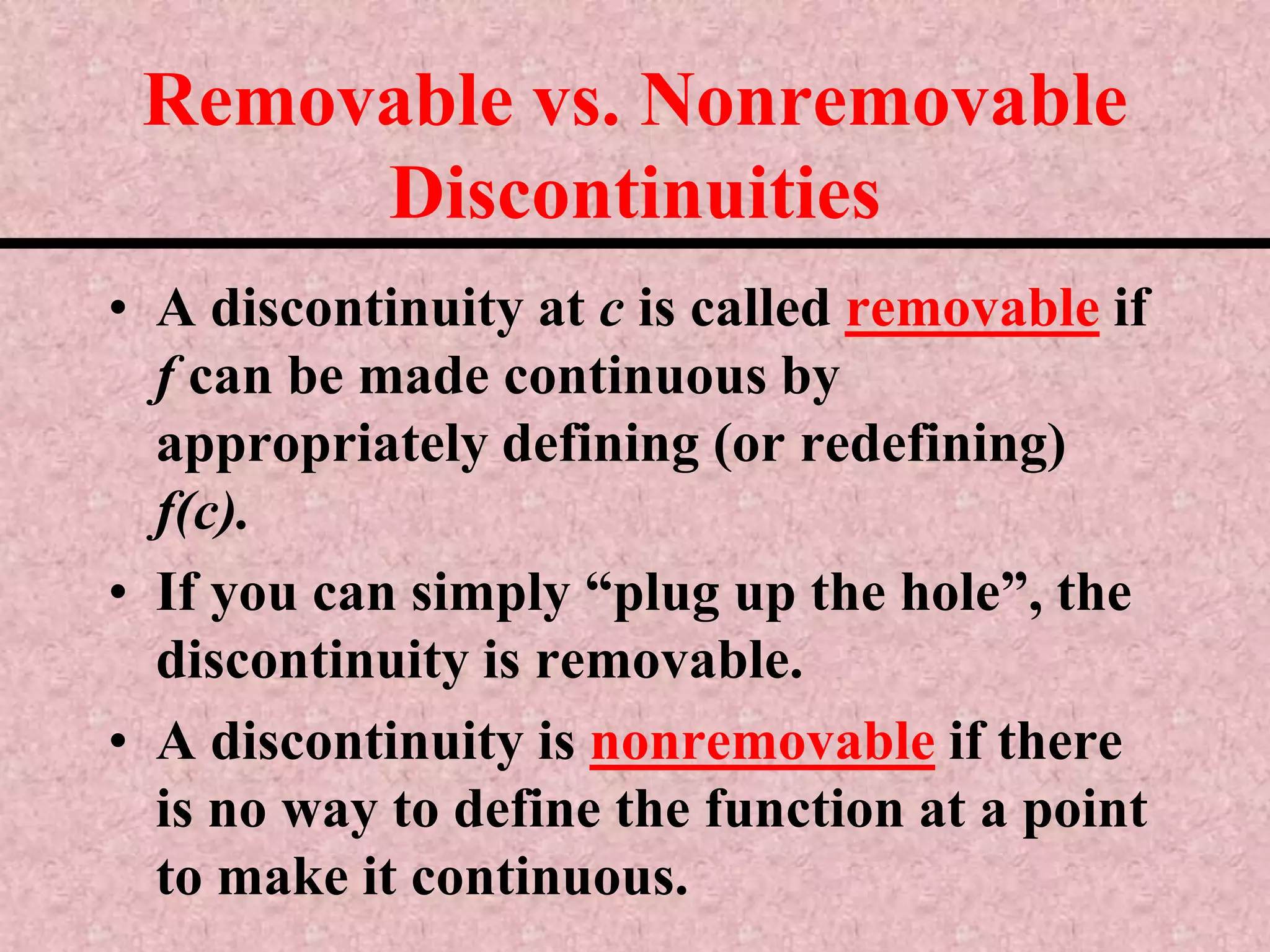
Removable vs. Nonremovable DiscontinuitiesA discontinuity at c is called removable if f can be made continuous by appropriately defining (or redefining) f(c).If you can simply “plug up the hole”, the discontinuity is removable.A discontinuity is nonremovable if there is no way to define the function at a point to make it continuous.
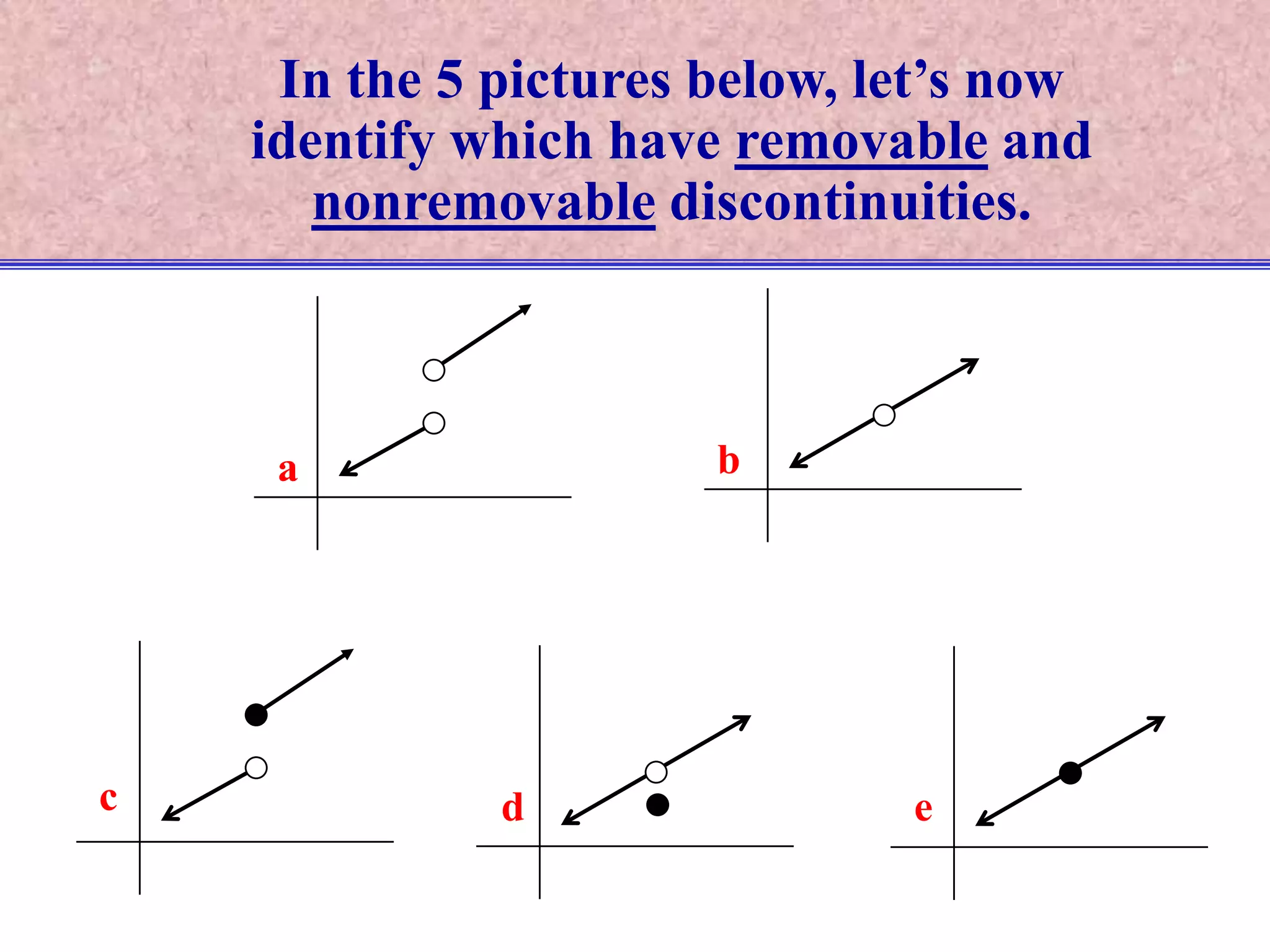
bacdeIn the 5 pictures below, let’s now identify which have removable and nonremovable discontinuities.
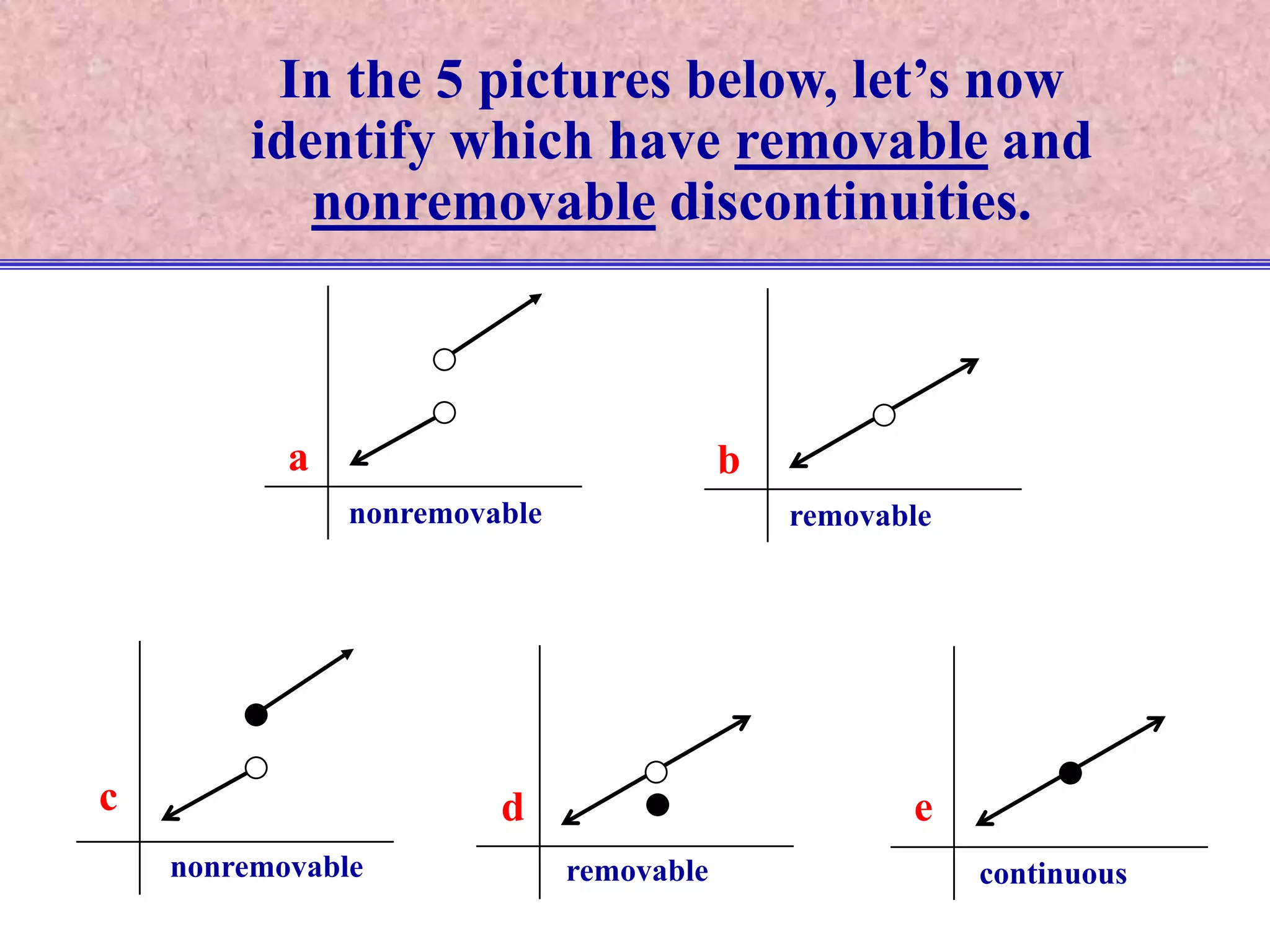
banonremovableremovablecdenonremovableremovablecontinuousIn the 5 pictures below, let’s now identify which have removable and nonremovable discontinuities.

2.3 CONTINUITY

  • 1.
  • 2.
    21ccccc345In the 5pictures below, let’s look at:a. Is the function defined at c ?b. Does the limit exist at c ?
  • 3.
    21a. f(c) isundb. lim DNEccccca. f(c) is undb. lim EXISTS345a. f(c) is definedb. lim DNEa. f(c) is definedb. lim EXISTSa. f(c) is definedb. lim EXISTSIn the 5 pictures below, let’s look at:a. Is the function defined at c ?b. Does the limit exist at c ?
  • 4.
    21a. f(c) isundb. lim DNEccccca. f(c) is undb. lim EXISTS345a. f(c) is definedb. lim DNEa. f(c) is definedb. lim EXISTSa. f(c) is definedb. lim EXISTSSo which of these are continuous?In the 5 pictures below, let’s look at:a. Is the function defined at c ?b. Does the limit exist at c ?
  • 5.
    A function iscontinuous at c if…1. The function is defined at c.2. The limit exists at c.3.The value of function at c equals the value of limit at c.* All three of these must occur.
  • 6.
    Another way ofsaying this is that a function is continuous at every point in the interval if you can draw it without lifting your pencil.
  • 7.
    bacdeBased on thedefinition of continuity, which of the functions are continuous?
  • 8.
    badiscontinuousdiscontinuouscdediscontinuousdiscontinuouscontinuousBased on thedefinition of continuity, which of the functions are continuous?
  • 9.
    Removable vs. NonremovableDiscontinuitiesA discontinuity at c is called removable if f can be made continuous by appropriately defining (or redefining) f(c).If you can simply “plug up the hole”, the discontinuity is removable.A discontinuity is nonremovable if there is no way to define the function at a point to make it continuous.
  • 10.
    bacdeIn the 5pictures below, let’s now identify which have removable and nonremovable discontinuities.
  • 11.
    banonremovableremovablecdenonremovableremovablecontinuousIn the 5pictures below, let’s now identify which have removable and nonremovable discontinuities.