
Exponential and
3.5   Logarithmic Models
Introduction
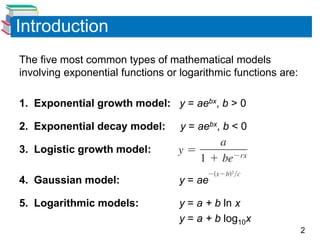
The five most common types of mathematical models
involving exponential functions or logarithmic functions are:

1. Exponential growth model: y = aebx, b > 0

2. Exponential decay model:        y = aebx, b < 0

3. Logistic growth model:

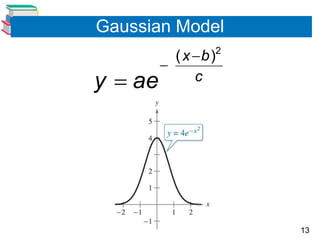
4. Gaussian model:                 y = ae

5. Logarithmic models:             y = a + b ln x
                                   y = a + b log10x
                                                                2
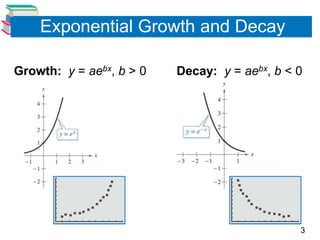
Exponential Growth and Decay

Growth: y = aebx, b > 0   Decay: y = aebx, b < 0


                                               3
Example 1 – Demography
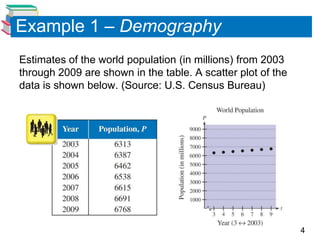
Estimates of the world population (in millions) from 2003
through 2009 are shown in the table. A scatter plot of the
data is shown below. (Source: U.S. Census Bureau)


                                                             4
Example 1 – Demography                                    cont’d


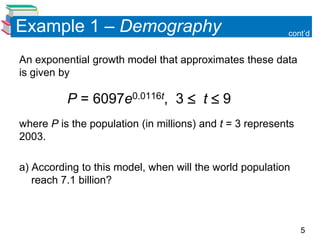
An exponential growth model that approximates these data
is given by

          P = 6097e0.0116t, 3  t  9
where P is the population (in millions) and t = 3 represents
2003.

a) According to this model, when will the world population
   reach 7.1 billion?


                                                               5
Example 1 – Solution                                             cont’d


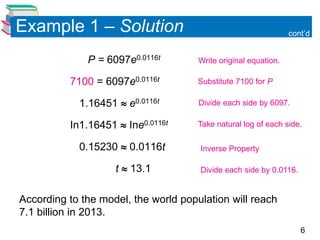
              P = 6097e0.0116t        Write original equation.

          7100 = 6097e0.0116t         Substitute 7100 for P.

            1.16451  e0.0116t        Divide each side by 6097.

          In1.16451  Ine0.0116t      Take natural log of each side.

            0.15230  0.0116t         Inverse Property

                    t  13.1          Divide each side by 0.0116.


According to the model, the world population will reach
7.1 billion in 2013.
                                                                    6
Logistic Growth Models


                         7
Logistic Growth Models
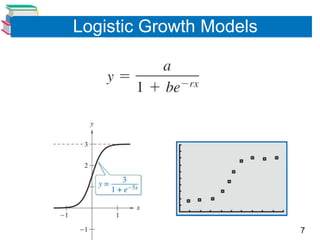
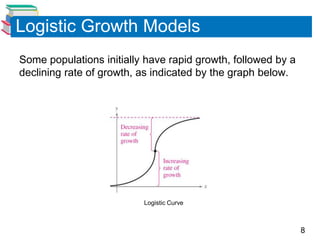
Some populations initially have rapid growth, followed by a
declining rate of growth, as indicated by the graph below.


                          Logistic Curve


                                                              8
Logistic Growth Models
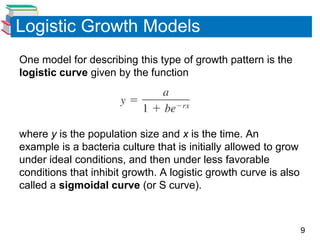
One model for describing this type of growth pattern is the
logistic curve given by the function


where y is the population size and x is the time. An
example is a bacteria culture that is initially allowed to grow
under ideal conditions, and then under less favorable
conditions that inhibit growth. A logistic growth curve is also
called a sigmoidal curve (or S curve).


                                                                  9
Example 2 – Spread of a Virus
On a college campus of 5000 students, one student returns
from vacation with a contagious flu virus. The spread of the
virus is modeled by


where y is the total number of students infected after days.
The college will cancel classes when 40% or more of the
students are infected.

a. How many students are infected after 5 days?

b. After how many days will the college cancel classes?
                                                               10
Example 2 – Solution
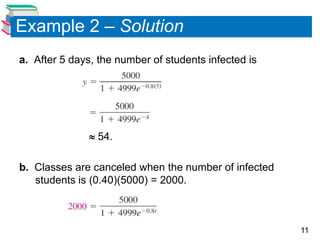
a. After 5 days, the number of students infected is


                54.

b. Classes are canceled when the number of infected
   students is (0.40)(5000) = 2000.


                                                      11
Example 2 – Solution                                      cont’d


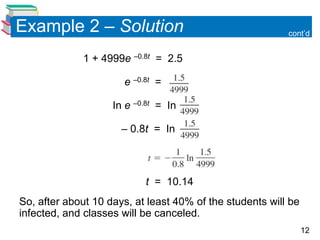
             1 + 4999e –0.8t = 2.5

                      e –0.8t =

                    In e –0.8t = In

                      – 0.8t = In


                           t = 10.14
So, after about 10 days, at least 40% of the students will be
infected, and classes will be canceled.
                                                                12
Gaussian Model
          ( x b)
                2
        
y   ae       c


                    13
Gaussian Models
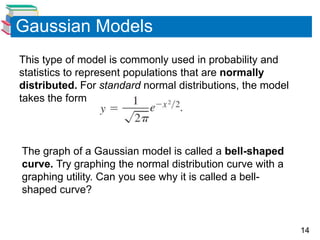
This type of model is commonly used in probability and
statistics to represent populations that are normally
distributed. For standard normal distributions, the model
takes the form


The graph of a Gaussian model is called a bell-shaped
curve. Try graphing the normal distribution curve with a
graphing utility. Can you see why it is called a bell-
shaped curve?


                                                            14
Gaussian Models

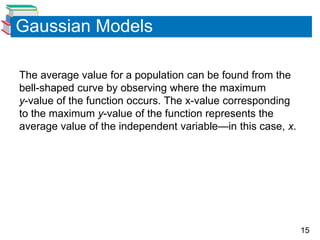
The average value for a population can be found from the
bell-shaped curve by observing where the maximum
y-value of the function occurs. The x-value corresponding
to the maximum y-value of the function represents the
average value of the independent variable—in this case, x.


                                                             15
Example 3 – SAT Scores
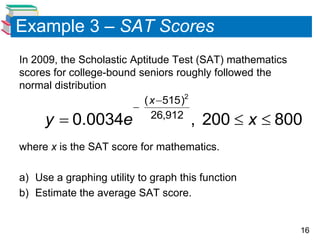
In 2009, the Scholastic Aptitude Test (SAT) mathematics
scores for college-bound seniors roughly followed the
normal distribution
                          ( x 515)2
                        
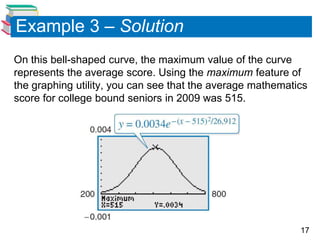
     y  0.0034e             26,912
                                     , 200  x  800
where x is the SAT score for mathematics.

a) Use a graphing utility to graph this function
b) Estimate the average SAT score.


                                                          16
Example 3 – Solution
On this bell-shaped curve, the maximum value of the curve
represents the average score. Using the maximum feature of
the graphing utility, you can see that the average mathematics
score for college bound seniors in 2009 was 515.


                                                            17
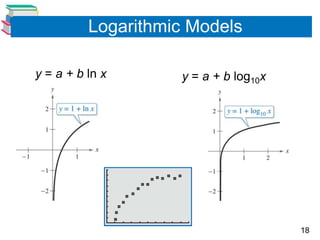
Logarithmic Models

y = a + b ln x      y = a + b log10x


                                       18
Example 4 - Meteorology
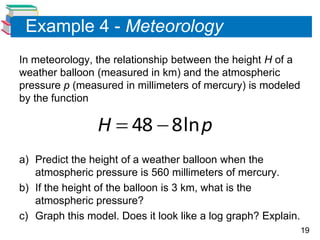
In meteorology, the relationship between the height H of a
weather balloon (measured in km) and the atmospheric
pressure p (measured in millimeters of mercury) is modeled
by the function

                H  48  8 ln p
a) Predict the height of a weather balloon when the
   atmospheric pressure is 560 millimeters of mercury.
b) If the height of the balloon is 3 km, what is the
   atmospheric pressure?
c) Graph this model. Does it look like a log graph? Explain.
                                                               19
Newton’s Law of Cooling


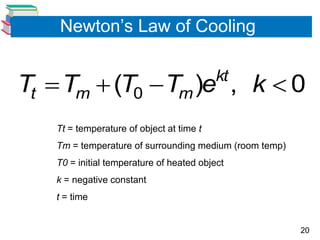
Tt  Tm  (T0  Tm )e , k  0             kt


   Tt = temperature of object at time t
   Tm = temperature of surrounding medium (room temp)
   T0 = initial temperature of heated object
   k = negative constant
   t = time


                                                        20
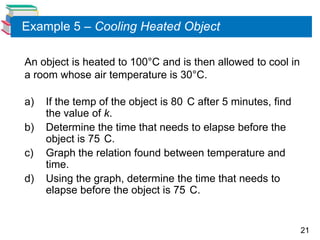
Example 5 – Cooling Heated Object

An object is heated to 100°C and is then allowed to cool in
a room whose air temperature is 30°C.

a)   If the temp of the object is 80 C after 5 minutes, find
     the value of k.
b)   Determine the time that needs to elapse before the
     object is 75 C.
c)   Graph the relation found between temperature and
     time.
d)   Using the graph, determine the time that needs to
     elapse before the object is 75 C.


                                                               21
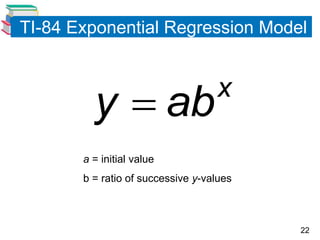
TI-84 Exponential Regression Model
on TI-84


         y  ab                    x

       a = initial value
       b = ratio of successive y-values


                                          22

3.5 EXP-LOG MODELS

  • 1.
    Exponential and 3.5 Logarithmic Models
  • 2.
    Introduction The five mostcommon types of mathematical models involving exponential functions or logarithmic functions are: 1. Exponential growth model: y = aebx, b > 0 2. Exponential decay model: y = aebx, b < 0 3. Logistic growth model: 4. Gaussian model: y = ae 5. Logarithmic models: y = a + b ln x y = a + b log10x 2
  • 3.
    Exponential Growth andDecay Growth: y = aebx, b > 0 Decay: y = aebx, b < 0 3
  • 4.
    Example 1 –Demography Estimates of the world population (in millions) from 2003 through 2009 are shown in the table. A scatter plot of the data is shown below. (Source: U.S. Census Bureau) 4
  • 5.
    Example 1 –Demography cont’d An exponential growth model that approximates these data is given by P = 6097e0.0116t, 3  t  9 where P is the population (in millions) and t = 3 represents 2003. a) According to this model, when will the world population reach 7.1 billion? 5
  • 6.
    Example 1 –Solution cont’d P = 6097e0.0116t Write original equation. 7100 = 6097e0.0116t Substitute 7100 for P. 1.16451  e0.0116t Divide each side by 6097. In1.16451  Ine0.0116t Take natural log of each side. 0.15230  0.0116t Inverse Property t  13.1 Divide each side by 0.0116. According to the model, the world population will reach 7.1 billion in 2013. 6
  • 7.
  • 8.
    Logistic Growth Models Somepopulations initially have rapid growth, followed by a declining rate of growth, as indicated by the graph below. Logistic Curve 8
  • 9.
    Logistic Growth Models Onemodel for describing this type of growth pattern is the logistic curve given by the function where y is the population size and x is the time. An example is a bacteria culture that is initially allowed to grow under ideal conditions, and then under less favorable conditions that inhibit growth. A logistic growth curve is also called a sigmoidal curve (or S curve). 9
  • 10.
    Example 2 –Spread of a Virus On a college campus of 5000 students, one student returns from vacation with a contagious flu virus. The spread of the virus is modeled by where y is the total number of students infected after days. The college will cancel classes when 40% or more of the students are infected. a. How many students are infected after 5 days? b. After how many days will the college cancel classes? 10
  • 11.
    Example 2 –Solution a. After 5 days, the number of students infected is  54. b. Classes are canceled when the number of infected students is (0.40)(5000) = 2000. 11
  • 12.
    Example 2 –Solution cont’d 1 + 4999e –0.8t = 2.5 e –0.8t = In e –0.8t = In – 0.8t = In t = 10.14 So, after about 10 days, at least 40% of the students will be infected, and classes will be canceled. 12
  • 13.
    Gaussian Model ( x b) 2  y ae c 13
  • 14.
    Gaussian Models This typeof model is commonly used in probability and statistics to represent populations that are normally distributed. For standard normal distributions, the model takes the form The graph of a Gaussian model is called a bell-shaped curve. Try graphing the normal distribution curve with a graphing utility. Can you see why it is called a bell- shaped curve? 14
  • 15.
    Gaussian Models The averagevalue for a population can be found from the bell-shaped curve by observing where the maximum y-value of the function occurs. The x-value corresponding to the maximum y-value of the function represents the average value of the independent variable—in this case, x. 15
  • 16.
    Example 3 –SAT Scores In 2009, the Scholastic Aptitude Test (SAT) mathematics scores for college-bound seniors roughly followed the normal distribution ( x 515)2  y  0.0034e 26,912 , 200  x  800 where x is the SAT score for mathematics. a) Use a graphing utility to graph this function b) Estimate the average SAT score. 16
  • 17.
    Example 3 –Solution On this bell-shaped curve, the maximum value of the curve represents the average score. Using the maximum feature of the graphing utility, you can see that the average mathematics score for college bound seniors in 2009 was 515. 17
  • 18.
    Logarithmic Models y =a + b ln x y = a + b log10x 18
  • 19.
    Example 4 -Meteorology In meteorology, the relationship between the height H of a weather balloon (measured in km) and the atmospheric pressure p (measured in millimeters of mercury) is modeled by the function H  48  8 ln p a) Predict the height of a weather balloon when the atmospheric pressure is 560 millimeters of mercury. b) If the height of the balloon is 3 km, what is the atmospheric pressure? c) Graph this model. Does it look like a log graph? Explain. 19
  • 20.
    Newton’s Law ofCooling Tt  Tm  (T0  Tm )e , k  0 kt Tt = temperature of object at time t Tm = temperature of surrounding medium (room temp) T0 = initial temperature of heated object k = negative constant t = time 20
  • 21.
    Example 5 –Cooling Heated Object An object is heated to 100°C and is then allowed to cool in a room whose air temperature is 30°C. a) If the temp of the object is 80 C after 5 minutes, find the value of k. b) Determine the time that needs to elapse before the object is 75 C. c) Graph the relation found between temperature and time. d) Using the graph, determine the time that needs to elapse before the object is 75 C. 21
  • 22.
    TI-84 Exponential RegressionModel on TI-84 y  ab x a = initial value b = ratio of successive y-values 22