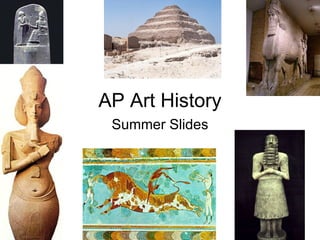
Summer Ap Art History

Loading...

Flash Player 9 (or above) is needed to view presentations.
We have detected that you do not have it on your computer. To install it, go here.

0 comments

Post a comment

    Post a comment
    Embed Video
    Edit your comment Cancel

    1 Favorite

    Summer Ap Art History - Presentation Transcript

    1. AP Art History Summer Slides
    2. Prehistoric Architecture
      • Stonehenge (c. 3100 BCE)
      • Post and lintel construction
      • Megaliths are 21 to 24 feet tall, including height of lintel, and buried four feet in the ground
      • Solar and lunar orientation
      • Stones dragged from far away to this site
      • Circle of megaliths embrace structure, enclosing it
      • Inside circle of megaliths is a larger horseshoe-shaped group of megaliths which frame an “altar stone”
    3. Mesopotamian Periods
      • Sumerian (3500 – 2340 BCE)
      • Akkadian (2340 – 2180 BCE)
      • Guti?Neo-Sumer (2180 – 2125 BCE)
      • Babylonian (2125 – 1750 BCE)
      • Hittites (1640 – 1200 BCE)
      • Assyrian (1000 – 612 BCE)
      • Neo – Babylonian (605-539 BCE)
      • Persia (539 – 331 BCE)
    4.  
    5. Sumerian Art (c. 3500 – 2400 BCE)
      • Development of Cuneiform
      • Building of Ziggurats
      • Small Scale Sculpture in marble, diorite, hammered gold and lapis lazuli
      • The writing of Gilgamesh
    6. Sumerian Art
      • Ziggurat at Ur
      • Mud-brick construction
      • Solid, no interior
      • Large ceremonial staircases
      • Temple at top now missing
      • Functioned as religious site and center of civic pride
      • Holes in surface used to show flags
      • Oriented by the points of the compass
      • Painted surface
    7. Sumerian Art
      • Statuettes from Tell Asmar
      • (c. 2700 BCE)
      • Short compact statues
      • Arms folded in front
      • Inscription on back “Always praying”
      • Huge eyes with giant pupils
      • Men have long flowing beards that ripple down chest
      • Compact statues
      • Arms cut away at side
      • Wear kilts
      • Standard of Ur
      • ( c. 2600 – 2400 BCE)
      • Hierarchy of Scale
      • Narrative in art
      • King inspects defeated enemies
      • Horses placed behind each other to suggest depth
      • Enemies nude to suggest defeat and debasement
      • Repetition of forms
    8. The Standard of Ur A mysterious object with one of the earliest representations of a Sumerian army From Ur, southern Iraq, about 2600-2400 BC This object was found in one of the largest graves in the Royal Cemetery at Ur, lying in the corner of a chamber above the right shoulder of a man. Its original function is not yet understood. Leonard Woolley, the excavator at Ur, imagined that it was carried on a pole as a standard, hence its common name. Another theory suggests that it formed the soundbox of a musical instrument. When found, the original wooden frame for the mosaic of shell, red limestone and lapis lazuli had decayed, and the two main panels had been crushed together by the weight of the soil. The bitumen acting as glue had disintegrated and the end panels were broken. As a result, the present restoration is only a best guess as to how it originally appeared. The main panels are known as 'War' and 'Peace'. 'War' shows one of the earliest representations of a Sumerian army. Chariots, each pulled by four donkeys, trample enemies; infantry with cloaks carry spears; enemy soldiers are killed with axes, others are paraded naked and presented to the king who holds a spear. The 'Peace' panel depicts animals, fish and other goods brought in procession to a banquet. Seated figures, wearing woollen fleeces or fringed skirts, drink to the accompaniment of a musician playing a lyre. Banquet scenes such as this are common on cylinder seals of the period, such as on the seal of the 'Queen' Pu-abi, also in the British Museum.
    9. Akkadian Art
      • Victory Stele of Naram-Sin
      • (c. 2230 BCE)
      • Naram-Sin as a god ruling with three gods symbolized as stars
      • Defeats his enemies: one thrown off cliff, one begs for mercy; one has a spear through his throat
      • Naram-Sin acts with the gods’ blessings, but is independent of them
      • He wears the horned crown of divinity
      • He and his army climb a mountain
      • Narrative in art
      • Hierarchy of scale
      • Relief sculpture
      • Rigid ground lines discarded
      • Regimentation of winners as opposed to the scattered defeated
    10. Detail Victory Stele of Naram-Sin
    11. Babylonian Art
      • Stele of Hammurabi c. 1792 – 1750 BCE)
      • 300 law codes at bottom
      • Punishments depend on social standing
      • Earliest body of laws in existence
      • Hammurabi standing saluting god Shamash
      • Hammurabi rules with the permission of the god
      • Shamash hands the code to him
      • Divinely inspired law
      • Shamash has a coil-shaped crown, an extremely long beard and flames (wings?) coming from his back
      • Cuneiform writing for text
    12. Assyrian Art
      • Lamassu (c. 700 BCE)
      • Guardian figure protects entrances into palaces
      • Combination of man and animals
      • Winged, hoofed
      • Has five legs: two if you look from the front, four as you look from the side
      • Assyrian Archers Pursuing Enemies (from the Palace of Nimrud c. 883 – 859 BCE)
      • Detail of wall-relief sculpture
      • Assyrians attacking a city and city giving up
      • Enemies are fleeing by swimming away, afloat on inflated skins
      • Hierarchy of scale: people are larger than the city they occupy
      • Meant as a warning and message to visiting dignitaries
      Assyrian Art
      •   Ashurbanipal Hunting Lions, Dying Lioness (from the Palace of Nineveh c. 883 – 859 BCE)
      • Relief sculpture
      • Animals show emotion, humans none
      • Ruthless rendering of lions
      • Chaotic arrangement of lions
      • Organized arrangement of humans
      • Humans as stoic and severe
      •  
    13. Persian
      • Palace Complex of Darius and Xerxes at Persepolis
      • Founded by Darius the Great c. 518 BCE
      • Meant as reception center demonstrating great wealth
      • Looted and burned by Alexander the Great in 331-330 BCE
      • (note Xerxes leading invasion of Greek mainland in 480 BCE)
    14. Persian Art
      • Persepolis, Iran (c. 515 BCE)
      • Palace complex
      • Apadana with huge columns 60 feet tall
      • 36 columns with bull-shaped tops
      • Reliefs on walls symbolize Persian guards called Immortals
      • 10,000 Immortals protected the city and ruler
      • Large ramps leading to apadana enable chariots to enter hall
    15. Audience Hall at Persepolis (c. 500 BCE)
    16. Egyptian Art
      • Predynastic Period c. 4500 - 3150 BCE
      • Archaic Period3150 - 2700 BCE
      • The Old Kingdom 2700 - 2213 BCE
      • First Intermediate Period2213 - 2061 BCE
      • The Middle Kingdom 2061 - 1668 BCE
      • Second Intermediate Period1668 - 1560 BCE
      • The New Kingdom 1560 - 1069 BCE
      • Third Intermediate Period1069 - 767 BCE
      • Late Period 767 - 525 BCE
      • Persian Period525 - 332 BCE
      • Greek Period332 - 30 BCE
      • Roman Period30 BCE - AD 395
      • Palette of Narmur
      • (reverse side)
      • (circa 3000 BCE)
      • First Historical Document currently known.
      • Ceremonial Palette
      • Represents the Unification of Upper and Lower Egypt by King Narmur
      • Demonstrates the power and strength of the Pharaoh through imagery
      • Utilizes Hierarchical scale
    17. Egyptian Old Kingdom Architecture
      • Step Pyramid, Saqqara
      • (c. 2750 BCE)
      • Built by Imhotep: first known architect - for Pharaoh Zoser)
      • 6 unequal steps
      • Largest pyramid
      • Giant staircase
      • Pharaoh buried inside
      • Outgrowth of the early mastaba burial structures
    18. Egyptian Old Kingdom Architecture
      • Three Pyramids of Gizeh (Giza) (c. 2570 – 2500 BCE)
      • Used no mortar
      • Largest Pyramid for Cheops, also Mycerinus and Khafre)
      • Stone casing
      • Burial of the pharaohs
      • Sides of the pyramids face north, east, south, west
      • Pyramids face rising run
      • 2.3 million stone blocks weigh 2.5 tons each
    19.  
    20. Egyptian New Kingdom Art
      • Mortuary Chapel of Hatshepsut
      • (c. 1480 BCE)
      • Memorial to most important female pharaoh of Egypt
      • Three colonnaded terraces
      • Two ramps
      • Suited to setting
      • Interplay of horizontals and verticals
      • Verticals match landscape behind
      • Decorated to evoke the Nile
    21. Egyptian New Kingdom Art
      • Akhenaten (c. 1360 BCE)
      • Uniques in Egyptian style – breaks with severe formulas
      • Represents Pharoah who promoted monotheism for the the sun god Aten
      • Frontal pose
      • Epicene body
      • Curving contours
      • Slack jaw
      • Full lips
      • Big hips
      • Belly hangs over belt
    22. Aegean Art
      • 2500 – 1100 BCE
      • Pre-cursor to the Greeks
      • Cycladic Art
      • Folded Arms
      • Slight & Virginal
      • Delicate proportions
      • Subtle contours
      • Most Likely Painted
      c. 2500 – 1100 BCE
    23. Minoans
      • Little Concern for defense or religion (no fortifications or temples)
      • Utilized Metals
      • System of writing
      • Urban, mercantile civilization
      • Emerging in Neolithic Age
      • Found on the Island of Crete
    24. Minoan Vessels Tossed in dump sites c. 1800 BCE c. 1500 BCE
      • Painting
      • Murals done in Fresco (c. 1500 BCE)
      • Large gaps filled in by modern restorers
      • Extremely curvilinear and lyrical line
      • Vibrant colors, smooth lines and sense of nature
      • Palace of Knossos, Crete (c. 1600 – 1400 BCE)
      • Rambling and not pre-planned
      • Labyrinthine in nature
      • Columns larger at top, taper to bottom
      • Bulbous round tops of columns
      • Megaron ( chamber composed of straight angled intersecting walls and a door opening to the outer space)
      • Low ceilings, intimate rooms
      • Terraces and open galleries
      • No armaments or fortifications
      • Toreador Fresco
      • (c 1500 BCE)
      • From the fresoes at the Palace of Knossos
      • Red-brown color of men
      • Yellow of women
      • Curving lines
      • Religious ritual?: jumping over the bull
      • Bull appears decorative and non-threatening
      • Thin waists
      • Inspired by Egyptian art
      • Snake Goddess (c. 1600 BCE)
      • Very small (apporx. 1 foot tall)
      • Frontal
      • Symmetrical
      • Quilted skirt, no visible legs
      • Pronounced breasts
      • Astonished expression
      • Thin waist
    25. Harvester Vase (c. 1550-1500 BC) Carved in low relief – note overlapping to depict space
      • Rhyton Bull from Knossos (c. 1550 – 1500 BCE)
      • Incised lines
      • Inlaid shell and rock crystal in eyes
    26. Mycenaean Art on the mainland of the Greek peninsula Mycenaean civilization was overwhelmed and destroyed around 1100 BCE – a time in which Greece entered a period known as the Dark Ages
    27. Mycenaean Art
      • Lion Gate, Mycenae, Greece
      • Propylon (columned gateway)
      • Heads of animals made of separate pieces of stone or metal, don’t survive
      • May have been sphinxes, not lions
      • Huge rocks grooved in place without mortar
      • Outer protected entrance of a Mycenaean citadel
      • C. 1250 BCE
    28. Mycenaean Art
      • Treasury of Atreus, Mycenaean
      • Dome of corbeled stones
      • Unknown function (tomb?)
      • Largest vaulted interior space built up to at that time, and until the Roman Pantheon
      • Each stone gently curved to create a circular interior
      • C. 1250 BCE
    29.  
    30.  
      • Funerary Mask (c. 1500 BCE)
      • Repoussé
      • Death mask
      • Curly-cue like ears
      • Life-like yet primitive quality
      • Beard, moustache and eyebrows rendered in short thick strokes
      • Claimed as the Mask of Agemmemnon by Heinrich Schliemann in 1876

    + bassmanbbassmanb, 2 years ago

    custom

    4199 views, 1 favs, 2 embeds more stats

    More info about this presentation

    © All Rights Reserved

    • Total Views 4199
      • 3994 on SlideShare
      • 205 from embeds
    • Comments 0
    • Favorites 1
    • Downloads 138
    Most viewed embeds
    • 149 views on http://www.amityarthistory.blogspot.com
    • 56 views on http://amityarthistory.blogspot.com

    more

    All embeds
    • 149 views on http://www.amityarthistory.blogspot.com
    • 56 views on http://amityarthistory.blogspot.com

    less

    Flagged as inappropriate Flag as inappropriate
    Flag as inappropriate

    Select your reason for flagging this presentation as inappropriate. If needed, use the feedback form to let us know more details.

    Cancel
    File a copyright complaint
    Having problems? Go to our helpdesk?

    Categories

    Tags