
Study slides for  ART181  Quiz 2 _________________ Great Pyramids    Doryphoros
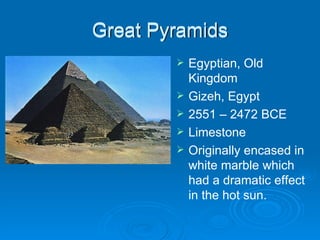
Great Pyramids Great Pyramids Egyptian, Old Kingdom Gizeh, Egypt 2551 – 2472 BCE Limestone Originally encased in white marble which had a dramatic effect in the hot sun.
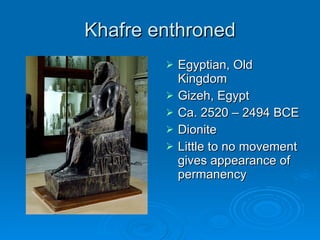
Khafre enthroned Egyptian, Old Kingdom Gizeh, Egypt Ca. 2520 – 2494 BCE Dionite Little to no movement gives appearance of permanency
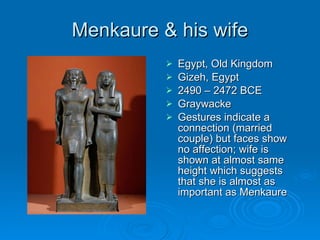
Menkaure & his wife Egypt, Old Kingdom Gizeh, Egypt 2490 – 2472 BCE Graywacke Gestures indicate a connection (married couple) but faces show no affection; wife is shown at almost same height which suggests that she is almost as important as Menkaure
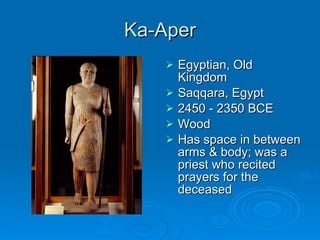
Ka-Aper Egyptian, Old Kingdom Saqqara, Egypt 2450 - 2350 BCE Wood Has space in between arms & body; was a priest who recited prayers for the deceased
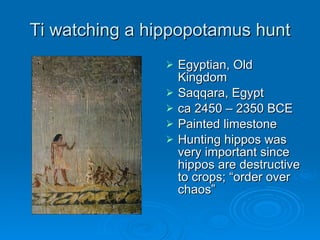
Ti watching a hippopotamus hunt Egyptian, Old Kingdom Saqqara, Egypt ca 2450 – 2350 BCE Painted limestone Hunting hippos was very important since hippos are destructive to crops; “order over chaos”
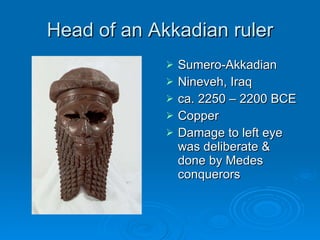
Head of an Akkadian ruler Sumero-Akkadian Nineveh, Iraq ca. 2250 – 2200 BCE Copper Damage to left eye was deliberate & done by Medes conquerors
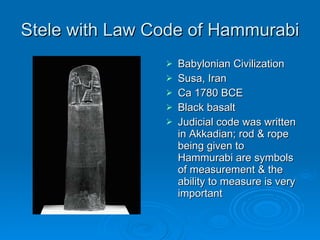
Stele with Law Code of Hammurabi Babylonian Civilization Susa, Iran Ca 1780 BCE Black basalt Judicial code was written in Akkadian; rod & rope being given to Hammurabi are symbols of measurement & the ability to measure is very important
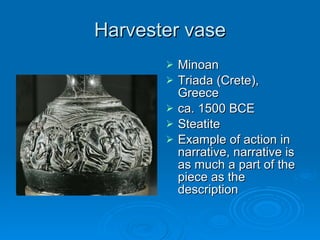
Harvester vase Minoan Triada (Crete), Greece ca. 1500 BCE Steatite Example of action in narrative, narrative is as much a part of the piece as the description
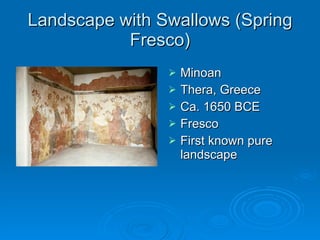
Landscape with Swallows (Spring Fresco) Minoan Thera, Greece Ca. 1650 BCE Fresco First known pure landscape
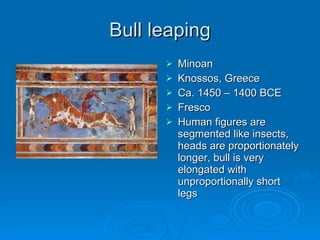
Bull leaping Minoan Knossos, Greece Ca. 1450 – 1400 BCE Fresco Human figures are segmented like insects, heads are proportionately longer, bull is very elongated with unproportionally short legs
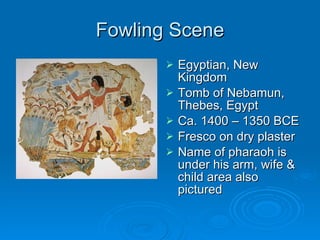
Fowling Scene Egyptian, New Kingdom Tomb of Nebamun, Thebes, Egypt Ca. 1400 – 1350 BCE Fresco on dry plaster Name of pharaoh is under his arm, wife & child area also pictured
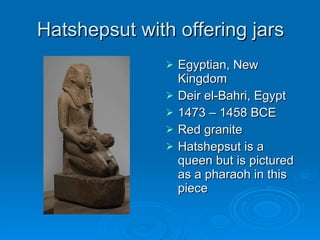
Hatshepsut with offering jars Egyptian, New Kingdom Deir el-Bahri, Egypt 1473 – 1458 BCE Red granite Hatshepsut is a queen but is pictured as a pharaoh in this piece
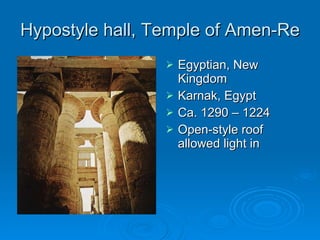
Hypostyle hall, Temple of Amen-Re Egyptian, New Kingdom Karnak, Egypt Ca. 1290 – 1224 Open-style roof allowed light in
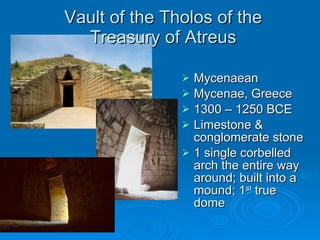
Vault of the Tholos of the Treasury of Atreus Mycenaean Mycenae, Greece 1300 – 1250 BCE Limestone & conglomerate stone 1 single corbelled arch the entire way around; built into a mound; 1 st  true dome
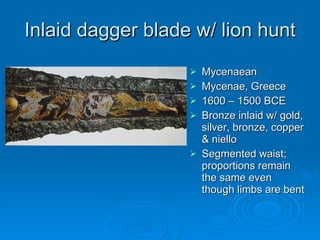
Inlaid dagger blade w/ lion hunt Mycenaean Mycenae, Greece 1600 – 1500 BCE Bronze inlaid w/ gold, silver, bronze, copper & niello Segmented waist; proportions remain the same even though limbs are bent
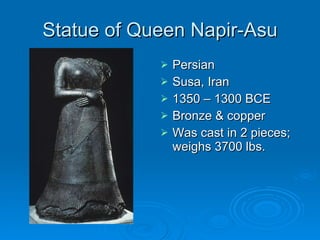
Statue of Queen Napir-Asu Persian Susa, Iran 1350 – 1300 BCE Bronze & copper Was cast in 2 pieces; weighs 3700 lbs.
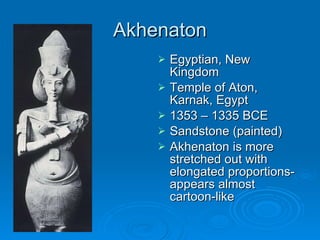
Akhenaton Egyptian, New Kingdom Temple of Aton, Karnak, Egypt 1353 – 1335 BCE Sandstone (painted) Akhenaton is more stretched out with elongated proportions- appears almost cartoon-like
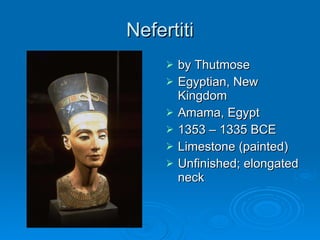
Nefertiti by Thutmose Egyptian, New Kingdom Amama, Egypt 1353 – 1335 BCE Limestone (painted) Unfinished; elongated neck
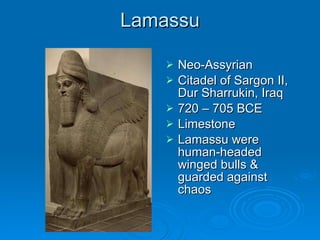
Neo-Assyrian Citadel of Sargon II, Dur Sharrukin, Iraq 720 – 705 BCE Limestone Lamassu were human-headed winged bulls & guarded against chaos Lamassu
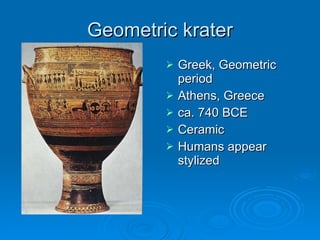
Geometric krater Greek, Geometric period Athens, Greece ca. 740 BCE Ceramic Humans appear stylized
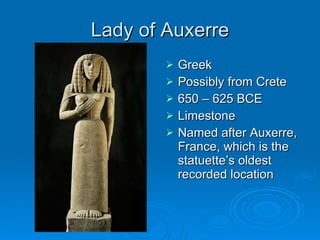
Lady of Auxerre Greek Possibly from Crete 650 – 625 BCE Limestone Named after Auxerre, France, which is the statuette’s oldest recorded location
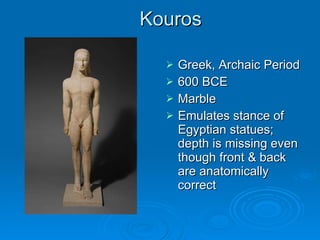
Kouros Greek, Archaic Period 600 BCE Marble Emulates stance of Egyptian statues; depth is missing even though front & back are anatomically correct
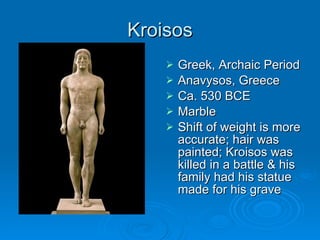
Kroisos Greek, Archaic Period Anavysos, Greece Ca. 530 BCE Marble Shift of weight is more accurate; hair was painted; Kroisos was killed in a battle & his family had his statue made for his grave
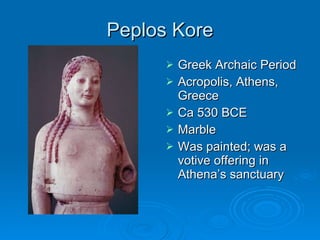
Peplos Kore Greek Archaic Period Acropolis, Athens, Greece Ca 530 BCE Marble Was painted; was a votive offering in Athena’s sanctuary
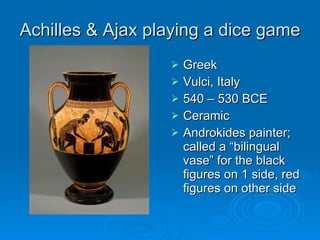
Achilles & Ajax playing a dice game Greek Vulci, Italy 540 – 530 BCE Ceramic Androkides painter; called a “bilingual vase” for the black figures on 1 side, red figures on other side
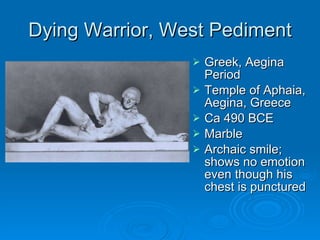
Dying Warrior, West Pediment Greek, Aegina Period Temple of Aphaia, Aegina, Greece Ca 490 BCE Marble Archaic smile; shows no emotion even though his chest is punctured
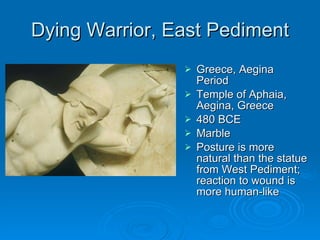
Dying Warrior, East Pediment Greece, Aegina Period Temple of Aphaia, Aegina, Greece 480 BCE Marble Posture is more natural than the statue from West Pediment; reaction to wound is more human-like
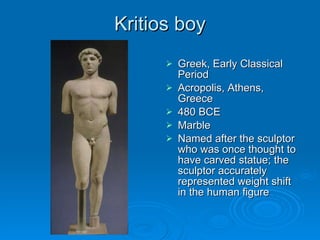
Kritios boy Greek, Early Classical Period Acropolis, Athens, Greece 480 BCE Marble Named after the sculptor who was once thought to have carved statue; the sculptor accurately represented weight shift in the human figure
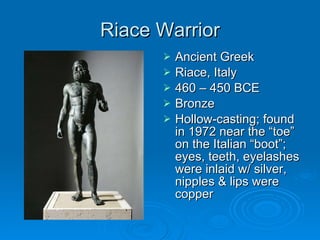
Riace Warrior Ancient Greek Riace, Italy 460 – 450 BCE Bronze Hollow-casting; found in 1972 near the “toe” on the Italian “boot”; eyes, teeth, eyelashes were inlaid w/ silver, nipples & lips were copper
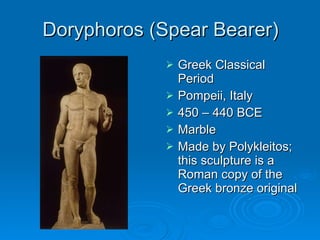
Doryphoros (Spear Bearer) Greek Classical Period Pompeii, Italy 450 – 440 BCE Marble Made by Polykleitos; this sculpture is a Roman copy of the Greek bronze original

Study slides

  • 1.
    Study slides for ART181 Quiz 2 _________________ Great Pyramids  Doryphoros
  • 2.
    Great Pyramids GreatPyramids Egyptian, Old Kingdom Gizeh, Egypt 2551 – 2472 BCE Limestone Originally encased in white marble which had a dramatic effect in the hot sun.
  • 3.
    Khafre enthroned Egyptian,Old Kingdom Gizeh, Egypt Ca. 2520 – 2494 BCE Dionite Little to no movement gives appearance of permanency
  • 4.
    Menkaure & hiswife Egypt, Old Kingdom Gizeh, Egypt 2490 – 2472 BCE Graywacke Gestures indicate a connection (married couple) but faces show no affection; wife is shown at almost same height which suggests that she is almost as important as Menkaure
  • 5.
    Ka-Aper Egyptian, OldKingdom Saqqara, Egypt 2450 - 2350 BCE Wood Has space in between arms & body; was a priest who recited prayers for the deceased
  • 6.
    Ti watching ahippopotamus hunt Egyptian, Old Kingdom Saqqara, Egypt ca 2450 – 2350 BCE Painted limestone Hunting hippos was very important since hippos are destructive to crops; “order over chaos”
  • 7.
    Head of anAkkadian ruler Sumero-Akkadian Nineveh, Iraq ca. 2250 – 2200 BCE Copper Damage to left eye was deliberate & done by Medes conquerors
  • 8.
    Stele with LawCode of Hammurabi Babylonian Civilization Susa, Iran Ca 1780 BCE Black basalt Judicial code was written in Akkadian; rod & rope being given to Hammurabi are symbols of measurement & the ability to measure is very important
  • 9.
    Harvester vase MinoanTriada (Crete), Greece ca. 1500 BCE Steatite Example of action in narrative, narrative is as much a part of the piece as the description
  • 10.
    Landscape with Swallows(Spring Fresco) Minoan Thera, Greece Ca. 1650 BCE Fresco First known pure landscape
  • 11.
    Bull leaping MinoanKnossos, Greece Ca. 1450 – 1400 BCE Fresco Human figures are segmented like insects, heads are proportionately longer, bull is very elongated with unproportionally short legs
  • 12.
    Fowling Scene Egyptian,New Kingdom Tomb of Nebamun, Thebes, Egypt Ca. 1400 – 1350 BCE Fresco on dry plaster Name of pharaoh is under his arm, wife & child area also pictured
  • 13.
    Hatshepsut with offeringjars Egyptian, New Kingdom Deir el-Bahri, Egypt 1473 – 1458 BCE Red granite Hatshepsut is a queen but is pictured as a pharaoh in this piece
  • 14.
    Hypostyle hall, Templeof Amen-Re Egyptian, New Kingdom Karnak, Egypt Ca. 1290 – 1224 Open-style roof allowed light in
  • 15.
    Vault of theTholos of the Treasury of Atreus Mycenaean Mycenae, Greece 1300 – 1250 BCE Limestone & conglomerate stone 1 single corbelled arch the entire way around; built into a mound; 1 st true dome
  • 16.
    Inlaid dagger bladew/ lion hunt Mycenaean Mycenae, Greece 1600 – 1500 BCE Bronze inlaid w/ gold, silver, bronze, copper & niello Segmented waist; proportions remain the same even though limbs are bent
  • 17.
    Statue of QueenNapir-Asu Persian Susa, Iran 1350 – 1300 BCE Bronze & copper Was cast in 2 pieces; weighs 3700 lbs.
  • 18.
    Akhenaton Egyptian, NewKingdom Temple of Aton, Karnak, Egypt 1353 – 1335 BCE Sandstone (painted) Akhenaton is more stretched out with elongated proportions- appears almost cartoon-like
  • 19.
    Nefertiti by ThutmoseEgyptian, New Kingdom Amama, Egypt 1353 – 1335 BCE Limestone (painted) Unfinished; elongated neck
  • 20.
    Neo-Assyrian Citadel ofSargon II, Dur Sharrukin, Iraq 720 – 705 BCE Limestone Lamassu were human-headed winged bulls & guarded against chaos Lamassu
  • 21.
    Geometric krater Greek,Geometric period Athens, Greece ca. 740 BCE Ceramic Humans appear stylized
  • 22.
    Lady of AuxerreGreek Possibly from Crete 650 – 625 BCE Limestone Named after Auxerre, France, which is the statuette’s oldest recorded location
  • 23.
    Kouros Greek, ArchaicPeriod 600 BCE Marble Emulates stance of Egyptian statues; depth is missing even though front & back are anatomically correct
  • 24.
    Kroisos Greek, ArchaicPeriod Anavysos, Greece Ca. 530 BCE Marble Shift of weight is more accurate; hair was painted; Kroisos was killed in a battle & his family had his statue made for his grave
  • 25.
    Peplos Kore GreekArchaic Period Acropolis, Athens, Greece Ca 530 BCE Marble Was painted; was a votive offering in Athena’s sanctuary
  • 26.
    Achilles & Ajaxplaying a dice game Greek Vulci, Italy 540 – 530 BCE Ceramic Androkides painter; called a “bilingual vase” for the black figures on 1 side, red figures on other side
  • 27.
    Dying Warrior, WestPediment Greek, Aegina Period Temple of Aphaia, Aegina, Greece Ca 490 BCE Marble Archaic smile; shows no emotion even though his chest is punctured
  • 28.
    Dying Warrior, EastPediment Greece, Aegina Period Temple of Aphaia, Aegina, Greece 480 BCE Marble Posture is more natural than the statue from West Pediment; reaction to wound is more human-like
  • 29.
    Kritios boy Greek,Early Classical Period Acropolis, Athens, Greece 480 BCE Marble Named after the sculptor who was once thought to have carved statue; the sculptor accurately represented weight shift in the human figure
  • 30.
    Riace Warrior AncientGreek Riace, Italy 460 – 450 BCE Bronze Hollow-casting; found in 1972 near the “toe” on the Italian “boot”; eyes, teeth, eyelashes were inlaid w/ silver, nipples & lips were copper
  • 31.
    Doryphoros (Spear Bearer)Greek Classical Period Pompeii, Italy 450 – 440 BCE Marble Made by Polykleitos; this sculpture is a Roman copy of the Greek bronze original