Year 11 Chemistry
Relative Atomic Masses
Mass Spectrometry
Masses
• E.g. What is the average mass of one
smartie?
How much will 200 smarties weigh?
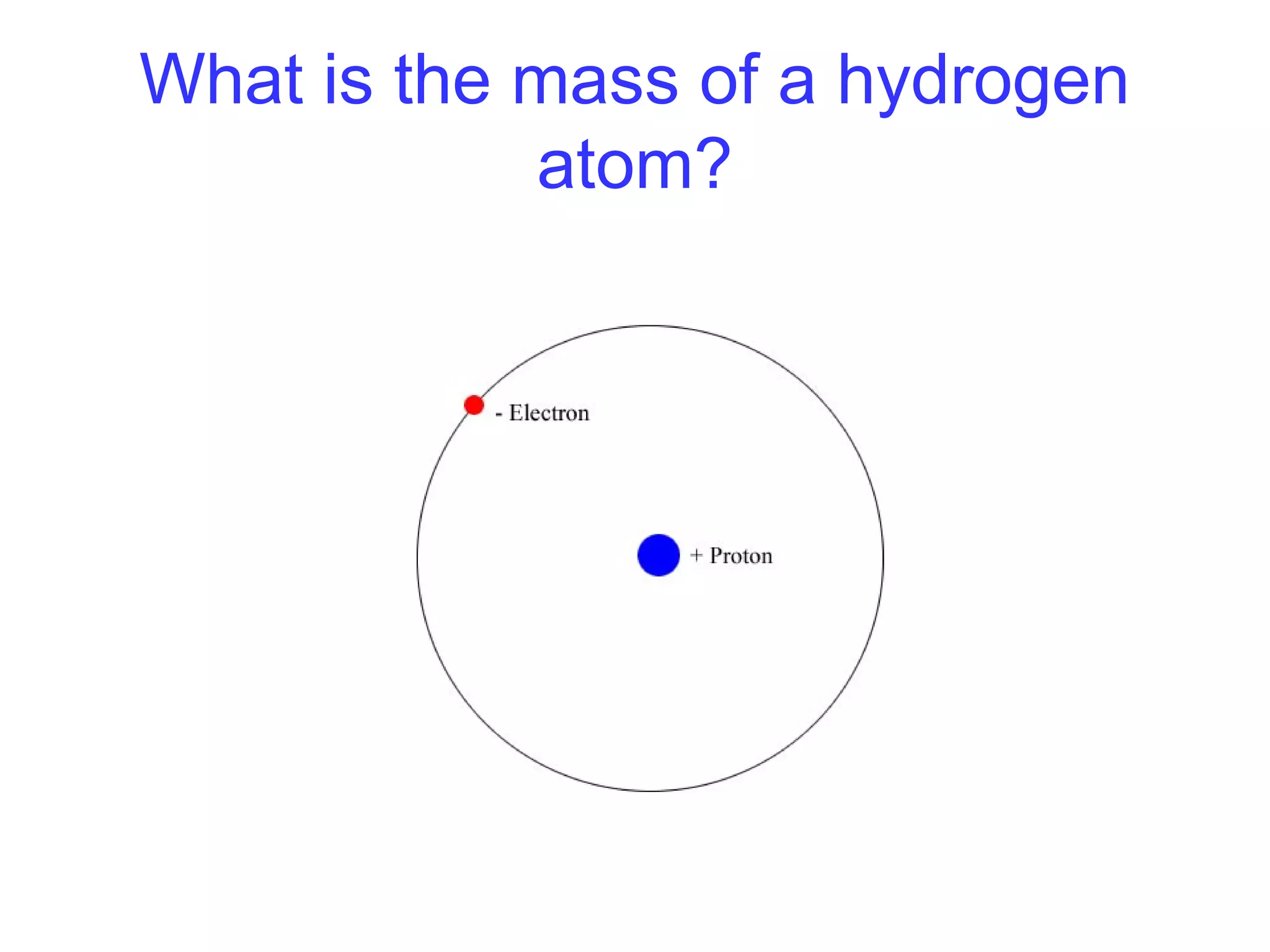
What is the mass of a hydrogen
atom?
What is the mass of a hydrogen
atom?
• This is not as simple because atoms are
tiny and therefore their mass is
exceptionally small.
Chemists use relative masses
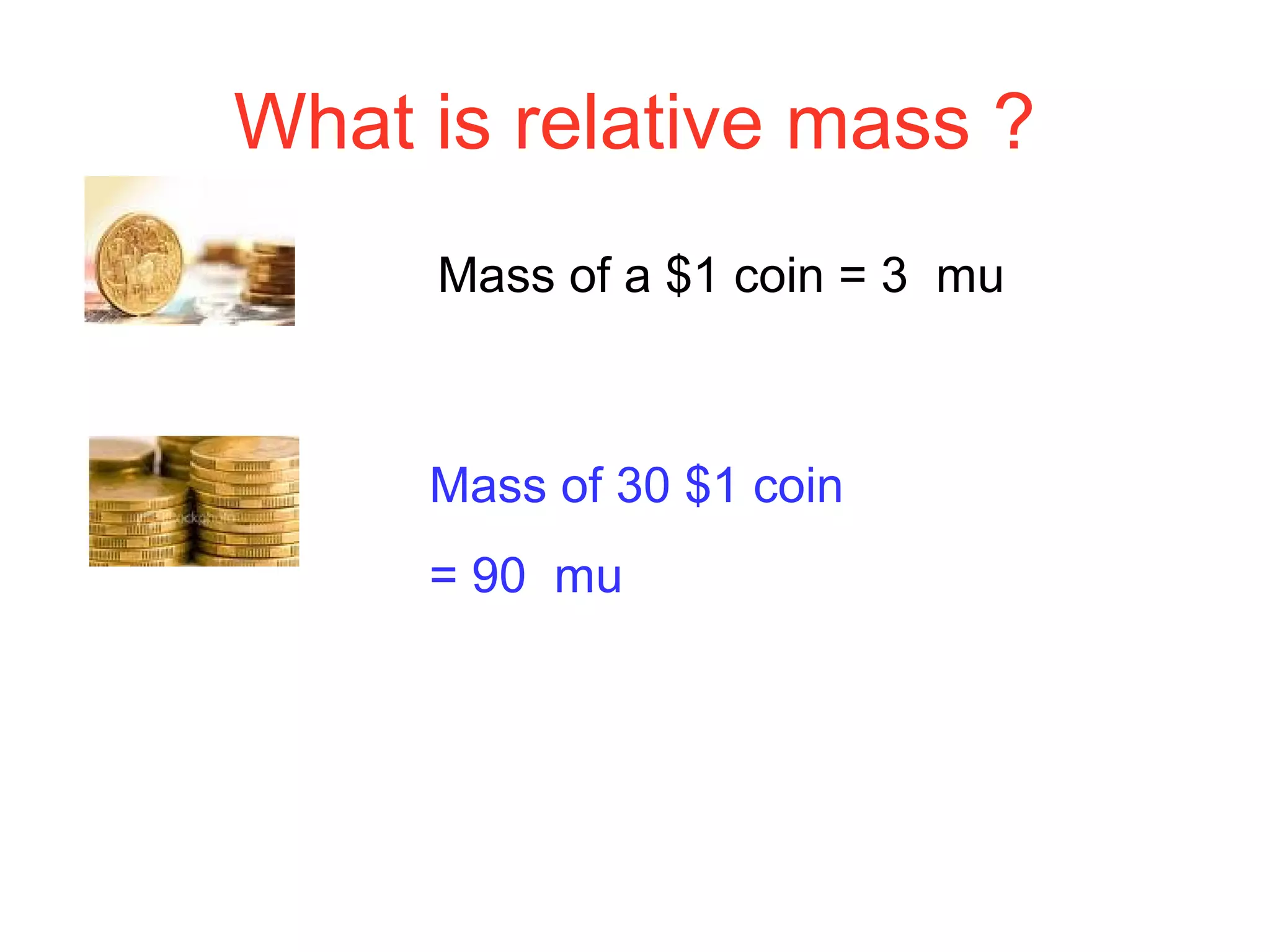
What is relative mass ?
Mass of a $1 coin = 3 mu
Mass of 30 $1 coin
= 90 mu
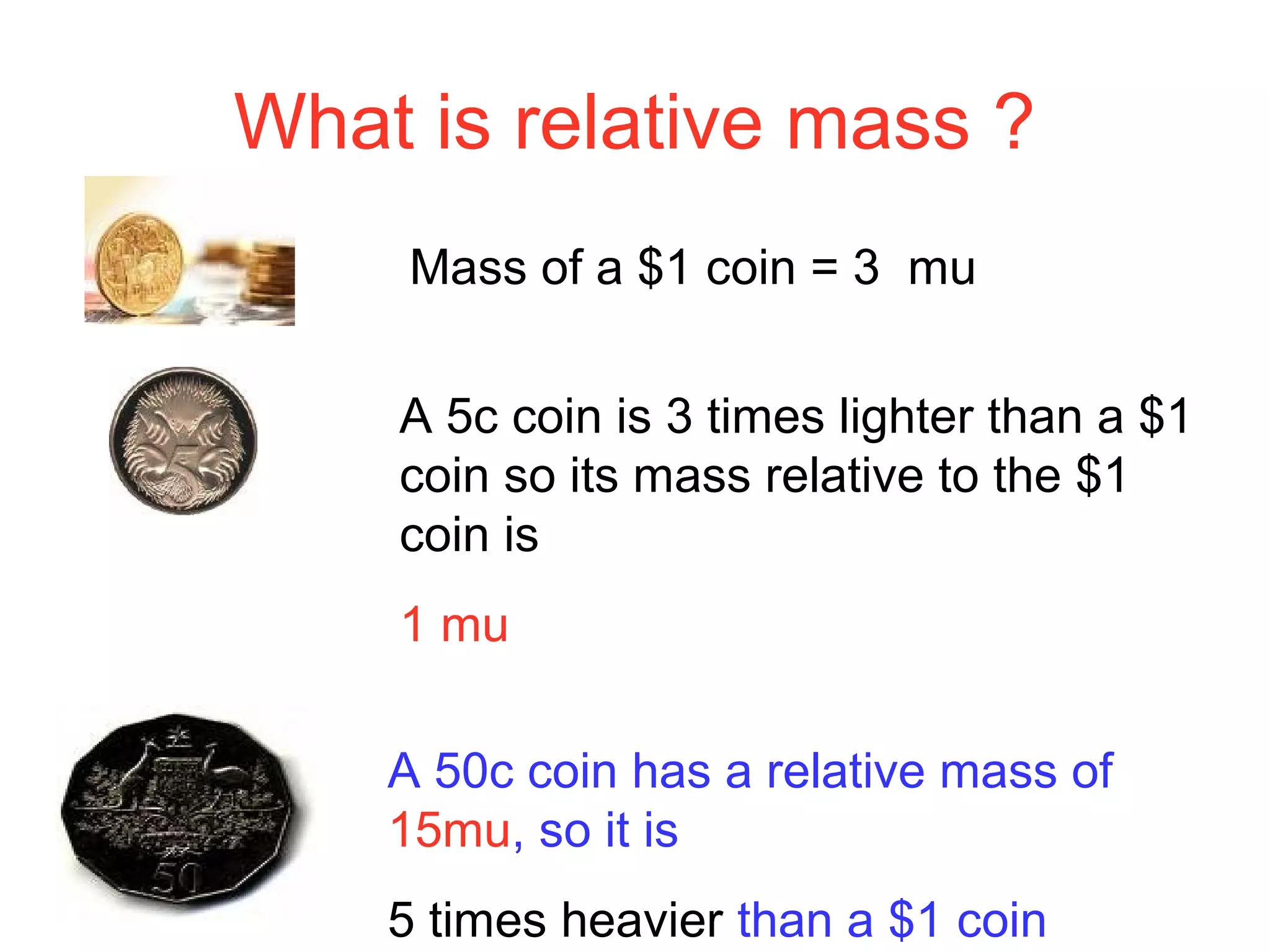
What is relative mass ?
A 5c coin is 3 times lighter than a $1
coin so its mass relative to the $1
coin is
1 mu
A 50c coin has a relative mass of
15mu, so it is
5 times heavier than a $1 coin
Mass of a $1 coin = 3 mu
MASSES OF ATOMS
An atoms mass is extremely small.
Eg one atom of carbon has an approximate
mass of 2 x 10-23
g.
ie 0.00000000000000000000002g
Chemists don’t use these types of masses
because
• Such small masses cannot be measured
accurately in experimental work and
• are awkward to work with in calculations
RELATIVE MASSES
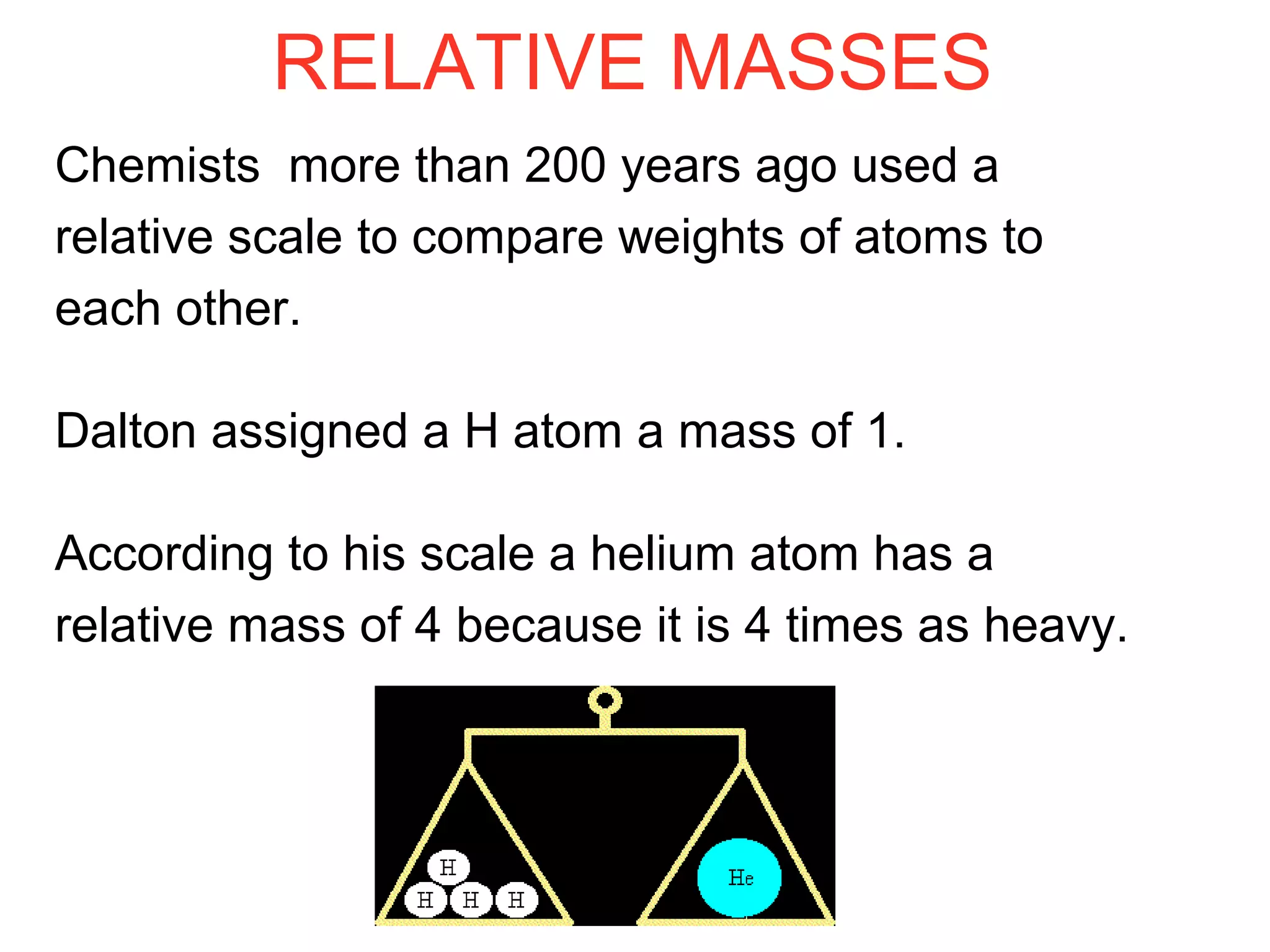
Chemists more than 200 years ago used a
relative scale to compare weights of atoms to
each other.
Dalton assigned a H atom a mass of 1.
According to his scale a helium atom has a
relative mass of 4 because it is 4 times as heavy.
RELATIVE MASSES
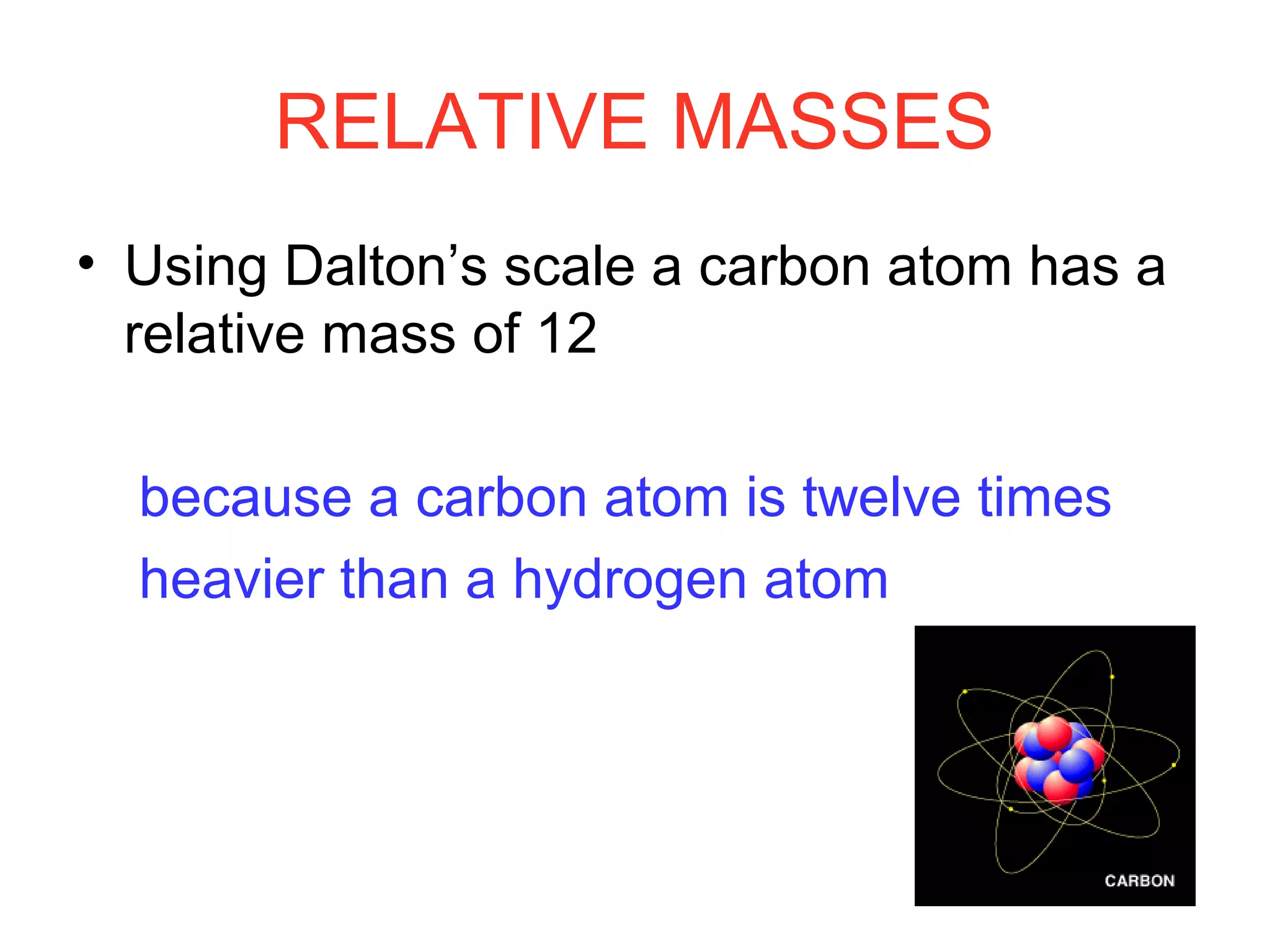
• Using Dalton’s scale a carbon atom has a
relative mass of 12
because a carbon atom is twelve times
heavier than a hydrogen atom
RELATIVE MASSES
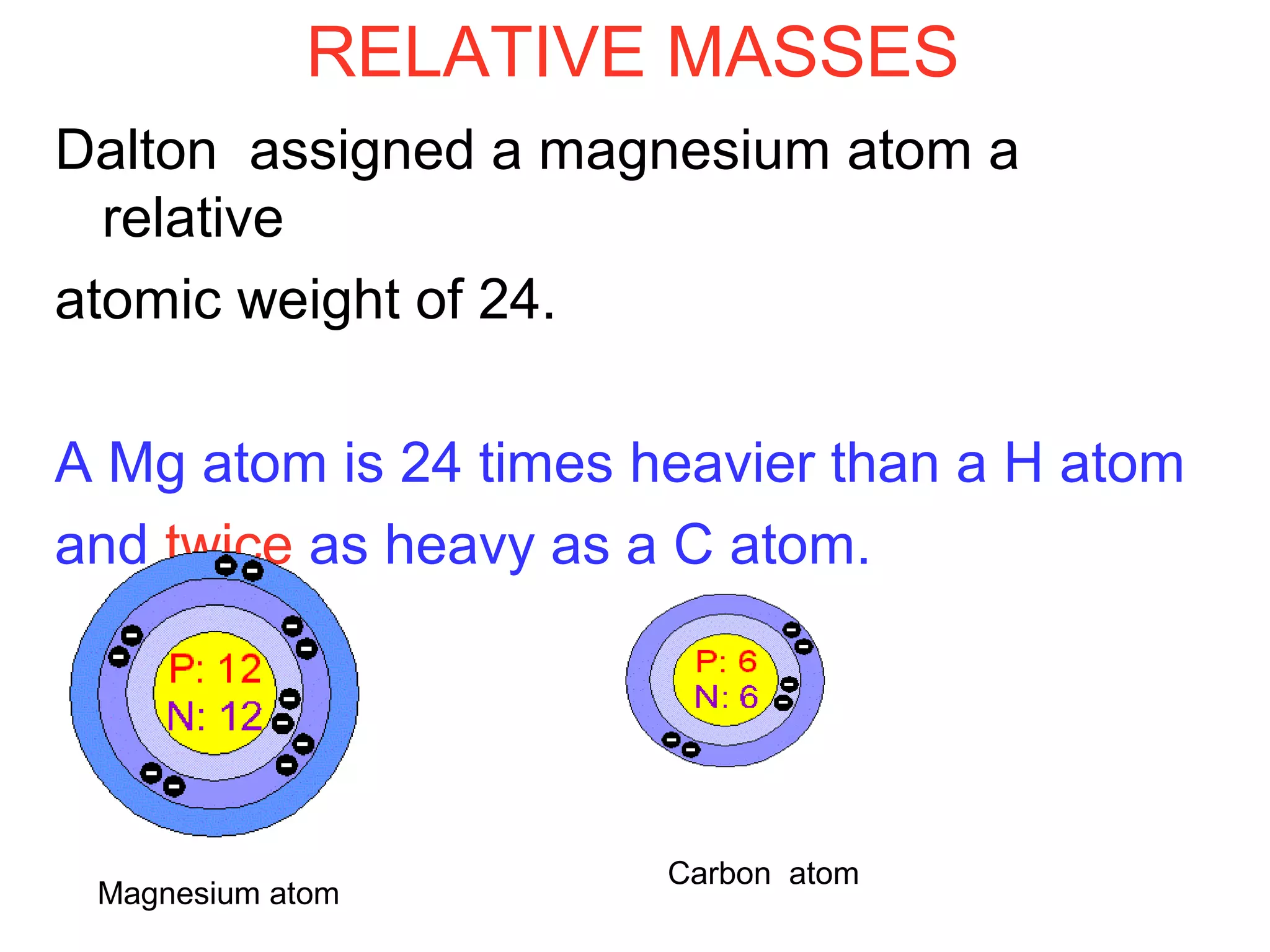
Dalton assigned a magnesium atom a
relative
atomic weight of 24.
A Mg atom is 24 times heavier than a H atom
and twice as heavy as a C atom.
Magnesium atom
Carbon atom
Comparing Masses
• In 1961 Dalton’s method of comparing
masses of atoms was replaced by IUPAC-
• International Union of Applied Physics and
Chemistry.
IUPAC RELATIVE MASSES
IUPAC decided that the most common isotope
of C which is 12
C would be used as a reference
standard and assigned an atom of 12
C a mass of
12 exactly.
Using this scale the helium isotope is assigned
a relative mass of 4
Comparing a helium atom to a carbon atom
The He atom is 3 times lighter
RELATIVE ATOMIC MASSES
A Krpton atom that is given a relative mass of 36
A Kr atom is three times heavier than a 12
C
atom
RELATIVE ATOMIC MASSES
All isotopes of elements are given a relative
isotopic mass compared to the 12
C isotope.
There are 3 isotopes of Mg
24
Mg
25
Mg
26
Mg
These 3 atoms are different because
they have different numbers of neutrons
Abundances of Isotopes
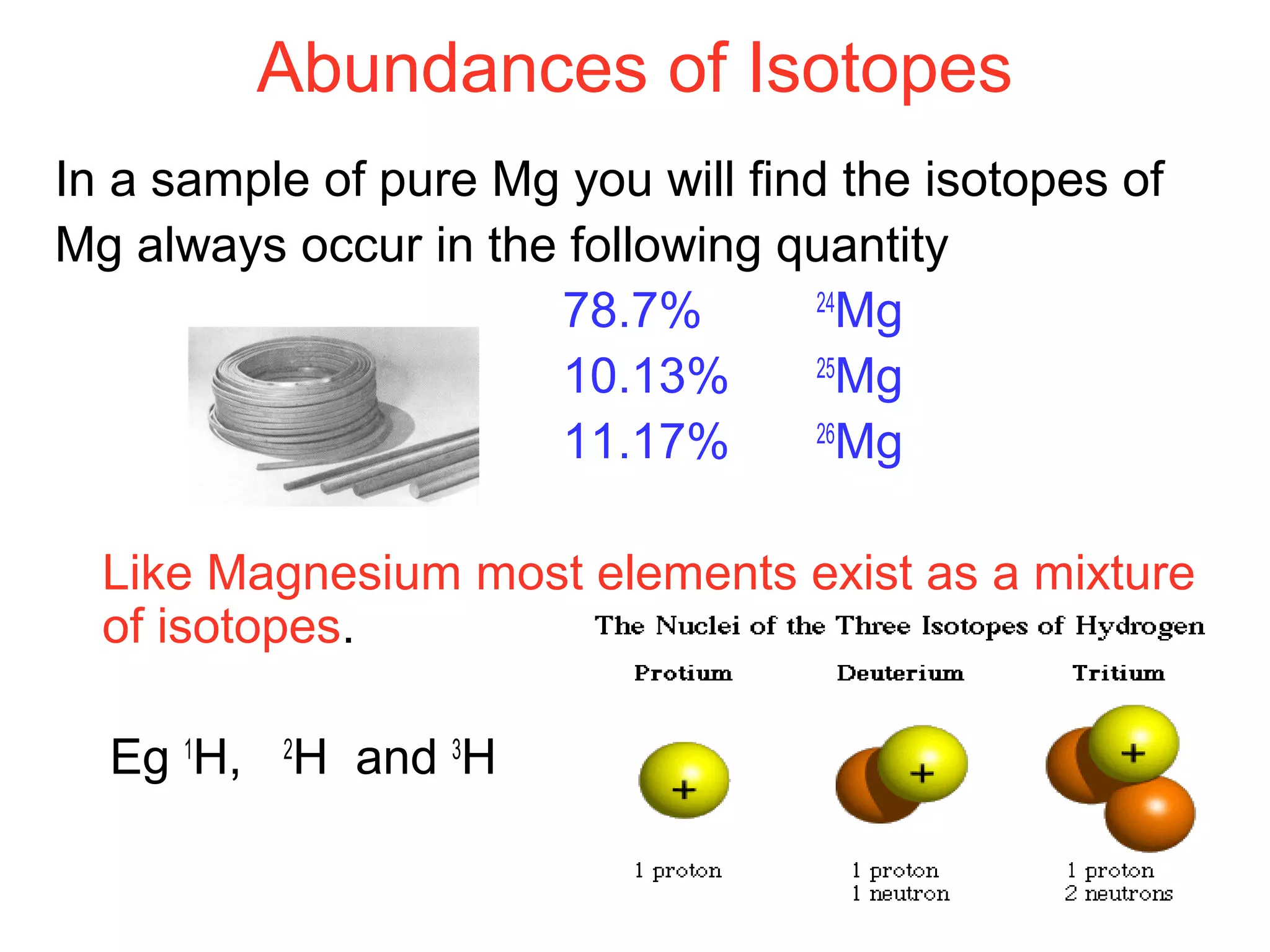
In a sample of pure Mg you will find the isotopes of
Mg always occur in the following quantity
78.7% 24
Mg
10.13% 25
Mg
11.17% 26
Mg
Like Magnesium most elements exist as a mixture
of isotopes.
Eg 1
H, 2
H and 3
H
Finding Relative Atomic Masses
Thomson (1913) discovered some elements
had atoms with different masses using an
instrument called a mass spectrometer.
Mass Spectrometer – Principle
• Separates using magnetic attraction and charge.
• If a force is applied at right angles to the path of a
moving object, the force will change the object’s
direction.
• A lighter object will be deflected more from its original
path than a heavier one.
• A more highly charged ion will be deflected more than a
one with a lower charge.
A Mass Spectrometer
• http://www.colby.edu/chemistry/OChem/DEMO
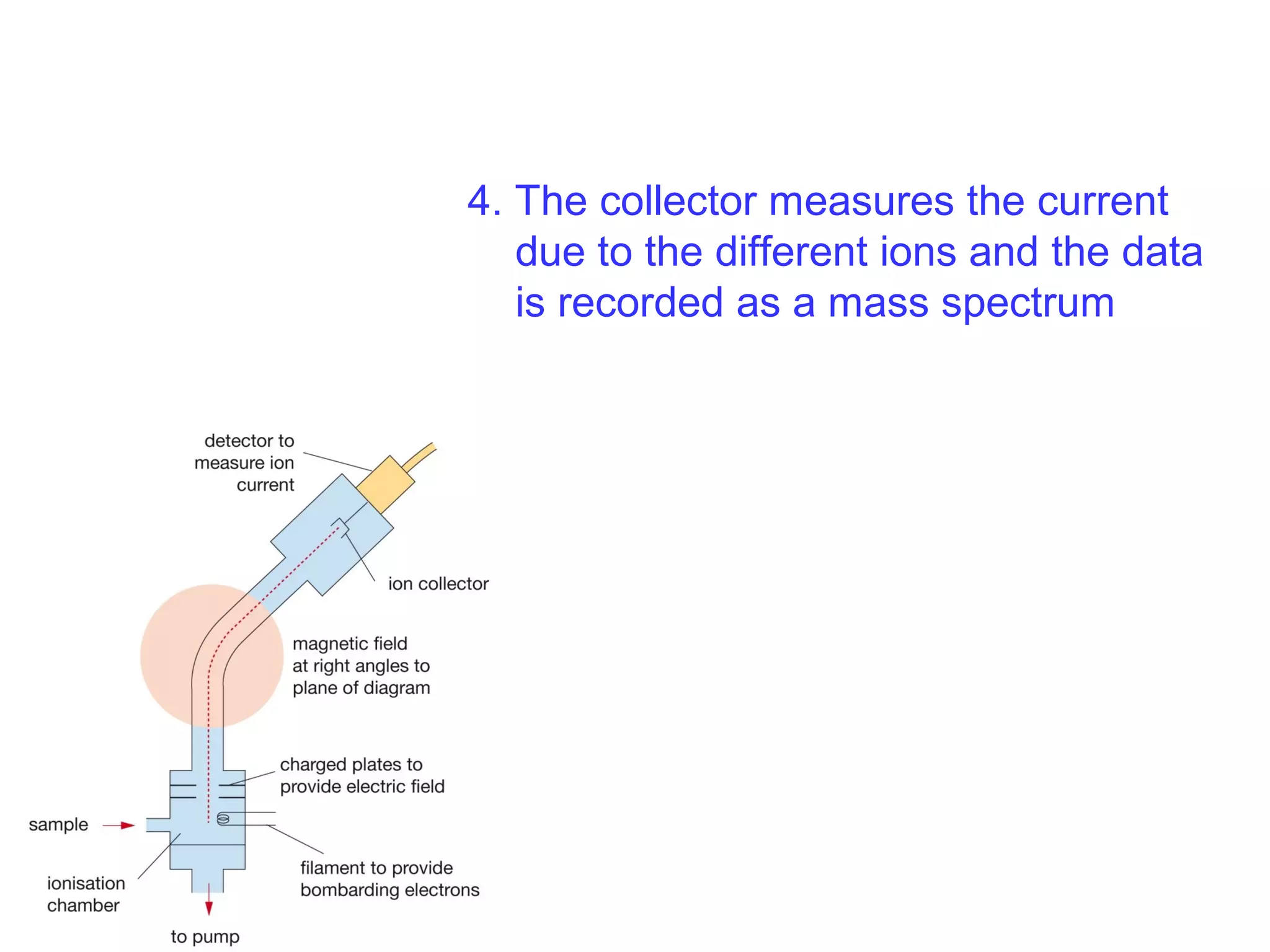
1. The element is vaporised
2. Atoms are ionised by knocking one or more electrons off to give
a positive ion. Positive ions are accelerated to high speeds by a
magnetic field so that they all have the same kinetic energy.
3.The ions are then deflected by a
magnetic field according to their
masses.
The lighter they are, the more they
are deflected.
The amount of deflection also
depends on charge on the ion - in
other words, on how many electrons
were knocked off in the first stage.
The more the ion is charged, the
more it gets deflected.
4. The collector measures the current
due to the different ions and the data
is recorded as a mass spectrum
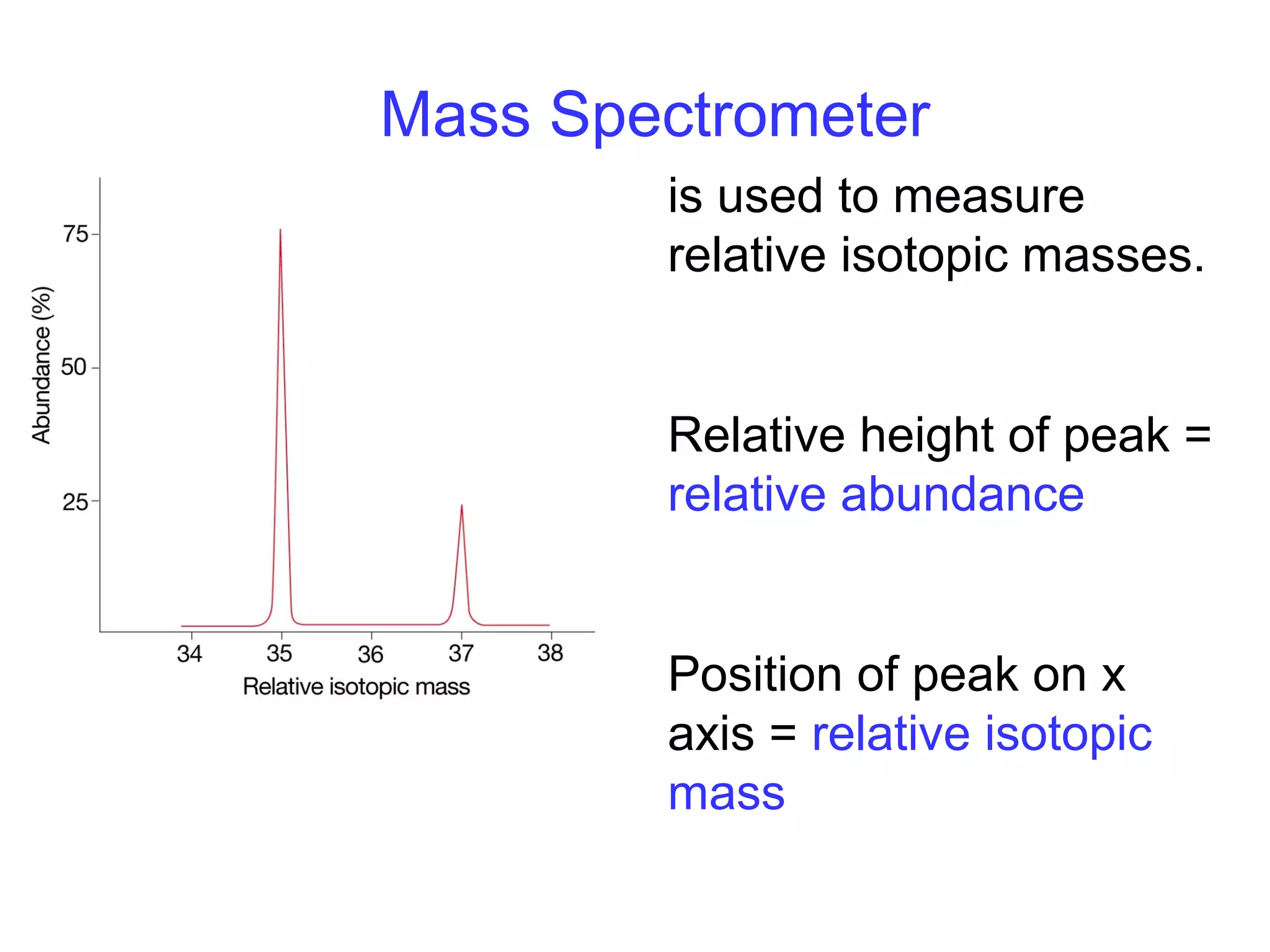
is used to measure
relative isotopic masses.
Relative height of peak =
relative abundance
Position of peak on x
axis = relative isotopic
mass
Mass Spectrometer
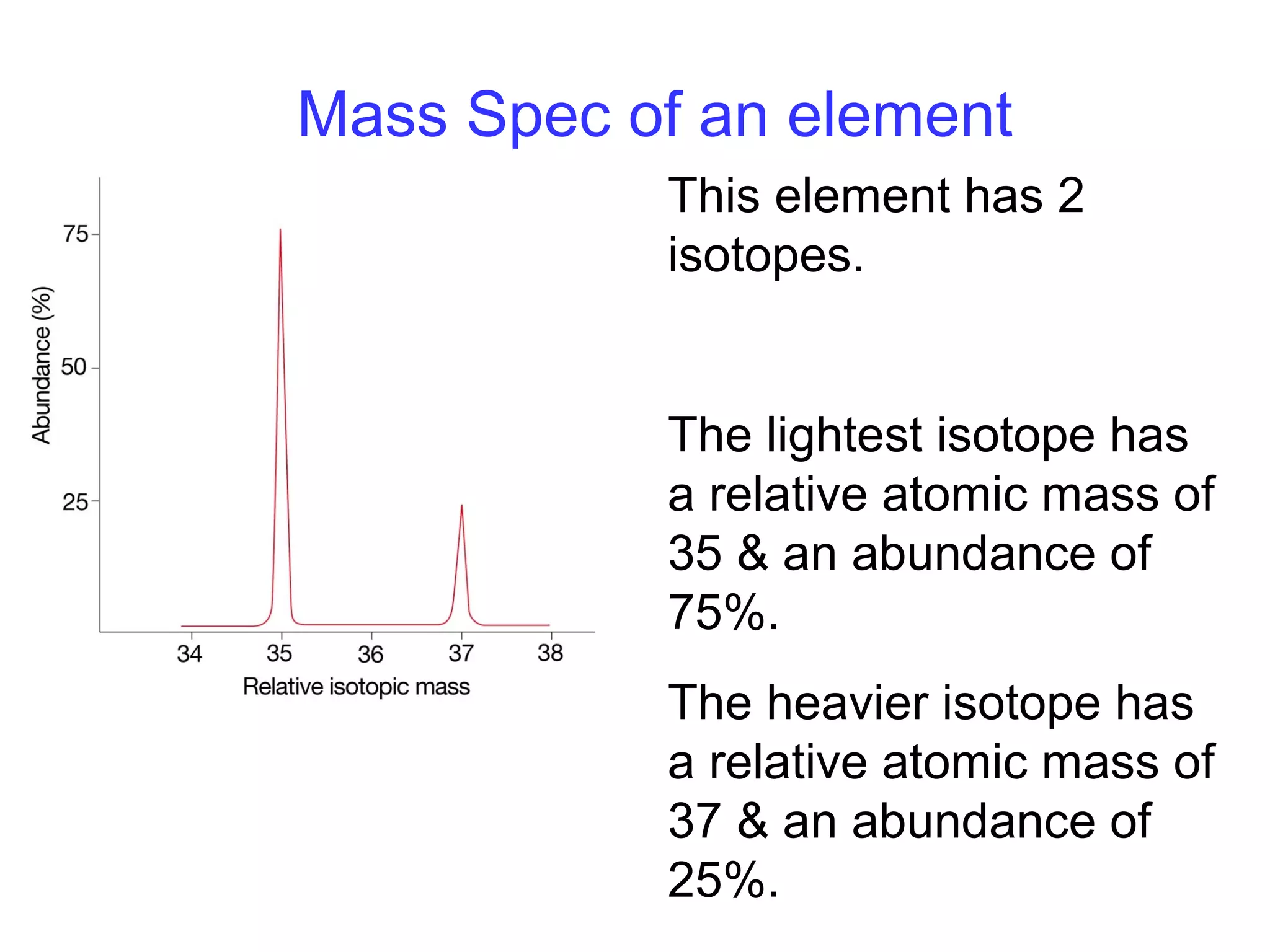
This element has 2
isotopes.
The lightest isotope has
a relative atomic mass of
35 & an abundance of
75%.
The heavier isotope has
a relative atomic mass of
37 & an abundance of
25%.
Mass Spec of an element
Summing Up
Relative masses of isotopes of an element are
determined by an instrument called a mass
spectrometer
This separates isotopes and determines their
mass relative to the 12
C isotope
and gives you the relative abundance of the
isotopes on a graph called a mass spectrum.
http://www.colby.edu/chemistry/OChem/DEMOS/MassSpec.html
Mass Spectrum of Magnesium
Each peak represents a
different isotope.
The position of each peak
on the horizontal axis
indicates the relative
isotopic mass which tells
us how heavy the atoms
of each isotope is
compared to the12
C
isotope.
The relative heights of the peaks correspond to
the relative abundance of the isotopes.
AVERAGE RELATIVE ATOMIC MASSES
Don’t normally worry about the isotopes of an
element because
they always occur in the same proportions and
behave identically in chemical reactions.
Chemists use what is known as average relative
atomic masses
This is an average mass of all the isotopes of an
element compared to12
C and it is given the symbol
Ar.
AVERAGE RELATIVE ATOMIC MASSES
Ar(Ti) = 47.90
A Ti atom on average is about 4 times
heavier than a C atom. (47.9 ÷ 12)
CALCULATING Ar
Calculate the average relative atomic mass of Magnesium
given:
Isotope Relative Mass Abundance
24
Mg 23.99 78.7%
25
Mg 24.89 10.13 %
26
Mg 25.98 11.17%
Assume we have 100 atoms of Mg.
mass contributed by the 24
Mg isotope is 23.99 x 78.7
mass contributed by the 25
Mg isotope is 24.89 x 10.13
mass contributed by the 26
Mg isotope is 25.98 x 11.17
Total mass of 100 Mg atoms
= 23.99 x 78.7 + 24.89 x 10.13 + 25.98
Finding Ar
Total mass of 100 Mg atoms
= 23.99 x 78.7 + 24.89 x 10.13 + 25.98 x 11.17
Ar(Mg) = 23.99 x 78.7 + 24.89 x 10.13 + 25.98 x 11.17
100
Ar(Mg) = 24.3
This is not the true mass of a Mg atom but its
relative mass compared to a 12
C atom.
Finding Ar
The general rule is:
Ar = Σ(relative isotopic mass x abundance)
100
Finding Ar
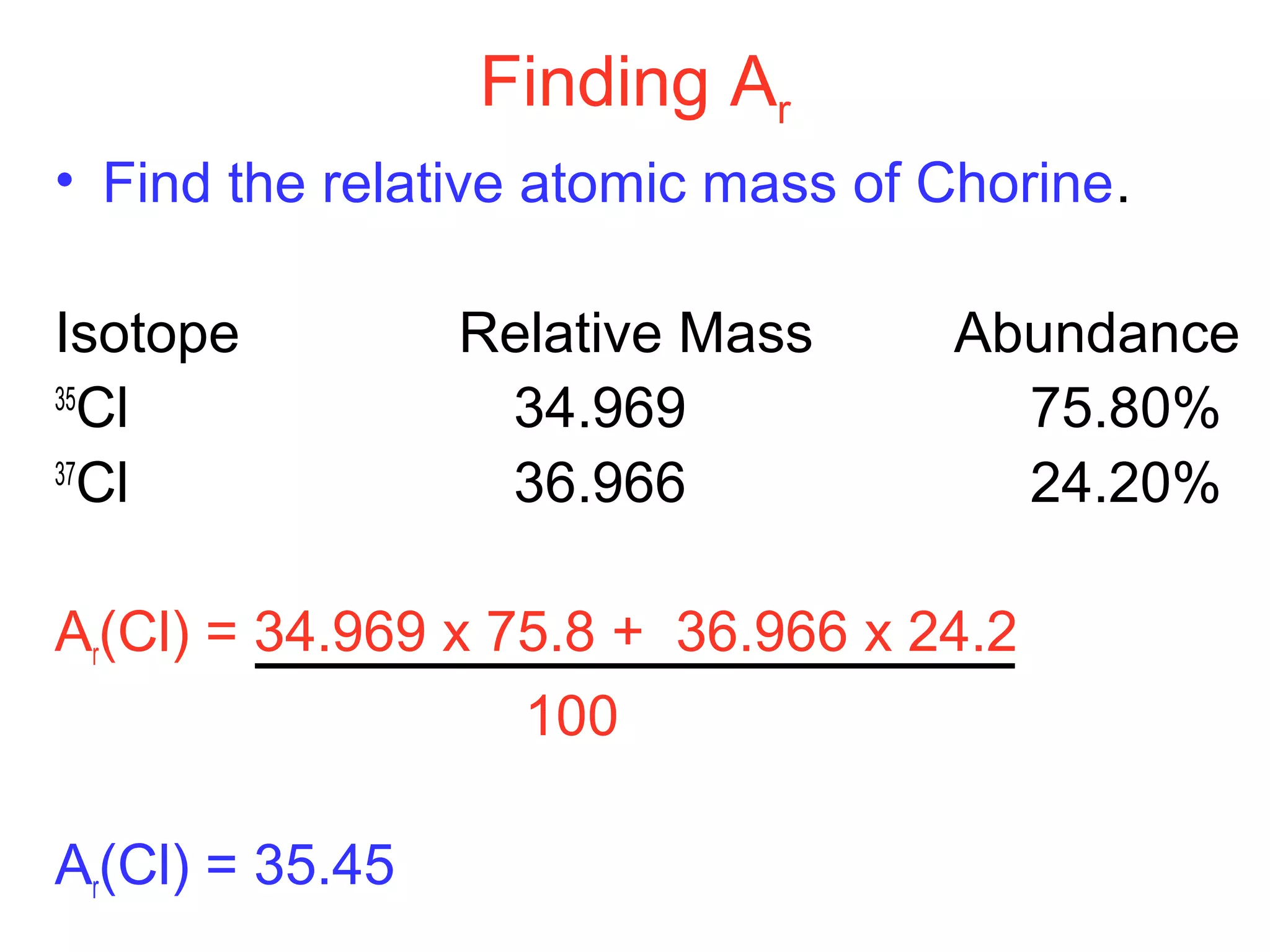
• Find the relative atomic mass of Chorine.
Isotope Relative Mass Abundance
35
Cl 34.969 75.80%
37
Cl 36.966 24.20%
Ar(Cl) = 34.969 x 75.8 + 36.966 x 24.2
100
Ar(Cl) = 35.45
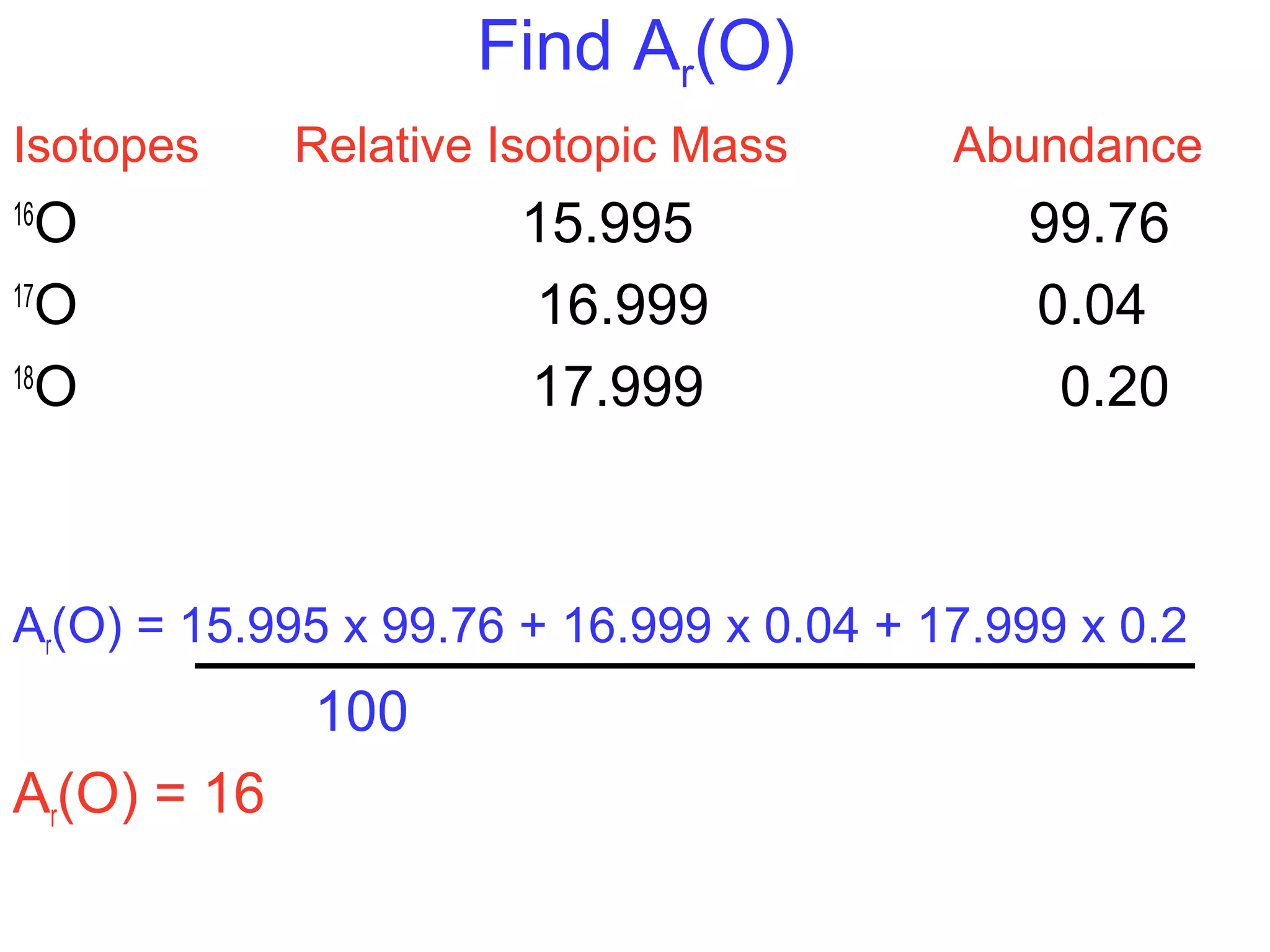
Find Ar(O)
Isotopes Relative Isotopic Mass Abundance
16
O 15.995 99.76
17
O 16.999 0.04
18
O 17.999 0.20
Ar(O) = 15.995 x 99.76 + 16.999 x 0.04 + 17.999 x 0.2
100
Ar(O) = 16
Calculating Abundances
• The relative atomic mass of Rubidium is
85.47. The relative masses of the two
isotopes are 84.94 and 86.94.
• Calculate the relative abundances of both
isotopes.
Calculating Abundances
Relative mass lightest isotope = 84.94
Relative mass heaviest isotope = 86.94
Ar = 85.47
Abundance of lightest isotope = x
Abundance of heaviest isotope = 100 – x
Ar =
∑
(relative isotopic mass x abundance)
100
85.47 = 84.94 × x + 86.94(100 – x)
100
Calculating Abundances
85.47 = 84.94 x x + 86.94(100 – x)
100
8547 = 84.94x + 8694 – 86.94x
-147 = -2x
x = 73.5
Abundance of lightest isotope = 73.5%
Abundance of heaviest isotope = 26.5%
Relative Atomic Masses
• Can be read from the Periodic table or a
table of relative atomic masses.
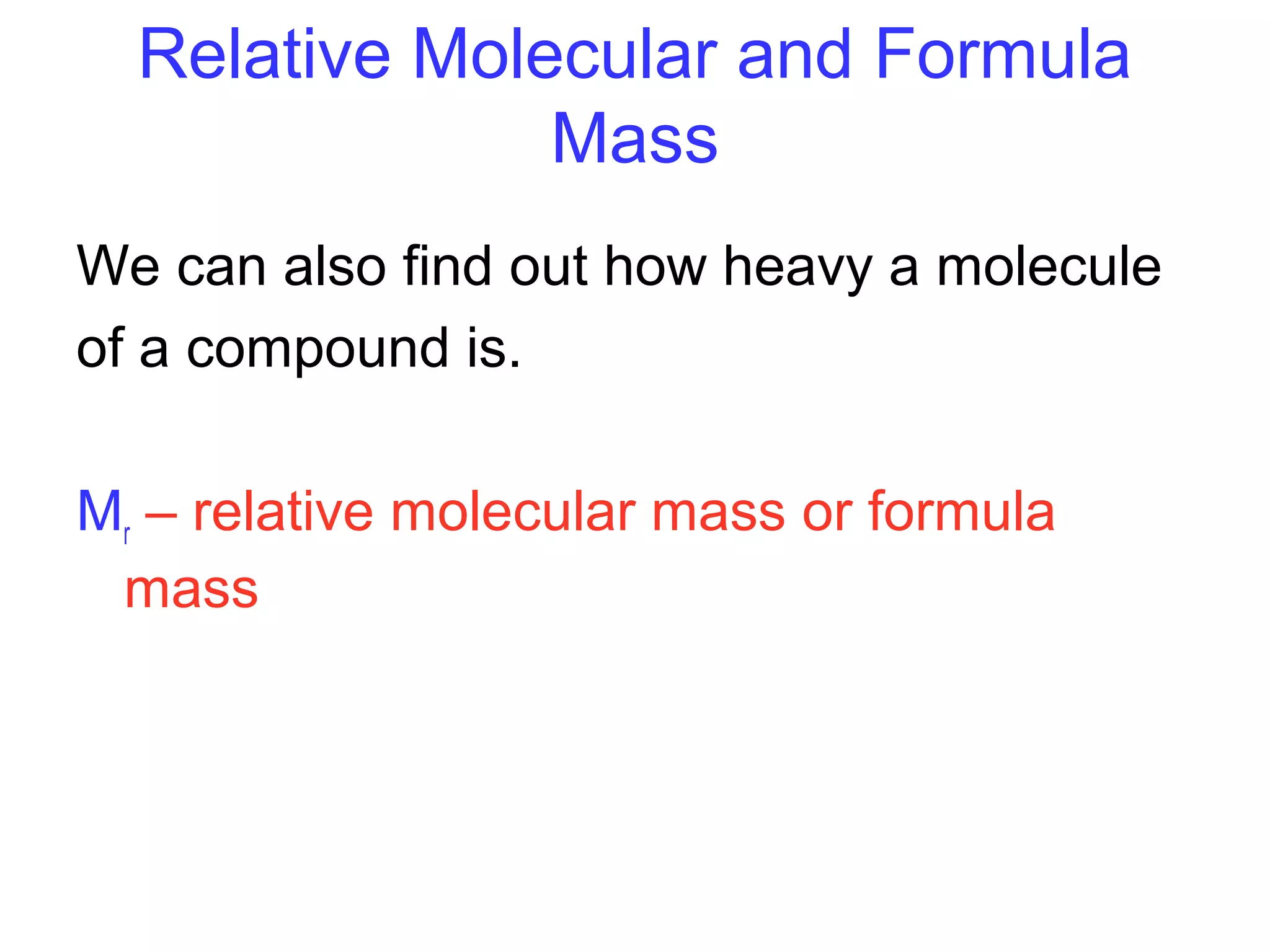
Relative Molecular and Formula
Mass
We can also find out how heavy a molecule
of a compound is.
Mr – relative molecular mass or formula
mass
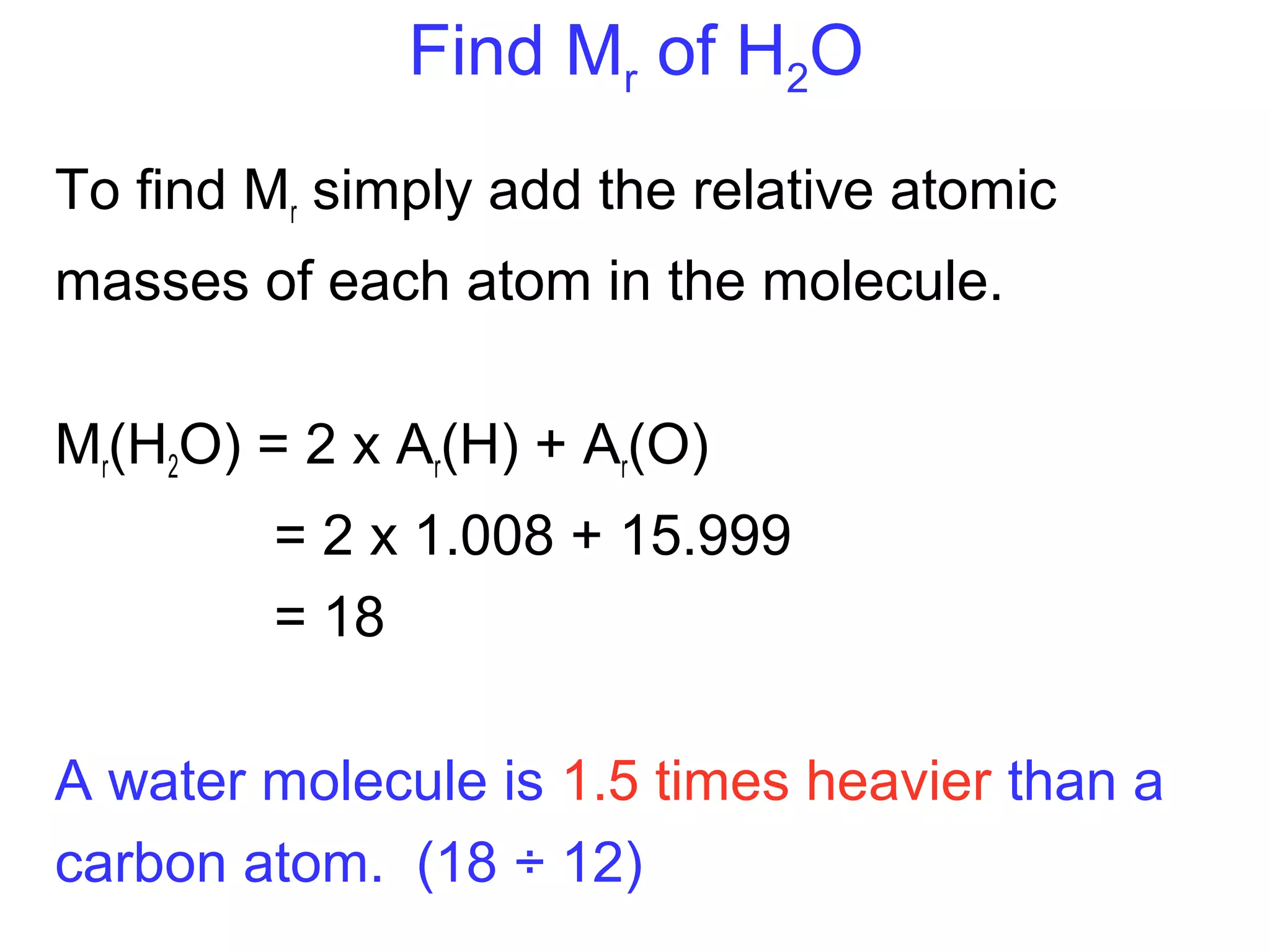
Find Mr of H2O
To find Mr simply add the relative atomic
masses of each atom in the molecule.
Mr(H2O) = 2 x Ar(H) + Ar(O)
= 2 x 1.008 + 15.999
= 18
A water molecule is 1.5 times heavier than a
carbon atom. (18 ÷ 12)
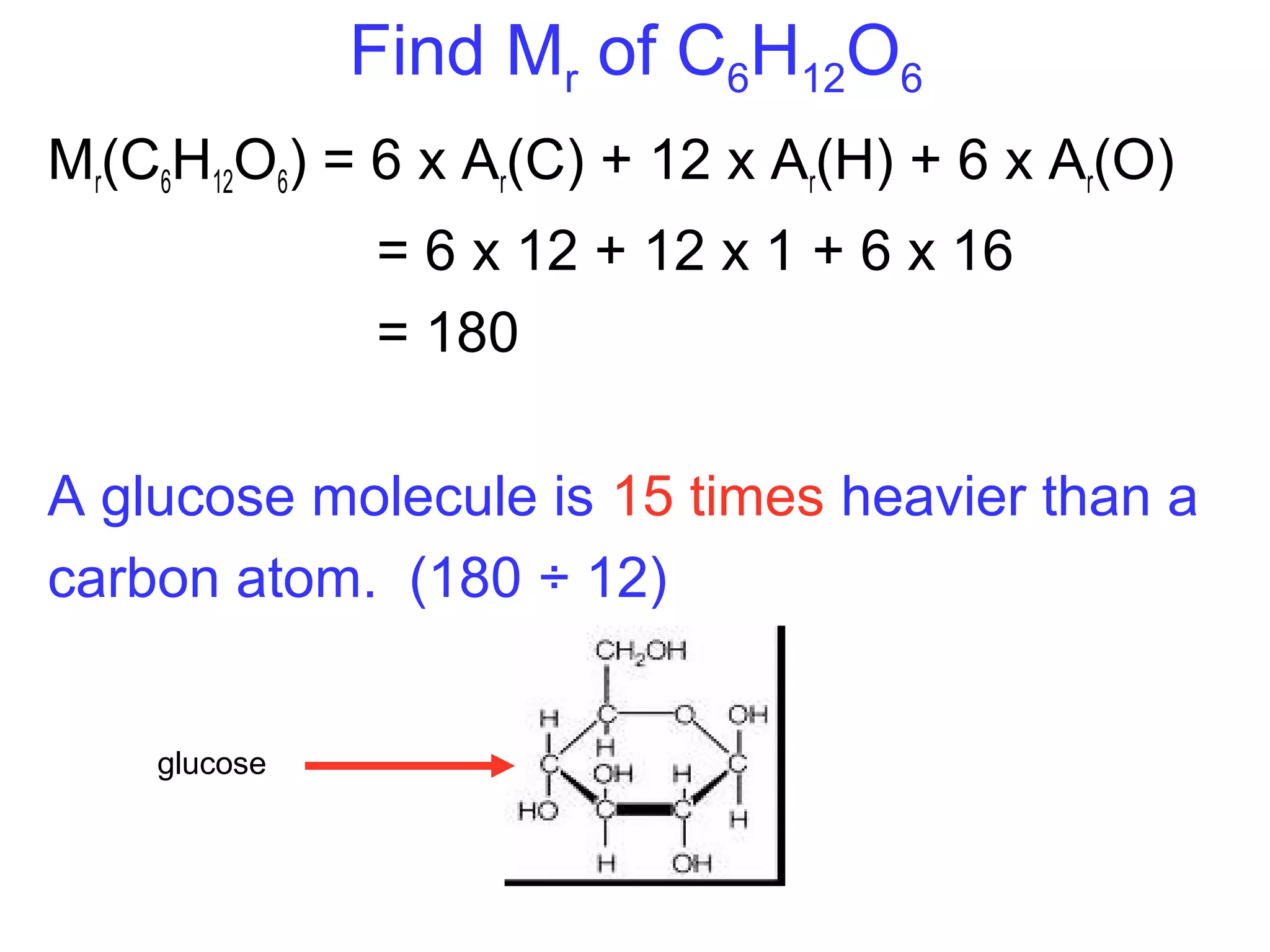
Find Mr of C6H12O6
Mr(C6H12O6) = 6 x Ar(C) + 12 x Ar(H) + 6 x Ar(O)
= 6 x 12 + 12 x 1 + 6 x 16
= 180
A glucose molecule is 15 times heavier than a
carbon atom. (180 ÷ 12)
glucose
Ionic Compounds
Eg NaCl
For compounds that don’t consist of
molecules we find the formula mass.
Mr(NaCl) = 23 + 35.5
= 58.5
Course Work
• Read Chapter 2 pp 37 – 38
Chapter Review Questions pg 49 Q 6, 7, 8,
• Chapter Questions pg 39 Q 10, 11, 14b, 15,
16, 18
• Complete mass spec worksheet

Relative atomic mass_&_mass_spectrometry[1][1]

  • 1.
    Year 11 Chemistry RelativeAtomic Masses Mass Spectrometry
  • 2.
    Masses • E.g. Whatis the average mass of one smartie?
  • 3.
    How much will200 smarties weigh?
  • 4.
    What is themass of a hydrogen atom?
  • 5.
    What is themass of a hydrogen atom? • This is not as simple because atoms are tiny and therefore their mass is exceptionally small.
  • 6.
  • 7.
    What is relativemass ? Mass of a $1 coin = 3 mu Mass of 30 $1 coin = 90 mu
  • 8.
    What is relativemass ? A 5c coin is 3 times lighter than a $1 coin so its mass relative to the $1 coin is 1 mu A 50c coin has a relative mass of 15mu, so it is 5 times heavier than a $1 coin Mass of a $1 coin = 3 mu
  • 9.
    MASSES OF ATOMS Anatoms mass is extremely small. Eg one atom of carbon has an approximate mass of 2 x 10-23 g. ie 0.00000000000000000000002g Chemists don’t use these types of masses because • Such small masses cannot be measured accurately in experimental work and • are awkward to work with in calculations
  • 10.
    RELATIVE MASSES Chemists morethan 200 years ago used a relative scale to compare weights of atoms to each other. Dalton assigned a H atom a mass of 1. According to his scale a helium atom has a relative mass of 4 because it is 4 times as heavy.
  • 11.
    RELATIVE MASSES • UsingDalton’s scale a carbon atom has a relative mass of 12 because a carbon atom is twelve times heavier than a hydrogen atom
  • 12.
    RELATIVE MASSES Dalton assigneda magnesium atom a relative atomic weight of 24. A Mg atom is 24 times heavier than a H atom and twice as heavy as a C atom. Magnesium atom Carbon atom
  • 13.
    Comparing Masses • In1961 Dalton’s method of comparing masses of atoms was replaced by IUPAC- • International Union of Applied Physics and Chemistry.
  • 14.
    IUPAC RELATIVE MASSES IUPACdecided that the most common isotope of C which is 12 C would be used as a reference standard and assigned an atom of 12 C a mass of 12 exactly. Using this scale the helium isotope is assigned a relative mass of 4 Comparing a helium atom to a carbon atom The He atom is 3 times lighter
  • 15.
    RELATIVE ATOMIC MASSES AKrpton atom that is given a relative mass of 36 A Kr atom is three times heavier than a 12 C atom
  • 16.
    RELATIVE ATOMIC MASSES Allisotopes of elements are given a relative isotopic mass compared to the 12 C isotope. There are 3 isotopes of Mg 24 Mg 25 Mg 26 Mg These 3 atoms are different because they have different numbers of neutrons
  • 17.
    Abundances of Isotopes Ina sample of pure Mg you will find the isotopes of Mg always occur in the following quantity 78.7% 24 Mg 10.13% 25 Mg 11.17% 26 Mg Like Magnesium most elements exist as a mixture of isotopes. Eg 1 H, 2 H and 3 H
  • 18.
    Finding Relative AtomicMasses Thomson (1913) discovered some elements had atoms with different masses using an instrument called a mass spectrometer.
  • 19.
    Mass Spectrometer –Principle • Separates using magnetic attraction and charge. • If a force is applied at right angles to the path of a moving object, the force will change the object’s direction. • A lighter object will be deflected more from its original path than a heavier one. • A more highly charged ion will be deflected more than a one with a lower charge.
  • 20.
    A Mass Spectrometer •http://www.colby.edu/chemistry/OChem/DEMO
  • 21.
    1. The elementis vaporised 2. Atoms are ionised by knocking one or more electrons off to give a positive ion. Positive ions are accelerated to high speeds by a magnetic field so that they all have the same kinetic energy.
  • 22.
    3.The ions arethen deflected by a magnetic field according to their masses. The lighter they are, the more they are deflected. The amount of deflection also depends on charge on the ion - in other words, on how many electrons were knocked off in the first stage. The more the ion is charged, the more it gets deflected.
  • 23.
    4. The collectormeasures the current due to the different ions and the data is recorded as a mass spectrum
  • 24.
    is used tomeasure relative isotopic masses. Relative height of peak = relative abundance Position of peak on x axis = relative isotopic mass Mass Spectrometer
  • 25.
    This element has2 isotopes. The lightest isotope has a relative atomic mass of 35 & an abundance of 75%. The heavier isotope has a relative atomic mass of 37 & an abundance of 25%. Mass Spec of an element
  • 26.
    Summing Up Relative massesof isotopes of an element are determined by an instrument called a mass spectrometer This separates isotopes and determines their mass relative to the 12 C isotope and gives you the relative abundance of the isotopes on a graph called a mass spectrum. http://www.colby.edu/chemistry/OChem/DEMOS/MassSpec.html
  • 27.
    Mass Spectrum ofMagnesium Each peak represents a different isotope. The position of each peak on the horizontal axis indicates the relative isotopic mass which tells us how heavy the atoms of each isotope is compared to the12 C isotope. The relative heights of the peaks correspond to the relative abundance of the isotopes.
  • 28.
    AVERAGE RELATIVE ATOMICMASSES Don’t normally worry about the isotopes of an element because they always occur in the same proportions and behave identically in chemical reactions. Chemists use what is known as average relative atomic masses This is an average mass of all the isotopes of an element compared to12 C and it is given the symbol Ar.
  • 29.
    AVERAGE RELATIVE ATOMICMASSES Ar(Ti) = 47.90 A Ti atom on average is about 4 times heavier than a C atom. (47.9 ÷ 12)
  • 30.
    CALCULATING Ar Calculate theaverage relative atomic mass of Magnesium given: Isotope Relative Mass Abundance 24 Mg 23.99 78.7% 25 Mg 24.89 10.13 % 26 Mg 25.98 11.17% Assume we have 100 atoms of Mg. mass contributed by the 24 Mg isotope is 23.99 x 78.7 mass contributed by the 25 Mg isotope is 24.89 x 10.13 mass contributed by the 26 Mg isotope is 25.98 x 11.17 Total mass of 100 Mg atoms = 23.99 x 78.7 + 24.89 x 10.13 + 25.98
  • 31.
    Finding Ar Total massof 100 Mg atoms = 23.99 x 78.7 + 24.89 x 10.13 + 25.98 x 11.17 Ar(Mg) = 23.99 x 78.7 + 24.89 x 10.13 + 25.98 x 11.17 100 Ar(Mg) = 24.3 This is not the true mass of a Mg atom but its relative mass compared to a 12 C atom.
  • 32.
    Finding Ar The generalrule is: Ar = Σ(relative isotopic mass x abundance) 100
  • 33.
    Finding Ar • Findthe relative atomic mass of Chorine. Isotope Relative Mass Abundance 35 Cl 34.969 75.80% 37 Cl 36.966 24.20% Ar(Cl) = 34.969 x 75.8 + 36.966 x 24.2 100 Ar(Cl) = 35.45
  • 34.
    Find Ar(O) Isotopes RelativeIsotopic Mass Abundance 16 O 15.995 99.76 17 O 16.999 0.04 18 O 17.999 0.20 Ar(O) = 15.995 x 99.76 + 16.999 x 0.04 + 17.999 x 0.2 100 Ar(O) = 16
  • 35.
    Calculating Abundances • Therelative atomic mass of Rubidium is 85.47. The relative masses of the two isotopes are 84.94 and 86.94. • Calculate the relative abundances of both isotopes.
  • 36.
    Calculating Abundances Relative masslightest isotope = 84.94 Relative mass heaviest isotope = 86.94 Ar = 85.47 Abundance of lightest isotope = x Abundance of heaviest isotope = 100 – x Ar = ∑ (relative isotopic mass x abundance) 100 85.47 = 84.94 × x + 86.94(100 – x) 100
  • 37.
    Calculating Abundances 85.47 =84.94 x x + 86.94(100 – x) 100 8547 = 84.94x + 8694 – 86.94x -147 = -2x x = 73.5 Abundance of lightest isotope = 73.5% Abundance of heaviest isotope = 26.5%
  • 38.
    Relative Atomic Masses •Can be read from the Periodic table or a table of relative atomic masses.
  • 39.
    Relative Molecular andFormula Mass We can also find out how heavy a molecule of a compound is. Mr – relative molecular mass or formula mass
  • 40.
    Find Mr ofH2O To find Mr simply add the relative atomic masses of each atom in the molecule. Mr(H2O) = 2 x Ar(H) + Ar(O) = 2 x 1.008 + 15.999 = 18 A water molecule is 1.5 times heavier than a carbon atom. (18 ÷ 12)
  • 41.
    Find Mr ofC6H12O6 Mr(C6H12O6) = 6 x Ar(C) + 12 x Ar(H) + 6 x Ar(O) = 6 x 12 + 12 x 1 + 6 x 16 = 180 A glucose molecule is 15 times heavier than a carbon atom. (180 ÷ 12) glucose
  • 42.
    Ionic Compounds Eg NaCl Forcompounds that don’t consist of molecules we find the formula mass. Mr(NaCl) = 23 + 35.5 = 58.5
  • 43.
    Course Work • ReadChapter 2 pp 37 – 38 Chapter Review Questions pg 49 Q 6, 7, 8, • Chapter Questions pg 39 Q 10, 11, 14b, 15, 16, 18 • Complete mass spec worksheet