A. Relative Atomic Mass and Relative
Molecular Mass
• Based on the theory of particles:
particles are very small and discrete. A single atom
is too small and light and cannot be weighed directly
• Thus, the mass of an atom is obtained by comparing
it with another atom which is taken as a standard.
Which element is chosen as
standard atom and why?
Carbon-12 is chosen as a standard because:
• Carbon exists as a solid at room temperature
• Carbon can be handled easily
• Carbon has an accurate mass
Relative atomic mass, RAM
• Meaning;
The average mass of one atom of the element
when compared with 1/12 of the mass of an
atom of carbon-12.
• Example:
RAM of magnesium
= 24 = 24
1/12 x 12
= magnesium is 24 times larger than carbon-12
** THE VALUE OF NUCLEON NUMBER IN THE
PERIODIC TABLE OF ELEMENT
= RELATIVE ATOMIC MASS, RAM
PERIODIC TABLE
Relative molecular mass, RMM
• Meaning;
The average mass of one molecule when compared
with 1/12 of the mass of an atom of carbon-12.
Relative Molecular Mass, RMM
= Average mass of one molecule
1/12 x the mass of an atom of carbon-12
• Calculate RMM by adding up the relative atomic mass
of all the atoms that present in the molecule
Carbon dioxide
Relative molecular mass, RMM
Glucose
Relative molecular mass, RMM
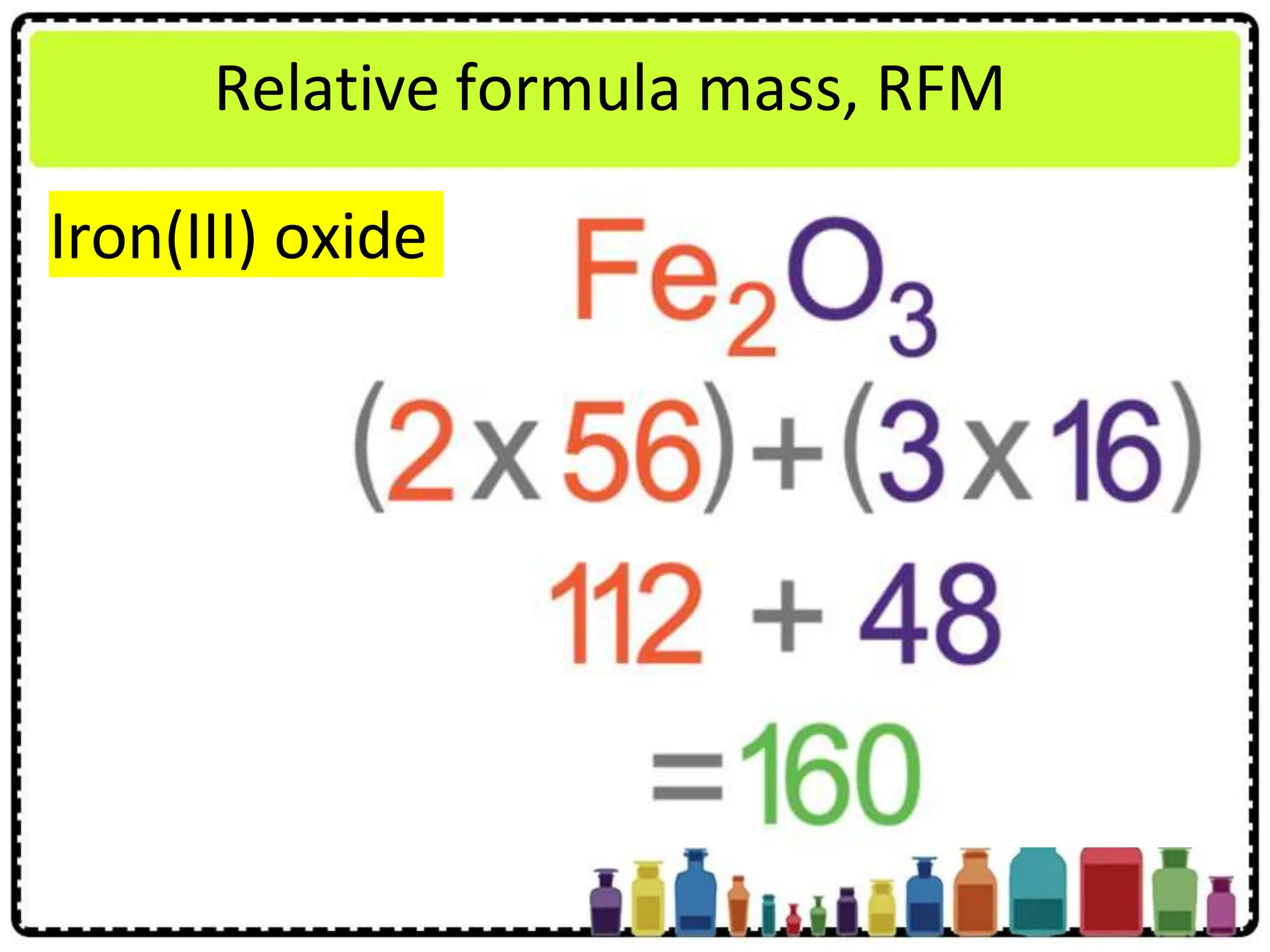
Relative formula mass, RFM
• Meaning;
The average mass of an ionic substance when
compared with 1/12 of the mass of an atom of
carbon-12.
Relative Molecular Mass, RMM
= Average mass of an ionic substance
1/12 x the mass of an atom of carbon-12
• Calculate RFM by adding up the relative atomic mass
of all the atoms that present in the ionic compound
Relative formula mass, RFM
Zinc chloride
Relative formula mass, RFM
Aluminium sulphate
Relative formula mass, RFM
Iron(III) oxide
Try this
1
Try this
2
one pair of shoes =??shoe
one dozen of beer=?? beer
One mole of atom=??? atom
602000000000000000000000
particles (atom/molecule/ion)
Avogadro constant,
The Mole and the Number of Particles
• The number of particles in matter is measured
in mole.
• Definition:
The amount of substance that contains as
many particles as the number of atoms in
exactly 12 g of carbon-12
• Symbol of mole: mol
How many atoms are there in 12 g of carbon-12?
= 6.02 × 10²³
• The value of 6.02 × 10²³ is called the Avogadro
constant or Avogadro number
• Avogadro constant, NA
The number of particles in one mole of a
substance
Point to note:
One mole of any substance contains 6.02 × 10²³
particles
1 mol of atomic substance contains 6.02 × 10²³
atoms
 1 mol of molecular substance contains 6.02 × 10²³
molecules
 1 mol of ionic substance contains 6.02 × 10²³ ions
Relationship between the number of moles and
the number of particles (atoms/molecules/ions)
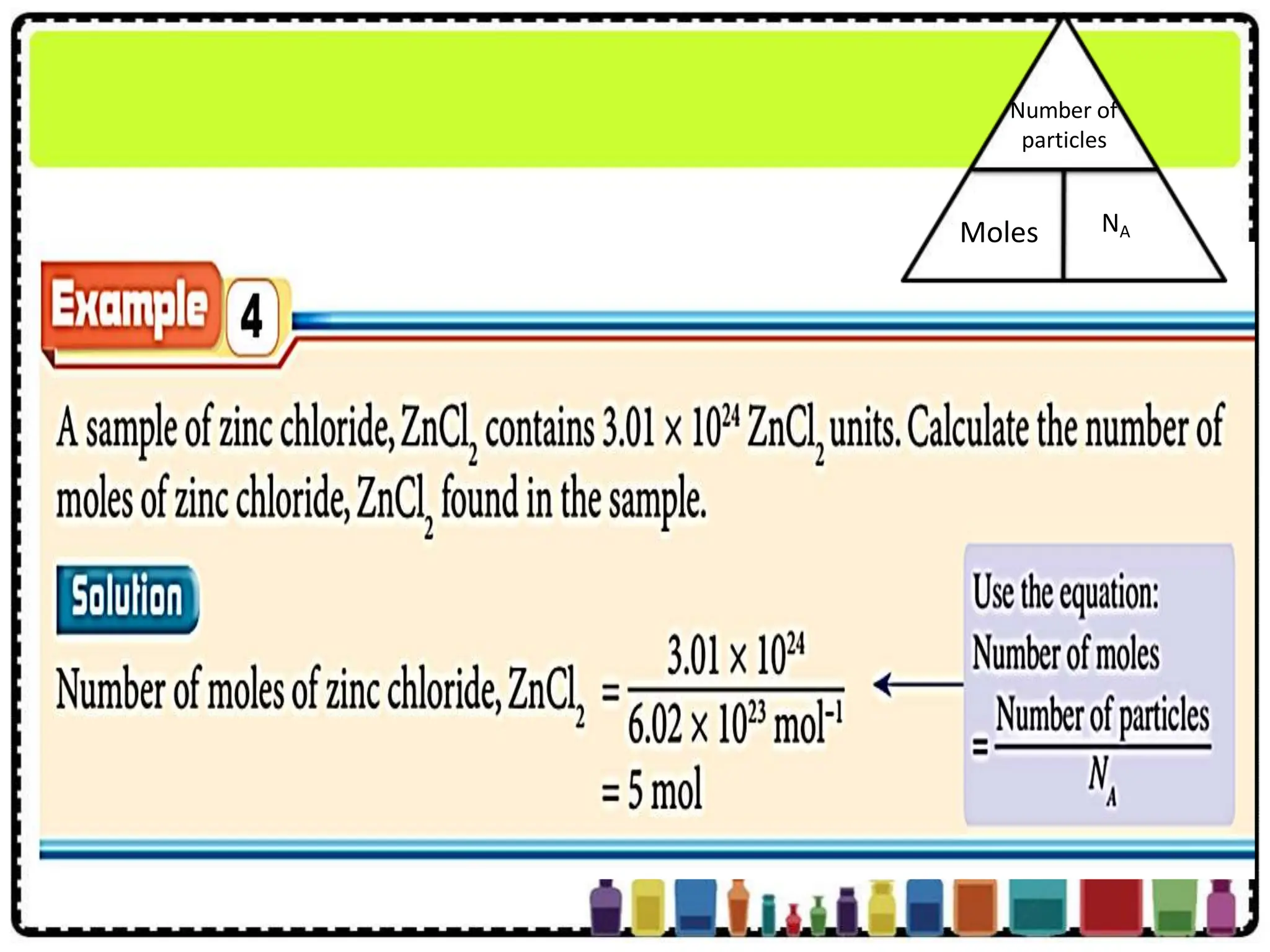
Number of moles,
(mol)
Number of particles
(atoms, molecules, ions)
× NA
÷ NA
Number of
particles
Moles NA
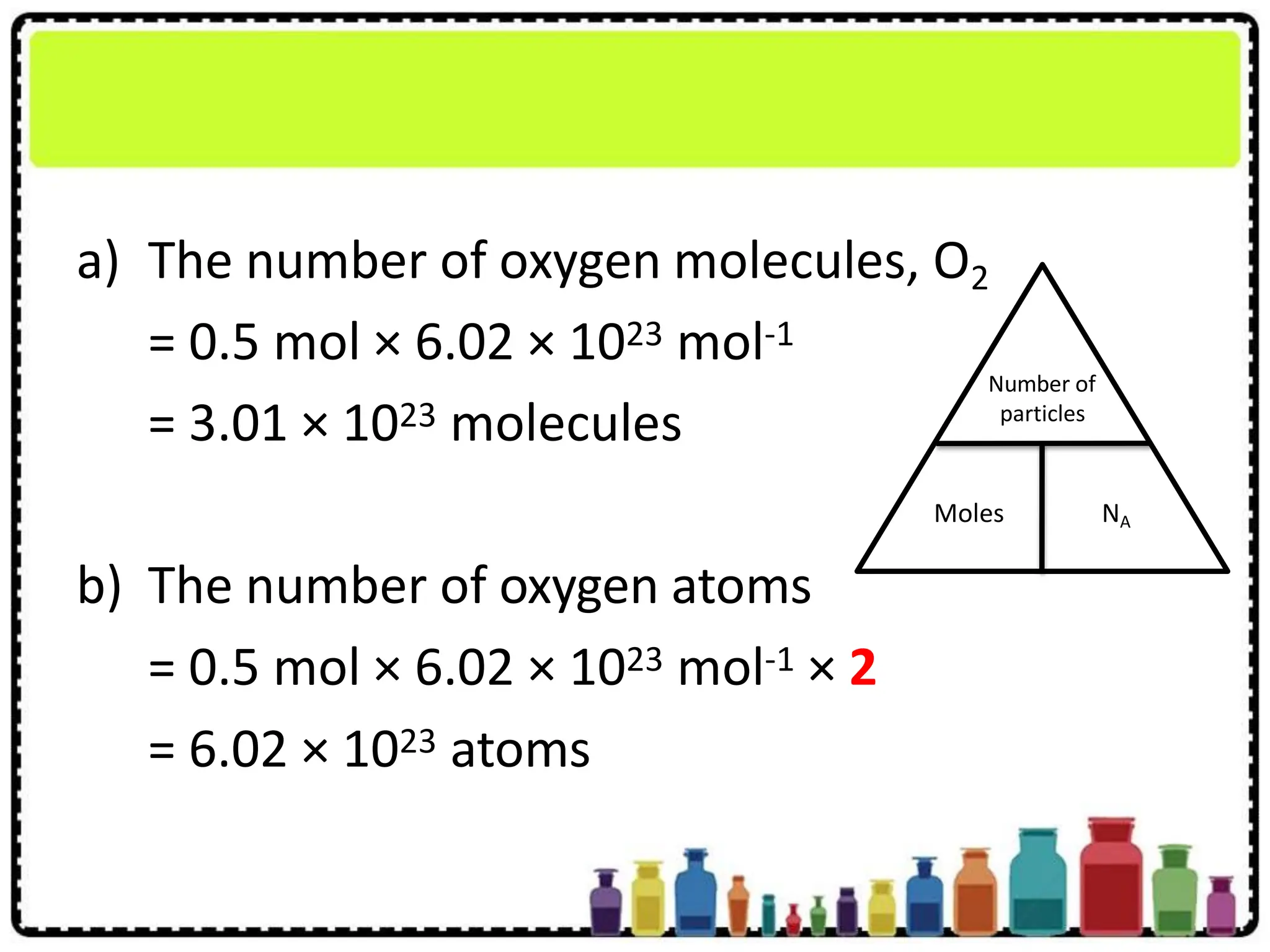
Example 1:
A closed glass bottle contains 0.5 mol of oxygen
gas, O2
(a) How many oxygen molecules, O2 are there in
the bottle?
oxygen atoms
(b)How many are there in the
bottle?
[Avogadro constant: 6.02 × 10²³ mol-1]
a) The number of oxygen molecules, O2
= 0.5 mol × 6.02 × 1023 mol-1
= 3.01 × 10²³ molecules
b) The number of oxygen atoms
= 0.5 mol × 6.02 × 1023 mol-1 × 2
= 6.02 × 10²³ atoms
Number of
particles
Moles NA
Number of
particles
Moles NA
Number of
particles
Moles NA
The Mole and the Mass of Substances
• The mass of one mole of any substance is
called molar mass
• Units: g mol-1
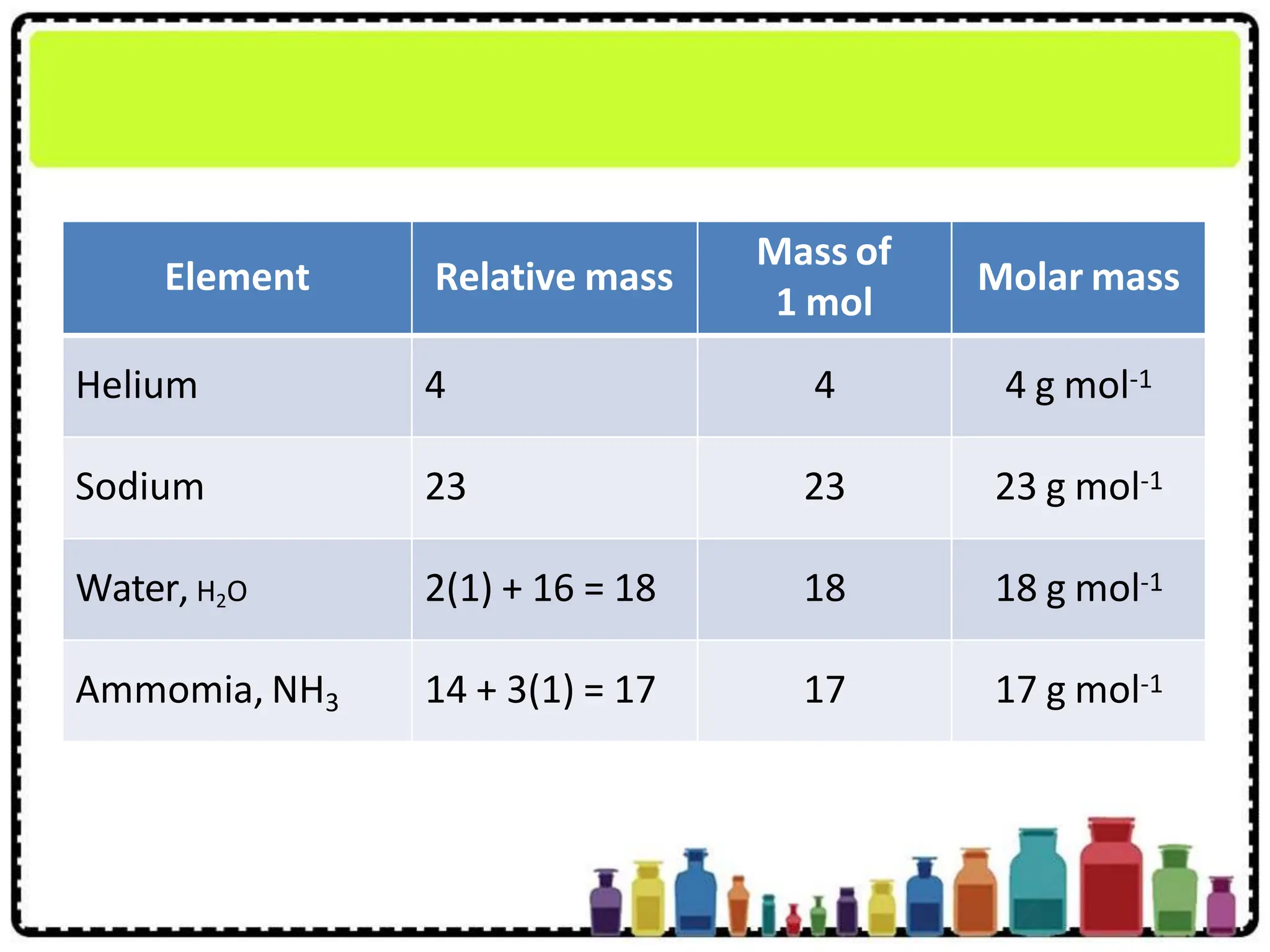
• The molar mass of substances are numerically
equal to relative mass
Element Relative mass
Mass of
1 mol
Molar mass
Helium 4 4 4 g mol-1
Sodium 23 23 23 g mol-1
Water, H2O 2(1) + 16 = 18 18 18 g mol-1
Ammomia, NH3 14 + 3(1) = 17 17 17 g mol-1
Relationship between the number of moles and
the mass of a substance
Number of moles,
(mol)
Mass
(g)
× molar mass
÷ molar mass
Mass
(g)
Moles
RAM /
RMM /
RFM
Example 1:
What is the mass of
0.1 mol
2.408 × 10²³ atoms
(a) of magnesium?
(b) of magnesium?
[Relative atomic mass: Mg=24; Avogadro
constant: 6.02 × 10²³ mol-1]
(b) The number of moles Mg atoms
= 2.408 × 10²³
6.02 × 10²³ mol-1
= 0.4 mol
Mass of Mg atoms
= 0.4 mol × 24 g mol-1 = 9.6 g
(a) Molar mass of Mg = 24 g mol-1
Mass of Mg = 0.1 mol × 24 g mol-1
= 2.4 g
Mass (g)
Moles
RAM /
RMM /
RFM
Number of
particles
Moles NA
Example 2:
RMM of SO2
= 32 + 2(16) = 64
Molar mass of SO2 = 64 g mol-1
The number of moles
= 16 g
64 g mol-1
= 0.25 mol
Mass (g)
Moles
RAM /
RMM /
RFM
How many moles of molecules are there in 16 g of sulphur
dioxide gas, SO2?
[Relative atomic mass: O=16, S=32]
The Mole and the Volume of Gas
Relationship between the number of moles and
the volume of gas
Number of moles,
(mol)
Volume of gas
(dm3)
× molar volume
÷ molar volume
Volume
(dm3)
Moles
22.4 dm3
(STP) /
24 dm3 (room
condition)
volume of 1.2 mol
What is the of ammonia gas,
NH3 at STP?
[Molar volume: 22.4 dm3 mol-1 at STP]
Example 1:
Volume
(dm3)
Moles
3
22.4 dm
(STP) /
24 dm3 (RC)
The volume of ammonia gas, NH3
= 1.2 mol × 22.4 dm3 mol-1
= 26.88 dm3
How many moles of ammonia gas, NH3 are present
in 600 cm3 of the gas measured at room conditions?
[Molar volume: 24 dm3 mol-1 at room condition]
Example 2:
Volume
(dm3)
Moles
3
22.4 dm
(STP) /
24 dm3 (RC)
The number of moles of ammonia gas, NH3
= 600 cm3
1000
= 0.6 dm3
= 0.6 dm3
24 dm3 mol-1
= 0.025 mol
Relationship between the number of moles, number of
particles, mass and the volume of gas
H2
Symbol of
hydrogen atom
Shows that there are
two hydrogen atom
in a hydrogen gas,
H2 molecule
Symbol of
hydrogen atom
H2O
Shows that there are
two hydrogen atom
in a water molecule
Symbol of
oxygen atom
Shows that there are
one oxygen atom in
a water molecule
• Compound can be represented by two types:
1. Empirical formula
- Chemical formula that shows the simplest
ratio of the number of atoms of each
element in a compound.
2. Molecular formula
- Chemical formula that shows the actual
number of atoms of each element found in a
molecule of a compound
To determine empirical formula of magnesium
oxide
Burn magnesium with oxygen
To determine empirical formula copper(II) oxide
Use hydrogen to removed oxygen from
copper(II) oxide
Weigh mass of copper
Try this..
Qualitative aspect:
- Identify the reactant and product
- Physical states
-
Quantitative aspect:
- Ratio of substances involved
-
Solving steps
Step 1: Find the mole
Step 2: Compare the mole ratio
Step 3: Find the value
Chapter 3 Mole concept, Chemical Formula and Equation

Chapter 3 Mole concept, Chemical Formula and Equation

  • 6.
    A. Relative AtomicMass and Relative Molecular Mass • Based on the theory of particles: particles are very small and discrete. A single atom is too small and light and cannot be weighed directly • Thus, the mass of an atom is obtained by comparing it with another atom which is taken as a standard.
  • 7.
    Which element ischosen as standard atom and why?
  • 8.
    Carbon-12 is chosenas a standard because: • Carbon exists as a solid at room temperature • Carbon can be handled easily • Carbon has an accurate mass
  • 9.
    Relative atomic mass,RAM • Meaning; The average mass of one atom of the element when compared with 1/12 of the mass of an atom of carbon-12.
  • 12.
    • Example: RAM ofmagnesium = 24 = 24 1/12 x 12 = magnesium is 24 times larger than carbon-12 ** THE VALUE OF NUCLEON NUMBER IN THE PERIODIC TABLE OF ELEMENT = RELATIVE ATOMIC MASS, RAM
  • 13.
  • 14.
    Relative molecular mass,RMM • Meaning; The average mass of one molecule when compared with 1/12 of the mass of an atom of carbon-12. Relative Molecular Mass, RMM = Average mass of one molecule 1/12 x the mass of an atom of carbon-12 • Calculate RMM by adding up the relative atomic mass of all the atoms that present in the molecule
  • 16.
  • 17.
  • 18.
    Relative formula mass,RFM • Meaning; The average mass of an ionic substance when compared with 1/12 of the mass of an atom of carbon-12. Relative Molecular Mass, RMM = Average mass of an ionic substance 1/12 x the mass of an atom of carbon-12 • Calculate RFM by adding up the relative atomic mass of all the atoms that present in the ionic compound
  • 19.
    Relative formula mass,RFM Zinc chloride
  • 20.
    Relative formula mass,RFM Aluminium sulphate
  • 21.
    Relative formula mass,RFM Iron(III) oxide
  • 23.
  • 24.
  • 28.
    one pair ofshoes =??shoe one dozen of beer=?? beer One mole of atom=??? atom
  • 29.
  • 30.
    The Mole andthe Number of Particles • The number of particles in matter is measured in mole. • Definition: The amount of substance that contains as many particles as the number of atoms in exactly 12 g of carbon-12 • Symbol of mole: mol
  • 31.
    How many atomsare there in 12 g of carbon-12? = 6.02 × 10²³ • The value of 6.02 × 10²³ is called the Avogadro constant or Avogadro number • Avogadro constant, NA The number of particles in one mole of a substance
  • 32.
    Point to note: Onemole of any substance contains 6.02 × 10²³ particles 1 mol of atomic substance contains 6.02 × 10²³ atoms  1 mol of molecular substance contains 6.02 × 10²³ molecules  1 mol of ionic substance contains 6.02 × 10²³ ions
  • 34.
    Relationship between thenumber of moles and the number of particles (atoms/molecules/ions) Number of moles, (mol) Number of particles (atoms, molecules, ions) × NA ÷ NA
  • 35.
  • 36.
    Example 1: A closedglass bottle contains 0.5 mol of oxygen gas, O2 (a) How many oxygen molecules, O2 are there in the bottle? oxygen atoms (b)How many are there in the bottle? [Avogadro constant: 6.02 × 10²³ mol-1]
  • 37.
    a) The numberof oxygen molecules, O2 = 0.5 mol × 6.02 × 1023 mol-1 = 3.01 × 10²³ molecules b) The number of oxygen atoms = 0.5 mol × 6.02 × 1023 mol-1 × 2 = 6.02 × 10²³ atoms Number of particles Moles NA
  • 38.
  • 39.
  • 42.
    The Mole andthe Mass of Substances • The mass of one mole of any substance is called molar mass • Units: g mol-1 • The molar mass of substances are numerically equal to relative mass
  • 43.
    Element Relative mass Massof 1 mol Molar mass Helium 4 4 4 g mol-1 Sodium 23 23 23 g mol-1 Water, H2O 2(1) + 16 = 18 18 18 g mol-1 Ammomia, NH3 14 + 3(1) = 17 17 17 g mol-1
  • 44.
    Relationship between thenumber of moles and the mass of a substance Number of moles, (mol) Mass (g) × molar mass ÷ molar mass
  • 45.
  • 46.
    Example 1: What isthe mass of 0.1 mol 2.408 × 10²³ atoms (a) of magnesium? (b) of magnesium? [Relative atomic mass: Mg=24; Avogadro constant: 6.02 × 10²³ mol-1]
  • 47.
    (b) The numberof moles Mg atoms = 2.408 × 10²³ 6.02 × 10²³ mol-1 = 0.4 mol Mass of Mg atoms = 0.4 mol × 24 g mol-1 = 9.6 g (a) Molar mass of Mg = 24 g mol-1 Mass of Mg = 0.1 mol × 24 g mol-1 = 2.4 g Mass (g) Moles RAM / RMM / RFM Number of particles Moles NA
  • 48.
    Example 2: RMM ofSO2 = 32 + 2(16) = 64 Molar mass of SO2 = 64 g mol-1 The number of moles = 16 g 64 g mol-1 = 0.25 mol Mass (g) Moles RAM / RMM / RFM How many moles of molecules are there in 16 g of sulphur dioxide gas, SO2? [Relative atomic mass: O=16, S=32]
  • 50.
    The Mole andthe Volume of Gas
  • 51.
    Relationship between thenumber of moles and the volume of gas Number of moles, (mol) Volume of gas (dm3) × molar volume ÷ molar volume
  • 52.
  • 53.
    volume of 1.2mol What is the of ammonia gas, NH3 at STP? [Molar volume: 22.4 dm3 mol-1 at STP] Example 1: Volume (dm3) Moles 3 22.4 dm (STP) / 24 dm3 (RC) The volume of ammonia gas, NH3 = 1.2 mol × 22.4 dm3 mol-1 = 26.88 dm3
  • 54.
    How many molesof ammonia gas, NH3 are present in 600 cm3 of the gas measured at room conditions? [Molar volume: 24 dm3 mol-1 at room condition] Example 2: Volume (dm3) Moles 3 22.4 dm (STP) / 24 dm3 (RC) The number of moles of ammonia gas, NH3 = 600 cm3 1000 = 0.6 dm3 = 0.6 dm3 24 dm3 mol-1 = 0.025 mol
  • 55.
    Relationship between thenumber of moles, number of particles, mass and the volume of gas
  • 61.
    H2 Symbol of hydrogen atom Showsthat there are two hydrogen atom in a hydrogen gas, H2 molecule
  • 62.
    Symbol of hydrogen atom H2O Showsthat there are two hydrogen atom in a water molecule Symbol of oxygen atom Shows that there are one oxygen atom in a water molecule
  • 63.
    • Compound canbe represented by two types: 1. Empirical formula - Chemical formula that shows the simplest ratio of the number of atoms of each element in a compound. 2. Molecular formula - Chemical formula that shows the actual number of atoms of each element found in a molecule of a compound
  • 68.
    To determine empiricalformula of magnesium oxide Burn magnesium with oxygen To determine empirical formula copper(II) oxide Use hydrogen to removed oxygen from copper(II) oxide Weigh mass of copper
  • 77.
  • 83.
    Qualitative aspect: - Identifythe reactant and product - Physical states -
  • 84.
    Quantitative aspect: - Ratioof substances involved -
  • 90.
    Solving steps Step 1:Find the mole Step 2: Compare the mole ratio Step 3: Find the value