Created by

Arun A

MRI Technologist

Dr.Shaji’s MRI

Kerala


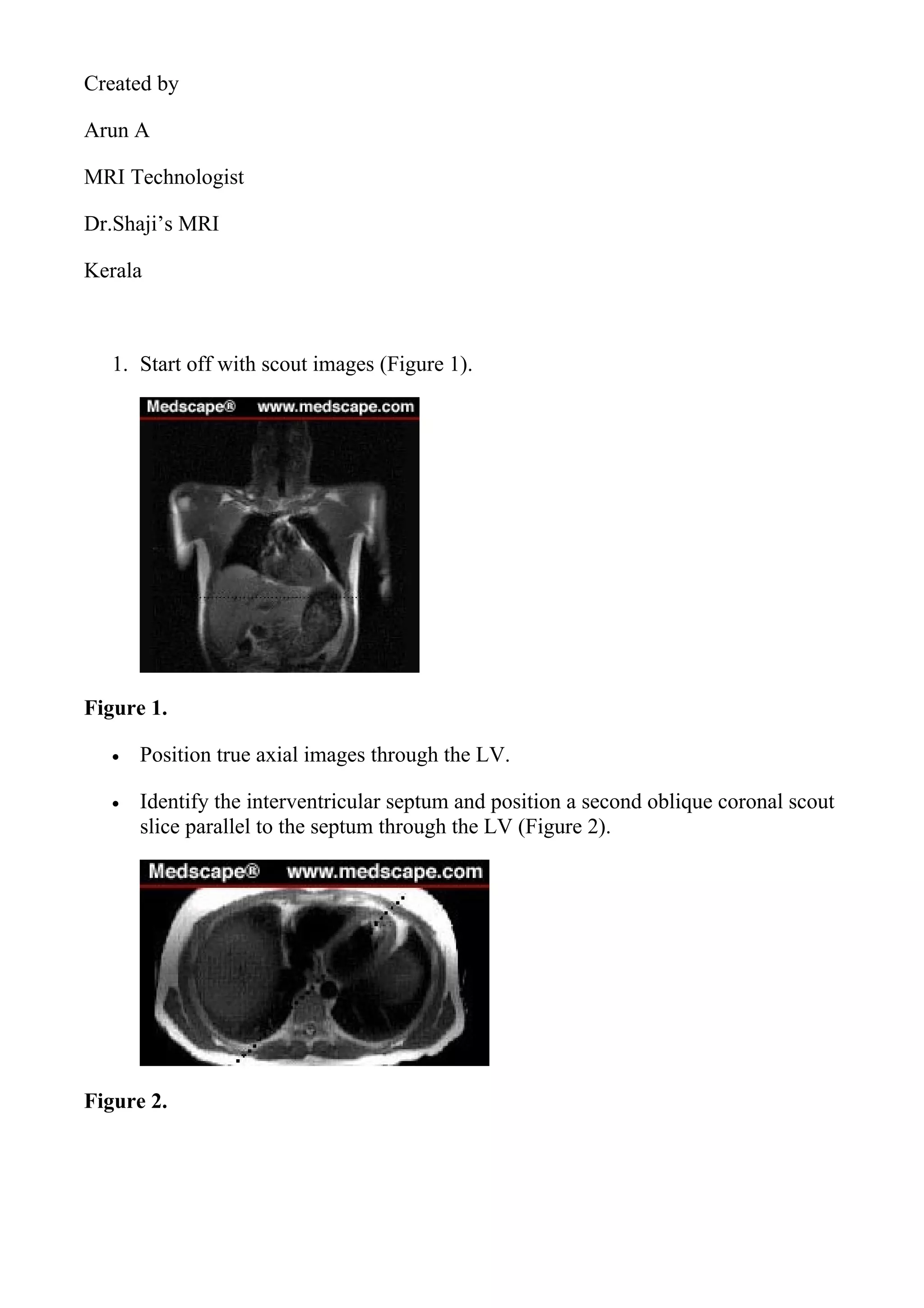
   1. Start off with scout images (Figure 1).


Figure 1.

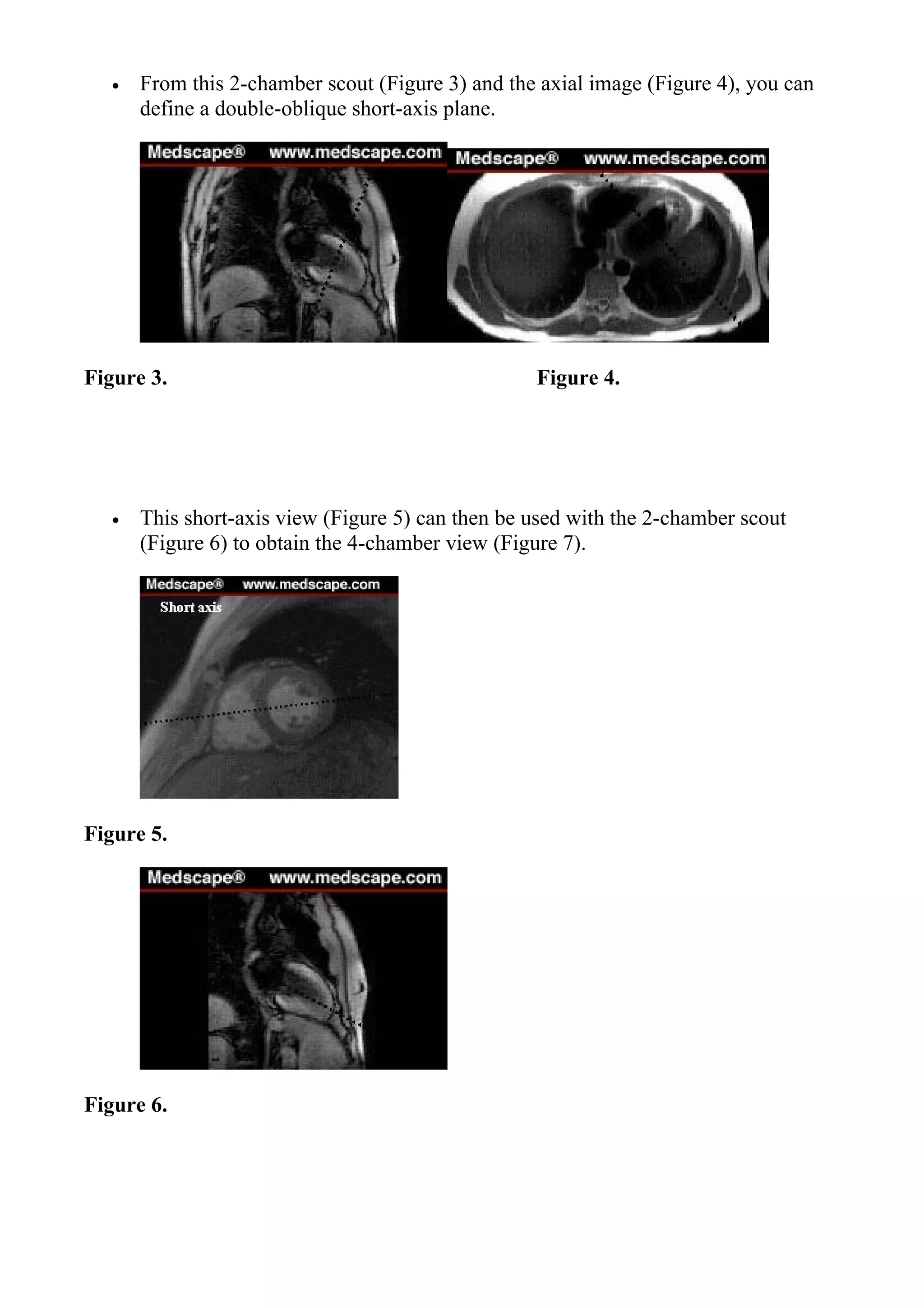
   •   Position true axial images through the LV.

   •   Identify the interventricular septum and position a second oblique coronal scout
       slice parallel to the septum through the LV (Figure 2).


Figure 2.
•   From this 2-chamber scout (Figure 3) and the axial image (Figure 4), you can
       define a double-oblique short-axis plane.


Figure 3.                                          Figure 4.


   •   This short-axis view (Figure 5) can then be used with the 2-chamber scout
       (Figure 6) to obtain the 4-chamber view (Figure 7).


Figure 5.


Figure 6.
Figure 7.

   •   From the 4-chamber view (Figure 7) and short axis (Figure 8), a true 2-chamber
       view (Figure 9) can be defined.


Figure 8.


Figure 9.

   •   Optional LV outflow tract view for aortic valve evaluation is obtained in
       oblique coronal from the true axial images. Position slice through aortic root
       and directed toward the LV (Figure 10).
Figure 10


                            Cardiac MRI: The Basic Sequences

Black Blood Imaging

   •   ECG-gated spin echo (SE) or fast-spin echo (FSE) (turbo spin echo [TSE])
   •   ECG-gated db-HASTE (double IR-half-Fourier single-shot turbo-spin echo)

       -Uses: To identify extraluminal aortic pathology, intramural hematoma, or dissection
       -Cardiac gating: TR = R-R interval for SE or FSE; gating not absolutely needed for HASTE
       -Can be performed breath-hold (fast imaging) or multiple averages non-breath-hold (NBH)
       -To get more slices, one may need to concatenate slices
       -HASTE can be used in arrhythmias

Bright Blood Imaging

   •   Cine gradient echo imaging (GRE)
   •   FASTCARD
   •   True fast imaging with steady-state precession (FISP)

       -Uses: To determine flow, motion, aortic valvular disease
       -Cardiac gating: Choose temporal resolution based on TR and R-R interval

       # temporal phases      0.85 x (R-R/TR)
       -Can be performed breath-hold (segmented k-space) or 3-4 averages NBH
       -Real-time true FISP can be used in arrhythmias
       -Retrospectively gated sequences can be used with peripheral pulse gating if necessary

Velocity-Encoded CINE (Phase Contrast)

   •   Velocity encoded CINE imaging (Vinnie)
   •   FASTCARD PC

       -Uses: To quantify flow at stenoses to estimate pressure gradient or collateral blood flow
-Encoding velocity (venc) = 250-500 cm/sec for through plane velocity
       -Cardiac gating: Choose temporal resolution based on TR and R-R interval

      # temporal phases        0.85 x (R-R/TR)
   -Can be performed breath-hold (segmented k-space, view-sharing) or multiple averages NBH
    Modified Bernouilli's equation:
    P (mm Hg) 4 vmax 2
    P (mm Hg) P = pressure gradient across stenosis
    vmax = peak velocity at or just distal to stenosis Regurgitant fraction = reverse flow during
      diastole / total forward flow
    Total blood flow (eg, cardiac output = total flow at ascending aorta) = area under flow-time
      curve


Gadolinium (Gd)-Enhanced MRA

   •   3D spoiled GRE (with interpolation)

       -Uses: aortography or pulmonary angiography
       -Preferably breath-hold (ungated)
       -Single or double dose (0.1-0.2 mmol/kg) Gd-contrast
       -Timing based on test dose or fluoroscopic triggering (Care Bolus, Smart Prep etc.)

Special Considerations When Performing Cardiothoracic MRI

   1. Postprocessing tools
          o Maximum intensity projection/maximum perfusion reserve index
               (MIP/MPRi)/volume rendering of Gd-MRA
          o Ventricular function: calculating EFs, stroke volumes from cine GRE
               LV volume = (A1 x Z) + (A2 x Z) +...
               An = cross-sectional area of slice n
               Z = slice thickness. If z = 1 cm, then LV volume = A1+ A2 + A3 +...EDV (end
               diastolic volume) = sum all short axes at maximum
               ESV (end systolic volume) = sum all short axes at minimum
               SV (stroke volume) = EDV-ESV
               EF = (EDV-ESV)/EDV = SV/EDV
          o Flow quantification from velocity-encoded phase contrast GRE
          o Wall motion abnormalities: thickening, stress/strain maps, velocity maps
          o Perfusion: analysis of enhancement profiles
   2. Pitfalls in cardiothoracic MRI
          o Right atrial pseudomass: protrusion along posterior wall of right atrium between SVC
               and IVC, caused by normal structures such as eustachian valve, Chiari network.
               DDX: mass or thrombus.
          o Metallic artifacts
          o Pseudo-subclavian stenosis on Gd-MRA of thoracic aorta
          o Inaccurate timing
          o Poor ECG-gating

Cardiac MRI: Advanced Tools
1. Myocardial perfusion: baseline and stress
   Dynamic multislice segmented GRE or echo planar imaging (EPI) during bolus infusion of
   Gd
   Optional adenosine or perfusion stress
2. Myocardial tagging: wall motion and thickening analysis, stress and strain, wall velocity
   Optional dobutamine stress test for wall motion abnormalities
3. Myocardial viability: enhancement on delayed postcontrast images
   Inversion recovery spoiled gradient echo for nulling of normal myocardium
4. Coronary MRA (intravascular or extravascular contrast agents)
5. Coronary flow (phase contrast flow quantification)
   Optional adenosine for flow reserve measurements
6. Real-time MR fluoroscopy

Cardiac MRI

  • 1.
    Created by Arun A MRITechnologist Dr.Shaji’s MRI Kerala 1. Start off with scout images (Figure 1). Figure 1. • Position true axial images through the LV. • Identify the interventricular septum and position a second oblique coronal scout slice parallel to the septum through the LV (Figure 2). Figure 2.
  • 2.
    From this 2-chamber scout (Figure 3) and the axial image (Figure 4), you can define a double-oblique short-axis plane. Figure 3. Figure 4. • This short-axis view (Figure 5) can then be used with the 2-chamber scout (Figure 6) to obtain the 4-chamber view (Figure 7). Figure 5. Figure 6.
  • 3.
    Figure 7. • From the 4-chamber view (Figure 7) and short axis (Figure 8), a true 2-chamber view (Figure 9) can be defined. Figure 8. Figure 9. • Optional LV outflow tract view for aortic valve evaluation is obtained in oblique coronal from the true axial images. Position slice through aortic root and directed toward the LV (Figure 10).
  • 4.
    Figure 10 Cardiac MRI: The Basic Sequences Black Blood Imaging • ECG-gated spin echo (SE) or fast-spin echo (FSE) (turbo spin echo [TSE]) • ECG-gated db-HASTE (double IR-half-Fourier single-shot turbo-spin echo) -Uses: To identify extraluminal aortic pathology, intramural hematoma, or dissection -Cardiac gating: TR = R-R interval for SE or FSE; gating not absolutely needed for HASTE -Can be performed breath-hold (fast imaging) or multiple averages non-breath-hold (NBH) -To get more slices, one may need to concatenate slices -HASTE can be used in arrhythmias Bright Blood Imaging • Cine gradient echo imaging (GRE) • FASTCARD • True fast imaging with steady-state precession (FISP) -Uses: To determine flow, motion, aortic valvular disease -Cardiac gating: Choose temporal resolution based on TR and R-R interval # temporal phases 0.85 x (R-R/TR) -Can be performed breath-hold (segmented k-space) or 3-4 averages NBH -Real-time true FISP can be used in arrhythmias -Retrospectively gated sequences can be used with peripheral pulse gating if necessary Velocity-Encoded CINE (Phase Contrast) • Velocity encoded CINE imaging (Vinnie) • FASTCARD PC -Uses: To quantify flow at stenoses to estimate pressure gradient or collateral blood flow
  • 5.
    -Encoding velocity (venc)= 250-500 cm/sec for through plane velocity -Cardiac gating: Choose temporal resolution based on TR and R-R interval # temporal phases 0.85 x (R-R/TR) -Can be performed breath-hold (segmented k-space, view-sharing) or multiple averages NBH  Modified Bernouilli's equation:  P (mm Hg) 4 vmax 2  P (mm Hg) P = pressure gradient across stenosis  vmax = peak velocity at or just distal to stenosis Regurgitant fraction = reverse flow during diastole / total forward flow  Total blood flow (eg, cardiac output = total flow at ascending aorta) = area under flow-time curve Gadolinium (Gd)-Enhanced MRA • 3D spoiled GRE (with interpolation) -Uses: aortography or pulmonary angiography -Preferably breath-hold (ungated) -Single or double dose (0.1-0.2 mmol/kg) Gd-contrast -Timing based on test dose or fluoroscopic triggering (Care Bolus, Smart Prep etc.) Special Considerations When Performing Cardiothoracic MRI 1. Postprocessing tools o Maximum intensity projection/maximum perfusion reserve index (MIP/MPRi)/volume rendering of Gd-MRA o Ventricular function: calculating EFs, stroke volumes from cine GRE LV volume = (A1 x Z) + (A2 x Z) +... An = cross-sectional area of slice n Z = slice thickness. If z = 1 cm, then LV volume = A1+ A2 + A3 +...EDV (end diastolic volume) = sum all short axes at maximum ESV (end systolic volume) = sum all short axes at minimum SV (stroke volume) = EDV-ESV EF = (EDV-ESV)/EDV = SV/EDV o Flow quantification from velocity-encoded phase contrast GRE o Wall motion abnormalities: thickening, stress/strain maps, velocity maps o Perfusion: analysis of enhancement profiles 2. Pitfalls in cardiothoracic MRI o Right atrial pseudomass: protrusion along posterior wall of right atrium between SVC and IVC, caused by normal structures such as eustachian valve, Chiari network. DDX: mass or thrombus. o Metallic artifacts o Pseudo-subclavian stenosis on Gd-MRA of thoracic aorta o Inaccurate timing o Poor ECG-gating Cardiac MRI: Advanced Tools
  • 6.
    1. Myocardial perfusion:baseline and stress Dynamic multislice segmented GRE or echo planar imaging (EPI) during bolus infusion of Gd Optional adenosine or perfusion stress 2. Myocardial tagging: wall motion and thickening analysis, stress and strain, wall velocity Optional dobutamine stress test for wall motion abnormalities 3. Myocardial viability: enhancement on delayed postcontrast images Inversion recovery spoiled gradient echo for nulling of normal myocardium 4. Coronary MRA (intravascular or extravascular contrast agents) 5. Coronary flow (phase contrast flow quantification) Optional adenosine for flow reserve measurements 6. Real-time MR fluoroscopy