CSF FLOW STUDY IN MRI
A.SHAJITHA
RADIOGRAPHER
APOLLO SPECIALITY HOSPITAL
Cerebro Spinal Fluid
• Cerebrospinal fluid (CSF) is a clear, colorless bodily fluid that
occupies the subarachnoid space and the ventricular system
around and inside the brain and spinal cord.
• The CSF occupies the space between the arachnoid mater and
the pia mater.
• Total volume
– Adults: 140-170 ml
– Children:10-60 ml
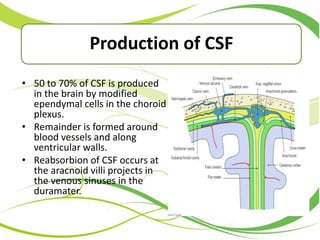
• 50 to 70% of CSF is produced
in the brain by modified
ependymal cells in the choroid
plexus.
• Remainder is formed around
blood vessels and along
ventricular walls.
• Reabsorbion of CSF occurs at
the aracnoid villi projects in
the venous sinuses in the
duramater.
Production of CSF
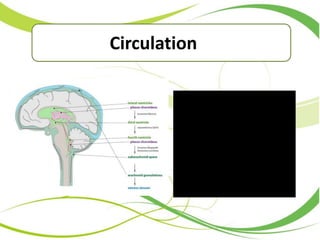
Circulation Circulation
• Two components can be distinguished in CSF circulation:
– (i) bulk flow (circulation)
– (ii) pulsatile flow (back and forth motion).
• In bulk flow, CSF is produced by choroid plexus and absorbed
by arachnoid granulations.
• In pulsatile flow, CSF movement is pulsatile and results from
pulsations related to cardiac cycle.
• Because very little CSF circulates through the subarachnoid
space, pulsatile flow can be measured and demonstrated by
PC MRI.
• Buoyancy.
• Protection: CSF protects the brain tissue from injury.
• Chemical stability.
• Prevention of brain ischemia.
• Clearing waste.
Functions of CSF
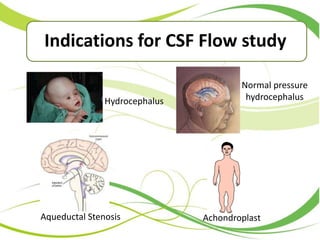
Hydrocephalus
Aqueductal Stenosis
Normal pressure
hydrocephalus
Achondroplast
Indications for CSF Flow study
Contra indications
• Two techniques are used
 Phase Contrast
 Time Spatial Labeling Inversion Pulse(Time-SLIP)
Imaging sequences
• CSF flow is pulsatile and synchronous with the cardiac cycle,
cardiac gating can be used to provide increased sensitivity.
• Retrospective gating – follows the
R wave and entire cardiac cycle
is sampled.
• Prospective gating – Partial cardiac
cycle is sampled.
• Most accurate results are obtained
in retrospective gating.
Cardiac Gating
• The PC MRI generates signal contrast between flowing and
stationary nuclei by sensitising the phase of the transverse
magnetisation to the velocity of motion.
• Before PC MRI data are acquired, the anticipated maximum CSF
flow velocity must be entered (velocity encoding (VENC)).
– For optimal signal, the CSF flow velocity should be the same
as, or slightly less than, VENC.
– velocities greater than VENC can produce aliasing artifacts.
– velocities much smaller than VENC result in a weak signal.
Phase Contrast technique
• Standard VENC value : 5 – 8 cm/s
• Low VENC values (2–4 cm/s) : Discrimination of
communicating and non-communicating arachnoid cysts and
assessment of the VP shunt patency.
• Higher VENC values (20–25 cm/s) : For hyper dynamic CSF
flow within the cerebral aqueduct in normal pressure
hydrocephalus.
• Two data sets are acquired with opposite sensitization.
• For stationary nuclei, the net phase is zero, and their signal is
eliminated.
• However, flowing nuclei move from one position to another
between the time of the first sensitization and that of the
second sensitization.
• Because phase varies with position, the net phase after
subtraction of the two data sets is non-zero, and there is
residual signal from flowing CSF.
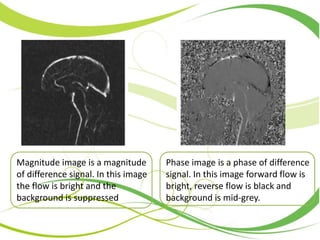
• The combination of PC MRI acquisitions results in magnitude
and phase images.
Magnitude image is a magnitude
of difference signal. In this image
the flow is bright and the
background is suppressed
Phase image is a phase of difference
signal. In this image forward flow is
bright, reverse flow is black and
background is mid-grey.
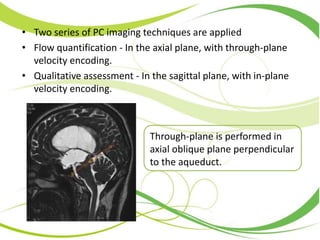
• Two series of PC imaging techniques are applied
• Flow quantification - In the axial plane, with through-plane
velocity encoding.
• Qualitative assessment - In the sagittal plane, with in-plane
velocity encoding.
Through-plane is performed in
axial oblique plane perpendicular
to the aqueduct.
In plane is performed in
sagittal plane parallel to the
aqueduct .
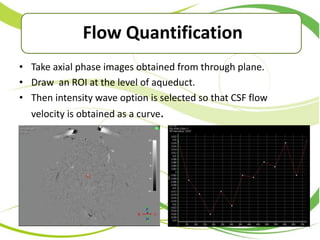
• Take axial phase images obtained from through plane.
• Draw an ROI at the level of aqueduct.
• Then intensity wave option is selected so that CSF flow
velocity is obtained as a curve.
Flow Quantification
• From the curve, flow velocity
table is obtained.
• The following parameters
must be then calculated and
obtained from the table.
End diastolic peak velocity = the highest positive velocity value in the table
(cm/s )
Peak systolic velocity = the highest negative velocity value in the table (cm/s )
Mean systolic velocity = summation of positive velocity values / their numbers
(cm/sec )
Peak systolic flow = the highest negative value in the table (ml/s )
Mean systolic flow = summation of all negative flow values / their numbers (ml/s )
Onset of CSF flow = from beginning of curve till the end of the diastole (msec )
Duration of CSF systole = from the end of diastole till end of the systole (msec)
Systolic stroke volume = mean systolic flow x duration (micro liters )
• Time SLIP can be used to capture CSF flow.
• It is based on the arterial spin labeling technique.
• Unlike PC MRI, 2D Time SLIP acquisitions are incremental,
allowing the bulk flow using Fast Advanced Spin Echo (FASE)
sequence.
• A series of single shot images with incremental inversion
recovery delay times are acquired.
• CSF flow can be acquired in any plane.
Time Spatial Labeling Inversion
Pulse
A non selective IR pulse is
applied ,inverting all signal
in the field of view.
A second
specially
selective
inversion pulse
is applied to
the region of
interest.
After a short
period, tagged
CSF is seen
moving in to
the non tagged
background.
Time SLIP
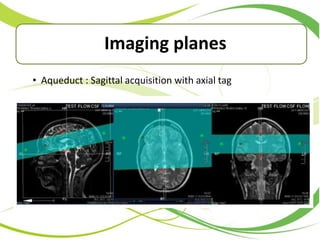
• Aqueduct : Sagittal acquisition with axial tag
Imaging planes
• Chiari : Sagittal acquisition with axial tag
• Lateral ventricles: oblique coronal acquisition with axial tag.
Comparison of PC MRI and Time SLIP
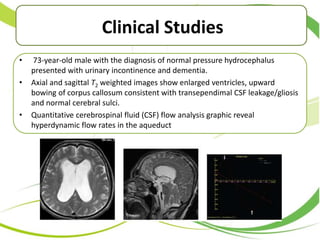
• 73-year-old male with the diagnosis of normal pressure hydrocephalus
presented with urinary incontinence and dementia.
• Axial and sagittal T2 weighted images show enlarged ventricles, upward
bowing of corpus callosum consistent with transependimal CSF leakage/gliosis
and normal cerebral sulci.
• Quantitative cerebrospinal fluid (CSF) flow analysis graphic reveal
hyperdynamic flow rates in the aqueduct
Clinical Studies
• A 24-year-old female with the diagnosis of Chiari 1 malformation presented
with sub occipital headache.
• Pre-operative and post-operative sagittal T2 weighted MRI show a large syrinx
in association with cerebellar tonsillar ectopia.
• Pre- and post-operative cerebrospinal fluid (CSF) flow MRI show no
association between cervical subarachnoid space and cisterna magna. No
symptomatic improvement was observed after the surgery. Both pre-operative
and post-operative CSF flow MRI show pulsatile CSF flow in the syrinx.
A series of single shot 2D Time SLIP images are shown in the coronal view
before and after the shunt placement. In the pre shunt series CSF is unable
to flow in to the lateral ventricles and after shunt placement CSF flow into
the lateral ventricles.
• Until now, the only MR imaging technique to visualize CSF
movement is phase-contrast (PC) MR imaging.
• Time–spatial labeling inversion pulse(Time-SLIP)is another
option, which makes it possible to noninvasively select CSF at
any region in the CNS and visualize its movement for up to 5
seconds, providing information about CSF dynamics even in
slow-flowing regions.
• Time-SLIP is expected to have widespread application for
diagnosis and evaluation of response to treatment of
abnormal CSF movement.
Conclusion
Csf flow study

Csf flow study

  • 1.
    CSF FLOW STUDYIN MRI A.SHAJITHA RADIOGRAPHER APOLLO SPECIALITY HOSPITAL
  • 2.
    Cerebro Spinal Fluid •Cerebrospinal fluid (CSF) is a clear, colorless bodily fluid that occupies the subarachnoid space and the ventricular system around and inside the brain and spinal cord. • The CSF occupies the space between the arachnoid mater and the pia mater. • Total volume – Adults: 140-170 ml – Children:10-60 ml
  • 3.
    • 50 to70% of CSF is produced in the brain by modified ependymal cells in the choroid plexus. • Remainder is formed around blood vessels and along ventricular walls. • Reabsorbion of CSF occurs at the aracnoid villi projects in the venous sinuses in the duramater. Production of CSF
  • 4.
  • 5.
    • Two componentscan be distinguished in CSF circulation: – (i) bulk flow (circulation) – (ii) pulsatile flow (back and forth motion). • In bulk flow, CSF is produced by choroid plexus and absorbed by arachnoid granulations. • In pulsatile flow, CSF movement is pulsatile and results from pulsations related to cardiac cycle. • Because very little CSF circulates through the subarachnoid space, pulsatile flow can be measured and demonstrated by PC MRI.
  • 6.
    • Buoyancy. • Protection:CSF protects the brain tissue from injury. • Chemical stability. • Prevention of brain ischemia. • Clearing waste. Functions of CSF
  • 7.
  • 8.
  • 10.
    • Two techniquesare used  Phase Contrast  Time Spatial Labeling Inversion Pulse(Time-SLIP) Imaging sequences
  • 11.
    • CSF flowis pulsatile and synchronous with the cardiac cycle, cardiac gating can be used to provide increased sensitivity. • Retrospective gating – follows the R wave and entire cardiac cycle is sampled. • Prospective gating – Partial cardiac cycle is sampled. • Most accurate results are obtained in retrospective gating. Cardiac Gating
  • 12.
    • The PCMRI generates signal contrast between flowing and stationary nuclei by sensitising the phase of the transverse magnetisation to the velocity of motion. • Before PC MRI data are acquired, the anticipated maximum CSF flow velocity must be entered (velocity encoding (VENC)). – For optimal signal, the CSF flow velocity should be the same as, or slightly less than, VENC. – velocities greater than VENC can produce aliasing artifacts. – velocities much smaller than VENC result in a weak signal. Phase Contrast technique
  • 13.
    • Standard VENCvalue : 5 – 8 cm/s • Low VENC values (2–4 cm/s) : Discrimination of communicating and non-communicating arachnoid cysts and assessment of the VP shunt patency. • Higher VENC values (20–25 cm/s) : For hyper dynamic CSF flow within the cerebral aqueduct in normal pressure hydrocephalus.
  • 14.
    • Two datasets are acquired with opposite sensitization. • For stationary nuclei, the net phase is zero, and their signal is eliminated. • However, flowing nuclei move from one position to another between the time of the first sensitization and that of the second sensitization. • Because phase varies with position, the net phase after subtraction of the two data sets is non-zero, and there is residual signal from flowing CSF. • The combination of PC MRI acquisitions results in magnitude and phase images.
  • 15.
    Magnitude image isa magnitude of difference signal. In this image the flow is bright and the background is suppressed Phase image is a phase of difference signal. In this image forward flow is bright, reverse flow is black and background is mid-grey.
  • 16.
    • Two seriesof PC imaging techniques are applied • Flow quantification - In the axial plane, with through-plane velocity encoding. • Qualitative assessment - In the sagittal plane, with in-plane velocity encoding. Through-plane is performed in axial oblique plane perpendicular to the aqueduct.
  • 17.
    In plane isperformed in sagittal plane parallel to the aqueduct .
  • 18.
    • Take axialphase images obtained from through plane. • Draw an ROI at the level of aqueduct. • Then intensity wave option is selected so that CSF flow velocity is obtained as a curve. Flow Quantification
  • 19.
    • From thecurve, flow velocity table is obtained. • The following parameters must be then calculated and obtained from the table. End diastolic peak velocity = the highest positive velocity value in the table (cm/s ) Peak systolic velocity = the highest negative velocity value in the table (cm/s ) Mean systolic velocity = summation of positive velocity values / their numbers (cm/sec ) Peak systolic flow = the highest negative value in the table (ml/s ) Mean systolic flow = summation of all negative flow values / their numbers (ml/s ) Onset of CSF flow = from beginning of curve till the end of the diastole (msec ) Duration of CSF systole = from the end of diastole till end of the systole (msec) Systolic stroke volume = mean systolic flow x duration (micro liters )
  • 20.
    • Time SLIPcan be used to capture CSF flow. • It is based on the arterial spin labeling technique. • Unlike PC MRI, 2D Time SLIP acquisitions are incremental, allowing the bulk flow using Fast Advanced Spin Echo (FASE) sequence. • A series of single shot images with incremental inversion recovery delay times are acquired. • CSF flow can be acquired in any plane. Time Spatial Labeling Inversion Pulse
  • 21.
    A non selectiveIR pulse is applied ,inverting all signal in the field of view. A second specially selective inversion pulse is applied to the region of interest. After a short period, tagged CSF is seen moving in to the non tagged background. Time SLIP
  • 22.
    • Aqueduct :Sagittal acquisition with axial tag Imaging planes
  • 23.
    • Chiari :Sagittal acquisition with axial tag
  • 24.
    • Lateral ventricles:oblique coronal acquisition with axial tag.
  • 25.
    Comparison of PCMRI and Time SLIP
  • 26.
    • 73-year-old malewith the diagnosis of normal pressure hydrocephalus presented with urinary incontinence and dementia. • Axial and sagittal T2 weighted images show enlarged ventricles, upward bowing of corpus callosum consistent with transependimal CSF leakage/gliosis and normal cerebral sulci. • Quantitative cerebrospinal fluid (CSF) flow analysis graphic reveal hyperdynamic flow rates in the aqueduct Clinical Studies
  • 27.
    • A 24-year-oldfemale with the diagnosis of Chiari 1 malformation presented with sub occipital headache. • Pre-operative and post-operative sagittal T2 weighted MRI show a large syrinx in association with cerebellar tonsillar ectopia. • Pre- and post-operative cerebrospinal fluid (CSF) flow MRI show no association between cervical subarachnoid space and cisterna magna. No symptomatic improvement was observed after the surgery. Both pre-operative and post-operative CSF flow MRI show pulsatile CSF flow in the syrinx.
  • 28.
    A series ofsingle shot 2D Time SLIP images are shown in the coronal view before and after the shunt placement. In the pre shunt series CSF is unable to flow in to the lateral ventricles and after shunt placement CSF flow into the lateral ventricles.
  • 29.
    • Until now,the only MR imaging technique to visualize CSF movement is phase-contrast (PC) MR imaging. • Time–spatial labeling inversion pulse(Time-SLIP)is another option, which makes it possible to noninvasively select CSF at any region in the CNS and visualize its movement for up to 5 seconds, providing information about CSF dynamics even in slow-flowing regions. • Time-SLIP is expected to have widespread application for diagnosis and evaluation of response to treatment of abnormal CSF movement. Conclusion