PERFORMANCE IMPROVEMENT
                                          THEORY

                          The Instructional Design Knowledge Base; Theory,REsearch and Practice
                                                          Rita C. Richey,James D. Klein and Monica W. Tracey


                                                                         aJsUe pReSeNtAtIoN


Wednesday, July 27, 11
Performance Improvement

                                         the
                                      ove ns,
                                    pr io
                               to im nizat als
                           lied orga vidu 5).
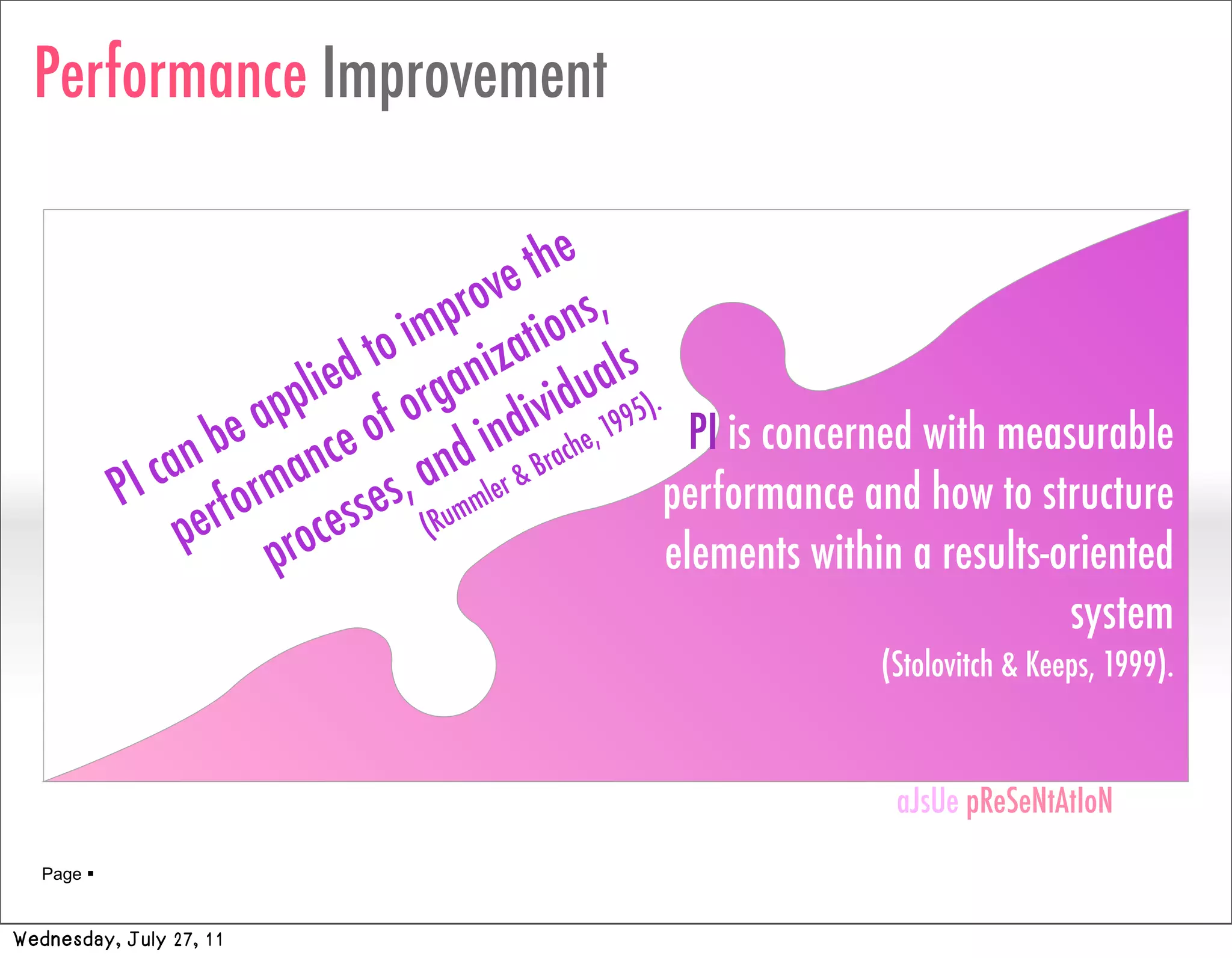
                      e app of         ndi rache, 199 PI is concerned with measurable
                  n b ance and i r & B
            P I ca form ses, mmle                    performance and how to structure
                    r
                  pe proce    s (Ru
                                                      elements within a results-oriented
                                                                                   system
                                                                  (Stolovitch & Keeps, 1999).

                                                                    aJsUe pReSeNtAtIoN
                                                                    aJsUe pReSeNtAtIoN
   Page 


Wednesday, July 27, 11
KEYPrinciples
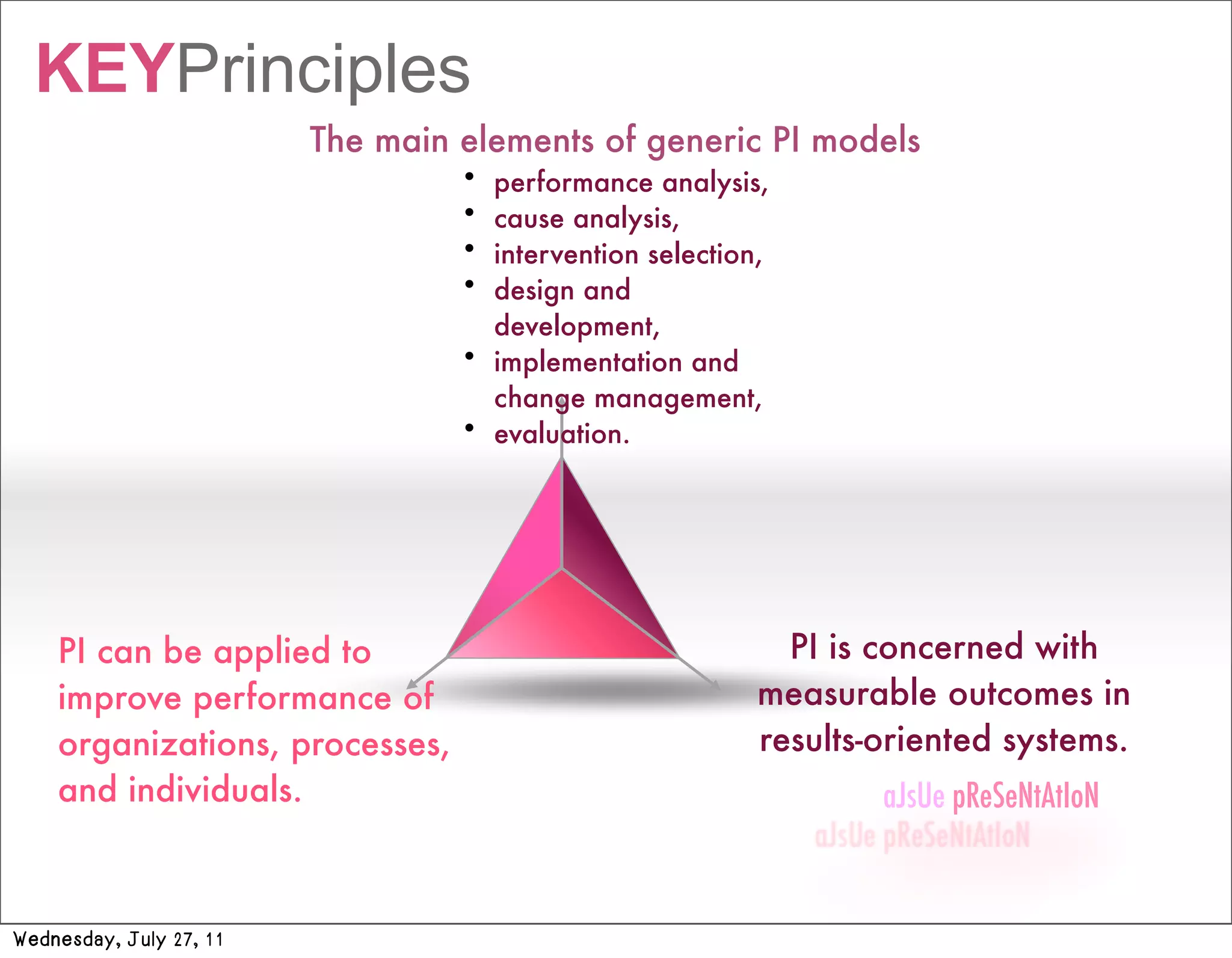
                         The main elements of generic PI models
                                  • performance analysis,
                                  • cause analysis,
                                  • intervention selection,
                                  • design and
                                    development,
                                  • implementation and
                                    change management,
                                  • evaluation.


    PI can be applied to                                    PI is concerned with
    improve performance of                                measurable outcomes in
    organizations, processes,                             results-oriented systems.
    and individuals.                                              aJsUe pReSeNtAtIoN


Wednesday, July 27, 11
Philosophical Emphases


            •   Human performance follows specific laws that can often be
                predicted and controlled (i.e., empiricism).
            •   PI theory reflects the belief that practical findings can be used as
                the basis for knowledge and meaning (i.e., pragmatism).
            •   Organizational theory emphasizes the use of intrinsic motivation
                and growth of individual in an organization (i.e., humanism).


                                                                 aJsUe pReSeNtAtIoN
                                                                 aJsUe pReSeNtAtIoN
   Page 


Wednesday, July 27, 11
Theoretical Foundations


                  • Behavioral learning theory,
                  • Communications theory,
                  • General systems theory,
                  • Instructional systems design, and
                  • Organizational development


Wednesday, July 27, 11
Early Contributors:


             • William Deterline,
             •Thomas Gilbert, Joe Harless,
             •Roger Kaufman,
             •Donald Kirkpatrick,
             •Robert Mager, and
             •Geary Rummler


                                             aJsUe pReSeNtAtIoN
                                             aJsUe pReSeNtAtIoN
   Page 


Wednesday, July 27, 11
Applications to ID:

       •
        Evaluation
       •
        Front-End Analysis
       •
        Intervention Design and
         Implementation
       •
        Strategies for Promoting
         Transfer


                                   aJsUe pReSeNtAtIoN
                                   aJsUe pReSeNtAtIoN
   Page 


Wednesday, July 27, 11
Research Support Studies of ::


            •ElectronicPerformance Support Systems (e.g., Nguyen & Klein, 2008)
            •Implementation of Performance Interventions (e.g., Rossett & Tobias,

              1999; Vadivelu & Klein, 2008)
            •Review of PI Research (e.g., Clark & Estes, 2002; Klein, 2002; Marker, et

              al., 2006; Conn & Gitonga, 2002)


                                                                        aJsUe pReSeNtAtIoN
                                                                        aJsUe pReSeNtAtIoN
   Page 


Wednesday, July 27, 11
Related Concepts:
            •
              Human Resource Management
            •
              Organizational Development
            •
              Performance Support Systems
            •
              Strategic Planning


                                            aJsUe pReSeNtAtIoN
                                            aJsUe pReSeNtAtIoN
   Page 


Wednesday, July 27, 11
Learners and Learning Processes :
    •
        The three main individual factors that influence
        performance are
          •
            knowledge,
          •
            capacity, and
          •
            motives.


                                                 aJsUe pReSeNtAtIoN
                                                 aJsUe pReSeNtAtIoN
   Page 


Wednesday, July 27, 11
Learning and Performance Contexts :


  Page 
                                           AjSuE
Wednesday, July 27, 11
Learning and Performance Contexts :
                           •
                            Critical Contexts
                               (orienting, transfer, and performance)


  Page 
                                                                        AjSuE
Wednesday, July 27, 11
Learning and Performance Contexts :
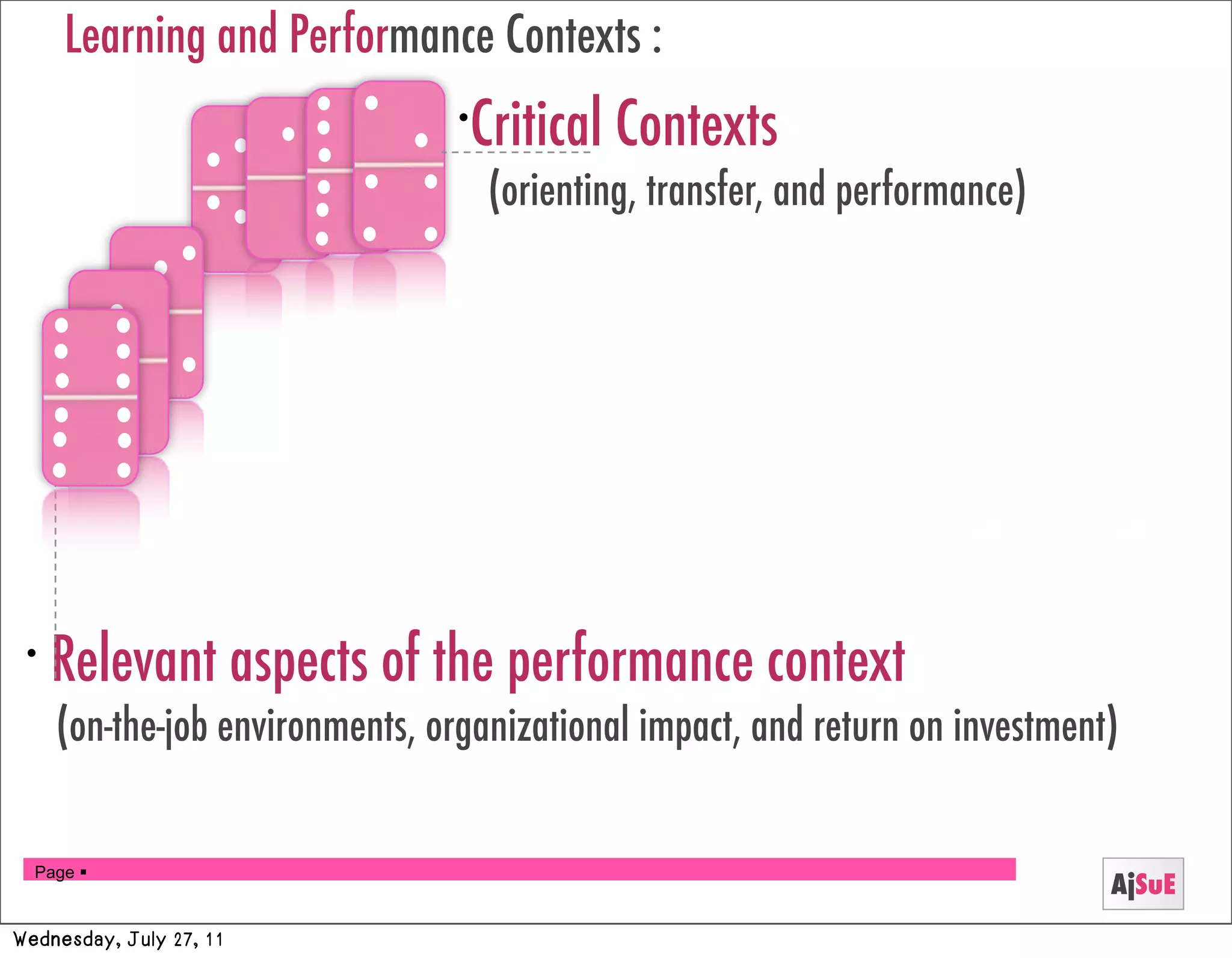
                                •
                                 Critical Contexts
                                    (orienting, transfer, and performance)


 •
     Relevant aspects of the performance context
     (on-the-job environments, organizational impact, and return on investment)


  Page 
                                                                              AjSuE
Wednesday, July 27, 11
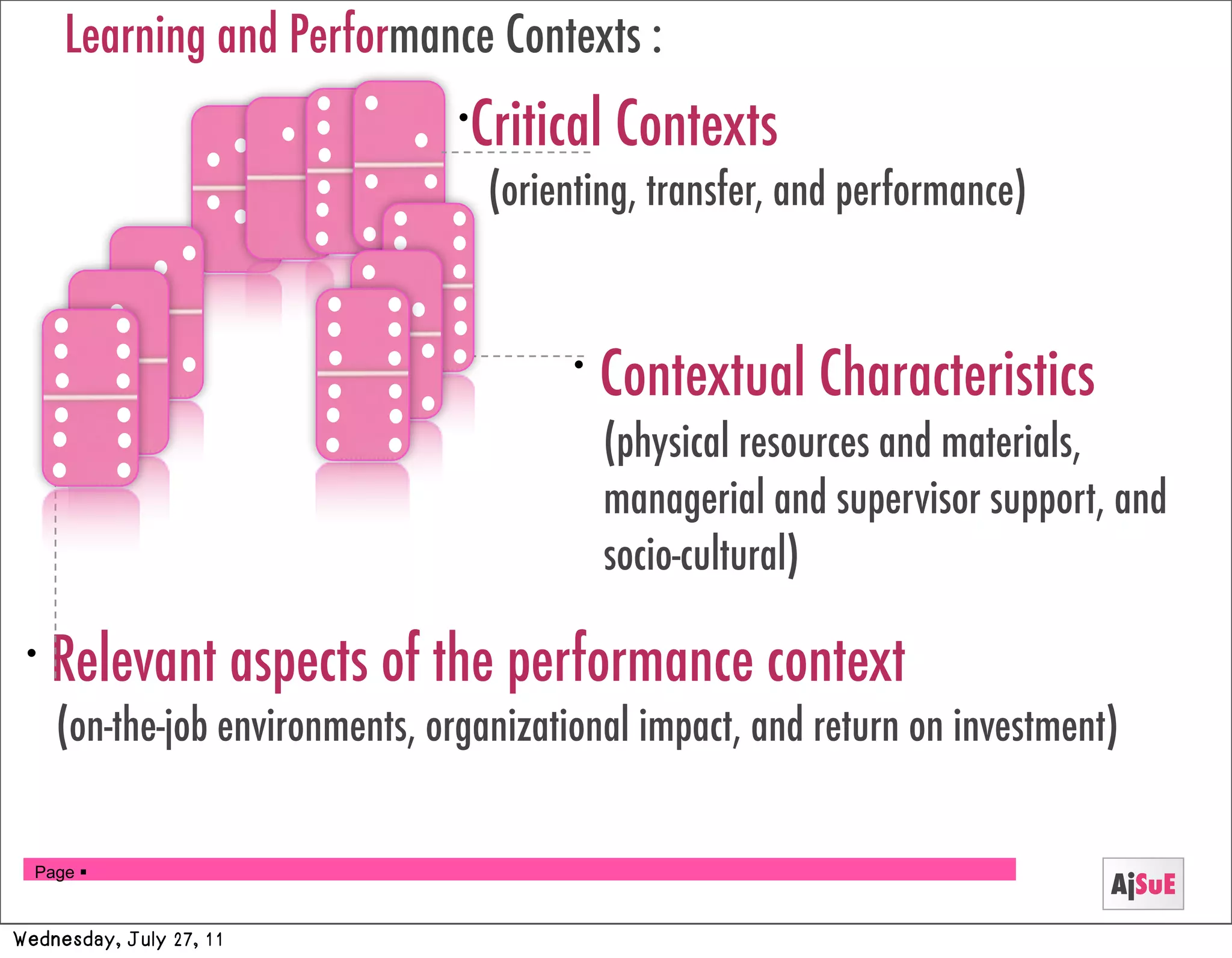
Learning and Performance Contexts :
                                •
                                 Critical Contexts
                                    (orienting, transfer, and performance)


                                         •
                                             Contextual Characteristics
                                             (physical resources and materials,
                                             managerial and supervisor support, and
                                             socio-cultural)

 •
     Relevant aspects of the performance context
     (on-the-job environments, organizational impact, and return on investment)


  Page 
                                                                               AjSuE
Wednesday, July 27, 11
Instructional and No instructional Strategies


                                               Strategies


                                                                         AjSuE
   Page 


Wednesday, July 27, 11
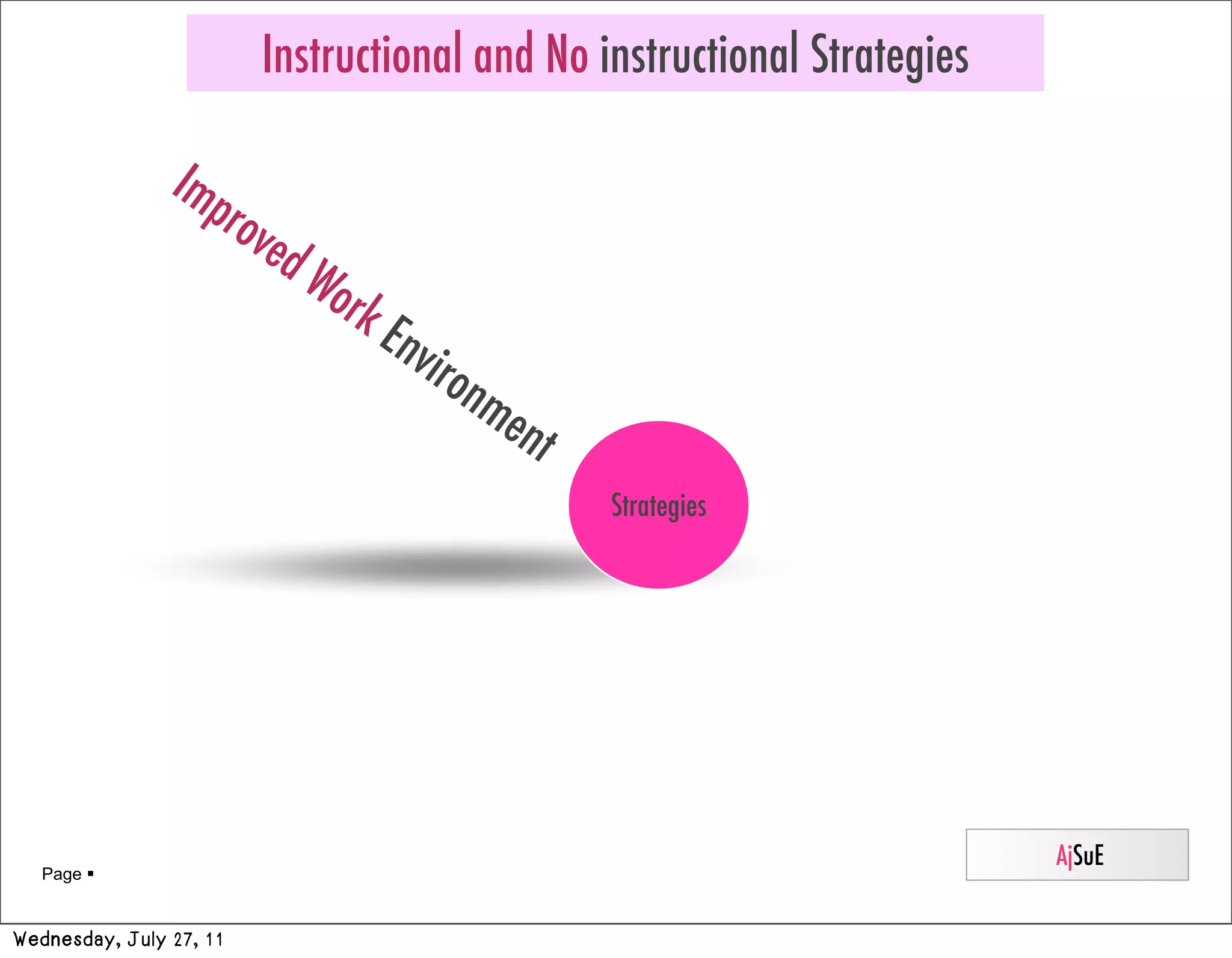
Instructional and No instructional Strategies

                Imp
                   rov
                      ed
                         Wo
                            rk
                                 Env
                                       iro
                                           nm
                                             ent
                                                   Strategies


                                                                         AjSuE
   Page 


Wednesday, July 27, 11
Instructional and No instructional Strategies

                Imp
                   rov
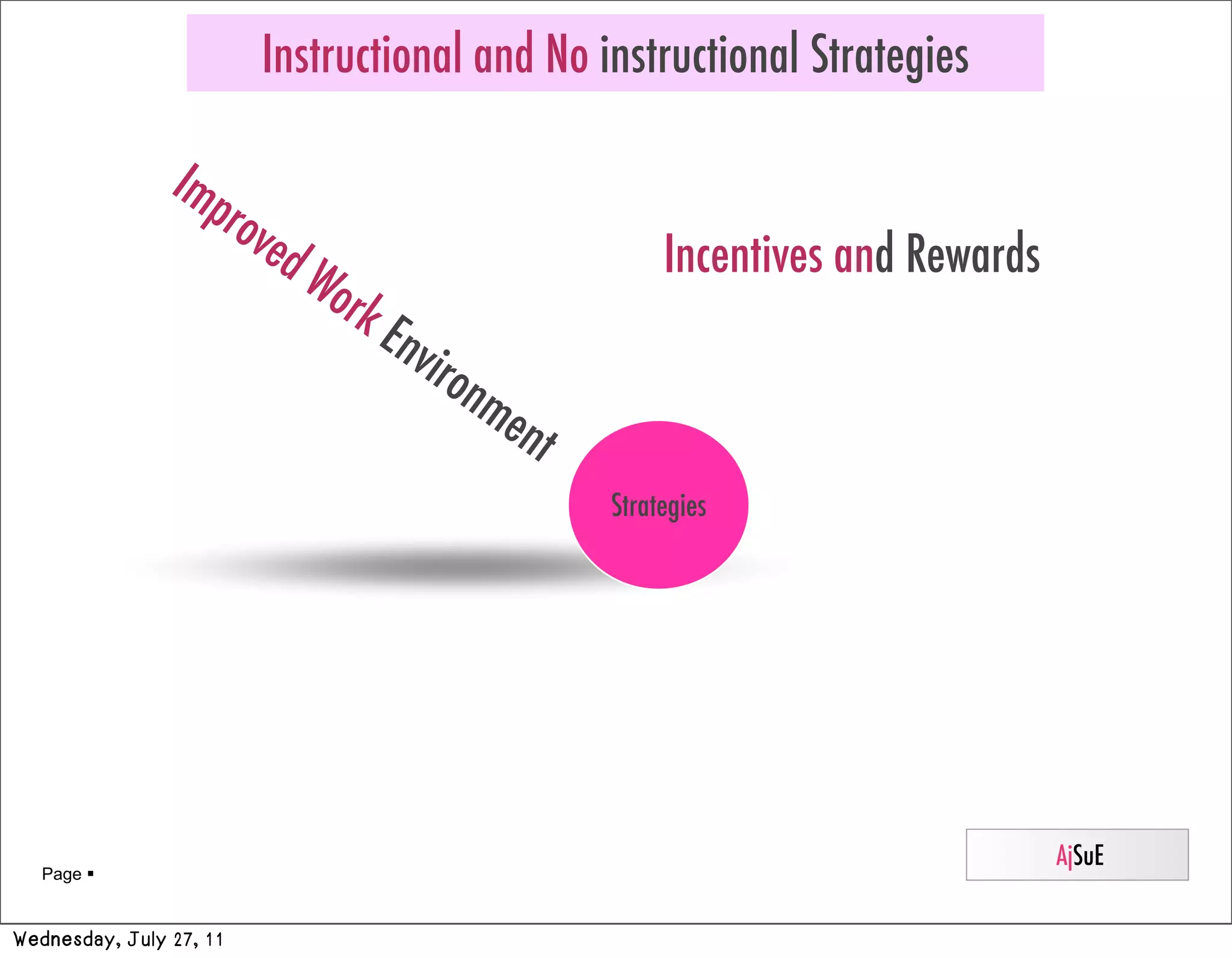
                      ed                                Incentives and Rewards
                         Wo
                            rk
                                 Env
                                       iro
                                           nm
                                             ent
                                                   Strategies


                                                                                 AjSuE
   Page 


Wednesday, July 27, 11
Instructional and No instructional Strategies

                Imp
                   rov
                      ed                                  Incentives and Rewards
                         Wo
                            rk
                                 Env
                                       iro
                                           nm
                                             ent
                                                     Strategies


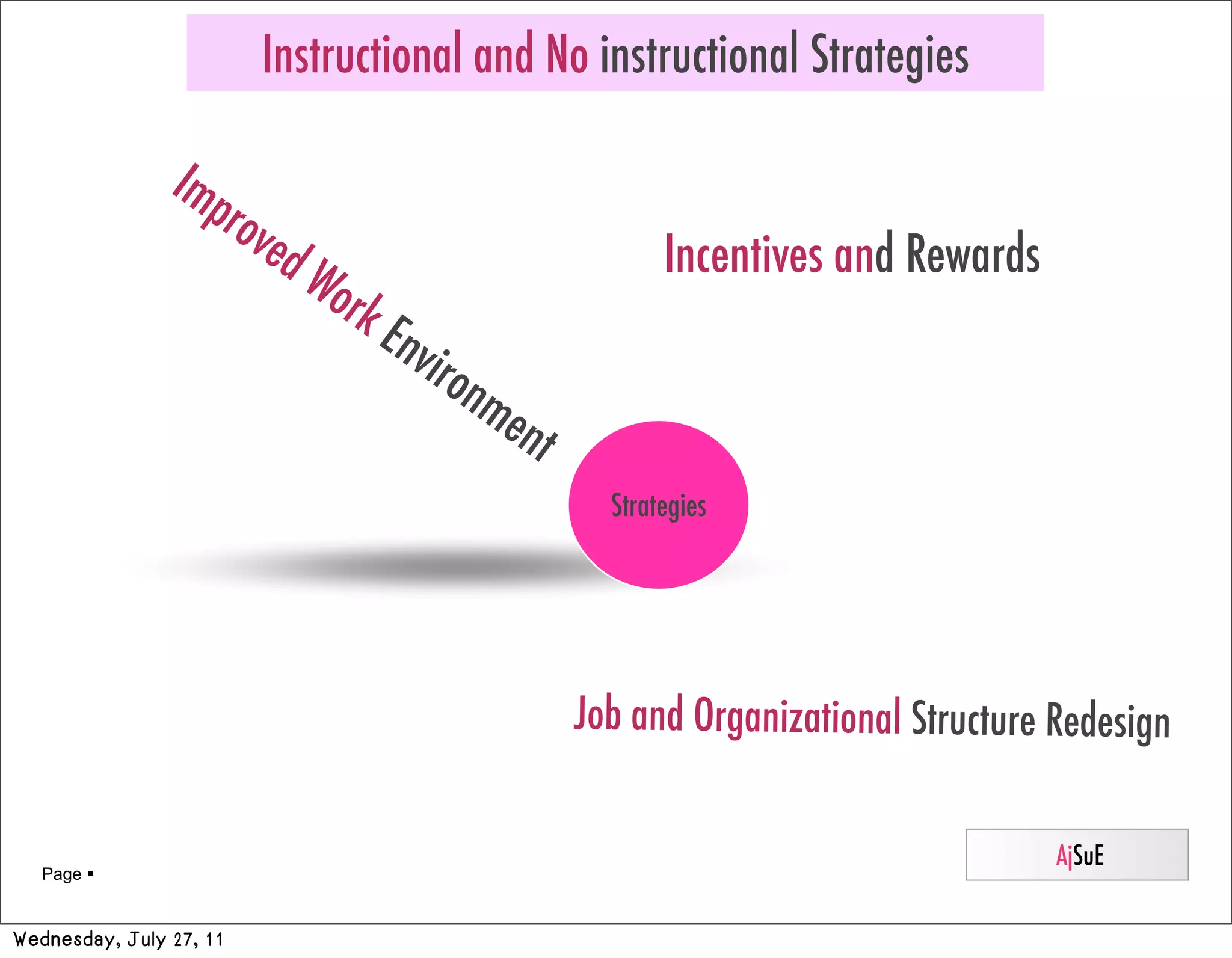
                                                   Job and Organizational Structure Redesign


                                                                                    AjSuE
   Page 


Wednesday, July 27, 11
Instructional and No instructional Strategies

                Imp
                   rov
                      ed                                  Incentives and Rewards
                         Wo
                            rk
                                 Env
                                       iro
                                           nm
                                             ent
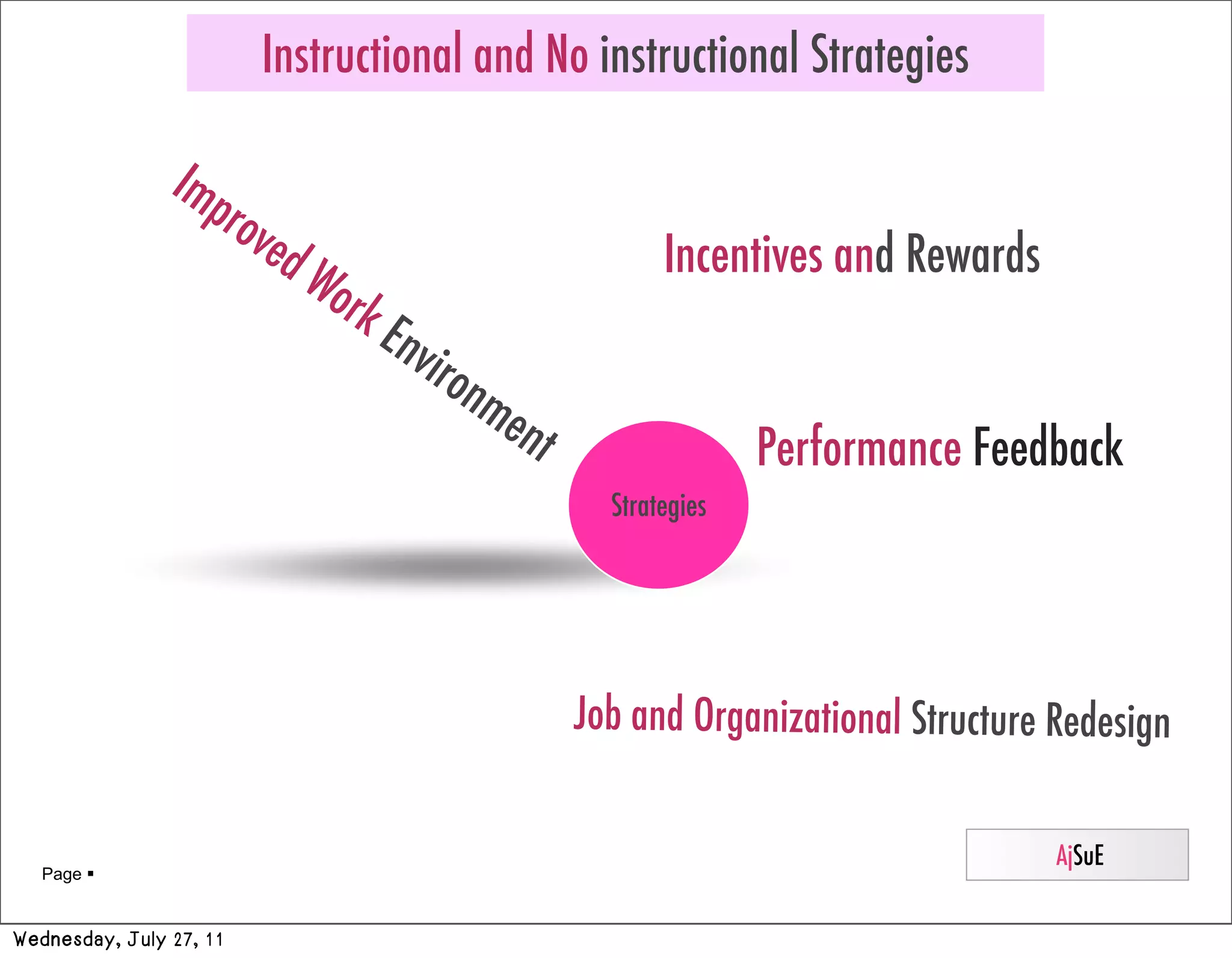
                                                                  Performance Feedback
                                                     Strategies


                                                   Job and Organizational Structure Redesign


                                                                                    AjSuE
   Page 


Wednesday, July 27, 11
Instructional and No instructional Strategies

                Imp
                   rov
                      ed                            Incentives and Rewards
                         Wo
                            rk
                                 Env
                         iro
                             nm
                               ent
                                                            Performance Feedback
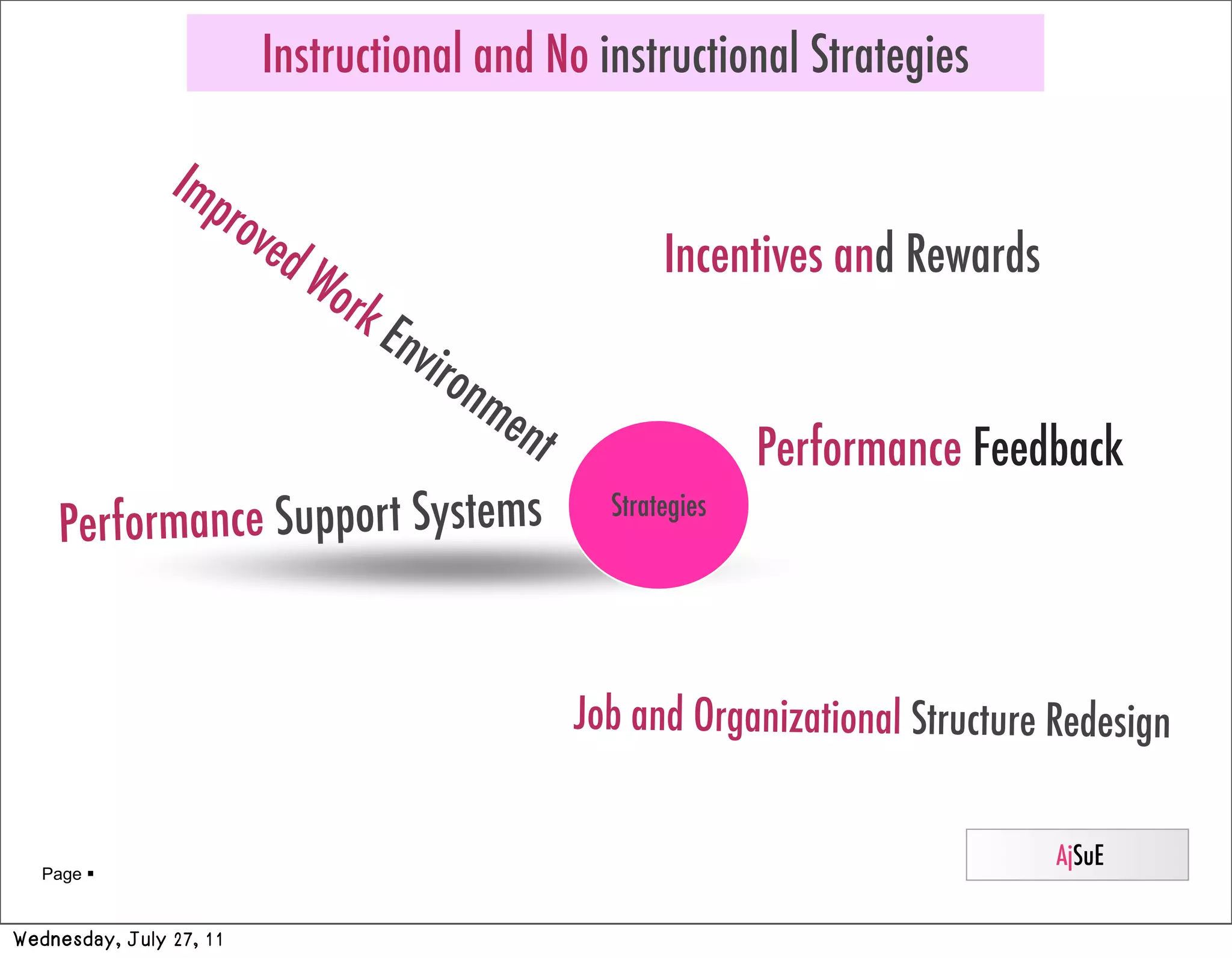
    Performance Support Systems
                                               Strategies


                                            Job and Organizational Structure Redesign


                                                                             AjSuE
   Page 


Wednesday, July 27, 11
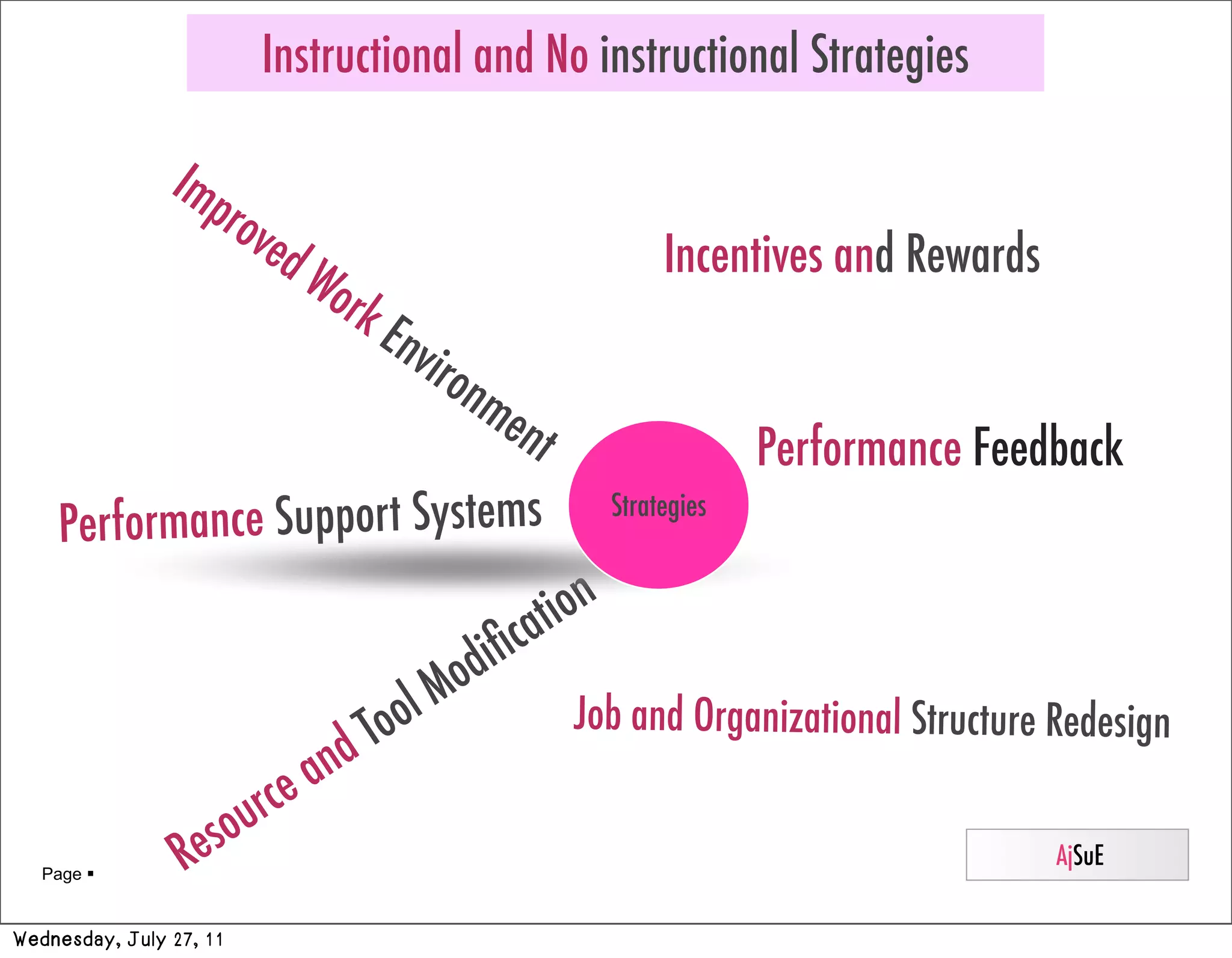
Instructional and No instructional Strategies

                Imp
                   rov
                      ed                                             Incentives and Rewards
                         Wo
                            rk
                                    Env
                         iro
                             nm
                               ent
                                                                             Performance Feedback
    Performance Support Systems
                                                                Strategies


                                                      cat ion
                                              o difi
                                    To ol M               Job and Organizational Structure Redesign
                               nd
                      ur   ce a
   Page         Reso                                                                         AjSuE

Wednesday, July 27, 11
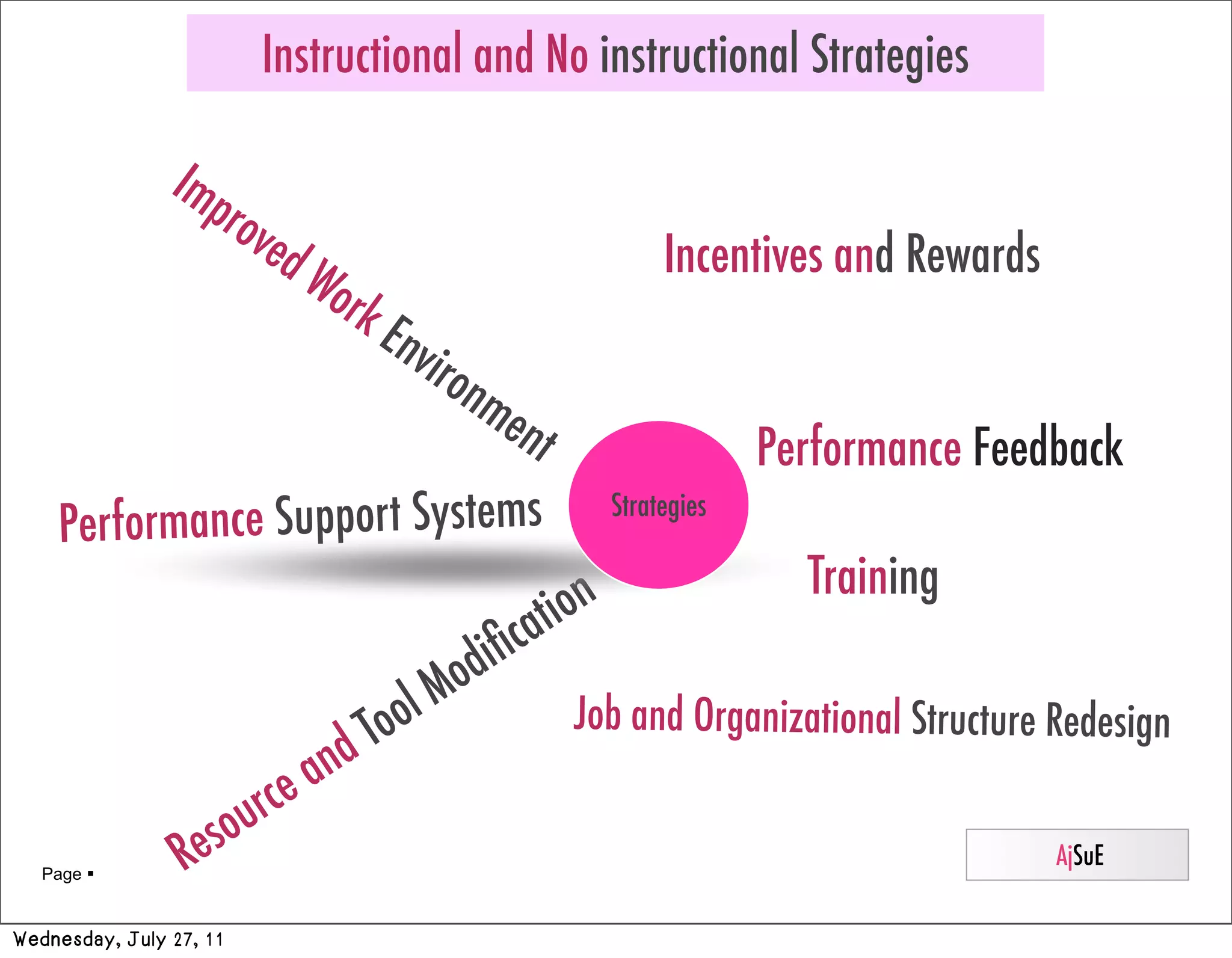
Instructional and No instructional Strategies

                Imp
                   rov
                      ed                                           Incentives and Rewards
                         Wo
                            rk
                                    Env
                         iro
                             nm
                               ent
                                                                           Performance Feedback
    Performance Support Systems
                                                              Strategies

                                                                             Training
                                                    cat ion
                                              o difi
                                    To ol M             Job and Organizational Structure Redesign
                               nd
                      ur   ce a
   Page         Reso                                                                       AjSuE

Wednesday, July 27, 11
Designers and Design Processes


                                   AjSuE
   Page 


Wednesday, July 27, 11
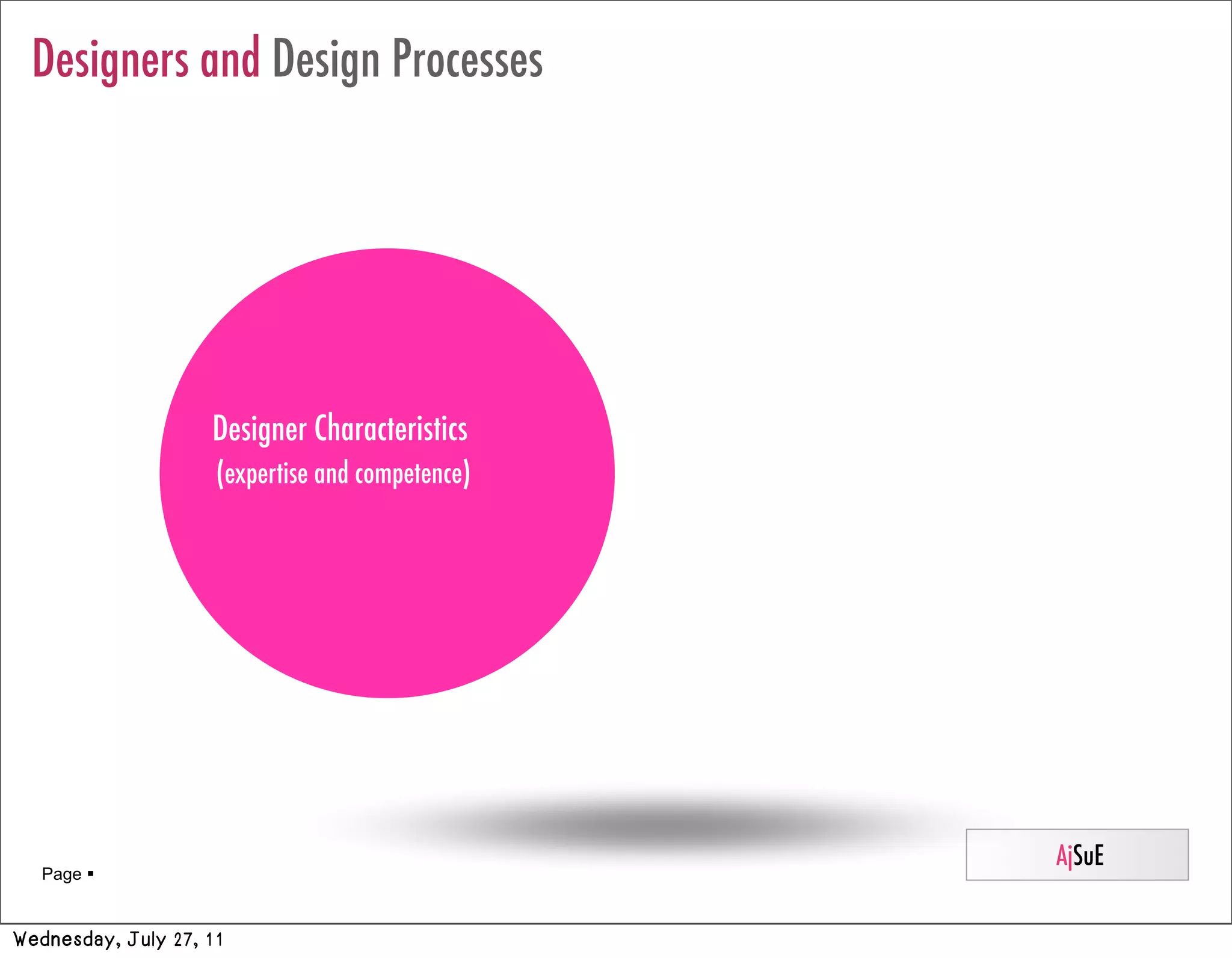
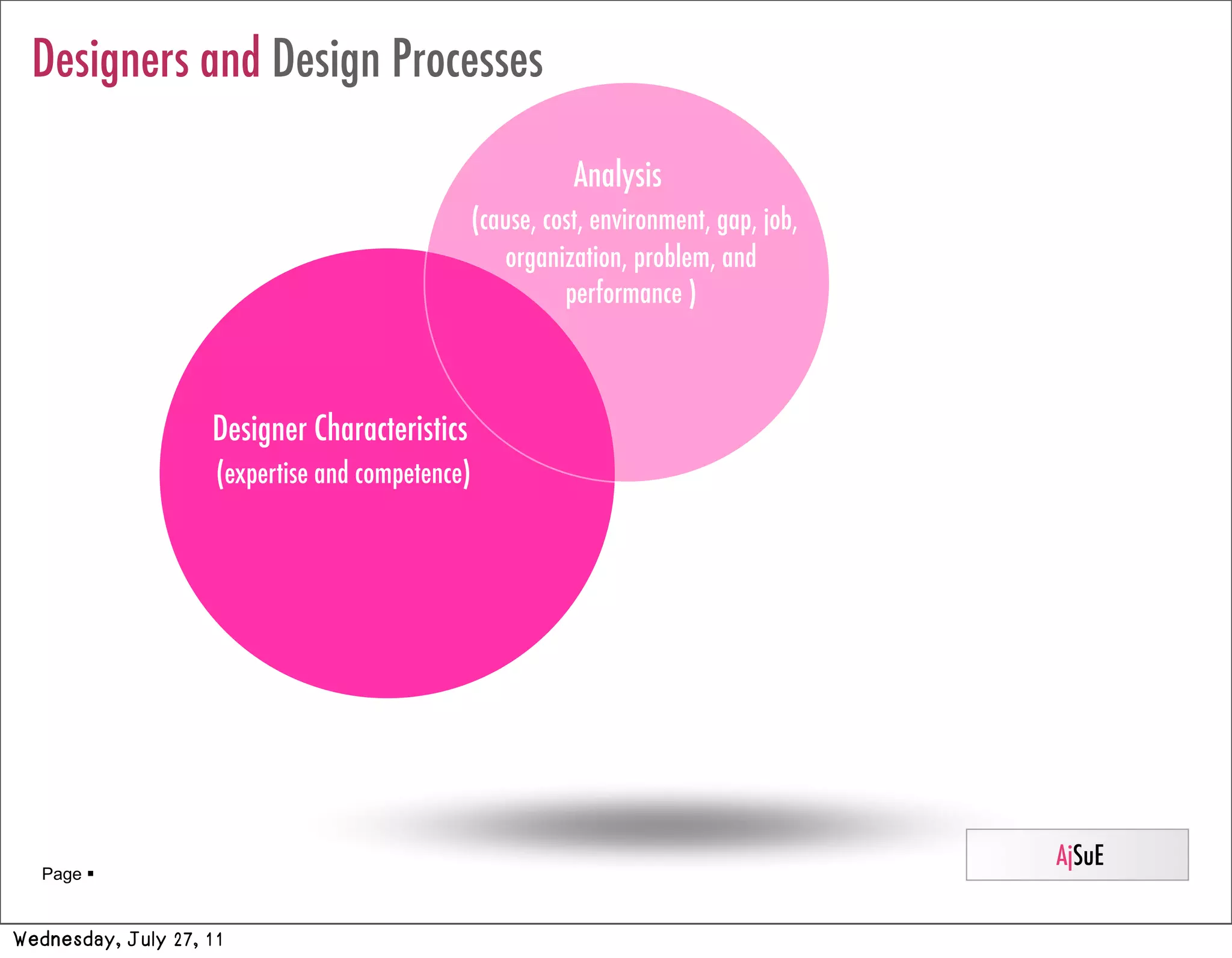
Designers and Design Processes


                    Designer Characteristics
                     (expertise and competence)


                                                  AjSuE
   Page 


Wednesday, July 27, 11
Designers and Design Processes

                                                             Analysis
                                                  (cause, cost, environment, gap, job,
                                                     organization, problem, and
                                                            performance )


                    Designer Characteristics
                     (expertise and competence)


                                                                                         AjSuE
   Page 


Wednesday, July 27, 11
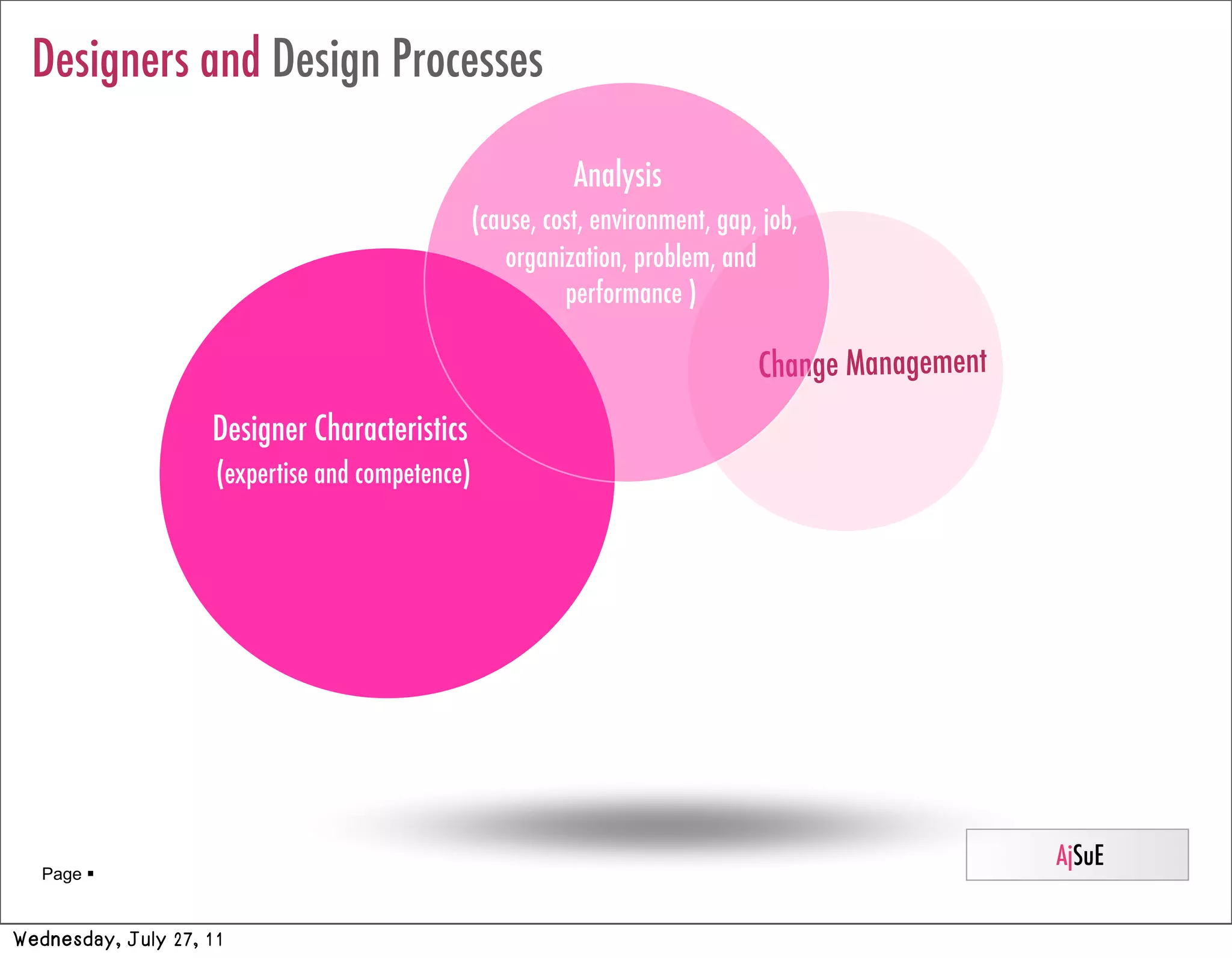
Designers and Design Processes

                                                             Analysis
                                                  (cause, cost, environment, gap, job,
                                                     organization, problem, and
                                                            performance )

                                                                                 Change Management
                    Designer Characteristics
                     (expertise and competence)


                                                                                                     AjSuE
   Page 


Wednesday, July 27, 11
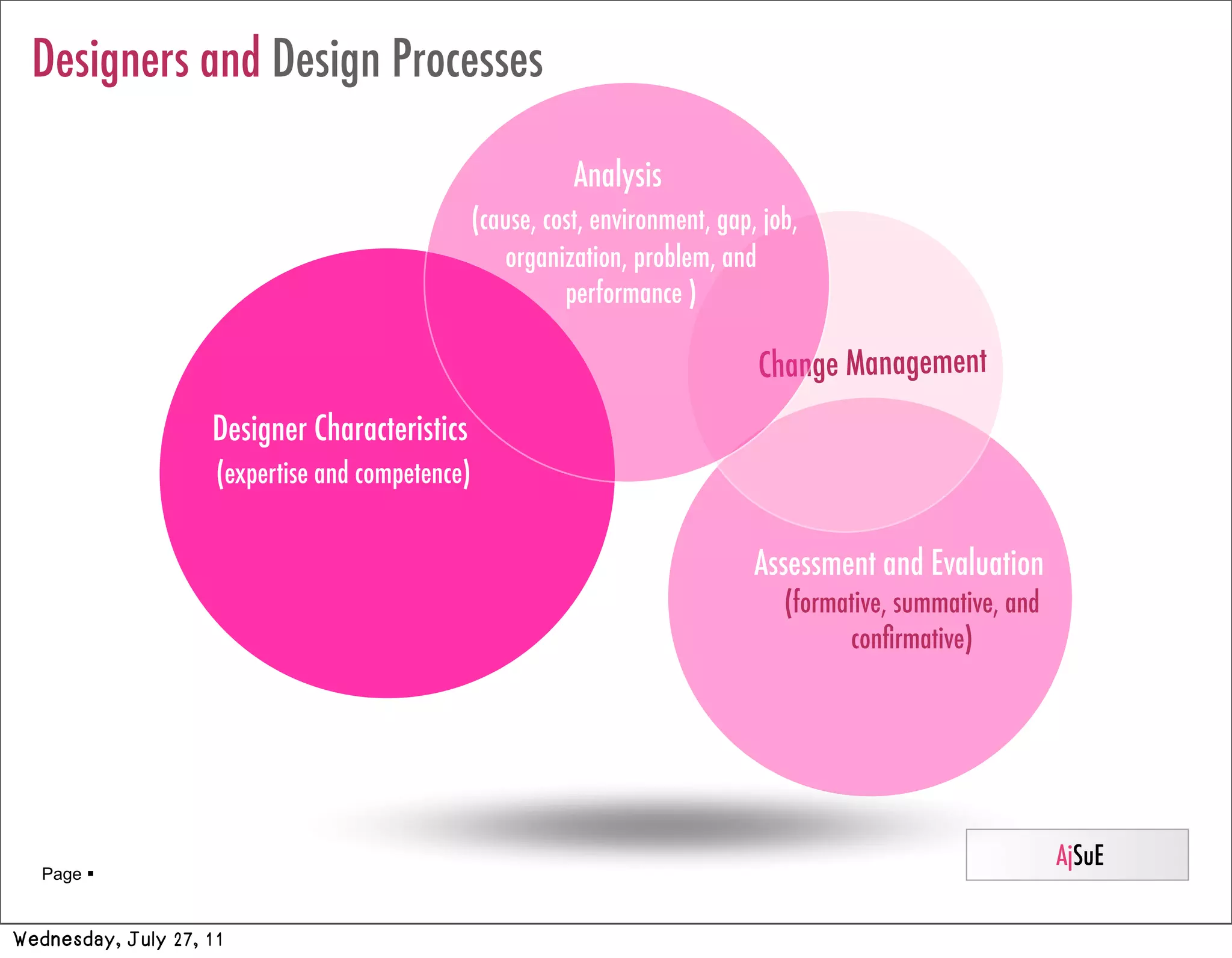
Designers and Design Processes

                                                             Analysis
                                                  (cause, cost, environment, gap, job,
                                                     organization, problem, and
                                                            performance )

                                                                                 Change Management
                    Designer Characteristics
                     (expertise and competence)


                                                                                 Assessment and Evaluation
                                                                                    (formative, summative, and
                                                                                          confirmative)


                                                                                                                 AjSuE
   Page 


Wednesday, July 27, 11
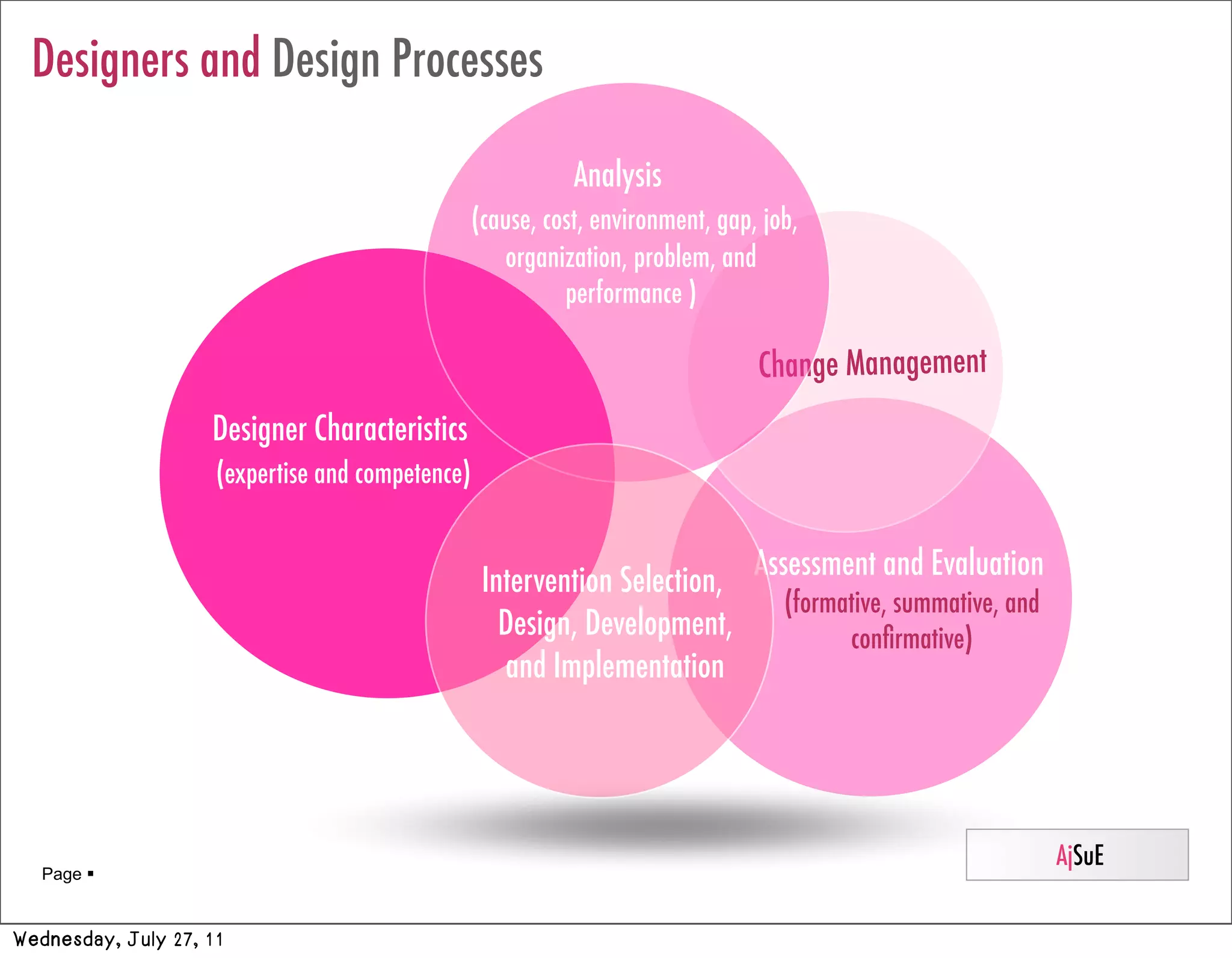
Designers and Design Processes

                                                             Analysis
                                                  (cause, cost, environment, gap, job,
                                                     organization, problem, and
                                                            performance )

                                                                                 Change Management
                    Designer Characteristics
                     (expertise and competence)


                                                   Intervention Selection, Assessment and Evaluation
                                                                              (formative, summative, and
                                                     Design, Development,           confirmative)
                                                     and Implementation


                                                                                                           AjSuE
   Page 


Wednesday, July 27, 11
MODELS OF PERFORMANCE IMPROVEMENT

                     A Comprehensive Performance Improvement Model


  Page 
                                                                     AjSuE
Wednesday, July 27, 11
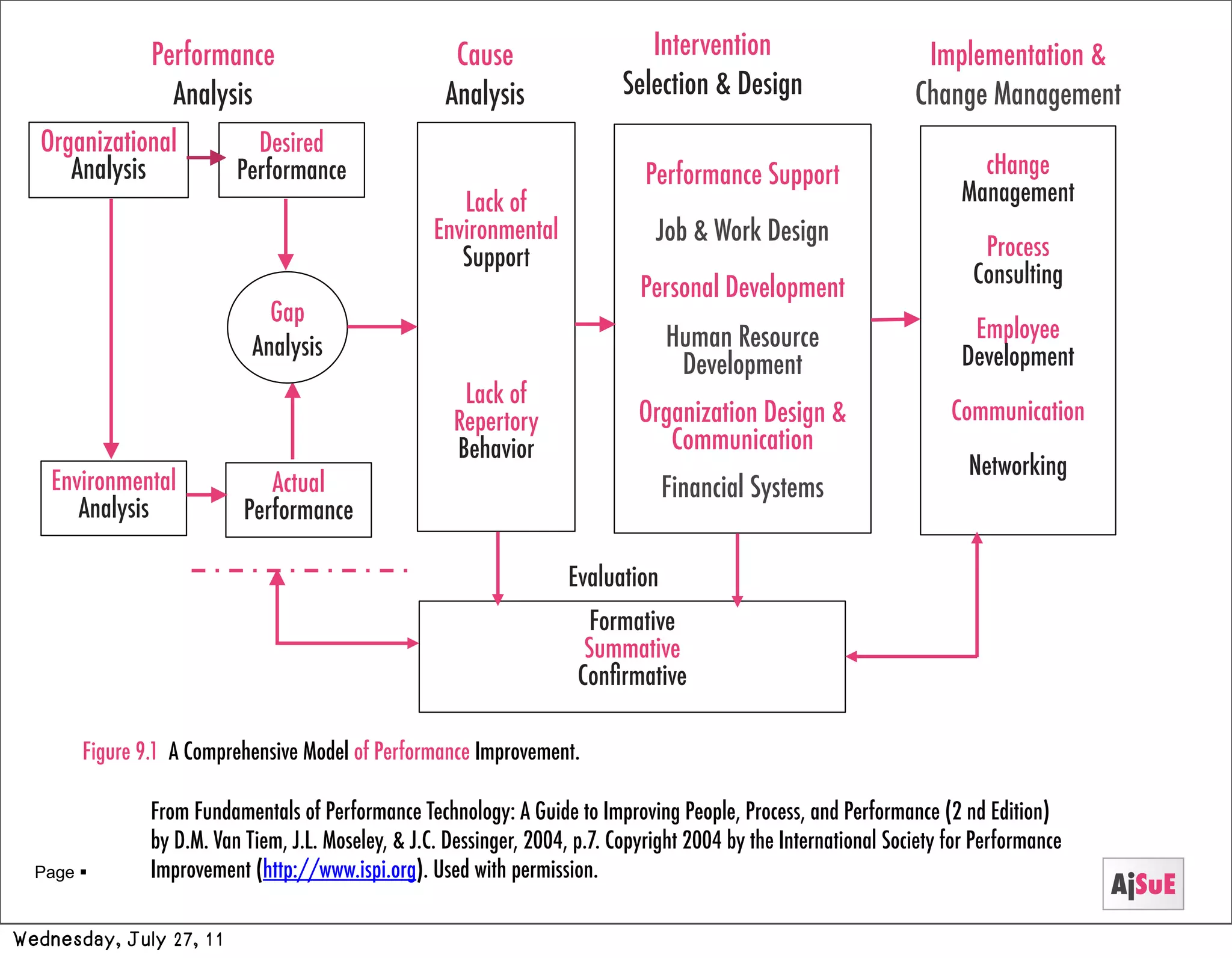
Performance                            Cause                     Intervention                        Implementation &
                 Analysis                            Analysis                Selection & Design                    Change Management
  Organizational            Desired
     Analysis             Performance                                           Performance Support                        cHange
                                                       Lack of                                                           Management
                                                    Environmental                Job & Work Design
                                                       Support                                                              Process
                                                                                                                           Consulting
                                                                               Personal Development
                              Gap
                                                                                  Human Resource                          Employee
                            Analysis                                                                                     Development
                                                                                   Development
                                                       Lack of
                                                      Repertory                Organization Design &                    Communication
                                                      Behavior                    Communication
                                                                                                                          Networking
    Environmental             Actual                                              Financial Systems
       Analysis            Performance

                                                                     Evaluation
                                                                         Formative
                                                                        Summative
                                                                       Confirmative

       Figure 9.1 A Comprehensive Model of Performance Improvement.

               From Fundamentals of Performance Technology: A Guide to Improving People, Process, and Performance (2 nd Edition)
               by D.M. Van Tiem, J.L. Moseley, & J.C. Dessinger, 2004, p.7. Copyright 2004 by the International Society for Performance
  Page        Improvement (http://www.ispi.org). Used with permission.
                                                                                                                                          AjSuE
Wednesday, July 27, 11
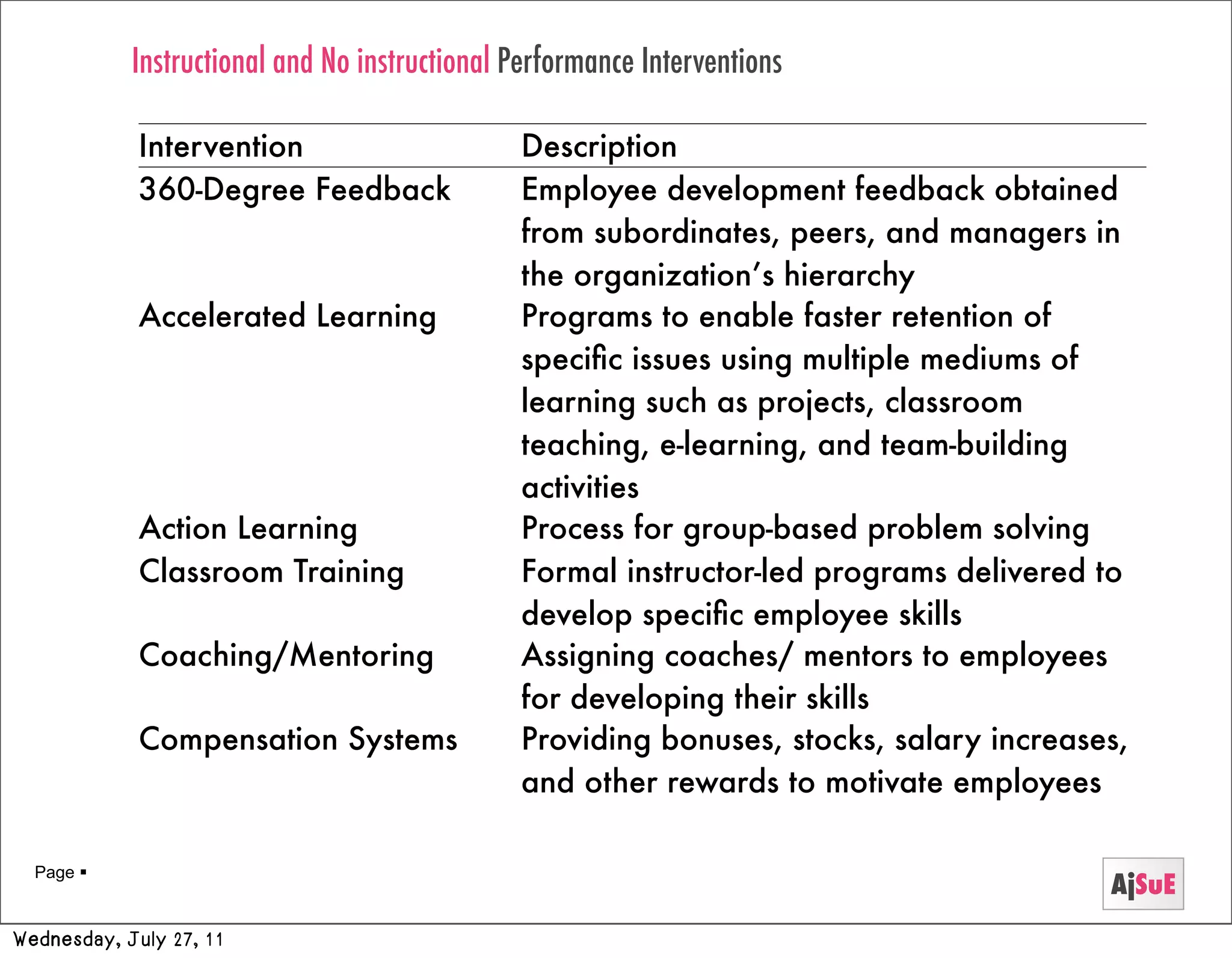
Instructional and No instructional Performance Interventions

             Intervention                      Description
             360-Degree Feedback               Employee development feedback obtained
                                               from subordinates, peers, and managers in
                                               the organization’s hierarchy
             Accelerated Learning              Programs to enable faster retention of
                                               specific issues using multiple mediums of
                                               learning such as projects, classroom
                                               teaching, e-learning, and team-building
                                               activities
             Action Learning                   Process for group-based problem solving
             Classroom Training                Formal instructor-led programs delivered to
                                               develop specific employee skills
             Coaching/Mentoring                Assigning coaches/ mentors to employees
                                               for developing their skills
             Compensation Systems              Providing bonuses, stocks, salary increases,
                                               and other rewards to motivate employees

  Page 
                                                                                         AjSuE
Wednesday, July 27, 11
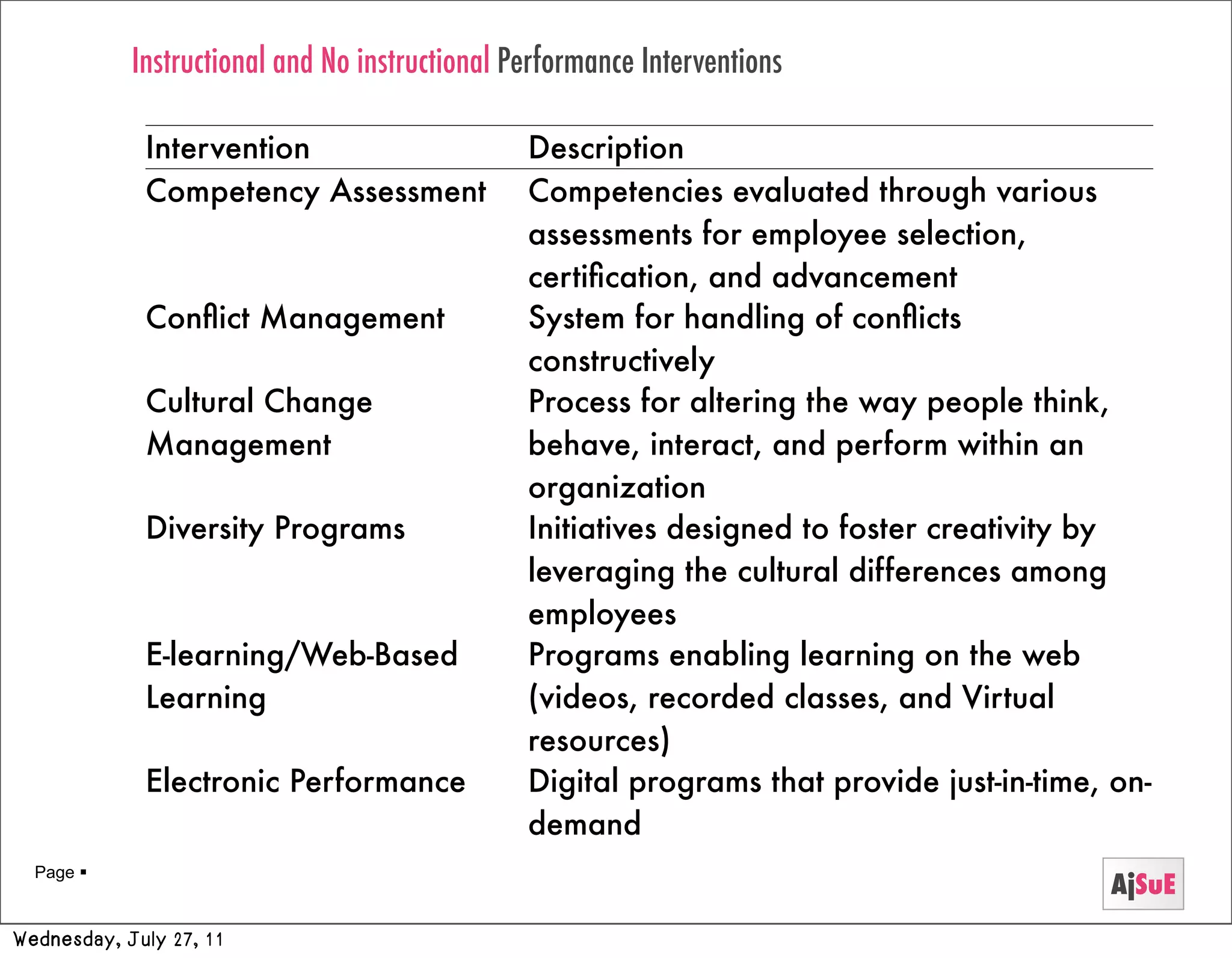
Instructional and No instructional Performance Interventions

             Intervention                       Description
             Competency Assessment              Competencies evaluated through various
                                                assessments for employee selection,
                                                certification, and advancement
             Conflict Management                 System for handling of conflicts
                                                constructively
             Cultural Change                    Process for altering the way people think,
             Management                         behave, interact, and perform within an
                                                organization
             Diversity Programs                 Initiatives designed to foster creativity by
                                                leveraging the cultural differences among
                                                employees
             E-learning/Web-Based               Programs enabling learning on the web
             Learning                           (videos, recorded classes, and Virtual
                                                resources)
             Electronic Performance             Digital programs that provide just-in-time, on-
                                                demand
  Page 
                                                                                           AjSuE
Wednesday, July 27, 11
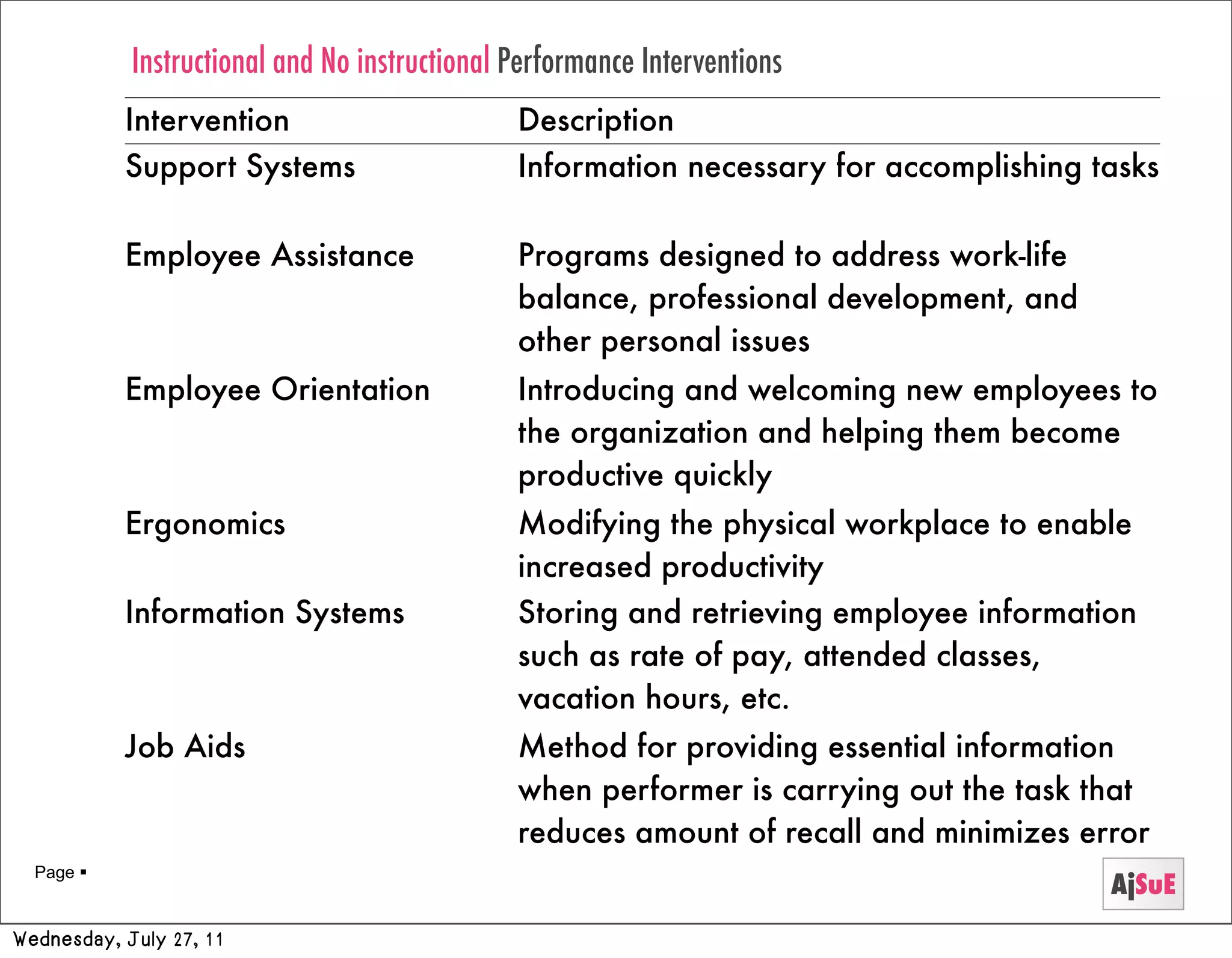
Instructional and No instructional Performance Interventions
           Intervention                        Description
           Support Systems                     Information necessary for accomplishing tasks

           Employee Assistance                 Programs designed to address work-life
                                               balance, professional development, and
                                               other personal issues
           Employee Orientation                Introducing and welcoming new employees to
                                               the organization and helping them become
                                               productive quickly
           Ergonomics                          Modifying the physical workplace to enable
                                               increased productivity
           Information Systems                 Storing and retrieving employee information
                                               such as rate of pay, attended classes,
                                               vacation hours, etc.
           Job Aids                            Method for providing essential information
                                               when performer is carrying out the task that
                                               reduces amount of recall and minimizes error
  Page 
                                                                                        AjSuE
Wednesday, July 27, 11
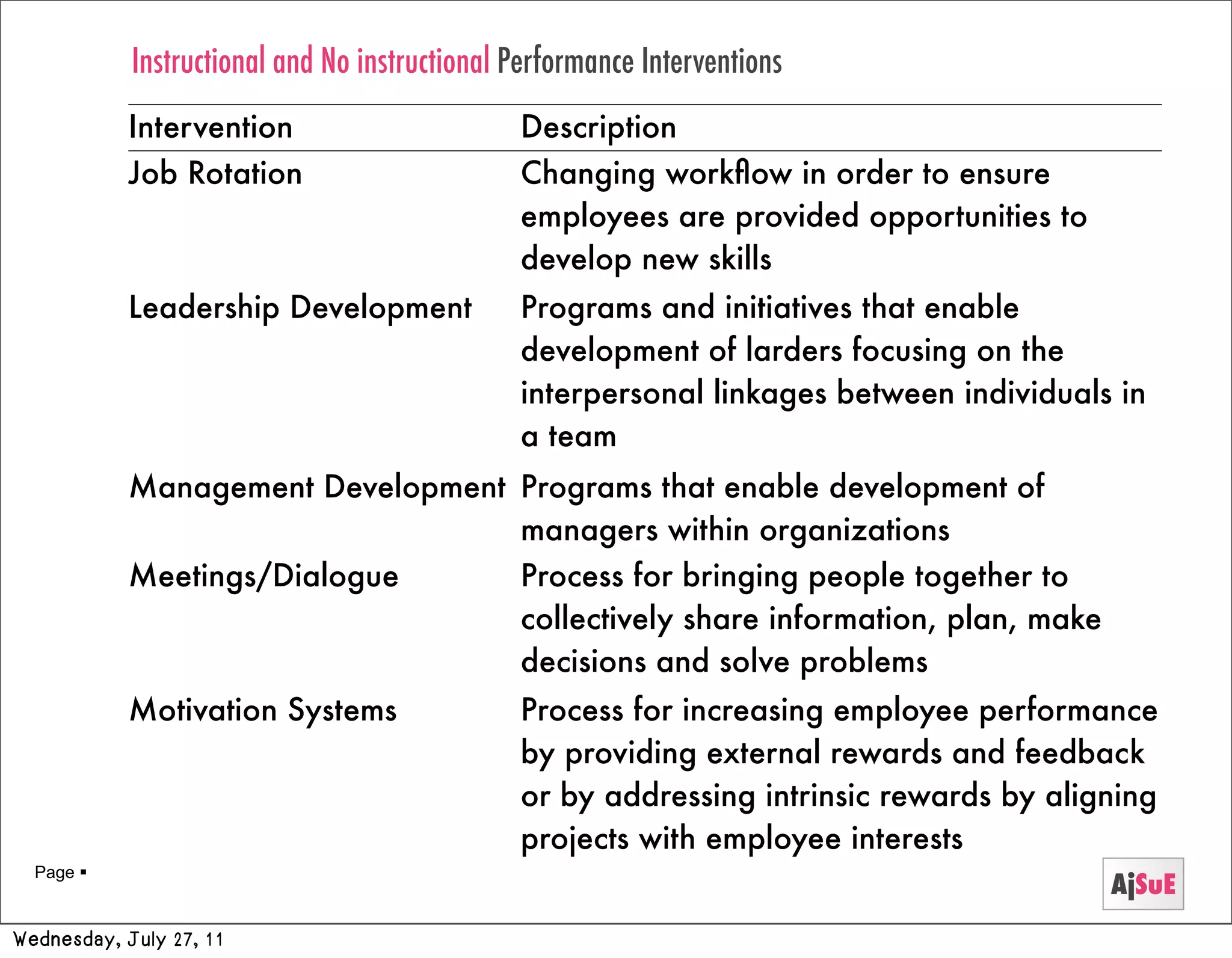
Instructional and No instructional Performance Interventions
            Intervention                       Description
            Job Rotation                       Changing workflow in order to ensure
                                               employees are provided opportunities to
                                               develop new skills
            Leadership Development             Programs and initiatives that enable
                                               development of larders focusing on the
                                               interpersonal linkages between individuals in
                                               a team
            Management Development Programs that enable development of
                                   managers within organizations
            Meetings/Dialogue      Process for bringing people together to
                                   collectively share information, plan, make
                                   decisions and solve problems
            Motivation Systems                 Process for increasing employee performance
                                               by providing external rewards and feedback
                                               or by addressing intrinsic rewards by aligning
                                               projects with employee interests
  Page 
                                                                                         AjSuE
Wednesday, July 27, 11
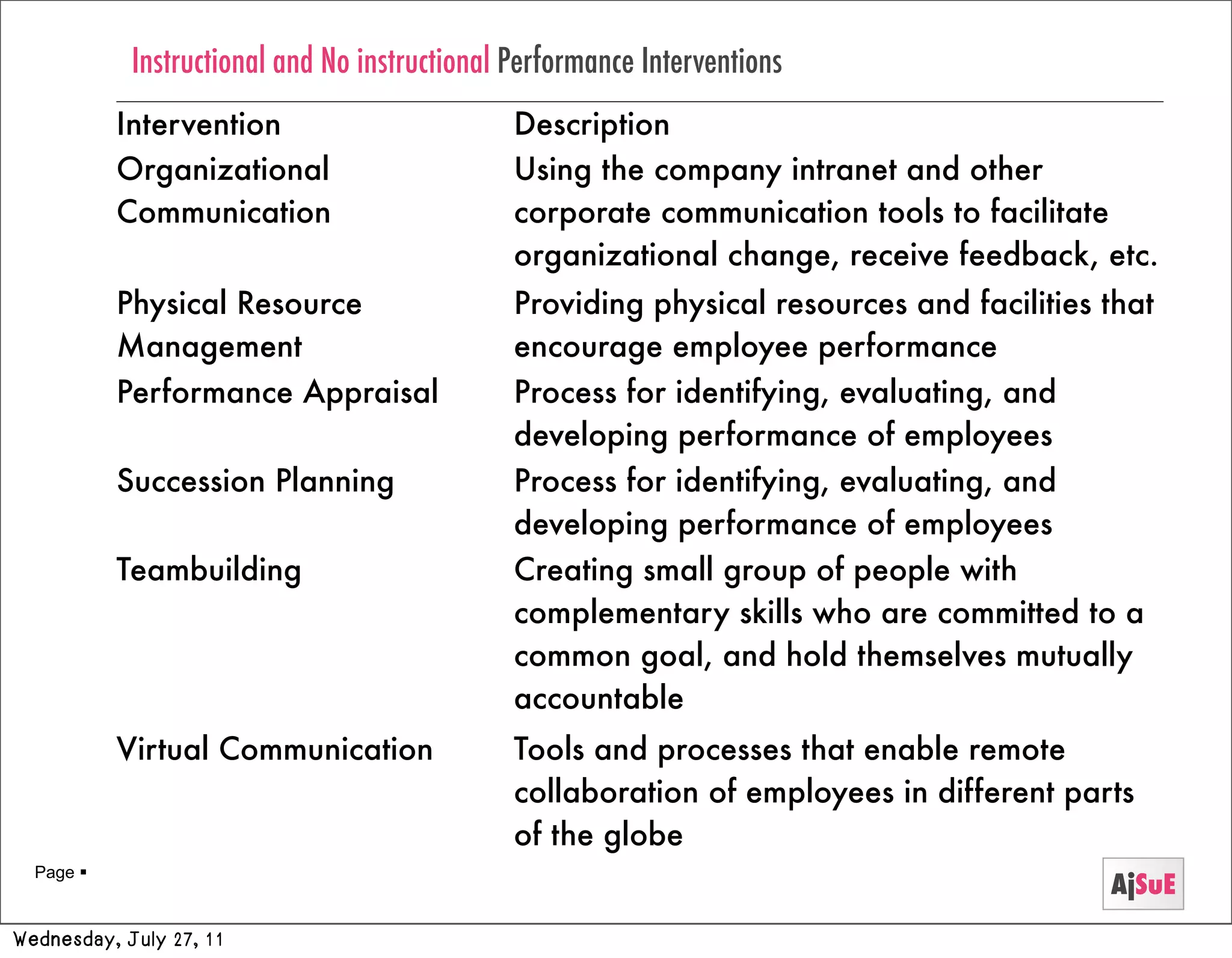
Instructional and No instructional Performance Interventions
           Intervention                        Description
           Organizational                      Using the company intranet and other
           Communication                       corporate communication tools to facilitate
                                               organizational change, receive feedback, etc.
           Physical Resource                   Providing physical resources and facilities that
           Management                          encourage employee performance
           Performance Appraisal               Process for identifying, evaluating, and
                                               developing performance of employees
           Succession Planning                 Process for identifying, evaluating, and
                                               developing performance of employees
           Teambuilding                        Creating small group of people with
                                               complementary skills who are committed to a
                                               common goal, and hold themselves mutually
                                               accountable
           Virtual Communication               Tools and processes that enable remote
                                               collaboration of employees in different parts
                                               of the globe
  Page 
                                                                                           AjSuE
Wednesday, July 27, 11
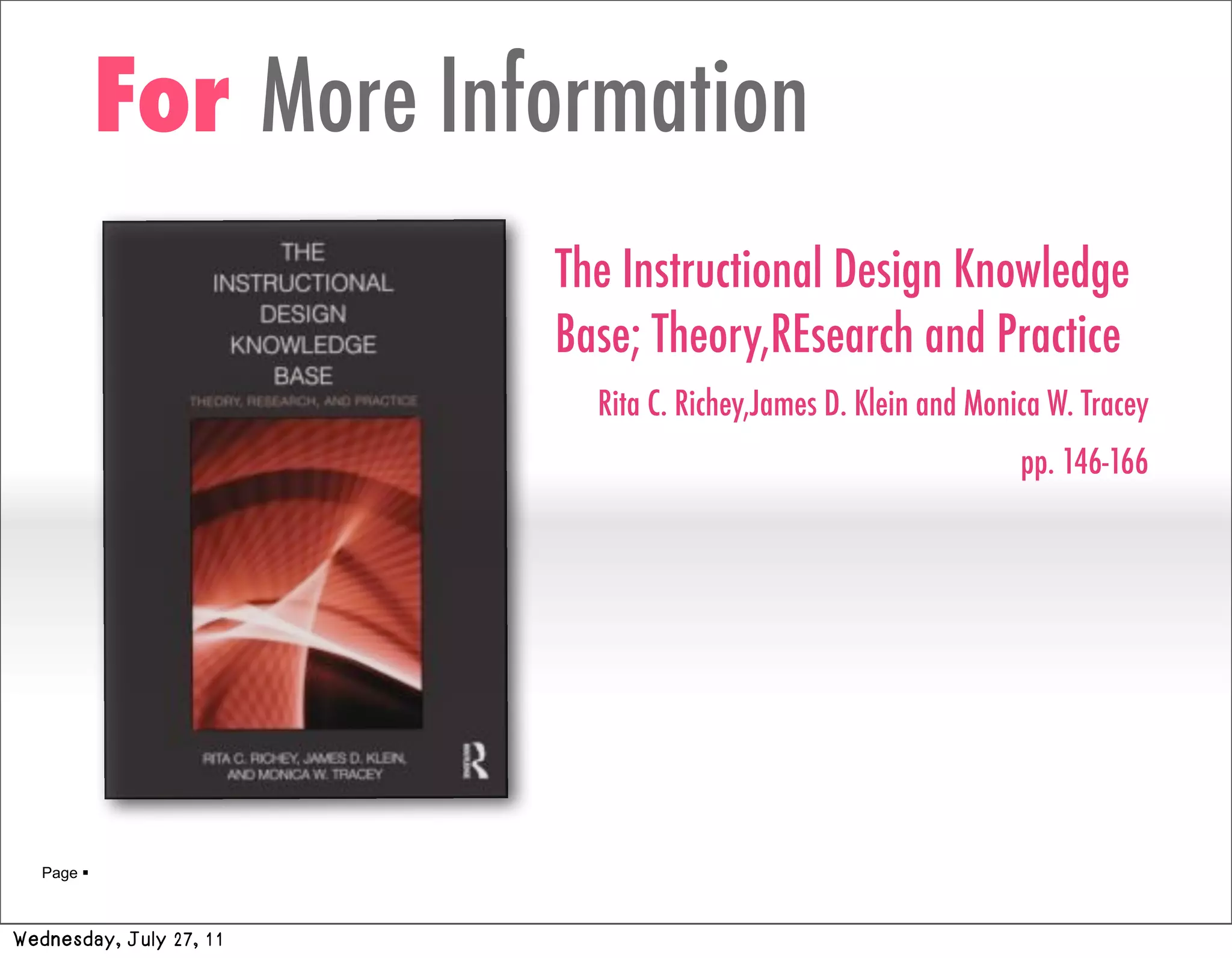
For More Information
                         The Instructional Design Knowledge
                         Base; Theory,REsearch and Practice
                           Rita C. Richey,James D. Klein and Monica W. Tracey
                                                                 pp. 146-166


   Page 


Wednesday, July 27, 11
Page 
                         AjSuE
Wednesday, July 27, 11

Performance improvement theory

  • 1.
    PERFORMANCE IMPROVEMENT THEORY The Instructional Design Knowledge Base; Theory,REsearch and Practice Rita C. Richey,James D. Klein and Monica W. Tracey aJsUe pReSeNtAtIoN Wednesday, July 27, 11
  • 2.
    Performance Improvement the ove ns, pr io to im nizat als lied orga vidu 5). e app of ndi rache, 199 PI is concerned with measurable n b ance and i r & B P I ca form ses, mmle performance and how to structure r pe proce s (Ru elements within a results-oriented system (Stolovitch & Keeps, 1999). aJsUe pReSeNtAtIoN aJsUe pReSeNtAtIoN Page  Wednesday, July 27, 11
  • 3.
    KEYPrinciples The main elements of generic PI models • performance analysis, • cause analysis, • intervention selection, • design and development, • implementation and change management, • evaluation. PI can be applied to PI is concerned with improve performance of measurable outcomes in organizations, processes, results-oriented systems. and individuals. aJsUe pReSeNtAtIoN Wednesday, July 27, 11
  • 4.
    Philosophical Emphases • Human performance follows specific laws that can often be predicted and controlled (i.e., empiricism). • PI theory reflects the belief that practical findings can be used as the basis for knowledge and meaning (i.e., pragmatism). • Organizational theory emphasizes the use of intrinsic motivation and growth of individual in an organization (i.e., humanism). aJsUe pReSeNtAtIoN aJsUe pReSeNtAtIoN Page  Wednesday, July 27, 11
  • 5.
    Theoretical Foundations • Behavioral learning theory, • Communications theory, • General systems theory, • Instructional systems design, and • Organizational development Wednesday, July 27, 11
  • 6.
    Early Contributors: • William Deterline, •Thomas Gilbert, Joe Harless, •Roger Kaufman, •Donald Kirkpatrick, •Robert Mager, and •Geary Rummler aJsUe pReSeNtAtIoN aJsUe pReSeNtAtIoN Page  Wednesday, July 27, 11
  • 7.
    Applications to ID: • Evaluation • Front-End Analysis • Intervention Design and Implementation • Strategies for Promoting Transfer aJsUe pReSeNtAtIoN aJsUe pReSeNtAtIoN Page  Wednesday, July 27, 11
  • 8.
    Research Support Studiesof :: •ElectronicPerformance Support Systems (e.g., Nguyen & Klein, 2008) •Implementation of Performance Interventions (e.g., Rossett & Tobias, 1999; Vadivelu & Klein, 2008) •Review of PI Research (e.g., Clark & Estes, 2002; Klein, 2002; Marker, et al., 2006; Conn & Gitonga, 2002) aJsUe pReSeNtAtIoN aJsUe pReSeNtAtIoN Page  Wednesday, July 27, 11
  • 9.
    Related Concepts: • Human Resource Management • Organizational Development • Performance Support Systems • Strategic Planning aJsUe pReSeNtAtIoN aJsUe pReSeNtAtIoN Page  Wednesday, July 27, 11
  • 10.
    Learners and LearningProcesses : • The three main individual factors that influence performance are • knowledge, • capacity, and • motives. aJsUe pReSeNtAtIoN aJsUe pReSeNtAtIoN Page  Wednesday, July 27, 11
  • 11.
    Learning and PerformanceContexts : Page  AjSuE Wednesday, July 27, 11
  • 12.
    Learning and PerformanceContexts : • Critical Contexts (orienting, transfer, and performance) Page  AjSuE Wednesday, July 27, 11
  • 13.
    Learning and PerformanceContexts : • Critical Contexts (orienting, transfer, and performance) • Relevant aspects of the performance context (on-the-job environments, organizational impact, and return on investment) Page  AjSuE Wednesday, July 27, 11
  • 14.
    Learning and PerformanceContexts : • Critical Contexts (orienting, transfer, and performance) • Contextual Characteristics (physical resources and materials, managerial and supervisor support, and socio-cultural) • Relevant aspects of the performance context (on-the-job environments, organizational impact, and return on investment) Page  AjSuE Wednesday, July 27, 11
  • 15.
    Instructional and Noinstructional Strategies Strategies AjSuE Page  Wednesday, July 27, 11
  • 16.
    Instructional and Noinstructional Strategies Imp rov ed Wo rk Env iro nm ent Strategies AjSuE Page  Wednesday, July 27, 11
  • 17.
    Instructional and Noinstructional Strategies Imp rov ed Incentives and Rewards Wo rk Env iro nm ent Strategies AjSuE Page  Wednesday, July 27, 11
  • 18.
    Instructional and Noinstructional Strategies Imp rov ed Incentives and Rewards Wo rk Env iro nm ent Strategies Job and Organizational Structure Redesign AjSuE Page  Wednesday, July 27, 11
  • 19.
    Instructional and Noinstructional Strategies Imp rov ed Incentives and Rewards Wo rk Env iro nm ent Performance Feedback Strategies Job and Organizational Structure Redesign AjSuE Page  Wednesday, July 27, 11
  • 20.
    Instructional and Noinstructional Strategies Imp rov ed Incentives and Rewards Wo rk Env iro nm ent Performance Feedback Performance Support Systems Strategies Job and Organizational Structure Redesign AjSuE Page  Wednesday, July 27, 11
  • 21.
    Instructional and Noinstructional Strategies Imp rov ed Incentives and Rewards Wo rk Env iro nm ent Performance Feedback Performance Support Systems Strategies cat ion o difi To ol M Job and Organizational Structure Redesign nd ur ce a Page  Reso AjSuE Wednesday, July 27, 11
  • 22.
    Instructional and Noinstructional Strategies Imp rov ed Incentives and Rewards Wo rk Env iro nm ent Performance Feedback Performance Support Systems Strategies Training cat ion o difi To ol M Job and Organizational Structure Redesign nd ur ce a Page  Reso AjSuE Wednesday, July 27, 11
  • 23.
    Designers and DesignProcesses AjSuE Page  Wednesday, July 27, 11
  • 24.
    Designers and DesignProcesses Designer Characteristics (expertise and competence) AjSuE Page  Wednesday, July 27, 11
  • 25.
    Designers and DesignProcesses Analysis (cause, cost, environment, gap, job, organization, problem, and performance ) Designer Characteristics (expertise and competence) AjSuE Page  Wednesday, July 27, 11
  • 26.
    Designers and DesignProcesses Analysis (cause, cost, environment, gap, job, organization, problem, and performance ) Change Management Designer Characteristics (expertise and competence) AjSuE Page  Wednesday, July 27, 11
  • 27.
    Designers and DesignProcesses Analysis (cause, cost, environment, gap, job, organization, problem, and performance ) Change Management Designer Characteristics (expertise and competence) Assessment and Evaluation (formative, summative, and confirmative) AjSuE Page  Wednesday, July 27, 11
  • 28.
    Designers and DesignProcesses Analysis (cause, cost, environment, gap, job, organization, problem, and performance ) Change Management Designer Characteristics (expertise and competence) Intervention Selection, Assessment and Evaluation (formative, summative, and Design, Development, confirmative) and Implementation AjSuE Page  Wednesday, July 27, 11
  • 29.
    MODELS OF PERFORMANCEIMPROVEMENT A Comprehensive Performance Improvement Model Page  AjSuE Wednesday, July 27, 11
  • 30.
    Performance Cause Intervention Implementation & Analysis Analysis Selection & Design Change Management Organizational Desired Analysis Performance Performance Support cHange Lack of Management Environmental Job & Work Design Support Process Consulting Personal Development Gap Human Resource Employee Analysis Development Development Lack of Repertory Organization Design & Communication Behavior Communication Networking Environmental Actual Financial Systems Analysis Performance Evaluation Formative Summative Confirmative Figure 9.1 A Comprehensive Model of Performance Improvement. From Fundamentals of Performance Technology: A Guide to Improving People, Process, and Performance (2 nd Edition) by D.M. Van Tiem, J.L. Moseley, & J.C. Dessinger, 2004, p.7. Copyright 2004 by the International Society for Performance Page  Improvement (http://www.ispi.org). Used with permission. AjSuE Wednesday, July 27, 11
  • 31.
    Instructional and Noinstructional Performance Interventions Intervention Description 360-Degree Feedback Employee development feedback obtained from subordinates, peers, and managers in the organization’s hierarchy Accelerated Learning Programs to enable faster retention of specific issues using multiple mediums of learning such as projects, classroom teaching, e-learning, and team-building activities Action Learning Process for group-based problem solving Classroom Training Formal instructor-led programs delivered to develop specific employee skills Coaching/Mentoring Assigning coaches/ mentors to employees for developing their skills Compensation Systems Providing bonuses, stocks, salary increases, and other rewards to motivate employees Page  AjSuE Wednesday, July 27, 11
  • 32.
    Instructional and Noinstructional Performance Interventions Intervention Description Competency Assessment Competencies evaluated through various assessments for employee selection, certification, and advancement Conflict Management System for handling of conflicts constructively Cultural Change Process for altering the way people think, Management behave, interact, and perform within an organization Diversity Programs Initiatives designed to foster creativity by leveraging the cultural differences among employees E-learning/Web-Based Programs enabling learning on the web Learning (videos, recorded classes, and Virtual resources) Electronic Performance Digital programs that provide just-in-time, on- demand Page  AjSuE Wednesday, July 27, 11
  • 33.
    Instructional and Noinstructional Performance Interventions Intervention Description Support Systems Information necessary for accomplishing tasks Employee Assistance Programs designed to address work-life balance, professional development, and other personal issues Employee Orientation Introducing and welcoming new employees to the organization and helping them become productive quickly Ergonomics Modifying the physical workplace to enable increased productivity Information Systems Storing and retrieving employee information such as rate of pay, attended classes, vacation hours, etc. Job Aids Method for providing essential information when performer is carrying out the task that reduces amount of recall and minimizes error Page  AjSuE Wednesday, July 27, 11
  • 34.
    Instructional and Noinstructional Performance Interventions Intervention Description Job Rotation Changing workflow in order to ensure employees are provided opportunities to develop new skills Leadership Development Programs and initiatives that enable development of larders focusing on the interpersonal linkages between individuals in a team Management Development Programs that enable development of managers within organizations Meetings/Dialogue Process for bringing people together to collectively share information, plan, make decisions and solve problems Motivation Systems Process for increasing employee performance by providing external rewards and feedback or by addressing intrinsic rewards by aligning projects with employee interests Page  AjSuE Wednesday, July 27, 11
  • 35.
    Instructional and Noinstructional Performance Interventions Intervention Description Organizational Using the company intranet and other Communication corporate communication tools to facilitate organizational change, receive feedback, etc. Physical Resource Providing physical resources and facilities that Management encourage employee performance Performance Appraisal Process for identifying, evaluating, and developing performance of employees Succession Planning Process for identifying, evaluating, and developing performance of employees Teambuilding Creating small group of people with complementary skills who are committed to a common goal, and hold themselves mutually accountable Virtual Communication Tools and processes that enable remote collaboration of employees in different parts of the globe Page  AjSuE Wednesday, July 27, 11
  • 36.
    For More Information The Instructional Design Knowledge Base; Theory,REsearch and Practice Rita C. Richey,James D. Klein and Monica W. Tracey pp. 146-166 Page  Wednesday, July 27, 11
  • 37.
    Page  AjSuE Wednesday, July 27, 11