1

Dynamic Capabilities and their Microfoundations:
Implications for Strategic Management
David J. Teece
Institute for Business Innovation
Haas School of Business
University of California, Berkeley
September 15, 2010

*Based on “Explicating Dynamic Capabilities: The Nature and Microfoundations of (Sustainable) Enterprise Performance”,
Strategic Management Journal, December 2007
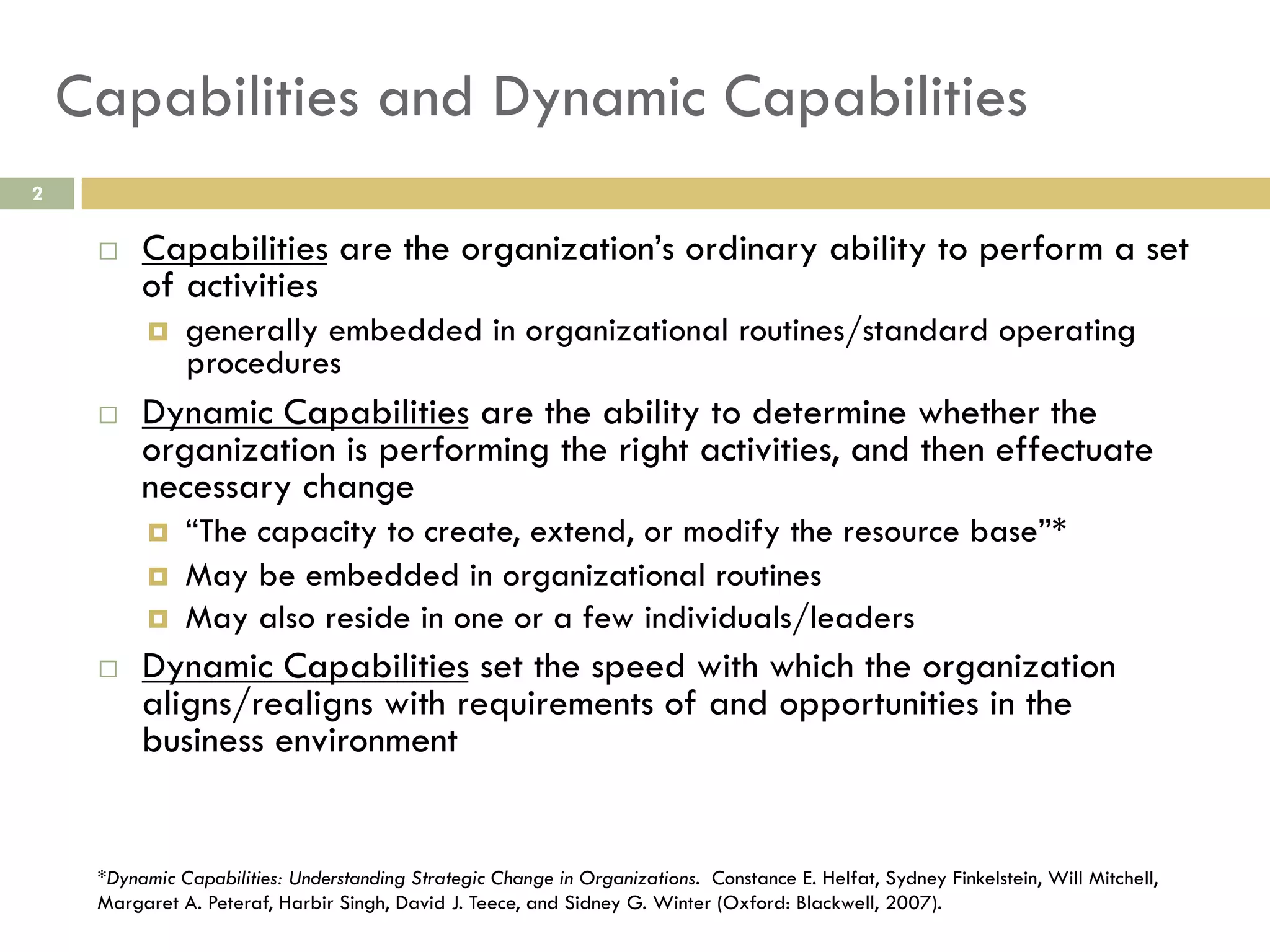
Capabilities and Dynamic Capabilities
2

 

Capabilities are the organization’s ordinary ability to perform a set
of activities
 

 

Dynamic Capabilities are the ability to determine whether the
organization is performing the right activities, and then effectuate
necessary change
 
 
 

 

generally embedded in organizational routines/standard operating
procedures

“The capacity to create, extend, or modify the resource base”*
May be embedded in organizational routines
May also reside in one or a few individuals/leaders

Dynamic Capabilities set the speed with which the organization
aligns/realigns with requirements of and opportunities in the
business environment

*Dynamic Capabilities: Understanding Strategic Change in Organizations. Constance E. Helfat, Sydney Finkelstein, Will Mitchell,
Margaret A. Peteraf, Harbir Singh, David J. Teece, and Sidney G. Winter (Oxford: Blackwell, 2007).
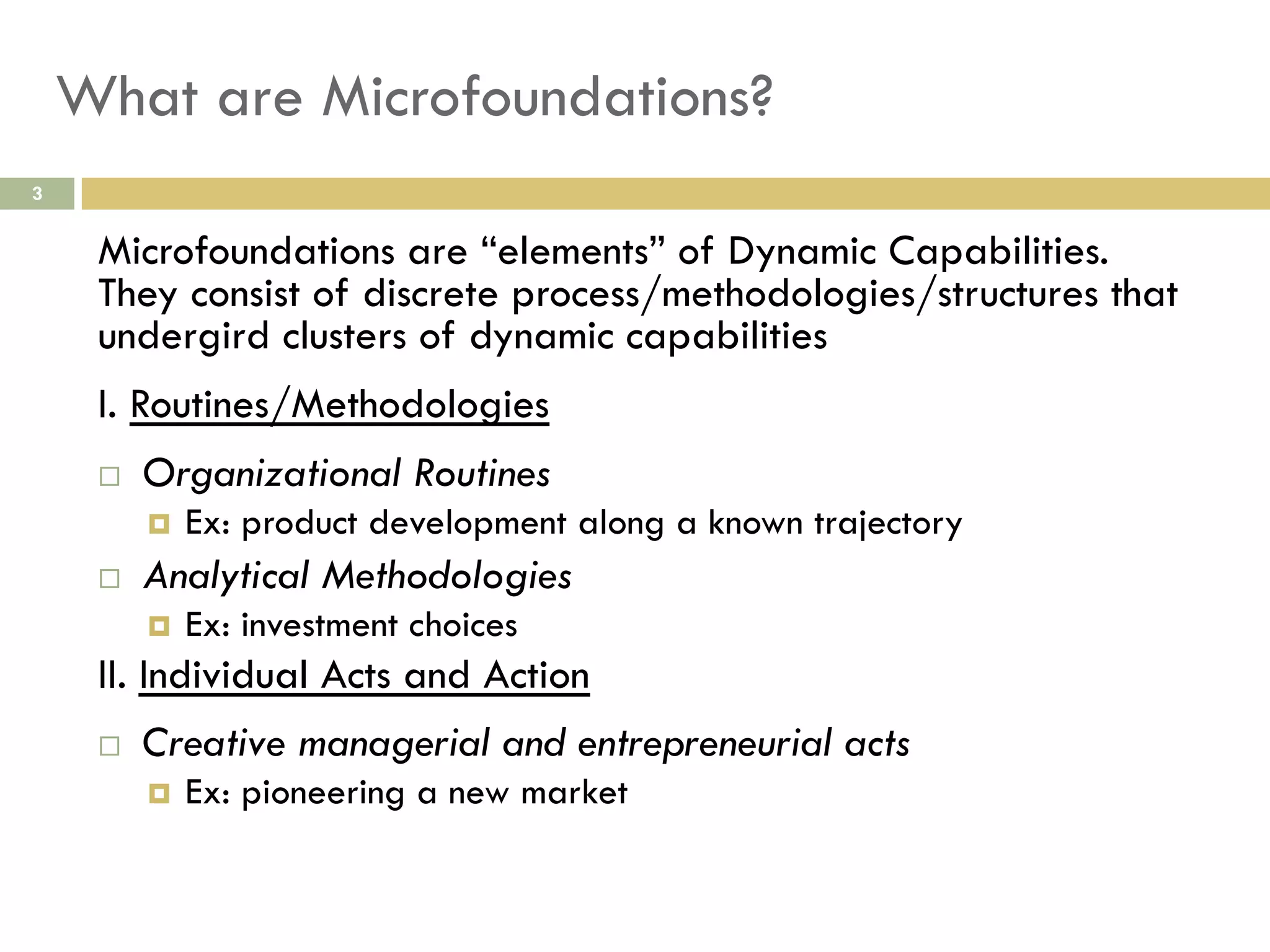
What are Microfoundations?
3

Microfoundations are “elements” of Dynamic Capabilities.
They consist of discrete process/methodologies/structures that
undergird clusters of dynamic capabilities
I. Routines/Methodologies
 

Organizational Routines
 

 

Ex: product development along a known trajectory

Analytical Methodologies
 

Ex: investment choices

II. Individual Acts and Action
 

Creative managerial and entrepreneurial acts
 

Ex: pioneering a new market
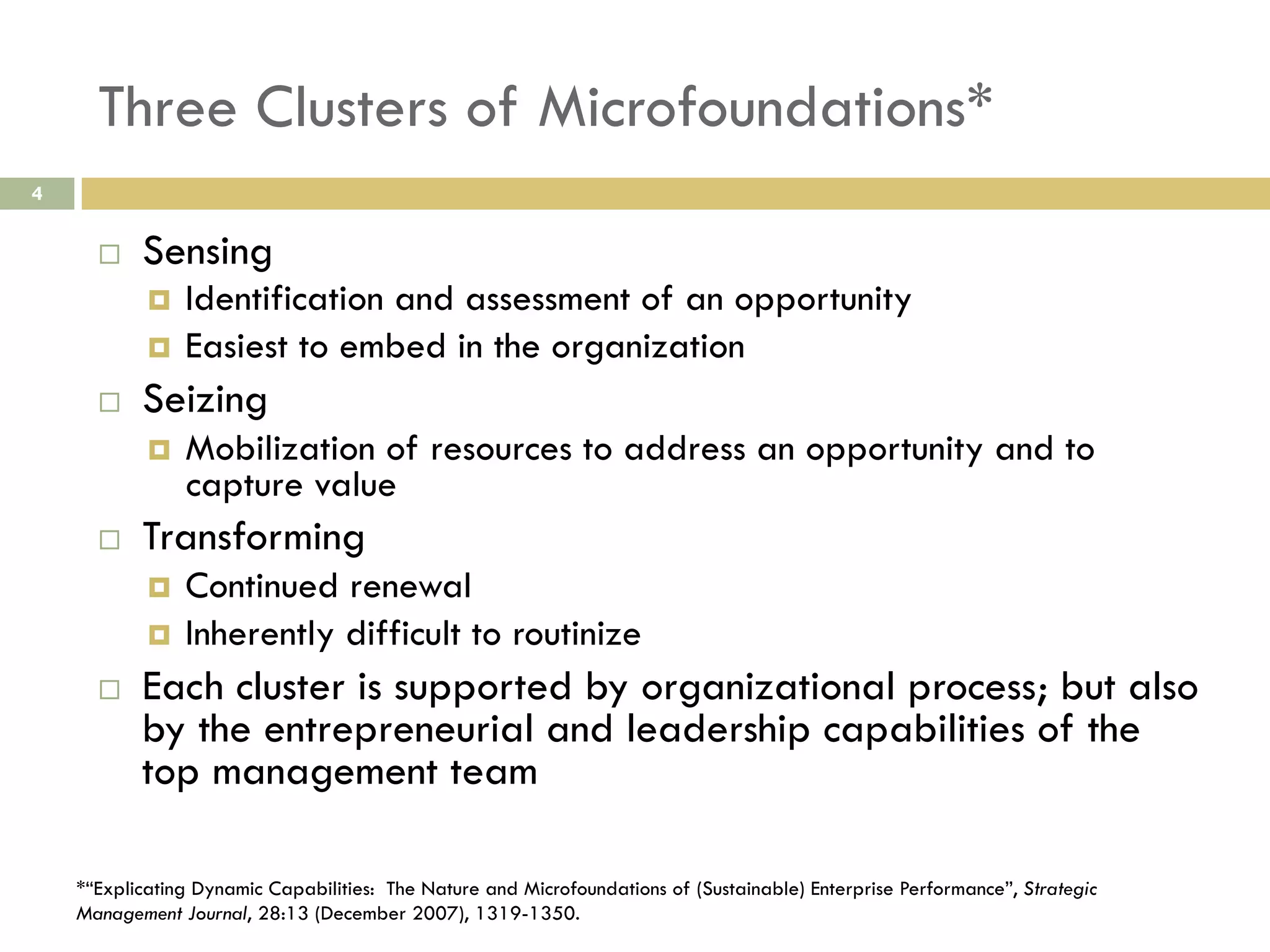
Three Clusters of Microfoundations*
4

 

Sensing
Identification and assessment of an opportunity
  Easiest to embed in the organization
 

 

Seizing
 

 

Mobilization of resources to address an opportunity and to
capture value

Transforming
Continued renewal
  Inherently difficult to routinize
 

 

Each cluster is supported by organizational process; but also
by the entrepreneurial and leadership capabilities of the
top management team

*“Explicating Dynamic Capabilities: The Nature and Microfoundations of (Sustainable) Enterprise Performance”, Strategic
Management Journal, 28:13 (December 2007), 1319-1350.
Example of (Embedded) Microfoundations
for Sensing and Seizing
5

 

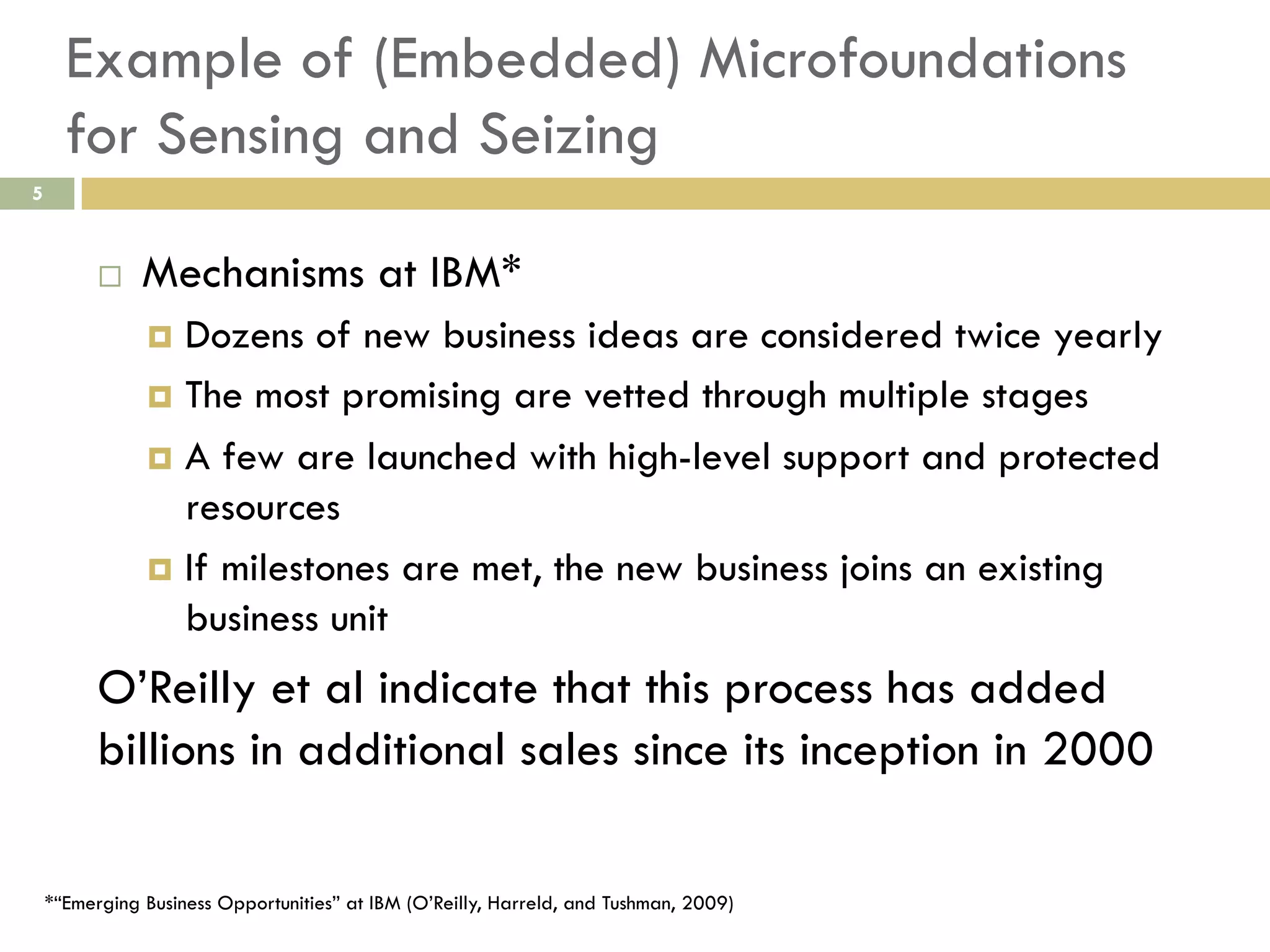
Mechanisms at IBM*
  Dozens

of new business ideas are considered twice yearly
  The most promising are vetted through multiple stages
  A few are launched with high-level support and protected
resources
  If milestones are met, the new business joins an existing
business unit

O’Reilly et al indicate that this process has added
billions in additional sales since its inception in 2000
*“Emerging Business Opportunities” at IBM (O’Reilly, Harreld, and Tushman, 2009)
Individual (Non-Routine) Action is also
Important
6

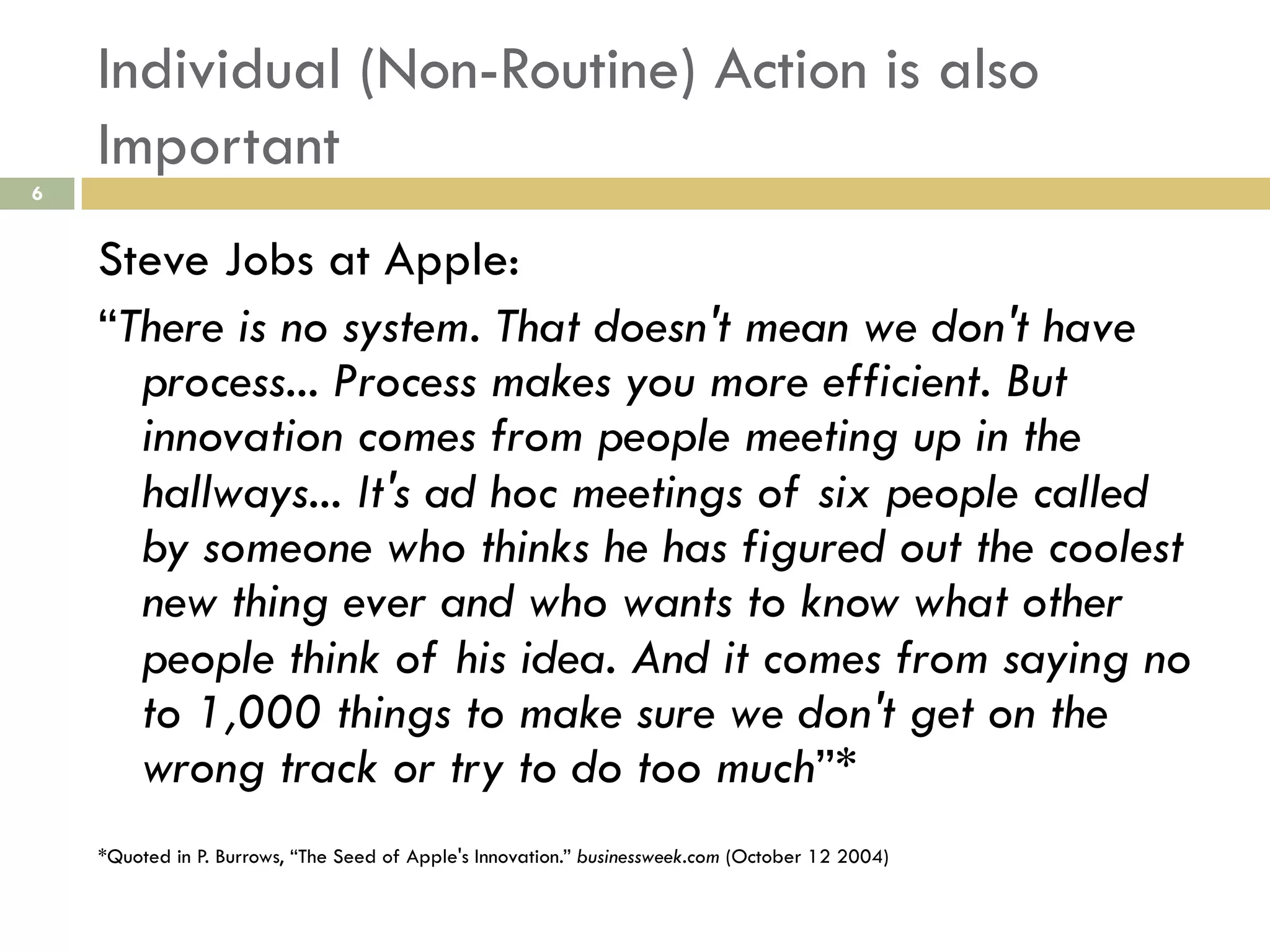
Steve Jobs at Apple:
“There is no system. That doesn't mean we don't have
process... Process makes you more efficient. But
innovation comes from people meeting up in the
hallways... It's ad hoc meetings of six people called
by someone who thinks he has figured out the coolest
new thing ever and who wants to know what other
people think of his idea. And it comes from saying no
to 1,000 things to make sure we don't get on the
wrong track or try to do too much”*
*Quoted in P. Burrows, “The Seed of Apple's Innovation.” businessweek.com (October 12 2004)
Interrelationships Amongst Microfoundations
7

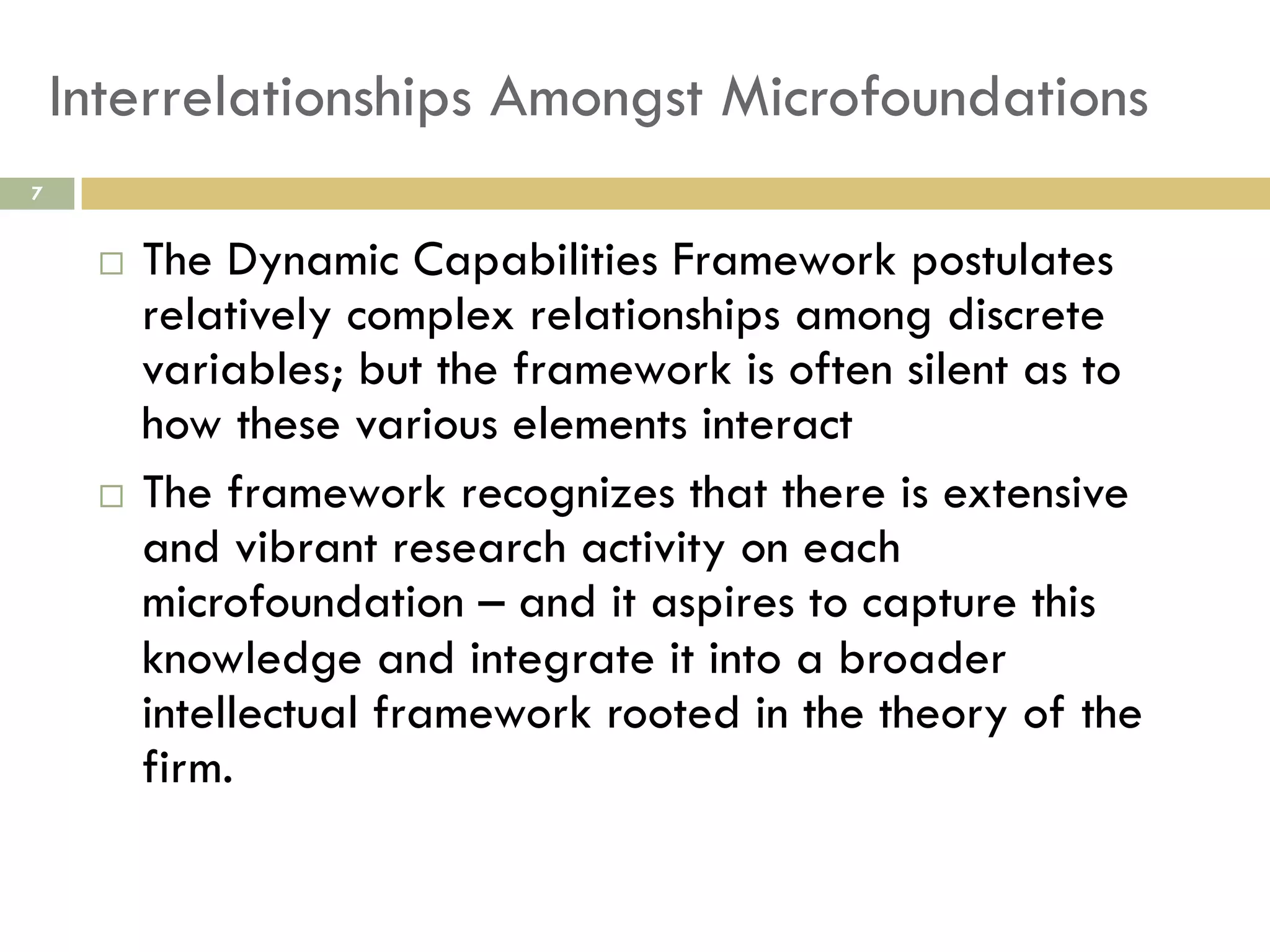
The Dynamic Capabilities Framework postulates
relatively complex relationships among discrete
variables; but the framework is often silent as to
how these various elements interact
  The framework recognizes that there is extensive
and vibrant research activity on each
microfoundation – and it aspires to capture this
knowledge and integrate it into a broader
intellectual framework rooted in the theory of the
firm.
 
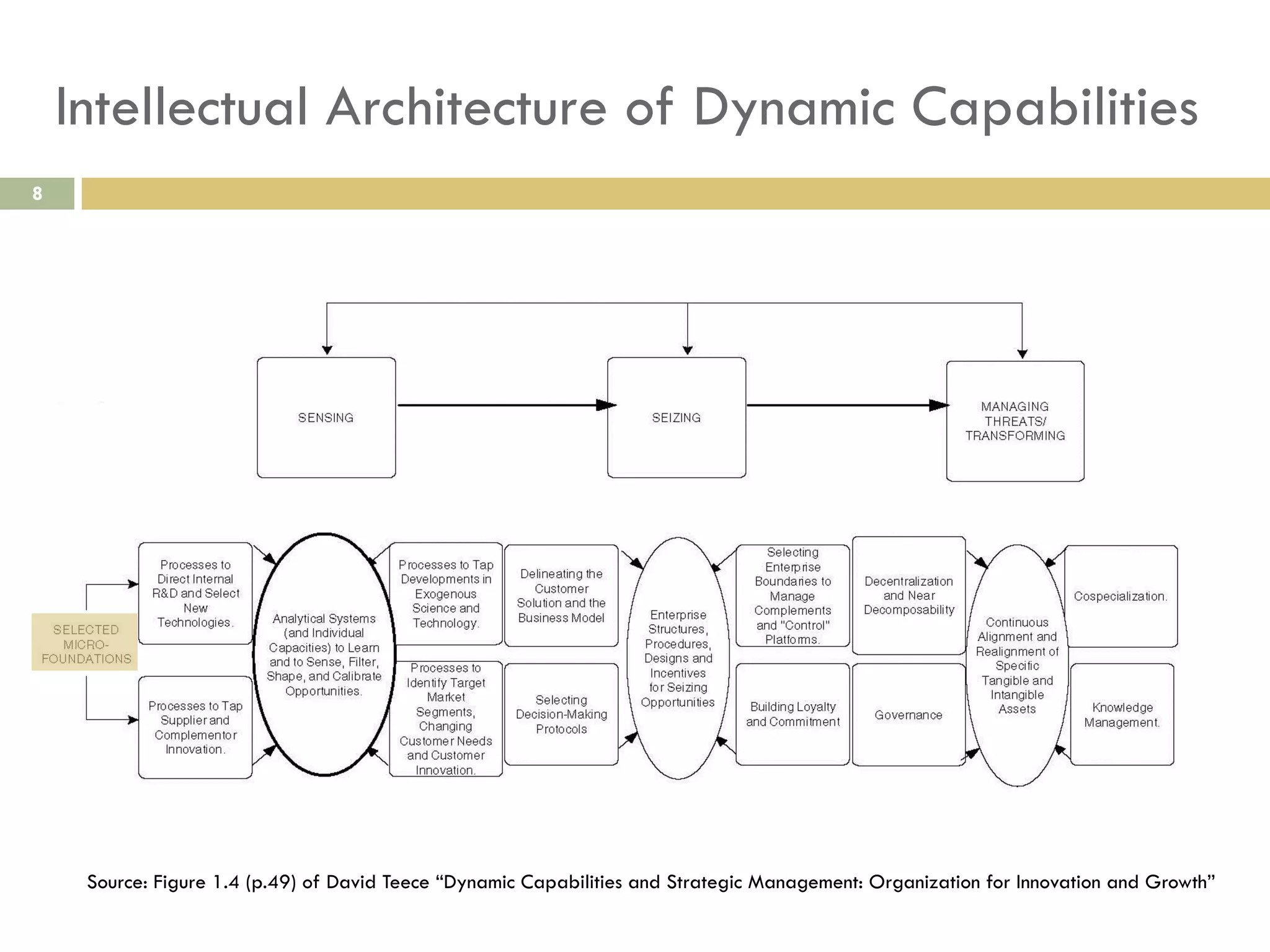
Intellectual Architecture of Dynamic Capabilities
8

Source: Figure 1.4 (p.49) of David Teece “Dynamic Capabilities and Strategic Management: Organization for Innovation and Growth”
Conclusions
9

 

Microfoundations involve both routine and nonroutine activity. Research questions include:
  The

appropriate balance between routines and the
non-routine action of top management.
  Under what circumstances (if any) can change be
routinized?
 

Empirical research can use both large data sets
(e.g. Adner and Helfat, 2003) and in-depth case
studies.

Teece dynamic capabilities-routines-versus_entrepreneurial_action_ppt

  • 1.
    1 Dynamic Capabilities andtheir Microfoundations: Implications for Strategic Management David J. Teece Institute for Business Innovation Haas School of Business University of California, Berkeley September 15, 2010 *Based on “Explicating Dynamic Capabilities: The Nature and Microfoundations of (Sustainable) Enterprise Performance”, Strategic Management Journal, December 2007
  • 2.
    Capabilities and DynamicCapabilities 2   Capabilities are the organization’s ordinary ability to perform a set of activities     Dynamic Capabilities are the ability to determine whether the organization is performing the right activities, and then effectuate necessary change         generally embedded in organizational routines/standard operating procedures “The capacity to create, extend, or modify the resource base”* May be embedded in organizational routines May also reside in one or a few individuals/leaders Dynamic Capabilities set the speed with which the organization aligns/realigns with requirements of and opportunities in the business environment *Dynamic Capabilities: Understanding Strategic Change in Organizations. Constance E. Helfat, Sydney Finkelstein, Will Mitchell, Margaret A. Peteraf, Harbir Singh, David J. Teece, and Sidney G. Winter (Oxford: Blackwell, 2007).
  • 3.
    What are Microfoundations? 3 Microfoundationsare “elements” of Dynamic Capabilities. They consist of discrete process/methodologies/structures that undergird clusters of dynamic capabilities I. Routines/Methodologies   Organizational Routines     Ex: product development along a known trajectory Analytical Methodologies   Ex: investment choices II. Individual Acts and Action   Creative managerial and entrepreneurial acts   Ex: pioneering a new market
  • 4.
    Three Clusters ofMicrofoundations* 4   Sensing Identification and assessment of an opportunity   Easiest to embed in the organization     Seizing     Mobilization of resources to address an opportunity and to capture value Transforming Continued renewal   Inherently difficult to routinize     Each cluster is supported by organizational process; but also by the entrepreneurial and leadership capabilities of the top management team *“Explicating Dynamic Capabilities: The Nature and Microfoundations of (Sustainable) Enterprise Performance”, Strategic Management Journal, 28:13 (December 2007), 1319-1350.
  • 5.
    Example of (Embedded)Microfoundations for Sensing and Seizing 5   Mechanisms at IBM*   Dozens of new business ideas are considered twice yearly   The most promising are vetted through multiple stages   A few are launched with high-level support and protected resources   If milestones are met, the new business joins an existing business unit O’Reilly et al indicate that this process has added billions in additional sales since its inception in 2000 *“Emerging Business Opportunities” at IBM (O’Reilly, Harreld, and Tushman, 2009)
  • 6.
    Individual (Non-Routine) Actionis also Important 6 Steve Jobs at Apple: “There is no system. That doesn't mean we don't have process... Process makes you more efficient. But innovation comes from people meeting up in the hallways... It's ad hoc meetings of six people called by someone who thinks he has figured out the coolest new thing ever and who wants to know what other people think of his idea. And it comes from saying no to 1,000 things to make sure we don't get on the wrong track or try to do too much”* *Quoted in P. Burrows, “The Seed of Apple's Innovation.” businessweek.com (October 12 2004)
  • 7.
    Interrelationships Amongst Microfoundations 7 TheDynamic Capabilities Framework postulates relatively complex relationships among discrete variables; but the framework is often silent as to how these various elements interact   The framework recognizes that there is extensive and vibrant research activity on each microfoundation – and it aspires to capture this knowledge and integrate it into a broader intellectual framework rooted in the theory of the firm.  
  • 8.
    Intellectual Architecture ofDynamic Capabilities 8 Source: Figure 1.4 (p.49) of David Teece “Dynamic Capabilities and Strategic Management: Organization for Innovation and Growth”
  • 9.
    Conclusions 9   Microfoundations involve bothroutine and nonroutine activity. Research questions include:   The appropriate balance between routines and the non-routine action of top management.   Under what circumstances (if any) can change be routinized?   Empirical research can use both large data sets (e.g. Adner and Helfat, 2003) and in-depth case studies.