© 2010 Dorling Kindersley India Pvt. Ltd.
All rights reserved.
PowerPoint Presentation by Rajeesh Viswanathan
Jansons school of Business
Organization Theory
Structure, Design, and Applications
Third Revised Edition
Stephen P. Robbins and Mary Mathew
C H A P T E R
4
PART I INTRODUCTION: WHAT’S IT ALL ABOUT?
Dimensions of Organization
Structure
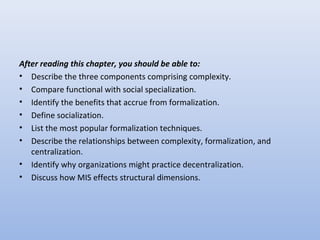
After reading this chapter, you should be able to:
• Describe the three components comprising complexity.
• Compare functional with social specialization.
• Identify the benefits that accrue from formalization.
• Define socialization.
• List the most popular formalization techniques.
• Describe the relationships between complexity, formalization, and
centralization.
• Identify why organizations might practice decentralization.
• Discuss how MIS effects structural dimensions.
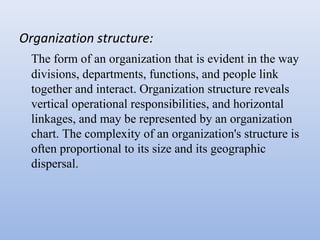
Organization structure:
The form of an organization that is evident in the way
divisions, departments, functions, and people link
together and interact. Organization structure reveals
vertical operational responsibilities, and horizontal
linkages, and may be represented by an organization
chart. The complexity of an organization's structure is
often proportional to its size and its geographic
dispersal.
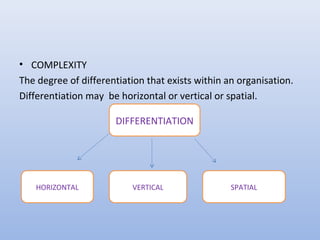
• COMPLEXITY
The degree of differentiation that exists within an organisation.
Differentiation may be horizontal or vertical or spatial.
DIFFERENTIATION
HORIZONTAL VERTICAL SPATIAL
HORIZONTAL DIFFERENTIATION
The degree of differentiation based on the
orientation of members , nature of tasks they
perform and education and training.
The most visible evidence of horizontal
differentiation is specialization and
departmentation.
VERTICAL DIFFERENTIATION
Refers to the depth in the structure.
As differentiation increases and hence the
complexity , as the number of hierarchical
levels in the organization increases.
The determining factor is the span of control,
that is the number of subordinates that a
manager can direct effectively.
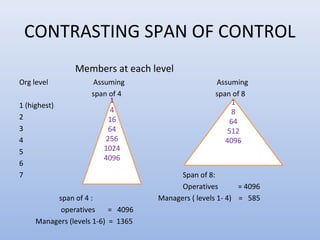
CONTRASTING SPAN OF CONTROL
Members at each level
Org level Assuming Assuming
span of 4 span of 8
1 (highest)
2
3
4
5
6
7 Span of 8:
Operatives = 4096
span of 4 : Managers ( levels 1- 4) = 585
operatives = 4096
Managers (levels 1-6) = 1365
1
4
16
64
256
1024
4096
1
8
64
512
4096
SPATIAL DIFFERENTIATION
An organization can perform the same activities
with the same degree of horizontal
differentiation and hierarchical arrangement in
multiple locations.
It refers to the degree to which the location of
an organization’s offices, plants and personnel
are dispersed geographically.
WHY IS COMPLEXITY IMPORTANT
The more complex an organization , the greater
the need for effective communication,
coordination and control devices.
As complexity increases so do the demands on
management to ensure that differentiated and
dispersed activities are working smoothly and
together towards achieving the org goals.
FORMALIZATION
Formalization refers to the degree to which jobs within the
organization are standardized. If a job is highly formalized, the job
incumbent has a minimum amount of discretion over what is to be
done, when it is to be done, and how he or she should do it
Degree of formalization varies widely within and
among organizations.
Organization use formalization because of the benefits that accrue
from regulating employees behavior.
Standardization behavior reduces variability.
SOCIALIZATION
The adaptation process by which individuals
learn the values, norms and expected
behavior patterns for the job and the
organization of which they will be a part.
Formalization Techniques
Selection: An effective selection process will be designed to determine if job
candidates “fit” into the organization.41
A “good” employee is defined as one who
will perform his or her job in a satisfactory manner and also whose personality,
work habits, and attitudes align with what the organization desires.
Role Requirements. Individuals in organizations fulfill roles. Every job carries with it
expectations on how the role incumbent is supposed to behave
Rules, Procedures and Policies. Rules are explicit statements that tell an employee
what he or she ought or ought not to do.
Procedures are established to ensure standardization of work processes. The same
input is processed in the same way, and the output is the same each day
Policies provide greater leeway than rules do. Rather than specifying a particular and
specifi c behavior, policies allow em ployees to use discretion but within limited
boundaries
T
• Training. Many organizations provide training to employees. This includes
the on-the-job variety where understudy assignments, coaching, and
apprenticeship methods are used to teach employees preferred job skills,
knowledge, and attitudes. It also includes off -the-job training such as
classroom lectures, films, demonstrations, simulation exercises, and
programmed instruction
• Rituals. Rituals are used as a formalization technique with members who
will have a strong and enduring impact on the organization.
CENTRALIZATION
Centralization refers to the degree to which
decision making is concentrated at a single point
in the organization.
Low concentration indicates low centralization
or it may be called decentralization.
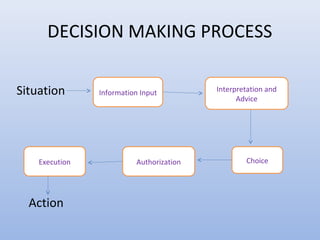
DECISION MAKING
Decision making is presented traditionally as the
making of choices. After developing and
evaluating at least two alternatives, the decision
maker chooses a preferred alternative.
DECISION MAKING PROCESS
Situation
Action
Information Input Interpretation and
Advice
ChoiceAuthorizationExecution
Reasons for Decentralization
Organizations need to respond rapidly to changing conditions
at the point at which the change is taking place.
Decentralization facilitates speedy action because it avoids
the need to process the information through the vertical
hierarchy
Decentralizing decision making can provide motivation to
employees by allowing them to participate in the decision-
making process.
A final plus for decentralization is the training opportunity
that it creates for low-level managers.

Ot chapter 4

  • 1.
    © 2010 DorlingKindersley India Pvt. Ltd. All rights reserved. PowerPoint Presentation by Rajeesh Viswanathan Jansons school of Business Organization Theory Structure, Design, and Applications Third Revised Edition Stephen P. Robbins and Mary Mathew C H A P T E R 4 PART I INTRODUCTION: WHAT’S IT ALL ABOUT? Dimensions of Organization Structure
  • 2.
    After reading thischapter, you should be able to: • Describe the three components comprising complexity. • Compare functional with social specialization. • Identify the benefits that accrue from formalization. • Define socialization. • List the most popular formalization techniques. • Describe the relationships between complexity, formalization, and centralization. • Identify why organizations might practice decentralization. • Discuss how MIS effects structural dimensions.
  • 3.
    Organization structure: The formof an organization that is evident in the way divisions, departments, functions, and people link together and interact. Organization structure reveals vertical operational responsibilities, and horizontal linkages, and may be represented by an organization chart. The complexity of an organization's structure is often proportional to its size and its geographic dispersal.
  • 4.
    • COMPLEXITY The degreeof differentiation that exists within an organisation. Differentiation may be horizontal or vertical or spatial. DIFFERENTIATION HORIZONTAL VERTICAL SPATIAL
  • 5.
    HORIZONTAL DIFFERENTIATION The degreeof differentiation based on the orientation of members , nature of tasks they perform and education and training. The most visible evidence of horizontal differentiation is specialization and departmentation.
  • 6.
    VERTICAL DIFFERENTIATION Refers tothe depth in the structure. As differentiation increases and hence the complexity , as the number of hierarchical levels in the organization increases. The determining factor is the span of control, that is the number of subordinates that a manager can direct effectively.
  • 7.
    CONTRASTING SPAN OFCONTROL Members at each level Org level Assuming Assuming span of 4 span of 8 1 (highest) 2 3 4 5 6 7 Span of 8: Operatives = 4096 span of 4 : Managers ( levels 1- 4) = 585 operatives = 4096 Managers (levels 1-6) = 1365 1 4 16 64 256 1024 4096 1 8 64 512 4096
  • 8.
    SPATIAL DIFFERENTIATION An organizationcan perform the same activities with the same degree of horizontal differentiation and hierarchical arrangement in multiple locations. It refers to the degree to which the location of an organization’s offices, plants and personnel are dispersed geographically.
  • 9.
    WHY IS COMPLEXITYIMPORTANT The more complex an organization , the greater the need for effective communication, coordination and control devices. As complexity increases so do the demands on management to ensure that differentiated and dispersed activities are working smoothly and together towards achieving the org goals.
  • 10.
    FORMALIZATION Formalization refers tothe degree to which jobs within the organization are standardized. If a job is highly formalized, the job incumbent has a minimum amount of discretion over what is to be done, when it is to be done, and how he or she should do it Degree of formalization varies widely within and among organizations. Organization use formalization because of the benefits that accrue from regulating employees behavior. Standardization behavior reduces variability.
  • 11.
    SOCIALIZATION The adaptation processby which individuals learn the values, norms and expected behavior patterns for the job and the organization of which they will be a part.
  • 12.
    Formalization Techniques Selection: Aneffective selection process will be designed to determine if job candidates “fit” into the organization.41 A “good” employee is defined as one who will perform his or her job in a satisfactory manner and also whose personality, work habits, and attitudes align with what the organization desires. Role Requirements. Individuals in organizations fulfill roles. Every job carries with it expectations on how the role incumbent is supposed to behave Rules, Procedures and Policies. Rules are explicit statements that tell an employee what he or she ought or ought not to do. Procedures are established to ensure standardization of work processes. The same input is processed in the same way, and the output is the same each day Policies provide greater leeway than rules do. Rather than specifying a particular and specifi c behavior, policies allow em ployees to use discretion but within limited boundaries T
  • 13.
    • Training. Manyorganizations provide training to employees. This includes the on-the-job variety where understudy assignments, coaching, and apprenticeship methods are used to teach employees preferred job skills, knowledge, and attitudes. It also includes off -the-job training such as classroom lectures, films, demonstrations, simulation exercises, and programmed instruction • Rituals. Rituals are used as a formalization technique with members who will have a strong and enduring impact on the organization.
  • 14.
    CENTRALIZATION Centralization refers tothe degree to which decision making is concentrated at a single point in the organization. Low concentration indicates low centralization or it may be called decentralization.
  • 15.
    DECISION MAKING Decision makingis presented traditionally as the making of choices. After developing and evaluating at least two alternatives, the decision maker chooses a preferred alternative.
  • 16.
    DECISION MAKING PROCESS Situation Action InformationInput Interpretation and Advice ChoiceAuthorizationExecution
  • 17.
    Reasons for Decentralization Organizationsneed to respond rapidly to changing conditions at the point at which the change is taking place. Decentralization facilitates speedy action because it avoids the need to process the information through the vertical hierarchy Decentralizing decision making can provide motivation to employees by allowing them to participate in the decision- making process. A final plus for decentralization is the training opportunity that it creates for low-level managers.