
Improving Human and Organizational Performance
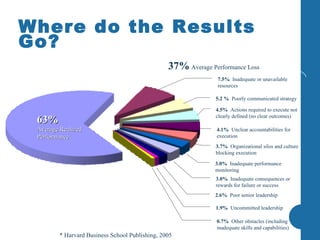
Most company strategies deliver only 63% of their promised financial value.  Why?  * Harvard Business School Publishing, 2005
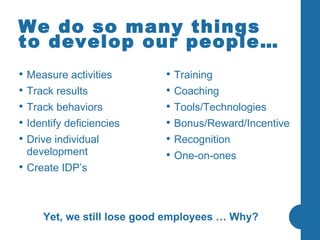
We do so many things to develop our people… Measure activities Track results Track behaviors Identify deficiencies Drive individual development Create IDP’s Training Coaching Tools/Technologies Bonus/Reward/Incentive Recognition One-on-ones Yet, we still lose good employees … Why?
Where do the Results Go? * Harvard Business School Publishing, 2005 7.5%   Inadequate or unavailable resources 5.2 %   Poorly communicated strategy 4.5%   Actions required to execute not clearly defined (no clear outcomes) 4.1%   Unclear accountabilities for execution 3.7%   Organizational silos and culture blocking execution 3.0%   Inadequate performance monitoring 3.0%  Inadequate consequences or rewards for failure or success 2.6%  Poor senior leadership 1.9%   Uncommitted leadership 0.7%   Other obstacles (including inadequate skills and capabilities) 63%   Average Realized Performance 37%   Average Performance Loss
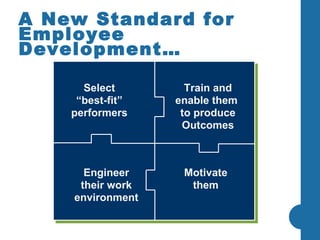
A New Standard for Employee Development…  Select “ best-fit” performers Train and enable them  to produce Outcomes Engineer their work environment Motivate them
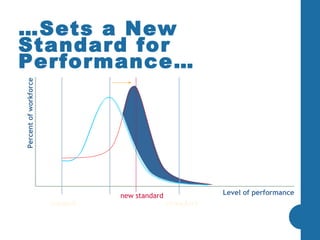
minimal exemplary Level of performance new standard … Sets a New Standard for Performance… standard minimal exemplary Percent of workforce Percent of workforce
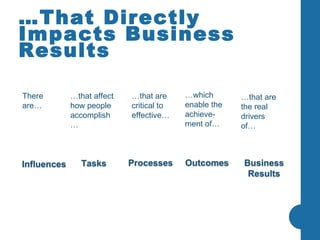
…That Directly Impacts Business Results There are… … that affect how people accomplish… … that are critical to effective… … which enable the achieve-ment of… … that are the real drivers of… Influences Tasks   Processes   Outcomes   Business Results
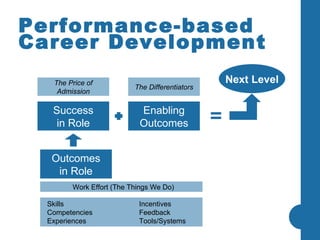
Performance-based Career Development Outcomes in Role Skills Incentives Competencies Feedback Experiences Tools/Systems Enabling Outcomes Work Effort (The Things We Do) Success in Role The Price of Admission The Differentiators Next Level
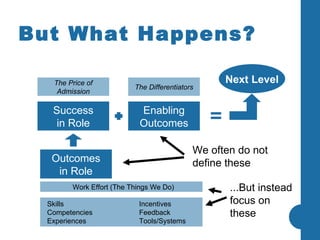
But What Happens? Outcomes in Role Skills Incentives Competencies Feedback Experiences Tools/Systems Enabling Outcomes Work Effort (The Things We Do) Success in Role The Price of Admission The Differentiators Next Level ...But instead focus on these We often do not define these
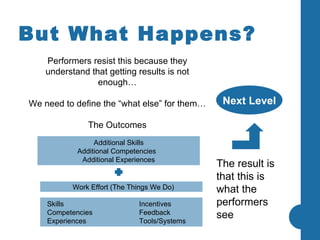
But What Happens? Performers resist this because they understand that getting results is not enough… We need to define the “what else” for them… The Outcomes Skills Incentives Competencies Feedback Experiences Tools/Systems Work Effort (The Things We Do) Next Level The result is that this is what the performers see Additional Skills Additional Competencies  Additional Experiences
Back Up
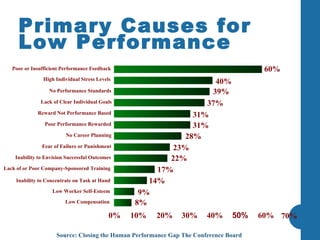
Primary Causes for Low Performance 0% 10% 20% 30% 40% 50% 60% 70% 17% 22% 23% 28% 37% 60% High Individual Stress Levels Fear of Failure or Punishment Inability to Envision Successful Outcomes Lack of or Poor Company-Sponsored Training Inability to Concentrate on Task at Hand Low Worker Self-Esteem Low Compensation Poor or Insufficient Performance Feedback 40% 39% Lack of Clear   Individual   Goals No Performance Standards Reward Not Performance Based 31% Poor Performance Rewarded 31% No Career Planning 14% 9% 8% Source: Closing the Human Performance Gap The Conference Board
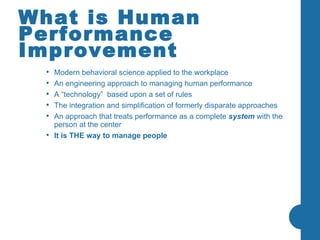
What is Human Performance Improvement Modern behavioral science applied to the workplace An engineering approach to managing human performance A “technology”  based upon a set of rules The integration and simplification of formerly disparate approaches An approach that treats performance as a complete  system  with the person at the center It is THE way to manage people
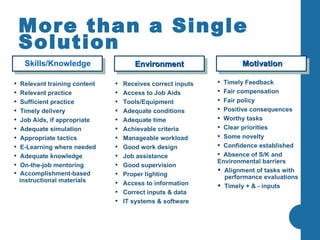
More than a Single Solution Timely Feedback Fair compensation Fair policy Positive consequences Worthy tasks Clear priorities Some novelty Confidence established Absence of S/K and Environmental barriers Alignment of tasks with   performance evaluations Timely + & - inputs Relevant training content Relevant practice Sufficient practice Timely delivery Job Aids, if appropriate Adequate simulation Appropriate tactics E-Learning where needed Adequate knowledge  On-the-job mentoring Accomplishment-based instructional materials Receives correct inputs Access to Job Aids Tools/Equipment Adequate conditions Adequate time Achievable criteria Manageable workload Good work design Job assistance Good supervision Proper lighting  Access to information Correct inputs & data IT systems & software Skills/Knowledge Motivation Environment
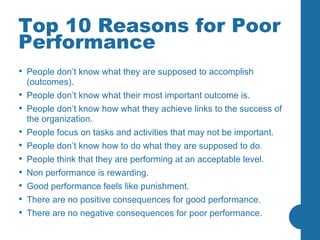
Top 10 Reasons for Poor Performance People don’t know what they are supposed to accomplish (outcomes).  People don’t know what their most important outcome is. People don’t know how what they achieve links to the success of the organization.  People focus on tasks and activities that may not be important.  People don’t know how to do what they are supposed to do.  People think that they are performing at an acceptable level.  Non performance is rewarding.  Good performance feels like punishment.  There are no positive consequences for good performance.  There are no negative consequences for poor performance.

Performance improvement and career development

  • 1.
    Improving Human andOrganizational Performance
  • 2.
    Most company strategiesdeliver only 63% of their promised financial value. Why? * Harvard Business School Publishing, 2005
  • 3.
    We do somany things to develop our people… Measure activities Track results Track behaviors Identify deficiencies Drive individual development Create IDP’s Training Coaching Tools/Technologies Bonus/Reward/Incentive Recognition One-on-ones Yet, we still lose good employees … Why?
  • 4.
    Where do theResults Go? * Harvard Business School Publishing, 2005 7.5% Inadequate or unavailable resources 5.2 % Poorly communicated strategy 4.5% Actions required to execute not clearly defined (no clear outcomes) 4.1% Unclear accountabilities for execution 3.7% Organizational silos and culture blocking execution 3.0% Inadequate performance monitoring 3.0% Inadequate consequences or rewards for failure or success 2.6% Poor senior leadership 1.9% Uncommitted leadership 0.7% Other obstacles (including inadequate skills and capabilities) 63% Average Realized Performance 37% Average Performance Loss
  • 5.
    A New Standardfor Employee Development… Select “ best-fit” performers Train and enable them to produce Outcomes Engineer their work environment Motivate them
  • 6.
    minimal exemplary Levelof performance new standard … Sets a New Standard for Performance… standard minimal exemplary Percent of workforce Percent of workforce
  • 7.
    …That Directly ImpactsBusiness Results There are… … that affect how people accomplish… … that are critical to effective… … which enable the achieve-ment of… … that are the real drivers of… Influences Tasks Processes Outcomes Business Results
  • 8.
    Performance-based Career DevelopmentOutcomes in Role Skills Incentives Competencies Feedback Experiences Tools/Systems Enabling Outcomes Work Effort (The Things We Do) Success in Role The Price of Admission The Differentiators Next Level
  • 9.
    But What Happens?Outcomes in Role Skills Incentives Competencies Feedback Experiences Tools/Systems Enabling Outcomes Work Effort (The Things We Do) Success in Role The Price of Admission The Differentiators Next Level ...But instead focus on these We often do not define these
  • 10.
    But What Happens?Performers resist this because they understand that getting results is not enough… We need to define the “what else” for them… The Outcomes Skills Incentives Competencies Feedback Experiences Tools/Systems Work Effort (The Things We Do) Next Level The result is that this is what the performers see Additional Skills Additional Competencies Additional Experiences
  • 11.
  • 12.
    Primary Causes forLow Performance 0% 10% 20% 30% 40% 50% 60% 70% 17% 22% 23% 28% 37% 60% High Individual Stress Levels Fear of Failure or Punishment Inability to Envision Successful Outcomes Lack of or Poor Company-Sponsored Training Inability to Concentrate on Task at Hand Low Worker Self-Esteem Low Compensation Poor or Insufficient Performance Feedback 40% 39% Lack of Clear Individual Goals No Performance Standards Reward Not Performance Based 31% Poor Performance Rewarded 31% No Career Planning 14% 9% 8% Source: Closing the Human Performance Gap The Conference Board
  • 13.
    What is HumanPerformance Improvement Modern behavioral science applied to the workplace An engineering approach to managing human performance A “technology” based upon a set of rules The integration and simplification of formerly disparate approaches An approach that treats performance as a complete system with the person at the center It is THE way to manage people
  • 14.
    More than aSingle Solution Timely Feedback Fair compensation Fair policy Positive consequences Worthy tasks Clear priorities Some novelty Confidence established Absence of S/K and Environmental barriers Alignment of tasks with performance evaluations Timely + & - inputs Relevant training content Relevant practice Sufficient practice Timely delivery Job Aids, if appropriate Adequate simulation Appropriate tactics E-Learning where needed Adequate knowledge On-the-job mentoring Accomplishment-based instructional materials Receives correct inputs Access to Job Aids Tools/Equipment Adequate conditions Adequate time Achievable criteria Manageable workload Good work design Job assistance Good supervision Proper lighting Access to information Correct inputs & data IT systems & software Skills/Knowledge Motivation Environment
  • 15.
    Top 10 Reasonsfor Poor Performance People don’t know what they are supposed to accomplish (outcomes). People don’t know what their most important outcome is. People don’t know how what they achieve links to the success of the organization. People focus on tasks and activities that may not be important. People don’t know how to do what they are supposed to do. People think that they are performing at an acceptable level. Non performance is rewarding. Good performance feels like punishment. There are no positive consequences for good performance. There are no negative consequences for poor performance.

Editor's Notes

  • #2 LMG
  • #8 Sherri
  • #13 It turns out that in various studies, including this one by the Conference Board, when you look at people performing below expectation and you look at contributing causes, there are many things not just LACK OF SKILL, KNOWLEDGE AND INFORMATION. In fact, when you have current workers doing current work and they are under-performing, less than 20% of the time this is due to they don’t know how. This chart demonstrates some of the reasons they are hampered. We think of clustering these barriers into four quadrants.