1
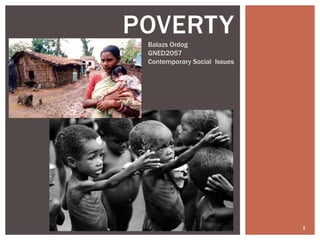
POVERTY
Balazs Ordog
GNED2057
Contemporary Social Issues
“A condition where people’s basic needs for
food, clothing, and shelter are not being met”
- businessdictionary.com
2
WHAT IS POVERTY?
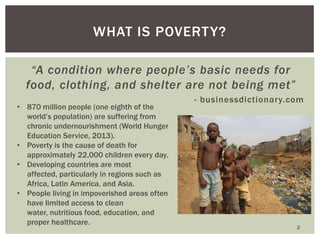
• 870 million people (one eighth of the
world’s population) are suffering from
chronic undernourishment (World Hunger
Education Service, 2013).
• Poverty is the cause of death for
approximately 22,000 children every day.
• Developing countries are most
affected, particularly in regions such as
Africa, Latin America, and Asia.
• People living in impoverished areas often
have limited access to clean
water, nutritious food, education, and
proper healthcare.
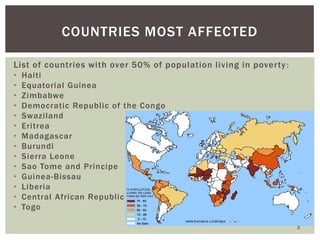
List of countries with over 50% of population living in poverty:
• Haiti
• Equatorial Guinea
• Zimbabwe
• Democratic Republic of the Congo
• Swaziland
• Eritrea
• Madagascar
• Burundi
• Sierra Leone
• Sao Tome and Principe
• Guinea-Bissau
• Liberia
• Central African Republic
• Togo
3
COUNTRIES MOST AFFECTED
Haiti is often regarded as having one of the highest rates of
poverty in the world, and is also the poorest country in the western
hemisphere (Rural Poverty Portal, n.d.).
4
HAITI
Haiti Facts:
• 77% of it’s population is living in
poverty.
• Rural areas are most
affected, having an average
income about one third that of
urban areas.
• Less than 8% of rural population
have access to drinking water.
• Not enough livestock and crops
are produced to feed the
country, about 60% of food
needs to be imported.
5
CAUSES OF POVERTY IN HAITI
The reason for why there is so much poverty in
Haiti is due mostly to a lack of access to inputs
such as tools, water, useable land.
Other factors include an insufficient level of
infrastructure and access to credit, as well as
low education levels (Rural Poverty Portal, n.d.).
Power struggles contribute to inequality, which
can be related to conflict theory.
The country is very susceptive to
hurricanes, floods, earthquakes, and other
natural disasters.
The 2010 Haiti earthquake caused over
250,000 buildings to collapse, and the
cost of damages have been estimated
at $14 billion USD.
6
GOVERNMENT OF CANADA AID TO HAITI
In 2009 the government of Canada selected
Haiti as a focus country as a part of the new
aid effectiveness strategy.
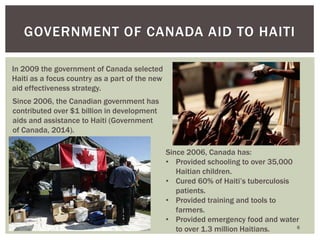
Since 2006, the Canadian government has
contributed over $1 billion in development
aids and assistance to Haiti (Government
of Canada, 2014).
Since 2006, Canada has:
• Provided schooling to over 35,000
Haitian children.
• Cured 60% of Haiti’s tuberculosis
patients.
• Provided training and tools to
farmers.
• Provided emergency food and water
to over 1.3 million Haitians.
7
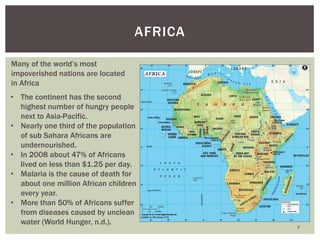
AFRICA
Many of the world’s most
impoverished nations are located
in Africa
• The continent has the second
highest number of hungry people
next to Asia-Pacific.
• Nearly one third of the population
of sub Sahara Africans are
undernourished.
• In 2008 about 47% of Africans
lived on less than $1.25 per day.
• Malaria is the cause of death for
about one million African children
every year.
• More than 50% of Africans suffer
from diseases caused by unclean
water (World Hunger, n.d.).
8
CAUSES OF POVERTY IN AFRICA
Primary causes of poverty in Africa:
• Lack of stable government.
• Corruption.
• Poor land utilization, locals are uneducated on
how to make effective use of land and crops.
• Prevalence of diseases, particularly Malaria
and HIV/AIDS.
Malaria
Malaria is a mosquito born disease that is
very common in sub-Sahara Africa.
Approximately 660,000 people die each
year from Malaria, and 90% of these
deaths occur in Africa (UNICEF, 2013).
9
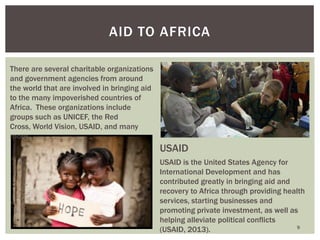
AID TO AFRICA
There are several charitable organizations
and government agencies from around
the world that are involved in bringing aid
to the many impoverished countries of
Africa. These organizations include
groups such as UNICEF, the Red
Cross, World Vision, USAID, and many
more.
USAID
USAID is the United States Agency for
International Development and has
contributed greatly in bringing aid and
recovery to Africa through providing health
services, starting businesses and
promoting private investment, as well as
helping alleviate political conflicts
(USAID, 2013).
10
UNITED STATES OF AMERICA
Poverty does not only affect third
world or developing nations. Even
in the United States, poverty is
evident in many areas despite
being a westernized and
reasonably wealthy country.
The 2012 census revealed
that one in seven people in
the USA were living in
poverty (National Centre for
Law and Economic Justice,
n.d.).
Groups most affected are ethnic
minorities and single-mother
families.
11
CAUSES OF POVERTY IN THE USA
A major factor in the levels of
poverty in the USA is the increase
in number of single parent
households (usually single
mothers), making it difficult for
them to provide for their children
on their own.
Low wages: One quarter of the
jobs in the United States pay less
than $23,000 per year
(Edelman, 2012).
There is also an insufficient
supply of welfare and cash
assistance to low income
families.
12
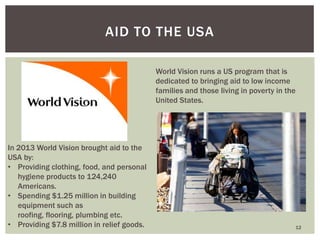
AID TO THE USA
World Vision runs a US program that is
dedicated to bringing aid to low income
families and those living in poverty in the
United States.
In 2013 World Vision brought aid to the
USA by:
• Providing clothing, food, and personal
hygiene products to 124,240
Americans.
• Spending $1.25 million in building
equipment such as
roofing, flooring, plumbing etc.
• Providing $7.8 million in relief goods.
13
SOCIOLOGICAL THEORIES
Poverty caused by an unequal distribution
of wealth can be explained through conflict
theory.
There are various countries in this world
competing for resources, and there is
simply not enough wealth to support
everyone. As some groups become more
rich, other groups of people become more
poor.
Conflict Theory Structural Functionalist Theory
Structural functionalist theory explains
that poverty in some ways serves a
purpose in society.
Poor people are more willing to do jobs
that are dangerous, low paying, and
work that other people are less willing
to do. Staying out of poverty is
considered as motivation to do jobs that
are more rewarding.
Wealthier nations are in many
cases more interested in
investing their money in activities
that benefit themselves, rather
than trying to reach out and help
those who are in need.
14
CONCLUSIONS
Poverty is a major global pandemic that
causes millions of people in the world to live
without access to basic needs.
In order to overcome this problem
wealthier, more prosperous nations need to
reach out and provide more aid and
assistance to those who are affected by
poverty. More equal pay grades and wages
need to be established to bring the upper
and lower classes together to ensure that
everyone is able to afford their basic needs.
Organizations and charities dedicated
to helping end poverty:
• Oxfam
• Save the children
• ActionAid
• CARE International
• Christian Aid
• The British Red Cross
• UNICEF
• Plan UK
• World Vision
• Concern Worldwide
15
REFERENCES
Edelman, P. (2012). Poverty in America: Why can’t we end it? The New York Times. Retrieved
from http://www.nytimes.com/2012/07/29/opinion/sunday/why-cant-we-end-
poverty-in-america.html?pagewanted=all&_r=1&
Government of Canada. (2014). Haiti. Retrieved from http://www.acdi-cida.gc.ca/haiti-e
National Centre for Law and Economic Justice. (n.d.). Poverty in the United States: A
snapshot. Retrieved from http://www.nclej.org/poverty-in-the-us.php
Poverty. (n.d.). businessdictionary.com. Retrieved from http://
www.businessdictionary.com/definition/poverty.html
Rural Poverty Portal. (n.d.). Rural poverty in Haiti. Retrieved from http://
www.ruralpovertyportal.org/country/home/tags/haiti
UNICEF. (2013). Malaria. Retrieved from http://www.unicef.org/health/index_malaria.html
USAID. (2013). Bureau for Africa. Retrieved from http://www.usaid.gov/who-we-
are/organization/bureaus/bureau-africa
World Hunger. (n.d.). Africa hunger and poverty facts. Retrieved from http://
www.worldhunger.org/articles/Learn/africa_hunger_facts.htm
World Hunger Education Service. (2013). 2013 World hunger and poverty facts and statistics.
Retrieved from http://
www.worldhunger.org/articles/Learn/world%20hunger%20facts%202002.htm

Poverty

  • 1.
  • 2.
    “A condition wherepeople’s basic needs for food, clothing, and shelter are not being met” - businessdictionary.com 2 WHAT IS POVERTY? • 870 million people (one eighth of the world’s population) are suffering from chronic undernourishment (World Hunger Education Service, 2013). • Poverty is the cause of death for approximately 22,000 children every day. • Developing countries are most affected, particularly in regions such as Africa, Latin America, and Asia. • People living in impoverished areas often have limited access to clean water, nutritious food, education, and proper healthcare.
  • 3.
    List of countrieswith over 50% of population living in poverty: • Haiti • Equatorial Guinea • Zimbabwe • Democratic Republic of the Congo • Swaziland • Eritrea • Madagascar • Burundi • Sierra Leone • Sao Tome and Principe • Guinea-Bissau • Liberia • Central African Republic • Togo 3 COUNTRIES MOST AFFECTED
  • 4.
    Haiti is oftenregarded as having one of the highest rates of poverty in the world, and is also the poorest country in the western hemisphere (Rural Poverty Portal, n.d.). 4 HAITI Haiti Facts: • 77% of it’s population is living in poverty. • Rural areas are most affected, having an average income about one third that of urban areas. • Less than 8% of rural population have access to drinking water. • Not enough livestock and crops are produced to feed the country, about 60% of food needs to be imported.
  • 5.
    5 CAUSES OF POVERTYIN HAITI The reason for why there is so much poverty in Haiti is due mostly to a lack of access to inputs such as tools, water, useable land. Other factors include an insufficient level of infrastructure and access to credit, as well as low education levels (Rural Poverty Portal, n.d.). Power struggles contribute to inequality, which can be related to conflict theory. The country is very susceptive to hurricanes, floods, earthquakes, and other natural disasters. The 2010 Haiti earthquake caused over 250,000 buildings to collapse, and the cost of damages have been estimated at $14 billion USD.
  • 6.
    6 GOVERNMENT OF CANADAAID TO HAITI In 2009 the government of Canada selected Haiti as a focus country as a part of the new aid effectiveness strategy. Since 2006, the Canadian government has contributed over $1 billion in development aids and assistance to Haiti (Government of Canada, 2014). Since 2006, Canada has: • Provided schooling to over 35,000 Haitian children. • Cured 60% of Haiti’s tuberculosis patients. • Provided training and tools to farmers. • Provided emergency food and water to over 1.3 million Haitians.
  • 7.
    7 AFRICA Many of theworld’s most impoverished nations are located in Africa • The continent has the second highest number of hungry people next to Asia-Pacific. • Nearly one third of the population of sub Sahara Africans are undernourished. • In 2008 about 47% of Africans lived on less than $1.25 per day. • Malaria is the cause of death for about one million African children every year. • More than 50% of Africans suffer from diseases caused by unclean water (World Hunger, n.d.).
  • 8.
    8 CAUSES OF POVERTYIN AFRICA Primary causes of poverty in Africa: • Lack of stable government. • Corruption. • Poor land utilization, locals are uneducated on how to make effective use of land and crops. • Prevalence of diseases, particularly Malaria and HIV/AIDS. Malaria Malaria is a mosquito born disease that is very common in sub-Sahara Africa. Approximately 660,000 people die each year from Malaria, and 90% of these deaths occur in Africa (UNICEF, 2013).
  • 9.
    9 AID TO AFRICA Thereare several charitable organizations and government agencies from around the world that are involved in bringing aid to the many impoverished countries of Africa. These organizations include groups such as UNICEF, the Red Cross, World Vision, USAID, and many more. USAID USAID is the United States Agency for International Development and has contributed greatly in bringing aid and recovery to Africa through providing health services, starting businesses and promoting private investment, as well as helping alleviate political conflicts (USAID, 2013).
  • 10.
    10 UNITED STATES OFAMERICA Poverty does not only affect third world or developing nations. Even in the United States, poverty is evident in many areas despite being a westernized and reasonably wealthy country. The 2012 census revealed that one in seven people in the USA were living in poverty (National Centre for Law and Economic Justice, n.d.). Groups most affected are ethnic minorities and single-mother families.
  • 11.
    11 CAUSES OF POVERTYIN THE USA A major factor in the levels of poverty in the USA is the increase in number of single parent households (usually single mothers), making it difficult for them to provide for their children on their own. Low wages: One quarter of the jobs in the United States pay less than $23,000 per year (Edelman, 2012). There is also an insufficient supply of welfare and cash assistance to low income families.
  • 12.
    12 AID TO THEUSA World Vision runs a US program that is dedicated to bringing aid to low income families and those living in poverty in the United States. In 2013 World Vision brought aid to the USA by: • Providing clothing, food, and personal hygiene products to 124,240 Americans. • Spending $1.25 million in building equipment such as roofing, flooring, plumbing etc. • Providing $7.8 million in relief goods.
  • 13.
    13 SOCIOLOGICAL THEORIES Poverty causedby an unequal distribution of wealth can be explained through conflict theory. There are various countries in this world competing for resources, and there is simply not enough wealth to support everyone. As some groups become more rich, other groups of people become more poor. Conflict Theory Structural Functionalist Theory Structural functionalist theory explains that poverty in some ways serves a purpose in society. Poor people are more willing to do jobs that are dangerous, low paying, and work that other people are less willing to do. Staying out of poverty is considered as motivation to do jobs that are more rewarding. Wealthier nations are in many cases more interested in investing their money in activities that benefit themselves, rather than trying to reach out and help those who are in need.
  • 14.
    14 CONCLUSIONS Poverty is amajor global pandemic that causes millions of people in the world to live without access to basic needs. In order to overcome this problem wealthier, more prosperous nations need to reach out and provide more aid and assistance to those who are affected by poverty. More equal pay grades and wages need to be established to bring the upper and lower classes together to ensure that everyone is able to afford their basic needs. Organizations and charities dedicated to helping end poverty: • Oxfam • Save the children • ActionAid • CARE International • Christian Aid • The British Red Cross • UNICEF • Plan UK • World Vision • Concern Worldwide
  • 15.
    15 REFERENCES Edelman, P. (2012).Poverty in America: Why can’t we end it? The New York Times. Retrieved from http://www.nytimes.com/2012/07/29/opinion/sunday/why-cant-we-end- poverty-in-america.html?pagewanted=all&_r=1& Government of Canada. (2014). Haiti. Retrieved from http://www.acdi-cida.gc.ca/haiti-e National Centre for Law and Economic Justice. (n.d.). Poverty in the United States: A snapshot. Retrieved from http://www.nclej.org/poverty-in-the-us.php Poverty. (n.d.). businessdictionary.com. Retrieved from http:// www.businessdictionary.com/definition/poverty.html Rural Poverty Portal. (n.d.). Rural poverty in Haiti. Retrieved from http:// www.ruralpovertyportal.org/country/home/tags/haiti UNICEF. (2013). Malaria. Retrieved from http://www.unicef.org/health/index_malaria.html USAID. (2013). Bureau for Africa. Retrieved from http://www.usaid.gov/who-we- are/organization/bureaus/bureau-africa World Hunger. (n.d.). Africa hunger and poverty facts. Retrieved from http:// www.worldhunger.org/articles/Learn/africa_hunger_facts.htm World Hunger Education Service. (2013). 2013 World hunger and poverty facts and statistics. Retrieved from http:// www.worldhunger.org/articles/Learn/world%20hunger%20facts%202002.htm