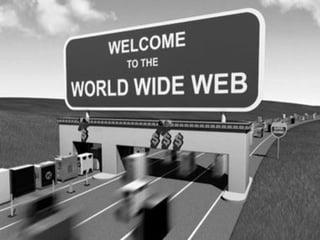
World Wide Web “ WWW”, "Web" or "W3"
What is WORLD WIDE WEB?
Background.
Structure.
Components.
Fundamental concepts.
How to access the web?
Creating a web page?
Internet and World wide web?
Growth
Examples
Conclusion
The World Wide Web is a way of exchanging information between computers on the Internet.
The World Wide Web is the network of pages of images, texts and sounds on the Internet which can be viewed using browser software .
WHAT IS WORLD WIDE WEB?
WWW …. BACKGROUND?
1989-1990 – Tim Berners-Lee invents the World Wide Web at CERN
Means for transferring text and graphics simultaneously
Lots of previous attempts (Gopher, WAIS, Archie, Xanadu, etc.)
Client/Server data transfer protocol
Established a common language for sharing information on computers
STRUCTURE
Clients use browser application to send URIs via HTTP to servers requesting a Web page
Web pages constructed using HTML (or other markup language) and consist of text, graphics, sounds plus embedded files
Servers (or caches) respond with requested Web page
Or with error message
Client’s browser renders Web page returned by server
Page is written using Hyper Text Markup Language (HTML)
Displaying text, graphics and sound in browser
Writing data as well
The entire system runs over standard networking protocols (TCP/IP, DNS,…)
WWW COMPONENTS
Structural Components:
Clients/browsers – to dominant implementations
Servers – run on sophisticated hardware
Caches – many interesting implementations
Internet – the global infrastructure which facilitates data transfer
Semantic Components:
Hyper Text Transfer Protocol (HTTP)
Hyper Text Markup Language (HTML)
extensible Markup Language (XML)
Uniform Resource Identifiers (URIs)
The Fundamental concept of the World Wide Web
The Hypertext concept
Hypertext is text which contains links to other texts. The term was coined by Ted Nelson around 1965 .
The Hypermedia concept
Hypermedia is a term used for hypertext which is not constrained to be text: it can include graphics, video and sound.
WEB Browser
A web browser displays a web document and enables users to access web documents.
WEB Server
This is a program that waits patiently for the browser to request a web page. The servers looks for the requested information, retrieves it and send it to the browser or sends an error message if the file is not found.
Uniform Resource Locator (URL)
These are the web addresses. The resource locator is an addressing system .
It is the Hypertext Transfer Protocol The domain name of web server on which page is located. It identifies the location of the document on internet It identifies the resource name.
HOW TO ACCESS THE WEB?
Written by William F. Slater, III
1996
President of the Chicago Chapter of the Internet Society
Creating a WEB PAGE !
Web pages are generally sets of text files coded with special notation called Hypertext Markup Language (HTML) that is interpreted by a web browser program reading the file.
THE DIFFERENCE BETWEEN WORLD WIDE WEB AND INTERNET…?
Many people use the terms Internet and World Wide Web , but in fact the two terms are not synonymous. The Internet and the Web are two separate but related things.
The Internet is a massive network of networks. It connects millions of computers together globally, forming a network in which any computer can communicate with any other computer as long as they are both connected to the Internet.
The World Wide Web , or simply Web , is a way of accessing information over the medium of the Internet.
So the Web is just a portion of the Internet, albeit a large portion, but the two terms are not synonymous and should not be confused.
GROWTH OF WORLD WIDE WEB
WORLD WIDE WEB success!!
World Wide Web succeeded because it was simple!
Didn’t attempt to maintain links, just a common way to name things
The World Wide Web was have today was created by some very bright, talented people who either had vision, or were inspired by other talented people’s visions.
Though their ideas were not always popular, they pressed ahead.
Their perseverance and hard work brought us to where we are today.
There is a lot to be learned by studying these people, their early work and keeping in mind what they had to work with.
1 comments
Comments 1 - 1 of 1 previous next Post a comment