   It is a global system of interconnected computer networks that use
    the standard Internet Protocol Suite (often called TCP/IP, although
    not all applications use TCP) to serve billions of users worldwide.

    It is a network of networks that consists of millions of
    private, public, academic, business, and government networks, of
    local to global scope, that are linked by a broad array of
    electronic, wireless and optical networking technologies.

   The Internet has enabled and accelerated new forms of human interactions
    through instant messaging , Internet forums, and social networking.

   The Internet carries an extensive range of information resources and
    services, such as the inter-linked hypertext documents of the World
    Wide Web (WWW) and the infrastructure to support email.
Internet
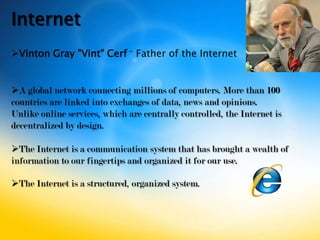
Vinton Gray "Vint" Cerf – Father of the Internet


A global network connecting millions of computers. More than 100
countries are linked into exchanges of data, news and opinions.
Unlike online services, which are centrally controlled, the Internet is
decentralized by design.

The Internet is a communication system that has brought a wealth of
information to our fingertips and organized it for our use.

The Internet is a structured, organized system.
 The most notable internet is called the Internet, a collaboration of more
than hundreds of thousands of interconnected networks.

In the mid-1960s, mainframe computers in research organizations were
stand alone devices. Computers from different manufacturers were unable
to communicate w/ one another. The Advanced Research Projects Agency
(ARPA) was interested in finding a way to connect computers so that the
researchers they funded could share their findings.

In 1967, at an Association for Computing Machinery (ACM)
meeting, ARPA presented its ideas for ARPANET, a small network of
connected computers.

In 1972, Vint Cerf and Bob Kahn were part of the core ARPANET
group, collaborated on what they called the Internetting Project. Cerf and
Kahn’s landmark 1973 paper outlined the protocols to achieved end-to-end
delivery packets.
A Brief History
This paper on Transmission Control Protocol (TCP) included concepts
such as encapsulation, the datagram, and the functions of a gateway.

Authorities made a decision to split TCP into two protocols:
Transmission Control Protocol (TCP) and Internetworking Protocol
(IP), IP would handle datagram routing while TCP would be responsible
for higher-level functions such as segmentations, reassembly, and error
detection. The internetworking protocol became known as TCP/ IP.
Uses Of the Internet
The Internet allows greater flexibility in working hours and
location, especially with the spread of unmetered high-speed connections. The
Internet can be accessed almost anywhere by numerous means, including
through mobile Internet devices.

For distance education, help with homework and other assignments, self-
guided learning, whiling away spare time, or just looking up more detail on an
interesting fact, it has never been easier for people to access educational
information at any level from anywhere.

 The Internet in general and the World Wide Web in particular are
important enablers of both formal and informal education.

The Internet allows computer users to remotely access other computers and
information stores easily, wherever they may be. This is encouraging new ways of
working from home, collaboration and information sharing in many industries.
Uses Of the Internet in Terms
Search Engines
It is designed to search for information on the internet. Search engine
presents the search results in the form of a search results list. The search
results can be web pages, images, videos, and other type of files.

To gather and present the searched information, each search engines has
their own algorithm, or combination of algorithmic and human input.

Google.com is currently the most popular and frequently used search
engine.

Web Browsers / Internet Browsers
A Web Browser is a type of software that retrieves and presents
information resources on the internet. The information resource can be
text, image, sound, video, or other type of content.

In a simple way, we can describe a web browser as a type of software that
we use to ‘surf’ the internet.
These are some examples of web browsers, each with their own
plus and minuses:
- Microsoft Internet Explorer
- Firefox
- Opera
- Safari
- Google Chrome

Types of Internet Connections
There are several types of internet connections.

-   Analog/Dial-Up
-   ISDN (Integrated Services Digital Network)
-   DSL
-   Cable
-   Wireless Internet Connections/Wireless Broadband
-   Satellite (Internet over Satellite/IoS)
Advantages of the Internet;
1. Faster Communication
The foremost target of Internet has always been speedy communication
and it has excelled way beyond the expectations. Newer innovations are only
going to make it faster and more reliable..

2. Information Resources
 Information is probably the biggest advantage that Internet offers.
     Internet is a virtual treasure trove of information. Any kind of
     information on any topic under the sun is available on the Internet.
Advantages of the Internet;
3. Entertainment
     Entertainment is another popular reason why many people prefer to surf
     the Internet. Downloading games or just surfing the celebrity websites are
     some of the uses people have discovered.

4. Social Networking
     Social networking has become so popular amongst youth that it might
    one day replace physical networking. Apart from finding long-lost
    friends, you can also look for job, business opportunities on
    forums, communities etc.
Advantages of the Internet;
5. Online Services
The Internet has made life very convenient. With numerous online
services you can now perform all your transactions online. You can book
tickets for a movie, transfer funds, pay utility bills, taxes etc., right from
your home.

6. e-commerce
The concept of e-commerce is used for any type of commercial
maneuvering or business deals that involves the transfer of information
across the globe via the Internet. It has become a phenomenon associated
with any kind of shopping, business deal etc.
Disadvantages of the Internet;
1. Theft of Personal Information
   If you use the Internet for online banking, social networking or other
   services, you may risk a theft to your personal information such as
   name, address, credit card number etc.

2. Spamming
   Spamming refers to sending unwanted e-mails in bulk, which provide
   no purpose and needlessly obstruct the entire system. Such illegal
   activities can be very frustrating for you as it makes your Internet slower
   and less reliable.

3.    Virus Threat
     Internet users are often plagued by virus attacks on their systems. Virus
     programs are inconspicuous and may get activated if you click a
     seemingly harmless link. Computers connected to the Internet are very
     prone to targeted virus attacks and may end up crashing.
Disadvantages of the Internet;
4. Pornography
     Pornography is perhaps the biggest disadvantage of the Internet.
     Internet allows you to access and download millions of pornographic
     photos, videos and other X-rated stuff. Such unrestricted access to porn
     can be detrimental for children and teenagers.

5. Social Disconnect
    Thanks to the Internet, people now only meet on social networks. More
    and more people are getting engulfed in virtual world and drifting apart
    from their friends and family. Even children prefer to play online games
    rather than going out and mingling with other kids. This may hamper a
    healthy social development in children.
The Internet Today
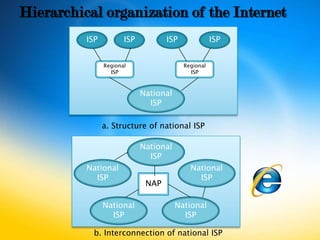
The Internet today is not a simple hierarchical structure. It is made up of
many wide and local-area networks joined by connecting devices and
switching stations. Today most end-users who want Internet connections
use the services of Internet Service Providers (ISPs).

An Internet service provider (ISP) is an organization that provides
access to the Internet.
There are international Service Providers:

• National service providers,
• Regional service providers,
• Local service providers.
Hierarchical organization of the Internet
          ISP          ISP          ISP              ISP


                Regional                  Regional
                  ISP                       ISP


                             National
                               ISP

                a. Structure of national ISP

                             National
                               ISP
          National                          National
            ISP                               ISP
                              NAP

                National                National
                  ISP                     ISP

            b. Interconnection of national ISP
The Internet Today
International Internet Service Providers
At the top of the hierarchy are the international service providers that
connect nations together.
1. National internet Service Providers
    The national Internet service providers are backbone networks created
    and maintained by specialized companies. Example of these backbone
    networks are Sprintlink, PSINet, UUNet technology, AGIS and
    internet MCI. To provide connectivity between the end users, these
    backbone networks are connected by complex switching stations called
    network access points (NAPs).

2. Regional Internet Service Providers
   Regional ISPs are smaller ISPs that are connected to one or more
    national ISPs. They are at the third level of the hierarchy with a small
    data rate.
The Internet Today
3 . Local Internet Service providers
    it provide direct service to the end users. The local ISPs can be
    connected to regional IPSs or directly to national ISPs. Each of local
    ISPs can be connected to a regional or national service providers.
World Wide Web and Internet

World Wide Web and Internet

  • 2.
    It is a global system of interconnected computer networks that use the standard Internet Protocol Suite (often called TCP/IP, although not all applications use TCP) to serve billions of users worldwide.  It is a network of networks that consists of millions of private, public, academic, business, and government networks, of local to global scope, that are linked by a broad array of electronic, wireless and optical networking technologies.  The Internet has enabled and accelerated new forms of human interactions through instant messaging , Internet forums, and social networking.  The Internet carries an extensive range of information resources and services, such as the inter-linked hypertext documents of the World Wide Web (WWW) and the infrastructure to support email.
  • 3.
    Internet Vinton Gray "Vint"Cerf – Father of the Internet A global network connecting millions of computers. More than 100 countries are linked into exchanges of data, news and opinions. Unlike online services, which are centrally controlled, the Internet is decentralized by design. The Internet is a communication system that has brought a wealth of information to our fingertips and organized it for our use. The Internet is a structured, organized system.
  • 4.
     The mostnotable internet is called the Internet, a collaboration of more than hundreds of thousands of interconnected networks. In the mid-1960s, mainframe computers in research organizations were stand alone devices. Computers from different manufacturers were unable to communicate w/ one another. The Advanced Research Projects Agency (ARPA) was interested in finding a way to connect computers so that the researchers they funded could share their findings. In 1967, at an Association for Computing Machinery (ACM) meeting, ARPA presented its ideas for ARPANET, a small network of connected computers. In 1972, Vint Cerf and Bob Kahn were part of the core ARPANET group, collaborated on what they called the Internetting Project. Cerf and Kahn’s landmark 1973 paper outlined the protocols to achieved end-to-end delivery packets.
  • 5.
    A Brief History Thispaper on Transmission Control Protocol (TCP) included concepts such as encapsulation, the datagram, and the functions of a gateway. Authorities made a decision to split TCP into two protocols: Transmission Control Protocol (TCP) and Internetworking Protocol (IP), IP would handle datagram routing while TCP would be responsible for higher-level functions such as segmentations, reassembly, and error detection. The internetworking protocol became known as TCP/ IP.
  • 6.
    Uses Of theInternet The Internet allows greater flexibility in working hours and location, especially with the spread of unmetered high-speed connections. The Internet can be accessed almost anywhere by numerous means, including through mobile Internet devices. For distance education, help with homework and other assignments, self- guided learning, whiling away spare time, or just looking up more detail on an interesting fact, it has never been easier for people to access educational information at any level from anywhere.  The Internet in general and the World Wide Web in particular are important enablers of both formal and informal education. The Internet allows computer users to remotely access other computers and information stores easily, wherever they may be. This is encouraging new ways of working from home, collaboration and information sharing in many industries.
  • 7.
    Uses Of theInternet in Terms Search Engines It is designed to search for information on the internet. Search engine presents the search results in the form of a search results list. The search results can be web pages, images, videos, and other type of files. To gather and present the searched information, each search engines has their own algorithm, or combination of algorithmic and human input. Google.com is currently the most popular and frequently used search engine. Web Browsers / Internet Browsers A Web Browser is a type of software that retrieves and presents information resources on the internet. The information resource can be text, image, sound, video, or other type of content. In a simple way, we can describe a web browser as a type of software that we use to ‘surf’ the internet.
  • 8.
    These are someexamples of web browsers, each with their own plus and minuses: - Microsoft Internet Explorer - Firefox - Opera - Safari - Google Chrome Types of Internet Connections There are several types of internet connections. - Analog/Dial-Up - ISDN (Integrated Services Digital Network) - DSL - Cable - Wireless Internet Connections/Wireless Broadband - Satellite (Internet over Satellite/IoS)
  • 9.
    Advantages of theInternet; 1. Faster Communication The foremost target of Internet has always been speedy communication and it has excelled way beyond the expectations. Newer innovations are only going to make it faster and more reliable.. 2. Information Resources  Information is probably the biggest advantage that Internet offers. Internet is a virtual treasure trove of information. Any kind of information on any topic under the sun is available on the Internet.
  • 10.
    Advantages of theInternet; 3. Entertainment Entertainment is another popular reason why many people prefer to surf the Internet. Downloading games or just surfing the celebrity websites are some of the uses people have discovered. 4. Social Networking Social networking has become so popular amongst youth that it might one day replace physical networking. Apart from finding long-lost friends, you can also look for job, business opportunities on forums, communities etc.
  • 11.
    Advantages of theInternet; 5. Online Services The Internet has made life very convenient. With numerous online services you can now perform all your transactions online. You can book tickets for a movie, transfer funds, pay utility bills, taxes etc., right from your home. 6. e-commerce The concept of e-commerce is used for any type of commercial maneuvering or business deals that involves the transfer of information across the globe via the Internet. It has become a phenomenon associated with any kind of shopping, business deal etc.
  • 12.
    Disadvantages of theInternet; 1. Theft of Personal Information If you use the Internet for online banking, social networking or other services, you may risk a theft to your personal information such as name, address, credit card number etc. 2. Spamming Spamming refers to sending unwanted e-mails in bulk, which provide no purpose and needlessly obstruct the entire system. Such illegal activities can be very frustrating for you as it makes your Internet slower and less reliable. 3. Virus Threat Internet users are often plagued by virus attacks on their systems. Virus programs are inconspicuous and may get activated if you click a seemingly harmless link. Computers connected to the Internet are very prone to targeted virus attacks and may end up crashing.
  • 13.
    Disadvantages of theInternet; 4. Pornography Pornography is perhaps the biggest disadvantage of the Internet. Internet allows you to access and download millions of pornographic photos, videos and other X-rated stuff. Such unrestricted access to porn can be detrimental for children and teenagers. 5. Social Disconnect Thanks to the Internet, people now only meet on social networks. More and more people are getting engulfed in virtual world and drifting apart from their friends and family. Even children prefer to play online games rather than going out and mingling with other kids. This may hamper a healthy social development in children.
  • 14.
    The Internet Today TheInternet today is not a simple hierarchical structure. It is made up of many wide and local-area networks joined by connecting devices and switching stations. Today most end-users who want Internet connections use the services of Internet Service Providers (ISPs). An Internet service provider (ISP) is an organization that provides access to the Internet. There are international Service Providers: • National service providers, • Regional service providers, • Local service providers.
  • 15.
    Hierarchical organization ofthe Internet ISP ISP ISP ISP Regional Regional ISP ISP National ISP a. Structure of national ISP National ISP National National ISP ISP NAP National National ISP ISP b. Interconnection of national ISP
  • 16.
    The Internet Today InternationalInternet Service Providers At the top of the hierarchy are the international service providers that connect nations together. 1. National internet Service Providers  The national Internet service providers are backbone networks created and maintained by specialized companies. Example of these backbone networks are Sprintlink, PSINet, UUNet technology, AGIS and internet MCI. To provide connectivity between the end users, these backbone networks are connected by complex switching stations called network access points (NAPs). 2. Regional Internet Service Providers  Regional ISPs are smaller ISPs that are connected to one or more national ISPs. They are at the third level of the hierarchy with a small data rate.
  • 17.
    The Internet Today 3. Local Internet Service providers  it provide direct service to the end users. The local ISPs can be connected to regional IPSs or directly to national ISPs. Each of local ISPs can be connected to a regional or national service providers.