The Web Vahideh Z.Gavgani @ Department Library  &  Information Science Osmania University
Content  Concept Usefulness Content creation
Concept WorldWideWeb ,  W orld  W ide  W eb ,   The Web ,  WEB WorldWideWeb : the world's first Web browser  WEB : a computer programming system created by Donald Knuth to implement literate programming
The  World Wide Web The  World Wide Web  (commonly shortened to  the Web )  is a system of interlinked hypertext documents accessed via the Internet . The World Wide Web is  one  of the   services  accessible via the  Internet , along with various others including e-mail, file sharing, online gaming and so on.
WWW It is a  system  of  interlinked   documents It is one of the  services  accessible via the Internet
Indespensible requirment to access www? By using a  Web browser , a user  can view Web pages that may contain text, images, videos, and other multimedia  or  navigates between them using hyperlinks
History  The World Wide Web was created in 1989 by Sir Tim Berners-Lee, working at CERN in Geneva, Switzerland.  Since then, Berners-Lee has played an active role in guiding the development of Web standards (such as the markup languages in which Web pages are composed), and in recent years has advocated his vision of a Semantic Web
Web browser A  web browser  is a software application which enables a user to display and interact with text, images, videos, music and other information typically located on a Webpage at a website on the World Wide Web or a local area network.
Web page A  Web page  or  webpage  is a resource of information that is suitable for the WWW and can be accessed through a  web browser .  This information is usually in HTML or  XHTML format, and may provide navigation to other web pages via hypertext links. Web pages may be retrieved from a local computer or from a remote  web server.
Web site A  website  (alternatively,  web site  or  Web site ) is a collection of Web pages, images, videos or other digital assets that is hosted on one or several Web server(s), usually accessible via the Internet, cell phone or a LAN.
Web server The term  web server  can mean one of two things: A  computer program  that is responsible for accepting HTTP requests from clients, which are known as web browsers, and serving them HTTP responses along with optional data contents, which usually are web pages such as HTML documents and linked objects (images, etc.).  A  computer  that runs a computer program as described above.
HTTP HTTP stands for  Hypertext Transfer Protocol,  it  is a communications protocol for the transfer of information on intranets and the World Wide Web.  Its original purpose was to provide a way to publish and retrieve hypertext pages over the Internet. HTTP development was coordinated by the World Wide Web Consortium (W3C) and the Internet Engineering Task Force (IETF),
Internet The  Internet  is a worldwide, publicly accessible series of interconnected  computer networks  that transmit  data  by  packet switching  using the standard Internet Protocol (IP). It is a "network of networks" that consists of millions of smaller domestic, academic, business, and government networks, which together carry various information and services, such as electronic mail,  online chat ,  file  transfer, and the interlinked web pages and other resources of the World Wide Web (WWW).
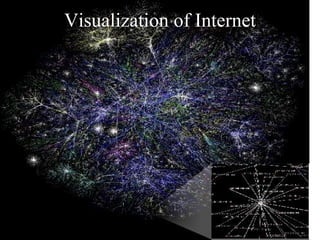
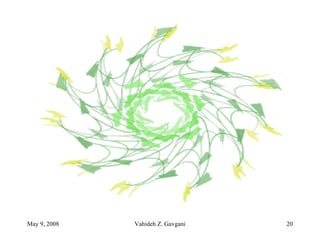
Visualization of Internet
Intranet  An  intranet  is a private computer network that uses Internet protocols and network connectivity to securely share part of an organization's information or operations with its employees.  Sometimes the term refers only to the most visible service, the internal website. The same concepts and technologies of the Internet such as clients and servers running on the Internet protocol are used to build an intranet.
TCP/IP IP  (Internet Protocol) defines the datagrams or packets that carry blocks of data from one node to another.  TCP  stands for  T ransmission  C ontrol  P rotocol , TCP and UDA (User Datagram Protocol)  are the protocols by which data is transmitted.
URL Uniform Resource Locator  ( URL ) EXAMPLE: http://en.wikipedia.org/wiki/india
Advantages of  Web  It is interlinked Real time Up-to-date (usually)  User friendly Useable for literates as well as illiterates Useable for people with various disabilities like blind/deaf Suitable for multimedia Suitable for distance learning/education as well as self learning Independent of place and time (ubiquity) Suitable for group education as well as individual It makes the publishing and availability of information Easy, quick, and cost effective
disadvantages Dependent to computer system  Dependent to information and communication technology (ICT) infrastructures  Required computer literacy  Some time costly for individual user
 

The Web

  • 1.
    The Web VahidehZ.Gavgani @ Department Library & Information Science Osmania University
  • 2.
    Content ConceptUsefulness Content creation
  • 3.
    Concept WorldWideWeb , W orld W ide W eb , The Web , WEB WorldWideWeb : the world's first Web browser WEB : a computer programming system created by Donald Knuth to implement literate programming
  • 4.
    The WorldWide Web The World Wide Web (commonly shortened to the Web ) is a system of interlinked hypertext documents accessed via the Internet . The World Wide Web is one of the services accessible via the Internet , along with various others including e-mail, file sharing, online gaming and so on.
  • 5.
    WWW It isa system of interlinked documents It is one of the services accessible via the Internet
  • 6.
    Indespensible requirment toaccess www? By using a Web browser , a user can view Web pages that may contain text, images, videos, and other multimedia or navigates between them using hyperlinks
  • 7.
    History TheWorld Wide Web was created in 1989 by Sir Tim Berners-Lee, working at CERN in Geneva, Switzerland. Since then, Berners-Lee has played an active role in guiding the development of Web standards (such as the markup languages in which Web pages are composed), and in recent years has advocated his vision of a Semantic Web
  • 8.
    Web browser A web browser is a software application which enables a user to display and interact with text, images, videos, music and other information typically located on a Webpage at a website on the World Wide Web or a local area network.
  • 9.
    Web page A Web page or webpage is a resource of information that is suitable for the WWW and can be accessed through a web browser . This information is usually in HTML or XHTML format, and may provide navigation to other web pages via hypertext links. Web pages may be retrieved from a local computer or from a remote web server.
  • 10.
    Web site A website (alternatively, web site or Web site ) is a collection of Web pages, images, videos or other digital assets that is hosted on one or several Web server(s), usually accessible via the Internet, cell phone or a LAN.
  • 11.
    Web server Theterm web server can mean one of two things: A computer program that is responsible for accepting HTTP requests from clients, which are known as web browsers, and serving them HTTP responses along with optional data contents, which usually are web pages such as HTML documents and linked objects (images, etc.). A computer that runs a computer program as described above.
  • 12.
    HTTP HTTP standsfor Hypertext Transfer Protocol, it is a communications protocol for the transfer of information on intranets and the World Wide Web. Its original purpose was to provide a way to publish and retrieve hypertext pages over the Internet. HTTP development was coordinated by the World Wide Web Consortium (W3C) and the Internet Engineering Task Force (IETF),
  • 13.
    Internet The Internet is a worldwide, publicly accessible series of interconnected computer networks that transmit data by packet switching using the standard Internet Protocol (IP). It is a "network of networks" that consists of millions of smaller domestic, academic, business, and government networks, which together carry various information and services, such as electronic mail, online chat , file transfer, and the interlinked web pages and other resources of the World Wide Web (WWW).
  • 14.
  • 15.
    Intranet An intranet is a private computer network that uses Internet protocols and network connectivity to securely share part of an organization's information or operations with its employees. Sometimes the term refers only to the most visible service, the internal website. The same concepts and technologies of the Internet such as clients and servers running on the Internet protocol are used to build an intranet.
  • 16.
    TCP/IP IP (Internet Protocol) defines the datagrams or packets that carry blocks of data from one node to another. TCP stands for T ransmission C ontrol P rotocol , TCP and UDA (User Datagram Protocol) are the protocols by which data is transmitted.
  • 17.
    URL Uniform ResourceLocator ( URL ) EXAMPLE: http://en.wikipedia.org/wiki/india
  • 18.
    Advantages of Web It is interlinked Real time Up-to-date (usually) User friendly Useable for literates as well as illiterates Useable for people with various disabilities like blind/deaf Suitable for multimedia Suitable for distance learning/education as well as self learning Independent of place and time (ubiquity) Suitable for group education as well as individual It makes the publishing and availability of information Easy, quick, and cost effective
  • 19.
    disadvantages Dependent tocomputer system Dependent to information and communication technology (ICT) infrastructures Required computer literacy Some time costly for individual user
  • 20.