Submitted by :- Milan | 9-A | 22
Introduction
Motion is defined as the change of position of an object with time, with respect
to its surroundings.
Similarly, an object is at rest when the position of the object does not change
with time, with respect to its surroundings.
Example :- A moving train is in motion because its position changes with
time. Now, consider a person sitting in the train. For someone standing on
the platform, the person sitting in the train is in motion. But for the co-
passengers, the person is at rest as the position of the person does not
change with time.
Hence, we need to consider the surroundings or the point of observation while
describing the state of motion of an object. The surroundings is called reference
frame.
Types of Motion
Motion can be broadly classified into three main categories:
Translatory motion is the motion of a particle in a straight line. A bus
travelling on a straight road and an apple falling from a tree are examples of
this kind of motion.
Rotational motion refers to the motion of a body around a fixed axis. A
spinning top, a bead moving on a circular track and Earth’s rotation are
examples of this kind of motion.
Periodic motion refers to the motion that is repeated in a regular interval of
time. An oscillating spring and the motion of a planet around the sun
illustrate this type of motion.
Linear Motion
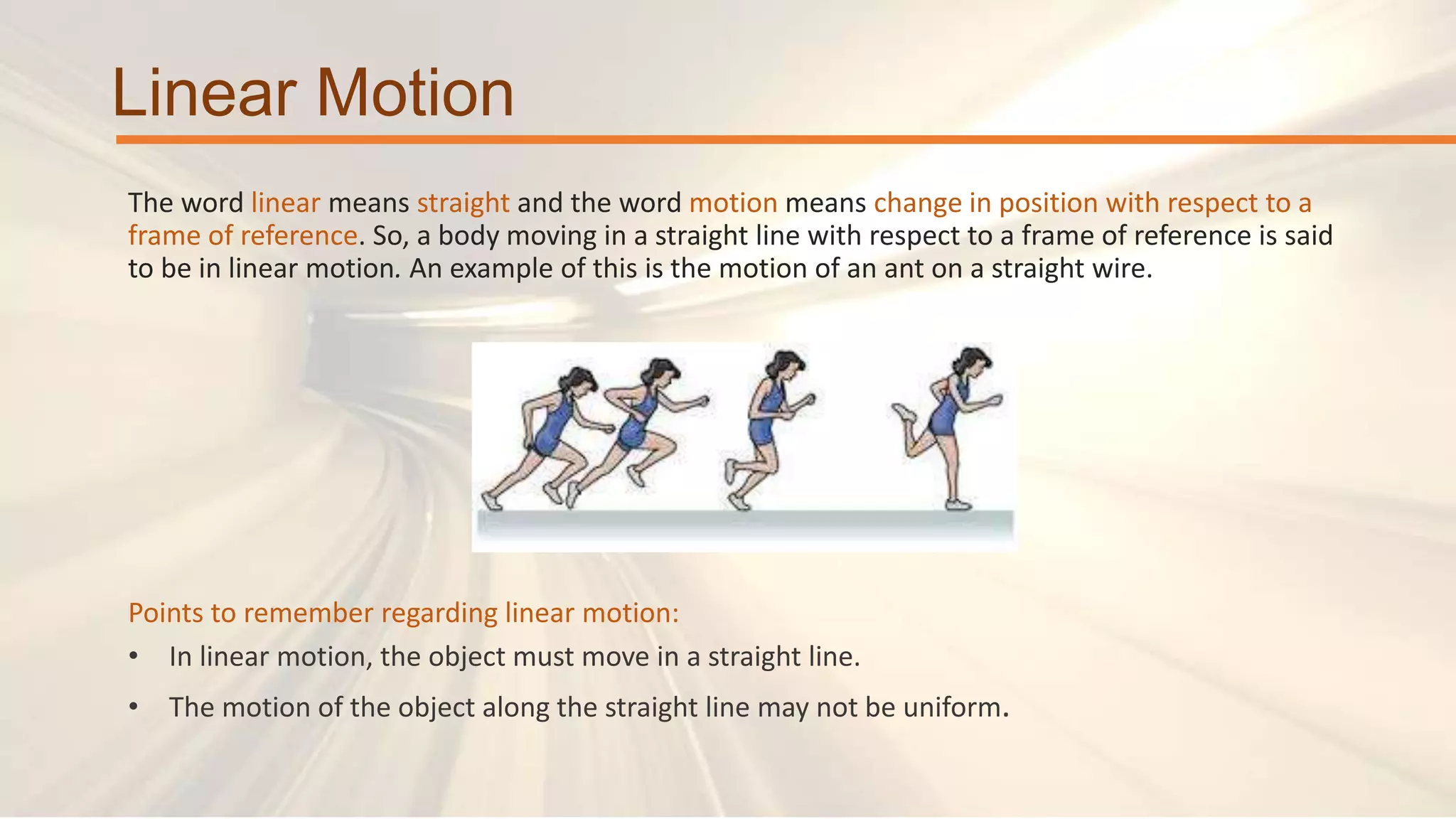
The word linear means straight and the word motion means change in position with respect to a
frame of reference. So, a body moving in a straight line with respect to a frame of reference is said
to be in linear motion. An example of this is the motion of an ant on a straight wire.
Points to remember regarding linear motion:
• In linear motion, the object must move in a straight line.
• The motion of the object along the straight line may not be uniform.
Uniform motion
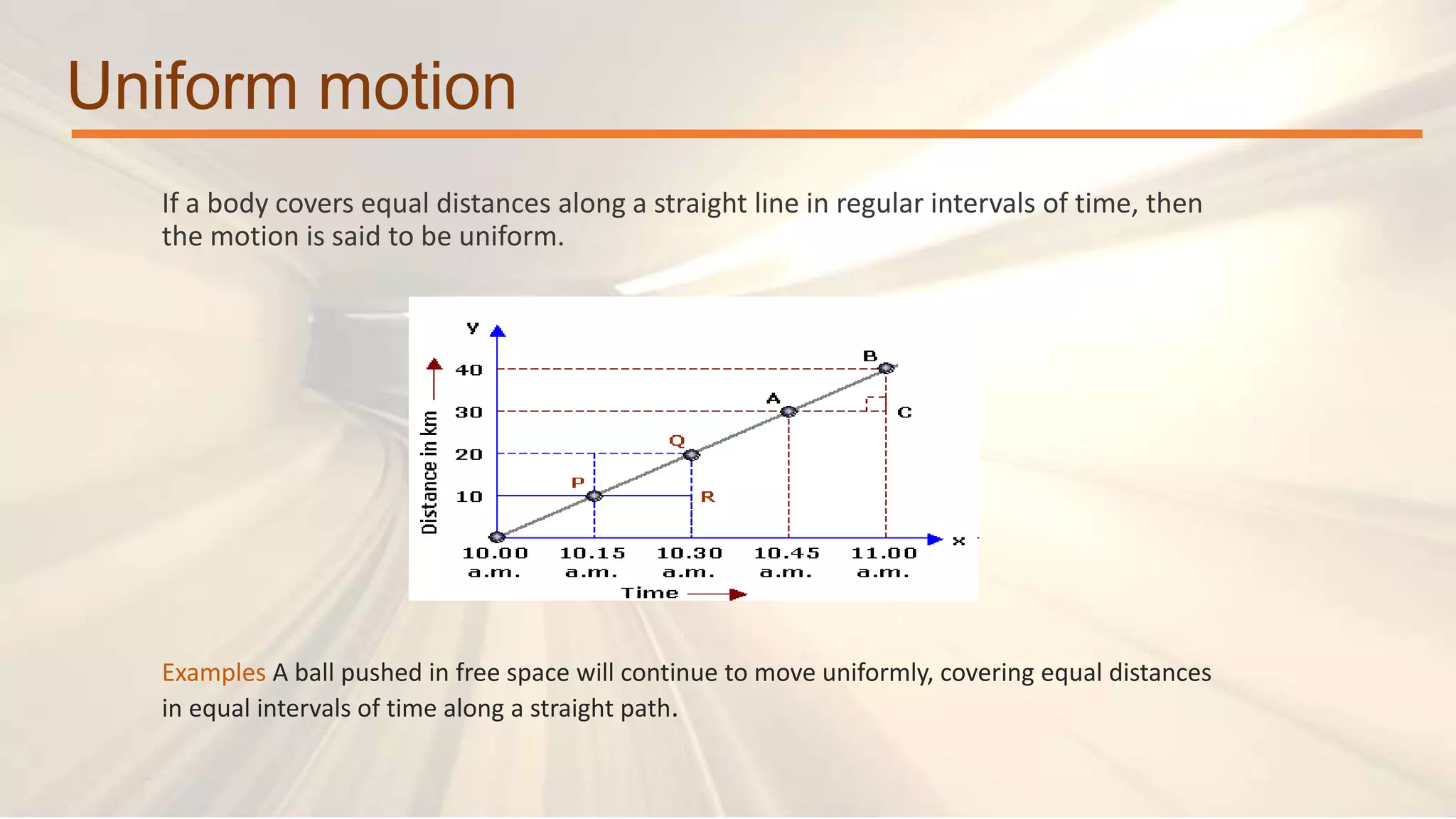
If a body covers equal distances along a straight line in regular intervals of time, then
the motion is said to be uniform.
Examples A ball pushed in free space will continue to move uniformly, covering equal distances
in equal intervals of time along a straight path.
Non-uniform motion
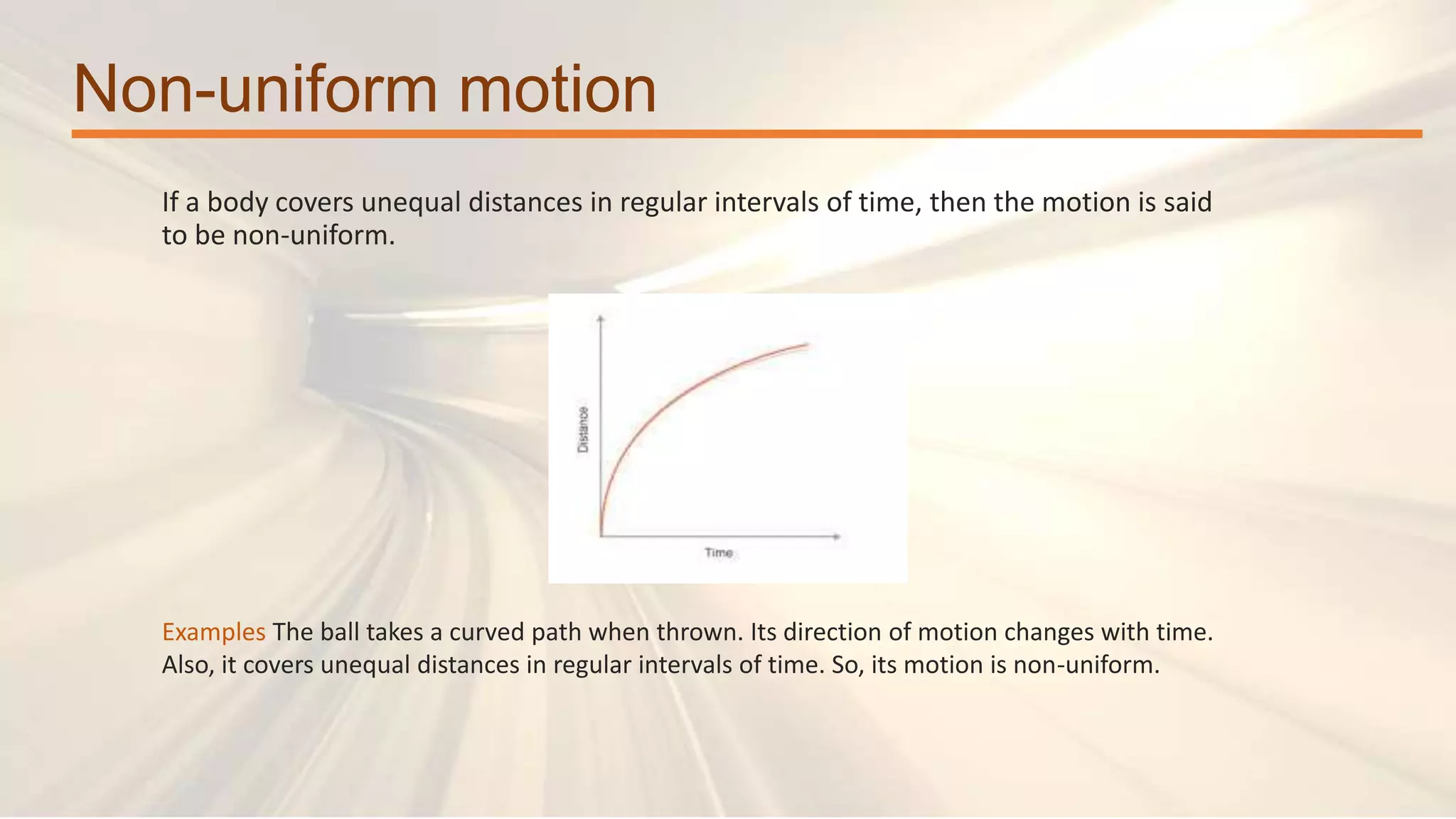
If a body covers unequal distances in regular intervals of time, then the motion is said
to be non-uniform.
Examples The ball takes a curved path when thrown. Its direction of motion changes with time.
Also, it covers unequal distances in regular intervals of time. So, its motion is non-uniform.
Physical quantity
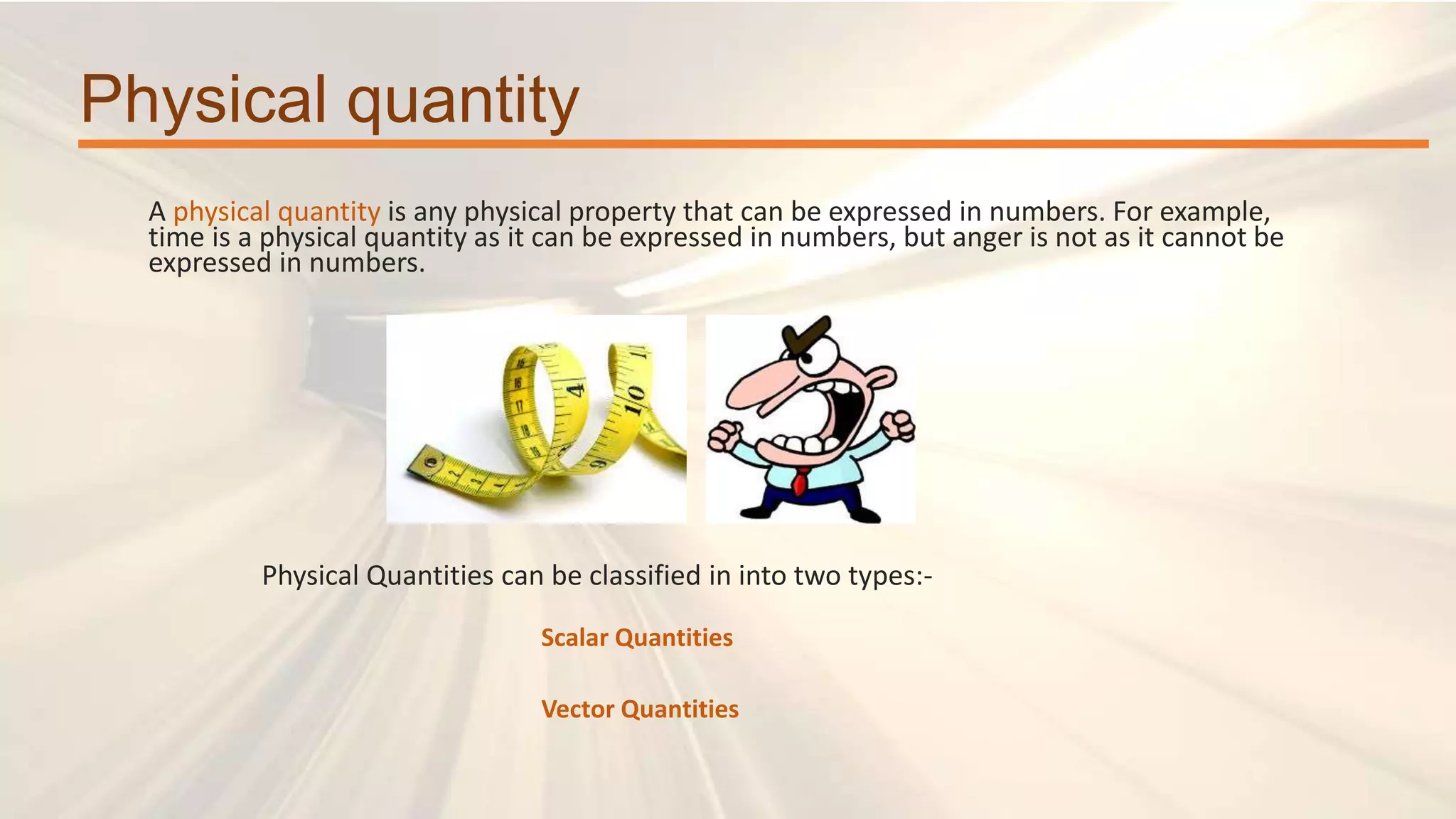
A physical quantity is any physical property that can be expressed in numbers. For example,
time is a physical quantity as it can be expressed in numbers, but anger is not as it cannot be
expressed in numbers.
Physical Quantities can be classified in into two types:-
Scalar Quantities
Vector Quantities
Scalar Quantities
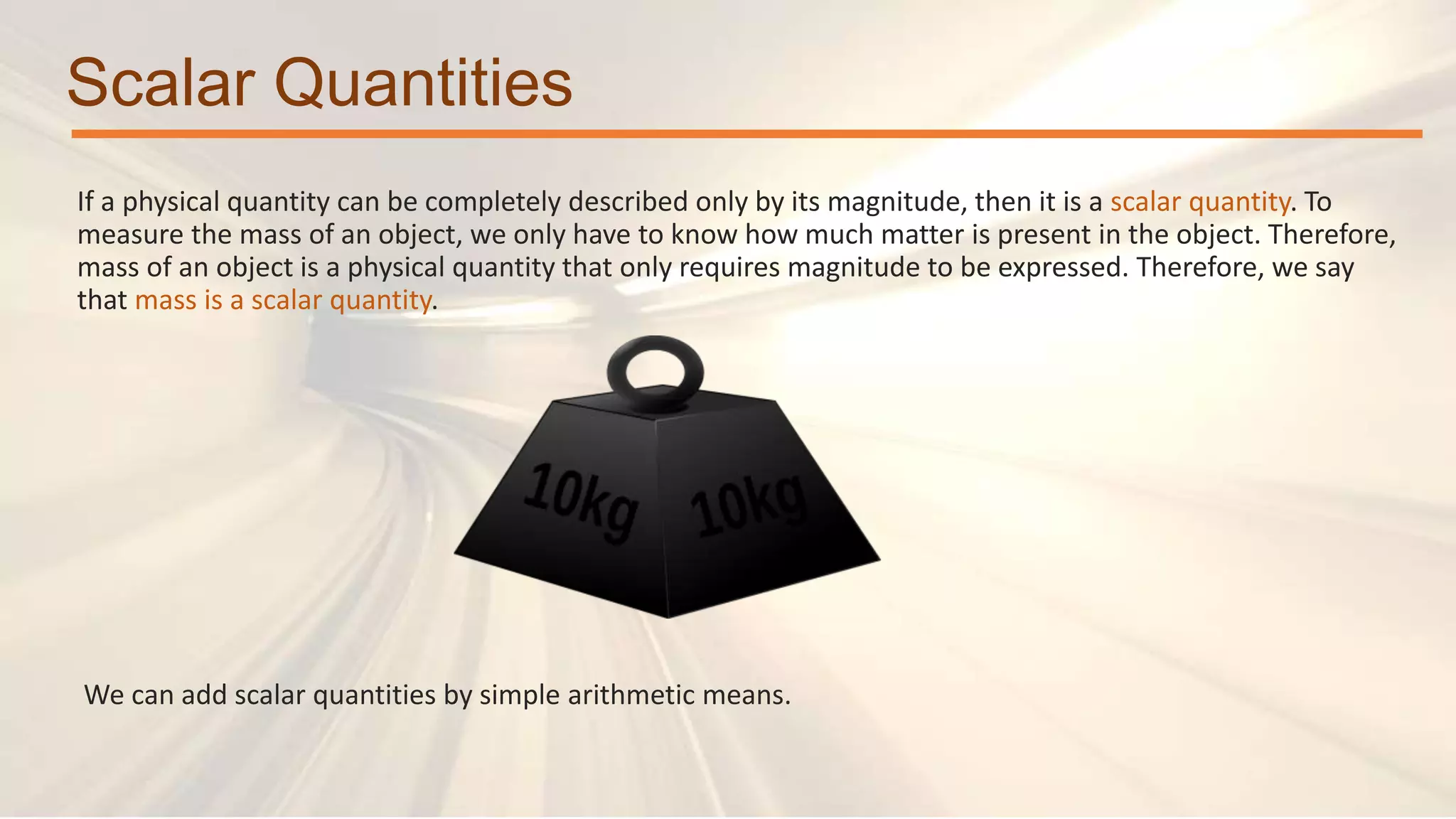
If a physical quantity can be completely described only by its magnitude, then it is a scalar quantity. To
measure the mass of an object, we only have to know how much matter is present in the object. Therefore,
mass of an object is a physical quantity that only requires magnitude to be expressed. Therefore, we say
that mass is a scalar quantity.
We can add scalar quantities by simple arithmetic means.
Vector Quantities
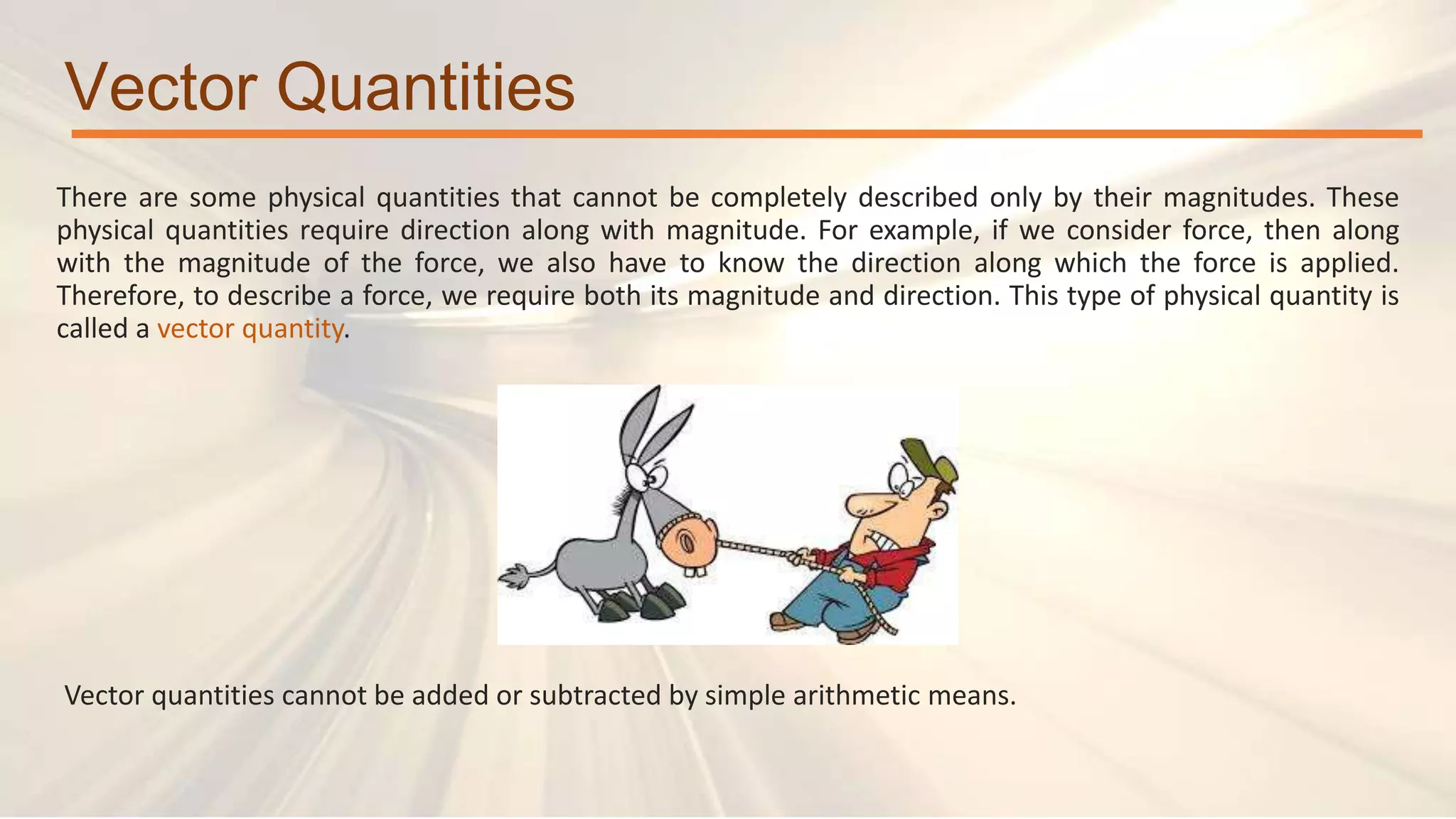
There are some physical quantities that cannot be completely described only by their magnitudes. These
physical quantities require direction along with magnitude. For example, if we consider force, then along
with the magnitude of the force, we also have to know the direction along which the force is applied.
Therefore, to describe a force, we require both its magnitude and direction. This type of physical quantity is
called a vector quantity.
Vector quantities cannot be added or subtracted by simple arithmetic means.
Distance and Displacement
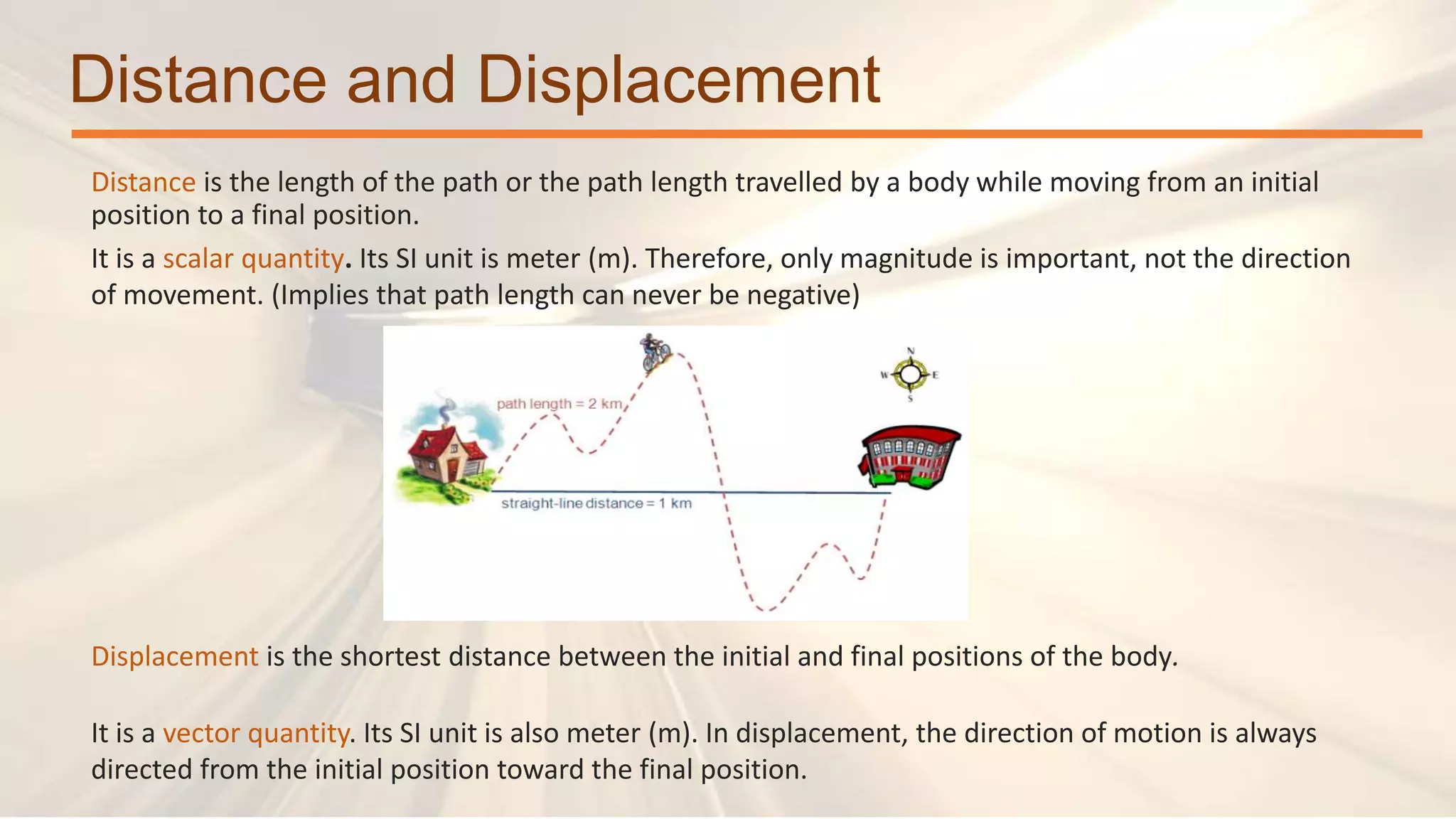
Distance is the length of the path or the path length travelled by a body while moving from an initial
position to a final position.
It is a scalar quantity. Its SI unit is meter (m). Therefore, only magnitude is important, not the direction
of movement. (Implies that path length can never be negative)
Displacement is the shortest distance between the initial and final positions of the body.
It is a vector quantity. Its SI unit is also meter (m). In displacement, the direction of motion is always
directed from the initial position toward the final position.
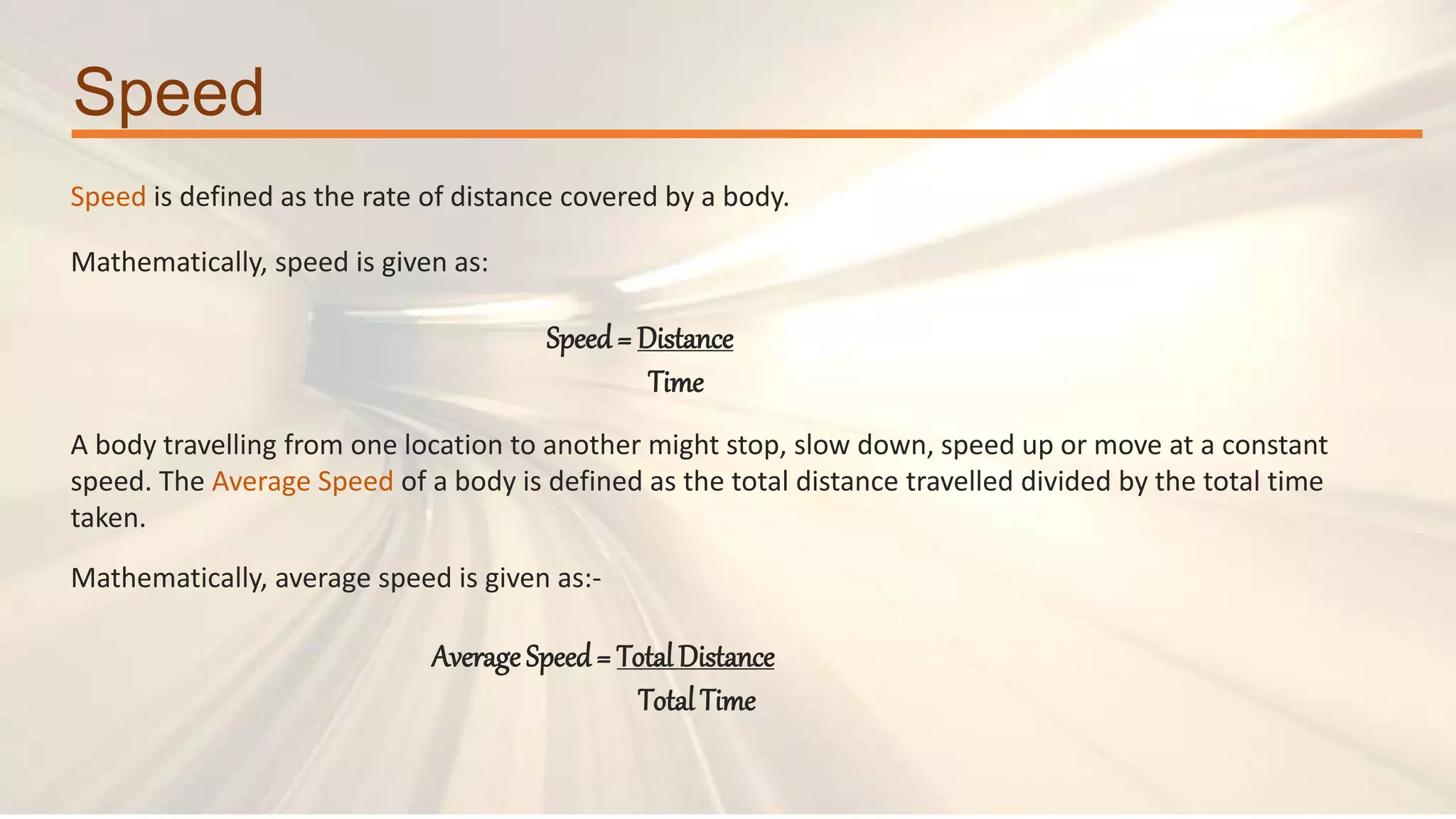
Speed
Speed is defined as the rate of distance covered by a body.
Mathematically, speed is given as:
A body travelling from one location to another might stop, slow down, speed up or move at a constant
speed. The Average Speed of a body is defined as the total distance travelled divided by the total time
taken.
Mathematically, average speed is given as:-
Speed = Distance
Time
Average Speed= TotalDistance
Total Time
Velocity
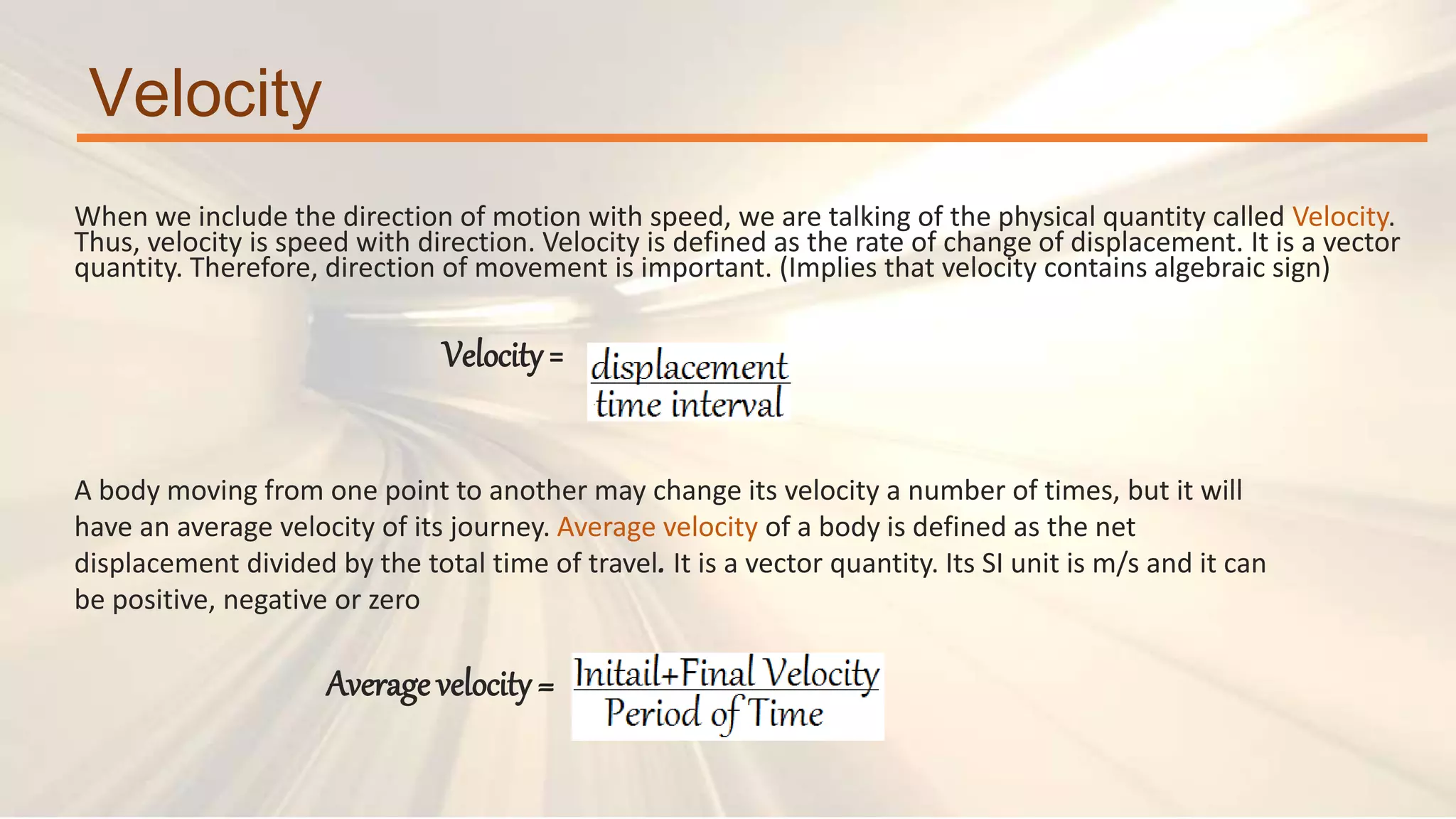
When we include the direction of motion with speed, we are talking of the physical quantity called Velocity.
Thus, velocity is speed with direction. Velocity is defined as the rate of change of displacement. It is a vector
quantity. Therefore, direction of movement is important. (Implies that velocity contains algebraic sign)
Velocity=
A body moving from one point to another may change its velocity a number of times, but it will
have an average velocity of its journey. Average velocity of a body is defined as the net
displacement divided by the total time of travel. It is a vector quantity. Its SI unit is m/s and it can
be positive, negative or zero
Average velocity =
Acceleration
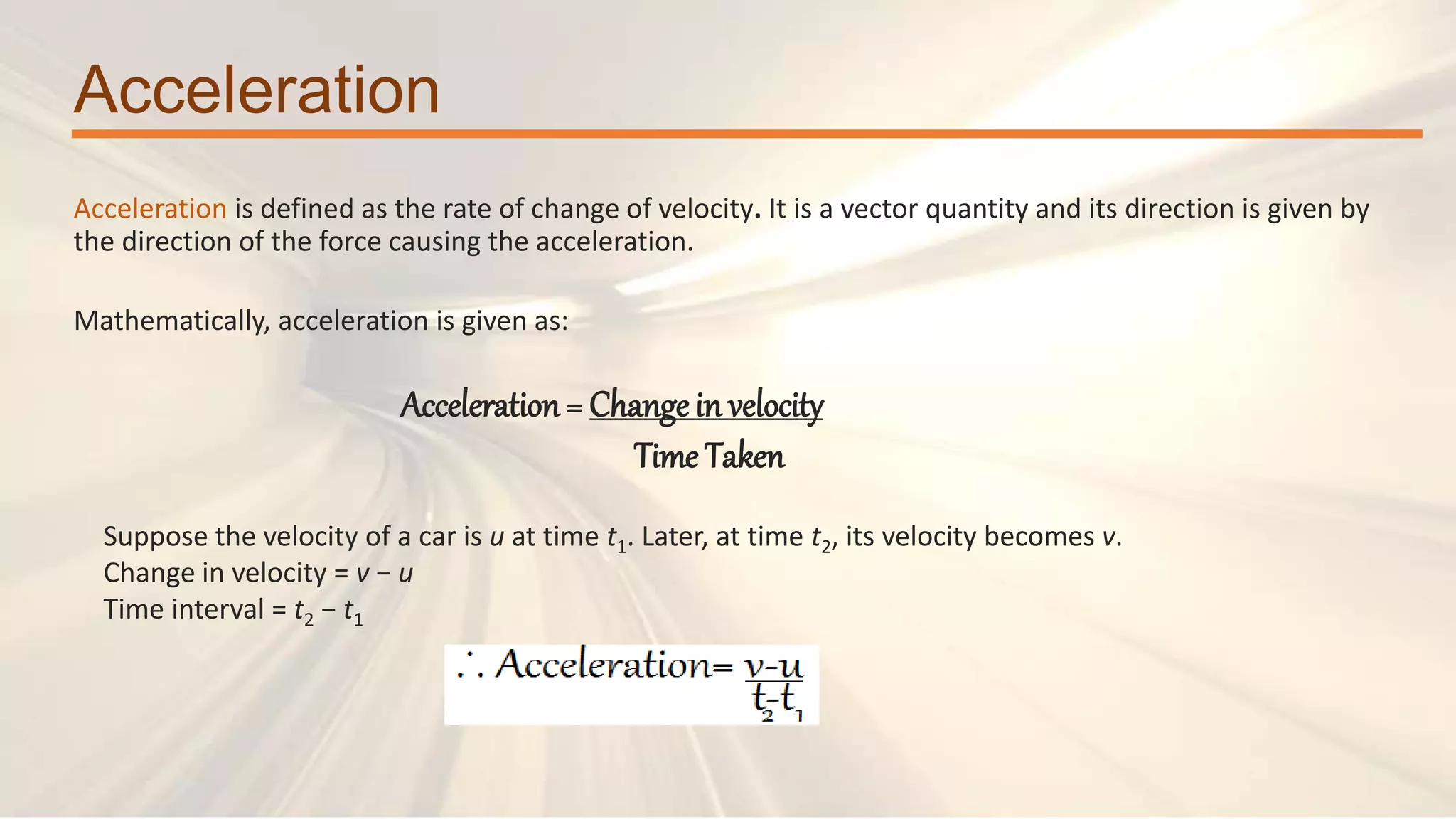
Acceleration is defined as the rate of change of velocity. It is a vector quantity and its direction is given by
the direction of the force causing the acceleration.
Suppose the velocity of a car is u at time t1. Later, at time t2, its velocity becomes v.
Change in velocity = v − u
Time interval = t2 − t1
Mathematically, acceleration is given as:
Acceleration= Change in velocity
Time Taken
Uniform and Non Uniform
Acceleration
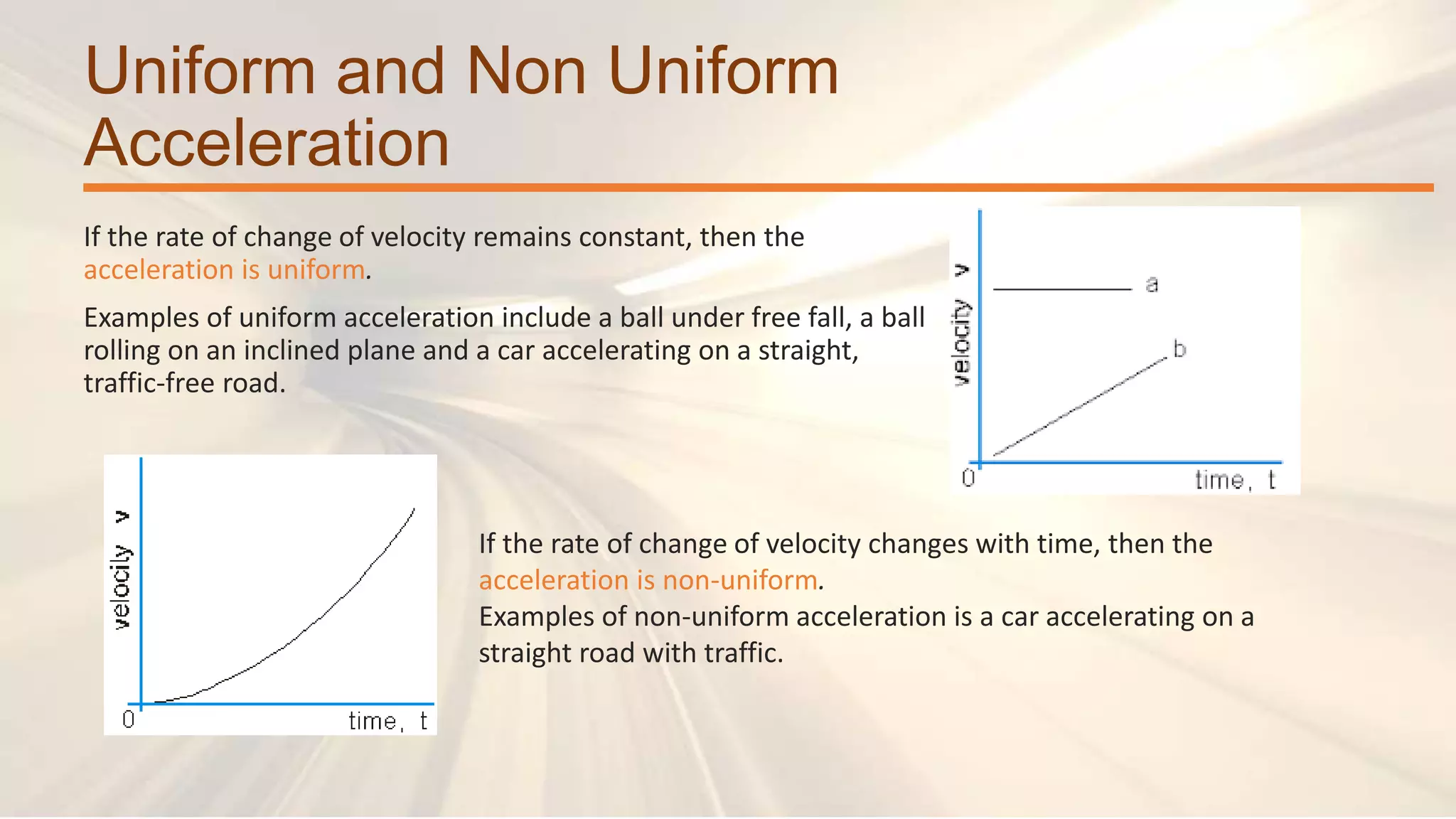
If the rate of change of velocity remains constant, then the
acceleration is uniform.
Examples of uniform acceleration include a ball under free fall, a ball
rolling on an inclined plane and a car accelerating on a straight,
traffic-free road.
If the rate of change of velocity changes with time, then the
acceleration is non-uniform.
Examples of non-uniform acceleration is a car accelerating on a
straight road with traffic.
First Equation of Motion
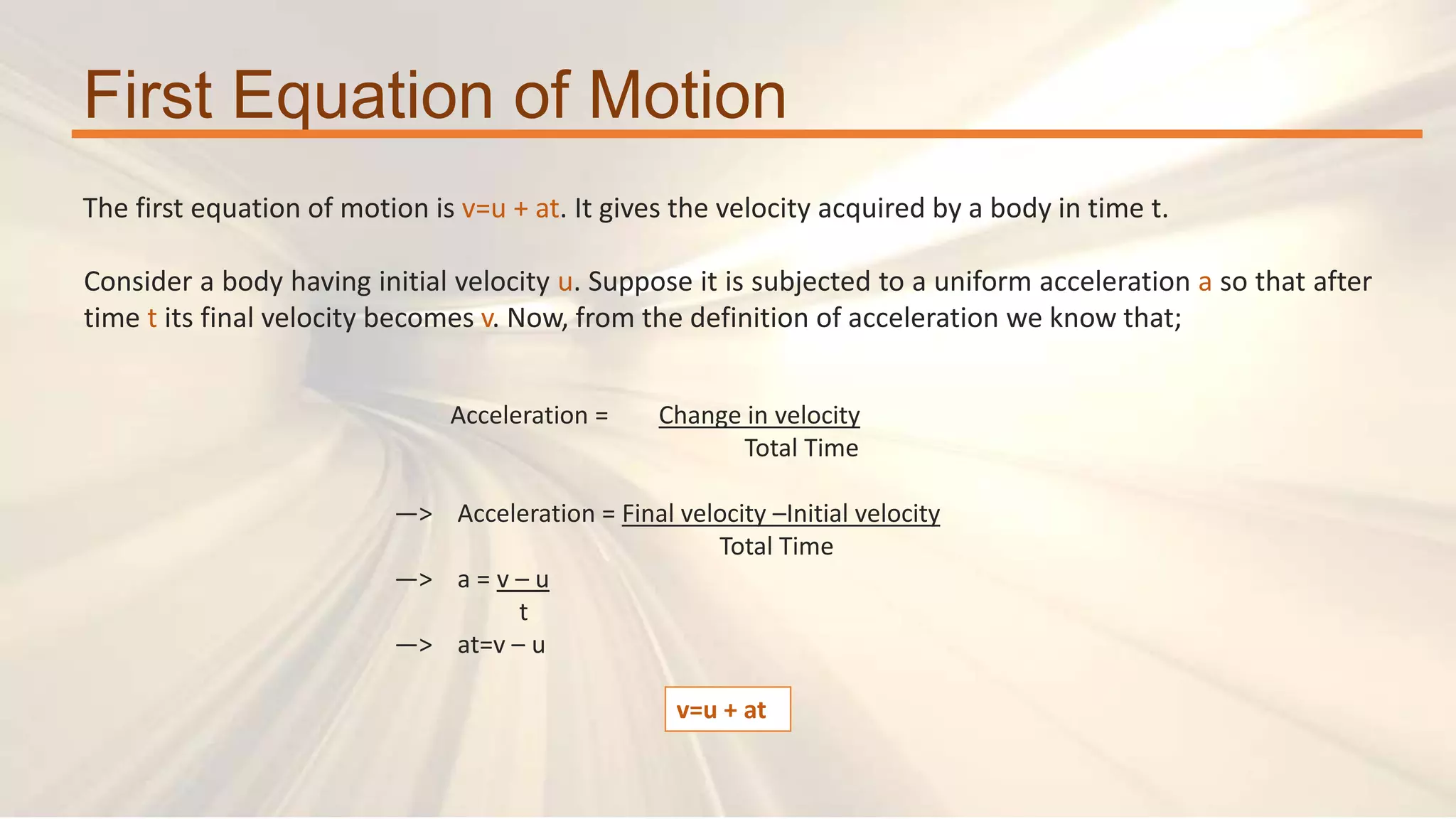
The first equation of motion is v=u + at. It gives the velocity acquired by a body in time t.
Consider a body having initial velocity u. Suppose it is subjected to a uniform acceleration a so that after
time t its final velocity becomes v. Now, from the definition of acceleration we know that;
Acceleration = Change in velocity
Total Time
—> Acceleration = Final velocity –Initial velocity
Total Time
—> a = v – u
t
—> at=v – u
v=u + at
Second Equation of Motion
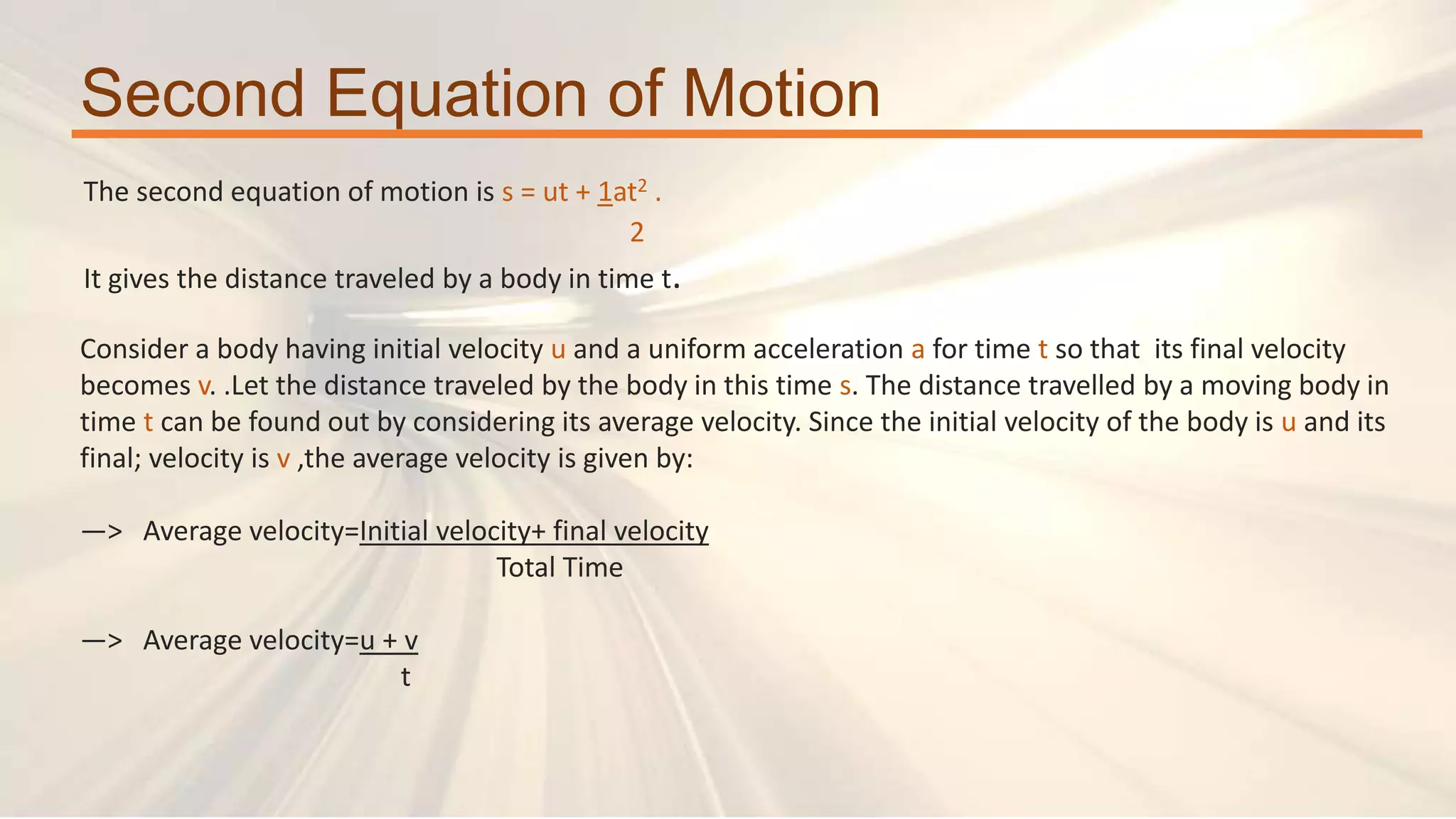
The second equation of motion is s = ut + 1at2 .
2
It gives the distance traveled by a body in time t.
Consider a body having initial velocity u and a uniform acceleration a for time t so that its final velocity
becomes v. .Let the distance traveled by the body in this time s. The distance travelled by a moving body in
time t can be found out by considering its average velocity. Since the initial velocity of the body is u and its
final; velocity is v ,the average velocity is given by:
—> Average velocity=Initial velocity+ final velocity
Total Time
—> Average velocity=u + v
t
Distance travelled= average velocity x Time
—> S=(u + v) x t
2
From the first equation of motion we have ,v=u + at. Putting the value of v in equation (1), we get
—> S=(u+ u+ at) x t
2
—> S=2ut+ at2
2
S= ut+1at2
2
The third equation of motion is v2=u2+2as. It gives the velocity acquired by a body in traveling a distance ‘s’.
Third Equation of Motion
The third equation of motion can be obtained by eliminating t between the first two equation of motion.
From second equation of motion we have;
S=ut+1at2
2
……………..(1)
Consider a body having initial velocity ‘u’ and a uniform acceleration ‘a’ for time ‘t’ so that its final velocity
becomes ‘v’. .Let the distance traveled by the body in this time ‘s’. The distance travelled by a moving body in
time ‘t’ can be found out by considering its average velocity. Since the initial velocity of the body is ‘u’ and its
final; velocity is ‘v’ ,the average velocity is given by:
And from the first equation of motion we have;
v=u + at
This can be rearranged and written as
at=v - u
—> t=v – u
a
Putting the value of t in equation (1)we get;
S = u (v-u/a)+ (1/2)a(v-u/a)2
—> S = 2uv-2u2+v2+u2-2uv
2a
—> 2as = v2-u2
v2=u2+2as
Circular motion
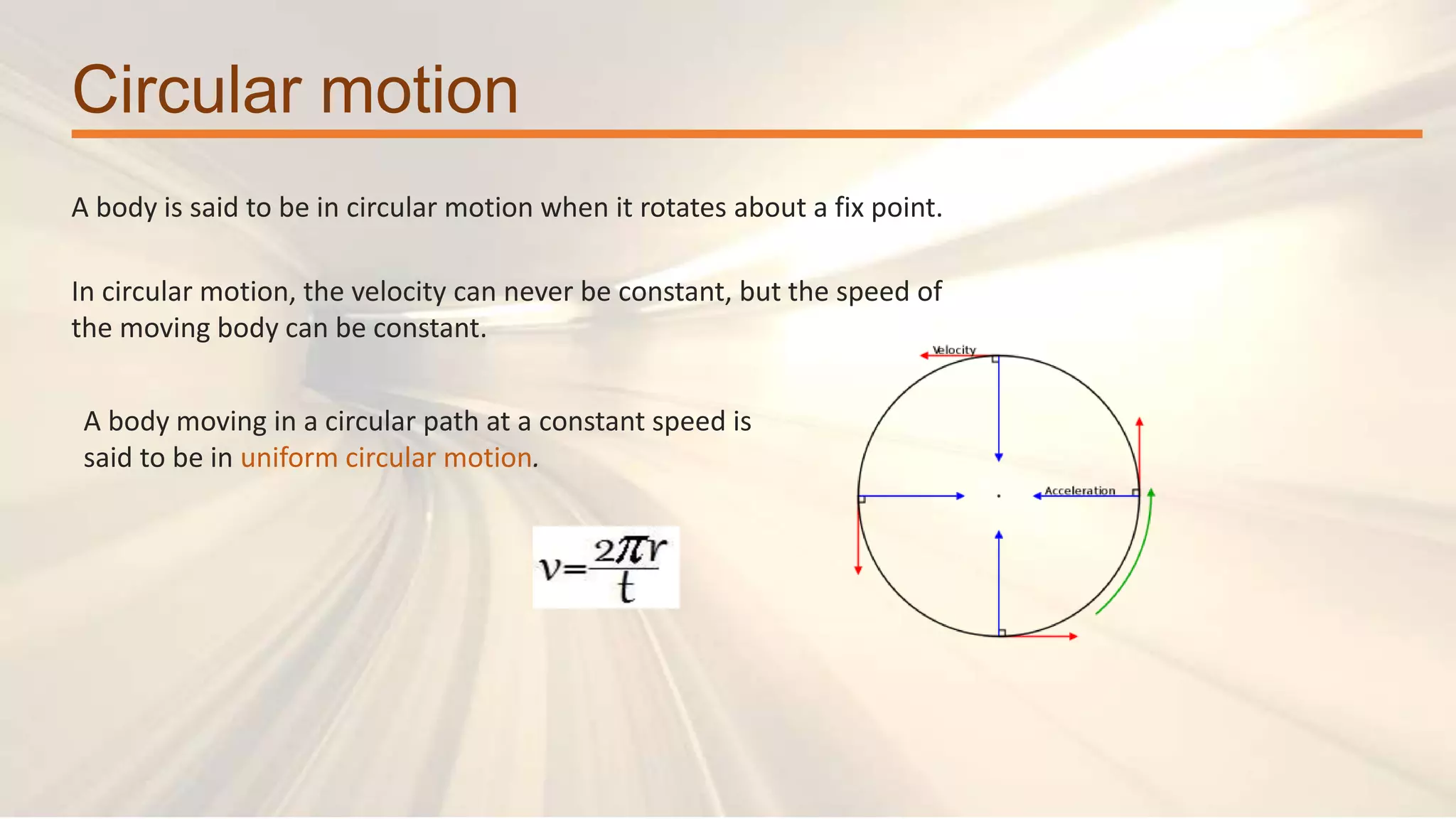
A body is said to be in circular motion when it rotates about a fix point.
In circular motion, the velocity can never be constant, but the speed of
the moving body can be constant.
A body moving in a circular path at a constant speed is
said to be in uniform circular motion.
Thank You

Motion Class 9

  • 1.
    Submitted by :-Milan | 9-A | 22
  • 2.
    Introduction Motion is definedas the change of position of an object with time, with respect to its surroundings. Similarly, an object is at rest when the position of the object does not change with time, with respect to its surroundings. Example :- A moving train is in motion because its position changes with time. Now, consider a person sitting in the train. For someone standing on the platform, the person sitting in the train is in motion. But for the co- passengers, the person is at rest as the position of the person does not change with time. Hence, we need to consider the surroundings or the point of observation while describing the state of motion of an object. The surroundings is called reference frame.
  • 3.
    Types of Motion Motioncan be broadly classified into three main categories: Translatory motion is the motion of a particle in a straight line. A bus travelling on a straight road and an apple falling from a tree are examples of this kind of motion. Rotational motion refers to the motion of a body around a fixed axis. A spinning top, a bead moving on a circular track and Earth’s rotation are examples of this kind of motion. Periodic motion refers to the motion that is repeated in a regular interval of time. An oscillating spring and the motion of a planet around the sun illustrate this type of motion.
  • 4.
    Linear Motion The wordlinear means straight and the word motion means change in position with respect to a frame of reference. So, a body moving in a straight line with respect to a frame of reference is said to be in linear motion. An example of this is the motion of an ant on a straight wire. Points to remember regarding linear motion: • In linear motion, the object must move in a straight line. • The motion of the object along the straight line may not be uniform.
  • 5.
    Uniform motion If abody covers equal distances along a straight line in regular intervals of time, then the motion is said to be uniform. Examples A ball pushed in free space will continue to move uniformly, covering equal distances in equal intervals of time along a straight path.
  • 6.
    Non-uniform motion If abody covers unequal distances in regular intervals of time, then the motion is said to be non-uniform. Examples The ball takes a curved path when thrown. Its direction of motion changes with time. Also, it covers unequal distances in regular intervals of time. So, its motion is non-uniform.
  • 7.
    Physical quantity A physicalquantity is any physical property that can be expressed in numbers. For example, time is a physical quantity as it can be expressed in numbers, but anger is not as it cannot be expressed in numbers. Physical Quantities can be classified in into two types:- Scalar Quantities Vector Quantities
  • 8.
    Scalar Quantities If aphysical quantity can be completely described only by its magnitude, then it is a scalar quantity. To measure the mass of an object, we only have to know how much matter is present in the object. Therefore, mass of an object is a physical quantity that only requires magnitude to be expressed. Therefore, we say that mass is a scalar quantity. We can add scalar quantities by simple arithmetic means.
  • 9.
    Vector Quantities There aresome physical quantities that cannot be completely described only by their magnitudes. These physical quantities require direction along with magnitude. For example, if we consider force, then along with the magnitude of the force, we also have to know the direction along which the force is applied. Therefore, to describe a force, we require both its magnitude and direction. This type of physical quantity is called a vector quantity. Vector quantities cannot be added or subtracted by simple arithmetic means.
  • 10.
    Distance and Displacement Distanceis the length of the path or the path length travelled by a body while moving from an initial position to a final position. It is a scalar quantity. Its SI unit is meter (m). Therefore, only magnitude is important, not the direction of movement. (Implies that path length can never be negative) Displacement is the shortest distance between the initial and final positions of the body. It is a vector quantity. Its SI unit is also meter (m). In displacement, the direction of motion is always directed from the initial position toward the final position.
  • 11.
    Speed Speed is definedas the rate of distance covered by a body. Mathematically, speed is given as: A body travelling from one location to another might stop, slow down, speed up or move at a constant speed. The Average Speed of a body is defined as the total distance travelled divided by the total time taken. Mathematically, average speed is given as:- Speed = Distance Time Average Speed= TotalDistance Total Time
  • 12.
    Velocity When we includethe direction of motion with speed, we are talking of the physical quantity called Velocity. Thus, velocity is speed with direction. Velocity is defined as the rate of change of displacement. It is a vector quantity. Therefore, direction of movement is important. (Implies that velocity contains algebraic sign) Velocity= A body moving from one point to another may change its velocity a number of times, but it will have an average velocity of its journey. Average velocity of a body is defined as the net displacement divided by the total time of travel. It is a vector quantity. Its SI unit is m/s and it can be positive, negative or zero Average velocity =
  • 13.
    Acceleration Acceleration is definedas the rate of change of velocity. It is a vector quantity and its direction is given by the direction of the force causing the acceleration. Suppose the velocity of a car is u at time t1. Later, at time t2, its velocity becomes v. Change in velocity = v − u Time interval = t2 − t1 Mathematically, acceleration is given as: Acceleration= Change in velocity Time Taken
  • 14.
    Uniform and NonUniform Acceleration If the rate of change of velocity remains constant, then the acceleration is uniform. Examples of uniform acceleration include a ball under free fall, a ball rolling on an inclined plane and a car accelerating on a straight, traffic-free road. If the rate of change of velocity changes with time, then the acceleration is non-uniform. Examples of non-uniform acceleration is a car accelerating on a straight road with traffic.
  • 15.
    First Equation ofMotion The first equation of motion is v=u + at. It gives the velocity acquired by a body in time t. Consider a body having initial velocity u. Suppose it is subjected to a uniform acceleration a so that after time t its final velocity becomes v. Now, from the definition of acceleration we know that; Acceleration = Change in velocity Total Time —> Acceleration = Final velocity –Initial velocity Total Time —> a = v – u t —> at=v – u v=u + at
  • 16.
    Second Equation ofMotion The second equation of motion is s = ut + 1at2 . 2 It gives the distance traveled by a body in time t. Consider a body having initial velocity u and a uniform acceleration a for time t so that its final velocity becomes v. .Let the distance traveled by the body in this time s. The distance travelled by a moving body in time t can be found out by considering its average velocity. Since the initial velocity of the body is u and its final; velocity is v ,the average velocity is given by: —> Average velocity=Initial velocity+ final velocity Total Time —> Average velocity=u + v t
  • 17.
    Distance travelled= averagevelocity x Time —> S=(u + v) x t 2 From the first equation of motion we have ,v=u + at. Putting the value of v in equation (1), we get —> S=(u+ u+ at) x t 2 —> S=2ut+ at2 2 S= ut+1at2 2
  • 18.
    The third equationof motion is v2=u2+2as. It gives the velocity acquired by a body in traveling a distance ‘s’. Third Equation of Motion The third equation of motion can be obtained by eliminating t between the first two equation of motion. From second equation of motion we have; S=ut+1at2 2 ……………..(1) Consider a body having initial velocity ‘u’ and a uniform acceleration ‘a’ for time ‘t’ so that its final velocity becomes ‘v’. .Let the distance traveled by the body in this time ‘s’. The distance travelled by a moving body in time ‘t’ can be found out by considering its average velocity. Since the initial velocity of the body is ‘u’ and its final; velocity is ‘v’ ,the average velocity is given by:
  • 19.
    And from thefirst equation of motion we have; v=u + at This can be rearranged and written as at=v - u —> t=v – u a Putting the value of t in equation (1)we get; S = u (v-u/a)+ (1/2)a(v-u/a)2 —> S = 2uv-2u2+v2+u2-2uv 2a —> 2as = v2-u2 v2=u2+2as
  • 20.
    Circular motion A bodyis said to be in circular motion when it rotates about a fix point. In circular motion, the velocity can never be constant, but the speed of the moving body can be constant. A body moving in a circular path at a constant speed is said to be in uniform circular motion.
  • 21.