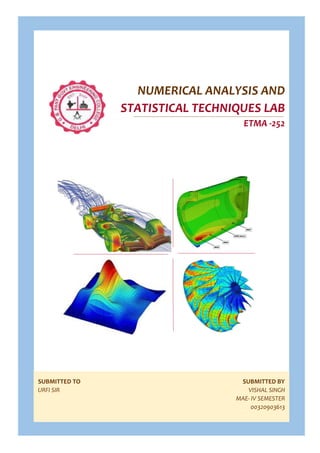
NUMERICAL ANALYSIS AND
STATISTICAL TECHNIQUES LAB
ETMA -252
SUBMITTED TO SUBMITTED BY
URFI SIR VISHAL SINGH
MAE- IV SEMESTER
00320903613
V i s h a l S i n g h ( 0 0 3 2 0 9 0 3 6 1 3 ) |i
INDEX
S. No. Name of the Experiment Page
No.
Date Remarks
1 To write a program in C language for finding the Largest
Number out of three integers. 1
2 Describe the different type of constant and variables in
‘C’. 3
3 To write a program in C language for finding Sum and
Average of ‘n’ integer numbers. 5
4 To write a program in C language for finding the Roots of
given Quadratic Equation. 7
5 To write a program in C language for finding sum of
series of function Sin(x) up to 5th
term. 10
6 To write a program in C language for finding value of
function at given value of argument on the basis of given
data by using Newton’s Divided Difference method.
13
7 To write a program in C language for finding value of
function at given value of argument on the basis of given
data by using Lagrange’s Method.
16
8 To write a program in C language for calculating value of
integration within given limits and number of intervals by
Trapezoidal Rule.
19
9 To write a program in C language for calculating the
value of integration within given limits and number of
intervals by Simpson’s 1/3rd
and 3/8th
Rule.
22
10 To write a program in C language for solving
simultaneous equation in ‘n’ variables by using Gauss
Elimination Method.
25
11 To write a program in C language for solving
simultaneous equation in ‘n’ variables by using Gauss
Siedal Method.
29
12 To write a program in C language for solving given
differential equation by Runge-Kutta Method. 32
13 To write a program in C language for solving given
differential equation (dy/dx=-0.01y) and find the amount
of radioactive material left given initial amount and final
time by Modified Euler Method.
35
14 To write a program in C language for solving a linear or
transcendental equation by Newton-Raphson Method. 38
V i s h a l S i n g h ( 0 0 3 2 0 9 0 3 6 1 3 ) |1
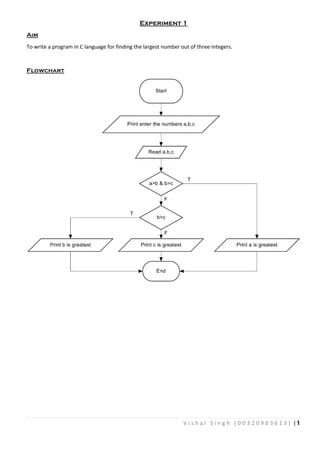
Experiment 1
Aim
To write a program in C language for finding the largest number out of three integers.
Flowchart
V i s h a l S i n g h ( 0 0 3 2 0 9 0 3 6 1 3 ) |2
Program
#include<stdio.h>
#include<conio.h>
int main()
{
inta,b,c;
printf("n enter the numbers a,b,c n");
scanf("%d%d%d",&a,&b,&c);
if(a>b&&a>c)
printf("a=%d is greatest ",a);
else
{
if(b>c)
{
printf("b=%d is greatest ",b);
}
else
printf("c=%d is greatest ",c);
}
getch();
return 0;
}
Output
V i s h a l S i n g h ( 0 0 3 2 0 9 0 3 6 1 3 ) |3
Experiment 2
Aim
Describe the different type of constant and variables in ‘C’.
Theory
Variables
Variables are memory location in computer's memory to store data. To indicate the memory location,
each variable should be given a unique name called identifier. Variable names are just the symbolic
representation of a memory location.
Examples of variable name: sum, car no., count etc.
In C, variables can be classified as:
 Numeric variables
Numeric variables can either be of the type integer (int) or of the type real (float). Integer (int) values are
whole numbers (like 10 or -10). Real (float) values can have a decimal point in them. (Like 1.23 or -
20.123).
 Character variables
Character variables are letters of the alphabet, ASCII characters or numbers 0-9. If you declare a character
variable you must always put the character between single quotes (like so ‘A’). So remember a number
without single quotes is not the same as a character with single quotes.
Constants
Constants are the terms that can't be changed during the execution of a program. For example: 1, 2.5,
"Programming is easy." etc.
In C, constants can be classified as:
 Integer constants
Integer constants are the numeric constants (constant associated with number) without any
fractional part or exponential part. There are three types of integer constants in C language:
Decimal constant (base 10), octal constant (base 8) and hexadecimal constant (base 16).
V i s h a l S i n g h ( 0 0 3 2 0 9 0 3 6 1 3 ) |4
 Floating-point constants
Floating point constants are the numeric constants that has either fractional form or exponent
form.
For example: -2.0, 0.0000234,-0.22E-5
 Character constants
Character constants are the constant which use single quotation around characters. For
example: 'a', 'l', 'm', 'F' etc.
 String constants
String constants are the constants which are enclosed in a pair of double-quote marks. For
example:
"Good" //string constant
" " //string constant of six white space
"x" //string constant having single character.
"Earth is roundn" //prints string with newline
 Enumeration constants
Keyword enum is used to declare enumeration types. For example
enum color {yellow, green, black, white};
Result
The different types variables and constant in ‘C’ programming language has been studied.
V i s h a l S i n g h ( 0 0 3 2 0 9 0 3 6 1 3 ) |5
Experiment 3
Aim
To write a program in C language for finding Sum and Average of ‘n’ integer numbers.
Flowchart
V i s h a l S i n g h ( 0 0 3 2 0 9 0 3 6 1 3 ) |6
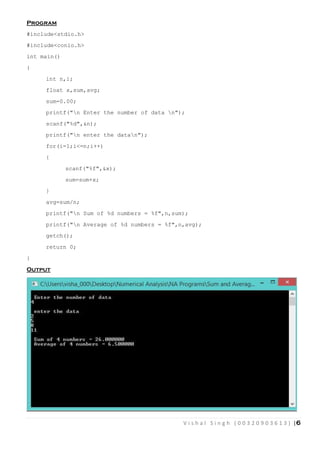
Program
#include<stdio.h>
#include<conio.h>
int main()
{
int n,i;
float x,sum,avg;
sum=0.00;
printf("n Enter the number of data n");
scanf("%d",&n);
printf("n enter the datan");
for(i=1;i<=n;i++)
{
scanf("%f",&x);
sum=sum+x;
}
avg=sum/n;
printf("n Sum of %d numbers = %f",n,sum);
printf("n Average of %d numbers = %f",n,avg);
getch();
return 0;
}
Output
V i s h a l S i n g h ( 0 0 3 2 0 9 0 3 6 1 3 ) |7
Experiment 4
Aim
To write a program in C language for finding the Roots of given Quadratic Equation
Flowchart
V i s h a l S i n g h ( 0 0 3 2 0 9 0 3 6 1 3 ) |8
Program
#include<stdio.h>
#include<math.h>
#include<conio.h>
int main()
{
int a,b,c;
float d,x1,x2;
printf("n enter the value of coefficients a,b,c n");
scanf("%d%d%d",&a,&b,&c);
printf("n Quadratic equation is");
printf("n %dx^2+%dx+%d=0",a,b,c);
d=pow(b,2)-4*a*c;
printf("n value of d=%f",d);
if(d==0)
{
printf("Roots are real and equal");
x1=-b/(2*a);
printf("n Roots are x1=x2=%f",x1);
}
else
{
if(d>0)
{
printf("n Roots are real and unequal");
x1=(-b+pow(d,0.5))/2*a;
x2=(-b-pow(d,0.5))/2*a;
printf("n Roots are x1=%f,x2=%f",x1,x2);
}
else
{
printf("n Roots are not equal");
x1=-b/(2*a);
x2=(pow(-d,0.5))/2*a;
printf("n Roots are n x1=%f-%fi",x1,x2);
V i s h a l S i n g h ( 0 0 3 2 0 9 0 3 6 1 3 ) |9
printf("n x2=%f+%fi",x1,x2);
}
}
getch();
return 0;
}
Output
V i s h a l S i n g h ( 0 0 3 2 0 9 0 3 6 1 3 ) |10
Experiment 5
Aim
To write a program in C language for finding sum of series of function Sin(x) up to 5th
term.
Flowchart
V i s h a l S i n g h ( 0 0 3 2 0 9 0 3 6 1 3 ) |11
Program
#include<stdio.h>
#include<math.h>
#include<conio.h>
int main()
{
int fact(int);
int i;
float x,s;
s=0.00;
printf("n enter the value of xn");
scanf("%f",&x);
for(i=1;i<=5;i++)
{
s=s+(pow(-1,i+1)*pow(x,(2*i)-1))/fact((2*i)-1);
}
printf("n sum of series = %f",s);
getch();
return 0;
}
int fact(int m)
{
int f;
f=1;
if(m==1)
return (f);
else
f=m*fact(m-1);
return (f);
}
V i s h a l S i n g h ( 0 0 3 2 0 9 0 3 6 1 3 ) |12
Output
V i s h a l S i n g h ( 0 0 3 2 0 9 0 3 6 1 3 ) |13
Experiment 6
Aim
To write a program in C language for finding value of function at given value of argument on the basis of given
data by using Newton’s Divided Difference method.
Flowchart
V i s h a l S i n g h ( 0 0 3 2 0 9 0 3 6 1 3 ) |14
Program
#include<stdio.h>
#include<conio.h>
int main()
{
int n,i,j;
float x[100],fx[100],xp,fxd[100],fxdj,t,fact,fxp;
printf("n Enter the number of known pointsn");
scanf("%d",&n);
printf("n Enter the points with their valuen");
for(i=0;i<n;i++)
{
printf("n Enter the %dst term n",i+1);
scanf("%f%f",&x[i],&fx[i]);
}
printf("n Enter the point at which value of function is requiredn");
scanf("%f",&xp);
for(i=0;i<n;i++)
{
fxd[i]=fx[i];;
}
fxp=fx[0];
fact=1.0;
for(i=1;i<n;i++)
{
t=fxd[i-1];
for(j=i;j<n;j++)
{
fxdj=(fxd[j]-t)/(x[j]-x[j-i]);
printf("n%f",fxdj);
t=fxd[j];
fxd[j]=fxdj;
}
fact=fact*(xp-x[i-1]);
fxp=fxp+(fxd[i]*fact);
V i s h a l S i n g h ( 0 0 3 2 0 9 0 3 6 1 3 ) |15
printf("n");
}
printf("n The value of function at %f=%f",xp,fxp);
getch();
}
Output
V i s h a l S i n g h ( 0 0 3 2 0 9 0 3 6 1 3 ) |16
Experiment 7
Aim
To write a program in C language for finding value of function at given value of argument on the basis of given
data by using Lagrange’s Method.
Flowchart
V i s h a l S i n g h ( 0 0 3 2 0 9 0 3 6 1 3 ) |17
Program
#include<stdio.h>
#include<conio.h>
int main()
{
int n,i,j;
float x[100],fx[100],xp,N,D,fxp;
printf("n How many data inputs are to be enteredn");
scanf("%d",&n);
printf("n Enter the value ofn tx[i]tfx[i]");
for(i=0;i<n;i++)
{
printf("n %d t",i+1);
scanf("%f%f",&x[i],&fx[i]);
}
fxp=0.0;
printf("n Enter the point at which value of function is requiredn");
scanf("%f",&xp);
for(i=0;i<n;i++)
{
N=D=1.0;
for(j=0;j<n;j++)
{
if(i==j)
continue;
N=N*(xp-x[j]);
D=D*(x[i]-x[j]);
}
fxp=fxp+(N/D)*fx[i];
}
printf("n The value of function at x=%0.2f is calculated as fx=%0.4f",xp,fxp);
getch();
return 0;
}
V i s h a l S i n g h ( 0 0 3 2 0 9 0 3 6 1 3 ) |18
Output
V i s h a l S i n g h ( 0 0 3 2 0 9 0 3 6 1 3 ) |19
Experiment 8
Aim
To write a program in C language for calculating value of integration within given limits and number of intervals
by Trapezoidal Rule.
Flowchart
V i s h a l S i n g h ( 0 0 3 2 0 9 0 3 6 1 3 ) |20
Program
#include<stdio.h>
#include<conio.h>
#include<math.h>
int main()
{
int n,i;
float x[100],fx[100],a,b,h,S;
printf("n Enter the initial & final limitn");
scanf("%f%f",&a,&b);
printf("n Enter the number of intervals n");
scanf("%d",&n);
h=(b-a)/n;
for(i=0;i<=n;i++)
{
x[i]=a+i*h;
fx[i]=sin(x[i]);
printf("n x=%ft fx=%f",x[i],fx[i]);
}
S=fx[0]+fx[n];
for(i=0;i<n;i++)
{
S=S+(2.0*fx[i]);
}
S=0.5*h*S;
printf("n The value of integration=%f",S);
getch();
}
V i s h a l S i n g h ( 0 0 3 2 0 9 0 3 6 1 3 ) |21
Output
V i s h a l S i n g h ( 0 0 3 2 0 9 0 3 6 1 3 ) |22
Experiment 9
Aim
To write a program in C language for calculating the value of integration within given limits and number of
intervals by Simpson’s 1/3rd
and 3/8th
Rule.
Flowchart
V i s h a l S i n g h ( 0 0 3 2 0 9 0 3 6 1 3 ) |23
Program
#include<stdio.h>
#include<conio.h>
int main()
{
int n,i,t;
float x[100],fx[100],a,b,h,s;
printf("n Enter the initial & final limitn");
scanf("%f%f",&a,&b);
printf("n Enter the number of intervals n");
scanf("%d",&n);
h=(b-a)/n;
printf("ntx[i]ttfx[i]");
for(i=0;i<=n;i++)
{
x[i]=a+(i*h);
fx[i]=1/(1+x[i]);
printf("n %dt%ft%f",i,x[i],fx[i]);
}
s=fx[0]+fx[n];
printf("n Enter 1 to solve by simpson's 1/3rd rulen Any other key to
solve by simpson's 3/8th rule n");
scanf("%d",&t);
if(t==1)
{
for(i=1;i<n;i+=2)
{
s=s+4.0*fx[i];
}
for(i=2;i<n;i+=2)
{
s=s+2.0*fx[i];
}
s=(1.0/3.0)*h*s;
printf("n The value of integration by 1/3 rule=%f",s);
V i s h a l S i n g h ( 0 0 3 2 0 9 0 3 6 1 3 ) |24
}
else
{
for(i=1;i<n;i+=2)
{
if(i%3==0)
{
s=s+2*fx[i];
}
else
{
s=s+3*fx[i];
}
}
s=(3.0/8.0)*h*s;
printf("n The value of integration by 3/8 rule=%f",s);
}
getch();
return 0;
}
Output
V i s h a l S i n g h ( 0 0 3 2 0 9 0 3 6 1 3 ) |25
Experiment 10
Aim
To write a program in C language for solving simultaneous equation in ‘n’ variables by using Gauss Elimination
Method.
Flowchart
V i s h a l S i n g h ( 0 0 3 2 0 9 0 3 6 1 3 ) |26
Program
#include<stdio.h>
#include<conio.h>
int main()
{
int i,j,k,n;
float a[21][21],b[20],c,x[20],S;
printf("Enter the number of unknowns [n<=20]n");
scanf("%d",&n);
printf("Enter the coefficient matrix A n");
for(i=1;i<=n;i++)
{
for(j=1;j<=n;j++)
{
scanf("%f",&a[i][j]);
}
printf("n");
}
printf("Enter the matrix B n");
for(i=1;i<=n;i++)
{
scanf("%f",&b[i]);
printf("n");
}
for(i=1;i<n;i++)
{
for(j=i+1;j<=n;j++)
{
c=a[j][i];
b[j]=b[j]-(b[i]*(c/a[i][i]));
for(k=1;k<=n;k++)
{
a[j][k]=a[j][k]-(a[i][k]*(c/a[i][i]));
}
}
V i s h a l S i n g h ( 0 0 3 2 0 9 0 3 6 1 3 ) |27
}
for(i=1;i<=n;i++)
{
a[i][n+1]=b[i];
}
for(i=1;i<=n;i++)
{
for(j=1;j<=n;j++)
{
printf("%ft",a[i][j]);
}
printf(" | %fn",a[i][n+1]);
}
for(i=0;i<=n;i++)
{
x[i]=0.0;
}
for(i=n;i>0;i--)
{
S=0;
for(j=i+1;j<=n;j++)
{
S=S+(a[i][j]*x[j]);
}
x[i]=a[i][n+1]-S;
x[i]=(x[i]/a[i][i]);
}
printf("The value of the variables are n");
for(i=1;i<=n;i++)
{
printf("The value of x[%d]=%fn",i,x[i]);
}
return 0;
}
V i s h a l S i n g h ( 0 0 3 2 0 9 0 3 6 1 3 ) |28
Output
V i s h a l S i n g h ( 0 0 3 2 0 9 0 3 6 1 3 ) |29
Experiment 11
Aim
To write a program in C language for solving simultaneous equation in ‘n’ variables by using Gauss Siedal Method.
Flowchart
V i s h a l S i n g h ( 0 0 3 2 0 9 0 3 6 1 3 ) |30
Program
#include<stdio.h>
#include<conio.h>
int main()
{
int i,j,k,n;
float a[21][21],b[20],x[20],temp,Sum;
printf("Enter the number of unknowns [n<=20]n");
scanf("%d",&n);
printf("Enter the coefficient matrix A n");
for(i=1;i<=n;i++)
{
for(j=1;j<=n;j++)
{
scanf("%f",&a[i][j]);
}
printf("n");
}
printf("Enter the matrix B n");
for(i=1;i<=n;i++)
{
scanf("%f",&a[i][n+1]);
printf("n");
}
printf("Enter the Initial Approximation n");
for(i=1;i<=n;i++)
{
printf("x[%d] = ",i);
scanf("%f",&x[i]);
printf("n");
}
for(k=1;k<=5;k++)
{
printf("n %d Iteration : ",k);
for(i=1;i<=n;i++)
V i s h a l S i n g h ( 0 0 3 2 0 9 0 3 6 1 3 ) |31
{
Sum=0;
for(j=1;j<=n;j++)
{
if(i!=j)
{
temp=x[j]*a[i][j];
Sum=Sum+temp;
}
}
x[i]=a[i][n+1]-Sum;
x[i]=x[i]/a[i][i];
printf("x[%d] = %0.4ft",i,x[i]);
}
}
return 0;
}
Output
V i s h a l S i n g h ( 0 0 3 2 0 9 0 3 6 1 3 ) |32
Experiment 12
Aim
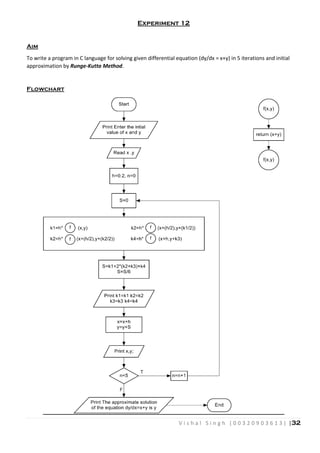
To write a program in C language for solving given differential equation (dy/dx = x+y) in 5 iterations and initial
approximation by Runge-Kutta Method.
Flowchart
V i s h a l S i n g h ( 0 0 3 2 0 9 0 3 6 1 3 ) |33
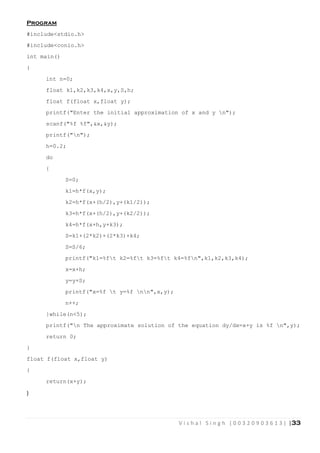
Program
#include<stdio.h>
#include<conio.h>
int main()
{
int n=0;
float k1,k2,k3,k4,x,y,S,h;
float f(float x,float y);
printf("Enter the initial approximation of x and y n");
scanf("%f %f",&x,&y);
printf("n");
h=0.2;
do
{
S=0;
k1=h*f(x,y);
k2=h*f(x+(h/2),y+(k1/2));
k3=h*f(x+(h/2),y+(k2/2));
k4=h*f(x+h,y+k3);
S=k1+(2*k2)+(2*k3)+k4;
S=S/6;
printf("k1=%ft k2=%ft k3=%ft k4=%fn",k1,k2,k3,k4);
x=x+h;
y=y+S;
printf("x=%f t y=%f nn",x,y);
n++;
}while(n<5);
printf("n The approximate solution of the equation dy/dx=x+y is %f n",y);
return 0;
}
float f(float x,float y)
{
return(x+y);
}
V i s h a l S i n g h ( 0 0 3 2 0 9 0 3 6 1 3 ) |34
Output
V i s h a l S i n g h ( 0 0 3 2 0 9 0 3 6 1 3 ) |35
Experiment13
Aim
To write a program in C language for solving given differential equation (dy/dx=-0.01y) and find the amount of
radioactive material left given initial amount and final time by Modified Euler Method.
Flowchart
V i s h a l S i n g h ( 0 0 3 2 0 9 0 3 6 1 3 ) |36
Program
#include<stdio.h>
#include<conio.h>
int main()
{
int n,k;
float x,y,temp,f1,f2,S,h;
float f(float x,float y);
printf("Enter initial amount of radioactive substance and final value of
time(Sec) n");
scanf("%f %f",&y,&x);
printf("n");
h=25;
k=x/h;
x=0;
n=0;
printf("time=%f t Radioactive substance=%f n",x,y);
do
{
S=0;
f1=f(x,y);
temp=y+(h*f1);
f2=f(x+h,temp);
S=f1+f2;
S=S*h/2;
y=y+S;
x=x+h;
printf("time=%0.2f t Radioactive substance=%f n",x,y);
n++;
}while(n<k);
printf("n The final amount of radioactive material after time %0.2f sec is
%f n",x,y);
return 0;
}
V i s h a l S i n g h ( 0 0 3 2 0 9 0 3 6 1 3 ) |37
float f(float x,float y)
{
return(-0.01*y);
}
Output
V i s h a l S i n g h ( 0 0 3 2 0 9 0 3 6 1 3 ) |38
Experiment 14
Aim
To write a program in C language for solving a linear or transcendental equation by Newton-Raphson Method.
Flowchart
V i s h a l S i n g h ( 0 0 3 2 0 9 0 3 6 1 3 ) |39
Program
#include<stdio.h>
#include<conio.h>
#include<math.h>
int main()
{
int i;
float x1,x2,f1,f2;
printf("Enter the intitial approxiamtionn");
scanf("%f",&x1);
x2=x1;
for(i=0;;i++)
{
x1=x2;
f1=pow(x1,2)-9;
f2=(2*x1);
x2=x1-(f1/f2);
if(abs(x2-x1)<0.001)
break;
}
printf("The Solution for the given equation is %f",x2);
return 0;
}
Output

Numerical analysis

  • 1.
    NUMERICAL ANALYSIS AND STATISTICALTECHNIQUES LAB ETMA -252 SUBMITTED TO SUBMITTED BY URFI SIR VISHAL SINGH MAE- IV SEMESTER 00320903613
  • 2.
    V i sh a l S i n g h ( 0 0 3 2 0 9 0 3 6 1 3 ) |i INDEX S. No. Name of the Experiment Page No. Date Remarks 1 To write a program in C language for finding the Largest Number out of three integers. 1 2 Describe the different type of constant and variables in ‘C’. 3 3 To write a program in C language for finding Sum and Average of ‘n’ integer numbers. 5 4 To write a program in C language for finding the Roots of given Quadratic Equation. 7 5 To write a program in C language for finding sum of series of function Sin(x) up to 5th term. 10 6 To write a program in C language for finding value of function at given value of argument on the basis of given data by using Newton’s Divided Difference method. 13 7 To write a program in C language for finding value of function at given value of argument on the basis of given data by using Lagrange’s Method. 16 8 To write a program in C language for calculating value of integration within given limits and number of intervals by Trapezoidal Rule. 19 9 To write a program in C language for calculating the value of integration within given limits and number of intervals by Simpson’s 1/3rd and 3/8th Rule. 22 10 To write a program in C language for solving simultaneous equation in ‘n’ variables by using Gauss Elimination Method. 25 11 To write a program in C language for solving simultaneous equation in ‘n’ variables by using Gauss Siedal Method. 29 12 To write a program in C language for solving given differential equation by Runge-Kutta Method. 32 13 To write a program in C language for solving given differential equation (dy/dx=-0.01y) and find the amount of radioactive material left given initial amount and final time by Modified Euler Method. 35 14 To write a program in C language for solving a linear or transcendental equation by Newton-Raphson Method. 38
  • 3.
    V i sh a l S i n g h ( 0 0 3 2 0 9 0 3 6 1 3 ) |1 Experiment 1 Aim To write a program in C language for finding the largest number out of three integers. Flowchart
  • 4.
    V i sh a l S i n g h ( 0 0 3 2 0 9 0 3 6 1 3 ) |2 Program #include<stdio.h> #include<conio.h> int main() { inta,b,c; printf("n enter the numbers a,b,c n"); scanf("%d%d%d",&a,&b,&c); if(a>b&&a>c) printf("a=%d is greatest ",a); else { if(b>c) { printf("b=%d is greatest ",b); } else printf("c=%d is greatest ",c); } getch(); return 0; } Output
  • 5.
    V i sh a l S i n g h ( 0 0 3 2 0 9 0 3 6 1 3 ) |3 Experiment 2 Aim Describe the different type of constant and variables in ‘C’. Theory Variables Variables are memory location in computer's memory to store data. To indicate the memory location, each variable should be given a unique name called identifier. Variable names are just the symbolic representation of a memory location. Examples of variable name: sum, car no., count etc. In C, variables can be classified as:  Numeric variables Numeric variables can either be of the type integer (int) or of the type real (float). Integer (int) values are whole numbers (like 10 or -10). Real (float) values can have a decimal point in them. (Like 1.23 or - 20.123).  Character variables Character variables are letters of the alphabet, ASCII characters or numbers 0-9. If you declare a character variable you must always put the character between single quotes (like so ‘A’). So remember a number without single quotes is not the same as a character with single quotes. Constants Constants are the terms that can't be changed during the execution of a program. For example: 1, 2.5, "Programming is easy." etc. In C, constants can be classified as:  Integer constants Integer constants are the numeric constants (constant associated with number) without any fractional part or exponential part. There are three types of integer constants in C language: Decimal constant (base 10), octal constant (base 8) and hexadecimal constant (base 16).
  • 6.
    V i sh a l S i n g h ( 0 0 3 2 0 9 0 3 6 1 3 ) |4  Floating-point constants Floating point constants are the numeric constants that has either fractional form or exponent form. For example: -2.0, 0.0000234,-0.22E-5  Character constants Character constants are the constant which use single quotation around characters. For example: 'a', 'l', 'm', 'F' etc.  String constants String constants are the constants which are enclosed in a pair of double-quote marks. For example: "Good" //string constant " " //string constant of six white space "x" //string constant having single character. "Earth is roundn" //prints string with newline  Enumeration constants Keyword enum is used to declare enumeration types. For example enum color {yellow, green, black, white}; Result The different types variables and constant in ‘C’ programming language has been studied.
  • 7.
    V i sh a l S i n g h ( 0 0 3 2 0 9 0 3 6 1 3 ) |5 Experiment 3 Aim To write a program in C language for finding Sum and Average of ‘n’ integer numbers. Flowchart
  • 8.
    V i sh a l S i n g h ( 0 0 3 2 0 9 0 3 6 1 3 ) |6 Program #include<stdio.h> #include<conio.h> int main() { int n,i; float x,sum,avg; sum=0.00; printf("n Enter the number of data n"); scanf("%d",&n); printf("n enter the datan"); for(i=1;i<=n;i++) { scanf("%f",&x); sum=sum+x; } avg=sum/n; printf("n Sum of %d numbers = %f",n,sum); printf("n Average of %d numbers = %f",n,avg); getch(); return 0; } Output
  • 9.
    V i sh a l S i n g h ( 0 0 3 2 0 9 0 3 6 1 3 ) |7 Experiment 4 Aim To write a program in C language for finding the Roots of given Quadratic Equation Flowchart
  • 10.
    V i sh a l S i n g h ( 0 0 3 2 0 9 0 3 6 1 3 ) |8 Program #include<stdio.h> #include<math.h> #include<conio.h> int main() { int a,b,c; float d,x1,x2; printf("n enter the value of coefficients a,b,c n"); scanf("%d%d%d",&a,&b,&c); printf("n Quadratic equation is"); printf("n %dx^2+%dx+%d=0",a,b,c); d=pow(b,2)-4*a*c; printf("n value of d=%f",d); if(d==0) { printf("Roots are real and equal"); x1=-b/(2*a); printf("n Roots are x1=x2=%f",x1); } else { if(d>0) { printf("n Roots are real and unequal"); x1=(-b+pow(d,0.5))/2*a; x2=(-b-pow(d,0.5))/2*a; printf("n Roots are x1=%f,x2=%f",x1,x2); } else { printf("n Roots are not equal"); x1=-b/(2*a); x2=(pow(-d,0.5))/2*a; printf("n Roots are n x1=%f-%fi",x1,x2);
  • 11.
    V i sh a l S i n g h ( 0 0 3 2 0 9 0 3 6 1 3 ) |9 printf("n x2=%f+%fi",x1,x2); } } getch(); return 0; } Output
  • 12.
    V i sh a l S i n g h ( 0 0 3 2 0 9 0 3 6 1 3 ) |10 Experiment 5 Aim To write a program in C language for finding sum of series of function Sin(x) up to 5th term. Flowchart
  • 13.
    V i sh a l S i n g h ( 0 0 3 2 0 9 0 3 6 1 3 ) |11 Program #include<stdio.h> #include<math.h> #include<conio.h> int main() { int fact(int); int i; float x,s; s=0.00; printf("n enter the value of xn"); scanf("%f",&x); for(i=1;i<=5;i++) { s=s+(pow(-1,i+1)*pow(x,(2*i)-1))/fact((2*i)-1); } printf("n sum of series = %f",s); getch(); return 0; } int fact(int m) { int f; f=1; if(m==1) return (f); else f=m*fact(m-1); return (f); }
  • 14.
    V i sh a l S i n g h ( 0 0 3 2 0 9 0 3 6 1 3 ) |12 Output
  • 15.
    V i sh a l S i n g h ( 0 0 3 2 0 9 0 3 6 1 3 ) |13 Experiment 6 Aim To write a program in C language for finding value of function at given value of argument on the basis of given data by using Newton’s Divided Difference method. Flowchart
  • 16.
    V i sh a l S i n g h ( 0 0 3 2 0 9 0 3 6 1 3 ) |14 Program #include<stdio.h> #include<conio.h> int main() { int n,i,j; float x[100],fx[100],xp,fxd[100],fxdj,t,fact,fxp; printf("n Enter the number of known pointsn"); scanf("%d",&n); printf("n Enter the points with their valuen"); for(i=0;i<n;i++) { printf("n Enter the %dst term n",i+1); scanf("%f%f",&x[i],&fx[i]); } printf("n Enter the point at which value of function is requiredn"); scanf("%f",&xp); for(i=0;i<n;i++) { fxd[i]=fx[i];; } fxp=fx[0]; fact=1.0; for(i=1;i<n;i++) { t=fxd[i-1]; for(j=i;j<n;j++) { fxdj=(fxd[j]-t)/(x[j]-x[j-i]); printf("n%f",fxdj); t=fxd[j]; fxd[j]=fxdj; } fact=fact*(xp-x[i-1]); fxp=fxp+(fxd[i]*fact);
  • 17.
    V i sh a l S i n g h ( 0 0 3 2 0 9 0 3 6 1 3 ) |15 printf("n"); } printf("n The value of function at %f=%f",xp,fxp); getch(); } Output
  • 18.
    V i sh a l S i n g h ( 0 0 3 2 0 9 0 3 6 1 3 ) |16 Experiment 7 Aim To write a program in C language for finding value of function at given value of argument on the basis of given data by using Lagrange’s Method. Flowchart
  • 19.
    V i sh a l S i n g h ( 0 0 3 2 0 9 0 3 6 1 3 ) |17 Program #include<stdio.h> #include<conio.h> int main() { int n,i,j; float x[100],fx[100],xp,N,D,fxp; printf("n How many data inputs are to be enteredn"); scanf("%d",&n); printf("n Enter the value ofn tx[i]tfx[i]"); for(i=0;i<n;i++) { printf("n %d t",i+1); scanf("%f%f",&x[i],&fx[i]); } fxp=0.0; printf("n Enter the point at which value of function is requiredn"); scanf("%f",&xp); for(i=0;i<n;i++) { N=D=1.0; for(j=0;j<n;j++) { if(i==j) continue; N=N*(xp-x[j]); D=D*(x[i]-x[j]); } fxp=fxp+(N/D)*fx[i]; } printf("n The value of function at x=%0.2f is calculated as fx=%0.4f",xp,fxp); getch(); return 0; }
  • 20.
    V i sh a l S i n g h ( 0 0 3 2 0 9 0 3 6 1 3 ) |18 Output
  • 21.
    V i sh a l S i n g h ( 0 0 3 2 0 9 0 3 6 1 3 ) |19 Experiment 8 Aim To write a program in C language for calculating value of integration within given limits and number of intervals by Trapezoidal Rule. Flowchart
  • 22.
    V i sh a l S i n g h ( 0 0 3 2 0 9 0 3 6 1 3 ) |20 Program #include<stdio.h> #include<conio.h> #include<math.h> int main() { int n,i; float x[100],fx[100],a,b,h,S; printf("n Enter the initial & final limitn"); scanf("%f%f",&a,&b); printf("n Enter the number of intervals n"); scanf("%d",&n); h=(b-a)/n; for(i=0;i<=n;i++) { x[i]=a+i*h; fx[i]=sin(x[i]); printf("n x=%ft fx=%f",x[i],fx[i]); } S=fx[0]+fx[n]; for(i=0;i<n;i++) { S=S+(2.0*fx[i]); } S=0.5*h*S; printf("n The value of integration=%f",S); getch(); }
  • 23.
    V i sh a l S i n g h ( 0 0 3 2 0 9 0 3 6 1 3 ) |21 Output
  • 24.
    V i sh a l S i n g h ( 0 0 3 2 0 9 0 3 6 1 3 ) |22 Experiment 9 Aim To write a program in C language for calculating the value of integration within given limits and number of intervals by Simpson’s 1/3rd and 3/8th Rule. Flowchart
  • 25.
    V i sh a l S i n g h ( 0 0 3 2 0 9 0 3 6 1 3 ) |23 Program #include<stdio.h> #include<conio.h> int main() { int n,i,t; float x[100],fx[100],a,b,h,s; printf("n Enter the initial & final limitn"); scanf("%f%f",&a,&b); printf("n Enter the number of intervals n"); scanf("%d",&n); h=(b-a)/n; printf("ntx[i]ttfx[i]"); for(i=0;i<=n;i++) { x[i]=a+(i*h); fx[i]=1/(1+x[i]); printf("n %dt%ft%f",i,x[i],fx[i]); } s=fx[0]+fx[n]; printf("n Enter 1 to solve by simpson's 1/3rd rulen Any other key to solve by simpson's 3/8th rule n"); scanf("%d",&t); if(t==1) { for(i=1;i<n;i+=2) { s=s+4.0*fx[i]; } for(i=2;i<n;i+=2) { s=s+2.0*fx[i]; } s=(1.0/3.0)*h*s; printf("n The value of integration by 1/3 rule=%f",s);
  • 26.
    V i sh a l S i n g h ( 0 0 3 2 0 9 0 3 6 1 3 ) |24 } else { for(i=1;i<n;i+=2) { if(i%3==0) { s=s+2*fx[i]; } else { s=s+3*fx[i]; } } s=(3.0/8.0)*h*s; printf("n The value of integration by 3/8 rule=%f",s); } getch(); return 0; } Output
  • 27.
    V i sh a l S i n g h ( 0 0 3 2 0 9 0 3 6 1 3 ) |25 Experiment 10 Aim To write a program in C language for solving simultaneous equation in ‘n’ variables by using Gauss Elimination Method. Flowchart
  • 28.
    V i sh a l S i n g h ( 0 0 3 2 0 9 0 3 6 1 3 ) |26 Program #include<stdio.h> #include<conio.h> int main() { int i,j,k,n; float a[21][21],b[20],c,x[20],S; printf("Enter the number of unknowns [n<=20]n"); scanf("%d",&n); printf("Enter the coefficient matrix A n"); for(i=1;i<=n;i++) { for(j=1;j<=n;j++) { scanf("%f",&a[i][j]); } printf("n"); } printf("Enter the matrix B n"); for(i=1;i<=n;i++) { scanf("%f",&b[i]); printf("n"); } for(i=1;i<n;i++) { for(j=i+1;j<=n;j++) { c=a[j][i]; b[j]=b[j]-(b[i]*(c/a[i][i])); for(k=1;k<=n;k++) { a[j][k]=a[j][k]-(a[i][k]*(c/a[i][i])); } }
  • 29.
    V i sh a l S i n g h ( 0 0 3 2 0 9 0 3 6 1 3 ) |27 } for(i=1;i<=n;i++) { a[i][n+1]=b[i]; } for(i=1;i<=n;i++) { for(j=1;j<=n;j++) { printf("%ft",a[i][j]); } printf(" | %fn",a[i][n+1]); } for(i=0;i<=n;i++) { x[i]=0.0; } for(i=n;i>0;i--) { S=0; for(j=i+1;j<=n;j++) { S=S+(a[i][j]*x[j]); } x[i]=a[i][n+1]-S; x[i]=(x[i]/a[i][i]); } printf("The value of the variables are n"); for(i=1;i<=n;i++) { printf("The value of x[%d]=%fn",i,x[i]); } return 0; }
  • 30.
    V i sh a l S i n g h ( 0 0 3 2 0 9 0 3 6 1 3 ) |28 Output
  • 31.
    V i sh a l S i n g h ( 0 0 3 2 0 9 0 3 6 1 3 ) |29 Experiment 11 Aim To write a program in C language for solving simultaneous equation in ‘n’ variables by using Gauss Siedal Method. Flowchart
  • 32.
    V i sh a l S i n g h ( 0 0 3 2 0 9 0 3 6 1 3 ) |30 Program #include<stdio.h> #include<conio.h> int main() { int i,j,k,n; float a[21][21],b[20],x[20],temp,Sum; printf("Enter the number of unknowns [n<=20]n"); scanf("%d",&n); printf("Enter the coefficient matrix A n"); for(i=1;i<=n;i++) { for(j=1;j<=n;j++) { scanf("%f",&a[i][j]); } printf("n"); } printf("Enter the matrix B n"); for(i=1;i<=n;i++) { scanf("%f",&a[i][n+1]); printf("n"); } printf("Enter the Initial Approximation n"); for(i=1;i<=n;i++) { printf("x[%d] = ",i); scanf("%f",&x[i]); printf("n"); } for(k=1;k<=5;k++) { printf("n %d Iteration : ",k); for(i=1;i<=n;i++)
  • 33.
    V i sh a l S i n g h ( 0 0 3 2 0 9 0 3 6 1 3 ) |31 { Sum=0; for(j=1;j<=n;j++) { if(i!=j) { temp=x[j]*a[i][j]; Sum=Sum+temp; } } x[i]=a[i][n+1]-Sum; x[i]=x[i]/a[i][i]; printf("x[%d] = %0.4ft",i,x[i]); } } return 0; } Output
  • 34.
    V i sh a l S i n g h ( 0 0 3 2 0 9 0 3 6 1 3 ) |32 Experiment 12 Aim To write a program in C language for solving given differential equation (dy/dx = x+y) in 5 iterations and initial approximation by Runge-Kutta Method. Flowchart
  • 35.
    V i sh a l S i n g h ( 0 0 3 2 0 9 0 3 6 1 3 ) |33 Program #include<stdio.h> #include<conio.h> int main() { int n=0; float k1,k2,k3,k4,x,y,S,h; float f(float x,float y); printf("Enter the initial approximation of x and y n"); scanf("%f %f",&x,&y); printf("n"); h=0.2; do { S=0; k1=h*f(x,y); k2=h*f(x+(h/2),y+(k1/2)); k3=h*f(x+(h/2),y+(k2/2)); k4=h*f(x+h,y+k3); S=k1+(2*k2)+(2*k3)+k4; S=S/6; printf("k1=%ft k2=%ft k3=%ft k4=%fn",k1,k2,k3,k4); x=x+h; y=y+S; printf("x=%f t y=%f nn",x,y); n++; }while(n<5); printf("n The approximate solution of the equation dy/dx=x+y is %f n",y); return 0; } float f(float x,float y) { return(x+y); }
  • 36.
    V i sh a l S i n g h ( 0 0 3 2 0 9 0 3 6 1 3 ) |34 Output
  • 37.
    V i sh a l S i n g h ( 0 0 3 2 0 9 0 3 6 1 3 ) |35 Experiment13 Aim To write a program in C language for solving given differential equation (dy/dx=-0.01y) and find the amount of radioactive material left given initial amount and final time by Modified Euler Method. Flowchart
  • 38.
    V i sh a l S i n g h ( 0 0 3 2 0 9 0 3 6 1 3 ) |36 Program #include<stdio.h> #include<conio.h> int main() { int n,k; float x,y,temp,f1,f2,S,h; float f(float x,float y); printf("Enter initial amount of radioactive substance and final value of time(Sec) n"); scanf("%f %f",&y,&x); printf("n"); h=25; k=x/h; x=0; n=0; printf("time=%f t Radioactive substance=%f n",x,y); do { S=0; f1=f(x,y); temp=y+(h*f1); f2=f(x+h,temp); S=f1+f2; S=S*h/2; y=y+S; x=x+h; printf("time=%0.2f t Radioactive substance=%f n",x,y); n++; }while(n<k); printf("n The final amount of radioactive material after time %0.2f sec is %f n",x,y); return 0; }
  • 39.
    V i sh a l S i n g h ( 0 0 3 2 0 9 0 3 6 1 3 ) |37 float f(float x,float y) { return(-0.01*y); } Output
  • 40.
    V i sh a l S i n g h ( 0 0 3 2 0 9 0 3 6 1 3 ) |38 Experiment 14 Aim To write a program in C language for solving a linear or transcendental equation by Newton-Raphson Method. Flowchart
  • 41.
    V i sh a l S i n g h ( 0 0 3 2 0 9 0 3 6 1 3 ) |39 Program #include<stdio.h> #include<conio.h> #include<math.h> int main() { int i; float x1,x2,f1,f2; printf("Enter the intitial approxiamtionn"); scanf("%f",&x1); x2=x1; for(i=0;;i++) { x1=x2; f1=pow(x1,2)-9; f2=(2*x1); x2=x1-(f1/f2); if(abs(x2-x1)<0.001) break; } printf("The Solution for the given equation is %f",x2); return 0; } Output