SAINIK SCHOOL GOPALGANJ
CLASS –IX
CHAPTER –MOTION
BY
Dr A K CHOUBEY (TGT)
CHAPTER 8
MOTION
Motion is defined as the change in
position of body with time.
• To describe the position (location) of an object we
need to specify a reference point called the origin.
• Let us assume that a school in a village is 2 km
north of the railway station. We have specified the
position of the school with respect to the railway
station. In this example, the railway station is the
reference point. We could have also chosen other
reference points according to our convenience.
Concept of Rest and Motion
A body is said to be in rest if its position does not vary with
respect Rest to a given referral point as time passes.
Motion: A body is said to be in motion if there is a
continues change in its position with respect to a given
referral as time passes. Concept of rest and motion is
related to referral change in position so a single object can
be at rest or motion same time with different referral points.
If we consider a single object as referral point and consider
it as rest, as a absolute point any object which is at rest
with respect to that point is considered at rest and same
case with motion. In general we consider Earth as
absolute point considering it at rest, Although It is in motion
with respect to Sun and other planets
Distance And Displacement
The actual path covered during motion of
The Change in position made during a body
It is needed not to be the Shortest path
between two points It is the Scalar quantity
as It does not have any particular direction
motion of a body is known as displacement
It is the shortest path between initial and
final position It is a vector quantity as it is
always directed.
Concept of Rate of Motion:
Rate is defined as ratio of change in two
quantities Rate is of two types . Average
Rate of quantity A with respect to B net
change in A net change in B
.lnstantaneous Rate is rate at an Instant
that is for very short interval of time.
.Speed, Velocity and Acceleration are
examples of Rate. Speed=Distance/Time
Average Speed =Total Distance
Travelled/Total Time Taken
Uniform and non Uniform motion
• Uniform Motion- If a body travels equal
distance in equal intervals of time then it is in
uniform motion
• Non-uniform motion- If a body travels unequal
distance in equal intervals of time then it is in
uniform motion
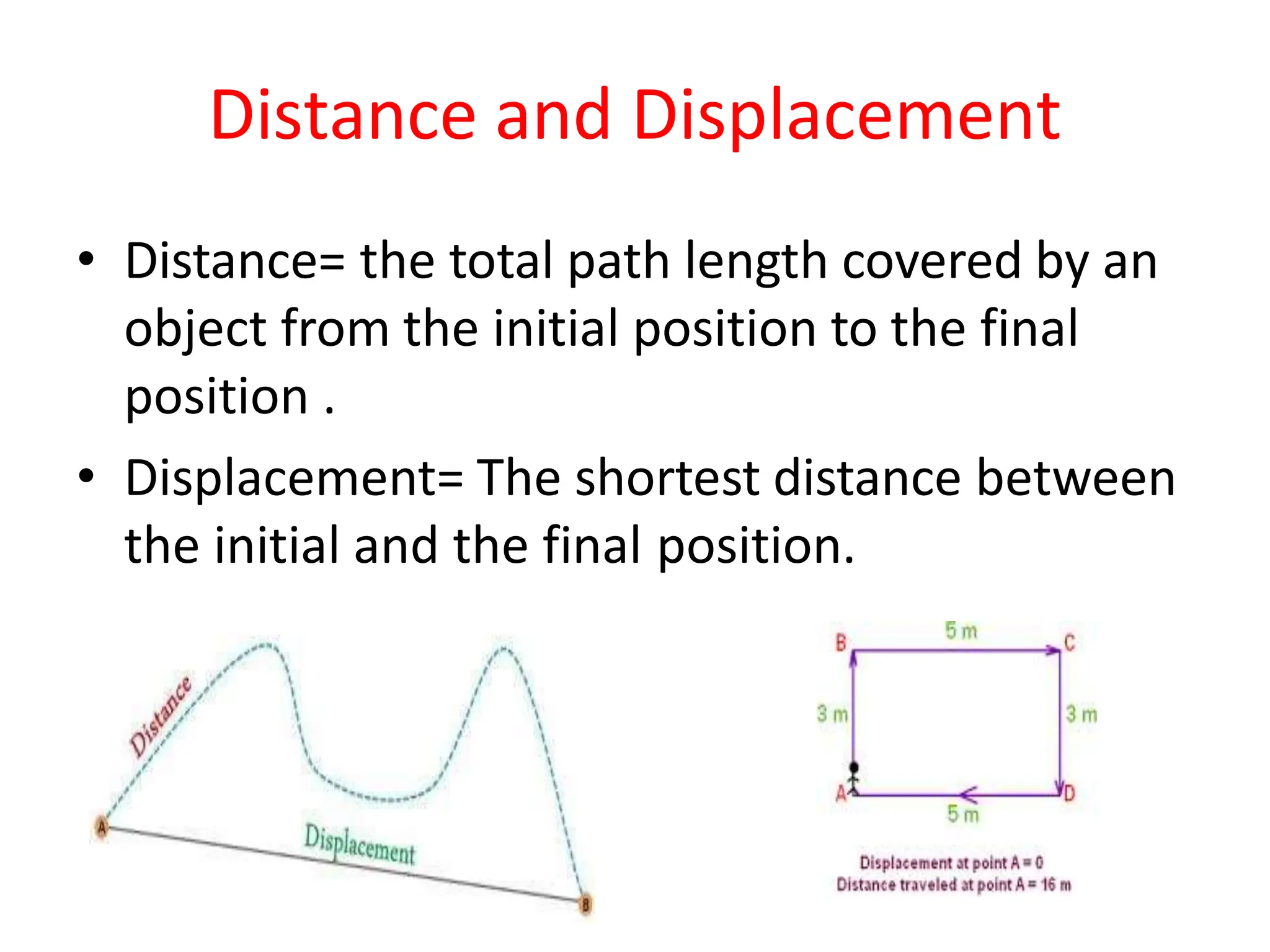
Distance and Displacement
• Distance= the total path length covered by an
object from the initial position to the final
position .
• Displacement= The shortest distance between
the initial and the final position.
Measuring the Rate of Motion- Different
objects may take different amounts of time to
cover a given distance. Some of them move
fast and some move slowly. One of the ways of
measuring the rate of motion of an object is to
find out the distance travelled by the object in
unit time. This quantity is referred to as speed.
Speed=Distance/Time
Average Speed =total distance travelled/Total
time taken
Velocity
The rate of motion is more meaningful if we
specify if we specify its direction of motion with
speed, which is termed as velocity.
It is a vector quantity.
Velocity=Dispalcement/Time
Average velocity= Total Dispalcement/Total Time
=v+u/2
ACCELERATION
The quantity which specifies changes in
velocity is acceleration.
Acceleration :- It is the change in velocity of a
body per unit time. ( or
the rate of change of velocity.)
Acceleration = Change in velocity/
Time
If the velocity of a body changes from initial
value u to final value v in
time t, then acceleration a is
a = v – u/t .The SI unit of acceleration is ms - 2
Acceleration
• The rate of change of velocity is termed as
acceleration. (During non-uniform motion)
• Acceleration =a=v-u/t
• Its SI unit is m/s2
• Uniform acceleration-When the change in
velocity is equal in equal intervals of time.
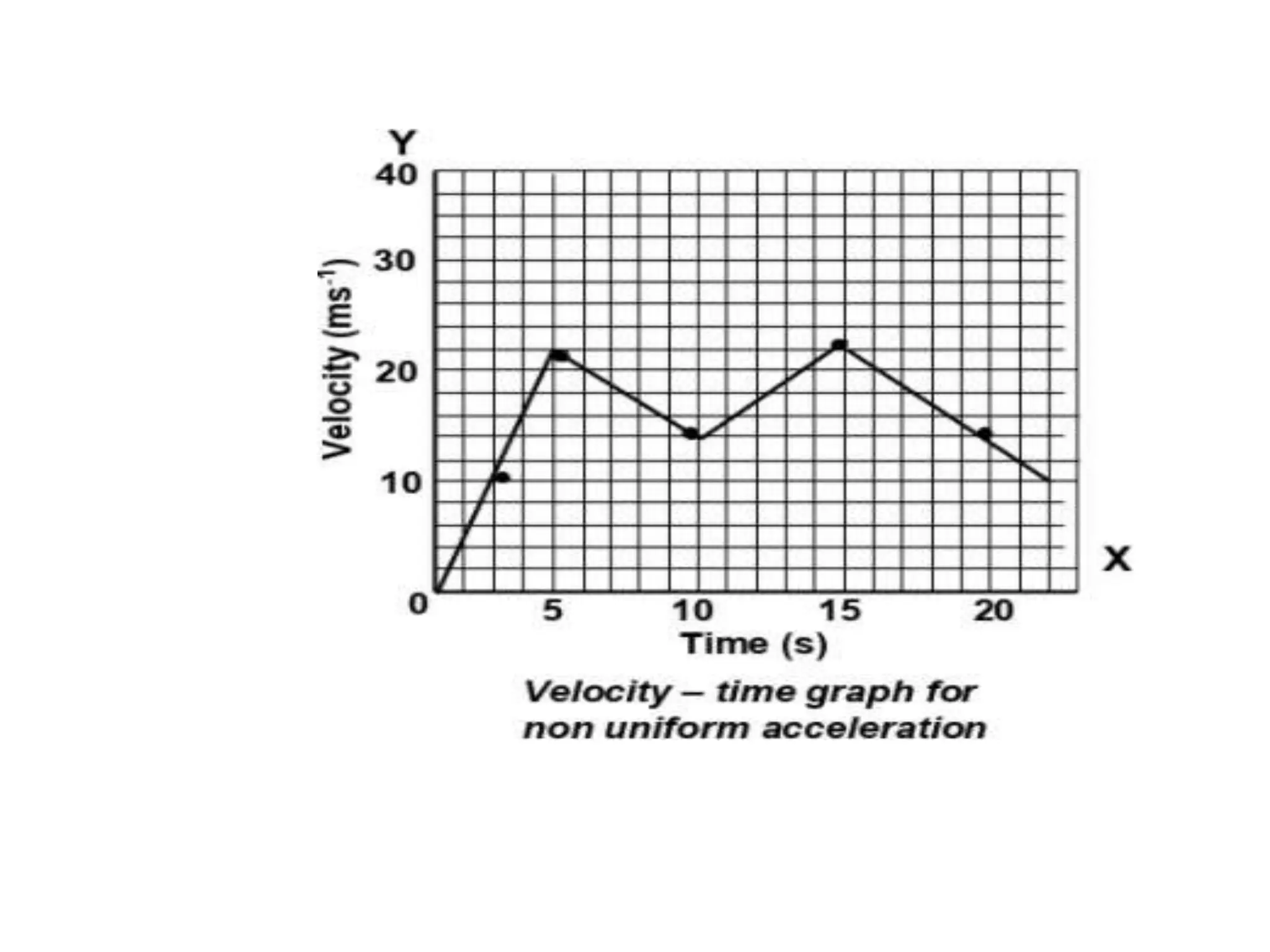
• Non-Uniform acceleration-When the change
in velocity is unequal in equal intervals of
time.
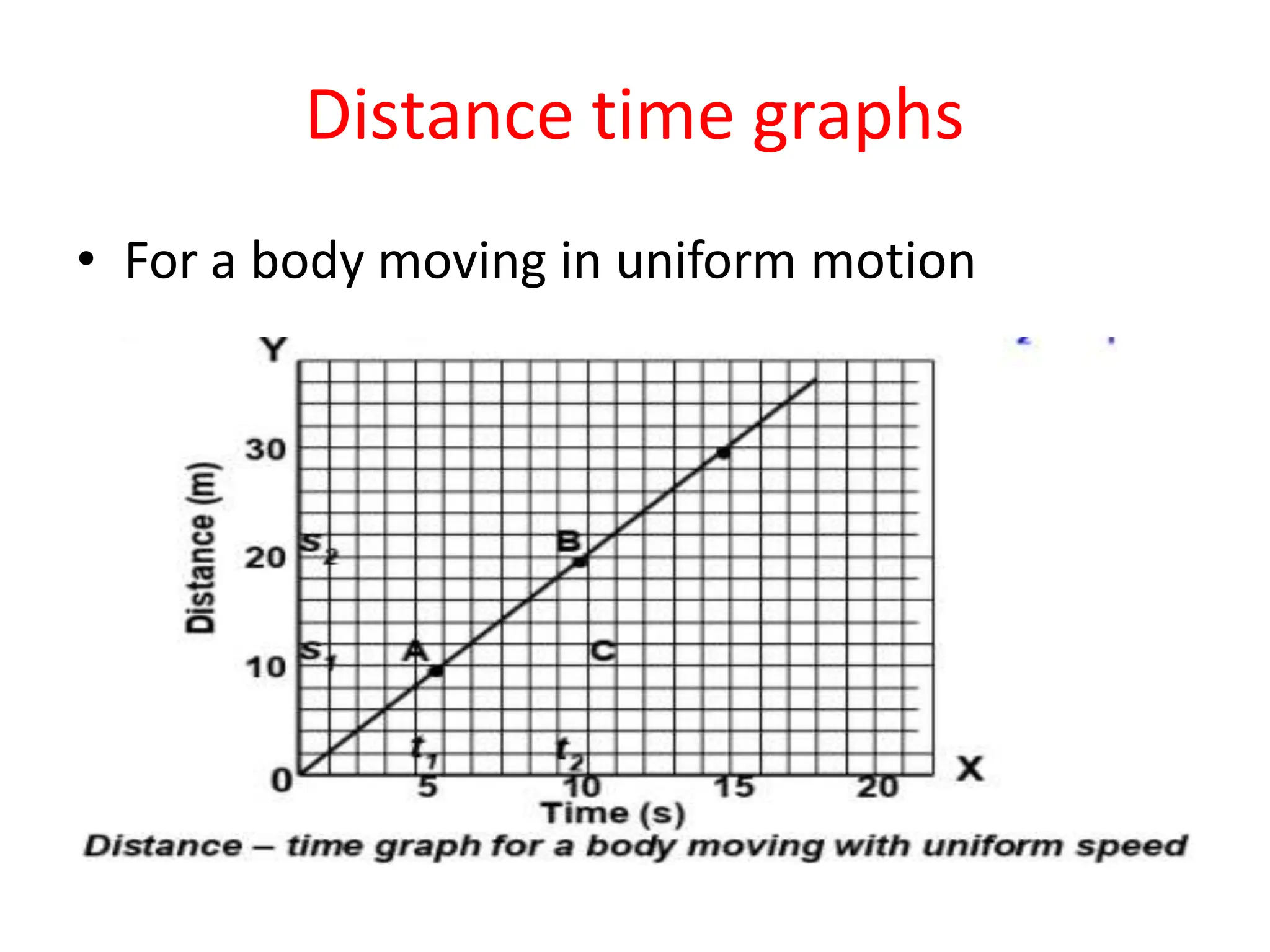
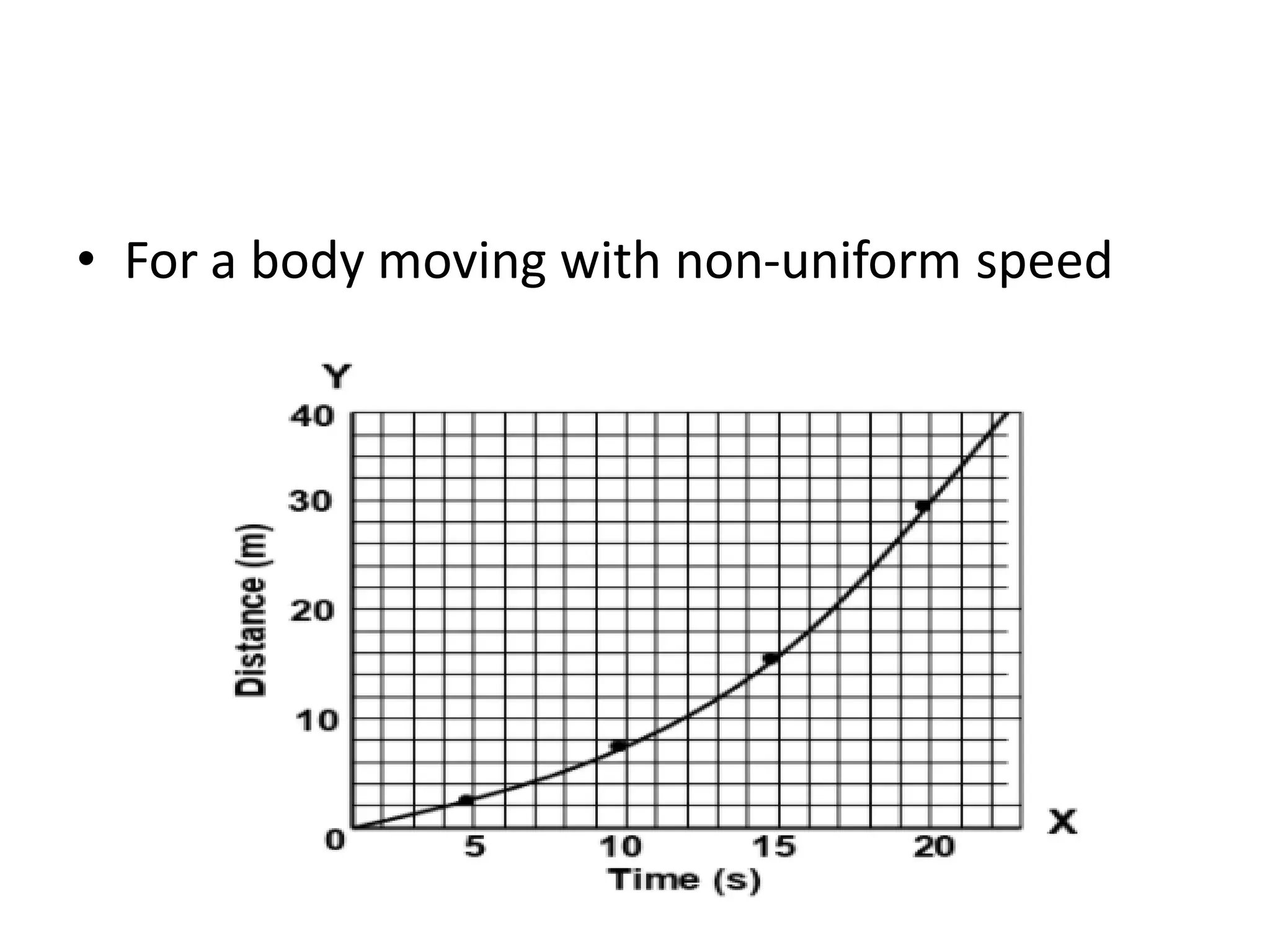
Distance time graphs
• For a body moving in uniform motion
• For a body moving with non-uniform speed
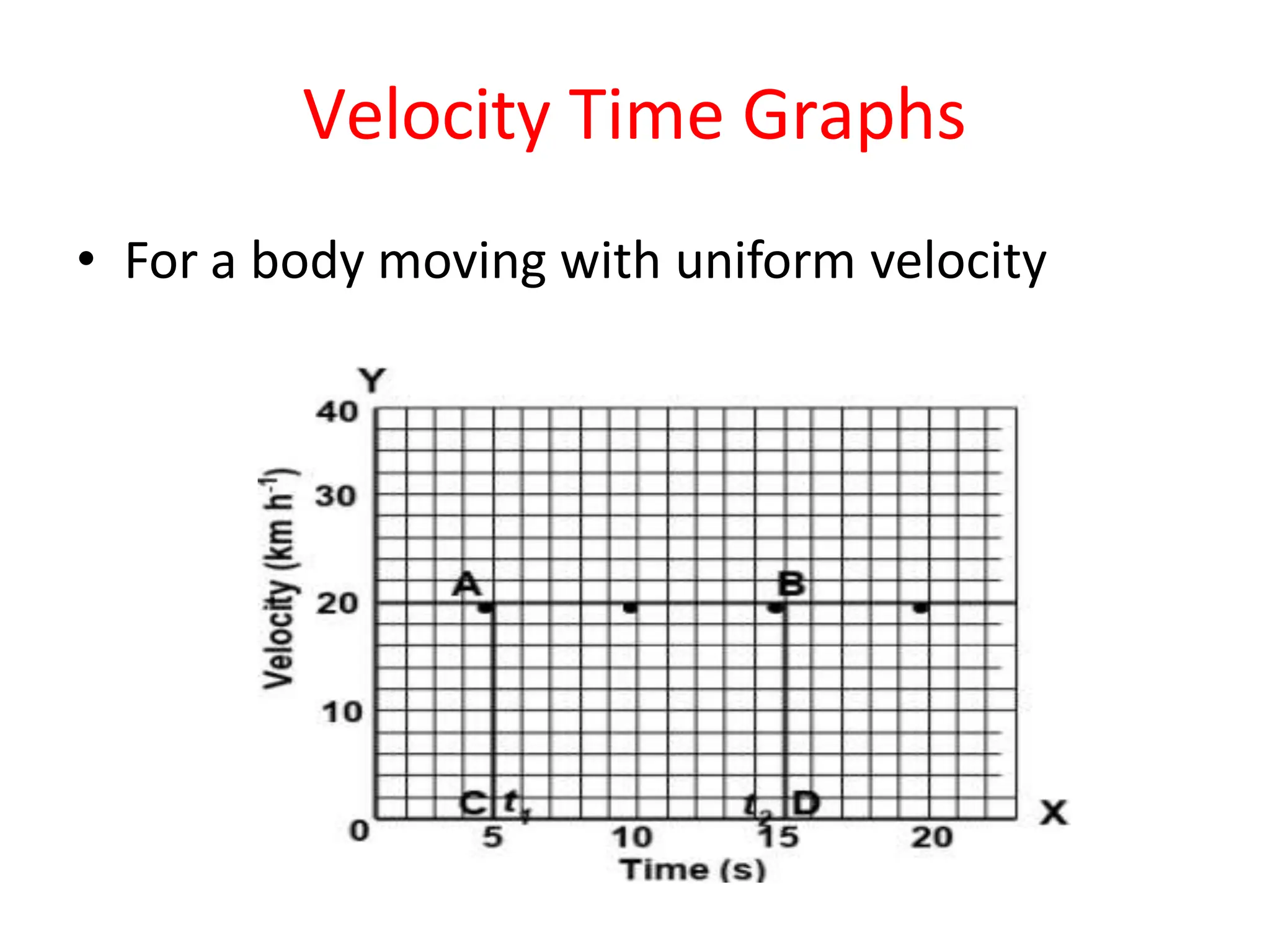
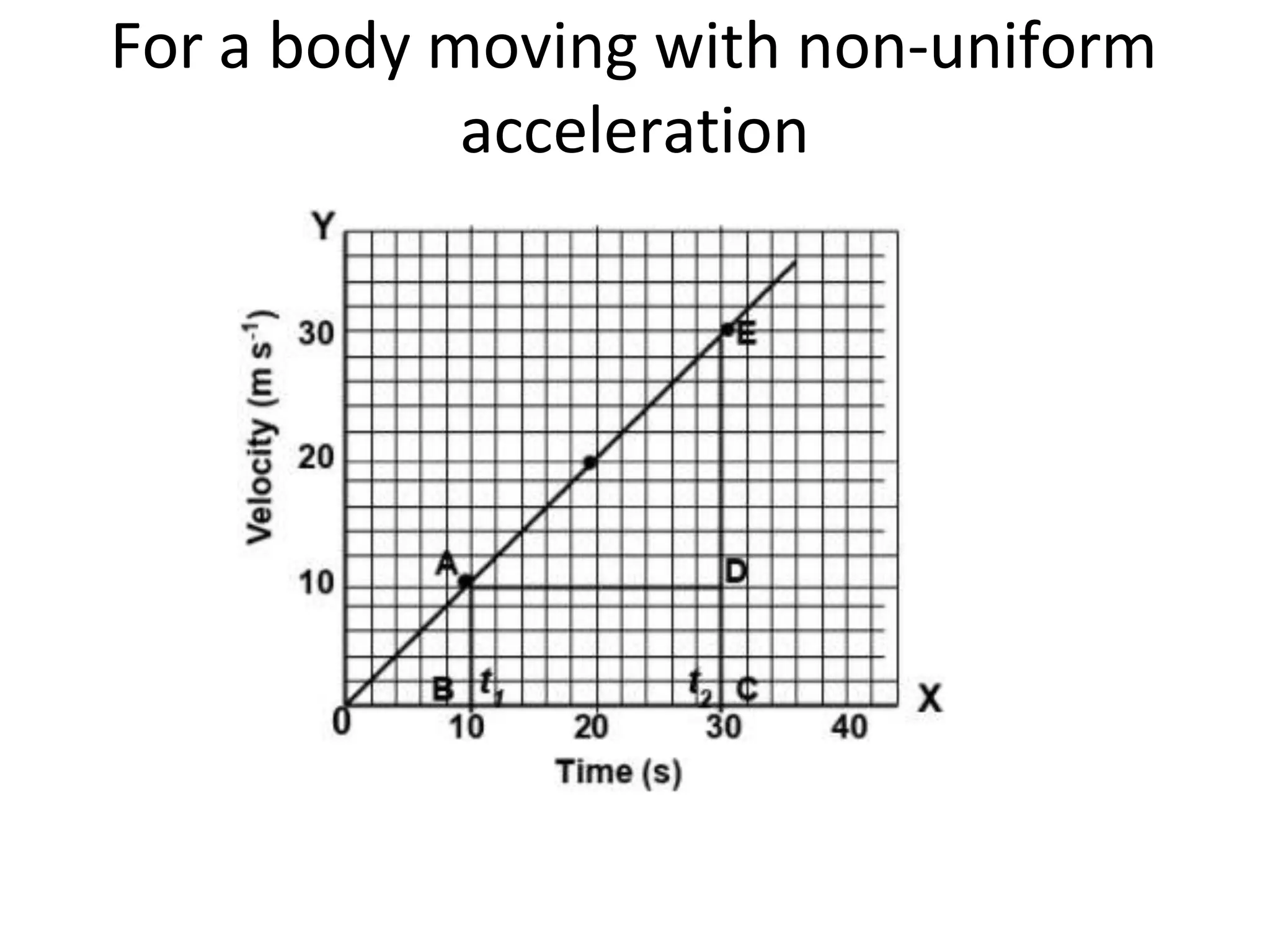
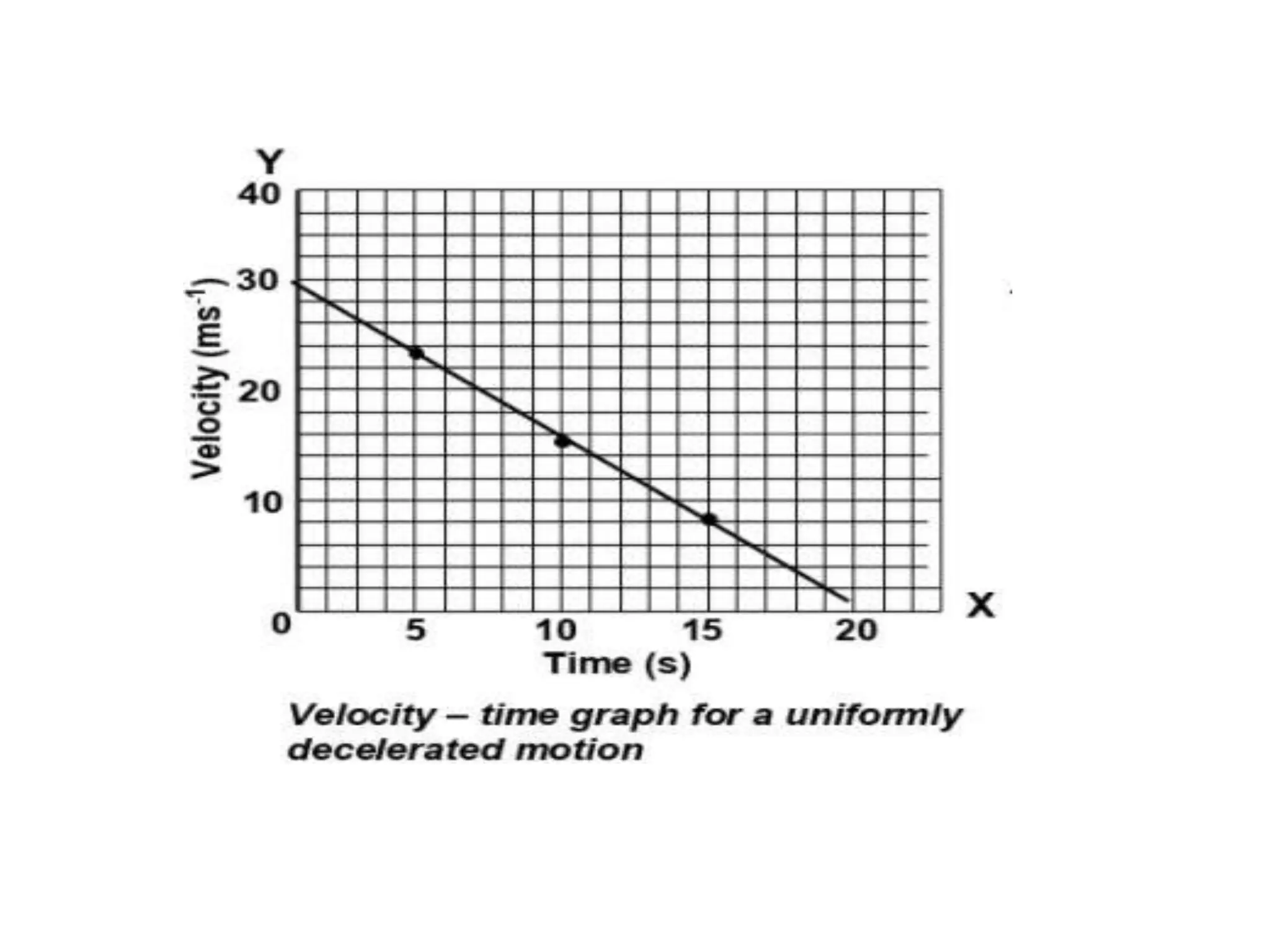
Velocity Time Graphs
• For a body moving with uniform velocity
For a body moving with non-uniform
acceleration
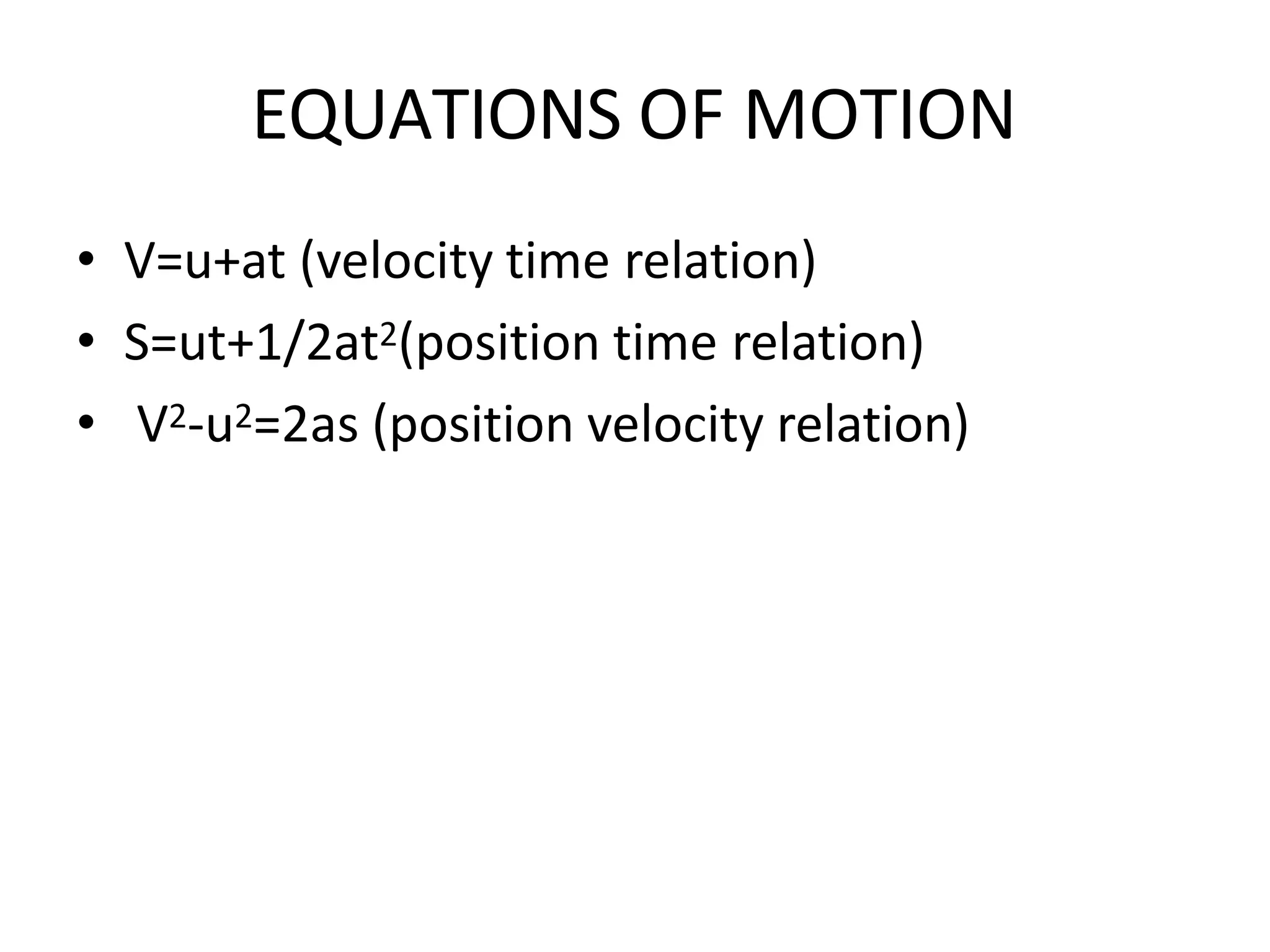
EQUATIONS OF MOTION
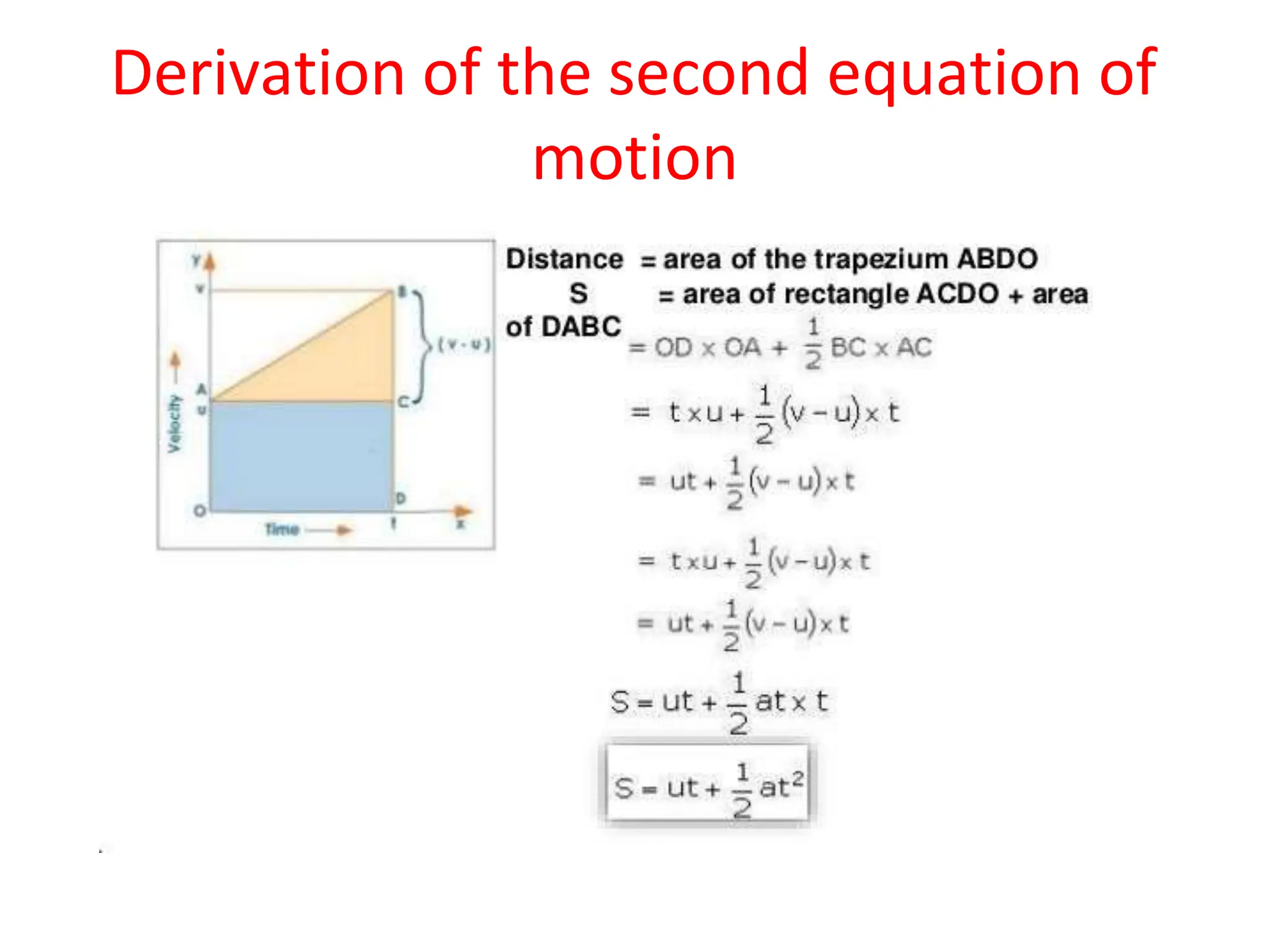
• V=u+at (velocity time relation)
• S=ut+1/2at2(position time relation)
• V2-u2=2as (position velocity relation)
Derivation of the first equation of
motion
Derivation of the second equation of
motion
Uniform circular motion :-
If a body moves in a circular path with
uniform speed, its motion is called
uniform circular motion.
Uniform circular motion is accelerated
motion because in a circular motion a
body continuously changes its
direction.
The circumference of a circle of radius
r is given by 2πr.
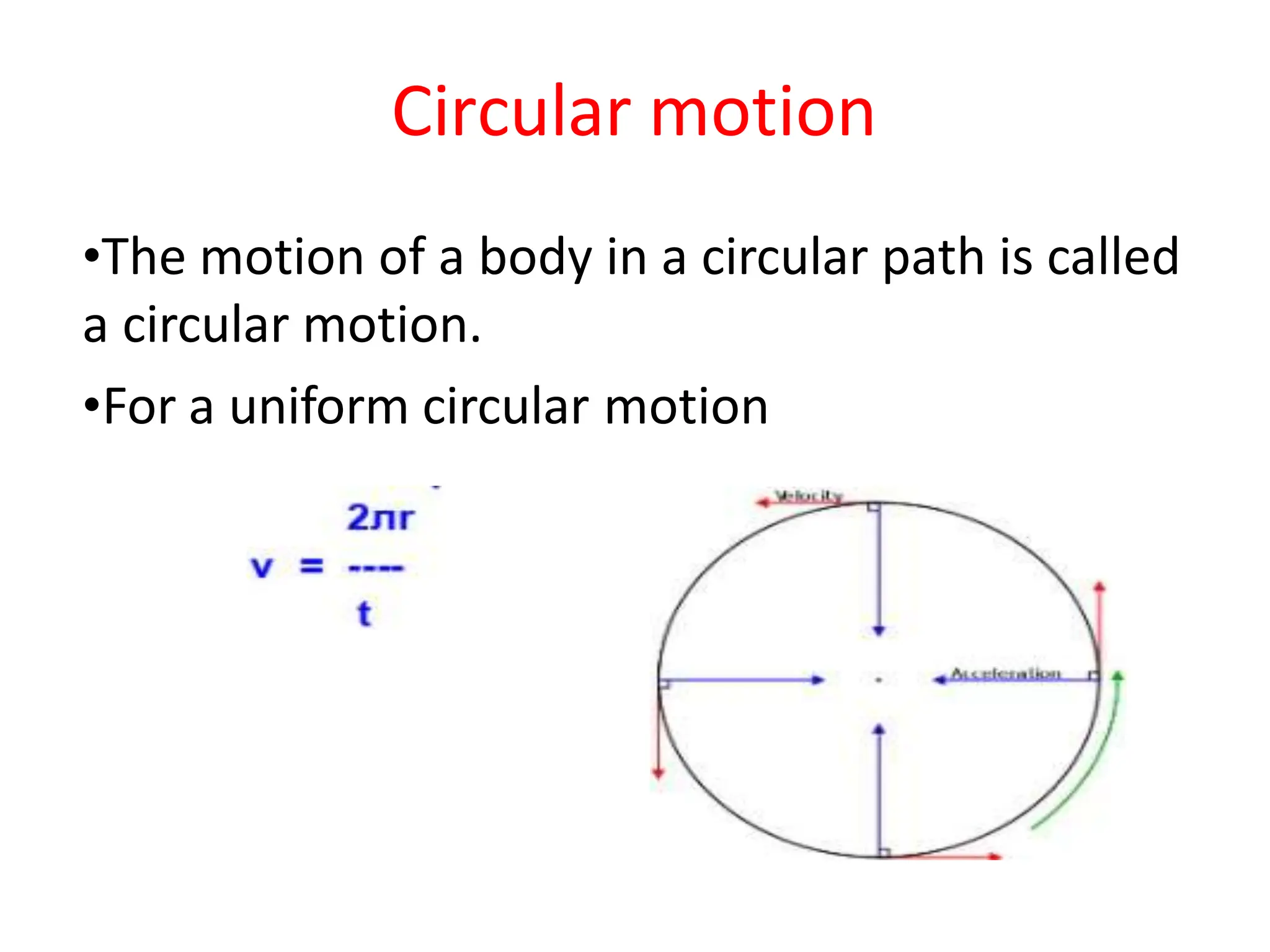
Circular motion
•The motion of a body in a circular path is called
a circular motion.
•For a uniform circular motion
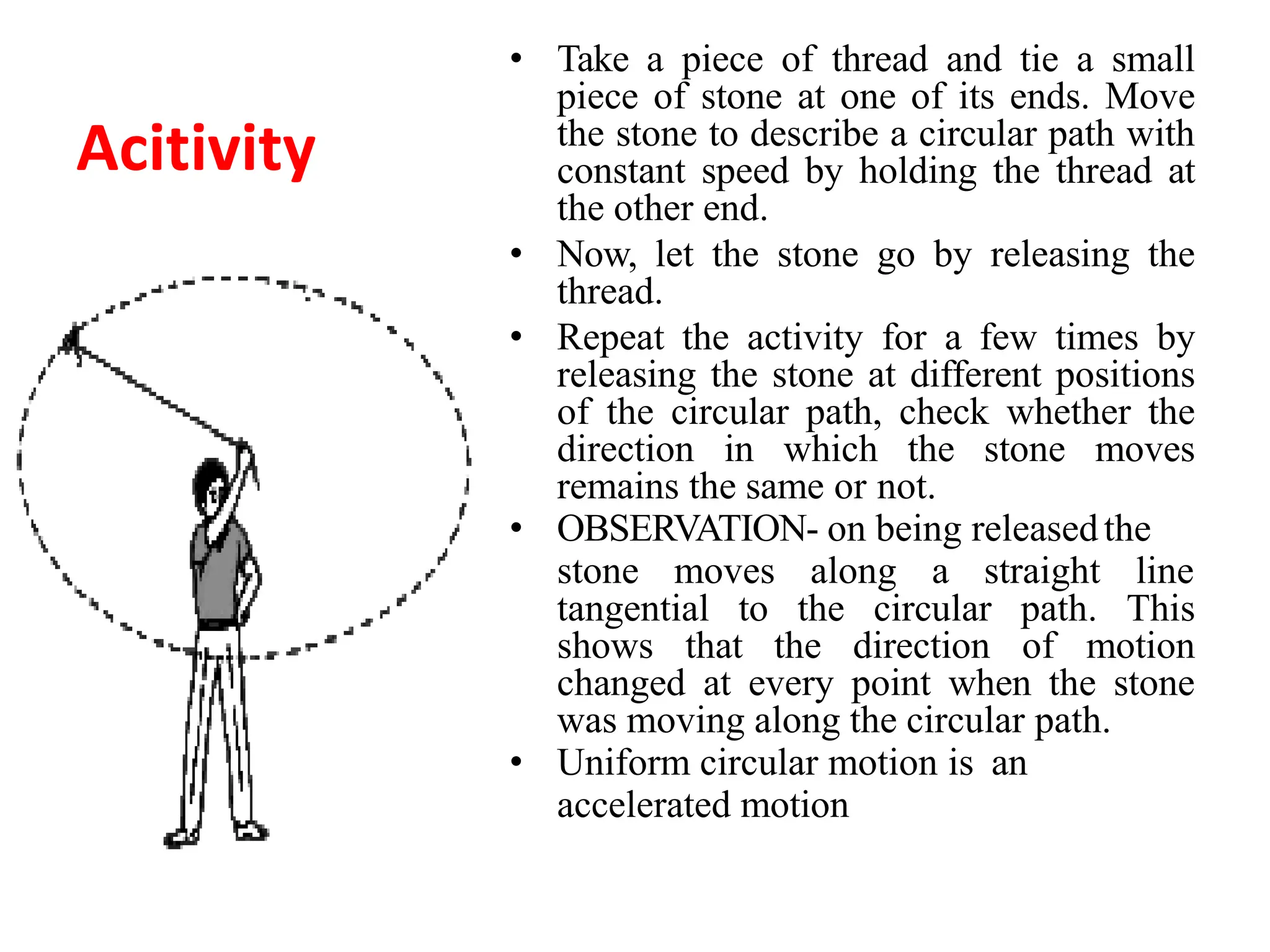
Acitivity
• Take a piece of thread and tie a small
piece of stone at one of its ends. Move
the stone to describe a circular path with
constant speed by holding the thread at
the other end.
• Now, let the stone go by releasing the
thread.
• Repeat the activity for a few times by
releasing the stone at different positions
of the circular path, check whether the
direction in which the stone moves
remains the same or not.
• OBSERVATION- on being releasedthe
stone moves along a straight line
tangential to the circular path. This
shows that the direction of motion
changed at every point when the stone
was moving along the circular path.
• Uniform circular motion is an
accelerated motion

CLASS 9 MOTION PPT NCERT CHAPTER FOR CLASS 9 .pptx

  • 1.
    SAINIK SCHOOL GOPALGANJ CLASS–IX CHAPTER –MOTION BY Dr A K CHOUBEY (TGT)
  • 2.
  • 4.
    Motion is definedas the change in position of body with time. • To describe the position (location) of an object we need to specify a reference point called the origin. • Let us assume that a school in a village is 2 km north of the railway station. We have specified the position of the school with respect to the railway station. In this example, the railway station is the reference point. We could have also chosen other reference points according to our convenience.
  • 5.
    Concept of Restand Motion A body is said to be in rest if its position does not vary with respect Rest to a given referral point as time passes. Motion: A body is said to be in motion if there is a continues change in its position with respect to a given referral as time passes. Concept of rest and motion is related to referral change in position so a single object can be at rest or motion same time with different referral points. If we consider a single object as referral point and consider it as rest, as a absolute point any object which is at rest with respect to that point is considered at rest and same case with motion. In general we consider Earth as absolute point considering it at rest, Although It is in motion with respect to Sun and other planets
  • 6.
    Distance And Displacement Theactual path covered during motion of The Change in position made during a body It is needed not to be the Shortest path between two points It is the Scalar quantity as It does not have any particular direction motion of a body is known as displacement It is the shortest path between initial and final position It is a vector quantity as it is always directed.
  • 7.
    Concept of Rateof Motion: Rate is defined as ratio of change in two quantities Rate is of two types . Average Rate of quantity A with respect to B net change in A net change in B .lnstantaneous Rate is rate at an Instant that is for very short interval of time. .Speed, Velocity and Acceleration are examples of Rate. Speed=Distance/Time Average Speed =Total Distance Travelled/Total Time Taken
  • 8.
    Uniform and nonUniform motion • Uniform Motion- If a body travels equal distance in equal intervals of time then it is in uniform motion • Non-uniform motion- If a body travels unequal distance in equal intervals of time then it is in uniform motion
  • 9.
    Distance and Displacement •Distance= the total path length covered by an object from the initial position to the final position . • Displacement= The shortest distance between the initial and the final position.
  • 10.
    Measuring the Rateof Motion- Different objects may take different amounts of time to cover a given distance. Some of them move fast and some move slowly. One of the ways of measuring the rate of motion of an object is to find out the distance travelled by the object in unit time. This quantity is referred to as speed. Speed=Distance/Time Average Speed =total distance travelled/Total time taken
  • 11.
    Velocity The rate ofmotion is more meaningful if we specify if we specify its direction of motion with speed, which is termed as velocity. It is a vector quantity. Velocity=Dispalcement/Time Average velocity= Total Dispalcement/Total Time =v+u/2
  • 12.
    ACCELERATION The quantity whichspecifies changes in velocity is acceleration. Acceleration :- It is the change in velocity of a body per unit time. ( or the rate of change of velocity.) Acceleration = Change in velocity/ Time If the velocity of a body changes from initial value u to final value v in time t, then acceleration a is a = v – u/t .The SI unit of acceleration is ms - 2
  • 13.
    Acceleration • The rateof change of velocity is termed as acceleration. (During non-uniform motion) • Acceleration =a=v-u/t • Its SI unit is m/s2 • Uniform acceleration-When the change in velocity is equal in equal intervals of time. • Non-Uniform acceleration-When the change in velocity is unequal in equal intervals of time.
  • 14.
    Distance time graphs •For a body moving in uniform motion
  • 15.
    • For abody moving with non-uniform speed
  • 16.
    Velocity Time Graphs •For a body moving with uniform velocity
  • 17.
    For a bodymoving with non-uniform acceleration
  • 20.
    EQUATIONS OF MOTION •V=u+at (velocity time relation) • S=ut+1/2at2(position time relation) • V2-u2=2as (position velocity relation)
  • 21.
    Derivation of thefirst equation of motion
  • 22.
    Derivation of thesecond equation of motion
  • 23.
    Uniform circular motion:- If a body moves in a circular path with uniform speed, its motion is called uniform circular motion. Uniform circular motion is accelerated motion because in a circular motion a body continuously changes its direction. The circumference of a circle of radius r is given by 2πr.
  • 24.
    Circular motion •The motionof a body in a circular path is called a circular motion. •For a uniform circular motion
  • 25.
    Acitivity • Take apiece of thread and tie a small piece of stone at one of its ends. Move the stone to describe a circular path with constant speed by holding the thread at the other end. • Now, let the stone go by releasing the thread. • Repeat the activity for a few times by releasing the stone at different positions of the circular path, check whether the direction in which the stone moves remains the same or not. • OBSERVATION- on being releasedthe stone moves along a straight line tangential to the circular path. This shows that the direction of motion changed at every point when the stone was moving along the circular path. • Uniform circular motion is an accelerated motion