Skill Learning
Unit 2- SAC 1
Classification of a Skill
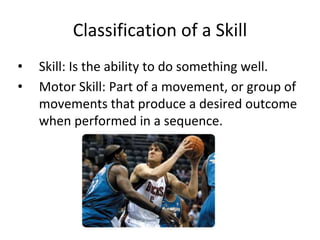
• Skill: Is the ability to do something well.
• Motor Skill: Part of a movement, or group of
movements that produce a desired outcome
when performed in a sequence.
Motor Programs
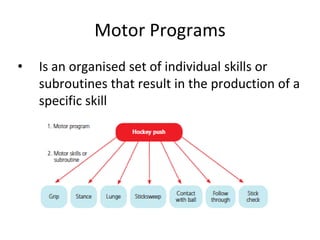
• Is an organised set of individual skills or
subroutines that result in the production of a
specific skill
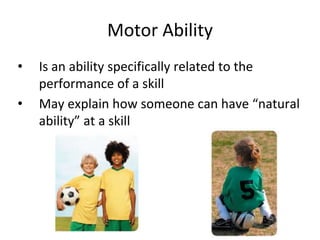
Motor Ability
• Is an ability specifically related to the
performance of a skill
• May explain how someone can have “natural
ability” at a skill
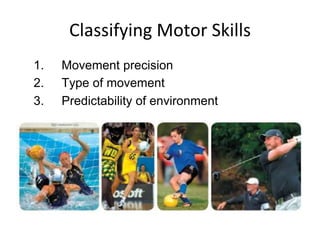
Classifying Motor Skills
1. Movement precision
2. Type of movement
3. Predictability of environment
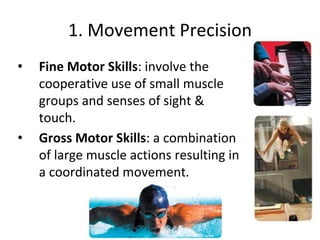
1. Movement Precision
• Fine Motor Skills: involve the
cooperative use of small muscle
groups and senses of sight &
touch.
• Gross Motor Skills: a combination
of large muscle actions resulting in
a coordinated movement.
2. Type of Movement
• Discrete Skills: Skills of brief duration with a
distinct beginning and end.
• Serial Skills: A series or group of discrete
skills joined together to make a complicated
skill.
• Continuous Skills: Skills with no distinct
beginning or end and involve repetitive
movements.
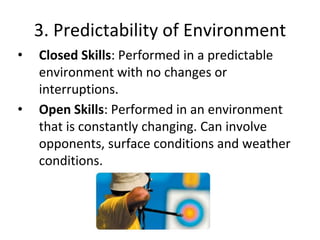
3. Predictability of Environment
• Closed Skills: Performed in a predictable
environment with no changes or
interruptions.
• Open Skills: Performed in an environment
that is constantly changing. Can involve
opponents, surface conditions and weather
conditions.
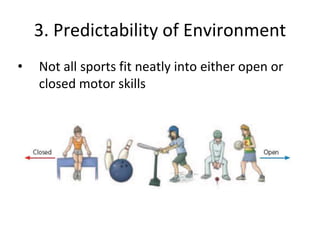
3. Predictability of Environment
• Not all sports fit neatly into either open or
closed motor skills
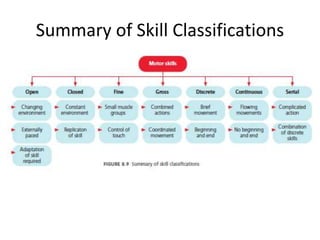
Summary of Skill Classifications
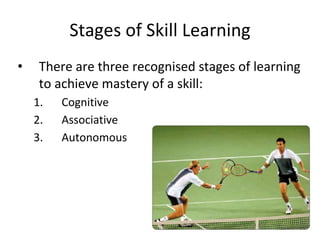
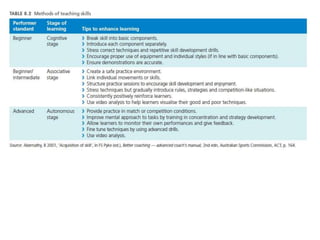
Stages of Skill Learning
• There are three recognised stages of learning
to achieve mastery of a skill:
1. Cognitive
2. Associative
3. Autonomous
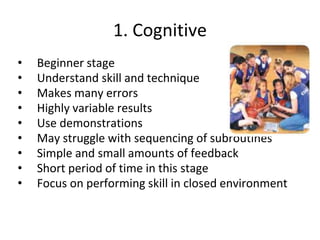
1. Cognitive
• Beginner stage
• Understand skill and technique
• Makes many errors
• Highly variable results
• Use demonstrations
• May struggle with sequencing of subroutines
• Simple and small amounts of feedback
• Short period of time in this stage
• Focus on performing skill in closed environment
2. Associative
• Make minor errors
• Emphasis on refining skill
• Begins to “feel” desired skill
• Begin to practice in competitive situations
• Can adjust skill through feedback
• Gradual improvement
• Requires large amounts of practice
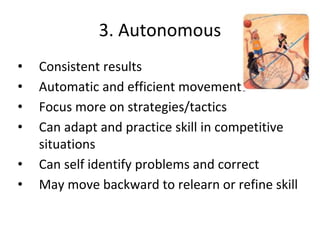
3. Autonomous
• Consistent results
• Automatic and efficient movements
• Focus more on strategies/tactics
• Can adapt and practice skill in competitive
situations
• Can self identify problems and correct
• May move backward to relearn or refine skill
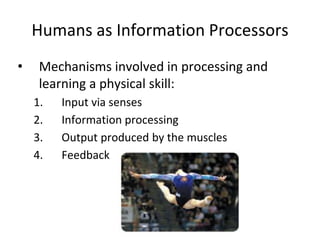
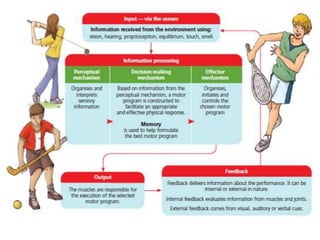
Humans as Information Processors
• Mechanisms involved in processing and
learning a physical skill:
1. Input via senses
2. Information processing
3. Output produced by the muscles
4. Feedback
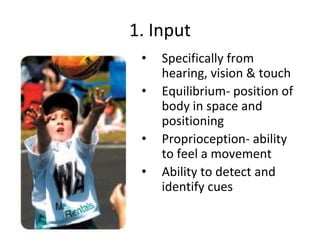
1. Input
• Specifically from
hearing, vision & touch
• Equilibrium- position of
body in space and
positioning
• Proprioception- ability
to feel a movement
• Ability to detect and
identify cues
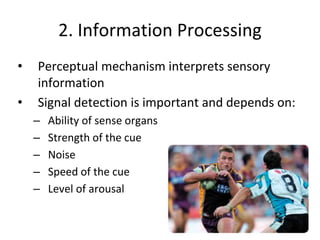
2. Information Processing
• Perceptual mechanism interprets sensory
information
• Signal detection is important and depends on:
– Ability of sense organs
– Strength of the cue
– Noise
– Speed of the cue
– Level of arousal
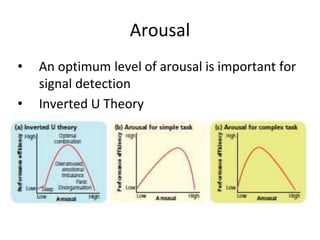
Arousal
• An optimum level of arousal is important for
signal detection
• Inverted U Theory
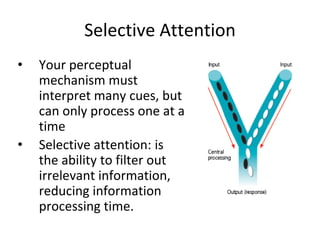
Selective Attention
• Your perceptual
mechanism must
interpret many cues, but
can only process one at a
time
• Selective attention: is
the ability to filter out
irrelevant information,
reducing information
processing time.
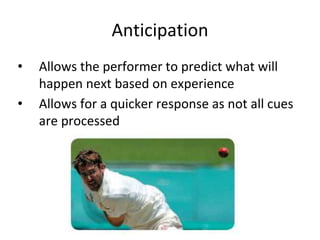
Anticipation
• Allows the performer to predict what will
happen next based on experience
• Allows for a quicker response as not all cues
are processed
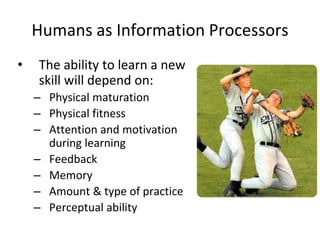
Humans as Information Processors
• The ability to learn a new
skill will depend on:
– Physical maturation
– Physical fitness
– Attention and motivation
during learning
– Feedback
– Memory
– Amount & type of practice
– Perceptual ability
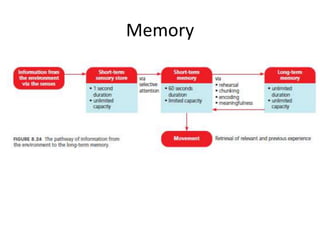
Memory
Short Term Memory
• You can improve your short term memory
and ability to learn a skill by:
– Chunking or coding: a method used to reduce
individual pieces of information into meaningful
chunks
– Avoiding distractions/noise
– Make the information more meaningful
– Rehearse or practice straight after instruction
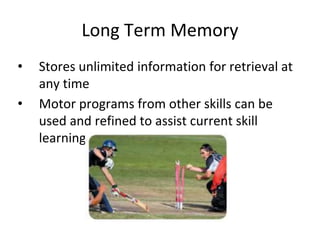
Long Term Memory
• Stores unlimited information for retrieval at
any time
• Motor programs from other skills can be
used and refined to assist current skill
learning
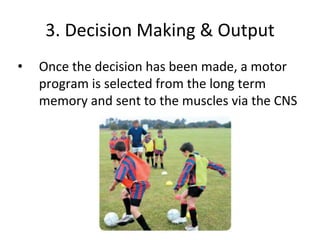
3. Decision Making & Output
• Once the decision has been made, a motor
program is selected from the long term
memory and sent to the muscles via the CNS
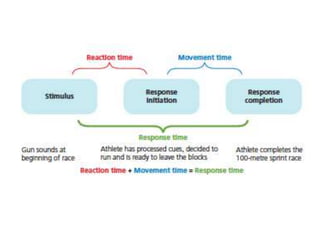
Reaction Time
• The delay between the stimulus and the
initiation of the movement.
• Depends on the task and the individual.
– Simple Reaction Time: Involves one stimulus and
one response. Eg. Starters Gun
– Choice Reaction Time: Multiple stimulus and
responses.
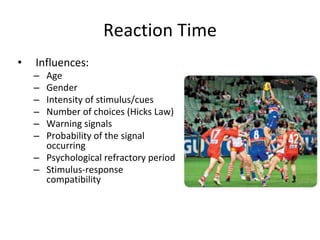
Reaction Time
• Influences:
– Age
– Gender
– Intensity of stimulus/cues
– Number of choices (Hicks Law)
– Warning signals
– Probability of the signal
occurring
– Psychological refractory period
– Stimulus-response
compatibility
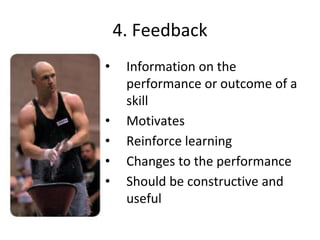
4. Feedback
• Information on the
performance or outcome of a
skill
• Motivates
• Reinforce learning
• Changes to the performance
• Should be constructive and
useful
Types of Feedback
• Internal: “feel” of the performance
• External: from sense organs
• Augmented: external from source other than
yourself
• Positive
• Negative
• Continuous: during the performance
• Terminal: at the completion of the skill
• Knowledge of results: result of the skill
• Knowledge of performance: actual performance of
the skill
Practice
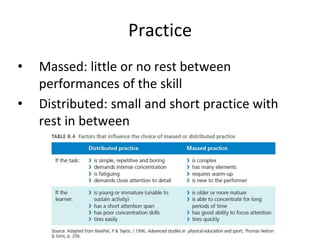
• Massed: little or no rest between
performances of the skill
• Distributed: small and short practice with
rest in between
Practice
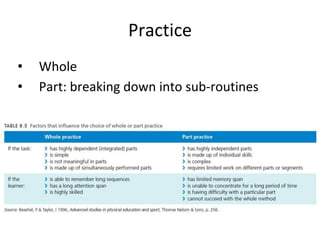
• Whole
• Part: breaking down into sub-routines
Practice
• Drill practice: repetitive drills
• Problem solving practice: discovery to
determine what skills or changes to the skill
need to be employed in different situations
• Physical practice
• Mental practice/imagery: mentally
rehearsing the skill in your mind

Skill learning

  • 1.
  • 2.
    Classification of aSkill • Skill: Is the ability to do something well. • Motor Skill: Part of a movement, or group of movements that produce a desired outcome when performed in a sequence.
  • 3.
    Motor Programs • Isan organised set of individual skills or subroutines that result in the production of a specific skill
  • 4.
    Motor Ability • Isan ability specifically related to the performance of a skill • May explain how someone can have “natural ability” at a skill
  • 5.
    Classifying Motor Skills 1.Movement precision 2. Type of movement 3. Predictability of environment
  • 6.
    1. Movement Precision •Fine Motor Skills: involve the cooperative use of small muscle groups and senses of sight & touch. • Gross Motor Skills: a combination of large muscle actions resulting in a coordinated movement.
  • 7.
    2. Type ofMovement • Discrete Skills: Skills of brief duration with a distinct beginning and end. • Serial Skills: A series or group of discrete skills joined together to make a complicated skill. • Continuous Skills: Skills with no distinct beginning or end and involve repetitive movements.
  • 8.
    3. Predictability ofEnvironment • Closed Skills: Performed in a predictable environment with no changes or interruptions. • Open Skills: Performed in an environment that is constantly changing. Can involve opponents, surface conditions and weather conditions.
  • 9.
    3. Predictability ofEnvironment • Not all sports fit neatly into either open or closed motor skills
  • 10.
    Summary of SkillClassifications
  • 11.
    Stages of SkillLearning • There are three recognised stages of learning to achieve mastery of a skill: 1. Cognitive 2. Associative 3. Autonomous
  • 12.
    1. Cognitive • Beginnerstage • Understand skill and technique • Makes many errors • Highly variable results • Use demonstrations • May struggle with sequencing of subroutines • Simple and small amounts of feedback • Short period of time in this stage • Focus on performing skill in closed environment
  • 13.
    2. Associative • Makeminor errors • Emphasis on refining skill • Begins to “feel” desired skill • Begin to practice in competitive situations • Can adjust skill through feedback • Gradual improvement • Requires large amounts of practice
  • 14.
    3. Autonomous • Consistentresults • Automatic and efficient movements • Focus more on strategies/tactics • Can adapt and practice skill in competitive situations • Can self identify problems and correct • May move backward to relearn or refine skill
  • 16.
    Humans as InformationProcessors • Mechanisms involved in processing and learning a physical skill: 1. Input via senses 2. Information processing 3. Output produced by the muscles 4. Feedback
  • 17.
    1. Input • Specificallyfrom hearing, vision & touch • Equilibrium- position of body in space and positioning • Proprioception- ability to feel a movement • Ability to detect and identify cues
  • 18.
    2. Information Processing •Perceptual mechanism interprets sensory information • Signal detection is important and depends on: – Ability of sense organs – Strength of the cue – Noise – Speed of the cue – Level of arousal
  • 19.
    Arousal • An optimumlevel of arousal is important for signal detection • Inverted U Theory
  • 20.
    Selective Attention • Yourperceptual mechanism must interpret many cues, but can only process one at a time • Selective attention: is the ability to filter out irrelevant information, reducing information processing time.
  • 21.
    Anticipation • Allows theperformer to predict what will happen next based on experience • Allows for a quicker response as not all cues are processed
  • 22.
    Humans as InformationProcessors • The ability to learn a new skill will depend on: – Physical maturation – Physical fitness – Attention and motivation during learning – Feedback – Memory – Amount & type of practice – Perceptual ability
  • 24.
  • 25.
    Short Term Memory •You can improve your short term memory and ability to learn a skill by: – Chunking or coding: a method used to reduce individual pieces of information into meaningful chunks – Avoiding distractions/noise – Make the information more meaningful – Rehearse or practice straight after instruction
  • 26.
    Long Term Memory •Stores unlimited information for retrieval at any time • Motor programs from other skills can be used and refined to assist current skill learning
  • 27.
    3. Decision Making& Output • Once the decision has been made, a motor program is selected from the long term memory and sent to the muscles via the CNS
  • 28.
    Reaction Time • Thedelay between the stimulus and the initiation of the movement. • Depends on the task and the individual. – Simple Reaction Time: Involves one stimulus and one response. Eg. Starters Gun – Choice Reaction Time: Multiple stimulus and responses.
  • 29.
    Reaction Time • Influences: –Age – Gender – Intensity of stimulus/cues – Number of choices (Hicks Law) – Warning signals – Probability of the signal occurring – Psychological refractory period – Stimulus-response compatibility
  • 31.
    4. Feedback • Informationon the performance or outcome of a skill • Motivates • Reinforce learning • Changes to the performance • Should be constructive and useful
  • 32.
    Types of Feedback •Internal: “feel” of the performance • External: from sense organs • Augmented: external from source other than yourself • Positive • Negative • Continuous: during the performance • Terminal: at the completion of the skill • Knowledge of results: result of the skill • Knowledge of performance: actual performance of the skill
  • 33.
    Practice • Massed: littleor no rest between performances of the skill • Distributed: small and short practice with rest in between
  • 34.
    Practice • Whole • Part:breaking down into sub-routines
  • 35.
    Practice • Drill practice:repetitive drills • Problem solving practice: discovery to determine what skills or changes to the skill need to be employed in different situations • Physical practice • Mental practice/imagery: mentally rehearsing the skill in your mind

Editor's Notes

  • #3 List 10 skills, place a star next to the motor skills, list 5 skills in your favourite sport
  • #7 List examples of fine and gross motor skills
  • #8 List examples of serial, discrete and continuous skills
  • #9 Examples of closed and open skills
  • #10 Why are closed skills easier to learn? Relate coaching beginners to open/closed skills.
  • #11 p.270
  • #15 Watch Danny MacAskill’s Imaginate Video
  • #16 p.272
  • #18 Cues- signals from the environment before, during or after the skill performance
  • #20 p.279
  • #22 Referred to as “reading the play” When could anticipation be an advantage/disadvantage? Watch Cricket Anticipation Catch Video
  • #23 Perceptual ability- the ability to interpret or perceive sensory information
  • #24 p.275
  • #25 p.283
  • #30 Hicks law- linear relationship between reaction time and the amount of information to be processed. Psychological refractory period- the delay in processing successive cues, while first cue is being processed. Stimulus-response compatibility- relevance between stimulus and response. High compatibility means faster reaction time.
  • #31 p.286
  • #34 p.294
  • #35 p.295