Skill Learning Principles
Monday, 19 August 13
What is skill?
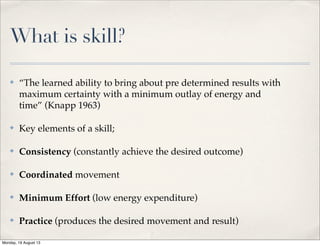
✤ “The learned ability to bring about pre determined results with
maximum certainty with a minimum outlay of energy and
time” (Knapp 1963)
✤ Key elements of a skill;
✤ Consistency (constantly achieve the desired outcome)
✤ Coordinated movement
✤ Minimum Effort (low energy expenditure)
✤ Practice (produces the desired movement and result)
Monday, 19 August 13
Motor Skill
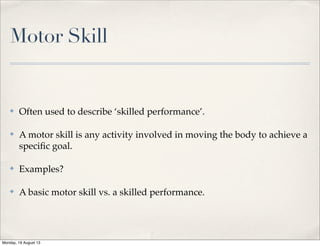
✤ Often used to describe ‘skilled performance’.
✤ A motor skill is any activity involved in moving the body to achieve a
specific goal.
✤ Examples?
✤ A basic motor skill vs. a skilled performance.
Monday, 19 August 13
Motor Ability
✤ “Born a natural”
✤ Coordination, Balance, Strength
✤ inconclusive
Monday, 19 August 13
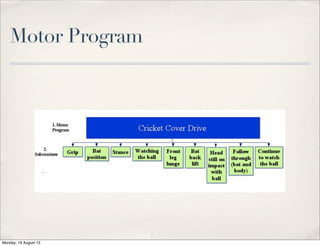
Motor Programs
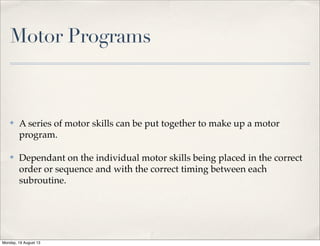
✤ A series of motor skills can be put together to make up a motor
program.
✤ Dependant on the individual motor skills being placed in the correct
order or sequence and with the correct timing between each
subroutine.
Monday, 19 August 13
Motor Program
Monday, 19 August 13
Motor Program
Monday, 19 August 13
Skill Classification
✤ Motor skills are often categorised under;
✤ movement precision
✤ type of movement
✤ predictability of the environment
Monday, 19 August 13
Movement precision
✤ Motor skills can be classified according to the number of muscles or
muscles groups involved in the activity.
✤ Gross motor skills.
✤ Fine motor skills.
Monday, 19 August 13
Gross motor skills
✤ Involve a combination of large muscle actions that result in a
coordinated movement.
✤ Examples
Monday, 19 August 13
Fine motor skills
✤ Involve the cooperative use of small muscle groups and the senses of
sight and touch.
✤ Examples
Monday, 19 August 13
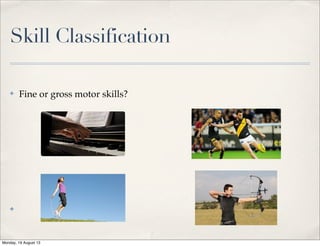
Skill Classification
✤ Fine or gross motor skills?
✤
Monday, 19 August 13
Type of movement
✤ Motor skills can also be classified according to the type of movement
as;
✤ discrete motor skills
✤ serial motor skills
✤ continuous motor skills
Monday, 19 August 13
Discrete motor skills
✤ Involve movements of brief duration, and they are easily defined by a
distinct beginning and end.
✤ Examples?
Monday, 19 August 13
Serial motor skills
✤ A series or group of discrete skills strung together to create a more
complicated, skilled action.
✤ Examples?
Monday, 19 August 13
Continuous motor skills
✤ No distinct beginning or end.
✤ Examples?
Monday, 19 August 13
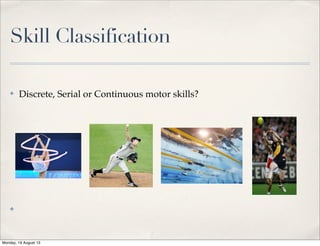
Skill Classification
✤ Discrete, Serial or Continuous motor skills?
✤
Monday, 19 August 13
Predictability of the environment
✤ Motor skills can also be classified according to the extent to which
they are influenced by environmental factors.
✤ Closed motor skills
✤ Open motor skills
Monday, 19 August 13
Closed motor skills
✤ Are performed in surroundings where the performer had the greatest
control over the performance environment. The environment refers to
external factors such as the weather, playing surface and opposition.
✤ Examples?
Monday, 19 August 13
Open motor skills
✤ Are performed in a less predictable environment. In an open
environment, the conditions are constantly changing and the
performer has limited, if any, control over their environment.
✤ Examples?
Monday, 19 August 13
Closed/open skill continuum
✤ Not all sports skills, whether classified as closed or open, are identical
in their ease or difficulty of execution. Some skills can be classed as
more closed or open than others. The classification system is best
represented along a continuum, with closed motor skills at one end
and open motor skills at the other.
Monday, 19 August 13
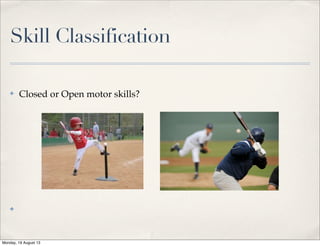
Skill Classification
✤ Closed or Open motor skills?
✤
Monday, 19 August 13
Skill Classification
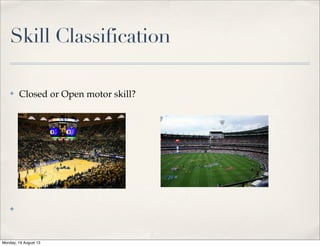
✤ Closed or Open motor skill?
✤
Monday, 19 August 13

Lesson 1 skill learning principles

  • 1.
  • 2.
    What is skill? ✤“The learned ability to bring about pre determined results with maximum certainty with a minimum outlay of energy and time” (Knapp 1963) ✤ Key elements of a skill; ✤ Consistency (constantly achieve the desired outcome) ✤ Coordinated movement ✤ Minimum Effort (low energy expenditure) ✤ Practice (produces the desired movement and result) Monday, 19 August 13
  • 3.
    Motor Skill ✤ Oftenused to describe ‘skilled performance’. ✤ A motor skill is any activity involved in moving the body to achieve a specific goal. ✤ Examples? ✤ A basic motor skill vs. a skilled performance. Monday, 19 August 13
  • 4.
    Motor Ability ✤ “Borna natural” ✤ Coordination, Balance, Strength ✤ inconclusive Monday, 19 August 13
  • 5.
    Motor Programs ✤ Aseries of motor skills can be put together to make up a motor program. ✤ Dependant on the individual motor skills being placed in the correct order or sequence and with the correct timing between each subroutine. Monday, 19 August 13
  • 6.
  • 7.
  • 8.
    Skill Classification ✤ Motorskills are often categorised under; ✤ movement precision ✤ type of movement ✤ predictability of the environment Monday, 19 August 13
  • 9.
    Movement precision ✤ Motorskills can be classified according to the number of muscles or muscles groups involved in the activity. ✤ Gross motor skills. ✤ Fine motor skills. Monday, 19 August 13
  • 10.
    Gross motor skills ✤Involve a combination of large muscle actions that result in a coordinated movement. ✤ Examples Monday, 19 August 13
  • 11.
    Fine motor skills ✤Involve the cooperative use of small muscle groups and the senses of sight and touch. ✤ Examples Monday, 19 August 13
  • 12.
    Skill Classification ✤ Fineor gross motor skills? ✤ Monday, 19 August 13
  • 13.
    Type of movement ✤Motor skills can also be classified according to the type of movement as; ✤ discrete motor skills ✤ serial motor skills ✤ continuous motor skills Monday, 19 August 13
  • 14.
    Discrete motor skills ✤Involve movements of brief duration, and they are easily defined by a distinct beginning and end. ✤ Examples? Monday, 19 August 13
  • 15.
    Serial motor skills ✤A series or group of discrete skills strung together to create a more complicated, skilled action. ✤ Examples? Monday, 19 August 13
  • 16.
    Continuous motor skills ✤No distinct beginning or end. ✤ Examples? Monday, 19 August 13
  • 17.
    Skill Classification ✤ Discrete,Serial or Continuous motor skills? ✤ Monday, 19 August 13
  • 18.
    Predictability of theenvironment ✤ Motor skills can also be classified according to the extent to which they are influenced by environmental factors. ✤ Closed motor skills ✤ Open motor skills Monday, 19 August 13
  • 19.
    Closed motor skills ✤Are performed in surroundings where the performer had the greatest control over the performance environment. The environment refers to external factors such as the weather, playing surface and opposition. ✤ Examples? Monday, 19 August 13
  • 20.
    Open motor skills ✤Are performed in a less predictable environment. In an open environment, the conditions are constantly changing and the performer has limited, if any, control over their environment. ✤ Examples? Monday, 19 August 13
  • 21.
    Closed/open skill continuum ✤Not all sports skills, whether classified as closed or open, are identical in their ease or difficulty of execution. Some skills can be classed as more closed or open than others. The classification system is best represented along a continuum, with closed motor skills at one end and open motor skills at the other. Monday, 19 August 13
  • 22.
    Skill Classification ✤ Closedor Open motor skills? ✤ Monday, 19 August 13
  • 23.
    Skill Classification ✤ Closedor Open motor skill? ✤ Monday, 19 August 13