CHAPTER
THE LEARNINGAND PERFORMANCE OF
MOTOR SKILLS
SkillAcquisition DefinitionsWhich ones do you know ?
Skill
Ability
Perceptual ability
Gross motor skill
Continuum
Open/Closed skills
Discrete/continuous skills
Serial skills
Self paced/externally paced skills
Fine/gross skills
Simple/complex skills
Coherent/incoherent skills
CharacteristicsofSkill
 Learned
 Controlled
 Goal directed
 Aesthetic
 Fluent
 Consistent
 Efficient
 Smooth
 Economical
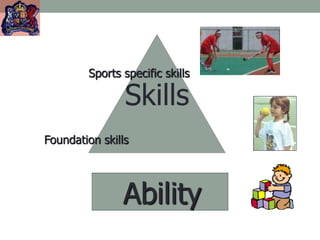
Skills
Ability
Foundation skills
Sports specific skills
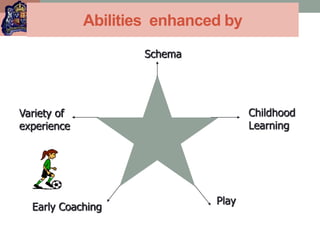
Abilities enhanced by
Childhood
Learning
Play
Early Coaching
Variety of
experience
Schema
Definitions
“Skill is a learned ability to bring about predetermined
results with maximum certainty, often with the minimum
outlay of time, energy or both”
Guthrie 1952
“Skill is learned- it is the efficient attainment of a pre
specified goal. It involves speed accuracy and the
adaptation of the task”
Bull 1994
Skill is the “learned ability to bring about predetermined results with a maximum of
certainty, often with a minimum outlay of time or energy, or both”
Skill Categories
There are 3 basic categories of skills;
1. Cognitive skills involving primarily the brain
E.g: reading, analysing a problem.
2. Perceptual skills involving how an individual
interprets stimuli
E.g: two players receive the same information from
the environment but interpret it differently.
Correct interpretation of stimuli improves performance.
3. Motor skills involving physical movement
E.g: catching, throwing, running.
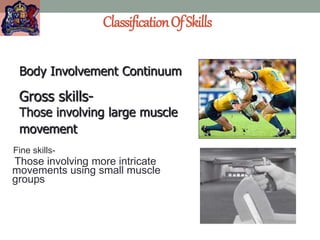
ClassificationOfSkills
Fine skills-
Those involving more intricate
movements using small muscle
groups
Gross skills-
Those involving large muscle
movement
Body Involvement Continuum
Classification of Skills
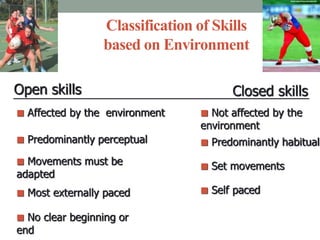
based on Environment
Open skills Closed skills
 Affected by the environment
 Predominantly perceptual
 Movements must be
adapted
 Most externally paced
 No clear beginning or
end
 Not affected by the
environment
 Predominantly habitual
 Set movements
 Self paced
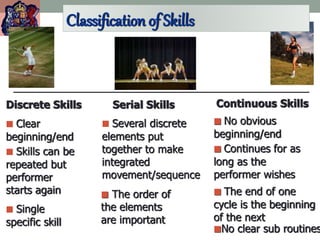
Discrete Skills Continuous Skills
Serial Skills
 Clear
beginning/end
 No obvious
beginning/end
 Several discrete
elements put
together to make
integrated
movement/sequence
 Skills can be
repeated but
performer
starts again
 Single
specific skill
 Continues for as
long as the
performer wishes
 The end of one
cycle is the beginning
of the next
No clear sub routines
 The order of
the elements
are important
Classification of Skills
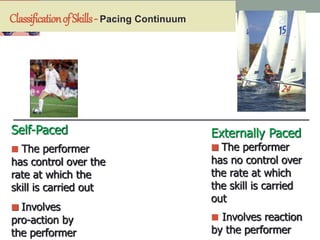
ClassificationofSkills-Pacing Continuum
Self-Paced Externally Paced
 The performer
has control over the
rate at which the
skill is carried out
 Involves
pro-action by
the performer
 The performer
has no control over
the rate at which
the skill is carried
out
 Involves reaction
by the performer
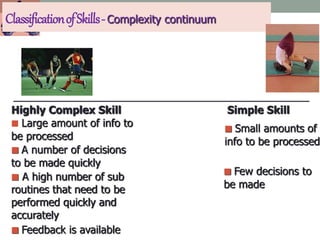
ClassificationofSkills-Complexity continuum
Highly Complex Skill Simple Skill
 Large amount of info to
be processed
 A number of decisions
to be made quickly
 A high number of sub
routines that need to be
performed quickly and
accurately
 Feedback is available
 Small amounts of
info to be processed
 Few decisions to
be made
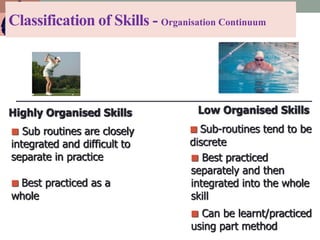
Classification of Skills - Organisation Continuum
Highly Organised Skills Low Organised Skills
 Sub routines are closely
integrated and difficult to
separate in practice
 Best practiced as a
whole
 Sub-routines tend to be
discrete
 Best practiced
separately and then
integrated into the whole
skill
 Can be learnt/practiced
using part method
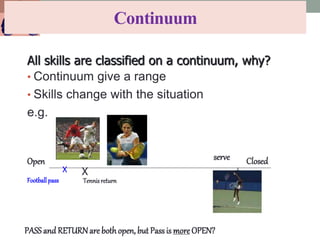
Continuum
• Continuum give a range
• Skills change with the situation
e.g.
X
Open Closed
X
Football pass Tennisreturn
PASSand RETURNare bothopen, but Pass is more OPEN?
All skills are classified on a continuum, why?
serve
x
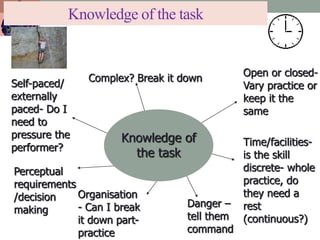
Knowledge of the task
Danger –
tell them
command
Perceptual
requirements
/decision
making
Complex? Break it down
Open or closed-
Vary practice or
keep it the
same
Organisation
- Can I break
it down part-
practice
Self-paced/
externally
paced- Do I
need to
pressure the
performer?
Time/facilities-
is the skill
discrete- whole
practice, do
they need a
rest
(continuous?)
Knowledge of
the task
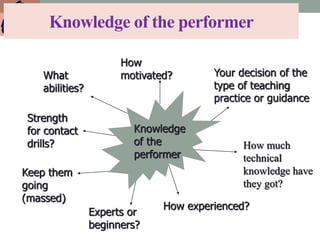
Knowledge of the performer
How
motivated?
Keep them
going
(massed)
How experienced?
Experts or
beginners?
What
abilities?
Strength
for contact
drills? How much
technical
knowledge have
they got?
Your decision of the
type of teaching
practice or guidance
Knowledge
of the
performer
Thanks for attending
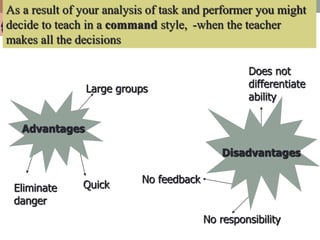
As a result of your analysis of task and performer you might
decide to teach in a command style, -when the teacher
makes all the decisions
Quick
Large groups
Eliminate
danger
No feedback
No responsibility
Does not
differentiate
ability
Disadvantages
Advantages
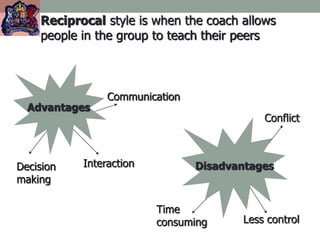
Reciprocal style is when the coach allows
people in the group to teach their peers
Communication
Interaction
Decision
making
Conflict
Less control
Time
consuming
Advantages
Disadvantages
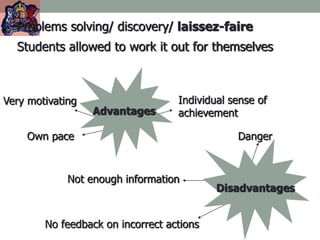
Problems solving/ discovery/ laissez-faire
Individual sense of
achievement
Very motivating
Own pace
Not enough information
No feedback on incorrect actions
Danger
Students allowed to work it out for themselves
Advantages
Disadvantages
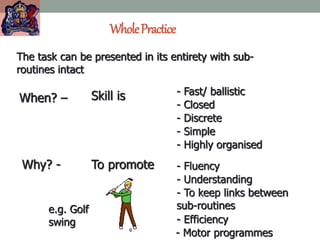
WholePractice
The task can be presented in its entirety with sub-
routines intact
When? – Skill is - Fast/ ballistic
- Closed
- Discrete
- Simple
- Highly organised
Why? - To promote - Fluency
- Understanding
- To keep links between
sub-routines
- Efficiency
- Motor programmes
e.g. Golf
swing
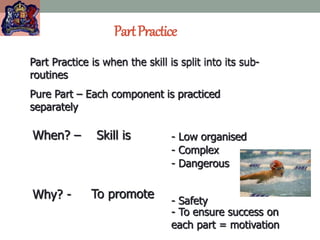
PartPractice
Part Practice is when the skill is split into its sub-
routines
Pure Part – Each component is practiced
separately
When? – Skill is
Why? - To promote
- Low organised
- Complex
- Dangerous
- Safety
- To ensure success on
each part = motivation
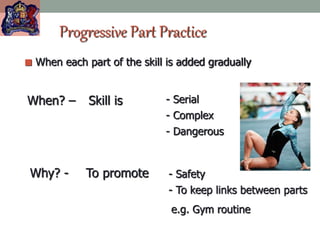
Progressive Part Practice
 When each part of the skill is added gradually
When? – Skill is - Serial
- Complex
- Dangerous
Why? - To promote - Safety
- To keep links between parts
e.g. Gym routine
Massedpractice
 Enables formation of motor programmes
 Good for grooving in a skill
 Good for discrete skills
 Enhances over learning
 Good for habitual responses/ closed skills
 Increases fitness
 No rest intervals
Fatigue
No time for
feedback
Disadvantages
For: - Experts
- Discrete skills
- Simple skills
No rest intervals
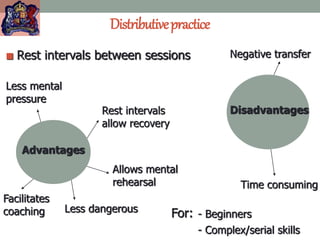
Distributivepractice
 Rest intervals between sessions
Rest intervals
allow recovery
Allows mental
rehearsal
Less dangerous
Facilitates
coaching
Less mental
pressure
Advantages
Disadvantages
Time consuming
Negative transfer
For: - Beginners
- Complex/serial skills
THEORIESOF
LEARNING
Learning
•Learning may be considered to be a more
or less permanent change in performance
associated with experiences but excluding
changes which occur through maturation
and degeneration, or through alterations in
the receptor or effect or organs.
Bull 2000
Performance
•Performance may be thought of
as a temporary occurrence…..
Fluctuating from time to time
because of many potentially
operating variables.
Bull 2000
The phases of learning Fitts and Posner
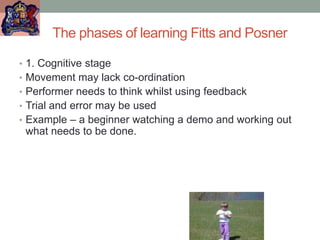
• 1. Cognitive stage
• Movement may lack co-ordination
• Performer needs to think whilst using feedback
• Trial and error may be used
• Example – a beginner watching a demo and working out
what needs to be done.
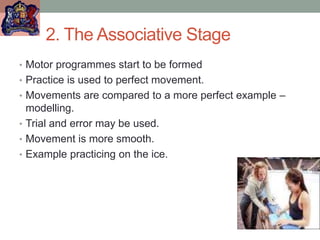
2. The Associative Stage
• Motor programmes start to be formed
• Practice is used to perfect movement.
• Movements are compared to a more perfect example –
modelling.
• Trial and error may be used.
• Movement is more smooth.
• Example practicing on the ice.
3. The Autonomous Phase
• Motor programmes are formed
• The task is completed with efficiency and attention to
detail.
• The performer may use open loop control
• Practice must continue to stay in this phase
“TellmeandIforget;showmeandIremember;involveme
andIunderstand”
Cognitive THEORY of learning
- Thinking and understanding
- Insight learning
- Use of “schema”
- Seeing the skill as a “whole” rather than a
collection of parts
Influenceoftransfer
 Positive
- Facilitates/ aids learning and performance
 Negative
- Hinders learning and performance
 Zero
- No impact on learning and performance
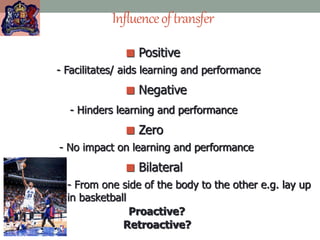
 Bilateral
- From one side of the body to the other e.g. lay up
in basketball
Proactive?
Retroactive?
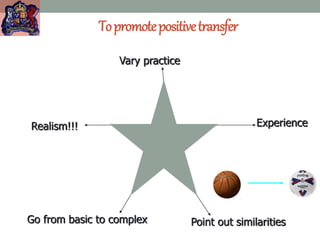
Topromotepositivetransfer
Vary practice
Experience
Point out similarities
Go from basic to complex
Realism!!!
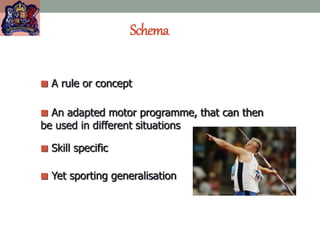
Schema
 A rule or concept
 An adapted motor programme, that can then
be used in different situations
 Skill specific
 Yet sporting generalisation
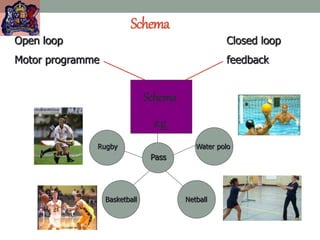
Schema
Open loop Closed loop
Motor programme feedback
Schema
e.g
Water polo
Basketball
Rugby
Pass
Netball
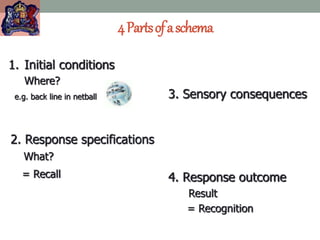
4Partsofaschema
1. Initial conditions
Where?
2. Response specifications
What?
= Recall
3. Sensory consequences
4. Response outcome
Result
= Recognition
e.g. back line in netball
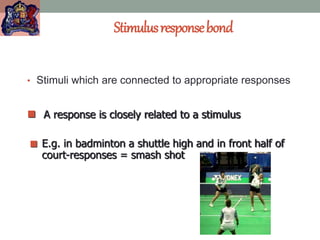
Stimulusresponsebond
• Stimuli which are connected to appropriate responses
 A response is closely related to a stimulus
 E.g. in badminton a shuttle high and in front half of
court-responses = smash shot
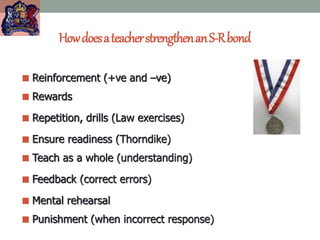
HowdoesateacherstrengthenanS-Rbond
 Reinforcement (+ve and –ve)
 Rewards
 Repetition, drills (Law exercises)
 Ensure readiness (Thorndike)
 Teach as a whole (understanding)
 Feedback (correct errors)
 Mental rehearsal
 Punishment (when incorrect response)
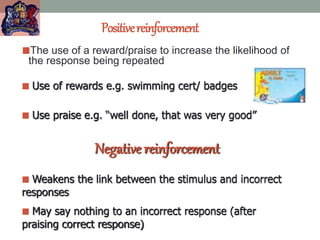
Positivereinforcement
The use of a reward/praise to increase the likelihood of
the response being repeated
 Use of rewards e.g. swimming cert/ badges
 Use praise e.g. “well done, that was very good”
Negative reinforcement
 Weakens the link between the stimulus and incorrect
responses
 May say nothing to an incorrect response (after
praising correct response)
Reinforcement
 The process causing behaviour to re-occur by
strengthening the S/R bond
 Any action that increases the likelihood of a
response/behaviour occurring again
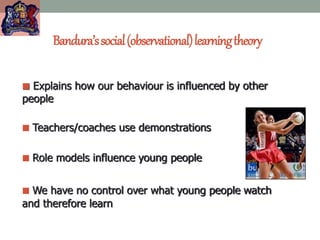
Bandura’ssocial(observational)learningtheory
 Explains how our behaviour is influenced by other
people
 Teachers/coaches use demonstrations
 Role models influence young people
 We have no control over what young people watch
and therefore learn
Bandura’ssociallearningtheory
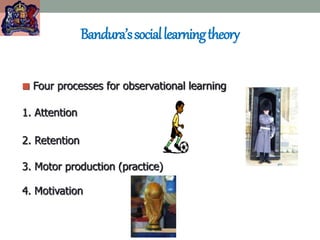
 Four processes for observational learning
1. Attention
2. Retention
3. Motor production (practice)
4. Motivation
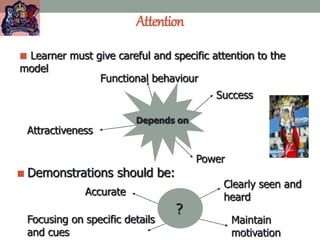
Attention
 Learner must give careful and specific attention to the
model
 Demonstrations should be:
Attractiveness
Success
Depends on
Power
Functional behaviour
Clearly seen and
heard
Accurate
Focusing on specific details
and cues
Maintain
motivation
?
Retention
 The process of remembering the modelled behaviour
-The ability to retain the skill in the memory and recall it
when needed
 It is helped by:
- Making learning interesting
- Repeating it
- Making it meaningful and relevant
- Use of catch phrases
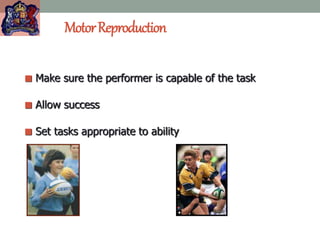
MotorReproduction
 Make sure the performer is capable of the task
 Allow success
 Set tasks appropriate to ability
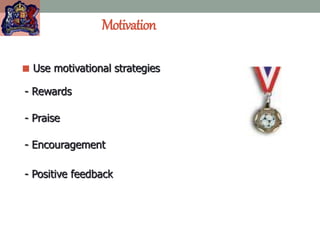
Motivation
 Use motivational strategies
- Rewards
- Praise
- Encouragement
- Positive feedback
Information processing.
• 3 Stages.
• Stimulus identification.
-Using senses to detect from display.
• Response selection.
-Decision making.
• Response programme.
-Initiating movement.
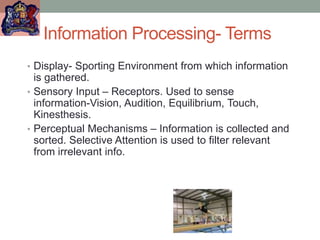
Information Processing- Terms
• Display- Sporting Environment from which information
is gathered.
• Sensory Input – Receptors. Used to sense
information-Vision, Audition, Equilibrium, Touch,
Kinesthesis.
• Perceptual Mechanisms – Information is collected and
sorted. Selective Attention is used to filter relevant
from irrelevant info.
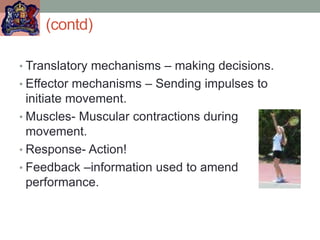
(contd)
• Translatory mechanisms – making decisions.
• Effector mechanisms – Sending impulses to
initiate movement.
• Muscles- Muscular contractions during
movement.
• Response- Action!
• Feedback –information used to amend
performance.
Information processing.
• Can you place the items from the previous slide in the
order that you think they might occur?
• To help you try to think of playing a shot in tennis or a
pass in a game and think of the first thing you would need
to do before you make the play. Then off you go!
• In your answer you may be beginning to make an
information processing model.
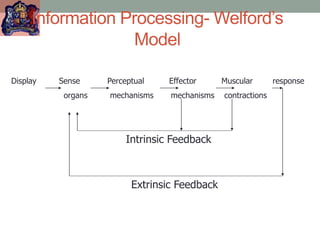
Information Processing- Welford’s
Model
Display Sense Perceptual Effector Muscular response
organs mechanisms mechanisms contractions
Intrinsic Feedback
Extrinsic Feedback
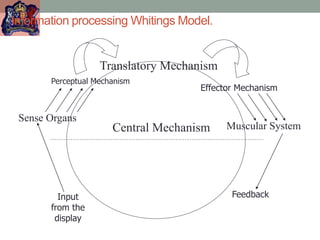
Information processing Whitings Model.
Feedback
Input
from the
display
Sense Organs
Perceptual Mechanism
Translatory Mechanism
Effector Mechanism
Muscular System
Central Mechanism
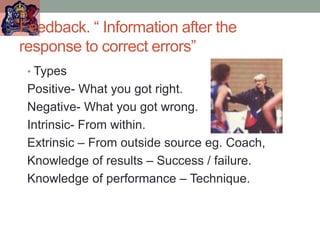
Feedback. “ Information after the
response to correct errors”
• Types
Positive- What you got right.
Negative- What you got wrong.
Intrinsic- From within.
Extrinsic – From outside source eg. Coach,
Knowledge of results – Success / failure.
Knowledge of performance – Technique.
Benefits of feedback
• Builds confidence.
• Motivates.
• Corrects errors.
• Tells you what to do.
• Makes the S-R bond stronger.
• Develops motor programmes.
• Gives reinforcement.
Reaction Time
Definitions
Reaction Time = Onset of stimulus to onset of response
Movement Time = Start to completion of task
Response Time = Onset of stimulus to completion of task
Response Time = Reaction Time plus Movement time
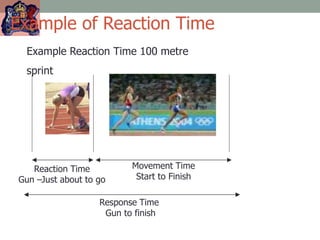
Example of Reaction Time
Reaction Time
Gun –Just about to go
Movement Time
Start to Finish
Response Time
Gun to finish
Example Reaction Time 100 metre
sprint
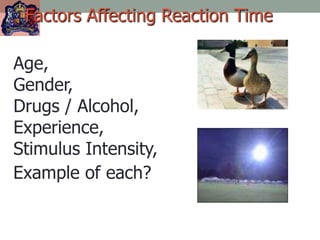
Factors Affecting Reaction Time
Age,
Gender,
Drugs / Alcohol,
Experience,
Stimulus Intensity,
Example of each?

Motor skills in PE.ppt

  • 1.
  • 2.
    SkillAcquisition DefinitionsWhich onesdo you know ? Skill Ability Perceptual ability Gross motor skill Continuum Open/Closed skills Discrete/continuous skills Serial skills Self paced/externally paced skills Fine/gross skills Simple/complex skills Coherent/incoherent skills
  • 3.
    CharacteristicsofSkill  Learned  Controlled Goal directed  Aesthetic  Fluent  Consistent  Efficient  Smooth  Economical
  • 4.
  • 5.
    Abilities enhanced by Childhood Learning Play EarlyCoaching Variety of experience Schema
  • 6.
    Definitions “Skill is alearned ability to bring about predetermined results with maximum certainty, often with the minimum outlay of time, energy or both” Guthrie 1952 “Skill is learned- it is the efficient attainment of a pre specified goal. It involves speed accuracy and the adaptation of the task” Bull 1994
  • 7.
    Skill is the“learned ability to bring about predetermined results with a maximum of certainty, often with a minimum outlay of time or energy, or both” Skill Categories There are 3 basic categories of skills; 1. Cognitive skills involving primarily the brain E.g: reading, analysing a problem. 2. Perceptual skills involving how an individual interprets stimuli E.g: two players receive the same information from the environment but interpret it differently. Correct interpretation of stimuli improves performance. 3. Motor skills involving physical movement E.g: catching, throwing, running.
  • 8.
    ClassificationOfSkills Fine skills- Those involvingmore intricate movements using small muscle groups Gross skills- Those involving large muscle movement Body Involvement Continuum
  • 9.
    Classification of Skills basedon Environment Open skills Closed skills  Affected by the environment  Predominantly perceptual  Movements must be adapted  Most externally paced  No clear beginning or end  Not affected by the environment  Predominantly habitual  Set movements  Self paced
  • 10.
    Discrete Skills ContinuousSkills Serial Skills  Clear beginning/end  No obvious beginning/end  Several discrete elements put together to make integrated movement/sequence  Skills can be repeated but performer starts again  Single specific skill  Continues for as long as the performer wishes  The end of one cycle is the beginning of the next No clear sub routines  The order of the elements are important Classification of Skills
  • 11.
    ClassificationofSkills-Pacing Continuum Self-Paced ExternallyPaced  The performer has control over the rate at which the skill is carried out  Involves pro-action by the performer  The performer has no control over the rate at which the skill is carried out  Involves reaction by the performer
  • 12.
    ClassificationofSkills-Complexity continuum Highly ComplexSkill Simple Skill  Large amount of info to be processed  A number of decisions to be made quickly  A high number of sub routines that need to be performed quickly and accurately  Feedback is available  Small amounts of info to be processed  Few decisions to be made
  • 13.
    Classification of Skills- Organisation Continuum Highly Organised Skills Low Organised Skills  Sub routines are closely integrated and difficult to separate in practice  Best practiced as a whole  Sub-routines tend to be discrete  Best practiced separately and then integrated into the whole skill  Can be learnt/practiced using part method
  • 14.
    Continuum • Continuum givea range • Skills change with the situation e.g. X Open Closed X Football pass Tennisreturn PASSand RETURNare bothopen, but Pass is more OPEN? All skills are classified on a continuum, why? serve x
  • 15.
    Knowledge of thetask Danger – tell them command Perceptual requirements /decision making Complex? Break it down Open or closed- Vary practice or keep it the same Organisation - Can I break it down part- practice Self-paced/ externally paced- Do I need to pressure the performer? Time/facilities- is the skill discrete- whole practice, do they need a rest (continuous?) Knowledge of the task
  • 16.
    Knowledge of theperformer How motivated? Keep them going (massed) How experienced? Experts or beginners? What abilities? Strength for contact drills? How much technical knowledge have they got? Your decision of the type of teaching practice or guidance Knowledge of the performer
  • 17.
  • 18.
    As a resultof your analysis of task and performer you might decide to teach in a command style, -when the teacher makes all the decisions Quick Large groups Eliminate danger No feedback No responsibility Does not differentiate ability Disadvantages Advantages
  • 19.
    Reciprocal style iswhen the coach allows people in the group to teach their peers Communication Interaction Decision making Conflict Less control Time consuming Advantages Disadvantages
  • 20.
    Problems solving/ discovery/laissez-faire Individual sense of achievement Very motivating Own pace Not enough information No feedback on incorrect actions Danger Students allowed to work it out for themselves Advantages Disadvantages
  • 21.
    WholePractice The task canbe presented in its entirety with sub- routines intact When? – Skill is - Fast/ ballistic - Closed - Discrete - Simple - Highly organised Why? - To promote - Fluency - Understanding - To keep links between sub-routines - Efficiency - Motor programmes e.g. Golf swing
  • 22.
    PartPractice Part Practice iswhen the skill is split into its sub- routines Pure Part – Each component is practiced separately When? – Skill is Why? - To promote - Low organised - Complex - Dangerous - Safety - To ensure success on each part = motivation
  • 23.
    Progressive Part Practice When each part of the skill is added gradually When? – Skill is - Serial - Complex - Dangerous Why? - To promote - Safety - To keep links between parts e.g. Gym routine
  • 24.
    Massedpractice  Enables formationof motor programmes  Good for grooving in a skill  Good for discrete skills  Enhances over learning  Good for habitual responses/ closed skills  Increases fitness  No rest intervals Fatigue No time for feedback Disadvantages For: - Experts - Discrete skills - Simple skills No rest intervals
  • 25.
    Distributivepractice  Rest intervalsbetween sessions Rest intervals allow recovery Allows mental rehearsal Less dangerous Facilitates coaching Less mental pressure Advantages Disadvantages Time consuming Negative transfer For: - Beginners - Complex/serial skills
  • 26.
  • 27.
    Learning •Learning may beconsidered to be a more or less permanent change in performance associated with experiences but excluding changes which occur through maturation and degeneration, or through alterations in the receptor or effect or organs. Bull 2000
  • 28.
    Performance •Performance may bethought of as a temporary occurrence….. Fluctuating from time to time because of many potentially operating variables. Bull 2000
  • 29.
    The phases oflearning Fitts and Posner • 1. Cognitive stage • Movement may lack co-ordination • Performer needs to think whilst using feedback • Trial and error may be used • Example – a beginner watching a demo and working out what needs to be done.
  • 30.
    2. The AssociativeStage • Motor programmes start to be formed • Practice is used to perfect movement. • Movements are compared to a more perfect example – modelling. • Trial and error may be used. • Movement is more smooth. • Example practicing on the ice.
  • 31.
    3. The AutonomousPhase • Motor programmes are formed • The task is completed with efficiency and attention to detail. • The performer may use open loop control • Practice must continue to stay in this phase
  • 32.
    “TellmeandIforget;showmeandIremember;involveme andIunderstand” Cognitive THEORY oflearning - Thinking and understanding - Insight learning - Use of “schema” - Seeing the skill as a “whole” rather than a collection of parts
  • 33.
    Influenceoftransfer  Positive - Facilitates/aids learning and performance  Negative - Hinders learning and performance  Zero - No impact on learning and performance  Bilateral - From one side of the body to the other e.g. lay up in basketball Proactive? Retroactive?
  • 34.
    Topromotepositivetransfer Vary practice Experience Point outsimilarities Go from basic to complex Realism!!!
  • 35.
    Schema  A ruleor concept  An adapted motor programme, that can then be used in different situations  Skill specific  Yet sporting generalisation
  • 36.
    Schema Open loop Closedloop Motor programme feedback Schema e.g Water polo Basketball Rugby Pass Netball
  • 37.
    4Partsofaschema 1. Initial conditions Where? 2.Response specifications What? = Recall 3. Sensory consequences 4. Response outcome Result = Recognition e.g. back line in netball
  • 38.
    Stimulusresponsebond • Stimuli whichare connected to appropriate responses  A response is closely related to a stimulus  E.g. in badminton a shuttle high and in front half of court-responses = smash shot
  • 39.
    HowdoesateacherstrengthenanS-Rbond  Reinforcement (+veand –ve)  Rewards  Repetition, drills (Law exercises)  Ensure readiness (Thorndike)  Teach as a whole (understanding)  Feedback (correct errors)  Mental rehearsal  Punishment (when incorrect response)
  • 40.
    Positivereinforcement The use ofa reward/praise to increase the likelihood of the response being repeated  Use of rewards e.g. swimming cert/ badges  Use praise e.g. “well done, that was very good” Negative reinforcement  Weakens the link between the stimulus and incorrect responses  May say nothing to an incorrect response (after praising correct response)
  • 41.
    Reinforcement  The processcausing behaviour to re-occur by strengthening the S/R bond  Any action that increases the likelihood of a response/behaviour occurring again
  • 42.
    Bandura’ssocial(observational)learningtheory  Explains howour behaviour is influenced by other people  Teachers/coaches use demonstrations  Role models influence young people  We have no control over what young people watch and therefore learn
  • 43.
    Bandura’ssociallearningtheory  Four processesfor observational learning 1. Attention 2. Retention 3. Motor production (practice) 4. Motivation
  • 44.
    Attention  Learner mustgive careful and specific attention to the model  Demonstrations should be: Attractiveness Success Depends on Power Functional behaviour Clearly seen and heard Accurate Focusing on specific details and cues Maintain motivation ?
  • 45.
    Retention  The processof remembering the modelled behaviour -The ability to retain the skill in the memory and recall it when needed  It is helped by: - Making learning interesting - Repeating it - Making it meaningful and relevant - Use of catch phrases
  • 46.
    MotorReproduction  Make surethe performer is capable of the task  Allow success  Set tasks appropriate to ability
  • 47.
    Motivation  Use motivationalstrategies - Rewards - Praise - Encouragement - Positive feedback
  • 48.
    Information processing. • 3Stages. • Stimulus identification. -Using senses to detect from display. • Response selection. -Decision making. • Response programme. -Initiating movement.
  • 49.
    Information Processing- Terms •Display- Sporting Environment from which information is gathered. • Sensory Input – Receptors. Used to sense information-Vision, Audition, Equilibrium, Touch, Kinesthesis. • Perceptual Mechanisms – Information is collected and sorted. Selective Attention is used to filter relevant from irrelevant info.
  • 50.
    (contd) • Translatory mechanisms– making decisions. • Effector mechanisms – Sending impulses to initiate movement. • Muscles- Muscular contractions during movement. • Response- Action! • Feedback –information used to amend performance.
  • 51.
    Information processing. • Canyou place the items from the previous slide in the order that you think they might occur? • To help you try to think of playing a shot in tennis or a pass in a game and think of the first thing you would need to do before you make the play. Then off you go! • In your answer you may be beginning to make an information processing model.
  • 52.
    Information Processing- Welford’s Model DisplaySense Perceptual Effector Muscular response organs mechanisms mechanisms contractions Intrinsic Feedback Extrinsic Feedback
  • 53.
    Information processing WhitingsModel. Feedback Input from the display Sense Organs Perceptual Mechanism Translatory Mechanism Effector Mechanism Muscular System Central Mechanism
  • 54.
    Feedback. “ Informationafter the response to correct errors” • Types Positive- What you got right. Negative- What you got wrong. Intrinsic- From within. Extrinsic – From outside source eg. Coach, Knowledge of results – Success / failure. Knowledge of performance – Technique.
  • 55.
    Benefits of feedback •Builds confidence. • Motivates. • Corrects errors. • Tells you what to do. • Makes the S-R bond stronger. • Develops motor programmes. • Gives reinforcement.
  • 56.
    Reaction Time Definitions Reaction Time= Onset of stimulus to onset of response Movement Time = Start to completion of task Response Time = Onset of stimulus to completion of task Response Time = Reaction Time plus Movement time
  • 57.
    Example of ReactionTime Reaction Time Gun –Just about to go Movement Time Start to Finish Response Time Gun to finish Example Reaction Time 100 metre sprint
  • 58.
    Factors Affecting ReactionTime Age, Gender, Drugs / Alcohol, Experience, Stimulus Intensity, Example of each?