Prof. Dr. A.MAHABOOBJAN
Bharathidasan University,
Tiruchirappalli, Tamilnadu, India.
Training Load
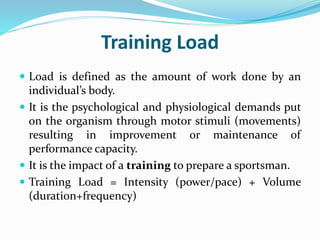
 Load is defined as the amount of work done by an
individual’s body.
 It is the psychological and physiological demands put
on the organism through motor stimuli (movements)
resulting in improvement or maintenance of
performance capacity.
 It is the impact of a training to prepare a sportsman.
 Training Load = Intensity (power/pace) + Volume
(duration+frequency)
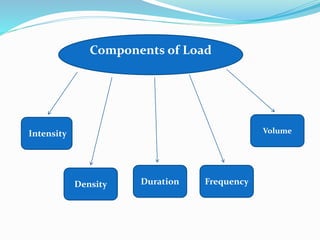
Components of Load
Intensity
DurationDensity Frequency
Volume
Intensity
 It is the rate of doing work or it is the pace at which
physical activity is done.
 It is an activity can be carried out with different
intensities which will have different effect on the
organism.
 It describes the difficulty of an exercise, typically based
on the amount of weight you lift.
 It defined as the amount of effort or work that must be
invested in a specific exercise workout
 Sports training require maximum intensity.
Density
 The temporal relationship between load and recovery
phases in a training session is called density.
 The rest period between two motor stimuli is called
density.
 It is related to the volume of training and deals with
the frequency of training per session, per day, per
week, etc.
Duration
 It is the time period for which a motor stimulus acts on
the organism. Optimum duration is required to start
the desired adaptation process.
 It refers to the length of time for each session of any
specific activity.
Frequency
 It is the number of time the motor stimulus
(repetition) is given.
 It refers to how many training sessions are performed
per week or per day. Number of jumps/throws.
Volume
 The total amount of work done by the sportsman in a
one training session.
 It is the amount of reps and sets you perform.
 The total distance covered total number of repetitions
or the total duration of the activity is the volume.
Volume should be optimum.

Components of load ppt

  • 1.
    Prof. Dr. A.MAHABOOBJAN BharathidasanUniversity, Tiruchirappalli, Tamilnadu, India.
  • 2.
    Training Load  Loadis defined as the amount of work done by an individual’s body.  It is the psychological and physiological demands put on the organism through motor stimuli (movements) resulting in improvement or maintenance of performance capacity.  It is the impact of a training to prepare a sportsman.  Training Load = Intensity (power/pace) + Volume (duration+frequency)
  • 3.
  • 4.
    Intensity  It isthe rate of doing work or it is the pace at which physical activity is done.  It is an activity can be carried out with different intensities which will have different effect on the organism.  It describes the difficulty of an exercise, typically based on the amount of weight you lift.  It defined as the amount of effort or work that must be invested in a specific exercise workout  Sports training require maximum intensity.
  • 5.
    Density  The temporalrelationship between load and recovery phases in a training session is called density.  The rest period between two motor stimuli is called density.  It is related to the volume of training and deals with the frequency of training per session, per day, per week, etc.
  • 6.
    Duration  It isthe time period for which a motor stimulus acts on the organism. Optimum duration is required to start the desired adaptation process.  It refers to the length of time for each session of any specific activity.
  • 7.
    Frequency  It isthe number of time the motor stimulus (repetition) is given.  It refers to how many training sessions are performed per week or per day. Number of jumps/throws.
  • 8.
    Volume  The totalamount of work done by the sportsman in a one training session.  It is the amount of reps and sets you perform.  The total distance covered total number of repetitions or the total duration of the activity is the volume. Volume should be optimum.