







Mental Skills Training
(MST)
Sir Mac/ Sir Drew
COE Graduate Studies, Students
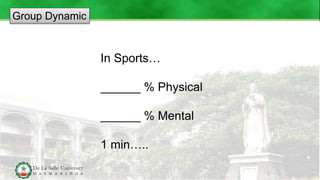
Group Dynamic
In Sports…
______ % Physical
______ % Mental
1 min…..
After reading this chapter, you should be able to
explain ….
Psychological Factors and Performance Excellence
Sharing…
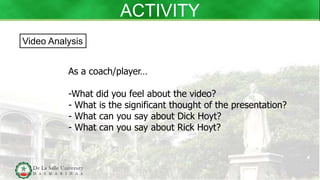
ACTIVITY
Video Analysis
As a coach/player…
-What did you feel about the video?
- What is the significant thought of the presentation?
- What can you say about Dick Hoyt?
- What can you say about Rick Hoyt?
Motivation
Energy Management
Attention Skills
Stress Management
Self Confidence
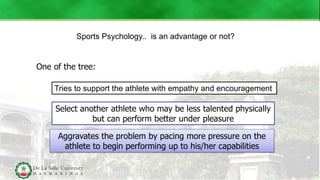
Sports Psychology.. is an advantage or not?
One of the tree:
Tries to support the athlete with empathy and encouragement
Select another athlete who may be less talented physically
but can perform better under pleasure
Aggravates the problem by pacing more pressure on the
athlete to begin performing up to his/her capabilities
LO 2: How mental skill training can improve performance,
enhance enjoyment, and help athletes develop life skills,
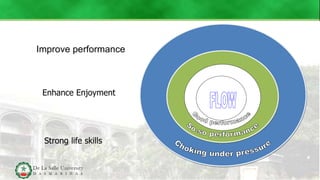
Improve performance
Enhance Enjoyment
Strong life skills
LO 3: How your athletes can use mental training
tools to develop mental skills
Four Mental Training Tools to Develop Athlete’s Mental Skills
G
O
A
L
S
E
T
T
I
N
G
I
M
A
G
E
R
Y
R
E
L
A
X
A
T
I
O
N
A
N
D
E
N
E
R
G
I
Z
A
T
I
O
N
S
E
L
F
T
A
L
K
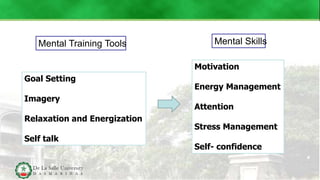
Mental Training Tools Mental Skills
Goal Setting
Imagery
Relaxation and Energization
Self talk
Motivation
Energy Management
Attention
Stress Management
Self- confidence
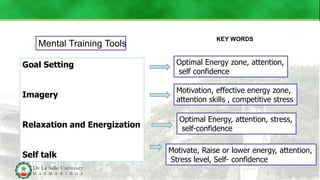
Goal Setting
Imagery
Relaxation and Energization
Self talk
Mental Training Tools
KEY WORDS
Optimal Energy zone, attention,
self confidence
Motivation, effective energy zone,
attention skills , competitive stress
Optimal Energy, attention, stress,
self-confidence
Motivate, Raise or lower energy, attention,
Stress level, Self- confidence
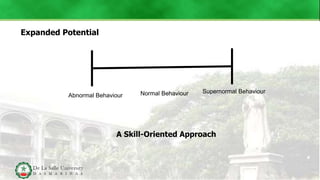
Expanded Potential
Abnormal Behaviour Normal Behaviour Supernormal Behaviour
A Skill-Oriented Approach
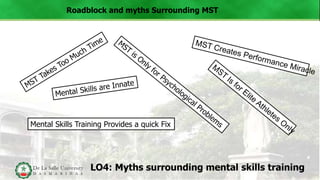
LO4: Myths surrounding mental skills training
Roadblock and myths Surrounding MST
Mental Skills Training Provides a quick Fix
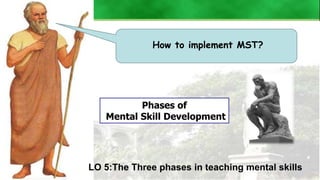
How to implement MST?
Phases of
Mental Skill Development
LO 5:The Three phases in teaching mental skills
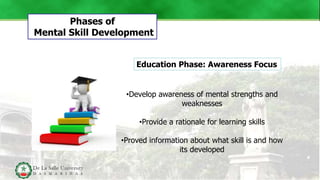
Phases of
Mental Skill Development
Education Phase: Awareness Focus
•Develop awareness of mental strengths and
weaknesses
•Provide a rationale for learning skills
•Proved information about what skill is and how
its developed
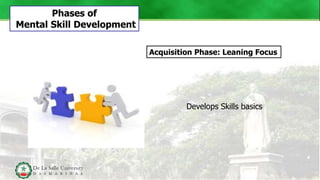
Acquisition Phase: Leaning Focus
Phases of
Mental Skill Development
Develops Skills basics
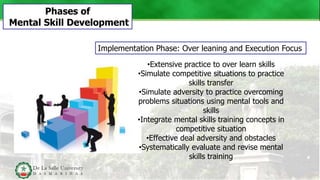
Implementation Phase: Over leaning and Execution Focus
Phases of
Mental Skill Development
•Extensive practice to over learn skills
•Simulate competitive situations to practice
skills transfer
•Simulate adversity to practice overcoming
problems situations using mental tools and
skills
•Integrate mental skills training concepts in
competitive situation
•Effective deal adversity and obstacles
•Systematically evaluate and revise mental
skills training
What is your Role
The ULTIMATE KEY to success with MST is YOU!
COACH
What will you do next?
In Sports…
______ % Physical
______ % Mental
YOU ARE THE KEY TO SUCCESS
and
YOUR PLAYERS ARE your INSTRUMENTS for SUCCESS
90/10 Principle
Reference
Burton, D. & Raedeke, T. (2008), Sport psychology
for coaches, Champaign, IL: Human Kinetics.

Intro to Mental Skills Training

  • 1.
    Mental Skills Training (MST) SirMac/ Sir Drew COE Graduate Studies, Students
  • 2.
    Group Dynamic In Sports… ______% Physical ______ % Mental 1 min…..
  • 3.
    After reading thischapter, you should be able to explain ….
  • 4.
    Psychological Factors andPerformance Excellence Sharing…
  • 5.
    ACTIVITY Video Analysis As acoach/player… -What did you feel about the video? - What is the significant thought of the presentation? - What can you say about Dick Hoyt? - What can you say about Rick Hoyt?
  • 6.
  • 7.
    Sports Psychology.. isan advantage or not? One of the tree: Tries to support the athlete with empathy and encouragement Select another athlete who may be less talented physically but can perform better under pleasure Aggravates the problem by pacing more pressure on the athlete to begin performing up to his/her capabilities
  • 8.
    LO 2: Howmental skill training can improve performance, enhance enjoyment, and help athletes develop life skills,
  • 9.
  • 10.
    LO 3: Howyour athletes can use mental training tools to develop mental skills
  • 11.
    Four Mental TrainingTools to Develop Athlete’s Mental Skills G O A L S E T T I N G I M A G E R Y R E L A X A T I O N A N D E N E R G I Z A T I O N S E L F T A L K
  • 12.
    Mental Training ToolsMental Skills Goal Setting Imagery Relaxation and Energization Self talk Motivation Energy Management Attention Stress Management Self- confidence
  • 13.
    Goal Setting Imagery Relaxation andEnergization Self talk Mental Training Tools KEY WORDS Optimal Energy zone, attention, self confidence Motivation, effective energy zone, attention skills , competitive stress Optimal Energy, attention, stress, self-confidence Motivate, Raise or lower energy, attention, Stress level, Self- confidence
  • 14.
    Expanded Potential Abnormal BehaviourNormal Behaviour Supernormal Behaviour A Skill-Oriented Approach
  • 15.
    LO4: Myths surroundingmental skills training Roadblock and myths Surrounding MST Mental Skills Training Provides a quick Fix
  • 16.
    How to implementMST? Phases of Mental Skill Development LO 5:The Three phases in teaching mental skills
  • 17.
    Phases of Mental SkillDevelopment Education Phase: Awareness Focus •Develop awareness of mental strengths and weaknesses •Provide a rationale for learning skills •Proved information about what skill is and how its developed
  • 18.
    Acquisition Phase: LeaningFocus Phases of Mental Skill Development Develops Skills basics
  • 19.
    Implementation Phase: Overleaning and Execution Focus Phases of Mental Skill Development •Extensive practice to over learn skills •Simulate competitive situations to practice skills transfer •Simulate adversity to practice overcoming problems situations using mental tools and skills •Integrate mental skills training concepts in competitive situation •Effective deal adversity and obstacles •Systematically evaluate and revise mental skills training
  • 20.
    What is yourRole The ULTIMATE KEY to success with MST is YOU! COACH
  • 21.
    What will youdo next?
  • 22.
    In Sports… ______ %Physical ______ % Mental
  • 23.
    YOU ARE THEKEY TO SUCCESS and YOUR PLAYERS ARE your INSTRUMENTS for SUCCESS 90/10 Principle
  • 25.
    Reference Burton, D. &Raedeke, T. (2008), Sport psychology for coaches, Champaign, IL: Human Kinetics.

Editor's Notes

  • #6 This is a 5 minute individual activity reflection.
  • #17 Lecturette
  • #21 Consider whether what you are about to say Understand other persons perspective
  • #22 Suggest desired changes and express interest for change.