Forging Process
Shaon Barua
Lecturer
shaon@cuet.ac.bd
Department of Mechatronics & Industrial Engineering
Chittagong University of Engineering & technology (CUET)
MIE 121: Production Process
Shaon Barua (CUET)
Production Process Forging
MIE 131 1/21Forging
Shaon Barua (CUET)
Forging Introduction
MIE 121 2/21Forging
Parts made by forging process
Shaon Barua (CUET)
Forging Introduction
MIE 121 3/21Forging
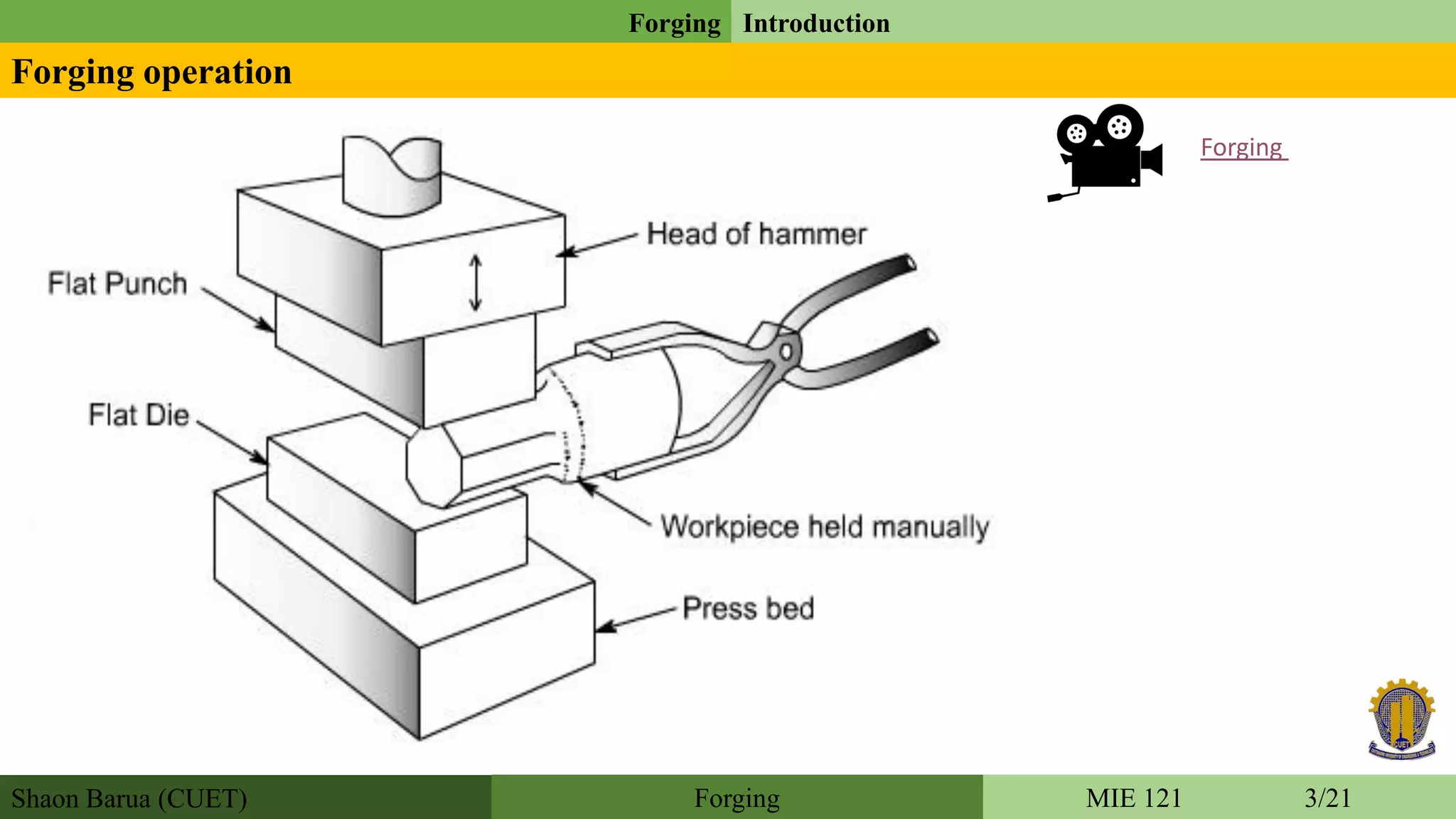
Forging operation
Forging
Shaon Barua (CUET)
Forging
MIE 121 4/21Forging
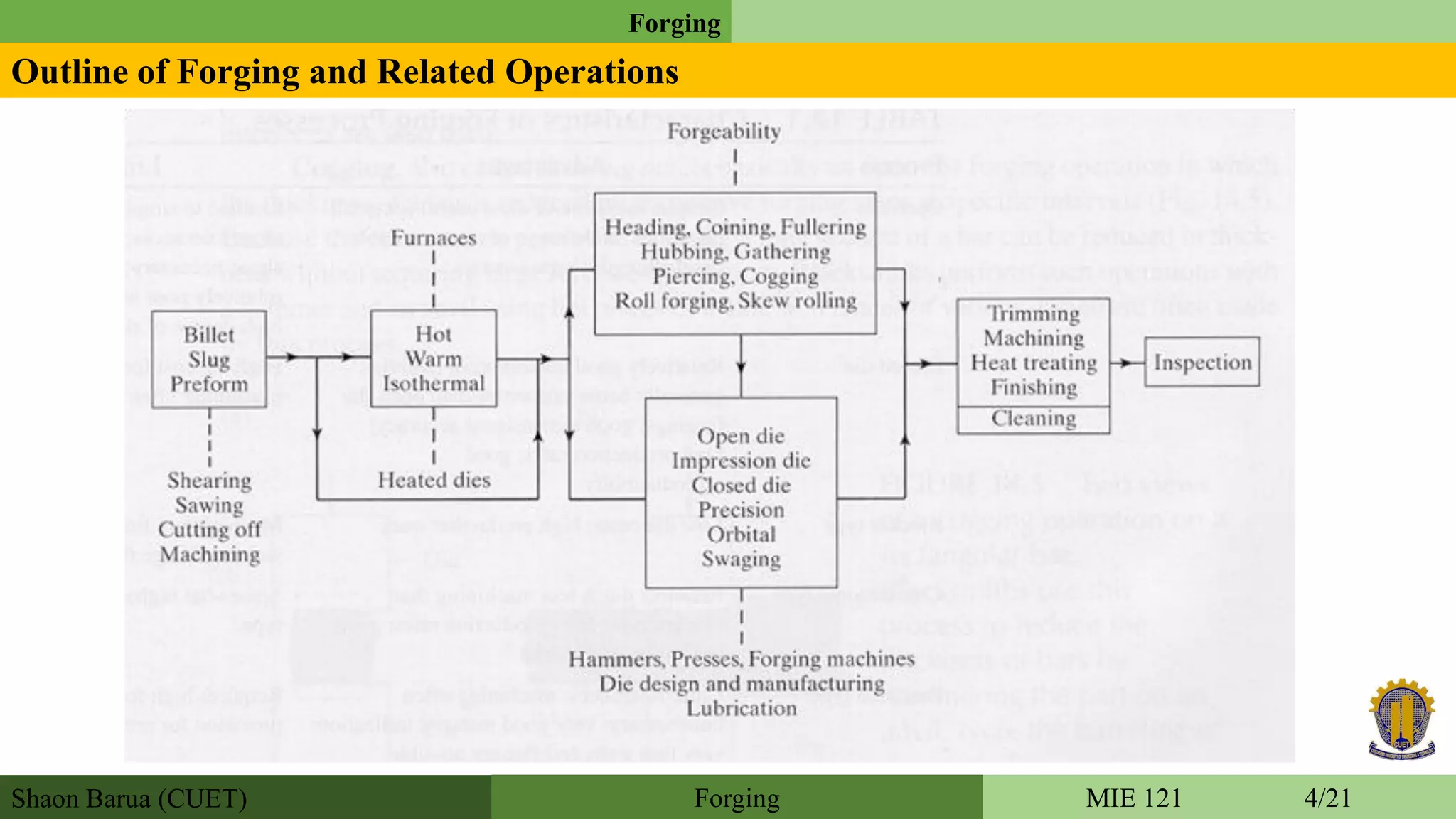
Outline of Forging and Related Operations
Shaon Barua (CUET)
Forging Introduction
MIE 121 5/21Forging
Introduction
 Deformation process in which work is compressed between two dies
 Oldest of the metal forming operations
 Dates from about 5000 BC
 Products: engine crankshafts, connecting rods, gears, aircraft structural
components, jet engine turbine parts
 Also, basic metals industries use forging to establish basic shape of large parts
that are subsequently machined to final geometry and size
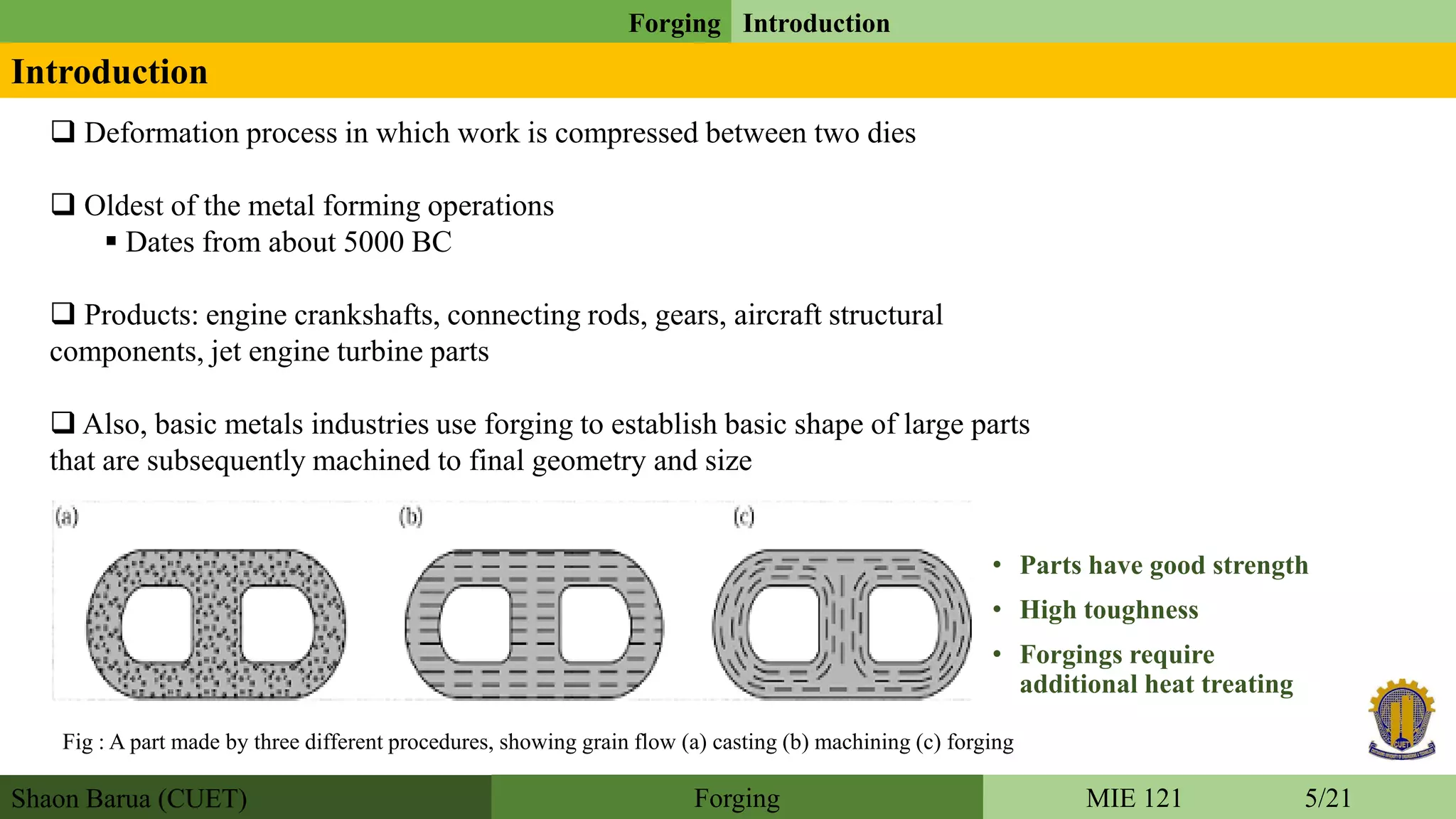
• Parts have good strength
• High toughness
• Forgings require
additional heat treating
Fig : A part made by three different procedures, showing grain flow (a) casting (b) machining (c) forging
Shaon Barua (CUET)
Forging
MIE 121 6/21Forging
Classification of Forging Operations
Cold vs. hot forging:
 Hot or warm forging – advantage: reduction in
strength and increase in ductility of work metal
 Cold forging – advantage: increased strength due to
strain hardening
Impact vs. press forging:
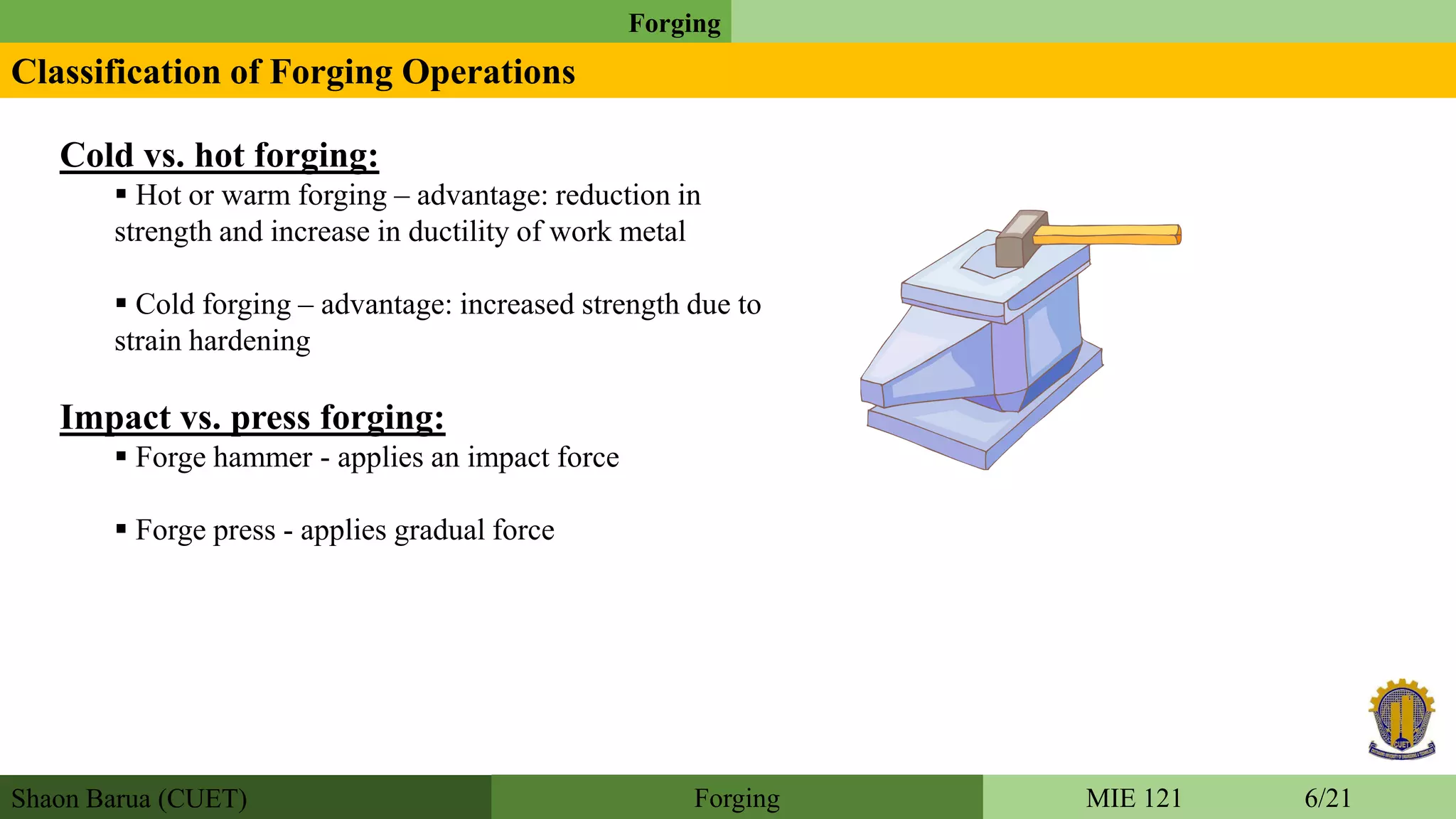
 Forge hammer - applies an impact force
 Forge press - applies gradual force
Shaon Barua (CUET)
Forging
MIE 121 7/21Forging
Types of Forging Operations
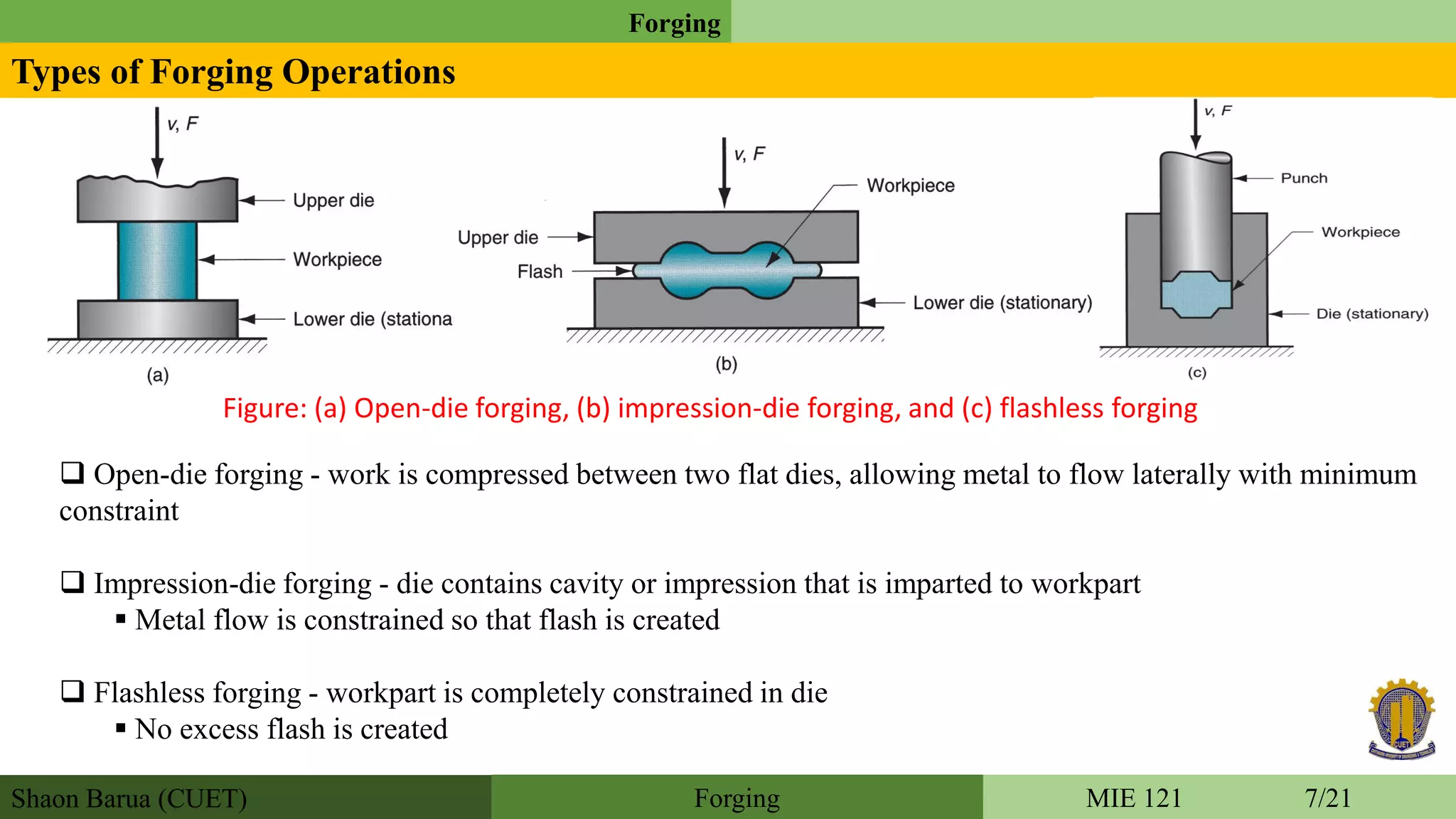
 Open-die forging - work is compressed between two flat dies, allowing metal to flow laterally with minimum
constraint
 Impression-die forging - die contains cavity or impression that is imparted to workpart
 Metal flow is constrained so that flash is created
 Flashless forging - workpart is completely constrained in die
 No excess flash is created
Figure: (a) Open-die forging, (b) impression-die forging, and (c) flashless forging
Shaon Barua (CUET)
Forging
MIE 121 8/21Forging
Open Die Forging
 Compression of workpart between two flat dies
 Similar to compression test when workpart has cylindrical cross section and is compressed along its axis
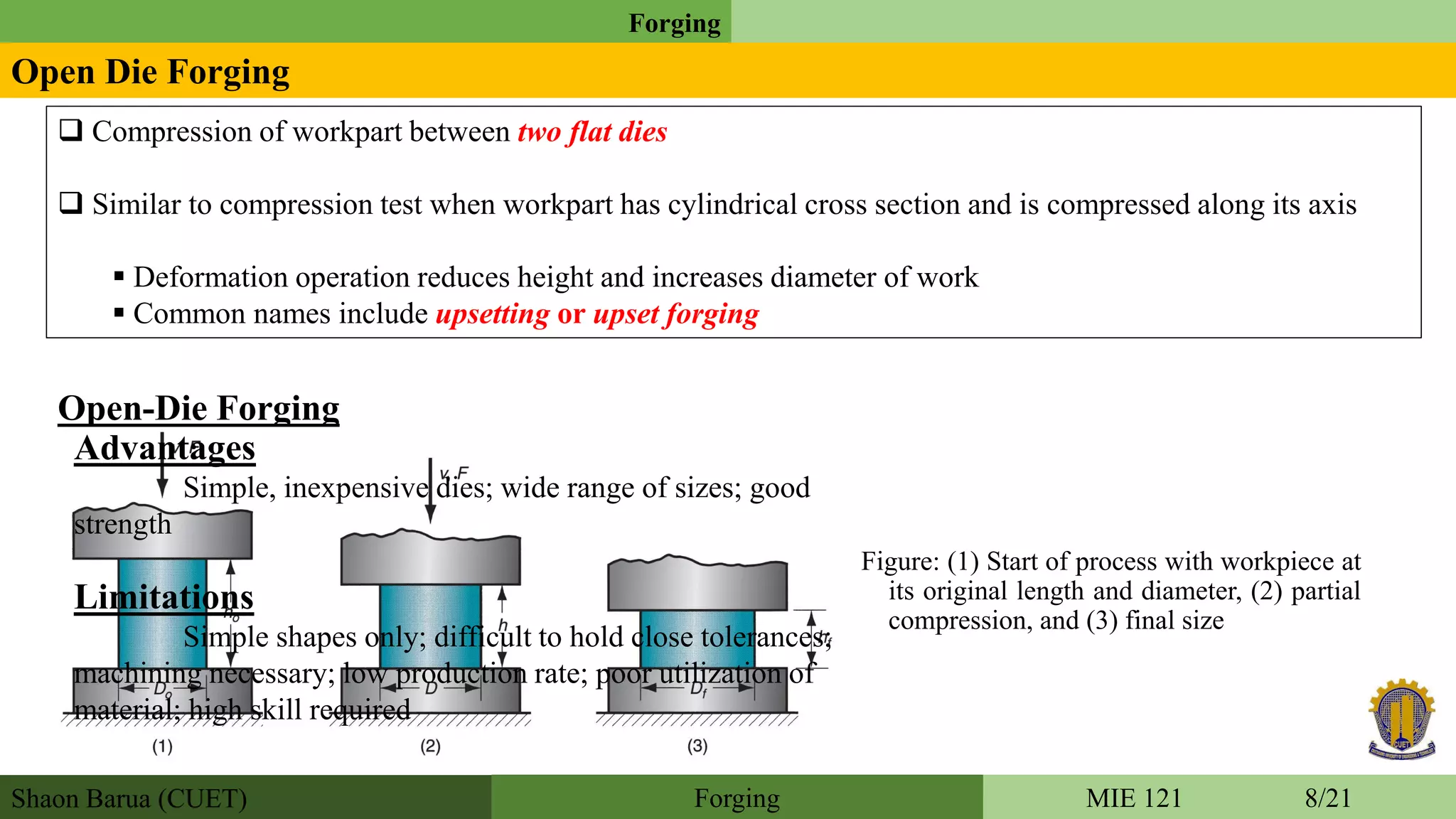
 Deformation operation reduces height and increases diameter of work
 Common names include upsetting or upset forging
Open-Die Forging
Figure: (1) Start of process with workpiece at
its original length and diameter, (2) partial
compression, and (3) final size
Advantages
Simple, inexpensive dies; wide range of sizes; good
strength
Limitations
Simple shapes only; difficult to hold close tolerances;
machining necessary; low production rate; poor utilization of
material; high skill required
Shaon Barua (CUET)
Forging
MIE 121 9/21Forging
Impression-Die Forging
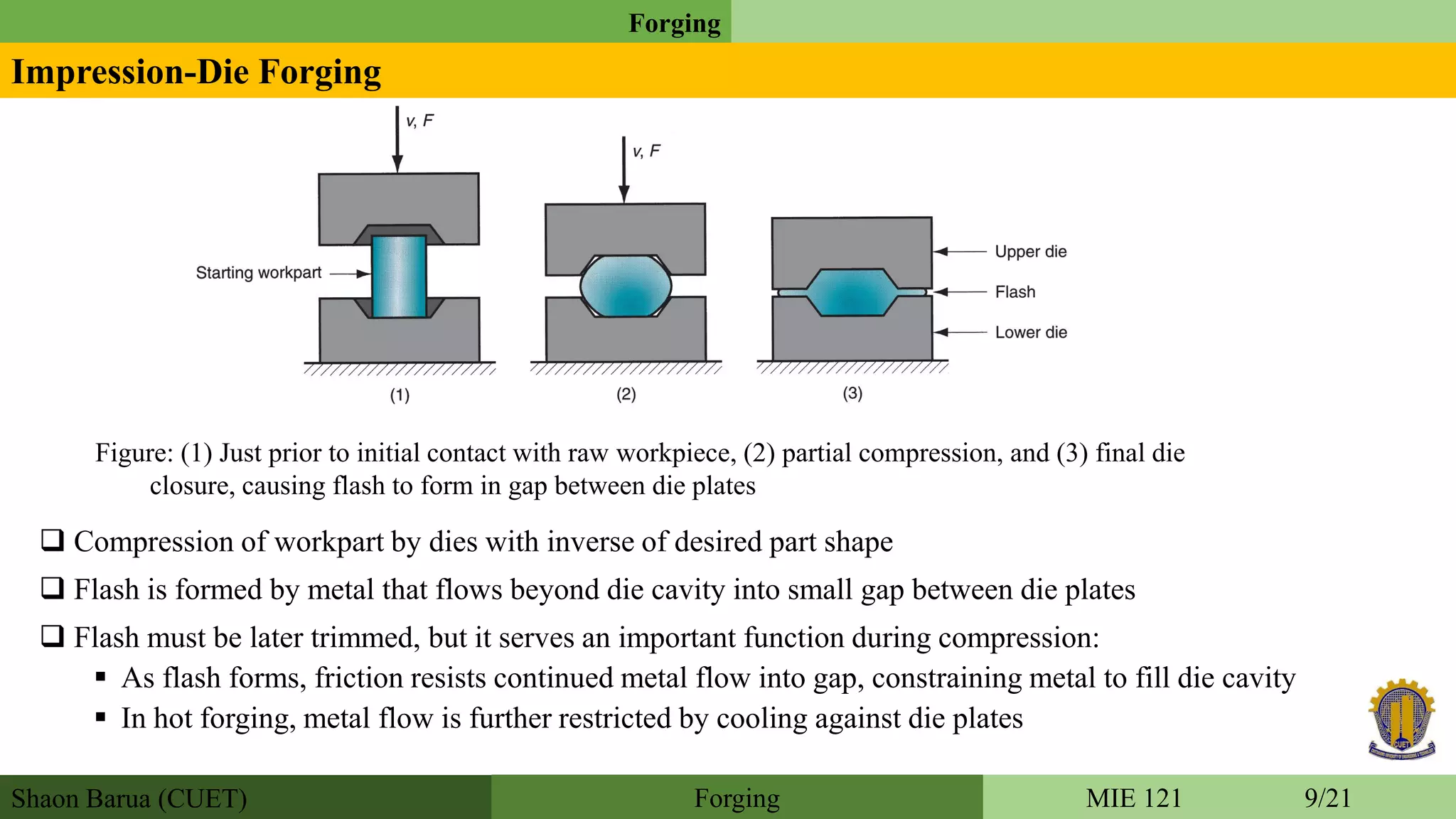
 Compression of workpart by dies with inverse of desired part shape
 Flash is formed by metal that flows beyond die cavity into small gap between die plates
 Flash must be later trimmed, but it serves an important function during compression:
 As flash forms, friction resists continued metal flow into gap, constraining metal to fill die cavity
 In hot forging, metal flow is further restricted by cooling against die plates
Figure: (1) Just prior to initial contact with raw workpiece, (2) partial compression, and (3) final die
closure, causing flash to form in gap between die plates
Shaon Barua (CUET)
Forging
MIE 121 10/21Forging
Impression-Die Forging
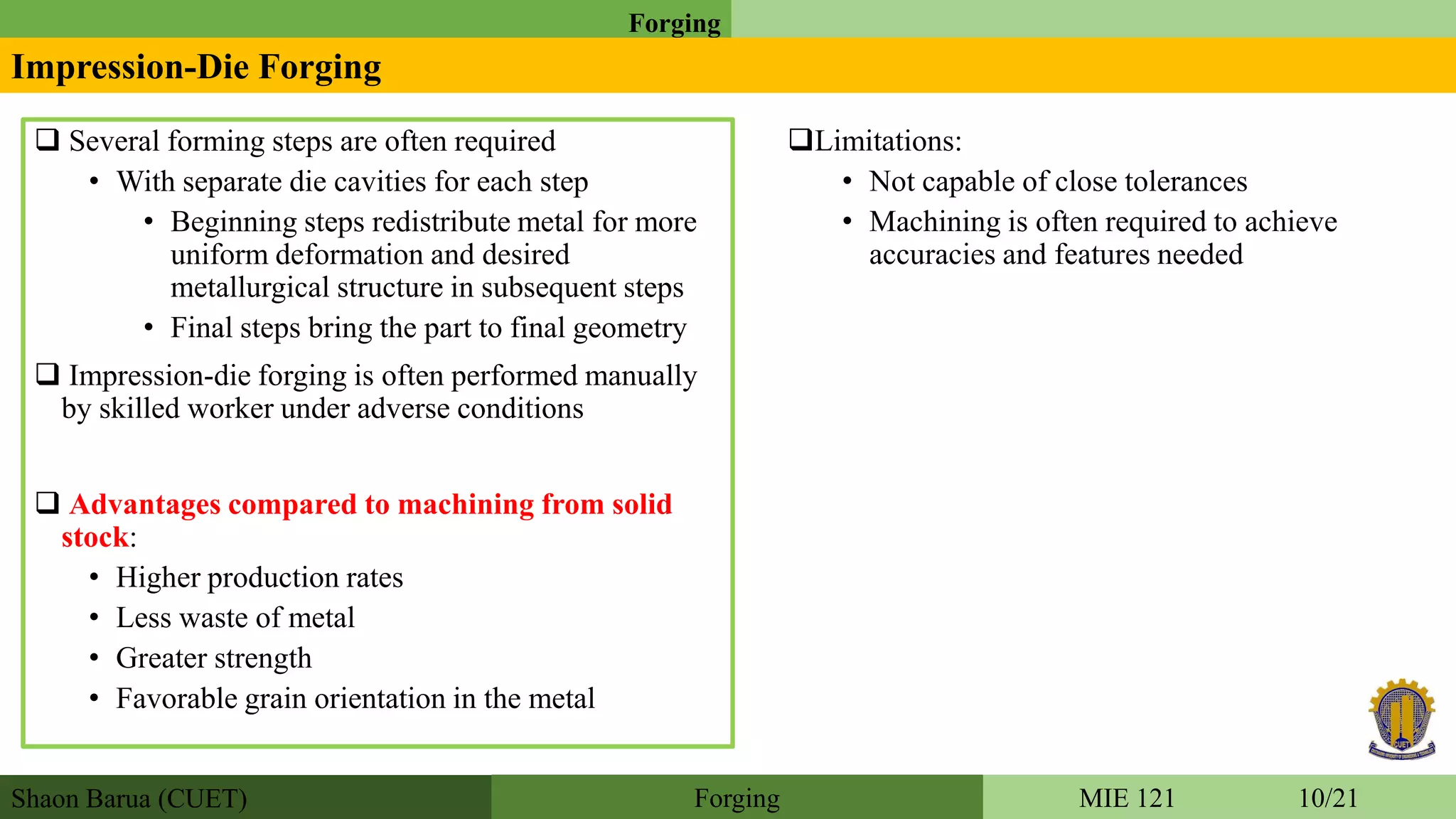
 Several forming steps are often required
• With separate die cavities for each step
• Beginning steps redistribute metal for more
uniform deformation and desired
metallurgical structure in subsequent steps
• Final steps bring the part to final geometry
 Impression-die forging is often performed manually
by skilled worker under adverse conditions
 Advantages compared to machining from solid
stock:
• Higher production rates
• Less waste of metal
• Greater strength
• Favorable grain orientation in the metal
Limitations:
• Not capable of close tolerances
• Machining is often required to achieve
accuracies and features needed
Shaon Barua (CUET)
Forging
MIE 121 11/21Forging
Flashless Forging
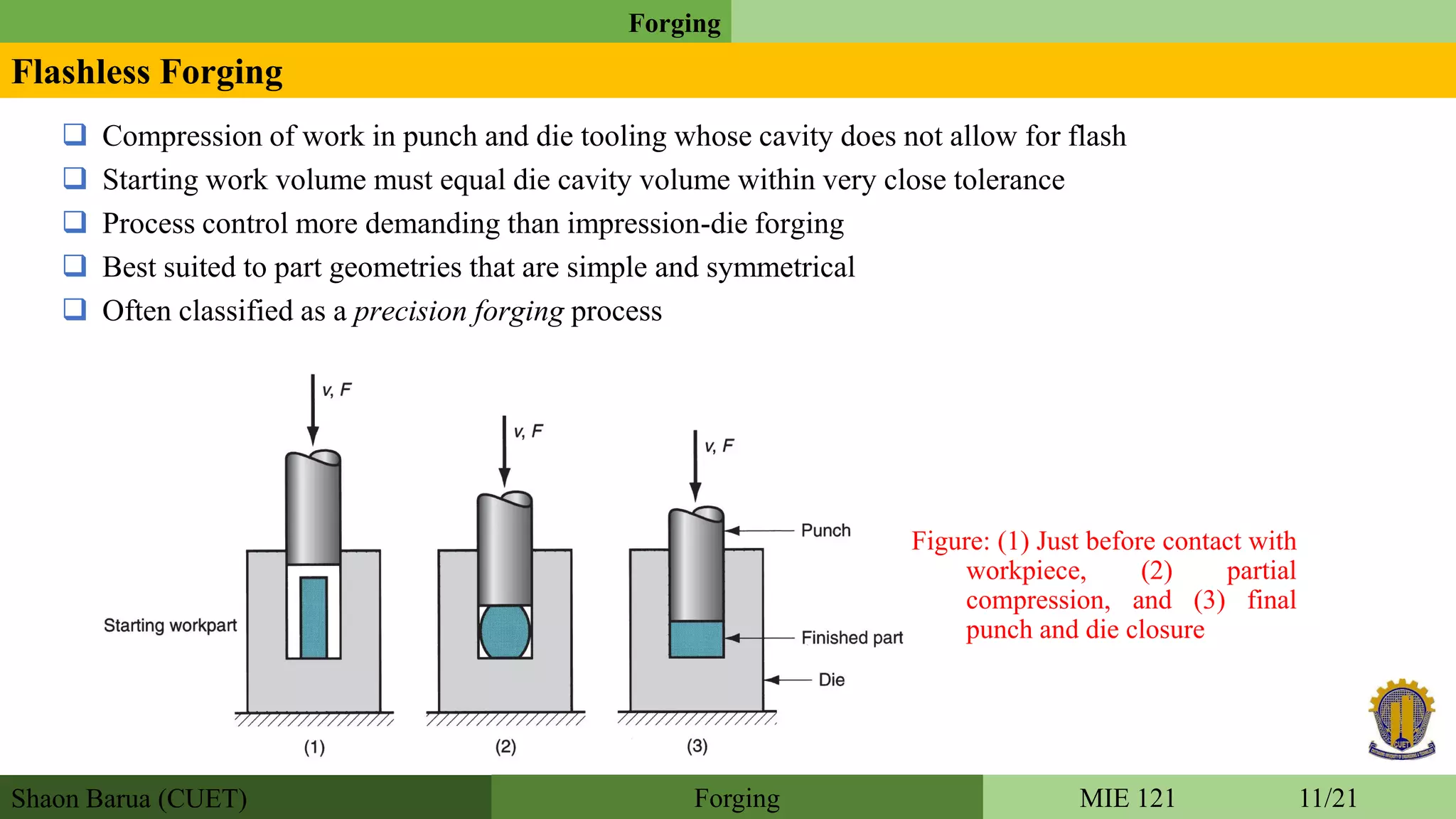
 Compression of work in punch and die tooling whose cavity does not allow for flash
 Starting work volume must equal die cavity volume within very close tolerance
 Process control more demanding than impression-die forging
 Best suited to part geometries that are simple and symmetrical
 Often classified as a precision forging process
Figure: (1) Just before contact with
workpiece, (2) partial
compression, and (3) final
punch and die closure
Shaon Barua (CUET)
Forging
MIE 121 12/21Forging
Forging operation in the industry
Crankshaft making process
Connecting rod forging
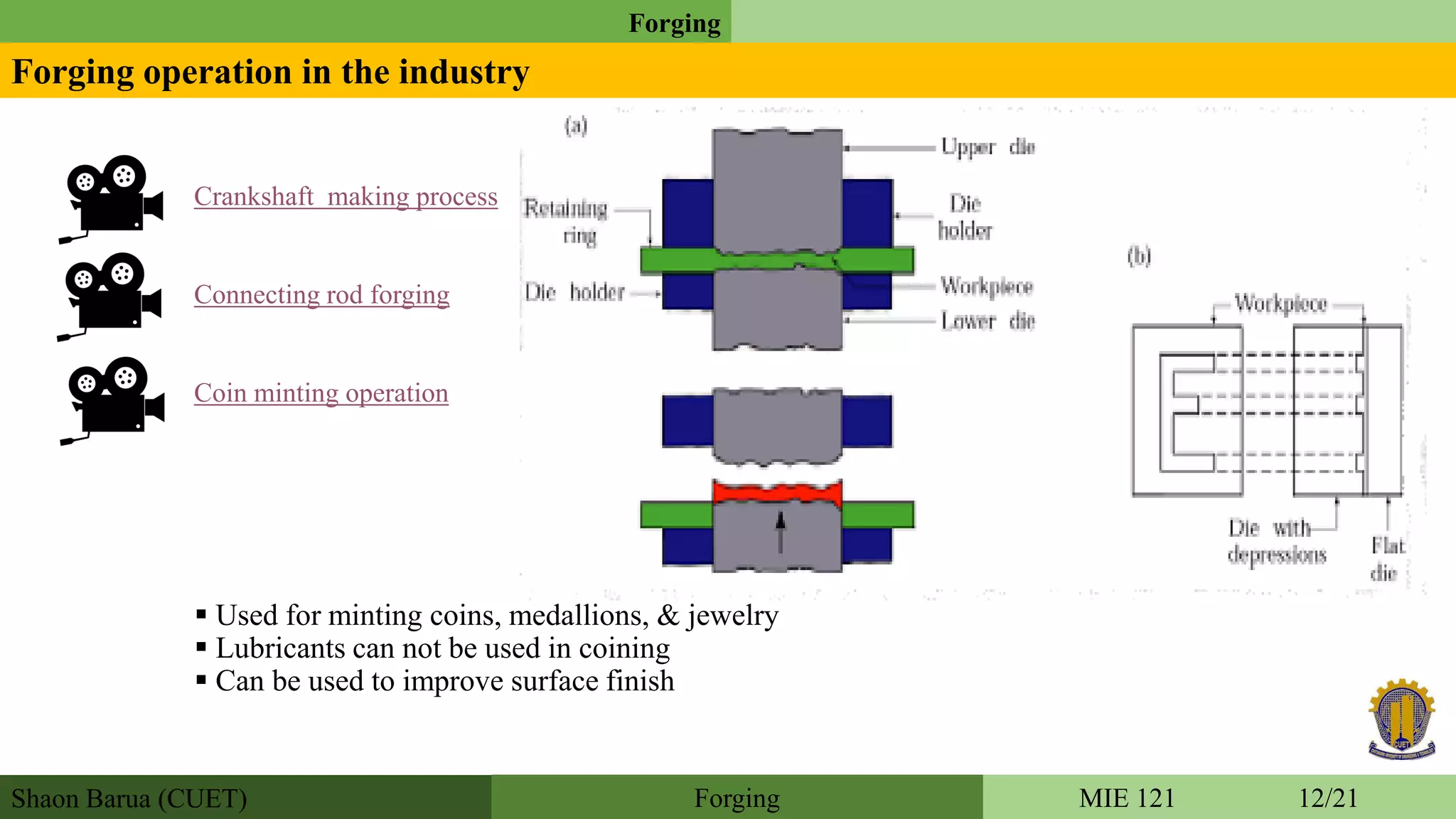
Coin minting operation
 Used for minting coins, medallions, & jewelry
 Lubricants can not be used in coining
 Can be used to improve surface finish
Shaon Barua (CUET)
Forging
MIE 121 13/21Forging
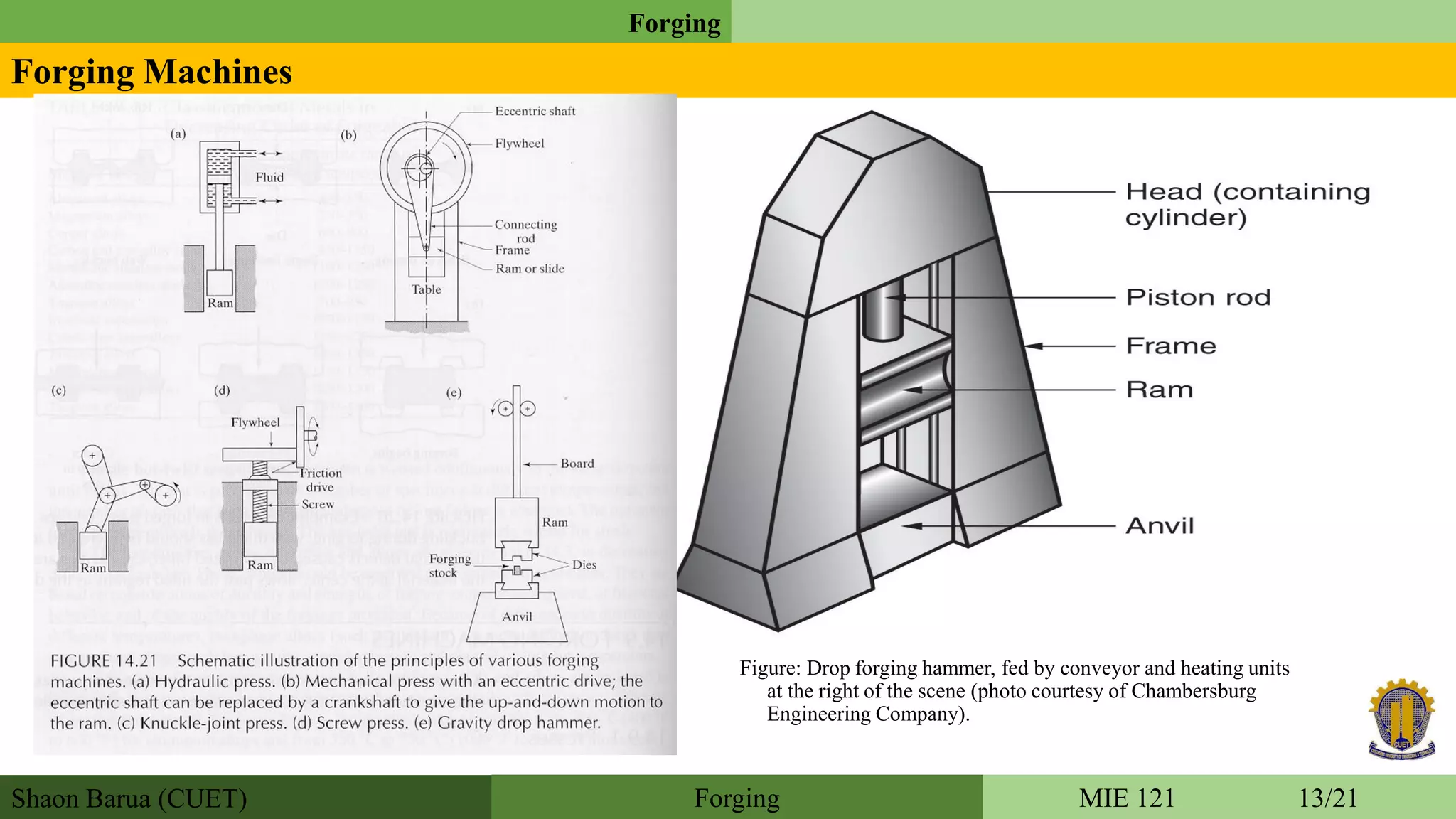
Forging Machines
Apply impact load against workpart: Two
types:
• Gravity drop hammers - impact energy
from falling weight of a heavy ram
• Power drop hammers - accelerate the
ram by pressurized air or steam
 Disadvantage: impact energy transmitted
through anvil into floor of building
• Commonly used for impression-die
forging
Figure: Drop forging hammer, fed by conveyor and heating units
at the right of the scene (photo courtesy of Chambersburg
Engineering Company).
Shaon Barua (CUET)
Forging
MIE 121 14/21Forging
Forging Presses
©2010 John Wiley & Sons, Inc. M P Groover, Fundamentals of Modern Manufacturing 4/e
• Apply gradual pressure to accomplish compression operation
• Types:
• Hydraulic press - hydraulic piston actuates ram
• Mechanical press - converts rotation of drive motor into linear
motion of ram
• Screw press - screw mechanism drives ram
Shaon Barua (CUET)
Forging
MIE 121 15/21Forging
Upsetting and Heading
Forging process used to form heads on nails, bolts, and similar hardware products
 More parts produced by upsetting than any other forging operation
 Performed cold, warm, or hot on machines called headers or formers
 Wire or bar stock is fed into machine, end is headed, then piece is cut to length
 For bolts and screws, thread rolling is then used to form threads
Figure: Upset forging to form a head
on a bolt or similar hardware
item: (1) wire stock is fed to
stop, (2) gripping dies close on
stock and stop retracts, (3)
punch moves forward, (4)
bottoms to form the head
Bolt manufacturing
Shaon Barua (CUET)
Forging
MIE 121 16/21Forging
Upsetting and Heading
Forging process used to form heads on nails, bolts, and similar hardware products
 More parts produced by upsetting than any other forging operation
 Performed cold, warm, or hot on machines called headers or formers
 Wire or bar stock is fed into machine, end is headed, then piece is cut to length
 For bolts and screws, thread rolling is then used to form threads
Figure: Examples of heading
operations: (a) heading a nail
using open dies, (b) round head
formed by punch, (c) and (d) two
common head styles for screws
formed by die, (e) carriage bolt
head formed by punch and die
Shaon Barua (CUET)
Forging
MIE 121 17/21Forging
Swaging and Radial forging
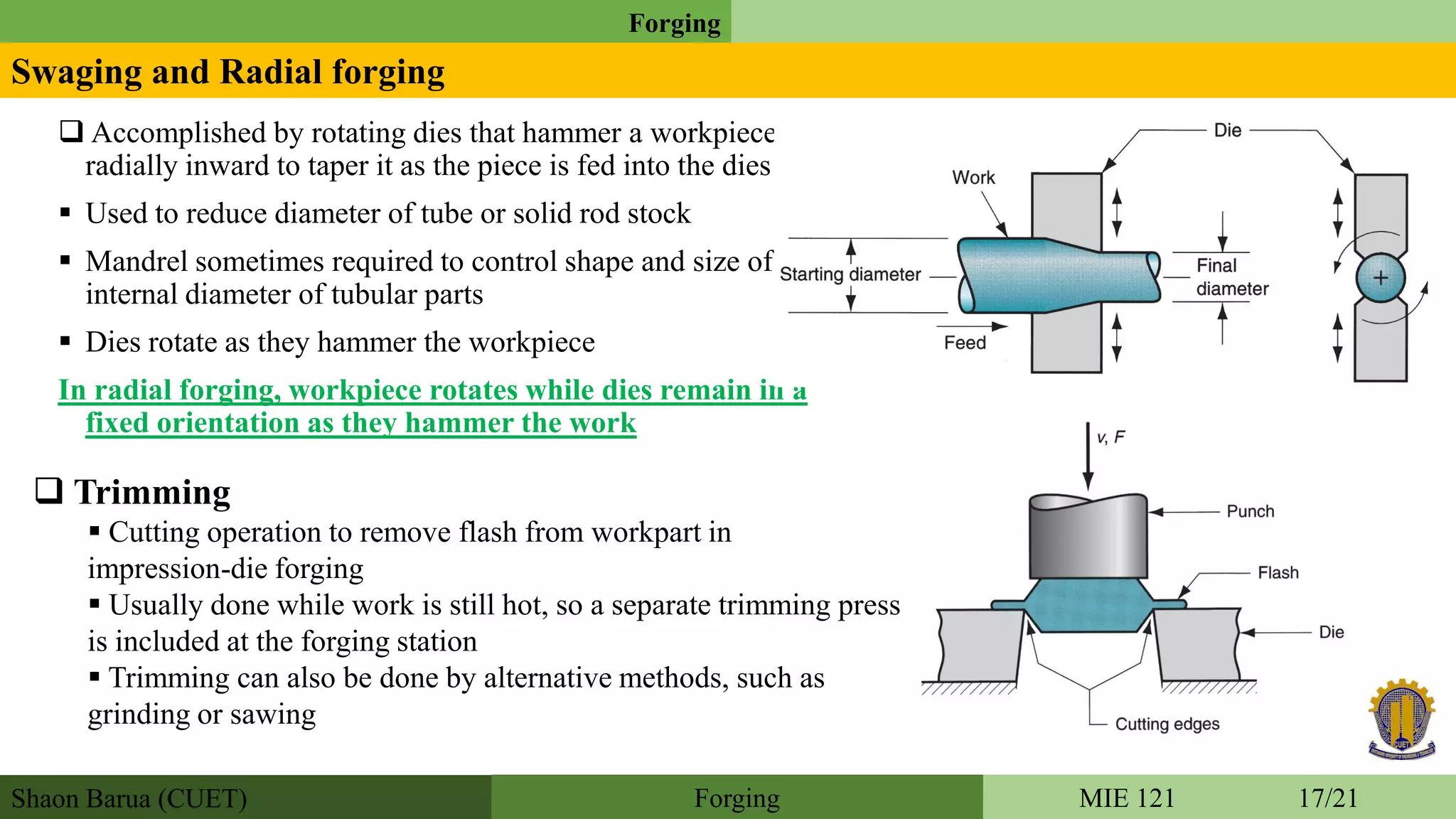
 Accomplished by rotating dies that hammer a workpiece
radially inward to taper it as the piece is fed into the dies
 Used to reduce diameter of tube or solid rod stock
 Mandrel sometimes required to control shape and size of
internal diameter of tubular parts
 Dies rotate as they hammer the workpiece
In radial forging, workpiece rotates while dies remain in a
fixed orientation as they hammer the work
 Trimming
 Cutting operation to remove flash from workpart in
impression-die forging
 Usually done while work is still hot, so a separate trimming press
is included at the forging station
 Trimming can also be done by alternative methods, such as
grinding or sawing
Shaon Barua (CUET)
Forging
MIE 121 18/21Forging
Related operations
Skew rolling
Swaging
Shaon Barua (CUET)
Forging
MIE 121 19/21Forging
Forging Defects
(A): Unfilled Section:
In this some section of the die cavity
are not completely filled by the flowing
metal. The causes of this defects are
improper design of the forging die or
using forging techniques.
(B): Cold Shut:
This appears as a small cracks at the
corners of the forging. This is caused
manely by the improper design of die.
Where in the corner and the fillet radie
are small as a result of which metal
does not flow properly into the corner
and the ends up as a cold shut.
(C): Scale Pits:
This is seen as irregular depurations on
the surface of the forging. This is
primarily caused because of improper
cleaning of the stock used for forging.
The oxide and scale gets embedded
into the finish forging surface. When
the forging is cleaned by pickling, these
are seen as depurations on the forging
surface.
(E): Flakes:
These are basically internal ruptures
caused by the improper cooling of the
large forging. Rapid cooling causes the
exterior to cool quickly causing internal
fractures. This can be remedied by
following proper cooling practices.
(F): Improper Grain Flow:
This is caused by the improper design of
the die, which makes the flow of the
metal not flowing the final interred
direction.
(D): Die Shift:
This is caused by the miss alignment of
the die halve, making the two halve of
the forging to be improper shape.
Shaon Barua (CUET)
Forging
MIE 121 20/21Forging
Related videos
1. Forging process animation [https://www.youtube.com/watch?v=aeSCjRaV9Og]
2. Basic forging[https://www.youtube.com/watch?v=FdEFptXI5zk]
3. Generator shaft forging[https://www.youtube.com/watch?v=KwNwN4eRQOA]
4. Open die forging[https://www.youtube.com/watch?v=QwKaKP53HDI]
5. Crankshaft production[https://www.youtube.com/watch?v=J2Y8q-1T4nQ]
6. Friction screw press[https://www.youtube.com/watch?v=a-IlvBmK2Bk]
7. Mechanical forging press[https://www.youtube.com/watch?v=ljRlDwoSNk0]
8. Drop forging hammer[https://www.youtube.com/watch?v=6022lxm0LdU]
Reference Book
1. Chapter 14 [Serope Kalpakjian and Steven R Schmid, Manufacturing Engineering and Technology ]
https://en.wikipedia.org/wiki/Forging]
Shaon Barua (CUET)
Forging
MIE 121 21/21Forging
You should be able to answer
Reference Book
1. Chapter 14 [Serope Kalpakjian and Steven R Schmid, Manufacturing Engineering and Technology ]
https://en.wikipedia.org/wiki/Forging]
 Coning operation, heading, swaging, cogging operation
 Different aspects of open-die forging and impression die forging
 Defects of forging
 Steel ball preparation

Forging process

  • 1.
    Forging Process Shaon Barua Lecturer shaon@cuet.ac.bd Departmentof Mechatronics & Industrial Engineering Chittagong University of Engineering & technology (CUET) MIE 121: Production Process Shaon Barua (CUET) Production Process Forging MIE 131 1/21Forging
  • 2.
    Shaon Barua (CUET) ForgingIntroduction MIE 121 2/21Forging Parts made by forging process
  • 3.
    Shaon Barua (CUET) ForgingIntroduction MIE 121 3/21Forging Forging operation Forging
  • 4.
    Shaon Barua (CUET) Forging MIE121 4/21Forging Outline of Forging and Related Operations
  • 5.
    Shaon Barua (CUET) ForgingIntroduction MIE 121 5/21Forging Introduction  Deformation process in which work is compressed between two dies  Oldest of the metal forming operations  Dates from about 5000 BC  Products: engine crankshafts, connecting rods, gears, aircraft structural components, jet engine turbine parts  Also, basic metals industries use forging to establish basic shape of large parts that are subsequently machined to final geometry and size • Parts have good strength • High toughness • Forgings require additional heat treating Fig : A part made by three different procedures, showing grain flow (a) casting (b) machining (c) forging
  • 6.
    Shaon Barua (CUET) Forging MIE121 6/21Forging Classification of Forging Operations Cold vs. hot forging:  Hot or warm forging – advantage: reduction in strength and increase in ductility of work metal  Cold forging – advantage: increased strength due to strain hardening Impact vs. press forging:  Forge hammer - applies an impact force  Forge press - applies gradual force
  • 7.
    Shaon Barua (CUET) Forging MIE121 7/21Forging Types of Forging Operations  Open-die forging - work is compressed between two flat dies, allowing metal to flow laterally with minimum constraint  Impression-die forging - die contains cavity or impression that is imparted to workpart  Metal flow is constrained so that flash is created  Flashless forging - workpart is completely constrained in die  No excess flash is created Figure: (a) Open-die forging, (b) impression-die forging, and (c) flashless forging
  • 8.
    Shaon Barua (CUET) Forging MIE121 8/21Forging Open Die Forging  Compression of workpart between two flat dies  Similar to compression test when workpart has cylindrical cross section and is compressed along its axis  Deformation operation reduces height and increases diameter of work  Common names include upsetting or upset forging Open-Die Forging Figure: (1) Start of process with workpiece at its original length and diameter, (2) partial compression, and (3) final size Advantages Simple, inexpensive dies; wide range of sizes; good strength Limitations Simple shapes only; difficult to hold close tolerances; machining necessary; low production rate; poor utilization of material; high skill required
  • 9.
    Shaon Barua (CUET) Forging MIE121 9/21Forging Impression-Die Forging  Compression of workpart by dies with inverse of desired part shape  Flash is formed by metal that flows beyond die cavity into small gap between die plates  Flash must be later trimmed, but it serves an important function during compression:  As flash forms, friction resists continued metal flow into gap, constraining metal to fill die cavity  In hot forging, metal flow is further restricted by cooling against die plates Figure: (1) Just prior to initial contact with raw workpiece, (2) partial compression, and (3) final die closure, causing flash to form in gap between die plates
  • 10.
    Shaon Barua (CUET) Forging MIE121 10/21Forging Impression-Die Forging  Several forming steps are often required • With separate die cavities for each step • Beginning steps redistribute metal for more uniform deformation and desired metallurgical structure in subsequent steps • Final steps bring the part to final geometry  Impression-die forging is often performed manually by skilled worker under adverse conditions  Advantages compared to machining from solid stock: • Higher production rates • Less waste of metal • Greater strength • Favorable grain orientation in the metal Limitations: • Not capable of close tolerances • Machining is often required to achieve accuracies and features needed
  • 11.
    Shaon Barua (CUET) Forging MIE121 11/21Forging Flashless Forging  Compression of work in punch and die tooling whose cavity does not allow for flash  Starting work volume must equal die cavity volume within very close tolerance  Process control more demanding than impression-die forging  Best suited to part geometries that are simple and symmetrical  Often classified as a precision forging process Figure: (1) Just before contact with workpiece, (2) partial compression, and (3) final punch and die closure
  • 12.
    Shaon Barua (CUET) Forging MIE121 12/21Forging Forging operation in the industry Crankshaft making process Connecting rod forging Coin minting operation  Used for minting coins, medallions, & jewelry  Lubricants can not be used in coining  Can be used to improve surface finish
  • 13.
    Shaon Barua (CUET) Forging MIE121 13/21Forging Forging Machines Apply impact load against workpart: Two types: • Gravity drop hammers - impact energy from falling weight of a heavy ram • Power drop hammers - accelerate the ram by pressurized air or steam  Disadvantage: impact energy transmitted through anvil into floor of building • Commonly used for impression-die forging Figure: Drop forging hammer, fed by conveyor and heating units at the right of the scene (photo courtesy of Chambersburg Engineering Company).
  • 14.
    Shaon Barua (CUET) Forging MIE121 14/21Forging Forging Presses ©2010 John Wiley & Sons, Inc. M P Groover, Fundamentals of Modern Manufacturing 4/e • Apply gradual pressure to accomplish compression operation • Types: • Hydraulic press - hydraulic piston actuates ram • Mechanical press - converts rotation of drive motor into linear motion of ram • Screw press - screw mechanism drives ram
  • 15.
    Shaon Barua (CUET) Forging MIE121 15/21Forging Upsetting and Heading Forging process used to form heads on nails, bolts, and similar hardware products  More parts produced by upsetting than any other forging operation  Performed cold, warm, or hot on machines called headers or formers  Wire or bar stock is fed into machine, end is headed, then piece is cut to length  For bolts and screws, thread rolling is then used to form threads Figure: Upset forging to form a head on a bolt or similar hardware item: (1) wire stock is fed to stop, (2) gripping dies close on stock and stop retracts, (3) punch moves forward, (4) bottoms to form the head Bolt manufacturing
  • 16.
    Shaon Barua (CUET) Forging MIE121 16/21Forging Upsetting and Heading Forging process used to form heads on nails, bolts, and similar hardware products  More parts produced by upsetting than any other forging operation  Performed cold, warm, or hot on machines called headers or formers  Wire or bar stock is fed into machine, end is headed, then piece is cut to length  For bolts and screws, thread rolling is then used to form threads Figure: Examples of heading operations: (a) heading a nail using open dies, (b) round head formed by punch, (c) and (d) two common head styles for screws formed by die, (e) carriage bolt head formed by punch and die
  • 17.
    Shaon Barua (CUET) Forging MIE121 17/21Forging Swaging and Radial forging  Accomplished by rotating dies that hammer a workpiece radially inward to taper it as the piece is fed into the dies  Used to reduce diameter of tube or solid rod stock  Mandrel sometimes required to control shape and size of internal diameter of tubular parts  Dies rotate as they hammer the workpiece In radial forging, workpiece rotates while dies remain in a fixed orientation as they hammer the work  Trimming  Cutting operation to remove flash from workpart in impression-die forging  Usually done while work is still hot, so a separate trimming press is included at the forging station  Trimming can also be done by alternative methods, such as grinding or sawing
  • 18.
    Shaon Barua (CUET) Forging MIE121 18/21Forging Related operations Skew rolling Swaging
  • 19.
    Shaon Barua (CUET) Forging MIE121 19/21Forging Forging Defects (A): Unfilled Section: In this some section of the die cavity are not completely filled by the flowing metal. The causes of this defects are improper design of the forging die or using forging techniques. (B): Cold Shut: This appears as a small cracks at the corners of the forging. This is caused manely by the improper design of die. Where in the corner and the fillet radie are small as a result of which metal does not flow properly into the corner and the ends up as a cold shut. (C): Scale Pits: This is seen as irregular depurations on the surface of the forging. This is primarily caused because of improper cleaning of the stock used for forging. The oxide and scale gets embedded into the finish forging surface. When the forging is cleaned by pickling, these are seen as depurations on the forging surface. (E): Flakes: These are basically internal ruptures caused by the improper cooling of the large forging. Rapid cooling causes the exterior to cool quickly causing internal fractures. This can be remedied by following proper cooling practices. (F): Improper Grain Flow: This is caused by the improper design of the die, which makes the flow of the metal not flowing the final interred direction. (D): Die Shift: This is caused by the miss alignment of the die halve, making the two halve of the forging to be improper shape.
  • 20.
    Shaon Barua (CUET) Forging MIE121 20/21Forging Related videos 1. Forging process animation [https://www.youtube.com/watch?v=aeSCjRaV9Og] 2. Basic forging[https://www.youtube.com/watch?v=FdEFptXI5zk] 3. Generator shaft forging[https://www.youtube.com/watch?v=KwNwN4eRQOA] 4. Open die forging[https://www.youtube.com/watch?v=QwKaKP53HDI] 5. Crankshaft production[https://www.youtube.com/watch?v=J2Y8q-1T4nQ] 6. Friction screw press[https://www.youtube.com/watch?v=a-IlvBmK2Bk] 7. Mechanical forging press[https://www.youtube.com/watch?v=ljRlDwoSNk0] 8. Drop forging hammer[https://www.youtube.com/watch?v=6022lxm0LdU] Reference Book 1. Chapter 14 [Serope Kalpakjian and Steven R Schmid, Manufacturing Engineering and Technology ] https://en.wikipedia.org/wiki/Forging]
  • 21.
    Shaon Barua (CUET) Forging MIE121 21/21Forging You should be able to answer Reference Book 1. Chapter 14 [Serope Kalpakjian and Steven R Schmid, Manufacturing Engineering and Technology ] https://en.wikipedia.org/wiki/Forging]  Coning operation, heading, swaging, cogging operation  Different aspects of open-die forging and impression die forging  Defects of forging  Steel ball preparation