HOW MEDIA CONSUMPTION HAS CHANGED SINCE 2000 News is pervasive, portable, personalized, participatory – and a social experience Lee Rainie Director – Pew Internet Project Newhouse MOB conference – NYC 6.24.10
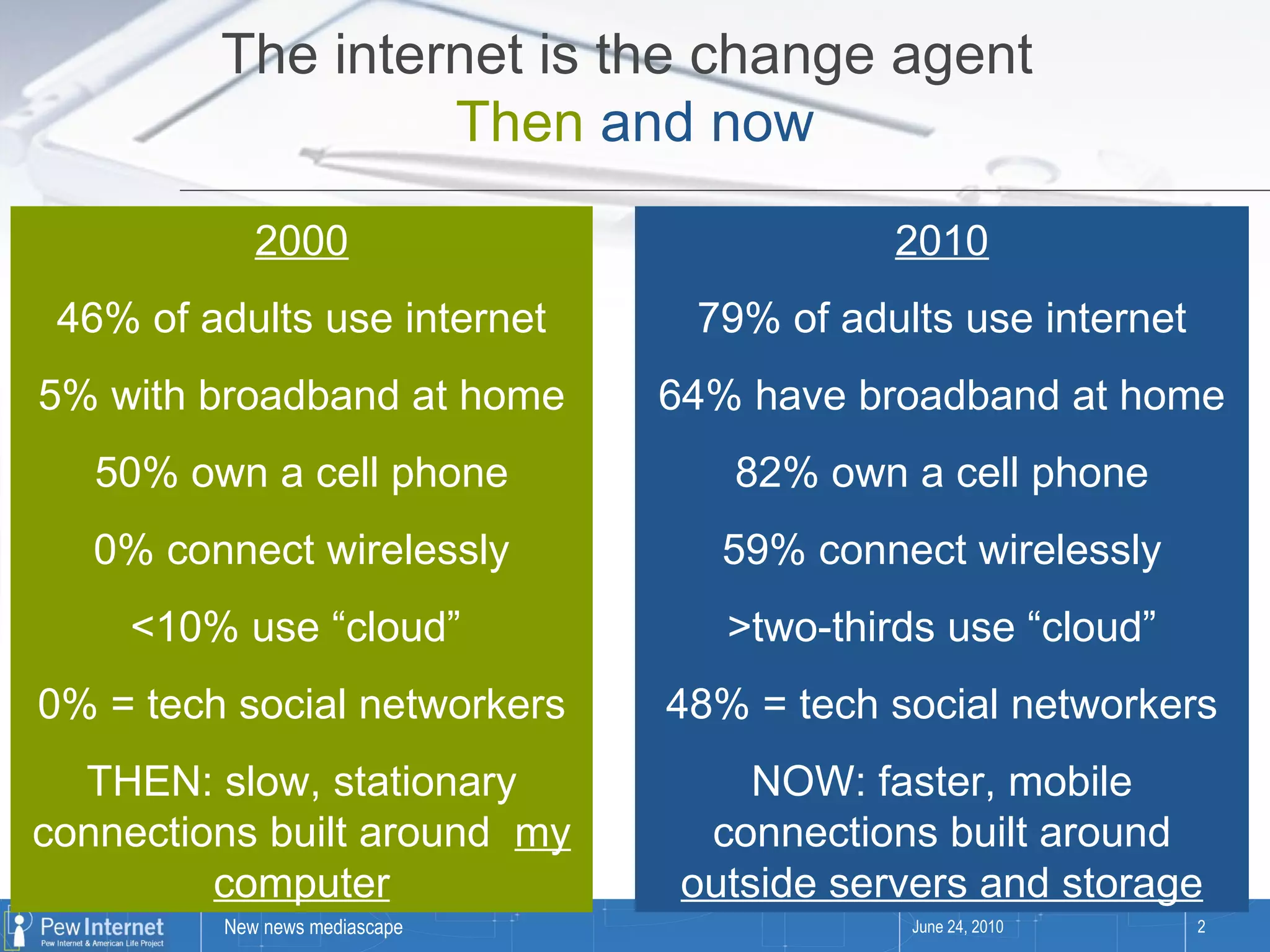
June 24, 2010 2000 46% of adults use internet 5% with broadband at home 50% own a cell phone 0% connect wirelessly <10% use “cloud”  0% = tech social networkers THEN: slow, stationary connections built around  my computer The internet is the change agent  Then   and now 2010 79% of adults use internet 64% have broadband at home 82% own a cell phone 59% connect wirelessly >two-thirds use “cloud” 48% = tech social networkers NOW: faster, mobile connections built around  outside servers and storage
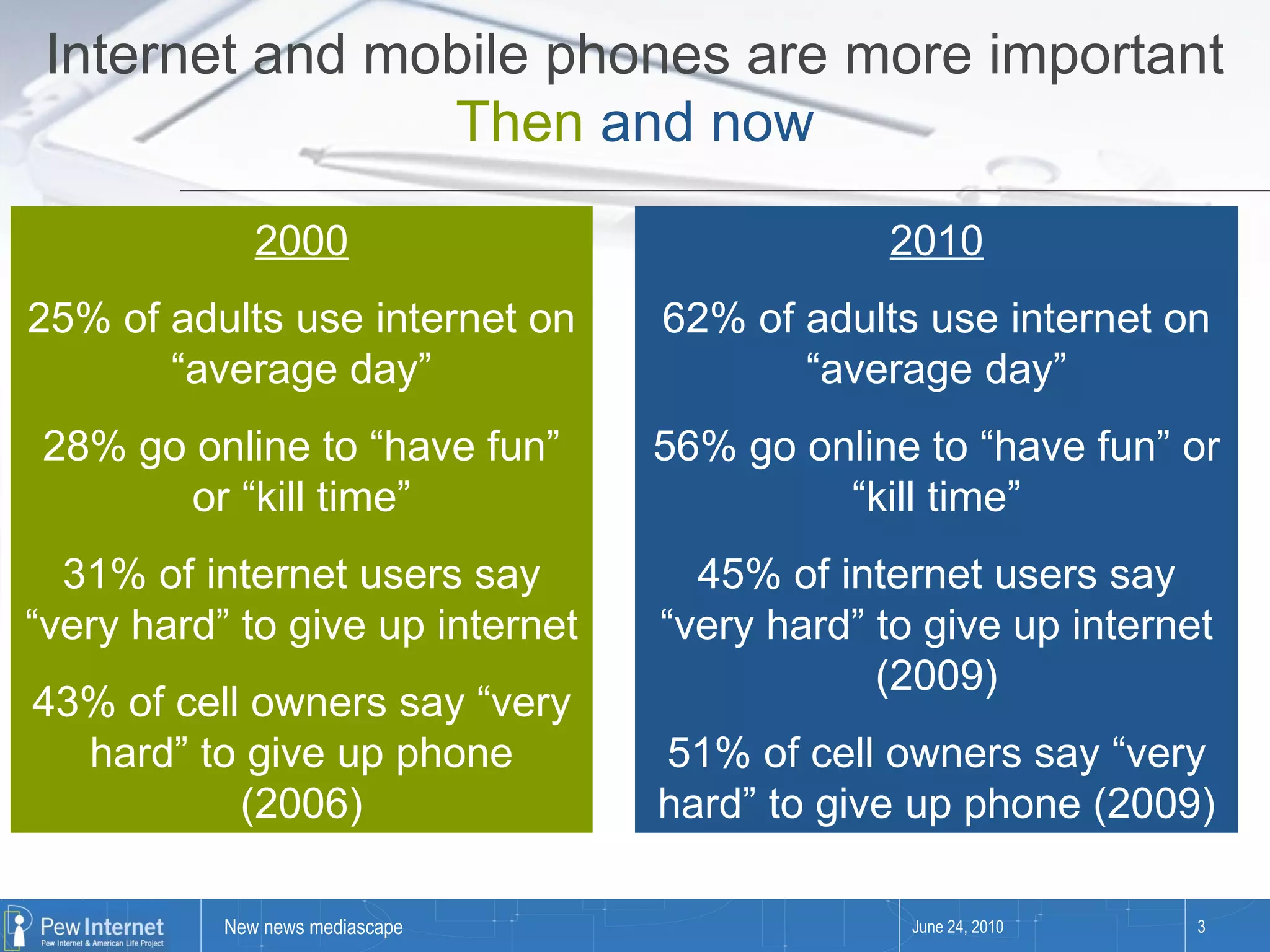
June 24, 2010 2000 25% of adults use internet on “average day” 28% go online to “have fun” or “kill time” 31% of internet users say “very hard” to give up internet  43% of cell owners say “very hard” to give up phone (2006) Internet and mobile phones are more important Then   and now 2010 62% of adults use internet on “average day” 56% go online to “have fun” or “kill time” 45% of internet users say “very hard” to give up internet (2009) 51% of cell owners say “very hard” to give up phone (2009)
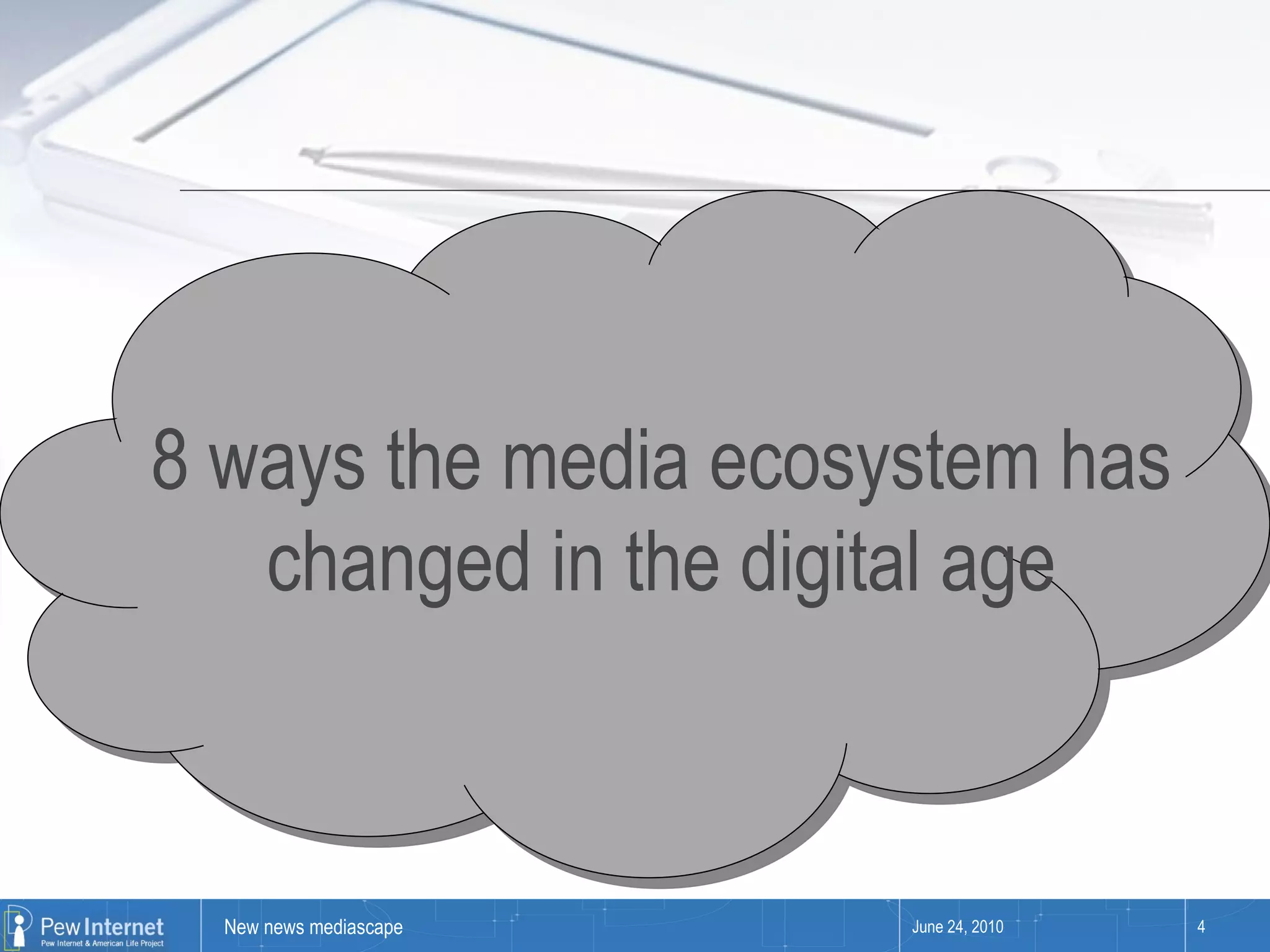
June 24, 2010 8 ways the media ecosystem has changed in the digital age
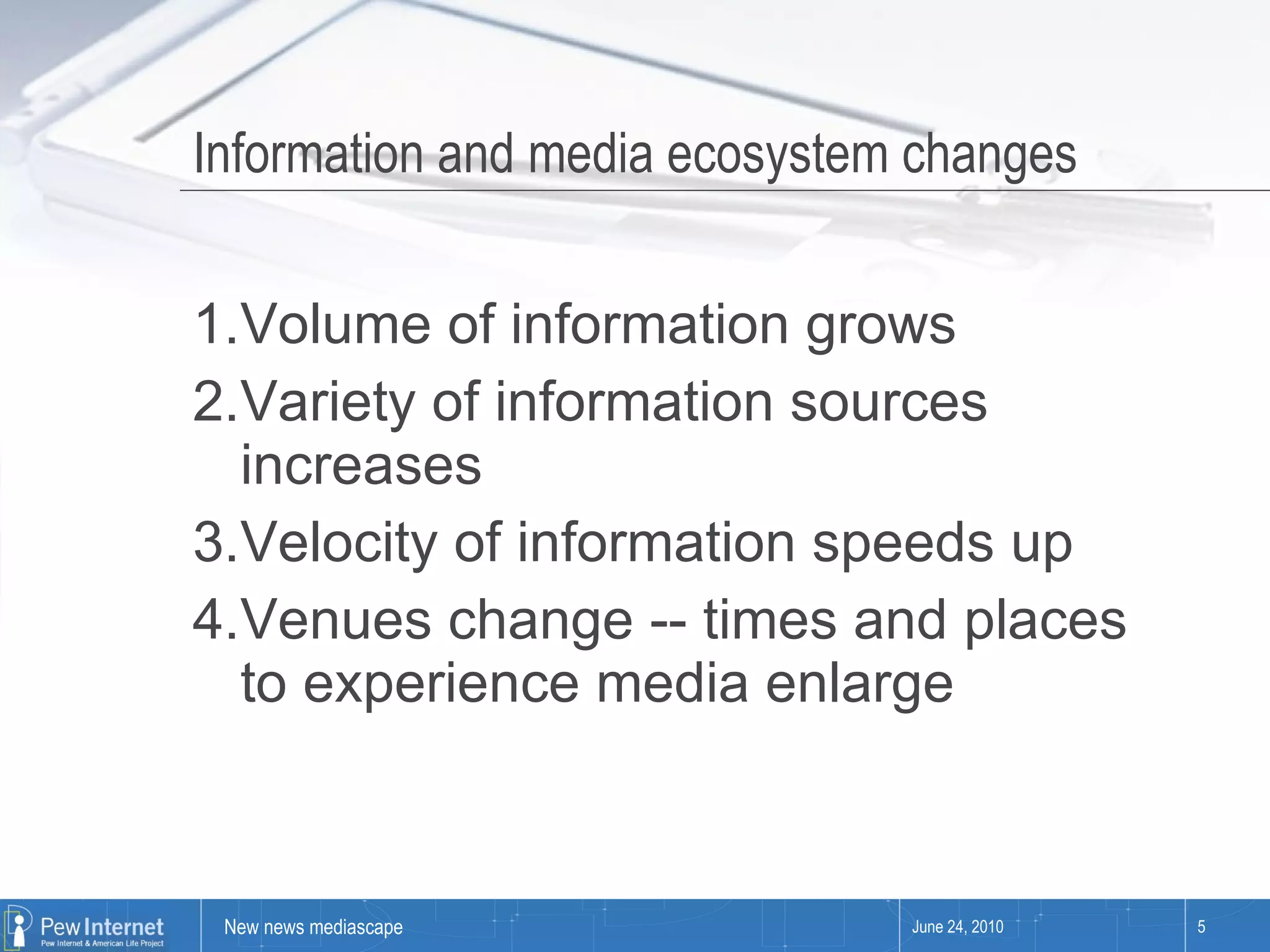
Information and media ecosystem changes  Volume of information grows Variety of information sources increases Velocity of information speeds up Venues change -- times and places to experience media enlarge June 24, 2010
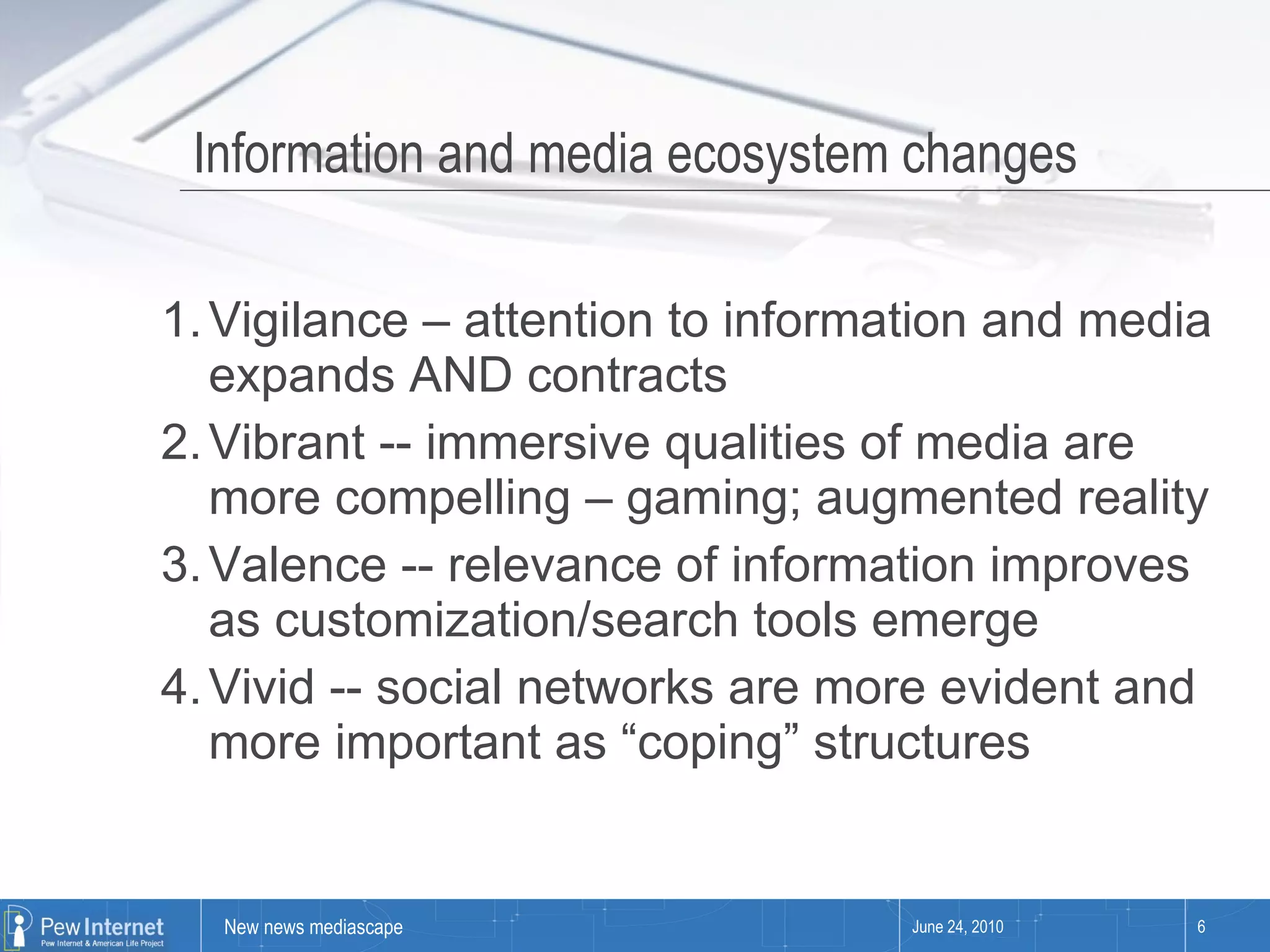
Information and media ecosystem changes Vigilance – attention to information and media expands AND contracts Vibrant -- immersive qualities of media are more compelling – gaming; augmented reality Valence -- relevance of information improves as customization/search tools emerge Vivid -- social networks are more evident and more important as “coping” structures June 24, 2010
June 24, 2010 How the news audience’s attitudes and behaviors have changed in this new media ecosystem
June 24, 2010 For the audience, news is pervasive
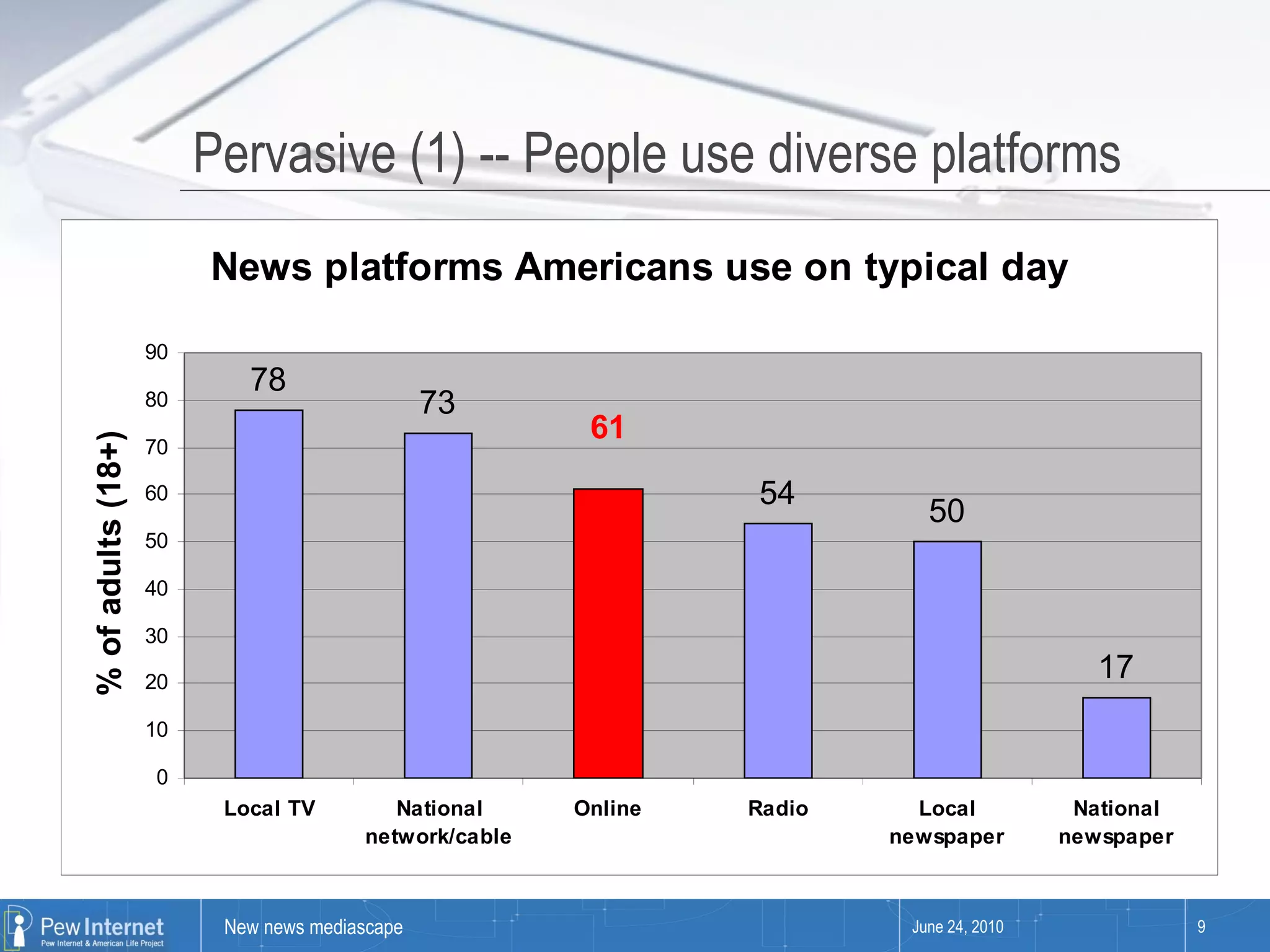
Pervasive (1) -- People use diverse platforms June 24, 2010
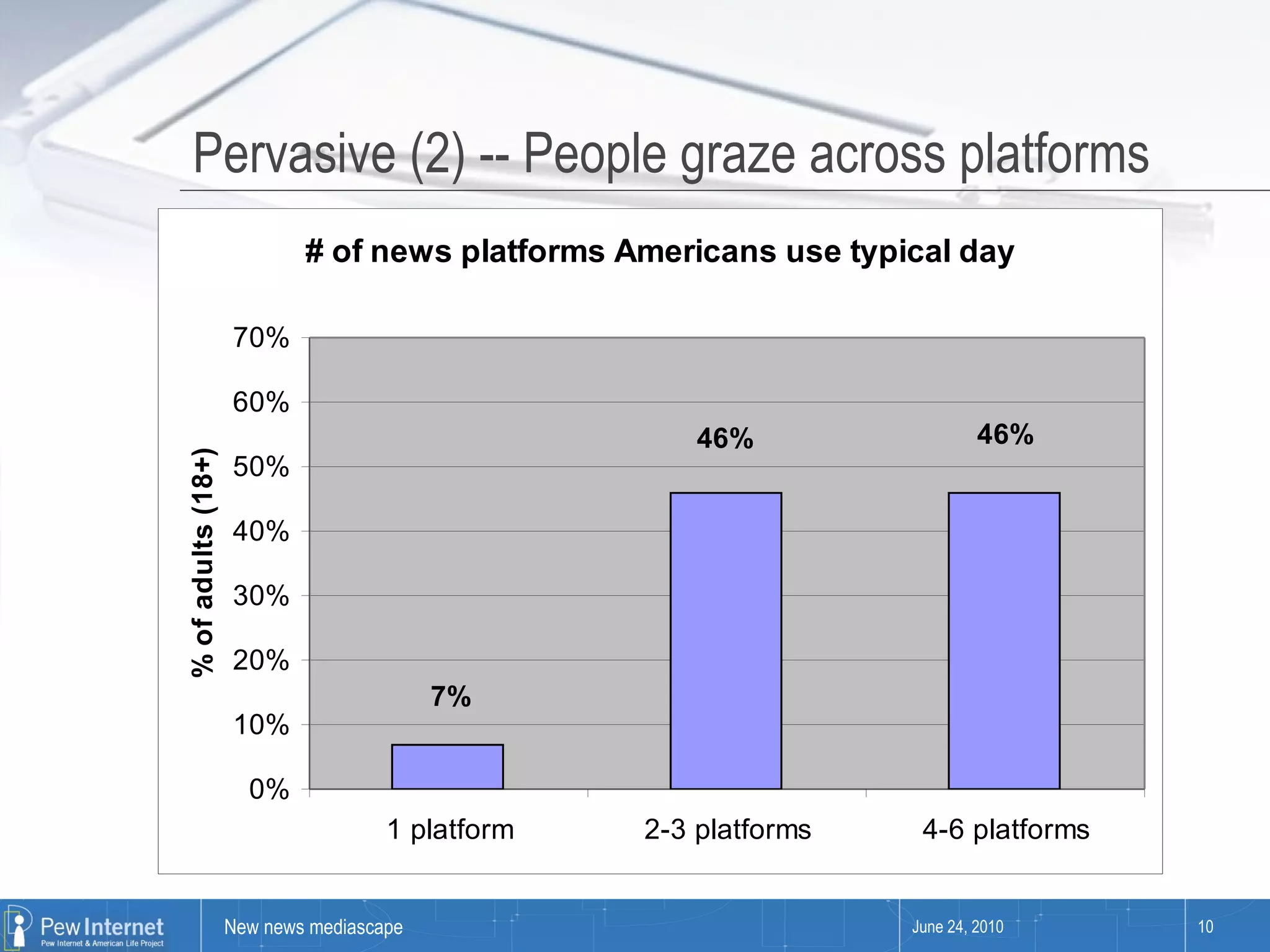
Pervasive (2) -- People graze across platforms  June 24, 2010
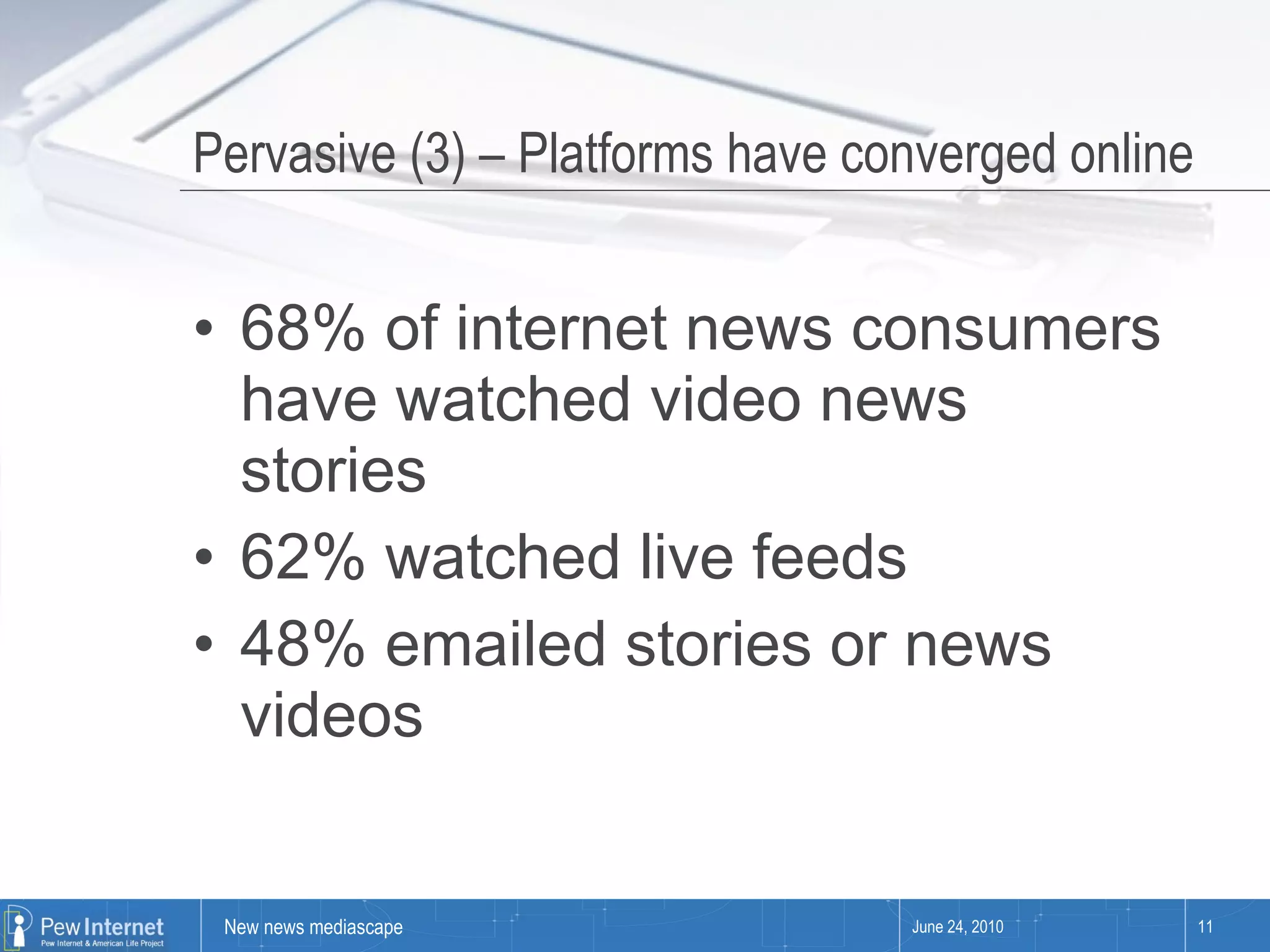
Pervasive (3) – Platforms have converged online  68% of internet news consumers have watched video news stories 62% watched live feeds 48% emailed stories or news videos June 24, 2010
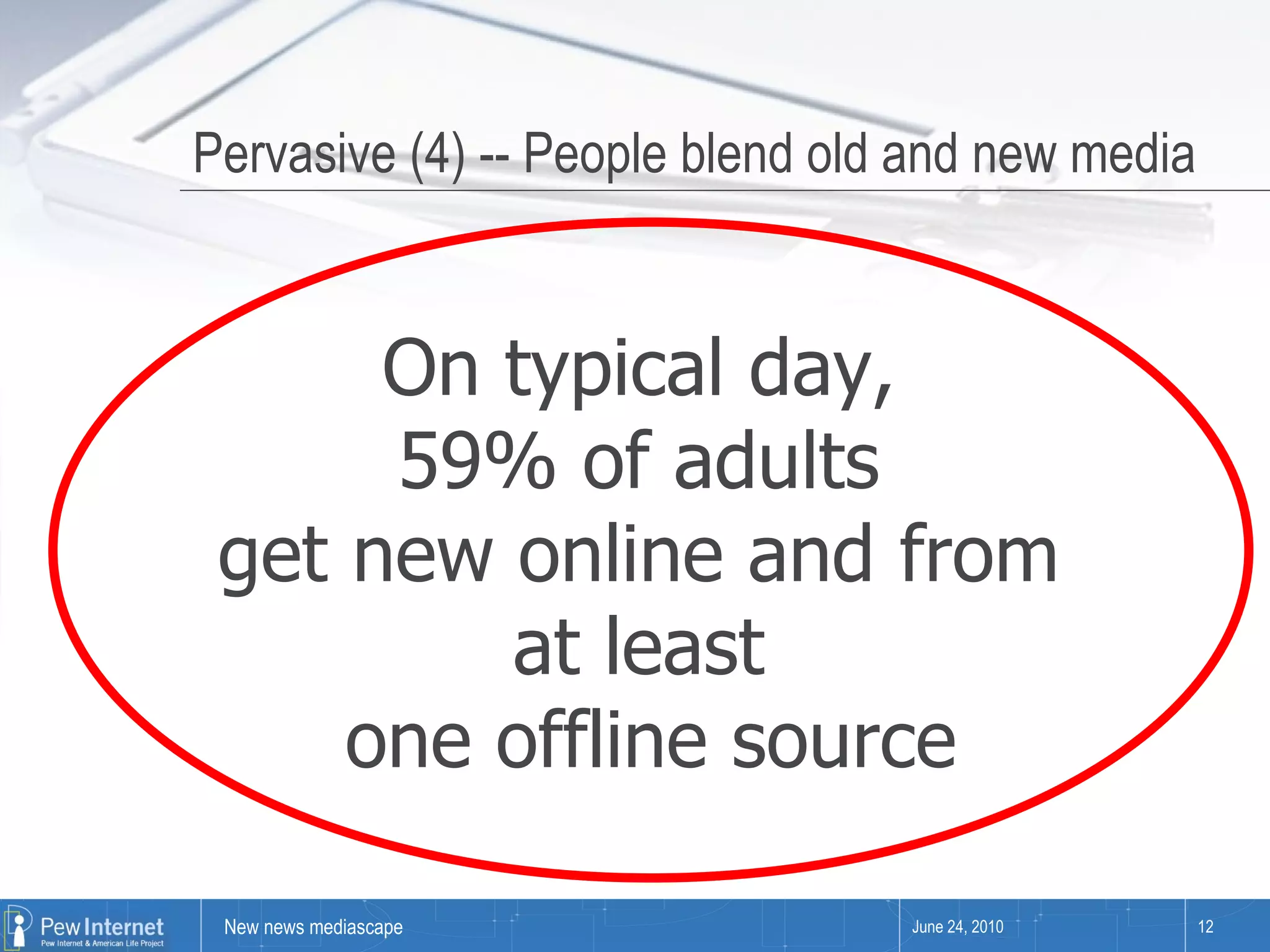
Pervasive (4) -- People blend old and new media June 24, 2010 On typical day,  59% of adults  get new online and from  at least  one offline source
June 24, 2010 For the audience, news is portable
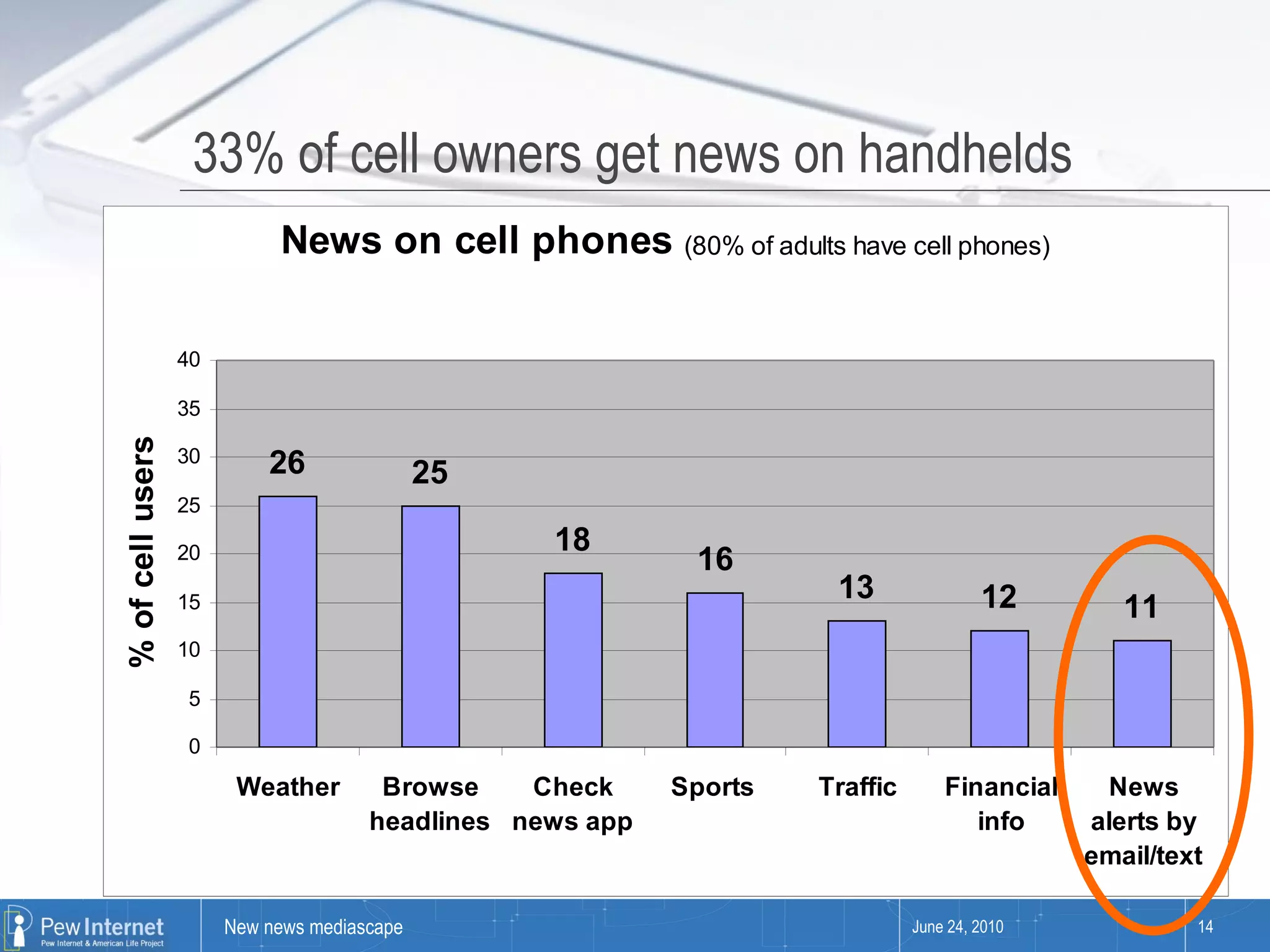
33% of cell owners get news on handhelds June 24, 2010
June 24, 2010 For the audience, news is personalized
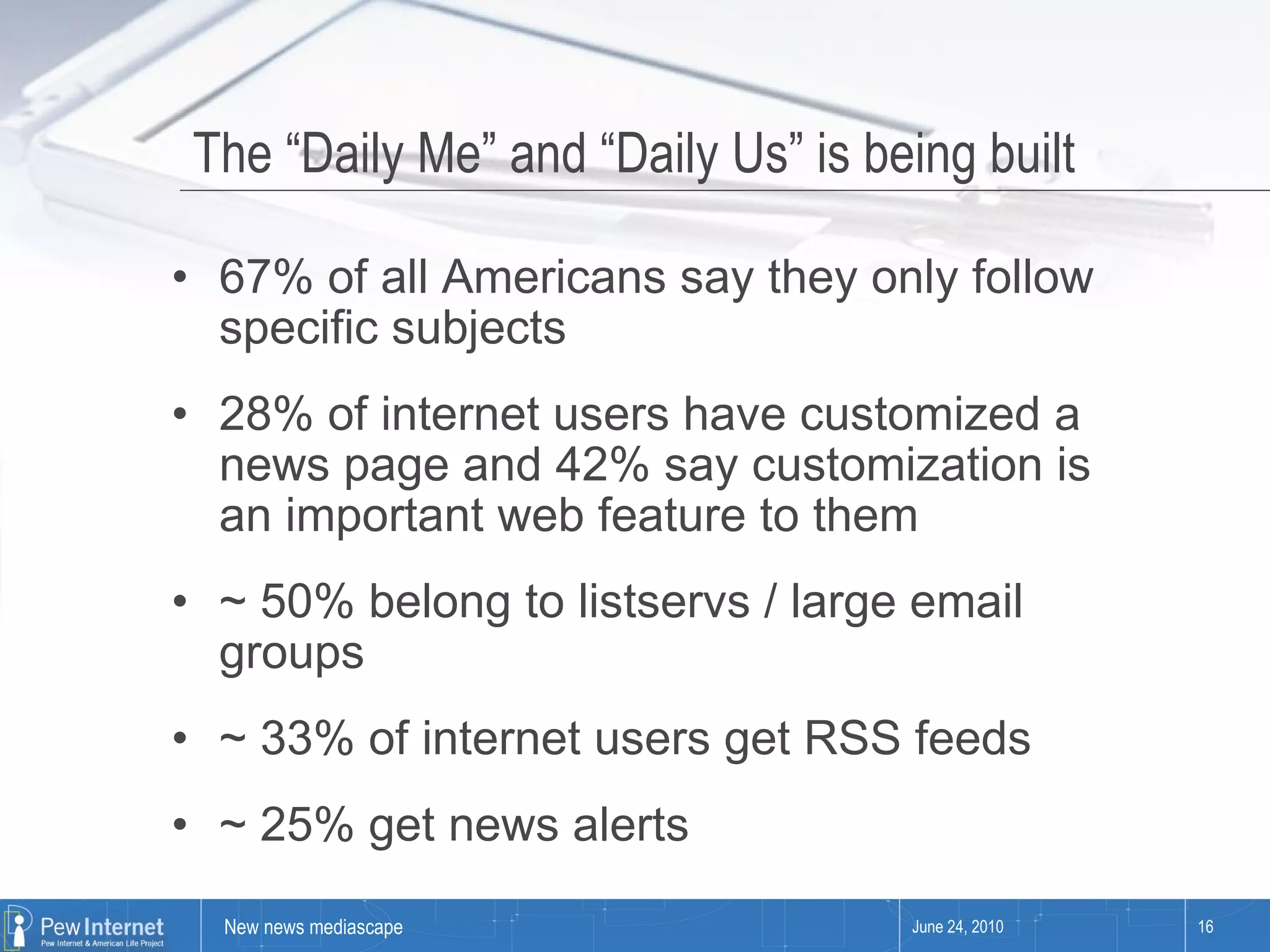
The “Daily Me” and “Daily Us” is being built  67% of all Americans say they only follow specific subjects 28% of internet users have customized a news page and 42% say customization is an important web feature to them ~ 50% belong to listservs / large email groups ~ 33% of internet users get RSS feeds ~ 25% get news alerts June 24, 2010
June 24, 2010 For the audience, news is participatory
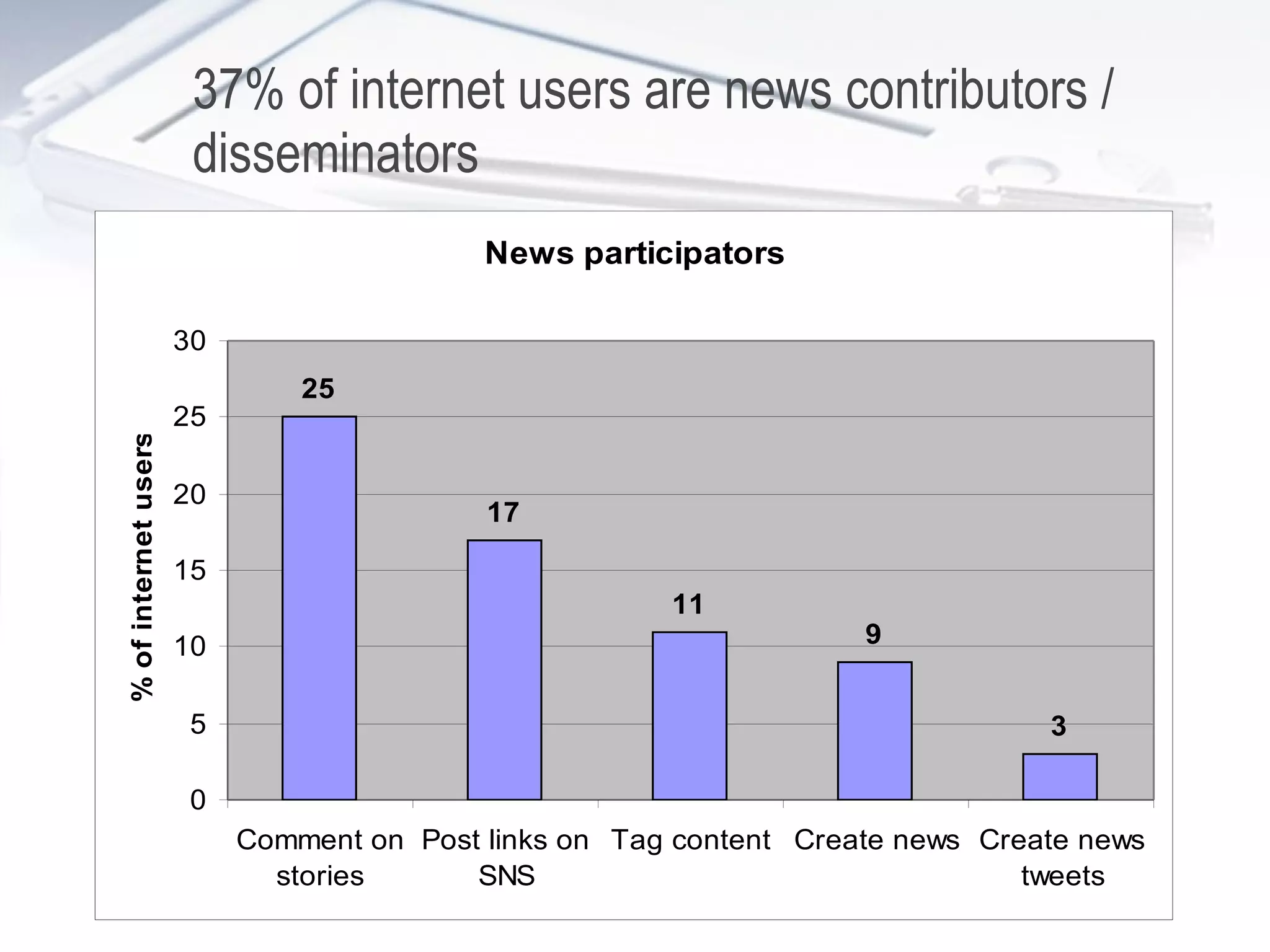
37% of internet users are news contributors / disseminators
June 24, 2010 For the audience, news is a social experience
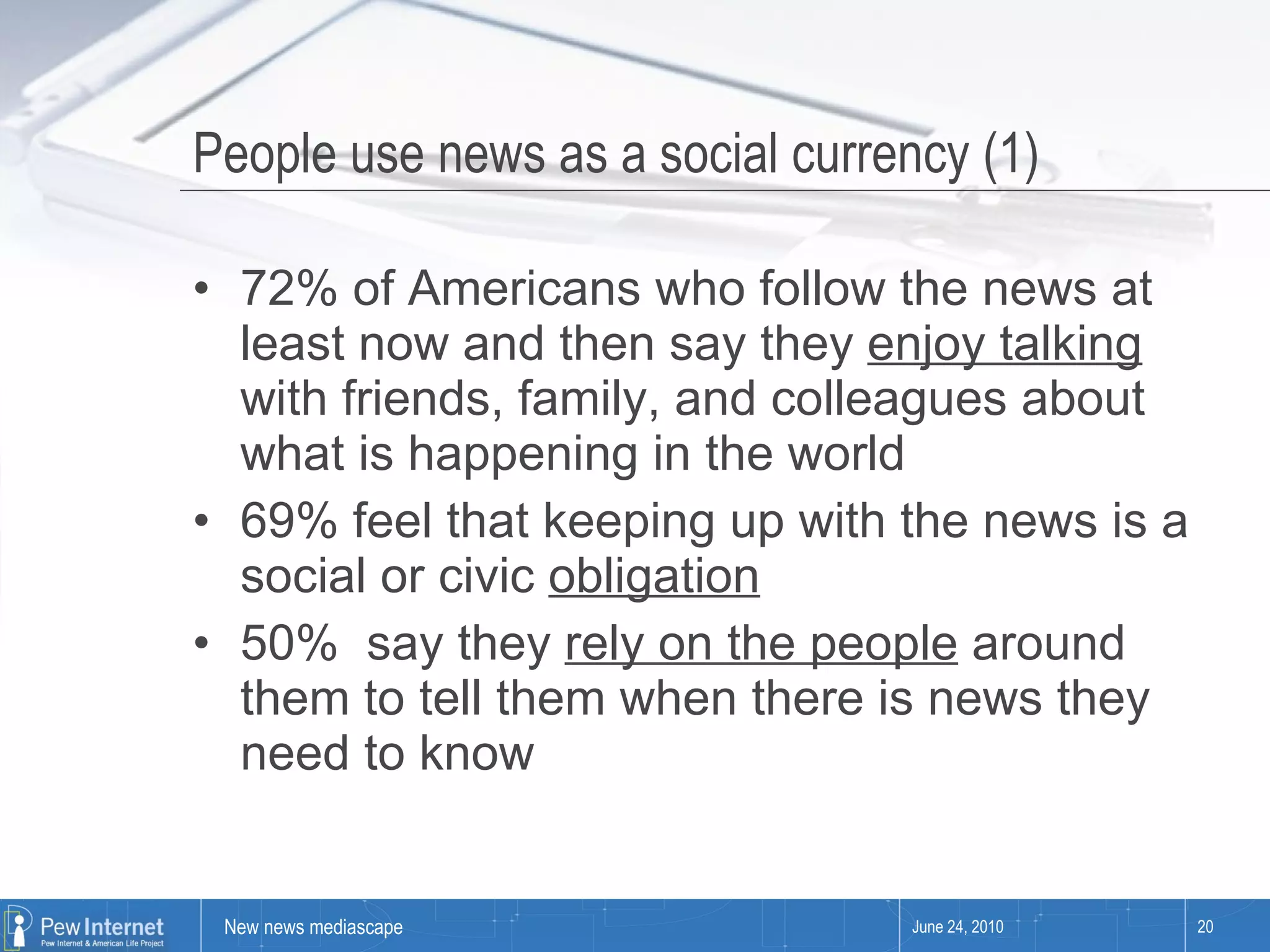
People use news as a social currency (1) 72% of Americans who follow the news at least now and then say they  enjoy talking  with friends, family, and colleagues about what is happening in the world  69% feel that keeping up with the news is a social or civic  obligation 50%  say they  rely on the people  around them to tell them when there is news they need to know June 24, 2010
People use news as a social currency (2) 57% of internet users  share links  to news stories 30% of internet users get news on typical day  through their SNS use 13%  follow  news organizations and journalists on SNS 6% get news via  Twitter  feeds June 24, 2010
People use news as a social currency (3) Serendipitous encounters with news still happen AND still matter 80% of online news consumers (57% of whole population) say they run across news several times a week while they are online for another purpose June 24, 2010
June 24, 2010 4 implications for and impacts on news operations
Implication 1 Social networks matter more as sentries, filters, curators, and distribution channels of news June 24, 2010
Implication 2 “ Consumers” are in charge of the news playlist … and they want to participate in the news-gathering and distribution process June 24, 2010
Implication 3: Paradoxes abound (1) More material – but less time with news More direct access to experts and more knowledge being generated – but not smarter at the societal level  More voices and more variety – but more traffic to big brands More participation and engagement – but less revenue June 24, 2010
Implication 3 – Paradoxes abound (2) More transparency of news creation process – but less trust of coverage More chance to customize, but less loyalty People say it is easier to keep up AND harder to navigate the clutter People are satisfied with MSM coverage of the issues that matter to them AND see more bias in coverage June 24, 2010
Implication 4 Much news is a commodity and consumers displaying a classic response: They don’t want to pay for something that is abundant June 24, 2010
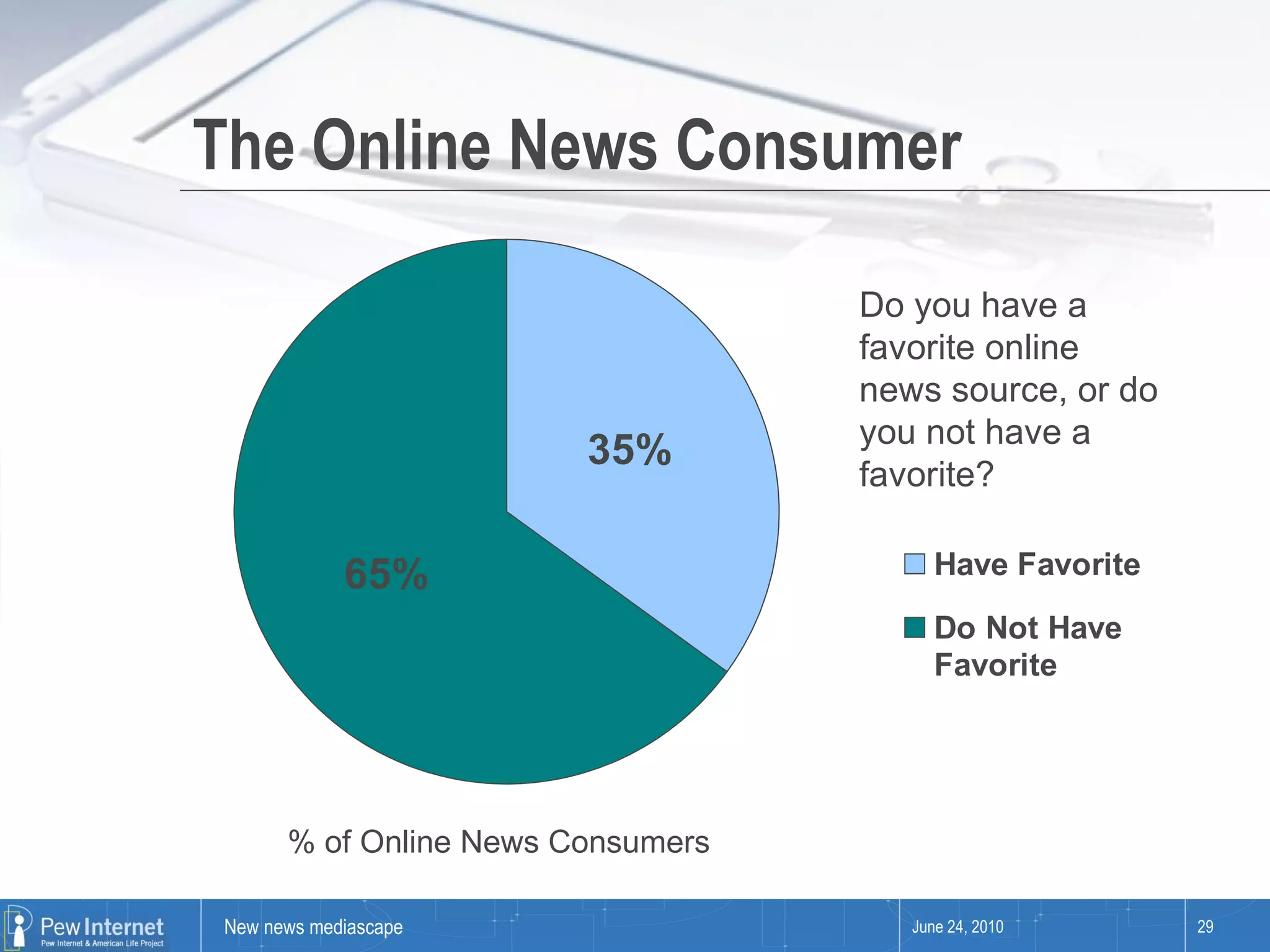
The Online News Consumer June 24, 2010 Do you have a favorite online news source, or do you not have a favorite? % of Online News Consumers
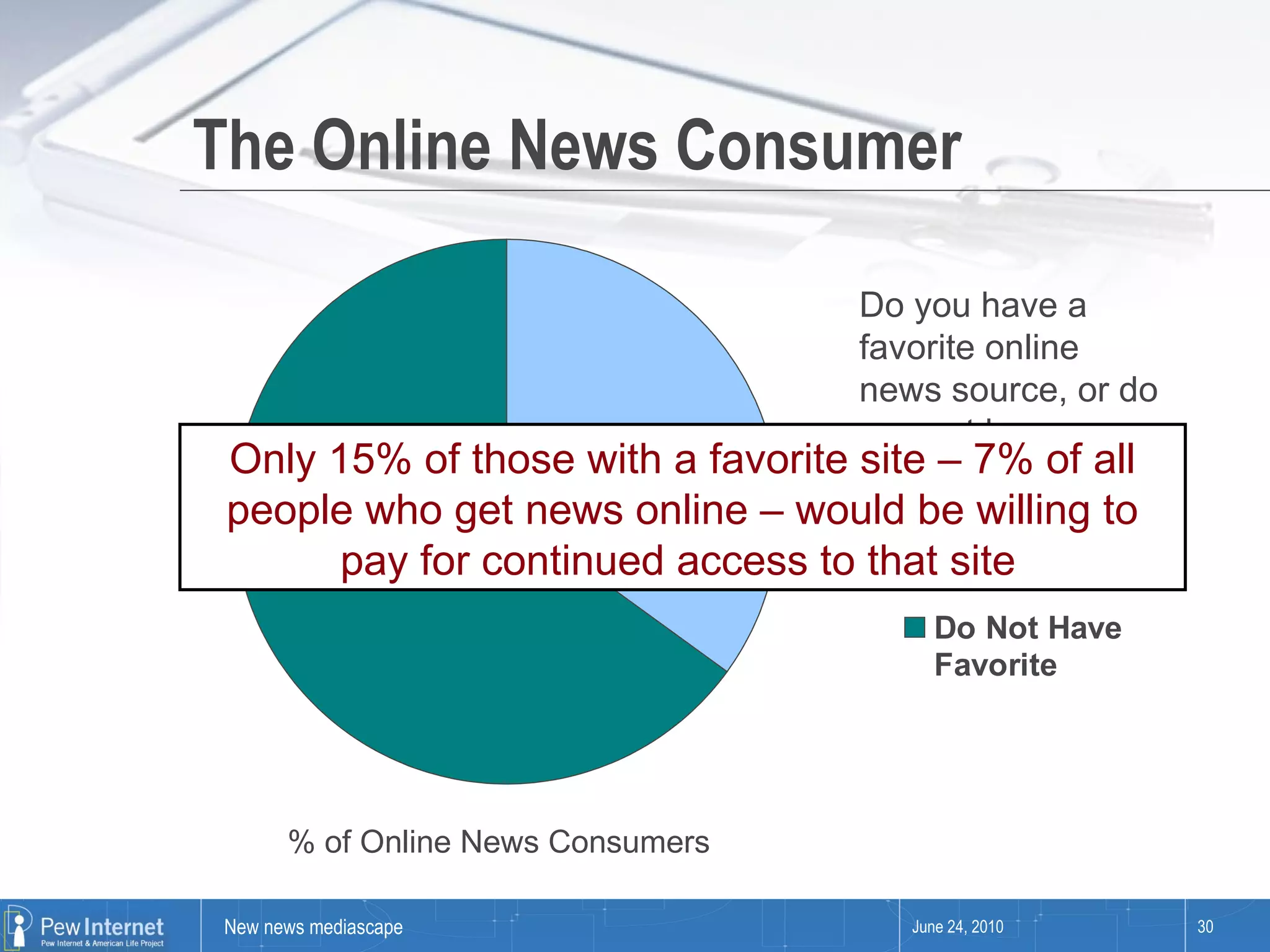
The Online News Consumer June 24, 2010 Do you have a favorite online news source, or do you not have a favorite? % of Online News Consumers  Only 15% of those with a favorite site – 7% of all people who get news online – would be willing to pay for continued access to that site
Implication 5 News organizations have to figure out where they can add value in the news chain June 24, 2010
June 24, 2010 2 models to help you organize your thinking about your place in the value chain
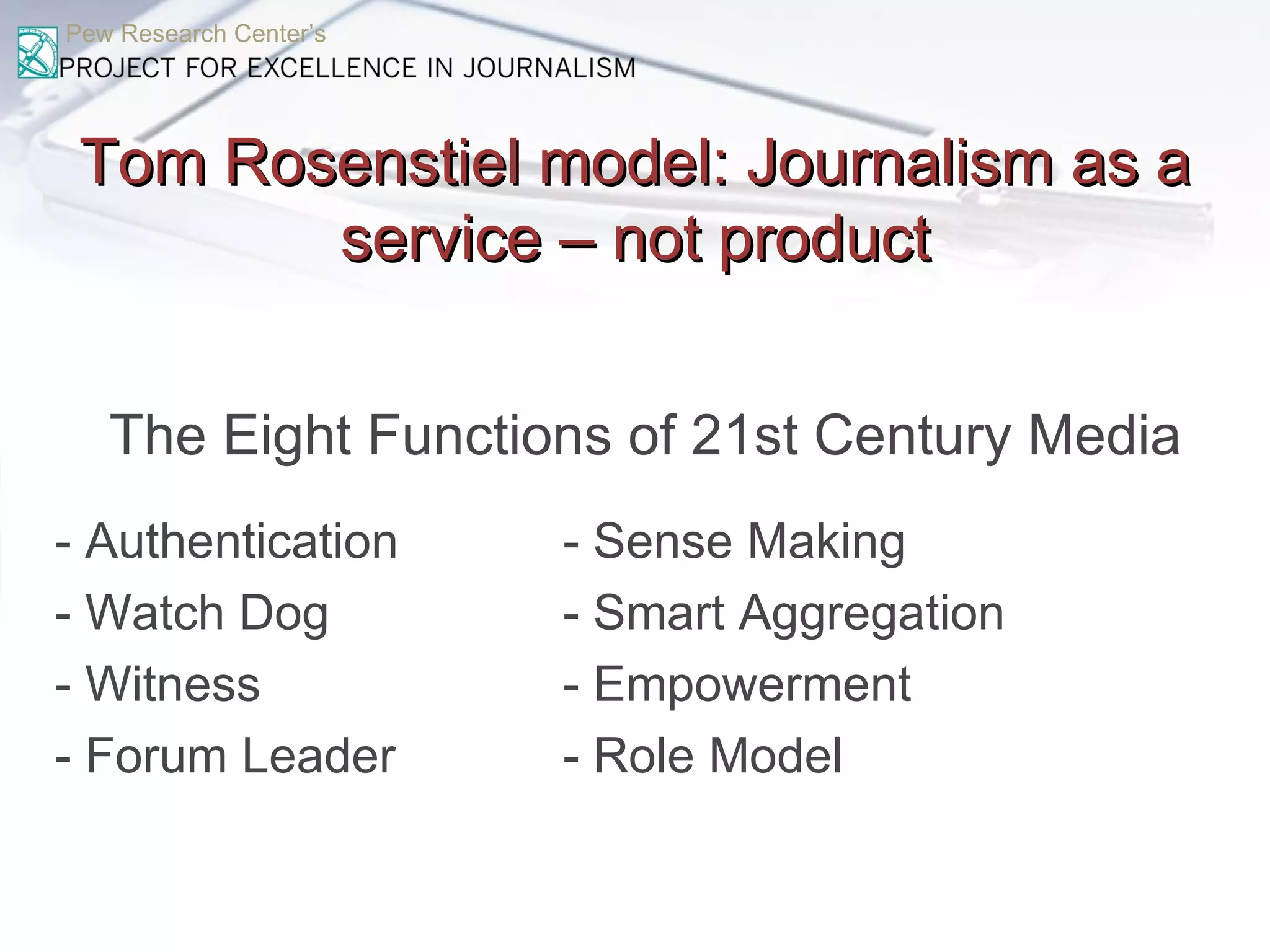
Pew Research Center’s Tom Rosenstiel model: Journalism as a service – not product The Eight Functions of 21st Century Media - Authentication  - Sense Making - Watch Dog - Smart Aggregation - Witness  - Empowerment - Forum Leader  - Role Model
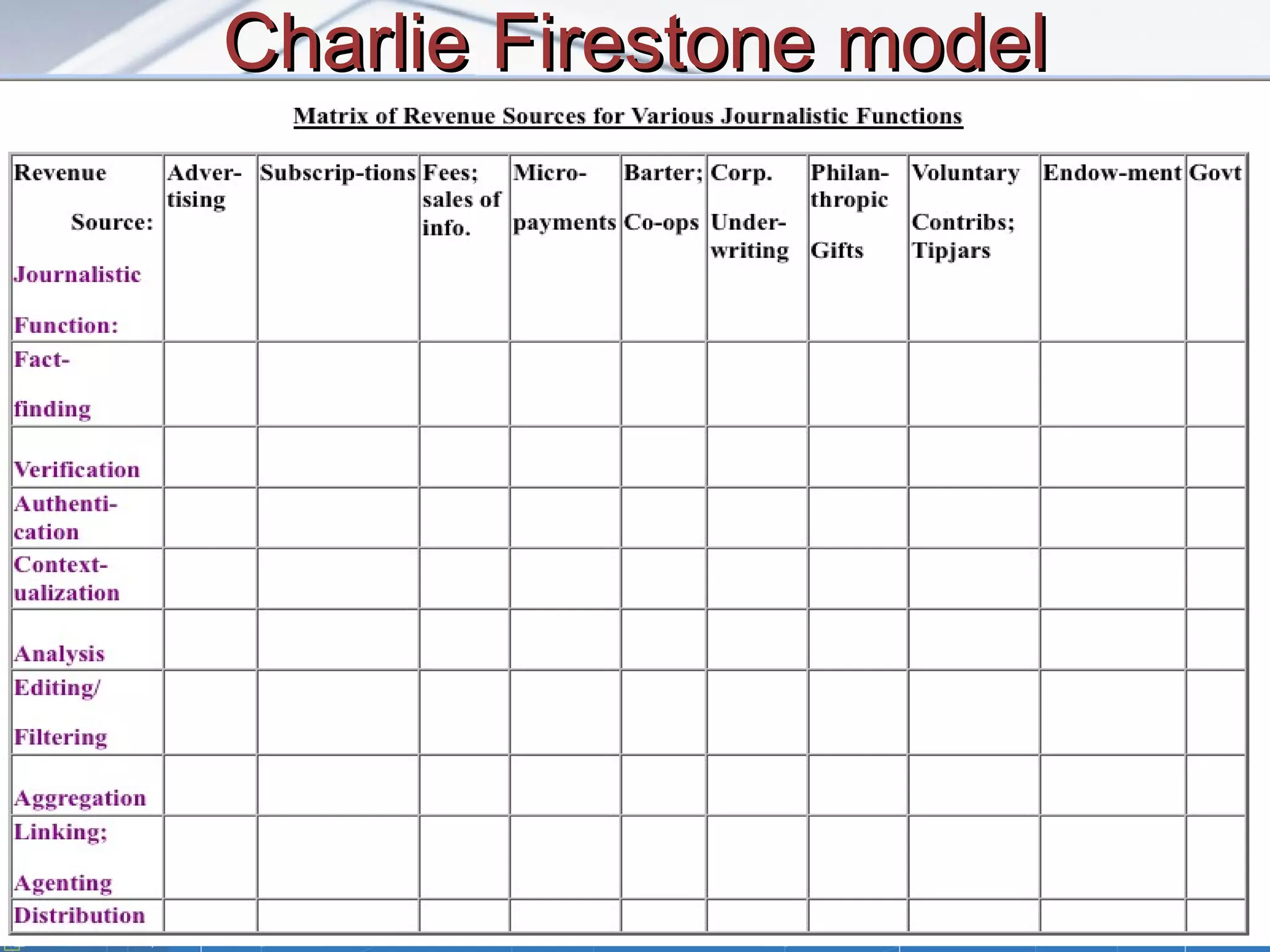
June 24, 2010 Charlie Firestone model
Thank you! Lee Rainie Director Pew Internet & American Life Project 1615 L Street NW Suite 700 Washington, DC 20036 Email:  [email_address] Twitter:  http://twitter.com/lrainie   202-419-4500 June 24, 2010

How Media Consumption Has Changed Since 2000

  • 1.
    HOW MEDIA CONSUMPTIONHAS CHANGED SINCE 2000 News is pervasive, portable, personalized, participatory – and a social experience Lee Rainie Director – Pew Internet Project Newhouse MOB conference – NYC 6.24.10
  • 2.
    June 24, 20102000 46% of adults use internet 5% with broadband at home 50% own a cell phone 0% connect wirelessly <10% use “cloud” 0% = tech social networkers THEN: slow, stationary connections built around my computer The internet is the change agent Then and now 2010 79% of adults use internet 64% have broadband at home 82% own a cell phone 59% connect wirelessly >two-thirds use “cloud” 48% = tech social networkers NOW: faster, mobile connections built around outside servers and storage
  • 3.
    June 24, 20102000 25% of adults use internet on “average day” 28% go online to “have fun” or “kill time” 31% of internet users say “very hard” to give up internet 43% of cell owners say “very hard” to give up phone (2006) Internet and mobile phones are more important Then and now 2010 62% of adults use internet on “average day” 56% go online to “have fun” or “kill time” 45% of internet users say “very hard” to give up internet (2009) 51% of cell owners say “very hard” to give up phone (2009)
  • 4.
    June 24, 20108 ways the media ecosystem has changed in the digital age
  • 5.
    Information and mediaecosystem changes Volume of information grows Variety of information sources increases Velocity of information speeds up Venues change -- times and places to experience media enlarge June 24, 2010
  • 6.
    Information and mediaecosystem changes Vigilance – attention to information and media expands AND contracts Vibrant -- immersive qualities of media are more compelling – gaming; augmented reality Valence -- relevance of information improves as customization/search tools emerge Vivid -- social networks are more evident and more important as “coping” structures June 24, 2010
  • 7.
    June 24, 2010How the news audience’s attitudes and behaviors have changed in this new media ecosystem
  • 8.
    June 24, 2010For the audience, news is pervasive
  • 9.
    Pervasive (1) --People use diverse platforms June 24, 2010
  • 10.
    Pervasive (2) --People graze across platforms June 24, 2010
  • 11.
    Pervasive (3) –Platforms have converged online 68% of internet news consumers have watched video news stories 62% watched live feeds 48% emailed stories or news videos June 24, 2010
  • 12.
    Pervasive (4) --People blend old and new media June 24, 2010 On typical day, 59% of adults get new online and from at least one offline source
  • 13.
    June 24, 2010For the audience, news is portable
  • 14.
    33% of cellowners get news on handhelds June 24, 2010
  • 15.
    June 24, 2010For the audience, news is personalized
  • 16.
    The “Daily Me”and “Daily Us” is being built 67% of all Americans say they only follow specific subjects 28% of internet users have customized a news page and 42% say customization is an important web feature to them ~ 50% belong to listservs / large email groups ~ 33% of internet users get RSS feeds ~ 25% get news alerts June 24, 2010
  • 17.
    June 24, 2010For the audience, news is participatory
  • 18.
    37% of internetusers are news contributors / disseminators
  • 19.
    June 24, 2010For the audience, news is a social experience
  • 20.
    People use newsas a social currency (1) 72% of Americans who follow the news at least now and then say they enjoy talking with friends, family, and colleagues about what is happening in the world 69% feel that keeping up with the news is a social or civic obligation 50% say they rely on the people around them to tell them when there is news they need to know June 24, 2010
  • 21.
    People use newsas a social currency (2) 57% of internet users share links to news stories 30% of internet users get news on typical day through their SNS use 13% follow news organizations and journalists on SNS 6% get news via Twitter feeds June 24, 2010
  • 22.
    People use newsas a social currency (3) Serendipitous encounters with news still happen AND still matter 80% of online news consumers (57% of whole population) say they run across news several times a week while they are online for another purpose June 24, 2010
  • 23.
    June 24, 20104 implications for and impacts on news operations
  • 24.
    Implication 1 Socialnetworks matter more as sentries, filters, curators, and distribution channels of news June 24, 2010
  • 25.
    Implication 2 “Consumers” are in charge of the news playlist … and they want to participate in the news-gathering and distribution process June 24, 2010
  • 26.
    Implication 3: Paradoxesabound (1) More material – but less time with news More direct access to experts and more knowledge being generated – but not smarter at the societal level More voices and more variety – but more traffic to big brands More participation and engagement – but less revenue June 24, 2010
  • 27.
    Implication 3 –Paradoxes abound (2) More transparency of news creation process – but less trust of coverage More chance to customize, but less loyalty People say it is easier to keep up AND harder to navigate the clutter People are satisfied with MSM coverage of the issues that matter to them AND see more bias in coverage June 24, 2010
  • 28.
    Implication 4 Muchnews is a commodity and consumers displaying a classic response: They don’t want to pay for something that is abundant June 24, 2010
  • 29.
    The Online NewsConsumer June 24, 2010 Do you have a favorite online news source, or do you not have a favorite? % of Online News Consumers
  • 30.
    The Online NewsConsumer June 24, 2010 Do you have a favorite online news source, or do you not have a favorite? % of Online News Consumers Only 15% of those with a favorite site – 7% of all people who get news online – would be willing to pay for continued access to that site
  • 31.
    Implication 5 Newsorganizations have to figure out where they can add value in the news chain June 24, 2010
  • 32.
    June 24, 20102 models to help you organize your thinking about your place in the value chain
  • 33.
    Pew Research Center’sTom Rosenstiel model: Journalism as a service – not product The Eight Functions of 21st Century Media - Authentication - Sense Making - Watch Dog - Smart Aggregation - Witness - Empowerment - Forum Leader - Role Model
  • 34.
    June 24, 2010Charlie Firestone model
  • 35.
    Thank you! LeeRainie Director Pew Internet & American Life Project 1615 L Street NW Suite 700 Washington, DC 20036 Email: [email_address] Twitter: http://twitter.com/lrainie 202-419-4500 June 24, 2010

Editor's Notes

  • #2 10:15   How Media Consumption Has Changed Since 2000 Consumption of news, information and entertainment has radically changed, and not just online. Lee Rainie, director of the Pew Internet &amp; American Life Project, presents the latest data and trends.
  • #6 expand
  • #7 expand